EP0259873A2 - Elektronisches Brett insbesondere Planungsbrett - Google Patents
Elektronisches Brett insbesondere Planungsbrett Download PDFInfo
- Publication number
- EP0259873A2 EP0259873A2 EP87113237A EP87113237A EP0259873A2 EP 0259873 A2 EP0259873 A2 EP 0259873A2 EP 87113237 A EP87113237 A EP 87113237A EP 87113237 A EP87113237 A EP 87113237A EP 0259873 A2 EP0259873 A2 EP 0259873A2
- Authority
- EP
- European Patent Office
- Prior art keywords
- board
- circuit
- marking elements
- marking
- board according
- Prior art date
- Legal status (The legal status is an assumption and is not a legal conclusion. Google has not performed a legal analysis and makes no representation as to the accuracy of the status listed.)
- Withdrawn
Links
- 230000008878 coupling Effects 0.000 claims abstract description 25
- 238000010168 coupling process Methods 0.000 claims abstract description 25
- 238000005859 coupling reaction Methods 0.000 claims abstract description 25
- 230000005540 biological transmission Effects 0.000 claims description 3
- 230000000295 complement effect Effects 0.000 claims 2
- 230000000875 corresponding effect Effects 0.000 claims 1
- 230000000007 visual effect Effects 0.000 abstract description 5
- 238000012800 visualization Methods 0.000 abstract description 2
- 238000006243 chemical reaction Methods 0.000 abstract 1
- 239000004020 conductor Substances 0.000 description 13
- 238000000034 method Methods 0.000 description 11
- 239000011159 matrix material Substances 0.000 description 9
- 239000000306 component Substances 0.000 description 7
- 230000008569 process Effects 0.000 description 6
- 238000012545 processing Methods 0.000 description 4
- 230000008901 benefit Effects 0.000 description 3
- 239000011449 brick Substances 0.000 description 3
- 230000008859 change Effects 0.000 description 3
- 238000001514 detection method Methods 0.000 description 3
- 230000000694 effects Effects 0.000 description 2
- 239000004973 liquid crystal related substance Substances 0.000 description 2
- 238000004519 manufacturing process Methods 0.000 description 2
- 230000000063 preceeding effect Effects 0.000 description 2
- 238000012546 transfer Methods 0.000 description 2
- 238000004378 air conditioning Methods 0.000 description 1
- 238000004364 calculation method Methods 0.000 description 1
- 238000004891 communication Methods 0.000 description 1
- 238000013461 design Methods 0.000 description 1
- 238000010586 diagram Methods 0.000 description 1
- 239000012777 electrically insulating material Substances 0.000 description 1
- 239000002184 metal Substances 0.000 description 1
- 239000000203 mixture Substances 0.000 description 1
- 239000004033 plastic Substances 0.000 description 1
- 229920003023 plastic Polymers 0.000 description 1
- 238000004080 punching Methods 0.000 description 1
- 230000004044 response Effects 0.000 description 1
- 238000004088 simulation Methods 0.000 description 1
- 239000000725 suspension Substances 0.000 description 1
- 230000001960 triggered effect Effects 0.000 description 1
Images






Classifications
-
- G—PHYSICS
- G09—EDUCATION; CRYPTOGRAPHY; DISPLAY; ADVERTISING; SEALS
- G09B—EDUCATIONAL OR DEMONSTRATION APPLIANCES; APPLIANCES FOR TEACHING, OR COMMUNICATING WITH, THE BLIND, DEAF OR MUTE; MODELS; PLANETARIA; GLOBES; MAPS; DIAGRAMS
- G09B25/00—Models for purposes not provided for in G09B23/00, e.g. full-sized devices for demonstration purposes
- G09B25/02—Models for purposes not provided for in G09B23/00, e.g. full-sized devices for demonstration purposes of industrial processes; of machinery
-
- G—PHYSICS
- G09—EDUCATION; CRYPTOGRAPHY; DISPLAY; ADVERTISING; SEALS
- G09B—EDUCATIONAL OR DEMONSTRATION APPLIANCES; APPLIANCES FOR TEACHING, OR COMMUNICATING WITH, THE BLIND, DEAF OR MUTE; MODELS; PLANETARIA; GLOBES; MAPS; DIAGRAMS
- G09B15/00—Teaching music
- G09B15/02—Boards or like means for providing an indication of notes
- G09B15/023—Electrically operated
-
- G—PHYSICS
- G09—EDUCATION; CRYPTOGRAPHY; DISPLAY; ADVERTISING; SEALS
- G09B—EDUCATIONAL OR DEMONSTRATION APPLIANCES; APPLIANCES FOR TEACHING, OR COMMUNICATING WITH, THE BLIND, DEAF OR MUTE; MODELS; PLANETARIA; GLOBES; MAPS; DIAGRAMS
- G09B29/00—Maps; Plans; Charts; Diagrams, e.g. route diagram
- G09B29/001—Planning boards
Definitions
- the invention concerns an electronic board, e.g. a planning board, comprising a plurality of different marking elements adapted to be positioned on the board and comprising electric components which can be detected by detecting means, placed in the board, via cooperating contact areas on the board and the marking elements, respectively.
- a planning board comprising a plurality of different marking elements adapted to be positioned on the board and comprising electric components which can be detected by detecting means, placed in the board, via cooperating contact areas on the board and the marking elements, respectively.
- the invention concerns a board of a type which is related to a chess game known from the German Offenlegungsschrift 2 348 016.
- This prior art comprises Hall elements which are placed within each of the matrix points of the board so that a distinction may be made between a small number of different forms of bricks which are dissimilarly magnetised.
- the drawbacks of this prior art are high manufacturing price, that the bricks are to be positioned very carefully and that magnetic respect distances are to be considered.
- the invention is also related to the chess game known from the US Patent Specification 4 391 447, in which a plurality of electric connections may be established between a brick and a circuit associated with each field, each arranged in accordance with the rules of the chess game and connected to circuits associated with all the fields.
- the usefulness of this art is limited to the relatively small number of fields in a chess game.
- the object of the invention is to provide an electronic board which permits a distinction to be made between a very large number of marking elements, and the position of these to be determined very rapidly among a very large number (several orders greater than in the said chess games) of possible positions.
- This creates a basis for a completely new tool for planning purposes, the electronic board providing for visualization of data information in the form of spatial position of the marking elements on the board as well as in the form of individual marking of the elements, and so that visual information of the latter nature can rapidly be converted into data information signals.
- the board is constructed as stated in the characterizing portion of claim 1, so that the marking elements may be relatively small and be placed in a very large number of different positions on the board and comprise almost arbitrarily many different identification codes.
- a high scanning rate for the detection of the many possible positions on the board is achieved in combination with said X-Y circuit.
- the electrically conducting contact areas are preferably constructed in connection with mechanical coupling studs, where, depending upon the size of the coupling stud, one or more mutually insulated contact areas per coupling stud may be provided.
- Planning boards having the mechanical structure stated in claim 2 are known, but when it has so far been unknown to provide such a board with the electric means mentioned in claim 1, the reason is probably that skilled persons would consider it expensive to produce partly the board with the many incorporated electric conductors and partly the marking elements at a sufficiently low price. It will later be explained briefly how these problems can be solved, and reference is also made to the Danish Patent Applications Nos. 4369/86 and 4370/86, which describe in more detail a technique for producing the electric conductors in the board and identification circuit for the marking element, respectively.
- the marking elements can also comprise the means defined in claim 3, which may e.g. be a liquid crystal display.
- a user can change the meaning of a marking element, which can be provided for by means of the features defined in claim 4, which can typically represent an on/off function, e.g. in the form of a switch on the marking element or an electric plug for connecting the marking element to a remote control.
- a marking element which can be provided for by means of the features defined in claim 4, which can typically represent an on/off function, e.g. in the form of a switch on the marking element or an electric plug for connecting the marking element to a remote control.
- certain marking elements are greater than a smallest base element, and it is therefore advantageous that the identification code comprises information on the size of the marking element, as stated in claim 5, so that the X and Y circuits can in advance skip the matrix points which are covered by a larger marking element.
- the board is composed of a plurality of adjacent board units, as stated in claim 6, which results in a more flexible system while allowing for the mutual thermal movement of insulating plastics and electrically conducting metal.
- the board can advantageously be preprinted as stated in claim 7, and for quite special purposes it may be expedient to use the sheet mentioned in claim 8.
- Claim 9 defines details of the preferred electric means in connection with the board, so that the position and identification of the marking elements may be determined by scanning all the matrix points of the board.
- the board control circuit is constructed as interface circuits for a data processing system.
- the features defined in claim 10 offer the advantage that in the subsequent scanning process it is sufficient to identify such marking elements as have changed position with respect to the earlier scanning, it being presupposed that the presence of a marking element in a position occupied by the preceding scanning cycle involves unchanged identification code. It will be appreciated that the latter feature cannot be utilized in connection with a marking element of the type defined in claim 4 or in connection with coupling of several marking elements on top of each other, as will be explained later.
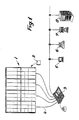
- Fig. 1 shows a board 1 on which a plurality of marking elements 2 may be placed in a plurality of different positions.
- a circuit 3 can detect partly the position and partly the type of the identification elements, cf. the mentioned German Offenlegungsschrift and US Patent Specification.
- the board of the invention provides a significant increase in the number of different positions and different types of marking elements, so that large information amounts can be exchanged via the lines 4.
- Fig. 2 shows an embodiment of a board unit 9, the division of the board 1 shown in fig. 1 indicating that the board may consist of eight units of the type shown in fig. 2.
- Each board unit comprises a front plate 10 provided with a modular pattern of coupling studs 15, a so-called flexprint 11, a rear plate 12 and a plate 13 for suspension of the board and for reception of a control circuit in the cavity indicated at 14.
- the plates 10-12 are arranged and assembled as appears from figs. 3 and 4.
- the plate 10 has a plurality of coupling studs disposed with a mutual modular distance and adapted to be received in a cavity in the underside of a marking element (fig. 5).
- the coupling studs 15 are hollow and are open downwardly and laterally via a cut 16 extending in the full height of the coupling stud and over a fraction of its arc length.
- the underside of the plate 10 is provided with a plurality of guide pins 17 adapted to be received in guide holes 18 in the plate 12.
- the guide pins 17 are slightly longer than locking pins 19 on the plate 12, so that the guide pins ensure that the locking pins 19 hit the cavities in the coupling studs 15 exactly when the plate parts 10 and 12 are assembled around the flexprint 11.
- the flexprint 11 comprises a flexible layer of electrically insulating material on which a plurality of electric conductors is applied by a technique known per se.
- the electrically conducting areas comprise partially punched flaps 20 flush with an associated coupling stud 15, and it will thus be appreciated that e.g. the flap 20 is pressed up into the cavity of the coupling stud 15 by means of the locking pin 19, so that the flap 20 is curved to firm engagement with the cylindrical surface of the coupling stud 19, thus providing electric contact via the cut 16 with the conductor or conductors in the flexprint 11 which are elctrically connected to the flap 20.
- the other flaps are arranged similarly, and it can be seen in the embodiment shown that the cuts 16 are disposed in four mutually different angular sections, corresponding to four mutually insulated power paths in the flexprint, each of said power paths connecting all flaps which are positioned in uniform angular sectors in the coupling studs.
- the flap 20 may be contiguous with an electric conductor 21, while the flap 22 is contiguous with an electric conductor 23, the latter conductors constituting X and Y data lines, respectively.
- the flap 24 may be connected to the electric conductor 25, while the flap 26 may be connected to a conductor 27 for feeding power supply to the marking elements.
- the flexprint may be produced by ordinary, known printed circuit techniques and by punching.
- fig. 4 which shows a section through the mutually mounted plates from fig. 3, it will be seen how the flap 20 is accessible through the cut 16 for provision of electric contact with the X data conductor in the flexprint.
- Another expedient detail in the flexprint 11 appears from fig. 4, as the flexprint 11 is bent along a section of the edge and has mutually isolated, electrically conducting areas which can readily be caused to cooperate with a terminal plug e.g. at 28 (compare also with the left corner at the bottom of the flexprint 11 from fig. 2).
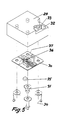
- Fig. 5 shows details of a preferred embodiment of a marking element of the invention. For clarity, this marking element is not provided with visual texts or signs on the surface, as has been done in figs. 10-12.
- the marking element comprises a housing 29 with a downwardly open cavity to receive a circuit 30 and to receive four adjacent studs 15 from fig. 3, so that the housing 29 may be attached mechanically on the board.
- the housing in fig. 5 has four electrically conducting legs 31 which are mechanically guided in a cavity 32 and an attachment pin 33, and which are electrically connected to a conductor on the circuit 30.
- each leg can provide resilient contact with a flap from the flexprint via an associated cut 16. It will be appreciated that the shown arrangement entails that the mutual distance between two different positions of a marking element corresponds to twice the modular distance between the coupling studs 15. In other embodiments, comprising e.g. four mutually insulated flaps per coupling stud, the mutual distance between two positions corresponds to said modular distance.
- the print board 30 may be adapted to receive an integrated circuit 35 at the location indicated at 36, so that power supply is fed via the contact legs to the circuit 35, which contains at least an identification circuit e.g of the type shown in fig. 6.
- the latter circuit contains an identification code which may be set beforehand, e.g. by breaking some of the program paths indicated at 37 in the circuit 30.
- Fig. 6 shows a very simple and thus inexpensive identification circuit for the marking element.
- the circuit comprises some inputs 38 which are hard wired as explained in connection with the program paths 37 from fig. 5, and which thus define an identification code for a combined counter and comparator circuit 39.
- the latter circuit receives input signals via a terminal 40, which is moreover connected to a D type multivibrator 41 and an OR gate 42, whose open collector output is connected partly to an output terminal 43 and partly to the multivibrator 41 via an inverter 44.
- the circuit may serve as an identification circuit in that the input terminal 40 is kept at a high level (which entails that the open collector output of the OR gate 42 is three stated, i.e. is kept at a high level by means of a resistor 45), and using the output terminal 43 as an input terminal for a brief switch from high to low signal level the multivibrator 41 can be triggered to produce a load signal on the -output to the line 46.
- the load signal entails that the counter starts counting the number of signals on the input terminal 40, and as long as the count does not correspond to the identification code, the output signal on the terminal 43 will reproduce the input signal in the input terminal 40, but when the counter has counted to the identification code, the OR gate 42 causes the output terminal 43 to go to high level.
- the position in the A-B matrix and the identification code of the element can be detected very easily by means of the schematically shown circuits comprising a plurality of output gates A1, A2 .... and a plurality of two-way communication gates B1, B2 ..
- the position A5, B3 of the marking element 47 can be detected when the A5 gate is connected to the input terminal 40, while the gate B3 is connected to the output terminal 43 on the circuit from fig. 6. It is noted that the position can be detected already after the first few signal changes on input and output when the input terminal 40 has received a plurality of input pulses corresponding to the associated identification code.
- the circuit comprises an identification circuit 48 of the type shown in fig. 6, an electronic switch 49, an input terminal 50, a buffer circuit 51, and a logic circuit 52 contained in the switch circuit 49.
- the circuit 52 is responsive to the signal levels on the input and output terminals 50 and 53, respectively, so that the output terminal 53 can be switched between the identification circuit 48 and the buffer circuit 51, respectively, in response to predetermined combinations of signal changes on the terminals 50 and 53.
- the control circuit coupled to the board is so arranged that upon detection of a circuit of the type shown in fig. 8, it can automatically switch over to control the electronic switch 49 and to transfer data to the buffer circuit 51, so that e.g. information can be displayed on a liquid crystal display.
- Fig. 9 is an expansion of fig. 7 and comprises an output circuit 60, a two-way transmission circuit 61, said circuits being connected to a board control circuit 62 and to the shown matrix X1 .. XM, Y1 ..YN.
- the input terminals of the identification circuit receive signals from the output circuit 60, while the output terminal of the identification circuit is coupled to the circuit 61, cf. also the resistors 45.
- the board control circuit 62 is adapted to transfer data and to control the signal direction for the circuit 61. Below, the mode of operation of said circuits will be described more fully.
- column No. 1 is scanned for applied marking elements, which is established in that the gate in the circuit 61 connected to the first column is inverted from being an output gate to being an input gate by means of the control line 63. Then a plurality of pulses monitored by a counter circuit 63 is transmitted on the first output of the circuit 60, while another counter circuit 65 detects that the pulses are transmitted on the first output of the circuit 60.
- the identification circuit is so arranged that the presence of a circuit in position X1, Y1 entails that the first gate on the circuit 61 will immediately reflect the input signal which is transmitted on the first row from the circuit 60.
- the board control circuit preferably comprises an electronic store 67 which is adapted to store the result of a whole scanning cycle with respect to the position of the elements as well as their identification code.
- This has the advantage that the next cycle can be restricted to monitor the position of all the marking elements and just to detect the identification code for such marking elements as do not have the same position as in the preceeding scanning. This results in a considerable increase in the scanning rate, but entails that variants explained later, where the identification code in a position can be changed, cannot be used. It may therefore be advantageous to divide the board and the control circuit 62 into respective sections, so that some areas of the board have a very high scanning rate but restricted flexibility, while other sections can handle quite special situations.
- the circuit in fig. 9 can also be used for transmitting information to a marking element as the control circuit 62 may have received the information e.g. from a data processing system, cf. fig. 1. More particularly, this takes place in that, after detection of a circuit of the type shown in fig. 8, coded signals are transmitted from the circuits 60 and 61 to switch the electronic switches in the marking element. Then data are transmitted via the circuit 61 simultaneously with transmission of clock pulses from the circuit 60, so that the drive circuit 51 receives the information synchronously. When data have been transferred, at new coded message is transmitted from the circuits 60 and 61 so that the electronic switch 48 returns to the initial position.
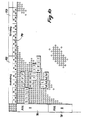
- Fig. 10 represents an embodiment and a use where the primary purpose is to convert the information appearing from an ordinary board into electronic detectable information, which can e.g. be processed by a data system.
- Fig. 10 can e.g. represent a duty hours plan, e.g. at a hospital where the individual wards are marked by means of marking elements 70, 71.
- the week days are represented by marking elements, such as 72, 73, while the hours are represented by marking elements 74.
- employee "P” works from 8 a.m. to 4 p.m
- employee "S” from 0 a.m. to 8 a.m.
- such a board can advantageously be used for immediately representing the situation visually.
- the visual information can be converted into electronic information, which can be processed by a data system, e.g. for calculating salary and overtime payment, for flex-time supervision or for producing information serving purposes of survey or statistics.
- a data system e.g. for calculating salary and overtime payment, for flex-time supervision or for producing information serving purposes of survey or statistics.
- Other uses may be e.g. arrangement of timetables for schools, etc.
- the marking elements may contain a switch which is operated by the individual employee and which when actuated changes the identification code of the marking element so that the data system is now informed that the employee is present.
- This may additionally be marked by lighting a light diode in the individual marking element.
- the light diode might also be caused e.g. to flash in various situations, so that the board may e.g. also serve as an intercommunication system and generally involves great advantages beyond ordinarily known planning uses, c.f. the examples below.
- Fig. 11 represents a use of the board of the invention where the board is used for visualizing electronic information, the scanning and identification technique of the invention being used for improving process simulation systems of the type where the calculations are primarily performed in the data processing system connected to the board.
- the marking elements may comprise a plurality of electrically passive elements whose upper side is provided with a symbol for a component in an industrial process.
- Fig. 11 is intended to represent a diagram of an air conditioning system which comprises air-cooled condensators, ceiling coolers, a compressor, various valves and control equipment. Both in normal operation and during running-in phases it is a great help if the state can be monitored at various locations in such a system, which can be obtained by means of the electronic board of the invention.
- the marking element 75 may be passive, while the marking element 76 comprises a display for display of a room temperature.
- the board can "find" the marking element on the basis of its identification code, as explained above.
- Fig. 11 shows a plurality of examples of other indicators, such as pressostats 77,78 etc.
- the board can particularly be used in a design phase of such a system where it is desired to find the effect of alternative configurations, it being possible to connect the board to a data system with a simulation program for the entire process. If e.g.
- a marking element 80 with push-buttons may be placed in the vicinity of it, causing the identification code of the element to be changed, which informs the simulation program of whether the magnet valve 79 is open or closed.
- the state may be registered by means of a marking element 81 serving as an indicator.
- a corresponding technique may conceivably also be used for designing a data program, using marking elements with the signature for various logic operations.
- Fig. 12 shows an additional example of the versatility of the board of the invention.
- the individual coupling studs are not shown, while the figure shows a sheet 85 with holes (not shown) in a pattern corresponding to the coupling studs, so that the sheet may be placed on the board and represent note lines.
- a marking element 86 e.g. with a treble clef
- the data system may receive information on which notes are represented by the marking elements 87-89.
- marking elements for various note values, several treble and bas clefs for indicating several voices, and when the data system is coupled to a tone generator, the melody represented by the marking elements may be played.
- the marking elements may additionally represent various instruments so that the invention may be used for composition purposes or reproduction of difficult passages.
- the electronic board of the invention may be considered a new medium between a data processing system and a user, said medium being considerably more flexible than e.g. a screen display in connection with the purposes described above.
Landscapes
- Engineering & Computer Science (AREA)
- Physics & Mathematics (AREA)
- Theoretical Computer Science (AREA)
- Business, Economics & Management (AREA)
- Educational Administration (AREA)
- Educational Technology (AREA)
- General Physics & Mathematics (AREA)
- Mathematical Physics (AREA)
- Multimedia (AREA)
- Structure Of Printed Boards (AREA)
- Supply And Installment Of Electrical Components (AREA)
Applications Claiming Priority (2)
| Application Number | Priority Date | Filing Date | Title |
|---|---|---|---|
| DK436886A DK158416C (da) | 1986-09-12 | 1986-09-12 | Elektronisk tavle, isaer en planlaegningstavle |
| DK4368/86 | 1986-09-12 |
Publications (2)
| Publication Number | Publication Date |
|---|---|
| EP0259873A2 true EP0259873A2 (de) | 1988-03-16 |
| EP0259873A3 EP0259873A3 (de) | 1989-09-13 |
Family
ID=8132910
Family Applications (1)
| Application Number | Title | Priority Date | Filing Date |
|---|---|---|---|
| EP87113237A Withdrawn EP0259873A3 (de) | 1986-09-12 | 1987-09-10 | Elektronisches Brett insbesondere Planungsbrett |
Country Status (3)
| Country | Link |
|---|---|
| EP (1) | EP0259873A3 (de) |
| JP (1) | JPS63225816A (de) |
| DK (1) | DK158416C (de) |
Cited By (1)
| Publication number | Priority date | Publication date | Assignee | Title |
|---|---|---|---|---|
| FR2739476A1 (fr) * | 1995-09-28 | 1997-04-04 | Mas Marien | Panneau d'affichage et d'acquisition de donnees |
Family Cites Families (5)
| Publication number | Priority date | Publication date | Assignee | Title |
|---|---|---|---|---|
| US2983892A (en) * | 1958-11-14 | 1961-05-09 | Transistor Electronics Corp | Mounting assemblage for electrical circuits |
| CH379344A (de) * | 1960-05-04 | 1964-06-30 | Autophon Ag | Dauerspeicher mit einer Steckplatte, insbesondere zur Steuerung einer Anzeigeanlage für Zeichen |
| DE2211787A1 (de) * | 1972-03-11 | 1973-09-13 | Klein Paul E Dr Ing | Vorrichtung zum schaltungsaufbau fuer den elektrotechnikunterricht |
| DE2802183A1 (de) * | 1978-01-19 | 1979-07-26 | Ingwesen Entwicklungs Kg | Verfahren und anordnung zur darstellung von daten |
| DE3541519C1 (de) * | 1985-11-23 | 1987-08-13 | Edding Ag | Planungsgeraet |
-
1986
- 1986-09-12 DK DK436886A patent/DK158416C/da not_active IP Right Cessation
-
1987
- 1987-09-10 EP EP87113237A patent/EP0259873A3/de not_active Withdrawn
- 1987-09-11 JP JP62226775A patent/JPS63225816A/ja active Pending
Cited By (1)
| Publication number | Priority date | Publication date | Assignee | Title |
|---|---|---|---|---|
| FR2739476A1 (fr) * | 1995-09-28 | 1997-04-04 | Mas Marien | Panneau d'affichage et d'acquisition de donnees |
Also Published As
| Publication number | Publication date |
|---|---|
| DK158416B (da) | 1990-05-14 |
| DK158416C (da) | 1990-10-22 |
| DK436886D0 (da) | 1986-09-12 |
| EP0259873A3 (de) | 1989-09-13 |
| DK436886A (da) | 1988-04-26 |
| JPS63225816A (ja) | 1988-09-20 |
Similar Documents
| Publication | Publication Date | Title |
|---|---|---|
| CA1097419A (en) | Calculator apparatus with electronically alterable key symbols | |
| JP2937409B2 (ja) | フロントパネル・アセンブリ | |
| US4334219A (en) | Operation setting device having stationary touch-sensitive control elements | |
| USRE40340E1 (en) | Electronic hand held logic game | |
| EP0232137A2 (de) | Drucktastenschalter mit veränderbarer Bezeichnung | |
| US5163844A (en) | Battery-free electronic teaching apparatus with keypad of piezo film switches | |
| WO1980000882A1 (en) | Solid state noncontacting keyboard employing a differential transformer element | |
| US3828643A (en) | Scanner for electronic musical instrument | |
| US4820171A (en) | Coupling plate having a plurality of electric coupling points, a method of producing such a plate and a use of the coupling plate as a planning board | |
| US4827257A (en) | Identification circuit | |
| US4696647A (en) | Electronic assembly toy | |
| JPS63225816A (ja) | 電気ボード | |
| US4001814A (en) | Fixed format message entry device with electronic storage and editing | |
| CN210091965U (zh) | 一种智能开关 | |
| RU2821430C1 (ru) | Способ визуализации работы электрической цепи и система для его осуществления | |
| JPH06269070A (ja) | 遠隔監視制御システムの表示操作端末器 | |
| US4135313A (en) | Educational toy with action | |
| JPS60264011A (ja) | キ−入力装置及びその組立て方法 | |
| JPS60250460A (ja) | スケジユ−ル作成装置 | |
| JP2887664B2 (ja) | 数字表示装置 | |
| Jerome et al. | A problem programmer | |
| SU1077615A2 (ru) | Устройство дл игры в шахматы | |
| JPS6022373Y2 (ja) | 演奏教習装置の打鍵表示装置 | |
| SU1714660A1 (ru) | Устройство дл обучени основам вычислительной техники | |
| SU788146A2 (ru) | Учебно-демонстрационное устройство периодического закона д.и.менделеева |
Legal Events
| Date | Code | Title | Description |
|---|---|---|---|
| PUAI | Public reference made under article 153(3) epc to a published international application that has entered the european phase |
Free format text: ORIGINAL CODE: 0009012 |
|
| AK | Designated contracting states |
Kind code of ref document: A2 Designated state(s): AT BE CH DE ES FR GB GR IT LI LU NL SE |
|
| PUAL | Search report despatched |
Free format text: ORIGINAL CODE: 0009013 |
|
| AK | Designated contracting states |
Kind code of ref document: A3 Designated state(s): AT BE CH DE ES FR GB GR IT LI LU NL SE |
|
| 17P | Request for examination filed |
Effective date: 19900307 |
|
| STAA | Information on the status of an ep patent application or granted ep patent |
Free format text: STATUS: THE APPLICATION IS DEEMED TO BE WITHDRAWN |
|
| 18D | Application deemed to be withdrawn |
Effective date: 19910403 |
|
| RIN1 | Information on inventor provided before grant (corrected) |
Inventor name: KORTEGAARD, PER |