EP0260062A2 - Métiers à tricoter - Google Patents
Métiers à tricoter Download PDFInfo
- Publication number
- EP0260062A2 EP0260062A2 EP87307758A EP87307758A EP0260062A2 EP 0260062 A2 EP0260062 A2 EP 0260062A2 EP 87307758 A EP87307758 A EP 87307758A EP 87307758 A EP87307758 A EP 87307758A EP 0260062 A2 EP0260062 A2 EP 0260062A2
- Authority
- EP
- European Patent Office
- Prior art keywords
- yarn
- control system
- knitting machine
- machine
- circular knitting
- Prior art date
- Legal status (The legal status is an assumption and is not a legal conclusion. Google has not performed a legal analysis and makes no representation as to the accuracy of the status listed.)
- Granted
Links
Images


Classifications
-
- D—TEXTILES; PAPER
- D04—BRAIDING; LACE-MAKING; KNITTING; TRIMMINGS; NON-WOVEN FABRICS
- D04B—KNITTING
- D04B9/00—Circular knitting machines with independently-movable needles
- D04B9/06—Circular knitting machines with independently-movable needles with needle cylinder and dial for ribbed goods
- D04B9/065—Circular knitting machines with independently-movable needles with needle cylinder and dial for ribbed goods with stitch-length regulation
-
- D—TEXTILES; PAPER
- D04—BRAIDING; LACE-MAKING; KNITTING; TRIMMINGS; NON-WOVEN FABRICS
- D04B—KNITTING
- D04B1/00—Weft knitting processes for the production of fabrics or articles not dependent on the use of particular machines; Fabrics or articles defined by such processes
- D04B1/10—Patterned fabrics or articles
- D04B1/102—Patterned fabrics or articles with stitch pattern
- D04B1/106—Patterned fabrics or articles with stitch pattern at a selvedge, e.g. hems or turned welts
-
- D—TEXTILES; PAPER
- D04—BRAIDING; LACE-MAKING; KNITTING; TRIMMINGS; NON-WOVEN FABRICS
- D04B—KNITTING
- D04B1/00—Weft knitting processes for the production of fabrics or articles not dependent on the use of particular machines; Fabrics or articles defined by such processes
- D04B1/22—Weft knitting processes for the production of fabrics or articles not dependent on the use of particular machines; Fabrics or articles defined by such processes specially adapted for knitting goods of particular configuration
- D04B1/24—Weft knitting processes for the production of fabrics or articles not dependent on the use of particular machines; Fabrics or articles defined by such processes specially adapted for knitting goods of particular configuration wearing apparel
-
- D—TEXTILES; PAPER
- D04—BRAIDING; LACE-MAKING; KNITTING; TRIMMINGS; NON-WOVEN FABRICS
- D04B—KNITTING
- D04B1/00—Weft knitting processes for the production of fabrics or articles not dependent on the use of particular machines; Fabrics or articles defined by such processes
- D04B1/22—Weft knitting processes for the production of fabrics or articles not dependent on the use of particular machines; Fabrics or articles defined by such processes specially adapted for knitting goods of particular configuration
- D04B1/24—Weft knitting processes for the production of fabrics or articles not dependent on the use of particular machines; Fabrics or articles defined by such processes specially adapted for knitting goods of particular configuration wearing apparel
- D04B1/26—Weft knitting processes for the production of fabrics or articles not dependent on the use of particular machines; Fabrics or articles defined by such processes specially adapted for knitting goods of particular configuration wearing apparel stockings
- D04B1/265—Surgical stockings
-
- D—TEXTILES; PAPER
- D04—BRAIDING; LACE-MAKING; KNITTING; TRIMMINGS; NON-WOVEN FABRICS
- D04B—KNITTING
- D04B15/00—Details of, or auxiliary devices incorporated in, weft knitting machines, restricted to machines of this kind
- D04B15/38—Devices for supplying, feeding, or guiding threads to needles
- D04B15/48—Thread-feeding devices
- D04B15/488—Thread-feeding devices in co-operation with stitch-length-regulating mechanism
-
- D—TEXTILES; PAPER
- D04—BRAIDING; LACE-MAKING; KNITTING; TRIMMINGS; NON-WOVEN FABRICS
- D04B—KNITTING
- D04B15/00—Details of, or auxiliary devices incorporated in, weft knitting machines, restricted to machines of this kind
- D04B15/38—Devices for supplying, feeding, or guiding threads to needles
- D04B15/48—Thread-feeding devices
- D04B15/50—Thread-feeding devices for elastic threads
-
- D—TEXTILES; PAPER
- D04—BRAIDING; LACE-MAKING; KNITTING; TRIMMINGS; NON-WOVEN FABRICS
- D04B—KNITTING
- D04B15/00—Details of, or auxiliary devices incorporated in, weft knitting machines, restricted to machines of this kind
- D04B15/88—Take-up or draw-off devices for knitting products
-
- D—TEXTILES; PAPER
- D04—BRAIDING; LACE-MAKING; KNITTING; TRIMMINGS; NON-WOVEN FABRICS
- D04B—KNITTING
- D04B15/00—Details of, or auxiliary devices incorporated in, weft knitting machines, restricted to machines of this kind
- D04B15/94—Driving-gear not otherwise provided for
-
- D—TEXTILES; PAPER
- D04—BRAIDING; LACE-MAKING; KNITTING; TRIMMINGS; NON-WOVEN FABRICS
- D04B—KNITTING
- D04B9/00—Circular knitting machines with independently-movable needles
- D04B9/42—Circular knitting machines with independently-movable needles specially adapted for producing goods of particular configuration
- D04B9/46—Circular knitting machines with independently-movable needles specially adapted for producing goods of particular configuration stockings, or portions thereof
- D04B9/52—Circular knitting machines with independently-movable needles specially adapted for producing goods of particular configuration stockings, or portions thereof surgical stockings
Definitions
- the present invention relates to knitting machines and more particularly to circular knitting machines which are used to knit tubular workpieces.
- Circular knitting machines are well known and a common type comprises two main knitting components to produce a tubular workpiece.
- the components known as a dial and cylinder co-operate together to produce a tubular workpiece, the dial being manually adjustable when the machine is stationary to adjust the stitch length and hence the width of the tubular workpiece within the practical limits set by the size of the machine.
- the operation of a circular knitting machine is extremely well known within the knitting machine art and does not form part of the present invention. Such operation will be referred to but will not be described in any detail because of its common knowledge within the knitting machine art.
- the simple dial and cylinder machine thus produces a parallel tubular workpiece the width of which can be adjusted when the machine is stationary by adjustment of the dial height.
- the simple machine is therefore not capable of producing a shaped tubular workpiece i.e. one which varies in diameter along its length.
- a particular, but not exclusive use of circular type knitting machines is in the manufacture of elastic bandages in which one of the yarns used is elastic, the yarn being knitted or laid in round the circumference of the tube to provide an elasticated bandage.
- a further known machine is the single cylinder stocking machine which is used to manufacture shaped stockings.
- This type of machine is provided with a drum/cam control system.
- the machine can knit a limited graduated shape e.g. a stocking shape by a combination of the control drum segments and by a graduated lowering of the cylinder during knitting using a rack wheel, cam and chain studs.
- the machine is however relatively non-versatile in that the shape to be knitted is not readily alterable and the machine cannot control the multi-feed of elastic and ground yarns.
- the present invention provides a control system for a knitting machine which enables the machine to produce a variable width workpiece of desired shape which control system is versatile in use and which is capable by simple changes of altering the shape produced by the machine.
- the present invention therefore provides a control system for a circular knitting machine the control system including means for varying the rate at which yarn is supplied to the machine in a controlled manner over a period of time such that the shape of the workpiece is controlled by the rate of yarn feed.
- the controlled yarn is a single feed of elastic yarn.
- the controlled yarn is a ground yarn.
- many yarn feeds may be controlled either elastic or non-elastic or ground yarns.
- the means for varying the rate at which yarn is supplied to the machine is by means of a former which is rotated to act on a variable speed pulley to control the yarn feed supply rate.
- the rotational speed of the former is varied relative to the main drive speed to produce a different shape of workpiece.
- variable speed pulley system is driven from the main drive supply such that the yarn feed is driven at a variable speed which is a ratio of the main drive speed of the knitting machine.
- the ground yarn is controlled at a different rate to the elastic yarn.
- the dial height may also be adjusted by further adjustment means in addition to the feed yarns during knitting.
- the width of a workpiece may be adjusted in a variable manner to produce a variable width garment.
- the present invention also provides a method of producing a variable width garment on a circular dial and cylinder knitting machine by adjusting the dial height of the machine whilst the machine is running. Additionally the feed rate of an elastic yarn may also be adjusted at the same or a different rate to the dial adjustment thereby producing a garment of a wide width variation.
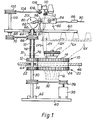
- control system is shown in conjunction with a dial and cylinder true rib knitting machine but it may be used with other types of knitting machine. Such machines are well known and the knitting portion of the machine will not be described in detail.
- the dial portion of the machine is indicated generally at 10 and the cylinder at 20. They are driven, in known manner, by gear trains 12, 14 and 22, 24 respectively the drive gears 12, 22 being fixed to a shaft 30 driven by a belt and pulley arrangement 32, 34 driven from a pulley 36 mounted on the main drive motor 38 for the knitting machine.
- the motor 38 is mounted onto a main frame 40 which may form the base of the machine (if bench mounted) or may be fitted with legs (not shown) for free standing operation.
- the shaft 30 is journalled at two points 42, 44 the journal 44 being in a plate 46 which supports the dial and cylinder arrangement 10, 20.
- Plate 46 is mounted in a fixed relation to plate 40 by any convenient means e.g. welded struts (not shown).
- the drive shaft 30 is terminated at a height as shown by dotted line 31 just above gear 12.
- the dial 10 is adjustable whilst the machine is stationary by a knurled nut adjuster arrangement 11 which when raised increases the intake per stitch of ground yarn GY.
- GY ground yarn
- the dial height determines the yarn required by the machine and the machine pulls the yarn required the yarn being held in cones on overhead gantries as indicated in dotted outline.
- the yarn can be metered to give a required length of yarn particularly in the case of the elastic yarn EY by a driven belt arrangement DB for the cone spools. This is well known and will not therefore be described in further detail.
- the arrangement is as follows.
- the shaft 30 is extended in an upward direction and is journalled in a bearing 62 in an upper plate 60.
- Bearing 62 is surrounded by a sliding collar 64 which is free to move vertically on extended shaft 30.
- the collar 64 can be forced to bear down onto a variable drive pulley 66 which (in well known fashion) cooperates with a mating pulley 68 via belt 70 such that on pressure being applied to pulley 66 the belt 70 is adjusted and forces a change in the position of pulley 68 thereby speeding up the rotation of pulley 68.
- a profile 80 (preferably made from steel plate of, for example 3/8" to 1/2" thick) which is rotatably mounted on a shaft 82 driven by an electric motor 84 via a gearbox 86.
- Motor 84 and gearbox 86 are rigidly mounted onto top plate 60 by supports 85, 87.
- the shaft 82 can be driven at a relatively slow speed by gearbox 86 and hence the profile 80 turns slowly.
- the speed of rotation of profile 80 can be further changed by using a variable speed motor 84 controlled for example by an electronic controller 88 connected in the main electrical feed line 90.
- Pulley 68 is keyed onto a shaft 100 onto which a further preset ratio capstan drive 102, 104, 106 is connected to drive via pulley 106 a yarn feed control system 108, 110, 112.
- the capstan 102 and associated pulley 106 are adjustable when the machine is stationary to set up the width of the workpiece by defining a fixed feed speed for the yarns controlled by the capstan. The variability of the yarn feed is then controlled (within the range set by the preset capstan) by the profile 80.
- the capstan is manually set to give the minimum width whilst the profile is also positioned at its minimum width position.
- the arrangement is such that via gearbox 108, and direction change device 110 the "constant" feed device 112 can be controlled to feed the elastic yarn EYV at a rate determined by the rotational speed of pulley 106. Since pulley 106 is controlled effectively by the rotation of profile 80 then it may be seen that the shape of the garment G knitted by the machine can be controlled by the shape of profile 80 and by the speed of rotation of profile 80 relative to the operating speed of the machine as controlled by motor 38.
- the embodiment shown in Figure 1 is able only to control one type of yarn feed although by a simple toothed belt arrangement for belt 104 it may easily be seen that more than one elastic yarn feed may be controlled. Additionally, one or more of the ground feed yarn or non-elastic yarns may be controlled in a variable manner as a fixed ratio of the variable elastic yarn feed.
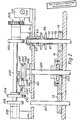
- the arrangement shown in Figure 2 provides for all three main criteria to be controlled, elastic yarn, ground yarn and dial height by three separate contours respectively 200, 202 and 204.
- the contours are driven from a gearbox and shaft arrangement 206, 208 driven by a variable speed motor 210 with dial speed adjuster 212. (A separate drive could be used for each profile 200, 202, 204 if desired).
- the profile 200 acts on the variable drive pulley 66 via collar 64 and as shaft 208 is rotated the speed of elastic yarn feed controlled via the arrangement shown in Figure 1 is varied as the machine knits.
- Shaft 224 is an extension of the shaft through the centre of the dial mechanism and raising or lowering shaft 224 thereby adjusts the dial height (and hence the garment size) in the same manner as knurled nut 11 in Figure 1.
- See-saw 200 comprises a contrally pivoted lever 230 provided with roller bearings 232, 234, to prevent excessive friction, at either end.
- the lever 230 is privoted at 236 in an upstand fork 238 mounted on plate 60.
- the roller bearing 234 is sandwiched between two plates 240, 242 mounted in a spaced apart manner on shaft 224 by spacing member 244, shaft 224 being provided with an upper bearing 246.
- Initial height can be set by adjusting the position of components 240, 242, 244 on shaft 224 by screw thread 248.
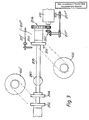
- FIG. 3 the arrangement of Figure 2 can be shown in diagrammatic plan view and in Figure 4 the capstans 102 and 102 ⁇ which respectively control the feed speeds of the elastic and the ground yarn can be seen.
- Capstan 102 is preset and then its speed is controlled as described with reference to Figure 1 and capstan 102 ⁇ is controlled by profile 202 in a similar manner. (in Figure 4 the dial height control is omitted for clarity).
- Pulley 68 and capstan 102 thereby controls the speed of feed of the elastic yarn and a similar pulley 68 ⁇ via a capstan 102 ⁇ the speed of feed of the ground yarn.
- Profiles 80 ( Figure 1) and 200, 202, 204 are readily replaced, being held on their respective shafts by, for example, grub screws. The profiles are thereby also readily positioned with respect to each other so that a garment is correctly fashioned.
- Garments may therefore be produced in an enormous variety of ways.
- the motor 84 is switched off the knitting machine will produce parallel tubular fabric at a width determined by the position of profile 80. With the motor 84 rotating at high speed the machine will produce variable width fabric with the "pattern" produced by profile 80 being repeated over short lengths. With motor 84 rotating at slow speed the pattern length will be longer.
- the shape of the garment can be influenced by the shape of all of the three profiles and by the speed at which they are rotated.
- the knitted garment "emerges" from the cylinder in a rotational manner because of the method of knitting.
- the arrangement shown in Figure 5 rolls up the garment and additionally ensures that it is not creased when rolled.
- the garment G is knitted in a direction shown by arrows 300.
- the garment G is wound on a roller 302 the roller rotating in the direction shown by arrow 304 (by means not shown).
- the roller 302 is journalled in a frame 306 which is rotated in a horizontal plane in a direction shown by arrow 308 to thereby complement the rotation of the garment G as it is knitted.
- FIG. 5 and 6 there is shown a second roller arrangement generally indicated at 320 which comprises two non-driven rollers 322, 324. These rollers are rotatably mounted in bearings on extended leg portions 326, 328 of frame 306.
- the rollers 322, 324 are mounted as shown in Figure 6 only a short distance apart and the garment G passes between the rollers.
- an omega shaped expanding element 330 Prior to threading through rollers 322, 324 an omega shaped expanding element 330 is inserted as shown inside the garment.
- the element 330 can expand freely in the direction of arrow 332 and therefore maintains the garment G in a flat condition through rollers 322, 324 and hence on to roller 302.
- Element 330 may be constructed, as shown with a length of flexible plastic piping 334 with suitable end pieces 336, 338 which serve to prevent the piping 334 from being drawn through the rollers.
- the control system allows the production of various shaped garments in one piece.
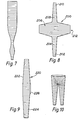
- Figure 7 shows a graduated compression bandage shaped to conform to a male or female leg. All yarns may be controlled, the circular bandage therefore having the natural shape as shown. The bandage can be made to exert any desired pressure through the leg length by appropriate control.
- bandages are made in parallel fabric and therefore do not exert a graduated pressure on the leg but either generally exert too much or too little pressure on the leg at different positions.
- the present invention (see Figure 2) makes it possible to graduate all yarns and to be able to multi-feed the elastic yarn to make a ratio of one ground yarn to one elastic yarn or any other desired ratio.
- the presently used ratio of one elastic to four ground produces a helical marking on a leg when the bandage is removed showing clearly the poor pressure pattern whereas a bandage made in accordance with the present invention will produce even pressure and at a controlled level. This is extremely important, for example, in the treatment of Deep Vein Thrombosis.
- Figure 8 shows a pullover or sweater 200 made in one piece in a "sideways on” manner.
- the sweater 200 is commenced at one arm end 202 where the machine can be made by adjustment of the dial height to knit a small diameter garment and by successive alterations of dial height and yarn feed as described with reference to Figure 2 the width of the garment can be altered to the arms 204 wide body 206 and then reduced again to form the second arm 208 and cuff 210.
- Elastic yarn can be used if required on, for example, the arms.
- the neck 212 of the sweater can be formed to a desired shape by cutting the tube and suitable finishing in known manner.
- Figures 9 and 10 show a pair of long pants (commonly known as "long johns") 220. They are made as shown in Figure 9 in one long piece with legs 222, 224 and then a cut 226 is made for the upper opening. They are then bent to shape.
- long johns commonly known as "long johns”
- Figure 11 shows the type of finished garment that can be readily produced and shows a track suit made in four pieces trousers 230, body 232 and arms 234, 236.
- Air vents 238 may be provided at any points in the pieces as shown.
- the garment may be made with elastic yarn to give a desired degree of stretch and the degree of stretch may be readily varied to give desired pressures for example on the calf muscles to assist, for example, in a racing driver in blood flow to the head. It may be seen that such a suit could be designed to assist in medical conditions such as varicose veins or torn muscles whilst providing attractive clothing because it can be made multi-coloured and styled as required.
- the garment can be made as a two piece of by suitable cutting and joining (e.g. in inside legs 240, 242 in a one piece with a zip 244 (shown dotted)).
- the machine by being able to vary dial height and yarn feed and by being provided with a link between dial height and the speed of motor 112 (Figure 1) can be made to knit extremely wide widths and close or open knit garments thereby producing cuffs, polo necks and bodies of garments all on one machine. Obviously there is a maximum size limit for each size of machine but using elastic yarn feed the variation in width is considerable. Without elastic yarn feed the variation is less but is still useful in producing shaped garments.
- the position of the profile (which can control (see Figure 2) the elastic yarn feed, ground yarn feed and dial height) can be used to control the speed of the profile drive motor 84.
- a further bevel gear arrangement 207 may be proved to drive a pulley and belt arrangement 207 ⁇ , 207 ⁇ and pulley 207 ⁇ may be used to move a dial speed controller 81 on motor 84.
- the gear ratios in arrangement 207 or by the relative size of pulleys 207 ⁇ , 207 ⁇ the rate of change of motor speed with profile rotation can be adjusted.
- very complex shapes can be produced from one profile.
- the profile may be provided (see Figures 1 and 3) with a pin 201 which signifies the start (or finish) position of a garment.
- This pin can be used to, for example, count the number of garments produced or it can be used to move a felt tip pen 201 ⁇ which may be mounted in a spring loaded manner to strike the feed yarn 201 ⁇ and thereby produce a mark (of suitable distinctive colour) on the garment to accurately identify the cutting position between garments.
- the finishing operator can quickly and accurately separate the garments or this could be done automatically by a machine with suitable optical recognition equipment.
- the process is also particularly useful for production of garments such as leotards or swimsuits in which the ground yarn may be, for example, a lycra type giving the swimwear two way stretch.
- Various styles and shapes can be made by simple alteration of the profiles controlling the feeds.
Landscapes
- Engineering & Computer Science (AREA)
- Textile Engineering (AREA)
- Health & Medical Sciences (AREA)
- General Health & Medical Sciences (AREA)
- Surgery (AREA)
- Knitting Machines (AREA)
- Preparation Of Compounds By Using Micro-Organisms (AREA)
- Organic Low-Molecular-Weight Compounds And Preparation Thereof (AREA)
- Manufacture Of Alloys Or Alloy Compounds (AREA)
Applications Claiming Priority (2)
| Application Number | Priority Date | Filing Date | Title |
|---|---|---|---|
| GB868621751A GB8621751D0 (en) | 1986-09-10 | 1986-09-10 | Knitting machines |
| GB8621751 | 1986-09-10 |
Publications (3)
| Publication Number | Publication Date |
|---|---|
| EP0260062A2 true EP0260062A2 (fr) | 1988-03-16 |
| EP0260062A3 EP0260062A3 (en) | 1990-04-18 |
| EP0260062B1 EP0260062B1 (fr) | 1994-07-27 |
Family
ID=10603935
Family Applications (1)
| Application Number | Title | Priority Date | Filing Date |
|---|---|---|---|
| EP87307758A Expired - Lifetime EP0260062B1 (fr) | 1986-09-10 | 1987-09-03 | Métiers à tricoter |
Country Status (9)
| Country | Link |
|---|---|
| US (1) | US4977758A (fr) |
| EP (1) | EP0260062B1 (fr) |
| AT (1) | ATE109220T1 (fr) |
| AU (1) | AU597419B2 (fr) |
| CA (1) | CA1300908C (fr) |
| DE (1) | DE3750281T2 (fr) |
| ES (1) | ES2060604T3 (fr) |
| GB (2) | GB8621751D0 (fr) |
| ZA (1) | ZA876781B (fr) |
Cited By (5)
| Publication number | Priority date | Publication date | Assignee | Title |
|---|---|---|---|---|
| EP0684329A1 (fr) * | 1994-05-26 | 1995-11-29 | Nisshinbo Industries Inc. | Métier à tricoter et procédé pour la fabrication d'articles tricotés |
| US5570725A (en) * | 1994-03-31 | 1996-11-05 | Toshimitsu Musha | Weaving method and reed used with 1/F fluctuations |
| US5598875A (en) * | 1994-05-17 | 1997-02-04 | Nisshinbo Industries, Inc. | Reeding method for 1/f fluctuation warp yarn distribution |
| US5680684A (en) * | 1994-05-24 | 1997-10-28 | Toshimitsu Musha | Air intermingling method and air intermingling machine employing a 1/f fluctuation |
| CN111910330A (zh) * | 2020-08-26 | 2020-11-10 | 肇庆市盛宝丽纺织有限公司 | 一种针织大圆机 |
Families Citing this family (8)
| Publication number | Priority date | Publication date | Assignee | Title |
|---|---|---|---|---|
| DE4128372A1 (de) * | 1991-08-27 | 1993-03-04 | Sipra Patent Beteiligung | Rundstrickmaschine mit einem nadelzylinder und einer rippscheibe |
| IT1264549B1 (it) * | 1993-07-30 | 1996-10-02 | Giuseppe Drisaldi | Procedimento e macchina per la produzione di nastri elastici nonche' nastri cosi' ottenuti |
| JPH07126965A (ja) * | 1993-11-04 | 1995-05-16 | Fukuhara Seiki Seisakusho:Kk | 丸編機のステッチ量自動調整装置および方法 |
| WO1997013904A1 (fr) * | 1995-10-12 | 1997-04-17 | E.I. Du Pont De Nemours And Company | Procede et equipement pour le tricotage de tissu avec un fil non elastique et du fil elastomere nu, et constitution de tissu tricote pour pull-overs |
| US7310976B1 (en) | 2006-10-04 | 2007-12-25 | Monarch Knitting Machinery Corp. | Circular knitting-machine chassis with cantilever support |
| US8371145B1 (en) * | 2011-12-20 | 2013-02-12 | Pai Lung Machinery Mill Co., Ltd. | Yarn conveying system for circular knitting machines |
| ES2703976T3 (es) * | 2014-12-09 | 2019-03-13 | Lonati Spa | Zapata para máquinas de tricotado circulares para géneros de punto o similar |
| DE102023004602A1 (de) * | 2023-11-13 | 2025-05-15 | Medi Gmbh & Co. Kg | Strickmaschine |
Family Cites Families (21)
| Publication number | Priority date | Publication date | Assignee | Title |
|---|---|---|---|---|
| US431417A (en) * | 1890-07-01 | townsend | ||
| GB288357A (en) * | 1926-12-28 | 1928-03-28 | Philip Ernest Frank Clay | Improvements in surgical elastic garments and method of making the same |
| US2073488A (en) * | 1934-03-02 | 1937-03-09 | Hemphill Co | Knitting machine |
| US2182295A (en) * | 1935-11-20 | 1939-12-05 | Lebocey Gaston | Automatic variable output feeder for shaped knitted articles |
| US2810279A (en) * | 1953-02-24 | 1957-10-22 | Max B Striar | Knitting machine |
| GB861880A (en) * | 1956-05-07 | 1961-03-01 | Hosiery And Allied Trades Res | Improvements in and relating to circular knitting machines |
| GB994045A (en) * | 1960-04-28 | 1965-06-02 | Hosiery & Allied Trades Res As | Improvements in knitting machines |
| GB1033827A (en) * | 1961-10-11 | 1966-06-22 | Kirkland & Company Ltd A | Improvements relating to knitting machines |
| BE624739A (fr) * | 1961-11-17 | |||
| US3225570A (en) * | 1963-06-27 | 1965-12-28 | Singer Co | Automatic stitch control |
| FR1402228A (fr) * | 1964-06-22 | 1965-06-11 | Singer Co | Dispositif de réglage automatique pour métier à tricoter et machine similaire |
| GB1120227A (en) * | 1964-10-10 | 1968-07-17 | Hosiery & Allied Trades Res As | Improvements in textile yarn feeding device |
| FR1585278A (fr) * | 1968-09-23 | 1970-01-16 | ||
| GB1320502A (en) * | 1969-06-20 | 1973-06-13 | Triplite Ltd | Positive yarn feed systems |
| CS178205B1 (fr) * | 1975-04-03 | 1977-08-31 | ||
| IT1194854B (it) * | 1979-10-22 | 1988-09-28 | Sangiacomo Di Sangiacomo Fulvi | Macchina circolare da calzetteria con cilindro e platorello porta-aghi,particolarmente per l'esecuzione di maglia a coste e di maglia a spugna |
| DE3002311C2 (de) * | 1980-01-23 | 1982-10-07 | Textilmaschinenfabrik Harry Lucas GmbH & Co KG, 2350 Neumünster | Strumpf-Rundstrickmaschine zur Herstellung von Gummistrümpfen |
| CA1158451A (fr) * | 1980-04-03 | 1983-12-13 | Erwin H. Fox | Machines de tricotage |
| US4527402A (en) * | 1982-09-29 | 1985-07-09 | Rampon Products, Inc. | Program-controlled knitting machine, method and products thereof |
| GB8410640D0 (en) * | 1984-04-26 | 1984-05-31 | Iropa Textile Accessories | Positive feed |
| DE3515104C1 (de) * | 1985-04-26 | 1986-10-02 | SIPRA Patententwicklungs- und Beteiligungsgesellschaft mbH, 7470 Albstadt | Vorrichtung zur zwangsweisen Zulieferung von Elastomerfaeden an Textilmaschinen |
-
1986
- 1986-09-10 GB GB868621751A patent/GB8621751D0/en active Pending
-
1987
- 1987-09-03 ES ES87307758T patent/ES2060604T3/es not_active Expired - Lifetime
- 1987-09-03 GB GB8720747A patent/GB2194968B/en not_active Expired - Fee Related
- 1987-09-03 EP EP87307758A patent/EP0260062B1/fr not_active Expired - Lifetime
- 1987-09-03 AT AT87307758T patent/ATE109220T1/de not_active IP Right Cessation
- 1987-09-03 DE DE3750281T patent/DE3750281T2/de not_active Expired - Fee Related
- 1987-09-09 AU AU78207/87A patent/AU597419B2/en not_active Ceased
- 1987-09-09 CA CA000546464A patent/CA1300908C/fr not_active Expired - Lifetime
- 1987-09-10 ZA ZA876781A patent/ZA876781B/xx unknown
-
1989
- 1989-12-13 US US07/450,592 patent/US4977758A/en not_active Expired - Fee Related
Cited By (6)
| Publication number | Priority date | Publication date | Assignee | Title |
|---|---|---|---|---|
| US5570725A (en) * | 1994-03-31 | 1996-11-05 | Toshimitsu Musha | Weaving method and reed used with 1/F fluctuations |
| US5598875A (en) * | 1994-05-17 | 1997-02-04 | Nisshinbo Industries, Inc. | Reeding method for 1/f fluctuation warp yarn distribution |
| US5680684A (en) * | 1994-05-24 | 1997-10-28 | Toshimitsu Musha | Air intermingling method and air intermingling machine employing a 1/f fluctuation |
| CN1048052C (zh) * | 1994-05-24 | 2000-01-05 | 武者利光 | 气流交织方法 |
| EP0684329A1 (fr) * | 1994-05-26 | 1995-11-29 | Nisshinbo Industries Inc. | Métier à tricoter et procédé pour la fabrication d'articles tricotés |
| CN111910330A (zh) * | 2020-08-26 | 2020-11-10 | 肇庆市盛宝丽纺织有限公司 | 一种针织大圆机 |
Also Published As
| Publication number | Publication date |
|---|---|
| AU7820787A (en) | 1988-03-17 |
| DE3750281D1 (de) | 1994-09-01 |
| ATE109220T1 (de) | 1994-08-15 |
| AU597419B2 (en) | 1990-05-31 |
| GB2194968B (en) | 1990-07-25 |
| US4977758A (en) | 1990-12-18 |
| ZA876781B (en) | 1988-05-25 |
| GB8720747D0 (en) | 1987-10-07 |
| GB8621751D0 (en) | 1986-10-15 |
| EP0260062A3 (en) | 1990-04-18 |
| GB2194968A (en) | 1988-03-23 |
| EP0260062B1 (fr) | 1994-07-27 |
| CA1300908C (fr) | 1992-05-19 |
| DE3750281T2 (de) | 1994-12-15 |
| ES2060604T3 (es) | 1994-12-01 |
Similar Documents
| Publication | Publication Date | Title |
|---|---|---|
| EP0260062B1 (fr) | Métiers à tricoter | |
| US2437735A (en) | Method of and apparatus for separating knitted fabrics | |
| EP1155176A1 (fr) | Procede et appareil pour allonger et collecter un tissu en maille fabrique dans un metier circulaire | |
| US4671083A (en) | Driving apparatus in take up unit of circular knitting machine | |
| JP2682883B2 (ja) | 縫い付け中に織物の縁の側面を整列させる装置 | |
| US2189166A (en) | Fabric feeding control system | |
| US4128066A (en) | Apparatus for sewing together portions of knitted articles | |
| US2441443A (en) | Elastic garment | |
| US3973305A (en) | Apparatus for conditioning and calendering circular knit tubular fabrics | |
| US2467281A (en) | Method of and apparatus for handling tubular knitted fabric | |
| US1594958A (en) | Method, apparatus, and product of knitting | |
| US3159988A (en) | Hosiery footwear and method of making | |
| US2321010A (en) | Method and apparatus for treating fabrics | |
| US2273052A (en) | Strand feeding mechanism | |
| US3973304A (en) | Spreader for circular knit fabric tubes | |
| US3120049A (en) | Method of producing hose | |
| US4517712A (en) | Method for automatically detecting and orienting the edge of a tubular knitted fabric | |
| JPS63500314A (ja) | ヤ−ン送給装置 | |
| CN110499589B (zh) | 一种服装加工用圆锁机 | |
| US3973306A (en) | Method of orienting and calendering circular knit fabric tubes | |
| US2300808A (en) | Device for use in knitting | |
| CN223548211U (zh) | 一种袜子缝头机送料装置 | |
| US2031430A (en) | Thread tensioning attachment for textile machines | |
| US4624036A (en) | Automatic orientation guide for tubular knitted fabric | |
| US2773296A (en) | Fabric control apparatus |
Legal Events
| Date | Code | Title | Description |
|---|---|---|---|
| PUAI | Public reference made under article 153(3) epc to a published international application that has entered the european phase |
Free format text: ORIGINAL CODE: 0009012 |
|
| AK | Designated contracting states |
Kind code of ref document: A2 Designated state(s): AT BE CH DE ES FR IT LI NL SE |
|
| PUAL | Search report despatched |
Free format text: ORIGINAL CODE: 0009013 |
|
| AK | Designated contracting states |
Kind code of ref document: A3 Designated state(s): AT BE CH DE ES FR IT LI NL SE |
|
| 17P | Request for examination filed |
Effective date: 19901017 |
|
| 17Q | First examination report despatched |
Effective date: 19920306 |
|
| GRAA | (expected) grant |
Free format text: ORIGINAL CODE: 0009210 |
|
| AK | Designated contracting states |
Kind code of ref document: B1 Designated state(s): AT BE CH DE ES FR IT LI NL SE |
|
| REF | Corresponds to: |
Ref document number: 109220 Country of ref document: AT Date of ref document: 19940815 Kind code of ref document: T |
|
| REF | Corresponds to: |
Ref document number: 3750281 Country of ref document: DE Date of ref document: 19940901 |
|
| ITF | It: translation for a ep patent filed | ||
| PGFP | Annual fee paid to national office [announced via postgrant information from national office to epo] |
Ref country code: DE Payment date: 19940908 Year of fee payment: 8 |
|
| PGFP | Annual fee paid to national office [announced via postgrant information from national office to epo] |
Ref country code: FR Payment date: 19940909 Year of fee payment: 8 |
|
| PGFP | Annual fee paid to national office [announced via postgrant information from national office to epo] |
Ref country code: AT Payment date: 19940913 Year of fee payment: 8 |
|
| PGFP | Annual fee paid to national office [announced via postgrant information from national office to epo] |
Ref country code: CH Payment date: 19940914 Year of fee payment: 8 |
|
| PGFP | Annual fee paid to national office [announced via postgrant information from national office to epo] |
Ref country code: SE Payment date: 19940915 Year of fee payment: 8 |
|
| PGFP | Annual fee paid to national office [announced via postgrant information from national office to epo] |
Ref country code: NL Payment date: 19940930 Year of fee payment: 8 |
|
| ET | Fr: translation filed | ||
| REG | Reference to a national code |
Ref country code: ES Ref legal event code: FG2A Ref document number: 2060604 Country of ref document: ES Kind code of ref document: T3 |
|
| EAL | Se: european patent in force in sweden |
Ref document number: 87307758.0 |
|
| PLBE | No opposition filed within time limit |
Free format text: ORIGINAL CODE: 0009261 |
|
| STAA | Information on the status of an ep patent application or granted ep patent |
Free format text: STATUS: NO OPPOSITION FILED WITHIN TIME LIMIT |
|
| 26N | No opposition filed | ||
| PG25 | Lapsed in a contracting state [announced via postgrant information from national office to epo] |
Ref country code: AT Effective date: 19950903 |
|
| PG25 | Lapsed in a contracting state [announced via postgrant information from national office to epo] |
Ref country code: SE Effective date: 19950904 |
|
| PGFP | Annual fee paid to national office [announced via postgrant information from national office to epo] |
Ref country code: ES Payment date: 19950928 Year of fee payment: 9 |
|
| PG25 | Lapsed in a contracting state [announced via postgrant information from national office to epo] |
Ref country code: LI Effective date: 19950930 Ref country code: CH Effective date: 19950930 |
|
| PGFP | Annual fee paid to national office [announced via postgrant information from national office to epo] |
Ref country code: BE Payment date: 19951011 Year of fee payment: 9 |
|
| PG25 | Lapsed in a contracting state [announced via postgrant information from national office to epo] |
Ref country code: NL Effective date: 19960401 |
|
| REG | Reference to a national code |
Ref country code: CH Ref legal event code: PL |
|
| PG25 | Lapsed in a contracting state [announced via postgrant information from national office to epo] |
Ref country code: FR Effective date: 19960531 |
|
| PG25 | Lapsed in a contracting state [announced via postgrant information from national office to epo] |
Ref country code: DE Effective date: 19960601 |
|
| NLV4 | Nl: lapsed or anulled due to non-payment of the annual fee |
Effective date: 19960401 |
|
| EUG | Se: european patent has lapsed |
Ref document number: 87307758.0 |
|
| REG | Reference to a national code |
Ref country code: FR Ref legal event code: ST |
|
| PG25 | Lapsed in a contracting state [announced via postgrant information from national office to epo] |
Ref country code: ES Free format text: LAPSE BECAUSE OF THE APPLICANT RENOUNCES Effective date: 19960904 |
|
| PG25 | Lapsed in a contracting state [announced via postgrant information from national office to epo] |
Ref country code: BE Effective date: 19960930 |
|
| BERE | Be: lapsed |
Owner name: SMITH & NEPHEW TEXTILES LTD Effective date: 19960930 |
|
| REG | Reference to a national code |
Ref country code: ES Ref legal event code: FD2A Effective date: 19991007 |
|
| PG25 | Lapsed in a contracting state [announced via postgrant information from national office to epo] |
Ref country code: IT Free format text: LAPSE BECAUSE OF NON-PAYMENT OF DUE FEES;WARNING: LAPSES OF ITALIAN PATENTS WITH EFFECTIVE DATE BEFORE 2007 MAY HAVE OCCURRED AT ANY TIME BEFORE 2007. THE CORRECT EFFECTIVE DATE MAY BE DIFFERENT FROM THE ONE RECORDED. Effective date: 20050903 |