EP0260621A2 - 3-Aryluracil-enoläther und deren Verwendung zur Unkrautbekämpfung - Google Patents
3-Aryluracil-enoläther und deren Verwendung zur Unkrautbekämpfung Download PDFInfo
- Publication number
- EP0260621A2 EP0260621A2 EP87113342A EP87113342A EP0260621A2 EP 0260621 A2 EP0260621 A2 EP 0260621A2 EP 87113342 A EP87113342 A EP 87113342A EP 87113342 A EP87113342 A EP 87113342A EP 0260621 A2 EP0260621 A2 EP 0260621A2
- Authority
- EP
- European Patent Office
- Prior art keywords
- fluoro
- chloro
- methoxy
- alkyl
- ppm
- Prior art date
- Legal status (The legal status is an assumption and is not a legal conclusion. Google has not performed a legal analysis and makes no representation as to the accuracy of the status listed.)
- Withdrawn
Links
- 0 *c(c(N1C(O*)=NC(*)=C(*)C1=O)c1)cc(*)c1O Chemical compound *c(c(N1C(O*)=NC(*)=C(*)C1=O)c1)cc(*)c1O 0.000 description 4
Classifications
-
- C—CHEMISTRY; METALLURGY
- C07—ORGANIC CHEMISTRY
- C07D—HETEROCYCLIC COMPOUNDS
- C07D239/00—Heterocyclic compounds containing 1,3-diazine or hydrogenated 1,3-diazine rings
- C07D239/02—Heterocyclic compounds containing 1,3-diazine or hydrogenated 1,3-diazine rings not condensed with other rings
- C07D239/24—Heterocyclic compounds containing 1,3-diazine or hydrogenated 1,3-diazine rings not condensed with other rings having three or more double bonds between ring members or between ring members and non-ring members
- C07D239/28—Heterocyclic compounds containing 1,3-diazine or hydrogenated 1,3-diazine rings not condensed with other rings having three or more double bonds between ring members or between ring members and non-ring members with hetero atoms or with carbon atoms having three bonds to hetero atoms with at the most one bond to halogen, directly attached to ring carbon atoms
- C07D239/32—One oxygen, sulfur or nitrogen atom
- C07D239/34—One oxygen atom
- C07D239/36—One oxygen atom as doubly bound oxygen atom or as unsubstituted hydroxy radical
-
- C—CHEMISTRY; METALLURGY
- C07—ORGANIC CHEMISTRY
- C07D—HETEROCYCLIC COMPOUNDS
- C07D239/00—Heterocyclic compounds containing 1,3-diazine or hydrogenated 1,3-diazine rings
- C07D239/02—Heterocyclic compounds containing 1,3-diazine or hydrogenated 1,3-diazine rings not condensed with other rings
- C07D239/24—Heterocyclic compounds containing 1,3-diazine or hydrogenated 1,3-diazine rings not condensed with other rings having three or more double bonds between ring members or between ring members and non-ring members
- C07D239/28—Heterocyclic compounds containing 1,3-diazine or hydrogenated 1,3-diazine rings not condensed with other rings having three or more double bonds between ring members or between ring members and non-ring members with hetero atoms or with carbon atoms having three bonds to hetero atoms with at the most one bond to halogen, directly attached to ring carbon atoms
- C07D239/46—Two or more oxygen, sulphur or nitrogen atoms
- C07D239/52—Two oxygen atoms
-
- C—CHEMISTRY; METALLURGY
- C07—ORGANIC CHEMISTRY
- C07D—HETEROCYCLIC COMPOUNDS
- C07D239/00—Heterocyclic compounds containing 1,3-diazine or hydrogenated 1,3-diazine rings
- C07D239/02—Heterocyclic compounds containing 1,3-diazine or hydrogenated 1,3-diazine rings not condensed with other rings
- C07D239/24—Heterocyclic compounds containing 1,3-diazine or hydrogenated 1,3-diazine rings not condensed with other rings having three or more double bonds between ring members or between ring members and non-ring members
- C07D239/28—Heterocyclic compounds containing 1,3-diazine or hydrogenated 1,3-diazine rings not condensed with other rings having three or more double bonds between ring members or between ring members and non-ring members with hetero atoms or with carbon atoms having three bonds to hetero atoms with at the most one bond to halogen, directly attached to ring carbon atoms
- C07D239/46—Two or more oxygen, sulphur or nitrogen atoms
- C07D239/52—Two oxygen atoms
- C07D239/54—Two oxygen atoms as doubly bound oxygen atoms or as unsubstituted hydroxy radicals
-
- C—CHEMISTRY; METALLURGY
- C07—ORGANIC CHEMISTRY
- C07D—HETEROCYCLIC COMPOUNDS
- C07D239/00—Heterocyclic compounds containing 1,3-diazine or hydrogenated 1,3-diazine rings
- C07D239/02—Heterocyclic compounds containing 1,3-diazine or hydrogenated 1,3-diazine rings not condensed with other rings
- C07D239/24—Heterocyclic compounds containing 1,3-diazine or hydrogenated 1,3-diazine rings not condensed with other rings having three or more double bonds between ring members or between ring members and non-ring members
- C07D239/28—Heterocyclic compounds containing 1,3-diazine or hydrogenated 1,3-diazine rings not condensed with other rings having three or more double bonds between ring members or between ring members and non-ring members with hetero atoms or with carbon atoms having three bonds to hetero atoms with at the most one bond to halogen, directly attached to ring carbon atoms
- C07D239/46—Two or more oxygen, sulphur or nitrogen atoms
- C07D239/52—Two oxygen atoms
- C07D239/54—Two oxygen atoms as doubly bound oxygen atoms or as unsubstituted hydroxy radicals
- C07D239/545—Two oxygen atoms as doubly bound oxygen atoms or as unsubstituted hydroxy radicals with other hetero atoms or with carbon atoms having three bonds to hetero atoms with at the most one bond to halogen, directly attached to ring carbon atoms
- C07D239/553—Two oxygen atoms as doubly bound oxygen atoms or as unsubstituted hydroxy radicals with other hetero atoms or with carbon atoms having three bonds to hetero atoms with at the most one bond to halogen, directly attached to ring carbon atoms with halogen atoms or nitro radicals directly attached to ring carbon atoms, e.g. fluorouracil
-
- C—CHEMISTRY; METALLURGY
- C07—ORGANIC CHEMISTRY
- C07D—HETEROCYCLIC COMPOUNDS
- C07D239/00—Heterocyclic compounds containing 1,3-diazine or hydrogenated 1,3-diazine rings
- C07D239/70—Heterocyclic compounds containing 1,3-diazine or hydrogenated 1,3-diazine rings condensed with carbocyclic rings or ring systems
Definitions
- the present invention relates to heterocyclic compounds, namely C 1-4 alkyl, C 2-4 alkenyl and C 3 or 4 alkynyl enol ether of 3-aryluracils of the general formula wherein R1 C 1-8 alkyl, C 2-6 alkenyl, C 2-6 alkynyl, C 2-8 alkoxyalkyl or a group R2 halogen or cyano, R3 is hydrogen or halogen, R4 is hydrogen, fluorine or C 1-4 alkyl, R5 C 1-4 alkyl or C 1-4 haloalkyl, or R4 and R5 together tri- or tetramethylene, R6 and R7 independently of one another are C 1-4 -alkyl, m 1 or 2 and XO, OC (O), OC (O) -O or C (O) -O mean.
- the enol ethers according to the invention thus comprise the compounds of the formulas wherein R1-R5 and X have the meanings given above and RC 1-4 alkyl, C 2-4 alkenyl or C 3 or 4 alkynyl.
- the enol ethers according to the invention are herbicidally active and are suitable as active compounds of weed control agents.
- the invention thus also comprises weed control compositions which comprise enol ethers according to the invention as active ingredients, processes for the preparation of these compounds and the use of such enol ethers or compositions for combating weeds.
- halogen as such or as part of the haloalkyl group includes fluorine, chlorine, bromine and iodine.
- the haloalkyl group (R5) can have one or more identical or different halogen atoms, trifluoromethyl being mentioned as an example of a polyhalogenated alkyl radical.
- the alkyl, alkenyl and alkynyl radicals (R, R1, R4, R5, R6, R7) can be straight-chain or branched, and this also applies to the or each alkyl part of the alkoxalkyl and haloalkyl groups (R1, R5).
- a subgroup of the enol ethers according to the invention consists of the C 1-4 alkyl, C 3 or 4 alkenyl and C 3 or 4 alkynyl enol ethers of those 3-aryluracils of the formula I ⁇ in which R1 is C 1-6 alkyl , C 3-6 alkenyl, C 3-6 alkynyl, C 2-7 alkoxyalkyl or a group and R2 is halogen, and R3, R4, R5, R6, R7, m and X have the meanings given above.
- R2 is preferably chlorine or bromine
- R3 is preferably fluorine
- R5 is preferably C 1-4 fluoroalkyl, in particular trifluoromethyl or pentafluoroethyl.
- Particularly preferred individual compounds according to the invention are: Isopropyl 2-chloro-4-fluoro-5- [2-methoxy-6-oxo-4-pentafluoroethyl-1 (6H) -pyrimidinyl] benzoate, Isopropyl 2-chloro-4-fluoro-5- [5-fluoro-2-methoxy-6-oxo-4-pentafluoroethyl-1 (6H) -pyrimidinyl] benzoate, 1- (4-chloro-2-fluoro-5-isopropoxyphenyl) -2-methoxy-4-trifluoromethyl-6 (1H) pyrimidinone, 1- (4-chloro-2-fluoro-5-isopropoxyphenyl) -2-methoxy-4-pentafluoroethyl-6 (1H) pyrimidinone, 1- (4-chloro-2-fluoro-5-isopropoxyphenyl) -5-methoxy-4-pentafluor
- metal ion stands in particular for an alkali metal ion, e.g. the sodium or potassium ion, or an alkaline earth metal ion, e.g. the calcium or magnesium ion.
- the sodium ion is the preferred metal ion.
- an organic tertiary base such as triethylamine or pyridine is particularly suitable as the base.
- the reaction is expediently carried out in excess of the corresponding alcohol ROH as a diluent and at temperatures between 0 ° C. and 50 ° C., preferably at room temperature.
- the compound according to the invention thus obtained can, after working up the reaction mixture, by methods known per se, e.g. Column chromatography and / or crystallization, isolated and purified.
- This process variant is preferably suitable for the preparation of those compounds Ia according to the invention and Ib in which X represents O or C (O) -O.
- reaction according to process variant b) leads to end products of the formula Ia in which X is O or C (O) -O.
- the alkylating agent (which includes means for introducing an alkyl, an alkenyl or an alkynyl group) for this process variant is expediently a C 1-4 alkyl, C 2-4 alkenyl or C 3 or 4 Alkynyl halide, especially the related chloride or bromide, or sulfate is used.
- the reaction is conveniently carried out in the presence of an inert aprotic or protic solvent, such as a lower alcohol, for example ethanol; an aliphatic or cyclic ether, for example 1,2-dimethoxyethane, tetrahydrofuran or dioxane; an aliphatic ketone, for example acetone; Acetonitrile; Dimethylformamide; or dimethyl sulfoxide, or a mixture of one or more of these solvents with water, and in the presence of a base such as sodium hydride, an alkali metal carbonate, in particular sodium carbonate or potassium carbonate, or an alkali metal hydrogen carbonate, in particular sodium hydrogen carbonate or potassium hydrogen carbonate, at temperatures between 0 ° C.
- aprotic or protic solvent such as a lower alcohol, for example ethanol; an aliphatic or cyclic ether, for example 1,2-dimethoxyethane, tetrahydrofuran or dioxane; an aliphatic
- the desired end product of the formula Ia can be released by methods known per se, for example column chromatography and / or crystallization.
- reaction according to process variant c) leads to end products of the formula Ia or Ib, in which XO, OC (O) or OC (O) -O means.
- this process variant is an alkylation (including the introduction of an alkyl, alkenyl, alkynyl, alkoxyalkyl or alkylidene aminooxyalkyl group) is understood) or acylation, which can be carried out in a manner known per se. Subsequent reaction stages and / or other substitution or addition reactions on the group X ⁇ -R1, which lead to further groups X ⁇ -R1, are not excluded from this process variant.
- a compound of the formula IVa or IVB is converted into a compound of the formula Ia or Ib in which X-R 1 is C 2-6 -alkynoxy, for example propargyloxy.
- X-R 1 is C 2-6 -alkynoxy, for example propargyloxy.
- compound IVa or IVb in an inert aprotic, polar solvent, such as, for example, acetone, dimethylformamide, dimethyl sulfoxide or acetonitrile, with a C 2-6 alkynyl halide, in particular the chloride or bromide, and a base, for example Sodium or potassium carbonate, treated at temperatures between room temperature and approx. 80 ° C.
- a compound of the formula IVa or IVb is converted into a compound of the formula Ia or Ib, in which X-R 1 is C 2-9 -alkoxycarbonyloxy, for example methoxycarbonyloxy.
- the reaction is conveniently carried out by the compound IVa or IVb in an inert aprotic solvent such as dimethylformamide, dimethyl sulfoxide, acetonitrile, an aliphatic ether, for example 1,2-dimethoxyethane, or a chlorinated, aliphatic hydrocarbon, for example methylene chloride, with a base , such as sodium hydride, triethylamine or pyridine, added and then treated with a C 2-9 alkoxycarbonyl halide in the same solvent at temperatures between room temperature and about 80 ° C.
- a base such as sodium hydride, triethylamine or pyridine
- Is preferably carried out in methylene chloride in the presence of triethylamine or pyridine at room temperature and then methyl chloroformate is also used at room temperature.
- reaction according to process variant d) leads to end products of the formula Ia or Ib in which XC is (O) -O.
- This process variant is an esterification of a substituted benzoic acid or a reactive derivative thereof, which can also be carried out according to methods known per se.
- R6R7C NO- (CH2) m -OH in an inert diluent at temperatures between room temperature and 100 ° C, for example at the reflux temperature of the reaction mixture, preferably in the temperature range from 40 ° C to 70 ° C, implemented.
- the salts of benzoic acid of the formula Va or Vb are in particular alkali metal salts, for example the sodium, potassium or lithium salt, alkaline earth metal salts, for example the magnesium, calcium or barium salt, and salts with organic bases, such as tertiary amines, for example triethylamine, 1,5-diaza-bicyclo [4,3,0] non-5-ene, 1,8-diaza-bicyclo [5,4,0] undec-7-ene and 1,4-diaza-bicyclo [2, 2.2] octane, in question, the alkali metal salts, in particular the sodium salt and the potassium salt, being preferred.
- alkali metal salts for example the sodium, potassium or lithium salt
- alkaline earth metal salts for example the magnesium, calcium or barium salt
- organic bases such as tertiary amines, for example triethylamine, 1,5-diaza-bicyclo [4,3,0] non-5-ene, 1,8-di
- the diluents which can be used are preferably inert organic solvents, such as lower alkanols, for example ethanol, aliphatic and cyclic ethers, for example diethyl ether, tetrahydrofuran and dioxane, ketones, for example acetone and 2-butanone, dimethylformamide, dimethyl sulfoxide and hexamethylphosphoric acid triamide.
- the salt can be prepared in situ by reacting the acid with a suitable inorganic base, for example an alkali metal or alkaline earth metal carbonate or hydrogen carbonate or organic base, to form the salt and then allowing this to react with the second reaction partner in the same reaction medium.
- an inert organic solvent such as an aliphatic or cyclic ether, for example diethyl ether, tetrahydrofuran or di
- an acid-binding agent such as an organic base, for example triethylamine, pyridine, 1,5-diaza-bicyclo [4,3,0] non-5-ene, 1,8-diaza-bicyclo [5, 4.0] undec-7-ene or 1,4-diaza-bicyclo [2,2,2] octane.
- the acid halide is preferably the acid chloride.
- Suitable reactive derivatives of benzoic acid of the formula Va or Vb are the corresponding O-acyl-1,3-dicyclohexylisourea and the corresponding N-acylimidazole or acid anhydride.
- the starting materials of the formulas IIa and IIb which are new, can be prepared from the 3-aryluracils of the formula I ⁇ given above, by treating such a 3-aryluracil with a chlorinating or brominating agent.
- a chlorinating or brominating agent for this purpose, in particular phosphorus pentachloride or phosphorus oxychloride or phosphorus pentabromide or phosphoryl bromide is used as the halogenating agent used.
- a mixture of phosphorus pentachloride and phosphorus oxychloride or of phosphorus pentabromide and phosphoryl bromide is used, it being possible for an excess of phosphorus oxychloride or phosphoryl bromide to serve as a diluent.
- the chlorination or bromination can be carried out in the presence of an inert diluent, in particular an aprotic organic solvent, such as an aliphatic or aromatic hydrocarbon, for example n-hexane, benzene, toluene or a xylene; a halogenated aliphatic hydrocarbon, for example methylene chloride, chloroform or 1,2-dichloroethane; or a halogenated aromatic hydrocarbon, for example chlorobenzene, and - in particular in the case of phosphorus oxychloride or phosphoryl bromide - in the presence of an organic base, such as a tertiary amine, for example pyridine or N, N-dimethylaniline.
- the reaction temperatures are generally between 0 ° C and the reflux temperature of the reaction mixture, preferably between 20 ° C and 70 ° C.
- a mixture of the two compounds IIa and IIb is obtained in this way.
- Such mixtures can optionally be separated and the individual isomers can be subjected to the reaction with the compound III, or, preferably, the isomer mixture IIa / IIb can be reacted with the compound III and the final product then optionally separated into the individual compounds Ia and Ib.
- Such separations can be carried out according to methods known per se.
- the new compounds IIa and IIb form a further subject of the present invention.
- the 3-aryluracils of formula I ⁇ are also new; these can be prepared in a manner known per se, for example according to the reaction scheme below in which R1-R5 and X have the meanings given above have, and R8 and R9 each lower alkyl, preferably C 1-4 alkyl, mean:
- Suitable diluents are, in particular, organic solvents which form azeotropes with water, such as aromatics, e.g.
- Benzene, toluene and xylenes halogenated hydrocarbons such as methylene chloride, chloroform, carbon tetrachloride and chlorobenzene; aliphatic and cyclic ethers such as 1,2-dimethoxyethane, tetrahydrofuran and dioxane; and cyclohexane, and as acidic catalysts in particular strong mineral acids, such as sulfuric acid and hydrochloric acid; organic acids such as p-toluenesulfonic acid; Acids containing phosphorus, such as orthophosphoric acid and polyphosphoric acid; and acidic cation exchangers, such as "Amberlyst 15" (Fluka), in question.
- the procedure is generally in a temperature range from about 70 ° C to 120 ° C, preferably at the reflux temperature of the reaction mixture. Under these reaction conditions, the desired rapid removal of the water formed in the reaction is achieved.
- an essentially anhydrous aprotic organic solvent such as an aliphatic or cyclic ether, for example diethyl ether, 1,2-dimethoxyethane, tetrahydrofuran or dioxane, an aliphatic or aromatic hydrocarbon, for example n -Hexane, benzene, toluene or a xylene, or a halogenated, aliphatic hydrocarbon, for example methylene chloride, chloroform, carbon tetrachloride or 1,2-dichloroethane; an aprotic, polar solvent such as dimethylformamide, hexamethylphosphoric triamide or dimethyl sulfoxide; or a mixture of two or more of the solvents mentioned, and optionally in the presence of a base, in particular an organic tertiary base, such as triethylamine or pyridine, the latter being
- the compounds of the formulas VIII and X are advantageously reacted with one another in an aprotic polar diluent, such as dimethylformamide, 2-butanone, dimethyl sulfoxide or acetonitrile, in the presence of a base, such as an alkali metal or alkaline earth metal alcoholate or carbonate, in particular sodium alkanolate or carbonate, or a metal hydride, especially lithium or sodium hydride, at temperatures between 80 ° C and 180 ° C, preferably at the reflux temperature of the reaction mixture. If an alcoholate is used as the base, the alcohol liberated in the course of the reaction is expediently distilled off.
- the compound of the formula XI thus prepared is generally prepared in situ, since the reaction conditions used favor the cyclization of the compound XI via the salt to the compound of the formula I ⁇ .
- the cyclization of the compound of formula XI can expediently be carried out by placing it in an inert protic organic solvent, such as an alcohol, for example methanol, ethanol or isopropanol; an inert aprotic organic solvent, such as an aliphatic or cyclic ether, for example 1,2-dimethoxyethane, tetrahydrofuran or dioxane, or an aromatic, for example benzene or toluene; an inert aprotic, polar organic solvent, for example dimethylformamide or dimethyl sulfoxide, where such solvents can optionally be used in a two-phase mixture with a hydrocarbon, for example n-hexane; or water is treated with a base at temperatures between room temperature and the reflux temperature of the reaction mixture.
- an inert protic organic solvent such as an alcohol, for example methanol, ethanol or isopropanol
- an inert aprotic organic solvent such as an aliphatic
- alkali metal hydroxides in particular sodium hydroxide and potassium hydroxide
- alkali metal carbonates in particular sodium carbonate and potassium carbonate
- sodium hydride is preferred.
- the solvent is preferably an aliphatic or cyclic ether, dimethylformamide or dimethyl sulfoxide.
- the product is in the form of the corresponding metal salt, depending on the nature of the base used, for example in the case of the bases mentioned above in the form of the corresponding alkali metal salt.
- the mixture formed after the cyclization is then acidified in order to convert the salt into the compound I ⁇ .
- a mineral acid such as hydrochloric acid or a strong organic acid such as acetic acid or p-toluenesulfonic acid is preferably used for this purpose.
- the product can then be isolated in a manner known per se and optionally purified.
- the uracil derivatives of the formulas IVa and IVb are also new; these can be achieved by acid-catalyzed hydrolysis of the corresponding protected phenols of the formula wherein R, R2, R3, R4 and R5 have the meanings given above, getting produced.
- the hydrolysis is advantageously carried out in the presence of sulfuric acid as an acid catalyst, in a chlorinated aliphatic hydrocarbon, preferably as methylene chloride, as a solvent and at temperatures between -30 ° C and 30 ° C, preferably between 0 ° C and room temperature. Excess sulfuric acid itself can serve as a solvent without an additional solvent.
- the above starting materials of the formulas Ia ⁇ and Ib ⁇ are a subset of compounds of the formula Ia and Ib.
- the new compounds IVa and IVb form a further subject of the present invention.
- the benzoic acids of the formulas Va and Vb and their reactive derivatives are also new.
- the benzoic acids can be prepared by hydrolysis of the corresponding enol ethers of the formulas Ia and Ib given above, in which X is C (O) -O. This hydrolysis can be carried out according to methods known per se, in particular using an inorganic acid and optionally in the presence of an organic solvent.
- Preferred acids are sulfuric acid, optionally organic chlorinated aliphatic hydrocarbons, e.g. Methylene chloride and carbon tetrachloride, in question. Excess sulfuric acid itself can serve as a solvent without an additional solvent.
- the reaction temperatures are generally between -30 ° C and 30 ° C, preferably between 0 ° C and room temperature. Starting from the benzoic acids, their reactive derivatives can be prepared by methods known per se.
- the alcohols ROH, alcoholates of the formula III or alkylating agents required in process variants a) and b) and the starting materials of the formulas VI, VII, VIII, IX and X involved in the reaction scheme are either known or can be prepared by methods known per se .
- the enol ethers according to the invention have herbicidal properties and are suitable for controlling weeds, including weeds, in particular Setaria faberii, Digitaria sanguinalis, Poa annua, Chenopodium album, Amaranthus retroflexus, Abutilon theopharasti, Sinapsis alba, Datura stramonium and Sorghum halepense, in various crops, especially in cotton, rice, maize, cereals and soybeans.
- the compounds are both pre-emergence and post-emergence herbicides.
- the compounds of the formulas IVa and IVb also have herbicidal properties and can be used in a manner similar to the enol ethers according to the invention for combating weeds, in particular those mentioned above.
- the enol ethers according to the invention compounds of the formulas Ia and Ib
- compounds of the formulas IVa and IVb are only referred to as (active substances)
- a concentration of 0.005-6.0 kg of active ingredient / ha, preferably 0.05-2.0 kg of active ingredient / ha, is usually sufficient to achieve the desired herbicidal effect.
- the weed control composition according to the invention is characterized in that it contains an effective amount of at least one active ingredient according to the invention and formulation auxiliaries.
- the agent expediently contains at least one of the following formulation auxiliaries: solid carriers; Solvents or dispersants; Surfactants (wetting and emulsifying agents); Dispersants (without surfactant); and stabilizers.
- the active compounds according to the invention can be converted into the customary formulations, such as dusts, powders, granules, solutions, emulsions, suspensions, emulsifiable concentrates, pastes and the like.
- the active compounds according to the invention are generally water-insoluble and can be packaged according to the methods customary for water-insoluble compounds, using the formulation auxiliaries relating to this.
- the preparation of the compositions can be carried out in a manner known per se, for example by mixing the respective active ingredient with solid carriers, by dissolving or suspending in suitable solvents or dispersing agents, possibly using surfactants as wetting or emulsifying agents and / or dispersing agents , by diluting already prepared emulsifiable concentrates with solvents or dispersing agents etc.
- the following are essentially suitable as solid carriers: natural minerals, such as chalk, dolomite, limestone, clays and silica and their salts (for example diatomaceous earth, kaolin, bentonite, talc, attapulgite and montmorrillonite); synthetic minerals such as finely divided silica, aluminum oxide and silicates; organic substances such as cellulose, starch, urea and synthetic resins; and fertilizers such as phosphates and nitrates, such carriers e.g. can be present as powder or as granules.
- natural minerals such as chalk, dolomite, limestone, clays and silica and their salts (for example diatomaceous earth, kaolin, bentonite, talc, attapulgite and montmorrillonite)
- synthetic minerals such as finely divided silica, aluminum oxide and silicates
- organic substances such as cellulose, starch, urea and synthetic resins
- fertilizers such as phosphates and nitrate
- solvents or dispersing agents aromatics, such as benzene, toluene, xylenes and alkylnaphthalenes; chlorinated aromatics and chlorinated aliphatic hydrocarbons such as chlorobenzenes, chloroethylene and methylene chloride; aliphatic hydrocarbons, such as cyclohexane and paraffins, for example petroleum fractions; Alcohols, such as butanol and glycol, and their ethers and esters; Ketones such as acetone, methyl ethyl ketone, methyl isobutyl ketone and cyclohexanone; and strongly polar solvents or dispersing agents, such as dimethylformamide, N-methylpyrrolidone and dimethyl sulfoxide, such solvents preferably having flash points of at least 30 ° C.
- aromatics such as benzene, toluene, xylenes and alkylnaphthalenes
- liquefied gaseous extenders or carriers which are products which are gaseous at room temperature and under normal pressure, are also suitable among the solvents or dispersants.
- examples of such products are in particular aerosol propellants, such as halogenated hydrocarbons substances, for example dichlorodifluoromethane.
- a solvent is expediently used in addition to the propellant gas.
- the surfactants can be nonionic compounds, such as condensation products of fatty acids, fatty alcohols or fat-substituted phenols with ethylene oxide; Fatty acid esters and ethers of sugars or polyhydric alcohols; the products obtained from sugars or polyhydric alcohols by condensation with ethylene oxide; Block polymers of ethylene oxide and propylene oxide; or alkyldimethylamine oxides.
- the surfactants can also be anionic compounds, such as soaps; Fatty sulfate esters, e.g. Dodecyl sodium sulfate, octadecyl sodium sulfate and cetyl sodium sulfate; Alkyl sulfonates, aryl sulfonates and fatty aromatic sulfonates such as alkyl benzene sulfonates, e.g. Calcium dodecylbenzenesulfonate, and butylnaphthalenesulfonate; and more complex fatty sulfonates, e.g. the amide condensation products of oleic acid and N-methyl taurine and the sodium sulfonate of dioctyl succinate.
- Fatty sulfate esters e.g. Dodecyl sodium sulfate, octadecyl sodium sulfate and cetyl sodium sulf
- the surfactants can be cationic compounds, such as alkyldimethylbenzylammonium chlorides, dialkyldimethylammonium chlorides, alkyltrimethylammonium chlorides and ethoxylated quaternary ammonium chlorides.
- lignin sodium and ammonium salts of lignin sulfonic acids, sodium salts of maleic anhydride-diisobutylene copolymers, sodium and ammonium salts of sulfonated polycondensation products made from naphthalene and formaldehyde, and sulfite waste liquors.
- dispersants which are particularly suitable as thickeners or anti-settling agents, for example methyl cellulose, carboxymethyl cellulose, hydroxyethyl cellulose, polyvinyl alcohol, alginates, caseinates and blood albumin can be used.
- Suitable stabilizers are acid-binding agents, e.g. Epichlorohydrin, phenylglycidyl ether and soya epoxides; Antioxidants, e.g. Gallic acid esters and butylated hydroxytoluene; UV absorbers, e.g. substituted benzophenones, diphenylacrylonitrile acid esters and cinnamic acid esters; and deactivators, e.g. Salts of ethylenediaminotetraacetic acid and polyglycols.
- acid-binding agents e.g. Epichlorohydrin, phenylglycidyl ether and soya epoxides
- Antioxidants e.g. Gallic acid esters and butylated hydroxytoluene
- UV absorbers e.g. substituted benzophenones, diphenylacrylonitrile acid esters and cinnamic acid esters
- deactivators
- the weed control agents according to the invention can, in addition to the active substances according to the invention, synergists and other active substances, e.g. Insecticides, acaricides, fungicides, plant growth regulators and fertilizers. Such combination agents are suitable for increasing the activity or for broadening the spectrum of action.
- the weed control compositions according to the invention generally contain between 0.01 and 95 percent by weight, preferably between 0.5 and 75 percent by weight, of one or more active ingredients according to the invention.
- active ingredients for example, they can be in a form suitable for storage and transportation.
- the active compound concentration is normally in the higher range, preferably between 1 and 50 percent by weight, in particular between 10 and 20 percent by weight.
- These formulations can then, for example with the same or different inert substances, be diluted to active ingredient concentrations which are suitable for practical use, that is to say preferably about 0.01 to 10 percent by weight, in particular about 0.5 to 5 percent by weight.
- the drug concentrations can also be smaller or larger.
- the weed control compositions according to the invention can be prepared in a manner known per se.
- the active ingredient according to the invention can be mixed with a solid carrier, e.g. by grinding together; or you can impregnate the solid carrier with a solution or suspension of the active ingredient and then remove the solvent or dispersant by evaporation, heating or suction under reduced pressure.
- a solid carrier e.g. by grinding together; or you can impregnate the solid carrier with a solution or suspension of the active ingredient and then remove the solvent or dispersant by evaporation, heating or suction under reduced pressure.
- surfactants or dispersants such powdery compositions can be made easily wettable with water, so that they can be dissolved in aqueous suspensions, e.g. suitable as a spray, can be transferred.
- the active ingredient according to the invention can also be mixed with a surfactant and a solid carrier to form a wettable powder which is dispersible in water, or it can be mixed with a solid pregranulated carrier to form a granular product.
- the active ingredient according to the invention can be dissolved in a water-immiscible solvent, such as, for example, a high-boiling hydrocarbon, which advantageously contains dissolved emulsifiers, so that the solution has a self-emulsifying effect when added to water. Otherwise, the active ingredient can be mixed with an emulsifier and the mixture can then be diluted with water to the desired concentration. In addition, the active ingredient can be dissolved in a solvent and then mixed with an emulsifier. Such a mixture can also be diluted with water to the desired concentration. In this way, emulsifiable concentrates or ready-to-use emulsions are obtained.
- a water-immiscible solvent such as, for example, a high-boiling hydrocarbon, which advantageously contains dissolved emulsifiers
- the weed control compositions according to the invention which forms a further subject of the present invention, can be used by customary application methods, such as spraying, spraying, dusting, pouring or scattering.
- the method according to the invention for controlling weeds is characterized in that the crop to be protected against weeds and / or the weeds is treated with an effective amount of an active ingredient according to the invention or of a weed control agent according to the invention.
- the mixture is then stirred for 30 minutes and evaporated to dryness under reduced pressure.
- the residue is separated chromatographically on a silica gel column using n-hexane / diethyl ether (3: 1).
- the first fraction which still contains some diethylaniline, is dissolved in diethyl ether, and the solution is shaken with 2N hydrochloric acid, washed neutral with water and dried over anhydrous sodium sulfate.
- the organic phase is evaporated to dryness under reduced pressure and the residue is recrystallized from n-hexane.
- the organic phase is dried over anhydrous sodium sulfate and evaporated to dryness and the residue is chromatographically purified on a silica gel column using n-hexane / diethyl ether (3: 1) as the eluent.
- the reaction mixture is cooled and poured onto 500 ml of water and the aqueous solution is extracted twice with 100 ml of ethyl acetate.
- the organic phase is washed twice with 100 ml of water, dried over anhydrous sodium sulfate and evaporated to dryness under reduced pressure.
- the residue is separated by chromatography on a silica gel column using n-hexane / diethyl ether (2: 1) as the eluent.
- the product is recrystallized from n-hexane.
- a solution of 0.80 g of 2 - [(isopropylidenamino) oxy] ethanol and 0.54 g of pyridine in 25 ml of diethyl ether is added to a solution of 2.10 g of trifluoromethanesulfonic anhydride in 50 ml of diethyl ether with stirring at 0 ° C. for 15 minutes added dropwise, and the mixture is stirred at 0 ° C. for 15 minutes.
- the clear solution is pipetted off of insoluble components.
- the trifluoromethanesulfonic acid ⁇ 2 - [(isopropylidenamino) oxy] ethyl ⁇ ester is obtained, which is used in the next step without purification.
- reaction mixture is washed twice with 100 ml of water each time, the organic phase is dried over anhydrous sodium sulfate and evaporated to dryness under reduced pressure.
- residue is purified by chromatography on a silica gel column using n-hexane / diethyl ether (2: 1) as the eluent.
- the product is recrystallized from n-hexane / diethyl ether.
- the residue is dissolved in 100 ml of ethyl acetate, the solution is washed three times with 50 ml of water each time, the organic phase is dried over anhydrous sodium sulfate and evaporated to dryness.
- the resinous residue is purified by chromatography on a silica gel column using diethyl ether / n-hexane (1: 3) as the eluent.
- a solution of 3.55 g of 3-amino-4,4,4-trifluorocrotonic acid ethyl ester in 50 ml of n-hexane becomes 0.85 g of a 55% sodium hydride dispersion with stirring at 0-3 ° C. for 15 minutes added dropwise in 50 ml of dimethylformamide, and the mixture is stirred for 30 minutes.
- a solution of 5.0 g of 2-chloro-4-fluoro-5-isocyanatobenzoic acid isopropyl ester in 100 ml of n-hexane is then added dropwise with stirring and cooling at -15 ° C. for 5 minutes.
- a solution of 1.0 g of 3-amino-4,4,4-trifluorocrotonic acid ethyl ester in 10 ml of absolute toluene becomes a suspension of 0.24 g of a 55% sodium hydride dispersion with stirring at 0 ° C. for 15 minutes added dropwise in 20 ml of absolute dimethylformamide, and the mixture is stirred at 0 ° C. for 15 minutes.
- the reaction mixture is then cooled to -30 ° C. and a solution of 1.26 g of 4-chloro-2-fluoro-5-isopropoxyphenyl isocyanate in 10 ml of absolute toluene is added.
- the reaction mixture is poured onto a solution of 3 ml of 2N hydrochloric acid and 500 ml of water and the aqueous mixture is extracted twice with 100 ml of ethyl acetate each time, and the organic phases are washed twice with 50 ml of water each time, dried over anhydrous sodium sulfate and under reduced pressure Pressure evaporated to dryness.
- the residue is made up of diethyl ether / n-hexane crystallized.
- the 3- (4-chloro-2-fluoro-5-isopropoxyphenyl) -6-trifluoromethyl -2,4 (1H, 3H) -pyrimidinedione, mp. 195-197 ° C. is obtained.
- reaction mixture is added dropwise at 0 ° C. with stirring for 20 minutes to a suspension of 1.62 g of a 55% sodium hydride dispersion in 80 ml of absolute dimethylformamide, and the whole is stirred for a further 15 minutes at 0 ° C. and then to -5 ° C. cooled down.
- a solution of 9.56 g of isopropyl 2-chloro-4-fluoro-5-isocyanatobenzoate in 40 ml of n-hexane is added. The temperature of the reaction mixture rises to 10 ° C., and the mixture is then stirred for 3 hours at room temperature.
- reaction mixture is poured onto 1.5 l of water containing 20 ml of 2N hydrochloric acid and the aqueous mixture is extracted twice with 200 ml of ethyl acetate each time.
- the organic phase is washed with water, dried over anhydrous sodium sulfate and evaporated to dryness under reduced pressure.
- the residue is briefly stirred with 100 ml of diethyl ether and a solution of 5 g of sodium hydrogen carbonate in 300 ml of water at 50 ° C. and cooled.
- the organic phase is shaken three times with a solution of 2.5 g of sodium hydrogen carbonate in 100 ml of water, and the combined aqueous solutions are then adjusted to pH 1 with 15 ml of concentrated hydrochloric acid and extracted with diethyl ether. Then the organic phase is washed with water, dried over anhydrous sodium sulfate and evaporated to dryness under reduced pressure. Finally, the residue is recrystallized from diethyl ether / n-hexane.
- a weak stream of ammonia is passed into a solution of 8.17 g of 3-ethoxy-2,4,4,5,5,5-hexafluoro-3-hydroxypentanecarboxylic acid ethyl ester in 30 ml of toluene with stirring for 20 hours azeotropic mixture of water, ethanol and toluene slowly distilled off. It forms as an intermediate of the 3-amino-2,4,4,5,5,5-hexafluoro-2-pentenecarboxylic acid ethyl ester.
- reaction mixture is added at 0 ° C. with stirring for 15 minutes to a suspension of 1.35 g of a 55% sodium hydride dispersion in 50 ml of dimethylformamide drips and the whole is stirred at 0 ° C for 15 minutes and then cooled to -30 ° C.
- a solution of 8.0 g of 2-chloro-4-fluoro-5-isocyanatobenzoic acid isopropyl ester in 30 ml of toluene is added. The temperature of the reaction mixture rises to -10 ° C. The mixture is then stirred for 3 hours at room temperature.
- reaction mixture is poured onto 1 l of water, which contains 17 ml of 2N hydrochloric acid, and the aqueous mixture is extracted twice with 200 ml of ethyl acetate each time.
- the organic phase is washed with water, dried over anhydrous sodium sulfate and evaporated to dryness under reduced pressure.
- the residue is stirred vigorously with 100 ml of diethyl ether and a solution of 4.0 g of sodium hydrogen carbonate in 200 ml of water.
- the organic phase is shaken three times with a solution of 2.5 g of sodium hydrogen carbonate in 100 ml of water, and the combined aqueous solutions are then adjusted to pH 1 with 16 ml of concentrated hydrochloric acid and extracted twice with 150 ml of diethyl ether each time.
- the organic phase is washed with water, dried over anhydrous sodium sulfate and evaporated to dryness under reduced pressure.
- the resinous residue is recrystallized from diethyl ether / n-hexane.
- An emulsifiable concentrate contains the following components: Compound of formula Ia, Ib, IVa or IVb (active ingredient) 50 g / l N-methylpyrrolidone (auxiliary solvent) 200 g / l Nonylphenol (10) ethoxylate (non-ionic emulsifier) 50 g / l Calcium dodecylbenzenesulfonate (anionic emulsifier) 25 g / l Mixture of alkylbenzenes (solvents) ad 1000 ml
- the active ingredient and the emulsifiers are dissolved in the auxiliary solvent with stirring, and the solution is made up to 1 liter with the solvent.
- the resulting emulsifiable concentrate can be emulsified in water and thus results in a ready-to-use spray mixture with the desired concentration.
- the mixture is then finely ground using a pin mill or comparable grinding device.
- the resulting wettable powder results in a fine suspension when stirred into water, which is suitable as a ready-to-use spray liquor .
Landscapes
- Chemical & Material Sciences (AREA)
- Organic Chemistry (AREA)
- Agricultural Chemicals And Associated Chemicals (AREA)
- Plural Heterocyclic Compounds (AREA)
Abstract
Description
- Die vorliegende Erfindung betrifft heterocyclische Verbindungen, und zwar C1-4-Alkyl-, C2-4-Alkenyl- und C3 oder 4-Alkinyl-enoläther von 3-Aryluracilen der allgemeinen Formel

R¹ C1-8-Alkyl, C2-6-Alkenyl, C2-6-Alkinyl, C2-8-Alkoxyalkyl oder eine Gruppe
R³ Wasserstoff oder Halogen,
R⁴ Wasserstoff, Fluor oder C1-4-Alkyl,
R⁵ C1-4-Alkyl oder C1-4-Halogenalkyl,
oder
R⁴ und R⁵ zusammen Tri- oder Tetramethylen,
R⁶ und R⁷ unabhängig voneinander C1-4-Alkyl,
m 1 oder 2
und
X O, O-C(O), O-C(O)-O oder C(O)-O bedeuten. - Die erfindungsgemässen Enoläther umfassen also die Verbindungen der Formeln

- Die erfindungsgemässen Enoläther sind herbizid wirksam und eignen sich als Wirkstoffe von Unkrautbekämpfungsmitteln. Somit umfasst die Erfindung auch Unkrautbekämpfungsmittel, welche erfindungsgemässe Enoläther als Wirkstoffe enthalten, Verfahren zur Herstellung dieser Verbindungen sowie die Verwendung solcher Enoläther bzw. Mittel zur Bekämpfung von Unkräutern.
- In den obigen Definitionen der Reste R², R³ und R⁵ umfasst "Halogen" als solches bzw. als Teil der Halogenalkylgruppe Fluor, Chlor, Brom und Jod. Die Halogenalkyl gruppe (R⁵) kann ein oder mehrere gleiche oder verschiedene Halogenatome aufweisen, wobei als Beispiel eines mehrfach halogenierten Alkylrestes Trifluormethyl genannt sei. Die Alkyl-, Alkenyl- und Alkinylreste (R, R¹, R⁴, R⁵, R⁶, R⁷) können geradkettig oder verzweigt sein, wobei dies auch für den bzw. jeden Alkylteil der Alkoxalkyl- und Halogenalkylgruppen (R¹, R⁵) gilt.
- Eine Untergruppe der erfindungsgemässen Enoläther besteht aus den C1-4-Alkyl-, C3 oder 4-Alkenyl- und C3 oder 4-Alkinyl-enoläthern von denjenigen 3-Aryluracilen der Formel Iʹ, in denen R¹ C1-6-Alkyl, C3-6-Alkenyl, C3-6-Alkinyl, C2-7-Alkoxyalkyl oder eine Gruppe

- Unabhängig voneinander bedeuten R² vorzugsweise Chlor oder Brom, R³ vorzugsweise Fluor und R⁵ vorzugsweise C1-4-Fluoralkyl, insbesondere Trifluormethyl oder Pentafluoräthyl.
- Besonders bevorzugte einzelne erfindungsgemässe Verbindungen sind:
2-Chlor-4-fluor-5-[2-methoxy-6-oxo-4-pentafluoräthyl-1(6H)-pyrimidinyl]-benzoesäure-isopropylester,
2-Chlor-4-fluor-5-[5-fluor-2-methoxy-6-oxo-4-pentafluoräthyl-1(6H)-pyrimidinyl]-benzoesäure-isopropylester,
1-(4-Chlor-2-fluor-5-isopropoxyphenyl)-2-methoxy-4-trifluormethyl-6(1H)-pyrimidinon,
1-(4-Chlor-2-fluor-5-isopropoxyphenyl)-2-methoxy-4-pentafluoräthyl-6(1H)-pyrimidinon,
1-(4-Chlor-2-fluor-5-isopropoxyphenyl)-5-fluor-2-methoxy-4-pentafluoräthyl-6(1H)-pyrimidinon,
2-Chlor-4-fluor-5-[2-methoxy-6-oxo-4-trifluormethyl-1(6H)-pyrimidinyl]-benzoesäure-isopropylester,
2-Chlor-4-fluor-5-[5-fluor-2-methoxy-6-oxo-4-trifluormethyl-1(6H)-pyrimidinyl]-benzoesäure-isopropylester,
1-(4-Chlor-2-fluor-5-propargyloxyphenyl)-2-methoxy-4-trifluormethyl-6(1H)-pyrimidinon,
2-Chlor-4-fluor-5-[2-methoxy-6-oxo-4-pentafluoräthyl-1(6H)-pyrimidinyl]-benzoesäure-methylester,
2-Chlor-4-fluor-5-[2-methoxy-6-oxo-4-pentafluoräthyl-1(6H)-pyrimidinyl]-benzoesäure-äthylester,
2-Chlor-4-fluor-5-[2-methoxy-6-oxo-4-pentafluoräthyl-1(6H)-pyrimidinyl]-benzoesäure-(n-propyl)ester,
2-Chlor-4-fluor-5-[2-methoxy-6-oxo-4-pentafluoräthyl-1(6H)-pyrimidinyl]-benzoesäure-(n-butyl)ester und
2-Chlor-4-fluor-5-[2-methoxy-6-oxo-4-pentafluoräthyl-1(6H)-pyrimidinyl]-benzoesäure-2-methoxyäthylester. - Weitere Vertreter von erfindungsgemässen Verbindungen sind diejenigen der Formeln


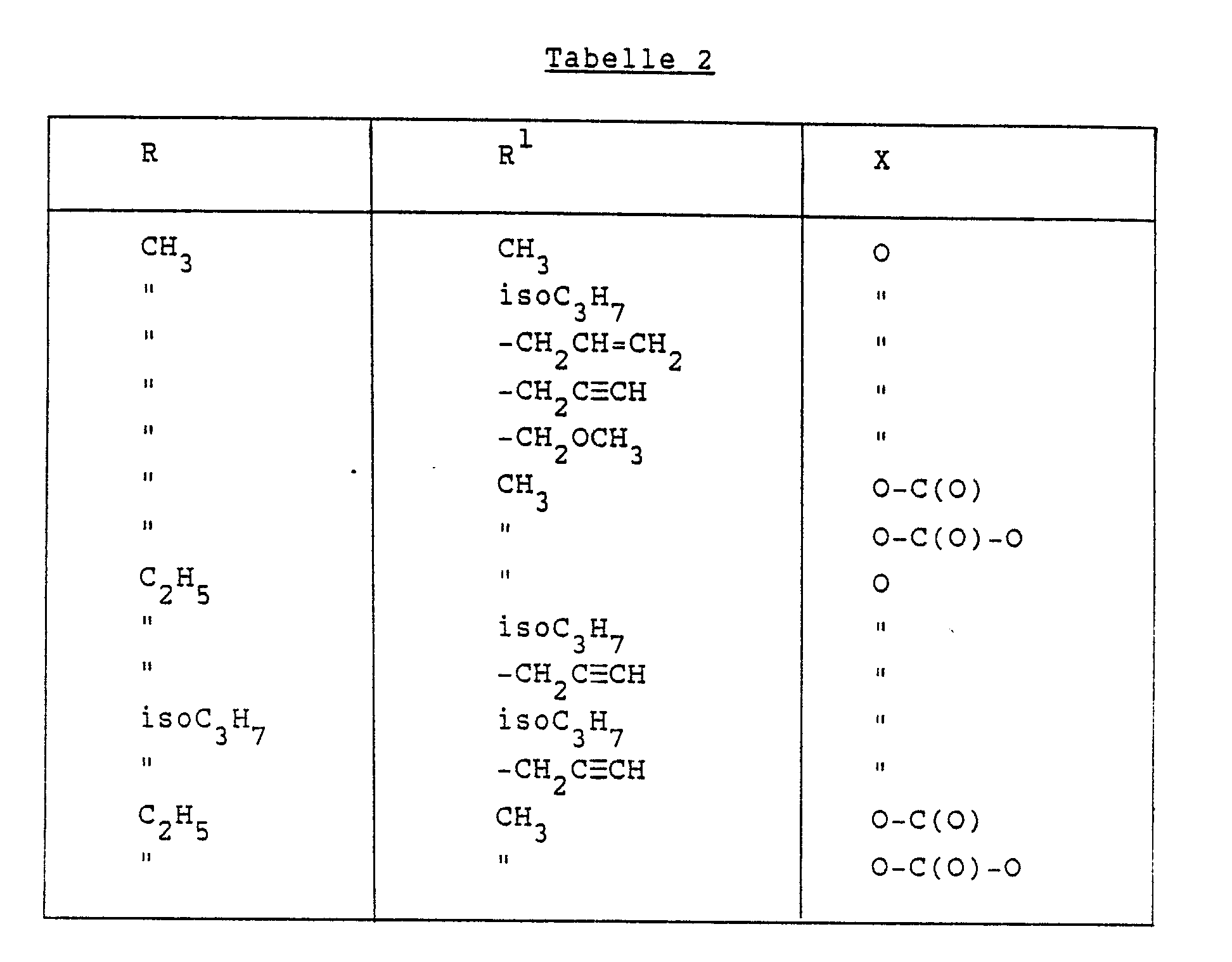
- Das erfindungsgemässe Verfahren zur Herstellung der Enoläther ist dadurch gekennzeichnet, dass man
- a) ein Uracilderivat der allgemeinen Formel

mit einem Alkohol ROH in Gegenwart einer organischen Base oder mit dem Metallalkoholat der allgemeinen Formel
RO⊖M⊕ III
worin R C1-4-Alkyl, C2-4-Alkenyl oder C3 oder 4-Alkinyl und M⊕ ein Aequivalent eines Metallions bedeuten,
behandelt, oder - b) ein 3-Aryluracil der oben angegebenen allgemeinen Formel Iʹ, in der X O oder C(O)-O bedeutet, unter basischen Reaktionsbedingungen einer entsprechenden Alkylierung unterwirft, oder
- c) in einem Uracilderivat der allgemeinen Formel

die Hydroxygruppe in an sich bekannter Weise durch den Substituenten Xʹ-R¹ ersetzt, worin Xʹ für O, O-C(O) oder O-C(O)-O steht, oder - d) eine Benzoesäure der allgemeinen Formel

oder ein reaktionsfähiges Derivat davon entsprechend verestert, - Bei der Verfahrensvariante a) steht der Ausdruck "Metallion" insbesondere für ein Alkalimetallion, z.B. das Natrium- oder Kaliumion, oder ein Erdalkalimetallion, z.B. das Calcium- oder Magnesiumion. Das Natriumion ist das bevorzugte Metallion. Im Falle der Verwendung des Alkohols ROH eignet sich als Base insbesondere eine organische tertiäre Base, wie Triäthylamin oder Pyridin.
- Die Umsetzung erfolgt zweckmässigerweise in einem Ueberschuss an dem entsprechenden Alkohol ROH als Verdünnungsmittel und bei Temperaturen zwischen 0°C und 50°C, vorzugsweise bei Raumtemperatur.
- Die so erhaltene erfindungsgemässe Verbindung kann nach Aufarbeiten des Reaktionsgemisches nach an sich bekannten Methoden, z.B. Säulenchromatographie und/oder Kristallisieren, isoliert und gereinigt werden.
- Diese Verfahrensvariante eignet sich vorzugsweise zur Herstellung derjenigen erfindungsgemässen Verbindungen Ia und Ib, in denen X O oder C(O)-O bedeutet.
- Die Umsetzung nach Verfahrensvariante b) führt zu Endprodukten der Formel Ia, in denen X O oder C(O)-O bedeutet.
- Als Alkylierungsmittel (worunter Mittel zur Einführung einer Alkyl-, einer Alkenyl- bzw. einer Alkinylgruppe zu verstehen sind) für diese Verfahrensvariante wird zweckmässigerweise ein C1-4-Alkyl-, C2-4-Alkenyl- bzw. C3 oder 4-Alkinylhalogenid, insbesondere das diesbezügliche Chlorid oder Bromid, oder -Sulfat verwendet. Die Umsetzung wird zweckmässigerweise in Gegenwart eines inerten aprotischen oder protischen Lösungsmittels, wie eines niederen Alkohols, z.B. Aethanol; eines aliphatischen oder cyclischen Aethers, z.B. 1,2-Dimethoxyäthan, Tetrahydrofuran oder Dioxan; eines aliphatischen Ketons, z.B. Aceton; Acetonitril; Dimethylformamid; oder Dimethylsulfoxid, oder eines Gemisches eines oder mehrerer dieser Lösungsmittel mit Wasser, sowie in Gegenwart einer Base, wie Natriumhydrid, eines Alkalimetallcarbonats, insbesondere Natriumcarbonat oder Kaliumcarbonat, oder eines Alkalimetallhydrogencarbonats, insbesondere Natriumhydrogencarbonat oder Kaliumhydrogencarbonat, bei Temperaturen zwischen 0°C und 100°C, vorzugsweise zwischen der Raumtemperatur und 50°C, durchgeführt. Aceton, Acetonitril und Dimethylformamid sind die bevorzugten Lösungsmittel. Das gewünschte Endprodukt der Formel Ia kann nach Aufarbeiten des Reaktionsgemisches von allfälligen verbleibenden Ausgangsmaterialien und/oder Nebenprodukten nach an sich bekannten Methoden, z.B. Säulenchromatographie und/oder Kristallisieren, freigesetzt werden.
- Die Umsetzung nach Verfahrensvariante c) führt zu Endprodukten der Formel Ia bzw. Ib, in denen X O, O-C(O) oder O-C(O)-O bedeutet. Bei dieser Verfahrensvariante handelt es sich also je nach Natur des Restes Xʹ-R¹ um eine Alkylierung (worunter die Einführung einer Alkyl-, Alkenyl-, Alkinyl-, Alkoxyalkyl- oder Alkylidenaminooxyalkylgruppe zu verstehen ist) bzw. Acylierung, die in an sich bekannter Weise durchgeführt werden kann. Nachträgliche Reaktionsstufen und/oder andersartige Substitutions- oder Additionsreaktionen an der Gruppe Xʹ-R¹, die zu weiteren Gruppen Xʹ-R¹ führen, sind allerdings nicht aus dieser Verfahrensvariante ausgeschlossen.
- Als typisches Beispiel einer Alkylierung wird eine Verbindung der Formel IVa oder IVB in eine Verbindung der Formel Ia bzw. Ib, in der X-R¹ C2-6-Alkinoxy, z.B. Propargyloxy, bedeutet, übergeführt. Dies wird zweckmässigerweise durchgeführt, indem man die Verbindung IVa oder IVb in einem inerten aprotischen, polaren Lösungsmittel, wie biespielsweise Aceton, Dimethylformamid, Dimethylsulfoxid oder Acetonitril, mit einem C2-6-Alkinylhalogenid, insbesondere dem Chlorid oder Bromid, und einer Base, z.B. Natrium oder Kaliumcarbonat, bei Temperaturen zwischen der Raumtemperatur und ca. 80°C behandelt.
- Als typisches Beispiel einer Acylierung wird eine Verbindung der Formel IVa oder IVb in eine Verbindung der Formel Ia bzw. Ib, in der X-R¹ C2-9-Alkoxycarbonyloxy, z.B. Methoxycarbonyloxy, bedeutet, übergeführt. Die Umsetzung wird zweckmässigerweise durchgeführt, indem man die Verbindung IVa oder IVb in einem inerten aprotischen Lösungsmittel, wie Dimethylformamid, Dimethylsulfoxid, Acetonitril, einem aliphatischen Aether, z.B. 1,2-Dimethoxyäthan, oder einem chlorierten, aliphatischen Kohlenwasserstoff, z.B. Methylenchlorid, mit einer Base, wie beispielsweise Natriumhydrid, Triäthylamin oder Pyridin, versetzt und anschliessend mit einem C2-9-Alkoxycarbonylhalogenid in demselben Lösungsmittel bei Temperaturen zwischen der Raumtemperatur und ca. 80°C behandelt. Vorzugsweise wird in Methylenchlorid in Gegenwart von Triäthylamin oder Pyridin bei Raumtemperatur gearbeitet und anschliessend Chlorameisensäure-methylester auch bei Raumtemperatur eingesetzt.
- Die Umsetzung nach Verfahrensvariante d) führt zu Endprodukten der Formel Ia bzw. Ib, in denen X C(O)-O bedeutet. Bei dieser Verfahrensvariante handelt es sich um eine Veresterung einer substituierten Benzoesäure bzw. eines reaktionsfähigen Derivats davon, die ebenfalls nach an sich bekannten Methoden durchgeführt werden kann. So wird beispielsweise ein Salz der Benzoesäure der Formel Va bzw. Vb mit einem C1-8-Alkyl-, C2-6-Alkenyl-, C2-6-Alkinyl- oder C2-8-Alkoxyalkyl-chlorid, -bromid, -jodid, -sulfat, -mesylat oder -tosylat bzw. mit dem entsprechenden Derivat des [(Alkylidenamino)oxy]methanols oder -äthanols R⁶R⁷C=N-O-(CH₂)m-OH in einem inerten Verdünnungsmittel bei Temperaturen zwischen der Raumtemperatur und 100°C, z.B. bei der Rückflusstemperatur des Reaktionsgemisches, vorzugsweise im Temperaturbereich von 40°C bis 70°C, umgesetzt. Es kommen als Salze der Benzoesäure der Formel Va bzw. Vb insbesondere Alkalimetallsalze, z.B. das Natrium-, Kalium- oder Lithiumsalz, Erdalkalimetallsalze, z.B. das Magnesium-, Calcium- oder Bariumsalz, und Salze mit organischen Basen, wie tertiäre Amine, z.B. Triäthylamin, 1,5-Diaza-bicyclo[4,3,0]non-5-en, 1,8-Diaza-bicyclo[5,4,0]undec-7-en und 1,4-Diaza-bicyclo[2,2,2]octan, in Frage, wobei die Alkalimetallsalze, insbesondere das Natriumsalz und das Kaliumsalz, bevorzugt sind. Die verwendbaren Verdünnungsmittel sind vorzugsweise inerte organische Lösungsmittel, wie niedere Alkanole, z.B. Aethanol, aliphatische und cyclische Aether, z.B. Diäthyläther, Tetrahydrofuran und Dioxan, Ketone, z.B. Aceton und 2-Butanon, Dimethylformamid, Dimethylsulfoxid und Hexamethylphosphorsäuretriamid. Das Salz kann in situ hergestellt werden, indem man die Säure mit einer geeigneten anorganischen Base, z.B. einem Alkalimetall- oder Erdalkalimetallcarbonat oder -hydrogencarbonat, bzw. organischen Base, zum Salz umsetzt und dies anschliessend im gleichen Reaktionsmedium mit dem zweiten Reaktionspartner reagieren lässt.
- Im Falle der Verwendung eines Säurehalogenids der Benzoesäure der Formel Va bzw. Vb als reaktionsfähiges Derivat wird dies zweckmässigerweise mit einem C1-8-Alkanol, C2-6-Alkenol, C2-6-Alkinol, C2-8-Alkoxyalkanol oder Alkohol R⁶R⁷C=N-O-(CH₂)m-OH in einem inerten organischen Lösungsmittel, wie einem aliphatischen oder cyclischen Aether, z.B. Diäthyläther, Tetrahydrofuran oder Dioxan, einem aliphatischen oder aromatischen Kohlenwasserstoff, z.B. n-Hexan, Benzol oder Toluol, oder einem halogenierten, insbesondere chlorierten, Kohlenwasserstoff, z.B. Methylenchlorid, Chloroform oder Tetrachlorkohlenstoff, bei Temperaturen von etwa -20°C bis 100°C, vorzugsweise von 0°C bis 50°C, umgesetzt. Zudem wird zweckmässigerweise in Gegenwart eines säurebindenden Mittels gearbeitet, wie einer organischen Base, z.B. Triäthylamin, Pyridin, 1,5-Diaza-bicyclo[4,3,0]non-5-en, 1,8-Diaza-bicyclo[5,4,0]undec-7-en oder 1,4-Diaza-bicyclo[2,2,2]octan. Das Säurehalogenid ist vorzugsweise das Säurechlorid.
- Als weitere in Frage kommende reaktionsfähige Derivate der Benzoesäure der Formel Va bzw. Vb seien der entsprechende O-Acyl-1,3-dicyclohexylisoharnstoff und das entsprechende N-Acylimidazol oder Säureanhydrid genannt. Solche Derivate können wie das Säurehalogenid mit einem C1-8-Alkanol, C2-6-Alkenol, C2-6-Alkinol, C2-8-Alkoxyalkanol oder Alkohol R⁶R⁷C=N-O-(CH₂)m-OH umgesetzt werden, um zu den gewünschten Benzoesäureestern zu gelangen. In diesen Fällen erübrigt sich jedoch die Verwendung eines säurebindenden Mittels.
- Die Ausgangsmaterialien der Formeln IIa und IIb, die neu sind, können aus den oben angegebenen 3-Aryluracilen der Formel Iʹ hergestellt werden, und zwar dadurch, dass man ein solches 3-Aryluracil mit einem Chlorierungs- bzw. Bromierungsmittel behandelt. Zu diesem Zwecke wird insbesondere Phosphorpentachlorid oder Phosphoroxychlorid bzw. Phosphorpentabromid oder Phosphorylbromid als Halogenierungsmittel verwendet. Gegebenenfalls wird ein Gemisch von Phosphorpentachlorid und Phosphoroxychlorid bzw. von Phosphorpentabromid und Phosphorylbromid eingesetzt, wobei ein Ueberschuss an Phosphoroxychlorid bzw. Phosphorylbromid als Verdünnungsmittel dienen kann. Die Chlorierung bzw. Bromierung kann in Gegenwart eines inerten Verdünnungsmittels, insbesondere eines aprotischen organischen Lösungsmittels, wie eines aliphatischen oder aromatischen Kohlenwasserstoffes, z.B. n-Hexan, Benzol, Toluol oder eines Xylols; eines halogenierten aliphatischen Kohlenwasserstoffes, z.B. Methylenchlorid, Chloroform oder 1,2-Dichloräthan; oder eines halogenierten aromatischen Kohlenwasserstoffes, z.B. Chlorbenzol, sowie - insbesondere im Falle von Phosphoroxychlorid oder Phosphorylbromid - in Gegenwart einer organischen Base, wie eines tertiären Amins, z.B. Pyridin oder N,N-Dimethylanilin, durchgeführt werden. Die Reaktionstemperaturen liegen im allgemeinen zwischen 0°C und der Rückflusstemperatur des Reaktionsgemisches, vorzugsweise zwischen 20°C und 70°C.
- Auf diese Weise wird in gewissen Fällen ein Gemisch der beiden Verbindungen IIa und IIb erhalten. Solche Gemische können gegebenenfalls aufgetrennt und die einzelnen Isomeren der Umsetzung mit der Verbindung III unterworfen werden, oder aber man kann, vorzugsweise, das Isomerengemisch IIa/IIb mit der Verbindung III umsetzen und danach das Endprodukt gegebenenfalls in die einzelnen Verbindungen Ia und Ib auftrennen. Solche Trennungen können nach an sich bekannten Methoden durchgeführt werden.
- Die neuen Verbindungen IIa und IIb bilden einen weiteren Gegenstand der vorliegenden Erfindung.
- Die 3-Aryluracile der Formel Iʹ sind ebenfalls neu; diese können in an sich bekannter Weise hergestellt werden, beispielsweise gemäss dem nachfolgenden Reaktionsschema, in dem R¹-R⁵ und X die oben angegebenen Bedeutungen besitzen, und R⁸ und R⁹ jeweils nieder Alkyl, vorzugsweise C1-4-Alkyl, bedeuten:

- Die Verbindungen der Formeln VI und VII werden zweckmässigerweise in einem im wesentlichen wasserfreien Verdünnungsmittel und in Gegenwart eines sauren Katalysators bei erhöhter Temperatur miteinander umgesetzt. Als Verdünnungsmittel kommen insbesondere mit Wasser Azeotrope bildende organische Lösungsmittel, wie Aromaten, z.B. Benzol, Toluol und Xylole; halogenierte Kohlenwasserstoffe, wie Methylenchlorid, Chloroform, Tetrachlorkohlenstoff und Chlorbenzol; aliphatische und cyclische Aether, wie 1,2-Dimethoxyäthan, Tetrahydrofuran und Dioxan; und Cyclohexan, und als saure Katalysatoren insbesondere starke Mineralsäuren, wie Schwefelsäure und Salzsäure; organische Säuren, wie p-Toluolsulfonsäure; Phosphor enthaltende Säuren, wie Orthophosphorsäure und Polyphosphorsäure; und saure Kationenaustauscher, wie "Amberlyst 15" (Fluka), in Frage. Man arbeitet im allgemeinen in einem Temperaturbereich von etwa 70°C bis 120°C, vorzugsweise bei der Rückflusstemperatur der Reaktionsgemisches. Unter diesen Reaktionsbedingungen wird die erwünschte rasche Entfernung des in der Reaktion gebildeten Wassers erzielt.
- Die Umsetzung der Verbindungen der Formeln VIII und IX miteinander erfolgt zweckmässigerweise in Gegenwart eines im wesentlichen wasserfreien aprotischen organischen Lösungsmittels, wie eines aliphatischen oder cyclischen Aethers, z.B. Diäthyläther, 1,2-Dimethoxyäthan, Tetrahydrofuran oder Dioxan, eines aliphatischen oder aromatischen Kohlenwasserstoffs, z.B. n-Hexan, Benzol, Toluol oder eines Xylols, oder eines halogenierten, aliphatischen Kohlenwasserstoffs, z.B. Methylenchlorid, Chloroform, Tetrachlorkohlenstoff oder 1,2-Dichloräthan; eines aprotischen, polaren Lösungsmittels, wie Dimethylformamid, Hexamethylphosphorsäuretriamid oder Dimethylsulfoxid; oder eines Gemisches zweier oder mehrerer der erwähnten Lösungsmittel, sowie gegebenenfalls in Gegenwart einer Base, insbesondere einer organischen tertiären Base, wie Triäthylamin oder Pyridin, wobei letzteres sowohl als Lösungsmittel wie auch als Base dienen kann, oder eines Metallhydrids, wie Natrium- oder Kaliumhydrid. Die Reaktionstemperaturen sind vorzugsweise im Bereich von etwa -70°C bis 50°C, wobei besonders bevorzugt bei Temperaturen zwischen -30°C und der Raumtemperatur gearbeitet wird.
- Die Umsetzung der Verbindungen der Formeln VIII und X miteinander erfolgt zweckmässigerweise in einem aprotischen polaren Verdünnungsmittel, wie Dimethylformamid, 2-Butanon, Dimethylsulfoxid oder Acetonitril, in Gegenwart einer Base, wie eines Alkalimetall- oder Erdalkalimetallalkoholats oder -carbonats, insbesondere Natriumalkanolat oder -carbonat, oder eines Metallhydrids, insbesondere Lithium oder Natriumhydrid, bei Temperaturen zwischen 80°C und 180°C, vorzugsweise bei der Rückflusstemperatur des Reaktionsgemisches. Falls ein Alkoholat als Base verwendet wird, destilliert man zweckmässigerweise den im Laufe der Reaktion freigesetzten Alkohol kontinuierlich ab. Bei dieser Methode wird die so hergestellte Verbindung der Formel XI in der Regel in situ hergestellt, da die verwendeten Reaktionsbedingungen die Cyclisierung der Verbindung XI über das Salz zu der Verbindung der Formel Iʹ begünstigen.
- Die Cyclisierung der Verbindung der Formel XI, wenn diese nicht bereits in situ geschieht, kann zweckmässigerweise durchgeführt werden, indem man diese in einem inerten protischen organischen Lösungsmittel, wie einem Alkohol, z.B. Methanol, Aethanol oder Isopropanol; einem inerten aprotischen organischen Lösungsmittel, wie einem aliphatischen oder cyclischen Aether, z.B. 1,2-Dimethoxyäthan, Tetrahydrofuran oder Dioxan, oder einem Aromaten, z.B. Benzol oder Toluol; einem inerten aprotischen, polaren organischen Lösungsmittel, z.B. Dimethylformamid oder Dimethylsulfoxid, wobei solche Lösungsmittel gegebenenfalls im Zweiphasen-Gemisch mit einem Kohlenwasserstoff, z.B. n-Hexan, verwendet werden können; oder Wasser mit einer Base bei Temperaturen zwischen Raumtemperatur und der Rückflusstemperatur des Reaktionsgemisches behandelt. Als Basen kommen vorzugsweise Natriumalkoholate, Alkalimetallhydroxide, insbesondere Natriumhydroxid und Kaliumhydroxid, Alkalimetallcarbonate, insbesondere Natriumcarbonat und Kaliumcarbonat, und Natriumhydrid in Betracht. Bei der Verwendung der letztgenannten Base ist das Lösungsmittel vorzugsweise ein aliphatischer oder cyclischer Aether, Dimethylformamid oder Dimethylsulfoxid.
- Nach Beendigung der Cyclisierung liegt das Produkt je nach Natur der verwendeten Base in Form des entsprechenden Metallsalzes vor, beispielsweise im Falle der oben erwähnten Basen in Form des entsprechenden Alkalimetallsalzes. Das nach der Cyclisierung entstandene Gemisch wird dann angesäuert, um die Ueberführung des Salzes in die Verbindung Iʹ zu erzielen. Zu diesem Zwecke verwendet man vorzugsweise eine Mineralsäure, wie Salzsäure, oder eine starke organische Säure, wie Essigsäure oder p-Toluolsulfonsäure. Das Produkt kann dann in an sich bekannter Weise isoliert und gegebenenfalls gereinigt werden.
- Auch die Uracilderivate der Formeln IVa und IVb sind neu; diese können durch säurekatalysierte Hydrolyse der entsprechenden geschützten Phenole der Formel

hergestellt werden. Die Hydrolyse erfolgt zweckmässigerweise in Gegenwart von Schwefelsäure als saurem Katalysator, in einem chlorierten aliphatischen Kohlenwasserstoff, vorzugs weise Methylenchlorid, als Lösungsmittel und bei Temperaturen zwischen -30°C und 30°C, vorzugsweise zwischen 0°C und Raumtemperatur. Ohne zusätzliches Lösungsmittel kann überschüssige Schwefelsäure selbst als Lösungsmittel dienen. Bei den obigen Ausgangsmaterialien der Formeln Iaʹ und Ibʹ handelt es sich um eine Untergruppe von Verbindungen der Formel Ia bzw. Ib. Die neuen Verbindungen IVa und IVb bilden einen weiteren Gegenstand der vorliegenden Erfindung. - Ebenfalls neu sind die Benzoesäuren der Formeln Va und Vb sowie deren reaktionsfähige Derivate. Die Benzoesäuren können durch Hydrolyse der entsprechenden Enoläther der oben angegebenen Formeln Ia und Ib, in denen X C(O)-O bedeutet, hergestellt werden. Diese Hydrolyse kann nach an sich bekannten Methoden erfolgen, insbesondere unter Verwendung einer anorganischen Säure und gegebenenfalls in Gegenwart eines organischen Lösungsmittels. Als Säuren kommen vorzugsweise Schwefelsäure, als organische Lösungsmittel gegebenenfalls chlorierte aliphatische Kohlenwasserstoffe, z.B. Methylenchlorid und Tetrachlormethan, in Frage. Ohne zusätzliches Lösungsmittel kann überschüssige Schwefelsäure selbst als Lösungsmittel dienen. Die Reaktionstemperaturen liegen im allgemeinen zwischen -30°C und 30°C, vorzugsweise zwischen 0°C und der Raumtemperatur. Ausgehend von den Benzoesäuren können deren reaktionsfähige Derivate nach an sich bekannten Methoden hergestellt werden.
- Die in den Verfahrensvarianten a) und b) benötigten Alkohole ROH, Alkoholate der Formel III bzw. Alkylierungsmittel sowie die in dem Reaktionsschema involvierten Ausgangsmaterialien der Formeln VI, VII, VIII, IX und X sind entweder bekannt oder können nach an sich bekannten Methoden hergestellt werden.
- Die erfindungsgemässen Enoläther besitzen herbizide Eigenschaften und eignen sich zur Bekämpfung von Unkräutern, einschliesslich Ungräsern, insbesondere Setaria faberii, Digitaria sanguinalis, Poa annua, Chenopodium album, Amaranthus retroflexus, Abutilon theopharasti, Sinapsis alba, Datura stramonium und Sorghum halepense, in diversen Nutzpflanzenkulturen, insbesondere in Baumwolle-, Reis-, Mais-, Getreide- und Soyakulturen. Zudem sind die Verbindungen sowohl Vorauflauf- als auch Nachauflauf-Herbizide.
- Auch die Verbindungen der Formeln IVa und IVb besitzen herbizide Eigenschaften und können auf ähnliche Weise wie die erfindungsgemässen Enoläther zur Bekämpfung von Unkräutern, insbesondere den obenerwähnten, eingesetzt werden. Im folgenden werden die erfindungsgemässen Enoläther (Verbindungen der Formeln Ia und Ib) und Verbindungen der Formeln IVa und IVb lediglich als (erfindungsgemässe) Wirkstoffe bezeichnet.
- Ueblicherweise genügt eine Konzentration von 0,005-6,0 kg Wirkstoff/ha, vorzugsweise 0,05-2,0 kg Wirkstoff/ha, um den gewünschten herbiziden Effekt zu erzielen.
- Das erfindungsgemässe Unkrautbekämpfungsmittel ist dadurch gekennzeichnet, dass es eine wirksame Menge mindestens eines erfindungsgemässen Wirkstoffes sowie Formulierungshilfsstoffe enthält. Das Mittel enthält zweckmässigerweise zumindest einen der folgenden Formulierungshilfsstoffe: feste Trägerstoffe; Lösungs- bzw. Dispersionsmittel; Tenside (Netz- und Emulgiermittel); Dispergatoren (ohne Tensidwirkung); und Stabilisatoren. Unter Verwendung solcher und anderer Hilfsstoffe können die erfindungsgemässen Wirkstoffe in die üblichen Formulierungen übergeführt werden, wie Stäube, Pulver, Granulate, Lösungen, Emulsionen, Suspensionen, emulgierbare Konzentrate, Pasten und dergleichen.
- Die erfindungsgemässen Wirkstoffe sind im allgemeinen wasserunlöslich und können nach den für wasserunlösliche Verbindungen üblichen Methoden unter Verwendung der diesbezüglichen Formulierungshilfsstoffe konfektioniert werden. Die Herstellung der Mittel kann in an sich bekannter Weise durchgeführt werden, z.B. durch Vermischen des jeweiligen Wirkstoffes mit festen Trägerstoffen, durch Auflösen oder Suspendieren in geeigneten Lösungs- bzw. Dispersionsmitteln, eventuell unter Verwendung von Tensiden als Netz- oder Emulgiermitteln und/oder von Dispergatoren, durch Verdünnen bereits vorbereiteter emulgierbarer Konzentrate mit Lösungs- bzw. Dispersionsmitteln usw.
- Als feste Trägerstoffe kommen im wesentlichen in Frage: natürliche Mineralstoffe, wie Kreide, Dolomit, Kalkstein, Tonerden und Kieselsäure und deren Salze (beispielsweise Kieselgur, Kaolin, Bentonit, Talkum, Attapulgit und Montmorrillonit); synthetische Mineralstoffe, wie hochdisperse Kieselsäure, Aluminiumoxid und Silikate; organische Stoffe, wie Cellulose, Stärke, Harnstoff und Kunstharze; und Düngemittel, wie Phosphate und Nitrate, wobei solche Trägerstoffe z.B. als Pulver oder als Granulate vorliegen können.
- Als Lösungs- bzw. Dispersionsmittel kommen im wesentlichen in Frage: Aromaten, wie Benzol, Toluol, Xylole und Alkylnaphthaline; chlorierte Aromaten und chlorierte aliphatische Kohlenwasserstoffe, wie Chlorbenzole, Chloräthylene und Methylenchlorid; aliphatische Kohlenwasserstoffe, wie Cyclohexan und Paraffine, z.B. Erdölfraktionen; Alkohole, wie Butanol und Glykol, sowie deren Aether und Ester; Ketone, wie Aceton, Methyläthylketon, Methylisobutylketon und Cyclohexanon; und stark polare Lösungs- bzw. Dispersionsmittel, wie Dimethylformamid, N-Methylpyrrolidon und Dimethylsulfoxid, wobei solche Lösungsmittel vorzugsweise Flammpunkte von mindestens 30°C und Siedepunkte von mindestens 50°C aufweisen, und Wasser. Unter den Lösungs- bzw. Dispersionsmitteln kommen auch in Frage sogenannte verflüssigte gasförmige Streckmittel oder Trägerstoffe, die solche Produkte sind, welche bei Raumtemperatur und unter Normaldruck gasförmig sind. Beispiele solcher Produkte sind insbesondere Aerosol-Treibgase, wie Halogenkohlenwasser stoffe, z.B. Dichlordifluormethan. Liegt das erfindungsgemässe Unkrautbekämpfungsmittel in Form einer Druckgaspackung vor, so wird zweckmässigerweise zusätzlich zum Treibgas ein Lösungsmittel verwendet.
- Die Tenside (Netz- und Emulgiermittel) können nicht-ionische Verbindungen sein, wie Kondensationsprodukte von Fettsäuren, Fettalkoholen oder fettsubstituierten Phenolen mit Aethylenoxid; Fettsäureester und -äther von Zuckern oder mehrwertigen Alkoholen; die Produkte, die aus Zuckern oder mehrwertigen Alkoholen durch Kondensation mit Aethylenoxid erhalten werden; Blockpolymere von Aethylenoxid und Propylenoxid; oder Alkyldimethylaminoxide.
- Die Tenside können auch anionische Verbindungen sein, wie Seifen; Fettsulfatester, z.B. Dodecylnatriumsulfat, Octadecylnatriumsulfat und Cetylnatriumsulfat; Alkylsulfonate, Arylsulfonate und fettaromatische Sulfonate, wie Alkylbenzolsulfonate, z.B. Calcium-dodecylbenzolsulfonat, und Butylnaphthalinsulfonate; und komplexere Fettsulfonate, z.B. die Amidkondensationsprodukte von Oelsäure und N-Methyltaurin und das Natriumsulfonat von Dioctylsuccinat.
- Die Tenside können schliesslich kationische Verbindungen sein, wie Alkyldimethylbenzylammoniumchloride, Dialkyldimethylammoniumchloride, Alkyltrimethylammoniumchloride und äthoxylierte quaternäre Ammoniumchloride.
- Als Dispergatoren (ohne Tensidwirkung) kommen im wesentlichen in Frage: Lignin, Natrium- und Ammoniumsalze von Ligninsulfonsäuren, Natriumsalze von Maleinsäureanhydrid-Diisobutylen-Copolymeren, Natrium- und Ammoniumslaze von sulfonierten Polykondensationsprodukten aus Naphthalin und Formaldehyd, und Sulfitablaugen.
- Als Dispergatoren, die sich insbesondere als Verdickungs- bzw. Antiabsetzmittel eignen, können z.B. Methyl cellulose, Carboxymethylcellulose, Hydroxyäthylcellulose, Polyvinylalkohol, Alginate, Caseinate und Blutalbumin eingesetzt werden.
- Beispiele von geeigneten Stabilisatoren sind säurebindende Mittel, z.B. Epichlorhydrin, Phenylglycidäther und Soyaepoxide; Antioxidantien, z.B. Gallussäureester und Butylhydroxytoluol; UV-Absorber, z.B. substituierte Benzophenone, Diphenylacrylonitrilsäureester und Zimtsäureester; und Deaktivatoren, z.B. Salze der Aethylendiaminotetraessigsäure und Polyglykole.
- Die erfindungsgemässen Unkrautbekämpfungsmittel können zusätzlich zu den erfindungsgemässen Wirkstoffen Synergisten und andere Wirkstoffe, z.B. Insektizide, Akarizide, Fungizide, Pflanzenwachstumsregulatoren und Düngemittel, enthalten. Solche Kombinationsmittel eignen sich zur Verstärkung der Aktivität bzw. zur Verbreiterung der Wirkungsspektrums.
- Die erfindungsgemässen Unkrautbekämpfungsmittel enthalten im allgemeinen zwischen 0,01 und 95 Gewichtsprozent, vorzugsweise zwischen 0,5 und 75 Gewichtsprozent eines bzw. mehrerer erfindungsgemässen Wirkstoffe. Sie können z.B. in einer Form vorliegen, die sich für die Lagerung und den Transport eignet. In solchen Formulierungen, z.B. emulgierbaren Konzentraten, ist die Wirkstoffkonzentration normalerweise im höheren Bereich, vorzugsweise zwischen 1 und 50 Gewichtsprozent, insbesondere zwischen 10 und 20 Gewichtsprozent. Diese Formulierungen können dann, z.B. mit gleichen oder verschiedenen inerten Stoffen, bis zu Wirkstoffkonzentrationen verdünnt werden, die sich für den praktischen Gebrauch eignen, also vorzugsweise ca. 0,01 bis 10 Gewichtsprozent, insbesondere ca. 0,5 bis 5 Gewichtsprozent. Die Wirkstoffkonzentrationen können jedoch auch kleiner oder grösser sein.
- Wie oben erwähnt, kann die Herstellung der erfindungsgemässen Unkrautbekämpfungsmittel in an sich bekannter Weise durchgeführt werden.
- Zur Herstellung pulverförmiger Präparate kann der erfindungsgemässe Wirkstoff mit festem Trägerstoff vermischt werden, z.B. durch Zusammenmahlen; oder man kann den festen Trägerstoff mit einer Lösung oder Suspension des Wirkstoffes imprägnieren und dann das Lösungs- bzw. Dispersionsmittel durch Abdunsten, Erhitzen oder Absaugen unter vermindertem Druck entfernen. Durch Zusatz von Tensiden bzw. Dispergatoren kann man solche pulverförmige Mittel mit Wasser leicht benetzbar machen, so dass sie in wässrige Suspensionen, die sich z.B. als Spritzmittel eignen, übergeführt werden können.
- Der erfindungsgemässe Wirkstoff kann auch mit einem Tensid und einem festen Trägerstoff zur Bildung eines netzbaren Pulvers vermischt werden, welches in Wasser dispergierbar ist, oder er kann mit einem festen vorgranulierten Trägerstoff zur Bildung eines granulatförmigen Produktes vermischt werden.
- Wenn gewünscht, kann der erfindungsgemässe Wirkstoff in einem mit Wasser nicht mischbaren Lösungsmittel, wie beispielsweise einem hochsiedenden Kohlenwasserstoff, gelöst werden, das zweckmässigerweise gelöste Emulgiermittel enthält, so dass die Lösung bei Zugabe zu Wasser selbstemulgierend wirkt. Andernfalls kann der Wirkstoff mit einem Emulgiermittel vermischt und das Gemisch dann mit Wasser auf die gewünschte Konzentration verdünnt werden. Zudem kann der Wirkstoff in einem Lösungsmittel gelöst und danach mit einem Emulgiermittel gemischt werden. Ein solches Gemisch kann ebenfalls mit Wasser auf die gewünschte Konzentration verdünnt werden. Auf diese Weise erhält man emulgierbare Konzentrate bzw. gebrauchsfertige Emulsionen.
- Die Verwendung der erfindungsgemässen Unkrautbekämpfungsmittel, die einen weiteren Gegenstand der vorliegenden Erfindung bildet, kann nach üblichen Applikationsmethoden, wie Spritzen, Sprühen, Stäuben, Giessen oder Streuen, erfolgen. Das erfindungsgemässe Verfahren zur Bekämpfung von Unkräutern ist dadurch gekennzeichnet, dass man das gegen Unkräuter zu schützende Gut und/oder die Unkräuter mit einer wirksamen Menge eines erfindungsgemässen Wirkstoffes bzw. eines erfindungsgemässen Unkrautbekämpfungsmittels behandelt.
- Die nachfolgenden Beispiele dienen zur näheren Erläuterung der Erfindung.
- Zu einer Lösung von 3,35 g 2-Chlor-5-3,6-dihydro-2,6-dioxo-4-pentafluoräthyl -1(2H)-pyrimidinyl]-4-fluorbenzoesäure-isopropylester und 10 ml Phosphoroxychlorid werden unter Rühren bei 25°C 1,3 ml Dimethylanilin zugefügt, und das Reaktionsgemisch wird 5 Stunden bei 75°C gerührt. Anschliessend werden weitere 1,3 g Dimethylanilin zugefügt, und das Gemisch wird 5 Stunden bei 75°C gerührt und danach 1 Stunde bei der Rückflusstemperatur erhitzt. Dann wird das Gemisch unter vermindertem Druck bei 70°C zur Trockene eingedampft und der Rückstand in 100 ml Diäthyläther gelöst und die Lösung dreimal mit je 50 ml Eiswasser ausgeschüttelt. Die organische Phase wird über wasserfreiem Natriumsulfat getrocknet und unter vermindertem Druck zur Trockene eingedampft.
- Der Rückstand, ein Gemisch von 2-Chlor-5-[2-chlor-6-oxo-4-pentafluoräthyl -1(6H)-pyrimidinyl]-4-fluorbenzoesäure-isopropylester und 2-Chlor-5-[6-chloro-2-oxo-4-pentafluoräthyl -1(2H)-pyrimidinyl]-4-fluorbenzoesäure-isopropylester, wird in 20 ml Methanol gelöst, und der Lösung werden unter Rühren bei 25°C 3,8 ml einer 2N-Natriummethylat-Lösung zugefügt. Die Temperatur des Reaktionsgemisches steigt auf 30°C an. Anschliessend wird 30 Minuten nachgerührt und unter vermindertem Druck zur Trockene eingedampft. Der Rückstand wird an einer Kieselgel-Säule unter Verwendung von n-Hexan/Diäthyläther (3:1) chromatographisch aufgetrennt. Die erste Fraktion, die noch etwas Diäthylanilin enthält, wird in Diäthyläther gelöst, und die Lösung mit 2N-Salzsäure ausgeschüttelt, mit Wasser neutral gewaschen und über wasserfreiem Natriumsulfat getrocknet. Die organische Phase wird unter vermindertem Druck zur Trockene eingedampft und der Rückstand aus n-Hexan umkristallisiert. Man erhält den 2-Chlor-4-fluor-5-[2-methoxy-6-oxo-4-pentafluoräthyl -1(6H)-pyrimidinyl]-benzoesäure-isopropylester, Smp. 82-84°C. Durch weiteres Eluieren der Säule mit n-Hexan/Diäthyläther (1:2) erhält man die zweite Fraktion, welche aus Diäthyläther/n-Hexan umkristallisiert wird. Auf diese Weise erhält man auch noch den 2-Chlor-4-fluor-5-[6-methoxy-2-oxo-4-pentafluoräthyl -1(2H)-pyrimidinyl]-benzoesäure-isopropylester, Smp. 127-129°C.
- Zu einer Lösung von 0,21 g einer 55%-igen Natriumhydrid-Dispersion in 20 ml Isopropanol werden unter Rühren und Kühlen bei 0°C 2,0 g 2-Chlor-5-[2-chlor-6-oxo-4-trifluormethyl-1(6H)-pyrimidinyl] -4-fluorbenzoesäure-isopropylester zugefügt. Das Reaktionsgemisch wird 10 Minuten bei Raumtemperatur nachgerührt und unter vermindertem Druck zur Trockene eingedampft. Man löst den Rückstand in 50 ml Diäthyläther und wäscht die Lösung zweimal mit je 25 ml Wasser. Die organische Phase wird über wasserfreiem Natriumsulfat getrocknet und zur Trockene eingedampft und der Rückstand an einer Kieselgel-Säule unter Verwendung von n-Hexan/Diäthyläther (3:1) als Laufmittel chromatographisch gereinigt. Man erhält den 2-Chlor-4-fluor-5-[2-isopropoxy-6-oxo-4-trifluormethyl -1(6H)-pyrimidinyl]-benzoesäure-isopropyl ester, ¹H-NMR (CDCl₃, 400 MHz): 7,81 ppm (d,1H), 7.38 ppm (d,1H), 6.58 ppm (s,1H), 5.40 ppm (m,1H), 5,26 ppm (m,1H), 1.38 ppm (d,3H), 1.37 ppm (d,3H), 1,29 ppm (d,3H), 1,28 ppm (d,3H).
- In analoger Weiser erhält man beim Einsatz von:
- 2-Chlor-5-[2-chlor-6-oxo-4-trifluormethyl-1(6H)-pyrimidinyl]-4-fluorbenzoesäure-isopropylester und Aethanol den 5-[2-Aethoxy-6-oxo-4-trifluormethyl-1(6H)-pyrimidinyl]-2-chlor-4-fluorbenzoesäure-isopropylester, Smp. 115-117°C;
- 2-Chlor-5-[2-chlor-6-oxo-4-trifluormethyl-1(6H)-pyrimidinyl]-4-fluorbenzoesäure-isopropylester und einer Lösung von Natriumhydrid in Allylalkohol den 5-[2-Allyloxy-6-oxo-4-trifluormethyl-1(6H)-pyrimidinyl]-2-chlor-4-fluorbenzoesäure-isopropylester, Smp. 94-96°C;
- 2-Chlor-5-[2-chlor-6-oxo-4-trifluormethyl-1(6H)-pyrimidinyl]-4-fluorbenzoesäure-isopropylester und Propargylalkohol mit Pyridin den 2-Chlor-4-fluor-5-[6-oxo-2-(2-propinyloxy)-4-trifluormethyl-1(6H)-pyrimidinyl]-benzoesäure-isopropylester, Smp. 117°-119°C;
- 2-Chlor-5-[2-chlor-6-oxo-4-trifluormethyl-1(6H)-pyrimidinyl]-4-fluorbenzoesäure-äthylester und Natriumäthylat in Aethanol den 5-[2-Aethoxy-6-oxo-4-trifluormethyl-1(6H)-pyrimidinyl]-2-chlor-4-fluorbenzoesäure-äthylester, Smp. 94-96°C;
- 2-Chlor-5-[2-chlor-6-oxo-4-pentafluoräthyl-1(6H)-pyrimidinyl]-4-fluorbenzoesäure-isopropylester und Propargylalkohol mit Pyridin den 2-Chlor-4-fluor-5-[6-oxo-4-pentafluoräthyl-2-(2-propinyloxy)-1(6H)-pyrimidinyl]-benzoesäure-isopropylester, ¹H-NMR (CDCl₃, 400 MHz): 7,85 ppm (d,1H), 7,41 ppm (d,1H), 6,71 ppm (s,1H), 5,27 ppm (m,1H), 5,00 ppm (d,2H), 2.53 ppm (t,1H), 1,39 ppm (d,3H), 1,38 ppm (d,3H);
- 2-Chlor-5-[2-chlor-6-oxo-4-pentafluoräthyl-1(6H)-pyrimidinyl]-4-fluorbenzoesäure-isopropylester und Natriumäthylat in Aethanol den 5-[2-Aethoxy-6-oxo-4-pentafluoräthyl-1(6H)-pyrimidinyl]-2-chlor-4-fluorbenzoesäure-isopropylester, ¹H-NMR (CDCl₃, 400 MHz): 7,83 ppm (d,1H), 7,39 ppm (d,1H), 6,65 ppm (s,1H), 5,72 ppm (m,1H), 4,48 ppm (m,2H), 1,38 ppm (d,3H), 1,37 ppm (d,3H), 1,29 ppm (t,3H);
- 2-Chlor-5-[2-chlor-6-oxo-4-pentafluoräthyl-1(6H)-pyrimidinyl]-4-fluorbenzoesäure-isopropylester und Natriumisopropylat in Isopropanol den 2-Chlor-4-fluor-5-[2-isopropoxy-6-oxo-4-pentafluoräthyl-1(6H)-pyrimidinyl]-benzoesäure-isopropylester, ¹H-NMR (CDCl₃, 400 MHz): 7,83 ppm (d,1H), 7,39 ppm (d,1H), 6,64 ppm (s,1H), 5,34 ppm (m,1H), 5,27 ppm (m,1H), 1,39 ppm (d,3H), 1,38 ppm (d,3H), 1,28 ppm (d,3H), 1,27 ppm (d,3H);
- 2-Chlor-5-[2-chlor-6-oxo-4-pentafluoräthyl-1(6H)-pyrimidinyl]-4-fluorbenzoesäure-isopropylester und einer Lösung von Natriumhydrid in Allylalkohol den 5-[2-Allyloxy-6-oxo-4-pentafluoräthyl-1(6H)-pyrimidinyl]-2-chlor-4-fluorbenzoesäure-isopropylester, ¹H-NMR (CDCl₃, 400 MHz): 7,84 ppm (d,1H), 7,40 ppm (d,1H), 6,67 ppm (s,1H), 5,87 ppm (m,1H), 5,21-5,32 ppm (m,3H), 4,89 ppm (m,2H), 1,38 ppm (d,3H), 1,37 ppm (d,3H);
- 2-Chlor-1-(4-chlor-2-fluor-5-isopropoxyphenyl)-4-pentafluoräthyl-6(1H)-pyrimidinon und Natriumäthylat in Aethanol das 2-Aethoxy-1-(4-chlor-2-fluor-5-isopropoxyphenyl)-4-pentafluoräthyl-6(1H)-pyrimidinon, ¹H-NMR (CDCl₃, 400 MHz): 7,31 ppm (d,1H), 6,81 ppm (d,1H), 6,64 ppm (s,1H), 4,39-4,55 ppm (m,3H), 1,39 ppm (d,3H), 1,38 ppm (d,3H), 1,29 ppm (t,3H);
- 2-Chlor-1-(4-chlor-2-fluor-5-isopropoxyphenyl)-4-pentafluoräthyl-6(1H)-pyrimidinon und Natriumisopropylat in Iso propanol das 1-(4-Chlor-2-fluor-5-isopropoxyphenyl)-2-isopropoxy-4-pentafluoräthyl-6(1H)-pyrimidinon, ¹H-NMR (CDCl₃, 400 MHz): 7,30 ppm (d,1H), 6,81 ppm (d,1H), 6,62 ppm (s,1H), 5,33 ppm (m,1H), 4,47 ppm (m,1H), 1,38 ppm (d,3H), 1,37 ppm (d,3H), 1,28 ppm (d,3H), 1,27 ppm (d,3H);
- 2-Chlor-5-[2-chlor-6-oxo-4-trifluormethyl-1(6H)-pyrimidinyl]-4-fluorbenzoesäure-methylester und Natriumäthylat in Aethanol den 5-[2-Aethoxy-6-oxo-4-trifluormethyl-1(6H)-pyrimidinyl]-2-chlor-4-fluorbenzoesäure-methylester, Smp. 96-98°C;
- 2-Chlor-1-(4-chlor-2-fluor-5-isopropoxyphenyl)-4-pentafluoräthyl-6(1H)-pyrimidinon und Natriumpropylat in n-Propanol das 1-(4-Chlor-2-fluor-5-isopropoxyphenyl)-4-pentafluoräthyl-2-(n-propoxy)-6(1H)-pyrimidinon, ¹H-NMR (CDCl₃, 400 MHz): 7,31 ppm (d,1H), 6,82 ppm (d,1H), 6,63 ppm (s,1H), 4,46 ppm (m,1H), 4,36 ppm (m,2H), 1,66 ppm (m,2H), 1,38 ppm (d,3H), 1,37 ppm (d,3H), 0,85 ppm (t,3H);
- 2-Chlor-1-(4-chlor-2-fluor-5-isopropoxyphenyl)-4-trifluormethyl-6(1H)-pyrimidinon und Natriumäthylat in Aethanol das 2-Aethoxy-1-(4-chlor-2-fluor-5-isopropoxyphenyl)-4-trifluormethyl-6(1H)-pyrimidinon, Smp. 101-103°C;
- 2-Chlor-5-[2-chlor-5-fluor-6-oxo-4-trifluormethyl-1(6H)-pyrimidinyl]-4-fluorbenzoesäure-isopropylester und Natriumäthylat in Aethanol den 5-[2-Aethoxy-5-fluor-6-oxo-4-trifluormethyl-1(6H)-pyrimidinyl]-2-chlor-4-fluorbenzoesäure-isopropylester, ¹H-NMR (CDCl₃, 400 MHz): 7,83 ppm (d,1H), 7,40 ppm (d,1H), 5,27 ppm (m,1H), 4,48 ppm (m,2H), 1,39 ppm (d,3H), 1,38 ppm (d,3H), 1,29 ppm (t,3H);
- 2-Chlor-1-(4-chlor-2-fluor-5-isopropoxyphenyl)-4-trifluormethyl-6(1H)-pyrimidinon und Natriumpropylat in n-Propanol das 1-(4-Chlor-2-fluor-5-isopropoxyphenyl)-2-propoxy-4-trifluormethyl-6(1H)-pyrimidinon, ¹H-NMR (CDCl₃, 400 MHz): 7,31 ppm (d,1H), 6,80 ppm (d,1H), 6,59 ppm (s,1H), 4,31-5,51 ppm (m,3H), 1,67 ppm (m,2H), 1,38 ppm (d,3H), 1,37 ppm (d,3H), 0,85 ppm (t,3H);
- 2-Chlor-5-[2-chlor-5-fluor-6-oxo-4-trifluormethyl-1(6H)-pyrimidinyl]-4-fluorbenzoesäure-isopropylester und eine Lösung von Natriumhydrid in Allylalkohol den 5-[2-Allyloxy-5-fluor-6-oxo-4-trifluormethyl-1(6H)-pyrimidinyl]-2-chlor-4-fluorbenzoesäure-isopropylester, ¹H-NMR (CDCl₃, 400 MHz): 7,84 ppm (d,1H), 7,41 ppm (d,1H), 5,87 ppm (m,1H), 5,24-5,32 ppm (m,3H), 4,89 ppm (m,2H), 1,38 ppm (d,3H), 1,39 ppm (d,3H);
- 2-Chlor-5-[2-chlor-5-fluor-6-oxo-4-trifluormethyl-1(6H)-pyrimidinyl]-4-fluorbenzoesäure-isopropylester und Propargylalkohol mit Pyridin den 2-Chlor-4-fluor-5-[5-fluor-6-oxo-2-(2-propinyloxy)-4-trifluormethyl-1(6H)-pyrimidinyl]-benzoesäure-isopropylester, ¹H-NMR (CDCl₃, 400 MHz): 7,85 ppm (d,1H), 7,43 ppm (d,1H), 5,27 ppm (m,1H), 5,01 ppm (d,2H), 2,54 ppm (t,1H), 1,39 ppm (d,3H), 1,38 ppm (d,3H);
- 1-(4-Brom-2-fluor-5-isopropoxyphenyl)-2-chlor-4-trifluormethyl-6(1H)-pyrimidinon und Natriummethylat in Methanol das 1-(4-Brom-2-fluor-5-isopropoxyphenyl)-2-methoxy-4-trifluormethyl-6(1H)-pyrimidinon, Smp. 137°C;
- 1-(4-Brom-2-fluor-5-isopropoxyphenyl)-2-chlor-4-trifluormethyl-6(1H)-pyrimidinon und Natriumäthylat in Aethanol das 2-Aethoxy-1-(4-brom-2-fluor-5-isopropoxyphenyl)-4-trifluormethyl-6(1H)-pyrimidinon, Smp. 106-108°C;
- 2-Chlor-5-[2-chlor-5-fluor-6-oxo-4-pentafluoräthyl-1(6H)-pyrimidinyl]-4-fluorbenzoesäure-isopropylester und Pyridin in Aethanol den 5-[2-Aethoxy-5-fluor-6-oxo-4-pentafluoräthyl-1(6H)-pyrimidinyl]-2-chlor-4-fluorbenzoesäure-isopropylester, ¹H-NMR (CDCl₃, 400 MHz): 7,84 ppm (d,1H), 7,41 ppm (d,1H), 5,27 ppm (m,1H), 4,46 ppm (m,2H), 1,38 ppm (d,3H), 1,37 ppm (d,3H), 1,29 ppm (t,3H);
- 2-Chlor-5-[2-chlor-5-fluor-6-oxo-4-pentafluoräthyl-1(6H)-pyrimidinyl]-4-fluorbenzoesäure-isopropylester und Pyridin in Propargylalkohol den 2-Chlor-5-[5-fluor-6-oxo-4-pentafluoräthyl-2-(2-propinyloxy)-1(6H)-pyrimidinyl]-4-fluorbenzoesäure-isopropylester, ¹H-NMR (CDCl₃, 400 MHz): 7,86 ppm (d,1H), 7,43 ppm (d,1H), 5,27 ppm (m,1H), 4,97 ppm (d,2H), 2,53 ppm (t,1H), 1,39 ppm (d,3H), 1,38 ppm (d,3H);
- 2-Chlor-1-(4-chlor-2-fluor-5-isopropoxyphenyl)-5-fluor-4-trifluormethyl-6(1H)-pyrimidinon und Natriummethylat in Methanol das 1-(4-Chlor-2-fluor-5-isopropoxyphenyl)-5-fluor-2-methoxy-4-trifluormethyl-6(1H)-pyrimidinon, Smp. 144-146°C;
- 2-Chlor-5-[2-chlor-5-fluor-6-oxo-4-trifluormethyl-1(6H)-pyrimidinyl]-4-fluorbenzoesäure-isopropylester und Natriumisopropylat in Isopropanol den 2-Chlor-5-[5-fluor-2-isopropoxy-6-oxo-4-trifluormethyl-1(6H)-pyrimidinyl]-4-fluorbenzoesäure-isopropylester, ¹H-NMR (CDCl₃, 400 MHz): 7,83 ppm (d,1H), 7,40 ppm (d,1H), 5,36 ppm (m,1H), 5,27 ppm (m,1H), 1,39 ppm (d,3H), 1,38 ppm (d,3H), 1,29 ppm (d,3H), 1,28 ppm (d.3H). - Ein Gemisch von 9,2 g rohem 2-Chlor-5-[3,6-dihydro-2,6-dioxo-5-fluor-4-pentafluoräthyl -1(2H)-pyrimidinyl]-4-fluorbenzoesäure-isopropylester, 3,36 g Natriumhydrogencarbonat und 3,78 g Dimethylsulfat in 50 ml wasserfreiem Aceton wird 3 Stunden auf Rückflusstemperatur erhitzt. Nach Abkühlen werden die festen Anteile abgenutscht und das Filtrat unter vermindertem Druck zur Trockene eingedampft. der Rückstand wird an einer Kieselgel-Säule unter Verwendung von n-Hexan/Diäthyläther (2:1) chromatographisch aufgetrennt. Man erhält den 2-Chlor-4-fluor-5-[5-fluor- 2-methoxy-6-oxo-4-pentafluoräthyl -1(6H)-pyrimidinyl]-benzoesäure-isopropylester, Smp. 75-77°C.
- In analoger Weise erhält man beim Einsatz von:
- 3-(4-Chlor-3-isopropoxyphenyl)-6-trifluormethyl-2,4(1H,3H)-pyrimidindion mit Dimethylsulfat und Natriumhydrogencarbonat in Aceton das 1-(4-Chlor-3-isopropoxyphenyl)-2-methoxy-4-trifluormethyl)-6(1H)-pyrimidinon, Smp. 55-58°C. - Zu einer Suspension von 0,93 g einer 55%igen Natriumhydrid-Dispersion in 25 ml Dimethylformamid werden bei Raumtemperatur unter Rühren 9,51 g 2-Chlor-5-[3,6-dihydro-2,6-dioxo-4-pentafluoräthyl -1(2H)-pyrimidinyl]-4-fluorbenzoesäure-isopropylester zugefügt, und das Gemisch wird 30 Minuten bei Raumtemperatur nachgerührt. Anschliessend wird mit 4,04 g Dimethylsulfat versetzt und 4 Stunden bei 50°C nachgerührt. Das Reaktionsgemisch wird abgekühlt und auf 500 ml Wasser gegossen und die wässrige Lösung wird zweimal mit je 100 ml Essigsäure-äthylester ausgeschüttelt. Die organische Phase wird zweimal mit je 100 ml Wasser gewaschen, über wasserfreiem Natriumsulfat getrocknet und unter vermindertem Druck zur Trockene eingedampft. Der Rückstand wird an einer Kieselgel-Säule unter Verwendung von n-Hexan/Diäthyläther (2:1) als Laufmittel chromatographisch aufgetrennt. Das Produkt wird aus n-Hexan umkristallisiert. Man erhält den 2-Chlor-4-fluor-5-[2-methoxy-6-oxo-4-pentafluoräthyl -1(6H)-pyrimidinyl]-benzoesäure-isopropylester, Smp. 82-84°C.
- In analoger Weise erhält man beim Einsatz von
- 3-(4-Chlor-2-fluor-5-isopropoxyphenyl)-6-trifluormethyl-2,4(1H,3H)-pyrimidindion das 1-(4-Chlor-2-fluor-5-iso propoxyphenyl)-2-methoxy-4-trifluormethyl-6(1H)-pyrimidinon, Smp. 117-119°C;
- 3-(4-Chlor-2-fluor-5-isopropoxyphenyl)-6-pentafluoräthyl -2,4(1H,3H)-pyrimidindion mit Natriumhydrogencarbonat und Dimethylsulfat in Aceton das 1-(4-Chlor-2-fluor-5-isopropoxyphenyl)-2-methoxy-4-pentafluoräthyl-6(1H)-pyrimidinon, Smp. 79-81°C;
- 3-(4-Chlor-2-fluor-5-isopropoxyphenyl)-5-fluor-6-pentafluoräthyl-2,4(1H,3H)-pyrimidindion mit Natriumhydrogencarbonat und Dimethylsulfat in Aceton das 1-(4-Chlor-2-fluor-5-isopropoxyphenyl)-5-fluor-2-methoxy-4-pentafluoräthyl-6(1H)-pyrimidinon, Smp. 69-71°C;
- 2-Chlor-5-[3,6-dihydro-2,6-dioxo-4-trifluormethyl-1(2H)-pyrimidinyl]-4-fluorbenzoesäure-isopropylester den 2-Chlor-4-fluor-5-[2-methoxy-6-oxo-4-trifluormethyl-1(6H)-pyrimidinyl]-benzoesäure-isopropylester, Smp. 121-123°C;
- 2-Chlor-5-[3,6-dihydro-2,6-dioxo-5-fluor-4-trifluormethyl-1(2H)-pyrimidinyl]-4-fluorbenzoesäure-isopropylester den 2-Chlor-4-fluor-5-[5-fluor-2-methoxy-6-oxo-4-trifluormethyl-1(6H)-pyrimidinyl]-benzoesäure-isopropylester, Smp. 104-106°C;
- 2-Chlor-5-(1,2,4,5,6,7-hexahydro-2,4-dioxo -3H-cyclopenta[d]pyrimidin-3-yl)-benzoesäure-äthylester mit Natriumhydrid und Isopropylbromid in Hexamethyl-phosphorsäure-triamid den 2-Chlor-5-(4,5,6,7-tetrahydro-2-isopropoxy-4-oxo-3H-cyclopenta[d]pyrimidin-3-yl)-benzoesäure-äthylester. ¹H-NMR (CDCl₃, 400 MHz): 7,69 ppm (d,1H), 7,54 ppm (d,1H), 7,23 ppm (q,1H), 5,30 ppm (m,1H), 4,38 ppm (q,2H), 2,79 ppm (m,4H), 2,09 ppm (m,2H), 1,38 ppm (t,3H), 1,22 ppm (d,6H). - Ein Gemisch von 2,0 g 1-(4-Chlor-2-fluor-5-hydroxyphenyl)-2-methoxy-4-trifluormethyl-6(1H)-pyrimidinon, 1,06 g Propargylbromid und 1,64 g Kaliumcarbonat in 50 ml wasserfreiem Aceton wird 2,5 Stunden unter Rühren bei dem Siedepunkt erhitzt. Anschliessend werden die unlöslichen Anteile abgenutscht, und das Filtrat wird unter vermindertem Druck zur Trockene eingedampft. Man löst den Rückstand in 100 ml Essigsäure-äthylester und schüttelt die Lösung dreimal mit je 50 ml Wasser aus. Dann wird die organische Phase über wasserfreiem Natriumsulfat getrocknet und zur Trockene eingedampft. Der Rückstand wird aus Diäthyläther/n-Hexan umkristallisiert. Man erhält das 1-(4-Chlor-2-fluor-5-propargyloxyphenyl) -2-methoxy-4-trifluormethyl-6(1H)-pyrimidinon, Smp. 108-110°C.
- In analoger Weise erhält man beim Einsatz von:
- 1-(4-Chlor-2-fluor-5-hydroxyphenyl)-2-methoxy-4-trifluormethyl-6(1H)-pyrimidinon und Chlorameisensäure-methylester mit Pyridin in Methylenchlorid das {2-Chlor-4-fluor-5-[2-methoxy-6-oxo-4-trifluormethyl-1(6H)-pyrimidinyl]-phenyl}methylcarbonat, ¹H-NMR (CDCl₃, 400 MHz): 7,40 ppm (d,1H), 7,24 ppm (d,1H), 6,61 ppm (s,1H), 4,02 ppm (s,3H), 3,95 ppm (s,3H);
- 1-(4-Chlor-2-fluor-5-hydroxyphenyl)-2-methoxy-4-trifluormethyl-6(1H)-pyrimidinon und Acetylchlorid mit Pyridin in Methylenchlorid das 2-Chlor-4-fluor-5-[2-methoxy-6-oxy-4-trifluormethyl-1(6H)-pyrimidinyl]-phenylacetat, Smp. 110-112°C;
- 1-(4-Chlor-2-fluor-5-hydroxyphenyl)-2-methoxy-4-trifluormethyl-6(1H)-pyrimidinon und Methyljodid mit Natriumhydrid in Dimethylformamid das 1-(4-Chlor-2-fluor-5-methoxyphenyl)-2-methoxy-4-trifluormethyl-1(6H)-pyrimidinon, Smp. 167-169°C;
- 1-(4-Chlor-2-fluor-5-hydroxyphenyl)-2-methoxy-4-trifluormethyl-6(1H)-pyrimidinon und Chlordimethyläther mit Natriumcarbonat in Aceton das 1-[4-Chlor-2-fluor-5-(methoxymethoxy)-phenyl]-2-methoxy-4-trifluormethyl-6(1H)-pyrimidinon, Smp. 97-98°C;
- 1-(4-Chlor-2-fluor-5-hydroxyphenyl)-2-methoxy-4-trifluormethyl-6(1H)-pyrimidinon und Allylbromid mit Natriumcarbonat in Aceton das 1-(5-Allyloxy-4-chlor-2-fluorphenyl)-2-methoxy-4-trifluormethyl-6(1H)-pyrimidinon, Smp. 103-104°C;
- 1-(4-Chlor-2-fluor-5-hydroxyphenyl)-2-methoxy-4-pentafluoräthyl-6(1H)-pyrimidinon und Methoxyacetylchlorid mit Pyridin in Methylenchlorid das {2-Chlor-4-fluor-5-[2-methoxy-6-oxo-4-pentafluoräthyl-1(6H)-pyrimidinyl]-phenyl}-methoxyacetat, Smp. 130-132°C;
- 1-(4-Chlor-2-fluor-5-hydroxyphenyl)-2-methoxy-4-pentafluoräthyl-6(1H)-pyrimidinon und Dimethylsulfat mit Natriumcarbonat in Aceton das 1-(4-Chlor-2-fluor-5-methoxyphenyl)-2-methoxy-4-pentafluoräthyl-6(1H)-pyrimidinon, Smp. 123-125°C;
- 1-(4-Chlor-2-fluor-5-hydroxyphenyl)-2-methoxy-4-pentafluoräthyl-6(1H)-pyrimidinon und Allylbromid mit Natriumcarbonat in Aceton das 1-(5-Allyloxy-4-chlor-2-fluorphenyl)-2-methoxy-4-pentafluoräthyl-6(1H)-pyrimidinon, Smp. 82-83°C;
- 1-(4-Chlor-2-fluor-5-hydroxyphenyl)-2-methoxy-4-pentafluoräthyl-6(1H)-pyrimidinon und Chlorameisensäure-propargylester und Pyridin in Methylenchlorid das {2-Chlor-4-fluor-5-[2-methoxy-6-oxo-4-pentafluoräthyl-1(6H)-pyrimidinyl]-phenyl}2-propinylcarbonat, ¹H-NMR (CDCl₃, 400 MHz): 7,41 ppm (d,1H), 7,28 ppm (d,1H), 6,66 ppm (s,1H), 4,88 ppm (d,2H), 4,00 ppm (s,3H), 2,61 ppm (t,1H);
- 1-(4-Chlor-2-fluor-5-hydroxyphenyl)-2-äthoxy-4-pentafluoräthyl-6(1H)-pyrimidinon und Dimethylsulfat mit Natriumcarbonat in Aceton das 2-Aethoxy-1-(4-chlor-2-fluor-5-methoxyphenyl)-4-pentafluoräthyl-6(1H)-pyrimidinon, ¹H-NMR (CDCl₃, 400 MHz): 7,33 ppm (d,1H), 6,79 ppm (d,1H), 6,65 ppm (s,1H), 4,48 ppm (m,2H), 3,89 ppm (s,3H), 1,29 ppm (t,3H);
- 1-(4-Chlor-2-fluor-5-hydroxyphenyl)-2-methoxy-4-pentafluoräthyl-6(1H)-pyrimidinon und Propargylbromid mit Natriumcarbonat in Aceton das 1-(4-Chlor-2-fluor-5-(2-propinyloxy)-phenyl]-2-methoxy-4-pentafluoräthyl-6(1H)-pyrimidinon, ¹H-NMR (CDCl₃, 400 MHz): 7,35 ppm (d,1H), 6,98 ppm (d,1H), 6,67 ppm (s,1H), 4,77 ppm (m,2H), 3,99 ppm (s,3H), 2,58 ppm (t,1H);
- 2-Aethoxy-1-(4-chlor-2-fluor-5-hydroxyphenyl)-4-trifluormethyl-6(1H)-pyrimidinon und Chlorameisensäure-(n-butyl)ester mit Pyridin in Diäthyläther das n-Butyl {5-[2-äthoxy-6-oxo-4-trifluormethyl-1(6H)-pyrimidinyl]-2-chlor-4-fluorphenyl}carbonat, Smp. 100-102°C;
- 2-Aethoxy-1-(4-chlor-2-fluor-5-hydroxyphenyl)-4-trifluormethyl-6(1H)-pyrimidinon und Dimethylsulfat mit Natriumcarbonat in Aceton das 2-Aethoxy-1-(4-chlor-2-fluor-5-methoxyphenyl)-4-trifluormethyl-6(1H)-pyrimidinon, Smp. 117-119°C;
- 2-Aethoxy-1-(4-chlor-2-fluor-5-hydroxyphenyl)-4-trifluormethyl-6(1H)-pyrimidinon und Propargylbromid mit Natriumcarbonat in Aceton das 2-Aethoxy-1-[4-chlor-2-fluor-5-(2-propinyloxy)-phenyl]-4-trifluormethyl-6(1H)-pyrimidinon, ¹H-NMR (CDCl₃, 400 MHz): 7,34 ppm (d,1H), 6,97 ppm (d,1H), 6,60 ppm (s,1H), 4,76 ppm (m,2H), 4,50 ppm (m,2H), 2,57 ppm (t,1H), 1,29 ppm (t,3H);
- 1-(4-Chlor-2-fluor-5-hydroxyphenyl)-4-pentafluoräthyl-2-(n-propoxy)-6(1H)-pyrimidinon und Propargylbromid mit Natriumcarbonat in Aceton das 1-[4-Chlor-2-fluor-5-(2-propinyloxy)-phenyl]-4-pentafluoräthyl-2-(n-propoxy)-6(1H)-pyrimidinon, ¹H-NMR (CDCl₃, 400 MHz): 7,34 ppm (d,1H), 6,98 ppm (d,1H), 6,65 ppm (s,1H), 4,76 ppm (m,2H), 4,36 ppm (m,2H), 2,56 ppm (t,1H), 1,67 ppm (m,2H), 0.85 ppm (t,3H);
- 2-Aethoxy-1-(4-chlor-2-fluor-5-hydroxyphenyl)-4-pentafluoräthyl-6(1H)-pyrimidinon und Propargylbromid mit Natriumcarbonat in Aceton das 2-Aethoxy-1-[4-chlor-2-fluor-5-(2-propinyloxy)-phenyl]-4-pentafluoräthyl-6(1H)-pyrimidinon, ¹H-NMR (CDCl₃, 400 MHz): 7,35 ppm (d,1H), 6,98 ppm (d,1H), 6,65 ppm (s,1H), 4,77 ppm (m,2H), 4,48 ppm (m,2H), 2,57 ppm (t,1H), 1,29 ppm (t,3H);
- 2-Aethoxy-1-(4-chlor-2-fluor-5-hydroxyphenyl)-4-trifluormethyl-6(1H)-pyrimidinon und Isobutyrylchlorid mit Pyridin in Diäthyläther das {5-[2-Aethoxy-6-oxo-4-trifluormethyl-1(6H)-pyrimidinyl]-2-chlor-4-fluorphenyl}-isobutyrat, ¹H-NMR (CDCl₃, 400 MHz): 7,38 ppm (d,1H), 7,13 ppm (d,1H), 6,58 ppm (s,1H), 4,50 ppm (m,2H), 2,87 ppm (m,1H), 1,35 ppm (d,3H), 1,34 ppm (d,3H), 1,31 ppm (t,3H);
- 2-Aethoxy-1-(4-chlor-2-fluor-5-hydroxyphenyl)-4-pentafluoräthyl-6(1H)-pyrimidinon und Chlorameisensäure-2-methoxyäthylester mit Pyridin in Diäthyläther das {5-[2-Aethoxy-6-oxo-4-pentafluoräthyl-1(6H)-pyrimidinyl]-2-chlor-4-fluorphenyl}-2-methoxyäthylcarbonat, ¹H-NMR (CDCl₃, 400 MHz): 7,39 ppm (d,1H), 7,26 ppm (d,1H), 6,64 ppm (s,1H), 4,39-4,56 ppm (m,4H), 3,70 ppm (m,2H), 3,43 ppm (s,3H), 1,30 ppm (t,3H);
- 1-(4-Brom-2-fluor-5-hydroxyphenyl)-2-methoxy-4-trifluormethyl-6(1H)-pyrimidinon und Methyljodid mit Natriumhydrid in Dimethylformamid das 1-(4-Brom-2-fluor-5-methoxyphenyl)-2-methoxy-4-trifluormethyl-6(1H)-pyrimidinon, Smp. 175-177°C;
- 1-(4-Brom-2-fluor-5-hydroxyphenyl)-2-methoxy-4-trifluormethyl-6(1H)-pyrimidinon und Allylbromid mit Natriumhydrid in Dimethylformamid das 1-(5-Allyloxy-4-brom-2-fluorphenyl)-2-methoxy-4-trifluormethyl-6(1H)-pyrimidinon, Smp. 107-110°C;
- 1-(4-Brom-2-fluor-5-hydroxyphenyl)-2-methoxy-4-trifluormethyl-6(1H)-pyrimidinon und Propargylbromid mit Natriumhydrid in Dimethylformamid das 1-[4-Brom-2-fluor-5-(2-propinyloxy)-phenyl]-2-methoxy-4-trifluormethyl-6(1H)-pyrimidinon, Smp. 136-138°C;
- 1-(4-Chlor-2-fluor-5-hydroxyphenyl)-5-fluor-2-methoxy-4-trifluormethyl-6(1H)-pyrimidinon und Acrylsäurechlorid mit Natriumhydrid in Dimethylformamid das {2-Chlor-4-fluor-5-[5-fluor-2-methoxy-6-oxo-4-trifluormethyl-1(6H)-pyrimidinyl]-phenyl}acrylat, ¹H-NMR (CDCl₃, 400 MHz): 7,42 ppm (d,1H), 7,21 ppm (d,1H), 6,68 ppm (q,1H), 6,35 ppm (q,1H), 6,12 ppm (q,1H), 4,00 ppm (s,3H);
- 1-(4-Chlor-2-fluor-5-hydroxyphenyl)-5-fluor-2-methoxy-4-trifluormethyl-6(1H)-pyrimidinon und Chlorameisensäure-allylester mit Pyridin in Diäthyläther das {2-Chlor-4-fluor-5-{5-fluor-2-methoxy-6-oxo-4-trifluormethyl-1(6H)-pyrimidinyl]-phenyl}-2-propenylcarbonat, ¹H-NMR (CDCl₃, 400 MHz): 7,42 ppm (d,1H), 7,26 ppm (d,1H), 5,94-6,06 ppm (m,1H), 5,45 ppm (m,1H), 5,36 ppm (m,1H), 4,78 ppm (m,2H), 4,00 ppm (s,3H);
- 1-(4-Chlor-2-fluor-5-hydroxyphenyl)-5-fluor-2-methoxy-4-pentafluoräthyl-6(1H)-pyrimidinon und Chlordimethyläther mit Natriumhydrid in Dimethylformamid das 1-(4-Chlor-2-fluor-5-methoxymethoxy-phenyl)-5-fluor-2-methoxy-4-pentafluoräthyl-6(1H)-pyrimidinon, ¹H-NMR (CDCl₃, 400 MHz): 7,34 ppm (d,1H), 7,13 ppm (d,1H), 5,22 ppm (q,2H), 3,98 ppm (s,3H), 3,52 ppm (s,3H);
- 1-(4-chlor-2-fluor-5-hydroxyphenyl)-5-fluor-2-methoxy-4-pentafluoräthyl-6(1H)-pyrimidinon und Crotonsäurechlorid mit Natriumhydrid in Dimethylformamid das {2-Chlor-4-fluor-5-[5-fluor-2-methoxy-6-oxo-4-pentafluoräthyl-1(6H)-pyrimidinyl]-phenyl}crotonat, ¹H-NMR (CDCl₃, 400 MHz): 7,42 ppm (d,1H), 7,28 ppm (m,1H), 7,20 ppm (d,1H), 6,08 ppm (m,1H), 3,98 (s,3H), 2,01 ppm (q,3H);
- 1-(4-Chlor-2-fluor-5-hydroxyphenyl)-2-propoxy-4-trifluormethyl-6(1H)-pyrimidinon und Propargylbromid mit Natriumcar-bonat in Aceton das 1-[4-Chlor-2-fluor-5-(2-propinyloxy)-phenyl]-2-propoxy-4-trifluormethyl-6(1H)-pyrimidinon, ¹H-NMR (CDCl₃, 400 MHz): 7,34 ppm (d,1H), 6.98 ppm (d,1H), 6,60 ppm (s,1H), 4,76 ppm (m,2H), 4,39 ppm (m,2H), 2,56 ppm (t,1H), 1,67 ppm (m,2H), 0,85 ppm (t,3H);
- 2-Aethoxy-1-(4-brom-2-fluor-5-hydroxyphenyl)-4-trifluormethyl-6(1H)-pyrimidinon und Propargylbromid mit Natriumhydrid in Dimethylformamid das 2-Aethoxy-1-[4-brom-2-fluor-5-(2-propinyloxy)-phenyl]-4-trifluormethyl-6(1H)-pyrimidinon, Smp. 101-102°C;
- 2-Aethoxy-1-(4-brom-2-fluor-5-hydroxyphenyl)-4-trifluormethyl-6(1H)-pyrimidinon und Allylbromid mit Natriumhydrid in Dimethylformamid das 2-Aethoxy-1-[4-brom-2-fluor-5-(2-propenyloxy)-phenyl]-4-trifluormethyl-6(1H)-pyrimidinon, Smp. 68-70°C;
- 2-Aethoxy-1-(4-brom-2-fluor-5-hydroxyphenyl)-4-trifluormethyl-6(1H)-pyrimidinon und Methyljodid mit Natriumhydrid in Dimethylformamid das 2-Aethoxy-1-(4-brom-2- fluor-5-methoxyphenyl)-4-trifluormethyl-6(1H)-pyrimidinon, Smp. 126-128°C. - Zu einer Lösung von 2,10 g Trifluormethansulfonsäureanhydrid in 50 ml Diäthyläther wird unter Rühren bei 0°C eine Lösung von 0,80 g 2-[(Isopropylidenamino)oxy]-äthanol und 0,54 g Pyridin in 25 ml Diäthyläther während 15 Minuten zugetropft, und das Gemisch wird 15 Minuten bei 0°C nachgerührt. Die klare Lösung wird von unlöslichen Anteilen abpipettiert. Man erhält den Trifluormethansulfonsäure-{2-[(isopropylidenamino)oxy]-äthyl}ester, der in der nächsten Stufe ohne Reinigung eingesetzt wird.
- Zu einer Suspension von 0,22 g einer 55%-igen Natriumhydrid-Dispersion in 25 ml Dimethylformamid werden bei Raumtemperatur unter Rühren 1,70 g 1-(4-Chlor-2-fluor-5-hydroxyphenyl)-2-methoxy-4-trifluormethyl-6(1H)-pyrimidinon zugefügt, und das Gemisch wird 1 Stunde nachgerührt. Anschliessend wird die vorher zubereitete Lösung von Trifluormethansulfonsäure-{2-[(isopropylidenamino)oxy]-äthyl}ester bei 0°C zugefügt, und das Gemisch wird 30 Minuten nachgerührt. Man wäscht das Reaktionsgemisch zweimal mit je 100 ml Wasser, trocknet die organische Phase über wasserfreiem Natriumsulfat und dampft sie unter vermindertem Druck zur Trockene ein. Der Rückstand wird an einer Kieselgel-Säule unter Verwendung von n-Hexan/Diäthyläther (2:1) als Laufmittel chromatographisch gereinigt. Das Produkt wird aus n-Hexan/Diäthyläther umkristallisiert. Man erhält das 1-[4-Chlor-2-fluor-5-{2-[(isopropylidenamino)-oxy]-äthoxy}-phenyl]-2-methoxy-4-trifluormethyl-6(1H)pyrimidinon, Smp. 136-138°C.
- In analoger Weise erhält man beim Einsatz von:
- 2-Aethoxy-1-(4-brom-2-fluor-5-hydroxyphenyl)-4-trifluormethyl-6(1H)-pyrimidinon das 2-Aethoxy-1-[4-brom-2-fluor-5-{2-[(isopropylidenamino)oxy]-äthoxy}-phenyl]-4-trifluormethyl-6(1H)-pyrimidinon, Smp. 131-132°C;
- 1-(4-Brom-2-fluor-5-hydroxyphenyl)-2-methoxy-4-trifluormethyl-6(1H)-pyrimidinon das 1-[4-Brom-2-fluor-5-{2-[(isopropylidenamino)oxy]-äthoxy}-phenyl]-2-methoxy-4-trifluormethyl-6(1H)-pyrimidinon, Smp. 149-150°C. - Zu einer Lösung von 1,60 g 1-(4-Chlor-2-fluor-5-hydroxyphenyl)-5-fluor-2-methoxy-4-pentafluoräthyl-6(1H)-pyrimidinon, 0,30 g 4-Pentinsäure und 0,05 g 4-Pyrrolidino-pyridin in 50 ml Methylenchlorid wird unter Rühren bei Raumtempratur 0,74 g N,Nʹ-Dicyclohexylcarbodiimid zugefügt, und das Gemisch wird 5 Stunden bei Raumtemperatur nachgerührt. Anschliessend werden unlösliche Anteile abgenutscht und das Filtrat zur Trockene eingedampft. Der Rückstand wird an einer Kieselgel-Säule unter Verwendung von n-Hexan/Diäthyläther (3:1) als Laufmittel chromatographisch gereinigt. Das Produkt wird aus n-Hexan/Diäthyläther umkristallisiert. Man erhält das 2-Chlor-4-fluor-5-[5-fluor-2-methoxy-6-oxo-4-pentafluoräthyl-1(6H)-pyrimidinyl]-phenyl-4-pentinoat, Smp. 107-109°C.
- Eine Suspension von 1,90 g 2-Chlor-4-fluor-5-[2-methoxy-6-oxo-4-trifluormethyl-1(6H)-pyrimidinyl]-benzoesäure in 10 ml Benzol und 1,85 g Thionylchlorid wird unter Rühren 4 Stunden bis zur Bildung einer Lösung erhitzt. Das Reaktionsgemisch wird unter vermindertem Druck zur Trockene eingedampft, der Rückstand in 20 ml Methylenchlorid gelöst und die Lösung bei Raumtemperatur mit 5 ml n-Butanol und 0,50 g Pyridin unter Rühren versetzt. Das Reaktionsgemisch wird 3 Stunden nachgerührt und unter vermindertem Druck zur Trockene eingedampft. Man löst den Rückstand in 100 ml Essigsäure-äthylester, wäscht die Lösung dreimal mit je 50 ml Wasser, trocknet die organische Phase über wasserfreiem Natriumsulfat und dampft sie zur Trockene ein. Der harzige Rückstand wird an einer Kieselgel-Säule unter Verwendung von Diäthyläther/n-Hexan (1:3) als Laufmittel chromatographisch gereinigt. Man erhält den 2-Chlor-4-fluor-5-[2-methoxy-6-oxo-4-trifluormethyl-1(6H)-pyrimidinyl]-benzoesäure-(n-butyl)ester, ¹H-NMR (CDCl₃: 400 MHz): 7,84 ppm (d,1H), 7,40 ppm (d,1H), 6,63 ppm (s,1H), 4,34 ppm (m,2H), 4,02 ppm (s,3H), 1,75 ppm (m,2H), 1,46 ppm (m,2H), 0,97 ppm (t,3H).
- In analoger Weise erhält man beim Einsatz von:
- 2-Chlor-4-fluor-5-[2-methoxy-6-oxo-4-trifluormethyl-1(6H)-pyrimidinyl]-benzoesäure und Thionylchlorid das Säurechlorid und aus diesem mit 2-Methoxyäthanol den 2-Chlor-4-fluor-5-[2-methoxy-6-oxo-4-trifluormethyl-1(6H)-pyrimidinyl]-benzoesäure-(2-methoxyäthyl)ester, Smp. 63-65°C;
- 2-Chlor-4-fluor-5-[2-methoxy-6-oxo-4-trifluormethyl-1(6H)-pyrimidinyl]-benzoesäure und Thionylchlorid das Säurechlorid und aus diesem mit n-Propanol den 2-Chlor-4-fluor-5-[2-methoxy-6-oxo-4-trifluormethyl-1(6H)-pyrimidinyl]-benzoesäure-(n-propyl)ester, Smp. 55-57°C;
- 2-Chlor-4-fluor-5-[2-methoxy-6-oxo-4-trifluormethyl-1(6H)-pyrimidinyl]-benzoesäure und Thionylchlorid das Säurechlorid und aus diesem mit Aethanol den 2-Chlor-4-fluor-5-[2-methoxy-6-oxo-4-trifluormethyl-1(6H)-pyrimidinyl]-benzoesäure-äthylester, Smp. 91-93°C;
- 2-Chlor-4-fluor-5-[2-methoxy-6-oxo-4-trifluormethyl-1(6H)-pyrimidinyl]-benzoesäure und Thionylchlorid das Säurechlorid und aus diesem mit Methanol den 2-Chlor-4-fluor-5-[2-methoxy-6-oxo-4-trifluormethyl-1(6H)-pyrimidinyl]-benzoesäure-methylester, Smp. 115-117°C;
- 2-Chlor-4-fluor-5-[5-fluor-2-methoxy-6-oxo-4-trifluormethyl-1(6H)-pyrimidinyl]-benzoesäure und Thionylchlorid das Säurechlorid und aus diesem mit Aethanol den 2-Chlor-4-fluor-5-[5-fluor-2-methoxy-6-oxo-4-trifluormethyl-1(6H)-pyrimidinyl]benzoesäure-äthylester, Smp. 69-72°C;
- 2-Chlor-4-fluor-5-[5-fluor-2-methoxy-6-oxo-4-trifluormethyl-1(6H)-pyrimidinyl]-benzoesäure und Thionylchlorid das Säurechlorid und aus diesem mit n-Propanol den 2-Chlor-4-fluor-5-[5-fluor-2-methoxy-6-oxo-4-trifluormethyl-1(6H)-pyrimidinyl]-benzoesäure-(n-propyl)ester, Smp. 76-78°C;
- 2-Chlor-4-fluor-5-[5-fluor-2-methoxy-6-oxo-4-trifluormethyl-1(6H)-pyrimidinyl]-benzoesäure und Thionylchlorid das Säurechlorid und aus diesem mit n-Butanol den 2-Chlor-4-fluor-5-[5-fluor-2-methoxy-6-oxo-4-trifluormethyl-1(6H)-pyrimidinyl]-benzoesäure-(n-butyl)ester, ¹H-NMR (CDCl₃, 400 MHz): 7,85 ppm (d,1H), 7,42 ppm (d,1H), 4,35 ppm (m,2H), 4,00 ppm (s,3H), 1,75 ppm (m,2H), 1,46 ppm (m,2H), 0,97 ppm (m,3H);
- 2-Chlor-4-fluor-5-[5-fluor-2-methoxy-6-oxo-4-trifluormethyl-1(6H)-pyrimidinyl]-benzoesäure und Thionylchlorid das Säurechlorid und aus diesem mit 2-Methoxyäthanol den 2-Chlor-4-fluor-5-[5-fluor-2-methoxy-6-oxo-4-trifluormethyl-1(6H)-pyrimidinyl]-benzoesäure-(2-methoxyäthyl)ester, ¹H-NMR (CDCl₃ , 400 MHz): 7,88 ppm (d,1H), 7,42 ppm (d,1H), 4,49 ppm (m,2H), 4,00 ppm (s,3H), 3,71 ppm (m,2H), 3,41 ppm (s,3H);
- 2-Chlor-4-fluor-5-[5-fluor-2-methoxy-6-oxo-4-trifluormethyl-1(6H)-pyrimidinyl]-benzoesäure und Thionylchlorid das Säurechlorid und aus diesem mit Methanol den 2-Chlor-4- fluor-5-[5-fluor-2-methoxy-6-oxo-4-trifluormethyl-1(6H)-pyrimidinyl]-benzoesäure-methylester, ¹H-NMR (CDCl₃, 400 MHz): 7,90 ppm (d,1H), 7,43 ppm (d,1H), 4,00 ppm (s,3H), 3,94 ppm (s,3H);
- 2-Chlor-4-fluor-5-[2-methoxy-6-oxo-4-pentafluoräthyl-1(6H)-pyrimidinyl]-benzoesäure und Thionylchlorid das Säurechlorid und aus diesem mit Methanol den 2-Chlor-4-fluor-5-[2-methoxy-6-oxo-4-pentafluoräthyl-1(6H)-pyrimidinyl]-bezoesäure-methylester, Smp. 80-82°C;
- 2-Chlor-4-fluor-5-[2-methoxy-6-oxo-4-pentafluoräthyl-1(6H)-pyrimidinyl]-benzoesäure und Thionylchlorid das Säurechlorid und aus diesem mit Aethanol den 2-Chlor-4-fluor-5-[2-methoxy-6-oxo-4-pentafluoräthyl-1(6H)-pyrimidinyl]-benzoesäure-äthylester, ¹H-NMR (CDCl₃, 400 MHz): 7,87 ppm (d,1H), 7,40 ppm (d,1H), 6,67 ppm (s,1H), 4,40 ppm (m,2H), 4,00 ppm (s,3H), 1,40 ppm (t,3H);
- 2-Chlor-4-fluor-5-[2-methoxy-6-oxo-4-pentafluoräthyl-1(6H)-pyrimidinyl]-benzoesäure und Thionylchlorid das Säurechlorid und aus diesem mit n-Propanol den 2-Chlor-4-fluor-5-[2-methoxy-6-oxo-4-pentafluoräthyl-1(6H)-pyrimidinyl]-benzoesäure-(n-propyl)ester, ¹H-NMR (CDCl₃, 400 MHz): 7,86 ppm (d,1H), 7,40 ppm (d,1H), 6,67 ppm (s,1H), 4,30 ppm (m,2H), 4,00 ppm (s,3H), 1,80 ppm (m,2H), 1,02 ppm (t,3H);
- 2-Chlor-4-fluor-5-[2-methoxy-6-oxo-4-pentafluoräthyl-1(6H)-pyrimidinyl]-benzoesäure und Thionylchlorid das Säurechlorid und aus diesem mit n-Butanol den 2-Chlor-4-fluor-5-[2-methoxy-6-oxo-4-pentafluoräthyl-1(6H)-pyrimidinyl]-benzoesäure-(n-butyl)ester, ¹H-NMR (CDCl₃, 400 MHz): 7,86 ppm (d,1H), 7,40 ppm (d,1H), 6,68 ppm (s,1H), 4,34 ppm (m,2H), 4,00 ppm (s,3H), 1,75 ppm (m,2H), 1,46 ppm (m,2H), 0,97 ppm (t,3H);
- 2-Chlor-4-fluor-5-[2-methoxy-6-oxo-4-pentafluoräthyl-1(6H)-pyrimidinyl]benzoesäure und Thionylchlorid das Säurechlorid und aus diesem mit 2-Methoxyäthanol den 2-Chlor-4-fluor-5-[2-methoxy-6-oxo-4-pentafluoräthyl-1(6H)-pyrimidinyl]-benzoesäure-(2-methoxyäthyl)ester, Smp. 92-94°C;
- 2-Chlor-4-fluor-5-[2-methoxy-6-oxo-4-trifluormethyl-1(6H)-pyrimidinyl]-benzoesäure und Thionylchlorid das Säurechlorid und aus diesem mit 2-[(Isopropylidenamino)oxy]-äthanol den 2-Chlor-4-fluor-5-[2-methoxy-6-oxo-4-trifluormethyl-1(6H)-pyrimidinyl]-benzoesäure-{2-[(isopropylidenamino)oxy]-äthyl}ester, ¹H-NMR (CDCl₃, 400 MHz): 7,89 ppm (d,1H), 7,40 ppm (d,1H), 6,62 ppm (s,1H), 4,56 ppm (m,2H), 4,32 ppm (m,2H), 4,02 ppm (s,3H), 1,85 ppm (s,3H), 1,83 ppm (s,3H). - Eine Lösung von 3,55 g 3-Amino-4,4,4-trifluorcrotonsäure-äthylester in 50 ml n-Hexan wird unter Rühren bei 0-3°C während 15 Minuten zu 0,85 g einer 55%igen Natriumhydrid-Dispersion in 50 ml Dimethylformamid zugetropft, und das Gemisch wird 30 Minuten nachgerührt. Anschliessend wird während 5 Minuten unter Rühren und Kühlen bei -15°C eine Lösung von 5,0 g 2-Chlor-4-fluor-5-isocyanatobenzoesäure-isopropylester in 100 ml n-Hexan zugetropft. Die Temperatur des Reaktionsgemisches steigt auf 10°C an, und das Gemisch wird danach eine Stunde bei Raumtemperatur nachgerührt. Das dabei anfallende Zwischenprodukt 2-Chlor-4-fluor-5-[3-(2-äthoxycarbonyl -1-trifluormethyl-vinyl)ureido]-benzoesäure-isopropylester wird nicht isoliert.
- Man bringt durch Zusatz von konzentrierter Essigsäure das Gemisch auf pH 4, giesst es auf 750 ml Wasser und extra hiert das wässrige Gemisch mit 300 ml Aethylacetat. Die organische Phase wird über wasserfreiem Natriumsulfat getrocknet und anschliessend unter vermindertem Druck zur Trockene eingedampft und der Rückstand aus Diäthyläther/ n-Hexan umkristallisiert. Man erhält auf diese Weise den 2-Chlor-5-[3,6-dihydro-2,6-dioxo-4-trifluormethyl -1(2H)-pyrimidinyl]-4-fluorbenzoesäure-isopropylester, Smp. 127-129°C.
- In analoger Weise erhält man beim Einsatz von:
- 3-Amino-4,4,5,5,5-pentafluor-2 -pentencarbonsäure-äthylester und 2-Chlor-4-fluor-5-isocyanatobenzoesäure-isopropylester über den 2-Chlor-5-[3-äthoxycarbonyl-1-pentafluoräthylvinyl)ureido] -4-fluor-benzoesäure-isopropylester den 2-Chlor-5-[3,6-dihydro-2,6-dioxo-4-pentafluoräthyl -1(2H)-pyrimidinyl]-4-fluorbenzoesäure-isopropylester, Smp. 189-191°C. - Eine Lösung von 1,0 g 3-Amino-4,4,4-trifluorcrotonsäure-äthylester in 10 ml absolutem Toluol wird unter Rühren bei 0°C während 15 Minuten zu einer Suspension von 0,24 g einer 55%igen Natriumhydrid-Dispersion in 20 ml absolutem Dimethylformamid zugetropft, und das Gemisch wird 15 Minuten bei 0°C nachgerührt. Anschliessend wird das Reaktionsgemisch auf -30°C abgekühlt und mit einer Lösung von 1,26 g 4-Chlor-2-fluor-5-isopropoxyphenylisocyanat in 10 ml absolutem Toluol versetzt. Die Temperatur steigt rasch auf -10°C an, und das Reaktiosgemisch wird danach 2 Stunden bei Raumtemperatur nachgerührt. Das Reaktionsgemisch wird auf eine Lösung von 3 ml 2N Salzsäure und 500 ml Wasser gegossen und das wässrige Gemisch zweimal mit je 100 ml Essigsäure-äthylester extrahiert, und die organischen Phasen werden zweimal mit je 50 ml Wasser gewaschen, über wasserfreiem Natriumsulfat getrocknet und unter vermindertem Druck zur Trockene eingedampft. Der Rückstand wird aus Diäthyläther/n-Hexan um kristallisiert. Man erhält das 3-(4-Chlor-2-fluor-5-isopropoxyphenyl)-6-trifluormethyl -2,4(1H,3H)-pyrimidindion, Smp. 195-197°C.
- In analoger Weise erhält man beim Einsatz von:
- 3-Amino-4,4,5,5,5-pentafluor-2 -pentencarbonsäure-äthylester und 4-Chlor-2-fluor-5-isopropoxyphenylisocyanat das 3-(4-Chlor-2-fluor-5-isopropoxyphenyl)-6-pentafluoräthyl -2,4(1H,3H)-pyrimidindion, Smp. 141-143°C;
- 3-Amino-2,4,4,5,5,5-hexafluor-2 -pentencarbonsäure-äthylester und 4-Chlor-2-fluor-5-isopropoxyphenylisocyanat das 3-(4-Chlor-2-fluor-5-isopropoxyphenyl)-5-fluor -6-pentafluoräthyl-2,4(1H,3H)-pyrimidindion, Smp. 160-162°C. - In eine Lösung von 7,5 g 3-Oxo-2,4,4,4-tetrafluor-buttersäure-äthylester in 20 ml Toluol wird bei 75°C unter Rühren Ammoniak bis zur Sättigung eingeleitet. Anschliessend wird das Reaktionsgemisch unter Verwendung eines Wasserabscheiders 5 Stunden auf Rückflusstemperatur erhitzt, wobei das Zwischenprodukt 3-Amino-2,4,4,4-tetrafluorcrotonsäure-äthylester gebildet wird.
- Das Reaktionsgemisch wird bei 0°C unter Rühren während 20 Minuten zu einer Suspension von 1,62 g einer 55%igen Natriumhydrid-Dispersion in 80 ml absolutem Dimethylformamid zugetropft und das Ganze 15 Minuten bei 0°C nachgerührt und danach auf -5°C abgekühlt. Man fügt eine Lösung von 9,56 g 2-Chlor-4-fluor-5-isocyanatobenzoesäure-isopropylester in 40 ml n-Hexan zu. Die Temperatur des Reaktionsgemisches steigt auf 10°C an, und das Gemisch wird danach 3 Stunden bei Raumtemperatur nachgerührt. Das dabei anfallende Zwischenprodukt 2-Chlor-4-fluor-5-[3-(2-äthoxycarbonyl-2-fluor -1-trifluormethyl-vinyl)ureido]-benzoesäure-iso propylester wird nicht isoliert.
- Das Reaktionsgemisch wird auf 1,5 l Wasser, das 20 ml 2N Salzsäure enthält, gegossen und das wässrige Gemisch zweimal mit je 200 ml Aethylacetat extrahiert. Man wäscht die organische Phase mit Wasser, trocknet sie über wasserfreiem Natriumsulfat und dampft sie unter vermindertem Druck zur Trockene ein. Der Rückstand wird mit 100 ml Diäthyläther und einer Lösung von 5 g Natriumhydrogencarbonat in 300 ml Wasser bei 50°C kurz gerührt und abgekühlt. Nach Abtrennen der wässrigen Phase wird die organische Phase dreimal mit einer Lösung von 2,5 g Natriumhydrogencarbonat in 100 ml Wasser ausgechüttelt, und anschliessend werden die vereinigten wässrigen Lösungen mit 15 ml konzentrierter Salzsäure auf pH 1 gestellt und mit Diäthyläther extrahiert. Dann wird die organische Phase mit Wasser gewaschen, über wasserfreiem Natriumsulfat getrocknet und unter vermindertem Druck zur Trockene eingedampft. Schliesslich wird der Rückstand aus Diäthyläther/n-Hexan umkristallisiert.
- Auf diese Weise erhält man den 2-Chlor-5-[3,6-dihydro-2,6-dioxo-5-fluor -4-trifluormethyl-1(2H)-pyrimidinyl]-4-fluorbenzoesäure-isopropylester, Smp. 102-106°C.
- In eine Lösung von 8,17 g 3-Aethoxy-2,4,4,5,5,5-hexafluor -3-hydroxypentancarbonsäure-äthylester in 30 ml Toluol wird während 20 Stunden unter Rühren ein schwacher Strom Ammoniak eingeleitet, zugleich wird ein azeotropisches Gemisch von Wasser, Aethanol und Toluol langsam abdestilliert. Es bildet sich als Zwischenprodukt der 3-Amino-2,4,4,5,5,5-hexafluor-2 -pentencarbonsäure-äthylester.
- Das Reaktionsgemisch wird bei 0°C unter Rühren während 15 Minuten zu einer Suspension von 1,35 g einer 55%igen Natriumhydrid-Dispersion in 50 ml Dimethylformamid zuge tropft und das Ganze 15 Minuten bei 0°C nachgerührt und danach auf -30°C abgekühlt. Man fügt eine Lösung von 8,0 g 2-Chlor-4-fluor-5-isocyanatobenzoesäure-isopropylester in 30 ml Toluol zu. Die Temperatur des Reaktionsgemisches steigt auf -10°C an. Danach wird das Gemisch 3 Stunden bei Raumtemperatur nachgerührt. Das Reaktionsgemisch wird auf 1 l Wasser, das 17 ml 2N Salzsäure enthält, gegossen und das wässrige Gemisch zweimal mit je 200 ml Essigsäure-äthylester extrahiert. Man wäscht die organische Phase mit Wasser, trocknet sie über wasserfreiem Natriumsulfat und dampft sie unter vermindertem Druck zur Trockene ein. Der Rückstand wird mit 100 ml Diäthyläther und einer Lösung von 4,0 g Natriumhydrogencarbonat in 200 ml Wasser intensiv gerührt. Nach Abtrennen der wässrigen Phase wird die organische Phase dreimal mit einer Lösung von 2,5 g Natriumhydrogencarbonat in 100 ml Wasser ausgeschüttelt, und anschliessend werden die vereinigten wässrigen Lösungen mit 16 ml konzentrierter Salzsäure auf pH 1 gestellt und zweimal mit je 150 ml Diäthyläther ausgeschüttelt. Die organische Phase wird mit Wasser gewaschen, über wasserfreiem Natriumsulfat getrocknet und unter vermindertem Druck zur Trockene eingedampft.
- Auf diese Weise erhält man den 2-Chlor-5-[3,6-dihydro-2,6-dioxo-5-fluor-4-pentafluoräthyl -1(2H)-pyrimidinyl]-4-fluorbenzoesäure-isopropylester, der ohne weitere Reinigung methyliert wird (siehe Beispiel 3).
- 48,4 g 2-Chlor-5-ureido-benzoesäure-äthylester und 31,2 g Cyclopentanon-2-carbonsäure-äthylester werden in 500 ml Benzol und 2 g Toluol-4-sulfonsäure-Monohydrat 6 Stunden auf Rückflusstemperatur erhitzt. Das sich bildende Wasser wird mittels eines Wasserabscheiders entfernt. An schliessend wird das Reaktionsgemisch zur Trockene eingedampft, der Rückstand in 700 ml Diäthyläther gelöst und die Lösung filtriert. Das Filtrat wird zur Trockene eingedampft und der Rückstand an 1,5 kg Kieselgel unter Verwendung von Diäthyläther/n-Hexan (1:2) als Laufmittel chromatographisch gereinigt. Man erhält den 2-Chlor-5-[3-(2-äthoxycarbonyl-1-cyclopenten-1-yl)- ureido]-benzoesäure-äthylester als farblose Kristalle. Das Produkt wird aus Diäthyläther/n-Hexan umkristallisiert, Smp. 110-112°C.
- Eine Lösung von 118,0 g 2-Chlor-5-[3-(2-äthoxycarbonyl-1-cyclopenten -1-yl)ureido]-benzoesäure-äthylester in 800 ml absolutem 1,2-Dimethoxyäthan wird unter Rühren bei 20°C während 10 Minuten zu einer Suspension von 7,7 g Natriumhydrid in 800 ml absolutem 1,2-Dimethoxyäthan zugetropft. Das Reaktionsgemisch wird anschliessend 1 Stunde nachgerührt, mit 20 ml Essigsäure versetzt und unter vermindertem Druck zur Trockene eingedampft. Der Rückstand wird in 2 l Methlyenchlorid gelöst und zweimal mit 1 l Wasser gewaschen. Die organische Phase wird über wasserfreiem Natriumsulfat getrocknet und bis zur Kristallisation eingedampft. Der Rückstand wird mit 1 l n-Hexan versetzt, und die Kristalle werden abgenutscht und mit n-Hexan nachgewaschen. Man erhält den 2-Chlor-5-(1,2,4,5,6,7-hexahydro-2,4-dioxo-3H-cyclopenta[d]pyrimidin-3-yl)-benzoesäure-äthylester, Smp. 178-180°C.
- Zu einer Lösung von 3,80 g 1-(4-Chlor-2-fluor-5-isopropoxyphenyl) -2-methoxy-4-trifluormethyl-6(1H)-pyrimidinon (siehe Beispiel 4, 2. Teil) in 10 ml Methylenchlorid werden unter Rühren und Kühlen bei Raumtemperatur 3,70 ml konzentrierte Schwefelsäure während 1 Minute zugetropft. Das Reaktionsgemisch wird 3 Stunden bei Raumtemperatur nachgerührt und auf 15 g Eis gegossen. Die organische Phase wird abgetrennt und die wässrige Phase zweimal mit je 5 ml Methylenchlorid ausgeschüttelt, und die vereinten organischen Phasen werden zweimal mit je 10 ml Wasser gewaschen. Anschliessend wird die Methylenchloridlösung über wasserfreiem Natriumsulfat getrocknet und unter vermindertem Druck zur Trockene eingedampft. Der Rückstand wird aus Diäthyläther/n-Hexan umkristallisiert. Man erhält das 1-(4-Chlor-2-fluor-5-hydroxyphenyl) -2-methoxy-4-trifluormethyl-6(1H)-pyrimidinon, Smp. 147-149°C.
- In analoger Weise erhält man beim Einsatz von:
- 1-(4-Chlor-2-fluor-5-isopropoxyphenyl)-4-pentafluoräthyl-2-propoxy-6(1H)-pyrimidinon mit konzentrierter Schwefelsäure bei 0°C während 1,5 Minuten das 1-(4-Chlor-2-fluor-5-hydroxyphenyl)-4-pentafluoräthyl-2-propoxy-6(1H)-pyrimidinon, Smp. 109-111°C;
- 2-Aethoxy-1-(4-chlor-2-fluor-5-isopropoxyphenyl)-4-pentafluoräthyl-6(1H)-pyrimidinon mit konzentrierter Schwefelsäure bei 0°C während 1,5 Minuten das 2-Aethoxy-1-(4-chlor-2-fluor-5-hydroxyphenyl)-4-pentafluoräthyl-6(1H)-pyrimidinon, Smp. 117-120°C;
- 1-(4-Chlor-2-fluor-5-isopropoxyphenyl)-2-methoxy-4-pentafluoräthyl-6(1H)-pyrimidinon mit konzentrierter Schwefelsäure bei Raumtemperatur während 20 Minuten das 1-(4-Chlor-2-fluor-5-hydroxyphenyl)-2-methoxy-4-pentafluoräthyl-6(1H)-pyrimidinon, Smp. 143-145°C;
- 1-(4-Brom-2-fluor-5-isopropoxyphenyl)-2-methoxy-4-trifluormethyl-6(1H)-pyrimidinon mit konzentrierter Schwefelsäure das 1-(4-Brom-2-fluor-5-hydroxyphenyl)-2-methoxy-4- trifluormethyl-6(1H)-pyrimidinon, Smp. 132-136°C;
- 1-(4-Chlor-2-fluor-5-isopropoxyphenyl)-2-propoxy-4-trifluormethyl-6(1H)-pyrimidinon mit konzentrierter Schwefelsäure während 2 Minuten bei 0°C das 1-(4-Chlor-2-fluor-5-hydroxyphenyl)-2-propoxy-4-trifluormethyl-6(1H)-pyrimidinon, Smp. 122-123°C;
- 1-(4-Chlor-2-fluor-5-isopropoxyphenyl)-5-fluor-2-methoxy-4-trifluormethyl-6(1H)-pyrimidinon mit konzentrierter Schwefelsäure während 2 Minuten bei 0°C das 1-(4-Chlor-2-fluor-5-hydroxyphenyl)-5-fluor-2-methoxy-4-trifluormethyl -6(1H)-pyrimidinon, ¹H-NMR (CDCl₃, 400 MHz): 7,30 ppm (d,1H), 6,87 ppm (d,1H), 4,00 ppm (s,3H);
- 1-(4-Chlor-2-fluor-5-isopropoxyphenyl)-5-fluor-2-methoxy-4-pentafluoräthyl-6(1H)-pyrimidinon mit konzentrierter Schwefelsäure während 2 Minuten bei 0°C das 1-(4-Chlor-2-fluor-5-hydroxyphenyl)-5-fluor-2-methoxy-4-pentafluoräthyl-6(1H)-pyrimidinon, ¹H-NMR (CDCl₃, 60 MHz): 7,28 ppm (d,1H), 6,83 ppm (d,1H), 5,10 ppm (s,1H), 4,00 ppm (s,3H);
- 2-Aethoxy-1-(4-brom-2-fluor-5-isopropoxyphenyl)-4-trifluormethyl-6(1H)-pyrimidinon mit konzentrierter Schwefelsäure während 2 Minuten bei 0°C das 2-Aethoxy-1-(4-brom-2-fluor-5-hydroxyphenyl)-4-trifluormethyl-6(1H)-pyrimidinon, Smp. 160-161°C. - Zu einer Suspension von 38,8 g 2-Chlor-5-[3,6-dihydro-2,6-dioxo-4-trifluormethyl-1(2H)-pyrimidinyl]-4-fluorbenzoesäure-isopropylester in 45,2 g Phosphoroxychlorid und 40 ml Toluol werden bei Raumtemperatur unter Rühren und Kühlen 23,3 g Pyridin zugefügt. Es bildet sich rasch eine Lösung. Die Temperatur wird zwischen 30 bis 35°C gehalten, und nach 15 Minuten beginnt sich ein farbloser Niederschlag abzu scheiden. Man rührt das Reaktionsgemisch 45 Minuten bei 30-35°C nach und giesst es dann auf 300 g Eis. Anschliessend wird mit 200 ml Essigsäure-äthylester ausgeschüttelt, und die organische Phase wird dreimal mit je 50 ml Wasser gewaschen, über wasserfreiem Natriumsulfat getrocknet und unter vermindertem Druck zur Trockene eingedampft. Der Rückstand wird aus n-Hexan umkristallisiert. Man erhält den 2-Chlor-5-[2-chlor-6-oxo-4-trifluormethyl-1(6H)-pyrimidinyl]-4-fluorbenzoesäure-isopropylester, Smp. 72-75°C.
- In analoger Weise erhält an beim Einsatz von:
- 3-(4-Chlor-2-fluor-5-isopropoxyphenyl)-6-trifluormethyl-2,4(1H,3H)-pyrimidindion mit Phosphoroxychlorid und Pyridin innert 20 Minuten bei 30-35°C, danach 1 Stunde bei 70°C das 2-Chlor-1-(4-chlor-2-fluor-5-isopropoxyphenyl)-4-trifluormethyl-6(1H)-pyrimidinon, Smp. 101-103°C;
- 2-Chlor-5-[3,6-dihydro-2,6-dioxo-4-trifluormethyl-1(2H)-pyrimidinyl]-4-fluorbenzoesäure-äthylester mit Phosphoroxychlorid und Pyridin innert 19 Stunden bei Raumtemperatur den 2-Chlor-5-[2-chlor-6-oxo-4-trifluormethyl-1(6H)-pyrimidinyl]-4-fluorbenzoesäure-äthylester, Smp. 88-90°C;
- 2-Chlor-5-[3,6-dihydro-2,6-dioxo-4-pentafluoräthyl-1(2H)-pyrimidinyl]-4-fluorbenzoesäure-isopropylester mit Phosphoroxychlorid und Pyridin innert 1 Stunde bei Raumtemperatur den 2-Chlor-5-[2-chlor-6-oxo-4-pentafluoräthyl-1(6H)-pyrimidinyl]-4-fluorbenzoesäure-isopropylester, ¹H-NMR (CDCl₃, 60 MHz): 7,90 ppm (dm,1H), 7,48 ppm (d,1H), 6,96 ppm (s,1H), 5,30 ppm (m,1H), 1,40 ppm (d,6H);
- 3-(4-Chlor-2-fluor-5-isopropoxyphenyl)-6-pentafluoräthyl-2,4(1H,3H)-pyrimidinon mit Phosphoroxychlorid und Pyridin innert 30 Minuten bei 0-30°C das 2-Chlor-1-(4-chlor-2-fluor-5-isopropoxyphenyl)-4-pentafluoräthyl-6(1H)-pyrimidinon, Smp. 55-58°C;
- 2-Chlor-5-[3,6-dihydro-2,6-dioxo-4-trifluormethyl-1(2H)-pyrimidinyl]-4-fluorbenzoesäure-methylester mit Phosphoroxychlorid und Pyridin innert 7 Stunden bei Raumtemperatur den 2-Chlor-5-[2-chlor-6-oxo-4-trifluormethyl-1(6H)-pyrimidinyl]-4-fluorbenzoesäure-methylester, Smp. 89-91°C;
- 2-Chlor-5-[3,6-dihydro-2,6-dioxo-5-fluor-4-trifluormethyl-1(2H)-pyrimidinyl]-4-fluorbenzoesäure-isopropylester mit Phosphoroxychlorid und Pyridin innert 1 Stunde bei Raumtemperatur, danach 1 Stunde bei 60°C den 2-Chlor-5-[2-chlor-5-fluor-6-oxo-4-trifluormethyl-1(6H)-pyrimidinyl]-4-fluorbenzoesäure-isopropylester, ¹H-NMR (CDCl₃, 60 MHz): 7,88 ppm (d,1H), 7,47 ppm (d,1H), 5,30 ppm (m,1H), 1,41 ppm (d,6H);
- 3-(4-Brom-2-fluor-5-isopropoxyphenyl)-6-trifluormethyl-2,4(1H,3H)-pyrimidindion mit Phosphoroxychlorid und Pyridin das 1-(4-Brom-2-fluor-5-isopropoxyphenyl)-2-chlor-4-trifluormethyl-6(1H)-pyrimidinon, Smp. 102°C;
- 3-(4-Chlor-2-fluor-5-isopropoxyphenyl)-5-fluor-6-trifluormethyl-2,4(1H,3H)-pyrimidindion mit Phosphoroxychlorid und Pyridin innert 15 Minuten bei 20-40°C, danach 1 Stunde bei 70°C das 2-Chlor-1-(4-chlor-2-fluor-5-isopropoxyphenyl)-5-fluor-4-trifluormethyl-6(1H)-pyrimidinon, ¹H-NMR (CDCl₃, 60 MHz): 7,42 ppm (d,1H), 6,84 ppm (d,1H), 4,50 ppm (m,1H), 1,44 ppm (d,6H);
- 2-Chlor-5-[3,6-dihydro-2,6-dioxo-5-fluor-4-pentafluoräthyl-1(2H)-pyrimidinyl]-4-fluorbenzoesäure-isopropylester mit Phosphoroxychlorid und Pyridin innert 6 Stunden bei Raumtemperatur den 2-Chlor-5-[2-chlor-5-fluor-6-oxo-4-pentafluoräthyl-1(6H)-pyrimidinyl]-4-fluorbenzoesäure-isopropylester, ¹H-NMR (CDCl₃, 400 MHz): 7,88 ppm (d,1H), 7,48 ppm (d,1H), 5,28 ppm (m,1H), 1,39 ppm (d,6H). - Eine Lösung von 5 g 2-Chlor-4-fluor-5-[2-methoxy-6-oxo-4-trifluormethyl -1(6H)-pyrimidinyl]-benzoesäure-isopropylester in 20 ml Methylenchlorid wird unter Rühren und Kühlen bei 20-25°C mit 25 ml konzentrierter Schwefelsäure versetzt. Das Reaktionsgemisch wird 20 Minuten bei Raumtemperatur nachgerührt und auf 100 g Eis gegossen. Die organische Phase wird abgetrennt, die wässrige Phase zweimal mit je 15 ml Aethylacetat ausgeschüttelt und die vereinigten organischen Phasen mit Wasser neutral gewaschen. Anschliessend wird die Lösung über wasserfreiem Natriumsulfat getrocknet und unter vermindertem Druck zur Trockene eingedampft. Der harzige Rückstand wird aus Diäthyläther/n-Hexan umkristallisiert. Man erhält die 2-Chlor-4-fluor-5-[2-methoxy-6-oxo-4-trifluormethyl -1(6H)-pyrimidinyl]-benzoesäure, Smp. 205-210°C.
- In analoger Weise enthält man beim Einsatz von:
- 2-Chlor-4-fluor-5-[2-methoxy-6-oxo-4-pentafluoräthyl -1(6H)-pyrimidinyl]-benzoesäure-isopropylester die 2-Chlor-4-fluor-5-[2-methoxy-6-oxo-4-pentafluoräthyl -1(6H)-pyrimidinyl]-benzoesäure, Smp. 197-199°C;
- 2-Chlor-4-fluor-5-[5-fluor-2-methoxy-6-oxo -4-trifluormethyl-1(6H)-pyrimidinyl] -benzoesäure-isopropylester die 2-Chlor-4-fluor-5-[5-fluor-2-methoxy-6-oxo-4-trifluormethyl -1(6H)-pyrimidinyl]-benzoesäure, Smp. 199-201°C. - Ein emulgierbares Konzentrat enthält folgende Bestandteile:
Verbindung der Formel Ia, Ib, IVa oder IVb (Wirkstoff) 50 g/l
N-Methylpyrrolidon (Hilfslösungsmittel) 200 g/l
Nonylphenol-(10)äthoxylat (nichtionogener Emulgator) 50 g/l
Calcium-dodecylbenzolsulfonat (anionischer Emulgator) 25 g/l
Gemisch von Alkylbenzolen (Lösungsmittel) ad 1000 ml - Der Wirkstoff und die Emulgatoren werden unter Rühren im Hilfslösungsmittel gelöst, und die Lösung wird mit dem Lösungsmittel auf 1 Liter ergänzt.
- Das resultierende emulgierbare Konzentrat lässt sich in Wasser emulgieren und ergibt so eine gebrauchsfertige Spritzbrühe mit der gewünschten Konzentration.
- Zur Herstellung eines 25% Spritzpulvers werden die nachstehend aufgeführten Bestandteile miteinander vermischt:

- Anschliessend wird das Gemisch unter Verwendung einer Stiftmühle oder vergleichbaren Mahleinrichtung fein gemahlen.
- Das resultierende Spritzpulver ergibt beim Einrühren in Wasser eine feine Suspension, die sich als gebrauchsfertige Spritzbrühe eignet.
Claims (26)

R¹ C1-8-Alkyl, C2-6-Alkenyl, C2-6-Alkinyl, C2-8-Alkoxyalkyl oder eine Gruppe

R³ Wasserstoff oder Halogen,
R⁴ Wasserstoff, Fluor oder C1-4-Alkyl,
R⁵ C1-4-Alkyl oder C1-4-Halogenalkyl,
oder
R⁴ und R⁵ zusammen Tri- oder Tetramethylen,
R⁶ und R⁷ unabhängig voneinander C1-4-Alkyl,
m 1 oder 2
und
X O, O-C(O), O-C(O)-O oder C(O)-O bedeuten.

R¹-R⁵ und X die in Anspruch 1 angegebenen Bedeutungen besitzen
und
R C1-4-Alkyl, C2-4-Alkenyl oder C3 oder 4-Alkinyl bedeutet.

R¹-R⁵ und X die in Anspruch 1 angegebenen Bedeutungen besitzen
und
R C1-4-Alkyl, C2-4-Alkenyl oder C3 oder 4-Alkinyl bedeutet.
R¹ C1-6-Alkyl, C3-6-Alkenyl, C3-6-Alkinyl, C2-7-Alkoxyalkyl oder eine Gruppe

2-Chlor-4-fluor-5-[2-methoxy-6-oxo-4-pentafluoräthyl-1(6H)-pyrimidinyl]-benzoesäure-isopropylester,
2-Chlor-4-fluor-5-[5-fluor-2-methoxy-6-oxo-4-pentafluoräthyl-1(6H)-pyrimidinyl]-benzoesäure-isopropylester,
1-(4-Chlor-2-fluor-5-isopropoxyphenyl)-2-methoxy-4-trifluormethyl-6(1H)-pyrimidinon,
1-(4-Chlor-2-fluor-5-isopropoxyphenyl)-2-methoxy-4-pentafluoräthyl-6(1H)-pyrimidinon,
1-(4-Chlor-2-fluor-5-isopropoxyphenyl)-5-fluor-2-methoxy-4-pentafluoräthyl-6(1H)-pyrimidinon,
2-Chlor-4-fluor-5-[2-methoxy-6-oxo-4-trifluormethyl-1(6H)-pyrimidinyl]-benzoesäure-isopropylester,
2-Chlor-4-fluor-5-[5-fluor-2-methoxy-6-oxo-4-trifluormethyl-1(6H)-pyrimidinyl]-benzoesäure-isopropylester,
1-(4-Chlor-2-fluor-5-propargyloxyphenyl)-2-methoxy-4-trifluormethyl-6(1H)-pyrimidinon,
2-Chlor-4-fluor-5-[2-methoxy-6-oxo-4-pentafluoräthyl-1(6H)-pyrimidinyl]-benzoesäure-methylester,
2-Chlor-4-fluor-5-[2-methoxy-6-oxo-4-pentafluoräthyl-1(6H)-pyrimidinyl]-benzoesäure-äthylester,
2-Chlor-4-fluor-5-[2-methoxy-6-oxo-4-pentafluoräthyl-1(6H)-pyrimidinyl]-benzoesäure-(n-propyl)ester und
2-Chlor-4-fluor-5-[2-methoxy-6-oxo-4-pentafluoräthyl-1(6H)-pyrimidinyl]-benzoesäure-(n-butyl)ester.

R¹ C1-8-Alkyl, C2-6-Alkenyl, C2-6-Alkinyl, C2-8-Alkoxyalkyl oder eine Gruppe

R³ Wasserstoff oder Halogen,
R⁴ Wasserstoff, Fluor oder C1-4-Alkyl,
R⁵ C1-4-Alkyl oder C1-4-Halogenalkyl,
oder
R⁴ und R⁵ zusammen Tri- oder Tetramethylen,
R⁶ und R⁷ unabhängig voneinander C1-4-Alkyl,
m 1 oder 2,
X O, O-C(O), O-C(O)-O oder C(O)-O
und
Hal Chlor oder Brom bedeuten.


R C1-4-Alkyl, C2-4-Alkenyl oder C3 oder 4-Alkinyl,
R² Halogen oder Cyano,
R³ Wasserstoff oder Halogen,
R⁴ Wasserstoff, Fluor oder C1-4-Alkyl und
R⁵ C1-4-Alkyl oder C1-4-Halogenalkyl,
oder
R⁴ und R⁵ zuammen Tri- oder Tetramethylen bedeuten.

R¹ C1-8-Alkyl, C2-6-Alkenyl, C2-6-Alkinyl, C2-8-Alkoxyalkyl oder eine Gruppe

R³ Wasserstoff oder Halogen,
R⁴ Wasserstoff, Fluor oder C1-4-Alkyl,
R⁵ C1-4-Alkyl oder C1-4-Halogenalkyl,
oder
R⁴ und R⁵ zusammen Tri- oder Tetramethylen,
R⁶ und R⁷ unabhängig voneinander C1-4-Alkyl,
m 1 oder 2
und
X O, O-C(O), O-C(O)-O oder C(O)-O bedeuten,
sowie Formulierungshilfsstoffe enthält.

2-Chlor-4-fluor-5-[2-methoxy-6-oxo-4-pentafluoräthyl-1(6H)-pyrimidinyl]-benzoesäure-isopropylester,
2-Chlor-4-fluor-5-[5-fluor-2-methoxy-6-oxo-4-pentafluoräthyl-1(6H)-pyrimidinyl]-benzoesäure-isopropylester,
1-(4-Chlor-2-fluor-5-isopropoxyphenyl)-2-methoxy-4-trifluormethyl-6(1H)-pyrimidinon,
1-(4-Chlor-2-fluor-5-isopropoxyphenyl)-2-methoxy-4-pentafluoräthyl-6(1H)-pyrimidinon,
1-(4-Chlor-2-fluor-5-isopropoxyphenyl)-5-fluor-2-methoxy-4-pentafluoräthyl-6(1H)-pyrimidinon,
2-Chlor-4-fluor-5-[2-methoxy-6-oxo-4-trifluormethyl-1-(6H)-pyrimidinyl]-benzoesäure-isopropylester,
2-Chlor-4-fluor-5-[5-fluor-2-methoxy-6-oxo-4-trifluormethyl-1(6H)-pyrimidinyl]-benzoesäure-isopropylester,
1-(4-Chlor-2-fluor-5-propargyloxyphenyl)-2-methoxy-4-trifluormethyl-6(1H)-pyrimidinon,
2-Chlor-4-fluor-5-[2-methoxy-6-oxo-4-pentafluoräthyl-1(6H)-pyrimidinyl]-benzoesäure-methylester,
2-Chlor-4-fluor-5-[2-methoxy-6-oxo-4-pentafluoräthyl-1(6H)-pyrimidinyl]-benzoesäure-äthylester,
2-Chlor-4-fluor-5-[2-methoxy-6-oxo-4-pentafluoräthyl-1(6H)-pyrimidinyl]-benzoesäure-(n-propyl)ester und
2-Chlor-4-fluor-5-[2-methoxy-6-oxo-4-pentafluoräthyl-1(6H)-pyrimidinyl]-benzoesäure-(n-butyl)ester
ausgewählten Verbindung sowie Formulierungshilfsstoffe enthält.

R C1-4-Alkyl, C2-4-Alkenyl oder C3 oder 4-Alkinyl,
R² Halogen oder Cyano,
R³ Wasserstoff oder Halogen,
R⁴ Wasserstoff, Fluor oder C1-4-Alkyl und
R⁵ C1-4-Alkyl oder C1-4-Halogenalkyl,
oder
R⁴ und R⁵ zuammen Tri- oder Tetramethylen bedeuten,
sowie Formulierungshilfsstoffe enthält.

R¹ C1-8-Alkyl, C2-6-Alkenyl, C2-6-Alkinyl, C2-8-Alkoxyalkyl oder eine Gruppe

R³ Wasserstoff oder Halogen,
R⁴ Wasserstoff, Fluor oder C1-4-Alkyl,
R⁵ C1-4-Alkyl oder C1-4-Halogenalkyl,
oder
R⁴ und R⁵ zusammen Tri- oder Tetramethylen,
R⁶ und R⁷ unabhängig voneinander C1-4-Alkyl,
m 1 oder 2
und
X O, O-C(O), O-C(O)-O oder C(O)-O bedeuten,
dadurch gekennzeichnet dass man

mit einem Alkohol ROH in Gegenwart einer organischen Base, oder mit dem Metallalkoholat der allgemeinen Formel
RO⊖M⊕ III
worin R C1-4-Alkyl, C2-4-Alkenyl oder C3 oder 4-Alkinyl und M⊕ ein Aequivalent eines Metallions bedeuten,
behandelt, oder

die Hydroxygruppe in an sich bekannter Weise durch den Substituenten Xʹ-R¹ ersetzt, worin Xʹ für O, O-C(O) oder O-C(O)-O steht, oder

oder ein reaktionsfähiges Derivat davon entsprechend verestert,


mit einem Metallalkoholat der allgemeinen Formel
RO⊖M⊕ III
worin R C1-4-Alkyl, C3 oder 4-Alkenyl oder C3 oder 4-Alkinyl und M⊕ ein Aequivalent eines Metallions bedeuten,
behandelt, oder

die Hydroxygruppe in an sich bekannter Weise durch den Substituenten Xʹ-R¹ ersetzt, worin Xʹ für O, O-C(O) oder O-C(O)-O steht.
Applications Claiming Priority (4)
| Application Number | Priority Date | Filing Date | Title |
|---|---|---|---|
| CH3741/86 | 1986-09-18 | ||
| CH374186 | 1986-09-18 | ||
| CH2828/87 | 1987-07-24 | ||
| CH282887 | 1987-07-24 |
Publications (2)
| Publication Number | Publication Date |
|---|---|
| EP0260621A2 true EP0260621A2 (de) | 1988-03-23 |
| EP0260621A3 EP0260621A3 (de) | 1989-03-15 |
Family
ID=25691495
Family Applications (1)
| Application Number | Title | Priority Date | Filing Date |
|---|---|---|---|
| EP87113342A Withdrawn EP0260621A3 (de) | 1986-09-18 | 1987-09-11 | 3-Aryluracil-enoläther und deren Verwendung zur Unkrautbekämpfung |
Country Status (5)
| Country | Link |
|---|---|
| US (1) | US4812164A (de) |
| EP (1) | EP0260621A3 (de) |
| CN (1) | CN87106833A (de) |
| AU (1) | AU7849087A (de) |
| HU (1) | HUT44904A (de) |
Cited By (17)
| Publication number | Priority date | Publication date | Assignee | Title |
|---|---|---|---|---|
| WO1989002891A1 (fr) * | 1987-09-23 | 1989-04-06 | F. Hoffmann-La Roche & Co. Aktiengesellschaft | Composes heterocycliques |
| US4927451A (en) * | 1988-12-30 | 1990-05-22 | Uniroyal Chemical Company, Inc. | 3-aryldihydrouracils |
| US4943309A (en) * | 1988-09-06 | 1990-07-24 | Uniroyal Chemical Company, Inc. | Method of defoleating cotton plants employing 3-carbonylphenyl uracil derivatives |
| WO1991000278A1 (de) * | 1989-06-29 | 1991-01-10 | Ciba-Geigy Ag | Heterocyclische verbindungen |
| WO1991007393A1 (en) * | 1989-11-20 | 1991-05-30 | Uniroyal Chemical Ltd./Uniroyal Chemical Ltee | Pesticidal 3-aryluracil ethers and thioethers |
| WO1991007392A1 (en) * | 1989-11-17 | 1991-05-30 | Uniroyal Chemical Ltd./Uniroyal Chemical Ltee | Pesticidal pyrimidinyl benzoic acids and esters |
| EP0473551A1 (de) * | 1990-08-31 | 1992-03-04 | Ciba-Geigy Ag | 3-Aryluracil-Derivate, Verfahren zu ihrer Herstellung und diese enthaltende Unkrautbekämpfungsmittel |
| US5176735A (en) * | 1990-06-28 | 1993-01-05 | Uniroyal Chemical Company, Inc. | Method of desiccating plants employing 3-carbonylphenyl uracil derivatives |
| EP0542685A1 (de) * | 1991-11-13 | 1993-05-19 | Ciba-Geigy Ag | Neue 3-Aryluracil-Derivate und deren Verwendung zur Unkrautbekämpfung |
| WO1993014073A1 (en) * | 1992-01-15 | 1993-07-22 | E.I. Du Pont De Nemours And Company | Pyrimidin compounds useful as herbicides |
| EP0568041A1 (de) * | 1992-04-28 | 1993-11-03 | Sumitomo Chemical Company, Limited | Pyrimidone Derivate und deren Verwendung |
| US5380701A (en) * | 1992-10-23 | 1995-01-10 | Ciba-Geigy Corporation | 3-aryluracil derivatives and the use thereof for weed control |
| EP0517181B1 (de) * | 1991-06-07 | 1995-09-20 | Sumitomo Chemical Company Limited | Amino-Urazilderivate, deren Herstellung und Verwendung |
| EP0476697B1 (de) * | 1990-09-21 | 1996-03-20 | Sumitomo Chemical Company, Limited | Benzofuranyl- und Benzothiophenyl-substituierte Uracilderivate, ihre Herstellung und ihre Verwendung als Herbizide |
| WO1996024590A1 (de) * | 1995-02-09 | 1996-08-15 | Basf Aktiengesellschaft | Neue 3-(4-cyanophenyl)uracile |
| WO1997001541A1 (de) * | 1995-06-29 | 1997-01-16 | Bayer Aktiengesellschaft | Substituierte cyanophenyluracile |
| WO2000078734A1 (de) * | 1999-06-17 | 2000-12-28 | Bayer Aktiengesellschaft | Substituierte herbizide phenyluracile |
Families Citing this family (27)
| Publication number | Priority date | Publication date | Assignee | Title |
|---|---|---|---|---|
| DK167280B1 (da) * | 1985-03-20 | 1993-10-04 | Ciba Geigy Ag | 3-aryluracilderivater, fremgangsmaade til fremstilling deraf, ukrudtsbekaempelsesmidler indeholdende disse derivater samt anvendelsen af derivaterne til ukrudtsbekaempelse |
| JPH02501831A (ja) * | 1987-10-22 | 1990-06-21 | チバ ― ガイギー アクチエンゲゼルシャフト | 複素環化合物 |
| US4981508A (en) * | 1989-01-23 | 1991-01-01 | Uniroyal Chemical Company, Inc. | 1,4-benzoxazin-3-one substituted uracils |
| GB8908638D0 (en) * | 1989-04-17 | 1989-06-01 | Ici Plc | Novel compounds |
| US5084084A (en) * | 1989-07-14 | 1992-01-28 | Nissan Chemical Industries Ltd. | Uracil derivatives and herbicides containing the same as active ingredient |
| AU627906B2 (en) * | 1989-07-14 | 1992-09-03 | Nissan Chemical Industries Ltd. | Uracil derivatives and herbicides containing the same as active ingredient |
| US5314864A (en) * | 1989-09-26 | 1994-05-24 | Sumitomo Chemical Company, Limited | N-aminouracil derivatives, and their production and use |
| JP3064374B2 (ja) * | 1989-10-02 | 2000-07-12 | 住友化学工業株式会社 | ウラシル誘導体、その製造法およびそれを有効成分とする除草剤 |
| DE69104071T2 (de) * | 1990-01-18 | 1995-05-11 | Nissan Chemical Ind Ltd | Uracilderivate und Pestizide, die diese als wirksame Stoffe enthalten. |
| JPH05504969A (ja) * | 1990-02-13 | 1993-07-29 | メルク・エンド・カムパニー・インコーポレーテツド | 置換ベンジル要素を含有するアンギオテンシン2アンタゴニスト類 |
| US5266554A (en) * | 1990-08-31 | 1993-11-30 | Ciba-Geigy Corporation | Heterocyclic compounds |
| JPH05125057A (ja) * | 1991-11-01 | 1993-05-21 | Sumitomo Chem Co Ltd | 1−フエニル−4−トリフルオロメチルウラシル誘導体およびそれを有効成分とする除草剤 |
| US5399543A (en) * | 1993-04-21 | 1995-03-21 | Fmc Corporation | 3-[4-(phenylmethoxy)phenyl]-1-substituted-6-haloalkyl-uracil herbicides |
| WO1995017096A1 (en) * | 1993-12-22 | 1995-06-29 | Fmc Corporation | Herbicidal haloalkyluracils |
| DE4415887A1 (de) * | 1994-05-05 | 1995-06-01 | Basf Ag | Verfahren zur Herstellung von O-Phenoxyalkyloximen und O-Phenoxyalkylhydroxylaminen |
| US5527764A (en) * | 1994-09-15 | 1996-06-18 | Uniroyal Chemical Company, Inc. | 3-arylthionouracils useful as herbicides, defoliants, and desiccants |
| US6656884B2 (en) | 1995-02-09 | 2003-12-02 | Basf Aktiengesellschaft | 3-(4-cyanophenyl) uracils |
| DE19528186A1 (de) * | 1995-08-01 | 1997-02-06 | Bayer Ag | Substituierte Phenyluracile |
| US6780821B1 (en) * | 1998-07-09 | 2004-08-24 | Bayer Aktiengesellschaft | Substituted phenyl uracils |
| JP4619542B2 (ja) * | 1999-02-16 | 2011-01-26 | ワイス・ホールディングズ・コーポレイション | 1,3−オキサジン−6−オン類およびウラシル類の製造のための方法および中間体 |
| DE19932813A1 (de) | 1999-07-14 | 2001-01-18 | Bayer Ag | Substituierte Phenyluracile |
| DE19954312A1 (de) | 1999-11-11 | 2001-05-17 | Bayer Ag | Substituierte Phenyluracile |
| HRP20020200B1 (hr) * | 2000-05-04 | 2013-06-30 | Basf Aktiengesellschaft | Fenil sulfamoil karboksamidi supstituirani uracilom |
| ITMI20022758A1 (it) * | 2002-12-23 | 2004-06-24 | Isagro Ricerca Srl | Nuovi uracili ad attivita' erbicida. |
| KR20060041309A (ko) * | 2003-08-13 | 2006-05-11 | 다케다 야쿠힌 고교 가부시키가이샤 | 4-피리미돈 유도체 및 펩티딜 펩티다제 저해제로서의 그의용도 |
| JP5789527B2 (ja) * | 2012-01-18 | 2015-10-07 | 株式会社アマダホールディングス | レーザ加工装置及びレーザ発振制御方法 |
| EP2873110B1 (de) | 2012-07-13 | 2016-12-21 | Solvay Sa | Fluorinierte carbonylverbindungen mit einer dreifachbindung, verfahren für ihre herstellung und verwendungen dafür |
Family Cites Families (10)
| Publication number | Priority date | Publication date | Assignee | Title |
|---|---|---|---|---|
| IT635567A (de) * | 1959-08-14 | 1900-01-01 | ||
| US3497515A (en) * | 1966-02-04 | 1970-02-24 | Du Pont | 3,5,6-substituted uracils |
| CH524616A (de) * | 1966-08-17 | 1972-06-30 | Basf Ag | Verfahren zur Herstellung von Propylenharnstoffderivaten |
| US3869457A (en) * | 1968-06-17 | 1975-03-04 | American Cyanamid Co | 2,3,5-substituted-6-trifluoromethyl-1,3-diazin-4-ones |
| US3580913A (en) * | 1968-06-17 | 1971-05-25 | American Cyanamid Co | Process for preparing substituted-6-trifluoromethyluracils |
| US3838128A (en) * | 1971-11-22 | 1974-09-24 | American Cyanamid Co | Process for the preparation of certain n-3-substituted-6-(trichloromethyl)uracils |
| BE795549A (fr) * | 1972-02-18 | 1973-08-16 | Bayer Ag | Nouveaux 1-aminouraciles et leurs sels, leur procede de preparation et leur application comme herbicides |
| US3823135A (en) * | 1972-12-26 | 1974-07-09 | Shell Oil Co | Pyrimidone herbicides |
| US4266056A (en) * | 1978-04-07 | 1981-05-05 | Zoecon Corporation | Phenyl uracils |
| DE3103348A1 (de) * | 1981-01-31 | 1982-08-26 | Dynamit Nobel Ag, 5210 Troisdorf | Verfahren zur herstellung von 4-hydroxy-2-alkoxypyrimidinen |
-
1987
- 1987-09-11 EP EP87113342A patent/EP0260621A3/de not_active Withdrawn
- 1987-09-15 US US07/096,432 patent/US4812164A/en not_active Expired - Lifetime
- 1987-09-16 AU AU78490/87A patent/AU7849087A/en not_active Abandoned
- 1987-09-16 HU HU874105A patent/HUT44904A/hu unknown
- 1987-09-17 CN CN198787106833A patent/CN87106833A/zh active Pending
Cited By (26)
| Publication number | Priority date | Publication date | Assignee | Title |
|---|---|---|---|---|
| WO1989002891A1 (fr) * | 1987-09-23 | 1989-04-06 | F. Hoffmann-La Roche & Co. Aktiengesellschaft | Composes heterocycliques |
| US4943309A (en) * | 1988-09-06 | 1990-07-24 | Uniroyal Chemical Company, Inc. | Method of defoleating cotton plants employing 3-carbonylphenyl uracil derivatives |
| US4927451A (en) * | 1988-12-30 | 1990-05-22 | Uniroyal Chemical Company, Inc. | 3-aryldihydrouracils |
| US5183492A (en) * | 1989-06-29 | 1993-02-02 | Ciba-Geigy Corporation | Herbicidal 3-aryluracils |
| WO1991000278A1 (de) * | 1989-06-29 | 1991-01-10 | Ciba-Geigy Ag | Heterocyclische verbindungen |
| WO1991007392A1 (en) * | 1989-11-17 | 1991-05-30 | Uniroyal Chemical Ltd./Uniroyal Chemical Ltee | Pesticidal pyrimidinyl benzoic acids and esters |
| WO1991007393A1 (en) * | 1989-11-20 | 1991-05-30 | Uniroyal Chemical Ltd./Uniroyal Chemical Ltee | Pesticidal 3-aryluracil ethers and thioethers |
| US5176735A (en) * | 1990-06-28 | 1993-01-05 | Uniroyal Chemical Company, Inc. | Method of desiccating plants employing 3-carbonylphenyl uracil derivatives |
| EP0473551A1 (de) * | 1990-08-31 | 1992-03-04 | Ciba-Geigy Ag | 3-Aryluracil-Derivate, Verfahren zu ihrer Herstellung und diese enthaltende Unkrautbekämpfungsmittel |
| TR25833A (tr) * | 1990-08-31 | 1993-09-01 | Ciba Geigy | Heterosiklik bilesikler ve bunlarin yabani otlari imha eden bilesimlerde kullanilmalari |
| EP0476697B1 (de) * | 1990-09-21 | 1996-03-20 | Sumitomo Chemical Company, Limited | Benzofuranyl- und Benzothiophenyl-substituierte Uracilderivate, ihre Herstellung und ihre Verwendung als Herbizide |
| EP0517181B1 (de) * | 1991-06-07 | 1995-09-20 | Sumitomo Chemical Company Limited | Amino-Urazilderivate, deren Herstellung und Verwendung |
| US5336663A (en) * | 1991-11-13 | 1994-08-09 | Ciba-Geigy Corporation | 3-aryluracil derivatives and their use for weed control |
| EP0542685A1 (de) * | 1991-11-13 | 1993-05-19 | Ciba-Geigy Ag | Neue 3-Aryluracil-Derivate und deren Verwendung zur Unkrautbekämpfung |
| WO1993014073A1 (en) * | 1992-01-15 | 1993-07-22 | E.I. Du Pont De Nemours And Company | Pyrimidin compounds useful as herbicides |
| US5602077A (en) * | 1992-01-15 | 1997-02-11 | E. I. Du Pont De Nemours And Company | Pyrimidine compounds as herbicides |
| US5567670A (en) * | 1992-01-15 | 1996-10-22 | E. I. Du Pont De Nemours And Company | Herbicides for citrus oil palm rubber and other plantation crops |
| EP0568041A1 (de) * | 1992-04-28 | 1993-11-03 | Sumitomo Chemical Company, Limited | Pyrimidone Derivate und deren Verwendung |
| US5366955A (en) * | 1992-04-28 | 1994-11-22 | Sumitomo Chemical Company, Limited | Pyrimidone derivatives and their use |
| US5380701A (en) * | 1992-10-23 | 1995-01-10 | Ciba-Geigy Corporation | 3-aryluracil derivatives and the use thereof for weed control |
| WO1996024590A1 (de) * | 1995-02-09 | 1996-08-15 | Basf Aktiengesellschaft | Neue 3-(4-cyanophenyl)uracile |
| WO1997001541A1 (de) * | 1995-06-29 | 1997-01-16 | Bayer Aktiengesellschaft | Substituierte cyanophenyluracile |
| EP1225171A1 (de) * | 1995-06-29 | 2002-07-24 | Bayer Ag | Substituierte Cyanophenyluracile |
| US6495491B1 (en) * | 1995-06-29 | 2002-12-17 | Bayer Aktiengesellschaft | Substituted cyanophenyl uracils |
| WO2000078734A1 (de) * | 1999-06-17 | 2000-12-28 | Bayer Aktiengesellschaft | Substituierte herbizide phenyluracile |
| US6624120B1 (en) | 1999-06-17 | 2003-09-23 | Bayer Aktiengesellschaft | Substituted herbicidal phenyluracils |
Also Published As
| Publication number | Publication date |
|---|---|
| AU7849087A (en) | 1988-03-31 |
| EP0260621A3 (de) | 1989-03-15 |
| US4812164A (en) | 1989-03-14 |
| HUT44904A (en) | 1988-05-30 |
| CN87106833A (zh) | 1988-04-27 |
Similar Documents
| Publication | Publication Date | Title |
|---|---|---|
| EP0260621A2 (de) | 3-Aryluracil-enoläther und deren Verwendung zur Unkrautbekämpfung | |
| EP0195346B1 (de) | 3-Aryluracile und deren Verwendung zur Unkrautbekämpfung | |
| EP0436680B1 (de) | Heterocyclische verbindungen | |
| EP0344232B1 (de) | 3-Aryluracile zur Unkrautbekämpfung | |
| EP0323487B1 (de) | Heterocyclische verbindungen | |
| EP0333791A1 (de) | Heterocyclische verbindungen | |
| EP0255047A1 (de) | 3-Aryluracile und deren Verwendung zur Unkrautbekämpfung | |
| EP0473551A1 (de) | 3-Aryluracil-Derivate, Verfahren zu ihrer Herstellung und diese enthaltende Unkrautbekämpfungsmittel | |
| EP0185256B1 (de) | Triazolderivate, deren Herstellung und Verwendung als Schädlingsbekämpfungsmittel | |
| EP0447506B1 (de) | Pyrimidin- und triazin-derivate mit herbizider und pflanzenwachstumsregulierender wirkung | |
| EP0542685A1 (de) | Neue 3-Aryluracil-Derivate und deren Verwendung zur Unkrautbekämpfung | |
| DE69011179T2 (de) | Heterocyclische Dione als Pestizide und Pflanzenwuchsregulatoren. | |
| WO1990015057A1 (de) | Heterocyclische verbindungen | |
| DE3340595A1 (de) | Imidazolinone, verfahren zu ihrer herstellung und ihre verwendung im pflanzenschutz | |
| CH617833A5 (de) | ||
| EP0114575B1 (de) | 2,4-Diamino-6-halogen-5-trifluormethylpyrimidine mit herbizider Wirkung | |
| EP0109575A2 (de) | Benzoesäurederivate, Verfahren und Mittel zu deren Herstellung | |
| DE4237920A1 (en) | 3-Aryl-uracil derivs. - are effective against weeds, act as dessicants, and facilitate harvesting of cotton, potato or rape | |
| DD250452A5 (de) | Unkrautbekaempfungsmittel | |
| EP0167888A1 (de) | Verfahren zur Herstellung von Phosphorsäurederivaten und Zwischenprodukten | |
| EP0114045B1 (de) | Pyrimidinderivate und deren Verwendung als Schädlingsbekämpfungsmittel | |
| EP0121871B1 (de) | Propionsäureester und deren Verwendung als Unkrautbekämpfungsmittel | |
| EP0103797A2 (de) | Substituierte Benzoxazin-Derivate | |
| EP0105527A1 (de) | Benzoesäurederivate und deren Verwendung als Unkrautbekämpfungsmittel | |
| EP0198311A2 (de) | Nicotinamide und deren Verwendung als fungizide Wirkstoffe |
Legal Events
| Date | Code | Title | Description |
|---|---|---|---|
| PUAI | Public reference made under article 153(3) epc to a published international application that has entered the european phase |
Free format text: ORIGINAL CODE: 0009012 |
|
| 17P | Request for examination filed |
Effective date: 19870911 |
|
| AK | Designated contracting states |
Kind code of ref document: A2 Designated state(s): CH DE ES FR GB IT LI NL |
|
| PUAL | Search report despatched |
Free format text: ORIGINAL CODE: 0009013 |
|
| AK | Designated contracting states |
Kind code of ref document: A3 Designated state(s): CH DE ES FR GB IT LI NL |
|
| STAA | Information on the status of an ep patent application or granted ep patent |
Free format text: STATUS: THE APPLICATION IS DEEMED TO BE WITHDRAWN |
|
| 18D | Application deemed to be withdrawn |
Effective date: 19890916 |
|
| RIN1 | Information on inventor provided before grant (corrected) |
Inventor name: WENGER, JEAN, DR. Inventor name: WINTERNITZ, PAUL, DR. |