EP0260838B1 - Enolates de titanium, zirconium et hafnium comme initiateurs dans la polymérisation de monomères acryliques jusqu'à des polymères vivants - Google Patents
Enolates de titanium, zirconium et hafnium comme initiateurs dans la polymérisation de monomères acryliques jusqu'à des polymères vivants Download PDFInfo
- Publication number
- EP0260838B1 EP0260838B1 EP87307651A EP87307651A EP0260838B1 EP 0260838 B1 EP0260838 B1 EP 0260838B1 EP 87307651 A EP87307651 A EP 87307651A EP 87307651 A EP87307651 A EP 87307651A EP 0260838 B1 EP0260838 B1 EP 0260838B1
- Authority
- EP
- European Patent Office
- Prior art keywords
- radical
- aromatic
- aliphatic
- living
- polymer
- Prior art date
- Legal status (The legal status is an assumption and is not a legal conclusion. Google has not performed a legal analysis and makes no representation as to the accuracy of the status listed.)
- Expired
Links
- FLASYBQZDNTCIS-UHFFFAOYSA-N C[N](C)(CCN)[NH+](N)[O-] Chemical compound C[N](C)(CCN)[NH+](N)[O-] FLASYBQZDNTCIS-UHFFFAOYSA-N 0.000 description 1
Classifications
-
- C—CHEMISTRY; METALLURGY
- C08—ORGANIC MACROMOLECULAR COMPOUNDS; THEIR PREPARATION OR CHEMICAL WORKING-UP; COMPOSITIONS BASED THEREON
- C08F—MACROMOLECULAR COMPOUNDS OBTAINED BY REACTIONS ONLY INVOLVING CARBON-TO-CARBON UNSATURATED BONDS
- C08F20/00—Homopolymers and copolymers of compounds having one or more unsaturated aliphatic radicals, each having only one carbon-to-carbon double bond, and only one being terminated by only one carboxyl radical or a salt, anhydride, ester, amide, imide or nitrile thereof
- C08F20/02—Monocarboxylic acids having less than ten carbon atoms, Derivatives thereof
- C08F20/10—Esters
- C08F20/12—Esters of monohydric alcohols or phenols
-
- C—CHEMISTRY; METALLURGY
- C08—ORGANIC MACROMOLECULAR COMPOUNDS; THEIR PREPARATION OR CHEMICAL WORKING-UP; COMPOSITIONS BASED THEREON
- C08F—MACROMOLECULAR COMPOUNDS OBTAINED BY REACTIONS ONLY INVOLVING CARBON-TO-CARBON UNSATURATED BONDS
- C08F4/00—Polymerisation catalysts
- C08F4/42—Metals; Metal hydrides; Metallo-organic compounds; Use thereof as catalyst precursors
- C08F4/72—Metals; Metal hydrides; Metallo-organic compounds; Use thereof as catalyst precursors selected from metals not provided for in group C08F4/44
- C08F4/74—Metals; Metal hydrides; Metallo-organic compounds; Use thereof as catalyst precursors selected from metals not provided for in group C08F4/44 selected from refractory metals
- C08F4/76—Metals; Metal hydrides; Metallo-organic compounds; Use thereof as catalyst precursors selected from metals not provided for in group C08F4/44 selected from refractory metals selected from titanium, zirconium, hafnium, vanadium, niobium or tantalum
-
- Y—GENERAL TAGGING OF NEW TECHNOLOGICAL DEVELOPMENTS; GENERAL TAGGING OF CROSS-SECTIONAL TECHNOLOGIES SPANNING OVER SEVERAL SECTIONS OF THE IPC; TECHNICAL SUBJECTS COVERED BY FORMER USPC CROSS-REFERENCE ART COLLECTIONS [XRACs] AND DIGESTS
- Y10—TECHNICAL SUBJECTS COVERED BY FORMER USPC
- Y10S—TECHNICAL SUBJECTS COVERED BY FORMER USPC CROSS-REFERENCE ART COLLECTIONS [XRACs] AND DIGESTS
- Y10S526/00—Synthetic resins or natural rubbers -- part of the class 520 series
- Y10S526/943—Polymerization with metallocene catalysts
Definitions
- This invention relates to processes for polymerizing acrylic monomers to "living" polymers by means of titanium (Ti), zirconium (Zr) and hafnium (Hf) enolates, and to the "living" polymers produced by such processes.
- Ester and ketone enolates of Ti, Zr and Hf are either known compounds or are obvious from the art.
- the use of Ziegler-type coordination catalysts for the polymerization or copolymerization of non-polar 1-olefins, such as ethylene or propylene, is well known in the art.
- Such catalysts usually are based on transition metal salts, e.g. titanium, zirconium or vanadium halides, which have been converted into reduced valence states by reaction with a variety of alkylating or arylating substances, usually simple organometallic compounds of a metal of Groups I, II or III of the Periodic Chart of the Elements.
- More recent variants of Ziegler-type catalysts employed in olefin polymerization include those described in U. S. Patents 3,681,317, 3,740,384, 3,738,944 and British Patent 1,314,828 wherein tetrabenzyl-transition metal compounds, e.g. tetrabenzyl zirconium, are complexed with anionic ligands, e.g. halide, and/or neutral ligands,e.g. pyridine.
- U. S. Patent 3,773,742 discloses tetraneopentyl titanium as an ingredient in an olefin polymerization catalyst, either alone or in combination with an organoaluminum compound or supported on silica gel.
- Patents 3,971,767 and 3,950,269 disclose olefin polymerization catalysts comprising a suspension of alumina having chemically bonded onto its surfaces a transition metal hydrocarbyl hydride aluminate prepared by reacting a hydrocarbon solution of a tetra(hydrocarbyl) transition metal (R-CH2)4M, wherein R is non-beta H-containing aryl, aralkyl or tertiary alkyl, and M is Ti, Zr or Hf, with a suspension of a selected hydrated alumina.
- Polar monomers such as acrylic monomers may be included as minor comonomers.
- U. S. Patents 3,919,180 and 3,846,389 disclose the production of alternating copolymers of "donor" and "acceptor” monomers comprising not less than three monomers, in the presence of a catalyst prepared from (a) at least one compound of a transition metal selected from Groups IV and V of the Periodic Chart and (b) an aluminum-containing component consisting of one or more aluminum hydrocarbyl halides, at least one of (a) and (b) being complexed with a basic organic compound which is an organic nitrile, ⁇ , ⁇ -unsaturated carboxylic acid ester, benzoic acid ester, selected amine or thiophene.
- Donor monomers are non-polar unsaturated hydrocarbons; acceptor monomers include acrylic monomers.
- U. S. Patent 3,114,737 discloses the aqueous dispersion polymerization of vinyl or acrylic monomers in the presence of: (a) a compound of the formula R n MR ' m wherein R is cyclopentadienyl, methylcyclopentadienyl, indenyl or flurenyl, M is Zr or Ti, R ⁇ is alkoxy, cycloalkoxy, acyloxy or halogen, n is 1 or 2, m is 1-3 and m+n is 3 or 4; and (b) a co-catalyst comprising a halogenated acetic acid.
- R n MR ' m wherein R is cyclopentadienyl, methylcyclopentadienyl, indenyl or flurenyl, M is Zr or Ti, R ⁇ is alkoxy, cycloalkoxy, acyloxy or halogen, n is 1 or 2, m is 1-3 and m+
- U. S. Patent 3,037,004 discloses the liquid phase polymerization of acrylic acids, acrylates, alkyl styrenes and a crylonitrile with a catalyst comprising (a) the Zr or Ti compound of U.S. Patent 3,114,737, provided that when m is 3, at least one R ⁇ must be halogen or acyloxy, and (b) a ketone or aldehyde whose carbonyl group is not in an aromatic ring.
- the composition preferably in two parts, also contains a catalyst and an activator, which are
- Japanese Patent Application J61 026,606 discloses the polymerization of ethylene and an acrylate in the presence of a Lewis acid and a catalyst comprised of compounds of the formula (a) M1(OR1)1X m Y n and (b) R2 q M2X p-q wherein: M1 is V, Zr or Hf; R1 and R2 are C 1-20 alkyl, cycloalkyl, aryl or aralkyl; X is halogen; Y is oxygen, cyclopentadienyl or acetylacetonyl; M2 is Li, Na, K, Zn, Cd, Al, B or Ga; l, m and n are 0-5; p is the valence of M2; and q is > 0 and equal to or less than p.
- M1 is V, Zr or Hf
- R1 and R2 are C 1-20 alkyl, cycloalkyl, aryl or aralkyl
- a further object is to provide "living” polymers containing initiating sites comprising the aforesaid metals.
- Another object is to provide such "living" polymers as intermediates to useful linear or branched acrylic polymers, including block copolymers, optionally containing functional substituents for further chemical processing.
- This invention provides a process for preparing a "living" polymer, the process comprising contacting under polymerizing conditions at least one acrylic monomer with a tetracoordinate organotitanium, organozirconium or organohafnium polymerization initiator having at least one initiating site.
- Monomers that are suitable for use in the practice of this invention are, in general, known compounds and include, but are not limited to, the following: methyl, ethyl and butyl methacrylates; lauryl methacrylate; sorbyl methacrylate; butyl acrylate; acrylonitrile; methacrylonitrile; 2-ethylhexyl methacrylate; 2-(dimethylamino)ethyl methacrylate; 2-(dimethylamino)ethyl acrylate; 3,3-dimethoxypropyl acrylate; 3-methacryloxypropyl acrylate; 2-acetoxyethyl methacrylate; p-tolyl methacrylate; 2,2,3,3,4,4,4-heptafluorobutyl methacrylate; methylene malononitrile; N,N-dimethyl methacrylamide; 2-methacryloxyethyl acrylate and linoleate; propyl vinyl ket
- Preferred monomers include the methacrylates, particularly methyl methacrylate; glycidyl methacrylate; 2-(trimethylsiloxy)ethyl methacrylate; 2-acetoxyethyl methacrylate; 2-(dimethylamino)ethyl methacrylate; N-phenyl-N-methylacrylamide; triethylene glycol dimethacrylate; 1,1,1-trimethylolpropane trimethacrylate; and hexamethylenediol dimethacrylate. Methyl methacrylate is most preferred.
- substituents that are unreactive under polymerizing conditions include those having oxygen-, nitrogen-, or silicon-containing groups which are devoid of reactive hydrogen atoms.
- Groups such as OSi(R1)3 and CONH2 are non-reactive under such conditions and, therefore, can be tolerated.
- groups such as CO2H and OH are reactive under polymerizing conditions.
- the groups may be chemically protected, i.e. deactivated.
- Monomers containing such deactivated groups are useful in the preparation of polymers which, upon treatment to remove the protective group, have functional sites along the polymer chain.
- Monomers which contain sufficiently sterically hindered amine and alcohol groups that remain inert under reaction conditions may be used directly without deactivation. The functional sites can impart special properties to the polymer products, including curability and photosensitivity.
- These reactive substituents provide additional centers for initiation of polymerization, leading to the growth of polymeric branches.
- the reactive substituents are derived from (meth)acrylates or (meth)acrylamides which are themselves operable monomers in the present invention. These substituents can react with initiators of the invention to provide new initiating sites from which polymeric branches can grow in the presence of monomer(s).
- the initiators are selected from the tetracoordinate organotitanium, organozirconium and organohafnium compounds of the formulas (R4) 3-a MZ a+1 and O[M(R4)2Z1]2 wherein: each R4, independently, is -CH3, -F, -Cl, -Br, -I, -OR5, -NHR5, -NR 5 2 , cyclopentadienyl, C 6-20 aryl or C 7-21 arylmethyl, or any of the last three groups containing substituents that are inert under polymerizing conditions, and/or two R4 groups taken together are wherein each Z ⁇ , independently, is O or NR ⁇ , R ⁇ is C 1-4 alkyl, and each of x and y is 2 to 4; each R5, independently, is hydrocarbyl which is aliphatic, alicyclic, aromatic or mixed aliphatic-aromatic containing up to 20 carbon atoms, or said hydrocarbyl radical
- Z is an activating substituent selected from the group consisting of and mixtures thereof;
- X ⁇ is -OSi(R1)3, -OR6 or -NR ⁇ R ⁇ ;
- Z ⁇ is O or NR ⁇ ;
- m is 2, 3 or 4;
- n is 3, 4 or 5;
- Z1 is R6 is
- each R4 is N(C1 ⁇ 4 alkyl)2, especially N(C2H5)2.
- at least two R4 groups are present and these are cyclopentadienyl, C6 ⁇ 20 aryl, c7 ⁇ 21 arylmethyl, or any of said groups containing substituents that are inert under polymerising conditions.
- the initiator is (R4)3MZ, two of R4 are cyclopentadienyl, and one R4 is Cl.
- each R4 can be OR5, R5 being c1 ⁇ 4 alkyl, wherein preferably each R4 is isopropoxy.
- X ⁇ is -OR6
- R2 and R3 are C 1-10 alkyl, more preferably methyl
- R6 is C 1-10 alkyl, more preferably methyl.
- initiating site is meant a group comprising a titanium, zirconium or hafnium-containing moiety, such as (R4) 3-a M-or -(R4)2MOM(R4)2-, wherein all symbols are as defined above.
- the process of the invention is carried out at about -100°C to about 150°C, preferably 0°C to 50°C, more preferably at ambient temperature.
- a solvent is desirable but not essential, and mixtures of solvents may be employed.
- useful solvents are aprotic ethers, nitriles, hydrocarbons, chlorinated hydrocarbons, carbonates, tertiary amides or amines.
- Suitable solvents are aprotic liquids in which the monomer and initiator are sufficiently soluble for reaction to occur; that is, the materials are dissolved at the concentrations employed.
- Suitable solvents include ethyl acetate, propionitrile, toluene, xylene, bromobenzene, dimethoxyethane, diethoxyethane, diethylether tetramethylene sulfone, N,N-dimethylformamide, N-N-dimethylacetamide, N-methylpyrrolidone, anisole, 2-butoxyethoxytrimethylsilane, cellosolve acetate, crown ethers such as 18-crown-6, and tetrahydrofuran, the latter being a preferred solvent.
- Acetonitrile also may be employed as a solvent, but only in a minor amount in admixture with another solvent.
- the monomers used in the process of the invention are generally liquids and can be polymerized without a solvent, although a solvent is beneficial in controlling temperature during exothermic polymerization.
- the monomer may be dissolved or dispersed therein at concentrations of at least 1 wt. %, preferably at least 10 wt. %.
- the initiator is employed at a concentration such that the monomer/initiator molar ratio is at least 4, preferably at least 10.
- Optimum operating temperature is markedly influenced by the chemical structure of the initiator, and principally in the substituent R4.
- the R4 groups are -OR5, -Z ⁇ ( ⁇ CH2) ⁇ m wherein Z ⁇ is O, -NHR5 and/or -NR 5 2
- highest conversion to "living" polymer is obtained at temperatures below about -20°C, preferably below about -70°C.
- at least two R4 groups are the bulkier non-polar cyclopentadienyl, aryl or arylmethyl groups, operation at temperatures above 0°C, preferably room temperature or higher, are desirable to overcome rate-reducing steric effects. Because of their higher activity, initiators wherein R4 is an O- or N-containing group, e.g.
- isopropoxy (Example 4) or diethylamino (Example 1), are most effective when kept in solution at temperatures below about -20°C, preferably below about -70°C; initiators wherein at least two R4 groups are larger, e.g. cyclopentadienyl (Examples 2, 3, 6-8), remain effective after isolation and storage at room temperature until used.
- a catalyst is not required in the practice of this invention, and catalysts which are essential in the practice of the inventions of the aforesaid patents and patent applications have been found to be without effect herein.
- the initiators used in the process of the invention are either known compounds or can be prepared by known methods from known starting materials.
- butyl lithium in the presence of a secondary amine, such as diisopropylamine, in an appropriate solvent, such as tetrahydrofuran can be reacted with a compound of the formula R2R3CHC(O)X ⁇ wherein R2, R3 and X ⁇ are defined as above, and the reaction product can then be reacted with an appropriate Ti, Zr or Hf compound, such as that of the formula (R4) 3-a M-Cl or O[M(R4)2-Cl]2 wherein R4, M and a are defined as above, to provide the initiator.
- Useful initiators of the invention include those wherein the activating substituent Z or Z1 also contains one or more reactive initiating substituents, resulting in branched polymers. Such initiators can be prepared in situ by reacting a monomeric compound containing at least one reactive substituent with a "simple" initiator (R1)3MZ, or precursor thereof, containing at least one initiating site.
- the useful initiators include nitriles, esters, amides, and ketones, and their corresponding ketene imine and enol forms, all of which are active in the polymerization process of this invention.
- the initiators wherein the activating moiety Z contains R6, R2, and/or R3 can also have, like the monomer, one or more functional substituents attached to an aforesaid R group, provided such substituents do not interfere with polymerization.
- substituents either directly or after treatment, for example, hydrolysis, provide functional sites along or at the end of polymer chains suitable for cross-linking, chain extension, chain branching, or for modifying properties such as water sorption, UV absorption, and the like.
- an initiator moiety forms one end of a polymer chain or branch and hence said polymers can be terminally or centrally functionalized by appropriate initiator selection and polymer treatment.
- the monomer/initiator molar ratio fairly accurately determines the number average molecular weight M n of the "living" polymer product which has a relatively low polydispersity (D).
- D is defined as the ratio of weight to number average molecular weight M w / M n , as determined by gel permeation chromatography (GPC).
- living polymer is meant a polymer that contains at least one initiating site and is therefore capable of polymerizing further in the presence of monomer(s).
- the polymers produced by the invention process are "living" polymers consisting essentially of at least four repeat units of at least one acrylic monomer and having at least one initiating site that comprises Ti, Zr or Hf and that is capable of polymerizing further in the presence of acrylic monomer(s), said "living" polymers of the invention being of the formula (R4) 3-a M[Q P Z ⁇ ] a+1 , R p [z3 P QM(R4)3] p or O[M(R4)2Q P Z ⁇ ]2 wherein: Rp is a hydrocarbyl radical which is aliphatic, alicyclic, aromatic or mixed aliphatic-aromatic containing up to 20 carbon atoms, or a polymeric radical containing at least 20 carbon atoms, of valence p, optionally containing one or more ether oxygen atoms, keto groups and/or functional substitu
- the "living" polymer comprises at least ten repeat units and preferably the monomer is methyl methacrylate.
- each R4 is N(C1 ⁇ 4 alkyl)2, especially each R4 is N(C2H5)2.
- the "living" polymer is of the formula (R4)3MQ P Z" wherein two of R4 are cyclopentadienyl and one R4 is Cl.
- each R4 is isopropoxy
- at least two R4 are cyclopentadienyl, C6 ⁇ 20 aryl, c7 ⁇ 21 arylmethyl, or any of said groups containing substituents that are inert under polymerizing conditions
- at least two R4 groups are cyclopentadienyl and
- R4 is OR5 and R5 is C1 ⁇ 4 alkyl.
- “Living” polymer obtained by means of the process of the invention can be contacted (quenched) with an active hydrogen source, such as moisture or an alcohol, for example, methanol, to convert it to a "nonliving" polymer by deactivating the initiating site.
- an active hydrogen source such as moisture or an alcohol, for example, methanol
- the "living" polymer of the invention can be a homopolymer or copolymer, depending on the monomer or monomers selected for use in the process of the invention, and it can be linear or branched. Moreover, the "living" polymer can be used to prepare block copolymers and/or, by reaction of functional substituents, cross-linked or graft polymers. Suitable functional substituents are inert under polymerizing conditions, as described above, and can be present in the monomer repeat units and/or in the initiator residues (which are derived from the activating substituent or diradical of the initiator) contained in the polymeric product.
- Functional substituents may also be introduced by chemically deactivating (capping) the initiating sites in the "living" polymer with a functionalized capping agent.
- chain-extended, block, star-branched and/or cross-linked polymers can be prepared, depending on the number of initiating sites and/or functional substituents present in the "living" polymer, or depending on the number of capping sites and/or functional substituents present in the capping agent.
- Capping (deactivating) agents that are useful in the process of the invention include optionally functionalized aliphatic-aromatic compounds containing one or more capping functions, such as -CHO, acetals, cyclic acetals, -Cl, -Br, -NCO, -TiCl3 and -C(O)X wherein X is -Cl or -Br.
- the capping reaction is normally carried out in an organic liquid wherein both polymer and capping agent are soluble; frequently, the polymerization solvent is suitable.
- Structural formulas of the initiators employed in the examples are as follows: M is Zr(Ex 2,7); Ti(Ex 3,8); Hf(Ex 6); Cp is cyclopentadienyl; iPr is isopropyl.
Landscapes
- Chemical & Material Sciences (AREA)
- Health & Medical Sciences (AREA)
- Chemical Kinetics & Catalysis (AREA)
- Medicinal Chemistry (AREA)
- Polymers & Plastics (AREA)
- Organic Chemistry (AREA)
- Engineering & Computer Science (AREA)
- Materials Engineering (AREA)
- Addition Polymer Or Copolymer, Post-Treatments, Or Chemical Modifications (AREA)
- Polymerisation Methods In General (AREA)
- Graft Or Block Polymers (AREA)
- Polymerization Catalysts (AREA)
Claims (24)
- Procédé de préparation d'un polymère "vivant", le procédé consistant à mettre en contact un ou plusieurs monomères acryliques, dans des conditions de polymérisation, avec une quantité inductrice de polymérisation d'un initiateur de polymérisation qui est un composé organométallique de titane, zirconium ou hafnium tétracoordonné de la formule (R⁴)3-aMZa+1 ou O[M(R⁴)₂Z¹]₂ où :
chaque R⁴ est indépendamment -CH₃, -F, -Cl, -Br, -I, -OR⁵, -NHR⁵, -NR
deux groupes R⁴ pris ensemble sont
chaque R⁵ est indépendamment un radical hydrocarbyle qui est un radical aliphatique, alicyclique, aromatique ou aliphatique-aromatique mixte contenant jusqu'à 20 atomes de carbone, ou bien ledit radical hydrocarbyle contenant un ou plusieurs substituants fonctionnels qui ne sont pas réactifs dans les conditions de polymérisation ;
Z est un substituant activateur choisi dans le groupe formé par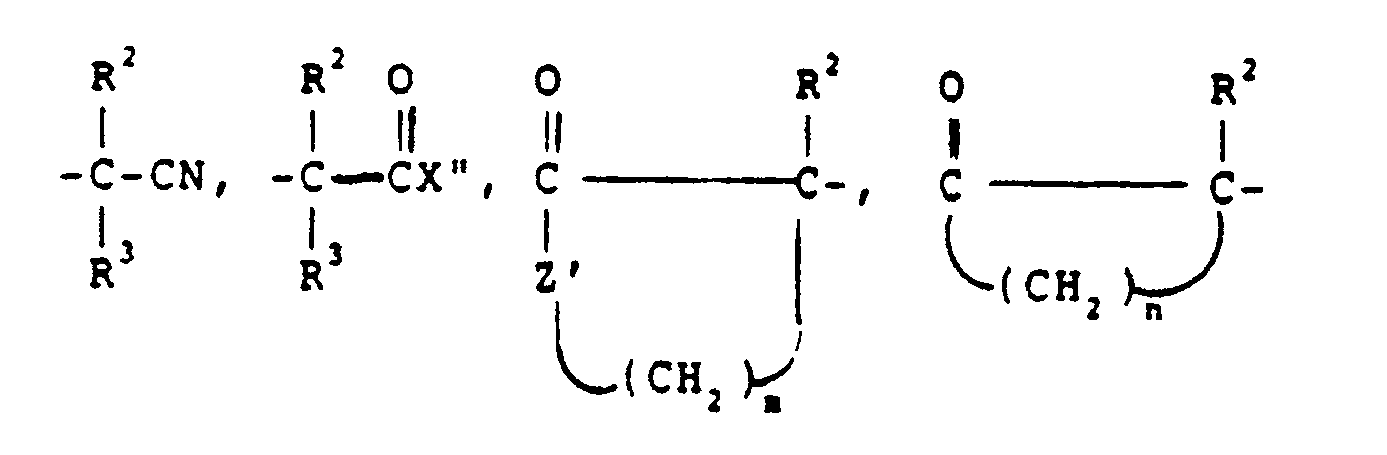

X" est -OSi(R¹)₃, -OR⁶ ou -NR"R" ;
Z' est O ou NR' ;
m est 2, 3 ou 4 ;
n est 3, 4 ou 5 ;
Z¹ est (a) un radical hydrocarbyle qui est un radical aliphatique, alicyclique, aromatique ou aliphatique-aromatique mixte contenant jusqu'à 20 atomes de carbone ;(b) un radical polymère contenant au moins 20 atomes de carbone ;(c) un radical de (a) ou (b) contenant un ou plusieurs atomes d'oxygène d'éther dans ses segments aliphatiques ;(d) un radical de (a), (b) ou (c) contenant un ou plusieurs substituants fonctionnels qui ne sont pas réactifs dans les conditions de polymérisation ; ou(e) un radical de (a), (b), (c) ou (d) contenant un ou plusieurs sites d'initiation ; etchaque R¹ est indépendamment un radical hydrocarbyle qui est un radical aliphatique, alicyclique, aromatique ou aliphatique-aromatique mixte contenant jusqu'à 20 atomes de carbone, ou -H, à condition qu'au moins un groupe R¹ ne soit pas -H ;
chacun de R² et R³ est choisi indépendamment entre -H et un radical hydrocarbyle défini comme pour R⁶ ci-dessus, sous-paragraphes (a) à (e) ;
chacun de R' et R" est choisi indépendamment parmi les groupes alkyles en C₁-C₄ ;
M est Ti, Zr ou Hf ; et
a est 0, 1 ou 2 ;
étant toutefois entendu que :
si Z est -OC(X")=C(R²)(R³), un groupe R⁴ et X", pris ensemble, peuvent être -Z'(CH₂)₂Z'- où Z' est tel que défini ci-dessus,
avec cependant la condition que :
si l'initiateur est (R⁴)3-aMZa+1 où R⁴ est -OR⁵, a est 0 et Z est -OC(X")=C(R²)(R³) ou
- Procédé de la revendication 1, dans lequel le monomère acrylique répond à la formule CH₂=C(Y)X où :
X est -CN, -CH=CHC(O)X' ou -C(O)X' ;
Y -H, -CH₃, -CN ou -CO₂ R, à condition cependant que si X est -CH=CHC(o)X', Y soit -H ou -CH₃ ;
X' est -OSi(R¹)₃, -R, -OR ou -NR'R" ;
chaque R¹ est indépendamment un radical hydrocarbyle qui est un radical aliphatique, alicyclique, aromatique ou aliphatique-aromatique mixte contenant jusqu'à 20 atomes de carbone, ou -H, à condition qu'au moins un groupe R¹ ne soit pas -H ;
R est :(a) un radical hydrocarbyle qui est un radical aliphatique, alicyclique, aromatique ou aliphatique-aromatique mixte contenant jusqu'à 20 atomes de carbone ;(b) un radical polymère contenant au moins 20 atomes de carbone ;(c) un radical de (a) ou (b) contenant un ou plusieurs atomes d'oxygène d'éther dans ses segments aliphatiques ;(d) un radical de (a), (b) ou (c) contenant un ou plusieurs substituants fonctionnels qui ne sont pas réactifs dans les conditions de polymérisation ; ou(e) un radical de (a), (b), (c) ou (d) contenant un ou plusieurs substituants réactifs de la formule -Z'(O)C-C(Y¹)-CH₂ où Y¹ est -H ou -CH₃ et Z' est 0 ou NR' où R' est tel que défini ci-dessous ; etchacun de R' et R" est choisi indépendamment parmi les groupes alkyles en C₁-C₄. - Procédé de la revendication 1 ou 2, dans lequel R⁵ est un groupe alkyle ou alkyle substitué.
- Procédé de la revendication 1, 2 ou 3, dans lequel Z est C(X")=C(R²)(R³) ; X" est OR⁶ ; R², R³ et R⁶ sont des groupes alkyles en C₁-C₁₀ ; M est Ti ou Zr ; et a est 0, 1 ou 2.
- Procédé de l'une quelconque des revendications 1 à 4, dans lequel chaque R⁴ est un groupe N(alkyle en C₁-C₄)₂.
- Procédé de la revendication 5, dans lequel chaque R⁴ est N(C₂H₅)₂.
- Procédé de l'une quelconque des revendications 1 à 4, dans lequel au moins deux groupes R⁴ sont présents et sont des groupes cyclopentadiényle, aryles en c₆-c₂₀, arylméthyles en c₇-c₂₁ ou n'importe lesquels desdits groupes contenant des substituants qui sont inertes dans les conditions de polymérisation.
- Procédé de la revendication 7, dans lequel au moins deux groupes R⁴ sont des groupes cyclopentadiényle.
- Procédé de la revendication 8, dans lequel l'initiateur est (R⁴)₃MZ, deux des groupes R⁴ sont des groupes cyclopentadiényle et l'un des groupes R⁴ est Cl.
- Procédé de l'une quelconque des revendications 1 à 4, dans lequel chaque R⁴ est OR⁵ et R⁵ est un groupe alkyle en C₁-C₄.
- Procédé de la revendication 10, dans lequel chaque R⁴ est un groupe isopropoxy.
- Polymère "vivant" constitué essentiellement d'au moins quatre motifs récurrents d'au moins un monomère acrylique et ayant au moins un site d'initiation qui comprend Ti, Zr ou Hf et qui est capable de se polymériser davantage en présence d'un ou plusieurs monomères acryliques, ledit polymère répondant à la formule Rp[Z³
P QM(R⁴)₃]p, O[M(R⁴)₂QP Z"]₂ ou (R⁴)3-aM[QP Z"]a+1 où :
Rp est un radical hydrocarbyle qui est un radical aliphatique, alicyclique, aromatique ou aliphatique-aromatique mixte contenant jusqu'à 20 atomes de carbone, ou un radical polymère contenant au moins 20 atomes de carbone, de valence p, contenant facultativement un ou plusieurs atomes d'oxygène d'éther, groupes céto et/ou substituants fonctionnels qui ne sont pas réactifs dans les conditions de polymérisation ;
p est un nombre entier et vaut au moins 1 ;
Z³ est un diradical choisi dans le groupe formé par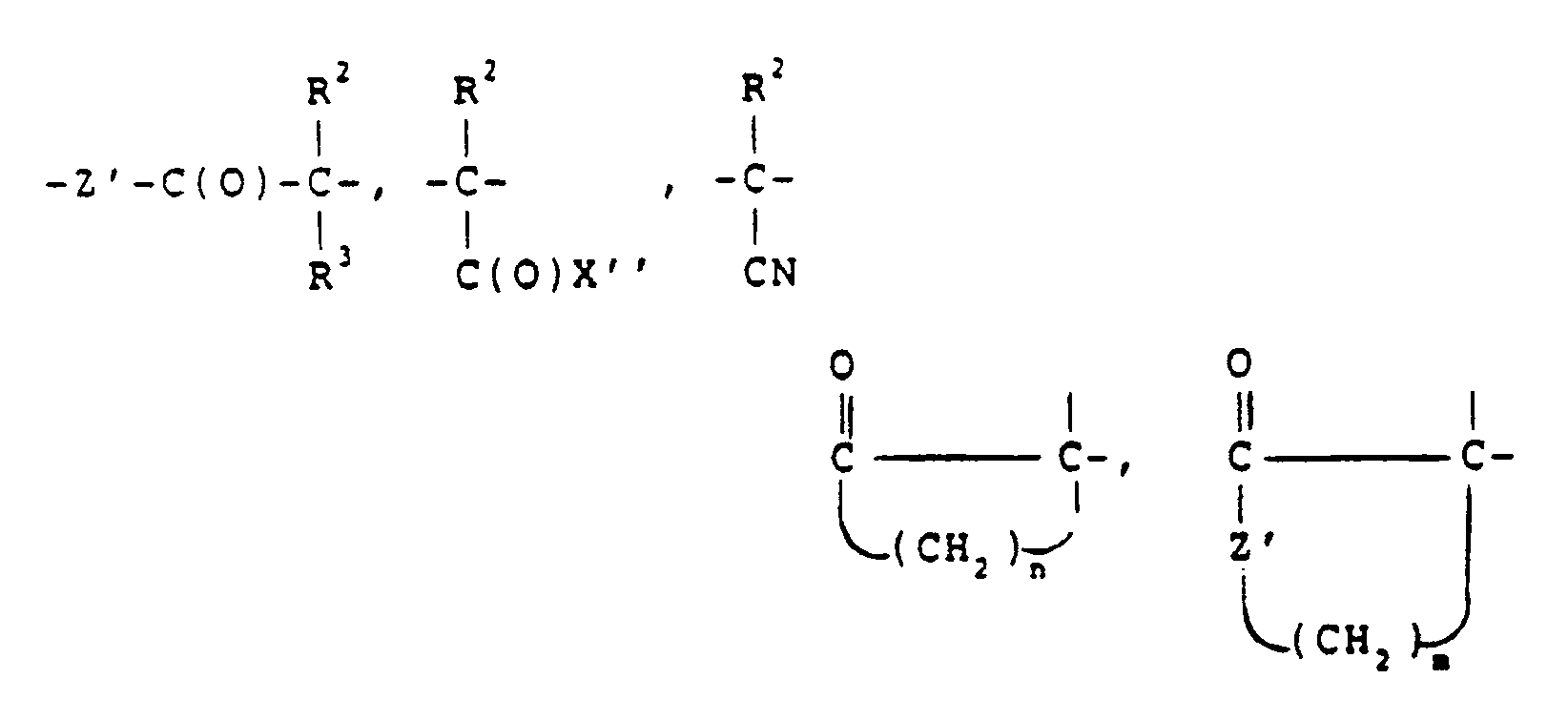
Z" est choisi dans le groupe formé par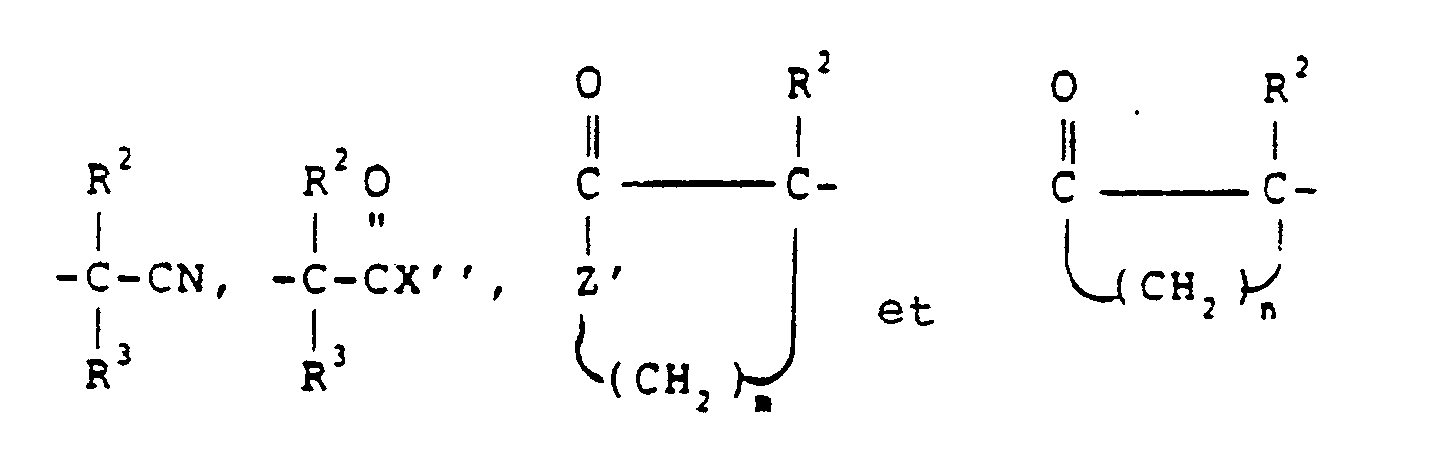
P est un radical polymère divalent constitué essentiellement d'au moins quatre motifs récurrents d'au moins un monomère acrylique ;
Q est un radical divalent constitué essentiellement d'une ou des deux formes tautomères d'un motif acrylique récurrent ;
chaque R⁴ est indépendamment -CH₃, -F, -Cl, -Br, -I, -OR⁵, -NHR⁵, -NR

M est Ti, Zr ou Hf ;
a est 0, 1 ou 2 ;
X" est -OSi(R¹)₃, -OR⁶ ou -NR'R" ;
R⁶ est(a) un radical hydrocarbyle qui est un radical aliphatique, alicyclique, aromatique ou aliphatique-aromatique mixte contenant jusqu'à 20 atomes de carbone ;(b) un radical polymère contenant au moins 20 atomes de carbone ;(c) un radical de (a) ou (b) contenant un ou plusieurs atomes d'oxygène d'éther dans ses segments aliphatiques ;(d) un radical de (a), (b) ou (c) contenant un ou plusieurs substituants fonctionnels qui ne sont pas réactifs dans les conditions de polymérisation ; ou(e) un radical de (a), (b), (c) ou (d) contenant un ou plusieurs sites d'initiation ; etchaque R⁵ est indépendamment un radical hydrocarbyle qui est un radical aliphatique, alicyclique, aromatique ou aliphatique-aromatique mixte contenant jusqu'à 20 atomes de carbone, ou bien ledit radical hydrocarbyle contenant un ou plusieurs substituants fonctionnels qui ne sont pas réactifs dans les conditions de polymérisation ;
chacun de R² et R³ est choisi indépendamment entre -H et un radical hydrocarbyle défini comme pour R⁶ ci-dessus, sous-paragraphes (a) à (e) ;
chaque R¹ est indépendamment un radical hydrocarbyle qui est un radical aliphatique, alicyclique, aromatique ou aliphatique-aromatique mixte contenant jusqu'à 20 atomes de carbone, ou -H, à condition qu'au moins un groupe R¹ ne soit pas -H ; et
chacun de R' et R" est choisi indépendamment parmi les groupes alkyles en C₁-C₄ ;
avec la condition cependant que :
si le polymère "vivant" est (R⁴)3-aM[QP Z"]a+1 où R⁴ est OR⁵, a est 0 et Z" est
- Polymère "vivant" de la revendication 12, dans lequel se trouvent au moins dix motifs récurrents.
- Polymère "vivant" de la revendication 12 ou 13, dans lequel le monomère est le méthacrylate de méthyle.
- Polymère "vivant" de la revendication 12, 13 ou 14, dans lequel M est Ti.
- Polymère "vivant" de la revendication 12, 13 ou 14, dans lequel M est Zr.
- Polymère "vivant" de l'une quelconque des revendications 12 à 16, dans lequel chaque R⁴ est un groupe N(alkyle en C₁-C₄)₂.
- Polymère "vivant" de la revendication 17, dans lequel chaque R⁴ est N(C₂H₅)₂.
- Polymère "vivant" de l'une quelconque des revendications 12 à 16, de la formule (R⁴)₃MQ
P Z", dans lequel deux des groupes R⁴ sont des groupes cyclopentadiényle et l'un des groupes R⁴ est Cl. - Polymère "vivant" de l'une quelconque des revendications 12 à 16, dans lequel chaque R⁴ est un groupe isopropoxy.
- Polymère "vivant" de l'une quelconque des revendications 12 à 16, dans lequel au moins deux groupes R⁴ sont des groupes cyclopentadiényle, aryles en C₆-C₂₀, arylméthyles en c₇-c₂₁ , ou n'importe lesquels desdits groupes contenant des substituants qui sont inertes dans les conditions de polymérisation.
- Polymère "vivant" de la revendication 21, dans lequel au moins deux groupes R⁴ sont des groupes cyclopentadiényle.
- Polymère "vivant" de l'une quelconque des revendications 12 à 16, dans lequel R⁴ est OR⁵ et R⁵ est un groupe alkyle en C₁-C₄.
- Procédé de la revendication 4, dans lequel R³ et R⁶ sont des groupes méthyle et a = 0.
Priority Applications (1)
| Application Number | Priority Date | Filing Date | Title |
|---|---|---|---|
| AT87307651T ATE66935T1 (de) | 1986-08-29 | 1987-08-28 | Titanium-, zirconium- und hafnium-enolate als initiatoren bei der polymerisation von acrylatmonomeren zu lebenden polymeren. |
Applications Claiming Priority (2)
| Application Number | Priority Date | Filing Date | Title |
|---|---|---|---|
| US06/901,769 US4728706A (en) | 1986-08-29 | 1986-08-29 | Titanium, zirconium- and hafnium containing initiators in the polymerization of acrylic monomers to "living" polymers |
| US901769 | 1986-08-29 |
Publications (2)
| Publication Number | Publication Date |
|---|---|
| EP0260838A1 EP0260838A1 (fr) | 1988-03-23 |
| EP0260838B1 true EP0260838B1 (fr) | 1991-09-04 |
Family
ID=25414783
Family Applications (1)
| Application Number | Title | Priority Date | Filing Date |
|---|---|---|---|
| EP87307651A Expired EP0260838B1 (fr) | 1986-08-29 | 1987-08-28 | Enolates de titanium, zirconium et hafnium comme initiateurs dans la polymérisation de monomères acryliques jusqu'à des polymères vivants |
Country Status (6)
| Country | Link |
|---|---|
| US (1) | US4728706A (fr) |
| EP (1) | EP0260838B1 (fr) |
| JP (1) | JPS6368608A (fr) |
| AT (1) | ATE66935T1 (fr) |
| CA (1) | CA1282527C (fr) |
| DE (1) | DE3772683D1 (fr) |
Families Citing this family (36)
| Publication number | Priority date | Publication date | Assignee | Title |
|---|---|---|---|---|
| US4939211A (en) * | 1989-03-01 | 1990-07-03 | E. I. Du Pont De Nemours And Company | Phosphonate-capped polymers |
| US4978723A (en) * | 1989-03-01 | 1990-12-18 | E. I. Du Pont De Nemours And Company | Phosphonate-capped polymers |
| JP3117231B2 (ja) * | 1991-03-11 | 2000-12-11 | 三井化学株式会社 | 幅広い分子量分布を有するシンジオタクチックポリ−α−オレフィンの製造方法 |
| US5668234A (en) * | 1994-09-12 | 1997-09-16 | Rhodes; Larry Funderburk | Reaction injection molding (RIM) of methyl (meth)acrylate and related monomers using group-4 catalysts |
| US5763548A (en) * | 1995-03-31 | 1998-06-09 | Carnegie-Mellon University | (Co)polymers and a novel polymerization process based on atom (or group) transfer radical polymerization |
| IT1276070B1 (it) | 1995-10-31 | 1997-10-24 | Siac It Additivi Carburanti | Processo per la preparazione di polimeri a base di etilene a basso peso molecolare |
| US5807937A (en) | 1995-11-15 | 1998-09-15 | Carnegie Mellon University | Processes based on atom (or group) transfer radical polymerization and novel (co) polymers having useful structures and properties |
| ATE207082T1 (de) | 1996-06-12 | 2001-11-15 | Univ Warwick | Polymerisation-katalysator und -verfahren |
| DE69710130T2 (de) * | 1996-06-26 | 2002-08-29 | Kaneka Corp., Osaka | Verfahren zur Herstellung von Vinylpolymeren |
| DE19651442A1 (de) * | 1996-12-11 | 1998-06-18 | Hoechst Ag | Katalysator zur Herstellung von funktionalisierten Polymeren |
| US7125938B2 (en) * | 1997-03-11 | 2006-10-24 | Carnegie Mellon University | Atom or group transfer radical polymerization |
| ES2182336T3 (es) | 1997-06-10 | 2003-03-01 | Peroxid Chemie Gmbh & Co Kg | Nuevos sistemas de catalizadores para reacciones de (co-)polimerizacion, halogenuros-amidas de metalocenos y su utilizacion. |
| AU3919500A (en) | 1999-03-23 | 2000-10-09 | Carnegie Wave Energy Limited | Catalytic processes for the controlled polymerization of free radically (co)polymerizable monomers and functional polymeric systems prepared thereby |
| US7049373B2 (en) * | 1999-08-06 | 2006-05-23 | Carnegie Mellon University | Process for preparation of graft polymers |
| WO2002028914A2 (fr) | 2000-10-06 | 2002-04-11 | Carnegie Mellon University | Systeme catalyseur de polymerisation controlee |
| US7332550B2 (en) * | 2000-10-06 | 2008-02-19 | Carnegie Mellon University | Stabilization of transition metal complexes for catalysis in diverse environments |
| AU2002307151A1 (en) * | 2001-04-06 | 2002-10-21 | Carnegie Mellon University | A process for the preparation of nanostructured materials |
| US6759491B2 (en) | 2001-10-12 | 2004-07-06 | Carnegie Mellon University | Simultaneous reverse and normal initiation of ATRP |
| WO2003031480A2 (fr) * | 2001-10-12 | 2003-04-17 | Carnegie Mellon University | Processus de commande de sequence de monomeres dans des polymerisations |
| WO2004014963A2 (fr) * | 2002-08-09 | 2004-02-19 | Carnegie Mellon University | Polymeres, elastomeres extra-doux et leurs procedes de preparation |
| US20050090632A1 (en) * | 2003-06-06 | 2005-04-28 | Carnegie Mellon University | Noel (co) polymers and a novel polymerization process based on atom (or group) transfer radical polymerization |
| EP1725590A4 (fr) * | 2004-03-05 | 2013-08-07 | Univ Carnegie Mellon | Procede de polymerisation radicalaire par transfert d'atome |
| US7795355B2 (en) * | 2004-03-05 | 2010-09-14 | Carnegie Mellon University | Preparation of functional polymers |
| WO2007025086A2 (fr) | 2005-08-23 | 2007-03-01 | Carnegie Mellon University | Polymerisation radicalaire controlee par transfert d'atomes (atrp) en microemulsion et vraie polymerisation en emulsion |
| CN101379091B (zh) * | 2005-08-26 | 2012-05-30 | 卡内基梅隆大学 | 在催化剂再生下的聚合方法 |
| US8367051B2 (en) * | 2006-10-09 | 2013-02-05 | Carnegie Mellon University | Preparation of functional gel particles with a dual crosslink network |
| US8865797B2 (en) * | 2007-05-23 | 2014-10-21 | Carnegie Mellon University | Hybrid particle composite structures with reduced scattering |
| US8252880B2 (en) * | 2007-05-23 | 2012-08-28 | Carnegie Mellon University | Atom transfer dispersion polymerization |
| GB2481561B (en) | 2009-03-27 | 2013-12-11 | Univ Carnegie Mellon | Preparation of functional star macromolecules |
| US9644042B2 (en) | 2010-12-17 | 2017-05-09 | Carnegie Mellon University | Electrochemically mediated atom transfer radical polymerization |
| WO2013028756A1 (fr) | 2011-08-22 | 2013-02-28 | Carnegie Mellon University | Polymérisation radicalaire par transfert d'atomes dans des conditions compatibles du point de vue biologique |
| US9533297B2 (en) | 2012-02-23 | 2017-01-03 | Carnegie Mellon University | Ligands designed to provide highly active catalyst complexes |
| US10273315B2 (en) | 2012-06-20 | 2019-04-30 | Chevron Phillips Chemical Company Lp | Methods for terminating olefin polymerizations |
| JP6013055B2 (ja) * | 2012-07-09 | 2016-10-25 | ダイキン工業株式会社 | 優れた撥水撥油性を有するアクリル酸エステル重合体、およびその製造方法 |
| US9982070B2 (en) | 2015-01-12 | 2018-05-29 | Carnegie Mellon University | Aqueous ATRP in the presence of an activator regenerator |
| WO2018132582A1 (fr) | 2017-01-12 | 2018-07-19 | Carnegie Mellon University | Formation assistée par tensioactif d'un complexe catalytique destiné à des procédés de polymérisation radicalaire en émulsion par transfert d'atome |
Family Cites Families (23)
| Publication number | Priority date | Publication date | Assignee | Title |
|---|---|---|---|---|
| US3114737A (en) * | 1958-02-11 | 1963-12-17 | Nat Lead Co | Aqueous polymerization process incorporating co-catalyst of organo-metallic compound nd halogenated acetic acid |
| US3037004A (en) * | 1958-10-07 | 1962-05-29 | Nat Lead Co | Aqueous phase polymerization of vinyl monomers with organic cocatalysts |
| US3394156A (en) * | 1960-03-07 | 1968-07-23 | Monsanto Co | Titanium amide borohydrides and chlorides |
| DE1176864B (de) * | 1962-11-09 | 1964-08-27 | Basf Ag | Verfahren zum Polymerisieren von Verbindungen mit polymerisierbaren Doppelbindungen |
| US3370041A (en) * | 1963-02-25 | 1968-02-20 | Monsanto Co | Polymerization process employing transition metal compounds as catalysts |
| US3846389A (en) * | 1968-03-28 | 1974-11-05 | N Kataoka | Production of alternating copolymers of conjugated dienes and conjugated polar vinyl monomers |
| US3919180A (en) * | 1968-07-03 | 1975-11-11 | Bridgestone Tire Co Ltd | Method of producing alternating copolymers of donor monomer and acceptor monomer from not less than three monomers |
| CA967583A (en) * | 1969-05-28 | 1975-05-13 | Imperial Chemical Industries Limited | Organo-metallic compounds and uses thereof |
| GB1314828A (en) * | 1969-08-13 | 1973-04-26 | Ici Ltd | Transition metal compositions and polymerisation process catalysed thereby |
| BE763475A (fr) * | 1970-03-03 | 1971-08-25 | Ici Ltd | Compositions pour amorcer la polymerisation des olefines et leur utilisation |
| GB1313183A (en) * | 1970-09-03 | 1973-04-11 | Ici Ltd | Polymerisation process and catalysts |
| US3773742A (en) * | 1971-02-02 | 1973-11-20 | Hercules Inc | Tetraneopentyltitanium and use as polymerization catalyst |
| US3950269A (en) * | 1974-05-20 | 1976-04-13 | E. I. Du Pont De Nemours & Co. | Olefin polymerization catalyst system and process for polymerization of olefins |
| US3971767A (en) * | 1974-05-20 | 1976-07-27 | E. I. Du Pont De Nemours And Company | Olefin polymerization catalyst system and process for polymerization of olefins |
| JPS55137178A (en) * | 1979-04-11 | 1980-10-25 | Kanebo Ltd | Adhesive material for rigid living tissue |
| JPS56136865A (en) * | 1980-03-28 | 1981-10-26 | Kanebo Ltd | Adhesive composition for hard living tissue |
| US4681918A (en) * | 1981-06-30 | 1987-07-21 | E. I. Du Pont De Nemours And Company | "Living" polymers and process for their preparation |
| US4417034A (en) * | 1981-06-30 | 1983-11-22 | E. I. Du Pont De Nemours & Co. | Living polymers and process for their preparation |
| US4508880A (en) * | 1981-06-30 | 1985-04-02 | E. I. Du Pont De Nemours And Company | "Living" polymers and process for their preparation |
| US4414372A (en) * | 1982-06-17 | 1983-11-08 | E. I. Du Pont De Nemours & Co. | Process for preparing living polymers |
| JPS6126607A (ja) * | 1984-07-16 | 1986-02-05 | Idemitsu Kosan Co Ltd | エチレン共重合体の製造法 |
| US4605716A (en) * | 1985-02-14 | 1986-08-12 | E. I. Du Pont De Nemours And Company | Lewis base-catalyzed polymerization |
| US4588795A (en) * | 1985-03-01 | 1986-05-13 | E. I. Du Pont De Nemours And Company | Oxyanion-catalyzed polymerization |
-
1986
- 1986-08-29 US US06/901,769 patent/US4728706A/en not_active Expired - Fee Related
-
1987
- 1987-08-25 CA CA000545310A patent/CA1282527C/fr not_active Expired - Lifetime
- 1987-08-28 JP JP62213183A patent/JPS6368608A/ja active Pending
- 1987-08-28 EP EP87307651A patent/EP0260838B1/fr not_active Expired
- 1987-08-28 AT AT87307651T patent/ATE66935T1/de not_active IP Right Cessation
- 1987-08-28 DE DE8787307651T patent/DE3772683D1/de not_active Expired - Lifetime
Also Published As
| Publication number | Publication date |
|---|---|
| CA1282527C (fr) | 1991-04-02 |
| JPS6368608A (ja) | 1988-03-28 |
| US4728706A (en) | 1988-03-01 |
| EP0260838A1 (fr) | 1988-03-23 |
| DE3772683D1 (de) | 1991-10-10 |
| ATE66935T1 (de) | 1991-09-15 |
Similar Documents
| Publication | Publication Date | Title |
|---|---|---|
| EP0260838B1 (fr) | Enolates de titanium, zirconium et hafnium comme initiateurs dans la polymérisation de monomères acryliques jusqu'à des polymères vivants | |
| US4524196A (en) | Process for preparing "living" polymers | |
| US4417034A (en) | Living polymers and process for their preparation | |
| EP0068887B1 (fr) | Polymères vivantes et procédé de leur préparation | |
| US6265493B1 (en) | Polyolefin graft copolymers derived from linear copolymers of alpha-olefins and divinylbenzene having narrow molecular weight and composition distributions and process for preparing same | |
| US7119158B2 (en) | Cyclopentadienyl-containing low-valent early transition metal olefin polymerization catalysts | |
| EP0265091A1 (fr) | Polymérisation de transfert de groupe et initiateurs pour cette polymérisation | |
| WO1991014713A1 (fr) | Systeme catalytique a productivite amelioree | |
| Atiqullah et al. | Synthesis of functional polyolefins using metallocenes: a comprehensive review | |
| JP2022527978A (ja) | 混成触媒組成物、これを含む触媒およびこれらの調製方法 | |
| CA2628442C (fr) | Procede de production de polymeres de poids moleculaire tres eleve au moyen de catalyseurs metallocenes pontes speciaux | |
| JP2001270909A (ja) | オレフィンのチーグラ−ナッタ重合触媒系 | |
| Shiono et al. | Polymerization of methyl methacrylate with non‐bridged zirconocene catalysts | |
| US7511105B2 (en) | One-pot process and reagents for preparing long chain branched polymers | |
| US5180799A (en) | Process for polymerizing methacrylic acid ester monomers | |
| JP3274511B2 (ja) | オレフィン重合用触媒及びオレフィン重合体の製造方法 | |
| US7041759B2 (en) | Method for the preparation of well-defined metal acetamidinate-based catalysts on solid supports | |
| JPH0391504A (ja) | 極性オレフイン系単量体の重合法 | |
| JP2002201225A (ja) | ランダム共重合体およびその製造方法 | |
| US4439588A (en) | Polymers of pivaloyloxyalkyl methacrylates, method for their preparation and modification | |
| JPH01254704A (ja) | 重合方法 | |
| JPH1180223A (ja) | クロトン酸メチル重合体又は共重合体の製法 | |
| US4218552A (en) | Polymers of pivaloyloxyalkyl methacrylates, method for their preparation and modification | |
| RU2171814C1 (ru) | Иммобилизованный катализатор гомо- и сополимеризации олефинов, способ его получения и способ получения гомо- и сополимеров олефинов | |
| JPH10182766A (ja) | グラフトポリマー |
Legal Events
| Date | Code | Title | Description |
|---|---|---|---|
| PUAI | Public reference made under article 153(3) epc to a published international application that has entered the european phase |
Free format text: ORIGINAL CODE: 0009012 |
|
| AK | Designated contracting states |
Kind code of ref document: A1 Designated state(s): AT BE DE FR GB IT NL SE |
|
| 17P | Request for examination filed |
Effective date: 19880905 |
|
| 17Q | First examination report despatched |
Effective date: 19900706 |
|
| GRAA | (expected) grant |
Free format text: ORIGINAL CODE: 0009210 |
|
| AK | Designated contracting states |
Kind code of ref document: B1 Designated state(s): AT BE DE FR GB IT NL SE |
|
| REF | Corresponds to: |
Ref document number: 66935 Country of ref document: AT Date of ref document: 19910915 Kind code of ref document: T |
|
| ITF | It: translation for a ep patent filed | ||
| REF | Corresponds to: |
Ref document number: 3772683 Country of ref document: DE Date of ref document: 19911010 |
|
| ET | Fr: translation filed | ||
| PLBE | No opposition filed within time limit |
Free format text: ORIGINAL CODE: 0009261 |
|
| PGFP | Annual fee paid to national office [announced via postgrant information from national office to epo] |
Ref country code: FR Payment date: 19920721 Year of fee payment: 6 |
|
| PGFP | Annual fee paid to national office [announced via postgrant information from national office to epo] |
Ref country code: GB Payment date: 19920814 Year of fee payment: 6 |
|
| 26N | No opposition filed | ||
| PG25 | Lapsed in a contracting state [announced via postgrant information from national office to epo] |
Ref country code: AT Effective date: 19920828 |
|
| PG25 | Lapsed in a contracting state [announced via postgrant information from national office to epo] |
Ref country code: SE Effective date: 19920829 |
|
| PG25 | Lapsed in a contracting state [announced via postgrant information from national office to epo] |
Ref country code: BE Effective date: 19920831 |
|
| BERE | Be: lapsed |
Owner name: E.I. DU PONT DE NEMOURS AND CY Effective date: 19920831 |
|
| PG25 | Lapsed in a contracting state [announced via postgrant information from national office to epo] |
Ref country code: NL Effective date: 19930301 |
|
| NLV4 | Nl: lapsed or anulled due to non-payment of the annual fee | ||
| PG25 | Lapsed in a contracting state [announced via postgrant information from national office to epo] |
Ref country code: DE Effective date: 19930501 |
|
| PG25 | Lapsed in a contracting state [announced via postgrant information from national office to epo] |
Ref country code: GB Effective date: 19930828 |
|
| GBPC | Gb: european patent ceased through non-payment of renewal fee |
Effective date: 19930828 |
|
| PG25 | Lapsed in a contracting state [announced via postgrant information from national office to epo] |
Ref country code: FR Effective date: 19940429 |
|
| REG | Reference to a national code |
Ref country code: FR Ref legal event code: ST |
|
| EUG | Se: european patent has lapsed |
Ref document number: 87307651.7 Effective date: 19930307 |
|
| PG25 | Lapsed in a contracting state [announced via postgrant information from national office to epo] |
Ref country code: IT Free format text: LAPSE BECAUSE OF NON-PAYMENT OF DUE FEES;WARNING: LAPSES OF ITALIAN PATENTS WITH EFFECTIVE DATE BEFORE 2007 MAY HAVE OCCURRED AT ANY TIME BEFORE 2007. THE CORRECT EFFECTIVE DATE MAY BE DIFFERENT FROM THE ONE RECORDED. Effective date: 20050828 |