EP0260908A2 - Verbrennungssystem mit thermischer Zündung - Google Patents
Verbrennungssystem mit thermischer Zündung Download PDFInfo
- Publication number
- EP0260908A2 EP0260908A2 EP87308094A EP87308094A EP0260908A2 EP 0260908 A2 EP0260908 A2 EP 0260908A2 EP 87308094 A EP87308094 A EP 87308094A EP 87308094 A EP87308094 A EP 87308094A EP 0260908 A2 EP0260908 A2 EP 0260908A2
- Authority
- EP
- European Patent Office
- Prior art keywords
- walls
- ignition
- chamber
- combustion system
- thermal
- Prior art date
- Legal status (The legal status is an assumption and is not a legal conclusion. Google has not performed a legal analysis and makes no representation as to the accuracy of the status listed.)
- Withdrawn
Links
Images

Classifications
-
- F—MECHANICAL ENGINEERING; LIGHTING; HEATING; WEAPONS; BLASTING
- F02—COMBUSTION ENGINES; HOT-GAS OR COMBUSTION-PRODUCT ENGINE PLANTS
- F02B—INTERNAL-COMBUSTION PISTON ENGINES; COMBUSTION ENGINES IN GENERAL
- F02B9/00—Engines characterised by other types of ignition
- F02B9/02—Engines characterised by other types of ignition with compression ignition
- F02B9/04—Methods of operating
-
- F—MECHANICAL ENGINEERING; LIGHTING; HEATING; WEAPONS; BLASTING
- F02—COMBUSTION ENGINES; HOT-GAS OR COMBUSTION-PRODUCT ENGINE PLANTS
- F02B—INTERNAL-COMBUSTION PISTON ENGINES; COMBUSTION ENGINES IN GENERAL
- F02B19/00—Engines characterised by precombustion chambers
- F02B19/14—Engines characterised by precombustion chambers with compression ignition
-
- F—MECHANICAL ENGINEERING; LIGHTING; HEATING; WEAPONS; BLASTING
- F02—COMBUSTION ENGINES; HOT-GAS OR COMBUSTION-PRODUCT ENGINE PLANTS
- F02B—INTERNAL-COMBUSTION PISTON ENGINES; COMBUSTION ENGINES IN GENERAL
- F02B19/00—Engines characterised by precombustion chambers
- F02B19/16—Chamber shapes or constructions not specific to sub-groups F02B19/02 - F02B19/10
- F02B19/165—The shape or construction of the pre-combustion chambers is specially adapted to be formed, at least in part, of ceramic material
-
- F—MECHANICAL ENGINEERING; LIGHTING; HEATING; WEAPONS; BLASTING
- F02—COMBUSTION ENGINES; HOT-GAS OR COMBUSTION-PRODUCT ENGINE PLANTS
- F02F—CYLINDERS, PISTONS OR CASINGS, FOR COMBUSTION ENGINES; ARRANGEMENTS OF SEALINGS IN COMBUSTION ENGINES
- F02F7/00—Casings, e.g. crankcases
- F02F7/0085—Materials for constructing engines or their parts
- F02F7/0087—Ceramic materials
-
- F—MECHANICAL ENGINEERING; LIGHTING; HEATING; WEAPONS; BLASTING
- F02—COMBUSTION ENGINES; HOT-GAS OR COMBUSTION-PRODUCT ENGINE PLANTS
- F02P—IGNITION, OTHER THAN COMPRESSION IGNITION, FOR INTERNAL-COMBUSTION ENGINES; TESTING OF IGNITION TIMING IN COMPRESSION-IGNITION ENGINES
- F02P21/00—Direct use of flames or burners for ignition
-
- F—MECHANICAL ENGINEERING; LIGHTING; HEATING; WEAPONS; BLASTING
- F02—COMBUSTION ENGINES; HOT-GAS OR COMBUSTION-PRODUCT ENGINE PLANTS
- F02B—INTERNAL-COMBUSTION PISTON ENGINES; COMBUSTION ENGINES IN GENERAL
- F02B19/00—Engines characterised by precombustion chambers
- F02B2019/006—Engines characterised by precombustion chambers with thermal insulation
-
- F—MECHANICAL ENGINEERING; LIGHTING; HEATING; WEAPONS; BLASTING
- F05—INDEXING SCHEMES RELATING TO ENGINES OR PUMPS IN VARIOUS SUBCLASSES OF CLASSES F01-F04
- F05C—INDEXING SCHEME RELATING TO MATERIALS, MATERIAL PROPERTIES OR MATERIAL CHARACTERISTICS FOR MACHINES, ENGINES OR PUMPS OTHER THAN NON-POSITIVE-DISPLACEMENT MACHINES OR ENGINES
- F05C2203/00—Non-metallic inorganic materials
- F05C2203/08—Ceramics; Oxides
- F05C2203/0865—Oxide ceramics
- F05C2203/0895—Zirconium oxide
-
- F—MECHANICAL ENGINEERING; LIGHTING; HEATING; WEAPONS; BLASTING
- F05—INDEXING SCHEMES RELATING TO ENGINES OR PUMPS IN VARIOUS SUBCLASSES OF CLASSES F01-F04
- F05C—INDEXING SCHEME RELATING TO MATERIALS, MATERIAL PROPERTIES OR MATERIAL CHARACTERISTICS FOR MACHINES, ENGINES OR PUMPS OTHER THAN NON-POSITIVE-DISPLACEMENT MACHINES OR ENGINES
- F05C2251/00—Material properties
- F05C2251/04—Thermal properties
- F05C2251/048—Heat transfer
-
- Y—GENERAL TAGGING OF NEW TECHNOLOGICAL DEVELOPMENTS; GENERAL TAGGING OF CROSS-SECTIONAL TECHNOLOGIES SPANNING OVER SEVERAL SECTIONS OF THE IPC; TECHNICAL SUBJECTS COVERED BY FORMER USPC CROSS-REFERENCE ART COLLECTIONS [XRACs] AND DIGESTS
- Y02—TECHNOLOGIES OR APPLICATIONS FOR MITIGATION OR ADAPTATION AGAINST CLIMATE CHANGE
- Y02T—CLIMATE CHANGE MITIGATION TECHNOLOGIES RELATED TO TRANSPORTATION
- Y02T10/00—Road transport of goods or passengers
- Y02T10/10—Internal combustion engine [ICE] based vehicles
- Y02T10/12—Improving ICE efficiencies
Definitions
- This invention relates to an ignition system, and more particularly to a thermally ignited combustion system adaptable to an internal combustion engine capable of operating on a wide variety of fuels including coal, natural gas, diesel and other synthetic fuels.
- One aspect of this invention involves ignition of an air-fuel mixture through rapid heat transfer at a high temperature to the air-fuel mixture from a specially designed heat storage unit.
- insulation of various sections of the engine or use of materials having low thermal conductivity have been suggested and tried in order to enhance the performance and efficiency of the spark-ignited or diesel engine.
- a variety of such applications are disclosed in the following U.S. Patents: 4,300,497 Webber 4,511,612 Wegher 3,110,292 Dobrosavljevic 3,140,697 Péras 4,522,171 Dworak, et al.
- This invention provides a novel system for operating power systems such as the internal combustion engine and utilizes a thermal ignition process which is not dependant on the production of threshold temperatures obtained through high compression of gases to ignite the air-fuel mixture.
- the present invention utilizes pre-chamber or ignition chamber walls designed to store rather than dissipate thermal energy. The heat energy produced during combustion is stored in the specially designed walls of the ignition chamber and is then transferred directly to the next cycle air-fuel mixture causing spontaneous combustion. The result is the production of a high temperature thermal environment which promotes a higher fuel energy heat release rate than in conventional engines. This in turn results in more complete burning of the air-fuel mixture taking place in a shorter crank angle duration and producing a higher thermal and mechanical efficiency.
- One embodiment of the present invention includes a thermal ignition combustion system adapted for use with an internal combustion engine, the engine having a main combustion chamber.
- the thermal ignition combustion system comprises means for providing walls defining an ignition chamber, the walls being made of a material having a thermal conductivity greater than 20 W/m°C and a specific heat greater than 480 J/kg°C with the ignition chamber being in constant communication with the main combustion chamber, means for maintaining the temperature of the walls above a threshold temperature capable of causing ignition of a fuel, and means for conducting fuel to the ignition chamber.
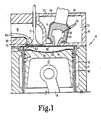
- FIG. 1 there is shown a thermal ignition combustion system integrally connected to a modified single cylinder engine in accordance with one embodiment of the present invention.
- the engine adapted for this embodiment is the known 1Y73 Caterpillar having a 130.2 mm (5.125 inch) bore, 165.1 mm (6.5 inch) stroke, 2.2 liter (134.1 cubic inch) displacement and a compression ratio of 16.5 to 1.
- the unmodified engine is capable of operating in the range of 800 rpm to 1800 rpm and has a pre-chamber combustion chamber.
- the 1Y73 was adapted, as described herein, to operate on coal powder. More specifically, the fuel to be used in this embodiment is micronized Otisca coal commercially available from OTISCA Industries, Ltd. of Syracuse, New York. The coal used was bituminus coal wherein 95.7% by weight had a particle size less than 20 microns (average size approximately 5 microns), 0.8% ash content, 33,885 kJ/kg colorific value, and 0.9% sulfur content.
- the single cylinder engine 10 includes an engine block 11, cylinder walls defined by a cylinder liner 12, a piston 13 with step gap piston rings 14 and a piston rod 15, an intake port 16 with intake poppet valve 17, an exhaust port with an exhaust poppet valve 17A, a cylinder head 18 and a pre-chamber combustion chamber or ignition chamber 19.
- a main combustion chamber 22 of the unmodified engine is defined by the piston crown 20 of piston 13, cylinder head 18, cylinder liner 12 and the faces 21 of the poppet valves.
- the configuration of the exhaust port 16A and poppet valve 17A is identical to that of the intake port 16 and poppet valve 17 except for a zirconia lining within the exhaust port as will be explained herein.
- the zirconia lining 59 is not present in the commercial 1Y73 Caterpillar engine.
- the micronized coal is fumigated in the intake manifold 35 through coal delivery nozzle 30 which was added to the engine. (FIG. 3)
- the delivery nozzle is positioned to deliver the coal powder at the stricture 37 of a venturi nozzle 31, also added to the engine and located within the intake manifold 35 which leads to intake port 16.
- Arrows 32 indicate the direction of air flow within the intake manifold.
- Air passage 33 provides air to mix upstream with the incoming coal powder (shown by arrow 34) aiding to form a suspension of coal powder in air into the venturi nozzle.
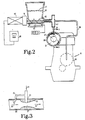
- the coal feed system was constructed from commercially available elements and is shown in FIG. 2. It includes the following commercially available elements; a volumetric feeder 40, an intromitter drive 41, a variable speed DC motor 42, a screw conveyer 43, a scale with digital readout 44, a variable speed controller 45 and a flexible driveshaft 46.
- the variable speed DC motor 42 and intromitter drive 41 which are controlled by the variable speed controller 45, drive the screw conveyer 43.
- the coal powder 27 contained in the volumetric feeder 40 is directed to the injection nozzle 30 by the screw conveyer 43.
- the particle size of the coal fuel should be no greater than 20 microns.
- the coal powder should be kept free of agglomerates as it is delivered to and fumigated into the intake manifold 35.
- coal powder often has a tendency to clump, forming agglomerates which may fail to break apart upon fumigation. This may result in miniature, uncontrolled and uneven explosions within the ignition chamber 19 and main combustion chamber 22.
- a suitable means for keeping the agglomerates to a minimum, or even eliminating the agglomerates as the coal is fumigated into the intake manifold 35, may be desired.
- One approach to improve this conditon is to insert a fluidizing means 47 between the screw conveyer 43 and the delivery nozzle 30.
- the fluidizing means should break apart the agglomerates, possibly by some type of rotary/kinetic or grinding motion.
- a fluidizing means or fluidizer 210 (FIGS. 6, 7 and 8) was constructed to promote coal powder consistency free of agglomerates.
- Coal powder is fed from the feeder 40 directly into a cylindrically shaped body 211 of the fluidizer 210 through an entrance port 212 in the end plate 213.
- the body additionally has an overflow port 222, an outlet port 223 and drive shaft port 224.
- End plate 213 has several rows of fixed, radially arranged and substantially orthogonal pins 214.
- Concentrically contained within the body 211 is a cylindrical rotor 215 which also incorporated rows of radially arranged pins 216.
- the pins 216 fixed to the rotor, extend toward end plate 213 so as to overlap pins 214, but pins 216 are radially staggered relative to the pins 214 so that rotor 215 may be rotated within the body 211 without pins 214 coming in contact with pins 216.
- a flexible shaft 46 is connected between the engine camshaft 48 and the rotor 215, with O-rings 226, or some suitable sealing means, preventing the coal powder from exiting the driveshaft port 224.
- the rotor is drum shaped having a open end toward which pins 214 extend, a bottom end 217 and cylindrical side walls 218.
- the side walls 218 have a radial port 219 for passage of the coal powder through an orifice 225 in the outlet port 223 and to the intake manifold.
- the bottom 217 has an axial port 220 for passage of the coal powder to the overflow port 222.
- the coal powder After entering the fluidizer body 211, the coal powder is set into rotating motion by the rotor 215 and pins 216 which are driven by the shaft 46.
- the relative motion of the two sets of pins, 214 and 216 generates intensive kinetic agitation of the powder improving its flowability while also repulverizing any crumbs or agglomerates which may have formed.
- the flow rate of the coal powder into the fluidizer may start to exceed the flow rate out causing a back-up or excess in the fluidizer.
- Axial port 220 allows for this excess coal to pass out of the rotor, through the overflow port 222 and to a reservoir (not shown) assuring a steady state, uninhibited flow.
- measuring the overflow mass and adjusting the other above-mentioned parameters can allow the coal powder flow rate to the intake manifold 35 to be precisely controlled.
- One concept underlying this invention is ignition of an air-fuel mixture through rapid heat transfer at a high temperature to the air-fuel mixture from a specially designed heat storage unit.
- the present invention relies entirely on high temperature heat storage and subsequent rapid heat transfer from the heat storage unit to the air-fuel mixture to achieve ignition.
- the Caterpillar 1Y73 is modified as follows. The heat storage is achieved first by insulating primary combustion surfaces of the engine and by removing the cooling liquid from the passages 36 of the cooling system so as to leave air therein thereby creating a nearly adiabatic system.
- the cylinder liner 12 is cast iron and its interior surface is coated with a 1.0 mm thickness of plasma sprayed zirconia (ZrO2) 60 for insulation.
- the zirconia has a thermal conductivity of 2 W/(m ⁇ °C).
- a suitable ceramic coating is then applied over the zirconia 60 to improve the wear of the zirconia.
- a K'Ramic coating was used.
- K'Ramic is a trademark for a ceramic coating which is performed by Kaman Sciences Corp., 4765 Northpart Drive, Colorado Springs, Colorado 80907. Specifically, the K'Ramic coating contains silica, chromia, and alumina which is densified by chromic acid treatments.
- the chrome is applied in liquid form made up of hexavalent chromium and water in a variety of ways -- spraying, painting or immersion. Capillary action pulls the chrome liquid into the open pores, thereby filling the pores with the liquid chrome.
- the coating is then fired at about 1000°F which drives off the water and converts the hexavalent chrome into Cr2O3 (chrome oxide) at the same time generating an oxide bond.
- Cr2O3 chrome oxide
- a number of impregnation cycles are needed. The number of cycles varies from 5 to 15 and the final thickness is about 0.127 mm. The process is more fully described in U.S. Patent No. 3,956,531 which is hereby incorporated by reference.
- the zirconia coating may be composed of partially or fully stabilized zirconia and may be performed commercially by APS Materials, Inc., 153 Wildbrook, Dayton, Ohio 45405. Due to the increased operating temperatures and the burning and ash characteristics of coal powder, the rings also receive a K'Ramic coating to reduce wear.
- the piston is made of aluminum and the piston crown 20 is coated with a 1.2 mm thickness of plasma sprayed zirconia (ZrO2) 61.
- the crown 20 and zirconia coating 61 are then coating with a wear resistant coating. Since the 1000°F temperature of the K'Ramic process would melt the aluminum piston, an alternative coating called Zircon is used.
- Zircon is also a trademark and can be obtained commercially from Kaman Sciences Corp., 4765 Northpart Drive, Colorado Springs, Colorado 80907. Any of a host of other commercially available ceramic coatings will substitute for the Zircon including the previously described K'Ramic coating which will perform well in place of the Zircon sealer in each application described herein except for the aluminum piston.
- the cylinder head 18 is cast iron and the portion of it which is exposed to the main combustion chamber 22 is coated with a 1.40 mm thickness of plasma sprayed zirconia (ZrO2) 62 and also with a Zircon sealer.
- ZrO2 plasma sprayed zirconia
- the lining of the exhaust port 16A is also coated with a 1.0 mm thickness of plasma sprayed zirconia (ZrO2) and also with a Zircon sealer.
- the intake port 16 is not insulated as it is generally not an important source of heat loss and because the intake gases should be at a low temperature for better volumetric efficiency.
- the faces of both the intake and exhaust poppet valves 21 are likewise coated with a 1.0 mm thickness of plasma sprayed zirconia (ZrO2) 63 with a Zircon sealer. The combined insulation effect reduces the heat transfer out of the main combustion chamber resulting in a more adiabatic system.
- the ignition chamber walls 70 which define the ignition chamber, are composed of a material having a high specific heat, a high thermal conductivity and the ability to withstand the high temperatures associated with this invention.
- the mass and material composition of the chamber walls 70 have a heat capacity of at least 22 J/°C per liter displacement. This parameter is thus made to depend on the size of the engine since, as the engine displacement increases, the need for greater heat storage in the ignition chamber walls increases.
- the ignition chamber walls 70 which define the entire interior surface of the ignition chamber, are composed of cast iron.
- the barrier comprises a layer of a suitable insulating material such as a coating 71 of zirconia approximately 2.0 mm in thickness.
- the zirconia layer is applied to the exterior surface of the walls and surrounds greater than 85% of the walls.
- Further insulation of the ignition chamber is provided by an air pocket 72 surrounding the zirconia coating 71 of the ignition chamber walls 70, which in the present embodiment, is formed merely by removing the liquid from the cooling system passages 36.
- the thickness of the air pocket that is the radial distance between the zirconia coating 71 and the nearest point of material of the cylinder head 18, varies due to the non-uniform configuration of the cylinder head 18. However, the minimum thickness of the air pocket is approximately 2mm.
- the resulting system reduces the heat flow out of the engine by as much as 40% and has a capacity to store a large quantity of heat within the the silicon nitride walls 70.
- the temperature of the walls 70 of the ignition chamber will reach a minimum of 1000°F and typically, during average to peak loads, this temperature will be between 1400°F and 2000°F.
- the operating temperature of the ignition chamber walls may fall as low as 1000°F.
- the coal fuel will operate efficiently within the entire range of this system. In fact, the engine will run well on the coal powder at about 800°F.
- a glow plug 23 is provided within the ignition chamber. The use of the glow plug 23 is continued until the ignition chamber walls reach somewhere between the threshold ignition temperature of the coal powder (about 700°F) and about 800°F where the coal begins to burn efficiently.
- the compressed fuel and gas mixture temperatures will rise due to mechanical compression work, but then continue to rise due to the heat transfer from the walls 70 of the ignition chamber. This additional heat transfer creates a high temperature thermal environment which pushes the air-fuel mixture temperature well past the ignition temperature of the coal powder causing spontaneous combustion.
- the ignition temperature is approximately 700°F.
- the high temperature thermal environment attainable in this invention enables the burning of other fuels heretofore not considered practical due to their low efficiencies at conventional, non-adiabatic engine operating temperatures or to the complicated systems which are required to effect their combustion.
- One such fuel, natural gas, is the fuel used in the following alternative embodiment.
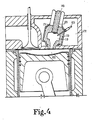
- FIG. 4 An embodiment of the thermal ignition combustion system for natural gas is illustrated in FIG. 4.
- the above-mentioned 1Y73 Caterpillar engine is again used to construct the embodiment.
- This embodiment is nearly identical to the previous embodiment, having a main combustion chamber 122, an ignition chamber 119, ignition chamber walls 170, a zirconia coating 171 surrounding the walls 170 and an air pocket 172.
- the variations involve the fuel used and the manner and timing of the fuel introduction.
- the ignition chamber 119 is defined by the ignition chamber walls 170.
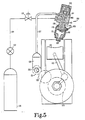
- a suitable means for injecting the natural gas into the ignition chamber is provided and designated at 150.
- a standard, commerically available diesel injector may be used and easily adapted to inject natural gas at a pressure of between 3000 and 5000 psi.
- the fuel is admitted to the ignition chamber 119 through a fuel injector admission line 124.
- Injection of high pressure natural gas into the ignition chamber is achieved by actuating the opening of the injector nozzle 125 which is connected to the high pressure natural gas source 126.
- the source 126 may be either stored under pressure or compressed during operation.
- the timing of the opening and closing of the injector nozzle 125 is controlled by the hydraulic control line 127 which is supplied from a pump 128 actuated by the engine cam shaft through gearing 129, 130, 131 and 132.
- An increase in hydraulic pressure through line 127 into reservoir 140 forces piston 141 in the direction of and against biasing spring 142 which pulls up injection nozzle valve 143 allowing fuel to flow through passage 144 and to enter ignition chamber 119.
- High pressure fuel (natural gas) is delivered through a control valve 133 and through emergency shut-off valve 134.
- the high pressure natural gas is injected in a diverse spray into the combustion chamber 119 to create even and rapid mixing of the fuel with the compressing air.
- the injection occurs during the crank angle duration of approximately 10° before top dead center to 10° after top dead center.
- a glow plug 123 is provided in the ignition chamber.
- the natural gas used is approximately 90% methane and has a threshold combustion temperature of approximately 1350°F.
- the temperature of the walls 170 of the ignition chamber will be between 1400°F and 2000°F. As in the first embodiment, the result is a very efficient and complete burning of the natural gas with lower emission characteristics.
- Alternative embodiments may be produced by varying certain parameters. For example, varying the relative thicknesses of the zirconia layer 71 and of the air pocket 72 surrounding the ignition chamber walls 70 may be performed to tune the thermal ignition combustion system to operate at or within a certain desired temperature range. Thus, if the cylinder head configuration will permit up to approximately a 12 mm thickness in the air pocket 72, then no zirconia layer 71 may be required to achieve an ignition chamber wall operating temperature for coal of 1200°F or above. Conversely, where only a small air pocket is possible, a 3 mm thickness of zirconia coating 71 may be sufficient to achieve the desired ignition chamber wall operating temperature. This flexibility will also permit the engine's cooling system to be operated in its intended manner if desired. Thus, the coolant may be left in and the zirconia and/or an air pocket having an adequate thickness may be provided to achieve the same results.
- the system may also likewise be tuned to burn a variety of other fuels.
- diesel fuel which has an ignition temperature of about 500°F, may be burned more efficiently with lower emission characteristics.
- the operating temperatures of this system also will permit burning of synthetic diesel and gasoline fuels, coal derived liquid fuels, methanol or ethanol.
- the only other modification which is needed to construct a thermal ignition combustion system capable of burning another liquid or solid fuel is to design the injector means to operate with the particular fuel to be used. This task is with the knowledge of persons skilled in this art.
- Another variation which may improve the performance of the coal burning embodiment is to design the fluidizing means, or some other means designed to operate in conjunction with the fluidizer, to feed the coal powder to the intake manifold only during the period in which the intake valve is open. This will allow the coal powder fuel to be metered into the intake air at a predetermined timing during the engine operating cycle, thus improving the efficiency of the engine.
- Another variation is to feed the coal powder in a timed fashion directly into the ignition chamber.
- the material composing the walls of ignition chamber may be any of various materials which meet the requirements cited previously of high thermal conductivity, high specific heat and mass (high heat capacity) and the ability to withstand the high temperatures associated with this invention.
Landscapes
- Engineering & Computer Science (AREA)
- Chemical & Material Sciences (AREA)
- Combustion & Propulsion (AREA)
- Mechanical Engineering (AREA)
- General Engineering & Computer Science (AREA)
- Ceramic Engineering (AREA)
- Combustion Methods Of Internal-Combustion Engines (AREA)
- Cylinder Crankcases Of Internal Combustion Engines (AREA)
Applications Claiming Priority (2)
| Application Number | Priority Date | Filing Date | Title |
|---|---|---|---|
| US06/907,809 US4738227A (en) | 1986-02-21 | 1986-09-16 | Thermal ignition combustion system |
| US907809 | 1997-08-08 |
Publications (2)
| Publication Number | Publication Date |
|---|---|
| EP0260908A2 true EP0260908A2 (de) | 1988-03-23 |
| EP0260908A3 EP0260908A3 (de) | 1989-03-22 |
Family
ID=25424670
Family Applications (1)
| Application Number | Title | Priority Date | Filing Date |
|---|---|---|---|
| EP87308094A Withdrawn EP0260908A3 (de) | 1986-09-16 | 1987-09-14 | Verbrennungssystem mit thermischer Zündung |
Country Status (3)
| Country | Link |
|---|---|
| US (1) | US4738227A (de) |
| EP (1) | EP0260908A3 (de) |
| JP (1) | JPS6385216A (de) |
Cited By (7)
| Publication number | Priority date | Publication date | Assignee | Title |
|---|---|---|---|---|
| EP0420642A1 (de) * | 1989-09-29 | 1991-04-03 | Isuzu Motors Limited | Alkoholbrennkraftmaschine mit Vorkammer |
| FR2669378A1 (fr) * | 1990-11-19 | 1992-05-22 | Peugeot | Procede de realisation d'un depot catalytique par jet de plasma dans une chambre de combustion d'un moteur a explosion. |
| WO1994021903A1 (en) * | 1993-03-15 | 1994-09-29 | TÖRNQVIST, Bengt, G. | Ignition gap arrangement |
| AU737759B2 (en) * | 1997-05-23 | 2001-08-30 | Honda Giken Kogyo Kabushiki Kaisha | Fuel injection internal combustion engine with sub-combustion chamber |
| DE10323841B4 (de) * | 2002-05-24 | 2008-03-20 | Nöker, Mehmet | Mit festem Brennstoff betriebene Zwölftakt-Kraftmaschine |
| AT523742A1 (de) * | 2020-04-16 | 2021-11-15 | Avl List Gmbh | Brennkraftmaschine |
| CN117967387A (zh) * | 2024-04-02 | 2024-05-03 | 山西潞安环保能源开发股份有限公司 | 一种井下瓦斯吸收装置 |
Families Citing this family (46)
| Publication number | Priority date | Publication date | Assignee | Title |
|---|---|---|---|---|
| JPS63154851A (ja) * | 1986-12-16 | 1988-06-28 | Kawasaki Heavy Ind Ltd | V型エンジン |
| JPH07111155B2 (ja) * | 1987-04-11 | 1995-11-29 | いすゞ自動車株式会社 | 断熱エンジン構造及びその製造方法 |
| JPS6421220U (de) * | 1987-07-29 | 1989-02-02 | ||
| JP2718071B2 (ja) * | 1988-07-21 | 1998-02-25 | いすゞ自動車株式会社 | 副室式断熱エンジン |
| JP2736659B2 (ja) * | 1988-09-19 | 1998-04-02 | ヤンマーディーゼル株式会社 | 副室式ガス機関 |
| DD275891A1 (de) * | 1988-10-03 | 1990-02-07 | Barkas Werke Veb | Brennkraftmaschine mit einem katalytisch beschichteten brennraum |
| JPH086587B2 (ja) * | 1988-10-28 | 1996-01-24 | いすゞ自動車株式会社 | 副燃焼室式断熱エンジン |
| US5067458A (en) * | 1989-03-27 | 1991-11-26 | Caterpillar Inc. | Fuel combustion system and method of operation for an otto-cycle internal combustion engine |
| CA2056236C (en) * | 1991-11-26 | 2001-08-21 | Gary D. Webster | Internal combustion engine with high temperature variable geometry pre-combustion chamber |
| US5163385A (en) * | 1992-03-12 | 1992-11-17 | The United States Of America As Represented By The United States Department Of Energy | Coal-water slurry fuel internal combustion engine and method for operating same |
| WO1993024672A1 (en) * | 1992-05-29 | 1993-12-09 | United Technologies Corporation | Ceramic thermal barrier coating for rapid thermal cycling applications |
| US5195488A (en) * | 1992-07-14 | 1993-03-23 | Rattigan Jerry D | Internal combustion engine with unique swirl |
| JPH0686503A (ja) * | 1992-09-03 | 1994-03-25 | Hitachi Ltd | モータ、ポリゴンミラーモータ、ディスク駆動モータ |
| US5305726A (en) * | 1992-09-30 | 1994-04-26 | United Technologies Corporation | Ceramic composite coating material |
| US5691636A (en) * | 1993-08-25 | 1997-11-25 | Andritz Sprout-Bauer, Inc. | Probe assembly mounting for a grinding machine |
| US5664540A (en) * | 1994-12-15 | 1997-09-09 | Isuzu Motors Limited | Pre-combustion chamber-type engine |
| DE4415073A1 (de) * | 1994-04-29 | 1995-11-02 | Fev Motorentech Gmbh & Co Kg | Hubkolbenmotor mit direkter Kraftstoffeinspritzeinrichtung und Funkenzündung, insbesondere für den Betrieb mit Alkoholkraftstoff |
| DE19542944C2 (de) * | 1995-11-17 | 1998-01-22 | Daimler Benz Ag | Brennkraftmaschine und Verfahren zum Aufbringen einer Wärmedämmschicht |
| US5683825A (en) | 1996-01-02 | 1997-11-04 | General Electric Company | Thermal barrier coating resistant to erosion and impact by particulate matter |
| US6060177A (en) * | 1998-02-19 | 2000-05-09 | United Technologies Corporation | Method of applying an overcoat to a thermal barrier coating and coated article |
| US6203927B1 (en) | 1999-02-05 | 2001-03-20 | Siemens Westinghouse Power Corporation | Thermal barrier coating resistant to sintering |
| US6517960B1 (en) * | 1999-04-26 | 2003-02-11 | General Electric Company | Ceramic with zircon coating |
| KR20010110266A (ko) * | 2001-11-15 | 2001-12-12 | 김창선 | 단열 처리된 엔진, 배출에너지를 재활용하는 엔진 및 그엔진이 장착된 고압 분사체 |
| US6663983B1 (en) | 2002-07-26 | 2003-12-16 | General Electric Company | Thermal barrier coating with improved strength and fracture toughness |
| CA2406137C (en) * | 2002-10-02 | 2004-12-28 | Westport Research Inc. | Control method and apparatus for gaseous fuelled internal combustion engine |
| FR2846044B1 (fr) * | 2002-10-18 | 2006-07-14 | Peugeot Citroen Automobiles Sa | Dispositif d'allumage a prechambre revetue d'un revetement refractaire, pour un moteur a combustion interne, et allumeur a prechambre |
| US20040221830A1 (en) * | 2003-05-06 | 2004-11-11 | Cummins Inc. | Cylinder head with machined intake port and process for manufacturing |
| WO2004111394A1 (ja) * | 2003-06-10 | 2004-12-23 | Ishikawajima-Harima Heavy Industries Co., Ltd. | タービン部品、ガスタービンエンジン、タービン部品の製造方法、表面処理方法、翼部品、金属部品、及び蒸気タービンエンジン |
| WO2007035468A2 (en) * | 2005-09-15 | 2007-03-29 | Adiabatics Technologies, Inc. | Composite sliding surfaces for sliding members |
| US7802553B2 (en) * | 2005-10-18 | 2010-09-28 | Gm Global Technology Operations, Inc. | Method to improve combustion stability in a controlled auto-ignition combustion engine |
| US20090071434A1 (en) * | 2007-09-19 | 2009-03-19 | Macmillan Shaun T | Low heat rejection high efficiency internal combustion engine |
| DE102009016461A1 (de) * | 2009-04-04 | 2010-10-07 | Man Diesel Se | Zündanordnung für einen Gasmotor, mit dieser ausgerüsteter Gasmotor und Verfahren zum Betreiben des Gasmotors |
| US20110210279A1 (en) * | 2010-02-26 | 2011-09-01 | Midwest Sealing Products, Inc. | Gas Valves for Pneumatic Devices |
| JP5949489B2 (ja) * | 2012-11-19 | 2016-07-06 | 株式会社デンソー | 固体燃料用の内燃機関 |
| US9567896B2 (en) * | 2013-01-28 | 2017-02-14 | Sonex Research, Inc. | Method for modifying combustion chamber in a reciprocating piston internal combustion engine and resulting engine |
| US9416723B2 (en) * | 2013-04-08 | 2016-08-16 | Kenneth W. Cowans | Air supply concepts to improve efficiency of VCRC engines |
| JP6446973B2 (ja) * | 2014-10-07 | 2019-01-09 | トヨタ自動車株式会社 | 内燃機関 |
| US9556832B1 (en) * | 2015-09-01 | 2017-01-31 | Combustion Engine Technologies, LLC | Adiabatic fuel injection-ignition method and device |
| US10519854B2 (en) | 2015-11-20 | 2019-12-31 | Tenneco Inc. | Thermally insulated engine components and method of making using a ceramic coating |
| US10578050B2 (en) | 2015-11-20 | 2020-03-03 | Tenneco Inc. | Thermally insulated steel piston crown and method of making using a ceramic coating |
| US9441573B1 (en) | 2015-12-09 | 2016-09-13 | Combustion Engine Technologies, LLC | Two-stroke reciprocating piston injection-ignition or compression-ignition engine |
| JP2019505731A (ja) | 2016-01-14 | 2019-02-28 | ノーティラス・エンジニアリング・リミテッド・ライアビリティ・カンパニーNautilus Engineering, LLC | 圧縮点火エンジンの改善したシステムおよび方法 |
| US10927750B2 (en) * | 2016-01-14 | 2021-02-23 | Nautilus Engineering, Llc | Systems and methods of compression ignition engines |
| WO2020014636A1 (en) * | 2018-07-12 | 2020-01-16 | Radical Combustion Technologies, Llc | Systems, apparatus, and methods for increasing combustion temperature of fuel-air mixtures in internal combustion engines |
| EP4090840A1 (de) | 2020-01-15 | 2022-11-23 | Radical Combustion Technologies, LLC | Systeme, vorrichtungen und verfahren zur auslösung einer verbesserten radikalischen zündung in verbrennungsmotoren mit einem radikalischen chemikalienerzeuger |
| CN118273798A (zh) * | 2022-12-30 | 2024-07-02 | 比亚迪股份有限公司 | 发动机以及车辆 |
Family Cites Families (25)
| Publication number | Priority date | Publication date | Assignee | Title |
|---|---|---|---|---|
| US1762550A (en) * | 1925-12-10 | 1930-06-10 | Louis O French | Internal-combustion engine |
| US1798260A (en) * | 1929-02-01 | 1931-03-31 | Aerol Engine Corp | Oil engine |
| US2739578A (en) * | 1950-07-20 | 1956-03-27 | Daimler Benz Ag | Precombustion diesel engine |
| US2855908A (en) * | 1954-05-25 | 1958-10-14 | Pflaum Walter | Method of combustion and internal combustion engines |
| US3140697A (en) * | 1959-12-28 | 1964-07-14 | Renault | Compression ignition engines |
| US3110292A (en) * | 1960-09-06 | 1963-11-12 | Slobodan M Dobrosavljevic | Internal combustion engine |
| US3082752A (en) * | 1961-04-04 | 1963-03-26 | Reynolds Metals Co | Lined engine members and methods of making the same or the like |
| FR1344892A (fr) * | 1962-05-28 | 1963-12-06 | Applic Tech Ind Lati | Perfectionnements aux moteurs à combustion interne à injection de carburant |
| FR1436612A (fr) * | 1965-02-08 | 1966-04-29 | Applic Tech | Perfectionnements aux moteurs à combustion interne du type à chambre thermiquement isolée |
| US3408995A (en) * | 1967-05-22 | 1968-11-05 | Thomas A. Johnson | Combustion chamber design and material for internal combustion cylinders and engines |
| US4074671A (en) * | 1974-10-31 | 1978-02-21 | Pennila Simo A O | Thin and low specific heat ceramic coating and method for increasing operating efficiency of internal combustion engines |
| US3965870A (en) * | 1975-03-03 | 1976-06-29 | Wallace Clark | Method of operating an internal combustion engine with solvent refined coal as a fuel |
| US4046114A (en) * | 1975-10-06 | 1977-09-06 | General Motors Corporation | Insulated, high efficiency, low heat rejection, engine cylinder head |
| US4284055A (en) * | 1978-10-14 | 1981-08-18 | Lucas Industries, Limited | Reciprocating piston internal combustion engine |
| JPS6030460B2 (ja) * | 1979-03-02 | 1985-07-16 | 富士通株式会社 | キヤリヤ検出信号制御方式 |
| US4485778A (en) * | 1980-02-27 | 1984-12-04 | Oliver Bernard M | Method and means for improving performance of diesel engines |
| US4300497A (en) * | 1980-06-30 | 1981-11-17 | Rockwell International Corporation | Prevaporizing diesel precombustion chamber |
| US4398527A (en) * | 1980-08-22 | 1983-08-16 | Chevron Research Company | Internal combustion engine having manifold and combustion surfaces coated with a foam |
| DE3123398C2 (de) * | 1981-06-12 | 1985-04-25 | MTU Motoren- und Turbinen-Union München GmbH, 8000 München | Vorbrennkammer für Dieselmaschinen |
| DE3133209C2 (de) * | 1981-08-21 | 1985-04-25 | MTU Motoren- und Turbinen-Union München GmbH, 8000 München | Hohler Verbundkörper, insbesondere Umdrehungskörper und Verfahren zu seiner Herstellung |
| SE426725B (sv) * | 1982-05-06 | 1983-02-07 | Abom Jan J V | Anordning for antendning av pulvret i pulvermotorer och pulverdrivna turbinmotorer |
| DE3303048C2 (de) * | 1982-06-18 | 1984-11-29 | Feldmühle AG, 4000 Düsseldorf | Vor- oder Wirbelkammer für Verbrennungsmotoren und Verfahren zu deren Herstellung |
| JPS5958119A (ja) * | 1982-09-28 | 1984-04-03 | Mitsubishi Heavy Ind Ltd | 副室式デイ−ゼル機関の燃焼室 |
| IT1181101B (it) * | 1984-04-04 | 1987-09-23 | Medardo Reggiani | Gruppo di iniezione per motori a combustione interna alimentati con gas combustibili come il gas di petrolio liquefatto o il metano |
| US4558664A (en) * | 1984-10-19 | 1985-12-17 | The United States Of America As Represented By The United States Department Of Energy | Superheated fuel injection for combustion of liquid-solid slurries |
-
1986
- 1986-09-16 US US06/907,809 patent/US4738227A/en not_active Expired - Fee Related
-
1987
- 1987-02-21 JP JP62036919A patent/JPS6385216A/ja active Pending
- 1987-09-14 EP EP87308094A patent/EP0260908A3/de not_active Withdrawn
Cited By (14)
| Publication number | Priority date | Publication date | Assignee | Title |
|---|---|---|---|---|
| EP0420642A1 (de) * | 1989-09-29 | 1991-04-03 | Isuzu Motors Limited | Alkoholbrennkraftmaschine mit Vorkammer |
| FR2669378A1 (fr) * | 1990-11-19 | 1992-05-22 | Peugeot | Procede de realisation d'un depot catalytique par jet de plasma dans une chambre de combustion d'un moteur a explosion. |
| EP0487372A1 (de) * | 1990-11-19 | 1992-05-27 | Automobiles Peugeot | Verfahren eines katalytischen Niederschlages mit einem Plasmastrahl in einer Brennkammer einer Brennkraftmaschine |
| WO1994021903A1 (en) * | 1993-03-15 | 1994-09-29 | TÖRNQVIST, Bengt, G. | Ignition gap arrangement |
| AU681637B2 (en) * | 1993-03-15 | 1997-09-04 | Jan Abom | Ignition gap arrangement |
| US5706768A (en) * | 1993-03-15 | 1998-01-13 | Jan Åbom | Zigzag ignition gap arrangement |
| CN1039661C (zh) * | 1993-03-15 | 1998-09-02 | 本特·G·托奎斯特 | 点火孔道装置 |
| AU737759B2 (en) * | 1997-05-23 | 2001-08-30 | Honda Giken Kogyo Kabushiki Kaisha | Fuel injection internal combustion engine with sub-combustion chamber |
| AU737759C (en) * | 1997-05-23 | 2002-03-21 | Honda Giken Kogyo Kabushiki Kaisha | Fuel injection internal combustion engine with sub-combustion chamber |
| DE10323841B4 (de) * | 2002-05-24 | 2008-03-20 | Nöker, Mehmet | Mit festem Brennstoff betriebene Zwölftakt-Kraftmaschine |
| AT523742A1 (de) * | 2020-04-16 | 2021-11-15 | Avl List Gmbh | Brennkraftmaschine |
| AT523742B1 (de) * | 2020-04-16 | 2022-03-15 | Avl List Gmbh | Brennkraftmaschine |
| CN117967387A (zh) * | 2024-04-02 | 2024-05-03 | 山西潞安环保能源开发股份有限公司 | 一种井下瓦斯吸收装置 |
| CN117967387B (zh) * | 2024-04-02 | 2024-05-28 | 山西潞安环保能源开发股份有限公司 | 一种井下瓦斯吸收装置 |
Also Published As
| Publication number | Publication date |
|---|---|
| EP0260908A3 (de) | 1989-03-22 |
| JPS6385216A (ja) | 1988-04-15 |
| US4738227A (en) | 1988-04-19 |
Similar Documents
| Publication | Publication Date | Title |
|---|---|---|
| US4738227A (en) | Thermal ignition combustion system | |
| US2773490A (en) | High expansion, spark ignited, gas burning, internal combustion engines | |
| US3508530A (en) | Internal combustion engine | |
| US4108136A (en) | Internal combustion engine control system | |
| CN101680353B (zh) | 内燃发动机及其操作方法 | |
| US4259932A (en) | Internal combustion engine control system | |
| US8550042B2 (en) | Full expansion internal combustion engine | |
| CA1054942A (en) | Compound spark-ignition and diesel engine | |
| CA1293415C (en) | Internal combustion engine | |
| US2615437A (en) | Method of operating internal-combustion engines | |
| JPS58500862A (ja) | 内燃機関 | |
| CA1069402A (en) | Internal combustion engine fuel injection system | |
| EP0420642B1 (de) | Alkoholbrennkraftmaschine mit Vorkammer | |
| US6298825B1 (en) | Method for igniting a multi-cylinder reciprocating gas engine by injecting an ignition gas | |
| US8973539B2 (en) | Full expansion internal combustion engine | |
| US4759319A (en) | Internal combustion engine | |
| CA2352047A1 (en) | Adiabatic internal combustion engine | |
| CN100473807C (zh) | 用于燃烧控制的均质压燃起动的方法 | |
| US20180363575A1 (en) | Augmented Compression Engine (ACE) | |
| JPH07500648A (ja) | 内燃機関 | |
| EP0431043A1 (de) | Wärmezündungsverfahren für innere brennkraftmaschinen | |
| JPH07509553A (ja) | 4ストロークエンジンの燃焼を制御する方法と装置 | |
| EP2449223B1 (de) | Verbrennungsmotor mit separater brennkammer und verfahren für modizierte und gesteuerte selbstzündung in dieser kammer | |
| US6263860B1 (en) | Intake stratifier apparatus | |
| US6295965B1 (en) | Engine cylinder stratifier |
Legal Events
| Date | Code | Title | Description |
|---|---|---|---|
| PUAI | Public reference made under article 153(3) epc to a published international application that has entered the european phase |
Free format text: ORIGINAL CODE: 0009012 |
|
| AK | Designated contracting states |
Kind code of ref document: A2 Designated state(s): AT DE FR GB IT SE |
|
| PUAL | Search report despatched |
Free format text: ORIGINAL CODE: 0009013 |
|
| AK | Designated contracting states |
Kind code of ref document: A3 Designated state(s): AT DE FR GB IT SE |
|
| 17P | Request for examination filed |
Effective date: 19890915 |
|
| 17Q | First examination report despatched |
Effective date: 19900112 |
|
| STAA | Information on the status of an ep patent application or granted ep patent |
Free format text: STATUS: THE APPLICATION IS DEEMED TO BE WITHDRAWN |
|
| 18D | Application deemed to be withdrawn |
Effective date: 19910220 |
|
| RIN1 | Information on inventor provided before grant (corrected) |
Inventor name: VALDMANIS, EDGARS Inventor name: KAMO, ROY Inventor name: WOODS, MELVIN E. Inventor name: KAKWANI, RAMESH M. |