EP0262849B1 - Entschwefelung - Google Patents
Entschwefelung Download PDFInfo
- Publication number
- EP0262849B1 EP0262849B1 EP87308338A EP87308338A EP0262849B1 EP 0262849 B1 EP0262849 B1 EP 0262849B1 EP 87308338 A EP87308338 A EP 87308338A EP 87308338 A EP87308338 A EP 87308338A EP 0262849 B1 EP0262849 B1 EP 0262849B1
- Authority
- EP
- European Patent Office
- Prior art keywords
- stream
- sulphur
- regenerable sorbent
- bed
- effluent
- Prior art date
- Legal status (The legal status is an assumption and is not a legal conclusion. Google has not performed a legal analysis and makes no representation as to the accuracy of the status listed.)
- Expired - Lifetime
Links
Images


Classifications
-
- C—CHEMISTRY; METALLURGY
- C07—ORGANIC CHEMISTRY
- C07C—ACYCLIC OR CARBOCYCLIC COMPOUNDS
- C07C7/00—Purification; Separation; Use of additives
- C07C7/12—Purification; Separation; Use of additives by adsorption, i.e. purification or separation of hydrocarbons with the aid of solids, e.g. with ion-exchangers
- C07C7/13—Purification; Separation; Use of additives by adsorption, i.e. purification or separation of hydrocarbons with the aid of solids, e.g. with ion-exchangers by molecular-sieve technique
-
- B—PERFORMING OPERATIONS; TRANSPORTING
- B01—PHYSICAL OR CHEMICAL PROCESSES OR APPARATUS IN GENERAL
- B01D—SEPARATION
- B01D53/00—Separation of gases or vapours; Recovering vapours of volatile solvents from gases; Chemical or biological purification of waste gases, e.g. engine exhaust gases, smoke, fumes, flue gases, aerosols
- B01D53/02—Separation of gases or vapours; Recovering vapours of volatile solvents from gases; Chemical or biological purification of waste gases, e.g. engine exhaust gases, smoke, fumes, flue gases, aerosols by adsorption, e.g. preparative gas chromatography
- B01D53/04—Separation of gases or vapours; Recovering vapours of volatile solvents from gases; Chemical or biological purification of waste gases, e.g. engine exhaust gases, smoke, fumes, flue gases, aerosols by adsorption, e.g. preparative gas chromatography with stationary adsorbents
-
- B—PERFORMING OPERATIONS; TRANSPORTING
- B01—PHYSICAL OR CHEMICAL PROCESSES OR APPARATUS IN GENERAL
- B01D—SEPARATION
- B01D2253/00—Adsorbents used in seperation treatment of gases and vapours
- B01D2253/30—Physical properties of adsorbents
- B01D2253/302—Dimensions
- B01D2253/306—Surface area, e.g. BET-specific surface
-
- B—PERFORMING OPERATIONS; TRANSPORTING
- B01—PHYSICAL OR CHEMICAL PROCESSES OR APPARATUS IN GENERAL
- B01D—SEPARATION
- B01D2253/00—Adsorbents used in seperation treatment of gases and vapours
- B01D2253/30—Physical properties of adsorbents
- B01D2253/302—Dimensions
- B01D2253/311—Porosity, e.g. pore volume
-
- B—PERFORMING OPERATIONS; TRANSPORTING
- B01—PHYSICAL OR CHEMICAL PROCESSES OR APPARATUS IN GENERAL
- B01D—SEPARATION
- B01D2256/00—Main component in the product gas stream after treatment
- B01D2256/24—Hydrocarbons
-
- B—PERFORMING OPERATIONS; TRANSPORTING
- B01—PHYSICAL OR CHEMICAL PROCESSES OR APPARATUS IN GENERAL
- B01D—SEPARATION
- B01D2257/00—Components to be removed
- B01D2257/30—Sulfur compounds
- B01D2257/304—Hydrogen sulfide
-
- B—PERFORMING OPERATIONS; TRANSPORTING
- B01—PHYSICAL OR CHEMICAL PROCESSES OR APPARATUS IN GENERAL
- B01D—SEPARATION
- B01D2259/00—Type of treatment
- B01D2259/40—Further details for adsorption processes and devices
- B01D2259/40083—Regeneration of adsorbents in processes other than pressure or temperature swing adsorption
- B01D2259/40088—Regeneration of adsorbents in processes other than pressure or temperature swing adsorption by heating
-
- B—PERFORMING OPERATIONS; TRANSPORTING
- B01—PHYSICAL OR CHEMICAL PROCESSES OR APPARATUS IN GENERAL
- B01D—SEPARATION
- B01D2259/00—Type of treatment
- B01D2259/40—Further details for adsorption processes and devices
- B01D2259/402—Further details for adsorption processes and devices using two beds
Definitions
- This invention relates to desulphurisation and in particular to the removal of sulphur compounds such as hydrogen sulphide from a liquid or gaseous feedstock stream, particularly hydrocarbon streams such as natural gas.
- sulphur compounds such as hydrogen sulphide
- Such streams often contain substantial amounts of sulphur compounds, for example, where the hydrocarbon is gaseous, in an excess of 50 ppm by volume expressed as equivalent hydrogen sulphide.
- One method of sulphur compound removal that could be employed is to sorb sulphur compounds from the stream by the use of a regenerable sorbent material such as a molecular sieve, active charcoal, or alumina.
- a regenerable sorbent material such as a molecular sieve, active charcoal, or alumina.
- the sorption stage is effected at a relatively low, e.g. ambient, temperature, and regeneration of the sorbent can be effected by contacting the regenerable sorbent with a suitable fluid, e.g. part of the feed or product, heated to an elevated temperature, generally in a direction counter-current to the direction of flow when on sorption duty.
- regenerable sorbent is cooled to the sorption temperature, prior to the return of the regenerable sorbent to sorption duty.
- This cooling step is necessary since the regenerable sorbents are not particularly effective at elevated temperatures and so return of the regenerable sorbent, while still hot, to sorption duty would result in a significant break-through of sulphur compounds into the product while the regenerable sorbent is cooling.
- This cooling step can be effected by passing part of the product, or feed, at the normal sorption temperature through the regenerable sorbent.
- the regeneration fluid is part of the feed or product stream
- the fluid employed for the regeneration (including cooling) stage represents a considerable proportion of the feed or product and has to be sent to waste, and so renders this type of process unattractive economically except in certain specialised cases.
- Another method of sulphur compound removal that is commonly employed is to contact the feedstock stream with a bed of particles of a suitable particulate non-regenerable sorbent, such as zinc oxide. While such beds enable a product stream of low sulphur content to be produced, such particulate non-regenerable sorbents have only a limited capacity and so if large quantities of sulphur compounds have to be removed, the beds of particulate non-regenerable sorbents need frequent replenishment.
- CS-B-246521 discloses a desulphurisation process wherein a bed of zinc oxide is used to remove hydrogen sulphide from a contaminated ethylene stream.
- the bed comprises from 50 to 75% of partially used zinc oxide and the complementary percentage of fresh zinc oxide.
- EP-A-230146 discloses a process comprising a combination of a non-regenerable sulphur sorbent and a regenerable sorbent, wherein the non-regenerable sulphur sorbent is temporarily heated by passing a heated stream through the non-regenerable sulphur sorbent prior to use in the regeneration of the regenerable sorbent.
- the present invention provides a method of treating a sulphur compound containing feedstock comprising
- regenerable sorbent is in the form of sorbent beds, and where it is desirable to maintain continuous production of a desulphurised product stream, two or more beds of regenerable sorbent are provided in parallel, such that whilst one or more of the regenerable sorbent beds is regenerating, another receives the sulphur compound laden feedstock stream, and to produce either a first effluent stream with a sulphur content consistent with the desired product specification, or a first effluent stream that requires further "polishing" by contacting with the bed of particulate non-regenerable sorbent.
- the particulate non-regenerable sorbent bed may be employed to treat only the third effluent stream, i.e. the effluent from the regenerable sorbent while the latter is cooling to, or approaching, the first temperature.
- the third effluent stream is passed through the particulate non-regenerable sorbent during the whole of the cooling step: thus passage of the third effluent through the particulate non-regenerable sorbent bed may only be necessary until the regenerable sorbent has cooled from the second, ie regeneration, temperature to a temperature intermediate the first and second temperatures and at which the regenerable sorbent is able to effect sufficient sulphur compound removal to meet the product specification.
- the particulate non-regenerable sorbent bed may also be used to treat some or all of the first effluent stream, i.e. the effluent stream from the regenerable sorbent during part or all of the normal sorption stage.
- the first effluent stream i.e. the effluent stream from the regenerable sorbent during part or all of the normal sorption stage.
- beds of regenerable sorbent it may be possible to increase the time that the bed of regenerable sorbent is on sorption duty since it is then not necessary to terminate the sorption stage before significant "breakthrough" of sulphur into the first effluent stream occurs.
- the third effluent stream there may be a controlled bypass by the third effluent stream.
- the proportion of the first and/or third effluent streams that bypasses the particulate non-regenerable sorbent bed is controlled so that the product stream has a sulphur content consistent with the desired product specification.
- regenerable sorbent provides a "coarse" sulphur removal effect, thereby generating a first effluent stream that is required to be “polished” by contacting of said first effluent stream with particulate non-regenerable sorbent, and where the fluid used to regenerate the regenerable sorbent is combustible, after use for said regeneration the resultant sulphur compound laden regeneration fluid, i.e.
- the second effluent stream is combusted, and heat is recovered from the combustion products thereof by means of indirect heat exchange with said first effluent stream, prior to the contacting of said first effluent stream with said particulate non-regenerable sorbent.
- regenerable sorbent provides a "coarse” sulphur removal effect, thereby generating a first effluent stream that is required to be “polished” by contacting of said first effluent stream with particulate non-regenerable sorbent, complete regeneration of the regenerable adsorbent is not necessary, it is possible to use the sulphur-containing feedstock as the regeneration fluid. However it is generally convenient to use part of the first effluent stream or part of the product stream as the regeneration fluid.
- the regeneration fluid is combustible
- the resultant sulphur laden regeneration fluid i.e. the second effluent stream
- heat is recovered from the combustion products thereof by means of indirect heat exchange to heat the regeneration fluid to said second temperature.
- the regeneration fluid flow is continuous.
- the combustion, and recovery of heat from the combustion products of a sulphur compound laden stream is also of utility in a process wherein, instead of employing a regenerable sorbent, the sulphur compound laden feedstock is subjected to a separation technique such as membrane separation to separate the feedstock into a partially desulphurised stream and a sulphur laden stream.
- the recovered heat can be used to heat the partially desulphurised fluid stream prior to contacting some or all of the partially desulphurised fluid stream with a particulate non-regenerable sorbent effecting a "polishing" treatment.
- the invention further provides a method of treating a sulphur compound containing feedstock wherein the feedstock is subjected to a first sulphur removal treatment producing a partially desulphurised stream and a sulphur compound enriched stream and forming a product stream from said partially desulphurised stream, characterised by
- such a sulphur removal treatment includes treatment of the feedstock with a regenerable sorbent as aforesaid, the sulphur compound laden regeneration fluid constituting the second effluent stream as aforesaid.
- the inlet feedstock stream for example natural gas containing 100 ppm by volume of hydrogen sulphide
- the inlet feedstock stream is fed via line 10 and valves 12, 14 through a first molecular sieve bed 16a wherein the bulk of the hydrogen sulphide is sorbed by the molecular sieve.
- the resulting partially purified stream 18 is then fed through a heat exchanger 20, and a fired heater 22 and then through a bed 24 of a particulate non-regenerable sorbent, for example zinc oxide.
- the purified gas stream 26 leaving bed 24 is then fed, via heat exchanger 20, to a product line 28.
- a bypass stream 30, taken from stream 18 and bypassing heat exchanger 20, heater 22, and bed 24, is reunited with the product line 28.
- the extent of bypass is controlled by a sensor 32 operating a valve 34 in the bypass line so that the product stream meets the desired sulphur content specification, for example 1 to 4 ppm by volume.
- a second molecular sieve bed 16b is undergoing regeneration by passing part of the partially purified gas stream 18, via line 36, through a heat exchanger 38 heated by the fired heater 22 and then, via valves 40, 42, through the bed 16b.
- the gas swept out of the molecular sieve bed 16b is combusted with air supplied via line 44 and heats heater 22,
- the resulting flue gas may be treated in a sulphur recovery unit (not shown).
- heater 22 and the feed/effluent heat exchanger 20
- the purpose of heater 22, and the feed/effluent heat exchanger 20, is to raise the temperature of the partially purified gas stream entering the particulate non-regenerable sorbent bed 24 to a temperature, for example 150 to 400°C, at which the latter has an improved sulphur capacity, as well as heating the regeneration gas to the desired regeneration temperature.
- valves 12, 14, 40, and 42 are switched to place bed 16b on sorption duty and to effect regeneration of bed 16a.
- the newly regenerated sorbent bed is hot as a result of the passage therethrough of the hot regeneration gas.
- the feed cools bed 16b.
- bed 16b is still hot its sulphur adsorption capacity is limited, but any excess of sulphur "breaking through” into the stream 18 will be sorbed by the particulate non-regenerable sorbent bed 24.
- the proportion of stream 18 bypassing the particulate non-regenerable sorbent bed 24 via bypass 30 can be increased.
- stream 36 could be taken from product line 28 instead of from stream 18.
- part of the product stream as regeneration fluid is less preferred as this means that some sulphur is needlessly sorbed by the particulate non-regenerable sorbent.
- stream 36 could be taken from the feed line 10 instead of from the partially purified gas stream 18.
- a bed of particulate non-regenerable sorbent is disposed in series with each molecular sieve bed and during the sweetening, i.e. sulphur-compound removal, mode, the gas stream passing through the particulate non-regenerable sorbent bed is not heated.
- the inlet gas is fed, via valve 12, to a molecular sieve bed, 16a on sorption duty and then through a particulate non-regenerable sorbent bed 24a, which may be provided, as described above, with a bypass 30a.
- molecular sieve bed 16b While bed 16a is on sorption duty, molecular sieve bed 16b is undergoing regeneration by passing part of the product gas stream (or part of the stream bypassing particulate non-regenerable sorbent bed 24a) through heat exchanger 20 and a fired heater 22 and then countercurrently (compared to normal sorption duty) through particulate non-regenerable sorbent bed 24b and its associated molecular sieve bed 16b. The gas leaving the molecular sieve bed 16b is then passed through the heat exchanger 20 and combusted as the fuel in fired heater 22.
- valves 12, 14, 40, and 42 are switched to place bed 16b on sorption duty and to effect regeneration of bed 16a.
- the intermittent heating of the particulate non-regenerable sorbent beds 24a 24b caused by the passage of heated gas therethrough during the regeneration of the associated molecular sieve bed has the effect of significantly increasing the sorption capacity of the particulate non-regenerable sorbent bed.
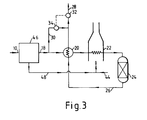
- the inlet feedstock stream for example natural gas containing 100 ppm by volume of hydrogen sulphide
- a membrane separation unit 46 wherein it is separated into a stream 18 of natural gas of reduced sulphur content, for example 10 ppm by volume and a stream 48 of gas containing the bulk of the hydrogen sulphide.
- the reduced sulphur content stream 18 is passed, as in the embodiment of Figure 1, through a heat exchanger 20, and a fired heater 22 and then through a bed 24 of a particulate sorbent, for example zinc oxide.
- the purified gas stream 26 leaving bed 24 is then fed, via heat exchanger 20, to a product line 28,
- a bypass stream 30, taken from stream 18 and bypassing heat exchanger 20, heater 22, and bed 24, is reunited with the product line 28.
- the extent of bypass is controlled by a sensor 32 operating a valve 34 in the bypass line so that the product stream meets the desired sulphur content specification, for example 1 to 4 ppm by volume.
- Some or all of the stream 48 of natural gas loaded with the hydrogen sulphide separated in the membrane unit 46 is combusted with air supplied via line 44 and heats heater 22.
- the resulting flue gas may be treated in a sulphur recovery unit (not shown).
- heater 22 and the feed/effluent heat exchanger 20
- the purpose of heater 22, and the feed/effluent heat exchanger 20, is to raise the temperature of the partially purified gas stream entering the particulate non-regenerable sorbent bed 24 to a temperature, for example 150 to 400°C, at which the latter has an improved sulphur capacity.
- the inlet feedstock stream typically contains hydrocarbons up to those containing six carbon atoms. Usually it will contain, in addition to methane, one or more of ethane, propane, propene, butanes, and butenes.
- the invention is also of utility with other feedstocks, for example naphtha, carbon dioxide, refinery off gas, or the product of fractionating a gas mixture produced by cracking or hydrocracking a normally liquid hydrocarbon feedstock, or the gaseous by-product of a zeolite-catalysed conversion of a feedstock such as methanol to gasoline.
- composition of the raw gas where the latter is a natural or oilfield associated gas, expressed by volume, is typically ethane 2 to 20 % propane plus propene 1 to 10 % butanes plus butenes 0,5 to 5 % higher hydrocarbons 0.2 to 2 % carbon dioxide 0 to 20 % nitrogen 0 to 20 % water up to saturation methane balance.
- the sulphur compounds initially present in the feedstock stream usually include hydrogen sulphide and/or carbonyl sulphide, and possibly carbon disulphide, methyl mercaptan, diethyl sulphide, and/or tetrahydrothiophene.
- the total initial concentration of sulphur compounds, expressed as sulphur equivalent hydrogen sulphide is typically in the range 10 to 1000 ppm by volume of the feedstock when the latter is in the gaseous phase.
- the sorption can be conducted so that a substantial proportion, e.g. over 75% by volume of the sulphur content of the feedstock stream can be removed.
- the sulphur compounds content of the product is under 10, for example under 5, ppm by volume, expressed as above, but this is a matter of design, depending on the user's requirements.
- the temperature of the feedstock is typically in the range -10 to +50°C.
- the heating step is preferably conducted so as to increase the temperature to at least 50°C, and preferably to within the range 80 to 200°C.
- the heating of the stream passing through the particulate non-regenerable sorbent bed by heat exchange with the combustion products is effected after feed/effluent heat exchange, so that the temperature difference in the latter heat exchange is maximised.
- the degree of heating is sufficient to increase the temperature of the non regenerable sorbent bed by at least 50°C, and in particular to a temperature in the range 150 to 350°C as such intermittent heating has the effect of increasing the sorption capacity of the bed as described in EP-A-230146.
- the particulate non-regenerable sorbent material preferably comprises at least 60, especially at least 80, % by weight of zinc oxide, calculated on the constituents of the particulate non-regenerable sorbent material non-volatile at 900°C.
- the zinc oxide may be, at least initially, wholly or partly hydrated or in the form of a salt of a weak acid, e.g. a carbonate,
- the particulate non-regenerable sorbent material is preferably in the form of porous agglomerates, as may be made, for example, by mixing a finely divided zinc oxide composition with a cement binder and a little water, insufficient to give a slurry, and then granulated or extruded. In order to aid access of the heated gas stream into the particles, the latter may be provided in the form of extruded pellets having a plurality of through passages.
- the BET surface area of the particles is at least 20, preferably in the range 50 to 200, m2.g ⁇ 1, and the pore volume of the particles is preferably at least 0.2 cm3.g ⁇ 1.
- the sorption efficiency and hence the life of a zinc oxide particulate bed depends on the rate of diffusion of the zinc sulphide formed by reaction of the zinc oxide with the sulphur compounds towards the interior of the particle, particularly at low sorption temperatures, it is preferable to employ zinc oxide particles having a high pore volume, above 0.2 cm3.g ⁇ 1 and high surface area, above 50 m2.g ⁇ 1.
- zinc oxide particles having a lower pore volume and a surface area of the order of 25 to 30 m2.g ⁇ 1 can be employed, the bed life at low sorption temperatures is relatively low, necessitating the use of large bed volumes to avoid premature break-through of the sulphur compounds into the product stream.
- the bed volume can be markedly reduced, e.g. to about one third of that required with particles of low pore volume and surface area 25 to 30 m2.g ⁇ 1.
- the particles employed thus preferably have a surface area above 50, particularly above 70, m2.g ⁇ 1 and a pore volume above 0.25 cm3.g ⁇ 1.
- Preferred particulate non-regenerable sorbent materials for the process have a hydrogen sulphide sorption capacity of at least 20, especially at least 25, % of the theoretical, at a temperature of 25°C, as determined in a standard test in which a mixture of hydrogen sulphide (2000 ppm by volume), carbon dioxide (4% by volume), and methane (balance) is passed through a bed of the particles at atmospheric pressure and a space velocity of 700 h ⁇ 1 using a bed of circular cross section having a length to diameter ratio of 5.
- a particularly suitable particulate non-regenerable zinc oxide material is that sold by Imperial Chemical Industries plc as "Catalyst 75-1". These particles are granules typically having a surface area of the order of 80 m2.g ⁇ 1 and a pore volume of about 0.3 cm3.g ⁇ 1, and an sorption capacity of about 27% of theoretical when measured by the above procedure.
- the particulate non-regenerable sorbent may comprise agglomerates of particles of an intimate mixture of oxides, hydroxides, carbonates and/or basic carbonates of copper, and zinc and/or at least one element such as aluminium as described in our copending European Patent Application 87303155.3 with publication number EP-A-243 052.
- regenerable liquid sorbent may be employed instead of using a bed, or beds, of an adsorbent such as a molecular sieve as the regenerable sorbent for the coarse sulphur removal stage.
- a regenerable liquid sorbent may be employed.
- the desulphurised stream may be dried by means of a further molecular sieve downstream of the particulate sorbent bed.
- This molecular sieve may be regenerated by means of a heated stream, e.g. part of the product stream that has been passed through a heat exchanger heated by the combustion products.
- a typical molecular sieve system having no particulate non-regenerable sorbent bed, for sorbing hydrogen sulphide from natural gas containing about 100 ppm and giving a product gas containing 1 ppm hydrogen sulphide, would require an sorption stage, with the feedstock at ambient temperature, of 8 hours, regeneration by passing gas heated to 280°C through the bed in a counter-current direction for 4 hours followed by cooling by passing feed, or product, gas through the bed for 4 hours to cool the bed down to the normal sorption temperature.
- the amount of gas required for the regeneration and cooling is about 12% of the total product flow.
- the sorption stage time can be increased to 8.5 hours since the hydrogen sulphide level of the gas leaving the regenerable sorbent bed during the sorption stage can be allowed to increase to above the 1 ppm specification, to for example 5 ppm.
- Regeneration, using feed heated to 280°C, could be effected for only 2 hours at a flow rate of 12% of the product flow, or preferably for the whole of the sorption time, ie 8.5 hours, at a rate of about 2.8% of the product flow.
Landscapes
- Chemical & Material Sciences (AREA)
- Organic Chemistry (AREA)
- Engineering & Computer Science (AREA)
- Analytical Chemistry (AREA)
- Oil, Petroleum & Natural Gas (AREA)
- Water Supply & Treatment (AREA)
- Chemical Kinetics & Catalysis (AREA)
- General Chemical & Material Sciences (AREA)
- Separation Of Gases By Adsorption (AREA)
- Treating Waste Gases (AREA)
- Production Of Liquid Hydrocarbon Mixture For Refining Petroleum (AREA)
- Led Devices (AREA)
- Crystals, And After-Treatments Of Crystals (AREA)
- Gyroscopes (AREA)
Claims (5)
- Verfahren zur Behandlung eines Schwefelverbindungen enthaltenden Einsatzmaterials (10), bei dema) ein Strom des Einsatzmaterials (10) bei einer ersten Temperatur durch ein regenerierbares Sorptionsmittel (16) hindurchgeleitet wird, wodurch Schwefelverbindungen aus dem Einsatzmaterial (10) sorbiert werden, so daß ein erster abgehender Strom (30) mit vermindertem Schwefelgehalt erzeugt wird, dannb) ein Strom eines erhitzten Regenerierungsfluids durch das regenerierbare Sorptionsmittel (16) hindurchgeleitet wird, wodurch das regenerierbare Sorptionsmittel (16) auf eine zweite Temperatur erhitzt wird, bei der die Schwefelverbindungen desorbiert werden, wodurch die Schwefelverbindungen desorbiert werden, so daß ein zweiter abgehender Strom erzeugt wird, der desorbierte Schwefelverbindungen enthält, dannc) ein Strom des Einsatzmaterials (10) durch das regenerierbare Sorptionsmittel (16) hindurchgeleitet wird, wodurch das regenerierbare Sorptionsmittel (16) auf die erste Temperatur abgekühlt und ein dritter abgehender Strom erzeugt wird, undd) aus dem dritten abgehenden Strom und mindestens einem Teil des ersten abgehenden Stroms (30) ein Produktstrom (28) gebildet wird,dadurch gekennzeichnet, daß Schwefelverbindungen mindestens aus einem Teil des dritten abgehenden Stroms entfernt werden, indem dieser Teil des dritten abgehenden Stroms während mindestens eines Anfangsteils der Abkühlung des regenerierbaren Sorptionsmittels durch ein Bett aus teilchenförmigem, nicht regenerierbarem Sorptionsmittel (24), das zum Sorbieren von Schwefelverbindungen befähigt ist, hindurchgeleitet wird.
- Verfahren nach Anspruch 1, bei dem mindestens ein Teil des Regenerierungsfluids und/oder mindestens ein Teil des dritten abgehenden Stromes durch indirekten Wärmeaustausch mit einem heißen Strom erhitzt wird, wobei der zweite abgehende Strom brennbar ist und verbrannt wird, um Verbrennungsprodukte zu erzeugen, die den heißen Strom bilden.
- Verfahren nach Anspruch 1 oder Anspruch 2, bei dem das erhitzte Regenerierungsfluid durch das Bett aus teilchenförmigem, nicht regenerierbarem Sorptionsmittel hindurchgeleitet wird, bevor das Regenerierungsfluid mit dem regenerierbaren Sorptionsmittel in Kontakt kommt.
- Verfahren zur Behandlung eines Schwefelverbindungen enthaltenden Einsatzmaterials (10), bei dem das Einsatzmaterial einer ersten Schwefelentfernungsbehandlung (46) unterzogen wird, wobei ein partiell entschwefelter Strom (18) und ein mit Schwefelverbindungen angereicherter Strom (48) erzeugt werden, und aus dem partiell entschwefelten Strom ein Produktstrom (28) gebildet wird, dadurch gekennzeichnet, daßa) der mit Schwefelverbindungen angereicherte Strom (48) verbrannt wird, um einen heißen Verbrennungsproduktstrom zu bilden,b) mindestens ein Teil des partiell entschwefelten Stroms (18) durch indirekten Wärmeaustausch mit dem heißen Verbrennungsproduktstrom erhitzt wird und der resultierende erhitzte partiell entschwefelte Strom mit einem Bett aus teilchenförmigem, nicht regenerierbarem Sorptionsmittel (24) in Kontakt gebracht wird, das zum Sorbieren von Schwefelverbindungen wirksam ist, wodurch ein entschwefelter abgehender Strom (26) erzeugt wird, undc) der Produktstrom (28) gebildet wird, indem der entschwefelte abgehende Strom (26) mit einem etwaigen Teil des partiell entschwefelten Stroms (18), der nicht der indirekten Erhitzung unterzogen worden ist, vereinigt wird.
- Verfahren nach einem der Ansprüche 1 bis 4, bei dem das teilchenförmige, nicht regenerierbare Sorptionsmittel aus Agglomeraten besteht, die eine spezifische Oberfläche von mindestens 50 m²·g⁻¹ und ein Porenvolumen von mindestens 0,25 cm³·g⁻¹ haben, wobei die Agglomerate mindestens 60 Masse% Zinkoxid, bezogen auf die Bestandteile des Sorptionsmittels, die bei 900 °C nicht flüchtig sind, enthalten.
Applications Claiming Priority (4)
| Application Number | Priority Date | Filing Date | Title |
|---|---|---|---|
| GB868623571A GB8623571D0 (en) | 1986-10-01 | 1986-10-01 | Desulphurisation |
| GB8623571 | 1986-10-01 | ||
| GB878710804A GB8710804D0 (en) | 1987-05-07 | 1987-05-07 | Desulphurisation |
| GB8710804 | 1987-05-07 |
Publications (3)
| Publication Number | Publication Date |
|---|---|
| EP0262849A2 EP0262849A2 (de) | 1988-04-06 |
| EP0262849A3 EP0262849A3 (en) | 1989-08-30 |
| EP0262849B1 true EP0262849B1 (de) | 1992-07-29 |
Family
ID=26291357
Family Applications (1)
| Application Number | Title | Priority Date | Filing Date |
|---|---|---|---|
| EP87308338A Expired - Lifetime EP0262849B1 (de) | 1986-10-01 | 1987-09-21 | Entschwefelung |
Country Status (6)
| Country | Link |
|---|---|
| EP (1) | EP0262849B1 (de) |
| JP (1) | JPH08171B2 (de) |
| AU (2) | AU599705B2 (de) |
| CA (1) | CA1303821C (de) |
| DE (1) | DE3780742T2 (de) |
| NO (1) | NO173601C (de) |
Families Citing this family (7)
| Publication number | Priority date | Publication date | Assignee | Title |
|---|---|---|---|---|
| WO1997022402A1 (en) * | 1995-12-15 | 1997-06-26 | Jordan Holding Company, Inc. | Apparatus and method for recovering volatile liquid |
| JP4533515B2 (ja) * | 2000-08-16 | 2010-09-01 | 三菱重工業株式会社 | 合成ガスの製造方法 |
| GB0201015D0 (en) * | 2002-01-17 | 2002-03-06 | Ici Plc | Hydrocarbon treating |
| KR20060129532A (ko) * | 2004-03-15 | 2006-12-15 | 허니웰 인터내셔날 인코포레이티드 | 내연기관의 연료 시스템으로부터 황을 포함한 방향족화합물을 저장하거나 방출하기 위한 기기 및 방법 |
| JP5812513B2 (ja) * | 2011-10-03 | 2015-11-17 | 住友電気工業株式会社 | ガス分解発電システム |
| CN102861507B (zh) * | 2012-09-07 | 2015-08-12 | 温州森源环保科技有限公司 | 一种含氨硫恶臭气体除臭净化设备 |
| WO2016075033A1 (en) * | 2014-11-10 | 2016-05-19 | Akzo Nobel Chemicals International B.V. | Process for removing a small-molecule contaminant from a chlorine compound stream |
Family Cites Families (2)
| Publication number | Priority date | Publication date | Assignee | Title |
|---|---|---|---|---|
| US4522793A (en) * | 1983-06-28 | 1985-06-11 | Phillips Petroleum Company | Removing H2 S from natural gas using two-stage molecular sieves |
| GB8600574D0 (en) * | 1986-01-10 | 1986-02-19 | Ici Plc | Desulphurisation |
-
1987
- 1987-09-21 EP EP87308338A patent/EP0262849B1/de not_active Expired - Lifetime
- 1987-09-21 DE DE8787308338T patent/DE3780742T2/de not_active Expired - Fee Related
- 1987-09-25 CA CA000547904A patent/CA1303821C/en not_active Expired - Lifetime
- 1987-09-30 NO NO874104A patent/NO173601C/no not_active IP Right Cessation
- 1987-09-30 AU AU79202/87A patent/AU599705B2/en not_active Ceased
- 1987-10-01 JP JP62249089A patent/JPH08171B2/ja not_active Expired - Lifetime
-
1990
- 1990-05-03 AU AU54667/90A patent/AU613558B2/en not_active Ceased
Also Published As
| Publication number | Publication date |
|---|---|
| NO874104D0 (no) | 1987-09-30 |
| AU599705B2 (en) | 1990-07-26 |
| NO874104L (no) | 1988-04-05 |
| DE3780742T2 (de) | 1993-03-18 |
| JPH08171B2 (ja) | 1996-01-10 |
| NO173601C (no) | 1994-01-05 |
| EP0262849A3 (en) | 1989-08-30 |
| EP0262849A2 (de) | 1988-04-06 |
| AU5466790A (en) | 1990-08-30 |
| CA1303821C (en) | 1992-06-23 |
| AU7920287A (en) | 1988-04-14 |
| AU613558B2 (en) | 1991-08-01 |
| DE3780742D1 (de) | 1992-09-03 |
| NO173601B (no) | 1993-09-27 |
| JPS63126520A (ja) | 1988-05-30 |
Similar Documents
| Publication | Publication Date | Title |
|---|---|---|
| US4865826A (en) | Desulphurization | |
| US4978439A (en) | Desulphurisation using solid sorbents | |
| US5424051A (en) | Process for the removal of carbon dioxide and mercaptans from a gas stream | |
| EP0324224B1 (de) | Integriertes Verfahren für die Entfernung von Schwefelverbindungen aus Fluidströmen | |
| US5114689A (en) | Integrated process for the removal of sulfur compounds from fluid streams | |
| US4830734A (en) | Integrated process for the removal of sulfur compounds from fluid streams | |
| KR100271539B1 (ko) | 온도스윙흡착방법 | |
| JP2967871B2 (ja) | 二酸化炭素と水の吸着方法及び吸着剤 | |
| US4957715A (en) | Gas treatment process | |
| EP0004619B1 (de) | Verfahren zur Trennung von Paraffinen von Isoparaffinen | |
| US3620969A (en) | Desulfurization by selective adsorption with a crystalline zeolitic molecular sieve | |
| KR0160000B1 (ko) | 촉매를 탈코크스화시키는 방법 | |
| US6120581A (en) | Sulfur production process | |
| KR920008080B1 (ko) | 공급스트림 성분에 민감한 처리단계를 갖는 화학적 처리방법 | |
| US3211644A (en) | Liquid phase sulfur removal from hydrocarbons with zeolite | |
| JPS62215539A (ja) | 液相オレフイン系c↓3〜c↓5供給原料からのジメチルエ−テルの回収 | |
| EP0335034A1 (de) | Integriertes Verfahren für die Entfernung von Schwefelverbindungen aus Fluidströmen | |
| EP0788403B1 (de) | Reinigungsverfahren | |
| US6287365B1 (en) | Sulfur production process | |
| EP0262849A2 (de) | Entschwefelung | |
| WO2003062177A1 (en) | Removal of sulphur compounds from low molecular weight hydrocarbons | |
| US4983365A (en) | Desulphurization | |
| US3186789A (en) | Method of removing hydrogen sulfide from gases | |
| EP0230146B1 (de) | Entschwefelung | |
| JPH0569566B2 (de) |
Legal Events
| Date | Code | Title | Description |
|---|---|---|---|
| PUAI | Public reference made under article 153(3) epc to a published international application that has entered the european phase |
Free format text: ORIGINAL CODE: 0009012 |
|
| AK | Designated contracting states |
Kind code of ref document: A2 Designated state(s): BE DE FR GB IT NL |
|
| PUAL | Search report despatched |
Free format text: ORIGINAL CODE: 0009013 |
|
| AK | Designated contracting states |
Kind code of ref document: A3 Designated state(s): BE DE FR GB IT NL |
|
| 17P | Request for examination filed |
Effective date: 19900202 |
|
| 17Q | First examination report despatched |
Effective date: 19901213 |
|
| GRAA | (expected) grant |
Free format text: ORIGINAL CODE: 0009210 |
|
| AK | Designated contracting states |
Kind code of ref document: B1 Designated state(s): BE DE FR GB IT NL |
|
| PG25 | Lapsed in a contracting state [announced via postgrant information from national office to epo] |
Ref country code: BE Effective date: 19920729 |
|
| ITF | It: translation for a ep patent filed | ||
| REF | Corresponds to: |
Ref document number: 3780742 Country of ref document: DE Date of ref document: 19920903 |
|
| ET | Fr: translation filed | ||
| PLBE | No opposition filed within time limit |
Free format text: ORIGINAL CODE: 0009261 |
|
| STAA | Information on the status of an ep patent application or granted ep patent |
Free format text: STATUS: NO OPPOSITION FILED WITHIN TIME LIMIT |
|
| 26N | No opposition filed | ||
| PGFP | Annual fee paid to national office [announced via postgrant information from national office to epo] |
Ref country code: FR Payment date: 19990807 Year of fee payment: 13 |
|
| PGFP | Annual fee paid to national office [announced via postgrant information from national office to epo] |
Ref country code: GB Payment date: 19990818 Year of fee payment: 13 |
|
| PGFP | Annual fee paid to national office [announced via postgrant information from national office to epo] |
Ref country code: NL Payment date: 19990819 Year of fee payment: 13 |
|
| PGFP | Annual fee paid to national office [announced via postgrant information from national office to epo] |
Ref country code: DE Payment date: 19990825 Year of fee payment: 13 |
|
| PG25 | Lapsed in a contracting state [announced via postgrant information from national office to epo] |
Ref country code: GB Free format text: LAPSE BECAUSE OF NON-PAYMENT OF DUE FEES Effective date: 20000921 |
|
| PG25 | Lapsed in a contracting state [announced via postgrant information from national office to epo] |
Ref country code: NL Free format text: LAPSE BECAUSE OF NON-PAYMENT OF DUE FEES Effective date: 20010401 |
|
| GBPC | Gb: european patent ceased through non-payment of renewal fee |
Effective date: 20000921 |
|
| PG25 | Lapsed in a contracting state [announced via postgrant information from national office to epo] |
Ref country code: FR Free format text: LAPSE BECAUSE OF NON-PAYMENT OF DUE FEES Effective date: 20010531 |
|
| NLV4 | Nl: lapsed or anulled due to non-payment of the annual fee |
Effective date: 20010401 |
|
| PG25 | Lapsed in a contracting state [announced via postgrant information from national office to epo] |
Ref country code: DE Free format text: LAPSE BECAUSE OF NON-PAYMENT OF DUE FEES Effective date: 20010601 |
|
| REG | Reference to a national code |
Ref country code: FR Ref legal event code: ST |
|
| PG25 | Lapsed in a contracting state [announced via postgrant information from national office to epo] |
Ref country code: IT Free format text: LAPSE BECAUSE OF NON-PAYMENT OF DUE FEES;WARNING: LAPSES OF ITALIAN PATENTS WITH EFFECTIVE DATE BEFORE 2007 MAY HAVE OCCURRED AT ANY TIME BEFORE 2007. THE CORRECT EFFECTIVE DATE MAY BE DIFFERENT FROM THE ONE RECORDED. Effective date: 20050921 |