EP0263182A1 - Elektrolytlösung für elektrolytkondensator, sowie mit dieser lösung hergestellter elektrolytkondensator - Google Patents
Elektrolytlösung für elektrolytkondensator, sowie mit dieser lösung hergestellter elektrolytkondensator Download PDFInfo
- Publication number
- EP0263182A1 EP0263182A1 EP87901641A EP87901641A EP0263182A1 EP 0263182 A1 EP0263182 A1 EP 0263182A1 EP 87901641 A EP87901641 A EP 87901641A EP 87901641 A EP87901641 A EP 87901641A EP 0263182 A1 EP0263182 A1 EP 0263182A1
- Authority
- EP
- European Patent Office
- Prior art keywords
- acid
- ammonium salt
- quaternary ammonium
- electrolytic capacitor
- electrolyte
- Prior art date
- Legal status (The legal status is an assumption and is not a legal conclusion. Google has not performed a legal analysis and makes no representation as to the accuracy of the status listed.)
- Granted
Links
Images

Classifications
-
- H—ELECTRICITY
- H01—ELECTRIC ELEMENTS
- H01G—CAPACITORS; CAPACITORS, RECTIFIERS, DETECTORS, SWITCHING DEVICES, LIGHT-SENSITIVE OR TEMPERATURE-SENSITIVE DEVICES OF THE ELECTROLYTIC TYPE
- H01G9/00—Electrolytic capacitors, rectifiers, detectors, switching devices, light-sensitive or temperature-sensitive devices; Processes of their manufacture
- H01G9/004—Details
- H01G9/02—Diaphragms; Separators
-
- H—ELECTRICITY
- H01—ELECTRIC ELEMENTS
- H01G—CAPACITORS; CAPACITORS, RECTIFIERS, DETECTORS, SWITCHING DEVICES, LIGHT-SENSITIVE OR TEMPERATURE-SENSITIVE DEVICES OF THE ELECTROLYTIC TYPE
- H01G9/00—Electrolytic capacitors, rectifiers, detectors, switching devices, light-sensitive or temperature-sensitive devices; Processes of their manufacture
- H01G9/004—Details
- H01G9/022—Electrolytes; Absorbents
Definitions
- This invention relates to an electrolyte for use in electrolytic capacitors and also to an electrolytic capacitor using the electrolyte.
- a typical electrolyte for electrolytic capacitors which has been hitherto used is an electrolyte of an ionogen dissolved in ethylene glycol.
- this type of electrolyte has a low specific conductance and tends to cause an impedance characteristic to deteriorate.
- usual practice is to add water to the electrolyte, but such an electrolyte is elevated in vapor pressure at high temperatures and ia apt to react with an aluminum electrode, thus being unsuitable for use in a high temperature range.
- Japanese Laid-open Patent Application No. 59-78522 describes electrolytes using quaternary ammonium salts of linear dicarboxylic acids
- Japanese Laid-open Patent Application No. 61-93610 teaches electrolytes using tetralkylammonium salts of 1,10-decanedicarboxylic acid or 1;6-decanedicerboxylic acid.
- the known electrolytes comprising triethylamine salts of phthalic acid or maleic acid dissolved in a ⁇ -butyrolactone solvent are disadvantageous in that the acid dissociation is caused by the proton equilibrium of the triethylamine, so that ions are produced only in small amounts. Thus, a sufficiently high specific conductance cannot be obtained.
- electrolytes using the quaternary ammonium salts of linear dicarboxylic acids or the tetraalkylammonium salts of 1,10- decanedicarboxylic acid or 1,6-decanedicarboxylic acid the specific conductance becomes low because of the rather inappropriate combination with the acid. Accordingly, electrolytic capacitors using these electrolytes cannot disadvantageously lower the impedance characteristic.
- the present invention contemplates to provide an electrolyte for electrolytic capacitors and an electrolytic capacitor using the electrolyte in which a solute of the electrolyte used is a quaternary ammonium salt of either a carboxylic acid selected from the group consisting of phthalic acid, tetrahydrophthalic acid. hexahydrophthalic acid and maleic acid, or an alkyl or nitro-substituted compound of the acid, whereby the resultant electrolytic capacitor has improved low temperature characteristics and improved characteristics with time at high temperatures, thus ensuring a prolonged life.
- a solute of the electrolyte used is a quaternary ammonium salt of either a carboxylic acid selected from the group consisting of phthalic acid, tetrahydrophthalic acid. hexahydrophthalic acid and maleic acid, or an alkyl or nitro-substituted compound of the acid, whereby the resultant electrolytic capacitor has improved low temperature characteristics and improved characteristics with time at high temperatures
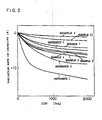
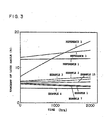
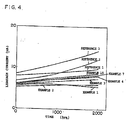
- Fig. 1 is a schematic perspective view illustrating the respective members of an electrolytic capacitor; and Figs. 2-4 are, respectively, graphs of characteristics, in relation to time, of aluminum electrolytic capacitors having ratings 10 V and 2200 ⁇ F ( ⁇ 16 x 32) and using known electrolytes and electrolytes of the invention, in which Fig. 2 is a characteristic graph showing a variation in electrostatic capacity by application of a rated voltage, Fig. 3 is a characteristic graph showing a variation in tangent of the loss angle by application of a rated voltage, and Fig. 4 is a characteristic graph of a variation in leakage current in the absence of an applied voltage.
- the present invention provides an electrolyte for use in an electrolytic capacitor which comprises a solution, in an organic solvent, of a quaternary ammonium salt of a carboxylic acid selected from the group consisting of Phthalic acid, a tetrahydrophthalic: acid, hexahydrophthalic acid and maleic acid, or of an alkyl or nitro-substituted compound of the carboxylic acid, and also provides an electrolytic capacitor using the electrolyte.
- a quaternary ammonium salt of a carboxylic acid selected from the group consisting of Phthalic acid, a tetrahydrophthalic: acid, hexahydrophthalic acid and maleic acid, or of an alkyl or nitro-substituted compound of the carboxylic acid
- the quaternary ammonium salts are those compounds of the following general formula in which X 1 represents X 2 represents or COOH in which each R 1' each R 2 , each R 3 and each R 4 independently represent an alkyl group, an aryl group, a cycloalkyl group, an aralkyl group and/or a hydroxyalkyl group, or the two of these substituents may combine to form a divalent group which forms a ring along with the nitrogen atom, and A represents a carboxylic acid residue.
- R 1' R 2 , R 3 and R 4 are, respectively, a C 1-12 . alkyl group (such as methyl, ethyl, proayl, butyl octyl, dodecyl and the like), an aryl group (such as phenyl and the like), a cycloalkyl group (such as cyclohexyl and the like), an aralkyl group (such as benzyl and the like), and a C 2-4 hydroxyalkyl group (such as hydroxyethyl and the like).
- alkyl group such as methyl, ethyl, proayl, butyl octyl, dodecyl and the like
- an aryl group such as phenyl and the like
- a cycloalkyl group such as cyclohexyl and the like
- an aralkyl group such as benzyl and the like
- these two substituents may combine to give a divalent group such as, for example, -(CH 2 )n- wherein n is 5 or 6, or - CH 2 CH 2 OCH 2 CH 2 -; and form a ring along with the nitrogen atom.
- the tetrahydrophthalic acid includes cyclohexene-1,2-dicarboxylic acid and cyclohexeme-4,5-dicarboxylic acid.
- the alkyl'-substituted compound of the carboxylic acid is one whose alkyl moiety has 1 - 3 carbon atoms, e.g. a methyl-substituted compound.
- Examples of the alkylsubstituted compound include mathylmaleic acid (citraconic acid) and dimethylmaleic acid.
- Examples of the nitro-substituted compounds include 3- or 4-nitrophthalic acid.
- quaternary ammonium salts examples include tetradkyl ammonium salts (whose alkyl moiety has generally 1-12 carbon atoms, e.g. a tetramethylammonium salt, a tetraethyl ammonium salt, a tetrapropylammonium salt, a tetrabutylammonium salt, a methyltriethyl ammonium salt, an ethyltrimethylammonium salt and the like), aryltrialkyammonium salts (such as a phenyltrimethylammonium salt and the like), eyelohexytriatkyammonium salts (such as a cyclohexyltrimethylammonium salt and the like).
- tetradkyl ammonium salts whose alkyl moiety has generally 1-12 carbon atoms, e.g. a tetramethylammonium salt, a tetraethyl ammoni
- arylaikyltrialkylammonium salts such as a benzyltrimethylammonium salt and the like
- trialkylhydroxyalkylammonium salts such as a trimethylhydroxyethylammonium salt and the like
- N,N-dialkylpiperidinium salts such as an N,N-dimethylpiperidinium salt and the like
- the tetraalkylammonium salts and the trialkylydroxyalkylammonium salts are preferred. Most preferably, a tetraethylammonium salt is used.
- the equivalent ratio between the carboxyl groups of a carboxylic acid and the quaternary ammonium base is generally in the range of 1.2:1.0 - 2.8:1.0. preferably 1.5:1.0 - 2.5:1.0. and most preferably 2.0:1.0. In other words, a mono-salt having a molar ratio between the acid and the base of 1:1 is most preferably used.
- the electrolyte for an electrolytic capacitor according to the invention comprises the above-defined salt and an organic solvent.
- the organic solvent include alcohols, e.g. monohydric alcohols such as butyl alcohol, diacetone alcohol, benzyl alcohol, amino alcohols and the like, dihydric alcohols such as ethylene glycol, propylene glycol, dithylene glycol, hexylene glycol, phenyl glycol and the like, trihydric alcohols such as glycerine, 3-methylpentane-1,3,5-triol and the like, and hexitol: ethers, e.g.
- monaethers such as ethylene glycol monomethyl ether, ethylene glycol monoethyl ether, diethylene glycol monomethyl ether, diethylene glycol monoethyl ether, ethylene glycol phenyl ether and the like, diethers such as ethylene glycol dimethyl ether, ethylene glycol diethyl ether, diethylene glycol dimethyl ether, diethylene glycol diethyl ether, and the like; amides, e. g .
- formamides such as N-methyl formamide, N,N-dimethylformamide, N-ethylformamide, N,N-diethyl förmamide and the like, acetamidas such as N-methylacetamide, N,N-dimethyl acetamide, N-ethyl acetamide, N,N-diethylacetamide and the like, propionamides such as N,N-dimethylpropionamide and the like, and hexamethylphosphoryl amide; oxazolidinones such as N-mathyl-2-oxazalidinone, N-ethyl-2-oxazolidinone, 3,5-dimethyl-2-axazolidinone and the like; dimethylsulfoxide, ⁇ -butyrolactone and the lika: and mixtures thereof.
- amides, oxazlidinones and ⁇ -butyrolactone are preferred. More preferably, ⁇ -butyrolactone alone or a mixed solvent comprising a major proportion of ⁇ -butyrolactone is used. In the latter case, the content of the r-butyrolactone is preferably in the range of 50 - 100% based on the total weight of the solvent.
- the electrolyte of the invention may further comprise water, if necessary.
- the content of water is generally not larger than 10% based on the weight of the electrolyte.
- the amount of the quaternary ammonium salt in the electrolyte is generally in the range of 1 wt% - 40 wt%, preferably 5 wt% - 30 wt%.
- the amount of the organic solvent is in the range of 60 wt% - 99 wt%, preferably 70 wt% - 95 wt%.
- the electrolyte of the invention obtained as described above has a high specific conductance and good stability at high temperatures.
- the use of the electrolytes results in an electrolytic capacitor which has a low impedance and is stable at high temperatures. More particutarly. when a solute which is used in combination with a solvent comprised mainly of ⁇ -butyrolactone is phthalic acid, maleic acid, nitrophthalic acid, hexahydrophthalic acid or citraconic acid, very high conductance is obtained, in ⁇ -butyrolactone, phthalic acid, maleic acid, nitrophthalic acid, tetrahydrophthalic acid, hexahydrophthalic acid, citraconic acid, and tetraethylammonium are very stable at high temperatures.
- the concentration of the quaternary ammonium salt is in the range of 1 wt% - 40 wt%. If the amount is less than 1 wt%, the specific conductance does not become satisfactorily high. Over 40 wt%, precipitation will take place.
- the present invention is illustrated by way of examples.
- hipher specific conductances can be obtained than the conductances of the known electrolytes.
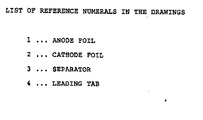
- Fig. 1 schematically shows an arrangement of the respective parts or members of this type of aluminum electrolytic capacitor.
- an anode foil 1 used as an anode of aluminum and a cathode foil 1 used as a cathode of aluminum are convolutely wound so that they are in face-to-face relation through a separator 3, thereby providing a capacitor element.
- the anode foil 1 and the cathode foil 2 of the element have leading tabs 4, respectively.
- the thus arranged element is impregnated uith each electrolyte and is sealingly encased in a case to obtain an electrolytic capacitor.
- the electrolytes of Examples of the invention have significantly lower tan ⁇ ⁇ 120Hz) and impedance (100 KHz) characteristics than the known electrolytes.
- Figs. 2 to 4 show variations in the respective characteristics at 105°C of the aluminum electrolytic capacitors using the electrolytes of References 1, 2 and 3 and Examples 1, 2, 3, 4, 7 and 15 in relation to time. More particularly, Fig. 2 shows a variation in electrostatic capacity obtained by application of a rated voltage, Fig. 3 shows a variation in tangent of the loss angle obtained by application of a rated voltage, and Fig. 4 shows a variation in leakage current without application of any voltage.
- the electrolytes for electrolytic capacitors and capacitors using such electrolytes according to the invention have high specific conductance, and the lose of the capacitor can be improved over a wide range of normal to low temperatures. Because the electrolytes do rarely deteriorate at high temperatures, electrolytic capacitors whose characteristics do not vary over a long term can be obtained.
- the present invention provides an electrolytic capacitor which exhibits stable characteristics over a wide temperature range of from low to high temperatures.
Landscapes
- Engineering & Computer Science (AREA)
- Power Engineering (AREA)
- Microelectronics & Electronic Packaging (AREA)
- Chemical & Material Sciences (AREA)
- Chemical Kinetics & Catalysis (AREA)
- Electrochemistry (AREA)
- Electric Double-Layer Capacitors Or The Like (AREA)
- Organic Low-Molecular-Weight Compounds And Preparation Thereof (AREA)
- Electrochromic Elements, Electrophoresis, Or Variable Reflection Or Absorption Elements (AREA)
- Secondary Cells (AREA)
Applications Claiming Priority (3)
| Application Number | Priority Date | Filing Date | Title |
|---|---|---|---|
| JP3802986 | 1986-02-21 | ||
| JP38029/86 | 1986-02-21 | ||
| PCT/JP1987/000107 WO1987005149A1 (en) | 1986-02-21 | 1987-02-20 | Electrolytic solution for driving electrolytic capacitor and electrolytic capacitor prepared by using it |
Publications (3)
| Publication Number | Publication Date |
|---|---|
| EP0263182A1 true EP0263182A1 (de) | 1988-04-13 |
| EP0263182A4 EP0263182A4 (de) | 1988-12-15 |
| EP0263182B1 EP0263182B1 (de) | 1994-06-08 |
Family
ID=12514129
Family Applications (1)
| Application Number | Title | Priority Date | Filing Date |
|---|---|---|---|
| EP87901641A Expired - Lifetime EP0263182B1 (de) | 1986-02-21 | 1987-02-20 | Elektrolytlösung für elektrolytkondensator, sowie mit dieser lösung hergestellter elektrolytkondensator |
Country Status (6)
| Country | Link |
|---|---|
| US (2) | US4821153A (de) |
| EP (1) | EP0263182B1 (de) |
| JP (2) | JPS62288815A (de) |
| KR (1) | KR910003216B1 (de) |
| DE (1) | DE3750011T2 (de) |
| WO (1) | WO1987005149A1 (de) |
Cited By (2)
| Publication number | Priority date | Publication date | Assignee | Title |
|---|---|---|---|---|
| EP0281994A1 (de) * | 1987-03-09 | 1988-09-14 | Nippon Chemi-Con Corporation | Elektrolyt für elektrolytischen Kondensator |
| US5055975A (en) * | 1989-06-29 | 1991-10-08 | Siemens Aktiengesellschaft | Electrolyte capacitor |
Families Citing this family (17)
| Publication number | Priority date | Publication date | Assignee | Title |
|---|---|---|---|---|
| JPS62288815A (ja) * | 1986-02-21 | 1987-12-15 | Sanyo Chem Ind Ltd | 電解液 |
| DE69016239T2 (de) * | 1989-04-04 | 1995-05-24 | Matsushita Electric Ind Co Ltd | Elektrolyt für elektrolytische Kondensatoren sowie diesen enthaltender Kondensator. |
| US5143587A (en) * | 1992-01-24 | 1992-09-01 | Asahi Glass Company Ltd. | Method for etching an aluminum foil for an electrolytic capacitor |
| US5194127A (en) * | 1992-01-24 | 1993-03-16 | Asahi Glass Company Ltd. | Method for etching an aluminum foil for an electrolytic capacitor |
| EP0684620B1 (de) * | 1993-12-03 | 2003-06-04 | Sanyo Chemical Industries, Ltd. | Elektrolytloesung und daraus hergestelltes elektrochemisches element |
| US6663760B2 (en) * | 1996-12-06 | 2003-12-16 | Seiko Epson Corporation | Method of fabricating two-terminal nonlinear element using non-aqueous electrolyte |
| US6166899A (en) | 1997-12-18 | 2000-12-26 | Nippon Chemi-Con Corporation | Electrolyte for electrolytic capacitor and electrolytic capacitor having the same |
| CN100394522C (zh) * | 2001-05-11 | 2008-06-11 | 三菱化学株式会社 | 电解电容器用电解液及使用该电解液的电解电容器 |
| US7194016B2 (en) * | 2002-03-22 | 2007-03-20 | The Research Foundation Of The University Of Central Florida | Laser-to-fiber coupling |
| US6587329B1 (en) * | 2002-05-23 | 2003-07-01 | Pacesetter, Inc. | Conductive electrolyte for high voltage capacitors |
| US6535373B1 (en) * | 2002-06-12 | 2003-03-18 | Lithdyne International | Non-aqueous electrolyte |
| DE102004037601B4 (de) * | 2004-08-03 | 2007-07-12 | Epcos Ag | Elektrolytlösung für Doppelschichtkondensatoren und Doppelschichtkondensator mit der Elektrolytlösung |
| JP5279687B2 (ja) * | 2009-11-12 | 2013-09-04 | 日本カーリット株式会社 | 電解コンデンサ用電解液及び電解コンデンサ |
| US10084206B2 (en) | 2013-11-12 | 2018-09-25 | Alexandre M. Iarochenko | Fast charge apparatus for a battery |
| US9912008B2 (en) | 2013-11-12 | 2018-03-06 | Intec Energy Storage Corporation | Electrical energy storage device with non-aqueous electrolyte |
| EP3218953B1 (de) * | 2014-11-12 | 2019-08-07 | Intec Energy Storage Corp. | Sekundäre batterie mit wasserfreiem elektrolyt |
| CN119108212B (zh) * | 2023-08-30 | 2026-04-17 | 深圳新宙邦科技股份有限公司 | 一种中高压铝电解电容器用电解液及铝电解电容器 |
Family Cites Families (18)
| Publication number | Priority date | Publication date | Assignee | Title |
|---|---|---|---|---|
| US3614218A (en) * | 1969-07-09 | 1971-10-19 | Leonard Bronstein | Fused eccentric trifocal corneal contact lens |
| JPS5146252B2 (de) * | 1971-09-01 | 1976-12-08 | ||
| US3812039A (en) * | 1971-02-25 | 1974-05-21 | Sanyo Electric Co | Electrolyte for electrolytic capacitor |
| JPS5610777B2 (de) * | 1972-06-13 | 1981-03-10 | ||
| JPS5240025A (en) * | 1975-09-26 | 1977-03-28 | Oki Electric Ind Co Ltd | High-speed printing equipment |
| US4117531A (en) * | 1977-05-25 | 1978-09-26 | Sprague Electric Company | Electrolytic capacitor |
| JPS547564A (en) * | 1977-06-20 | 1979-01-20 | Sanyo Electric Co | Electrolyte for driving electrolytic capacitor |
| US4377692A (en) * | 1981-07-24 | 1983-03-22 | Sprague Electric Company | Anomalous salts of dibasic acids |
| JPS59125610A (ja) * | 1983-01-07 | 1984-07-20 | 日立コンデンサ株式会社 | 電解コンデンサ用電解液 |
| JPS59232410A (ja) * | 1983-06-15 | 1984-12-27 | 日本ケミコン株式会社 | 電解コンデンサ駆動用電解液 |
| JPS617617A (ja) * | 1984-06-21 | 1986-01-14 | エルナ−株式会社 | 電解コンデンサ駆動用電解液 |
| JPS6132509A (ja) * | 1984-07-25 | 1986-02-15 | 昭和電工株式会社 | 電解コンデンサの駆動用電解液 |
| JPS6193610A (ja) * | 1984-10-12 | 1986-05-12 | エルナ−株式会社 | 電解コンデンサ駆動用電解液 |
| EP0227433B1 (de) * | 1985-12-20 | 1992-01-15 | Mitsubishi Petrochemical Co., Ltd. | Elektrolytische Lösung eines quaternären Ammoniumsalzes für elektrolytische Kondensatoren |
| JPS62145715A (ja) * | 1985-12-20 | 1987-06-29 | 三菱油化株式会社 | 電解コンデンサ用電解液 |
| JPS62145713A (ja) * | 1985-12-20 | 1987-06-29 | 三菱油化株式会社 | 電解コンデンサ用電解液 |
| JPS62288815A (ja) * | 1986-02-21 | 1987-12-15 | Sanyo Chem Ind Ltd | 電解液 |
| US4734821A (en) * | 1986-05-13 | 1988-03-29 | Asahi Glass Company Ltd. | Electrolytic capacitor |
-
1987
- 1987-02-10 JP JP62028491A patent/JPS62288815A/ja active Pending
- 1987-02-20 DE DE3750011T patent/DE3750011T2/de not_active Expired - Fee Related
- 1987-02-20 WO PCT/JP1987/000107 patent/WO1987005149A1/ja not_active Ceased
- 1987-02-20 US US07/127,298 patent/US4821153A/en not_active Expired - Lifetime
- 1987-02-20 KR KR1019870700965A patent/KR910003216B1/ko not_active Expired
- 1987-02-20 EP EP87901641A patent/EP0263182B1/de not_active Expired - Lifetime
- 1987-02-20 JP JP62501288A patent/JP2702726B2/ja not_active Expired - Fee Related
-
1989
- 1989-01-17 US US07/298,345 patent/US5457599A/en not_active Expired - Lifetime
Cited By (2)
| Publication number | Priority date | Publication date | Assignee | Title |
|---|---|---|---|---|
| EP0281994A1 (de) * | 1987-03-09 | 1988-09-14 | Nippon Chemi-Con Corporation | Elektrolyt für elektrolytischen Kondensator |
| US5055975A (en) * | 1989-06-29 | 1991-10-08 | Siemens Aktiengesellschaft | Electrolyte capacitor |
Also Published As
| Publication number | Publication date |
|---|---|
| EP0263182A4 (de) | 1988-12-15 |
| WO1987005149A1 (en) | 1987-08-27 |
| DE3750011D1 (de) | 1994-07-14 |
| KR880701013A (ko) | 1988-04-13 |
| US4821153A (en) | 1989-04-11 |
| KR910003216B1 (ko) | 1991-05-22 |
| EP0263182B1 (de) | 1994-06-08 |
| US5457599A (en) | 1995-10-10 |
| JP2702726B2 (ja) | 1998-01-26 |
| DE3750011T2 (de) | 1994-10-06 |
| JPS62288815A (ja) | 1987-12-15 |
Similar Documents
| Publication | Publication Date | Title |
|---|---|---|
| EP0263182A1 (de) | Elektrolytlösung für elektrolytkondensator, sowie mit dieser lösung hergestellter elektrolytkondensator | |
| US5160653A (en) | Electrolytic capacitor and electrolyte therefor | |
| JPWO1987005149A1 (ja) | 電解コンデンサ駆動用電解液およびそれを用いた電解コンデンサ | |
| US5177673A (en) | Electrolyte for driving electrolytic capacitors and capacitor using the same | |
| US3509425A (en) | Electrolytic capacitor and electrolyte material therefor | |
| US5006964A (en) | Low resistivity low ESR capacitor electrolyte | |
| JPH0325912A (ja) | 電解コンデンサ用電解液 | |
| JPH0351285B2 (de) | ||
| JPH02277207A (ja) | 電解コンデンサ駆動用電解液 | |
| JP3191818B2 (ja) | 電解コンデンサ駆動用高分子固体電解質 | |
| KR100348923B1 (ko) | 전해콘덴서구동용 전해액 및 그것을 사용한 전해콘덴서 | |
| JPS63228708A (ja) | 電解コンデンサ | |
| JPS63224212A (ja) | 電解コンデンサ | |
| JPS63232409A (ja) | 電解コンデンサ | |
| JPS63239913A (ja) | 電解コンデンサ | |
| JPS6369212A (ja) | 電解コンデンサ | |
| JPS63232410A (ja) | 電解コンデンサ | |
| JPS63219119A (ja) | 電解コンデンサ | |
| JPS63228709A (ja) | 電解コンデンサ | |
| JPH0254919A (ja) | 電解コンデンサ用電解液 | |
| JPH02263422A (ja) | 電解コンデンサ駆動用電解液 | |
| JPS6369213A (ja) | 電解コンデンサ | |
| JPS63261822A (ja) | 電解コンデンサ駆動用電解液 | |
| JPS6369214A (ja) | 電解コンデンサ | |
| JPH0325911A (ja) | 電解コンデンサ用電解液 |
Legal Events
| Date | Code | Title | Description |
|---|---|---|---|
| PUAI | Public reference made under article 153(3) epc to a published international application that has entered the european phase |
Free format text: ORIGINAL CODE: 0009012 |
|
| 17P | Request for examination filed |
Effective date: 19871020 |
|
| AK | Designated contracting states |
Kind code of ref document: A1 Designated state(s): DE FR GB NL |
|
| A4 | Supplementary search report drawn up and despatched |
Effective date: 19881215 |
|
| 17Q | First examination report despatched |
Effective date: 19910703 |
|
| GRAA | (expected) grant |
Free format text: ORIGINAL CODE: 0009210 |
|
| AK | Designated contracting states |
Kind code of ref document: B1 Designated state(s): DE FR GB NL |
|
| ET | Fr: translation filed | ||
| REF | Corresponds to: |
Ref document number: 3750011 Country of ref document: DE Date of ref document: 19940714 |
|
| PLBE | No opposition filed within time limit |
Free format text: ORIGINAL CODE: 0009261 |
|
| STAA | Information on the status of an ep patent application or granted ep patent |
Free format text: STATUS: NO OPPOSITION FILED WITHIN TIME LIMIT |
|
| 26N | No opposition filed | ||
| REG | Reference to a national code |
Ref country code: GB Ref legal event code: IF02 |
|
| PGFP | Annual fee paid to national office [announced via postgrant information from national office to epo] |
Ref country code: NL Payment date: 20050203 Year of fee payment: 19 |
|
| PGFP | Annual fee paid to national office [announced via postgrant information from national office to epo] |
Ref country code: FR Payment date: 20050208 Year of fee payment: 19 |
|
| PGFP | Annual fee paid to national office [announced via postgrant information from national office to epo] |
Ref country code: GB Payment date: 20050216 Year of fee payment: 19 |
|
| PGFP | Annual fee paid to national office [announced via postgrant information from national office to epo] |
Ref country code: DE Payment date: 20050217 Year of fee payment: 19 |
|
| PG25 | Lapsed in a contracting state [announced via postgrant information from national office to epo] |
Ref country code: GB Free format text: LAPSE BECAUSE OF NON-PAYMENT OF DUE FEES Effective date: 20060220 |
|
| PG25 | Lapsed in a contracting state [announced via postgrant information from national office to epo] |
Ref country code: NL Free format text: LAPSE BECAUSE OF NON-PAYMENT OF DUE FEES Effective date: 20060901 Ref country code: DE Free format text: LAPSE BECAUSE OF NON-PAYMENT OF DUE FEES Effective date: 20060901 |
|
| GBPC | Gb: european patent ceased through non-payment of renewal fee |
Effective date: 20060220 |
|
| NLV4 | Nl: lapsed or anulled due to non-payment of the annual fee |
Effective date: 20060901 |
|
| REG | Reference to a national code |
Ref country code: FR Ref legal event code: ST Effective date: 20061031 |
|
| PG25 | Lapsed in a contracting state [announced via postgrant information from national office to epo] |
Ref country code: FR Free format text: LAPSE BECAUSE OF NON-PAYMENT OF DUE FEES Effective date: 20060228 |