EP0263326B1 - Verfahren zur Herstellung von wässrigen, konzentrierten Polymerisatdispersionen auf Basis von Vinyl- und/oder Acrylsäureestern - Google Patents
Verfahren zur Herstellung von wässrigen, konzentrierten Polymerisatdispersionen auf Basis von Vinyl- und/oder Acrylsäureestern Download PDFInfo
- Publication number
- EP0263326B1 EP0263326B1 EP87113371A EP87113371A EP0263326B1 EP 0263326 B1 EP0263326 B1 EP 0263326B1 EP 87113371 A EP87113371 A EP 87113371A EP 87113371 A EP87113371 A EP 87113371A EP 0263326 B1 EP0263326 B1 EP 0263326B1
- Authority
- EP
- European Patent Office
- Prior art keywords
- parts
- weight
- vinyl
- acrylic esters
- monomers
- Prior art date
- Legal status (The legal status is an assumption and is not a legal conclusion. Google has not performed a legal analysis and makes no representation as to the accuracy of the status listed.)
- Expired - Lifetime
Links
- 239000006185 dispersion Substances 0.000 title claims abstract description 33
- 229920000642 polymer Polymers 0.000 title claims description 9
- NIXOWILDQLNWCW-UHFFFAOYSA-N acrylic acid group Chemical group C(C=C)(=O)O NIXOWILDQLNWCW-UHFFFAOYSA-N 0.000 title claims description 6
- 238000004519 manufacturing process Methods 0.000 title description 4
- 125000002348 vinylic group Chemical group 0.000 title 1
- 239000003995 emulsifying agent Substances 0.000 claims abstract description 28
- 239000000178 monomer Substances 0.000 claims abstract description 22
- 238000000034 method Methods 0.000 claims abstract description 20
- XTXRWKRVRITETP-UHFFFAOYSA-N Vinyl acetate Chemical compound CC(=O)OC=C XTXRWKRVRITETP-UHFFFAOYSA-N 0.000 claims description 10
- 125000004432 carbon atom Chemical group C* 0.000 claims description 9
- 239000004815 dispersion polymer Substances 0.000 claims description 9
- 238000002360 preparation method Methods 0.000 claims description 8
- 229920002554 vinyl polymer Polymers 0.000 claims description 7
- UIWXSTHGICQLQT-UHFFFAOYSA-N ethenyl propanoate Chemical compound CCC(=O)OC=C UIWXSTHGICQLQT-UHFFFAOYSA-N 0.000 claims description 6
- 125000000391 vinyl group Chemical group [H]C([*])=C([H])[H] 0.000 claims description 6
- 229920006395 saturated elastomer Polymers 0.000 claims description 5
- 150000005691 triesters Chemical class 0.000 claims 1
- -1 phosphoric acid triester Chemical class 0.000 abstract description 19
- NBIIXXVUZAFLBC-UHFFFAOYSA-N phosphoric acid Substances OP(O)(O)=O NBIIXXVUZAFLBC-UHFFFAOYSA-N 0.000 abstract description 11
- 229910000147 aluminium phosphate Inorganic materials 0.000 abstract description 5
- 150000001875 compounds Chemical class 0.000 description 17
- IAYPIBMASNFSPL-UHFFFAOYSA-N Ethylene oxide Chemical group C1CO1 IAYPIBMASNFSPL-UHFFFAOYSA-N 0.000 description 12
- 239000000839 emulsion Substances 0.000 description 12
- GLDOVTGHNKAZLK-UHFFFAOYSA-N octadecan-1-ol Chemical compound CCCCCCCCCCCCCCCCCCO GLDOVTGHNKAZLK-UHFFFAOYSA-N 0.000 description 9
- XLYOFNOQVPJJNP-UHFFFAOYSA-N water Substances O XLYOFNOQVPJJNP-UHFFFAOYSA-N 0.000 description 9
- 239000000203 mixture Substances 0.000 description 8
- 238000006116 polymerization reaction Methods 0.000 description 6
- 239000007787 solid Substances 0.000 description 5
- 239000000243 solution Substances 0.000 description 5
- 125000005396 acrylic acid ester group Chemical group 0.000 description 4
- GOQYKNQRPGWPLP-UHFFFAOYSA-N n-heptadecyl alcohol Natural products CCCCCCCCCCCCCCCCCO GOQYKNQRPGWPLP-UHFFFAOYSA-N 0.000 description 4
- 238000003860 storage Methods 0.000 description 4
- 150000008027 tertiary esters Chemical class 0.000 description 4
- CNCOEDDPFOAUMB-UHFFFAOYSA-N N-Methylolacrylamide Chemical compound OCNC(=O)C=C CNCOEDDPFOAUMB-UHFFFAOYSA-N 0.000 description 3
- ULUAUXLGCMPNKK-UHFFFAOYSA-N Sulfobutanedioic acid Chemical compound OC(=O)CC(C(O)=O)S(O)(=O)=O ULUAUXLGCMPNKK-UHFFFAOYSA-N 0.000 description 3
- CQEYYJKEWSMYFG-UHFFFAOYSA-N butyl acrylate Chemical compound CCCCOC(=O)C=C CQEYYJKEWSMYFG-UHFFFAOYSA-N 0.000 description 3
- 239000011248 coating agent Substances 0.000 description 3
- 238000000576 coating method Methods 0.000 description 3
- 150000002148 esters Chemical class 0.000 description 3
- 150000002191 fatty alcohols Chemical class 0.000 description 3
- NLHHRLWOUZZQLW-UHFFFAOYSA-N Acrylonitrile Chemical compound C=CC#N NLHHRLWOUZZQLW-UHFFFAOYSA-N 0.000 description 2
- RTZKZFJDLAIYFH-UHFFFAOYSA-N Diethyl ether Chemical compound CCOCC RTZKZFJDLAIYFH-UHFFFAOYSA-N 0.000 description 2
- JIGUQPWFLRLWPJ-UHFFFAOYSA-N Ethyl acrylate Chemical compound CCOC(=O)C=C JIGUQPWFLRLWPJ-UHFFFAOYSA-N 0.000 description 2
- CERQOIWHTDAKMF-UHFFFAOYSA-N Methacrylic acid Chemical compound CC(=C)C(O)=O CERQOIWHTDAKMF-UHFFFAOYSA-N 0.000 description 2
- 229910004882 Na2S2O8 Inorganic materials 0.000 description 2
- IGFHQQFPSIBGKE-UHFFFAOYSA-N Nonylphenol Natural products CCCCCCCCCC1=CC=C(O)C=C1 IGFHQQFPSIBGKE-UHFFFAOYSA-N 0.000 description 2
- PPBRXRYQALVLMV-UHFFFAOYSA-N Styrene Chemical compound C=CC1=CC=CC=C1 PPBRXRYQALVLMV-UHFFFAOYSA-N 0.000 description 2
- 125000000129 anionic group Chemical group 0.000 description 2
- 238000006555 catalytic reaction Methods 0.000 description 2
- 239000003638 chemical reducing agent Substances 0.000 description 2
- 239000000470 constituent Substances 0.000 description 2
- 150000005690 diesters Chemical class 0.000 description 2
- LQZZUXJYWNFBMV-UHFFFAOYSA-N dodecan-1-ol Chemical class CCCCCCCCCCCCO LQZZUXJYWNFBMV-UHFFFAOYSA-N 0.000 description 2
- 239000000463 material Substances 0.000 description 2
- XMYQHJDBLRZMLW-UHFFFAOYSA-N methanolamine Chemical class NCO XMYQHJDBLRZMLW-UHFFFAOYSA-N 0.000 description 2
- SNQQPOLDUKLAAF-UHFFFAOYSA-N nonylphenol Chemical compound CCCCCCCCCC1=CC=CC=C1O SNQQPOLDUKLAAF-UHFFFAOYSA-N 0.000 description 2
- PNJWIWWMYCMZRO-UHFFFAOYSA-N pent‐4‐en‐2‐one Natural products CC(=O)CC=C PNJWIWWMYCMZRO-UHFFFAOYSA-N 0.000 description 2
- 238000010992 reflux Methods 0.000 description 2
- 150000003839 salts Chemical class 0.000 description 2
- CHQMHPLRPQMAMX-UHFFFAOYSA-L sodium persulfate Chemical compound [Na+].[Na+].[O-]S(=O)(=O)OOS([O-])(=O)=O CHQMHPLRPQMAMX-UHFFFAOYSA-L 0.000 description 2
- 239000004753 textile Substances 0.000 description 2
- 229920001567 vinyl ester resin Polymers 0.000 description 2
- ALSTYHKOOCGGFT-KTKRTIGZSA-N (9Z)-octadecen-1-ol Chemical compound CCCCCCCC\C=C/CCCCCCCCO ALSTYHKOOCGGFT-KTKRTIGZSA-N 0.000 description 1
- XUJLWPFSUCHPQL-UHFFFAOYSA-N 11-methyldodecan-1-ol Chemical class CC(C)CCCCCCCCCCO XUJLWPFSUCHPQL-UHFFFAOYSA-N 0.000 description 1
- SMZOUWXMTYCWNB-UHFFFAOYSA-N 2-(2-methoxy-5-methylphenyl)ethanamine Chemical compound COC1=CC=C(C)C=C1CCN SMZOUWXMTYCWNB-UHFFFAOYSA-N 0.000 description 1
- IEORSVTYLWZQJQ-UHFFFAOYSA-N 2-(2-nonylphenoxy)ethanol Chemical class CCCCCCCCCC1=CC=CC=C1OCCO IEORSVTYLWZQJQ-UHFFFAOYSA-N 0.000 description 1
- GOXQRTZXKQZDDN-UHFFFAOYSA-N 2-Ethylhexyl acrylate Chemical compound CCCCC(CC)COC(=O)C=C GOXQRTZXKQZDDN-UHFFFAOYSA-N 0.000 description 1
- 125000000954 2-hydroxyethyl group Chemical group [H]C([*])([H])C([H])([H])O[H] 0.000 description 1
- OMIGHNLMNHATMP-UHFFFAOYSA-N 2-hydroxyethyl prop-2-enoate Chemical compound OCCOC(=O)C=C OMIGHNLMNHATMP-UHFFFAOYSA-N 0.000 description 1
- QOXOZONBQWIKDA-UHFFFAOYSA-N 3-hydroxypropyl Chemical group [CH2]CCO QOXOZONBQWIKDA-UHFFFAOYSA-N 0.000 description 1
- HRPVXLWXLXDGHG-UHFFFAOYSA-N Acrylamide Chemical compound NC(=O)C=C HRPVXLWXLXDGHG-UHFFFAOYSA-N 0.000 description 1
- NIXOWILDQLNWCW-UHFFFAOYSA-M Acrylate Chemical compound [O-]C(=O)C=C NIXOWILDQLNWCW-UHFFFAOYSA-M 0.000 description 1
- VHUUQVKOLVNVRT-UHFFFAOYSA-N Ammonium hydroxide Chemical compound [NH4+].[OH-] VHUUQVKOLVNVRT-UHFFFAOYSA-N 0.000 description 1
- LSNNMFCWUKXFEE-UHFFFAOYSA-M Bisulfite Chemical compound OS([O-])=O LSNNMFCWUKXFEE-UHFFFAOYSA-M 0.000 description 1
- DWAQJAXMDSEUJJ-UHFFFAOYSA-M Sodium bisulfite Chemical compound [Na+].OS([O-])=O DWAQJAXMDSEUJJ-UHFFFAOYSA-M 0.000 description 1
- QAOWNCQODCNURD-UHFFFAOYSA-N Sulfuric acid Chemical class OS(O)(=O)=O QAOWNCQODCNURD-UHFFFAOYSA-N 0.000 description 1
- 239000002253 acid Substances 0.000 description 1
- 150000007513 acids Chemical class 0.000 description 1
- 150000001252 acrylic acid derivatives Chemical class 0.000 description 1
- 150000001298 alcohols Chemical class 0.000 description 1
- 125000005250 alkyl acrylate group Chemical group 0.000 description 1
- 150000001412 amines Chemical class 0.000 description 1
- QGZKDVFQNNGYKY-UHFFFAOYSA-N ammonia Natural products N QGZKDVFQNNGYKY-UHFFFAOYSA-N 0.000 description 1
- 239000012874 anionic emulsifier Substances 0.000 description 1
- 239000007864 aqueous solution Substances 0.000 description 1
- 125000002843 carboxylic acid group Chemical group 0.000 description 1
- 230000015271 coagulation Effects 0.000 description 1
- 238000005345 coagulation Methods 0.000 description 1
- 238000001816 cooling Methods 0.000 description 1
- FWLDHHJLVGRRHD-UHFFFAOYSA-N decyl prop-2-enoate Chemical compound CCCCCCCCCCOC(=O)C=C FWLDHHJLVGRRHD-UHFFFAOYSA-N 0.000 description 1
- 230000007812 deficiency Effects 0.000 description 1
- 235000014113 dietary fatty acids Nutrition 0.000 description 1
- 239000002270 dispersing agent Substances 0.000 description 1
- 125000003438 dodecyl group Chemical group [H]C([H])([H])C([H])([H])C([H])([H])C([H])([H])C([H])([H])C([H])([H])C([H])([H])C([H])([H])C([H])([H])C([H])([H])C([H])([H])C([H])([H])* 0.000 description 1
- 238000007720 emulsion polymerization reaction Methods 0.000 description 1
- 239000000194 fatty acid Substances 0.000 description 1
- 229930195729 fatty acid Natural products 0.000 description 1
- 150000004665 fatty acids Chemical class 0.000 description 1
- 150000002193 fatty amides Chemical class 0.000 description 1
- 239000002657 fibrous material Substances 0.000 description 1
- SBGKURINHGJRFN-UHFFFAOYSA-N hydroxymethanesulfinic acid Chemical compound OCS(O)=O SBGKURINHGJRFN-UHFFFAOYSA-N 0.000 description 1
- 238000003475 lamination Methods 0.000 description 1
- 239000012875 nonionic emulsifier Substances 0.000 description 1
- 229940055577 oleyl alcohol Drugs 0.000 description 1
- XMLQWXUVTXCDDL-UHFFFAOYSA-N oleyl alcohol Natural products CCCCCCC=CCCCCCCCCCCO XMLQWXUVTXCDDL-UHFFFAOYSA-N 0.000 description 1
- 125000006353 oxyethylene group Chemical group 0.000 description 1
- 239000002245 particle Substances 0.000 description 1
- 150000003014 phosphoric acid esters Chemical class 0.000 description 1
- 229920000058 polyacrylate Polymers 0.000 description 1
- 229920000151 polyglycol Polymers 0.000 description 1
- 239000010695 polyglycol Substances 0.000 description 1
- 230000000379 polymerizing effect Effects 0.000 description 1
- USHAGKDGDHPEEY-UHFFFAOYSA-L potassium persulfate Chemical compound [K+].[K+].[O-]S(=O)(=O)OOS([O-])(=O)=O USHAGKDGDHPEEY-UHFFFAOYSA-L 0.000 description 1
- 150000003254 radicals Chemical class 0.000 description 1
- 235000010267 sodium hydrogen sulphite Nutrition 0.000 description 1
- 159000000000 sodium salts Chemical class 0.000 description 1
- 238000003756 stirring Methods 0.000 description 1
- 238000009988 textile finishing Methods 0.000 description 1
- 229920003169 water-soluble polymer Polymers 0.000 description 1
- 150000007934 α,β-unsaturated carboxylic acids Chemical class 0.000 description 1
Classifications
-
- C—CHEMISTRY; METALLURGY
- C08—ORGANIC MACROMOLECULAR COMPOUNDS; THEIR PREPARATION OR CHEMICAL WORKING-UP; COMPOSITIONS BASED THEREON
- C08F—MACROMOLECULAR COMPOUNDS OBTAINED BY REACTIONS ONLY INVOLVING CARBON-TO-CARBON UNSATURATED BONDS
- C08F2/00—Processes of polymerisation
- C08F2/12—Polymerisation in non-solvents
- C08F2/16—Aqueous medium
- C08F2/22—Emulsion polymerisation
- C08F2/24—Emulsion polymerisation with the aid of emulsifying agents
- C08F2/30—Emulsion polymerisation with the aid of emulsifying agents non-ionic
Definitions
- the present invention relates to a process for the preparation of aqueous, concentrated polymer dispersions based on vinyl and / or acrylic acid esters by polymerizing the monomers in a customary manner, a small amount of a selected phosphoric acid meter being used as an additional emulsifier.
- EP-A 0 037 150 describes a process for the preparation of aqueous dispersions of water-soluble polymers, in which at least one monomer having a phosphoric acid, sulfonic acid or carboxylic acid group and at least one emulsifier are used, which comprises a polyoxyethylene chain with between 60 and 400 oxyethylene units contains.
- US-A 39 63 688 describes a process for emulsion polymerization, in which a phosphoric acid mono- or diester or salts thereof are used.
- EP-A 0 082 408 describes a process for polymerization in aqueous dispersion in the presence of free acids as dispersants.
- aqueous, concentrated polymer dispersions based on vinyl and / or acrylic acid esters is known in principle.
- acrylic acid esters of alkanols having 1 to 8, in particular 2 to 8, carbon atoms are generally used as the base monomers. Examples of the latter are ethyl acrylate, 2-ethylhexyl acrylate and in particular n-butyl acrylate.
- Mixtures of the vinyl esters and acrylic acid esters can of course also be used as base monomers, base monomer meaning that at least 60% by weight, in particular at least 85% by weight, based on the sum of the monomers to be polymerized, are present in these monomers.
- Styrene (1 to 25% by weight), 2-hydroxyethyl or 3-hydroxypropyl (meth) acrylate (2 to 10% by weight), alkyl methacrylates with 2 to 8 C atoms in the alkyl radical (2 to 20% by weight ), Alkyl acrylate with more than 8 carbon atoms in the alkyl radical (1 to 12% by weight), (meth) acrylic acid (1 to 5% by weight), (meth) acrylic acid amides or N-methylolamides or with alcohols with 1 to 4 C-atom etherified N-methylolamides of ⁇ , ⁇ -unsaturated carboxylic acids or mixtures of such monomers (0.5 to 5% by weight), acrylonitrile (1 to 10% by weight) and vinyl versatic acid (2 to 12% by weight).
- the finished concentrated dispersions generally have a solids content of at least 40% by weight, in particular 45 to 70% by weight.
- the emulsions are usually prepared in the presence of emulsifiers.
- the known anionic and non-ionogenic compounds are generally used as emulsifiers.
- Those skilled in the art are familiar with the alkylbenzenesulfonates, dialkyl sulfosuccinates used and the sulfated, optionally ethoxylated sulfuric acid esters of alkylphenols or fatty alcohols or the ethoxylated fatty alcohols, fatty amides, fatty acids, alkylphenols and fatty amines or their salts and will have no difficulty in selecting these compounds accordingly.
- the compound of the formula (I) according to the invention is obtained in amounts of 0.05 to 1.5, in particular 0.05 to 1.0% by weight, very particularly preferably in amounts of 0.1 to 0.5% by weight on the entire dispersion.
- the present method is characterized in addition to other advantages by a reduction in the total amount of emulsifier required.
- the total amount of emulsifier containing the customary anionic and / or non-ionic emulsifier and the compound of the formula (I) hereinafter referred to as the emulsifier system - is up to 5% by weight, based on the total dispersion, but dispersions with an excellent Overall impression obtained when using only 3% by weight or even less than 1.0% by weight of the emulsifier system, based on the total dispersion, especially when using acrylates as base monomers.
- the preparation of the polymer dispersions is known in principle.
- a monomer emulsion is prepared which, in addition to the base monomers and optionally further comonomers, also contains the emulsifier system.
- the actual polymerization is now carried out in a known manner. Details are familiar to the person skilled in the art.
- the aqueous dispersions obtained serve not only for finishing and stiffening fiber materials, but also for coating and lamination of textile materials.
- the use of such polymer dispersions is generally known.
- textile finishing they are used in the usual manner in amounts of 5 to 80 g / l.
- For the coating these products are pasted in a known manner and then a solid coating of 5 to 70 g / m 2 is applied to the textile material in a likewise known manner.
- the total amount of emulsifier can be relatively low due to the concomitant use of the compounds of formula (I) in an emulsifier system, the stability of the dispersions in no way suffering, but on the contrary, these dispersions have a significantly improved storage stability. This is particularly evident in the fact that the polymerization dispersions prepared according to the invention do not form any solid particles even after months of storage and that no coagulation is detectable. In addition, it should be emphasized in relation to the prior art that the dispersions obtained according to the invention have a noticeably lower viscosity, so that it is only possible with the present process to process the dispersions without problems at all times.
- the concentrated dispersions despite the use of a reduced amount of emulsifier, are low in viscosity and have a long shelf life and thus fully meet the many practical requirements.
- the parts given in the examples are parts by weight.
- ethoxylated technical stearyl alcohol a total of 35 ethylene oxide groups per mole
- HOSTAPHAT L 327 emulsifier system
- a pre-emulsion is prepared from the following constituents under the conditions specified in Example 1: 160 parts of water, 30 parts of emulsifier system 26 parts of the ethoxylated technical stearyl alcohol mentioned in Example 1, 4 parts HOSTAPHAT L 327, 50 parts of 20% aqueous methylolacrylamide solution, 210 parts of vinyl acetate and 210 parts of butyl acrylate.
- Example 1 The polymerization is carried out in the manner described in Example 1, a product which can be filtered very well and which has no residue and remains stable even after weeks of storage is obtained.
- the following pre-emulsion is prepared for the preparation of a polymer dispersion: 30 parts of an emulsifier system are composed of 400 parts of water 12 parts of an ethoxylated isotridecyl alcohol (a total of 40 ethylene oxide groups per mole), 12 parts of sulfated nonylphenol ethoxylate with 25 ethylene oxide per mole and 6 parts of compound (3) dissolved at 60 to 70 ° C., cooled to about 40 ° C. and a mixture of 30 parts of vinyl versatic acid in this solution, 550 parts of vinyl acetate and 150 parts of vinyl propionate are stirred in.
- an emulsifier system are composed of 400 parts of water 12 parts of an ethoxylated isotridecyl alcohol (a total of 40 ethylene oxide groups per mole), 12 parts of sulfated nonylphenol ethoxylate with 25 ethylene oxide per mole and 6 parts of compound (3) dissolved at 60 to 70 ° C., cooled to about 40 ° C
- Example 1 50 parts of the pre-emulsion described above are now introduced into 358 parts of water and the polymerization is then carried out as described in Example 1. A white, thin, extremely durable polymer dispersion is obtained. If appropriate, post-catalysis can be carried out using a reducing agent such as sodium bisulfite or the sodium salt of hydroxymethanesulfinic acid.
- a reducing agent such as sodium bisulfite or the sodium salt of hydroxymethanesulfinic acid.
- an emulsion can also be prepared by using 650 parts of vinyl acetate and 70 parts of vinyl versatic acid instead of the monomer mixture mentioned above for the preparation of the pre-emulsion.
- an inlet (A) is made up of the following components 336 parts of ethyl acrylate, 10.5 parts of acrylic acid, 3.5 parts of acrylamide, 0.8 parts of 25% aqueous ammonia, 80 parts of water and prepares an emulsifier system from 1 part of sulfated, with 25 ethylene oxide ethoxylated sulfuric acid ester of nonylphenol and 1 part of compound (2) and an inlet (B) from 1.05 parts of Na2S2O8 and 16 parts of water.
- feed (A) 15 parts of feed (A) are now added to the hot receiver and stirred for 15 minutes.
- the feeds (A) and (B) are then introduced uniformly and continuously at 85 ° C. within 3 hours and then reheated at 90 ° C. for a further 2 hours.
- a thin, finely divided polymer dispersion is obtained which is easy to filter and does not have any solid deposits even after several months.
- a pre-emulsion is prepared from the following constituents under the conditions given in Example 1: 400 parts of water 45 parts of emulsifier system 35 parts of a nonylphenol polyglycol ether ethoxylated with 30 ethylene oxide and 10 parts of connection (5), 50 parts of 20% aqueous methylolacrylamide solution, 700 parts of vinyl acetate and 10 parts of 2-hydroxyethyl acrylate.
- the polymerization is carried out as described in Example 1, giving a low-viscosity, stable, readily filterable product which can be stored for months.
Landscapes
- Chemical & Material Sciences (AREA)
- Health & Medical Sciences (AREA)
- Chemical Kinetics & Catalysis (AREA)
- Medicinal Chemistry (AREA)
- Polymers & Plastics (AREA)
- Organic Chemistry (AREA)
- Polymerisation Methods In General (AREA)
- Addition Polymer Or Copolymer, Post-Treatments, Or Chemical Modifications (AREA)
- Processes Of Treating Macromolecular Substances (AREA)
- Compositions Of Macromolecular Compounds (AREA)
Description
- Die vorliegende Erfindung betrifft ein Verfahren zur Herstellung von wäßrigen, konzentrierten Polymerisatdispersionen auf Basis von vinyl- und/oder Acrylsäureestern durch Polymerisation der Monomeren in üblicher Weise, wobei als zusätzlicher Emulgator eine geringe Menge eines ausgewählten Phosphorsäuretriesters eingesetzt wird.
- Aus der EP-PS 065 253 ist ein Verfahren zur Herstellung von konzentrierten Polyacrylatdispersionen bekannt, bei welchen unter sonst üblichen Bedingungen ein weiterer Emulgator, nämlich ein Sulfobernsteinsäuredialkylester mit 8 bis 18 C-Atomen im Alkylrest in geringen Mengen mitverwendet wird. Dieses Verfahren bringt eine gewisse Verbesserung in der Stabilität der Dispersionen mit sich, jedoch weisen dieselben für eine leichte Handhabung für viele Zwecke eine zu hohe Viskosität auf. Vor allem aber bringt das bekannte Verfahren bei der Herstellung von Polymerisatdispersionen auf Basis von Vinylestern kaum entscheidende Vorteile.
- Die EP-A 0 037 150 beschreibt ein Verfahren zur Herstellung wäßriger Dispersionen von wasserlöslichen Polymeren, bei dem mindestens ein Monomeres mit einer Phosphorsäure-, Sulfonsäure- oder Carbonsäuregruppe sowie mindestens ein Emulgator mitverwendet wird, der eine Polyoxyäthylenkette mit zwischen 60 und 400 Oxyäthyleneinheiten enthält. Die US-A 39 63 688 beschreibt ein Verfahren zur Emulsionspolymerisation, bei dem ein Phosphorsäuremono- oder -diester bzw. Salze davon mitverwendet werden. Die EP-A 0 082 408 beschreibt ein Verfahren zur Polymerisation in wäßriger Dispersion in Gegenwart freier Säuren als Dispergatoren.
- Es wurde nun gefunden, daß man bei der Herstellung von wäßrigen, konzentrierten Polymerisatdispersionen auf Basis von Vinyl- und/oder Acrylsäureestern in Gegenwart eines ausgewählten Phosphorsäuretriesters in geringen Mengen die nach dem Stand der Technik bestehenden Mängel beseitigen kann. Das erfindungsgemäße Verfahren ist im Patentanspruch 1 wiedergegeben. In den Unteransprüchen 2 bis 4 werden besondere Ausgestaltungen dieses Verfahrens beschrieben. Die Patentansprüche 5 und 6 schließlich stellen die nach diesem Verfahren erhältlichen Polymerisatdispersionen unter Schutz.
- Die Herstellung wäßriger, konzentrierter Polymerisatdispersionen auf Basis von Vinyl- und/oder Acrylsäureestern ist grundsätzlich bekannt. Im allgemeinen werden neben dem Vinylacetat und/oder Vinylpropionat als Basismonomere Acrylsäureester von Alkanolen mit 1 bis 8, insbesondere mit 2 bis 8 C-Atomen verwendet. Beispiele für letztere sind Ethylacrylat, 2-Ethylhexylacrylat und insbesondere n-Butylacrylat. Selbstverständlich sind auch Mischungen aus den Vinylestern und Acrylsäureestern als Basismonomere einsetzbar, wobei Basismonomer bedeutet, daß zumindest 60 Gew.%, insbesondere zumindest 85 Gew.%, bezogen auf die Summe der zu polymerisierenden Monomere, an diesen Monomeren enthalten sind.
- Als Monomere, die mit den Basismonomeren copolymerisierbar sind, seien ohne Anspruch auf Vollständigkeit folgende genannt (Angaben in Klammern beziehen sich auf die Summe der Monomeren).
- Styrol (1 bis 25 Gew.%), 2-Hydroxyethyl- bzw. 3-Hydroxypropyl-(meth)acrylat (2 bis 10 Gew.%), Alkylmethacrylate mit 2 bis 8 C-Atomen im Alkylrest (2 bis 20 Gew.%), Alkylacrylat mit mehr als 8 C-Atomen im Alkylrest (1 bis 12 Gew.%), (Meth)acrylsäure (1 bis 5 Gew.%), (Meth)acrylsäureamide oder N-Methylolamide bzw. mit Alkoholen mit 1 bis 4 C-Atomen veretherte N-Methylolamide α, β-ungesättigter Carbonsäuren oder Gemische solcher Monomere (0,5 bis 5 Gew.%), Acrylnitril (1 bis 10 Gews.%) und Versaticsäurevinylester (2 bis 12 Gew.%).
- Die fertigen konzentrierten Dispersionen weisen in der Regel einen Feststoffgehalt von mindestens 40 Gew.%, insbesondere 45 bis 70 Gew.% auf. Die Herstellung der Emulsionen erfolgt üblicherweise in Gegenwart von Emulgatoren. Als Emulgatoren werden hierbei im allgemeinen die bekannten anionischen und nicht-ionogenen Verbindungen herangezogen. Der Fachmann kennt die verwendeten Alkylbenzolsulfonate, Sulfobernsteinsäuredialkylester und die sulfatierten, gegebenenfalls ethoxylierten Schwefelsäureester von Alkylphenolen oder Fettalkoholen bzw. die ethoxylierten Fettalkohole, Fettamide, Fettsäuren, Alkylphenole und Fettamine bzw. deren Salze und wird keine Schwierigkeiten haben, diese Verbindungen entsprechend auszuwählen.
- Das erfindungsgemäße Merkmal liegt nun darin, daß neben den obengenannten üblichen Emulgatoren eine geringe Menge eines Phosphorsäuretriesters der allgemeinen Formel (I)

in der
R₁ = (̵ CH₂-CH₂O)x-Q,
R₂ = (̵ CH₂-CH₂O)yH
mit der Maßgabe, daß bei
y = 0, R₂ gleich R₁ ist
und R₃ bei
y = 0 gleich R₁ bzw. bei
y ungleich 0 gleich R₁ oder R₂
ist, wobei x ganze Zahlen von 2 bis 10, y ganze Zahlen von 0 bis 10 und Q einen gesättigten oder ungesättigten Alkylrest bzw. Alkenylrest mit 8 bis 30 C-Atomen bedeuten, verwendet wird. Da es sich hierbei um technische Produkte handelt, können bei den Werten für x und y geringfügige Abweichungen vorliegen und die tertiären Ester geringe Mengen an Mono- und Diestern enthalten. Es handelt sich bei den angegebenen Werten für x und y also um Durchschnittswerte. - Grundsätzlich ist eine gewisse gegenseitige Beeinflussung der Werte für x und y erkennbar. So kann bei hohen Werten für x z.B. 4, 6 oder 8 Ethylenoxideinheiten, die Anzahl der Ethylenoxidgruppen für y niedrig und sogar Null werden, wobei dann definitionsgemäß R₂ = R₁ ist Ähnliches gilt auch umgekehrt.
Letzten Endes sind die Werte für x und y davon abhängig, welche Bedeutung der Rest R₃ hat, der aber bei technischen Produkten gewissen Schwankungen unterworfen ist. In der Verbindung der Formel (I) ist R₃ im Regelfall gleich R₁ bzw. bei y ungleich 0 R₁ oder R₂. - Beispiele für Verbindungen der Formel (I) sind folgende:
- (1) Verbindung mit x = 2, y = 7 und Q = eine technische Mischung aus gesättigten C 25 bis C 30 Alkylresten,
- (2) Verbindung mit x = 2, y = 7 und Q = der Laurylrest,
- (3) Verbindung mit x = 4, y = 0 und Q = eine technische Mischung aus gesättigten und ungesättigten C ₁₂ bis C₂₀ Alkylresten bzw. Alkenylresten, also der tertiäre Ester der o-Phosphorsäure eines mit 4 Ethylenoxyd ethoxilierten technischen Fettalkohols.
- (4) Verbindung mit x = 2, y = 5 und Q = ein gesättigter C₁₆ - C₁₈-Alkylrest,
- (5) Verbindung mit x = 4, y= 0 und Q = Laurylrest, also der tertiäre Ester der o-Phosphorsäure eines mit 4 Ethylenoxid ethoxylierten Laurylalkohols und
- (6) Verbindung mit x = 8, y = 0 und Q ein ungesättigter C₁₈-Alkenylrest, also der tertiäre Ester der o-Phosphorsäure eines mit 8 Ethylenoxid ethoxylierten Oleylalkohols.
- Verbindungen dieser Art sind im Handel z.B. als ®HOSTAPHAT L 327, W 327, O 380 oder L 340 von der Firma HOECHST erhältlich.
- Die erfindungsgemäße Verbindung der Formel (I) wird in Mengen von 0,05 bis 1,5, insbesondere 0,05 bis 1,0 Gew.%, ganz besonders bevorzugt in Mengen von 0,1 bis 0,5 Gew.%, bezogen auf die gesamte Dispersion, eingesetzt. Das vorliegende Verfahren zeichnet sich dabei insgesamt gesehen neben anderen Vorteilen auch durch eine Verringerung der notwendigen Gesamtmenge von Emulgator aus.
- Die Gesamtmenge von Emulgator, enthaltend den üblichen anionischen und/oder nicht-ionogenen Emulgator und die Verbindung der Formel (I) nachfolgend als Emulgatorsystem bezeichnet - liegt bei bis zu 5 Gew.%, bezogen auf die gesamte Dispersion, doch werden Dispersionen mit einem hervorragenden Gesamteindruck schon bei Einsatz von nur 3 Gew.% oder von sogar weniger als 1,0 Gew.% an Emulgatorsystem, bezogen auf die gesamte Dispersion, erhalten, vor allem bei Verwendung von Acrylaten als Basismonomere.
- Die Herstellung der Polymerisatdispersionen ist grundsätzlich bekannt. Im allgemeinen wird eine Monomeremulsion bereitet, die neben den Basismonomeren und gegebenenfalls weiteren Comonomeren auch das Emulgatorsystem enthält. Die eigentliche Polymerisation wird nun in bekannter Weise vorgenommen. Einzelheiten sind dem Fachmann geläufig.
- Die erhaltenen wäßrigen Dispersionen dienen sowohl zur Griff- und Steifausrüstung von Fasermaterialien, als auch zur Beschichtung und Kaschierung von Textilmaterialien. Der Einsatz solcher Polymerisatdispersionen ist dabei allgemein bekannt. Bei der Textilausrüstung werden dieselben in Mengen von 5 bis 80 g/l in üblicher Weise eingesetzt. Für die Beschichtung werden diese Produkte auf bekanntem Wege verpastet und dann in ebenfalls bekannter Weise eine Feststoffauflage von 5 bis 70 g/m² auf dem textilen Material aufgebracht.
- Es muß als überraschend angesehen werden, daß durch die Mitverwendung der Verbindungen der Formel (I) im Rahmen eines Emulgatorsystems die Gesamtmenge an Emulgator relativ niedrig sein kann, wobei die Stabilität der Dispersionen keineswegs leidet, sondern im Gegenteil diese Dispersionen eine wesentlich verbesserte Lagerstabilität aufweisen. Das zeigt sich vor allem darin, daß die erfindungsgemäß hergestellten Polymerisierungsdispersionen auch nach monatelanger Lagerung keine Feststoffteilchen bilden und auch keine Koagulation feststellbar ist. Daneben ist gegenüber dem Stand der Technik hervorzuheben, daß die erfindungsgemäß erhaltenen Dispersionen eine merklich geringere Viskosität aufweisen, so daß erst durch das vorliegende Verfahren eine allzeit problemlose Verarbeitung der Dispersionen möglich wird. Zusammenfassend muß man also festhalten, daß die konzentrierten Dispersionen trotz Einsatz einer verringerten Emulgatormenge niedrig viskos und lagerstabil sind und somit den vielfältigen Anforderungen der Praxis voll entsprechen.
Die in den Beispielen angegebenen Teile sind Gewichtsteile. - Zur Herstellung einer Polymerisatdispersion wird folgende Voremulsion bereitet:
In 200 Teile Wasser werden 25 Teile eines ethoxylierten technischen Stearylalkohols (insgesamt 35 Ethylenoxidgruppen je Mol) und 5 Teile HOSTAPHAT L 327 (= Emulgatorsystem) bei 90 bis 95°C gelöst, auf 40°C abgekühlt und in diese Lösung
470 Teile Vinylacetat eingerührt. - Es werden nun in 308 Teile Wasser 50 Teile der obenbeschriebenen Voremulsion vorgelegt, auf 60°C erwärmt die entstandene Mischung mit 12 ml 5-%iger Kaliumpersulfatlösung geimpft und während 1 1/2 Stunden bei 70 bis 75°C die restliche Emulsion zulaufen gelassen. Abschließend wird noch 1 Stunde bei der genannten Temperatur nachgerührt. Die erhaltene dünnflüssige Polymerisatdispersion ist äußerst stabil und zeigt auch nach 3 Monaten keine festen Abscheidungen. In gleicher Weise kann mit einem Emulgatorsystem aus 12 Teilen des obengenannten ethoxylierten Stearylalkohols und 8 Teilen HOSTAPHAT L 327 gearbeitet werden.
- Wird in gleicher Weise anstelle des verwendeten Emulgatorsystems nur unter Einsatz von 30 Teilen des genannten ethoxylierten technischen Stearylalkohols gearbeitet, so ist keine Dispersion erhältlich, sondern das Monomere koaguliert aus, d.h. die Emulgatormenge ist nicht ausreichend zur Erzielung einer einheitlichen Dispersion.
- Zur Herstellung einer Polymerisatdispersion wird unter den im Beispiel 1 angegebenen Bedingungen eine Voremulsion aus folgenden Bestandteilen bereitet:
160 Teile Wasser,
30 Teile Emulgatorsystem aus
26 Teilen des in Beispiel 1 genannten ethoxylierten technischen Stearylalkohols,
4 Teilen HOSTAPHAT L 327,
50 Teile 20 %ige wäßrige Methylolacrylamidlösung,
210 Teile Vinylacetat und
210 Teile Butylacrylat. - Die Polymerisation wird in der in Beispiel 1 beschriebenen Weise vorgenommen, wobei ein sehr gut filtrierbares Produkt erhalten wird, das keinen Rückstand aufweist und auch nach wochenlangem Lagern stabil bleibt.
- Wird in gleicher Weise anstelle des verwendeten Emulgatorsystems nur unter Einsatz von 30 Teilen des genannten ethoxylierten technischen Stearylalkohols gearbeitet, so wird eine Dispersion erhalten, die das Filter verklebt, also kaum filtrierbar ist und auch deutliche Rückstände aufweist. Die Lagerstabilität dieser Emulsion ist nicht gewährleistet. Die eingesetzte Emulgatormenge reicht zur Herstellung einer einheitlichen Dispersion nicht aus.
- Zur Herstellung einer Polymerisatdispersion wird folgende Voremulsion bereitet:
In 400 Teile Wasser werden 30 Teile eines Emulgatorsystems bestehend aus
12 Teilen eines ethoxylierten Isotridecylalkohols (insgesamt 40 Ethylenoxidgruppen je Mol),
12 Teilen sulfatiertes Nonylphenolethoxylat mit 25 Ethylenoxid je Mol und
6 Teilen der Verbindung (3) bei 60 bis 70°C gelöst, auf etwa 40°C abgekühlt und in diese Lösung eine Mischung aus 30 Teilen Versaticsäurevinylester,
550 Teilen Vinylacetat und 150 Teilen Vinylpropionat eingerührt. - Es werden nun in 358 Teilen Wasser 50 Teile der obenbeschriebenen Voremulsion vorgelegt und dann wie im Beispiel 1 beschrieben, die Polymerisation durchgeführt. Es wird eine weiße, dünnflüssige, äußerst haltbare Polymerisatdispersion erhalten. Gegebenenfalls kann mit einem Reduktionsmittel wie Natriumbisulfit oder dem Na-Salz der Hydroxymethansulfinsäure nachkatalysiert werden.
- In gleicher Weise kann auch eine Emulsion dadurch hergestellt werden, daß 650 Teile Vinylacetat und 70 Teile Versaticsäurevinylester anstelle der obengenannten Monomerenmischung zur Herstellung der Voremulsion herangezogen werden.
- In einem mit Rührer, Rückflußkühler und 2 Tropftrichtern versehenen Dreihalskolben werden 90 Teile Wasser und 0,5 Teile Na₂S₂O₈ vorgelegt und diese Vorlage unter Rückflußkühlung auf 85°C aufgeheizt. In der Zwischenzeit wird ein Zulauf (A) aus folgenden Bestandteilen
336 Teile Ethylacrylat,
10,5 Teile Acrylsäure,
3,5 Teile Acrylamid,
0,8 Teile 25 %iger wäßriger Ammoniak,
80 Teile Wasser und
ein Emulgatorsystem aus 1 Teile sulfatiertem, mit 25 Ethylenoxid ethoxiliertem Schwefelsäureester des Nonylphenols und 1 Teile der Verbindung (2) und ein Zulauf (B) aus 1,05 Teilen Na₂S₂O₈ und 16 Teilen Wasser bereitet. - In die heiße Vorlage werden nun 15 Teile von Zulauf (A) zugegeben und 15 Minuten gerührt. Innerhalb von 3 Stunden werden anschließend die Zuläufe (A) und (B) gleichmäßig und kontinuierlich bei 85°C eingebracht und abschließend noch 2 Stunden bei 90°C nacherwärmt. Es wird eine dünnflüssige, feinteilige Polymerisatdispersion erhalten, die sich gut filtrieren läßt und auch nach mehreren Monaten keine festen Abscheidungen aufweist.
- Wird in gleicher Weise nach dem Stand der Technik gearbeitet (EP-PS 65 253 Beispiel 2) und dabei anstelle der Verbindung (2) der dort angegebene Sulfobernsteinsäuredialkylester in gleicher Weise eingesetzt, so erhält man eine hochviskose, kaum filtrierbare Dispersion, die den Anforderungen an eine gute Handhabung nicht gerecht wird.
- Zur Herstellung einer Polymerisatdispersion wird unter den in Beispiel 1 angegebenen Bedingungen eine Voremulsion aus folgenden Bestandteilen bereitet:
400 Teile Wasser
45 Teile Emulgatorsystem aus
35 Teilen eines mit 30 Ethylenoxid ethoxylierten Nonylphenolpolyglykolethers und
10 Teilen der Verbindung (5),
50 Teile 20 %ige wäßrige Methylolacrylamidlösung,
700 Teile Vinylacetat und
10 Teile 2-Hydroxiethylacrylat. - Die Polymerisation wird wie im Beispiel 1 beschrieben durchgeführt, wobei ein niedrig viskoses, stabiles gut filtrierbares Produkt erhalten wird, das monatelang lagerfähig ist.
- Gegebenenfalls kann mit einem Reduktionsmittel nachkatalysiert werden.
Zu gleich guten Ergebnissen gelangt man, wenn folgendes Monomerengemisch in gleicher Weise polymerisiert
560 Teile n-Butylacrylat,
70 Teile n-Decylacrylat,
112 Teile Acrylnitril und
28 Teile N-Methylolacrylamid in Form der 20 %igen wäßrigen Lösung.
Claims (6)
- Verfahren zur Herstellung von wäßrigen, konzentrierten Polymerisatdispersionen auf Basis von Vinyl- und/oder Acrylsäureestern durch Polymerisation der Monomeren in üblicher Weise, wobei 60 bis 100 Gew.% an Vinylacetat, Vinylpropionat und/oder Acrylsäureestern von 1 bis 8 C-Atomen enthaltenden Alkanolen als Basismonomer und 0 bis 40 Gew.% damit copolymerisierbare Monomere eingesetzt werden, dadurch gekennzeichnet, daß als zusätzlicher Emulgator 0,05 bis 1,5 Gew.%, bezogen auf die gesamte Dispersion, eines Phosphorsäuretriesters der allgemeinen Formel (I)
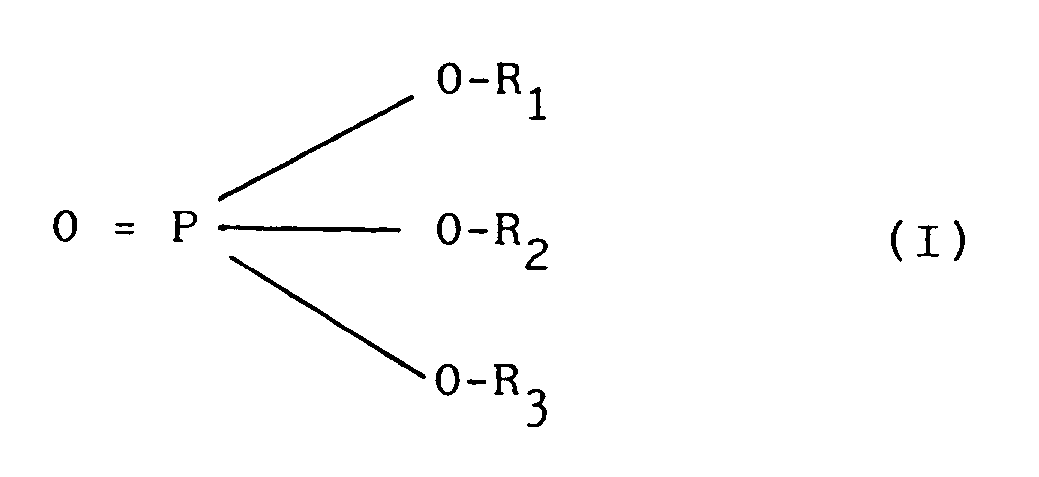
R₁ = (̵CH₂-CH₂O)x-Q,
R₂ = (̵CH₂-CH₂O)yH
mit der Maßgabe, daß bei
y = 0 R₂ gleich R₁ ist und
R₃ bei y = 0 gleich R₁ bzw. bei
y ungleich 0 R₁ oder R₂
ist, wobei
x ganze Zahlen von 2 bis 10,
y ganze Zahlen von 0 bis 10 und
Q einen gesättigten oder ungesättigten Alkylrest bzw. Alkenylrest mit 8 bis 30 C-Atomen bedeuten, eingesetzt wird. - Verfahren nach Patentanspruch 1, dadurch gekennzeichnet, daß der zusätzliche Emulgator der Formel (I) in Mengen von 0,05 bis 1,0 Gew.%, bezogen auf die gesamte Dispersion, eingesetzt wird.
- Verfahren nach den Patentansprüchen 1 und 2, dadurch gekennzeichnet, daß in der Formel (I)
x ganze Zahlen von 2 bis 8,
y ganze Zahlen von 0 bis 7 und
Q einen gesättigten Alkylrest mit 10 bis 30 C-Atomen bedeuten. - Verfahren nach Patentanspruch 1 - 3, dadurch gekennzeichnet, daß als Basismonomere Vinylacetat und/oder Vinylpropionat eingesetzt werden.
- Polymerisatdispersion auf Basis von Vinylacetat, Vinylpropionat und/oder Acrylsäureester, erhältlich durch ein Verfahren nach einem der Patentansprüche 1 bis 4.
- Polymerisatdispersion nach Patentanspruch 5 auf Basis von Vinylacetat und/oder Vinylpropionat.
Priority Applications (1)
| Application Number | Priority Date | Filing Date | Title |
|---|---|---|---|
| AT87113371T ATE97133T1 (de) | 1986-10-04 | 1987-09-12 | Verfahren zur herstellung von waessrigen, konzentrierten polymerisatdispersionen auf basis von vinyl- und/oder acrylsaeureestern. |
Applications Claiming Priority (2)
| Application Number | Priority Date | Filing Date | Title |
|---|---|---|---|
| DE3633940 | 1986-10-04 | ||
| DE19863633940 DE3633940A1 (de) | 1986-10-04 | 1986-10-04 | Verfahren zur herstellung von waessrigen, konzentrierten polymerisatdispersionen auf basis von vinyl- und/oder acrylsaeureestern |
Publications (3)
| Publication Number | Publication Date |
|---|---|
| EP0263326A2 EP0263326A2 (de) | 1988-04-13 |
| EP0263326A3 EP0263326A3 (en) | 1989-12-27 |
| EP0263326B1 true EP0263326B1 (de) | 1993-11-10 |
Family
ID=6311123
Family Applications (1)
| Application Number | Title | Priority Date | Filing Date |
|---|---|---|---|
| EP87113371A Expired - Lifetime EP0263326B1 (de) | 1986-10-04 | 1987-09-12 | Verfahren zur Herstellung von wässrigen, konzentrierten Polymerisatdispersionen auf Basis von Vinyl- und/oder Acrylsäureestern |
Country Status (3)
| Country | Link |
|---|---|
| EP (1) | EP0263326B1 (de) |
| AT (1) | ATE97133T1 (de) |
| DE (2) | DE3633940A1 (de) |
Families Citing this family (1)
| Publication number | Priority date | Publication date | Assignee | Title |
|---|---|---|---|---|
| DE19508530A1 (de) * | 1995-03-10 | 1996-09-12 | Basf Ag | Flammfeste, wäßrige Polymerzubereitungen |
Family Cites Families (7)
| Publication number | Priority date | Publication date | Assignee | Title |
|---|---|---|---|---|
| AT14738B (de) * | 1901-12-23 | 1904-01-11 | Oscar Cosserat | Vorrichtung für Webstühle zum selbsttätigen Auswechseln des Schützens. |
| NL302219A (de) * | 1962-12-20 | |||
| BE707561A (fr) * | 1967-12-05 | 1968-06-05 | Celanese Corp | Catalyseur rédox et procédé de polymérisation en émulsion en comportant utilisation |
| US3963688A (en) * | 1974-08-02 | 1976-06-15 | Gaf Corporation | Method of emulsion polymerization using phosphate esters of normal alkanols as surfactant |
| NL161769C (nl) * | 1975-09-25 | 1980-03-17 | Synres Internationaal Nv | Werkwijze voor de bereiding van stabiele waterige emulsies van additiepolymeren en copolymeren. |
| NL160278C (nl) * | 1975-09-25 | 1979-10-15 | Synres Internationaal Nv | Werkwijze voor het bereiden van waterige emulsies van additiepolymeren. |
| DE3149941A1 (de) * | 1981-12-17 | 1983-06-30 | Röhm GmbH, 6100 Darmstadt | Verfahren zur herstellung von salzfreien polymerfestprodukten aus emulsionspolymerisaten |
-
1986
- 1986-10-04 DE DE19863633940 patent/DE3633940A1/de not_active Withdrawn
-
1987
- 1987-09-12 AT AT87113371T patent/ATE97133T1/de not_active IP Right Cessation
- 1987-09-12 EP EP87113371A patent/EP0263326B1/de not_active Expired - Lifetime
- 1987-09-12 DE DE87113371T patent/DE3788104D1/de not_active Expired - Lifetime
Also Published As
| Publication number | Publication date |
|---|---|
| DE3788104D1 (de) | 1993-12-16 |
| EP0263326A2 (de) | 1988-04-13 |
| ATE97133T1 (de) | 1993-11-15 |
| EP0263326A3 (en) | 1989-12-27 |
| DE3633940A1 (de) | 1988-04-07 |
Similar Documents
| Publication | Publication Date | Title |
|---|---|---|
| EP0009772B1 (de) | Verfahren zur Herstellung von wässrigen Polyacrylat-Dispersionen mit verbessertem Fliessverhalten | |
| DE3319340C2 (de) | ||
| EP0037923B1 (de) | Verfahren zur Herstellung von wässrigen Polymer-Dispersionen mit einem Polymerisatgehalt bis 75 Gew.% | |
| DE2643145C2 (de) | Verfahren zur Herstellung stabiler wässriger Emulsionen von Additionspolymerisaten und Copolymerisaten | |
| DE69602700T2 (de) | Emulsion mit niedrigem Gehalt an flüchtigen organischen Verbindungen | |
| DE2442121C2 (de) | ||
| DE2643144A1 (de) | Verfahren zur herstellung waesseriger emulsionen von additionspolymerisaten mit eingebautem emulgator | |
| EP0423565A2 (de) | Perfluoralkylgruppen enthaltende Copolymerisate/II | |
| DE3503584C1 (de) | Verfahren zur Herstellung von Suspensionspolymerisaten | |
| DE1720395A1 (de) | Vinylester-Mischpolymerisat | |
| EP0073296B1 (de) | Verfahren zur Herstellung von Acrylkunststoffdispersionen | |
| DE2027443A1 (de) | Verfahren zur Reinigung von Hydro xyalkvlacrylaten oder Hvdroxyalkylmetha crylaten | |
| DE1165856B (de) | Verfahren zur Polymerisation von radikalisch polymerisierbaren ungesaettigten Verbindungen | |
| EP0263326A2 (de) | Verfahren zur Herstellung von wässrigen, konzentrierten Polymerisatdispersionen auf Basis von Vinyl- und/oder Acrylsäureestern | |
| EP0364772B1 (de) | Perfluoralkylgruppen enthaltende Copolymerisate | |
| DE3518617A1 (de) | Copolymeres von fluormethacrylat mit styrol oder dessen derivaten und verfahren zu seiner herstellung | |
| DE1242875B (de) | Verfahren zur Herstellung von Homo- oder Mischpolymerisaten durch Polymerisation vonAcrylsaeureestern endocyclischer Alkohole | |
| DE2260957A1 (de) | Verfahren zur homo- oder copolymerisation von vinylchlorid | |
| DE1900860A1 (de) | Verfahren zur Herstellung von waessrigen Polymerisatdispersionen | |
| EP0034204A1 (de) | Verfahren zur Herstellung rest-acrylnitril-armer Polymerisat-Dispersionen und die so hergestellten Dispersionen | |
| DE1092200B (de) | Verfahren zur Herstellung von Mischpolymeren aus Vinylalkohol und Acrylsaeureestern | |
| EP0225447B1 (de) | Verfahren zur Herstellung wässriger hochviskoser Dispersionen von Polymerisaten olefinisch ungesättigter Carbonsäureester | |
| DE1947788C3 (de) | Verfahren zur Herstellung von Polymerisaten | |
| DE3149941A1 (de) | Verfahren zur herstellung von salzfreien polymerfestprodukten aus emulsionspolymerisaten | |
| DE2021623C3 (de) | Verfahren zur Herstellung von wäßrigen Dispersionen von Polymerisaten äthylenisch ungesättigter Monomerer mit einem Dispergiermittelsystem aus mindestens zwei Komponenten |
Legal Events
| Date | Code | Title | Description |
|---|---|---|---|
| PUAI | Public reference made under article 153(3) epc to a published international application that has entered the european phase |
Free format text: ORIGINAL CODE: 0009012 |
|
| AK | Designated contracting states |
Kind code of ref document: A2 Designated state(s): AT BE CH DE ES FR GB IT LI NL |
|
| PUAL | Search report despatched |
Free format text: ORIGINAL CODE: 0009013 |
|
| AK | Designated contracting states |
Kind code of ref document: A3 Designated state(s): AT BE CH DE ES FR GB IT LI NL |
|
| RHK1 | Main classification (correction) |
Ipc: C08F 2/30 |
|
| 17P | Request for examination filed |
Effective date: 19900612 |
|
| RAP3 | Party data changed (applicant data changed or rights of an application transferred) |
Owner name: CHEMISCHE FABRIK PFERSEE GMBH |
|
| RAP1 | Party data changed (applicant data changed or rights of an application transferred) |
Owner name: PFERSEE CHEMIE GMBH |
|
| 17Q | First examination report despatched |
Effective date: 19920220 |
|
| GRAA | (expected) grant |
Free format text: ORIGINAL CODE: 0009210 |
|
| AK | Designated contracting states |
Kind code of ref document: B1 Designated state(s): AT BE CH DE ES FR GB IT LI NL |
|
| PG25 | Lapsed in a contracting state [announced via postgrant information from national office to epo] |
Ref country code: NL Effective date: 19931110 Ref country code: GB Effective date: 19931110 Ref country code: BE Effective date: 19931110 |
|
| REF | Corresponds to: |
Ref document number: 97133 Country of ref document: AT Date of ref document: 19931115 Kind code of ref document: T |
|
| REF | Corresponds to: |
Ref document number: 3788104 Country of ref document: DE Date of ref document: 19931216 |
|
| ITF | It: translation for a ep patent filed | ||
| ET | Fr: translation filed | ||
| PG25 | Lapsed in a contracting state [announced via postgrant information from national office to epo] |
Ref country code: ES Free format text: LAPSE BECAUSE OF FAILURE TO SUBMIT A TRANSLATION OF THE DESCRIPTION OR TO PAY THE FEE WITHIN THE PRESCRIBED TIME-LIMIT Effective date: 19940221 |
|
| NLV1 | Nl: lapsed or annulled due to failure to fulfill the requirements of art. 29p and 29m of the patents act | ||
| GBV | Gb: ep patent (uk) treated as always having been void in accordance with gb section 77(7)/1977 [no translation filed] |
Effective date: 19931110 |
|
| PLBE | No opposition filed within time limit |
Free format text: ORIGINAL CODE: 0009261 |
|
| STAA | Information on the status of an ep patent application or granted ep patent |
Free format text: STATUS: NO OPPOSITION FILED WITHIN TIME LIMIT |
|
| PG25 | Lapsed in a contracting state [announced via postgrant information from national office to epo] |
Ref country code: AT Effective date: 19940912 |
|
| 26N | No opposition filed | ||
| PGFP | Annual fee paid to national office [announced via postgrant information from national office to epo] |
Ref country code: CH Payment date: 20030806 Year of fee payment: 17 |
|
| PGFP | Annual fee paid to national office [announced via postgrant information from national office to epo] |
Ref country code: FR Payment date: 20040813 Year of fee payment: 18 |
|
| PG25 | Lapsed in a contracting state [announced via postgrant information from national office to epo] |
Ref country code: LI Free format text: LAPSE BECAUSE OF NON-PAYMENT OF DUE FEES Effective date: 20040930 Ref country code: CH Free format text: LAPSE BECAUSE OF NON-PAYMENT OF DUE FEES Effective date: 20040930 |
|
| REG | Reference to a national code |
Ref country code: CH Ref legal event code: PL |
|
| PG25 | Lapsed in a contracting state [announced via postgrant information from national office to epo] |
Ref country code: IT Free format text: LAPSE BECAUSE OF NON-PAYMENT OF DUE FEES;WARNING: LAPSES OF ITALIAN PATENTS WITH EFFECTIVE DATE BEFORE 2007 MAY HAVE OCCURRED AT ANY TIME BEFORE 2007. THE CORRECT EFFECTIVE DATE MAY BE DIFFERENT FROM THE ONE RECORDED. Effective date: 20050912 |
|
| PG25 | Lapsed in a contracting state [announced via postgrant information from national office to epo] |
Ref country code: FR Free format text: LAPSE BECAUSE OF NON-PAYMENT OF DUE FEES Effective date: 20060531 |
|
| REG | Reference to a national code |
Ref country code: FR Ref legal event code: ST Effective date: 20060531 |
|
| PGFP | Annual fee paid to national office [announced via postgrant information from national office to epo] |
Ref country code: DE Payment date: 20060915 Year of fee payment: 20 |