EP0423565A2 - Perfluoralkylgruppen enthaltende Copolymerisate/II - Google Patents
Perfluoralkylgruppen enthaltende Copolymerisate/II Download PDFInfo
- Publication number
- EP0423565A2 EP0423565A2 EP90119140A EP90119140A EP0423565A2 EP 0423565 A2 EP0423565 A2 EP 0423565A2 EP 90119140 A EP90119140 A EP 90119140A EP 90119140 A EP90119140 A EP 90119140A EP 0423565 A2 EP0423565 A2 EP 0423565A2
- Authority
- EP
- European Patent Office
- Prior art keywords
- copolymers
- weight
- gew
- tle
- parts
- Prior art date
- Legal status (The legal status is an assumption and is not a legal conclusion. Google has not performed a legal analysis and makes no representation as to the accuracy of the status listed.)
- Granted
Links
Classifications
-
- D—TEXTILES; PAPER
- D06—TREATMENT OF TEXTILES OR THE LIKE; LAUNDERING; FLEXIBLE MATERIALS NOT OTHERWISE PROVIDED FOR
- D06M—TREATMENT, NOT PROVIDED FOR ELSEWHERE IN CLASS D06, OF FIBRES, THREADS, YARNS, FABRICS, FEATHERS OR FIBROUS GOODS MADE FROM SUCH MATERIALS
- D06M15/00—Treating fibres, threads, yarns, fabrics, or fibrous goods made from such materials, with macromolecular compounds; Such treatment combined with mechanical treatment
- D06M15/19—Treating fibres, threads, yarns, fabrics, or fibrous goods made from such materials, with macromolecular compounds; Such treatment combined with mechanical treatment with synthetic macromolecular compounds
- D06M15/21—Macromolecular compounds obtained by reactions only involving carbon-to-carbon unsaturated bonds
- D06M15/263—Macromolecular compounds obtained by reactions only involving carbon-to-carbon unsaturated bonds of unsaturated carboxylic acids; Salts or esters thereof
- D06M15/277—Macromolecular compounds obtained by reactions only involving carbon-to-carbon unsaturated bonds of unsaturated carboxylic acids; Salts or esters thereof containing fluorine
-
- C—CHEMISTRY; METALLURGY
- C08—ORGANIC MACROMOLECULAR COMPOUNDS; THEIR PREPARATION OR CHEMICAL WORKING-UP; COMPOSITIONS BASED THEREON
- C08F—MACROMOLECULAR COMPOUNDS OBTAINED BY REACTIONS ONLY INVOLVING CARBON-TO-CARBON UNSATURATED BONDS
- C08F220/00—Copolymers of compounds having one or more unsaturated aliphatic radicals, each having only one carbon-to-carbon double bond, and only one being terminated by only one carboxyl radical or a salt, anhydride ester, amide, imide or nitrile thereof
- C08F220/02—Monocarboxylic acids having less than ten carbon atoms; Derivatives thereof
- C08F220/10—Esters
- C08F220/22—Esters containing halogen
- C08F220/24—Esters containing halogen containing perhaloalkyl radicals
-
- C—CHEMISTRY; METALLURGY
- C08—ORGANIC MACROMOLECULAR COMPOUNDS; THEIR PREPARATION OR CHEMICAL WORKING-UP; COMPOSITIONS BASED THEREON
- C08F—MACROMOLECULAR COMPOUNDS OBTAINED BY REACTIONS ONLY INVOLVING CARBON-TO-CARBON UNSATURATED BONDS
- C08F290/00—Macromolecular compounds obtained by polymerising monomers on to polymers modified by introduction of aliphatic unsaturated end or side groups
- C08F290/02—Macromolecular compounds obtained by polymerising monomers on to polymers modified by introduction of aliphatic unsaturated end or side groups on to polymers modified by introduction of unsaturated end groups
- C08F290/06—Polymers provided for in subclass C08G
- C08F290/061—Polyesters; Polycarbonates
-
- C—CHEMISTRY; METALLURGY
- C14—SKINS; HIDES; PELTS; LEATHER
- C14C—CHEMICAL TREATMENT OF HIDES, SKINS OR LEATHER, e.g. TANNING, IMPREGNATING, FINISHING; APPARATUS THEREFOR; COMPOSITIONS FOR TANNING
- C14C11/00—Surface finishing of leather
- C14C11/003—Surface finishing of leather using macromolecular compounds
-
- D—TEXTILES; PAPER
- D21—PAPER-MAKING; PRODUCTION OF CELLULOSE
- D21H—PULP COMPOSITIONS; PREPARATION THEREOF NOT COVERED BY SUBCLASSES D21C OR D21D; IMPREGNATING OR COATING OF PAPER; TREATMENT OF FINISHED PAPER NOT COVERED BY CLASS B31 OR SUBCLASS D21G; PAPER NOT OTHERWISE PROVIDED FOR
- D21H17/00—Non-fibrous material added to the pulp, characterised by its constitution; Paper-impregnating material characterised by its constitution
- D21H17/20—Macromolecular organic compounds
- D21H17/33—Synthetic macromolecular compounds
- D21H17/34—Synthetic macromolecular compounds obtained by reactions only involving carbon-to-carbon unsaturated bonds
- D21H17/37—Polymers of unsaturated acids or derivatives thereof, e.g. polyacrylates
Definitions
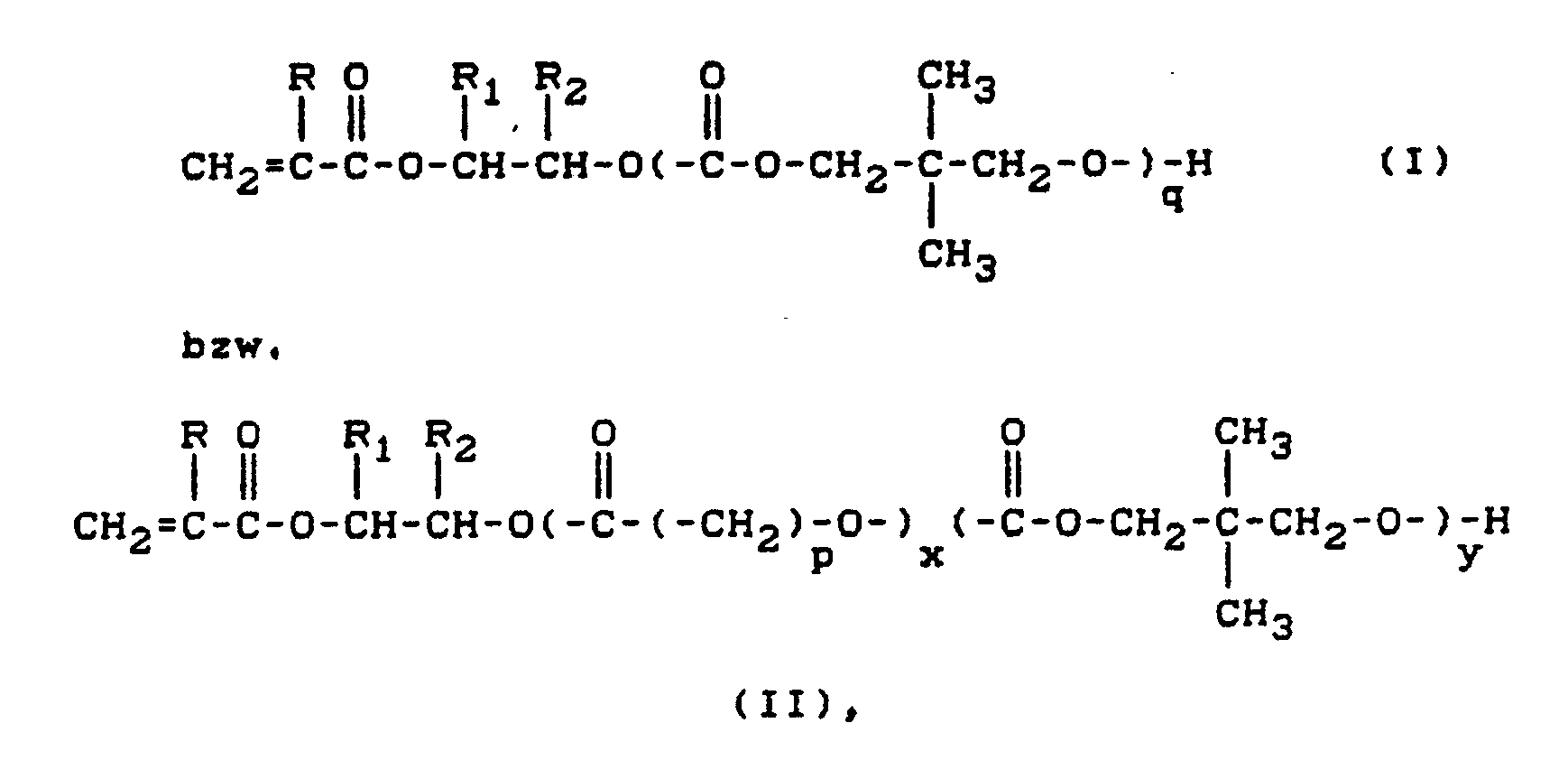
- the invention relates to copolymers and graft copolymers of perfluoroalkyl acrylates or methacrylates and esters of the general formula (I) or (II) in which - independently of one another - R, R1 and R2 are hydrogen or methyl, p 2 to 6, q 2 to 200, and x and y mean 3 - 30, their manufacture and their use for finishing textile materials, leather and paper.
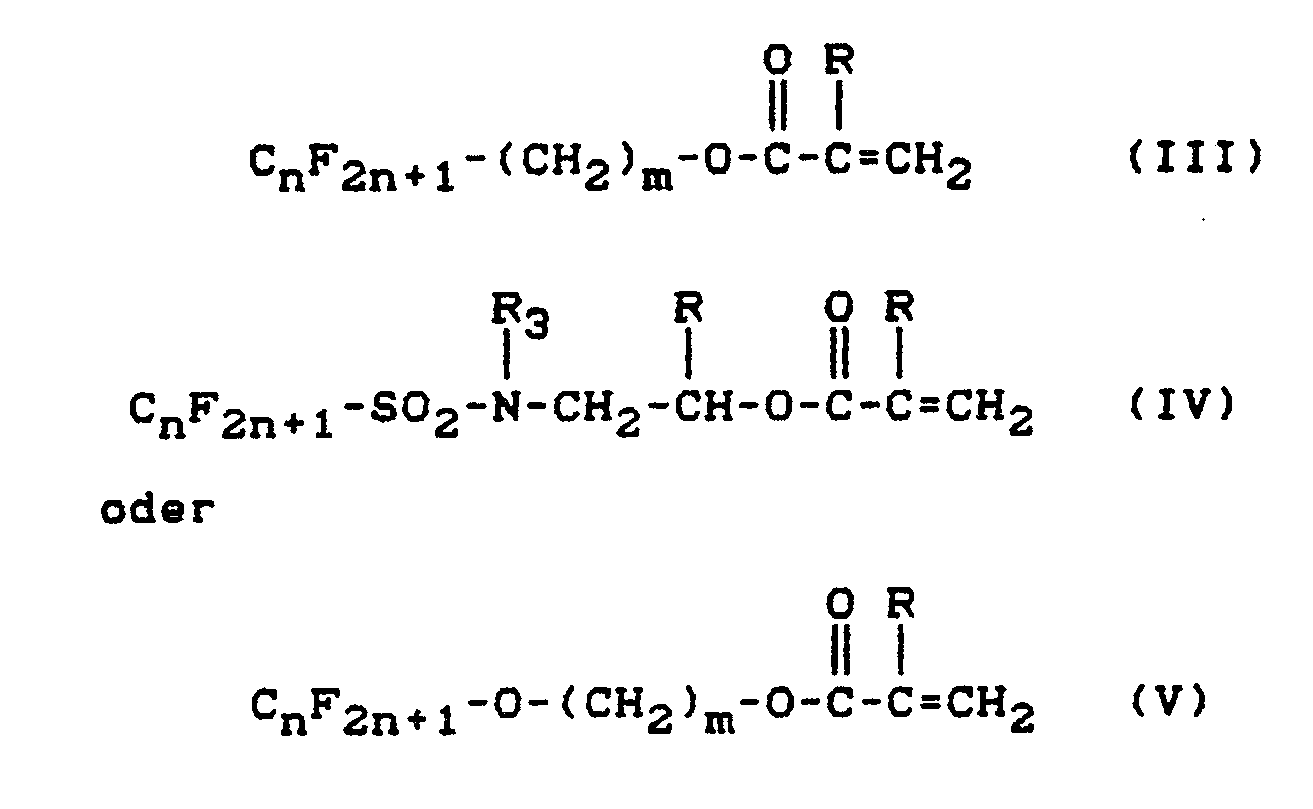
- Perfluoroalkyl (meth) acrylates are preferably compounds of the general formulas understood what R is hydrogen or methyl, R3 H or C1-C6 alkyl, m 1 to 4 and n is 6 to 12.
- esters of the general formula (I) are e.g. described in DE 3 723 194 and EP 299 305.
- esters of the general formula (II) are described in US 3,379,693.
- the comonomers (III) to (V), the polymers produced therefrom and their use for the oil and water repellent finishing of textiles include known from US 3,403,122, 3,847,657, 3,916,053 and 3,919,183.
- alkyl (meth) acrylates as comonomers in the production of perfluoroalkyl copolymers and the use of these copolymers for textile finishing is already known and is described, for example, in US Pat. Nos. 2,803,615 and 3,062,765.
- the copolymers according to the invention which are prepared using the esters (I) or (II), are excellently suitable for simultaneous hydrophobization and oleophobicization.
- the esters (I) or (II) as comonomers compared to fluorine-containing copo Lymerisaten, which are produced without the use of esters of the general formula (I) or (II)
- an improvement in the oleophobic, but above all the hydrophobic properties can be achieved without the proportion of fluorine-containing component in the latex having to be increased.
- Copolymers with special properties can be obtained by copolymerizing the esters (I) or (II) and the perfluoroalkyl (meth) acrylates (III to V) with further olefinically unsaturated copolymerizable monomers.
- Such olefinically unsaturated comonomers can be used in proportions of e.g. up to 65 wt .-% are polymerized.
- examples of such comonomers are styrene, acrylonitrile, vinyl acetate, acrylic and methacrylic acid esters, which are derived from aliphatic alcohols having up to 22 carbon atoms. Examples of these alcohols are n-butanol, isobutanol, ethylhexyl, lauryl, stearyl, behenyl and oleyl alcohol.
- the glass transition temperatures and thus the film formation tendency and temperature can be influenced in the desired manner.
- copolymers according to the invention can also be present as graft copolymers which are prepared from the comonomers described above using known graft bases,
- Graft copolymerization using perfluoroalkyl (meth) acrylates in aqueous emulsion is e.g. known from DE 3 407 361 and 3 407 362.
- Particularly suitable graft bases are hydrophobic polymers in the form of aqueous dispersions.
- graft bases examples are melamine polycondensates. You can e.g. are obtained by polycondensation of methylolaminotriazines, their etherification or esterification products with carboxylic acids and primary or secondary amines. They are described for example in DE 956 990.
- the preferred weight ratio of the comonomers (I) or (II) to the perfluoroalkyl monomers (III), (IV) and / or (V) is 1: 1.5 to 6, in particular 1: 2.5 to 4.5.
- the proportion of the monomers in the copolymers according to the invention is 5 to 35% by weight, preferably 8 to 20% by weight, the esters (I) or (II) 15 to 65% by weight, preferably 25 to 55% by weight of the perfluoroalkyl monomers (III), (IV) and / or (V) and at 0 to 65% by weight, preferably 35 to 60% by weight, of further olefinically unsaturated copolymerizable monomers.
- copolymers according to the invention are prepared in solution, dispersion or emulsion. It may be advantageous to use auxiliary sol in the copolymerization to use agents that are described, for example, in US Pat. No. 3,062,765. It is also possible to use auxiliary solvents which are immiscible with water, such as ethyl acetate or chlorofluorocarbons. It can be advantageous to polymerize in the absence of oxygen or air, ie using inert gases. If auxiliary solvents are used, it is necessary to remove the auxiliary solvents by distillation after the polymerization has ended.
- the copolymerization is initiated by known free radical initiators or starter systems such as peroxides, aliphatic azo compounds or redox systems.
- starter systems such as peroxides, aliphatic azo compounds or redox systems.
- the polymerization temperature depends on the respective initiator system. Polymerization is generally carried out at temperatures of 40 to 110 ° C. Special redox systems also make it possible to carry out the polymerization at 25 ° C.
- a particularly preferred embodiment of the copolymerization according to the invention is polymerization in aqueous dispersion or emulsion. Dispersants or emulsifiers are used as auxiliaries in this procedure.
- Polyvinyl alcohols or cellulose derivatives such as cellulose esters or cellulose ethers are preferably suitable as dispersants.
- Both nonionic, anionic and cationic emulsifiers can be used as emulsifiers. It is particularly advantageous to use mixtures of either anionic and nonionic emulsifiers or of cationic and nonionic emulsifiers.
- the amounts of emulsifier are in the known range.
- nonionic emulsifiers are polyglycol ethers e.g. Ethylene oxide / propylene oxide block or copolymer and alkoxylation products, in particular ethoxylation products of fatty alcohols, alkylphenols, fatty acids, fatty acid amides, sorbitol monooleate.
- cationic emulsifiers are quaternary ammonium or pyridinium salts, e.g. Stearyldimethylbenzylammonium chloride or N, N, N-trimethyl-N-perfluorooctane sulfonamidopropylammonium chloride.
- copolymers according to the invention are preferably used in the form of aqueous dispersions for hydrophobic / oleophobic finishing.
- copolymers according to the invention natural and synthetic materials such as fibers, filaments, yarns, nonwovens, woven fabrics, knitted fabrics and knitted fabrics, in particular carpets, made in particular of cellulose and its derivatives, but also of polyester, polyamide and polyacrylonitrile materials, wool or silk, can be successfully oleophobic and be made hydrophobic.
- the copolymers and graft copolymers according to the invention are used in the form of aqueous dispersions, preferably in combination with aqueous colloidal suspensions of organosilsesquioxanes, as described in DE 3 307 420, and, if appropriate, in an additional combination with other fluorine-containing dispersions.
- the equipment is made according to known methods, e.g. by the exhaust or foulard process, for example between room temperature and 40 ° C, but also by splashing or spraying with a subsequent temperature treatment at 80 to 180 ° C, preferably 120 to 150 ° C.
- a combined oleophobic / hydrophobic finish of natural and synthetic materials is possible with the copolymer systems according to the invention.
- the use according to the invention of the esters (I) and (II) as comonomers also enables the oleophobic / hydrophobic properties to be improved without, as usual, the proportion of perfluorocomponents in the latex having to be increased, as a result of which disadvantages such as sticking and hardening and the associated poor grip the textiles equipped with it can be avoided.
- Solutions 1 and 2 are emulsified at 50 ° C.
- the emulsion obtained is placed in a reactor equipped with a stirrer, reflux condenser and internal thermometer and allowed to cool to 30 ° C.
- Solution 3 is added at 30 ° C. with stirring and the temperature is raised from 30 to 50 ° C. within 1 hour and from 50 to 70 ° C. in a further hour.
- the reaction mixture is then left at 70 ° C. for 2 hours.
- the temperature is then kept at 70 to 80 ° C. for 2 hours, while distilling the Ethyl acetate using an additional distillation apparatus and stirring for a further hour at 80 ° C.
- Solids content 15.0% Fluorine content in the solid: 19.6% Average particle size: 236 nm (after light scattering).
- a mixture is prepared from solutions 1 and 2 and this is emulsified seven times at 50 ° C.
- the received Emulsion is placed in a reactor equipped with a stirrer, reflux condenser and internal thermometer.
- Solution 3 is added with stirring at 50.degree.
- the mixture is stirred at 50 to 60 ° C for half an hour, then at 60 to 70 ° C for half an hour and then kept at 70 ° C for 2 hours.
- the reaction mixture is then allowed to react at reflux at about 78 ° C. for 3 hours.
- a preliminary latex with a solids content of 29.7% is obtained.
- Solutions 1 and 2 are combined and homogenized at 50 ° C.
- the emulsion obtained is placed in a reactor which is equipped with a stirrer, reflux condenser and internal thermometer and is allowed to cool to 30 ° C.
- Solution 3 is added with stirring and the mixture is stirred at 40 ° C. for one hour.
- Solutions 1 and 2 are emulsified.
- the emulsion obtained is placed in a reactor equipped with a stirrer, reflux condenser and internal thermometer.
- Solution 3 is added at 40 ° C. with stirring and the temperature is raised to 70 ° C. in the course of half an hour.
- the mixture is left to react at this temperature for two hours, then heated to 70 to 80 ° C. and the reaction mixture is left for a further two hours at this temperature range, the ethyl acetate being distilled off using an additionally attached distillation apparatus. Then the mixture is stirred at 80 ° C. for 1 hour.
- An aqueous dispersion is prepared according to Example 4. 15 parts by weight of this dispersion are mixed with 15 parts by weight of a further fluorine-containing dispersion (AG 800, Asahi Glass) and 70 parts by weight of an aqueous colloidal suspension of organosilsesquioxanes as described in DE 3 307 420 are described, mixed.
- a further fluorine-containing dispersion AG 800, Asahi Glass
- a 2.5% aqueous dilution of this mixture is applied to a polyamide carpet (tufted goods with 30% rest wet pile weight: 500 g / m2) applied in such a way that a coating of 1% by weight of the above mixture (based on the pile weight) remains on the carpet.
- Example 1b Analogously, dispersions prepared according to Example 1b), 2, 3, 5 and 6 were used. The application results obtained are also shown in Table 1.
- Example 1b) 5 70/30 - 60/40
- Example 2 4 - 5 80/20 - 70/30
- Example 3 5 60/40 - 50/50
- Example 4 6 20/80 Example 5 5 - 6 20/80
- Table 1 shows the application results which are obtained when the copolymer dispersions prepared according to Examples 1b) to 6 are used in the oleophobic / hydrophobic finishing of carpets based on polyamide fibers.
Landscapes
- Chemical & Material Sciences (AREA)
- Chemical Kinetics & Catalysis (AREA)
- Organic Chemistry (AREA)
- Health & Medical Sciences (AREA)
- Medicinal Chemistry (AREA)
- Polymers & Plastics (AREA)
- General Chemical & Material Sciences (AREA)
- Engineering & Computer Science (AREA)
- Textile Engineering (AREA)
- Treatments For Attaching Organic Compounds To Fibrous Goods (AREA)
- Addition Polymer Or Copolymer, Post-Treatments, Or Chemical Modifications (AREA)
- Macromonomer-Based Addition Polymer (AREA)
- Paper (AREA)
- Materials Applied To Surfaces To Minimize Adherence Of Mist Or Water (AREA)
Abstract

R, R₁ und R₂ Wasserstoff oder Methyl,
p 2 bis 6,
q 2 bis 200 und
x und y 3 - 30 bedeuten,
eignen sich hervorragend zur Ausrüstung von Textilmaterialien, Leder und Papier.
Description
- Die Erfindung betrifft Copolymerisate und Pfropfcopolymerisate aus Perfluoralkylacrylaten oder -methacrylaten und Estern der allgemeinen Formel (I) bzw. (II)

R, R₁ und R₂ Wasserstoff oder Methyl,
p 2 bis 6,
q 2 bis 200, und
x und y 3 - 30 bedeuten,
deren Herstellung sowie deren Verwendung zur Ausrüstung von Textilmaterialien, Leder und Papier. - Unter Perfluoralkyl(meth)acrylaten werden bevorzugt Verbindungen der allgemeinen Formeln

R Wasserstoff oder Methyl,
R₃ H oder C₁-C₆-Alkyl,
m 1 bis 4 und
n 6 bis 12 bedeuten. - Von den Estern der Formel (I) werden die mit R = Wasserstoff oder Methyl, R₁ = R₂ = Wasserstoff und q = 8 bis 30 bevorzugt.
- Von den Estern der Formel (II) werden die mit R = Wasserstoff oder Methyl, R₁ = R₂ = Wasserstoff, p = 5 sowie die Kombinationen
x ≈ y ≈ 5 bzw.
x ≈ y ≈ 10 bzw. x ≈ 7,5, y ≈ 5 bzw.
x ≈ 15, y ≈ 10
bevorzugt. - Die Ester der allgemeinen Formel (I) sind z.B. beschrieben in DE 3 723 194 und EP 299 305.
- Ester der allgemeinen Formel (II) sind beschrieben in US 3 379 693.
- Die Comonomeren (III) bis (V), die daraus hergestellten Polymeren und deren Verwendung zur öl- und wasserabweisenden Ausrüstung von Textilien sind u.a. aus US 3 403 122, 3 847 657, 3 916 053 und 3 919 183 bekannt.
- Die Verwendung von Alkyl(meth)acrylaten als Comonomere bei der Herstellung von Perfluoralkylcopolymerisaten und die Verwendung dieser Copolymerisate zur Textilausrüstung ist bereits bekannt und wird beispielsweise in US 2 803 615 und 3 062 765 beschrieben.
- Mit diesen Perfluoralkylcopolymerisaten kann eine weitere Verbesserung der Oleophob-/Hydrophob-Eigenschaften nur durch eine Erhöhung der fluorhaltigen Komponente in der Copolymerisatdispersion erreicht werden. Diese Vorteile werden aber mit Nachteilen wie Verhärtungen und Verklebungen, die sich negativ auf den Griff der damit ausgerüsteten Textilien auswirken, erkauft.
- Es ist auch bekannt, polare Comonomere zur Herstellung von Perfluoralkylcopolymeren zu verwenden. Zum Beispiel wird in US 4 557 637 die Synthese spezieller in Methanol löslicher Perfluoralkylpolymerer durch Copolymerisation von Perfluoralkyl(meth)acrylaten und solchen polaren Comonomeren, die eine Solubilisierung der Copolymeren in Methanol bewirken, beschrieben. Derartige Comonomere sind beispielsweise Acrylsäure- oder Methacrylsäureester, die mit Glykolen wie Ethylenglykol oder Triethylenglykol verestert sind. Diese Perfluoralkylacrylatcopolymerisate sind für eine Oleophobausrüstung von Textilien geeignet, nicht aber für eine gleichzeitige Hydrophobausrüstung.
- Es bestand darum die Aufgabe, hochwirksame Ausrüstungsmittel zur Verfügung zu stellen, die gleichzeitig oleophobierend und hydrophobierend wirken und nicht die geschilderten Nachteile zeigen.
- Überraschend wurde nun gefunden, daß sich die erfindungsgemäßen Copolymerisate, die unter Verwendung der Ester (I) bzw. (II) hergestellt werden, ausgezeichnet zum gleichzeitigen Hydrophobieren und Oleophobieren eignen. Zudem kann bei Verwendung der Ester (I) bzw. (II) als Comonomere im Vergleich zu fluorhaltigen Copo lymerisaten, die ohne Einsatz von Estern der allgemeinen Formel (I) bzw. (II) hergestellt werden, eine Verbesserung der Oleophob-, aber vor allem der Hydrophobeigenschaften erreicht werden, ohne daß der Anteil an fluorhaltiger Komponente im Latex erhöht werden muß.
- Copolymerisate mit speziellen Eigenschaften können durch Copolymerisation der Ester (I) bzw. (II) und der Perfluoralkyl(meth)acrylate (III bis V) mit weiteren olefinisch ungesättigten copolymerisierbaren Monomeren erhalten werden. Solche olefinisch ungesättigten Comonomere können in Anteilen von z.B. bis zu 65 Gew.-% einpolymerisiert werden. Beispiele für solche Comonomere sind Styrol, Acrylnitril, Vinylacetat, Acryl- und Methacrylsäureester, die sich von aliphatischen Alkoholen mit bis zu 22 Kohlenstoffatomen ableiten. Beispiele für diese Alkohole sind n-Butanol, Isobutanol, Ethylhexyl-, Lauryl-, Stearyl-, Behenyl- und Oleylalkohol.
- Beispielsweise können durch Einpolymerisieren dieser Monomeren die Einfriertemperaturen und damit die Filmbildungstendenz und -temperatur in gewünschter Weise beeinflußt werden.
- Die erfindungsgemäßen Copolymerisate können auch als Pfropfcopolymerisate vorliegen, die unter Verwendung bekannter Pfropfgrundlagen aus den vorstehend beschriebenen Comonomeren hergestellt werden,
- Die Pfropfcopolymerisation unter Verwendung von Perfluoralkyl(meth)acrylaten in wäßriger Emulsion ist z.B. aus den DE 3 407 361 und 3 407 362 bekannt.
- Als Pfropfgrundlagen eignen sich besonders hydrophobe Polymere in Form von wäßrigen Dispersionen.
- Beispiele für derartige Pfropfgrundlagen sind Melaminpolykondensate. Sie können z.B. erhalten werden durch Polykondensation von Methylolaminotriazinen, deren Veretherungs- oder Veresterungsprodukten mit Carbonsäuren und primären oder sekundären Aminen. Sie werden beispielsweise in DE 956 990 beschrieben.
- Bei den erfindungsgemäßen Copolymerisaten liegt das bevorzugte Gewichtsverhältnis der Comonomeren (I) bzw. (II) zu den Perfluoralkylmonomeren (III), (IV) und/oder (V) bei 1:1,5 bis 6, insbesondere bei 1:2,5 bis 4,5.
- Der Anteil der Monomeren in den erfindungsgemäßen Copolymeren liegt bei 5 bis 35 Gew.-%, bevorzugt 8 bis 20 Gew.-%, der Ester (I) bzw. (II), bei 15 bis 65 Gew.-%, bevorzugt 25 bis 55 Gew.-%, der Perfluoralkylmonomeren (III), (IV) und/oder (V) und bei 0 bis 65 Gew.-%, bevorzugt 35 bis 60 Gew.-%, von weiteren olefinisch ungesättigten copolymerisierbaren Monomeren.
- Die Herstellung der erfindungsgemäßen Copolymerisate erfolgt in Lösung, Dispersion oder Emulsion. Es kann vorteilhaft sein, bei der Copolymerisation Hilfslö sungsmittel zu verwenden, die z.B. in US 3 062 765 beschrieben werden. Weiterhin ist es möglich, mit Wasser nicht mischbare Hilfslösungsmittel wie Essigsäureethylester oder Chlorfluorokohlenstoffe zu verwenden. Es kann vorteilhaft sein, unter Ausschluß von Sauerstoff oder Luft, d.h. unter Verwendung von Inertgasen, zu polymerisieren. Falls Hilfslösungsmittel verwendet werden, ist es erforderlich, nach Beendigung der Polymerisation die Hilfslösungsmittel destillativ abzutrennen.
- Die Copolymerisation wird durch bekannte Radikale bildende Starter oder Startersysteme wie Peroxide, aliphatische Azoverbindungen oder Redoxsysteme initiiert. Im allgemeinen ist es vorteilhaft, ein Mengenverhältnis vom Starter zum Monomergemisch von 0,2 bis 0,4:100, vorzugsweise von 0,3 bis 0,35:100, zu wählen.
- Die Polymerisationstemperatur richtet sich nach dem jeweiligen Initiatorsystem. Allgemein polymerisiert man bei Temperaturen von 40 bis 110°C. Spezielle Redoxsysteme erlauben es auch, die Polymerisation bereits bei 25°C durchzuführen.
- Eine besonders bevorzugte Ausführungsform der erfindungsgemäßen Copolymerisation ist die Polymerisation in wäßriger Dispersion oder Emulsion. Als Hilfsmittel werden bei dieser Verfahrensweise Dispergatoren oder Emulgatoren verwendet.
- Als Dispergatoren sind vorzugsweise Polyvinylalkohole oder Cellulosederivate wie Celluloseester oder Celluloseether geeignet.
- Als Emulgatoren kann man sowohl nichtionische, anionische wie auch kationische Emulgatoren verwenden. Besonders vorteilhaft ist es, Gemische aus entweder anionischen und nichtionischen Emulgatoren oder aus kationischen und nichtionischen Emulgatoren zu verwenden.
- Die Emulgatormengen liegen im bekannten Rahmen.
- Beispiele für nichtionische Emulgatoren sind Polyglykolether z.B. Ethylenoxid/Propylenoxid-Block- oder -copolymer sowie Alkoxylierungsprodukte, insbesondere Ethoxylierungsprodukte von Fettalkoholen, Alkylphenolen, Fettsäuren, Fettsäureamiden, Sorbitmonooleat. Beispiele für kationische Emulgatoren sind quartäre Ammonium- oder Pyridiniumsalze, z.B. Stearyldimethylbenzylammoniumchlorid oder N,N,N-Trimethyl-N-perfluoroctansulfonamidopropylammoniumchlorid.
- Die erfindungsgemäßen Copolymerisate werden vorzugsweise in Form wäßriger Dispersionen zur Hydrophob-/Oleophobausrüstung verwendet.
- Mit den erfindungsgemäßen Copolymeren können natürliche und synthetische Materialien wie Fasern, Filamente, Garne, Vliese, Gewebe, Gewirke und Gestricke, insbesondere Teppiche, aus insbesondere Cellulose und ihren Derivaten, aber auch aus Polyester-, Polyamid- und Polyacrylnitrilmaterialien, Wolle oder Seide erfolgreich oleophob und hydrophob ausgerüstet werden.
- Für die Ausrüstung von Teppichen werden die erfindungsgemäßen Copolymerisate und Pfropfcopolymerisate in Form wäßriger Dispersionen, vorzugsweise in Kombination mit wäßrigen kolloidalen Suspensionen von Organosilsesquioxanen, wie sie in DE 3 307 420 beschrieben sind, und gegebenenfalls in zusätzlicher Kombination mit anderen fluorhaltigen Dispersionen eingesetzt.
- Die Ausrüstung erfolgt nach bekannten Verfahren, z.B. nach dem Auszieh- oder Foulard-Verfahren, beispielsweise zwischen Raumtemperatur und 40°C, aber auch durch Pflatschen oder Besprühen mit einer nachgeschalteten Temperaturbehandlung bei 80 bis 180°C, vorzugsweise 120 bis 150°C.
- Mit den erfindungsgemäßen Copolymerisatsystemen ist eine kombinierte Oleophob-/Hydrophobausrüstung natürlicher und synthetischer Materialien möglich. Die erfindungsgemäße Verwendung der Ester (I) und (II) als Comonomere ermöglicht zudem eine Verbesserung der Oleophob-/Hydrophobeigenschaften, ohne daß wie üblich der Anteil an Perfluorkomponenten im Latex erhöht werden muß, wodurch Nachteile wie Verklebungen und Verhärtungen sowie damit verbundener schlechter Griff auf den damit ausgerüsteten Textilien vermieden werden.
- 1,5 Mol Behensäure werden aufgeschmolzen und innerhalb 30 Min. gleichzeitig mit 1 Mol Melaminhexamethylolpentamethylether und 0,9 Mol N-Methyldiethanolamin versetzt. Dabei wird die Schmelze auf 150°C gebracht und 3 Stunden bei dieser Temperatur gehalten.
- Anschließend wird in die Schmelze die gleiche Gewichtsmenge eines Paraffins vom Schmelzpunkt 52°C eingetragen.
- Man bereitet folgende Lösungen bei 50°C:
- Lösung 1
780,0 Gew.-Tle entionisiertes Wasser
4,54 Gew.-Tle eines ethoxylierten Nonylphenols mit 10 EO
1,8 Gew.-Tle Benzyldodecyldimethylammoniumchlorid - Lösung 2
300 Gew.-Tle Essigsäureethylester
57,5 Gew.-Tle N-Methyl-N-perfluoroctansulfonamidoethylmethacrylat
29,5 Gew.-Tle Stearylmethacrylat
23,8 Gew.-Tle Vinylacetat
20,0 Gew.-Tle Monomeres der Formel (I) mit q ∼ 15, R = H, R₁, R₂ = H - Man bereitet folgende Lösung bei 30°C:
- Lösung 3
0,656 Gew.-Tle t-Butylperpivalat
0,925 Gew.-Tle Dilaurylperoxid
5,0 Gew.-Tle Essigsäureethylester - Die Lösungen 1 und 2 werden bei 50°C emulgiert. Die erhaltene Emulsion gibt man in einen Reaktor, der mit Rührer, Rückflußkühler und Innenthermometer ausgestattet ist und läßt auf 30°C abkühlen. Man setzt Lösung 3 bei 30°C unter Rühren zu und steigert die Temperatur innerhalb 1 Stunde von 30 auf 50°C, sowie in einer weiteren Stunde von 50 auf 70°C.
- Danach beläßt man das Reaktionsgemisch 2 Stunden bei 70°C. Anschließend hält man die Temperatur für 2 Stunden bei 70 bis 80°C, destilliert dabei den Essigsäureethylester über eine zusätzlich angebrachte Destillationsapparatur ab und rührt noch 1 Stunde bei 80°C nach.
Feststoffgehalt: 15,0 %
Fluorgehalt im Feststoff: 19,6 %
Mittlere Teilchengröße: 236 nm
(nach Lichtstreuung). - Man bereitet folgende Lösungen bei 50°C:
Lösung 1: wie im Beispiel 1b) beschrieben,
Lösung 2: wie im Beispiel 1b) beschrieben, aber ohne Monomeres I. - Man bereitet folgende Lösung bei 30°C:
Lösung 3: wie im Beispiel 1b) beschrieben. - Die Lösungen werden anschließend nach dem im Beispiel 1b) beschriebenen Verfahren umgesetzt.
Feststoffgehalt: 13,0 %
Fluorgehalt im Feststoff: 21,3 %
Mittlere Teilchengröße: 221 nm
(nach Lichtstreuung) - Man bereitet folgende Lösungen bei Raumtemperatur:
- Lösung 1
1323 Gew.-Tle entionisiertes Wasser
19,2 Gew.-Tle eines ethoxylierten Nonylphenols mit 20 EO
12,6 Gew.-Tle Benzyldodecyldimethylammoniumchlorid - Lösung 2
231,6 Gew.-Tle Essigsäureethylester
38,4 Gew.-Tle Bernsteinsäurediethylester
316,8 Gew.-Tle Stearylmethacrylat
316,8 Gew.-Tle Isobutylmethacrylat - Losung 3
3,6 Gew.-Tle t-Butylperpivalat
3,6 Gew.-Tle Essigsäureethylester - Aus den Lösungen 1 und 2 wird eine Mischung hergestellt und diese siebenmal bei 50°C emulgiert. Die erhaltene Emulsion wird in einen Reaktor gegeben, der mit Rührer, Rückflußkühler und Innenthermometer versehen ist. Man gibt unter Rühren bei 50°C Lösung 3 zu. Es wird noch eine halbe Stunde bei 50 bis 60°C, dann eine halbe Stunde bei 60 bis 70°C gerührt und danach 2 Stunden bei 70°C gehalten. Anschließend läßt man das Reaktionsgemisch 3 Stunden am Rückfluß bei ca. 78°C reagieren. Man erhält einen Vorlatex mit 29,7 % Feststoffgehalt.
- Man bereitet folgende Lösungen bei 50°C:
- Lösung 1
268,0 Gew.-Tle Vorlatex aus Stufe 1
4,1 Gew.-Tle eines ethoxylierten Nonylphenols mit 10 EO
4,16 Gew.-Tle Benzyldodecyldimethylammoniumchlorid
498,0 Gew.-Tle entionisiertes Wasser - Lösung 2
332,0 Gew.-Tle Essigsaureethylester
38,6 Gew.-Tle N-methyl-N-perfluoroctansulfonamidoethylmethacrylat
11,3 Gew.-Tle Stearylmethacrylat
16,4 Gew.-Tle Vinylacetat
12,0 Gew.-Tle Monomeres der allgemeinen Formel (I) mit R = H, q ≈ 15, R₁, R₂ = H. - Es wird folgende Lösung bei 30°C hergestellt:
- Lösung 3
0,815 Gew.-Tle Dilaurylperoxid
5 Gew.-Tle Essigsäureethylester
0,238 Gew.-Tle tert.-Butylperpivalat - Die Lösungen 1 und 2 werden zusammengegeben und bei 50°C homogenisiert. Die erhaltene Emulsion gibt man in einen Reaktor, der mit Rührer, Rückflußkühler und Innenthermometer ausgestattet ist und läst auf 30°C abkühlen. Man setzt Lösung 3 unter Rühren zu und laßt eine Stunde bei bis 40°C rühren.
- Anschließend erhitzt man auf 60 bis 70°C und läßt eineinhalb Stunden in diesem Temperaturbereich reagieren. Danach erhöht man die Temperatur auf 70 bis 80°C und destilliert dabei innerhalb von drei Stunden über eine zusätzlich angebrachte Destillationsapparatur den Essigsäureethylester ab. Man rührt noch drei Stunden bei 83 bis 85°C nach.
Feststoffgehalt: 19,8 %
Fluorgehalt im Feststoff: 11,7 %
Mittlere Teilchengröße: 352 nm
(nach Lichtstreuung) - Man bereitet folgende Lösungen bei 40°C:
- Lösung 1
800 Gew.-Tle entionisiertes Wasser
5 Gew.-Tle eines ethoxylierten Laurylalkohols mit 12 EO
7,5 Gew.-Tle Benzyldodecyldimethylammoniumchlorid - Lösung 2
300 Gew.-Tle Essigsäureethylester
41,1 Gew.-Tle N-Methyl-N-perfluoroctansulfonamidoethylmethacrylat
20,5 Gew.-Tle Stearylmethacrylat
20,5 Gew.-Tle Behenylacrylat
28,45 Gew.-Tle Isobutylmethacrylat 28,45 Gew.-Tle Butylacrylat
14 Gew.-Tle Monomeres der Formel (II) mit R₁, R₂ = H, R = CH₃, y ≈ z ≈ 10. - Lösung 3
1,5 Gew.-Tle t-Butylperpivalat
185 Gew.-Tle Dilaurylperoxid
2,0 Gew.-Tle Essigsäureethylester - Die Lösungen 1 und 2 werden emulgiert. Die erhaltene Emulsion gibt man in einen Reaktor, der mit Rührer, Rückflußkühler und Innenthermometer ausgestattet ist. Man setzt Lösung 3 bei 40°C unter Rühren zu und steigert die Temperatur innerhalb einer halben Stunde auf 70°C. Man läßt zwei Stunden bei dieser Temperatur reagieren, erhitzt dann auf 70 bis 80°C und beläßt das Reaktionsgemisch weitere zwei Stunden bei diesem Temperaturbereich, wobei der Essigsäureethylester über eine zusätzlich angebrachte Destillationsapparatur abdestilliert wird. Danach rührt man noch 1 Stunde bei 80°C nach.
Feststoffgehalt: 15,8 %
Fluorgehalt im Feststoff: 13,5 %
Mittlere Teilchengröße: 237 nm
(nach Lichtstreuung) - Man bereitet folgende Lösungen bei 40°C:
- Wie in Beispiel 4 beschrieben.
- Wie in Beispiel 4 beschrieben, aber unter Ersatz der Verbindung der Formel (II) durch eine Verbindung der Formel (I) mit R, R₁, R₂ = H sowie q ∼ 30.
- Wie in Beispiel 4 beschrieben.
- Die Lösungen werden anschließend nach dem in Beispiel 4 beschriebenen Verfahren umgesetzt.
Feststoffgehalt: 15,4 %
Fluorgehalt im Feststoff: 13,5 %
Mittlere Teilchengröße: 240 nm
(nach Lichtstreuung) - Man bereitet folgende Lösungen bei 40°C:
- Wie in Beispiel 4 beschrieben.
- Wie in Beispiel 4 beschrieben, aber ohne Monomeres (II).
- Wie in Beispiel 4 beschrieben.
- Die Lösungen werden anschließend nach dem in Beispiel 4 beschriebenen Verfahren umgesetzt.
Feststoffgehalt: 14,9 %
Fluorgehalt im Feststoff: 14,8 %
Mittlere Teilchengröße: 492 nm
(nach Lichtstreuung) - Es wird eine wäßrige Dispersion nach Beispiel 4 hergestellt4 15 Gew.-Teile dieser Dispersion werden mit 15 Gew.-Teilen einer weiteren fluorhaltigen Dispersion (AG 800, Asahi Glass) und 70 Gew.-Teilen einer wäßrigen kolloidalen Suspension von Organosilsesquioxanen, wie sie in DE 3 307 420 beschrieben sind, abgemischt.
- Eine 2,5 %ige wäßrige Verdünnung dieser Mischung wird auf einen Polyamid-Teppich (Tuftingware mit 30 % Rest feuchte, Polgewicht: 500 g/m²) so aufgebracht (Sprühauftrag), daß eine Auflage von 1 Gew.-% der obengenannten Mischung (bezogen auf das Polgewicht) auf dem Teppich verbleibt.
- Anschließend wird bei 125 bis 150°C während 5 bis 15 Minuten getrocknet und kondensiert, dann 24 Stunden bei 23°C und 65 % relativer Luftfeuchtigkeit klimatisiert und die anwendungstechnischen Prüfungen durchgeführt. Die Ergebnisse sind Tabelle 1 zu entnehmen.
- Analog wurden nach Beispiel 1b), 2, 3, 5 und 6 hergestellte Dispersionen eingesetzt. Die erhaltenen anwendungstechnischen Ergebnisse sind ebenfalls Tabelle 1 zu entnehmen.
Tabelle 1 Oleophobie1) Hydrophobie2) Beispiel 1b) 5 70/30 - 60/40 Beispiel 2 4 - 5 80/20 - 70/30 Beispiel 3 5 60/40 - 50/50 Beispiel 4 6 20/80 Beispiel 5 5 - 6 20/80 Beispiel 6 5 40/60 - 30/70 1) nach AATCC-Test-Methode 118 (5 besser als 4) 2) Beständigkeit gegen wäßrig isopropanolische Lösungen (Wasser/Isopropanol = 40/60 besser als 50/50). - Tabelle 1 zeigt die anwendungstechnischen Ergebnisse, die erhalten werden, wenn die nach Beispiel 1b) bis 6 hergestellten Copolymerisatdispersionen bei der Oleophob-/Hydrophobausrüstung von Teppichen auf Basis von Polyamidfasern eingesetzt werden.
- Gegenüber den ohne Verwendung von Monomeren der Formel (I) bzw. (II) hergestellten Copolymerisatdispersionen (Beispiele 2 und 6) ergibt sich eine deutliche Verbesserung der oleophobierenden und der hydrophobierenden Wirkung bei Copolymerisation mit solchen Monomeren (Beispiele 1b), 3, 4 und 5). Das Anschmutzverhalten der mit den erfindungsgemäßen Copolymerisatdispersionen ausgerüsteten Teppiche ist verbessert und entspricht erhöhten Anforderungen.
Claims (9)
R, R₁ und R₂ Wasserstoff oder Methyl,
p 2 bis 6,
q 2 bis 200
und x und y 3 bis 30 bedeuten.
R Wasserstoff oder Methyl,
R₃ H oder C₁-C₆-Alkyl,
m 1 bis 4 und
n 6 bis 12 bedeuten.
Applications Claiming Priority (2)
| Application Number | Priority Date | Filing Date | Title |
|---|---|---|---|
| DE3934543 | 1989-10-17 | ||
| DE3934543A DE3934543A1 (de) | 1989-10-17 | 1989-10-17 | Perfluoralkylgruppen enthaltende copolymerisate/ii |
Publications (3)
| Publication Number | Publication Date |
|---|---|
| EP0423565A2 true EP0423565A2 (de) | 1991-04-24 |
| EP0423565A3 EP0423565A3 (en) | 1991-12-18 |
| EP0423565B1 EP0423565B1 (de) | 1994-08-24 |
Family
ID=6391590
Family Applications (1)
| Application Number | Title | Priority Date | Filing Date |
|---|---|---|---|
| EP90119140A Expired - Lifetime EP0423565B1 (de) | 1989-10-17 | 1990-10-05 | Perfluoralkylgruppen enthaltende Copolymerisate/II |
Country Status (4)
| Country | Link |
|---|---|
| US (1) | US5173547A (de) |
| EP (1) | EP0423565B1 (de) |
| JP (1) | JP2901738B2 (de) |
| DE (2) | DE3934543A1 (de) |
Cited By (2)
| Publication number | Priority date | Publication date | Assignee | Title |
|---|---|---|---|---|
| EP0712873A3 (de) * | 1994-11-18 | 1996-11-06 | Nippon Paint Co Ltd | Hydrofiele Acrylatharze und diese enthaltende wässrige Beschichtungszusammensetzung |
| US6130298A (en) * | 1996-05-16 | 2000-10-10 | Daikin Industries Ltd. | Soil-resistant finish |
Families Citing this family (13)
| Publication number | Priority date | Publication date | Assignee | Title |
|---|---|---|---|---|
| US5292796A (en) * | 1991-04-02 | 1994-03-08 | Minnesota Mining And Manufacturing Company | Urea-aldehyde condensates and melamine derivatives comprising fluorochemical oligomers |
| JPH0710920A (ja) * | 1992-12-01 | 1995-01-13 | Nippon Paint Co Ltd | 環状カーボネート化合物のアルコール性水酸基への開環付加方法 |
| JPH06228534A (ja) * | 1993-02-01 | 1994-08-16 | Daikin Ind Ltd | 撥水撥油剤および防汚加工剤 |
| EP1533356A1 (de) * | 2003-11-24 | 2005-05-25 | 3M Innovative Properties Company | Fluorchemische Zusammensetzung zur Oleophobierung und/oder Hydrophobierung von Substraten |
| KR20060117981A (ko) * | 2003-12-31 | 2006-11-17 | 쓰리엠 이노베이티브 프로퍼티즈 컴파니 | 발수성 및 발유성 플루오로아크릴레이트 |
| US20050158609A1 (en) * | 2004-01-16 | 2005-07-21 | Gennadi Finkelshtain | Hydride-based fuel cell designed for the elimination of hydrogen formed therein |
| US20050260481A1 (en) * | 2004-05-20 | 2005-11-24 | Gennadi Finkelshtain | Disposable fuel cell with and without cartridge and method of making and using the fuel cell and cartridge |
| US7291688B2 (en) * | 2004-12-28 | 2007-11-06 | 3M Innovative Properties Company | Fluoroacrylate-mercaptofunctional copolymers |
| US20060142530A1 (en) | 2004-12-28 | 2006-06-29 | Moore George G | Water- and oil-repellent fluorourethanes and fluoroureas |
| US7253241B2 (en) * | 2004-12-28 | 2007-08-07 | 3M Innovative Properties Company | Fluorochemical containing low adhesion backsize |
| US7345123B2 (en) * | 2004-12-28 | 2008-03-18 | 3M Innovative Properties Company | Fluoroacrylate-multifunctional acrylate copolymer compositions |
| US7411020B2 (en) * | 2004-12-28 | 2008-08-12 | 3M Innovative Properties Company | Water-based release coating containing fluorochemical |
| US7644512B1 (en) | 2006-01-18 | 2010-01-12 | Akrion, Inc. | Systems and methods for drying a rotating substrate |
Family Cites Families (6)
| Publication number | Priority date | Publication date | Assignee | Title |
|---|---|---|---|---|
| US3379693A (en) * | 1964-05-28 | 1968-04-23 | Union Carbide Corp | Carbonate compositions |
| US4742140A (en) * | 1986-01-23 | 1988-05-03 | E. I. Du Pont De Nemours And Company | Oil- and water-repellent copolymers |
| US4680361A (en) * | 1986-02-20 | 1987-07-14 | Union Carbide Corporation | Novel polymers and crosslinked compositions made therefrom |
| DE3723194A1 (de) * | 1987-07-14 | 1989-01-26 | Bayer Ag | Verfahren zur herstellung von aliphatischen polycarbonaten |
| DE3800845A1 (de) * | 1988-01-14 | 1989-07-27 | Bayer Ag | Pfropfcopolymerisate, ein verfahren zu deren herstellung und deren verwendung |
| DE3842539A1 (de) * | 1988-06-08 | 1989-12-21 | Bayer Ag | Perfluoralkylgruppen enthaltende copolymerisate |
-
1989
- 1989-10-17 DE DE3934543A patent/DE3934543A1/de not_active Withdrawn
-
1990
- 1990-10-02 US US07/592,033 patent/US5173547A/en not_active Expired - Fee Related
- 1990-10-05 EP EP90119140A patent/EP0423565B1/de not_active Expired - Lifetime
- 1990-10-05 DE DE59006895T patent/DE59006895D1/de not_active Expired - Fee Related
- 1990-10-15 JP JP2273493A patent/JP2901738B2/ja not_active Expired - Lifetime
Cited By (2)
| Publication number | Priority date | Publication date | Assignee | Title |
|---|---|---|---|---|
| EP0712873A3 (de) * | 1994-11-18 | 1996-11-06 | Nippon Paint Co Ltd | Hydrofiele Acrylatharze und diese enthaltende wässrige Beschichtungszusammensetzung |
| US6130298A (en) * | 1996-05-16 | 2000-10-10 | Daikin Industries Ltd. | Soil-resistant finish |
Also Published As
| Publication number | Publication date |
|---|---|
| EP0423565A3 (en) | 1991-12-18 |
| US5173547A (en) | 1992-12-22 |
| JP2901738B2 (ja) | 1999-06-07 |
| JPH03153716A (ja) | 1991-07-01 |
| DE59006895D1 (de) | 1994-09-29 |
| DE3934543A1 (de) | 1991-04-18 |
| EP0423565B1 (de) | 1994-08-24 |
Similar Documents
| Publication | Publication Date | Title |
|---|---|---|
| EP0552630B1 (de) | Fluorhaltige Copolymerisate und daraus hergestellte wässrige Dispersionen | |
| EP0423565B1 (de) | Perfluoralkylgruppen enthaltende Copolymerisate/II | |
| DE2531119C2 (de) | ||
| DE60110903T2 (de) | Polymerisierbare verbindungen und deren verwendung | |
| EP0384125B1 (de) | Filmbildende, selbstvernetzende wässrige Kunststoffdispersion | |
| EP0424765B1 (de) | Dispersionen von Perfluoralkylgruppen enthaltenden Copolymerisaten | |
| EP0345552B1 (de) | Perfluoralkylgruppen enthaltende Copolymerisate | |
| EP0727441B1 (de) | Verfahren zur Herstellung von emulgatorfreien wässrigen Polymerdispersionen | |
| EP0049819A2 (de) | Schutzkolloidfreie Kunststoffdispersion mit bimodaler Partikelgrössenverteilung und deren Verwendung | |
| EP0436524B1 (de) | Dispersionen zur ausrüstung von fasermaterialien | |
| DE19909560A1 (de) | Verfahren zur Herstellung einer wäßrigen Emulsion | |
| DE3390093C2 (de) | ||
| EP0324354B1 (de) | Pfropfcopolymerisate, ein Verfahren zu deren Herstellung und deren Verwendung | |
| EP0364772B1 (de) | Perfluoralkylgruppen enthaltende Copolymerisate | |
| DE1469378C3 (de) | Schmutzabweisendmachen von Fasern und Fasergebilden | |
| DE1910488B2 (de) | Verfahren zur Herstellung mindestens 55 prozentiger Acrylatdispersionen | |
| EP0444509A2 (de) | Fluorurethangruppen enthaltende Polymerisate aus ethylenisch ungesättigten Monomeren, Verfahren zu ihrer Herstellung und ihre Verwendung | |
| EP0086889A2 (de) | Verfahren zur Herstellung von Emulsionscopolymerisaten, die nach dem Verfahren hergestellten Emulsionscopolymerisate und deren Verwendung | |
| EP0392350B1 (de) | Wässrige Kunstharzdispersionen | |
| DE1911360C3 (de) | Stabilisierte, selbstvernetzbare Polymerisate | |
| EP0270842B1 (de) | Verfahren zum Herstellen von Nadelvliesbodenbelägen | |
| CH679364A5 (de) | ||
| DE4113894A1 (de) | Waessrige dispersionen von perfluoralkylgruppen enthaltenden copolymerisaten, ihre herstellung und verwendung | |
| EP4698569A1 (de) | Waschbeständige textilhydrophobierung | |
| DE2247181C3 (de) | Fasermaterial-Oleophobier- und Hydrophobier-Mittel |
Legal Events
| Date | Code | Title | Description |
|---|---|---|---|
| PUAI | Public reference made under article 153(3) epc to a published international application that has entered the european phase |
Free format text: ORIGINAL CODE: 0009012 |
|
| 17P | Request for examination filed |
Effective date: 19901005 |
|
| AK | Designated contracting states |
Kind code of ref document: A2 Designated state(s): CH DE FR GB IT LI |
|
| PUAL | Search report despatched |
Free format text: ORIGINAL CODE: 0009013 |
|
| AK | Designated contracting states |
Kind code of ref document: A3 Designated state(s): CH DE FR GB IT LI |
|
| 17Q | First examination report despatched |
Effective date: 19930701 |
|
| GRAA | (expected) grant |
Free format text: ORIGINAL CODE: 0009210 |
|
| AK | Designated contracting states |
Kind code of ref document: B1 Designated state(s): CH DE FR GB IT LI |
|
| PG25 | Lapsed in a contracting state [announced via postgrant information from national office to epo] |
Ref country code: IT Free format text: LAPSE BECAUSE OF FAILURE TO SUBMIT A TRANSLATION OF THE DESCRIPTION OR TO PAY THE FEE WITHIN THE PRE;WARNING: LAPSES OF ITALIAN PATENTS WITH EFFECTIVE DATE BEFORE 2007 MAY HAVE OCCURRED AT ANY TIME BEFORE 2007. THE CORRECT EFFECTIVE DATE MAY BE DIFFERENT FROM THE ONE RECORDED.SCRIBED TIME-LIMIT Effective date: 19940824 |
|
| GBT | Gb: translation of ep patent filed (gb section 77(6)(a)/1977) |
Effective date: 19940825 |
|
| REF | Corresponds to: |
Ref document number: 59006895 Country of ref document: DE Date of ref document: 19940929 |
|
| ET | Fr: translation filed | ||
| PLBE | No opposition filed within time limit |
Free format text: ORIGINAL CODE: 0009261 |
|
| STAA | Information on the status of an ep patent application or granted ep patent |
Free format text: STATUS: NO OPPOSITION FILED WITHIN TIME LIMIT |
|
| 26N | No opposition filed | ||
| PGFP | Annual fee paid to national office [announced via postgrant information from national office to epo] |
Ref country code: DE Payment date: 20010914 Year of fee payment: 12 |
|
| PGFP | Annual fee paid to national office [announced via postgrant information from national office to epo] |
Ref country code: FR Payment date: 20010928 Year of fee payment: 12 |
|
| PGFP | Annual fee paid to national office [announced via postgrant information from national office to epo] |
Ref country code: GB Payment date: 20011003 Year of fee payment: 12 |
|
| PGFP | Annual fee paid to national office [announced via postgrant information from national office to epo] |
Ref country code: CH Payment date: 20011008 Year of fee payment: 12 |
|
| REG | Reference to a national code |
Ref country code: GB Ref legal event code: IF02 |
|
| PG25 | Lapsed in a contracting state [announced via postgrant information from national office to epo] |
Ref country code: GB Free format text: LAPSE BECAUSE OF NON-PAYMENT OF DUE FEES Effective date: 20021005 |
|
| PG25 | Lapsed in a contracting state [announced via postgrant information from national office to epo] |
Ref country code: LI Free format text: LAPSE BECAUSE OF NON-PAYMENT OF DUE FEES Effective date: 20021031 Ref country code: CH Free format text: LAPSE BECAUSE OF NON-PAYMENT OF DUE FEES Effective date: 20021031 |
|
| PG25 | Lapsed in a contracting state [announced via postgrant information from national office to epo] |
Ref country code: DE Free format text: LAPSE BECAUSE OF NON-PAYMENT OF DUE FEES Effective date: 20030501 |
|
| GBPC | Gb: european patent ceased through non-payment of renewal fee |
Effective date: 20021005 |
|
| REG | Reference to a national code |
Ref country code: CH Ref legal event code: PL |
|
| PG25 | Lapsed in a contracting state [announced via postgrant information from national office to epo] |
Ref country code: FR Free format text: LAPSE BECAUSE OF NON-PAYMENT OF DUE FEES Effective date: 20030630 |
|
| REG | Reference to a national code |
Ref country code: FR Ref legal event code: ST |