EP0263437A2 - Chirale Aryl-2,3-epoxyalkyl-ether und deren entsprechende Thioverbindungen und ihre Verwendung als Dotierstoff in Flüssigkristall-Phasen - Google Patents
Chirale Aryl-2,3-epoxyalkyl-ether und deren entsprechende Thioverbindungen und ihre Verwendung als Dotierstoff in Flüssigkristall-Phasen Download PDFInfo
- Publication number
- EP0263437A2 EP0263437A2 EP87114332A EP87114332A EP0263437A2 EP 0263437 A2 EP0263437 A2 EP 0263437A2 EP 87114332 A EP87114332 A EP 87114332A EP 87114332 A EP87114332 A EP 87114332A EP 0263437 A2 EP0263437 A2 EP 0263437A2
- Authority
- EP
- European Patent Office
- Prior art keywords
- liquid crystal
- chiral
- alkyl
- general formula
- compounds
- Prior art date
- Legal status (The legal status is an assumption and is not a legal conclusion. Google has not performed a legal analysis and makes no representation as to the accuracy of the status listed.)
- Granted
Links
- 0 C*C1=CCC(**)C=C1 Chemical compound C*C1=CCC(**)C=C1 0.000 description 1
Classifications
-
- A—HUMAN NECESSITIES
- A61—MEDICAL OR VETERINARY SCIENCE; HYGIENE
- A61M—DEVICES FOR INTRODUCING MEDIA INTO, OR ONTO, THE BODY; DEVICES FOR TRANSDUCING BODY MEDIA OR FOR TAKING MEDIA FROM THE BODY; DEVICES FOR PRODUCING OR ENDING SLEEP OR STUPOR
- A61M37/00—Other apparatus for introducing media into the body; Percutany, i.e. introducing medicines into the body by diffusion through the skin
-
- C—CHEMISTRY; METALLURGY
- C07—ORGANIC CHEMISTRY
- C07D—HETEROCYCLIC COMPOUNDS
- C07D405/00—Heterocyclic compounds containing both one or more hetero rings having oxygen atoms as the only ring hetero atoms, and one or more rings having nitrogen as the only ring hetero atom
- C07D405/02—Heterocyclic compounds containing both one or more hetero rings having oxygen atoms as the only ring hetero atoms, and one or more rings having nitrogen as the only ring hetero atom containing two hetero rings
- C07D405/12—Heterocyclic compounds containing both one or more hetero rings having oxygen atoms as the only ring hetero atoms, and one or more rings having nitrogen as the only ring hetero atom containing two hetero rings linked by a chain containing hetero atoms as chain links
-
- C—CHEMISTRY; METALLURGY
- C09—DYES; PAINTS; POLISHES; NATURAL RESINS; ADHESIVES; COMPOSITIONS NOT OTHERWISE PROVIDED FOR; APPLICATIONS OF MATERIALS NOT OTHERWISE PROVIDED FOR
- C09K—MATERIALS FOR MISCELLANEOUS APPLICATIONS, NOT PROVIDED FOR ELSEWHERE
- C09K19/00—Liquid crystal materials
- C09K19/52—Liquid crystal materials characterised by components which are not liquid crystals, e.g. additives with special physical aspect: solvents, solid particles
- C09K19/58—Dopants or charge transfer agents
-
- C—CHEMISTRY; METALLURGY
- C09—DYES; PAINTS; POLISHES; NATURAL RESINS; ADHESIVES; COMPOSITIONS NOT OTHERWISE PROVIDED FOR; APPLICATIONS OF MATERIALS NOT OTHERWISE PROVIDED FOR
- C09K—MATERIALS FOR MISCELLANEOUS APPLICATIONS, NOT PROVIDED FOR ELSEWHERE
- C09K19/00—Liquid crystal materials
- C09K19/52—Liquid crystal materials characterised by components which are not liquid crystals, e.g. additives with special physical aspect: solvents, solid particles
- C09K19/58—Dopants or charge transfer agents
- C09K19/586—Optically active dopants; chiral dopants
- C09K19/588—Heterocyclic compounds
Definitions
- liquid crystals have found their way into a wide variety of technical fields in which electro-optical and display device properties are in demand (e.g. in watch, calculator and typewriter displays).
- These display devices are based on the dielectric alignment effects in the nematic, cholesteric and / or smectic phases of the liquid-crystalline compounds, wherein - due to the dielectric anisotropy - the molecular longitudinal axis of the compounds assumes a preferred alignment in an applied electrical field.
- the usual switching times for these display devices are rather too slow for many other potential fields of application of liquid crystals, which in themselves are very promising chemical compounds due to their unique properties.
- smectic liquid crystal phases have also become increasingly important for practical applications in a few years. If such inclined-smectic phases, in particular smectic C (S c or SmC) phases, suitable dopants are added which show a so-called spontaneous polarization (P s ) or induce them in the liquid crystal phase, then the Phases are converted into a ferroelectric liquid crystal phase (naming P s in nC ⁇ cm ⁇ 2), see for example Lagerwall et al. in the article "Ferroelectric Liquid Cristals for Displays", SID Symposium, October Meeting, 1985, San Diego (USA).
- ferroelectric liquid crystal phases have - compared to the usual TN ("twisted nematic") cells - about 1000 times faster switching times, so that - also due to other positive properties such as a bistable switching option - they are good potential candidates for the above Areas of application listed (eg via a matrix control).
- DM Walba presented ferroelectric liquid crystals that contain chiral 2,3-epoxy-alkyl side chains and have the following general formula:
- the compound with a C10-alkyl or C3-alkyl radical has a SmC * phase between 75 ° C and 80 ° C; the switching time (75 ° C, 15 V / ⁇ m) is 14 ⁇ sec, the value for the spontaneous polarization P s is 45 nC / cm2.
- the object of the present invention is to identify compounds which have s structural element at high values for their own or in liquid-phase induced spontaneous polarization P, they also with other Make components in liquid crystal systems "compatible" (ie miscible), since among other things the mesogenic part of the molecules is often responsible for good "compatibility" with the other mixture components in liquid crystal systems; these compounds themselves do not necessarily have to be liquid crystalline, in particular they do not necessarily have to have an SmC phase.
- the invention is based on the known chiral compounds with a mesogenic aromatic building block and a chiral building block with a heterocyclic three-membered ring.
- the N atoms in the diazine ring system can be in 1,3- (pyrimidines) or in 1,2-position (pyridazines) are located, in the preferred 1,3-position the N atoms can be on the side facing the radical R 1 or the side facing the phenyl ring of the ring system.
- nucleofugic (leaving) groups include tosylates, brosylates, mesilates or triflates known to those skilled in the art, and can be prepared in a known manner, for example from the alcohols and the respective acid chlorides. Corresponding reaction options also apply to the thiirane compounds.
- the starting materials are compounds known from the literature.
- twistable liquid crystal phase containing at least one chiral compound which contains at least one compound of the general formula (I) as chiral compound.
- twistable liquid crystal phase means nematic, cholesteric or tilted smectic, in particular SmC phases.
- the twistable liquid crystal phases consist of 2 to 20, preferably 2 to 15 components, including at least one of the chiral compounds claimed according to the invention.
- the other constituents are preferably selected from the known compounds with nematic, cholesteric and / or inclined-smectic phases; these include, for example, Schiff bases, biphenyls, terphenyls, phenylcyclohexanes, cyclohexylbiphenyls, pyrimidines, cinnamic acid esters, cholesterol esters, variously bridged, terminal-polar polynuclear esters of p-alkylbenzoic acids.
- the twistable liquid crystal phase contains, in addition to at least one of the chiral compounds claimed according to the invention, a phenylpyrimidine compound with a S c phase, for example a 4- (5-alkylpyrimidin-2-yl) -1-alkoxybenzene.
- the liquid crystal phases generally contain from 0.01 to 70% by weight, in particular 0.05 to 50% by weight, of the compound (s) according to the invention.
- the compounds according to the invention are particularly suitable as dopants for inclined-smectic liquid crystal phases, since they convert them into ferroelectric liquid crystal phases; the values for the spontaneous polarization (Ps) are in the range of about 30 to 70 nC ⁇ cm ⁇ 2 (extrapolated to the pure compound).
- the P s values are determined according to the method of Sawyer et al. (Phys. Rev. 35 , 269 to 273, 1930), whereby a special measuring cell [Skarp et. al. in Ferroelectric Letters Vol. 06, 000 (1986)] is used, in which the ⁇ and ⁇ values are also determined. With a cell layer thickness of 2 ⁇ m, a uniform planar orientation of the liquid crystals in the SmC * phase is achieved by shearing [SSFLC-Technik, Clark et al., Appl. Phys. Lett. 36 , 899 (1980)].
- the switching time is determined with the aid of a photodiode and that of the optical angle of inclination or the switching angle by rotating the measuring cell from maximum to minimum light passage through the measuring arrangement.
- Table II summarizes the results for the blends. In addition to the values for Ps, ⁇ and 2 ⁇ (each at 25 ° C), the SmC * range of the respective mixture is given; the values in brackets indicate the subcoolable lower temperature limit of the SmC * range.
Landscapes
- Chemical & Material Sciences (AREA)
- Organic Chemistry (AREA)
- Engineering & Computer Science (AREA)
- Crystallography & Structural Chemistry (AREA)
- Materials Engineering (AREA)
- Health & Medical Sciences (AREA)
- Heart & Thoracic Surgery (AREA)
- Animal Behavior & Ethology (AREA)
- Anesthesiology (AREA)
- Biomedical Technology (AREA)
- Dermatology (AREA)
- Hematology (AREA)
- Life Sciences & Earth Sciences (AREA)
- Medical Informatics (AREA)
- General Health & Medical Sciences (AREA)
- Public Health (AREA)
- Veterinary Medicine (AREA)
- Liquid Crystal Substances (AREA)
- Plural Heterocyclic Compounds (AREA)
- Epoxy Compounds (AREA)
- Liquid Crystal (AREA)
Abstract
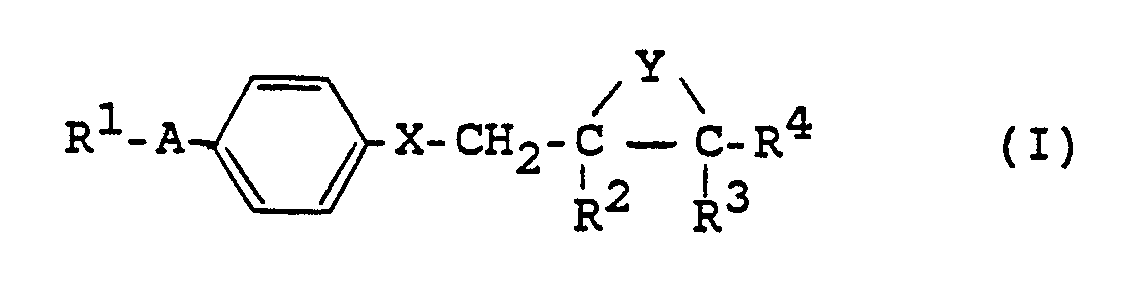
R¹ = geradkettiges oder verzweigtes (C₁-C₁₂)Alkyl, wobei eine oder zwei nicht-benachbarte CH₂-Gruppen durch O- und/oder S-Atome ersetzt sein können,
A = Diazin-2,5-diyl oder diazin-3,6-diyl,
X,Y = O und/oder S, und
R²,R³,R⁴ = unabhängig voneinander H, geradkettiges (C₁-C₁₀)Alkyl oder verzweigtes (C₃-C₁₀)Alkyl, wobei R², R³ und R⁴ nicht gleichzeitig H sind.
Description
- Flüssigkristalle haben insbesondere im letzten Jahrzehnt Eingang in verschiedenste technische Gebiete gefunden, in denen elektrooptische und Anzeigevorrichtungs-Eigenschaften gefragt sind (z.B. in Uhren-, Taschenrechner- und Schreibmaschinenanzeigen). Diese Anzeigevorrichtungen beruhen auf den dielektrischen Ausrichtungseffekten in den nematischen, cholesterischen und/oder smektischen Phasen der flüssigkristallinen Verbindungen, wobei - verursacht durch die dielektrische Anisotropie - die molekulare Längsachse der Verbindungen eine bevorzugte Ausrichtung in einem angelegten elektrischen Feld einnimmt. Die üblichen Schaltzeiten bei diesen Anzeigevorrichtungen sind für viele andere potentielle Anwendungsgebiete von Flüssigkristallen, die an sich für die Technik wegen ihrer einzigartigen Eigenschaften sehr vielversprechende chemische Verbindungen sind, eher zu langsam. Dieser Nachteil macht sich insbesondere dann bemerkbar, wenn - was bei größeren Anzeigeelementflächen zwangsläufig der Fall ist - eine große Anzahl von Bildpunkten angesteuert werden muß, wodurch die Produktionskosten solcher, diese größeren Flächen enthaltenden Geräte wie Videogeräte, Oszillographen oder TV-, Radar-, EDV- oder Schreibautomaten-Bildschirme zu hoch wären.
- Neben den nematischen und cholesterischen Flüssigkristallen haben seit einigen wenigen Jahren in zunehmendem Maße auch für Praxisanwendungen geneigt("tilted")-smektische Flüssigkristall-Phasen an Bedeutung gewonnen. Wenn solchen geneigt-smektischen Phasen, insbesondere smektisch C (Sc oder SmC)Phasen, geeignete Dotierstoffe zugesetzt werden, die eine sogenannte spontane Polarisation (Ps) zeigen oder in der Flüssigkristall-Phase induzieren, so können die Phasen in eine ferroelektrische Flüssigkristall-Phase umgewandelt werden (Benennung von Ps in nC·cm⁻²), siehe dazu beispielsweise Lagerwall et al. im Aufsatz "Ferroelectric Liquid Cristals for Displays" (Ferroelektrische Flüssigkristalle für Anzeigeelemente), SID Symposium, October Meeting, 1985, San Diego (USA). Diese ferroelektrischen Flüssigkristall-Phasen weisen - verglichen mit den üblichen TN("twisted nematic")-Zellen -um etwa den Faktor 1000 schnellere Schaltzeiten auf, so daß sie - auch aufgrund anderer positiver Eigenschaften wie einer bistabilen Schaltmöglichkeit - gute potentielle Kandidaten für die oben aufgeführten Anwendungsgebiete (z.B. über eine Matrixansteuerung) sind.
- Auf der 11. Internationalen, Flüssigkristallkonferenz (30.6. bis 4.7.1986) in Berkeley/USA wurden von D.M. Walba ferroelektrische Flüssigkristalle vorgestellt, die chirale 2,3-Epoxy-alkyl-Seitenketten enthalten und folgende allgemeine Formel aufweisen:

- Die Verbindung mit einem C₁₀-Alkyl- bzw. C₃-Alkylrest weist zwischen 75 °C und 80 °C eine SmC*-Phase auf; die Schaltzeit (75 °C, 15 V/µm) beträgt 14 µsec, der Wert für die spontane Polarisation Ps beträgt 45 nC/cm².
- Aufgabe der vorliegenden Erfindung ist es, Verbindungen aufzuzeigen, die bei hohen Werten für die eigene oder in Flüssigkristall-Phasen induzierte spontane Polarisation Ps Strukturelement aufweisen, die sie auch mit anderen Komponenten in Flüssigkristall-Systemen "verträglich" (d. h. mischbar) machen, da u.a. der mesogene Teil der Moleküle oftmals für eine gute "Verträglichkeit" mit den anderen Mischungskomponenten in Flüssigkristall-Systemen verantwortlich ist; dabei müssen diese Verbindungen selbst nicht unbedingt flüssigkristallin sein, insbesondere nicht unbedingt eine SmC-Phase aufweisen.
- Die Erfindung geht aus von den bekannten chiralen Verbindungen mit einem mesogenen aromatischen Baustein und einem chiralen Baustein mit einem heterocyclischen Dreiring. Die erfindungsgemäßen Verbindungen sind dann dadurch gekennzeichnet, daß in der allgemeinen Formel (I)

R¹ = geradkettiges oder verzweigtes (C₁-C₁₂)Alkyl, wobei eine oder zwei nicht-benachbarte CH₂-Gruppen durch 0- und/oder S-Atome ersetzt sein können,
A = Diazin-2,5-diyl oder Diazin-3,6-diyl,
X,Y = O und/oder S, und
R²,R³,R⁴ = unabhängig voneinander H, geradkettiges (C₁-C₁₀)Alkyl oder verzweigtes (C₃-C₁₀)Alkyl, wobei R², R³ und R⁴ nicht gleichzeitig H sind. - Die N-Atome im Diazin-Ringsystem können sich dabei in 1,3-(Pyrimidine) oder in 1,2-Stellung (Pyridazine) befinden, wobei in der bevorzugten 1,3-Stellung sich die N-Atome auf der dem Rest R¹ zugewandten Seite oder der dem Phenylring zugewandten Seite des Ringsystems befinden können.
- Unter den Verbindungen der allgemeinen Formel (I) sind die bevorzugt, bei denen die Symbole folgende Bedeutung haben: R¹ = geradkettiges (C₅-C₁₁)Alkyl, wobei eine CH₂-Gruppe durch ein O- oder S-Atom ersetzt sein kann, X, Y = O, R², R³ = H und R⁴ = geradkettiges oder verzweigtes (C₃-C₇)Alkyl.
- Die Verbindungen der allgemeinen Formel (I) können beispielsweise hergestellt werden durch Umsetzung der Phenole oder Thiophenole der allgemeinen Formeln (II), (III) oder (IV) mit dem Oxiranen oder Thiiranen der allgemeinen Formel (V); worin Z = H ist oder für eine nucleofuge Gruppe steht:

- Die Verknüpfung der mesogenen Phenole oder Thiophenole der allgemeinen Formeln (II), (III) oder (IV) mit den chiralen Oxiranen oder Thiiranen der allgemeinen Formel (V) kann in an sich bekannter Weise erfolgen, z.B. durch Umsetzung von (II), (III) oder (IV) mit den Epoxyalkoholen (Y=O, X=O und Z=H) unter Zuhilfenahme von Diethylazodicarboxylat und Triphenylphosphin, wie von Mitsonobu, "The Use of Diethyl Azodicarboxylate and Triphenylphosphine in Synthesis and Transformation Natural Products" in Synthesis 1981, S.1-28 beschrieben. Möglich ist es auch, die Epoxyalkohole mit einer derartigen nucleofugen Gruppe Z zu versehen, daß die Umsetzung mit Alkali oder Erdalkali-Salzen der Verbindungen (II), (III) oder (IV) zur Bildung der gewünschten Ether der allgemeinen Formel I (mit X=O) führt. Als derartige nucleofuge (Abgangs-)Gruppen sind u.a. Tosylate, Brosylate, Mesilate oder Triflate dem Fachmann bekannt, sie lassen sich in bekannter Weise z.B. aus den Alkoholen und den jeweiligen Säurechloriden herstellen. Entsprechende Reaktionsmöglichkeiten gelten auch für die Thiiranverbindungen.
- Die Edukte sind aus der Literatur bekannte Verbindungen. Beispielsweise können die Verbindungen (II) mit X=O durch Kondensation von substituierten Benzamiden mit 2-Alkylmalonsäureestern, Überführung der entstehenden Dihydroxypyrimidine in Dichlorpyrimidine und nachfolgende Hydrogenolyse hergestellt werden (siehe DE-C 22 57 588). Die Verbindungen (III) mit X=O werden beispielsweise durch Kondensation entsprechend substituierter 2-Aryl-3-(methylthio)acroleine mit geeigneten Amidinen hergestellt [siehe Kano et al., "A New and Facile Synthesis of 5-Arylpyrimidines and 4-Arylpyrazoles" in Heterocycles, Vol. 19, No. 6, 1079 bis 1082 (1982)]. Aus den Phenolen werden die entsprechenden Thiophenole nach bekannten Methoden erhalten [z.B. Newman et al., "The Conversion of Phenols to Thiphenoles via Dialkylcarbamates" in J. Org. Chem., 31, S. 3980-3984 (1966)].
- Die Oxirane (Epoxyalkohole) als bevorzugte Verbindungen der allgemeinen Formel (V) mit X, Y = O und Z = H werden beispielsweise aus den entsprechenden Allylalkoholen durch enantioselektive Epoxidierung hergestellt (siehe Pfenninger, "Asymmetric Epoxidation of Allylic Alcohols: The Skarplen Epoxidation" in Synthesis 1986, S. 89-116). Sie werden dann als solche eingesetzt (Z=H) oder aber nach Standardmethoden, z.B. durch Umsetzung mit 4-Toluolsulfonylchlorid, in die entsprechenden Tosylate überführt (Z=SO₂C₆H₄CH₃), analoges gilt für die anderen genannten nucleofugen Gruppen.
- Eine weitere Lösung der gestellten Aufgabe ist eine verdrillbare Flüssigkristall-Phase mti einem Gehalt an mindestens einer chiralen Verbindung, die als chirale Verbindung mindestens eine Verbindung der allgemeinen Formel (I), enthält. Unter dem Begriff "verdrillbare Flüssigkristall-Phase" sind nematische, cholesterische oder geneigt("tilted")-smektische, insbesondere SmC-Phasen zu verstehen.
- Die verdrillbaren Flüssigkristall-Phasen bestehen aus 2 bis 20, vorzugsweise 2 bis 15 Komponenten, darunter mindestens einer der erfindungsgemäß beanspruchten chiralen Verbindungen. Die anderen Bestandteile werden vorzugsweise ausgewählt aus den bekannten Verbindungen mit nematischen, cholesterischen und/oder geneigt-smektischen Phasen, dazu gehören beispielsweise Schiffsche Basen, Biphenyle, Terphenyle, Phenylcyclohexane, Cyclohexylbiphenyle, Pyrimidine, Zimtsäureester, Cholesterinester, verschieden überbrückte, terminal-polare mehrkernige Ester von p-Alkylbenzoesäuren. Im allgemeinen liegen die im Handel erhältlichen Flüssigkristall-Phasen bereits vor der Zugabe der chiralen Verbindung(en) als Gemische verschiedenster Komponenten vor, von denen mindestens eine mesogen ist, d.h. als Verbindung, in derivatisierter Form oder im Gemisch mit bestimmten Cokomponenten eine Flüssigkristall-Phase zeigt [=mindestens eine enantiotrope (Klärtemperatur> Schmelztemperatur) oder monotrope (Klärtemperatur< Schmelztemperatur) Mesophasenbildung erwarten läßt]. Insbesondere enthält die verdrillbare Flüssigkristall-Phase neben mindestens einer der erfindungsgemäß beanspruchten chiralen Verbindungen eine Phenylpyrimidinverbindung mit Sc-Phase z.B. ein 4-(5-Alkyl-pyrimidin-2-yl)-1-alkoxybenzol.
- Von der oder den erfindungsgemäßen Verbindung(en) enthalten die Flüssigkristall-Phasen im allgemeinen 0,01 bis 70 Gew.-%, insbesondere 0,05 bis 50 Gew.-%.
- Die erfindungsgemäßen Verbindungen sind insbesondere als Dotierstoffe für geneigt-smektische Flüssigkristall-Phasen geeignet, da sie diese in ferroelektrische Flüssigkristall-Phasen umwandeln; die Werte für die spontane Polarisation (Ps) liegen im Bereich von etwa 30 bis 70 nC·cm⁻² (extrapoliert auf die reine Verbindung).
- Eine Lösung von 1,42 g (5 mmol) des 2-(4-Hydroxy-phenyl)-5-n-oxtyl-pyrimidins in 50 ml Dimethylformamid wird bei einer Temperatur von 0 °C mit 0,16 g NaH (5 mmol), als 80 %ige Dispersion in Öl, versetzt. Nach Abklingen der Gasentwicklung werden 1,35 g (7 mmol) des (2S,3S)-1-Mesyloxy-2,3-epoxyhexans zugegeben und bei 0 °C während 6 h gerührt. Anschließend wird in 100 ml Eiswasser hydrolysiert und mit Dichlormethan extrahiert. Nach dreimaliger Säulenchromatographie (Kieselgel, Dichlormethan) werden 0,61 g (32 % d.Th.) an farblosen Kristallen erhalten. Das IR-Spektrum (in KBr) und das ¹H-NMR-Spektrum (in CDCl₃) stützen die angegebene Strukturformel, der Drehwert beträgt [α]: -18,8 ° (c = 10, CH₂Cl₂).

Bei Einsatz der entsprechenden Phenole (II), (III) oder (IV) und der Epoxyalkohole (V) sind diese und die nachstehende Vorschrift repräsentativ für alle Verbindungen der nachfolgenden Tabelle (I). - Es werden 1,31 g (5 mmol) Triphenylphosphin und 0,79 g (5 mmol) Azodicarbonsäurediethylester in 10 ml Tetrahydrofuran bei 0 °C vereinigt. Nach 20 min werden 1,49 g (5 mmol) des 2-(4-Hydroxy-phenyl)-5-n-nonyl-pyrimidins und 0,72 g (5 mmol) des (2S,3S)-2,3-Epoxyoctans, jeweils in 8 ml Tetrahydrofuran, zugegeben. Nach 24 h wird im Vakuum zur Trockene eingedampft und der Rückstand wird über Kieselgel (200 g) mit CH₂Cl₂ chromatographiert. Nach Umkristallisation aus Hexan werden 0,79 g an farblosen Kristallen erhalten; [α]: -15,3 ° (c = 5, CHCl₃)


- Zur Überprüfung der Wirksamkeit der vorstehend beschriebenen Verbindungen als Dotierstoffe in Flüssigkristall-Systemen werden diese in Konzentrationen von jeweils 10 Mol-% (oder in einem Fall von 25 Mol-% ) mit dem Racemat der Verbindung

- Die Ps -Werte werden nach der Methode von Sawyer et al. (Phys. Rev. 35, 269 bis 273, 1930) gemassen, wobei eine spezielle Meßzelle [Skarp et. al. in Ferroelectric Letters Vol. 06, 000 (1986)] verwendet wird, in der auch die τ- und ϑ-Werte bestimmt werden. Bei einer Zellenschichtdicke von 2 µm wird durch Scherung eine einheitliche planare Orientierung der Flüssigkristalle in der SmC*-Phase erreicht [SSFLC-Technik, Clark et al., Appl. Phys. Lett. 36, 899 (1980)]. Nach Anordnung der Meßzelle zwischen zwei gekreuzte Polarisatoren erfolgt die Bestimmung der Schaltzeit mit Hilfe einer Photodiode und die des optischen Neigungswinkels bzw. des Schaltwinkels durch Drehung der Meßzelle von maximalem zu minimalem Lichtdurchgang durch die Meßanordnung. Tabelle II faßt die Ergebnisse für die Mischungen zusammen. Neben den Werten für Ps, τ und 2 ϑ (jeweils bei 25°C) ist der SmC*-Bereich der jeweiligen Mischung angegeben; die Werte in Klammern geben dabei die unterkühlbare untere Temperaturgrenze des SmC*-Bereichs an.

Claims (8)

R¹ = geradkettiges oder verzweigtes (C₁-C₁₂)Alkyl, wobei eine oder zwei nicht-benachbarte CH₂-Gruppen durch 0- und/oder S-Atome ersetzt sein können,
A = Diazin-2,5-diyl oder Diazin-3,6-diyl,
X,Y = O und/oder S, und
R²,R³,R⁴ = unabhängig voneinander H, geradkettiges (C₁-C₁₀)Alkyl oder verzweigtes (C₃-C₁₀)Alkyl, wobei R², R³ und R⁴ nicht gleichzeitig H sind.
Priority Applications (1)
| Application Number | Priority Date | Filing Date | Title |
|---|---|---|---|
| AT87114332T ATE60603T1 (de) | 1986-10-06 | 1987-10-01 | Chirale aryl-2,3-epoxyalkyl-ether und deren entsprechende thioverbindungen und ihre verwendung als dotierstoff in fluessigkristallphasen. |
Applications Claiming Priority (2)
| Application Number | Priority Date | Filing Date | Title |
|---|---|---|---|
| DE3633968 | 1986-10-06 | ||
| DE19863633968 DE3633968A1 (de) | 1986-10-06 | 1986-10-06 | Chirale aryl-2,3-epoxyalkyl-ether und deren entsprechende thioverbindungen und ihre verwendung als dotierstoff in fluessigkristall-phasen |
Publications (3)
| Publication Number | Publication Date |
|---|---|
| EP0263437A2 true EP0263437A2 (de) | 1988-04-13 |
| EP0263437A3 EP0263437A3 (en) | 1989-11-02 |
| EP0263437B1 EP0263437B1 (de) | 1991-01-30 |
Family
ID=6311139
Family Applications (1)
| Application Number | Title | Priority Date | Filing Date |
|---|---|---|---|
| EP87114332A Expired - Lifetime EP0263437B1 (de) | 1986-10-06 | 1987-10-01 | Chirale Aryl-2,3-epoxyalkyl-ether und deren entsprechende Thioverbindungen und ihre Verwendung als Dotierstoff in Flüssigkristall-Phasen |
Country Status (9)
| Country | Link |
|---|---|
| US (1) | US4876028A (de) |
| EP (1) | EP0263437B1 (de) |
| JP (1) | JPS6391387A (de) |
| KR (1) | KR960007518B1 (de) |
| AT (1) | ATE60603T1 (de) |
| CA (1) | CA1290755C (de) |
| DE (2) | DE3633968A1 (de) |
| ES (1) | ES2021320B3 (de) |
| NO (1) | NO170416C (de) |
Cited By (15)
| Publication number | Priority date | Publication date | Assignee | Title |
|---|---|---|---|---|
| EP0286043A3 (en) * | 1987-04-07 | 1989-12-06 | Hoechst Aktiengesellschaft | Use of compounds having a polar chiral group as components of liquid-crystal mixtures for the exploitation of the electroclinic effect |
| EP0365820A1 (de) * | 1988-09-24 | 1990-05-02 | Hoechst Aktiengesellschaft | Verwendung optisch aktiver Carbonsäureester von Sauerstoff enthaltenden Heterocyclen als Dotierstoffe in Flüssigkristallmischungen und diese enthaltende Flüssigkristallmischungen |
| WO1990011335A1 (de) * | 1989-03-22 | 1990-10-04 | Hoechst Aktiengesellschaft | Ferroelektrische flüssigkristalline mischungen |
| EP0365255A3 (de) * | 1988-10-19 | 1991-07-03 | Matsushita Electric Industrial Co., Ltd. | Ferroelektrische Flüssigkristallmischung und Flüssigkristallanzeigevorrichtung |
| WO1992001685A1 (de) * | 1990-07-20 | 1992-02-06 | Hoechst Aktiengesellschaft | Chirale alken-aryl-2,3-epoxyalkyl-ether und ihre verwendung in flüssigkristallinen mischungen |
| US5130048A (en) * | 1988-03-04 | 1992-07-14 | Displaytech, Inc. | Ferroelectric liquid crystal compositions containing chiral haloalkoxy tails units |
| US5145601A (en) * | 1990-06-25 | 1992-09-08 | The University Of Colorado Foundation Inc. | Ferroelectric liquid crystals with nicotinic acid cores |
| US5167855A (en) * | 1988-03-04 | 1992-12-01 | University Research Corporation | Ferroelectric liquid crystal compositions chiral haloalkoxy tail units |
| US5180520A (en) * | 1988-03-04 | 1993-01-19 | University Research Corporation | Ferroelectric liquid crystal compositions containing halogenated cores and chiral halogenated cores and chiral haloalkoxy tail units |
| WO1993013093A1 (de) * | 1991-12-28 | 1993-07-08 | Hoechst Aktiengesellschaft | Chirale oxiranylmethyl-ether und ihre verwendung als dotierstoffe in flüssigkristallmischungen |
| WO1993020069A1 (de) * | 1992-04-07 | 1993-10-14 | Hoechst Aktiengesellschaft | Chirale oxiranderivate und ihre verwendung als dotierstoffe in flüssigkristallmischungen |
| USRE34726E (en) * | 1988-03-04 | 1994-09-13 | Displaytech, Inc. | Ferroelectric liquid crystal compositions containing chiral haloalkoxy tail units |
| US5354500A (en) * | 1986-05-29 | 1994-10-11 | Hoechst Aktiengesellschaft | Optically active carboxylic esters of oxygen-containing heterocycles as doping substances in liquid crystal mixtures and liquid crystal mixtures containing them |
| US5866036A (en) * | 1989-06-01 | 1999-02-02 | Displaytech, Inc. | High tilt ferroelectric liquid crystal compounds and compositions |
| WO1999005236A1 (de) | 1997-07-25 | 1999-02-04 | Aventis Research & Technologies Gmbh & Co Kg | Chipkarte mit bistabiler anzeige |
Families Citing this family (10)
| Publication number | Priority date | Publication date | Assignee | Title |
|---|---|---|---|---|
| DE3718174A1 (de) * | 1987-05-29 | 1988-12-15 | Hoechst Ag | Verwendung von optisch aktiven oxiran-2-carbonsaeureestern als dotierstoffe in fluessigkristallmischungen, diese enthaltende fluessigkristallmischungen und neue optisch aktive oxiran-2-carbonsaeureester |
| JPH07116131B2 (ja) * | 1987-06-15 | 1995-12-13 | チッソ株式会社 | チオエ−テル化合物及び液晶組成物 |
| CA1320728C (en) * | 1987-09-07 | 1993-07-27 | Kazuhiko Sakaguchi | Liquid crystalline compounds and process for production thereof |
| US5407599A (en) * | 1987-11-25 | 1995-04-18 | Hoechst Aktiengesellschaft | Cyclopropylaklyl or -alkenyl or heterocyclic compounds, process for their preparation and their use in liquid-crystalline mixtures |
| DE3827603A1 (de) * | 1988-08-13 | 1990-03-15 | Hoechst Ag | Chirale smektische fluessigkristalle und diese enthaltende glasartige materialien zur darstellung und speicherung von information |
| US5178793A (en) * | 1989-06-01 | 1993-01-12 | University Research Corporation | Ferroelectric liquid crystal compounds and compositions |
| US5231528A (en) * | 1989-06-23 | 1993-07-27 | Hoechst Aktiengesellschaft | Ferroelectric liquid crystal components having high spontaneous polarization and low helical pitch |
| US5327273A (en) * | 1989-06-29 | 1994-07-05 | Hoffmann-La Roche Inc. | Bistable ferroelectric liquid crystal display cell |
| DE4120783A1 (de) * | 1991-06-24 | 1993-01-07 | Hoechst Ag | Optisch aktive oxiranderivate und ihre verwendung als dotierstoffe in fluessigkristallmischungen |
| DE4311968A1 (de) * | 1993-04-10 | 1994-10-20 | Hoechst Ag | Smektische Flüssigkristallmischung |
Family Cites Families (3)
| Publication number | Priority date | Publication date | Assignee | Title |
|---|---|---|---|---|
| HU192973B (en) * | 1984-01-16 | 1987-08-28 | Chinoin Gyogyszer Es Vegyeszet | New process for reducing sulfochlorides, sulfoxides and alpha-halogenocarbonyl compounds for producing dithio-, thio- or carbonyl compounds |
| US4638073A (en) * | 1985-10-01 | 1987-01-20 | Walba David M | Synthesis of new liquid crystal materials possessing phenylbenzoate or biphenyl core units and (2,3)-epoxyalkyloxiranemethanol chiral tails |
| JPH01291574A (ja) * | 1988-05-19 | 1989-11-24 | Fujitsu General Ltd | 垂直出力回路 |
-
1986
- 1986-10-06 DE DE19863633968 patent/DE3633968A1/de not_active Withdrawn
-
1987
- 1987-10-01 AT AT87114332T patent/ATE60603T1/de not_active IP Right Cessation
- 1987-10-01 DE DE8787114332T patent/DE3767821D1/de not_active Expired - Fee Related
- 1987-10-01 EP EP87114332A patent/EP0263437B1/de not_active Expired - Lifetime
- 1987-10-01 ES ES87114332T patent/ES2021320B3/es not_active Expired - Lifetime
- 1987-10-02 US US07/104,350 patent/US4876028A/en not_active Expired - Lifetime
- 1987-10-05 JP JP62250050A patent/JPS6391387A/ja active Granted
- 1987-10-05 KR KR1019870011082A patent/KR960007518B1/ko not_active Expired - Fee Related
- 1987-10-05 CA CA000548549A patent/CA1290755C/en not_active Expired - Fee Related
- 1987-10-05 NO NO874177A patent/NO170416C/no unknown
Cited By (17)
| Publication number | Priority date | Publication date | Assignee | Title |
|---|---|---|---|---|
| US5354500A (en) * | 1986-05-29 | 1994-10-11 | Hoechst Aktiengesellschaft | Optically active carboxylic esters of oxygen-containing heterocycles as doping substances in liquid crystal mixtures and liquid crystal mixtures containing them |
| EP0286043A3 (en) * | 1987-04-07 | 1989-12-06 | Hoechst Aktiengesellschaft | Use of compounds having a polar chiral group as components of liquid-crystal mixtures for the exploitation of the electroclinic effect |
| USRE34726E (en) * | 1988-03-04 | 1994-09-13 | Displaytech, Inc. | Ferroelectric liquid crystal compositions containing chiral haloalkoxy tail units |
| US5180520A (en) * | 1988-03-04 | 1993-01-19 | University Research Corporation | Ferroelectric liquid crystal compositions containing halogenated cores and chiral halogenated cores and chiral haloalkoxy tail units |
| US5167855A (en) * | 1988-03-04 | 1992-12-01 | University Research Corporation | Ferroelectric liquid crystal compositions chiral haloalkoxy tail units |
| US5130048A (en) * | 1988-03-04 | 1992-07-14 | Displaytech, Inc. | Ferroelectric liquid crystal compositions containing chiral haloalkoxy tails units |
| EP0365820A1 (de) * | 1988-09-24 | 1990-05-02 | Hoechst Aktiengesellschaft | Verwendung optisch aktiver Carbonsäureester von Sauerstoff enthaltenden Heterocyclen als Dotierstoffe in Flüssigkristallmischungen und diese enthaltende Flüssigkristallmischungen |
| US5122296A (en) * | 1988-10-19 | 1992-06-16 | Matsushita Electric Industrial Co., Ltd. | Ferroelectric liquid crystal composition and liquid crystal display device |
| EP0365255A3 (de) * | 1988-10-19 | 1991-07-03 | Matsushita Electric Industrial Co., Ltd. | Ferroelektrische Flüssigkristallmischung und Flüssigkristallanzeigevorrichtung |
| WO1990011335A1 (de) * | 1989-03-22 | 1990-10-04 | Hoechst Aktiengesellschaft | Ferroelektrische flüssigkristalline mischungen |
| US5866036A (en) * | 1989-06-01 | 1999-02-02 | Displaytech, Inc. | High tilt ferroelectric liquid crystal compounds and compositions |
| US5145601A (en) * | 1990-06-25 | 1992-09-08 | The University Of Colorado Foundation Inc. | Ferroelectric liquid crystals with nicotinic acid cores |
| WO1992001685A1 (de) * | 1990-07-20 | 1992-02-06 | Hoechst Aktiengesellschaft | Chirale alken-aryl-2,3-epoxyalkyl-ether und ihre verwendung in flüssigkristallinen mischungen |
| WO1993013093A1 (de) * | 1991-12-28 | 1993-07-08 | Hoechst Aktiengesellschaft | Chirale oxiranylmethyl-ether und ihre verwendung als dotierstoffe in flüssigkristallmischungen |
| US5707545A (en) * | 1991-12-28 | 1998-01-13 | Hoechst Aktiengesellschaft | Chiral oxiranylmethyl ethers, and their use as dopants in liquid-crystal mixtures |
| WO1993020069A1 (de) * | 1992-04-07 | 1993-10-14 | Hoechst Aktiengesellschaft | Chirale oxiranderivate und ihre verwendung als dotierstoffe in flüssigkristallmischungen |
| WO1999005236A1 (de) | 1997-07-25 | 1999-02-04 | Aventis Research & Technologies Gmbh & Co Kg | Chipkarte mit bistabiler anzeige |
Also Published As
| Publication number | Publication date |
|---|---|
| NO874177L (no) | 1988-04-07 |
| DE3633968A1 (de) | 1988-04-07 |
| DE3767821D1 (de) | 1991-03-07 |
| NO170416B (no) | 1992-07-06 |
| JPH0583552B2 (de) | 1993-11-26 |
| EP0263437B1 (de) | 1991-01-30 |
| KR880005122A (ko) | 1988-06-28 |
| ATE60603T1 (de) | 1991-02-15 |
| JPS6391387A (ja) | 1988-04-22 |
| CA1290755C (en) | 1991-10-15 |
| US4876028A (en) | 1989-10-24 |
| KR960007518B1 (ko) | 1996-06-05 |
| NO170416C (no) | 1992-10-14 |
| ES2021320B3 (es) | 1991-11-01 |
| EP0263437A3 (en) | 1989-11-02 |
| NO874177D0 (no) | 1987-10-05 |
Similar Documents
| Publication | Publication Date | Title |
|---|---|---|
| EP0263437B1 (de) | Chirale Aryl-2,3-epoxyalkyl-ether und deren entsprechende Thioverbindungen und ihre Verwendung als Dotierstoff in Flüssigkristall-Phasen | |
| DD289524A5 (de) | Fluessigkristalline cyclopropylalkyl- oder-alkenyl-heterocyclen, verfahren zu ihrer herstellung und ihre verwendung in fluessigkristallinen mischungen | |
| DE69426358T2 (de) | Verbindungen zur verwendung in flüssigkristallzusammensetzungen | |
| EP0292954B1 (de) | Verwendung von optisch aktiven Oxiran-2-carbonsäureestern als Dotierstoffe in Flüssigkristallmischungen, diese enthaltende Flüssigkristallmischungen und neue optisch aktive Oxiran-2-carbonsäureester | |
| EP0248335B1 (de) | Chirale Ester aus alpha-substituierten Carbonsäuren und mesogenen Pyrimidin-5-yl-phenolen und ihre Verwendung als Dotierstoff in Flüssigkristall-Phasen | |
| DE3824902A1 (de) | Optisch aktive, in 4-stellung einen mesogenen rest tragende 1,3-dioxolan-derivate, ein verfahren zu ihrer herstellung und ihre verwendung als dotierstoffe in fluessigkristallmischungen | |
| EP0321504B1 (de) | Chirale aryloxypropionsäureester und ihre verwendung als dotierstoff in flüssigkristall-phasen | |
| DE19500768A1 (de) | Phenanthren-Derivate und ihre Verwendung in flüssigkristallinen Mischungen | |
| EP0234437A1 (de) | Chirale Umsetzungsprodukte aus mesogenen Molekülbausteinen und bifunktionell reaktionsfähigen Weinsäurederivaten und ihre Verwendung als Dotierstoff in Flüssigkristall-Phasen | |
| EP0295370B1 (de) | Flüssigkristalline 5-Phenylpyrimidin-Derivate mit Sc- oder Sc(Stern)-Phase und Verfahren zu ihrer Herstellung | |
| EP0618914B1 (de) | Chirale oxiranylmethyl-ether und ihre verwendung als dotierstoffe in flüssigkristallmischungen | |
| EP0883618B1 (de) | Difluorphenylpyrimidylpyridin-derivate und ihre verwendung in flüssigkristallinen mischungen | |
| EP0602596B1 (de) | Trifluorphenylen-Verbindungen, Verfahren zu ihrer Herstellung und ihre Verwendung in flüssigkristallinen Mischungen | |
| EP0552658A1 (de) | Derivate der 3-Cyclohexylpropionsäure und ihre Verwendung in ferroelektrischen Flüssigkristallmischungen | |
| EP0428665B1 (de) | Fluorphenylpyrimidine | |
| EP0540572B1 (de) | Chirale alken-aryl-2,3-epoxyalkyl-ether und ihre verwendung in flüssigkristallinen mischungen | |
| EP0438811A2 (de) | Ester von 3-Halogen- bzw. 3-Cyano-substituierten 2-Methylalkancarbonsäuren und ihre Verwendung als Dotierstoffe in flüssigkristallinen Mischungen | |
| DE4003012A1 (de) | Geminale dimethylalkyl-verbindungen, verfahren zu ihrer herstellung und ihre verwendung in fluessigkristallinen mischungen | |
| DE4200819A1 (de) | Ferroelektrische dotierstoffe | |
| DE4230288A1 (de) | Chirale Valerolacton-Derivate | |
| DE4211563A1 (de) | Chirale Oxiranderivate und ihre Verwendung als Dotierstoffe in Flüssigkristallmischungen | |
| DE4211562A1 (de) | Chirale Oxiranderivate und ihre Verwendung als Dotierstoffe in Flüssigkristallmischungen | |
| DE3630933A1 (de) | Chirale ester aus (alpha)-substituierten carbonsaeuren und mesogenen phenolen und ihre verwendung als dotierstoff in fluessigkristall-phasen | |
| DE4116750A1 (de) | Optisch aktive 1,3-dioxolane als dotierungskomponenten in fluessigkristallmischungen | |
| DE3922416A1 (de) | Chirale oder achirale ringverbindungen |
Legal Events
| Date | Code | Title | Description |
|---|---|---|---|
| PUAI | Public reference made under article 153(3) epc to a published international application that has entered the european phase |
Free format text: ORIGINAL CODE: 0009012 |
|
| AK | Designated contracting states |
Kind code of ref document: A2 Designated state(s): AT BE CH DE ES FR GB IT LI NL SE |
|
| PUAL | Search report despatched |
Free format text: ORIGINAL CODE: 0009013 |
|
| AK | Designated contracting states |
Kind code of ref document: A3 Designated state(s): AT BE CH DE ES FR GB IT LI NL SE |
|
| 17P | Request for examination filed |
Effective date: 19900113 |
|
| 17Q | First examination report despatched |
Effective date: 19900417 |
|
| GRAA | (expected) grant |
Free format text: ORIGINAL CODE: 0009210 |
|
| AK | Designated contracting states |
Kind code of ref document: B1 Designated state(s): AT BE CH DE ES FR GB IT LI NL SE |
|
| REF | Corresponds to: |
Ref document number: 60603 Country of ref document: AT Date of ref document: 19910215 Kind code of ref document: T |
|
| REF | Corresponds to: |
Ref document number: 3767821 Country of ref document: DE Date of ref document: 19910307 |
|
| ITF | It: translation for a ep patent filed | ||
| ET | Fr: translation filed | ||
| GBT | Gb: translation of ep patent filed (gb section 77(6)(a)/1977) | ||
| PLBE | No opposition filed within time limit |
Free format text: ORIGINAL CODE: 0009261 |
|
| STAA | Information on the status of an ep patent application or granted ep patent |
Free format text: STATUS: NO OPPOSITION FILED WITHIN TIME LIMIT |
|
| 26N | No opposition filed | ||
| PGFP | Annual fee paid to national office [announced via postgrant information from national office to epo] |
Ref country code: CH Payment date: 19930917 Year of fee payment: 7 |
|
| PGFP | Annual fee paid to national office [announced via postgrant information from national office to epo] |
Ref country code: SE Payment date: 19930923 Year of fee payment: 7 |
|
| PGFP | Annual fee paid to national office [announced via postgrant information from national office to epo] |
Ref country code: AT Payment date: 19930924 Year of fee payment: 7 |
|
| PGFP | Annual fee paid to national office [announced via postgrant information from national office to epo] |
Ref country code: BE Payment date: 19931007 Year of fee payment: 7 |
|
| PGFP | Annual fee paid to national office [announced via postgrant information from national office to epo] |
Ref country code: ES Payment date: 19931014 Year of fee payment: 7 |
|
| PGFP | Annual fee paid to national office [announced via postgrant information from national office to epo] |
Ref country code: NL Payment date: 19931031 Year of fee payment: 7 |
|
| PG25 | Lapsed in a contracting state [announced via postgrant information from national office to epo] |
Ref country code: AT Effective date: 19941001 |
|
| PG25 | Lapsed in a contracting state [announced via postgrant information from national office to epo] |
Ref country code: SE Effective date: 19941002 |
|
| PG25 | Lapsed in a contracting state [announced via postgrant information from national office to epo] |
Ref country code: ES Free format text: LAPSE BECAUSE OF THE APPLICANT RENOUNCES Effective date: 19941003 |
|
| PG25 | Lapsed in a contracting state [announced via postgrant information from national office to epo] |
Ref country code: LI Effective date: 19941031 Ref country code: CH Effective date: 19941031 Ref country code: BE Effective date: 19941031 |
|
| EAL | Se: european patent in force in sweden |
Ref document number: 87114332.7 |
|
| BERE | Be: lapsed |
Owner name: HOECHST A.G. Effective date: 19941031 |
|
| PG25 | Lapsed in a contracting state [announced via postgrant information from national office to epo] |
Ref country code: NL Effective date: 19950501 |
|
| NLV4 | Nl: lapsed or anulled due to non-payment of the annual fee | ||
| REG | Reference to a national code |
Ref country code: CH Ref legal event code: PL |
|
| EUG | Se: european patent has lapsed |
Ref document number: 87114332.7 |
|
| PGFP | Annual fee paid to national office [announced via postgrant information from national office to epo] |
Ref country code: GB Payment date: 19980923 Year of fee payment: 12 Ref country code: FR Payment date: 19980923 Year of fee payment: 12 |
|
| PG25 | Lapsed in a contracting state [announced via postgrant information from national office to epo] |
Ref country code: GB Free format text: LAPSE BECAUSE OF NON-PAYMENT OF DUE FEES Effective date: 19991001 |
|
| REG | Reference to a national code |
Ref country code: ES Ref legal event code: FD2A Effective date: 19991007 |
|
| GBPC | Gb: european patent ceased through non-payment of renewal fee |
Effective date: 19991001 |
|
| PG25 | Lapsed in a contracting state [announced via postgrant information from national office to epo] |
Ref country code: FR Free format text: LAPSE BECAUSE OF NON-PAYMENT OF DUE FEES Effective date: 20000630 |
|
| REG | Reference to a national code |
Ref country code: FR Ref legal event code: ST |
|
| PGFP | Annual fee paid to national office [announced via postgrant information from national office to epo] |
Ref country code: DE Payment date: 20040804 Year of fee payment: 18 |
|
| PG25 | Lapsed in a contracting state [announced via postgrant information from national office to epo] |
Ref country code: IT Free format text: LAPSE BECAUSE OF NON-PAYMENT OF DUE FEES;WARNING: LAPSES OF ITALIAN PATENTS WITH EFFECTIVE DATE BEFORE 2007 MAY HAVE OCCURRED AT ANY TIME BEFORE 2007. THE CORRECT EFFECTIVE DATE MAY BE DIFFERENT FROM THE ONE RECORDED. Effective date: 20051001 |
|
| PG25 | Lapsed in a contracting state [announced via postgrant information from national office to epo] |
Ref country code: DE Free format text: LAPSE BECAUSE OF NON-PAYMENT OF DUE FEES Effective date: 20060503 |