EP0263773B1 - Symétrisation pour canaux redondants - Google Patents
Symétrisation pour canaux redondants Download PDFInfo
- Publication number
- EP0263773B1 EP0263773B1 EP87630199A EP87630199A EP0263773B1 EP 0263773 B1 EP0263773 B1 EP 0263773B1 EP 87630199 A EP87630199 A EP 87630199A EP 87630199 A EP87630199 A EP 87630199A EP 0263773 B1 EP0263773 B1 EP 0263773B1
- Authority
- EP
- European Patent Office
- Prior art keywords
- channel
- channels
- ccdb
- local
- foreign
- Prior art date
- Legal status (The legal status is an assumption and is not a legal conclusion. Google has not performed a legal analysis and makes no representation as to the accuracy of the status listed.)
- Expired - Lifetime
Links
Images


Classifications
-
- G—PHYSICS
- G06—COMPUTING OR CALCULATING; COUNTING
- G06F—ELECTRIC DIGITAL DATA PROCESSING
- G06F11/00—Error detection; Error correction; Monitoring
- G06F11/07—Responding to the occurrence of a fault, e.g. fault tolerance
- G06F11/16—Error detection or correction of the data by redundancy in hardware
- G06F11/18—Error detection or correction of the data by redundancy in hardware using passive fault-masking of the redundant circuits
- G06F11/181—Eliminating the failing redundant component
-
- G—PHYSICS
- G06—COMPUTING OR CALCULATING; COUNTING
- G06F—ELECTRIC DIGITAL DATA PROCESSING
- G06F11/00—Error detection; Error correction; Monitoring
- G06F11/07—Responding to the occurrence of a fault, e.g. fault tolerance
- G06F11/16—Error detection or correction of the data by redundancy in hardware
- G06F11/18—Error detection or correction of the data by redundancy in hardware using passive fault-masking of the redundant circuits
-
- G—PHYSICS
- G06—COMPUTING OR CALCULATING; COUNTING
- G06F—ELECTRIC DIGITAL DATA PROCESSING
- G06F11/00—Error detection; Error correction; Monitoring
- G06F11/07—Responding to the occurrence of a fault, e.g. fault tolerance
- G06F11/16—Error detection or correction of the data by redundancy in hardware
- G06F11/18—Error detection or correction of the data by redundancy in hardware using passive fault-masking of the redundant circuits
- G06F11/182—Error detection or correction of the data by redundancy in hardware using passive fault-masking of the redundant circuits based on mutual exchange of the output between redundant processing components
Definitions
- This invention relates to redundant control systems used for improving system availability in which individual channel transients sometimes cause nuisance shutdowns.
- US-A- 3 783 250 is directed to an adaptive control apparatus used in connection with a plurality of self-testing data processing computer modules whereby the operational computer modules of said data processing computer modules are interconnectable with a data bus and whereby the failed computer modules are excluded from communication with the data bus in accordance with an operational status of the computer modules.
- redundant In critical control computer applications, the use of hardware redundancy is commonplace for improving the reliability of the system. It should be understood that usage of the word "redundant” herein includes not only strictly identical channels using identical sensors but also includes quasi-redundant channels in which either the sensors used or even the channels themselves may vary slightly between channels. In other words, some signals associated with a channel may not appear in other channels.
- RM Redundancy Management
- FDI algorithmic Failure Detection and Isolation
- BIT Built-In-Tests
- the high false alarm rate is mainly due to the non-identical operation of the redundant channels which, in turn, is caused by the occurrence of asymmetrical or asynchronous events including transient faults.
- a common example of an asymmetrical event is the temporary loss of power to a subset of channels in a redundant control system.
- the occurrence of permanent faults can also lead to a asymmetrical or asynchronous channel operation but does not result in a false alarm because the persistently faulty signals are permanently voted out and the voting planes are reconfigured to only include the unaffected redundant channels in subsequent votes.
- redundancy management voting planes are influenced not only by the signal data bases (redundant sets of input signals) but also by the configuration data bases.
- the configuration data bases contain information regarding the fault and redundancy levels of signals and channels.
- these configuration data bases are historical in nature in that as faults accumulate they are added to the data base and not removed until specifically requested by a user of the system.
- the occurrence of such events and transients asymmetrically and permanently affects the channel configuration data bases which contain the health, status and FDI information on the redundant channels. For example, when a channel receives dissimilar data due to a transient fault on its data links it can result in a dissimilar output at the next or any subsequent voting plane which may persist for a long time due to historical effects of filters, etc. This, in turn, can lead to failure confirmation in the affected channel or channels.
- the object of the present invention is to provide a method and apparatus by which redundant systems may be made more reliable or available and less subject to false alarms caused by non-symmetrical events occurring on one or more of the channels of such a redundant system.
- the signal health, status and FDI information generated at all voting planes in each channel of a plural channel system can be considered to be defining a local channel configuration data base (CCDB) which is communicated to all other channels digitally, e.g., via Cross Channel Data Link(s) (CCDL).
- CCDB local channel configuration data base
- Each channel has a storage area for storing duplicates of all of the other CCDBs in the system.
- Each channel also has a storage area for storing a duplicate of its own local CCDB.
- Each local CCDB is updated at random with signal data from its associated channel.
- the foreign CCDBs and duplicate local CCDB resident in each channel are periodically updated with signal data obtained from the corresponding local CCDBs in each of the other channels, including itself.
- SCDB System Configuration Data Base
- That signal or channel Before excluding a non-identical signal or misoperating channel, that signal or channel may be "equalized" to the corresponding signal valid or CCDB determined from the majority of signals or CCDBs. If the errant signal or channel continues to misbehave after a selected number of periodic determinations of miscomparison, the system is then reconfigured to exclude the signal or channel in which the non-identical signal or CCDB is persistently different.
- the periodic updating of each of the foreign and duplicate local CCDBs in each channel is accomplished substantially at the same relative time within each frame of a repetitive series of synchronized computational time frames common to all channels.
- the periodic comparison of the signal configuration data contained in the various CCDBs within a channel is accomplished substantially at the same relative time within each frame of a repetitive series of synchronized computational time frames common to all channels.
- the duplicate local CCDB in each channel is updated from its own local CCDB by communicating the present signal configuration data content thereof externally via a route and environment similar to that used to communicate the present local signal data configuration content to foreign channels.
- a loss of power signal is sent from a channel in which a loss of power occurs to all of the plural channels in the system in order that the unaffected channels may stop using the affected channel's associated foreign CCDBs therein.
- the present invention is guaranteed to produce an identical SCDB in each channel which is then used for driving all voting planes and control computations and producing identical selected signal and output commands.
- the implementation of the data base symmetrization concept disclosed herein centers around an autonomous, synchronous controller embedded in each channel of a plural channel computer system.
- a channel's controller can be constructed as taught herein and is frame synchronized by a synchronizer.
- These autonomous controllers can be implemented as embedded processors or as programmable state machines driven by the local clock in each channel and may perform the digital transfer of information between link transmitters and receivers.
- a key element of the present invention is the "frame" synchronous transmission of data to and from all redundant channels over the CCDL.
- the resulting cross channel data bases are frame synchronous and architectually symmetrical in all channels and are guaranteed to produce identical computations and outputs in the presence of asymmetrical events and transient failures.
- the potential race problem is solved architecturally and is a key teaching of the present invention.
- the symmetrical data base architecture disclosed herein also contains a unique feature for protection of the global data bases by a common asymmetrical event, namely, the loss of power.
- a common asymmetrical event namely, the loss of power.
- LOP loss of power
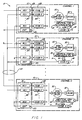
- Fig. 1 illustrates symmetrized data flow in a plural channel system having a symmetrical system architecture, according to the present invention.
- Each channel 10 of a multi-channel redundant system on the basis of FDI and other routines, creates a local configuration data base 14 called the Channel Signal Configuration Data Base (CCDB), each consisting of a plurality of status words.
- CCDB Channel Signal Configuration Data Base
- Each status word indicates the fault and redundancy configuration level of one or more of the plural signals in the associated channel.
- One or more of the signals may indicate the redundancy status or "health" of the channels in the system.
- Each local CCDB receives data from various voting planes within its channel as indicated generally by an input signal on a line 16.
- Each local CCDB also receives data from asymmetrical events occurring in its channel, e.g., MIL-STD-1553 messages, LOP, etc., as symbolized by a signal line 18.
- Each channel transmits this local data base via a transmitter 20 over cross channel digital data links 22 to all channels in the multi-channel system.
- a plurality of receivers 24 are located in each channel, and may reside in a frame synchronous I/O controller 26 which may also include the transmitter 20.
- the receivers are responsive to the data sent over the cross channel data links (CCDLs) and, in turn, provide the updated data received to a global memory space 28 which includes a plurality of CCDBs which together constitute a global image of all the each local CCDBs in the system.
- CCDLs cross channel data links
- each of the global images 28 contains a duplicate of its own local CCDB 14 which has been transmitted to itself over a route and environment similar to that of the foreign channel images or copies, e.g., over the CCDLs.
- This method of creating images or copies of CCDBs in all channels for every CCDB generated using the same medium for each is a key teaching of the present invention. This approach increases the probability that the data base copies used to generate the system data bases (SCDBs), as defined below, will be identical.
- SCDBs system data bases
- Each of the global CCDB images 28 are periodically symmetrized as shown symbolically in a symmetrization block 30 in each of the channels.
- the symmetrization process takes place in each channel at essentially the same time as it takes place in all of the channels.
- SCDB System Configuration Data Base
- a System Configuration Data Base is provided as indicated by an SCDB block 32 in each channel which in turn defines the (sub)set of signals and channels available to the channel for performing identical computations and failure detection and isolation as indicated by a block 33. Only the Symmetrization routine is permitted to write into the SCDB and all other routines are only able to read the SCDB.
- the symmetrization process consists, in part, of voting on the local data bases (CCDBs) received from all channels.
- the SCDB defines the status and configuration of system resources such as sensor sets and actuators.
- the SCDB contains configuration information which, together with the old SCDB, enables equalization and/or reconfiguration routines to change software gains, switch settings, signal management configuration, etc., for those channels in which it is determined that selected signals, switches, etc., require equalization and/or reconfiguration.
- Fig. 2 illustrates the mechanization of symmetrization.
- the illustration of Fig. 2 is for a single channel, e.g., channel number 1 in a four channel system.
- a plurality of channel signal configuration data base (CCDB) signals on lines 40, 42, 44, 46 from, respectively, channels 1, 2, 3, 4 are received over the cross channel data links 22 of Fig. 1 and are presented to a channel 1 CCDB vote as indicated by a voting block 50.
- SCW System Configuration Word
- VCW Voted Configuration Word
- the CCWs are an integral part of the corresponding CCDBs and are taken from each received CCDB as indicated on lines 52, 54, 56, 58 and presented to a System Configuration Word Vote in a voting block 60.
- the resultant Voted Configuration Word is compared to, or masked, by the previous Voted Configuration Word (VCW1 n-1 ), as indicated by a signal on a line 61, to prevent any channel previously deemed "bad” from "surreptitiously" or inadvertantly becoming deemed “good”.
- each channel produces a preliminary Voted Configuration Word (VCW) as indicated in Fig. 2 by a VCW1 signal on a line 62 presented to an OR gate 64.
- the VCW signal on line 62 is based on channel 1's present "knowledge" of the system status.
- the purpose of the OR gate 64 is to make sure that the present VCW does not include status information which might inadvertently indicate restored "health" to a channel which was previously deemed bad in the absence of an externally generated RESET signal.
- An AND gate 65 is responsive to the VCW n-1 signal on line 61 and to a not RESET signal on a line 65a which permits the old VCW signal on line 61 to get through to OR gate 64 in the absence of an externally generated reset request. If a reset request is present, all channels are permitted to participate in the upgrading of the VCW1 of block 60 to the VCW1 n of block 64 via a majority vote without the masking of block 64.
- the previous VCW as indicated by a signal on a line 66 (assuming no reset request is present) is ORed with the VCW on the line 62.
- the resulting VCW1 n signal on a line 68 is therefore a result of the masked SCW vote executed in voting block 60, i.e., taking into account the VCW from the last cycle in conjunction with the presence or absence of a reset request, in order to determine which channels are to be included in the CCDB vote in voting block 50.
- voting may proceed in voting block 50 to produce a Voted System Configuration Data Base (SCDB) signal on a line 70.
- the VSCDB on line 70 is ORed with the previous cycle's System Configuration Data Base in a manner similar to the operation of the block 64 and is indicated by a signal on a line 72 presented to an OR gate 74 also responsive to the VSCDB on line 70.
- the SCDB n-1 signal on the line 72 is identical to a similar signal on a line 72a only if no external reset has been requested, as indicated by a not RESET signal on a line 73.
- the resulting output signal from the OR gate 74 is the present SCDB n on a line 76.
- the channel must be reconfigured as indicated by a reconfiguration block 78. This will compare the present SCDB with that of the previous cycle and if a change is detected there will be necessary changes made to the gains, switches, etc., in the remaining "healthy" channels. Thus, if there is a quad redundant system and one of the channels is detected bad, there will only be three channels now sharing the output load and the output gains must be adjusted accordingly to reflect the reduction from four channels to three. For example, if each channel contributed 25% of the electrical current driving an actuator, the remaining channels must now contribute 33 1/3% each. Of course, the switches associated with the bad channel must be opened to ensure isolation of the bad channel.
- An equalization block 80 is shown in Fig. 2 for that purpose. Upon detecting a channel in a "bad” condition, that channel's data is made the same as that of the good channel and it is allowed to recommence computations on the presumably good data. If it continues to diverge after a selected number of cycles the reconfiguration process indicated by block 78 is permitted to proceed in order to eliminate the bad channel.
- the SCDB n created by the majority vote of the data in the SCDBs received from all the authorized channels as defined by the current VCW n may include certain status information which is peculiar to individual channels and therefore is not symmetrized. It can simply be appended to the SCDB (not shown).
- the SCDB in each channel is set equal to the corresponding status word in the CCDB.
- Fig. 3 is a block diagram flow chart illustration of a series of logical steps which may be executed, according to the present invention, to symmetrize a multi-channel system.
- the flow chart of Fig. 3 is similar to the process described in Fig. 2.
- the signal values contained in each of the CCDBs are input to a channel in a step 92.
- a selection is then made in a step 94 as to which of the CCWs from each of the CCDBs are to be used in the CCW vote.
- the CCWs on lines 52, 54, 56, 58 of Fig. 2 are selected for voting, they are voted in a step 96.
- a step 98 next determines whether a reset has been actuated.
- a step 100 is next executed, in which the VCW is ORed with the old VCW (from the previous cycle) to obtain the present VCW. If so, a step 102 is directly executed in which the CCDBs selected according to the VCW n are voted in a voting block 50 as shown in Fig. 2.
- the VSCDB is ORed, in a step 108 with the SCDB from the previous cycle to obtain the present SCDB. If a reset had been actuated, the SCDB is allowed to be upgraded as determined by a majority vote of the selected CCDBs. In the case of a reset condition, neither steps 100 nor 108 are executed as normally executed since it is desired to start from some predefined initial condition different from the immediate past history. Thus, steps 100 and 108 are bypassed so as to start from this desired initial condition.
- Equalization is not illustrated in Fig. 3 but may easily be inserted before step 108 so that the suspected channel can be equalized with the "healthy" channels and a selected number of additional cycles can be permitted before forcing reconfiguration in steps 110 and 116.
Landscapes
- Engineering & Computer Science (AREA)
- Theoretical Computer Science (AREA)
- Quality & Reliability (AREA)
- Physics & Mathematics (AREA)
- General Engineering & Computer Science (AREA)
- General Physics & Mathematics (AREA)
- Hardware Redundancy (AREA)
- Safety Devices In Control Systems (AREA)
Claims (16)
- Procédé de symétrisation comprenant les étapes consistant à stocker, dans chaque canal d'un système à canaux multiples, une base de données de configuration locale associée du canal (CCDB) (14), représentative à la fois du statut de défaut et de redondance de signaux et de canaux dans le système, à mettre à jour chaque CCDB locale, d'une manière aléatoire, avec la donnée de configuration provenant de son canal associé, à stocker, dans chaque canal, une pluralité de CCDB étrangères (28) dont chacune correspond à une CCDB locale associée dans chacun des autres canaux, cette étape de stockage comportant l'étape de stockage, dans chaque canal, d'un double de sa propre CCDB locale associée, à mettre à jour périodiquement, dans chaque canal, chaque CCDB parmi la pluralité de CCDB étrangères y compris le double de la CCDB locale associée, à partir de données de configuration obtenues à partir des CCDB locales correspondantes dans les autres canaux, cette mise à jour périodique de chaque CCDB dupliquée dans chaque canal étant effectuée à partir de sa CCDB locale associée par l'intermédiaire d'une route, utilisant une liaison de données entre canaux (CCDL) (22), semblable à celle utilisée pour communiquer la donnée de configuration de sa CCDB locale associée à la CCDB étrangère associée dans chacun des autres canaux, à effectuer périodiquement un vote (30), dans chaque canal, sur la donnée de configuration existant présentement dans chaque CCDB étrangère et dans la CCDB locale dupliquée dans le canal, à considérer comme valides (30) uniquement les signaux dans lesquels les données des signaux des CCDB étrangères et de la CCDB locale, soumises périodiquement au vote, sont identiques et qui ont été et sont toutes les deux jugées valides à la fois dans le dernier cycle de vote et dans le cycle de vote présent, à juger valides (30) uniquement ceux des canaux qui ont été jugés valides à la fois au cours du dernier cycle de vote et au cours du présent cycle de vote, et à fournir, dans chaque canal, une base de données de configuration du système (SCDB) (32) représentant l'identité des CCDB étrangères et de la CCDB locale dupliquée valides à la fois au cours du dernier cycle de vote et au cours du cycle de vote présent, cette SCDB étant identique, pratiquement à tout moment, à chaque SCDB dans chaque autre canal jugé valide au cours du présent cycle de vote.
- Procédé suivant la revendication 1 caractérisé en ce qu'il comprend en outre l'étape de reconfiguration du système à canaux multiples de manière à inclure uniquement les canaux qui ont été jugés valides à la fois au cours du dernier cycle de vote et au cours du cycle de vote présent.
- Procédé suivant la revendication 1 caractérisé en ce qu'il comprend en outre l'étape d'égalisation d'un ou plusieurs des signaux dans le système à canaux multiples, cette étape d'égalisation étant exécutée après qu'il ait été déterminé qu'un ou plusieurs canaux contiennent des données de signal jugées invalides, cette étape d'égalisation consistant à rendre la donnée de signal jugée invalide la même que les signaux redondants jugés valides et, après un nombre sélectionné de votes et d'égalisations périodiques au cours desquels la donnée de signal dans le ou les canaux continue à être jugée invalide, à reconfigurer le système à canaux multiples de manière qu'il comporte uniquement les signaux redondants jugés valides.
- Procédé suivant la revendication 1 caractérisé en ce que l'étape de mise à jour périodique, dans chaque canal, de chaque CCDB parmi la pluralité de CCDB étrangères y compris le double de la CCDB locale associée, est effectuée pratiquement au même instant relatif dans chaque trame d'une série répétitive de trames temporelles de calcul synchronisées communes à tous les canaux.
- Procédé suivant la revendication 1 caractérisé en ce que l'étape du vote périodique, dans chaque canal, est effectuée pratiquement au même instant relatif dans chaque trame d'une série répétitive de trames temporelles de calcul synchronisées communes à tous les canaux.
- Procédé suivant la revendication 1 caractérisé en ce que l'étape de mise à jour périodique est effectuée, dans chaque canal, en communiquant le contenu de la donnée de signal présente de sa CCDB locale, vers l'extérieur, en direction de tous les autres canaux, en vue de son stockage dans les CCDB étrangères, et en dirigeant également le contenu de la CCDB locale en retour, vers son canal d'origine, à travers une route semblable à celle utilisée pour communiquer le contenu de la donnée de signal présente de la CCDB locale aux canaux étrangers.
- Procédé suivant la revendication 1 caractérisé en ce qu'il comprend en outre l'étape consistant à fournir, à partir de chaque canal dans lequel a lieu une perte de l'alimentation électrique, un signal de coupure d'alimentation transmis à tous les différents canaux dans le système de telle façon que la CCDB étrangère associée du canal affecté, dans les canaux non affectés, puisse être empêchée d'affecter les CCDB des canaux non affectés.
- Procédé suivant la revendication 1 caractérisé en ce qu'il comprend en outre l'étape consistant à prévoir un signal de remise à zéro produit extérieurement pour améliorer le système à canaux multiples de façon à inclure des canaux sélectionnés jugés précédemment invalides.
- Appareil de symétrisation caractérisé en ce qu'il comprend un moyen pour stocker, dans chaque canal d'un système à canaux multiples, une base de données de configuration locale associée du canal (CCDB) (14), représentative à la fois du statut de défaut et de redondance de signaux et de canaux dans le système, un moyen pour mettre à jour chaque CCDB locale, d'une manière aléatoire, avec la donnée de configuration provenant de son canal associé, un moyen pour stocker, dans chaque canal, une pluralité de CCDB étrangères (28) dont chacune correspond à une CCDB locale associée dans chacun des autres canaux, ce moyen de stockage d'une pluralité de CCDB étrangères comportant un moyen de stockage, dans chaque canal, d'un double de sa propre CCDB locale associée, un moyen pour mettre à jour périodiquement, chaque CCDB parmi la pluralité de CCDB étrangères y compris le double de la CCDB locale associée, dans chaque canal, à partir de données de configuration obtenues à partir des CCDB locales correspondantes dans les autres canaux, ce moyen de mise à jour périodique de la pluralité de CCDB étrangères comportant un moyen de mise à jour du double de la CCDB locale associée, dans chaque canal, mise à jour effectuée à partir de sa CCDB locale associée par l'intermédiaire d'une route, utilisant une liaison de données entre canaux (CCDL) (22), semblable à celle utilisée pour mettre à jour la CCDB étrangère associée dans chacun des autres canaux, un moyen (30) pour effectuer périodiquement un vote, dans chaque canal, sur la donnée de configuration existant présentement dans chaque CCDB étrangère et dans la CCDB locale dupliquée un moyen (30) pour considérer comme valides uniquement les signaux dans lesquels les données des signaux des CCDB étrangères et de la CCDB locale, soumises périodiquement au vote, sont identiques et qui ont été et sont toutes les deux jugées valides à la fois dans le dernier cycle de vote et dans le cycle de vote présent, un moyen pour juger valides uniquement ceux des canaux qui ont été jugés valides à la fois au cours du dernier cycle de vote et au cours du présent cycle de vote, et un moyen pour fournir, dans chaque canal, une base de données de configuration du système (SCDB) (32) représentant l'identité des CCDB étrangères et de la CCDB locale dupliquée valides à la fois au cours du dernier cycle de vote et au cours du cycle de vote présent, cette SCDB étant identique, pratiquement à tout moment, à chaque SCDB dans chaque autre canal jugé valide au cours du présent cycle de vote.
- Appareil suivant la revendication 9 caractérisé en ce qu'il comprend en outre un moyen pour reconfigurer le système à canaux multiples de manière qu'il comporte uniquement la majorité des canaux jugés valides.
- Appareil suivant la revendication 9 caractérisé en ce qu'il comprend en outre un moyen pour égaliser un ou plusieurs des signaux dans le système à canaux multiples, cette égalisation étant exécutée après qu'il ait été déterminé qu'un ou plusieurs canaux contiennent des données de signal jugées invalides, cette égalisation consistant à rendre la donnée de signal jugée invalide la même que les signaux redondants jugés valides et, après un nombre sélectionné de votes et d'égalisations périodiques au cours desquels la donnée de signal dans le ou les canaux continue à être jugée invalide, à reconfigurer le système à canaux multiples de manière qu'il comporte uniquement les signaux redondants jugés valides.
- Appareil suivant la revendication 9 caractérisé en ce que le moyen de mise à jour comporte un moyen pour effectuer la mise à jour pratiquement au même instant relatif, dans chaque canal, dans chaque trame d'une série répétitive de trames temporelles de calcul synchronisées communes à tous les canaux.
- Appareil suivant la revendication 9 caractérisé en ce que le moyen de vote, dans chaque canal, effectue le vote pratiquement au même instant relatif, dans chaque canal, dans chaque trame d'une série répétitive de trames temporelles de calcul synchronisées communes à tous les canaux.
- Appareil suivant la revendication 9 caractérisé en ce que le moyen de mise à jour périodique, dans chaque canal, comporte un moyen pour communiquer le contenu de la donnée de signal présente de sa CCDB locale, le long d'une route externe des données de signaux, en direction de tous les autres canaux, en vue de son stockage dans les CCDB étrangères, et pour diriger également le contenu de la donnée de signaux de la CCDB locale, vers l'extérieur de son canal d'origine et la retourner dans ce canal, à travers une route de données de signaux semblable à celle utilisée pour communiquer le contenu de la donnée présente de la CCDB locale aux canaux étrangers.
- Appareil suivant la revendication 9 caractérisé en ce qu'il comprend en outre un moyen pour fournir, à partir d'un canal quelconque qui a perdu son alimentation électrique, un signal de coupure d'alimentation (LOP) en direction de tous les autres canaux du système, de telle façon que ces autres canaux ne puissent pas utiliser la CCDB étrangère associée du canal affecté dans chacun des autres canaux.
- Appareil suivant la revendication 9 caractérisé en ce qu'il comprend en outre un moyen répondant à un signal de remise à zéro produit extérieurement pour améliorer le système à canaux multiples de façon à inclure des canaux sélectionnés jugés précédemment invalides.
Applications Claiming Priority (2)
| Application Number | Priority Date | Filing Date | Title |
|---|---|---|---|
| US06/914,697 US4774709A (en) | 1986-10-02 | 1986-10-02 | Symmetrization for redundant channels |
| US914697 | 1986-10-02 |
Publications (3)
| Publication Number | Publication Date |
|---|---|
| EP0263773A2 EP0263773A2 (fr) | 1988-04-13 |
| EP0263773A3 EP0263773A3 (en) | 1990-03-28 |
| EP0263773B1 true EP0263773B1 (fr) | 1995-04-12 |
Family
ID=25434677
Family Applications (1)
| Application Number | Title | Priority Date | Filing Date |
|---|---|---|---|
| EP87630199A Expired - Lifetime EP0263773B1 (fr) | 1986-10-02 | 1987-10-01 | Symétrisation pour canaux redondants |
Country Status (4)
| Country | Link |
|---|---|
| US (1) | US4774709A (fr) |
| EP (1) | EP0263773B1 (fr) |
| JP (1) | JPS6395545A (fr) |
| DE (1) | DE3751231T2 (fr) |
Families Citing this family (31)
| Publication number | Priority date | Publication date | Assignee | Title |
|---|---|---|---|---|
| US5093910A (en) * | 1986-10-29 | 1992-03-03 | United Technologies Corporation | Serial data transmission between redundant channels |
| CA2003338A1 (fr) * | 1987-11-09 | 1990-06-09 | Richard W. Cutts, Jr. | Synchronisation d'un ordinateur insensible aux defaillances a processeurs multiples |
| AU616213B2 (en) * | 1987-11-09 | 1991-10-24 | Tandem Computers Incorporated | Method and apparatus for synchronizing a plurality of processors |
| JPH0616617B2 (ja) * | 1987-12-07 | 1994-03-02 | 富士通株式会社 | 初期条件設定方法 |
| US4965879A (en) * | 1988-10-13 | 1990-10-23 | United Technologies Corporation | X-wing fly-by-wire vehicle management system |
| US4965717A (en) * | 1988-12-09 | 1990-10-23 | Tandem Computers Incorporated | Multiple processor system having shared memory with private-write capability |
| AU625293B2 (en) * | 1988-12-09 | 1992-07-09 | Tandem Computers Incorporated | Synchronization of fault-tolerant computer system having multiple processors |
| US4984240A (en) * | 1988-12-22 | 1991-01-08 | Codex Corporation | Distributed switching architecture for communication module redundancy |
| US5295258A (en) * | 1989-12-22 | 1994-03-15 | Tandem Computers Incorporated | Fault-tolerant computer system with online recovery and reintegration of redundant components |
| US5203004A (en) * | 1990-01-08 | 1993-04-13 | Tandem Computers Incorporated | Multi-board system having electronic keying and preventing power to improperly connected plug-in board with improperly configured diode connections |
| US5274554A (en) * | 1991-02-01 | 1993-12-28 | The Boeing Company | Multiple-voting fault detection system for flight critical actuation control systems |
| US5365516A (en) * | 1991-08-16 | 1994-11-15 | Pinpoint Communications, Inc. | Communication system and method for determining the location of a transponder unit |
| JPH05191388A (ja) * | 1992-01-14 | 1993-07-30 | Fujitsu Ltd | 通信処理システム |
| US5349654A (en) * | 1992-02-20 | 1994-09-20 | The Boeing Company | Fault tolerant data exchange unit |
| US5428769A (en) * | 1992-03-31 | 1995-06-27 | The Dow Chemical Company | Process control interface system having triply redundant remote field units |
| US5533188A (en) * | 1992-10-19 | 1996-07-02 | The United States Of America As Represented By The Administrator Of The National Aeronautics And Space Administration | Fault-tolerant processing system |
| ES2106254T3 (es) * | 1993-11-18 | 1997-11-01 | Siemens Ag | Procedimiento de diseño asistido por ordenador para un sistema de automatizacion programable. |
| US5864654A (en) * | 1995-03-31 | 1999-01-26 | Nec Electronics, Inc. | Systems and methods for fault tolerant information processing |
| US6928606B2 (en) * | 2001-12-20 | 2005-08-09 | Hyperchip Inc | Fault tolerant scan chain for a parallel processing system |
| US7181644B2 (en) * | 2002-01-11 | 2007-02-20 | Delphi Technologies, Inc. | Method for synchronizing data utilized in redundant, closed loop control systems |
| EP1468337A1 (fr) * | 2002-01-22 | 2004-10-20 | Honeywell International Inc. | Systeme et procede de validation et d'arbitrage de signaux |
| US7093168B2 (en) | 2002-01-22 | 2006-08-15 | Honeywell International, Inc. | Signal validation and arbitration system and method |
| EP1629636B1 (fr) * | 2003-05-20 | 2008-03-05 | Nxp B.V. | Systeme de communication a declenchement temporel et procede de lancement synchronise d'un reseau bicanal |
| WO2004105278A1 (fr) * | 2003-05-20 | 2004-12-02 | Philips Intellectual Property & Standards Gmbh | Systeme de communication a declenchement temporel et procede de synchronisation d'un reseau bicanal |
| US20080320340A1 (en) * | 2004-10-25 | 2008-12-25 | Reinhard Weiberle | Method and Device for Performing Switchover Operations and for Comparing Data in a Computer System Having at Least Three Execution Units |
| US20070294237A1 (en) * | 2006-06-13 | 2007-12-20 | Mariam John | Enterprise-Wide Configuration Management Database Searches |
| IT1391785B1 (it) * | 2008-11-21 | 2012-01-27 | St Microelectronics Srl | Sistema elettronico per il rilevamento di un guasto |
| CN103336425B (zh) * | 2013-07-04 | 2016-02-10 | 北京新航智科技有限公司 | 一种应用于工业自动化冗余模拟量输出设备的主动放弃式无扰切换方法 |
| CN104714406B (zh) * | 2014-12-31 | 2017-06-09 | 重庆川仪自动化股份有限公司 | 输入输出模块冗余切换方法 |
| FR3093829B1 (fr) * | 2019-03-12 | 2021-02-26 | Safran Aircraft Engines | Localisation de panne dans un système d’acquisition redondant |
| US11656594B2 (en) | 2019-10-22 | 2023-05-23 | Fisher-Rosemount Systems, Inc. | Technologies for configuring voting blocks associated with a process control system |
Family Cites Families (8)
| Publication number | Priority date | Publication date | Assignee | Title |
|---|---|---|---|---|
| US3882456A (en) * | 1972-01-26 | 1975-05-06 | Nippon Electric Co | Fault-detecting system for a multi-channel relay system |
| US3783250A (en) * | 1972-02-25 | 1974-01-01 | Nasa | Adaptive voting computer system |
| US3805235A (en) * | 1972-12-26 | 1974-04-16 | Collins Radio Co | Equalization means for multi-channel redundant control system |
| US4347563A (en) * | 1980-06-16 | 1982-08-31 | Forney Engineering Company | Industrial control system |
| US4497059A (en) * | 1982-04-28 | 1985-01-29 | The Charles Stark Draper Laboratory, Inc. | Multi-channel redundant processing systems |
| US4661310A (en) * | 1983-10-27 | 1987-04-28 | Westinghouse Electric Corp | Pulsed multichannel protection system with saturable core magnetic logic units |
| EP0148297B1 (fr) * | 1984-01-09 | 1993-12-15 | Hitachi, Ltd. | Système de traitement décentralisé synchrone |
| US4658359A (en) * | 1984-12-31 | 1987-04-14 | The United States Of America As Represented By The Secretary Of The Navy | Method for managing redundant resources in a complex avionics communication system |
-
1986
- 1986-10-02 US US06/914,697 patent/US4774709A/en not_active Expired - Lifetime
-
1987
- 1987-10-01 EP EP87630199A patent/EP0263773B1/fr not_active Expired - Lifetime
- 1987-10-01 DE DE3751231T patent/DE3751231T2/de not_active Expired - Fee Related
- 1987-10-01 JP JP62249049A patent/JPS6395545A/ja active Pending
Also Published As
| Publication number | Publication date |
|---|---|
| DE3751231D1 (de) | 1995-05-18 |
| DE3751231T2 (de) | 1995-08-24 |
| EP0263773A3 (en) | 1990-03-28 |
| US4774709A (en) | 1988-09-27 |
| JPS6395545A (ja) | 1988-04-26 |
| EP0263773A2 (fr) | 1988-04-13 |
Similar Documents
| Publication | Publication Date | Title |
|---|---|---|
| EP0263773B1 (fr) | Symétrisation pour canaux redondants | |
| US5694542A (en) | Time-triggered communication control unit and communication method | |
| US5222065A (en) | Device for generating measuring signals with a plurality of redundantly provided sensors | |
| EP0263055A2 (fr) | Auto-égalisation dans les canaux redondants | |
| JP5337022B2 (ja) | フォールト・トレランス・コンピューティング・システムにおけるエラー・フィルタリング | |
| EP0760973B1 (fr) | Methode et appareil pour la mise en uvre d'un comparateur de bus de donnees pour la selection des signaux de commande provenant d'une ou plusieurs unites asynchrones redondantes de traitement numerique | |
| US4757442A (en) | Re-synchronization system using common memory bus to transfer restart data from non-faulty processor to failed processor | |
| US4497059A (en) | Multi-channel redundant processing systems | |
| EP0743600B1 (fr) | Méthode et appareil pour obtenir un haut niveau d'intégrité et disponibilité dans un système multi-canaux | |
| EP0866389A2 (fr) | Controleur répliqué et son procédé de correction d'erreur | |
| CN108388108B (zh) | 一种多重冗余控制系统中同步数据的方法及装置 | |
| US5056090A (en) | Data transmission apparatus to be connected to multiplexed transmission line | |
| Tulplue et al. | Symmetrization for redundant channels | |
| EP0265366B1 (fr) | Procédé et mécanisme de transfert indépendant sur mode de réserve pour calculatrice de commande numérique | |
| US20050172167A1 (en) | Communication fault containment via indirect detection | |
| JPH04260238A (ja) | クロックの周波数ずれ検出装置 | |
| KR102751251B1 (ko) | 비행조종장치의 동기화 방법 및 장치 | |
| JP2003140704A (ja) | プロセス制御装置 | |
| GB2087689A (en) | Transit exchanges of time division telecommunication systems | |
| JP2728500B2 (ja) | 時刻データ同値化方式 | |
| JPH02281343A (ja) | Cpu動作の監視方式 | |
| Tulpule et al. | Equalization in redundant channels | |
| JPH08331162A (ja) | トークンパッシングリング故障検出方式 | |
| JPS60110073A (ja) | 多重系計算機システムでのデ−タ伝送装置 | |
| JPH061401B2 (ja) | 制御装置のバツクアツプ方式 |
Legal Events
| Date | Code | Title | Description |
|---|---|---|---|
| PUAI | Public reference made under article 153(3) epc to a published international application that has entered the european phase |
Free format text: ORIGINAL CODE: 0009012 |
|
| AK | Designated contracting states |
Kind code of ref document: A2 Designated state(s): DE FR GB IT |
|
| PUAL | Search report despatched |
Free format text: ORIGINAL CODE: 0009013 |
|
| AK | Designated contracting states |
Kind code of ref document: A3 Designated state(s): DE FR GB IT |
|
| 17P | Request for examination filed |
Effective date: 19900612 |
|
| 17Q | First examination report despatched |
Effective date: 19921030 |
|
| GRAA | (expected) grant |
Free format text: ORIGINAL CODE: 0009210 |
|
| AK | Designated contracting states |
Kind code of ref document: B1 Designated state(s): DE FR GB IT |
|
| ET | Fr: translation filed | ||
| REF | Corresponds to: |
Ref document number: 3751231 Country of ref document: DE Date of ref document: 19950518 |
|
| ITF | It: translation for a ep patent filed | ||
| PLBE | No opposition filed within time limit |
Free format text: ORIGINAL CODE: 0009261 |
|
| STAA | Information on the status of an ep patent application or granted ep patent |
Free format text: STATUS: NO OPPOSITION FILED WITHIN TIME LIMIT |
|
| 26N | No opposition filed | ||
| PGFP | Annual fee paid to national office [announced via postgrant information from national office to epo] |
Ref country code: FR Payment date: 20000911 Year of fee payment: 14 |
|
| PGFP | Annual fee paid to national office [announced via postgrant information from national office to epo] |
Ref country code: GB Payment date: 20000919 Year of fee payment: 14 |
|
| PGFP | Annual fee paid to national office [announced via postgrant information from national office to epo] |
Ref country code: DE Payment date: 20000925 Year of fee payment: 14 |
|
| PG25 | Lapsed in a contracting state [announced via postgrant information from national office to epo] |
Ref country code: GB Free format text: LAPSE BECAUSE OF NON-PAYMENT OF DUE FEES Effective date: 20011001 |
|
| REG | Reference to a national code |
Ref country code: GB Ref legal event code: IF02 |
|
| GBPC | Gb: european patent ceased through non-payment of renewal fee |
Effective date: 20011001 |
|
| PG25 | Lapsed in a contracting state [announced via postgrant information from national office to epo] |
Ref country code: FR Free format text: LAPSE BECAUSE OF NON-PAYMENT OF DUE FEES Effective date: 20020628 |
|
| PG25 | Lapsed in a contracting state [announced via postgrant information from national office to epo] |
Ref country code: DE Free format text: LAPSE BECAUSE OF NON-PAYMENT OF DUE FEES Effective date: 20020702 |
|
| REG | Reference to a national code |
Ref country code: FR Ref legal event code: ST |
|
| PG25 | Lapsed in a contracting state [announced via postgrant information from national office to epo] |
Ref country code: IT Free format text: LAPSE BECAUSE OF NON-PAYMENT OF DUE FEES;WARNING: LAPSES OF ITALIAN PATENTS WITH EFFECTIVE DATE BEFORE 2007 MAY HAVE OCCURRED AT ANY TIME BEFORE 2007. THE CORRECT EFFECTIVE DATE MAY BE DIFFERENT FROM THE ONE RECORDED. Effective date: 20051001 |