EP0264092B1 - Système téléphonique - Google Patents
Système téléphonique Download PDFInfo
- Publication number
- EP0264092B1 EP0264092B1 EP87114846A EP87114846A EP0264092B1 EP 0264092 B1 EP0264092 B1 EP 0264092B1 EP 87114846 A EP87114846 A EP 87114846A EP 87114846 A EP87114846 A EP 87114846A EP 0264092 B1 EP0264092 B1 EP 0264092B1
- Authority
- EP
- European Patent Office
- Prior art keywords
- telephone
- personal
- mode
- memory card
- memory
- Prior art date
- Legal status (The legal status is an assumption and is not a legal conclusion. Google has not performed a legal analysis and makes no representation as to the accuracy of the status listed.)
- Expired - Lifetime
Links
- 239000011159 matrix material Substances 0.000 description 10
- 238000000034 method Methods 0.000 description 4
- 238000010586 diagram Methods 0.000 description 2
- 239000004065 semiconductor Substances 0.000 description 2
Images




Classifications
-
- H—ELECTRICITY
- H04—ELECTRIC COMMUNICATION TECHNIQUE
- H04M—TELEPHONIC COMMUNICATION
- H04M3/00—Automatic or semi-automatic exchanges
- H04M3/38—Graded-service arrangements, i.e. some subscribers prevented from establishing certain connections
- H04M3/387—Graded-service arrangements, i.e. some subscribers prevented from establishing certain connections using subscriber identification cards
-
- H—ELECTRICITY
- H04—ELECTRIC COMMUNICATION TECHNIQUE
- H04M—TELEPHONIC COMMUNICATION
- H04M1/00—Substation equipment, e.g. for use by subscribers
- H04M1/26—Devices for calling a subscriber
-
- H—ELECTRICITY
- H04—ELECTRIC COMMUNICATION TECHNIQUE
- H04M—TELEPHONIC COMMUNICATION
- H04M1/00—Substation equipment, e.g. for use by subscribers
- H04M1/26—Devices for calling a subscriber
- H04M1/27—Devices whereby a plurality of signals may be stored simultaneously
- H04M1/274—Devices whereby a plurality of signals may be stored simultaneously with provision for storing more than one subscriber number at a time, e.g. using toothed disc
- H04M1/276—Devices whereby a plurality of signals may be stored simultaneously with provision for storing more than one subscriber number at a time, e.g. using toothed disc using magnetic recording, e.g. on tape
- H04M1/2765—Devices whereby a plurality of signals may be stored simultaneously with provision for storing more than one subscriber number at a time, e.g. using toothed disc using magnetic recording, e.g. on tape implemented by means of portable magnetic cards
-
- H—ELECTRICITY
- H04—ELECTRIC COMMUNICATION TECHNIQUE
- H04M—TELEPHONIC COMMUNICATION
- H04M1/00—Substation equipment, e.g. for use by subscribers
- H04M1/66—Substation equipment, e.g. for use by subscribers with means for preventing unauthorised or fraudulent calling
- H04M1/667—Preventing unauthorised calls from a telephone set
- H04M1/67—Preventing unauthorised calls from a telephone set by electronic means
- H04M1/675—Preventing unauthorised calls from a telephone set by electronic means the user being required to insert a coded card, e.g. a smart card carrying an integrated circuit chip
-
- H—ELECTRICITY
- H04—ELECTRIC COMMUNICATION TECHNIQUE
- H04M—TELEPHONIC COMMUNICATION
- H04M3/00—Automatic or semi-automatic exchanges
- H04M3/42—Systems providing special services or facilities to subscribers
- H04M3/42229—Personal communication services, i.e. services related to one subscriber independent of his terminal and/or location
-
- H—ELECTRICITY
- H04—ELECTRIC COMMUNICATION TECHNIQUE
- H04Q—SELECTING
- H04Q3/00—Selecting arrangements
- H04Q3/58—Arrangements providing connection between main exchange and sub-exchange or satellite
- H04Q3/62—Arrangements providing connection between main exchange and sub-exchange or satellite for connecting to private branch exchanges
- H04Q3/625—Arrangements in the private branch exchange
-
- H—ELECTRICITY
- H04—ELECTRIC COMMUNICATION TECHNIQUE
- H04M—TELEPHONIC COMMUNICATION
- H04M2250/00—Details of telephonic subscriber devices
- H04M2250/14—Details of telephonic subscriber devices including a card reading device
-
- Y—GENERAL TAGGING OF NEW TECHNOLOGICAL DEVELOPMENTS; GENERAL TAGGING OF CROSS-SECTIONAL TECHNOLOGIES SPANNING OVER SEVERAL SECTIONS OF THE IPC; TECHNICAL SUBJECTS COVERED BY FORMER USPC CROSS-REFERENCE ART COLLECTIONS [XRACs] AND DIGESTS
- Y10—TECHNICAL SUBJECTS COVERED BY FORMER USPC
- Y10S—TECHNICAL SUBJECTS COVERED BY FORMER USPC CROSS-REFERENCE ART COLLECTIONS [XRACs] AND DIGESTS
- Y10S379/00—Telephonic communications
- Y10S379/913—Person locator or person-specific
Definitions
- the present invention relates to a telephone system which can connect one telephone to another in accordance with a personal ID number assigned to an individual.
- a caller dials a desired telephone number to talk with a person. When this person is absent, another person responds and tells the caller where the called person is. The caller may then ask this person to give a message to the called person, or may dial the number of the telephone nearest the called person. It takes some time to convey the message, or to dial the number of the other telephone. Consequently, the work efficiency in the office is reduced.
- the object of the present invention is to provide a telephone system which can change to a desired relation between a telephone and a person from a basic relation and can connect to the telephone which has the changed relation to the person and, thereafter again, to the telephone which has the basic relation to the person, thereby enabling a caller to quickly get in touch and talk with the desired person, and which can therefore serve to increase the work efficiency in offices.
- a telephone system comprising a plurality of telephones each assigned with a telephone number and provided with input means for inputting a personal ID number of a person who wants to use the telephone, and exchange means connected with said plurality of telephones, said exchange means including reference table means for storing data which relates the telephone number with the personal ID number; and connecting means for connecting a calling telephone to a called telephone in accordance with the data stored in said reference table means based on the personal ID number; whereby said exchange means further includes: mode selecting means for selecting one of an exchange mode and a registration mode, said connecting means connecting a calling telephone to a called telephone in accordance with the data stored in said reference table means based on the personal ID number input from the calling telephone, when said mode selecting means selects the exchange mode; writing means for writing change data related the telephone number with the personal ID number into said reference table means, based on the personal ID number and the telephone number input from said input means provided in said telephone, when said mode selecting means selects the registration mode; time detecting means for counting time
- Fig. 1 shows exchange apparatus 10 used in a first embodiment of this invention, which is used as a private telephone system.
- Exchange apparatus 10 can operate in two modes, i.e., exchange mode (ordinary mode) and ID number-registering mode (special mode).
- exchange apparatus 10 comprises telephone lines 1a, 1b, ... 1n, relay matrix 2 connected to lines 1a, 1b, ... 1n, control bus 3, control section 4 coupled to relay matrix 2 by control bus 3, dial signal line 5 connecting relay matrix 2 and control section 4, data bus 6, and memory 7 coupled to section 4 by data bus 6.
- exchange apparatus 10 When exchange apparatus 10 is set in the exchange mode, a personal ID number assigned to an individual can be supplied in the form of dial signals to relay matrix 2 through one of telephone lines 1a, 1b, ... 1n.
- exchange apparatus 10 When exchange apparatus 10 is set in the ID number-registering mode, an ID number-registering signal and a personal ID number can be supplied in the form of dial signals to relay matrix 2 through one of telephone lines 1a, 1b, ... 1n.
- dial signals are supplied from relays matrix 2 to control section 4 through control bus 3.
- dial signals are supplied from relay matrix 2 to control section 4 through dial signal line 5.
- control section 4 Upon receipt of the dial signals forming the personal ID number supplied via control bus 3, control section 4, whose main component is a general purpose CPU, encodes these signals, thus forming an ID code.
- the ID code is supplied to memory 7 via data bus 6. Memory 7 is thereby accessed, and the data required for selecting the telephone corresponding to the ID code (i.e., the personal ID number) is read out from memory 7. This data is supplied to control section 4 through data bus 6.
- Control section 4 calculates procedures of connecting the telephone to one of telephone lines 1a, 1b, ... 1n, in accordance with the data read out from memory 7. At the same time, control section 4 gives relay matrix 2 instructions for connecting the telephone to one of telephone lines 1a, 1b, ... 1n.
- control section 4 updates the data which is stored in memory 7 and corresponds to this personal ID number.
- Memory 7 stores a table of personal ID numbers and telephone numbers, which are in such a relationship as is schematically shown in Fig. 3 and which are stored in such a way as is illustrated in Fig. 4.
- the data of this table stored in memory 7 can be altered in accordance with the ID number-registering signal and the personal ID number supplied to memory 7 when exchange apparatus is set in the ID number-registering mode.
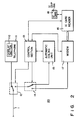
- Telephones 20 are connected to telephone lines 1a, 1b, ... 1n of exchange apparatus 10. Each of these telephones 20 has the structure shown in Fig. 2. As is shown in this figure, each telephone 20 comprises telephone unit 11, first changeover relay 12, control section 13, second changeover relay 14, automatic dialing unit 15, IC card reader 16, and modem 17.
- Telephone unit 11 is connected to telephone line 1 by first changeover relay 12, and is provided with display section 11a.
- Control section 13 is provided to control the other components of telephone 20, and stores a program for controlling the other components. Its main component is a general purpose CPU. More specifically, control section 13 gives changeover control signals to first and second changeover relays 12 and 14, and supplies control signals to automatic dialing unit 15, IC card reader 16, and modem 17. Second changeover relay 14 connects automatic dialing unit 15 or modem 17 to first changeover unit 12 in accordance with the control signal given by control section 13.
- Automatic dialing unit 15 is designed to the ID number-registering signal and the number of telephone 20 to exchange apparatus 10 through second changeover relay 14, first changeover relay 12 and telephone line 1. As has been described, the ID number-registering signal supplied from unit 15 sets exchange apparatus 10 into the ID number-registering mode.
- IC card reader 16 When IC card device 18 is inserted into IC card reader 16, IC card reader 16 reads the personal ID number stored in a semiconductor IC chip 18A contained in the IC card device 18.
- IC card device 18 is a plastic card containing a semiconductor IC chip storing the personal ID number data and having connecting terminals on its surface. The IC chip stores the personal ID number.
- Modem 17 is provided for supplying the data read by IC card reader, to exchange apparatus 10 through second changeover relay 14, first changeover relay 12 and telephone line 1.
- exchange apparatus 10 is usually set in the ordinary operation mode, i.e., the exchange mode.
- memory 7 of exchange apparatus 10 stores personal ID numbers and telephone numbers in such a relationship as is schematically shown in the tables of Figs. 3 and 4. This is, personal ID number "1001" corresponds to telephone number "101"; personal ID number "1002” corresponds to telephone number "900"; personal ID number "1003” corresponds to telephone number "101”; and personal ID number "1004" corresponds to telephone number "899".
- control section 13 causes first changeover relay 12 to connect telephone unit 11 to telephone line 1.
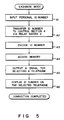
- the dial signals representing the personal ID number are supplied to exchange apparatus 10 through telephone line 1, (Steps A1 and A2 in the flow chart of Fig. 5).
- the dial signal (i.e., the personal ID number) are supplied to control section 4 via control bus 3.
- Control section 4 encodes the dial signals into an ID code (Step A3).
- This ID code is supplied to memory 7 via data bus 6, thereby accessing memory 7 (Step A4).
- a signal required for selecting the telephone whose number corresponds to the personal ID number (Step A5). If the personal ID number, which the user (or caller) has dialed, is "1001", the corresponding telephone number, "101”, is read out from memory 7.
- This telephone number is supplied to control section 4 through data bus 6.
- Control section 4 executes the procedure for connecting telephone line 1 to the called telephone whose number is "101".
- This telephoen-connecting procedure is supplied from control section 4 to relay matrix 2 via control bus 2.
- relay matrix 2 establishes connection between the calling telephone and the called telephone.
- the personal ID number, "1001” is displayed by display section 11a of the called telephone 20 (Step A6).
- This number "1001" being displayed can understand who is being called.
- exchange apparatus 10 when exchange apparatus 10 is set in the exchange mode, it suffices to dial a personal ID number on the nearest telephone 20, in order to have this telephone connected to the telephone 20 of the person assigned with the personal ID number.
- personal ID number "1001" is dialed, and the telephone is automatically connected to the telephone whose number is "101".
- personal ID number "1002" when personal ID number "1002" is dialed, telephone 20 of number "900" will be automatically connected.
- personal ID number "1003" When personal ID number "1003" is dialed, telephone 20 of number "101” will be connected.
- personal ID number "1004" When personal ID number "1004" is dialed, telephone 20 of number "899" will be connected.
- Exchange apparatus 10 can be set into the ID number-registering mode by anyone who is away from his or her desk and wishes to receive telephone calls in the room or place where he or she is at present.
- Step B1 IC card device 18 is inserted into IC card reader of the nearest telephone 20 (Step B1).
- Control section 13 causes first changeover relay 12 to connect itself to second changeover relay 14, and causes second changeover relay 14 to connect itself to automatic dialing unit 15 (Step B2).
- automatic dialing unit 15 is connected to telephone line 1.
- Unit 15 has received the personal ID number read from IC card device 18 by IC card reader 16. Therefore, automatic dialing unit 15 outputs the personal ID number and the number of telephone 20 (Step B3).
- the data output from unit 15 is supplied to exchange apparatus 10 through telephone line 1.
- an ID number-registering signal is supplied to control section 4 via dial signal line 5, whereby control section 4 is set into the ID number-registering mode (Step B4).
- control section 13 causes second changeover relay 14 to connect first changeover relay 12 or modem 17, after the ID number-registering signal has been supplied to control section 4 of exchange apparatus 10. Then, control section 13 gives IC card reader 16 a control signal, whereby IC card reader 16 reads the personal ID number from IC card device 18. The personal ID number, thus read from IC card device 18, is supplied to exchange apparatus 10 through modem 17 and telephone line 1, and is finally input to control section 4 via dial signal line 5.
- Control section 4 searches memory 7 for a personal ID number identical to the personal ID number read out from IC card device 18 (Step B5).
- this ID number is erased (Step B7).
- the personal ID number read from IC card device 18 is written into the memory area assigned to the telephone number already supplied from automatic dialing unit 15 (Step B8). In other words, the telephone number associated to the personal ID number of the owner of IC card device 18 is changed to the number of the nearest telephone 20. In short, the personal ID number is registered via the nearest telephone 20 in the memory 7 of exchanged apparatus 10.
- control section 13 put the other components of telephone 20 into idling condition, after all data has been transferred to exchange apparatus 10. Thereafter, first changeover relay 12 is operated under the control of section 13, thereby connecting telephone unit 11 to telephone line 1. Then, control section 13 goes into idling condition, too. Control section 13 remains in this condition until it receives the next operation command.
- this telephone can be connected to any other telephone on which the personal ID number has been dialed. For instance, if a person whose personal ID number is "1234" registers this personal ID number in the telephone the number of which is "001", anyone else can get in touch with this person by dialing number "1234". When this person moves to a place, he or she can register his or her personal ID number in the telephone set in that place by inserting the IC card device 18 into the IC card reader provided in this telephone. If the personal ID number is registered via the telephone, this telephone can be connected to any other telephone on which the personal ID number has been dialed.
- the telephone system described above it is possible for a person to register his or her ID number by inserting IC card 18 into IC card reader 16 of the nearest telephone whenever he or she moves from one place to another. He or she can readily and quickly be talked to through the telephone. Therefore, the telephone system can help to increase the work efficiency.
- additional memory area 7C is provided in memory 7 of exchange apparatus 10, and timer clock circuit 4a is provided in control section 4.
- a person registers his or her ID number into memory 7 via the telephone set in his or her room. The ID number is stored in memory area 7C. When this person moves to another room and registers the ID number via the telephone set in this room, this ID number is stored in a memory area other than area 7C. Hence, the personal ID number remains unerased in memory area 7C, and the person need not register the personal ID number again via the telephone set in his or her room, upon returning to his or her room.
- the personal ID number stored in the memory area other than area 7C is automatically erased when timer circuit 4a detects that it is twelve midnight, and a new day starts. Thereafter, any telephone calling this person is connected to the telephone set in his or her room to the telephone set in the other room.
- exchange apparatus 10 can be of a dial-in type, and telephones 20 can be replaced by those having a push-button key pad.
- the IC card can be replaced by a magnetic card or a laser card.
- a laser card is a plastic card containing an optically recording medium.
- control section 4 of exchange apparatus 10 may be designed to distinguish telephone numbers from personal ID numbers, so that a calling telephone can be connected to the telephone whose number has been dialed on the calling telephone.
- a plurality of memory areas may be provided in memory 7 for the same personal ID number, so that a calling telephone can be connected to the telephones through which the ID number has been registered, one after another.
- each telephone must be provided with means for generating a signal representing the called person is absent.
- the telephone system can connect a telephone to another in accordance with the personal ID number assigned to a person, thus enabling a caller to quickly get in touch with the person identified by the ID number.
- the telephone system can therefore serve to increase the work efficiency in offices.
Landscapes
- Engineering & Computer Science (AREA)
- Signal Processing (AREA)
- Computer Security & Cryptography (AREA)
- Physics & Mathematics (AREA)
- Astronomy & Astrophysics (AREA)
- General Physics & Mathematics (AREA)
- Computer Networks & Wireless Communication (AREA)
- Microelectronics & Electronic Packaging (AREA)
- Sub-Exchange Stations And Push- Button Telephones (AREA)
- Telephonic Communication Services (AREA)
Claims (4)
- Système téléphonique comprenant :
une pluralité de téléphones (20) dont chacun se voit assigner un numéro de téléphone et est muni d'un moyen d'entrée (16, 18) pour entrer un numéro d'identification (ID) personnel d'une personne qui veut utiliser le téléphone (20), et un moyen de commutation (10) connecté à ladite pluralité de téléphones (20), ledit moyen de commutation (10) incluant :
un moyen de table de référence (7) pour stocker des données qui concernent le numéro de téléphone et le numéro ID personnel ; et
un moyen de connexion (2) pour connecter un téléphone appelant à un téléphone appelé en relation avec les données stockées dans ledit moyen de table de référence (7) sur la base du numéro ID personnel ;
caractérisé en ce que ledit moyen de commutation (10) inclut en outre :
un moyen de sélection de mode (4) pour sélectionner soit un mode commutation soit un mode enregistrement,
ledit moyen de connexion (2) connectant un téléphone appelant un téléphone appelé en relation avec les données stockées dans ledit moyen de table de référence (7) sur la base du numéro ID personnel entré depuis le téléphone appelant lorsque ledit moyen de sélection de mode (4) sélectionne le mode commutation ;
un moyen d'écriture (4) pour écrire des données de modification concernant le numéro de téléphone avec le numéro ID personnel dans ledit moyen de table de référence (7) sur la base du numéro ID personnel et du numéro de téléphone entré depuis ledit moyen d'entrée (16, 18) prévu dans ledit téléphone (20) lorsque ledit moyen de sélection de mode (4) sélectionne le mode enregistrement ;
un moyen de détection de temps (4a) pour compter le temps et pour détecter si oui ou non un temps de comptage est égal à un temps prédéterminé ; et
un moyen d'effacement (4) pour effacer les données de modification écrites dans ledit moyen de table de référence (7) au moyen dudit moyen d'écriture (4) lorsque ledit moyen de détection de temps (4a) détecte qu'un temps prédéterminé a été compté. - Système téléphonique selon la revendication 1, caractérisé en ce que ledit moyen de table de référence inclut :
un premier moyen de mémoire (Ta, Tb) pour stocker des données fixes qui concernent le numéro de téléphone avec le numéro ID personnel ; et
un second moyen de mémoire (Tc) pour stocker des données de modification écrites par ledit moyen d'écriture (4) ;
ledit moyen d'écriture (4) écrit les données de modification dans ledit second moyen de mémoire (Tc) ; et
ledit moyen d'effacement (4) efface les données de modification stockées dans ledit second moyen de mémoire. - Système téléphonique selon la revendication 1, caractérisé en ce que ledit moyen d'entrée inclut un moyen de carte mémoire (18) qui peut être séparé dudit téléphone et qui stocke le numéro ID personnel ; et
un moyen de lecture de carte mémoire (16) à l'intérieur duquel est inséré ledit moyen de carte mémoire pour lire le numéro ID personnel stocké dans ledit moyen de carte mémoire. - Système téléphonique selon la revendication 3, caractérisé en ce que ledit téléphone inclut :
un moyen d'appréciation (13) pour apprécier si oui ou non ledit moyen de carte mémoire est inséré dans ledit moyen de lecture de carte mémoire (16) ;
un moyen de désignation de mode (13) pour désigner le mode enregistrement pour ledit moyen de sélection de mode lorsque ledit moyen d'appréciation apprécie que ledit moyen de carte mémoire est inséré dans ledit moyen de lecture de carte mémoire d'où il résulte que ledit moyen de sélection de mode sélectionne le mode enregistrement ;
un moyen de génération de numéro de téléphone (15) pour générer le numéro de téléphone assigné audit téléphone et pour émettre en sortie le numéro de téléphone pour ledit moyen d'écriture (4) ; et
ledit moyen d'écriture (4) écrit les données de modification dans ledit moyen de table de référence en relation avec le numéro téléphone émis en sortie depuis le moyen de génération de numéro de téléphone (15) et avec le numéro ID personnel extrait dudit moyen de carte mémoire.
Applications Claiming Priority (2)
| Application Number | Priority Date | Filing Date | Title |
|---|---|---|---|
| JP156358/86 | 1986-10-13 | ||
| JP15635886 | 1986-10-13 |
Publications (3)
| Publication Number | Publication Date |
|---|---|
| EP0264092A2 EP0264092A2 (fr) | 1988-04-20 |
| EP0264092A3 EP0264092A3 (en) | 1988-10-26 |
| EP0264092B1 true EP0264092B1 (fr) | 1993-06-16 |
Family
ID=15626012
Family Applications (1)
| Application Number | Title | Priority Date | Filing Date |
|---|---|---|---|
| EP87114846A Expired - Lifetime EP0264092B1 (fr) | 1986-10-13 | 1987-10-12 | Système téléphonique |
Country Status (3)
| Country | Link |
|---|---|
| US (1) | US4852156A (fr) |
| EP (1) | EP0264092B1 (fr) |
| DE (1) | DE3786222T2 (fr) |
Families Citing this family (25)
| Publication number | Priority date | Publication date | Assignee | Title |
|---|---|---|---|---|
| GB2198910B (en) * | 1986-12-17 | 1990-09-05 | Stanley Electric Co Ltd | Telephone exchange system |
| DE3900364A1 (de) * | 1989-01-09 | 1989-07-20 | Blum Burkhardt Ursula | Realisierung von buero- und auskunftssystemen unter verwendung digitaler telefonanlagen |
| JP2770430B2 (ja) * | 1989-06-23 | 1998-07-02 | 株式会社日立製作所 | 加入者状態管理機能付き交換システム |
| CA2042051A1 (fr) * | 1989-09-14 | 1991-03-15 | Tadamitsu Ryu | Systeme de controle de reseau |
| JPH03270453A (ja) * | 1990-03-20 | 1991-12-02 | Fujitsu Ltd | 自動追い掛け電話装置 |
| US5243645A (en) * | 1990-11-01 | 1993-09-07 | At&T Bell Laboratories | Automatic system for forwarding of calls |
| JP2994090B2 (ja) * | 1991-07-10 | 1999-12-27 | 株式会社東芝 | パーソナル通信システム |
| US5179588A (en) * | 1991-07-30 | 1993-01-12 | Gai-Tronics | Improved page party system |
| CA2076434C (fr) * | 1991-10-09 | 1996-07-02 | Gary Joe Grimes | Methode de transfert de communications utilisant un indicateur de localisation d'appele |
| DE4140974A1 (de) * | 1991-12-12 | 1993-06-17 | Sel Alcatel Ag | Kommunikationssystem |
| CA2125780C (fr) * | 1991-12-30 | 2004-07-06 | Deepak R. Parikh | Polymerisations d'interpolymeres d'ethylene |
| GB2263843A (en) * | 1992-01-10 | 1993-08-04 | Frederic Emmanuel Lamond | Portable personal telephone number |
| JPH06291849A (ja) * | 1993-04-02 | 1994-10-18 | N T T Idou Tsuushinmou Kk | 通信システムの発番号伝達方法 |
| CA2107982C (fr) * | 1992-10-16 | 1999-03-30 | Akihisa Nakajima | Centre de commutation pour reseau de communications personnelles |
| ATA65993A (de) * | 1993-04-01 | 1996-04-15 | Schnallinger Helfried Ing | Telefonanlage |
| CA2100699C (fr) * | 1993-07-16 | 1997-07-08 | Mitel Corporation | Methode de transmission de profils d'utilisateurs de telephones portatifs au moyen d'un ordinateur central |
| CA2108225C (fr) * | 1993-10-12 | 1997-07-22 | Rolf G. Meier | Chargeur-detecteur pour telephones sans fil |
| FI935142A7 (fi) * | 1993-11-19 | 1995-05-20 | Nokia Telecommunications Oy | Menetelmä tilaajan identifioimiseksi kiinteässä verkossa |
| DE4420462A1 (de) * | 1994-06-13 | 1995-12-14 | Sel Alcatel Ag | Verfahren zur Auswahl eines von mindestens zwei Fernmeldeendgeräten und Fernmeldeendgerät dafür |
| NL9401344A (nl) * | 1994-08-19 | 1996-04-01 | Nederland Ptt | Werkwijze voor het deregistreren van een bij een terminal via registratiegegevens geregistreerde gebruiker, alsmede telecommunicatiesysteem. |
| US5673308A (en) * | 1994-10-12 | 1997-09-30 | Bell Atlantic Network Services, Inc. | Personal phone number system |
| US5745850A (en) * | 1994-10-24 | 1998-04-28 | Lucent Technologies, Inc. | Apparatus and method for mobile (e.g. cellular or wireless) telephone call handover and impersonation |
| US5724417A (en) * | 1995-09-11 | 1998-03-03 | Lucent Technologies Inc. | Call forwarding techniques using smart cards |
| JPH1051855A (ja) * | 1996-07-31 | 1998-02-20 | Sony Corp | 通信方法及び通信装置 |
| US7451921B2 (en) * | 2004-09-01 | 2008-11-18 | Eric Morgan Dowling | Methods, smart cards, and systems for providing portable computer, VoIP, and application services |
Family Cites Families (5)
| Publication number | Priority date | Publication date | Assignee | Title |
|---|---|---|---|---|
| US3932709A (en) * | 1973-04-16 | 1976-01-13 | General Teletronics Incorporated | Electronic business telephone |
| US3920926A (en) * | 1973-12-07 | 1975-11-18 | Northern Electric Co | Telephone data set including visual display means |
| US4313035A (en) * | 1980-01-18 | 1982-01-26 | Bell Telephone Laboratories, Incorporated | Method of providing person locator service |
| DE3047883A1 (de) * | 1980-12-18 | 1982-07-15 | Siemens AG, 1000 Berlin und 8000 München | "schaltungsanordnung fuer eine fernsprechanlage, insbesondere fernsprechnebenstellenanlage mit speicherschaltmitteln fuer anruftermine" |
| JPS60103834A (ja) * | 1983-11-11 | 1985-06-08 | Nippo Tsushin Kogyo Kk | 個人呼出通信システム |
-
1987
- 1987-10-09 US US07/107,383 patent/US4852156A/en not_active Expired - Lifetime
- 1987-10-12 DE DE87114846T patent/DE3786222T2/de not_active Expired - Fee Related
- 1987-10-12 EP EP87114846A patent/EP0264092B1/fr not_active Expired - Lifetime
Also Published As
| Publication number | Publication date |
|---|---|
| EP0264092A2 (fr) | 1988-04-20 |
| EP0264092A3 (en) | 1988-10-26 |
| US4852156A (en) | 1989-07-25 |
| DE3786222D1 (de) | 1993-07-22 |
| DE3786222T2 (de) | 1994-02-03 |
Similar Documents
| Publication | Publication Date | Title |
|---|---|---|
| EP0264092B1 (fr) | Système téléphonique | |
| US5153906A (en) | Personal-servicing communication system | |
| US4759056A (en) | Personal-servicing communication system | |
| US5469501A (en) | Communication exchange apparatus with switching of communication terminal information | |
| US4860342A (en) | Computer-telephone interface method and apparatus | |
| US4975896A (en) | Communications network and method | |
| CA1268568A (fr) | Reseau et methode de communication a fonctions de transmission d'informations relatives aux rendez- vous | |
| WO2000045586A1 (fr) | Carte d'affaires a utiliser comme carte telephonique | |
| SE470149B (sv) | Anordning för åtkomst av tjänster via telefonapparat | |
| US5557665A (en) | Telephone system | |
| WO1994000947A1 (fr) | Telephone public a encaissement/carte d'appel et son procede de commande | |
| JP2572584B2 (ja) | カ−ド通信端末装置 | |
| JPH09252348A (ja) | 情報処理システム | |
| KR100342738B1 (ko) | 키폰전화기의데이타자동변경장치 | |
| JP2638907B2 (ja) | カード式電話機 | |
| JPH01132296A (ja) | 暗証コード式ボタン電話装置 | |
| KR970011433B1 (ko) | 전자전화번호부 검색 공중전화기의 제어장치 및 방법 | |
| JP3137699B2 (ja) | 電話着信システム | |
| JPH0640653B2 (ja) | ボタン電話装置 | |
| JPH04255145A (ja) | Idカード式ボタン電話装置 | |
| JP2583073B2 (ja) | 構内電話交換システム | |
| JPH07273878A (ja) | 電子交換機システム | |
| JPH0461457A (ja) | ディーリング通話システム | |
| JPH06225350A (ja) | 交換機システム | |
| JPH02135958A (ja) | 発呼者情報表示方式 |
Legal Events
| Date | Code | Title | Description |
|---|---|---|---|
| PUAI | Public reference made under article 153(3) epc to a published international application that has entered the european phase |
Free format text: ORIGINAL CODE: 0009012 |
|
| AK | Designated contracting states |
Kind code of ref document: A2 Designated state(s): DE FR GB |
|
| PUAL | Search report despatched |
Free format text: ORIGINAL CODE: 0009013 |
|
| AK | Designated contracting states |
Kind code of ref document: A3 Designated state(s): DE FR GB |
|
| 17P | Request for examination filed |
Effective date: 19890410 |
|
| 17Q | First examination report despatched |
Effective date: 19910618 |
|
| GRAA | (expected) grant |
Free format text: ORIGINAL CODE: 0009210 |
|
| AK | Designated contracting states |
Kind code of ref document: B1 Designated state(s): DE FR GB |
|
| REF | Corresponds to: |
Ref document number: 3786222 Country of ref document: DE Date of ref document: 19930722 |
|
| ET | Fr: translation filed | ||
| PLBE | No opposition filed within time limit |
Free format text: ORIGINAL CODE: 0009261 |
|
| STAA | Information on the status of an ep patent application or granted ep patent |
Free format text: STATUS: NO OPPOSITION FILED WITHIN TIME LIMIT |
|
| 26N | No opposition filed | ||
| PGFP | Annual fee paid to national office [announced via postgrant information from national office to epo] |
Ref country code: GB Payment date: 20011010 Year of fee payment: 15 Ref country code: FR Payment date: 20011010 Year of fee payment: 15 |
|
| PGFP | Annual fee paid to national office [announced via postgrant information from national office to epo] |
Ref country code: DE Payment date: 20011029 Year of fee payment: 15 |
|
| REG | Reference to a national code |
Ref country code: GB Ref legal event code: IF02 |
|
| PG25 | Lapsed in a contracting state [announced via postgrant information from national office to epo] |
Ref country code: GB Free format text: LAPSE BECAUSE OF NON-PAYMENT OF DUE FEES Effective date: 20021012 |
|
| PG25 | Lapsed in a contracting state [announced via postgrant information from national office to epo] |
Ref country code: DE Free format text: LAPSE BECAUSE OF NON-PAYMENT OF DUE FEES Effective date: 20030501 |
|
| GBPC | Gb: european patent ceased through non-payment of renewal fee |
Effective date: 20021012 |
|
| PG25 | Lapsed in a contracting state [announced via postgrant information from national office to epo] |
Ref country code: FR Free format text: LAPSE BECAUSE OF NON-PAYMENT OF DUE FEES Effective date: 20030630 |
|
| REG | Reference to a national code |
Ref country code: FR Ref legal event code: ST |