EP0264240A2 - Piezoelektrisches oder pyroelektrisches Vinylidencyanid-Copolymer - Google Patents
Piezoelektrisches oder pyroelektrisches Vinylidencyanid-Copolymer Download PDFInfo
- Publication number
- EP0264240A2 EP0264240A2 EP87308975A EP87308975A EP0264240A2 EP 0264240 A2 EP0264240 A2 EP 0264240A2 EP 87308975 A EP87308975 A EP 87308975A EP 87308975 A EP87308975 A EP 87308975A EP 0264240 A2 EP0264240 A2 EP 0264240A2
- Authority
- EP
- European Patent Office
- Prior art keywords
- copolymer
- group
- vinylidene cyanide
- hydrocarbon group
- saturated hydrocarbon
- Prior art date
- Legal status (The legal status is an assumption and is not a legal conclusion. Google has not performed a legal analysis and makes no representation as to the accuracy of the status listed.)
- Granted
Links
Images


Classifications
-
- C—CHEMISTRY; METALLURGY
- C08—ORGANIC MACROMOLECULAR COMPOUNDS; THEIR PREPARATION OR CHEMICAL WORKING-UP; COMPOSITIONS BASED THEREON
- C08F—MACROMOLECULAR COMPOUNDS OBTAINED BY REACTIONS ONLY INVOLVING CARBON-TO-CARBON UNSATURATED BONDS
- C08F222/00—Copolymers of compounds having one or more unsaturated aliphatic radicals, each having only one carbon-to-carbon double bond, and at least one being terminated by a carboxyl radical and containing at least one other carboxyl radical in the molecule; Salts, anhydrides, esters, amides, imides, or nitriles thereof
- C08F222/30—Nitriles
- C08F222/34—Vinylidene cyanide
-
- H—ELECTRICITY
- H01—ELECTRIC ELEMENTS
- H01G—CAPACITORS; CAPACITORS, RECTIFIERS, DETECTORS, SWITCHING DEVICES, LIGHT-SENSITIVE OR TEMPERATURE-SENSITIVE DEVICES OF THE ELECTROLYTIC TYPE
- H01G7/00—Capacitors in which the capacitance is varied by non-mechanical means; Processes of their manufacture
- H01G7/02—Electrets, i.e. having a permanently-polarised dielectric
- H01G7/021—Electrets, i.e. having a permanently-polarised dielectric having an organic dielectric
- H01G7/023—Electrets, i.e. having a permanently-polarised dielectric having an organic dielectric of macromolecular compounds
-
- H—ELECTRICITY
- H10—SEMICONDUCTOR DEVICES; ELECTRIC SOLID-STATE DEVICES NOT OTHERWISE PROVIDED FOR
- H10N—ELECTRIC SOLID-STATE DEVICES NOT OTHERWISE PROVIDED FOR
- H10N15/00—Thermoelectric devices without a junction of dissimilar materials; Thermomagnetic devices, e.g. using the Nernst-Ettingshausen effect
- H10N15/10—Thermoelectric devices using thermal change of the dielectric constant, e.g. working above and below the Curie point
- H10N15/15—Thermoelectric active materials
-
- H—ELECTRICITY
- H10—SEMICONDUCTOR DEVICES; ELECTRIC SOLID-STATE DEVICES NOT OTHERWISE PROVIDED FOR
- H10N—ELECTRIC SOLID-STATE DEVICES NOT OTHERWISE PROVIDED FOR
- H10N30/00—Piezoelectric or electrostrictive devices
- H10N30/80—Constructional details
- H10N30/85—Piezoelectric or electrostrictive active materials
- H10N30/857—Macromolecular compositions
-
- Y—GENERAL TAGGING OF NEW TECHNOLOGICAL DEVELOPMENTS; GENERAL TAGGING OF CROSS-SECTIONAL TECHNOLOGIES SPANNING OVER SEVERAL SECTIONS OF THE IPC; TECHNICAL SUBJECTS COVERED BY FORMER USPC CROSS-REFERENCE ART COLLECTIONS [XRACs] AND DIGESTS
- Y10—TECHNICAL SUBJECTS COVERED BY FORMER USPC
- Y10T—TECHNICAL SUBJECTS COVERED BY FORMER US CLASSIFICATION
- Y10T428/00—Stock material or miscellaneous articles
- Y10T428/31504—Composite [nonstructural laminate]
- Y10T428/31551—Of polyamidoester [polyurethane, polyisocyanate, polycarbamate, etc.]
- Y10T428/31573—Next to addition polymer of ethylenically unsaturated monomer
- Y10T428/31583—Nitrile monomer type [polyacrylonitrile, etc.]
Definitions
- This invention relates to a copolymer comprising vinylidene cyanide and a vinyl compound, and more particularly to a copolymer comprising vinylidene cyanide and a vinyl compound which provides transparent molded articles having high dielectric constants.
- the copolymer according to the present invention has excellent transparency and provides an electret exhibiting excellent piezoelectricity and pyroelectricity upon polarization.
- the vinylidene cyanide copolymer of the present invention is a random copolymer or alternating copolymer obtained by copolymerizing a vinylidene cyanide monomer represented by formula (I) and a vinyl compound monomer represented by formula (II).
- the random copolymer comprises a repeating unit (B) derived from the vinyl compound and a repeating unit (A) derived from vinylidene cyanide at a (B)/(A) molar ratio of from 0.8 to 20, and preferably from 0.9 to 15.
- Both the random and alternating copolymers of the present invention are low crystalline resins having a glass transition point of from 100 to 250°C, and preferably from 140 to 200°C, and a molecular weight of from 200,000 to 1,500,000, and preferably from 500,000 to 1,000,000.
- Preferred examples of those having a branched hydrocarbon group are groups having a secondary hydrocarbon group or a tertiary hydrocarbon group, e.g., (CH3)3CCOO- and (C2H5)3CCOO-.
- R represents CH3COO- or a group having a benzene ring.
- Preferred examples of the group having a benzene ring include a phenyl group and a naphthyl group.
- the saturated hydrocarbon group as represented by Z may be either a straight chain group or a branched chain group having a secondary or tertiary carbon atom. Examples of the hydrocarbon groups are a methyl group and an ethyl group.
- the copolymer according to the present invention can be prepared by, for example, polymerizing vinylidene cyanide and the vinyl compound of formula (II) in the presence of a radical initiator with or without a solvent.
- the copolymerization may also be carried out by slurry polymerization or in an ampule.
- the vinyl compound is usually used in an amount of from 0.8 to 20 mols per mol of vinylidene cyanide, and preferably from 1 to 8 mols when obtaining an alternating copolymer and from 8 to 20 mols when obtaining a random copolymer.
- the solvent if used, includes an aprotic solvent, such as benzene, toluene or xylene, an aliphatic hydrocarbon, such as pentane, hexane or heptane, and mixtures thereof.
- an aprotic solvent such as benzene, toluene or xylene
- an aliphatic hydrocarbon such as pentane, hexane or heptane, and mixtures thereof.
- the polymerization temperature ranges from 0 to 150°C, and preferably from 50 to 80°C, in the case of slurry polymerization.
- the polymerization temperature when effected in an ampoule is not particularly restricted and usually ranges from 0 to 100°C.
- radical initiator can be used as a polymerization catalyst.
- useful radical initiators include oxygen; dialkyl peroxides or the derivatives thereof, e.g., di-t-butyl peroxide, t-butylcumyl peroxide, dicumyl peroxide; diacyl peroxides, e.g., diacetyl peroxide, dioctanyl peroxide; peroxydicarbonates, e.g., diisopropyl peroxydicarbonate, di-2-ethylhexyl peroxydicarbonate; peroxy esters, e.g., t-butyl peroxyisobutyrate, t-butyl peroxypivalate, t-butyl peroxylaurate; ketone peroxides, e.g., methyl ethyl ketone peroxide, cyclohexanone peroxide; peroxy ketals, e.g.,
- the copolymer according to the present invention contains a cyano group and an ester group having large polarity. It can be molded by commonly employed molding methods, such as a cast molding, press molding, and injection molding. The resulting molded articles have high dielectric constants and are useful as an insulating layer for condensers, electroluminescence elements, etc. Again, molded articles having been subjected to polarization are applicable as high performance materials, such as piezoelectric or pyroelectric materials.
- the molded articles obtained from the copolymer of the present invention have excellent transparency, they are also suitable for use as optical materials, such as optical fibers and lenses, as well as optical elements taking advantage of their high dielectric constant.
- the resulting product was confirmed to be a 1:1 alternating copolymer by 1H-NMR analysis, 13C-NMR analysis, IR spectroscopic analysis, and elementary analysis.
- the IR spectrum is shown in Fig. 1.
- Main physical properties of the copolymer (powder) were as shown below.
- the powder was dissolved in dimethylacetamide (DMA), and the solution was cast to form a film.
- the dielectric constant of the resulting film was measured at room temperature (25°C), and the results obtained are shown in Table 1 below.
- Example 2 In the same flask as used in Example 1 were charged 6 g (0.08 mol) of vinylidene cyanide synthesized in a usual manner, 50 g (0.4 mol) of vinyl pivalate (produced by Wako Pure Chemical Industries Ltd.), 12 ml of heptane, and 6 mg of lauroyl peroxide, and the mixture was heated at 70°C for 4 hours under stirring in an argon gas stream.
- the dielectric constant (25°C) of a cast film prepared from the copolymer in the same manner as in Example 1 is shown in Table 2.
- Example 2 In the same flask as used in Example 1 were charged 10 g (0.13 mol) of vinylidene cyanide synthesized in a usual manner, 68 g (0.64 mol) of isopropenyl acetate (produced by Wako Pure Chemical Industries Ltd.), 20 ml of toluene, and several grains (several tens milligrams) of diisopropyl peroxydicarbonate, and the mixture was heated at 70°C for 1 hours while stirring in an argon gas stream.
- 10 g (0.13 mol) of vinylidene cyanide synthesized in a usual manner 68 g (0.64 mol) of isopropenyl acetate (produced by Wako Pure Chemical Industries Ltd.), 20 ml of toluene, and several grains (several tens milligrams) of diisopropyl peroxydicarbonate.
- the resulting viscous reaction mixture was poured into toluene, and the precipitated polymer was collected by filtration, washed successively with toluene and ethanol, and dried at 80°C under reduced pressure overnight to obtain 12 g (53%) of a polymer product.
- the product was confirmed to be a 1:1 alternating copolymer by 1H-NMR analysis, 13C-NMR analysis, IR spectroscopic analysis, and elementary analysis.
- the IR spectrum is shown in Fig. 2.
- the main physical properties of the copolymer (powder) were as follows. Tg: 112°C [ ⁇ ]: 0.5 VDCN Content: 50 mol%
- the dielectric constant (25°C) of a cast film obtained from the copolymer in the same manner as in Example 1 is shown in Table 4.
- Example 2 In the same flask as used in Example 1 were charged 20 g (0.26 mol) of vinylidene cyanide synthesized in a usual manner, 30 g (0.26 mol) of ⁇ -methylstyrene (produced by Wako Pure Chemical Industries Ltd.), 50 ml of toluene, and 20 mg of lauroyl peroxide, and the mixture was stirred at room temperature in an argon gas stream. At the time when heat generation subsided, the mixture was heated at 70°C for 1.5 hours with stirring. The precipitated polymer was collected by filtration, dissolved in acetone, and reprecipitated in toluene.
- ⁇ -methylstyrene produced by Wako Pure Chemical Industries Ltd.
- the dielectric constant (25°C) of a cast film obtained from the copolymer in the same manner as in Example 1 is shown in Table 5 below.
- Example 2 In the same flask as used in Example 1 were charged 5 g (0.06 mol) of vinylidene cyanide synthesized in a usual manner, 40 g (0.35 mol) of vinyl butyrate (produced by Tokyo Kasei K.K.), and 5 mg of lauroyl peroxide, and the mixture was heated at 70°C for 2 hours while stirring in an argon gas stream. The precipitated polymer was collected by filtration, washed successively with toluene and ethanol, and dried at 80°C under reduced pressure overnight to obtain 10.5 g (85%) of a polymer product.
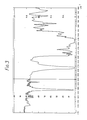
- the product was confirmed to be a 1:1 alternating copolymer by 1H-NMR analysis, 13C-NMR analysis, IR spectroscopic analysis, and elementary analysis.
- the IR spectrum is shown in Fig. 3.
- the main physical properties of the copolymer (powder) were as follows. Tg: 192°C [ ⁇ ]: 6.3 VDCN Content: 50 mol%
- the dielectric constant (25°C) of a cast film obtained from the copolymer in the same manner as in Example 1 was as shown in Table 6 below.
- the cast film was uniaxially stretched about 3 times in a silicone oil bath maintained at 190°C and then subjected to polarization.
- the resulting stretched film was determined for piezoelectric constants d31 and K t . The results obtained are shown in Table 8.
- Example 2 In the same flask as used in Example 1 were charged 5 g (0.06 mol) of vinylidene cyanide synthesized in a usual manner, 50 g (0.35 mol) of vinyl hexanoate (produced by Tokyo Kasei K.K.), and 5 mg of lauroyl peroxide, and the mixture was heated at 70°C for 3 hours with stirring in an argon gas stream. The precipitated polymer was collected by filtration, washed successively with toluene and ethanol, and dried at 80°C under reduced pressure overnight to obtain 9.6 g (68%) of a polymer product.
- the product was confirmed to be a 1:1 alternating copolymer by 1H-NMR analysis, 13C-NMR analysis, IR spectroscopic analysis, and elementary analysis.
- the main physical properties of the copolymer (powder) were as follows. Tg: 214°C [ ⁇ ]: 2.5 VDCN Content: 51 mol%
- the dielectric constant (25°C) of a cast film obtained from the copolymer in the same manner as in Example 1 was as shown in Table 9 below.
Landscapes
- Physics & Mathematics (AREA)
- Spectroscopy & Molecular Physics (AREA)
- Engineering & Computer Science (AREA)
- Power Engineering (AREA)
- Chemical & Material Sciences (AREA)
- Health & Medical Sciences (AREA)
- Toxicology (AREA)
- Microelectronics & Electronic Packaging (AREA)
- Chemical Kinetics & Catalysis (AREA)
- Medicinal Chemistry (AREA)
- Polymers & Plastics (AREA)
- Organic Chemistry (AREA)
- Addition Polymer Or Copolymer, Post-Treatments, Or Chemical Modifications (AREA)
Applications Claiming Priority (4)
| Application Number | Priority Date | Filing Date | Title |
|---|---|---|---|
| JP240762/86 | 1986-10-09 | ||
| JP24076286 | 1986-10-09 | ||
| JP2567987 | 1987-02-06 | ||
| JP25679/87 | 1987-02-06 |
Publications (3)
| Publication Number | Publication Date |
|---|---|
| EP0264240A2 true EP0264240A2 (de) | 1988-04-20 |
| EP0264240A3 EP0264240A3 (en) | 1989-05-10 |
| EP0264240B1 EP0264240B1 (de) | 1992-03-11 |
Family
ID=26363337
Family Applications (1)
| Application Number | Title | Priority Date | Filing Date |
|---|---|---|---|
| EP87308975A Expired - Lifetime EP0264240B1 (de) | 1986-10-09 | 1987-10-09 | Piezoelektrisches oder pyroelektrisches Vinylidencyanid-Copolymer |
Country Status (3)
| Country | Link |
|---|---|
| US (1) | US4990584A (de) |
| EP (1) | EP0264240B1 (de) |
| DE (1) | DE3777320D1 (de) |
Cited By (3)
| Publication number | Priority date | Publication date | Assignee | Title |
|---|---|---|---|---|
| WO1991013922A1 (en) * | 1990-03-09 | 1991-09-19 | Hoechst Celanese Corporation | Vinylidene cyanide alternating copolymers |
| US5061760A (en) * | 1990-03-09 | 1991-10-29 | Hoechst Celanese Corporation | Vinylidene cyanide alternating copolymers exhibiting nonlinear optical and piezoelectric properties |
| EP0415342A3 (en) * | 1989-08-28 | 1991-12-04 | Mitsubishi Petrochemical Co., Ltd. | Vinylidene cyanide copolymer |
Families Citing this family (2)
| Publication number | Priority date | Publication date | Assignee | Title |
|---|---|---|---|---|
| US5210165A (en) * | 1991-06-21 | 1993-05-11 | Hoechst Celanese Corp. | Alkyl vinylidene cyanide polymers exhibiting nonlinear optical and piezoelectric properties |
| US6367132B2 (en) * | 1998-08-31 | 2002-04-09 | Eastman Kodak Company | Method of making a print head |
Family Cites Families (15)
| Publication number | Priority date | Publication date | Assignee | Title |
|---|---|---|---|---|
| CA505173A (en) * | 1954-08-17 | Gilbert Harry | Copolymers of vinylidene cyanide and isopropenyl esters | |
| CA505340A (en) * | 1954-08-24 | The B. F. Goodrich Company | Copolymers of vinylidene cyanide and vinyl esters | |
| US2615866A (en) * | 1949-09-13 | 1952-10-28 | Goodrich Co B F | Copolymers of vinylidene cyanide with vinyl esters |
| US2615875A (en) * | 1949-09-13 | 1952-10-28 | Goodrich Co B F | Copolymers of vinylidene cyanide and isopropenyl esters |
| US2615868A (en) * | 1949-09-13 | 1952-10-28 | Goodrich Co B F | Copolymers of vinylidene cyanide with styrene and substituted styrenes |
| US2615867A (en) * | 1949-09-13 | 1952-10-28 | Goodrich Co B F | Copolymers of vinylidene cyanide with vinyl esters of aromatic acids |
| US2615865A (en) * | 1949-09-13 | 1952-10-28 | Goodrich Co B F | Copolymers of vinylidene cyanide with monoolefins |
| US2716106A (en) * | 1952-01-26 | 1955-08-23 | Goodrich Co B F | Multicomponent polymers of vinylidene cyanide |
| US2716105A (en) * | 1952-01-26 | 1955-08-23 | Goodrich Co B F | Multicomponent interpolymers of vinylidene cyanide |
| NL88845C (de) * | 1952-01-26 | |||
| US2819253A (en) * | 1955-11-30 | 1958-01-07 | Goodrich Co B F | Method of enhancing the acetate dyeability of vinylidene cyanide interpolymers |
| US2975158A (en) * | 1956-12-20 | 1961-03-14 | Goodrich Co B F | High fluidity process for polymerizing vinylidene cyanide |
| BE610579A (de) * | 1960-11-25 | |||
| US3206420A (en) * | 1961-04-28 | 1965-09-14 | Celanese Corp | Blends of a vinylidene cyanide polymer and a polyalkylene glycol or derivative thereof |
| US3426005A (en) * | 1965-05-26 | 1969-02-04 | Exxon Research Engineering Co | Thermosetting resin compositions and a method of producing same |
-
1987
- 1987-10-09 DE DE8787308975T patent/DE3777320D1/de not_active Expired - Lifetime
- 1987-10-09 EP EP87308975A patent/EP0264240B1/de not_active Expired - Lifetime
-
1988
- 1988-11-16 US US07/275,628 patent/US4990584A/en not_active Expired - Lifetime
Cited By (3)
| Publication number | Priority date | Publication date | Assignee | Title |
|---|---|---|---|---|
| EP0415342A3 (en) * | 1989-08-28 | 1991-12-04 | Mitsubishi Petrochemical Co., Ltd. | Vinylidene cyanide copolymer |
| WO1991013922A1 (en) * | 1990-03-09 | 1991-09-19 | Hoechst Celanese Corporation | Vinylidene cyanide alternating copolymers |
| US5061760A (en) * | 1990-03-09 | 1991-10-29 | Hoechst Celanese Corporation | Vinylidene cyanide alternating copolymers exhibiting nonlinear optical and piezoelectric properties |
Also Published As
| Publication number | Publication date |
|---|---|
| DE3777320D1 (de) | 1992-04-16 |
| EP0264240A3 (en) | 1989-05-10 |
| US4990584A (en) | 1991-02-05 |
| EP0264240B1 (de) | 1992-03-11 |
Similar Documents
| Publication | Publication Date | Title |
|---|---|---|
| Conticello et al. | Ring-opening metathesis polymerization of substituted bicyclo [2.2. 2] octadienes: a new precursor route to poly (1, 4-phenylenevinylene) | |
| Palmgren et al. | Synthesis of degradable crosslinked polymers based on 1, 5‐dioxepan‐2‐one and crosslinker of bis‐ϵ‐caprolactone type | |
| Masuda et al. | Synthesis and characterization of poly [[o-(trifluoromethyl) phenyl] acetylene] | |
| US5061768A (en) | Vinylidene cyanide copolymer | |
| US3476722A (en) | Process for polymerizing acrylic acid esters | |
| IE54966B1 (en) | Process and polymers | |
| US4990584A (en) | Piezoelectric or pyroelectric material | |
| US3394116A (en) | Trifluoroethyoxyethyl vinyl ether and polymers thereof | |
| US3394115A (en) | Trifluoroethoxyethyl acrylate and polymers thereof | |
| Maślińska-Solich et al. | Optically active polymers—I. Copolymerization of β-pinene with maleic anhydride | |
| JPH0813862B2 (ja) | シアン化ビニリデン共重合体 | |
| US3240722A (en) | alpha-substituted para-xylylene polymers and method for the preparation thereof | |
| EP0520037A4 (en) | Vinylidene cyanide alternating copolymers | |
| US3751522A (en) | Graft copolymers and process for their preparation | |
| US3516973A (en) | Process for the polymerization of beta-lactones | |
| US3143533A (en) | Maleic anhydride copolymer | |
| JPH02124850A (ja) | 新規カリックス[n]アレーン誘導体とその製造方法、および、前記誘導体からなる高分子化合物 | |
| Zaremski et al. | TEMPO-mediated radical polymerization in the synthesis of poly (methyl methacrylate) macromonomer | |
| US3423378A (en) | Copolymers of perfluoromethacrylyl fluoride | |
| KR102705506B1 (ko) | 극성 작용기를 포함하는 광학 필름용 그라디언트 공중합체 및 이의 제조방법 | |
| US3165497A (en) | Acryloxyacetophenone copolymers | |
| JP4787418B2 (ja) | (メタ)アクリル酸オリゴスチレン・エステルと(メタ)アクリル酸メチルとの共重合体及びその製造方法 | |
| GB2184737A (en) | Manufacture of fluorinated copolymers | |
| Angelovici et al. | Copolymerization of acrylic esters with ethyl α‐cyanocinnamate | |
| Vijayanand et al. | Homopolymer and copolymers of 4‐cyanophenyl acrylate with glycidyl methacrylate: Synthesis, characterization, thermal properties, and determination of monomer reactivity ratios |
Legal Events
| Date | Code | Title | Description |
|---|---|---|---|
| PUAI | Public reference made under article 153(3) epc to a published international application that has entered the european phase |
Free format text: ORIGINAL CODE: 0009012 |
|
| AK | Designated contracting states |
Kind code of ref document: A2 Designated state(s): DE GB NL |
|
| PUAL | Search report despatched |
Free format text: ORIGINAL CODE: 0009013 |
|
| AK | Designated contracting states |
Kind code of ref document: A3 Designated state(s): DE GB NL |
|
| 17P | Request for examination filed |
Effective date: 19891109 |
|
| 17Q | First examination report despatched |
Effective date: 19910123 |
|
| RBV | Designated contracting states (corrected) |
Designated state(s): DE GB |
|
| GRAA | (expected) grant |
Free format text: ORIGINAL CODE: 0009210 |
|
| AK | Designated contracting states |
Kind code of ref document: B1 Designated state(s): DE GB |
|
| REF | Corresponds to: |
Ref document number: 3777320 Country of ref document: DE Date of ref document: 19920416 |
|
| PLBE | No opposition filed within time limit |
Free format text: ORIGINAL CODE: 0009261 |
|
| STAA | Information on the status of an ep patent application or granted ep patent |
Free format text: STATUS: NO OPPOSITION FILED WITHIN TIME LIMIT |
|
| 26N | No opposition filed | ||
| REG | Reference to a national code |
Ref country code: GB Ref legal event code: IF02 |
|
| PGFP | Annual fee paid to national office [announced via postgrant information from national office to epo] |
Ref country code: GB Payment date: 20031008 Year of fee payment: 17 |
|
| PGFP | Annual fee paid to national office [announced via postgrant information from national office to epo] |
Ref country code: DE Payment date: 20031016 Year of fee payment: 17 |
|
| PG25 | Lapsed in a contracting state [announced via postgrant information from national office to epo] |
Ref country code: GB Free format text: LAPSE BECAUSE OF NON-PAYMENT OF DUE FEES Effective date: 20041009 |
|
| PG25 | Lapsed in a contracting state [announced via postgrant information from national office to epo] |
Ref country code: DE Free format text: LAPSE BECAUSE OF NON-PAYMENT OF DUE FEES Effective date: 20050503 |
|
| GBPC | Gb: european patent ceased through non-payment of renewal fee |
Effective date: 20041009 |