EP0265063A2 - Conteneurs souples pour matières en vrac - Google Patents
Conteneurs souples pour matières en vrac Download PDFInfo
- Publication number
- EP0265063A2 EP0265063A2 EP87308000A EP87308000A EP0265063A2 EP 0265063 A2 EP0265063 A2 EP 0265063A2 EP 87308000 A EP87308000 A EP 87308000A EP 87308000 A EP87308000 A EP 87308000A EP 0265063 A2 EP0265063 A2 EP 0265063A2
- Authority
- EP
- European Patent Office
- Prior art keywords
- wall
- fabric
- lifting
- flexible bulk
- bulk container
- Prior art date
- Legal status (The legal status is an assumption and is not a legal conclusion. Google has not performed a legal analysis and makes no representation as to the accuracy of the status listed.)
- Withdrawn
Links
- 230000006872 improvement Effects 0.000 title description 2
- 239000004744 fabric Substances 0.000 claims description 57
- 230000003014 reinforcing effect Effects 0.000 claims description 49
- 239000002759 woven fabric Substances 0.000 claims description 25
- 239000000463 material Substances 0.000 claims description 14
- 238000004519 manufacturing process Methods 0.000 claims description 7
- 238000005520 cutting process Methods 0.000 claims description 3
- 238000000034 method Methods 0.000 claims description 2
- 238000009826 distribution Methods 0.000 description 7
- 239000004743 Polypropylene Substances 0.000 description 6
- -1 polypropylene Polymers 0.000 description 6
- 229920001155 polypropylene Polymers 0.000 description 6
- 238000010276 construction Methods 0.000 description 5
- 238000005299 abrasion Methods 0.000 description 2
- 230000015572 biosynthetic process Effects 0.000 description 2
- 238000009941 weaving Methods 0.000 description 2
- 239000004952 Polyamide Substances 0.000 description 1
- 230000009471 action Effects 0.000 description 1
- 238000009411 base construction Methods 0.000 description 1
- 206010061592 cardiac fibrillation Diseases 0.000 description 1
- 238000006073 displacement reaction Methods 0.000 description 1
- 230000000694 effects Effects 0.000 description 1
- 239000000835 fiber Substances 0.000 description 1
- 230000002600 fibrillogenic effect Effects 0.000 description 1
- 239000007788 liquid Substances 0.000 description 1
- 230000014759 maintenance of location Effects 0.000 description 1
- 230000007246 mechanism Effects 0.000 description 1
- 230000004048 modification Effects 0.000 description 1
- 238000012986 modification Methods 0.000 description 1
- 229920002647 polyamide Polymers 0.000 description 1
- 229920000728 polyester Polymers 0.000 description 1
- 229920000098 polyolefin Polymers 0.000 description 1
- 239000000843 powder Substances 0.000 description 1
- 230000002787 reinforcement Effects 0.000 description 1
- 238000003860 storage Methods 0.000 description 1
- 229920002994 synthetic fiber Polymers 0.000 description 1
- 229920001059 synthetic polymer Polymers 0.000 description 1
- XLYOFNOQVPJJNP-UHFFFAOYSA-N water Substances O XLYOFNOQVPJJNP-UHFFFAOYSA-N 0.000 description 1
Images
Classifications
-
- B—PERFORMING OPERATIONS; TRANSPORTING
- B65—CONVEYING; PACKING; STORING; HANDLING THIN OR FILAMENTARY MATERIAL
- B65D—CONTAINERS FOR STORAGE OR TRANSPORT OF ARTICLES OR MATERIALS, e.g. BAGS, BARRELS, BOTTLES, BOXES, CANS, CARTONS, CRATES, DRUMS, JARS, TANKS, HOPPERS, FORWARDING CONTAINERS; ACCESSORIES, CLOSURES, OR FITTINGS THEREFOR; PACKAGING ELEMENTS; PACKAGES
- B65D88/00—Large containers
- B65D88/16—Large containers flexible
- B65D88/1612—Flexible intermediate bulk containers [FIBC]
- B65D88/1618—Flexible intermediate bulk containers [FIBC] double-walled or with linings
-
- B—PERFORMING OPERATIONS; TRANSPORTING
- B65—CONVEYING; PACKING; STORING; HANDLING THIN OR FILAMENTARY MATERIAL
- B65D—CONTAINERS FOR STORAGE OR TRANSPORT OF ARTICLES OR MATERIALS, e.g. BAGS, BARRELS, BOTTLES, BOXES, CANS, CARTONS, CRATES, DRUMS, JARS, TANKS, HOPPERS, FORWARDING CONTAINERS; ACCESSORIES, CLOSURES, OR FITTINGS THEREFOR; PACKAGING ELEMENTS; PACKAGES
- B65D88/00—Large containers
- B65D88/16—Large containers flexible
- B65D88/1612—Flexible intermediate bulk containers [FIBC]
- B65D88/1675—Lifting fittings
- B65D88/1681—Flexible, e.g. loops, or reinforcements therefor
Definitions
- This invention relates to flexible bulk containers such are used in the storage and transport of materials in granular, powder and other particulate forms, and to a method of making such containers.
- Such containers are generally in the form of large bags or sacks which are often required to carry loads of up to one tonne or more with considerable safety margin above their rated working load.
- the containers are commonly made from woven fabric, particularly woven polypropylene or other suitable synthetic material.
- the side wall structure may be made up from panels of woven fabric, may be formed from a single length of woven fabric stitched to form a tube, or may be formed from tubular woven fabric so as to give a seamless side wall structure.
- Many different base constructions are known, ranging from a simple base sewn into the opening at the lower end of the side wall structure, to bases formed by cutting, folding and/or stitching extensions of the fabric present in the side wall structure.
- Such bases may be formed to have closeable and openable discharge arrangements.
- the lifting means may be in the form of bands which form extensions of the side wall structure, or they may be separate lifting loops, for example loops of high strength webbing, which are stitched to the side wall structure, desirably so that there is reinforcement in the area where stitching occurs.
- a flexible bulk container comprises a side wall structure having an outer wall and an inner wall lying within and closely adjacent to the outer wall, a base closing a lower open end of the side wall structure, and a plurality of lifting loops at the upper end of the side wall structure, each lifting loop having a first end that is connected to or integral with the outer wall and a second end that is connected to or integral with the inner wall.
- the invention thus provides what can be looked upon as being a double-walled container closed by a base structure common to the two walls.
- Each lifting loop is connected to or integral with the fabric of both walls, so that lifting stresses are transmitted into both walls.
- Both walls will generally be of woven fabric, and distribution of lifting stress thus occurs over a much greater width of fabric than in previous single-walled container constructions, so leading to containers capable of higher working load and reliability or, alternatively, for a given rated load, allowing weaker fabric to be used for the side wall structure than was the case in previous containers.
- the double-walled construction provides other advantages.
- the container gives significantly greater protection to the contents, both against intrusion of water or other liquid into the container and against puncture due to abrasion or impact against the fabric.
- the double-walled construction also improves retention of the contents inside the container, and indeed it may be possible to dispense completely with the usual impervious lining with which flexible bulk containers are provided.
- each lifting loop may be connected to or integral with the respective outer and inner walls in substantially the same circumferential region of the side wall structure. More desirably, however, the first and second ends of each lifting loop are displaced one from the other around the circumference of the container, as overall stress distribution is thereby improved.
- four lifting loops are provided, and the circumferential spacing between the two ends of each lifting loop is substantially equal to the circumferential spacing between adjacent lifting loops.
- either or both of the outer and inner walls is formed from woven fabric comprising base fabric and reinforcing bands woven integrally with the base fabric, each reinforcing band extending from the lower to the upper end of the respective wall, and the respective end of each lifting loop is connected to or integral with a respective one of the reinforcing bands. It is preferred that both inner and outer walls are so formed, and each lifting loop will then have its first end connected to or integral with a reinforcing band in the outer wall, and its second end connected to or integral with a reinforcing band in the inner wall.
- the reinforcing bands may be provided, for example, by the cramming of warp threads in the region of the reinforcing band, i.e. by making the number of warps per centimetre in the reinforcing band regions greater than the number of warps per centimetre in the base fabric of the tube.
- the reinforcing bands may incorporate warp yarns of higher tensile strength than the warp yarns of the base fabric. These higher strength yarns may replace entirely the warp yarns used for the base fabric, or they may be used in addition to those warp yarns so that each reinforcing band will incorporate both base fabric warp yarns and higher strength warp yarns.
- the material may be woven fabric having polypropylene warp and weft threads interwoven in any appropriate weaving pattern, usually smooth woven, although twill, basket and rib weaves may also be used. Interwoven with the polypropylene weft threads in the regions of the reinforcing bands are additional warp threads having a higher tensile strength than the base polypropylene warp threads.
- the reinforcing threads may be made from any suitable natural fibre or from yarn of synthetic or semi-synthetic polymer, such as polyester, polyamide, polyolefin or polyacrylic.
- the higher strength warp threads may alternatively also be of polypropylene, which may be of a higher count than the base polypropylene threads or may be a thread similar to the base thread which has been treated, e.g. by fibrillation, in order to increase its tensile strength.
- polypropylene which may be of a higher count than the base polypropylene threads or may be a thread similar to the base thread which has been treated, e.g. by fibrillation, in order to increase its tensile strength.
- each lifting loop comprises an integral extension of a reinforcing band of the outer wall and of a reinforcing band of the inner wall. Two such extensions from the respective walls may be joined to form the loop, but more preferably each lifting loop is continuous.
- Forming the lifting loops from such integral extensions means that there are no stitched connections whatsoever between the individual lifting loops and the side wall structure of the container. Apart from avoiding the operation of stitching the loops to the side wall structure, this arrangement avoids stress concentrations which would occur at such stitching points, and significantly improves the distribution of stress from the lifting loops over the fabric of the inner and outer walls.
- the inner and outer walls and the lifting loops are all formed from a single continuous length of tubular woven fabric folded to form a double-walled tube, with parts of the base fabric being cut from the remainder of the base fabric in the folded region of the tube.
- Tubular woven fabric is a particularly suitable material from which to form the container according to the invention, as it produces inner and outer walls which are seamless, and so facilitates manufacture of the container.
- tubular woven fabric which has continuous weft threads extending around the full circumference of the respective wall, leads to an additional improvement in stress distribution around the side wall structure.
- Those parts of the base fabric which are cut in order to leave the lifting loops of reinforced material may be cut away completely, but more preferably they are folded around the reinforcing band material in order to form the lifting loops.
- the folded sections give desirable abrasion resistance to the reinforcing band material that is embodied in the loop.
- the tubular woven fabric has four reinforcing bands therein, equally spaced around the fabric, the container has four lifting loops, and the inner wall is rotated through 45° relative to the outer wall.
- the formation of such a container by folding a length of tubular woven fabric to form a double-thickness wall structure and then rotating the inner wall through 45° relative to the outer wall will cause each of the lifting loops to have a 180° twist imparted thereto.
- This twist is found materially to improve even further the stress distribution in the side wall structure, and the introduction of the twist also renders the loop substantially fully resistant to damage and tear-out from the container, even when the container with its rated load is lifted or pulled with only a single loop engaged by the lifting or pulling means.
- This provides a simple and inexpensive solution to the problem that is known as "pull-out", i.e. the failure of a loop when an attempt is made to lift or pull the container by one loop only.
- the container of the invention may have an open top or may be closed by a top stitched around the upper part of the side wall structure.
- the top may be formed with any suitable opening and/or skirt arrangement.
- the bottom of the container may be formed, and it may, if required, incorporate a suitable discharge arrangement.
- a method of making a flexible bulk container comprises the steps of taking a continuous length of tubular woven fabric that comprises base fabric and reinforcing bands woven integrally with the base fabric and extending parallel to the axis of the tube, drawing one end of the length of fabric into and through the remainder of the fabric to form a double-walled tube, cutting away parts of the base fabric at an upper end of the tube to leave lengths of reinforcing band material upstanding above the remainder of the tube to join together the inner and outer walls of the tube, whereby the upstanding lengths of reinforcing band material form lifting loops at the upper end of a side wall structure formed by the remainder of the double-walled tube, and closing the lower end of the double-walled tube with a base structure.
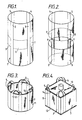
- Fig. 1 this shows a blank in the form of a length of tubular woven fabric.
- the fabric comprises a base fabric 1 and four parallel reinforcing bands 2 to 5 woven integrally with the base fabric and extending parallel to the axis of the tube.
- sections of base fabric lying between adjacent reinforcing bands in the central region of the length of fabric are cut as shown by the dotted lines in order to form four flaps 6 to 9, each attached to one of the reinforcing bands.
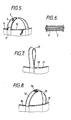
- the flap 6 is then wrapped around the reinforcing band 2 and stitched to each side of the reinforcing band as shown in Fig. 5.
- the flaps 7, 8 and 9 are wrapped around the reinforcing bands 3, 4 and 5 and stitched to each side of the band.
- the blank then takes the form shown in Fig. 2 of the drawings.
- the next step is to take hold of one end of the length of tubular fabric and to turn this inside out and draw it into and through the remainder of the fabric to form a double-walled tube, so effectively folding the fabric around the centre parts of the reinforced sections that will form the lifting loops.
- the tube then constitutes a side wall structure having an inner wall 10 and an outer wall 11. Either during the folding operation or after that operation the inner wall is rotated through 45° relative to the outer wall to arrive at the structure shown in Fig. 3. It will be seen that this action displaces the first and second ends of each lifting loop from one another by 45° around the circumference of the container, and that the circumferential spacing between adjacent lifting loops is also 45°. The rotation imparts a 180° twist to each loop as more clearly shown in Fig. 6.
- the container may then be finished by adding to it a suitable base structure and a suitable top structure.
- the base 12 takes the form of a separate cut piece of fabric simply stitched to the lower ends of the two walls in order to close the base of the container.
- the base may be formed with any suitable spout or other discharge arrangement, desirably before securing the base to the side wall structure.
- the base may be formed by extensions of the fabric of either the inner wall, the outer wall or both walls, the extensions being suitably cut, folded and stitched to form a base of the required shape.
- each lifting loop extends across one of the four top corners of the container.
- a square base and a circular base or base of any other suitable shape may equally well be used.
- the inner wall fits loosely within the outer wall, and is not secured thereto other than by way of the lifting loops and the base. This is desirable as it allows relative movement between the walls in order to enable stress equalisation to occur. Alternatively, however, it would be possible to effect additional securing between the inner and outer walls, for example by stitching the walls together in appropriate regions, e.g. around the top of the container.
- Fig. 4 also shows a square top 13 that is stitched around the top of the side wall structure, for example by stitching 14, either to the inner wall only or to both inner and outer walls if these are to be joined in the region of the top of the container.
- the top may be formed with any suitable filling arrangement.
- the container may be fitted with an impervious liner, located either within the inner wall, or as an intermediate layer between the inner and outer walls.
- the strength that is given to the container by the double-walled structure will be immediately apparent, and it will also be seen that the container can be manufactured quite simply.
- the strength of the base fabric and of the reinforcing bands forming the lifting loops are, of course, chosen according to the rated load of the container in order to give an appropriate factor of safety, usually required to be at least 5:1. Stress distribution in the side wall structure is found to be excellent, with stress being transferred to both inner and outer walls, those walls being capable of relative movement to achieve optimum stress equalisation.
- the presence of the 180° twist in each lifting loop also renders the container capable of being pulled or lifted with only a single loop engaged by the handling means.
- each lifting loop 22 has both ends integral with the inner and outer walls in the same circumferential region of the container. Obviously, rotation through an angle of other than 45° can be effected if required.
- containers may be made in other ways.
- two similar sections 30, 31 of tubular fabric may be used, each having been cut at one end to form upstanding reinforcing sections 32, 33.
- One such length of fabric is then simply drawn into the other length of fabric with a displacement of 45° between the two lengths, and the free end of each upstanding reinforcing section 32 of the resulting outer wall 30 is sewn to the free end of the adjacent upstanding reinforcing section 33 of the inner wall 31 as indicated at 34.
- the inner and outer walls may be formed from suitable panels of fabric stitched together to give the required construction.
- the lifting loops need not be integral extensions of reinforced sections of the wall fabric, but may be separate material, for example webbing such as used for car seat belts, stitched to the wall fabric, desirably in reinforced regions thereof.
Landscapes
- Engineering & Computer Science (AREA)
- Mechanical Engineering (AREA)
- Bag Frames (AREA)
- Thermally Insulated Containers For Foods (AREA)
- Filling Or Emptying Of Bunkers, Hoppers, And Tanks (AREA)
Applications Claiming Priority (2)
| Application Number | Priority Date | Filing Date | Title |
|---|---|---|---|
| GB8622893 | 1986-09-23 | ||
| GB868622893A GB8622893D0 (en) | 1986-09-23 | 1986-09-23 | Bulk containers |
Publications (2)
| Publication Number | Publication Date |
|---|---|
| EP0265063A2 true EP0265063A2 (fr) | 1988-04-27 |
| EP0265063A3 EP0265063A3 (fr) | 1988-09-07 |
Family
ID=10604655
Family Applications (1)
| Application Number | Title | Priority Date | Filing Date |
|---|---|---|---|
| EP87308000A Withdrawn EP0265063A3 (fr) | 1986-09-23 | 1987-09-10 | Conteneurs souples pour matières en vrac |
Country Status (6)
| Country | Link |
|---|---|
| US (1) | US4807299A (fr) |
| EP (1) | EP0265063A3 (fr) |
| DK (1) | DK493987A (fr) |
| FI (1) | FI874138A7 (fr) |
| GB (1) | GB8622893D0 (fr) |
| NO (1) | NO873936L (fr) |
Cited By (4)
| Publication number | Priority date | Publication date | Assignee | Title |
|---|---|---|---|---|
| EP0340622A3 (en) * | 1988-05-03 | 1990-11-28 | Huemer E Unistrap Verpackung | Container made of flexible material |
| US5108196A (en) * | 1989-12-20 | 1992-04-28 | Bowater Packaging Limited | Relating to bulk containers |
| CN104364156A (zh) * | 2012-03-16 | 2015-02-18 | 天命科技控股有限责任公司 | 物资包和用于制造物资包的方法及系统 |
| EP2578766A4 (fr) * | 2010-05-25 | 2017-02-01 | Midori Anzen Co., Ltd. | Système antichute, élément à anneaux multiples, élément anneau en forme de 8, élément à quatre trous, méthode de travail sur un toit, procédé d'installation de corde principale, seau pour système antichute et crochet pour saillie de rive de toit |
Families Citing this family (33)
| Publication number | Priority date | Publication date | Assignee | Title |
|---|---|---|---|---|
| NO161111C (no) * | 1987-04-24 | 1989-07-05 | Norsk Hydro As | Storsekk med i det minste to integrerte loeftestropper. |
| EP0332333A1 (fr) * | 1988-03-04 | 1989-09-13 | Mulox Ibc Limited | Conteneur de sac |
| IE76456B1 (en) * | 1990-09-11 | 1997-10-22 | Christopher C Cuddy | Bulk containers |
| US5244279A (en) * | 1992-06-15 | 1993-09-14 | Ralston Purina Company | Bulk bag |
| US5542765A (en) * | 1994-04-25 | 1996-08-06 | Engineered Fabrics Corporation | Container for carrying flowable materials and related method |
| US5810478A (en) * | 1997-02-26 | 1998-09-22 | Custom Packaging Systems, Inc. | Bulk bag with lift straps and exterior liner |
| CN1077068C (zh) * | 1997-07-30 | 2002-01-02 | 田中产业株式会社 | 用于根菜的挠性容器 |
| GB2354754A (en) * | 1999-09-30 | 2001-04-04 | Brendan Mckenna | Fluid transport container |
| US6626312B2 (en) | 2000-06-28 | 2003-09-30 | Javier Urzua Maturana | Storage bag |
| US6467955B1 (en) * | 2001-05-22 | 2002-10-22 | Jong H. Kim | Seamless tubular fabric bulk container |
| FR2831145B1 (fr) * | 2001-10-19 | 2004-08-27 | Filtisac France | Procede de fabrication d'un conteneur souple destine a recevoir des produits en vrac, et conteneur ainsi obtenu |
| US20050100248A1 (en) * | 2003-11-10 | 2005-05-12 | Da-Yu Chang | Easy-to-transport sack |
| DE102005025918A1 (de) * | 2005-06-06 | 2006-12-07 | Big Bag Harbeck Gmbh | Hochwasserschutz |
| US7594883B1 (en) * | 2005-10-03 | 2009-09-29 | Rhonda G. Harrington | Fabric gift bag |
| US9375591B2 (en) | 2005-10-07 | 2016-06-28 | Caylym Technologies International, Llc | Aerial delivery devices, systems and methods |
| US8480034B2 (en) | 2009-05-29 | 2013-07-09 | Caylym Technologies International, Llc | Aerial delivery devices, systems and methods |
| US20070090174A1 (en) * | 2005-10-07 | 2007-04-26 | Goddard Richard V | Cellulose-based aerial delivery system and method of use |
| US20080300602A1 (en) * | 2007-03-02 | 2008-12-04 | Schmitt Peter J | Fabric medical device having a tapered transition and method of making |
| DE102007036914A1 (de) * | 2007-08-06 | 2009-02-12 | Martin Siegbert | Containerseitenwand, Container mit einer solchen Containerseitenwand sowie Transportgutbehälter mit solchem Container |
| WO2009023645A1 (fr) * | 2007-08-16 | 2009-02-19 | Smart Nanomaterials, Llc | Contenant structuré de manière modulaire nano-amplifié |
| US9457902B2 (en) * | 2010-08-20 | 2016-10-04 | The Skylife Company, Inc. | Supply packs and methods and systems for manufacturing supply packs |
| US9845189B2 (en) * | 2010-08-20 | 2017-12-19 | The Skylife Company, Inc. | Methods and systems for mass distribution of supply packs |
| US8365912B2 (en) | 2010-10-21 | 2013-02-05 | Lincoln Global, Inc. | Wire containment structure including container and bag |
| US9175451B2 (en) * | 2011-02-01 | 2015-11-03 | Ameriglobe, Llc | Flood wall protection system |
| EP2670930A4 (fr) * | 2011-02-01 | 2014-11-05 | Ameriglobe Llc | Système de protection de murs d'inondation |
| US9085866B2 (en) | 2011-02-01 | 2015-07-21 | Ameriglobe, Llc | Flood wall protection system |
| US8721221B2 (en) * | 2011-02-16 | 2014-05-13 | Premark Packaging Llc | System for providing flood protection and method of implementing same |
| CN103857306B (zh) | 2011-08-30 | 2016-04-13 | 耐克创新有限合伙公司 | 编织纺织品鞋 |
| GB2517726B (en) * | 2013-08-29 | 2016-02-03 | Hesco Bastion Ltd | Flood defence barrier |
| US9512581B2 (en) * | 2014-02-27 | 2016-12-06 | Caylym Technologies International, Llc | Rapid deployment barrier system |
| AU2015289610B2 (en) * | 2014-07-16 | 2019-05-09 | The Skylife Company, Inc. | Methods and systems for mass distribution of supply packs |
| KR101803470B1 (ko) * | 2017-03-20 | 2017-11-30 | 박찬경 | 오버랩 구조의 컨테이너백 제조방법 및 그 제조방법으로 제조된 컨테이너백 |
| USD1009478S1 (en) * | 2022-09-20 | 2024-01-02 | Junhua Chen | Tote cover |
Family Cites Families (11)
| Publication number | Priority date | Publication date | Assignee | Title |
|---|---|---|---|---|
| US3061170A (en) * | 1958-07-24 | 1962-10-30 | Union Carbide Corp | Multiwall bag |
| US3789897A (en) * | 1970-09-11 | 1974-02-05 | Shinwa Kagaku Kogyo Kk | Packing containers |
| GB1323804A (en) * | 1971-09-10 | 1973-07-18 | Shinwa Kagaku Kogyo Kk | Packing containers |
| GB1590943A (en) * | 1978-01-05 | 1981-06-10 | Miller Weblift Ltd | Containers |
| US4224970A (en) * | 1978-10-18 | 1980-09-30 | Super Sack Manufacturing Corporation | Collapsible receptacle for flowable materials |
| ATE10354T1 (de) * | 1980-06-05 | 1984-12-15 | Norsk Hydro A/S | Flexibler behaelter fuer transport und lagerung von schuettgut. |
| US4390051A (en) * | 1981-04-03 | 1983-06-28 | Bonar Industries Inc. | Securing a liner within a flexible container |
| GB2116143B (en) * | 1982-03-01 | 1986-05-21 | Frank Nattrass | Flexible bulk container |
| CH661701A5 (de) * | 1983-11-09 | 1987-08-14 | Imag Verlags Ag | Container aus einem schlauchgewebe. |
| GB8420600D0 (en) * | 1984-08-14 | 1984-09-19 | Nattrass Frank | Bulk containers |
| US4646357A (en) * | 1985-03-11 | 1987-02-24 | Bulk Lift International, Incorporated | Transport bag for particulate material |
-
1986
- 1986-09-23 GB GB868622893A patent/GB8622893D0/en active Pending
-
1987
- 1987-09-10 EP EP87308000A patent/EP0265063A3/fr not_active Withdrawn
- 1987-09-21 DK DK493987A patent/DK493987A/da not_active Application Discontinuation
- 1987-09-21 NO NO873936A patent/NO873936L/no unknown
- 1987-09-22 FI FI874138A patent/FI874138A7/fi not_active Application Discontinuation
- 1987-09-23 US US07/100,114 patent/US4807299A/en not_active Expired - Fee Related
Cited By (5)
| Publication number | Priority date | Publication date | Assignee | Title |
|---|---|---|---|---|
| EP0340622A3 (en) * | 1988-05-03 | 1990-11-28 | Huemer E Unistrap Verpackung | Container made of flexible material |
| US5108196A (en) * | 1989-12-20 | 1992-04-28 | Bowater Packaging Limited | Relating to bulk containers |
| EP2578766A4 (fr) * | 2010-05-25 | 2017-02-01 | Midori Anzen Co., Ltd. | Système antichute, élément à anneaux multiples, élément anneau en forme de 8, élément à quatre trous, méthode de travail sur un toit, procédé d'installation de corde principale, seau pour système antichute et crochet pour saillie de rive de toit |
| CN104364156A (zh) * | 2012-03-16 | 2015-02-18 | 天命科技控股有限责任公司 | 物资包和用于制造物资包的方法及系统 |
| CN104364156B (zh) * | 2012-03-16 | 2016-05-25 | 空中生活公司 | 用于部署物品的空中分配系统和从载具部署货物的方法 |
Also Published As
| Publication number | Publication date |
|---|---|
| FI874138A0 (fi) | 1987-09-22 |
| FI874138L (fi) | 1988-03-24 |
| DK493987A (da) | 1988-03-24 |
| US4807299A (en) | 1989-02-21 |
| GB8622893D0 (en) | 1986-10-29 |
| FI874138A7 (fi) | 1988-03-24 |
| NO873936D0 (no) | 1987-09-21 |
| NO873936L (no) | 1988-03-24 |
| DK493987D0 (da) | 1987-09-21 |
| EP0265063A3 (fr) | 1988-09-07 |
Similar Documents
| Publication | Publication Date | Title |
|---|---|---|
| US4807299A (en) | Bulk containers | |
| CA1240935A (fr) | Contenant de vrac | |
| US5108196A (en) | Relating to bulk containers | |
| US4362199A (en) | Flexible containers | |
| EP0703162B1 (fr) | Conteneur souple recyclable pour matières en vrac | |
| US4493109A (en) | Flexible bulk container with integral lifting loops | |
| EP0027309A1 (fr) | Fabrication de containers souples | |
| US6048296A (en) | Method of making a lined bag | |
| US4948265A (en) | Container bag | |
| JP2730557B2 (ja) | たわみ可能な中間ばら荷コンテナ | |
| US5518314A (en) | Flexible container | |
| EP0041586B1 (fr) | Réceptacle flexible pour le transport et le stockage de marchandises en vrac | |
| GB2130172A (en) | Flexible bulk container | |
| GB1590943A (en) | Containers | |
| US5415614A (en) | Manufacture of bulk bags | |
| GB2194216A (en) | Flexible bulk containers | |
| GB2194770A (en) | Bags having lifting loops | |
| EP0119743A1 (fr) | Conteneur en forme de sac | |
| AU640986C (en) | Improvements relating to bulk containers | |
| GB2205302A (en) | Container | |
| JPS5811700Y2 (ja) | フレキシブルコンテナ | |
| GB1590942A (en) | Containers | |
| EP0720956B1 (fr) | Fabrication de sacs de grande capacité | |
| JPS5811699Y2 (ja) | フレキシブル コンテナ | |
| EP0968936A1 (fr) | Conteneur flexible |
Legal Events
| Date | Code | Title | Description |
|---|---|---|---|
| PUAI | Public reference made under article 153(3) epc to a published international application that has entered the european phase |
Free format text: ORIGINAL CODE: 0009012 |
|
| AK | Designated contracting states |
Kind code of ref document: A2 Designated state(s): AT BE CH DE ES FR GB GR IT LI LU NL SE |
|
| PUAL | Search report despatched |
Free format text: ORIGINAL CODE: 0009013 |
|
| AK | Designated contracting states |
Kind code of ref document: A3 Designated state(s): AT BE CH DE ES FR GB GR IT LI LU NL SE |
|
| 17P | Request for examination filed |
Effective date: 19890228 |
|
| 17Q | First examination report despatched |
Effective date: 19890623 |
|
| STAA | Information on the status of an ep patent application or granted ep patent |
Free format text: STATUS: THE APPLICATION IS DEEMED TO BE WITHDRAWN |
|
| 18D | Application deemed to be withdrawn |
Effective date: 19900713 |
|
| RIN1 | Information on inventor provided before grant (corrected) |
Inventor name: NATTRASS, FRANK Inventor name: PAGE, GEOFFREY |