EP0265236A2 - Bracket orthodontique en verre renforcé par échange d'ions - Google Patents
Bracket orthodontique en verre renforcé par échange d'ions Download PDFInfo
- Publication number
- EP0265236A2 EP0265236A2 EP87309287A EP87309287A EP0265236A2 EP 0265236 A2 EP0265236 A2 EP 0265236A2 EP 87309287 A EP87309287 A EP 87309287A EP 87309287 A EP87309287 A EP 87309287A EP 0265236 A2 EP0265236 A2 EP 0265236A2
- Authority
- EP
- European Patent Office
- Prior art keywords
- glass
- bracket
- ion exchange
- brackets
- torque
- Prior art date
- Legal status (The legal status is an assumption and is not a legal conclusion. Google has not performed a legal analysis and makes no representation as to the accuracy of the status listed.)
- Granted
Links
Images




Classifications
-
- A—HUMAN NECESSITIES
- A61—MEDICAL OR VETERINARY SCIENCE; HYGIENE
- A61C—DENTISTRY; APPARATUS OR METHODS FOR ORAL OR DENTAL HYGIENE
- A61C7/00—Orthodontics, i.e. obtaining or maintaining the desired position of teeth, e.g. by straightening, evening, regulating, separating, or by correcting malocclusions
- A61C7/12—Brackets; Arch wires; Combinations thereof; Accessories therefor
Definitions
- the invention relates to orthodontic brackets made from ion exchange strengthened glass.
- Orthodontic brackets attach directly to teeth and serve to transmit corrective forces from an orthodontic archwire to the tooth to which the bracket is attached.
- the requirements for an orthodontic bracket are quite severe. First, it must have sufficient mechanical strength to withstand the forces to which it will be subjected, including the forces transmitted by an archwire, ligation forces, and mastication forces. Second, it must be chemically inert in the oral environment so that it will not corrode and will be and remain biologically inert. The bracket must meet these requirements, and still remain small enough to fit on the tooth.
- the overwhelming majority of orthodontic brackets in use today are made of metal, usually stainless steel. Metal brackets meet all of the essential requirements, but they have one undesirable attribute - they are unsightly. A person undergoing orthodontic treatment has a conspicuous amount of metal in full view on the front surfaces of his or her teeth. And since the treatment may extend over a number of years, this unsightly appearance must be endured for a considerable period of time.
- brackets and archwire are installed on the lingual (tongue) side of the teeth.
- the lingual side technique usually takes longer and is usually more expensive than the customary buccal side technique to complete the treatment.
- brackets and archwire sometimes interfere with the tongue during speech.
- transparent or translucent plastic e.g.. polycarbonate
- ceramic materials which more closely resemble natural dentition.
- the invention provides an orthodontic bracket comprising a base member for attaching to a tooth and a body member extending from the base member.
- the body member includes walls that define an archwire groove.
- the bracket of the invention comprises a glass that has been strengthened by ion exchange. The transparency characteristics of glass permit the provision of brackets that are much more esthetic than metal brackets. The ion exchange strengthening provides brackets that are stronger than the plastic or ceramic brackets that have heretofore been proposed.
- Plastic orthodontic brackets containing metal reinforcement or liners for the archwire grooves are disclosed by Andrews in U. S. Patent No. 3,930,311. by Stahl, U. S. Patent No. 3,964,165, by Kurz, U. S. Patent No. 4,107,844, By Frantz, in U. S. Patent No. 4,299,569, and by Wallshein in U. S. Patent No. 4,302,532,
- This invention is directed to the provision of orthodontic brackets made of ion exchange strengthened glass.
- the term "ion exchange strengthened glass” refers to glass that has been strengthened by a chemothermal ion exchange treatment such that a compressive stress layer is formed on the surface of the glass.
- Such glasses are known in the art. They are prepared by immersing a glass article in a molten salt bath containing exchangeable ions such that the ions in the molten salt bath will be exchanged for ions in the glass. This treatment is carried out at elevated temperature above the strain point of the glass, but below its deformation temperature.
- an article made of a lithium alumino-silicate glass is immersed in a molten sodium nitrate bath at a temperature of about 400°C. for about four hours. The articles are removed, cooled, and then rinsed in a solvent to remove residual salt. The resulting article is significantly stronger than the original article owing to compressive stresses developed in a thin layer on the surface of the glass.
- the orthodontic bracket is first produced in the desired configuration from an ion exchange strengthenable glass, and it is then strengthened by the ion exchange treatment.
- the brackets may be produced in the desired configuration by the following process:
- a glass rod of a predetermined cross-sectional configuration can be produced by known procedures by drawing the rod through a heated graphite die.
- the glass should be heated to its working temperature, which is usually of the order of 1300° to 1500°C., where its viscosity is of the order of 104 poises.
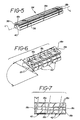
- the rods may be machined to finish them, cut into individual bracket blanks, and then subjected to the ion exchange treatment. This process will now be explained in more detail with reference to the drawings.
- Figs. 1 through 4 show an orthodontic bracket made in accordance with the invention.
- the bracket 10 includes a base portion 12 and a body portion 14.
- the base 12 includes a tooth contacting surface 16 that has a double concavity, as can be seen from Figs. 2 and 4, to match the contour of the tooth to which the bracket is to be bonded.
- An archwire groove in the body portion 14 is defined by walls 18a, 18b, 18c.
- the body portion also contains a "saddle", which is defined by walls 20a, 20b, 20c.
- the version of bracket shown is a "twin bracket", which contains two pairs of tie wings, shown as 22, 24, 26, and 28.
- the bracket depicted in Figs. 1-4 can be produced by the following process:
- An ion exchange strengthenable glass is heated to its working temperature and is drawn through a heated graphite die 29 (Fig. 12) having an orifice 30 to produce a rod blank 32 (Fig. 13) having a cross-sectional configuration essentially the same as the configuration of the orifice 30, although reduced in size.
- the rod blank 32 is then machined to produce a rod 34 (Fig. 5) from which individual bracket blanks 42 (Figs. 6 and 7) can be cut, as is explained below.
- the rod 34 shown in Fig. 5 includes a longitudinal groove defined by walls 18a, 18b, 18c.
- the rod 34 also includes a pair of longitudinal grooves 36, 38, cut in either side of the rod 34. All three grooves can be cut in the rod blank 32 by diamond grinding wheels.
- the rod 34 can then have its bottom side 40 ground to impart concavity. This concavity is most readily seen in Fig. 6 at 15.
- a second concavity at right angles to the first can then be ground in the bottom of the rod 34 to impart the concavity that is most readily seen in Fig. 4 at 16.
- these two concavities are machined by using a double-contoured grinding wheel in a stepped grinding Procedure. which grinds both concavities at once.
- the saddles can be ground by using a stepped grinding procedure, and then the rod is cut into individual bracket blanks 42.
- the cuts to make the individual bracket blanks 42 are made at a slight angle, ⁇ , to a line perpendicular to the longitudinal axis L of the rod 34. This is shown most clearly in Figs. 6 and 7.
- brackets are then preferably polished to remove minute surface imperfections and to smooth off the contours.
- a suitable polishing bath is a solution of three parts of 50% aqueous hydroflouric acid and one part of concentrated sulfuric acid.
- the brackets are immersed in the polishing bath at room temperature for a short time, e. g., one to three minutes, removed, and rinsed. They are then read, for the ion exchange strengthening step.
- the brackets are subjected to the ion exchange reaction for a period of time sufficient to strengthen them to a point where they are suitable for use as orthodontic brackets.
- the ion exchange bath can be, for example, molten sodium nitrate, potassium nitrate, sodium sulfate, potassium sulfate, and mixtures thereof.
- the ion exchange treatment is carried out by immersing the brackets in a bath of molten salt at elevated temperature above the strain point and below the softening point of the glass. To reduce to a minimum the possibility of deformation of the pieces, it is preferred that the molten salt bath be at a temperature not more than 50° to 100° C.
- a suitable temperature for lithium alumino-silicate glass ion exchanged in molten sodium nitrate is about 400° C.
- the treatment time varies with such factors as specific nature of the glass and treating salt, temperature, and the like, but will usually be from about 2 hours to about 24 hours.
- a treatment time of about 3-1/2 to about 4-1/2 hours is suitable for the specific materials discussed above when using a sodium nitrate treating salt.
- the treatment process is self-limiting in that when all the exchangeable ions at or near the surface of the glass have been exchanged, the ion exchange stops.
- brackets are removed from the ion exchange bath, cooled, and then washed clean of excess salt, as by using a bath of acetone, water, or other solvent for the salt.
- Ultra-sonic treatment may be used to enhance or accelerate the removal of excess salt.
- the ion exchangeable glass used had the following analysis, by spectroscopy:
- a large block of ion exchangeable glass was machined into 1.25" x o.125" x 0.062: flexural strength bars, and into 0.082" x 0.060" x 0.150" pieces.
- the latter pieces had a slot 0.020" x 0.030" in cross section machined down the center of the pieces.
- All the flexural bars and torque test pieces were polished by immersion in a bath of three parts 50% aqueous hydrofluoric acid and one part concentratd (85%) sulfuric acid for two minutes at room temperature. The pieces were removed from the bath and rinsed in water.
- Half of the pieces were maintained as controls, and the other half were immersed in a molten bath of sodium nitrate at 400° C. for 4 hours.
- the ion exchanged pieces were removed from the sodium nitrate, cooled, and rinsed in acetone.
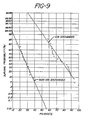
- the flexural bars were tested using three point loading in an Instron tester. Twenty bars of each condition, as-polished and ion exchanged, were tested. The crosshead speed was 0.01 cm/sec across a one-inch span.
- the strength values for the individual samples are arranged in ascending order.
- the nth ranked sample from a total of N samples has a probability of survival (of the strength value found for the nth ranked sample) of n/(N+1) x 100, in which n represents the ranking,with "1" being the rank of the weakest sample, and "N” being the total number of samples.
- Fig. 9 is a graph of flexural strength (x-axis) versus the probability of survival, in per cent (y-axis). A brief summary of the results is also displayed in Table I:
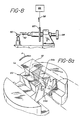
- Fig 10 is a cross-sectional elevation of the torque strength test pieces 50.
- the specific dimensions of these test pieces were the following: a - 0.150 inch b - 0.030 inch c - 0.030 inch d - 0.082 inch e - 0.020 inch f - 0.032 inch
- test pieces were 0.060 inch deep (i.e., in the dimension perpendicular to the plane of the cross-section shown in Fig. 10).
- the torque strength test piece 50 is fastened in the test stand with the slot facing upwards and with the longitudinal axis L s of the slot aligned with the test blade 52.
- the test blade 52 is inserted in the slot using a positioning wheel 64 to position the blade 52.
- the test blade 52 is sized to fit snugly in the slot without exerting any expansion force on the walls 54a, 54b of the slot (refer to Fig. 10).
- the blade is operatively connected to a load cell 56 via a wire 58 attached to a torque pulley 60.
- the load cell 56 is operatively connected to an Instron tester (not shown). A rotational force is applied to the test blade 52 by the wire 58 acting on a torque pulley 60.
- the test blade 52 Upon application of a force by the wire 58, the test blade 52 is twisted in the direction of the arrow A shown in Fig. 8a. The test is continued until the test piece 50 breaks. Prior to testing, the Instron is calibrated with a 2000 gram load cell using a 250-gram calibration weight. In applying the load, the torquing device (i.e., the wire 58) moves at a rate of 2 centimeters per minute. (The torque pulley 60 had a diameter of 7.62 centimeters.)
- the torque applied by the torque test simulates stresses normally encountered during the latter stages of treatment, when an archwire of rectangular cross-section is often used to impart a torque to the bracket.
- test piece used in the torque test simulates a "single wing" bracket that has only one pair of tie wings
- the prior description of the preferred embodiment of the brackets of the invention was of "twin brackets” that have two sets of tie wings with an open space (“saddle") between the two sets of tie wings. Therefore, the test piece apparently has more material with which to resist the torque because there is no cut out area or saddle that interrupts the continuity of the side walls of the archwire groove. It is believed that this makes no sifnificant difference in the test results because failure in glasses and ceramics occurs at stresses much lower than the theoretical strength, owing to the presence of minute flaws in the glass.
- the ion exchange strengthened glass brackets of the invention have a torque strength of at least about 1000 gram-centimeters, measured by the test described above, since 1000 gm-cm of torque is the approximate point at which the strongest archwires in use today yield.
- the brackets of the invention have a probability of survival, using Weibull statistical analysis, at 1000 gram-centimeters of torque, of greater than 95 per cent.
Landscapes
- Health & Medical Sciences (AREA)
- Oral & Maxillofacial Surgery (AREA)
- Dentistry (AREA)
- Epidemiology (AREA)
- Life Sciences & Earth Sciences (AREA)
- Animal Behavior & Ethology (AREA)
- General Health & Medical Sciences (AREA)
- Public Health (AREA)
- Veterinary Medicine (AREA)
- Dental Tools And Instruments Or Auxiliary Dental Instruments (AREA)
- Surface Treatment Of Glass (AREA)
Applications Claiming Priority (2)
| Application Number | Priority Date | Filing Date | Title |
|---|---|---|---|
| US92198486A | 1986-10-22 | 1986-10-22 | |
| US921984 | 1997-08-28 |
Publications (3)
| Publication Number | Publication Date |
|---|---|
| EP0265236A2 true EP0265236A2 (fr) | 1988-04-27 |
| EP0265236A3 EP0265236A3 (en) | 1989-07-19 |
| EP0265236B1 EP0265236B1 (fr) | 1991-05-08 |
Family
ID=25446300
Family Applications (1)
| Application Number | Title | Priority Date | Filing Date |
|---|---|---|---|
| EP19870309287 Expired EP0265236B1 (fr) | 1986-10-22 | 1987-10-21 | Bracket orthodontique en verre renforcé par échange d'ions |
Country Status (6)
| Country | Link |
|---|---|
| EP (1) | EP0265236B1 (fr) |
| JP (1) | JPS63117747A (fr) |
| AU (1) | AU596230B2 (fr) |
| BR (1) | BR8705635A (fr) |
| CA (1) | CA1288264C (fr) |
| DE (1) | DE3769911D1 (fr) |
Cited By (2)
| Publication number | Priority date | Publication date | Assignee | Title |
|---|---|---|---|---|
| EP0393002A1 (fr) * | 1989-04-12 | 1990-10-17 | Scandinavian Bioortodontic Ab | Appareil d'orthodontie, boîtier et fil |
| EP0458562A1 (fr) * | 1990-05-22 | 1991-11-27 | Rmo, Inc. | Rainure pour crochets orthodontiques perfectionnée et son procédé |
Families Citing this family (4)
| Publication number | Priority date | Publication date | Assignee | Title |
|---|---|---|---|---|
| US5032081A (en) * | 1989-05-26 | 1991-07-16 | Ormco Corporation | Glass orthodontic bracket |
| TWI861872B (zh) * | 2014-10-08 | 2024-11-11 | 美商康寧公司 | 具有葉長石及矽酸鋰結構的高強度玻璃陶瓷 |
| DE102015108173A1 (de) * | 2015-05-22 | 2016-11-24 | Degudent Gmbh | Verfahren zur Erhöhung der Festigkeit von aus Lithiumsilikat-Glaskeramik bestehendem Formkörper |
| DE102015108171A1 (de) * | 2015-05-22 | 2016-11-24 | Degudent Gmbh | Verfahren zur Erhöhung der Festigkeit von aus Lithiumsilikat-Glaskeramik bestehendem Formkörper |
Family Cites Families (6)
| Publication number | Priority date | Publication date | Assignee | Title |
|---|---|---|---|---|
| US3428513A (en) * | 1964-04-24 | 1969-02-18 | Owens Illinois Inc | Strengthened crystalline article and method of making the same |
| US4074992A (en) * | 1964-05-05 | 1978-02-21 | Corning Glass Works | Sodium ion-exchange on surface of beta-spodumene |
| US4156755A (en) * | 1978-04-19 | 1979-05-29 | Ppg Industries, Inc. | Lithium containing ion exchange strengthened glass |
| US4189325A (en) * | 1979-01-09 | 1980-02-19 | The Board of Regents, State of Florida, University of Florida | Glass-ceramic dental restorations |
| DE3588089T2 (de) * | 1984-04-23 | 1996-10-02 | Company Orthodontics A | Orthodontisches Bracket aus kristallinem Aluminiumoxid |
| DD242171A1 (de) * | 1985-11-04 | 1987-01-21 | Univ Schiller Jena | Anwendung einer glimmer-cordierit-glaskeramik in der kieferorthopaedie/orthodontie |
-
1987
- 1987-10-20 CA CA000549726A patent/CA1288264C/fr not_active Expired - Fee Related
- 1987-10-21 EP EP19870309287 patent/EP0265236B1/fr not_active Expired
- 1987-10-21 BR BR8705635A patent/BR8705635A/pt not_active IP Right Cessation
- 1987-10-21 DE DE8787309287T patent/DE3769911D1/de not_active Expired - Fee Related
- 1987-10-21 AU AU80020/87A patent/AU596230B2/en not_active Ceased
- 1987-10-21 JP JP62264032A patent/JPS63117747A/ja active Pending
Cited By (2)
| Publication number | Priority date | Publication date | Assignee | Title |
|---|---|---|---|---|
| EP0393002A1 (fr) * | 1989-04-12 | 1990-10-17 | Scandinavian Bioortodontic Ab | Appareil d'orthodontie, boîtier et fil |
| EP0458562A1 (fr) * | 1990-05-22 | 1991-11-27 | Rmo, Inc. | Rainure pour crochets orthodontiques perfectionnée et son procédé |
Also Published As
| Publication number | Publication date |
|---|---|
| CA1288264C (fr) | 1991-09-03 |
| AU596230B2 (en) | 1990-04-26 |
| EP0265236B1 (fr) | 1991-05-08 |
| DE3769911D1 (de) | 1991-06-13 |
| JPS63117747A (ja) | 1988-05-21 |
| AU8002087A (en) | 1988-04-28 |
| EP0265236A3 (en) | 1989-07-19 |
| BR8705635A (pt) | 1988-05-31 |
Similar Documents
| Publication | Publication Date | Title |
|---|---|---|
| US4784606A (en) | Orthodontic brackets made from ion exchange strengthened glass | |
| US5109586A (en) | Crystalline alumina orthodontic bracket | |
| CA2168455C (fr) | Reconstitution dentaire | |
| US6485849B2 (en) | Method for molding dental restorations and related apparatus | |
| US6818573B2 (en) | Method for molding dental restorations and related apparatus | |
| JP3088708B2 (ja) | 成形半透明リチウムジシリケートガラスセラミック製品の調製プロセス | |
| Flores et al. | The fracture strength of ceramic brackets: a comparative study | |
| EP0265236B1 (fr) | Bracket orthodontique en verre renforcé par échange d'ions | |
| HUE027211T2 (en) | Lithium silicate materials | |
| CA1275185C (fr) | Liaison verre-ceramique dans des produits dentaires | |
| WO2006042046A2 (fr) | Restaurations dentaires haute resistance | |
| US4793809A (en) | Fiber filled dental porcelain | |
| Seghi et al. | Effects of ion exchange on hardness and fracture toughness of dental ceramics. | |
| AU729276B2 (en) | Use of novel glass compositions in preparing dental glass pillars and support pillars, and method for producing the glass pillars | |
| US20050115460A1 (en) | Method for molding dental restorations and related apparatus | |
| JPH02149447A (ja) | 歯科用結晶化ガラス | |
| Barghi et al. | Comparison of fracture strength of porcelain-veneered-to-high noble and base metal alloys | |
| EP0399787A2 (fr) | Bracket orthodontique en verre | |
| O'kane et al. | Surface roughness and droplet contact angle measurement of various orthodontic bonding cements | |
| US5145365A (en) | Glass orthodontic bracket | |
| Anusavice et al. | Effect of grinding and fluoride-gel exposure on strength of ion-exchanged porcelain | |
| US6465106B1 (en) | Method for molding dental restorations and related apparatus | |
| KR100415779B1 (ko) | 치과용 유리주 및 지지주의 제조에 있어서의 신규한 유리 | |
| ANDRE'RAYNE | DISSERTATION SUBMITTED IN COMPLIANCE WITH THE REQUIREMENTS FOR THE NATIONAL MASTER'S DEGREE IN TECHNOLOGY: DENTAL TECHNOLOGY. DEPARTMENT OF DENTAL TECHNOLOGY, TECHNIKON NATAL | |
| Rokhlin et al. | Effect of Decay of Supersaturated Solid Solution on Hardness, Specific Resistance and Ultrasonic Attenuation of Aluminum-- Zinc Alloys.(Translation) |
Legal Events
| Date | Code | Title | Description |
|---|---|---|---|
| PUAI | Public reference made under article 153(3) epc to a published international application that has entered the european phase |
Free format text: ORIGINAL CODE: 0009012 |
|
| AK | Designated contracting states |
Kind code of ref document: A2 Designated state(s): BE CH DE FR GB IT LI LU NL SE |
|
| PUAL | Search report despatched |
Free format text: ORIGINAL CODE: 0009013 |
|
| AK | Designated contracting states |
Kind code of ref document: A3 Designated state(s): BE CH DE FR GB IT LI LU NL SE |
|
| 17P | Request for examination filed |
Effective date: 19891228 |
|
| 17Q | First examination report despatched |
Effective date: 19900606 |
|
| GRAA | (expected) grant |
Free format text: ORIGINAL CODE: 0009210 |
|
| AK | Designated contracting states |
Kind code of ref document: B1 Designated state(s): BE CH DE FR GB IT LI LU NL SE |
|
| ITF | It: translation for a ep patent filed | ||
| REF | Corresponds to: |
Ref document number: 3769911 Country of ref document: DE Date of ref document: 19910613 |
|
| ET | Fr: translation filed | ||
| RAP2 | Party data changed (patent owner data changed or rights of a patent transferred) |
Owner name: JOHNSON & JOHNSON CONSUMER PRODUCTS, INC. |
|
| REG | Reference to a national code |
Ref country code: CH Ref legal event code: PUE Owner name: JOHNSON & JOHNSON CONSUMER PRODUCTS INC. |
|
| NLT2 | Nl: modifications (of names), taken from the european patent patent bulletin |
Owner name: JOHNSON & JOHNSON CONSUMER PRODUCTS, INC. TE NEW B |
|
| PLBE | No opposition filed within time limit |
Free format text: ORIGINAL CODE: 0009261 |
|
| STAA | Information on the status of an ep patent application or granted ep patent |
Free format text: STATUS: NO OPPOSITION FILED WITHIN TIME LIMIT |
|
| 26N | No opposition filed | ||
| EPTA | Lu: last paid annual fee | ||
| PGFP | Annual fee paid to national office [announced via postgrant information from national office to epo] |
Ref country code: LU Payment date: 19941001 Year of fee payment: 8 |
|
| PGFP | Annual fee paid to national office [announced via postgrant information from national office to epo] |
Ref country code: GB Payment date: 19941011 Year of fee payment: 8 Ref country code: FR Payment date: 19941011 Year of fee payment: 8 |
|
| PGFP | Annual fee paid to national office [announced via postgrant information from national office to epo] |
Ref country code: CH Payment date: 19941014 Year of fee payment: 8 |
|
| PGFP | Annual fee paid to national office [announced via postgrant information from national office to epo] |
Ref country code: SE Payment date: 19941017 Year of fee payment: 8 |
|
| PGFP | Annual fee paid to national office [announced via postgrant information from national office to epo] |
Ref country code: NL Payment date: 19941031 Year of fee payment: 8 |
|
| PGFP | Annual fee paid to national office [announced via postgrant information from national office to epo] |
Ref country code: DE Payment date: 19941110 Year of fee payment: 8 |
|
| PGFP | Annual fee paid to national office [announced via postgrant information from national office to epo] |
Ref country code: BE Payment date: 19941208 Year of fee payment: 8 |
|
| EAL | Se: european patent in force in sweden |
Ref document number: 87309287.8 |
|
| PG25 | Lapsed in a contracting state [announced via postgrant information from national office to epo] |
Ref country code: LU Free format text: LAPSE BECAUSE OF NON-PAYMENT OF DUE FEES Effective date: 19951021 Ref country code: GB Effective date: 19951021 |
|
| PG25 | Lapsed in a contracting state [announced via postgrant information from national office to epo] |
Ref country code: SE Effective date: 19951022 |
|
| PG25 | Lapsed in a contracting state [announced via postgrant information from national office to epo] |
Ref country code: LI Effective date: 19951031 Ref country code: CH Effective date: 19951031 Ref country code: BE Effective date: 19951031 |
|
| BERE | Be: lapsed |
Owner name: JOHNSON & JOHNSON CONSUMER PRODUCTS INC. Effective date: 19951031 |
|
| PG25 | Lapsed in a contracting state [announced via postgrant information from national office to epo] |
Ref country code: NL Effective date: 19960501 |
|
| REG | Reference to a national code |
Ref country code: CH Ref legal event code: PL |
|
| GBPC | Gb: european patent ceased through non-payment of renewal fee |
Effective date: 19951021 |
|
| PG25 | Lapsed in a contracting state [announced via postgrant information from national office to epo] |
Ref country code: FR Effective date: 19960628 |
|
| EUG | Se: european patent has lapsed |
Ref document number: 87309287.8 |
|
| PG25 | Lapsed in a contracting state [announced via postgrant information from national office to epo] |
Ref country code: DE Effective date: 19960702 |
|
| NLV4 | Nl: lapsed or anulled due to non-payment of the annual fee |
Effective date: 19960501 |
|
| REG | Reference to a national code |
Ref country code: FR Ref legal event code: ST |
|
| PG25 | Lapsed in a contracting state [announced via postgrant information from national office to epo] |
Ref country code: IT Free format text: LAPSE BECAUSE OF NON-PAYMENT OF DUE FEES;WARNING: LAPSES OF ITALIAN PATENTS WITH EFFECTIVE DATE BEFORE 2007 MAY HAVE OCCURRED AT ANY TIME BEFORE 2007. THE CORRECT EFFECTIVE DATE MAY BE DIFFERENT FROM THE ONE RECORDED. Effective date: 20051021 |