EP0265273A2 - Acier à haute résistance, pour ressorts - Google Patents
Acier à haute résistance, pour ressorts Download PDFInfo
- Publication number
- EP0265273A2 EP0265273A2 EP87309368A EP87309368A EP0265273A2 EP 0265273 A2 EP0265273 A2 EP 0265273A2 EP 87309368 A EP87309368 A EP 87309368A EP 87309368 A EP87309368 A EP 87309368A EP 0265273 A2 EP0265273 A2 EP 0265273A2
- Authority
- EP
- European Patent Office
- Prior art keywords
- less
- steel
- weight
- spring steel
- quenching
- Prior art date
- Legal status (The legal status is an assumption and is not a legal conclusion. Google has not performed a legal analysis and makes no representation as to the accuracy of the status listed.)
- Withdrawn
Links
- 229910000639 Spring steel Inorganic materials 0.000 title claims abstract description 20
- PXHVJJICTQNCMI-UHFFFAOYSA-N Nickel Chemical compound [Ni] PXHVJJICTQNCMI-UHFFFAOYSA-N 0.000 claims abstract description 28
- IJGRMHOSHXDMSA-UHFFFAOYSA-N Atomic nitrogen Chemical compound N#N IJGRMHOSHXDMSA-UHFFFAOYSA-N 0.000 claims abstract description 22
- 229910001566 austenite Inorganic materials 0.000 claims abstract description 22
- 238000010791 quenching Methods 0.000 claims abstract description 21
- 230000000171 quenching effect Effects 0.000 claims abstract description 21
- 229910000831 Steel Inorganic materials 0.000 claims abstract description 18
- 239000010959 steel Substances 0.000 claims abstract description 18
- 230000000717 retained effect Effects 0.000 claims abstract description 16
- OKTJSMMVPCPJKN-UHFFFAOYSA-N Carbon Chemical compound [C] OKTJSMMVPCPJKN-UHFFFAOYSA-N 0.000 claims abstract description 12
- 229910052799 carbon Inorganic materials 0.000 claims abstract description 12
- 229910052759 nickel Inorganic materials 0.000 claims abstract description 12
- QVGXLLKOCUKJST-UHFFFAOYSA-N atomic oxygen Chemical compound [O] QVGXLLKOCUKJST-UHFFFAOYSA-N 0.000 claims abstract description 11
- 229910052757 nitrogen Inorganic materials 0.000 claims abstract description 11
- 229910052760 oxygen Inorganic materials 0.000 claims abstract description 11
- 239000001301 oxygen Substances 0.000 claims abstract description 11
- 229910052710 silicon Inorganic materials 0.000 claims abstract description 10
- 239000010703 silicon Substances 0.000 claims abstract description 10
- XUIMIQQOPSSXEZ-UHFFFAOYSA-N Silicon Chemical compound [Si] XUIMIQQOPSSXEZ-UHFFFAOYSA-N 0.000 claims abstract description 8
- 238000005496 tempering Methods 0.000 claims abstract description 8
- 229910052720 vanadium Inorganic materials 0.000 claims abstract description 8
- LEONUFNNVUYDNQ-UHFFFAOYSA-N vanadium atom Chemical compound [V] LEONUFNNVUYDNQ-UHFFFAOYSA-N 0.000 claims abstract description 8
- ZOKXTWBITQBERF-UHFFFAOYSA-N Molybdenum Chemical compound [Mo] ZOKXTWBITQBERF-UHFFFAOYSA-N 0.000 claims abstract description 7
- 229910052750 molybdenum Inorganic materials 0.000 claims abstract description 7
- 239000011733 molybdenum Substances 0.000 claims abstract description 7
- XEEYBQQBJWHFJM-UHFFFAOYSA-N Iron Chemical compound [Fe] XEEYBQQBJWHFJM-UHFFFAOYSA-N 0.000 claims abstract description 6
- 239000012535 impurity Substances 0.000 claims abstract description 5
- VYZAMTAEIAYCRO-UHFFFAOYSA-N Chromium Chemical compound [Cr] VYZAMTAEIAYCRO-UHFFFAOYSA-N 0.000 claims abstract description 3
- 229910052804 chromium Inorganic materials 0.000 claims abstract description 3
- 239000011651 chromium Substances 0.000 claims abstract description 3
- 229910052742 iron Inorganic materials 0.000 claims abstract description 3
- WPBNNNQJVZRUHP-UHFFFAOYSA-L manganese(2+);methyl n-[[2-(methoxycarbonylcarbamothioylamino)phenyl]carbamothioyl]carbamate;n-[2-(sulfidocarbothioylamino)ethyl]carbamodithioate Chemical compound [Mn+2].[S-]C(=S)NCCNC([S-])=S.COC(=O)NC(=S)NC1=CC=CC=C1NC(=S)NC(=O)OC WPBNNNQJVZRUHP-UHFFFAOYSA-L 0.000 claims abstract description 3
- 238000012360 testing method Methods 0.000 description 18
- 238000000034 method Methods 0.000 description 12
- 239000000463 material Substances 0.000 description 8
- 238000010438 heat treatment Methods 0.000 description 4
- 239000000203 mixture Substances 0.000 description 4
- 238000010008 shearing Methods 0.000 description 4
- 239000000126 substance Substances 0.000 description 4
- 239000000725 suspension Substances 0.000 description 4
- PWHULOQIROXLJO-UHFFFAOYSA-N Manganese Chemical compound [Mn] PWHULOQIROXLJO-UHFFFAOYSA-N 0.000 description 3
- 229910052748 manganese Inorganic materials 0.000 description 3
- 239000011572 manganese Substances 0.000 description 3
- 238000004519 manufacturing process Methods 0.000 description 3
- ATJFFYVFTNAWJD-UHFFFAOYSA-N Tin Chemical compound [Sn] ATJFFYVFTNAWJD-UHFFFAOYSA-N 0.000 description 1
- 239000000654 additive Substances 0.000 description 1
- 238000005275 alloying Methods 0.000 description 1
- 229910001567 cementite Inorganic materials 0.000 description 1
- 238000002485 combustion reaction Methods 0.000 description 1
- 238000007796 conventional method Methods 0.000 description 1
- 238000002425 crystallisation Methods 0.000 description 1
- 238000013461 design Methods 0.000 description 1
- 238000011161 development Methods 0.000 description 1
- 230000000694 effects Effects 0.000 description 1
- 238000009661 fatigue test Methods 0.000 description 1
- -1 i.e. Substances 0.000 description 1
- 230000000977 initiatory effect Effects 0.000 description 1
- 238000004881 precipitation hardening Methods 0.000 description 1
- 238000005096 rolling process Methods 0.000 description 1
- 229910000859 α-Fe Inorganic materials 0.000 description 1
Images

Classifications
-
- C—CHEMISTRY; METALLURGY
- C22—METALLURGY; FERROUS OR NON-FERROUS ALLOYS; TREATMENT OF ALLOYS OR NON-FERROUS METALS
- C22C—ALLOYS
- C22C38/00—Ferrous alloys, e.g. steel alloys
- C22C38/18—Ferrous alloys, e.g. steel alloys containing chromium
- C22C38/34—Ferrous alloys, e.g. steel alloys containing chromium with more than 1.5% by weight of silicon
Definitions
- the present invention relates to a spring steel, and more particularly, to a high-strength spring steel adapted for suspension coil springs of automobiles and the like.
- Spring steel is used as a material for valve springs, suspension springs, etc., in internal combustion engines of automobiles and the like. With increase of the demand for lighter, higher-speed versions of engines, therefore, spring steel has come to require higher strength. Thus, there is an increasing demand for the development of high-strength spring steel with satisfactory fatigue strength and relaxation resistance or sag-resistance, in particular.
- springs are produced in the following manner, with use of the spring steel of this type.
- the steel In the case of hot forming, the steel is hot-coiled, quenched, tempered, shot-peened, and preset.
- the material In the case of cold forming, the material is quenched and tempered, cold-coiled, shot-peened, and preset.
- the steps of quenching and tempering are inevitably included in both cold and hot forming processes. If the amount of additives, such as nickel or other alloying elements, is increased to improve the strength and toughness of the material, retained austenite remains in the structure, thereby exerting a bad influence to the fatigue strength.
- the inventors hereof have previously proposed a method for removing the retained austenite (Japanese Provisional Patent Publication No. 60-89553).
- Japanese Provisional Patent Publication No. 60-89553 Japanese Patent Publication No. 60-89553.
- the amount of addition of nickel is increased, and the retained austenite is left intentionally by quenching for higher ductility. After quenching, the material is cold-coiled, taking advantage of the improved ductility. Thereafter, the retained austenite is removed by tempering.
- this method requires more steps of heat treatment, and therefore, is complicated. Moreover, this method is not applicable to hot spring forming.
- the principal object of the present invention is to provide a high-strength spring steel improved in fatigue strength and relaxation resistance.
- Another object of the invention is to provide a high-strength spring steel which can be subjected to both the conventional hot and cold spring forming processes, without requiring any complicated special heat treatment, thus permitting mass production of springs.
- the present invention is based on a finding that high-strength spring steel with satisfactory fatigue strength can be obtained by the conventional spring forming process, only if the amount of retained austenite is restricted to less than 10 % after quenching, with use of a properly adjusted chemical composition.
- a high-strength spring steel which contains 0.30 to 0.75 % carbon, 1.0 to 4.0 % silicon, 0.5 to 1.5 % manganese, 0.1 to 2.0 % chromium, and 2.0 % or less nickel, all by weight, and iron and unavoidable impurities for the remainder.
- the spring steel further contains 0.05 to 0.5 % vanadium and/or 0.05 to 2.0 % molybdenum, as required.
- the spring steel of the invention produces retained austenite less than 10 % in content by weight after quenching in steps of quenching and tempering, and has high fatigue strength and relaxation resistance.
- the retained-austenite content can be easily set to less than 10 % by adjusting the carbon, silicon, and nickel contents as follows: 35 ⁇ C (%) + 2 ⁇ Si (%) + Ni (%) ⁇ 23 %.
- the fatigue strength of the steel is further improved by restricting the oxygen and nitrogen contents thereof to 0.0010 % or less and 0.005 % or less, respectively.
- Carbon is an effective element for the improvement of the mechanical strength of steel. If the carbon content of steel is less than 0.30 %, however, the material cannot enjoy a necessary strength for a high-strength spring. If the carbon content exceeds 0.75 %, on the other hand, net-cementite is liable to be produced, so that the fatigue strength of the spring is lowered. Thus, the proper carbon content ranges from 0.30 to 0.75 %.
- Silicon tends to be solid-dissolved in ferrite, thereby increasing the strength of the material, and is effective for the improvement of the relaxation resistance of the spring. To attain this, the silicon content must be 1.0 % or more. If it exceeds 4.0 %, however, the toughness of the spring is lowered, and free carbon may possibly be produced by heat treatment. Thus, the proper silicon content ranges from 1.0 to 4.0 %.
- Manganese serves not only as a deoxidizing element but also as an effective element for the improvement of hardenability. To attain this, the manganese content must be 0.5 % or more. If it exceeds 1.5 %, however, the hardenability becomes so high that the spring is lowered in toughness and is also deformed in quenching. Thus, the proper manganese content ranges from 0.5 to 1.5 %.
- Nickel is an effective element for the improvement of toughness after quenching and tempering. If the nickel content exceeds 2 %, however, too much austenite is retained after quenching, thereby lowering the fatigue strength. Thus, nickel should be added at 2 % or less.
- vanadium and/or molybdenum may be added as required to improve the spring characteristics.
- Vanadium in particular, has a substantial micro-crystallization effect at the time of low-temperature rolling, thus ensuring improved spring characteristics and reliability.
- vanadium is conducive to precipitation hardening at the time of quenching and tempering.
- molybdenum is an effective element for the improvement of relaxation resistance. Vanadium and molybdenum are added within content ranges of 0.05 to 0.5 % and 0.05 to 2.0 %, respectively. If the vanadium content exceeds its upper limit, the toughness and spring characteristics are lowered. If the molybdenum content exceeds its upper limit, complex carbide is formed which cannot be dissolved in austenite. If the carbide increases, thus forming a bulky mass, it is as harmful as nonmetallic inclusions, and may possibly lower the fatigue strength.
- Oxygen in particular, produces oxide-based inclusions, which are liable to be an initiation site of fatigue fracture. Preferably, therefore, the oxygen content is restricted to 0.0010 % or less, by weight.
- Nitrogen on the other hand, produces TiN-based inclusions, thereby lowering the fatigue strength, so that the nitrogen content is preferably restricted to 0.005 % or less, by weight.
- the spring steel of the chemical composition described above can be formed into springs by the conventional hot or cold spring forming process, including steps of quenching and tempering.
- the amount of retained austenite after quenching must be less than 10 %. If the austenite content is less than 10 %, it has no substantial influence on the fatigue strength.
- a retained-austenite content of 10 % or more may be reduced to less than 10 % by, for example, subjecting the material to sub-zero treatment after quenching. This method is not advisable, however, in view of the simplicity of processes for mass production of springs.
- the carbon, silicon, and nickel contents should be restricted as follows: 35 ⁇ C (%) + 2 ⁇ Si (%) + Ni (%) ⁇ 23 %.
- the amount of retained austenite produced after quenching, in the conventional spring forming processes can be easily set to lower than 10 %.
- a rolled rod of 16 mm ⁇ was manufactured by a conventional method, using a steel of the chemical composition (% by weight) shown in Table 1.
- Test pieces for tension, relaxation, and fatigue tests were cut out from the rolled rod. They were oil-quenched after being heated at 900 °C for 30 minutes, whereupon the test pieces were tempered at 350 °C for 0.1 hour, and finish-machined. All the test pieces were thermal refined to be adjusted to H RC 55.
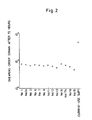
- Table 1 shows test results for the Y-value and endurance limit, and Fig. 2 shows those for the relaxation resistance. Table 1 also shows results of tests on the amount of retained austenite after quenching and the residual shearing strain.
- Fig. 3 A torsional creep tester of a dead-weight type (max. torque: 25 kgf ⁇ m) shown in Fig. 3 was used for the tests on the relaxation resistance.
- Figs. 4 and 5 show the size and shape of the test pieces used in these tests.
- the test conditions were as follows: Test temperature: 80 °C, Test time: 72 hr, Applied stress: 110 kgf/mm2, Shearing prestrain: 0.1 %, Hardness: H RC 55.
- the torsional creep tester comprises a test piece holder 2, a loading arm 3, and a dead weight 5 suspended from the distal end of the arm 3.
- One end of a test piece 10 is fixedly supported by the test piece holder 2, while the other end is fixed to the proximal end of the loading arm 3.
- the dead weight 5, which has a predetermined weight, is hung down gently from the loading arm 3 by using a jack 6. While keeping this state, the creep strain was measured by means of a dial gage 4.
- the test pieces were heated by being surrounded by small-sized heating furnaces.
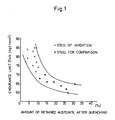
- Fig. 1 is a graph showing, by plotting, the relationship between the endurance shown in Table 1 and the amount of retained austenite ⁇ R after quenching. As seen from Fig. 1, the endurance limit is reduced considerably when the amount of retained austenite reaches 10 % or more. All of sample steels according to the present invention exhibited a retained-austenite content of less than 10 %, thus ensuring satisfactory fatigue strength. The relationship between the endurance limit and the content ratios of different impurities, i.e., oxygen and nitrogen, was examined for some of the sample steels. Sample No. 2a, which contains 0.0020 % oxygen and 0.0100 % nitrogen, as shown in Table 1, exhibited a endurance limit of 75 kgf/mm2, while Sample No.
- suspension springs depends considerably on their relaxation resistance.
- the warm relaxation resistance of the suspension springs has recently become the object of public attention.
- a torsional creep test was conducted under the aforementioned conditions.
- the steel according to the present invention proved much superior to the currently used material, JIS SUP 7 (equivalent to AISI 9260), in shearing creep strain after 72 hours of testing and in relaxation resistance.
Landscapes
- Chemical & Material Sciences (AREA)
- Engineering & Computer Science (AREA)
- Materials Engineering (AREA)
- Mechanical Engineering (AREA)
- Metallurgy (AREA)
- Organic Chemistry (AREA)
- Heat Treatment Of Articles (AREA)
- Springs (AREA)
Applications Claiming Priority (1)
| Application Number | Priority Date | Filing Date | Title |
|---|---|---|---|
| JP25297886A JPH0796697B2 (ja) | 1986-10-24 | 1986-10-24 | 高強度ばね用鋼 |
Publications (2)
| Publication Number | Publication Date |
|---|---|
| EP0265273A2 true EP0265273A2 (fr) | 1988-04-27 |
| EP0265273A3 EP0265273A3 (fr) | 1989-01-18 |
Family
ID=17244799
Family Applications (1)
| Application Number | Title | Priority Date | Filing Date |
|---|---|---|---|
| EP87309368A Withdrawn EP0265273A3 (fr) | 1986-10-24 | 1987-10-22 | Acier à haute résistance, pour ressorts |
Country Status (2)
| Country | Link |
|---|---|
| EP (1) | EP0265273A3 (fr) |
| JP (1) | JPH0796697B2 (fr) |
Cited By (7)
| Publication number | Priority date | Publication date | Assignee | Title |
|---|---|---|---|---|
| EP0400564A1 (fr) * | 1989-05-29 | 1990-12-05 | Aichi Steel Works, Ltd. | Acier pour ressorts, présentant une haute durabilité et une bonne résistance à l'affaissement |
| FR2682124A1 (fr) * | 1991-10-02 | 1993-04-09 | Kobe Steel Ltd | Acier a ressort a haute resistance. |
| EP0614994A1 (fr) * | 1993-02-17 | 1994-09-14 | Sumitomo Electric Industries, Ltd. | Fils d'acier à ressort et procédé pour leur fabrication |
| EP0657557A1 (fr) * | 1993-11-04 | 1995-06-14 | Kabushiki Kaisha Kobe Seiko Sho | Acier à ressort à résistance mécanique et résistance à la corrosion élevée |
| DE4480344T1 (de) * | 1993-12-29 | 1996-02-22 | Po Hang Iron & Steel | Federstahl von hoher Festigkeit und hoher Zähigkeit, sowie Herstellungsverfahren dafür |
| WO1997045565A1 (fr) * | 1996-05-29 | 1997-12-04 | Datec Scherdel Datentechnik, Forschungs- Und Entwicklungs-Gmbh | Ressort d'acier resistant au relachement |
| FR2784119A1 (fr) * | 1998-10-01 | 2000-04-07 | Nippon Steel Corp | Fil d'acier pour ressorts et son procede de production |
Families Citing this family (4)
| Publication number | Priority date | Publication date | Assignee | Title |
|---|---|---|---|---|
| JPH0830246B2 (ja) * | 1987-03-05 | 1996-03-27 | 大同特殊鋼株式会社 | 高強度ばね用鋼 |
| JPH0713269B2 (ja) * | 1990-08-01 | 1995-02-15 | 新日本製鐵株式会社 | 高疲労強度ばねの製造法 |
| JPH04311529A (ja) * | 1991-04-10 | 1992-11-04 | Sugita Seisen Kojo:Kk | 高強度高靱性ばね用オイルテンパー鋼線の連続熱処理方法 |
| JPH08158013A (ja) | 1994-10-03 | 1996-06-18 | Daido Steel Co Ltd | 耐食性バネ用鋼 |
Family Cites Families (4)
| Publication number | Priority date | Publication date | Assignee | Title |
|---|---|---|---|---|
| US2914401A (en) * | 1958-02-24 | 1959-11-24 | Crucible Steel Co America | Alloy steel |
| GB1179074A (en) * | 1967-05-24 | 1970-01-28 | Int Nickel Ltd | Steel |
| JPS6089553A (ja) * | 1983-10-19 | 1985-05-20 | Daido Steel Co Ltd | 高強度ばね用鋼および前記鋼を使用した高強度ばねの製造方法 |
| US20110188071A1 (en) | 2007-12-12 | 2011-08-04 | Kenji Yoshida | Information input device, information processing device, information input system, information processing system, two-dimensional format information server, information input method, control program, and recording medium |
-
1986
- 1986-10-24 JP JP25297886A patent/JPH0796697B2/ja not_active Expired - Fee Related
-
1987
- 1987-10-22 EP EP87309368A patent/EP0265273A3/fr not_active Withdrawn
Cited By (11)
| Publication number | Priority date | Publication date | Assignee | Title |
|---|---|---|---|---|
| EP0400564A1 (fr) * | 1989-05-29 | 1990-12-05 | Aichi Steel Works, Ltd. | Acier pour ressorts, présentant une haute durabilité et une bonne résistance à l'affaissement |
| US5009843A (en) * | 1989-05-29 | 1991-04-23 | Aichi Steel Works, Ltd. | Spring steel having good durability and sag-resistance |
| FR2682124A1 (fr) * | 1991-10-02 | 1993-04-09 | Kobe Steel Ltd | Acier a ressort a haute resistance. |
| US5286312A (en) * | 1991-10-02 | 1994-02-15 | Kabushiki Kaisha Kobe Seiko Sho | High-strength spring steel |
| EP0614994A1 (fr) * | 1993-02-17 | 1994-09-14 | Sumitomo Electric Industries, Ltd. | Fils d'acier à ressort et procédé pour leur fabrication |
| US5904830A (en) * | 1993-02-17 | 1999-05-18 | Sumitomo Electric Industries, Ltd. | Process for finishing steelwire |
| EP0657557A1 (fr) * | 1993-11-04 | 1995-06-14 | Kabushiki Kaisha Kobe Seiko Sho | Acier à ressort à résistance mécanique et résistance à la corrosion élevée |
| US5508002A (en) * | 1993-11-04 | 1996-04-16 | Kabushiki Kaisha Kobe Seiko Sho | Spring steel of high strength and high corrosion resistance |
| DE4480344T1 (de) * | 1993-12-29 | 1996-02-22 | Po Hang Iron & Steel | Federstahl von hoher Festigkeit und hoher Zähigkeit, sowie Herstellungsverfahren dafür |
| WO1997045565A1 (fr) * | 1996-05-29 | 1997-12-04 | Datec Scherdel Datentechnik, Forschungs- Und Entwicklungs-Gmbh | Ressort d'acier resistant au relachement |
| FR2784119A1 (fr) * | 1998-10-01 | 2000-04-07 | Nippon Steel Corp | Fil d'acier pour ressorts et son procede de production |
Also Published As
| Publication number | Publication date |
|---|---|
| JPS63109144A (ja) | 1988-05-13 |
| EP0265273A3 (fr) | 1989-01-18 |
| JPH0796697B2 (ja) | 1995-10-18 |
Similar Documents
| Publication | Publication Date | Title |
|---|---|---|
| US5286312A (en) | High-strength spring steel | |
| JP3233188B2 (ja) | 高靱性ばね用オイルテンパー線およびその製造方法 | |
| EP0838533B1 (fr) | Alliage réfractaire pour soupape d'échappement et procédé pour la fabrication de la soupape d'échappement | |
| EP1491647B1 (fr) | Fil d'acier pour un ressort etire presentant d'excellentes caracteristiques de resistance a la fatigue et au tassement | |
| EP0643148B1 (fr) | Materiau en acier pour partie d'arbre trempee par induction et partie d'arbre ainsi produite | |
| US4409026A (en) | Spring steel for vehicles | |
| JP2003105485A (ja) | 耐水素疲労破壊特性に優れた高強度ばね用鋼およびその製造方法 | |
| US5225008A (en) | Method for manufacturing a high-strength spring | |
| KR960005230B1 (ko) | 고강도 고인성 스프링용강의 제조방법 | |
| EP1612287B1 (fr) | Utilisation d'acier pour ressort presentant une excellente resistance a la fatigue et d'excellentes caracteristiques de fatigue | |
| JP4403624B2 (ja) | 軟窒化用非調質鋼及び軟窒化非調質クランク軸とその製造方法 | |
| EP0124348B1 (fr) | Aciers résistant aux températures élevées | |
| US5258082A (en) | High strength spring | |
| JP3918587B2 (ja) | 冷間成形用ばね鋼 | |
| JPS6250542B2 (fr) | ||
| JPS63109144A (ja) | 高強度ばね用鋼 | |
| JPWO2000068450A1 (ja) | 耐硫化物割れ性に優れた高強度油井用鋼材及びその製造方法 | |
| JP2650225B2 (ja) | ばね用鋼 | |
| CN105861940A (zh) | 大型锻造用钢及大型锻造部件 | |
| JP3720750B2 (ja) | コネクティングロッドの製造方法およびコネクティングロッド | |
| Assefpour-Dezfuly et al. | Parameters affecting sag resistance in spring steels | |
| JP2739713B2 (ja) | 高強度ボルト | |
| JPH064904B2 (ja) | ばね用▲高▼強度オイルテンパー線 | |
| JPH05148581A (ja) | 高強度ばね用鋼および高強度ばねの製造方法 | |
| JPH0830246B2 (ja) | 高強度ばね用鋼 |
Legal Events
| Date | Code | Title | Description |
|---|---|---|---|
| PUAI | Public reference made under article 153(3) epc to a published international application that has entered the european phase |
Free format text: ORIGINAL CODE: 0009012 |
|
| AK | Designated contracting states |
Kind code of ref document: A2 Designated state(s): DE FR GB IT |
|
| PUAL | Search report despatched |
Free format text: ORIGINAL CODE: 0009013 |
|
| AK | Designated contracting states |
Kind code of ref document: A3 Designated state(s): DE FR GB IT |
|
| STAA | Information on the status of an ep patent application or granted ep patent |
Free format text: STATUS: THE APPLICATION IS DEEMED TO BE WITHDRAWN |
|
| 18D | Application deemed to be withdrawn |
Effective date: 19890812 |
|
| RIN1 | Information on inventor provided before grant (corrected) |
Inventor name: IIKUBO, TOMOHITO Inventor name: ITO, YUKIO |