EP0265690A2 - Procédé et dispositif pour déterminer la présence des microorganismes dans des liqueurs du corps - Google Patents
Procédé et dispositif pour déterminer la présence des microorganismes dans des liqueurs du corps Download PDFInfo
- Publication number
- EP0265690A2 EP0265690A2 EP87114198A EP87114198A EP0265690A2 EP 0265690 A2 EP0265690 A2 EP 0265690A2 EP 87114198 A EP87114198 A EP 87114198A EP 87114198 A EP87114198 A EP 87114198A EP 0265690 A2 EP0265690 A2 EP 0265690A2
- Authority
- EP
- European Patent Office
- Prior art keywords
- column
- sorbent
- diagnosis
- culture medium
- packed
- Prior art date
- Legal status (The legal status is an assumption and is not a legal conclusion. Google has not performed a legal analysis and makes no representation as to the accuracy of the status listed.)
- Withdrawn
Links
- 244000005700 microbiome Species 0.000 title claims abstract description 16
- 238000000034 method Methods 0.000 title claims abstract description 15
- 239000002594 sorbent Substances 0.000 claims abstract description 27
- 238000003745 diagnosis Methods 0.000 claims abstract description 25
- 239000001963 growth medium Substances 0.000 claims abstract description 24
- 238000005192 partition Methods 0.000 claims abstract description 11
- 239000000560 biocompatible material Substances 0.000 claims abstract description 6
- 230000004913 activation Effects 0.000 claims abstract description 4
- 239000011148 porous material Substances 0.000 claims abstract description 3
- 239000002245 particle Substances 0.000 claims description 9
- 239000010410 layer Substances 0.000 claims description 4
- NIXOWILDQLNWCW-UHFFFAOYSA-M Acrylate Chemical compound [O-]C(=O)C=C NIXOWILDQLNWCW-UHFFFAOYSA-M 0.000 claims description 2
- CERQOIWHTDAKMF-UHFFFAOYSA-M Methacrylate Chemical compound CC(=C)C([O-])=O CERQOIWHTDAKMF-UHFFFAOYSA-M 0.000 claims description 2
- 239000002504 physiological saline solution Substances 0.000 claims description 2
- 239000011241 protective layer Substances 0.000 claims description 2
- 239000002609 medium Substances 0.000 claims 1
- -1 Polypropylene, ethylene - propylene copolymers Polymers 0.000 description 14
- 241000894006 Bacteria Species 0.000 description 10
- 210000004369 blood Anatomy 0.000 description 8
- 239000008280 blood Substances 0.000 description 8
- 238000002474 experimental method Methods 0.000 description 7
- 239000004743 Polypropylene Substances 0.000 description 6
- 239000003610 charcoal Substances 0.000 description 6
- 230000017531 blood circulation Effects 0.000 description 5
- 229920001155 polypropylene Polymers 0.000 description 5
- 239000000463 material Substances 0.000 description 4
- 235000013162 Cocos nucifera Nutrition 0.000 description 3
- 244000060011 Cocos nucifera Species 0.000 description 3
- 241000588724 Escherichia coli Species 0.000 description 3
- 238000011109 contamination Methods 0.000 description 3
- 229920001577 copolymer Polymers 0.000 description 3
- 238000001514 detection method Methods 0.000 description 3
- 239000007788 liquid Substances 0.000 description 3
- 230000000813 microbial effect Effects 0.000 description 3
- 102000009123 Fibrin Human genes 0.000 description 2
- 108010073385 Fibrin Proteins 0.000 description 2
- BWGVNKXGVNDBDI-UHFFFAOYSA-N Fibrin monomer Chemical compound CNC(=O)CNC(=O)CN BWGVNKXGVNDBDI-UHFFFAOYSA-N 0.000 description 2
- FAPWRFPIFSIZLT-UHFFFAOYSA-M Sodium chloride Chemical compound [Na+].[Cl-] FAPWRFPIFSIZLT-UHFFFAOYSA-M 0.000 description 2
- 241000191940 Staphylococcus Species 0.000 description 2
- 230000015572 biosynthetic process Effects 0.000 description 2
- 239000003795 chemical substances by application Substances 0.000 description 2
- 239000011248 coating agent Substances 0.000 description 2
- 238000000576 coating method Methods 0.000 description 2
- 238000007599 discharging Methods 0.000 description 2
- 229950003499 fibrin Drugs 0.000 description 2
- 239000012530 fluid Substances 0.000 description 2
- 208000015181 infectious disease Diseases 0.000 description 2
- 238000009630 liquid culture Methods 0.000 description 2
- 238000004519 manufacturing process Methods 0.000 description 2
- 230000035515 penetration Effects 0.000 description 2
- 229920002338 polyhydroxyethylmethacrylate Polymers 0.000 description 2
- 229920000642 polymer Polymers 0.000 description 2
- 229920001343 polytetrafluoroethylene Polymers 0.000 description 2
- OKTJSMMVPCPJKN-UHFFFAOYSA-N Carbon Chemical class [C] OKTJSMMVPCPJKN-UHFFFAOYSA-N 0.000 description 1
- 241000588722 Escherichia Species 0.000 description 1
- 206010037660 Pyrexia Diseases 0.000 description 1
- 241000191967 Staphylococcus aureus Species 0.000 description 1
- 238000004026 adhesive bonding Methods 0.000 description 1
- 230000023555 blood coagulation Effects 0.000 description 1
- 210000001772 blood platelet Anatomy 0.000 description 1
- 238000007664 blowing Methods 0.000 description 1
- 210000004027 cell Anatomy 0.000 description 1
- 230000006866 deterioration Effects 0.000 description 1
- 210000003743 erythrocyte Anatomy 0.000 description 1
- 238000001125 extrusion Methods 0.000 description 1
- 239000004744 fabric Substances 0.000 description 1
- 230000027950 fever generation Effects 0.000 description 1
- 230000001524 infective effect Effects 0.000 description 1
- 230000036512 infertility Effects 0.000 description 1
- 238000001746 injection moulding Methods 0.000 description 1
- 238000011081 inoculation Methods 0.000 description 1
- 239000002648 laminated material Substances 0.000 description 1
- 210000000265 leukocyte Anatomy 0.000 description 1
- 239000003446 ligand Substances 0.000 description 1
- 210000004185 liver Anatomy 0.000 description 1
- 230000002906 microbiologic effect Effects 0.000 description 1
- 238000009629 microbiological culture Methods 0.000 description 1
- 238000000465 moulding Methods 0.000 description 1
- 238000010137 moulding (plastic) Methods 0.000 description 1
- 230000001453 nonthrombogenic effect Effects 0.000 description 1
- 230000010412 perfusion Effects 0.000 description 1
- 239000004417 polycarbonate Substances 0.000 description 1
- 229920000728 polyester Polymers 0.000 description 1
- 229920002635 polyurethane Polymers 0.000 description 1
- 239000004814 polyurethane Substances 0.000 description 1
- 230000000644 propagated effect Effects 0.000 description 1
- 238000005070 sampling Methods 0.000 description 1
- 239000011780 sodium chloride Substances 0.000 description 1
- 239000007787 solid Substances 0.000 description 1
- 239000000243 solution Substances 0.000 description 1
- 229910001220 stainless steel Inorganic materials 0.000 description 1
- 239000010935 stainless steel Substances 0.000 description 1
- 230000001954 sterilising effect Effects 0.000 description 1
- 238000004659 sterilization and disinfection Methods 0.000 description 1
- 239000000126 substance Substances 0.000 description 1
- 239000000758 substrate Substances 0.000 description 1
- 229920002994 synthetic fiber Polymers 0.000 description 1
- 229920003002 synthetic resin Polymers 0.000 description 1
- 239000000057 synthetic resin Substances 0.000 description 1
- 230000007704 transition Effects 0.000 description 1
- 238000002604 ultrasonography Methods 0.000 description 1
- 238000003466 welding Methods 0.000 description 1
Images
Classifications
-
- C—CHEMISTRY; METALLURGY
- C12—BIOCHEMISTRY; BEER; SPIRITS; WINE; VINEGAR; MICROBIOLOGY; ENZYMOLOGY; MUTATION OR GENETIC ENGINEERING
- C12Q—MEASURING OR TESTING PROCESSES INVOLVING ENZYMES, NUCLEIC ACIDS OR MICROORGANISMS; COMPOSITIONS OR TEST PAPERS THEREFOR; PROCESSES OF PREPARING SUCH COMPOSITIONS; CONDITION-RESPONSIVE CONTROL IN MICROBIOLOGICAL OR ENZYMOLOGICAL PROCESSES
- C12Q1/00—Measuring or testing processes involving enzymes, nucleic acids or microorganisms; Compositions therefor; Processes of preparing such compositions
- C12Q1/02—Measuring or testing processes involving enzymes, nucleic acids or microorganisms; Compositions therefor; Processes of preparing such compositions involving viable microorganisms
- C12Q1/04—Determining presence or kind of microorganism; Use of selective media for testing antibiotics or bacteriocides; Compositions containing a chemical indicator therefor
-
- C—CHEMISTRY; METALLURGY
- C12—BIOCHEMISTRY; BEER; SPIRITS; WINE; VINEGAR; MICROBIOLOGY; ENZYMOLOGY; MUTATION OR GENETIC ENGINEERING
- C12M—APPARATUS FOR ENZYMOLOGY OR MICROBIOLOGY; APPARATUS FOR CULTURING MICROORGANISMS FOR PRODUCING BIOMASS, FOR GROWING CELLS OR FOR OBTAINING FERMENTATION OR METABOLIC PRODUCTS, i.e. BIOREACTORS OR FERMENTERS
- C12M25/00—Means for supporting, enclosing or fixing the microorganisms, e.g. immunocoatings
- C12M25/02—Membranes; Filters
-
- C—CHEMISTRY; METALLURGY
- C12—BIOCHEMISTRY; BEER; SPIRITS; WINE; VINEGAR; MICROBIOLOGY; ENZYMOLOGY; MUTATION OR GENETIC ENGINEERING
- C12M—APPARATUS FOR ENZYMOLOGY OR MICROBIOLOGY; APPARATUS FOR CULTURING MICROORGANISMS FOR PRODUCING BIOMASS, FOR GROWING CELLS OR FOR OBTAINING FERMENTATION OR METABOLIC PRODUCTS, i.e. BIOREACTORS OR FERMENTERS
- C12M29/00—Means for introduction, extraction or recirculation of materials, e.g. pumps
- C12M29/04—Filters; Permeable or porous membranes or plates, e.g. dialysis
-
- C—CHEMISTRY; METALLURGY
- C12—BIOCHEMISTRY; BEER; SPIRITS; WINE; VINEGAR; MICROBIOLOGY; ENZYMOLOGY; MUTATION OR GENETIC ENGINEERING
- C12M—APPARATUS FOR ENZYMOLOGY OR MICROBIOLOGY; APPARATUS FOR CULTURING MICROORGANISMS FOR PRODUCING BIOMASS, FOR GROWING CELLS OR FOR OBTAINING FERMENTATION OR METABOLIC PRODUCTS, i.e. BIOREACTORS OR FERMENTERS
- C12M29/00—Means for introduction, extraction or recirculation of materials, e.g. pumps
- C12M29/10—Perfusion
-
- Y—GENERAL TAGGING OF NEW TECHNOLOGICAL DEVELOPMENTS; GENERAL TAGGING OF CROSS-SECTIONAL TECHNOLOGIES SPANNING OVER SEVERAL SECTIONS OF THE IPC; TECHNICAL SUBJECTS COVERED BY FORMER USPC CROSS-REFERENCE ART COLLECTIONS [XRACs] AND DIGESTS
- Y10—TECHNICAL SUBJECTS COVERED BY FORMER USPC
- Y10S—TECHNICAL SUBJECTS COVERED BY FORMER USPC CROSS-REFERENCE ART COLLECTIONS [XRACs] AND DIGESTS
- Y10S435/00—Chemistry: molecular biology and microbiology
- Y10S435/803—Physical recovery methods, e.g. chromatography, grinding
Definitions
- the invention pertains to a method for the determination of the presence of microorganisms in body liquors and to a diagnosis column for performing this method.
- An efficient method for the detection of an infective microbial agent causing pyrexia in blood is the diagnostic perfusion.
- Blood of the examinated person flows through a column packed with sorbent particles for a predetermined period of time.
- the total blood volume of an adult patient passes through the column in about 60 min at a flow rate of 100 ⁇ ml min ⁇ 1.
- the method for the determination of the presence of microorganisms causing septic states in body liquors avoids the avobe-mentioned disadvantage.
- Body liquor is first allowed to flow through a column packed with a sorbent which traps microorganisms.
- the residual body liquor is displaced by physiological saline, whereupon the column is filled with a culture medium in such a way that the all sorbent is immersed, and the cultivation is carried out directly in the column.
- the culture medium is discharged from the column, preferably by suction, and the presence of microorganisms is determined by methods known as such.
- the diagnosis column for performing the method according to the invention is made of a biocompatible material, has a smooth inner surface, advantageously with longitudinal ribs, is packed with a sorbent placed between partitions made of a porous material, and is characterized by a jacket consisting of a cylindrical body and conical terminals with a mutual volume ratio of 1:0,3 to 1:5, whereby the supporting partitions have different porosity.
- the diagnosis column according to the invention has a total inner volume of 30 to 300 ml.
- the volume of the column cylindrical body is about 10 to 100 ml, and the total volume of both terminals is about 20 to 200 ml.
- the partitions separating the sorbent may have different porosity.
- the partition near the outlet terminal is advantageously formed of several layers having different porosity, preferably 2000 to 80, 150 to 50, and 80 to 20 ⁇ m.
- the inner surface of column body may advantageously be provided with ribs.
- the diagnosis column according to the invention is packed with a sorbent advantageously coated with a protective layer of a bicompatible polymer of methacrylate or acrylate type preferably in an amount of 0,01 to 20 mass-%.
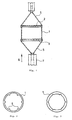
- Fig. 1 shows a longitudinal cross-section of the column
- Figs. 2 and 3 show a horizontal cross-section through the column provided with ribs.
- the column according to Fig. 1 consists of a column body 1 which is connected, via porous partitions 2 and 3 separating the sorbent 4, with conical terminals 5 with attached inlet and outlet tubes 7.
- the arrow S in Fig. 1 indicates the direction of blood flow.
- An arbitrary number of ribs 6 may be provided.
- Figs. 2 and 3 schematically show horizontal cross-sections with marked ribs. An arbitrary number of ribs 6 may be provided.
- the column material has to be strong, biocompatible and non-thrombogenic, and has to withstand sterilization.
- Polypropylene, ethylene - propylene copolymers, polycarbonates, poly(tetrafluoroethylene) and similar materials can be used. These polymers may be processed by injection moulding or extrusion blowing.
- the shape of the column represents a suitable compromise between the demands on blood through-flow and technical and economical production aspects.
- the column must have a smooth inner surface advantageously provided with longitudinal ribs 6 which assist in directing the blood flow and reducing the motion of sorbent grains 4, and increase the strength of the jacket.
- the column body 1 and the conical terminals 5 are designed in such a way that the transitions between them are completely smooth.
- the connection of the body 1 to the terminal 5 is realized by adhesion, adhesion gluing or by heat, ultrafrequency or ultrasound welding.
- the spaces of terminals 5 and column body 1 are separated with screens 2, 3 which act as support of the sorbent 4 inside the column and at the same time prevent from penetration of the sorbent 4 into the terminal 5 or as far as into the blood circulation of the patient.
- the screens 2, 3 may be made of stainless steel, synthetic fabric, or plastic mouldings. Their material has to meet the same conditions as the material of the column jacket. A polypropylene or polyester fabric or porous polyurethane may be used. Both screens 2, 3 may have the same or different density. It is advantageous to use a denser screen 2 in the outlet terminal where it acts as a protection against the penetration of thrombs, which may form in the column, into the blood circulation of the patient.
- the mesh size of the screen 2 may range from 40 ⁇ m to an upper limit which is determined by the grain size of the sorbent 4.
- the screens 2, 3 may be of multiple type and consist of several layers of different porosity.
- the sorbent 4 is packed into the column by means of an isotonic apyrogenic solution of sodium chloride before the outlet terminal with the screen 2 is attached.
- the sorbent 4 may active charcoal preferably made from coconut shells or a synthetic resin.
- the optimal particle size is 0,3 to 0,7 mm.
- the packed column is then closed with the upper terminal, provided with tubes 7 at both ends and sterilized for 2 h at 120 °C in an autoclave.
- the diagnosis column contains microbial cells trapped from patient's blood on the surface of the sorbent 4. Their detection and further determination require the cultivation of the sorbent in a culture medium suitable for the growth of the respective microbes.
- the diagnosis column according to the invention is designed such that the cultivation can be carried out directly in the column in a liquid culture medium. Opening of the column and handling of the sorbent are not necessary, and the possible contamination of the column content and of laboratory personal are prevented.
- the tubes 7 at both ends of the column may serve for handling of the liquid content of the column (discharging of the liquid content, charging with a culture medium, inoculation of the grown microbial culture) because they can easily be punctured with a hypodermic needle, and the fluid content may be handled by means of a syringe.
- An air filter trapping the contingent air contamination can be provided at the end of the tube 7 during discharging the fluid content of the column.
- liquid culture media either commercial or prepared in laboratory may be used as the cultivation charge.
- the volume of the culture medium must be sufficient to immerse or cover all particles of the sorbent 4.
- Microorganisms are trapped above all in a biological coating which is formed on the surface of particles present in blood.
- the system of blood coagulation plays an important role in the formation of this coating.
- a fibrin network is formed on the surface of the particles which traps blood platelets, a small number of red and white blood cells, and other corpuscles including microorganisms.
- a mechanical trapping of microorganisms in the fibrin network and various specific and non-specific receptors and ligands contribute to this process.
- the sorbent particles 4 can be made from an inorganic or organic substance, from their combinations, and from laminated materials, and may have various shape, size and internal structure.
- a biocompatible material is suitable as it prevents from the formation and growth of thrombs on the particles.
- the diagnostic column according to the invention has many advantages in comparison with similar columns heretofore used.
- the firm connection of the column body 1 with the terminals 5 warrants the necessary sterility of column much better than the commonly used screw closure with uncertain tightness. This substantially extends the expiration time, i.e. the period of column applicability, which is advantageous from the point of view of production as well as of clinical practice.
- the column according to the invention is designed such that it allows cultivation of trapped bacteria without opening and handling of the sorbent. It is suited for working in a closed and strictly sterile system which excludes the possibility of contamination from outside and deterioration of the test results. At the same time, the risk of infection of medical and laboratory attendances is reduced to a minimum. Further, it enables optimal conditions for trapping and cultivation of bacteria from blood and thus substantially improves the diagnosis of septic states.
- the invention is further described by way of examples.
- a diagnosis column having a volume of 50 ml made from polypropylene (screens with a mesh size of 290 ⁇ m) and packed with active charcoal from coconut shells (Chemviron SC XII) with an untreated surface was used in an experiment with an animal infected with rod-like Escherichia coli bacteria.
- the haemoperfusion was carried out for 1 h at a rate of 20 ml/min.
- the tube was punctured at the end of the column, and the liquid content was removed by suction with a hypodermic syringe and needle.
- the column was then charged in the same way with a culture medium (liver stock) in such amount that the sorbent was completely immersed.
- the column charged with the culture medium was kept for 24 h at 37 °C. After completion of the activation, a sample of the culture medium was withdrawn in the same manner as the column was earlier discharged.
- the propagated bacteria were identified microscopically and by further cultivation on solid cultivation substrates.
- a diagnosis column having a volume of 30 ml made from polypropylene (screens with a mesh size of 300 ⁇ m) and packed with active charcoal having the surface modified with 3 mass-% of poly(2-hydroxyethyl methacrylate) was used in an experiment with an animal infected with rod-like Escherichia coli bacteria.
- the haemoperfusion was carried out for 1 h at a rate of 20 ml/min. After 24 h of cultivation, the bacteria were then isolated from a culture medium in the column.
- a diagnosis column having a volume of 70 ml made from polypropylene (screens with a mesh size of 300 ⁇ m) and packed with active charcoal from coconut shells (Chemviron SC II) having the surface modified with 3 mass-% of poly(2-hydroxyethyl methacrylate) was used in an experiment with an animal infected with coccobacillus Staphylococcus aureaus.
- the haemoperfusion was carried out for 1 h at a rate of 20 ml/min. After 24 h of cultivation, the bacteria were isolated from a culture medium in the column.
- a diagnosis column having a volume of 50 ml made from polypropylene (screens with a mesh size 290 ⁇ m) and packed with active charcoal (Chemviron SC XII) with untreated surface was used in an experiment with an animal infected with coccobacillus Staphylococcus aureus. The haemoperfusion was carried out for 1 h at a rate of 20 ml/min. The bacteria were then isolated from a culture medium in the column after 24 h of cultivation.
- a diagnosis column having a volume of 150 ml made from poly(tetraethylene) (mesh size of 200 ⁇ m at the inlet screen and of 75 ⁇ m at the outlet screen) packed with a styrene - divinylbenzene copolymer (Synachrom E5) was used in an experiment with an animal infected with rod-like Escherichia coli bacteria.
- the haemoperfusion was carried out for 1,5 h at a rate of 20 ml/min.
- the bacteria were then isolated from a culture medium in the column after 24 h of cultivation.
- a diagnosis column having a volume of 100 ml made from poly(tetrafluoroethylene) (mesh size of 290 ⁇ m at the inlet screen and of 150 ⁇ m at the outlet screen) and packed with a styrene - divinylbenzene copolymer (Persorb) was used in an experiment with an animal infected with rod-like Escherichia coil bacteria. The haemoperfusion was carried out for 1 h at a rate of 25 ml/min. The bacteria were then isolated from a culture medium in the column after 24 h of cultivation.
- a diagnosis column having a volume of 300 ml made from polypropylene (screens with a mesh size of 214 ⁇ m) and packed with a styrene - divinylbenzene copolymer (Persorb) having their surface modified with 0,1 mass-% of poly(2-hydroxypropyl acrylate) was used in an experiment with an animal infected with coccobacillus Staphylococcus aureaus.
- the haemoperfusion was carried out for 2 h at a rate of 18 ml/min.
- the bacteria were then isolated from a culture medium in the column after 24 h of cultivation.
Landscapes
- Chemical & Material Sciences (AREA)
- Health & Medical Sciences (AREA)
- Organic Chemistry (AREA)
- Life Sciences & Earth Sciences (AREA)
- Engineering & Computer Science (AREA)
- Wood Science & Technology (AREA)
- Zoology (AREA)
- Bioinformatics & Cheminformatics (AREA)
- General Engineering & Computer Science (AREA)
- Biotechnology (AREA)
- Microbiology (AREA)
- General Health & Medical Sciences (AREA)
- Genetics & Genomics (AREA)
- Biochemistry (AREA)
- Sustainable Development (AREA)
- Biomedical Technology (AREA)
- Immunology (AREA)
- Proteomics, Peptides & Aminoacids (AREA)
- Biophysics (AREA)
- Molecular Biology (AREA)
- Analytical Chemistry (AREA)
- Physics & Mathematics (AREA)
- Toxicology (AREA)
- Apparatus Associated With Microorganisms And Enzymes (AREA)
- Measuring Or Testing Involving Enzymes Or Micro-Organisms (AREA)
- Solid-Sorbent Or Filter-Aiding Compositions (AREA)
- External Artificial Organs (AREA)
Applications Claiming Priority (2)
| Application Number | Priority Date | Filing Date | Title |
|---|---|---|---|
| CS6957/86 | 1986-09-29 | ||
| CS866957A CS265063B1 (en) | 1986-09-29 | 1986-09-29 | Diagnostic column |
Publications (2)
| Publication Number | Publication Date |
|---|---|
| EP0265690A2 true EP0265690A2 (fr) | 1988-05-04 |
| EP0265690A3 EP0265690A3 (fr) | 1988-10-12 |
Family
ID=5417796
Family Applications (1)
| Application Number | Title | Priority Date | Filing Date |
|---|---|---|---|
| EP87114198A Withdrawn EP0265690A3 (fr) | 1986-09-29 | 1987-09-29 | Procédé et dispositif pour déterminer la présence des microorganismes dans des liqueurs du corps |
Country Status (3)
| Country | Link |
|---|---|
| US (1) | US4962036A (fr) |
| EP (1) | EP0265690A3 (fr) |
| CS (1) | CS265063B1 (fr) |
Cited By (1)
| Publication number | Priority date | Publication date | Assignee | Title |
|---|---|---|---|---|
| US8618201B2 (en) | 2011-03-08 | 2013-12-31 | Basf Se | Laser-transparent polyesters with inorganic salts |
Families Citing this family (13)
| Publication number | Priority date | Publication date | Assignee | Title |
|---|---|---|---|---|
| US5612187A (en) * | 1994-03-22 | 1997-03-18 | Espress Tech, Inc. | Clot lysis time determining device and method for determining the time necessary for fluid to lyse a clot, and clot supporter |
| US5817032A (en) | 1996-05-14 | 1998-10-06 | Biopath Automation Llc. | Means and method for harvesting and handling tissue samples for biopsy analysis |
| WO1998039409A1 (fr) * | 1997-03-06 | 1998-09-11 | Osmetech Plc | Dispositif d'analyse de microorganismes |
| US20070166834A1 (en) * | 1998-10-05 | 2007-07-19 | Biopath Automation, L.L.C. | Apparatus and method for harvesting and handling tissue samples for biopsy analysis |
| US6712976B2 (en) * | 2001-09-13 | 2004-03-30 | Abtech Industries, Inc. | Dual-action decontamination system |
| US7179424B2 (en) * | 2002-09-26 | 2007-02-20 | Biopath Automation, L.L.C. | Cassette for handling and holding tissue samples during processing, embedding and microtome procedures, and methods therefor |
| EP1545775B1 (fr) * | 2002-09-26 | 2010-06-16 | BioPath Automation, L.L.C. | Cassette et ensemble d'incorporation, dispositifs de stadification, et procedes de manipulation d'echantillons de tissu |
| JP4105164B2 (ja) * | 2002-09-26 | 2008-06-25 | バイオパス・オートメーション・エル・エル・シー | 組織標本のハンドリングおよび包埋を自動化する機器および方法 |
| US7071001B2 (en) | 2003-01-10 | 2006-07-04 | Dnk Associates, Inc. | System and method for in vitro bleeding time testing |
| US8383067B2 (en) | 2006-12-12 | 2013-02-26 | Biopath Automation, L.L.C. | Biopsy support with sectionable resilient cellular material |
| BRPI0923630A2 (pt) * | 2008-12-30 | 2016-01-19 | Biopath Automation Llc | sistemas e métodos de processamento e incorporação de amostras de tecido para biópsia durante processo de histopalogia e de realização de pelo menos parte do mesmo. |
| BRPI1006958B1 (pt) * | 2009-01-22 | 2019-11-19 | Biopath Automation Llc | dispositivos de suporte e orientação de amostras de tecido histológico e métodos de preparação de uma ou mais amostras alongadas de tecido de biópsia para exame histológico |
| DE102011000061B4 (de) * | 2011-01-09 | 2015-10-22 | Technische Universität Dresden | Perfusionsbioreaktor zum Kultivieren von Zellen auf Gerüstmaterialien |
Family Cites Families (9)
| Publication number | Priority date | Publication date | Assignee | Title |
|---|---|---|---|---|
| DE8207121U1 (de) * | 1983-08-25 | Boehringer Mannheim Gmbh, 6800 Mannheim | Vorrichtung zum Nachweis von Bakterien, Pilzen und Viren im Blut | |
| US3402103A (en) * | 1965-01-27 | 1968-09-17 | Crown Zellerbach Corp | Fermentation of carbohydratecontaining materials |
| SE7712058L (sv) * | 1976-11-12 | 1978-05-13 | Ceskoslovenska Akademie Ved | Tredimensionell berare av oorganiskt, porost material och en reaktiv polymer och ett forfarande for framstellning derav |
| DE2826416C3 (de) * | 1978-06-16 | 1980-10-23 | Boehringer Mannheim Gmbh, 6800 Mannheim | Vorrichtung zum Nachweis von Bakterien, Pilzen und Viren im Blut |
| US4286061A (en) * | 1978-09-05 | 1981-08-25 | Corning Glass Works | Method for continuous culturing of microbes |
| GB2041233B (en) * | 1979-02-14 | 1983-08-17 | Fresenius Chem Pharm Ind | Blood filter |
| DE7923865U1 (de) * | 1979-08-22 | 1979-11-08 | Biotest-Serum-Institut Gmbh, 6000 Frankfurt | Mikrofiltrationsgeraet zur filtration von koageln und mikroaggregaten von blut |
| US4351900A (en) * | 1981-01-30 | 1982-09-28 | Millipore Corporation | Test method and apparatus for the presence of microorganisms in ampoule |
| CS248505B1 (en) * | 1983-06-23 | 1987-02-12 | Marie Tlustakova | Method of biocompatible layer production on surface of porous synthetic sorbents' particles |
-
1986
- 1986-09-29 CS CS866957A patent/CS265063B1/cs not_active IP Right Cessation
-
1987
- 1987-09-25 US US07/101,376 patent/US4962036A/en not_active Expired - Fee Related
- 1987-09-29 EP EP87114198A patent/EP0265690A3/fr not_active Withdrawn
Cited By (1)
| Publication number | Priority date | Publication date | Assignee | Title |
|---|---|---|---|---|
| US8618201B2 (en) | 2011-03-08 | 2013-12-31 | Basf Se | Laser-transparent polyesters with inorganic salts |
Also Published As
| Publication number | Publication date |
|---|---|
| US4962036A (en) | 1990-10-09 |
| EP0265690A3 (fr) | 1988-10-12 |
| CS695786A1 (en) | 1989-01-12 |
| CS265063B1 (en) | 1989-09-12 |
Similar Documents
| Publication | Publication Date | Title |
|---|---|---|
| EP0265690A2 (fr) | Procédé et dispositif pour déterminer la présence des microorganismes dans des liqueurs du corps | |
| KR101498138B1 (ko) | 세포 수확 장치 및 시스템 | |
| AU651646B2 (en) | System and method for processing biological fluids | |
| US5587070A (en) | System for processing biological fluid | |
| US4197847A (en) | Method and apparatus for collecting transfusable granulocytes | |
| US4164449A (en) | Surface separation technique for the detection of microbial pathogens | |
| US5540841A (en) | Cardioplegia filter and method for processing cardioplegia fluid | |
| TW201412350A (zh) | 過濾裝置 | |
| US4543328A (en) | Process for detecting pathogens | |
| AU763879B2 (en) | Biological fluid filter and system | |
| DE2826416C3 (de) | Vorrichtung zum Nachweis von Bakterien, Pilzen und Viren im Blut | |
| JP2003507149A (ja) | 循環流体を生物学的に処理するための神経膠星状細胞装置 | |
| AT367795B (de) | Verfahren zum nachweis von erregern im blut | |
| DE4192629B4 (de) | System und Verfahren zum Bearbeiten von biologischen Flüssigkeiten | |
| DE7818078U1 (de) | Vorrichtung zum nachweis von erregern im blut | |
| CZ343991A3 (cs) | Způsob zpracování biologické tekutiny a zařízení k provádění tohoto způsobu |
Legal Events
| Date | Code | Title | Description |
|---|---|---|---|
| PUAI | Public reference made under article 153(3) epc to a published international application that has entered the european phase |
Free format text: ORIGINAL CODE: 0009012 |
|
| AK | Designated contracting states |
Kind code of ref document: A2 Designated state(s): CH DE FR GB LI SE |
|
| PUAL | Search report despatched |
Free format text: ORIGINAL CODE: 0009013 |
|
| AK | Designated contracting states |
Kind code of ref document: A3 Designated state(s): CH DE FR GB LI SE |
|
| 17P | Request for examination filed |
Effective date: 19890104 |
|
| 17Q | First examination report despatched |
Effective date: 19910423 |
|
| STAA | Information on the status of an ep patent application or granted ep patent |
Free format text: STATUS: THE APPLICATION IS DEEMED TO BE WITHDRAWN |
|
| 18D | Application deemed to be withdrawn |
Effective date: 19910904 |
|
| RIN1 | Information on inventor provided before grant (corrected) |
Inventor name: MONHART CSH, VACLAV, MU DR. Inventor name: CERMAK, PAVEL, MU DR. Inventor name: HORAK, JIRI, MU DR., CSC Inventor name: PAROUBEK, MIROSLAV Inventor name: TLUSTAKOVA, MARIE CSC |