EP0265830A2 - Elektrochrome Anzeigevorrichtung - Google Patents
Elektrochrome Anzeigevorrichtung Download PDFInfo
- Publication number
- EP0265830A2 EP0265830A2 EP87115426A EP87115426A EP0265830A2 EP 0265830 A2 EP0265830 A2 EP 0265830A2 EP 87115426 A EP87115426 A EP 87115426A EP 87115426 A EP87115426 A EP 87115426A EP 0265830 A2 EP0265830 A2 EP 0265830A2
- Authority
- EP
- European Patent Office
- Prior art keywords
- electrode
- display device
- electrochromic
- lithium salt
- alkyl ammonium
- Prior art date
- Legal status (The legal status is an assumption and is not a legal conclusion. Google has not performed a legal analysis and makes no representation as to the accuracy of the status listed.)
- Ceased
Links
Images
Classifications
-
- G—PHYSICS
- G02—OPTICS
- G02F—OPTICAL DEVICES OR ARRANGEMENTS FOR THE CONTROL OF LIGHT BY MODIFICATION OF THE OPTICAL PROPERTIES OF THE MEDIA OF THE ELEMENTS INVOLVED THEREIN; NON-LINEAR OPTICS; FREQUENCY-CHANGING OF LIGHT; OPTICAL LOGIC ELEMENTS; OPTICAL ANALOGUE/DIGITAL CONVERTERS
- G02F1/00—Devices or arrangements for the control of the intensity, colour, phase, polarisation or direction of light arriving from an independent light source, e.g. switching, gating or modulating; Non-linear optics
- G02F1/01—Devices or arrangements for the control of the intensity, colour, phase, polarisation or direction of light arriving from an independent light source, e.g. switching, gating or modulating; Non-linear optics for the control of the intensity, phase, polarisation or colour
- G02F1/15—Devices or arrangements for the control of the intensity, colour, phase, polarisation or direction of light arriving from an independent light source, e.g. switching, gating or modulating; Non-linear optics for the control of the intensity, phase, polarisation or colour based on an electrochromic effect
- G02F1/1514—Devices or arrangements for the control of the intensity, colour, phase, polarisation or direction of light arriving from an independent light source, e.g. switching, gating or modulating; Non-linear optics for the control of the intensity, phase, polarisation or colour based on an electrochromic effect characterised by the electrochromic material, e.g. by the electrodeposited material
- G02F1/1523—Devices or arrangements for the control of the intensity, colour, phase, polarisation or direction of light arriving from an independent light source, e.g. switching, gating or modulating; Non-linear optics for the control of the intensity, phase, polarisation or colour based on an electrochromic effect characterised by the electrochromic material, e.g. by the electrodeposited material comprising inorganic material
- G02F1/1525—Devices or arrangements for the control of the intensity, colour, phase, polarisation or direction of light arriving from an independent light source, e.g. switching, gating or modulating; Non-linear optics for the control of the intensity, phase, polarisation or colour based on an electrochromic effect characterised by the electrochromic material, e.g. by the electrodeposited material comprising inorganic material characterised by a particular ion transporting layer, e.g. electrolyte
Definitions
- This invention relates to an electrochromic display device. More particularly, it relates to an electrochromic display device which utilizes color change of an electrochromic compound caused by its reaction with a counter electrode material through an electrolyte.
- a typical electrochromic display device comprises a display electrode comprising a transparent substrate, a transparent electrode formed on an inner surface of the transparent substrate and an electrochromic material layer for display formed on the transparent electrode; a counter electrode comprising a substrate, a conductive layer formed on an inner surface of the substrate and a counter electrode material; and a spacer provided between the display electrode and the counter electrode with their inner surfaces facing each other to shield them to define, between them, an electrolyte chamber which is filled with an electrolyte.
- Such electrochromic display device utilizes coloring of the electrochromic material by applying voltage between the the display electrode and the counter electrode through the electrolyte.
- tungsten oxide (WO3) is used as an electrochromic material, and a lithium salt is used as an electrolyte.
- tungsten oxide turns blue according to the following reaction:
- the electrochromic display device comprising tungsten oxide as an electrochromic material and a solution of a lithium salt in a non-aqueous solution as an electrolyte
- water is added to the electrolyte, and an activated carbon material such as activated carbon fiber is used as a counter electrode material.
- Water is dissociated to liberate H+, which acts in the same manner as Li+ in the electrode.
- An object of the present invention is to provide an electrochromic display device which has large injected charge and can maintains such large injected charge for a long time.
- Another object of the present invention is to provide an electrochromic display device having improved original response characteristics which does not deteriorate for a long time.
- Further object of the present invention is to provide an electrochromic display device which has improved storage stability.
- an electrochromic display device of the present invention comprises a display electrode comprising a transparent substrate, a transparent electrode formed on an inner surface of the transparent substrate and an electrochromic material layer for display made of tungsten oxide and formed on the transparent electrode; a counter electrode comprising a substrate, a conductive layer formed on an inner surface of the substrate and an activated carbon fiber material; and a spacer provided between the display electrode and the counter electrode with their inner surfaces facing each other to shield them to define, between them, an electyrolyte chamber, which is filled with an electrolyte comprising a lithium salt and at least one of tertiary alkyl ammonium salts and quarternary alkyl ammonium salts dissolved in a non-aqueous medium containing a small amount of water.
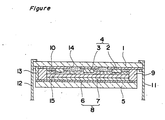
- Figure is a cross section of an electrochromic display device according to the present invention.
- the electrolyte contains the tertiary alkyl ammonium salt and/or the quarternary alkyl ammonium salt as an electrolyte material in addition to the lithium salt in the non-aqueous medium containing a small amount of water.
- an anion e.g. C104 ⁇ in case of LiClO4
- H+ which is liberated from water
- the activated carbon material which is used as the counter electrode may be easily absorbed by the activated carbon material which is used as the counter electrode, and said absorption gradually proceeds during storage of the electrochromic display device.
- a concentration of OH ⁇ increases and, on the other hand, turn a concentration of H+ decreases.
- tungsten oxide tends to be easily dissolved in the electrolyte or to be converted to a material which does not act as electrochromic material such as Li2WO4.
- a tertiary ammonium ion (e.g. (C2H5)3NH+), which is larger than the H+ ion, is liberated and selectively absorbed by the activated carbon material so that the absorption of the H+ ion by the activated carbon material is prevented.
- a tertiary ammonium ion e.g. (C2H5)3NH+
- C2H5H5NH+ tertiary ammonium ion
- the kinds of the electrolytes were as follows: Solution A: 0.1 mole of LiClO4 Solution B: 0.1 mole of LiClO4 and 0.1 mole of (C2H5)3NHClO4 Solution C: 0.03 mole of (C3H7)3NHClO4 Solution D: 0.1 mole of (C2H5)3NHClO4 Solution E: 0.1 mole of LiClO4 and 0.1 mole of (C2H5)4NClO4 Solution F: 0.03 mole of (C3H7)4NClO4 Solution G: 0.1 mole of (C2H5)4NClO4 The results are shown in Table 1.
- the present invention can reduce the amount of water to be added to the electrolyte.
- the tertiary or quarternary alkyl ammonium compound when used, the original charge can be increased even if the water to be added to the electrolyte is decreased.
- the decrease of the amount of water additionally contributes to the storage stability of the electrochromic display device.
- one of the characteristics of the present invention resides in the co-use of the lithium salt and the tertiary or quarternary alkyl ammonium compound in the electrolyte.
- the sole use of the tertiary or quarternary alkyl ammonium compound in the electrolyte is preferred in view of the storage stability of the electrochromic display device as understood from the results for Solutions C, D, F and G in Table 1, it cannot increase the original injected charge satisfactorily.
- the present invention achieves synergistic effects of the lithium salt and the tertiary or quarternary alkyl ammonium compound such that the original injected charge can be made larger than the sole use of not only the lithium salt but also the tertiary or quarternary alkyl ammonium compound.
- the injected charge is maximum when the amount of the lithium salt is 50 to 70 % by mole based on the total moles of the lithium salt and the tertiary or quarternary alkyl ammonium compound. As the amount of the lithium salt increases over 70 % by mole, the injected charge gradually decreases. However, in the range of 30 to 90 % by mole of the lithium salt, the injected charge is still larger than the sole use of the lithium salt.
- lithium salt any of conventionally used salts may be used. Specific exampales of the lithium salt are LiClO4, LiBF4 and LiPF6. Amont them, LiClO4 is preferred.
- tertiary alkyl ammonium compound examples include tertiary C1-C4 alkyl ammonium compounds, preferably such as (CH3)3NHClO4, (C2H5)3NHClO4 and (C3H7)3NHClO4.
- quarternary alkyl ammonium compound examples include quarternary C1-C4 alkyl ammonium compounds, preferably (C2H5)4NClO4 and (C3H7)4NClO4.
- the tertiary or quarternary alkyl ammonium compound contains more than 4 carbon atoms in the alkyl group, it is chemically unstable and not preferred.
- the non-aqueous medium in which the electrolyte materials are dissolved may be any of non-aqueous mediums which are used in the conventional electrochromic display device.
- Specific examples of the non-aqueous medium are propylene carbonate, acetonitrile, ⁇ -butyrolactone, dimethoxyethane, and the like.
- the electrolyte is prepared by dissolving the lithium salt and the tertiary or quarternary alkyl ammonium compound in the non-aqueous medium and then adding a small amount of water to the resulting electrolyte.
- the total amount of the lithium salt and the tertiary or quarternary alkyl ammonium compound is from 0.3 to 1.5 mole, preferably from 0.5 to 1.0 mole per liter of the non-aqueous medium.
- the ratio of the lithium salt to and the tertiary or quarternary alkyl ammonium compound depends on the amount of original injected charge and the storage stability of the electrochromic display device.
- the lithium salt constitutes 30 to 90 % by mole, preferably 40 to 80 % by mole, most preferably 5o to 70 % by mole of the total moles of the lithium salt and the tertiary or quarternary alkyl ammonium compound.
- the amount of the water to be added to the electrolyte also depends on the amount of original injected charge and the storage stability of the electrochromic display device, but may be smaller than the amount of water contained in the electrolyte of the conventional electrochromic display device.
- water is added in an amount of 1 % by weight or less, preferably 0.5 % by weight, more preferably 0.2 % by weight based on the weight of the non-aqueous medium.
- the structure of the electrochromic display device of the present invention may be the same as that of the conventional one.
- the electrochromic display device of the present invention will be illustrated by making reference to the drawing which shows the cross section of the electrochromic display device.
- a substrate 1 is made of a transparent material such as glass
- a display electrode 4 having a pattern comprises a transparent electrode 2 made of an indium-tin oxide (ITO) or SnO2 thin film of 1,000 to 3,000 ⁇ in thickness formed on the transparent substrate 1 by vacuum deposition, spattering, ion plating and the like, and an electrochromic material layer 3 made of a tungsten oxide film of 3,000 to 10,000 ⁇ in thickness, which can be formed on the transparent electrode by the same method as used for the formation of the transparent electrode.
- ITO indium-tin oxide
- SnO2 thin film 1,000 to 3,000 ⁇ in thickness
- a conductive layer 6 made of an electrically conductive material such as noble metal (e.g. gold and platinum), its alloy or the same material as the transparent electrode 2 is provided by the same method as used for forming the transparent electrode 2 or contact bonding or adhesion of a metal foil.
- the thickness of the conductive layer 6 is usually from 1,000 to 5,000 ⁇ .
- an activated carbon fiber cloth having a thickness of 100 to 500 ⁇ m is fixed with an electrically conductive adhesive comprising a binder and electrically conductive particles such as carbon so as to constitute a counter electrode 8.
- the activated carbon fiber cloth may be replaced with any form of activated carbon material.
- the display electrode 4 and the counter electrode 8 are separated by a spacer 9 made of glass or a synthetic resin.
- An electrolyte chamber is defined by said spacer 9 and both electrodes 4 and 8 and filled with an electrolyte 10 having a specific composition according to the present invention.
- Electrodes 11 and 12 are connected to edges of the substrate 1, respectively.
- a conductive coating 13 is provided for electrically connecting the lead 12 and the conductive layer 6.
- the conductive layer 13 may be formed by silver past or metal foil.
- an insulating layer 14 which may comprise SiO2 is provided to protect the transparent electrode 2.
- a reflector 15 is provided between the display electrode 4 and the counter electrode 8 to conceal the coun ter electrode 8 so that its own color is used as a background of the display.
- a sheet made of a mixture of a pigment such as titanium oxide and polytetrafluoroethylene powder is adhered to a surface of the counter electrode 8, or a gel of the pigment and the electrolyte is coated on the surface of the counter electrode 8 by screen process printing.
- the electrochromic layer when a voltage is applied between the display electrode 4 and the counter electrode 8, the electrochromic layer turns blue, whereby a desired pattern appears.
- a display electrode was prepared as follows:
- a display electrode with a suitable pattern and an electrochromic material layer were formed by vacuum deposition, respectively.
- the displaying electrode was made of ITO having a thickness of 2,500 ⁇ .
- the electrochromic material layer consisted of six 8-figured patterns. Each pattern consisted of 7 segments and was made of a tungsten oxide film having at thickness of 5,000 ⁇ . Further, the exposed surface area of the substrate and the display elect rodes were covered with a protective layer made of SiO2 having a thickness of 5,000 ⁇ .
- a counter electrode was prepared as follows:
- a counter electrode made of ITO having a thickness of 2,500 ⁇ was formed by vacuum deposition.
- a carbon resin ink comprising a paste containing a phenolnovolak type epoxy resin and carbon black (trade name "PR-10" of Tokuriki) was screen printed to a thickness of 100 ⁇ m.
- an activated carbon fiber cloth (trade name "CH 20" of Kurare) was fixed with the carbon resin ink and thermally cured at 180°C for 2 hours to form a counter electrode.
- Both substrate plates were bonded and sealed by an epoxy adhesive with the display electrode and the counter electrode facing each other and with inserting therebetween a reflector and placing a spacer on the peripheral portion of the substrate.
- the reflector consisted of a 0.3 mm thick sheet material made of a mixture of a titanium oxide pigment and polytetrafluoroethylene powder (trade name "POREFLON” of Sumitomo Electric Industries, Ltd.), and the spacer had an annular form and a thickness of 1.0 mm and consisted of polyester resin.
- enclosed was about 6 ml of an electrolyte prepared by dissolving, in propylene carbonate, LiClO4 in a concentration of 0.7 mole/l and (C2H5)3NHClO4 in a concentration of 0.3 mole/l and adding 0.1 % by weight of water.
- leads were attached and a conductive layer was formed by coating a silver paste to form an electrochromic display device having a structure as shown in Figure.
- Example 2 In the same manner as in Example 1 but adding water in an amount of 1 % by weight, an electrochromic display device was prepared.
- Example 3 In the same manner as in Example 3 but adding water in an amount of 1 % by weight, an electrochromic display device was prepared.
- Example 5 In the same manner as in Example 5 but adding water in an amount of 1 % by weight, an electrochromic display device was prepared.
- Example 7 In the same manner as in Example 7 but adding water in an amount of 1 % by weight, an electrochromic display device was prepared.
Landscapes
- Physics & Mathematics (AREA)
- Chemical & Material Sciences (AREA)
- Nonlinear Science (AREA)
- Chemical Kinetics & Catalysis (AREA)
- Electrochemistry (AREA)
- Inorganic Chemistry (AREA)
- General Physics & Mathematics (AREA)
- Optics & Photonics (AREA)
- Electrochromic Elements, Electrophoresis, Or Variable Reflection Or Absorption Elements (AREA)
- Devices For Indicating Variable Information By Combining Individual Elements (AREA)
Applications Claiming Priority (4)
| Application Number | Priority Date | Filing Date | Title |
|---|---|---|---|
| JP254167/86 | 1986-10-25 | ||
| JP61254167A JPS63108325A (ja) | 1986-10-25 | 1986-10-25 | エレクトロクロミツク表示素子 |
| JP61254166A JPS63108324A (ja) | 1986-10-25 | 1986-10-25 | エレクトロクロミツク表示素子 |
| JP254166/86 | 1986-10-25 |
Publications (2)
| Publication Number | Publication Date |
|---|---|
| EP0265830A2 true EP0265830A2 (de) | 1988-05-04 |
| EP0265830A3 EP0265830A3 (de) | 1988-09-21 |
Family
ID=26541561
Family Applications (1)
| Application Number | Title | Priority Date | Filing Date |
|---|---|---|---|
| EP87115426A Ceased EP0265830A3 (de) | 1986-10-25 | 1987-10-21 | Elektrochrome Anzeigevorrichtung |
Country Status (2)
| Country | Link |
|---|---|
| US (1) | US4773740A (de) |
| EP (1) | EP0265830A3 (de) |
Cited By (3)
| Publication number | Priority date | Publication date | Assignee | Title |
|---|---|---|---|---|
| DE4417220A1 (de) * | 1994-05-17 | 1995-11-23 | Flachglas Ag | Elektrochrome Scheibenanordnung |
| WO1995031746A1 (en) * | 1994-05-17 | 1995-11-23 | Flachglas Aktiengesellschaft | Electrochromic pane arrangement |
| CN108873539A (zh) * | 2018-06-29 | 2018-11-23 | 东华大学 | 一种电致变色纤维及其制备和应用 |
Families Citing this family (54)
| Publication number | Priority date | Publication date | Assignee | Title |
|---|---|---|---|---|
| US5066112A (en) * | 1989-12-21 | 1991-11-19 | Donnelly Corporation | Perimeter coated, electro-optic mirror |
| US5311350A (en) * | 1991-01-16 | 1994-05-10 | Hamamatsu Photonics K.K. | Optical device and apparatus using the optical device |
| US5910854A (en) | 1993-02-26 | 1999-06-08 | Donnelly Corporation | Electrochromic polymeric solid films, manufacturing electrochromic devices using such solid films, and processes for making such solid films and devices |
| US5668663A (en) | 1994-05-05 | 1997-09-16 | Donnelly Corporation | Electrochromic mirrors and devices |
| DE69703391D1 (de) * | 1996-08-08 | 2000-11-30 | Danionics As Odense S | Elektrochrome anzeige für hohe spannungen, deren herstellungsverfahren und die verwendung spezieller nicht-wässriger elektrolyte in elektrochromen geräten |
| JP3904101B2 (ja) * | 1996-09-20 | 2007-04-11 | ソニー株式会社 | 光学装置及び電解液 |
| US6326613B1 (en) | 1998-01-07 | 2001-12-04 | Donnelly Corporation | Vehicle interior mirror assembly adapted for containing a rain sensor |
| US6172613B1 (en) | 1998-02-18 | 2001-01-09 | Donnelly Corporation | Rearview mirror assembly incorporating vehicle information display |
| US8294975B2 (en) | 1997-08-25 | 2012-10-23 | Donnelly Corporation | Automotive rearview mirror assembly |
| US6124886A (en) | 1997-08-25 | 2000-09-26 | Donnelly Corporation | Modular rearview mirror assembly |
| US8288711B2 (en) | 1998-01-07 | 2012-10-16 | Donnelly Corporation | Interior rearview mirror system with forwardly-viewing camera and a control |
| US6445287B1 (en) | 2000-02-28 | 2002-09-03 | Donnelly Corporation | Tire inflation assistance monitoring system |
| US6693517B2 (en) | 2000-04-21 | 2004-02-17 | Donnelly Corporation | Vehicle mirror assembly communicating wirelessly with vehicle accessories and occupants |
| US6477464B2 (en) | 2000-03-09 | 2002-11-05 | Donnelly Corporation | Complete mirror-based global-positioning system (GPS) navigation solution |
| US6329925B1 (en) | 1999-11-24 | 2001-12-11 | Donnelly Corporation | Rearview mirror assembly with added feature modular display |
| US7370983B2 (en) | 2000-03-02 | 2008-05-13 | Donnelly Corporation | Interior mirror assembly with display |
| US7195381B2 (en) | 2001-01-23 | 2007-03-27 | Donnelly Corporation | Vehicle interior LED lighting system |
| WO2001064481A2 (en) | 2000-03-02 | 2001-09-07 | Donnelly Corporation | Video mirror systems incorporating an accessory module |
| US7167796B2 (en) | 2000-03-09 | 2007-01-23 | Donnelly Corporation | Vehicle navigation system for use with a telematics system |
| US7255451B2 (en) | 2002-09-20 | 2007-08-14 | Donnelly Corporation | Electro-optic mirror cell |
| US7581859B2 (en) | 2005-09-14 | 2009-09-01 | Donnelly Corp. | Display device for exterior rearview mirror |
| US6918674B2 (en) | 2002-05-03 | 2005-07-19 | Donnelly Corporation | Vehicle rearview mirror system |
| WO2003105099A1 (en) | 2002-06-06 | 2003-12-18 | Donnelly Corporation | Interior rearview mirror system with compass |
| US7329013B2 (en) | 2002-06-06 | 2008-02-12 | Donnelly Corporation | Interior rearview mirror system with compass |
| US7360932B2 (en) | 2004-06-01 | 2008-04-22 | Donnelly Corporation | Mirror assembly for vehicle |
| US7310177B2 (en) | 2002-09-20 | 2007-12-18 | Donnelly Corporation | Electro-optic reflective element assembly |
| US7184190B2 (en) * | 2002-09-20 | 2007-02-27 | Donnelly Corporation | Electro-optic reflective element assembly |
| US7274501B2 (en) | 2002-09-20 | 2007-09-25 | Donnelly Corporation | Mirror reflective element assembly |
| WO2004042457A2 (en) * | 2002-11-05 | 2004-05-21 | Donnelly Corporation | Electro-optic reflective element assembly |
| US7289037B2 (en) | 2003-05-19 | 2007-10-30 | Donnelly Corporation | Mirror assembly for vehicle |
| US7420756B2 (en) | 2003-05-20 | 2008-09-02 | Donnelly Corporation | Mirror reflective element |
| US7446924B2 (en) | 2003-10-02 | 2008-11-04 | Donnelly Corporation | Mirror reflective element assembly including electronic component |
| US7308341B2 (en) | 2003-10-14 | 2007-12-11 | Donnelly Corporation | Vehicle communication system |
| EP1700151B1 (de) * | 2003-12-23 | 2014-01-22 | Magna Mirrors of America, Inc. | Elektrooptische spiegelzelle |
| US7400435B2 (en) | 2005-01-19 | 2008-07-15 | Donnelly Corporation | Mirror assembly with heater element |
| EP1883855B1 (de) | 2005-05-16 | 2011-07-20 | Donnelly Corporation | Fahrzeugspiegelanordnung mit zeichen am reflektierenden teil |
| US11242009B2 (en) | 2005-07-06 | 2022-02-08 | Donnelly Corporation | Vehicular exterior mirror system with blind spot indicator |
| US11498487B2 (en) | 2005-07-06 | 2022-11-15 | Magna Mirrors Of America, Inc. | Vehicular exterior mirror system with blind spot indicator |
| WO2008051910A2 (en) | 2006-10-24 | 2008-05-02 | Donnelly Corporation | Display device for exterior mirror |
| CN101535087B (zh) | 2005-11-01 | 2013-05-15 | 唐纳利公司 | 具有显示装置的内部后视镜 |
| US7944371B2 (en) | 2007-11-05 | 2011-05-17 | Magna Mirrors Of America, Inc. | Exterior mirror with indicator |
| US11890991B2 (en) | 2006-10-24 | 2024-02-06 | Magna Mirrors Of America, Inc. | Vehicular exterior rearview mirror assembly with blind spot indicator element |
| US7748856B2 (en) | 2007-05-23 | 2010-07-06 | Donnelly Corporation | Exterior mirror element with integral wide angle portion |
| US8154418B2 (en) | 2008-03-31 | 2012-04-10 | Magna Mirrors Of America, Inc. | Interior rearview mirror system |
| US7813023B2 (en) | 2008-06-09 | 2010-10-12 | Magna Mirrors Of America, Inc. | Electro-optic mirror |
| US9205780B2 (en) | 2010-02-04 | 2015-12-08 | Magna Mirrors Of America, Inc. | Electro-optic rearview mirror assembly for vehicle |
| US9481304B2 (en) | 2010-05-24 | 2016-11-01 | Magna Mirrors Of America, Inc. | Automotive exterior mirror heater control |
| US8988755B2 (en) | 2011-05-13 | 2015-03-24 | Magna Mirrors Of America, Inc. | Mirror reflective element |
| US8736940B2 (en) | 2011-09-30 | 2014-05-27 | Magna Mirrors Of America, Inc. | Exterior mirror with integral spotter mirror and method of making same |
| US8801245B2 (en) | 2011-11-14 | 2014-08-12 | Magna Mirrors Of America, Inc. | Illumination module for vehicle |
| US9216691B2 (en) | 2013-02-25 | 2015-12-22 | Magna Mirrors Of America, Inc. | Exterior mirror with spotter mirror |
| US10895794B2 (en) * | 2013-09-10 | 2021-01-19 | Nanyang Technological University | Electrochromic device having a patterned electrode free of indium tin oxide (ITO) |
| US9761144B2 (en) | 2014-09-11 | 2017-09-12 | Magna Mirrors Of America, Inc. | Exterior mirror with blind zone indicator |
| US9776569B2 (en) | 2015-01-30 | 2017-10-03 | Magna Mirrors Of America, Inc. | Exterior mirror with heater pad |
Family Cites Families (3)
| Publication number | Priority date | Publication date | Assignee | Title |
|---|---|---|---|---|
| US4249013A (en) * | 1979-01-26 | 1981-02-03 | Bell Telephone Laboratories, Incorporated | Conjugatively linked tetrathiafulvalenes and method for preparation thereof |
| JPS56168685A (en) * | 1980-05-30 | 1981-12-24 | Sharp Kk | Electrochromatic display unit |
| JPS617567A (ja) * | 1984-06-22 | 1986-01-14 | Hitachi Ltd | 二次電池およびその製造法 |
-
1987
- 1987-10-21 US US07/110,884 patent/US4773740A/en not_active Expired - Fee Related
- 1987-10-21 EP EP87115426A patent/EP0265830A3/de not_active Ceased
Cited By (4)
| Publication number | Priority date | Publication date | Assignee | Title |
|---|---|---|---|---|
| DE4417220A1 (de) * | 1994-05-17 | 1995-11-23 | Flachglas Ag | Elektrochrome Scheibenanordnung |
| WO1995031746A1 (en) * | 1994-05-17 | 1995-11-23 | Flachglas Aktiengesellschaft | Electrochromic pane arrangement |
| CN108873539A (zh) * | 2018-06-29 | 2018-11-23 | 东华大学 | 一种电致变色纤维及其制备和应用 |
| CN108873539B (zh) * | 2018-06-29 | 2020-12-18 | 东华大学 | 一种电致变色纤维的连续化制备方法 |
Also Published As
| Publication number | Publication date |
|---|---|
| US4773740A (en) | 1988-09-27 |
| EP0265830A3 (de) | 1988-09-21 |
Similar Documents
| Publication | Publication Date | Title |
|---|---|---|
| EP0265830A2 (de) | Elektrochrome Anzeigevorrichtung | |
| US4793695A (en) | Electrochromic display device | |
| EP0169442B1 (de) | Elektrooptische Vorrichtung | |
| US6111685A (en) | Reversible electrochemical mirror (REM) with improved electrolytic solution | |
| US7317106B2 (en) | Reversible electro-optic device employing aprotic molten salts and method | |
| CA2416540A1 (en) | Fast-switching reversible electrochemical mirror (rem) | |
| US4457589A (en) | Electro-optic device with particular location of electrode cross-overs | |
| US4256379A (en) | Electrochromic device | |
| EP1488957B1 (de) | Elektrochromer Spiegel mit variabler Reflektivität | |
| EP0054587A1 (de) | Elektrochrome Metall-Diphthalocyanin-Anzeigen und dazu geeignete Elektrolyten | |
| CN107203052A (zh) | 电沉积显示组件及其制备方法 | |
| US3995943A (en) | All solid electrochromic display | |
| US4091847A (en) | Process for filling dynamic scattering liquid crystal cells | |
| JPH0812361B2 (ja) | エレクトロクロミック素子 | |
| JPH0477889B2 (de) | ||
| JPS6360888B2 (de) | ||
| JPH0219443B2 (de) | ||
| JPS6360887B2 (de) | ||
| JPS6063272A (ja) | セル型エレクトロクロミツク表示素子 | |
| JP3771398B2 (ja) | 溶液相エレクトロクロミック素子 | |
| JPS6231828A (ja) | エレクトロクロミツク素子 | |
| SU691109A3 (ru) | Жидкокристаллическое индикаторное устройство | |
| JPS6320979Y2 (de) | ||
| JPH0139565B2 (de) | ||
| JPH0140330B2 (de) |
Legal Events
| Date | Code | Title | Description |
|---|---|---|---|
| PUAI | Public reference made under article 153(3) epc to a published international application that has entered the european phase |
Free format text: ORIGINAL CODE: 0009012 |
|
| AK | Designated contracting states |
Kind code of ref document: A2 Designated state(s): DE FR GB |
|
| PUAL | Search report despatched |
Free format text: ORIGINAL CODE: 0009013 |
|
| AK | Designated contracting states |
Kind code of ref document: A3 Designated state(s): DE FR GB |
|
| 17P | Request for examination filed |
Effective date: 19890118 |
|
| 17Q | First examination report despatched |
Effective date: 19910506 |
|
| STAA | Information on the status of an ep patent application or granted ep patent |
Free format text: STATUS: THE APPLICATION HAS BEEN REFUSED |
|
| 18R | Application refused |
Effective date: 19921214 |
|
| RIN1 | Information on inventor provided before grant (corrected) |
Inventor name: KAWAKAMI, AKIRA Inventor name: OHIWA, TSUNEMI Inventor name: WADA, SHUICHI Inventor name: NONOGAKI, SABURO Inventor name: YAMANAKA, KAZUSUKE Inventor name: YOKOYAMA, KENICHI Inventor name: MANABE, TOSHIKATSU |