EP0265933A2 - Verfahren und Reagenz zur spezifischen Bestimmung des Cholesterins der HDL-Fraktion - Google Patents
Verfahren und Reagenz zur spezifischen Bestimmung des Cholesterins der HDL-Fraktion Download PDFInfo
- Publication number
- EP0265933A2 EP0265933A2 EP87115841A EP87115841A EP0265933A2 EP 0265933 A2 EP0265933 A2 EP 0265933A2 EP 87115841 A EP87115841 A EP 87115841A EP 87115841 A EP87115841 A EP 87115841A EP 0265933 A2 EP0265933 A2 EP 0265933A2
- Authority
- EP
- European Patent Office
- Prior art keywords
- cholesterol
- concentration
- oxidase
- measurement
- hdl
- Prior art date
- Legal status (The legal status is an assumption and is not a legal conclusion. Google has not performed a legal analysis and makes no representation as to the accuracy of the status listed.)
- Granted
Links
Images


Classifications
-
- C—CHEMISTRY; METALLURGY
- C12—BIOCHEMISTRY; BEER; SPIRITS; WINE; VINEGAR; MICROBIOLOGY; ENZYMOLOGY; MUTATION OR GENETIC ENGINEERING
- C12Q—MEASURING OR TESTING PROCESSES INVOLVING ENZYMES, NUCLEIC ACIDS OR MICROORGANISMS; COMPOSITIONS OR TEST PAPERS THEREFOR; PROCESSES OF PREPARING SUCH COMPOSITIONS; CONDITION-RESPONSIVE CONTROL IN MICROBIOLOGICAL OR ENZYMOLOGICAL PROCESSES
- C12Q1/00—Measuring or testing processes involving enzymes, nucleic acids or microorganisms; Compositions therefor; Processes of preparing such compositions
- C12Q1/60—Measuring or testing processes involving enzymes, nucleic acids or microorganisms; Compositions therefor; Processes of preparing such compositions involving cholesterol
-
- G—PHYSICS
- G01—MEASURING; TESTING
- G01N—INVESTIGATING OR ANALYSING MATERIALS BY DETERMINING THEIR CHEMICAL OR PHYSICAL PROPERTIES
- G01N33/00—Investigating or analysing materials by specific methods not covered by groups G01N1/00 - G01N31/00
- G01N33/48—Biological material, e.g. blood, urine; Haemocytometers
- G01N33/50—Chemical analysis of biological material, e.g. blood, urine; Testing involving biospecific ligand binding methods; Immunological testing
- G01N33/92—Chemical analysis of biological material, e.g. blood, urine; Testing involving biospecific ligand binding methods; Immunological testing involving lipids, e.g. cholesterol, lipoproteins, or their receptors
-
- G—PHYSICS
- G01—MEASURING; TESTING
- G01N—INVESTIGATING OR ANALYSING MATERIALS BY DETERMINING THEIR CHEMICAL OR PHYSICAL PROPERTIES
- G01N2800/00—Detection or diagnosis of diseases
- G01N2800/04—Endocrine or metabolic disorders
- G01N2800/044—Hyperlipemia or hypolipemia, e.g. dyslipidaemia, obesity
-
- Y—GENERAL TAGGING OF NEW TECHNOLOGICAL DEVELOPMENTS; GENERAL TAGGING OF CROSS-SECTIONAL TECHNOLOGIES SPANNING OVER SEVERAL SECTIONS OF THE IPC; TECHNICAL SUBJECTS COVERED BY FORMER USPC CROSS-REFERENCE ART COLLECTIONS [XRACs] AND DIGESTS
- Y10—TECHNICAL SUBJECTS COVERED BY FORMER USPC
- Y10S—TECHNICAL SUBJECTS COVERED BY FORMER USPC CROSS-REFERENCE ART COLLECTIONS [XRACs] AND DIGESTS
- Y10S435/00—Chemistry: molecular biology and microbiology
- Y10S435/805—Test papers
-
- Y—GENERAL TAGGING OF NEW TECHNOLOGICAL DEVELOPMENTS; GENERAL TAGGING OF CROSS-SECTIONAL TECHNOLOGIES SPANNING OVER SEVERAL SECTIONS OF THE IPC; TECHNICAL SUBJECTS COVERED BY FORMER USPC CROSS-REFERENCE ART COLLECTIONS [XRACs] AND DIGESTS
- Y10—TECHNICAL SUBJECTS COVERED BY FORMER USPC
- Y10S—TECHNICAL SUBJECTS COVERED BY FORMER USPC CROSS-REFERENCE ART COLLECTIONS [XRACs] AND DIGESTS
- Y10S435/00—Chemistry: molecular biology and microbiology
- Y10S435/962—Prevention or removal of interfering materials or reactants or other treatment to enhance results, e.g. determining or preventing nonspecific binding
-
- Y—GENERAL TAGGING OF NEW TECHNOLOGICAL DEVELOPMENTS; GENERAL TAGGING OF CROSS-SECTIONAL TECHNOLOGIES SPANNING OVER SEVERAL SECTIONS OF THE IPC; TECHNICAL SUBJECTS COVERED BY FORMER USPC CROSS-REFERENCE ART COLLECTIONS [XRACs] AND DIGESTS
- Y10—TECHNICAL SUBJECTS COVERED BY FORMER USPC
- Y10S—TECHNICAL SUBJECTS COVERED BY FORMER USPC CROSS-REFERENCE ART COLLECTIONS [XRACs] AND DIGESTS
- Y10S436/00—Chemistry: analytical and immunological testing
- Y10S436/807—Apparatus included in process claim, e.g. physical support structures
- Y10S436/81—Tube, bottle, or dipstick
-
- Y—GENERAL TAGGING OF NEW TECHNOLOGICAL DEVELOPMENTS; GENERAL TAGGING OF CROSS-SECTIONAL TECHNOLOGIES SPANNING OVER SEVERAL SECTIONS OF THE IPC; TECHNICAL SUBJECTS COVERED BY FORMER USPC CROSS-REFERENCE ART COLLECTIONS [XRACs] AND DIGESTS
- Y10—TECHNICAL SUBJECTS COVERED BY FORMER USPC
- Y10S—TECHNICAL SUBJECTS COVERED BY FORMER USPC CROSS-REFERENCE ART COLLECTIONS [XRACs] AND DIGESTS
- Y10S436/00—Chemistry: analytical and immunological testing
- Y10S436/824—Immunological separation techniques
Definitions
- the invention relates to a method and a reagent for the specific determination of the cholesterol of the HDL fraction in the presence of the LDL fraction of the lipoproteins of the serum by the action of cholesterol esterase to release the cholesterol and oxidation of the released cholesterol with cholesterol oxidase and oxygen to form H2O2 and kinetic Measurement of H2O2 formation or oxygen consumption.
- the determination of the total cholesterol and the individual lipid fractions containing cholesterol in the serum is of great importance in the clinical-chemical laboratory. Hypercholesterolaemia and hypertriglyceridaemia promote the development of atherosclerosis and heart attack. The individual coronary risk can therefore be determined by determining cholesterol and triglycerides in the serum. Even better statements can be made if the pathological shifts in the lipoprotein pattern are also determined. The proportion of the individual lipid fractions in total cholesterol allows statements to be made about the risk of infarction, whereby on the one hand extensive clinical studies have shown that an increased total serum cholesterol level leads to an increased risk of heart attack, while on the other hand there is an inverse relationship between serum HDL cholesterol and the risk of atherosclerotic changes in the blood vessels .
- the lipoproteins of the serum can be divided into 4 groups: chylomicrons, pre- ⁇ -lipoprotein, also called very low density lipoprotein or VLDL; ⁇ -lipoprotein, also called low density lipoprotein or LDL and ⁇ -lipoprotein, also called high density lipoprotein or HDL.
- lipoproteins can be separated off by ultracentrifugation, electrophoresis or various precipitation methods, such as immunoprecipitation, precipitation with phosphotungstic acid / Mg2+, dextran sulfate / Mg2+ or heparin / Mn2+ or with polyethylene glycol. All of these processes are complex and require several reaction steps and a relatively large amount of time.
- a method should be made available which can also be used to determine total cholesterol at the same time.
- This object is achieved by a method for the specific determination of the cholesterol of the HDL fraction in the presence of the LDL fraction of the lipoproteins of the serum by the action of cholesterol esterase to release the cholesterol and oxidation of the released cholesterol with cholesterol oxidase and oxygen to form H2O2 and kinetic measurement the H2O2 formation or the oxygen consumption, which is characterized in that the measurement is carried out within 2 minutes to 15 minutes after the start of the oxidase reaction at a temperature of 20 to 40 ° C for a predetermined time interval and during the measurement in the reaction solution a cholesterol esterase concentration of 0.05 to 30 U / ml, a cholesterol oxidase concentration of 0.1 to 50 U / ml, a concentration of a surfactant of the bile acid group of 1.0 to 20 mmol / l, a concentration of nonionic detergent of 0.1 to 10 g / l and a pH value of 5 to 9 are observed.
- the cholesterol conversion of the serum lipoproteins by means of cholesterol esterase and cholesterol oxidase takes place in two phases in the presence of suitable detergent combinations.
- the reaction initially proceeds at a rate that is dependent on the LDL cholesterol concentration, but is independent of the HDL cholesterol concentration.
- the reaction rate will depend on the HDL-cholesterol concentration from a point in time dependent on the reaction conditions.
- the implementation of the HDL fractions therefore begins with a delay.
- the HDL conversion can be observed at a time when LDL cholesterol has already been largely converted.
- the change in extinction in a correspondingly selected time interval is then proportional to the HDL cholesterol concentration. In this way it is possible, using a simple method, to determine the HDL directly in the presence of the other cholesterol-containing lipid fractions.
- reaction conditions are set so that the HDL conversion takes place at a favorable time.
- the release of the cholesterol is first effected by adding cholesterol esterase to the reaction solution.
- the cholesterol esterases can come from different organisms, e.g. B. microorganisms or animal tissues can be obtained.
- Microbial cholesterol esterase is e.g. B. from Pseudomonas or Candida.
- cholesterol esterase from Pank has proven particularly suitable reas (e.g. cattle or pancreas).
- the concentration of cholesterol esterase in the reaction solution is 0.05 to 30 U / ml.
- the unit of measurement U is based on the following definition for cholesterol esterase: 1 U is the amount of enzyme which converts 1 ⁇ mol cholesteryl linoleate per minute at 37 ° C, whereby the reaction mixture contains the following substances in addition to the cholesterol esterase: 0.2 mol / l potassium phosphate buffer pH 7.0 0.15 mol / l sodium chloride 4 g / l sodium cholate 16 g / l Thesit ® 2 g / l phenol 0.3 g / l 4-aminoantipyrine 20 U / ml peroxidase from horseradish 0.2 U / ml cholesterol oxidase from Nocardia erythropolis 0.45 g / l cholesteryl linoleate
- Cholesterol oxidase can also be obtained from various organisms.
- a cholesterol oxidase obtained from Brevibacterium, Nocardia or Streptomyces is preferably used.
- the concentration of cholesterol oxidase is 0.1 to 50 U / ml.
- the cholesterol oxidase is preferably used in a concentration of 1 to 30 U / ml, particularly preferably 5 to 25 U / ml.
- the unit of measurement U for cholesterol oxidase is based on the following definition: 1 U is the amount of enzyme which converts 1 ⁇ mol of cholesterol per minute at 25 ° C, the reaction mixture containing the following substances in addition to the enzyme: 0.47 mol / l potassium phosphate buffer pH 7.5 8 g / l Thesit ® 2.5 g / l n-propanol 0.125 g / l cholesterol
- a surfactant from the bile acid group is present in the reaction solution.
- This surfactant is present in a concentration of 1.0 to 20 mmol / l.
- the concentration of the bile acid group surfactant is preferably 1.5 to 8 mmol / l.
- Bile acid group surfactants are known per se.
- the derivatives of cholic acid are preferably used, with sodium cholate being particularly preferred.
- a nonionic detergent is also present in the reaction solution.
- the concentration of this nonionic detergent is 0.1 to 10 g / l, preferably 0.4 to 4 g / l.
- a detergent containing polyethylene oxide groups is preferably used as the nonionic surfactant.
- Sugar-based detergents are also suitable. Examples of nonionic detergents are alkyl or alkaryl polyethylene oxide ethers such as n-dodecyl polyethylene glycol ether, iso-tridekanol polyethylene oxide ether and iso-octylphenol polyethylene oxide ether.
- the nonionic detergent is added after the addition of oxidase, but 1 to 14 minutes before the measurement.
- the pH of the reaction solution is in the range from 5 to 9.
- the buffer substances active in this range are added.
- the type of buffer substance used is not critical in itself. However, Tris / HCl buffer and in particular phosphate buffer is preferably used.
- the process according to the invention is carried out at a temperature in the range from 20 to 40 ° C. Is preferably carried out at a temperature between 25 and 37 ° C.
- the cholesterol of the HDL fraction can be measured in the time range from 2 minutes to 15 minutes after the start of the oxidase reaction.
- the measurement is preferably carried out in the time range from 3 to 10 minutes after the start of the oxidase reaction.
- anti-LDL antibodies This antiserum stops the implementation of LDL at an early stage.
- known anti-LDL antibodies or anti-apolipoprotein B antibodies can be used alone or in a mixture. These antibodies are preferably present in a concentration of 10 ⁇ 6 to 10 ⁇ 4 mmol / l as defatted ⁇ -globulin or IgG preparation.
- the cholesterol contained in the LDL fraction is released first, so that the measurement signal is first proportional to the cholesterol content of the LDL fraction. It is therefore possible, using the method according to the invention, to determine both LDL cholesterol and HDL cholesterol from a test batch. Since the reaction rate is initially dependent on LDL and later dependent on HDL, the most favorable time interval for measuring LDL- or HDL-dependent extinction changes can be selected within each reaction phase. For this purpose, the H2O2 formation is kinetically determined within the first minute after the start of the oxidase reaction, as a measure of the cholesterol bound in the LDL fraction of the serum. Subsequently, in the time interval from 2 to 15 minutes after the start of the oxidase reaction, the H2O2 formation is determined kinetically as a measure of the cholesterol bound in the HDL fraction of the serum.
- the concentration of cholesterol esterase by adding a second reagent solution in such a way that the conversion of the entire cholesterol content takes place within a short time.
- the total amount of cholesterol in the sample can then be determined.
- H2O2 is preferably formed using the colorimetric methods known to the person skilled in the art H2O2 determination detected.
- a typical H2O2 determination method which is very suitable for the method of the present invention, is based on the color reaction of phenol or a phenol derivative with 4-aminoantipyrine or a derivative thereof, in the presence of peroxidase. These determinations are familiar to the person skilled in the art and need not be described in more detail here.
- Another object of the invention is a reagent for the specific determination of the cholesterol of the HDL fraction in the presence of the LDL fraction of the lipoproteins of the serum containing cholesterol esterase, cholesterol oxidase, surfactant of the bile acid groups, nonionic Detergent, buffer pH 5 to 9 and a system for the photometric determination of H2O2, which is characterized in that it contains the cholesterol esterase in a concentration of 0.05 to 30 U / ml, the cholesterol oxidase in a concentration of 0.1 to 50 U / ml, a surfactant of the bile acid groups in a concentration of 1.0 to 20 mmol / l and a nonionic detergent in a concentration of 0.1 to 10 g / l, each based on the dilution used in the test.
- the individual reaction components can also be impregnated on or in a carrier material.
- An absorbent, swellable or film-forming carrier material e.g. B. a known for test strips backing material such as paper and similar nonwoven materials, such as tea bag paper, can be used.
- the reaction components can be distributed over several carriers in contact.
- the reagent according to the invention additionally contains antibodies against LDL and / or apolipoprotein B.
- the invention makes it possible to determine the cholesterol contained in HDL directly, without prior separation of the other lipoprotein fractions. Furthermore, it is also possible to simultaneously determine the cholesterol contained in the LDL fraction and the total cholesterol contained in the serum. The process is easy to carry out and can be automated.
- Fig. 1 shows that the increase in extinction at 546 nm is initially largely independent of the HDL cholesterol concentration, but becomes significantly dependent on it in the further course. Accordingly, the increase in extinction during the first minute is not a measure of the HDL cholesterol concentration (FIG. 2), while the increase in extinction in the sixth minute is proportional to the HDL cholesterol concentration (FIG. 3).
- the increase in absorbance at 546 nm is initially largely independent of the HDL cholesterol concentration and becomes proportional to the HDL cholesterol concentration in the 6th minute.
- a reaction mixture contains 0.5 U / ml cholesterol esterase from Pseudomonas and 2 U / ml cholesterol oxidase from Streptomyces; otherwise the composition corresponds to Example 1.
- the combination of 1.5 U / ml cholesterol esterase from Candida cylindracea and 2 U / ml cholesterol oxidase from Streptomyces gives a similar result.
- the HDL cholesterol content in human sera can be determined on a photometric automatic analyzer using the extinction differences at conveniently selected time intervals.
- the calibration is carried out using a known HDL cholesterol content in human serum.
- the reagent basically corresponds to the reagent in Example 1, the person skilled in the art testing the test by varying the activity of cholesterol esterase and / or cholesterol oxidase, the concentration of sodium cholate and thesite, the time interval and by adding commercially available anti-B antiserum can coordinate the automatic analyzers used.
- Fig. 4 shows that, for example, values similar to those with the established phosphotungstate precipitation method for HDL cholesterol can be achieved if the activity of the cholesterol oxidase compared to Example 1 is reduced to 0.36 U / ml and the extinction increase at 30 ° C. within the seventh minute of incubation.
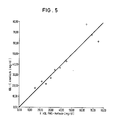
- Fig. 5 shows that under these conditions an addition of 8 ⁇ 10 ⁇ 6 mol / l of a degreased antibody against LDL further improves the agreement of the methods.
Landscapes
- Life Sciences & Earth Sciences (AREA)
- Health & Medical Sciences (AREA)
- Chemical & Material Sciences (AREA)
- Engineering & Computer Science (AREA)
- Molecular Biology (AREA)
- Organic Chemistry (AREA)
- Immunology (AREA)
- Zoology (AREA)
- General Health & Medical Sciences (AREA)
- Proteomics, Peptides & Aminoacids (AREA)
- Microbiology (AREA)
- Biophysics (AREA)
- Analytical Chemistry (AREA)
- Wood Science & Technology (AREA)
- Physics & Mathematics (AREA)
- Biochemistry (AREA)
- Urology & Nephrology (AREA)
- Hematology (AREA)
- Biotechnology (AREA)
- Biomedical Technology (AREA)
- Endocrinology (AREA)
- Genetics & Genomics (AREA)
- Cell Biology (AREA)
- General Engineering & Computer Science (AREA)
- Bioinformatics & Cheminformatics (AREA)
- Food Science & Technology (AREA)
- Medicinal Chemistry (AREA)
- General Physics & Mathematics (AREA)
- Pathology (AREA)
- Measuring Or Testing Involving Enzymes Or Micro-Organisms (AREA)
- Investigating Or Analysing Biological Materials (AREA)
Abstract
Description
- Die Erfindung betrifft ein Verfahren und ein Reagenz zur spezifischen Bestimmung des Cholesterins der HDL-Fraktion in Gegenwart der LDL-Fraktion der Lipoproteine des Serums durch Einwirkung von Cholesterinesterase zur Freisetzung des Cholesterins und Oxidation des freigesetzten Cholesterins mit Cholesterinoxidase und Sauerstoff unter Bildung von H₂O₂ und kinetische Messung der H₂O₂-Bildung oder des Sauerstoffverbrauchs.
- Die Bestimmung des Gesamtcholesterins sowie der einzelnen Cholesterin enthaltenden Lipidfraktionen im Serum hat im klinisch-chemischen Labor eine große Bedeutung. Hypercholesterinämie und Hypertriglyceridämie begünstigen die Entstehung der Atherosklerose und des Herzinfarktes. Das individuelle Koronarrisiko kann daher über die Bestimmung von Cholesterin und Triglyceriden im Serum erfaßt werden. Noch bessere Aussagen können gemacht werden, wenn außerdem auch die pathologischen Verschiebungen im Lipoproteinmuster ermittelt werden. Der Anteil der einzelnen Lipidfraktionen am Gesamtcholesterin läßt Aussagen über das Infarktrisiko zu, wobei einerseits umfangreiche klinische Studien erwiesen haben, daß ein erhöhter Serumgesamtcholesterinspiegel zu einem gesteigerten Herzinfarktrisiko führt, während andererseits eine inverse Beziehung zwischen dem Serum-HDL-Cholesterin und der Gefahr atherosklerotischer Blutgefäßveränderungen besteht. Die Lipoproteine des Serums lassen sich in 4 Gruppen einteilen : Chylomikronen, Prä-β-Lipoprotein, auch Very low density lipoprotein oder VLDL genannt; β-Lipoprotein, auch Low density lipoprotein oder LDL genannt und α-Lipoprotein, auch High density lipoprotein oder HDL genannt.
- Für die Bestimmung des Serumgesamtcholesterins stehen seit etwa 15 Jahren einfache, aber dennoch sehr genaue vollenzymatische Analysenverfahren zur Verfügung, die sowohl manuell als auch gleichermaßen gut an automatisierten Analysensystemen ohne jegliche Probenvorbereitung durchführbar sind und üblicherweise nach dem Reaktionsschema:
- 1. Cholesterinester + H₂O Cholesterinesterase Cholesterin + Fettsäure
- 2. Cholesterin + O₂ Cholesterinoxidase Δ 4-Cholesten-3-on + H₂O₂
- Es ist auch bereits bekannt, die Bestimmung des HDL-Cholesterins im Serum nach Abtrennung der anderen cholesterinhaltigen Lipoproteinpartikel durchzuführen. Die Abtrennung dieser Lipoproteine kann durch Ultrazentrifugation, Elektrophorese oder diverse Präzipitationsmethoden, wie Immunpräzipitation, Fällung mit Phosphorwolframsäure/Mg²⁺, Dextransulfat/Mg²⁺ oder Heparin/Mn²⁺ oder mit Polyethylenglykol erfolgen. Alle diese Verfahren sind aufwendig und erfordern mehrere Reaktionsschritte und einen relativ großen Zeitaufwand.
- Aus DE-OS 32 08 253.3 ist es weiterhin bekannt, daß der Cholesterinanteil der LDL-Fraktion direkt zu bestimmen ist. Diese Bestimmung beruht auf der Erkenntnis, daß unter bestimmten Bedingungen die Reaktionsgeschwindigkeit des Cholesterinanteils in der LDL-Fraktion linear von deren Konzentration abhängt, und daß bei einer kinetischen Messung der dabei erhaltene Meßwert direkt proportional zur LDL-Cholesterinkonzentration im Reaktionsansatz ist. Dieses Verfahren ist sehr gut zur Bestimmung der LDL geeignet, eine Bestimmung des HDL-Anteils ist hiermit jedoch nicht möglich.
- Es war nun Aufgabe der vorliegenden Erfindung, ein Verfahren und ein Reagenz zu schaffen, das die Bestimmung des HDL im Serum mit einfachen Mitteln und in einer Stufe erlaubt. Insbesondere sollte ein Verfahren zur Verfügung gestellt werden, mit Hilfe dessen gleichzeitig auch das Gesamtcholesterin bestimmt werden kann.
- Diese Aufgabe wird gelöst durch ein Verfahren zur spezifischen Bestimmung des Cholesterins der HDL-Fraktion in Gegenwart der LDL-Fraktion der Lipoproteine des Serums durch Einwirkung von Cholesterinesterase zur Freisetzung des Cholesterins und Oxidation des freigesetzten Cholesterin mit Cholesterinoxidase und Sauerstoff unter Bildung von H₂O₂ und kinetische Messung der H₂O₂-Bildung oder des Sauerstoffverbrauchs, das dadurch gekennzeichnet ist, daß die Messung innerhalb von 2 Minuten bis 15 Minuten nach dem Start der Oxidasereaktion bei einer Temperatur von 20 bis 40 °C während eines vorbestimmten Zeitintervalls durchgeführt wird und während der Messung in der Reaktionslösung eine Cholesterinesterase-Konzentration von 0,05 bis 30 U/ml, eine Cholesterinoxidase-Konzentration von 0,1 bis 50 U/ml, eine Konzentration eines Tensids der Gallensäurengruppe von 1,0 bis 20 mmol/l, eine Konzentration an nichtionischen Detergens von 0,1 bis 10 g/l und ein pH-Wert von 5 bis 9 eingehalten werden.
- Überraschenderweise wurde festgestellt, daß die Umsetzung des Cholesterins der Serum-Lipoproteine mittels Cholesterinesterase und Cholesterinoxidase in Gegenwart geeigneter Detergenskombinationen in zwei Phasen verläuft. Die Reaktion verläuft zunächst mit einer Geschwindigkeit, die abhängig von der LDL-Cholesterin-Konzentration, aber unabhängig von der HDL-Cholesterin-Konzentration ist. Im weiteren Reaktionsverlauf wird dann von einem von den Reaktionsbedingungen abhängigen Zeitpunkt an die Reaktionsgeschwindigkeit von der HDL-Cholesterin-Konzentration abhängig. Die Umsetzung der HDL-Fraktionen setzt also mit zeitlicher Verzögerung ein. Bei geeigneter Wahl der Reaktionsbedingungen kann die HDL-Umsetzung zu einem Zeitpunkt beobachtet werden, zu dem LDL-Cholesterin schon weitgehend umgesetzt ist. Die Extinktionsänderung in einem entsprechend gewählten Zeitintervall wird dann der HDL-Cholesterin-Konzentration proportional. Auf diese Weise ist es möglich, mittels eines einfachen Verfahrens das HDL direkt in Gegenwart der anderen cholesterinhaltigen Lipidfraktionen zu bestimmen.
- Wesentlich für das erfindungsgemäße Verfahren ist es, daß die Reaktionsbedingungen so eingestellt werden, daß die HDL-Umsetzung zu einem günstigen Zeitpunkt erfolgt.
- Bei dem erfindungsgemäßen Verfahren wird zuerst durch Zugabe von Cholesterinesterase zu der Reaktionslösung die Freisetzung des Cholesterins bewirkt. Die Cholesterinesterasen können aus verschiedenen Organismen, z. B. Mikroorganismen oder tierischen Geweben, erhalten werden. Mikrobielle Cholesterinesterase wird z. B. aus Pseudomonas oder Candida gewonnen. Als besonders geeignet hat sich jedoch Cholesterinesterase aus Pank reas (z. B. Rinder oder Schweinepankreas) erwiesen. Die Konzentration der Cholesterinesterase in der Reaktionslösung beträgt 0,05 bis 30 U/ml. Bevorzugt wird eine Cholesterinesterase-Konzentration von 0,05 bis 10 U/ml, besonders bevorzugt von 0,05 bis 1 U/ml, eingesetzt.
- Der Maßeinheit U liegt für Cholesterin-Esterase folgende Definition zugrunde:
1 U ist die Enzymmenge, welche bei 37 °C 1 µmol Cholesteryllinoleat pro Minute umsetzt, wobei die Reaktionsmischung neben der Cholesterinesterase folgende Substanzen enthält: 0,2 mol/l Kaliumphosphatpuffer pH 7,0
0,15 mol/l Natriumchlorid
4 g/l Natriumcholat
16 g/l Thesit ®
2 g/l Phenol
0,3 g/l 4-Aminoantipyrin
20 U/ml Peroxidase aus Meerrettich
0,2 U/ml Cholesterinoxidase aus Nocardia erythropolis
0,45 g/l Cholesteryllinoleat
- Das freigesetzte Cholesterin wird dann mit Cholesterinoxidase zu Cholestenon und H₂O₂ oxidiert. Die Cholesterinoxidase kann ebenfalls aus verschiedenen Organismen erhalten werden. Bevorzugt wird eine Cholesterinoxidase, die aus Brevibacterium,Nocardia oder Streptomyces erhalten wurde, eingesetzt. Die Konzentration der Cholesterinoxidase beträgt 0,1 bis 50 U/ml. Bevorzugt wird die Cholesterinoxidase mit einer Konzentration von 1 bis 30 U/ml, besonders bevorzugt von 5 bis 25 U/ml, eingesetzt.
- Der Maßeinheit U liegt fur Cholesterinoxidase folgende Definition zugrunde: 1 U ist die Enzymmenge, welche bei 25 °C 1 µmol Cholesterin pro Minute umsetzt, wobei die Reaktionsmischung neben dem Enzym folgende Substanzen enthält: 0,47 mol/l Kaliumphosphatpuffer pH 7,5
8 g/l Thesit ®
2,5 g/l n-Propanol
0,125 g/l Cholesterin
- Wesentlich für das erfindungsgemäße Verfahren ist weiterhin, daß in der Reaktionslösung ein Tensid aus der Gallensäuregruppe vorhanden ist. Dieses Tensid ist in einer Konzentration von 1,0 bis 20 mmol/l vorhanden. Bevorzugt beträgt die Konzentration des Tensids der Gallensäuregruppe 1,5 bis 8 mmol/l. Tenside der Gallensäuregruppe sind an sich bekannt. Bevorzugt werden die Derivate der Cholsäure verwendet, wobei das Natriumcholat besonders bevorzugt ist.
- In der Reaktionslösung ist weiterhin ein nichtionisches Detergens vorhanden. Die Konzentration dieses nichtionisches Detergens beträgt 0,1 bis 10 g/l, bevorzugt 0,4 bis 4 g/l. Als nichtionisches Tensid wird bevorzugt ein Detergens, das Polyethylenoxidgruppen enthält, verwendet. Ebenfalls geeignet sind Detergenzien auf Zuckerbasis. Beispiele für nichtionische Detergenzien sind Alkyl- oder Alkaryl-polyethylenoxidether wie n-Dodecylpolyethylenglykolether, iso-Tridekanolpolyethylenoxidether und iso-Octylphenolpolyethylenoxidether.
- In einer günstigen Ausführungsform wird das nichtionische Detergens nach der Zugabe von Oxidase, jedoch 1 bis 14 Minuten vor der Messung zugegeben.
- Der pH-Wert der Reaktionslösung liegt im Bereich von 5 bis 9. Zur Einstellung des erforderlichen pH-Wertbereiches werden die in diesem Bereich wirksamen Puffersubstanzen zugesetzt. Die Art der verwendeten Puffersubstanz ist an sich nicht kritisch. Bevorzugt wird jedoch Tris/HCl-Puffer und insbesondere Phosphatpuffer verwendet.
- Das erfindungsgemäße Verfahren wird bei einer Temperatur im Bereich von 20 bis 40 °C durchgeführt. Bevorzugt wird bei einer Temperatur zwischen 25 und 37 °C gearbeitet.
- Bei Einhaltung aller erfindungswesentlichen Parameter kann die Messung des Cholesterins der HDL-Fraktion in dem Zeitbereich von 2 Minuten bis 15 Minuten nach dem Start der Oxidasereaktion erfolgen. Bevorzugt wird die Messung in dem Zeitbereich von 3 bis 10 Minuten nach dem Start der Oxidasereaktion durchgeführt.
- Wenn die Messung der H₂O₂-Bildung unter weniger günstigen Reaktions- und Meßbedingungen erfolgen muß, kann die Umsetzung von Resten der LDL-Fraktion noch innerhalb des für die Messung ausgewählten Zeitintervalls erfolgen und könnte somit die Messung der HDL-Fraktion stören. Um diese Störung zu vermeiden, wird in einer weiteren Ausführungform des erfindungsgemäßen Verfahrens durch Zusatz von Anti-LDL-Antikörpern ein derartiger Spezifitätsverlust verhindert. Dieses Antiserum bringt die Umsetzung der LDL in einem frühen Stadium zum Erliegen. Hierzu können an sich bekannte Anti-LDL-Antikörper oder auch Anti-Apolipoprotein-B-Antikörper allein oder in Mischung verwendet werden. Diese Antikörper liegen bevorzugt in einer Konzentration von 10⁻⁶ bis 10⁻⁴ mmol/l als entfettete γ-Globulin oder IgG-Präparation vor.
- Wie bereits oben ausgeführt, erfolgt bei dem erfindungsgemäßen Verfahren zuerst die Freisetzung des in der LDL-Fraktion enthaltenen Cholesterins, so daß das Meßsignal zuerst proportional dem Cholesterin-Gehalt der LDL-Fraktion ist. Es ist daher möglich, mit Hilfe des erfindungsgemäßen Verfahrens aus einem Testansatz sowohl LDL-Cholesterin als auch HDL-Cholesterin zu bestimmen. Da die Reaktionsgeschwindigkeit zunächst LDL-abhängig und später HDL-abhängig ist, kann inner halb jeder Reaktionsphase das jeweils günstigste Zeitintervall für die Messung LDL- bzw. HDL-abhängiger Extinktionsänderungen gewählt werden. Dazu wird innerhalb der ersten Minute nach dem Start der Oxidasereaktion die H₂O₂-Bildung kinetisch bestimmt, als Maß für das in der LDL-Fraktion des Serums gebundene Cholesterin. Anschließend wird in dem Zeitintervall von 2 bis 15 Minuten nach dem Start der Oxidasereaktion die H₂O₂-Bildung kinetisch bestimmt als Maß für das in der HDL-Fraktion des Serums gebundene Cholesterin.
- Weiterhin ist es gemäß einer günstigen Ausführungsform des erfindungsgemäßen Verfahrens möglich, nach der Messung des HDL-Cholesterins die Konzentration an Cholesterinesterase durch Zugabe einer zweiten Reagenzlösung so zu erhöhen, daß die Umsetzung des gesamten Cholesteringehaltes innerhalb kurzer Zeit vollständig abläuft. Es kann dann die Gesamtmenge an Cholesterin in der Probe bestimmt werden. Hierzu genügt es, zusätzlich, d.h. über die für die HDL-Cholesterinbestimmung vorgeschriebene Menge hinaus, Cholesterinesterase und gegebenenfalls -oxidase und/oder Tensid in hohen Konzentrationen zuzusetzen, sobald die HDL-Bestimmung beendet ist.
- Ebenso kann einfach der Zusatz einer ausreichenden Menge eines, für die schnelle und voll Umsetzung des Gesamtcholesterins, geeigneten Reagenzes gemäß dem Stand der Technik erfolgen.
- Mit dem erfindungsgemäßen Verfahren ist es somit möglich, in einer Probe parallel den Anteil an LDL-Fraktion, HDL-Fraktion sowie das Gesamtcholesterin zu bestimmen.
- Die Bestimmung des freien Cholesterins mittels Cholesterinoxidase unter Bildung von H₂O₂ und Cholestenon und die kinetische Bestimmung der Veränderung eines Reaktionspartners dieser Oxidationsreaktion ist bekannt, beispielsweise aus der deutschen Auslegeschrift 25 58 536. Bevorzugt wird dabei gebildetes H₂O₂ unter Anwendung der, dem Fachmann geläufigen colorimetrischen Methoden der H₂O₂-Bestimmung nachgewiesen. Eine typische H₂O₂-Bestimmungsmethode, die für das Verfahren der vorliegenden Erfindung sehr geeignet ist, beruht auf der Farbreaktion von Phenol oder einem Phenolderivat mit 4-Aminoantipyrin oder einem Derivat davon, in Anwesenheit von Peroxidase. Diese Bestimmungen sind dem Fachmann geläufig und brauchen hier nicht näher beschrieben zu werden.
- Ein weiterer Gegenstand der Erfindung ist ein Reagenz zur spezifischen Bestimmung des Cholesterins der HDL-Fraktion in Gegenwart der LDL-Fraktion der Lipoproteine des Serums enthaltend Cholesterinesterase, Cholesterinoxidase, Tensid der Gallensäuregruppen, nichtionisches Detergens, Puffer-pH 5 bis 9 und ein System zur photometrischen Bestimmung von H₂O₂, das dadurch gekennzeichnet ist, daß es die Cholesterinesterase in einer Konzentration von 0,05 bis 30 U/ml, die Cholesterinoxidase in einer Konzentration von 0,1 bis 50 U/ml, ein Tensid der Gallensäuregruppen in einer Konzentration von 1,0 bis 20 mmol/l und ein nichtionisches Detergens in einer Konzentration von 0,1 bis 10 g/l, jeweils bezogen aus die im Test eingesetzte Verdünnung, enthält.
- Zur Durchführung des erfindungsgemäßen Verfahrens aus einem Analysenautomaten können die einzelnen Reaktionskomponenten auch auf oder in einem Trägermaterial imprägniert sein. Als Trägermaterial kann ein saugfähiges, quellfähiges oder filmbildendes Trägermaterial, z. B. ein für Teststreifen bekanntes Trägermaterial wie Papier und ähnliche Vliesmaterialien, beispielsweise Teebeutelpapier, verwendet werden. Dabei können die Reaktionskomponenten auf mehrere, in Kontakt stehende Träger verteilt sein.
- In einer bevorzugten Ausführungsform enthält das erfindungsgemäße Reagenz zusätzlich noch Antikörper gegen LDL und/oder Apolipoprotein B.
- Die Erfindung ermöglicht es, das in HDL enthaltende Cholesterin direkt, ohne vorherige Abtrennung der anderen Lipoproteinfraktionen, zu bestimmen. Weiterhin ist es möglich, gleichzeitig auch noch das in der LDL-Fraktion enthaltende Cholesterin und das im Serum enthaltende Gesamtcholesterin zu bestimmen. Das Verfahren ist einfach durchzuführen und ist automatisierbar.
- Die Erfindung wird durch die folgenden Beispiele und Abbildungen weiter erläutert.
- Die Abbildungen zeigen:
- Fig. 1: Reaktionsverlauf mit Proben unterschiedlicher HDL-Cholesterinkonzentration bei einer konstanten LDL-Cholesterinkonzentration von 84 mg/dl. HDL-Cholesterin in Kurve 1: 65,6 mg/dl, Kurve 2: 56,5 mg/dl, Kurve 3: 47,4 mg/dl, Kurve 4: 38,3 mg/dl, Kurve 5: 29,2 mg/dl.
- Fig. 2: Auswertung von Fig. 1 im Zeitintervall Δ t = 0 - 1 min.
- Fig. 3: Auswertung von Fig. 1 im Zeitintervall Δ t = 5 - 6 min.
- Fig. 4: Vergleich der HDL-Cholesterinbestimmung gemäß der Erfindung (ohne Zusatz von anti-Apo-ß-Antikörpern) mit der Phosphowolfram-Fällungsmethode (PWS).
- Fig. 5: Vergleich der HDL-Cholesterinbestimmung gemäß der Erfindung (mit Zusatz von 8 · 10⁻⁶ mol/l anti-Apo-β-Antikörper) mit PWS.
- Zwei Humanseren gleichen Gehaltes an LDL-Cholesterin, aber unterschiedlichen Gehaltes an HDL-Cholesterin werden in verschiedenen Verhältnissen gemischt, so daß sich eine Serie von Proben ergibt, welche steigende Mengen HDL-Cholesterin bei konstantem LDL-Cholesterin enthalten. Je 0,02 ml dieser Proben werden mit je 2,0 ml eines Reagenzes der folgenden Zusammensetzung bei 30 °C inkubiert:
0,1 M Kaliumphosphatpuffer pH 6,7
8,6 mM Tribromhydroxybenzoesäure
1,6 mM 4-Aminoantipyrin
3 mM Natriumcholat
0,1 % Polyethylenglycol 6000
0,1 % Thesit®
1 U/ml Cholesterin-Esterase aus Schweinepankreas
1 U/ml Cholesterin-Oxidase aus Nocardia
2,5 U/ml Peroxidase
- Fig. 1 zeigt, daß die Extinktionszunahme bei 546 nm zunächst weitgehend von der HDL-Cholesterinkonzentration unabhängig ist, im weiteren Verlauf jedoch deutlich von ihr abhängig wird. Entsprechend ist die Extinktionszunahme während der ersten Minute kein Maß für die HDL-Cholesterinkonzentration (Fig. 2), während die Extinktionszunahme in der sechsten Minute der HDL-Cholesterinkonzentration proportional ist (Fig. 3).
- Zwei Humanseren gleichen Gehalts an LDL-Cholesterin, aber unterschiedlichen Gehalts an HDL-Cholesterin werden in verschiedenen Verhältnissen gemischt, so daß sich eine Serie von Proben ergibt, welche steigende Mengen HDL-Cholesterin bei konstantem LDL-Cholesterin enthalten. Je 0,02 ml dieser Proben werden mit je 2,0 ml eines Reagenzes der folgenden Zusammensetzung bei 30 °C inkubiert:
0,1 M Kaliumphosphatpuffer pH 6,7
8,6 mM Tribromhydroxybenzoesäure
1,6 mM 4-Aminoantipyrin
3 mM Natriumcholat
0,1 % Polyethylenglycol 6000
0,1 % Thesit®
1 U/ml Cholesterin-Esterase aus Schweinepankreas
1 U/ml Cholesterin-Oxidase aus Brevibacterium
2,5 U/ml Peroxidase
- Wie in Beispiel 1 ist auch hier die Extinktionszunahme bei 546 nm zunächst weitgehend von der HDL-Cholesterinkonzentration unabhängig und wird in der 6. Minute proportional der HDL-Cholesterinkonzentration.
- Ausgehend von der in Beispiel 1 erläuterten Reaktionsmischung werden die Konzentrationen der folgenden Komponenten variiert:
Thesit®, Natriumcholat, Cholesterin-Esterase, Cholesterin-Oxidase. Mit diesen Varianten werden die in Bei spiel 1 geschilderten Untersuchungen durchgeführt. Die beobachteten Abhängigkeiten von der HDL-Konzentration sind in der vorliegenden Tabelle in Form der bei Auswertung verschiedener Zeitintervalle erhaltenen Regressionsdaten dargestellt.
- Eine Reaktionsmischung enthält 0,5 U/ml CholesterinEsterase aus Pseudomonas und 2 U/ml Cholesterinoxidase aus Streptomyces; ansonsten entspricht die Zusammensetzung Beispiel 1. Auch hier beobachtet man in entsprechend gewählten Zeitintervallen eine ausgeprägte Abhängigkeit von der HDL-Cholesterin-Konzentration; in der 4. Inkubationsminute bei 37 °C erhält man z. B. bei einer Auswertung entsprechend Fig. 2 bzw. 3 eine Regressionsgerade y = 1,02x + 1,5 mg/dl. Ein ähnliches Resultat ergibt auch die Kombination von 1,5 U/ml Cholesterin-Esterase aus Candida cylindracea und 2 U/ml Cholesterin-Oxidase aus Streptomyces (y = 1,13x - 0,9).
- Es wird vorgegangen, wie in Beispiel 1 erläutert, jedoch werden anstelle von Thesit® andere nichtionische Detergentien eingesetzt. Die beobachteten Abhängigkeiten von der HDL-Cholesterin-Konzentration sind in der folgenden Tabelle in Form der bei Auswertung verschiedener Zeitintervalle erhaltenen Regressionsdaten dargestellt.

- An einem photometrischen Analysenautomaten kann man über die Extinktionsdifferenzen in günstig gewählten Zeitintervallen den HDL-Cholesteringehalt in Humanseren ermitteln. Die Kalibration erfolgt mittels eines Humanserums bekannten HDL-Cholesteringehalts. Das Reagenz entspricht grundsätzlich dem Reagenz in Beispiel 1, wobei der Fachmann den Test durch Variation der Aktivität von Cholesterin-Esterase und/oder Cholesterin-Oxidase, der Konzentration von Natriumcholat und Thesit, des Zeitintervalls sowie durch Zusatz von käuflichem Anti-B-Antiserum auf den zum Einsatz kommenden Analysenautomaten abstimmen kann. Fig. 4 zeigt, daß beispielsweise ähnliche Werte wie mit der etablierten Phosphowolframat-Fällungsmethode für HDL-Cholesterin erzielt werden können, wenn man die Aktivität der Cholesterin-Oxidase gegenüber Beispiel 1 auf 0,36 U/ml reduziert und bei 30 °C die Extinktionszunahme innerhalb der siebten Minute der Inkubation mißt. Fig. 5 zeigt, daß unter diesen Bedingungen ein Zusatz von 8 × 10⁻⁶ mol/l eines entfetteten Antikörpers gegen LDL die Übereinstimmung der Methoden noch weiter verbessert.
Regressionsgeraden (Standardhauptkomponentenanalyse):
Fig. 4: Y = 0,771 x + 3,551 (mg/dl)
Fig. 5: Y = 0,981 x + 0,034 (mg/dl) - Es wurde vorgegangen, wie in Beispiel 6 beschrieben. In parallelen Versuchen wurden unabhängig voneinander das Zeitintervall für die photometrische Messung und der Zusatz von entfettetem Anti-LDL-Antiserum variiert. Der Vergleich der für ein Kollektiv von Humanseren erhaltenen Daten mit den Resultaten der Phosphowolframsäure-Fällungsmethode ist in der folgenden Tabelle in Form der Regressionsdaten dargestellt.

- Durch geeignete Wahl des Meßintervalls kann bei allen in der klinischen Chemie gebräuchlichen Meßtemperaturen eine gute Übereinstimmung mit den Ergebnissen der etablierten Phosphowolframat-Fällungsmethode für HDL-Cholesterin erzielt werden. Für die im folgenden in Form der Regressionsdaten dargestellte Serie von Methodenvergleichen anhand eines Kollektivs von 27 Humanseren wurde folgende Ausführungsform des erfindungsgemäßen Verfahrens gewählt:
Gerät: Hitachi 705
Meßwellenlänge: 505 nm
Vergleichswellenlänge: 600 nm
Kalibrator: Humanserum bekannten HDL-Cholesterin-Gehalts
Probenvolumen: 10 µl
Reagensvolumen: 0,5 ml
Reagenszusammensetzung:
0,1 M Kaliumphosphatpuffer pH 6,7
8,6 mM Tribromhydroxybenzoesäure
1,6 mM 4-Aminoantipyrin
5 mM Natriumcholat
0,1 % Polyethylenglycol MG 6000
1,5 g/l Thesit® (nichtionisches Detergens)
0,25 U/ml Cholesterin-Esterase aus Schweinepankreas
Cholesterin-Oxidase wie unten angegeben
2,5 U/ml Peroxidase

Claims (18)
Cholesterinesterase,
Cholesterinoxidase,
Tensid der Gallensäuregruppe,
nichtionisches Detergens,
Puffer-pH 5 bis 9 und
ein System zur photometrischen Bestimmung von H₂O₂,
dadurch gekennzeichnet, daß es die Cholesterinesterase in einer Konzentration von 0,05 bis 30 U/ml, die Cholesterinoxidase in einer Konzentration von 0,1 bis 50 U/ml, Detergens der Gallensäuregruppe in einer Konzentration von 1,0 bis 20 mmol/l und nichtionisches Detergens in einer Konzentration von 0,1 bis 10 g/l, jeweils bezogen auf die im Test eingesetzte Verdünnung, enthält.
Priority Applications (1)
| Application Number | Priority Date | Filing Date | Title |
|---|---|---|---|
| AT87115841T ATE85366T1 (de) | 1986-10-29 | 1987-10-28 | Verfahren und reagenz zur spezifischen bestimmung des cholesterins der hdl-fraktion. |
Applications Claiming Priority (2)
| Application Number | Priority Date | Filing Date | Title |
|---|---|---|---|
| DE19863636851 DE3636851A1 (de) | 1986-10-29 | 1986-10-29 | Verfahren und reagenz zur spezifischen bestimmung des cholesterins der hdl-fraktion |
| DE3636851 | 1986-10-29 |
Publications (3)
| Publication Number | Publication Date |
|---|---|
| EP0265933A2 true EP0265933A2 (de) | 1988-05-04 |
| EP0265933A3 EP0265933A3 (en) | 1989-12-06 |
| EP0265933B1 EP0265933B1 (de) | 1993-02-03 |
Family
ID=6312758
Family Applications (1)
| Application Number | Title | Priority Date | Filing Date |
|---|---|---|---|
| EP87115841A Expired - Lifetime EP0265933B1 (de) | 1986-10-29 | 1987-10-28 | Verfahren und Reagenz zur spezifischen Bestimmung des Cholesterins der HDL-Fraktion |
Country Status (8)
| Country | Link |
|---|---|
| US (1) | US4892815A (de) |
| EP (1) | EP0265933B1 (de) |
| JP (1) | JPH0734760B2 (de) |
| AT (1) | ATE85366T1 (de) |
| AU (1) | AU588143B2 (de) |
| CA (1) | CA1309645C (de) |
| DE (2) | DE3636851A1 (de) |
| FI (1) | FI90882C (de) |
Cited By (1)
| Publication number | Priority date | Publication date | Assignee | Title |
|---|---|---|---|---|
| EP0753583A4 (de) * | 1995-01-31 | 1997-12-10 | Daiichi Pure Chemicals Co Ltd | Verfahren zur quantitativen analyse von cholesterin |
Families Citing this family (36)
| Publication number | Priority date | Publication date | Assignee | Title |
|---|---|---|---|---|
| ATE141335T1 (de) * | 1989-01-13 | 1996-08-15 | Robert Q Maines | Verfahren zur bestimmung des cholesterins, zum nachweis von gefässkrankheiten und zur anhebung des anteils an hdl-cholesterin |
| US5135716A (en) * | 1989-07-12 | 1992-08-04 | Kingston Diagnostics, L.P. | Direct measurement of HDL cholesterol via dry chemistry strips |
| US5844097A (en) * | 1990-11-30 | 1998-12-01 | Monoclonetics International, Inc. | Methods for the diagnosis of peripheral nerve damage |
| AU667462B2 (en) * | 1990-11-30 | 1996-03-28 | Monoclonetics International Incorporated | Methods for the diagnosis of chronic lower back and cervical pain |
| US5344571A (en) * | 1992-02-18 | 1994-09-06 | University Of Texas System Board Of Regents | Method for separating isoanalytes and measuring analytes in fluids |
| US5460974A (en) * | 1992-10-13 | 1995-10-24 | Miles Inc. | Method of assaying whole blood for HDL cholesterol |
| US5618683A (en) * | 1993-04-13 | 1997-04-08 | Brocia; Robert W. | Diagnostic kit for cholesteryl ester transfer protein (CETP) activity measurement and a new synthetic particle used therein |
| US5585235A (en) * | 1993-04-13 | 1996-12-17 | Diagnescent Technologies, Inc. | Fluorescent assay and method that corrects for spectral interference |
| JP2653755B2 (ja) * | 1994-03-08 | 1997-09-17 | 協和メデックス株式会社 | 高密度リポ蛋白中のコレステロールの定量法 |
| JP2600065B2 (ja) * | 1994-03-08 | 1997-04-16 | 協和メデックス株式会社 | 高密度リポ蛋白中のコレステロールの定量法 |
| WO1996029599A1 (en) * | 1995-03-20 | 1996-09-26 | Kyowa Medex Co., Ltd. | Method of quantifying cholesterol in low-density or very-low-density lipoprotein |
| AU702443C (en) * | 1995-03-16 | 2003-02-20 | Kyowa Medex Co., Ltd. | Method for determinaton of cholesterol in low-density lipoprotein |
| EP0754948B1 (de) * | 1995-07-21 | 2001-10-17 | Wako Pure Chemical Industries, Ltd | Methode zur Messung der Menge eines in einem spezifischen Lipoprotein enthaltenen Bestandteils |
| WO1997040376A1 (fr) * | 1996-04-22 | 1997-10-30 | Iatron Laboratories, Inc. | Procede specifique de dosage du cholesterol des lphd et composition utilisee pour le dosage. |
| JP3193634B2 (ja) * | 1996-05-29 | 2001-07-30 | 第一化学薬品株式会社 | Ldlコレステロールの定量方法 |
| KR980010429A (ko) * | 1996-07-18 | 1998-04-30 | 다나까 모또아끼 | 콜레스테롤 측량용 시약 |
| ES2248856T3 (es) | 1996-12-09 | 2006-03-16 | Denka Seiken Co., Ltd. | Procedimiento para determinar el contenido en colesterol de lipoproteinas de alta densidad. |
| JPH1156395A (ja) * | 1997-08-27 | 1999-03-02 | Dai Ichi Pure Chem Co Ltd | コレステロールの定量法 |
| WO2000017388A1 (fr) | 1998-09-18 | 2000-03-30 | Kyowa Medex Co., Ltd. | Dosage du cholesterol dans les lipoproteines et reactifs de quantification |
| DE60039418D1 (de) * | 1999-03-01 | 2008-08-21 | Sysmex Corp | Verfahren zum austesten biologischer probenkomponenten |
| MXPA02000067A (es) * | 1999-06-21 | 2003-02-27 | Daiichi Pure Chemicals Co Ltd | Metodo de pretratamiento de muestra para cuantificar colesterol y metodo para cuantificar colesterol en lipoproteinas especificas utilizando el mismo. |
| CA2428686A1 (en) * | 2000-11-14 | 2002-05-23 | Daiichi Pure Chemicals Co., Ltd. | Method of lipid assay and reagent for use therein |
| US6898728B2 (en) * | 2001-09-25 | 2005-05-24 | Sun Microsystems, Inc. | System domain targeted, configurable interconnection |
| WO2003064684A1 (fr) * | 2002-01-30 | 2003-08-07 | Denka Seiken Co., Ltd. | Procede de quantification de cholesterol dans des lipoproteines de haute densite et compositions de reactifs |
| WO2004035817A1 (ja) * | 2002-10-16 | 2004-04-29 | Kyowa Medex Co., Ltd. | 高密度リポ蛋白中のコレステロールの測定方法および試薬 |
| ATE449867T1 (de) * | 2002-10-16 | 2009-12-15 | Kyowa Medex Co Ltd | Verfahren und reagens zur messung von cholesterin in lipoproteinen hoher dichte |
| WO2004048605A1 (ja) * | 2002-11-27 | 2004-06-10 | Daiichi Pure Chemicals Co., Ltd. | 特定リポ蛋白中の脂質測定法 |
| US20050037504A1 (en) * | 2003-07-17 | 2005-02-17 | Dimagno Theodore John | One-step assay for high-density lipoprotein cholesterol |
| US20050032141A1 (en) * | 2003-07-17 | 2005-02-10 | Dimagno Theodore John | Dry analytical element for high-density lipoprotein cholesterol quantification |
| TWI372783B (en) * | 2005-04-27 | 2012-09-21 | Kyowa Medex Co Ltd | A process for measuring the cholesterol in high density lipoprotein |
| GB0609494D0 (en) * | 2006-05-12 | 2006-06-21 | Oxford Biosensors Ltd | HDL cholesterol sensor using specific surfactant |
| GB0609493D0 (en) * | 2006-05-12 | 2006-06-21 | Oxford Biosensors Ltd | Cholesterol sensor |
| JP5332611B2 (ja) * | 2007-01-15 | 2013-11-06 | 東洋紡株式会社 | 高密度リポ蛋白中コレステロールの測定方法およびその試薬 |
| JP5813284B2 (ja) | 2009-10-26 | 2015-11-17 | デンカ生研株式会社 | ApoE−containingHDL中コレステロールの測定方法 |
| CN104603282A (zh) | 2012-08-31 | 2015-05-06 | 协和梅迪克斯株式会社 | 高密度脂蛋白中的胆固醇的测定方法 |
| US9051599B2 (en) | 2012-12-10 | 2015-06-09 | Theranos, Inc. | Rapid, low-sample-volume cholesterol and triglyceride assays |
Family Cites Families (10)
| Publication number | Priority date | Publication date | Assignee | Title |
|---|---|---|---|---|
| US4164448A (en) * | 1973-12-07 | 1979-08-14 | Boehringer Mannheim Gmbh | Activation of cholesterol oxidase for cholesterol assay |
| US4275151A (en) * | 1977-02-03 | 1981-06-23 | Eastman Kodak Company | Hydrolysis of protein-bound cholesterol esters |
| DE2910134A1 (de) * | 1979-03-15 | 1980-09-25 | Boehringer Mannheim Gmbh | Diagnostisches mittel zum nachweis von bestandteilen von koerperfluessigkeiten |
| ATE8912T1 (de) * | 1980-07-10 | 1984-08-15 | Ivan Endre Modrovich | Stabilisierte enzymatische loesungen und verfahren zum bestimmen von gesamtcholesterin im menschlichen serum. |
| US4409326A (en) * | 1980-07-10 | 1983-10-11 | Modrovich Ivan Endre | Stabilized enzymatic solutions and method for determining total cholesterol in human serum |
| DE3046241A1 (de) * | 1980-12-08 | 1982-07-15 | Boehringer Mannheim Gmbh, 6800 Mannheim | Verfahren und reagenz zur bestimmung von cholesterin |
| DE3208253A1 (de) * | 1982-03-08 | 1983-09-15 | Boehringer Mannheim Gmbh, 6800 Mannheim | Verfahren zur spezifischen bestimmung des cholesterins der ldl-fraktion im serum |
| DE3338836A1 (de) * | 1983-10-26 | 1985-05-09 | Boehringer Mannheim Gmbh | Verfahren zur bestimmung der low density lipoproteine (ldl) und reagenz zu seiner durchfuehrung |
| WO1986004144A1 (en) * | 1984-12-31 | 1986-07-17 | International Genetic Engineering, Inc. | Peptide fragments of human apolipoprotein, type-specific antibodies and methods of use |
| DE3533288A1 (de) * | 1985-09-18 | 1987-03-26 | Boehringer Mannheim Gmbh | Verfahren und reagenz zur spezifischen bestimmung von hdl-cholesterin im serum |
-
1986
- 1986-10-29 DE DE19863636851 patent/DE3636851A1/de not_active Withdrawn
-
1987
- 1987-10-06 US US07/107,467 patent/US4892815A/en not_active Expired - Lifetime
- 1987-10-09 CA CA000549035A patent/CA1309645C/en not_active Expired - Lifetime
- 1987-10-27 JP JP62269522A patent/JPH0734760B2/ja not_active Expired - Lifetime
- 1987-10-28 EP EP87115841A patent/EP0265933B1/de not_active Expired - Lifetime
- 1987-10-28 AT AT87115841T patent/ATE85366T1/de not_active IP Right Cessation
- 1987-10-28 FI FI874749A patent/FI90882C/fi not_active IP Right Cessation
- 1987-10-28 DE DE8787115841T patent/DE3784004D1/de not_active Expired - Fee Related
- 1987-10-28 AU AU80446/87A patent/AU588143B2/en not_active Ceased
Cited By (1)
| Publication number | Priority date | Publication date | Assignee | Title |
|---|---|---|---|---|
| EP0753583A4 (de) * | 1995-01-31 | 1997-12-10 | Daiichi Pure Chemicals Co Ltd | Verfahren zur quantitativen analyse von cholesterin |
Also Published As
| Publication number | Publication date |
|---|---|
| US4892815A (en) | 1990-01-09 |
| AU8044687A (en) | 1988-05-05 |
| CA1309645C (en) | 1992-11-03 |
| FI874749A0 (fi) | 1987-10-28 |
| DE3636851A1 (de) | 1988-05-11 |
| FI90882C (fi) | 1994-04-11 |
| FI90882B (fi) | 1993-12-31 |
| DE3784004D1 (de) | 1993-03-18 |
| AU588143B2 (en) | 1989-09-07 |
| ATE85366T1 (de) | 1993-02-15 |
| EP0265933A3 (en) | 1989-12-06 |
| JPH0734760B2 (ja) | 1995-04-19 |
| FI874749L (fi) | 1988-04-30 |
| EP0265933B1 (de) | 1993-02-03 |
| JPS63126498A (ja) | 1988-05-30 |
Similar Documents
| Publication | Publication Date | Title |
|---|---|---|
| EP0265933B1 (de) | Verfahren und Reagenz zur spezifischen Bestimmung des Cholesterins der HDL-Fraktion | |
| DE69731203T2 (de) | Methode zur quantifizierung von ldl-cholesterin | |
| EP0088420B1 (de) | Verfahren zur spezifischen Bestimmung des Cholesterins der LDL-Fraktion im Serum | |
| EP0218127B1 (de) | Verfahren und Reagenz zur spezifischen Bestimmung von HDL-Cholesterin im Serum | |
| DE69519160T2 (de) | Verfahren zur quantitativen analyse von cholesterin | |
| DE69920937T2 (de) | Verfahren zur quantifizierung von cholesterol in lipoproteinen und quantifizierungsreagenzien | |
| EP0141343B1 (de) | Verfahren zur Bestimmung der Low Density Lipoproteine (LDL) und Reagenz zu seiner Durchführung | |
| EP0092801B1 (de) | Verfahren zur Bestimmung der Low Density Lipoproteine (LDL) und Reagenz zu seiner Durchführung | |
| DE3249743C2 (de) | ||
| DE69032422T2 (de) | Reagenzzusammensetzung, Verfahren und Kits zur Quantifizierung von Magnesium oder Calcium und Magnesium | |
| EP0250991B1 (de) | Verfahren zur spezifischen Bestimmung des Serumfructosamingehalts sowie hierfür geeignetes Reagenzgemisch | |
| EP0035211B1 (de) | Verfahren und Reagens zur Bestimmung der beta-Lipoproteine (LDL) | |
| DE60028776T2 (de) | Verfahren zum vorbehandeln von proben und zum quantifizieren von cholesterin in spezifischen lipoproteinen | |
| DE112007002921T5 (de) | Vorrichtung und Verfahren zur Cholesterinbestimmung | |
| DE3780205T2 (de) | Verfahren zur messung von lipidgebundener sialinsaeure und dabei zu verwendender reagenssatz. | |
| EP0130537A2 (de) | Verfahren und Mittel zur raschen und vollständigen Beseitigung einer Trübung in einer biologischen Flüssigkeit | |
| CH632092A5 (de) | Verfahren und mittel zur bestimmung von hydroperoxiden. | |
| EP0468481A1 (de) | Nichtionische Blockcopolymere aus Propylenoxid und Ethylenoxid | |
| EP0729032A2 (de) | Verfahren und Reagenz zur spezifischen Bestimmung von LDL in Serumproben | |
| EP0182385B1 (de) | Verfahren und Reagenz zur quantitativen Bestimmung von freiem Thyroxin in Plasma, Serum oder Vollblut | |
| DE3125667C2 (de) | Verfahren und Mittel zum Nachweis von Wasserstoffperoxid | |
| EP0291060A2 (de) | Verfahren zur Bestimmung von Fructosamin | |
| EP1040354B1 (de) | Bestimmung von in lipoprotein enthaltenem triglycerid | |
| DE2500689C2 (de) | ||
| EP0309882A2 (de) | Verfahren zur spezifischen Bestimmung des Serumfructosamingehalts sowie hierfür geeignetes Reagenzgemisch |
Legal Events
| Date | Code | Title | Description |
|---|---|---|---|
| PUAI | Public reference made under article 153(3) epc to a published international application that has entered the european phase |
Free format text: ORIGINAL CODE: 0009012 |
|
| 17P | Request for examination filed |
Effective date: 19871028 |
|
| AK | Designated contracting states |
Kind code of ref document: A2 Designated state(s): AT BE CH DE ES FR GB GR IT LI LU NL SE |
|
| PUAL | Search report despatched |
Free format text: ORIGINAL CODE: 0009013 |
|
| AK | Designated contracting states |
Kind code of ref document: A3 Designated state(s): AT BE CH DE ES FR GB GR IT LI LU NL SE |
|
| 17Q | First examination report despatched |
Effective date: 19910712 |
|
| GRAA | (expected) grant |
Free format text: ORIGINAL CODE: 0009210 |
|
| AK | Designated contracting states |
Kind code of ref document: B1 Designated state(s): AT BE CH DE ES FR GB GR IT LI LU NL SE |
|
| PG25 | Lapsed in a contracting state [announced via postgrant information from national office to epo] |
Ref country code: SE Effective date: 19930203 Ref country code: GR Free format text: LAPSE BECAUSE OF FAILURE TO SUBMIT A TRANSLATION OF THE DESCRIPTION OR TO PAY THE FEE WITHIN THE PRESCRIBED TIME-LIMIT Effective date: 19930203 |
|
| REF | Corresponds to: |
Ref document number: 85366 Country of ref document: AT Date of ref document: 19930215 Kind code of ref document: T |
|
| ITF | It: translation for a ep patent filed | ||
| GBT | Gb: translation of ep patent filed (gb section 77(6)(a)/1977) |
Effective date: 19930215 |
|
| REF | Corresponds to: |
Ref document number: 3784004 Country of ref document: DE Date of ref document: 19930318 |
|
| ET | Fr: translation filed | ||
| PG25 | Lapsed in a contracting state [announced via postgrant information from national office to epo] |
Ref country code: ES Free format text: LAPSE BECAUSE OF FAILURE TO SUBMIT A TRANSLATION OF THE DESCRIPTION OR TO PAY THE FEE WITHIN THE PRESCRIBED TIME-LIMIT Effective date: 19930514 |
|
| PGFP | Annual fee paid to national office [announced via postgrant information from national office to epo] |
Ref country code: AT Payment date: 19931007 Year of fee payment: 7 |
|
| PGFP | Annual fee paid to national office [announced via postgrant information from national office to epo] |
Ref country code: CH Payment date: 19931025 Year of fee payment: 7 |
|
| PGFP | Annual fee paid to national office [announced via postgrant information from national office to epo] |
Ref country code: NL Payment date: 19931031 Year of fee payment: 7 |
|
| PGFP | Annual fee paid to national office [announced via postgrant information from national office to epo] |
Ref country code: LU Payment date: 19931101 Year of fee payment: 7 |
|
| PGFP | Annual fee paid to national office [announced via postgrant information from national office to epo] |
Ref country code: BE Payment date: 19931130 Year of fee payment: 7 |
|
| PLBE | No opposition filed within time limit |
Free format text: ORIGINAL CODE: 0009261 |
|
| STAA | Information on the status of an ep patent application or granted ep patent |
Free format text: STATUS: NO OPPOSITION FILED WITHIN TIME LIMIT |
|
| EPTA | Lu: last paid annual fee | ||
| 26N | No opposition filed | ||
| PG25 | Lapsed in a contracting state [announced via postgrant information from national office to epo] |
Ref country code: LU Free format text: LAPSE BECAUSE OF NON-PAYMENT OF DUE FEES Effective date: 19941028 Ref country code: AT Effective date: 19941028 |
|
| PG25 | Lapsed in a contracting state [announced via postgrant information from national office to epo] |
Ref country code: LI Effective date: 19941031 Ref country code: CH Effective date: 19941031 Ref country code: BE Effective date: 19941031 |
|
| BERE | Be: lapsed |
Owner name: BOEHRINGER MANNHEIM G.M.B.H. Effective date: 19941031 |
|
| PG25 | Lapsed in a contracting state [announced via postgrant information from national office to epo] |
Ref country code: NL Effective date: 19950501 |
|
| NLV4 | Nl: lapsed or anulled due to non-payment of the annual fee | ||
| REG | Reference to a national code |
Ref country code: CH Ref legal event code: PL |
|
| PGFP | Annual fee paid to national office [announced via postgrant information from national office to epo] |
Ref country code: FR Payment date: 20001010 Year of fee payment: 14 |
|
| PGFP | Annual fee paid to national office [announced via postgrant information from national office to epo] |
Ref country code: DE Payment date: 20001023 Year of fee payment: 14 |
|
| PGFP | Annual fee paid to national office [announced via postgrant information from national office to epo] |
Ref country code: GB Payment date: 20001025 Year of fee payment: 14 |
|
| PG25 | Lapsed in a contracting state [announced via postgrant information from national office to epo] |
Ref country code: GB Free format text: LAPSE BECAUSE OF NON-PAYMENT OF DUE FEES Effective date: 20011028 |
|
| REG | Reference to a national code |
Ref country code: GB Ref legal event code: IF02 |
|
| GBPC | Gb: european patent ceased through non-payment of renewal fee |
Effective date: 20011028 |
|
| PG25 | Lapsed in a contracting state [announced via postgrant information from national office to epo] |
Ref country code: FR Free format text: LAPSE BECAUSE OF NON-PAYMENT OF DUE FEES Effective date: 20020628 |
|
| PG25 | Lapsed in a contracting state [announced via postgrant information from national office to epo] |
Ref country code: DE Free format text: LAPSE BECAUSE OF NON-PAYMENT OF DUE FEES Effective date: 20020702 |
|
| REG | Reference to a national code |
Ref country code: FR Ref legal event code: ST |
|
| PG25 | Lapsed in a contracting state [announced via postgrant information from national office to epo] |
Ref country code: IT Free format text: LAPSE BECAUSE OF NON-PAYMENT OF DUE FEES Effective date: 20051028 |