EP0266019A2 - Photographisch ähnliches Verfahren zur Bildung eines Bildes auf Schokolade - Google Patents
Photographisch ähnliches Verfahren zur Bildung eines Bildes auf Schokolade Download PDFInfo
- Publication number
- EP0266019A2 EP0266019A2 EP87304488A EP87304488A EP0266019A2 EP 0266019 A2 EP0266019 A2 EP 0266019A2 EP 87304488 A EP87304488 A EP 87304488A EP 87304488 A EP87304488 A EP 87304488A EP 0266019 A2 EP0266019 A2 EP 0266019A2
- Authority
- EP
- European Patent Office
- Prior art keywords
- image
- chocolate
- peaks
- valleys
- transfer blanket
- Prior art date
- Legal status (The legal status is an assumption and is not a legal conclusion. Google has not performed a legal analysis and makes no representation as to the accuracy of the status listed.)
- Ceased
Links
Images

Classifications
-
- A—HUMAN NECESSITIES
- A23—FOODS OR FOODSTUFFS; TREATMENT THEREOF, NOT COVERED BY OTHER CLASSES
- A23G—COCOA; COCOA PRODUCTS, e.g. CHOCOLATE; SUBSTITUTES FOR COCOA OR COCOA PRODUCTS; CONFECTIONERY; CHEWING GUM; ICE-CREAM; PREPARATION THEREOF
- A23G3/00—Sweetmeats; Confectionery; Marzipan; Coated or filled products
- A23G3/0002—Processes of manufacture not relating to composition and compounding ingredients
- A23G3/0097—Decorating sweetmeats or confectionery
-
- A—HUMAN NECESSITIES
- A23—FOODS OR FOODSTUFFS; TREATMENT THEREOF, NOT COVERED BY OTHER CLASSES
- A23G—COCOA; COCOA PRODUCTS, e.g. CHOCOLATE; SUBSTITUTES FOR COCOA OR COCOA PRODUCTS; CONFECTIONERY; CHEWING GUM; ICE-CREAM; PREPARATION THEREOF
- A23G1/00—Cocoa; Cocoa products, e.g. chocolate; Substitutes therefor
- A23G1/04—Apparatus specially adapted for manufacture or treatment of cocoa or cocoa products
- A23G1/20—Apparatus for moulding, cutting or dispensing chocolate
- A23G1/22—Chocolate moulds
-
- A—HUMAN NECESSITIES
- A23—FOODS OR FOODSTUFFS; TREATMENT THEREOF, NOT COVERED BY OTHER CLASSES
- A23G—COCOA; COCOA PRODUCTS, e.g. CHOCOLATE; SUBSTITUTES FOR COCOA OR COCOA PRODUCTS; CONFECTIONERY; CHEWING GUM; ICE-CREAM; PREPARATION THEREOF
- A23G1/00—Cocoa; Cocoa products, e.g. chocolate; Substitutes therefor
- A23G1/04—Apparatus specially adapted for manufacture or treatment of cocoa or cocoa products
- A23G1/20—Apparatus for moulding, cutting or dispensing chocolate
- A23G1/28—Apparatus for removing chocolate from the moulds
-
- A—HUMAN NECESSITIES
- A23—FOODS OR FOODSTUFFS; TREATMENT THEREOF, NOT COVERED BY OTHER CLASSES
- A23G—COCOA; COCOA PRODUCTS, e.g. CHOCOLATE; SUBSTITUTES FOR COCOA OR COCOA PRODUCTS; CONFECTIONERY; CHEWING GUM; ICE-CREAM; PREPARATION THEREOF
- A23G3/00—Sweetmeats; Confectionery; Marzipan; Coated or filled products
- A23G3/02—Apparatus specially adapted for manufacture or treatment of sweetmeats or confectionery; Accessories therefor
- A23G3/28—Apparatus for decorating sweetmeats or confectionery
-
- B—PERFORMING OPERATIONS; TRANSPORTING
- B29—WORKING OF PLASTICS; WORKING OF SUBSTANCES IN A PLASTIC STATE IN GENERAL
- B29C—SHAPING OR JOINING OF PLASTICS; SHAPING OF MATERIAL IN A PLASTIC STATE, NOT OTHERWISE PROVIDED FOR; AFTER-TREATMENT OF THE SHAPED PRODUCTS, e.g. REPAIRING
- B29C33/00—Moulds or cores; Details thereof or accessories therefor
- B29C33/38—Moulds or cores; Details thereof or accessories therefor characterised by the material or the manufacturing process
- B29C33/3842—Manufacturing moulds, e.g. shaping the mould surface by machining
- B29C33/3857—Manufacturing moulds, e.g. shaping the mould surface by machining by making impressions of one or more parts of models, e.g. shaped articles and including possible subsequent assembly of the parts
-
- Y—GENERAL TAGGING OF NEW TECHNOLOGICAL DEVELOPMENTS; GENERAL TAGGING OF CROSS-SECTIONAL TECHNOLOGIES SPANNING OVER SEVERAL SECTIONS OF THE IPC; TECHNICAL SUBJECTS COVERED BY FORMER USPC CROSS-REFERENCE ART COLLECTIONS [XRACs] AND DIGESTS
- Y10—TECHNICAL SUBJECTS COVERED BY FORMER USPC
- Y10T—TECHNICAL SUBJECTS COVERED BY FORMER US CLASSIFICATION
- Y10T428/00—Stock material or miscellaneous articles
- Y10T428/24—Structurally defined web or sheet [e.g., overall dimension, etc.]
- Y10T428/24479—Structurally defined web or sheet [e.g., overall dimension, etc.] including variation in thickness
- Y10T428/24612—Composite web or sheet
- Y10T428/2462—Composite web or sheet with partial filling of valleys on outer surface
-
- Y—GENERAL TAGGING OF NEW TECHNOLOGICAL DEVELOPMENTS; GENERAL TAGGING OF CROSS-SECTIONAL TECHNOLOGIES SPANNING OVER SEVERAL SECTIONS OF THE IPC; TECHNICAL SUBJECTS COVERED BY FORMER USPC CROSS-REFERENCE ART COLLECTIONS [XRACs] AND DIGESTS
- Y10—TECHNICAL SUBJECTS COVERED BY FORMER USPC
- Y10T—TECHNICAL SUBJECTS COVERED BY FORMER US CLASSIFICATION
- Y10T428/00—Stock material or miscellaneous articles
- Y10T428/24—Structurally defined web or sheet [e.g., overall dimension, etc.]
- Y10T428/24802—Discontinuous or differential coating, impregnation or bond [e.g., artwork, printing, retouched photograph, etc.]
- Y10T428/24835—Discontinuous or differential coating, impregnation or bond [e.g., artwork, printing, retouched photograph, etc.] including developable image or soluble portion in coating or impregnation [e.g., safety paper, etc.]
Definitions
- This invention relates to a process for producing a photographic quality likeness of a photographic image on the surface of a chocolate candy.
- Images are typically created in castable materials by simply casting the material against a mold surface having a pattern cut or otherwise formed therein.
- the mold pattern is a reversal of the desired image to be reproduced.
- the quality of the final image is to a large extent dependent upon the amount of detail that is contained in the mold pattern.
- High quality molds require a good deal of fine detail and are very expensive to construct. Because of the mold costs involved, these quality molds are typically used in the manufacture of high priced items, or those that can be mass produced and sold on a high volume basis.
- photorelief imaging means the formation of a relief image on a photosensitive element wherein such photosensitive element may be a photoengraving plate, a photopolymer, etc.
- a method of reproducing in chocolate a selected image from a fulltone photograph with photographic likeness includes the step of forming on film a halftone image of the selected full-tone image located on the photograph.
- the selected halftone image on the film is photorelief imaged in a photosensitive element such that peaks and valleys are created in the photosensitive element corresponding to the selected image.
- a deformable transfer blanket is cast against the photosensitive element surface to record in a surface of the transfer blanket peaks and valleys corresponding to the selected image.
- a chocolate material is cast against the surface of the transfer blanket to record the selected image by peaks and valleys in the surface of the chocolate.
- An edible developer that contrasts in color with the chocolate is placed in the valleys formed in the chocolate with the chocolate peaks protruding above the developer to render the image formed in the chocolate visible with photographic likeness.
- the present invention shall be described with particular reference to a process for faithfully recording image information in the surface of chocolate to provide, a high quality replica of the original.
- the present imaging process can be used to create photographic likenesses of a selected image in chocolate. Because the present image recording process can be rapidly and economically carried out, it is ideally suited for use in the manufacture of many kinds of low volume inexpensive consumable items such as chocolate novelty items.
- the present image recording process will be herein described with particular reference to recording a photograph-like portrait of a person upon a chocolate greeting card and developing the recorded image using an edible confectionary.
- the portrait depicted in the drawings is that of a male character having a head of hair and a heavy mustache and other prominent features that are brought out by tonal qualities of the image.
- candy portraits were limited to likenesses done in caricature using rather crude procedures.
- the images recorded on the candy support were of extremely poor quality and the production of anything approaching a true likeness of the original was generally unattainable.
- employing the technique of the present imaging process allows a photographic image original to be recorded upon chocolate bars, chocolate lollipops and the like at a cost that is not prohibitive.
- the starting original can be a black-and-white photograph or a color picture showing a well-defined image of the original.
- the photograph as initially recorded on film contains a continuous tone image along with an infinite number of tonal shades ranging between these extreme light and dark values.
- continuous tone photographs can be reproduced in a large number of mediums such as newsprint and magazines.
- the continuous tone original is first converted into a halftone image which, unlike line art, creates the effect of continuous tone to the eye.
- the initial steps in recording the image can be similar to those used in the printing art in that an etched halftone image of the original is initially produced in a photoengraving plate.
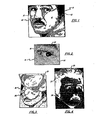
- the picture 10 shown in FIG. 1 is a halftone image of the original that has been created upon a transparent material 11 using we,1-1-known halftone image techniques.
- the halftone image is a portrait of a person and clearly brings out the tones found in and about the facial region.
- the region along the bridge of the nose, for example, is highlighted and contains smaller cells or dots.
- the hair region at 13, however, which is dark, contains larger dots and therefore appears dark to the eye.
- the size of the dots in the pattern varies to bring out different tonal gradations depicting other facial features.
- the end result is a high quality image that is of photographic quality faithfully capturing the details found in the original.
- a negative or reverse halftone transparency is then made from the original halftone image.
- the negative halftone transparency bearing the reverse halftone portrait of the original is employed in the process to expose a photoengraving plate that has been coated with a soluble light-sensitive photo-etch material.
- the plate is preferably made of magnesium or aluminum, both of which react predictably with known acids.
- the transparency is placed over the photosensitive coating and the coating is exposed through the transparency to ultraviolet light or light at a wavelength that will react with the coating to render it insoluble in the light- exposed regions.
- a latent image of the reverse halftone image is thus recorded on the plate surface with the light or clear (as in a transparency) regions (corresponding to the dark regions of the original halftone image) being recorded as insoluble areas and the dot regions as soluble regions.
- the exposed plate is washed with a suitable solvent to remove the coating in the unexposed regions, thereby revealing the underlying metal.
- the exposed coating remains.
- the washed plate is now placed in an acid bath and the acid is allowed to attack the unprotected metal for a sufficient period of time to produce relatively deep recesses in the unexposed region.
- the depth of the etch is considerably greater than that used in preparing a printing plate. The reason for the deep etch will become apparent from the disclosure below.
- FI G . 2 shows a portion of the etched plate 15 illustrating a region about the subject's eye greatly enlarged.
- the halftone dots are represented as raised cells 16, each one of which is terminated or cut off in the plane described by the top surface of the plate.
- the cells, where they do not blend together to provide solid area coverage, such as at the eyebrow 17, are connected by recesses 18.
- highlighted areas contain smaller cells or dots, while shadow areas contain heavy solid area dot coverage. It should be carefully noted that because of this etching process, the peak of the raised areas making up the halftone pattern are all cut off in a common plane. This is an extremely important step in the instant process which allows the image to be ultimately transferred to the final support without loss of quality or image fidelity.
- the depth of the recesses will vary and, more importantly, the bottom of each recess will be generally ragged and non-uniform.
- the image finally recorded on the support material using the transfer step of the invention would be made up of a series of jagged peaks of non-uniform height in which information would either be faintly visible or totally lost.
- the etched plate bearing the halftone dot pattern is used to generate a second transfer plate or blanket which is used to transfer the true image of the original recorded on the first etched plate 15 onto the final support material.
- a rubber-like mold material 20 which is self-curing is poured over the imaged surface of etched plate 15 as shown in FIG. 3.
- other materials may be used for the transfer blanket, such as silicone in uncured sheet form.
- the plate 15 may be enclosed by a raised frame during the pouring process which contains the flexible mold material within the imaged region.
- the mold material is poured to a desired thickness and then allowed to cure against the imaged plate surface.
- the mold material is able to fill the recesses between the cells formed in the plate and thus records a reverse image of the original in the molded face of the transfer blanket.
- the tops of the-cells all terminate in a common plane residing inside the blanket.
- the blanket or intermediate plate is peeled back from the etched plate.
- the image recorded in the molding face of the transfer blanket 25 shows the original dark areas as being recessed 27 and the original light areas as being raised 28.
- the transfer blanket 25 may be fabricated from any number of well-known rubber-like synthetic materials that are capable of curing against an imaged plate as described above to create an imaged strip suitable for use in a downstream molding process. Urethane or silicone materials of this nature are readily available under a number of different trade names.
- the cured blanket should exhibit high tear strength and sufficient flexibility to permit it to be peeled away from the etched plate or a final support material without damaging the image recorded therein. This combination of strength and flexibility is important when the blanket is used to mold certain hard plastics or the like that might tend to tear the mold, particularly in the imaged regions, during separation.
- the flexible transfer blanket 25 is used to create a true image of the original in a castable final support material which, for the purpose of this disclosure, will be chocolate candy.
- the image blanket is mounted with its imaged face up in the bottom of a molding tray 30 (FIG. 5), one side of which has been removed so that the inside of the tray can be more clearly viewed.
- the blanket is shown seated in a flat plane in the bottom of the tray.
- the blanket can be wrapped or seated upon a curved backing wall when arcuate-shaped articles such as candies or lollipops are being manufactured, provided that the plane in which the cells terminate describes a smooth continuous surface that will not distort the image to any great extent.
- the final support material which in this case is chocolate, is poured into the mold over the mold face of the transfer blanket to a desired depth.
- the block of chocolate After the block of chocolate has solidified or hardened, it is removed from the tray along with the transfer blanket 25. As shown in FIG. 6, the blanket is removed from the chocolate simply by pulling up one corner of the blanket and carefully peeling the blanket away from the top surface 37 of the chocolate. Here again, the flexibility of the mold strip comes into play.
- the strip should have a low enough durometer (softness) so that as it is being pulled away from the chocolate it will not physically damage the raised peaks embossed in the chocolate which define the halftone gradations.
- FIG. 7 shows the strip in the final stages of removal and the faint but discernible image that is left behind in the chocolate support material.
- FIG. 8 shows the imaged block of chocolate tilted to emphasize the shadows and thus more clearly outline the recorded image.
- the image is a faithful halftone replica of the original that accurately displays all the facial features found in the original subject matter.
- the fidelity of the image is comparable to that of a photograph appearing in newsprint or magazines and thus provides a picture of a quality infinitely greater than anything now available in the art for manufacturing low priced items.
- FIG. 9 illustrates one means of developing the image recorded in the chocolate support material.
- the contrast between highlights and shadows is low on a single color support material, particularly where the support is dark, as here.
- a different colored filler is placed in the recesses formed between the raised cells in the imaged region.
- a white or light tinted filler would be used which can be tapped onto the chocolate by a finger. The reverse would be true if the chocolate were light (white chocolate).
- a white powdered sugar 42 is sprinkled from a container 41 over the imaged surface 37 of the support so that the powder completely fills or, preferably, overfills the recesses.
- the imaged surface is then lightly squeegeed using any suitable means to remove the filler from the tops of the cells.
- all cells terminate in a common plane which, because of the double image transfer process, now lies in the plane described by the top surface of the support. Accordingly, the squeegeeing will clear the top of the support to reveal an extremely clear, high quality image of the original.
- tinted icings such as those used to frost cakes and cupcakes, can also be used effectively as fillers. These icings can be easily wiped from the top of the cells and will set up in the recesses to provided a long-lasting developer that is not readily dislodged. Fusible filler can also be used which can be heated or otherwise treated so as to bond to the support material.
- the image support When using the image support as a greeting card, it might be desirable to have the recipient develop the image himself or herself.
- the image can be hidden from view until after development by randomly forming a series of shallow indentations in the imaged surface of the final support material.
- the shallow indentations will reside at the top of the cell peaks and, prior to development, hide or mask the image information contained in the cells.
- the final support 50 is cast as explained above to create recesses 52-52 between peak regions-51-51 formed of single or merged cells.
- a series of shallow indentations 53-53 are placed in the peaks. As shown, the indentations are extremely shallow when compared to the recesses and are randomly dispersed so that they will not carry any intelligent information.
- the image data will be lost in the random pattern.
- the developer is placed on the imaged surface of the support, as explained in conjunction with FIG. 9, and the surface lightly squeegeed using paper or a business card or some other device that performs squeegeeing 55. Light squeegeeing will remove the developer from the cell peaks and shallow indentations to reveal a clear sharp image.
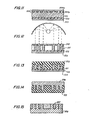
- FIGS. 11-15 as with the first embodiment shown in FIGS. 1-10, a continuous tone photograph is utilized to form a halftone image thereof on a film.
- the film in FIG. 11 is identified by the reference numeral 100 and includes a base 100a and an emulsion 100b.
- the film is placed over a photosensitive element 101 which, in this case, is a photosensitive photopolymer. Examples of such a photopolymer would be Dupont Cyrel, UniRoyal Flexlight, TOK made by Miraclon of Japan and Toyoba of Japan.
- the base 102 of the photopolymer is pre- exposed to preharden the same. Beneath base 102 is a bonded metal strip 103 for support purposes.
- a source of ultraviolet light 104 which is energized for a pre-selected amount of time so that an image on the photopolymer will be formed which corresponds to the image found on film 100.
- the unexposed areas of the photopolymer are washed away with water, or suitable chemicals if a water washout is not used, with the exposed areas in raised peaks as shown in FIG. 12.
- high-intensity steam or brushes may be used to wash away the unexposed areas.
- the photopolymer photosensitive element will now have on it peaks and valleys which correspond to the halftone image found in the film.
- the photopolymer has relief-formed valleys which generally have straight sides, a flat bottom and are uniform.
- the advantage of this is that the image formed from the photopolymer element has a very high quality photographic likeness. It is important to note that the tops of the peaks are formed in a common plane.
- the next step in the process is to cast a silicone rubber 105 transfer blanket onto the photopolymer to form an image on the silicone rubber by peaks and valleys that correspond to the image on the film and which is a reversal thereof.
- the photopolymer may be enclosed by a raised frame during the casting of the silicone rubber thereon.
- the silicone rubber will be formed to a desired thickness and allowed to cure against the photosensitive element.
- chocolate 106 is then cast onto the silicone rubber which will have an image formed thereon by means of peaks and valleys which is a reversal of the image on the silicone rubber. Because of the uniformity of the indentations on the silicone rubber transfer blanket, the chocolate indentations will likewise be uniform and the peaks at the same height.
- a frame can be placed about the blanket, as was previously described herein.
- the chocolate will be cast to the desired thickness and allowed to harden.
- a confectionery product 107 which has a coloration distinct from that of the chocolate is placed on top of the chocolate product and squeegeed or otherwise removed from the top surface of the chocolate product so that it only fills the indentations thereon.
- the effect this has is of instantly developing the image formed on the chocolate.
- heat or hot moisture can be applied to the formed image causing the white to be whiter and the dark to be darker, which increases the photographic likeness.
- a further aspect of the invention provides a method of reproducing in the surface of a castable material a photographic image from a full-tone photograph, characterised by the steps of forming on film a half-tone image from the photograph, photorelief imaging the half-tone image on the film in a surface of a photosensitive element such that peaks and valleys are created therein corresponding to the image, casting a deformable transfer blanket against the photosensitive element surface to record in a surface of the transfer blanket peaks and valleys corresponding to the image, and casting the castable material against the surface of the transfer blanket to reproduce the image by peaks and valleys in a surface of the castable material.
- the method is particularly suitable for use with castable materials having a low strength and/or soft surface, such as wax, chocolate, and other confectionery materials.
Landscapes
- Engineering & Computer Science (AREA)
- Life Sciences & Earth Sciences (AREA)
- Chemical & Material Sciences (AREA)
- Food Science & Technology (AREA)
- Polymers & Plastics (AREA)
- Manufacturing & Machinery (AREA)
- Mechanical Engineering (AREA)
- Confectionery (AREA)
- Photosensitive Polymer And Photoresist Processing (AREA)
Applications Claiming Priority (2)
| Application Number | Priority Date | Filing Date | Title |
|---|---|---|---|
| US06/892,994 US4668521A (en) | 1985-03-04 | 1986-08-01 | Method of forming an image with photographic likeness on chocolate |
| US892994 | 1986-08-01 |
Publications (2)
| Publication Number | Publication Date |
|---|---|
| EP0266019A2 true EP0266019A2 (de) | 1988-05-04 |
| EP0266019A3 EP0266019A3 (de) | 1989-03-01 |
Family
ID=25400851
Family Applications (1)
| Application Number | Title | Priority Date | Filing Date |
|---|---|---|---|
| EP87304488A Ceased EP0266019A3 (de) | 1986-08-01 | 1987-05-20 | Photographisch ähnliches Verfahren zur Bildung eines Bildes auf Schokolade |
Country Status (6)
| Country | Link |
|---|---|
| US (1) | US4668521A (de) |
| EP (1) | EP0266019A3 (de) |
| JP (1) | JPS6342651A (de) |
| AU (1) | AU7337687A (de) |
| CA (1) | CA1306140C (de) |
| IL (1) | IL82595A (de) |
Cited By (3)
| Publication number | Priority date | Publication date | Assignee | Title |
|---|---|---|---|---|
| DE19646813A1 (de) * | 1996-01-10 | 1997-08-21 | Hans Hnatek | Verfahren zum Erzeugen von Bildern und Schriften in pastösen Eßwaren wie Fleisch-, Teig- oder Süßwaren oder anderen Fertigprodukten der Lebensmittelindustrie mittels eines CO2-Laserbeschriftungssystems |
| EP1362515A3 (de) * | 2002-05-13 | 2004-01-02 | Grabenhorst, Oliver | Form zur Herstellung von Konfiserie |
| WO2022053618A1 (de) * | 2020-09-10 | 2022-03-17 | Agathon Gmbh & Co. Kg | Verfahren zur herstellung eines schokoladenartikels und schokoladenartikel |
Families Citing this family (40)
| Publication number | Priority date | Publication date | Assignee | Title |
|---|---|---|---|---|
| EP0272768A3 (de) * | 1985-12-19 | 1989-01-18 | Gary Green | Produkt aus Schokolade und Verfahren zur Herstellung |
| US5017394A (en) * | 1986-10-13 | 1991-05-21 | The Lucks Company | Method for making edible base shapes having pictorial images for decorating foodstuffs |
| CA1320322C (en) * | 1987-11-30 | 1993-07-20 | Jeffrey R. Robinson | Method and mold for imprinting moldable food stuffs and method and apparatus for making the mold |
| JPH03155750A (ja) * | 1989-11-13 | 1991-07-03 | Toshihiro Nakamura | 模様を施した物体及びその製造方法並びに製造に供される版 |
| JP2968555B2 (ja) * | 1990-05-10 | 1999-10-25 | 理想科学工業株式会社 | 成形型の作製方法 |
| WO1997005786A1 (en) * | 1995-08-07 | 1997-02-20 | Hoy Stephen B | Edible animal greeting cards |
| DK1688045T3 (en) | 1997-01-11 | 2015-06-29 | Mars Inc | Method of forming chocolate products |
| US7223428B2 (en) * | 1998-01-09 | 2007-05-29 | Mars Incorporated | Method of embossing chocolate products |
| US7286258B2 (en) * | 1998-03-25 | 2007-10-23 | Decopac, Inc. | Decorating system for edible products |
| US20020008751A1 (en) * | 1998-03-25 | 2002-01-24 | Stephen L. Spurgeon | Decorating system for edible items |
| US6159398A (en) * | 1998-03-31 | 2000-12-12 | Physical Optics Corporation | Method of making replicas while preserving master |
| US6230073B1 (en) | 1998-10-29 | 2001-05-08 | Chocolate Printing Company | Computerized foodstuffs imaging process and apparatus |
| AU706808B3 (en) * | 1998-12-04 | 1999-06-24 | Brabham, Allison Michelle | Mould plates for making chocolate products |
| WO2003005839A2 (en) * | 1999-08-05 | 2003-01-23 | Dimensional Foods Corporation | Edibles containing edible optical elements and methods |
| HN2000000165A (es) * | 1999-08-05 | 2001-07-09 | Dimensional Foods Corp | Productos holograficos comestibles, particularmente farmaceuticos, y metodos y aparatos para producirlos. |
| US6499842B1 (en) | 1999-10-15 | 2002-12-31 | Chocolate Printing Company | Foodstuffs imaging process and apparatus |
| US6376000B1 (en) | 2000-01-03 | 2002-04-23 | Peter B Waters | Method of creating painted chocolate |
| US20040007558A1 (en) * | 2000-08-14 | 2004-01-15 | Sim Woo Youl | Manufacturing method for high-density type copper plate memorial |
| US6623553B2 (en) | 2001-04-20 | 2003-09-23 | John Russell | Printing process with edible inks |
| US20050061184A1 (en) * | 2001-04-20 | 2005-03-24 | Russell John R. | Printing process with edible inks |
| AU2002354556A1 (en) * | 2001-07-09 | 2003-01-29 | Dimensional Foods Corporation | Edibles containing edible optical elements and methods |
| US20030175385A1 (en) * | 2002-03-18 | 2003-09-18 | Helferich John D. | Unique fat based ganache coating for the surface of packaged frozen products |
| US20040213877A1 (en) * | 2002-05-22 | 2004-10-28 | Anthony Badalucca | Educational systems and methods utilizing edible body parts and associated information cards |
| US7029112B2 (en) * | 2002-08-05 | 2006-04-18 | Mars, Incorporated | Ink-jet printing on surface modified edibles and products made |
| GB0227663D0 (en) * | 2002-11-27 | 2003-01-08 | Culpitt Ltd | Adornment for comestible products |
| EP1613174A2 (de) * | 2003-03-21 | 2006-01-11 | Decopac, Inc. | HERSTELLUNG VON GENIEßBAREN SUBSTRATEN |
| US9713342B2 (en) | 2004-08-25 | 2017-07-25 | Decopac, Inc. | Online decorating system for edible products |
| US7307249B2 (en) * | 2004-09-30 | 2007-12-11 | Cantu Homaro R | System and methods for preparing substitute food items |
| US20070202242A1 (en) * | 2006-02-27 | 2007-08-30 | Cielo Kevin K | System for manufacturing edible greeting cards |
| US10206423B2 (en) | 2010-08-09 | 2019-02-19 | Decopac, Inc. | Decorating system for edible items |
| US9743687B2 (en) | 2010-08-09 | 2017-08-29 | Decopac, Inc. | Decorating system for edible items |
| US9907332B2 (en) | 2010-08-09 | 2018-03-06 | Decopac, Inc. | Decorating system for edible items |
| US10543671B2 (en) | 2010-08-09 | 2020-01-28 | Decopac, Inc. | Three-dimensional decorating system for edible items |
| US10455096B2 (en) | 2010-08-09 | 2019-10-22 | Decopac, Inc. | Decorating system for edible products |
| GB2484472B (en) * | 2010-10-11 | 2012-11-14 | Graphic Ip Ltd | A method of casting |
| US9409312B2 (en) | 2013-01-14 | 2016-08-09 | Geoffrey Gretton | Durable earthenware engraving process |
| US10624362B2 (en) | 2015-01-07 | 2020-04-21 | The Lucks Company, Llc | Edible print substrates and methods of making and using the same |
| FR3058027A1 (fr) * | 2016-11-02 | 2018-05-04 | Hamide Frederic Cheikh-Djavadi | Procede d'ornementation et de decoration de tablette et de bonbon a base de chocolat et de confiserie, produits ainsi obtenus. |
| US10692124B1 (en) | 2018-12-07 | 2020-06-23 | Decopac, Inc. | Systems and methods for ordering and preparation of customized comestibles |
| EP4461137A1 (de) * | 2023-05-08 | 2024-11-13 | Hans Brunner GmbH | Mikrostrukturierte form zur konfektionierung eines härtbaren lebensmittels |
Family Cites Families (29)
| Publication number | Priority date | Publication date | Assignee | Title |
|---|---|---|---|---|
| US495341A (en) * | 1893-04-11 | Photogravure-printing plate | ||
| US727435A (en) * | 1899-08-18 | 1903-05-05 | Carl Pietzner | Photomechanical process of producing finished and plastic casts. |
| GB161740A (en) * | 1920-01-30 | 1921-04-21 | William Vanson Dawkings | A process of ornamenting cakes and confectionery generally |
| US1502006A (en) * | 1923-09-04 | 1924-07-22 | Alvord Charles Clinton | Educational article |
| FR605596A (fr) * | 1925-10-31 | 1926-05-28 | Procédé de marquage des bonbons en chocolat | |
| US1792486A (en) * | 1929-07-05 | 1931-02-17 | Of Engraving Inc Bureau | Process of producing plaque etchings |
| US2147770A (en) * | 1936-06-17 | 1939-02-21 | Walter D Ford | Method of producing colored designs on ceramic ware |
| US2181452A (en) * | 1936-10-16 | 1939-11-28 | Walter D Ford | Method of transferring photogrpahic designs on ceramic ware |
| US2294865A (en) * | 1938-03-25 | 1942-09-01 | Swedisch Artid Ab | Method of making decorated articles |
| GB628886A (en) * | 1938-09-29 | 1949-09-07 | Jamin N V C | Improvements in or relating to decoration of chocolate articles |
| US3101668A (en) * | 1960-03-14 | 1963-08-27 | Johnson & Son Inc S C | Printing members and method of making same |
| US2952225A (en) * | 1960-04-15 | 1960-09-13 | Ellison Eve | Food decorating stencil |
| NL277120A (de) * | 1961-06-27 | |||
| US3277541A (en) * | 1964-06-26 | 1966-10-11 | Ralph P Wilton | Photographic method of making a pattern for molding |
| US3739051A (en) * | 1971-07-21 | 1973-06-12 | G Smith | Method of making a molded foam decorative product |
| JPS4920858A (de) * | 1972-06-19 | 1974-02-23 | ||
| JPS5120923A (ja) * | 1974-08-13 | 1976-02-19 | Matsushita Electric Works Ltd | Hooronoseiho |
| JPS5248521A (en) * | 1975-10-15 | 1977-04-18 | Kubota Ltd | Dividing roll for continuous casting |
| FR2334509A1 (fr) * | 1975-12-12 | 1977-07-08 | Cambier Edouard | Perfectionnements apportes aux moyens du genre de ceux pour la decoration des gateaux ou semblables |
| US4144300A (en) * | 1976-09-15 | 1979-03-13 | Joseph P. Rolles | Chemical etching of record patterns and the like |
| US4200658A (en) * | 1978-12-18 | 1980-04-29 | Katzman Ellen F | Method for making candy in detailed designs |
| FR2453030A3 (fr) * | 1979-04-04 | 1980-10-31 | Daudignac Jean | Procede de realisation de decors pour patisserie, confiserie et autre |
| IE51406B1 (en) * | 1980-07-02 | 1986-12-24 | Unilever Plc | Improvements in confectionery articles and methods of manufacturing them |
| US4578273A (en) * | 1981-04-07 | 1986-03-25 | Keebler Company | Printing of foods |
| US4455320A (en) * | 1982-09-30 | 1984-06-19 | Chocolate Photos | Method of making chocolate candy sculpture of photo image |
| JPS59120051A (ja) * | 1982-12-27 | 1984-07-11 | Dainippon Printing Co Ltd | 菓子類の絵付法 |
| US4531292A (en) * | 1983-02-14 | 1985-07-30 | Joytronix, Inc. | Foodstuffs imaging process and apparatus |
| JPS605251A (ja) * | 1983-06-23 | 1985-01-11 | Toyo Seikan Kaisha Ltd | 塗料の連続的供給方法と装置 |
| JPS61118282U (de) * | 1984-07-30 | 1986-07-25 |
-
1986
- 1986-08-01 US US06/892,994 patent/US4668521A/en not_active Expired - Lifetime
-
1987
- 1987-04-30 CA CA000536023A patent/CA1306140C/en not_active Expired - Fee Related
- 1987-05-19 JP JP62123620A patent/JPS6342651A/ja active Granted
- 1987-05-20 IL IL82595A patent/IL82595A/xx unknown
- 1987-05-20 EP EP87304488A patent/EP0266019A3/de not_active Ceased
- 1987-05-25 AU AU73376/87A patent/AU7337687A/en not_active Abandoned
Cited By (5)
| Publication number | Priority date | Publication date | Assignee | Title |
|---|---|---|---|---|
| DE19646813A1 (de) * | 1996-01-10 | 1997-08-21 | Hans Hnatek | Verfahren zum Erzeugen von Bildern und Schriften in pastösen Eßwaren wie Fleisch-, Teig- oder Süßwaren oder anderen Fertigprodukten der Lebensmittelindustrie mittels eines CO2-Laserbeschriftungssystems |
| DE19646813C2 (de) * | 1996-01-10 | 1998-07-09 | Hans Hnatek | Verfahren zur Erzeugung von Bildern und Schriftzeichen auf der Oberfläche von schnittfesten Produkten der Lebensmittelindustrie |
| EP1362515A3 (de) * | 2002-05-13 | 2004-01-02 | Grabenhorst, Oliver | Form zur Herstellung von Konfiserie |
| WO2022053618A1 (de) * | 2020-09-10 | 2022-03-17 | Agathon Gmbh & Co. Kg | Verfahren zur herstellung eines schokoladenartikels und schokoladenartikel |
| DE102020123603B4 (de) | 2020-09-10 | 2026-04-02 | agathon GmbH | Verfahren zur Herstellung eines Schokoladenartikels |
Also Published As
| Publication number | Publication date |
|---|---|
| JPS6342651A (ja) | 1988-02-23 |
| US4668521A (en) | 1987-05-26 |
| IL82595A0 (en) | 1987-11-30 |
| JPH0218821B2 (de) | 1990-04-26 |
| EP0266019A3 (de) | 1989-03-01 |
| CA1306140C (en) | 1992-08-11 |
| AU7337687A (en) | 1988-02-04 |
| IL82595A (en) | 1991-03-10 |
Similar Documents
| Publication | Publication Date | Title |
|---|---|---|
| US4668521A (en) | Method of forming an image with photographic likeness on chocolate | |
| US4832966A (en) | Method of forming an image with photographic likeness on chocolate and product thereof | |
| US4778683A (en) | Method of forming a multi-color chocolate product | |
| US4001062A (en) | Variable scale relief reproduction process and product thereof | |
| US6099379A (en) | Eye article for taxidermy form | |
| US4321105A (en) | Method of producing embossed designs on surfaces | |
| US5896663A (en) | Process for making jewelry utilizing a soft photopolymer | |
| US5594989A (en) | Process for making jewelry utilizing a hard photopolymer | |
| JPH0128932B2 (de) | ||
| US6071655A (en) | Glazed photo-relief image | |
| JPH0857871A (ja) | ワックスパターンの製造方法 | |
| US5843250A (en) | Method of forming an image pattern on a die plate | |
| US5244620A (en) | Mold forming method | |
| JPWO1995021060A1 (ja) | 木目導管溝の凹凸構造を再現した化粧材/エンボス版ならびにその作成方法および作成装置 | |
| IE35028L (en) | Moulded article having a three-dimensional coloured surface¹design. | |
| JPS60199542A (ja) | 貴金属製品の製造方法 | |
| CA1140797A (en) | Method of producing embossed designs on surfaces | |
| JP3264393B2 (ja) | ロストワックス鋳造用鋳型の製造方法及びこの鋳造製品から射出成形用金型を製造する方法 | |
| JP2961519B2 (ja) | チョコレート菓子の表面に文字又は図形を立体的に表わ したチョコレートの製造方法 | |
| GB2227456A (en) | Improvements relating to picture forming | |
| US242414A (en) | Batjd | |
| US4184910A (en) | Surface-texture filmwork generation | |
| JP4831884B2 (ja) | 金属装飾板とその製造方法 | |
| JPS63301749A (ja) | チョコレ−ト成形加工方法 | |
| JPH02299551A (ja) | 菓子、食品に対象となる写真、絵柄、文字をそっくり表現する方法 |
Legal Events
| Date | Code | Title | Description |
|---|---|---|---|
| PUAI | Public reference made under article 153(3) epc to a published international application that has entered the european phase |
Free format text: ORIGINAL CODE: 0009012 |
|
| AK | Designated contracting states |
Kind code of ref document: A2 Designated state(s): AT BE CH DE ES FR GB GR IT LI LU NL SE |
|
| PUAL | Search report despatched |
Free format text: ORIGINAL CODE: 0009013 |
|
| RHK1 | Main classification (correction) |
Ipc: A23G 1/22 |
|
| AK | Designated contracting states |
Kind code of ref document: A3 Designated state(s): AT BE CH DE ES FR GB GR IT LI LU NL SE |
|
| 17P | Request for examination filed |
Effective date: 19890831 |
|
| 17Q | First examination report despatched |
Effective date: 19901114 |
|
| STAA | Information on the status of an ep patent application or granted ep patent |
Free format text: STATUS: THE APPLICATION HAS BEEN REFUSED |
|
| 18R | Application refused |
Effective date: 19910518 |
|
| RIN1 | Information on inventor provided before grant (corrected) |
Inventor name: NEWSTEDER, ROBERT |