EP0266597A2 - Verfahren zur Entfernung von metallischen Bestandteilen aus bei der elektrothermischen Herstellung von gelbem Phosphor anfallenden Stäuben - Google Patents
Verfahren zur Entfernung von metallischen Bestandteilen aus bei der elektrothermischen Herstellung von gelbem Phosphor anfallenden Stäuben Download PDFInfo
- Publication number
- EP0266597A2 EP0266597A2 EP87115119A EP87115119A EP0266597A2 EP 0266597 A2 EP0266597 A2 EP 0266597A2 EP 87115119 A EP87115119 A EP 87115119A EP 87115119 A EP87115119 A EP 87115119A EP 0266597 A2 EP0266597 A2 EP 0266597A2
- Authority
- EP
- European Patent Office
- Prior art keywords
- dust
- carbon
- calcinate
- temperatures
- phosphorus
- Prior art date
- Legal status (The legal status is an assumption and is not a legal conclusion. Google has not performed a legal analysis and makes no representation as to the accuracy of the status listed.)
- Granted
Links
Classifications
-
- C—CHEMISTRY; METALLURGY
- C01—INORGANIC CHEMISTRY
- C01B—NON-METALLIC ELEMENTS; COMPOUNDS THEREOF; METALLOIDS OR COMPOUNDS THEREOF NOT COVERED BY SUBCLASS C01C
- C01B25/00—Phosphorus; Compounds thereof
- C01B25/02—Preparation of phosphorus
- C01B25/027—Preparation of phosphorus of yellow phosphorus
Definitions
- the invention relates to a process for removing metallic constituents, in particular heavy metals, from dust which has been electrostatically separated from the gas mixture obtained in the electrothermal production of yellow phosphorus and consisting essentially of carbon monoxide and phosphorus vapor.
- the metallic components introduced into the phosphor furnace with the raw materials phosphate, coke and gravel flow out of the phosphor furnace in elementary form or as readily volatile oxides with the furnace gas consisting essentially of phosphorus vapor and carbon monoxide.
- the most important metallic components are zinc, cadmium, lead, silver, gallium, germanium and alkali metals; these condense either as discrete particles or on the surface of dust particles contained in the phosphor furnace gas.
- the discrete particles and the dust particles are separated from the phosphorus furnace gas by electrostatic separation, for which purpose an electrical separator according to Cottrell is generally used, from which the so-called Cottrell dust is removed.
- the Cottrell dust which has a relatively high metal content, can either be discharged and deposited after processing (cf. US Pat. No. 4,537,756) or re-introduced into the phosphor furnace together with new feedstocks.
- the recirculation of the Cottrell dust in the phosphor furnace is due to this its high content of phosphorus and phosphorus compounds is desirable for economic reasons; however, the recirculation of the Cottrell dust entails an enrichment of its metallic components, especially its heavy metal components, which has a negative effect on the operation of the phosphor furnace and the downstream electrical separator (see US Pat. No. 4,537,756).
- the treatment can be carried out under reducing conditions in a fluidized bed or in the circulation process or batchwise in a fixed bed.
- an inert gas for example nitrogen, or a reducing gas such as carbon monoxide or hydrogen and also mixtures thereof can be used as carrier gas. If air is used as the carrier gas in the treatment of the calcinate, the reducing atmosphere is generated in situ by oxidation of the activated carbon to carbon monoxide.
- the carrier gas can be recirculated after flowing through the condensation stage for the treatment of further calcinate.
- the dwell time is not critical unless extremely short contact times are selected.
- the outflowing gas phase was passed through a cooled receiver, in which the condensate was collected.
- the residue remaining in the reaction tube (100.8 g) was calcined to constant weight at 800 ° C. to completely burn the activated carbon while passing air over it (20 l / h), resulting in 85.0 g of residue.
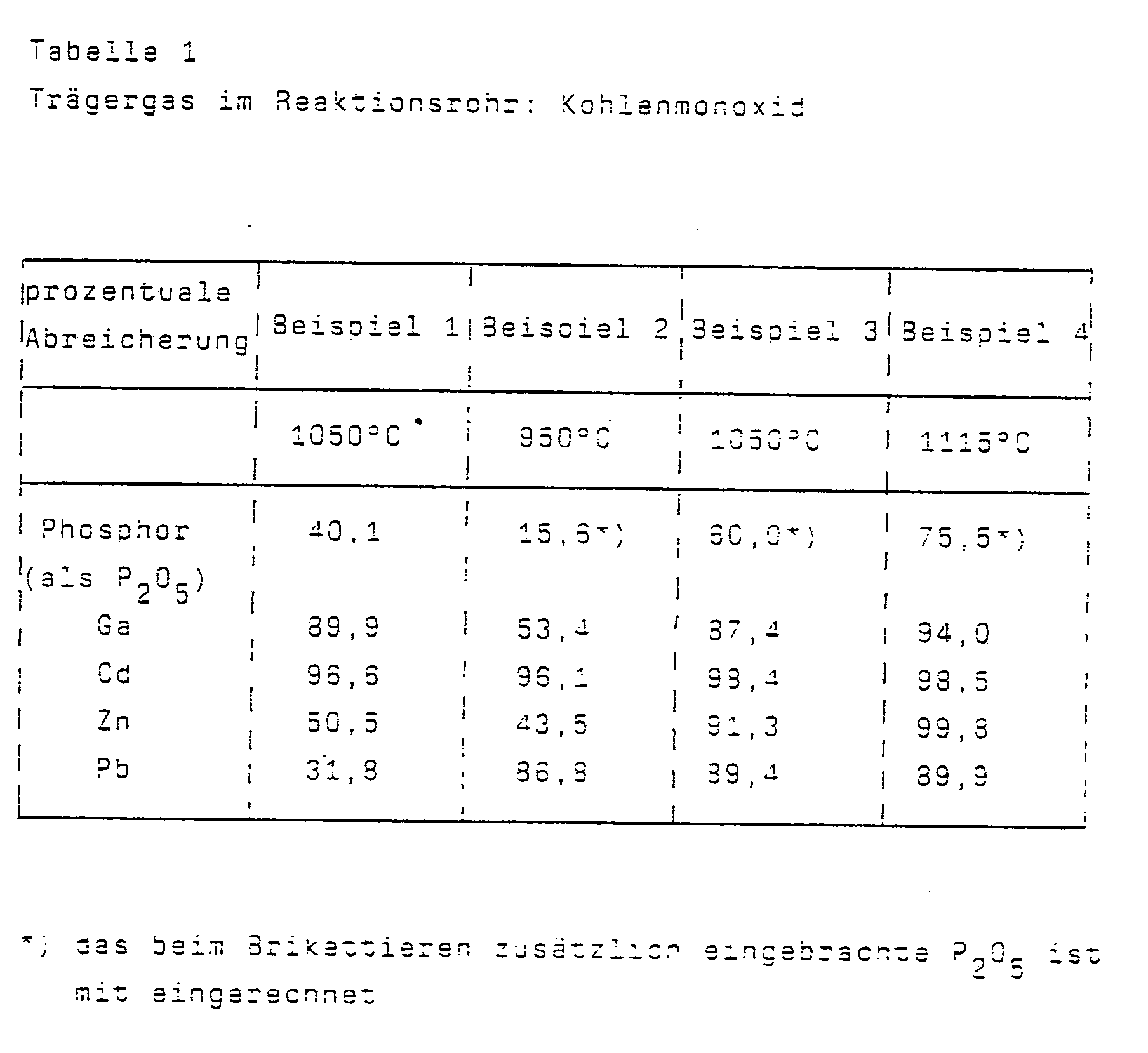
- the residue contained 19.8% P2O5, 0.022% gallium, 0.032% cadmium, 8.0% zinc and 0.91% lead. From the comparison of the contents in filter cake and residue, the depletion of the total phosphorus is 40.1% (calculated as P2O5), the gallium to 89.9%, the cadmium to 96.6%, the zinc to 50.5% and the Lead was calculated to be 32.5% (see Table 1).
- Example 2 200 g of the dried and ground filter cake according to Example 1 were calcined for 2 hours in a laboratory rotary tube oven at 600 ° C. while passing air (200 l / h) through it.
- the calcinate contained 21.8% P2O5, 0.12% Ga, 0.48% Cd, 10.4% Zn and 0.71% Pb.
- 100 g of the calcine were mixed with 25 g of activated carbon and the mixture with 42 g of phosphoric acid (P2O5 content: 20.5%) pasted and briquetted.
- the press obtained Linge were introduced into the reaction tube used in Example 1 and dried therein at 150 ° C. The mixture was then heated to a final temperature of 950 ° C. while passing a CO stream and this temperature was maintained for 90 minutes.
- Example 2 was repeated with the change that the final temperature in the quartz tube was 1050 ° C. The result was 75.5 g of residue with 16.1% P2O5, 0.02% Ga, 0.010% Cd, 1.2% Zn and 0.10% Pb. The percentages that can be calculated from the comparison of filter cake and residue are listed in Table 1.
- Example 2 was repeated with the change that the final temperature in the quartz tube was 1115 ° C. This resulted in 70.6 g of residue with 10.5% P2O5, 0.01% Ga, 0.010% Cd, 0.025% Zn and 0.10% Pb. The percentages that can be calculated from the comparison of filter cake and residue are listed in Table 1.
- Example 1 was repeated with the change that by an air stream (20 l / h) was passed through the reaction tube instead of carbon monoxide.
- the resulting residue (87.1 g) contained 20.7% P2O5 0.083% Ga, 0.06% Cd, 12.0% Zn and 0.96% Pb.
- the percentages that can be calculated from the comparison of filter cake and residue are listed in Table 2.
- Example 2 100 g of a calcinate prepared according to Example 2 (with 18.6% P2O5, 0.16% Ga, 0.91% Cd, 10.9% Zn and 0.96% Pb) were mixed with 20 g activated carbon. The mixture was introduced into the reaction tube used in Example 1 and heated to a final temperature of 1050 ° C. while passing an air stream (20 l / h) and maintained at this temperature for 90 minutes. The treatment of the outflowing gas phase and the combustion of the remaining activated carbon was carried out analogously to Example 1. The resulting residue (83.3 g) contained 18.6% P2O5, 0.03% Ga, 0.05% Cd, 5.3% Zn and 0.51% Pb. The percentages that can be calculated from the comparison of filter cake and residue are listed in Table 2.
Landscapes
- Chemical & Material Sciences (AREA)
- Organic Chemistry (AREA)
- Inorganic Chemistry (AREA)
- Manufacture And Refinement Of Metals (AREA)
- Catalysts (AREA)
Abstract
Description
- Die Erfindung betrifft ein Verfahren zur Entfernung von metallischen Bestandteilen, insbesondere von Schwermetallen, aus Staub, welcher aus dem bei der elektrothermischen Herstellung von gelbem Phosphor anfallenden, im wesentlichen aus Kohlenmonoxid und Phosphordampf bestehenden Gasgemisch elektrostatisch abgeschieden wurde.
- Unter den stark reduzierenden Bedingungen im elektrothermischen Phosphorofen strömen ein Teil der mit den Einsatzstoffen Rohphosphat, Koks und Kies in den Phosphorofen eingebrachten metallischen Bestandteile elementar oder als leicht flüchtige Oxide mit dem im wesentlichen aus Phosphordampf und Kohlenmonoxid bestehenden Ofengas gasförmig aus dem Phosphorofen ab. Dabei sind die bedeutendsten metallischen Bestandteile Zink, Cadmium, Blei, Silber, Gallium, Germanium und Alkalimetalle; diese kondensieren entweder als diskrete Teilchen oder auf der Oberfläche von im Phosphorofengas enthaltenen Staubteilchen. Die diskreten Teilchen und die Staubteilchen werden aus dem Phosphorofengas durch elektrostatische Abscheidung abgetrennt, wozu in der Regel ein Elektroabscheider nach Cottrell eingesetzt wird, aus welchem der sog. Cottrell-Staub ausgetragen wird.
Der Cottrell-Staub, welcher einen relativ hohen Metallgehalt aufweist, kann entweder ausgeschleust und nach einer Verarbeitung deponiert werden (vergl. US-PS 4 537 756) oder gemeinsam mit neuen Einsatzstoffen erneut in den Phosphorofen eingetragen werden. Dabei ist die Rezirkulation des Cottrell-Staubes in den Phosphorofen auf Grund seines hohen Gehaltes an Phosphor und Phosphorverbindungen aus wirtschaftlichen Gründen wünschenswert; jedoch bringt die Rezirkulation des Cottrell-Staubes eine Anreicherung seiner metallischen Bestandteile, insbesondere seiner Schwemetallbestandteile, mit sich, wodurch der Betrieb des Phosphorofens und der nachgeschalteten Elektroabscheider negativ beeinflußt werden (vergl. US-PS 4 537 756). - Es ist daher Aufgabe der vorliegenden Erfindung, ein Verfahren anzugeben, welches eine Aufarbeitung des ausgeschleusten Cottrell-Staubes einerseits in eine metallarme Phase mit hohem Phosphorgehalt und andererseits in eine metall- bzw. metalloxidreiche Phase erlaubt. Das wird erfindungsgemäß dadurch erreicht, daß man den Staub zunächst unter oxidierenden Bedingungen bei Temperaturen von 300 bis 800°C unter ständiger Bewegung calciniert; daß man das resultierende Calcinat mit Kohlenstoff vermischt und bei Temperaturen von 950 bis 1200°C, vorzugsweise von 1000 bis 1100°C, unter Verflüchtigung der metallischen Bestandteilen reduzierend behandelt; und daß man die verflüchtigten metallischen Bestandteile kondensiert und abscheidet.
- Das Verfahren gemäß der Erfindung kann weiterhin wahlweise auch noch dadurch ausgestaltet sein, daß
- a) man den Staub in Form eines Filterkuchens einsetzt, welcher durch Filtration einer durch Anrühren des Staubes mit Wasser gebildeten Suspension erhalten wurde;
- b) die Suspension durch Anrühren des Staubes mit Wasser im Gewichtsverhältnis 1 : (2 bis 5) erhalten wurde;
- c) das Calcinat vermahlen ist;
- d) das Gemisch aus Calcinat und Kohlenstoff mit Phosphorsäure zu einem stichfesten Material verarbeitet ist;
- e) das stichfeste Material zu Briketts geformt ist;
- f) das Calcinat mit Kohlenstoff im Gewichtsverhältnis 10 : 1 bis 10 : 3 vermischt wird.
- Mit dem erfindungsgemäßen Verfahren wird ein Rückstand erhalten, welcher in bezug auf den Metallgehalt des eingesetzten Cottrell-Staubes beträchtlich von Metallen, insbesondere Schwermetallen, abgereichert ist.
- Beim Verfahren gemäß der Erfindung kann die Behandlung unter reduzierenden Bedingungen im Wirbelbett oder im Umwälzverfahren oder diskontinuierlich im Festbett durchgeführt werden.
- Beim Erfindungsgemäßen Verfahren können als Trägergas ein Inertgas, beispielsweise Stickstoff, oder ein reduzierendes Gas wie Kohlenmonoxid oder Wasserstoff sowie auch deren Gemische verwendet werden. Verwendet man bei der Behandlung des Calcinates als Trägergas Luft, so wird durch Oxidation der Aktivkohle zu Kohlenmonoxid die reduzierende Atmosphäre in situ erzeugt.
- Beim Verfahren gemäß der Erfindung kann das Trägergas nach Durchströmen der Kondensationsstufe zur Behandlung von weiterem Calcinat rezirkuliert werden.
- Beim erfindungsgemäßen Verfahren ist die Verweilzeit unkritisch, sofern nicht extrem kurze Kontaktzeiten gewählt werden.
- 132 g eines Filterkuchens, welcher durch Filtration einer wäßrigen Suspension von Cottrell-Staub erhalten wurde und einen Gesamtphosphorgehalt von 21,3 % (als P₂O₅ gerechnet) sowie 0.14 % Gallium, 0,60 % Cadmium, 10,4 % Zink und 0,86 % Blei aufwies, wurde 2 Stunden bei 300°C getrocknet und anschließend gemahlen. Das trockene Mahlgut (100 g) wurde mit 20 g Aktivkohle vermischt. Das Gemsich wurde in einem senkrecht angeordneten, mit einem Rohr aus Pythagorasmasse ausgekleideten Quarzrohr im Kohlenmonoxid-Strom (6 l/h) auf 1050°C erhitzt und 1 Stunde bei dieser Temperatur belassen. Die abströmende Gasphase wurde durch eine gekühlte Vorlage geleitet, in welcher das Kondensat gesammelt wurde. Der im Reaktionsrohr verbliebene Rückstand (100,8 g) wurde zur vollständigen Verbrennung der Aktivkohle unter Überleiten von Luft (20 l/h) bei 800°C bis zur Gewichtskonstanz geglüht, wobei 85,0 g Rückstand resultierten. Der Rückstand enthielt 19,8 % P₂O₅, 0,022 % Gallium, 0.032 % Cadmium, 8,0 % Zink und 0,91 % Blei. Aus dem Vergleich der Gehalte in Filterkuchen und Rückstand ist die Abreicherung des Gesamtphosphors zu 40,1 % (als P₂O₅ gerechnet), des Galliums zu 89,9 %, des Cadmiums zu 96,6 %, des Zinks zu 50,5 % und des Bleis zu 32,5 % berechnet worden (vergl. Tabelle 1).
- 200 g des getrockneten und gemahlenen Filterkuchens gemäß Beispiel 1 wurden 2 Stunden in einem Labor-Drehrohrofen bei 600°C unter Durchleiten von Luft (200 l/h) calciniert. Das Calcinat enthielt 21,8 % P₂O₅, 0,12 % Ga, 0,48 % Cd, 10,4 % Zn und 0,71 % Pb. 100 g des Calcinates wurden mit 25 g Aktivkohle vermischt und die Mischung mit 42 g Phosphorsäure (P₂O₅-Gehalt: 20,5 %) angeteigt und brikettiert. Die erhaltenen Preß linge wurden in das im Beispiel 1 verwendete Reaktionsrohr eingebracht und darin bei 150°C getrocknet. Anschließend wurde unter Durchleiten eines CO-Stromes auf eine Endtemperatur von 950°C erhitzt und diese Temperatur 90 Minuten lang beibehalten. Die abströmende Gasphase wurde durch eine gekühlte Vorlage geleitet, in welcher das Kondensat gesammelt wurde. Die Verbrennung der restlichen Aktivkohle und das Glühen bis zur Gewichtskonstanz wurde analog Beispiel 1 durchgeführt. Danach resultierten 93,3 g Rückstand mit 27,5 % P₂O₅, 0.06 % Ga, 0.020 % Cd, 6,3 % Zn und 0.10 % Pb. Die aus dem Vergleich von Filterkuchen und Rückstand errechenbaren prozentualen Abreicherungen sind in Tabelle 1 aufgeführt.
- Beispiel 2 wurde mit der Änderung wiederholt, daß die Endtemperatur im Quarzrohr 1050°C betrug. Es resultierten 75,5 g Rückstand mit 16,1 % P₂O₅, 0.02 % Ga, 0,010 % Cd, 1,2 % Zn und 0,10 % Pb. Die aus dem Vergleich von Filterkuchen und Rückstand errechenbaren prozentualen Abreicherungen sind in Tabelle 1 aufgeführt.
- Beispiel 2 wurde mit der Änderung wiederholt, daß die Endtemperatur im Quarzrohr 1115°C betrug. Es resultierten 70,6 g Rückstand mit 10,5 % P₂O₅, 0,01 % Ga, 0,010 % Cd, 0,025 % Zn und 0,10 % Pb. Die aus dem Vergleich von Filterkuchen und Rückstand errechenbaren prozentualen Abreicherungen sind in Tabelle 1 aufgeführt.
- Beispiel 1 wurde mit der Änderung wiederholt, daß durch das Reaktionsrohr anstelle von Kohlenmonoxid ein Luftstrom (20 l/h) hindurchgeleitet wurde. Der resultierende Rückstand (87, 1 g) enthielt 20,7 % P₂O₅ 0,083 % Ga, 0,06 % Cd, 12,0 % Zn und 0,96 % Pb. Die aus dem Vergleich von Filterkuchen und Rückstand errechenbaren prozentualen Abreicherungen sind in Tabelle 2 aufgeführt.
- 100 g eines gemäß Beispiel 2 hergestellten Calcinates (mit 18,6 % P₂O₅, 0.16 % Ga, 0,91 % Cd, 10,9 % Zn und 0,96 % Pb) wurden mit 20 g Aktivkohle vermischt. Die Mischung wurde in das im Beispiel 1 verwendete Reaktionsrohr eingebracht und darin unter Durchleiten eines Luftstromes (20 l/h) auf eine Endtemperatur von 1050°C erhitzt und diese Temperatur 90 Minuten lang beibehalten. Die Behandlung der abströmenden Gasphase und die Verbrennung der restlichen Aktivkohle erfolgte analog Beispiel 1. Der resultierende Rückstand (83,3 g) enthielt 18,6 % P₂O₅, 0,03 % Ga, 0,05 % Cd, 5,3 % Zn und 0,51 % Pb. Die aus dem Vergleich von Filterkuchen und Rückstand errechenbaren prozentualen Abreicherungen sind in Tabelle 2 aufgeführt.

Claims (7)
Applications Claiming Priority (2)
| Application Number | Priority Date | Filing Date | Title |
|---|---|---|---|
| DE3637670 | 1986-11-05 | ||
| DE19863637670 DE3637670A1 (de) | 1986-11-05 | 1986-11-05 | Verfahren zur entfernung von metallischen bestandteilen aus bei der elektrothermischen herstellung von gelbem phosphor anfallenden staeuben |
Publications (3)
| Publication Number | Publication Date |
|---|---|
| EP0266597A2 true EP0266597A2 (de) | 1988-05-11 |
| EP0266597A3 EP0266597A3 (en) | 1990-06-13 |
| EP0266597B1 EP0266597B1 (de) | 1991-07-24 |
Family
ID=6313213
Family Applications (1)
| Application Number | Title | Priority Date | Filing Date |
|---|---|---|---|
| EP87115119A Expired - Lifetime EP0266597B1 (de) | 1986-11-05 | 1987-10-16 | Verfahren zur Entfernung von metallischen Bestandteilen aus bei der elektrothermischen Herstellung von gelbem Phosphor anfallenden Stäuben |
Country Status (4)
| Country | Link |
|---|---|
| US (1) | US4889702A (de) |
| EP (1) | EP0266597B1 (de) |
| CA (1) | CA1282224C (de) |
| DE (2) | DE3637670A1 (de) |
Cited By (3)
| Publication number | Priority date | Publication date | Assignee | Title |
|---|---|---|---|---|
| US4904459A (en) * | 1988-08-09 | 1990-02-27 | Hoechst Aktiengesellschaft | Process for working up dusts which are produced in the electrothermal production of phosphorus |
| GB2199313B (en) * | 1986-12-30 | 1990-06-06 | Inst Orch Sinteza I Uglekhimii | Process for obtaining phosphorus from aqueous suspension of phosphorus slime |
| EP0586910A1 (de) * | 1992-09-10 | 1994-03-16 | Hoechst Aktiengesellschaft | Verfahren und Anlage zum Entfernen von Blei, Cadmium und Zink aus Stäuben |
Families Citing this family (2)
| Publication number | Priority date | Publication date | Assignee | Title |
|---|---|---|---|---|
| CN103657329B (zh) * | 2013-12-25 | 2016-05-04 | 贵州开磷集团股份有限公司 | 一种黄磷尾气集中控制回收与净化装置 |
| CN104862488A (zh) * | 2015-04-28 | 2015-08-26 | 内蒙古科技大学 | 一种含锗粉尘电弧炉高温火法二次富集方法 |
Family Cites Families (9)
| Publication number | Priority date | Publication date | Assignee | Title |
|---|---|---|---|---|
| US1820606A (en) * | 1929-03-23 | 1931-08-25 | Victor Chemical Works | Production of phosphorus in volatilization furnaces |
| DE669749C (de) * | 1937-03-02 | 1939-01-03 | Ruhrstahl Akt Ges | Verfahren zum gleichzeitigen Gewinnen von Blei und Zink aus dem Filterstaub der Hochofengastrockenreinigungen |
| DE899556C (de) * | 1951-09-07 | 1953-12-14 | Administration Sequestre Des R | Verfahren zur Nutzbarmachung des Hochofenfilterstaubes |
| US3717451A (en) * | 1970-10-06 | 1973-02-20 | Imc Corp | Fluidized bed treatment of phosphorus-containing precipitator dust |
| JPS5735644A (en) * | 1980-08-13 | 1982-02-26 | Toshin Seikou Kk | Recovering method for valuable metal from dust from electric furnace for manufacturing steel |
| SU1151504A1 (ru) * | 1982-05-20 | 1985-04-23 | Казахский Научно-Исследовательский И Проектный Институт Фосфорной Промышленности | Способ получени восстановител |
| DE3404952A1 (de) * | 1983-07-18 | 1985-01-31 | Hoechst Ag, 6230 Frankfurt | Verfahren zum ausschleusen von fremdstoffen aus dem materialkreislauf bei der elektrothermischen herstellung von gelbem phosphor |
| US4673431A (en) * | 1986-01-08 | 1987-06-16 | Bricmont & Associates, Inc. | Furnace dust recovery process |
| US4678647A (en) * | 1986-05-12 | 1987-07-07 | Enron Corp. | Process for the recovery of gallium and germanium from coal fly ash |
-
1986
- 1986-11-05 DE DE19863637670 patent/DE3637670A1/de not_active Withdrawn
-
1987
- 1987-10-15 CA CA000549302A patent/CA1282224C/en not_active Expired - Fee Related
- 1987-10-16 DE DE8787115119T patent/DE3771655D1/de not_active Expired - Fee Related
- 1987-10-16 EP EP87115119A patent/EP0266597B1/de not_active Expired - Lifetime
-
1988
- 1988-11-29 US US07/277,567 patent/US4889702A/en not_active Expired - Fee Related
Cited By (4)
| Publication number | Priority date | Publication date | Assignee | Title |
|---|---|---|---|---|
| GB2199313B (en) * | 1986-12-30 | 1990-06-06 | Inst Orch Sinteza I Uglekhimii | Process for obtaining phosphorus from aqueous suspension of phosphorus slime |
| US4904459A (en) * | 1988-08-09 | 1990-02-27 | Hoechst Aktiengesellschaft | Process for working up dusts which are produced in the electrothermal production of phosphorus |
| EP0354338A3 (de) * | 1988-08-09 | 1991-06-12 | Hoechst Aktiengesellschaft | Verfahren zur Aufarbeitung von Stäuben, die bei der elektrothermischen Phosphorherstellung anfallen |
| EP0586910A1 (de) * | 1992-09-10 | 1994-03-16 | Hoechst Aktiengesellschaft | Verfahren und Anlage zum Entfernen von Blei, Cadmium und Zink aus Stäuben |
Also Published As
| Publication number | Publication date |
|---|---|
| CA1282224C (en) | 1991-04-02 |
| DE3771655D1 (de) | 1991-08-29 |
| DE3637670A1 (de) | 1988-05-19 |
| EP0266597A3 (en) | 1990-06-13 |
| US4889702A (en) | 1989-12-26 |
| EP0266597B1 (de) | 1991-07-24 |
Similar Documents
| Publication | Publication Date | Title |
|---|---|---|
| DE69027437T2 (de) | Verhüttung metallurgischer abfallstoffe enthaltend eisenbestandteile und toxische elemente | |
| DE69225993T2 (de) | Verfahren zur Behandlung von Erz mit rückgewinnbaren Metallwertstoffen einschliesslich arsenhaltiger Komponenten | |
| DE3705787A1 (de) | Verfahren zur entfernung von giftigen oxiden aus abfallstaub | |
| DE3131898C2 (de) | Verfahren zur Gewinnung von Zink und Blei aus bei metallurgischen Raffinationsöfen anfallenden Stäuben | |
| EP0266597B1 (de) | Verfahren zur Entfernung von metallischen Bestandteilen aus bei der elektrothermischen Herstellung von gelbem Phosphor anfallenden Stäuben | |
| DE69501955T2 (de) | Verfahren zur extraktion von metallen aus metallenthaltenden materialien durch pyrohydrolyse | |
| DE2953581C2 (de) | Verfahren zur Aufbereitung eines pyrithaltigen Polymetallrohstoffes | |
| DE2539309C3 (de) | Verfahren zum Herstellen von hochreinem metallischen Molybdän | |
| DE2708634C2 (de) | Verfahren zur sintermetallurgischen Herstellung von Ferromolybdän | |
| WO2016131445A1 (de) | Verarbeitungsverfahren und verarbeitungsvorrichtung für arsenopyrit-konzentrate | |
| DE2930635C2 (de) | ||
| DE2038227A1 (de) | Verfahren zur Aufbereitung von Erzen und Konzentraten | |
| DE3811594A1 (de) | Verfahren zur verarbeitung sulfidischer bleihaltiger oder sulfidischer blei- und zinkhaltiger erze und/oder konzentrate | |
| DE2953802C1 (de) | Verfahren zur Behandlung von pyrithaltigem Polymetallischem Rohstoff | |
| EP0162954B1 (de) | Verfahren zur Gewinnung eines weiterverarbeitbaren Germaniumkonzentrats | |
| DE4124547C2 (de) | Verfahren zur Isolierung von Titananteilen | |
| CN111115684B (zh) | 一种高纯硫化锑的制备方法 | |
| DE947518C (de) | Verfahren zur Gewinnung von Schwefeldioxyd und der Metalle aus sulfidischen Erzen oder Konzentraten und sauerstoffhaltigen Metallverbindungen | |
| DE1583184A1 (de) | Verfahren zur Entfernung von Arsen aus Kieseabbraenden und eisenhaltigen Mineralien | |
| DE524714C (de) | Herstellung von Phosphor durch Reduktion von Phosphormineralien | |
| DE2000085B2 (de) | Verfahren zur stufenweisen Wirbelschichtröstung sulfidischer Eisenmaterialien | |
| DE547052C (de) | Verfahren zur Entfernung von Cadmium aus cadmiumhaltigem Gut | |
| DE680520C (de) | Verfahren zur Entfernung von Arsen aus huettenmaennischen Zwischen- und Abfallerzeugnissen | |
| DE2446844C3 (de) | Verfahren zur Herstellung von Fluorwasserstoff, Phosphorsäureanhydrid, Calziumpolyphosphaten und Salpetersaure | |
| DE1222027B (de) | Verfahren zur Herstellung von Molybdaentrioxyd aus Molybdaendisulfid |
Legal Events
| Date | Code | Title | Description |
|---|---|---|---|
| PUAI | Public reference made under article 153(3) epc to a published international application that has entered the european phase |
Free format text: ORIGINAL CODE: 0009012 |
|
| AK | Designated contracting states |
Kind code of ref document: A2 Designated state(s): DE FR GB NL |
|
| PUAL | Search report despatched |
Free format text: ORIGINAL CODE: 0009013 |
|
| AK | Designated contracting states |
Kind code of ref document: A3 Designated state(s): DE FR GB NL |
|
| 17P | Request for examination filed |
Effective date: 19900627 |
|
| 17Q | First examination report despatched |
Effective date: 19901128 |
|
| GRAA | (expected) grant |
Free format text: ORIGINAL CODE: 0009210 |
|
| AK | Designated contracting states |
Kind code of ref document: B1 Designated state(s): DE FR GB NL |
|
| REF | Corresponds to: |
Ref document number: 3771655 Country of ref document: DE Date of ref document: 19910829 |
|
| ET | Fr: translation filed | ||
| GBT | Gb: translation of ep patent filed (gb section 77(6)(a)/1977) | ||
| PGFP | Annual fee paid to national office [announced via postgrant information from national office to epo] |
Ref country code: DE Payment date: 19911207 Year of fee payment: 5 |
|
| PLBE | No opposition filed within time limit |
Free format text: ORIGINAL CODE: 0009261 |
|
| STAA | Information on the status of an ep patent application or granted ep patent |
Free format text: STATUS: NO OPPOSITION FILED WITHIN TIME LIMIT |
|
| 26N | No opposition filed | ||
| PGFP | Annual fee paid to national office [announced via postgrant information from national office to epo] |
Ref country code: FR Payment date: 19920915 Year of fee payment: 6 |
|
| PGFP | Annual fee paid to national office [announced via postgrant information from national office to epo] |
Ref country code: GB Payment date: 19920921 Year of fee payment: 6 |
|
| PGFP | Annual fee paid to national office [announced via postgrant information from national office to epo] |
Ref country code: NL Payment date: 19921031 Year of fee payment: 6 |
|
| PG25 | Lapsed in a contracting state [announced via postgrant information from national office to epo] |
Ref country code: DE Effective date: 19930701 |
|
| PG25 | Lapsed in a contracting state [announced via postgrant information from national office to epo] |
Ref country code: GB Effective date: 19931016 |
|
| PG25 | Lapsed in a contracting state [announced via postgrant information from national office to epo] |
Ref country code: NL Effective date: 19940501 |
|
| GBPC | Gb: european patent ceased through non-payment of renewal fee |
Effective date: 19931016 |
|
| NLV4 | Nl: lapsed or anulled due to non-payment of the annual fee | ||
| PG25 | Lapsed in a contracting state [announced via postgrant information from national office to epo] |
Ref country code: FR Effective date: 19940630 |
|
| REG | Reference to a national code |
Ref country code: FR Ref legal event code: ST |