EP0266747A2 - Support d'information de mémoire - Google Patents
Support d'information de mémoire Download PDFInfo
- Publication number
- EP0266747A2 EP0266747A2 EP87116175A EP87116175A EP0266747A2 EP 0266747 A2 EP0266747 A2 EP 0266747A2 EP 87116175 A EP87116175 A EP 87116175A EP 87116175 A EP87116175 A EP 87116175A EP 0266747 A2 EP0266747 A2 EP 0266747A2
- Authority
- EP
- European Patent Office
- Prior art keywords
- memory medium
- information memory
- medium according
- centering
- base plate
- Prior art date
- Legal status (The legal status is an assumption and is not a legal conclusion. Google has not performed a legal analysis and makes no representation as to the accuracy of the status listed.)
- Granted
Links
Images


Classifications
-
- G—PHYSICS
- G11—INFORMATION STORAGE
- G11B—INFORMATION STORAGE BASED ON RELATIVE MOVEMENT BETWEEN RECORD CARRIER AND TRANSDUCER
- G11B7/00—Recording or reproducing by optical means, e.g. recording using a thermal beam of optical radiation by modifying optical properties or the physical structure, reproducing using an optical beam at lower power by sensing optical properties; Record carriers therefor
- G11B7/24—Record carriers characterised by shape, structure or physical properties, or by the selection of the material
- G11B7/24018—Laminated discs
-
- G—PHYSICS
- G11—INFORMATION STORAGE
- G11B—INFORMATION STORAGE BASED ON RELATIVE MOVEMENT BETWEEN RECORD CARRIER AND TRANSDUCER
- G11B17/00—Guiding record carriers not specifically of filamentary or web form, or of supports therefor
- G11B17/02—Details
- G11B17/022—Positioning or locking of single discs
- G11B17/028—Positioning or locking of single discs of discs rotating during transducing operation
- G11B17/0282—Positioning or locking of single discs of discs rotating during transducing operation by means provided on the turntable
-
- G—PHYSICS
- G11—INFORMATION STORAGE
- G11B—INFORMATION STORAGE BASED ON RELATIVE MOVEMENT BETWEEN RECORD CARRIER AND TRANSDUCER
- G11B23/00—Record carriers not specific to the method of recording or reproducing; Accessories, e.g. containers, specially adapted for co-operation with the recording or reproducing apparatus ; Intermediate mediums; Apparatus or processes specially adapted for their manufacture
- G11B23/0014—Record carriers not specific to the method of recording or reproducing; Accessories, e.g. containers, specially adapted for co-operation with the recording or reproducing apparatus ; Intermediate mediums; Apparatus or processes specially adapted for their manufacture record carriers not specifically of filamentary or web form
- G11B23/0021—Record carriers not specific to the method of recording or reproducing; Accessories, e.g. containers, specially adapted for co-operation with the recording or reproducing apparatus ; Intermediate mediums; Apparatus or processes specially adapted for their manufacture record carriers not specifically of filamentary or web form discs
-
- G—PHYSICS
- G11—INFORMATION STORAGE
- G11B—INFORMATION STORAGE BASED ON RELATIVE MOVEMENT BETWEEN RECORD CARRIER AND TRANSDUCER
- G11B23/00—Record carriers not specific to the method of recording or reproducing; Accessories, e.g. containers, specially adapted for co-operation with the recording or reproducing apparatus ; Intermediate mediums; Apparatus or processes specially adapted for their manufacture
- G11B23/0014—Record carriers not specific to the method of recording or reproducing; Accessories, e.g. containers, specially adapted for co-operation with the recording or reproducing apparatus ; Intermediate mediums; Apparatus or processes specially adapted for their manufacture record carriers not specifically of filamentary or web form
- G11B23/0021—Record carriers not specific to the method of recording or reproducing; Accessories, e.g. containers, specially adapted for co-operation with the recording or reproducing apparatus ; Intermediate mediums; Apparatus or processes specially adapted for their manufacture record carriers not specifically of filamentary or web form discs
- G11B23/0028—Details
- G11B23/0035—Details means incorporated in the disc, e.g. hub, to enable its guiding, loading or driving
Definitions
- the present invention relates to an information memory medium, such as an optical disk, for use in an information processing apparatus, on which information can be recorded and from which it can be reproduced or erased when irradiated by an optical beam, such as a laser beam.
- an optical beam such as a laser beam.
- the information memory medium is held on a turntable.
- a conventional magnetic memory medium is held on the turntable by a magnet clamper.
- the clamper has a magnet, and the turntable is formed of magnetic material.
- conventional magnetic memory medium is held on the turntable by the magnetic attraction produced by the clamper.
- the same type of a magnet clamper is used to hold an optical disk on the turntable of the information processing apparatus.
- This copending application also discloses two types of optical disk.
- the metal plate is directly attached to the main body of the disk.
- the metal plate is connected to a centering member which in turn is attached to the main body of the disk.
- the information memory medium according to the present invention is of the second type, but is different as regards the means for attaching a metal plate to the centering member of the disk.
- the object of the present invention is to provide an information memory medium which can be securely mounted on or attached to the turntable of an information processing apparatus.
- an information memory medium which is adapted to be driven by a drive mechanism having a turntable for rotating the medium and a magnetic attraction member for magnetically attracting the medium to the turntable.
- the information memory medium comprises a body having a disk-like base plate, and a recording portion for recording information; a centering member, provided on the center portion of the body, for centering the body on the turntable; and a magnetic member attached to the centering member and adapted to be attracted to the magnetic attraction member.
- the magnetic member has openings into which are fitted projecting members formed on the centering member, whereby the centering member holds the magnetic member.
- an information processing apparatus comprises optical disk 10 used as an information memory medium, and drive mechanism 12 for rotating optical disk 10.
- Disk 10 contained in cartridge 14 (indicated by two-dot and dash line), is inserted into the apparatus through a medium slot cut in a housing of the apparatus. Thereupon, disk 10 is automatically introduced horizontally into a predetermined position by a medium guiding/loading mechanism. During this process, part of cartridge 14 is open so that the center portion of disk 10 is exposed. Thereafter, cartridge 14 is moved along the plane of disk 10, so that the disk is mounted automatically on drive mechanism 12.
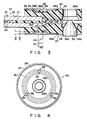
- Optical disk 10 comprises body 16 and a pair of attractable members 22.
- Body 16 comprises two disk-shaped base plates 18, two information recording layers 20, inside spacer 21, an outside spacer (not shown).
- Either base plate 18 has bore 19 and is made of transparent synthetic resin, such as acrylic resin or polycarbonate, by means of injection molding.
- Information recording layers 20 are formed on base plates 18, respectively.
- the spacers both shaped like a ring, are interposed between those surfaces of base plates 18 which face away from layers 20. The spacers are bonded to each other and also to plates 18 by means of ultrasonic curing, whereby base plates 18 are coupled concentrically.
- either attractable member 22 is fixed to the center portion of the associated base plate 18. It has centering member 24 and magnetic member 26 attached to the surface of centering member 24.
- Centering member 24 is a discoid of thickness t, which is formed of synthetic resin and has center hole 24a. Further, either centering member 24 has ring-shaped projection 28 is fitted in bore 19 of its corresponding base plate 18, it is fixedly bonded to the outer surface of the base plate, or the opposite surface thereof to that surface on which information record layer 20 is formed. Thus, centering member 24 is coaxially positioned relatively to base plate 18. Centering member 24 is bonded to the corresponding base plate 18 by bonding agent such as epoxy resin, which has no adverse influence on base plate 18.
- Base 19 formed in this manner is formed, as shown in Fig. 3, in a stepwise shape having a large-diameter portion 19a and a small-diameter portion 19b formed by exfoliating by a punch in case of cutting by the punch of an injection molding machine.
- each base plate 18 is worked with high accuracy, so as to be coaxial with a spiral pre-groove (not shown) for recording and reproduction, formed on the base plate.
- the outer peripheral surface of projection 30 and center hole 26a of each centering member 26 are worked with high accuracy, so as to be coaxial with each other.
- Both centering members 24 are made of the same synthetic resin as base plates 18, and have substantially the same thermal expansion coefficient as base plates 18. Therefore, either base plate 18 and centering member 24 boned to plate 18 do not distort each other even when the ambient temperature changes greatly.
- magnetic members 26 of attractable members 22 are formed of metal in a disk shape having a through hole 26a at the center, and each magnetic member 26 has annular projection 32 coaxial with through hole 26a.
- Annular recess 34 coaxial with hole 24a is formed in the surface of centering member 24.
- Recess 34 has a width slightly larger than that of projection 32.
- Magnetic member 26 is arranged on centering member 24 such that projection 32 is fitted in recess 34.
- Magnetic member 26 is attached to centering member 24, cannot move in a direction perpendicular to the surface of base plate 18 since projecting members 36 are fitted in engaging holes 38 (described later), but can slightly move in a direction parallel to the surface of the base plate.
- three projecting members 36 are formed on the bottom of recesses 34 of centering member 24, at equal intervals in the circumferential direction.
- Three engaging holes 38 are formed in magnetic member 26, at equal intervals in the circumferential direction of projection 32 of magnetic member 26.
- Magnetic member 26 is attached to centering member 24, as described above, since projecting members 36 are fitted in engaging holes 38.
- Each projecting member 36 has an elastically deformable detent 36a formed at the end thereof, and a support 36b for supporting detent 36a.
- Detent 36a has a diameter H0 larger than diameter H1 of support 36b.
- Each engaging hole 38 has a diameter H2 larger than diameter H1 and smaller than diameter H0.
- Each detent 36a is positioned far from each engaging hole 38, and each support 36b is disposed in each engaging hole 38 such that projections 36 are fitted in engaging holes 38.
- Distance H3 between the surface of magnetic member 26 and recess 34 is longer than height H4 of projecting member 36 so that detent 36a may not project from the surface of magnetic member 26.
- magnetic member 26 is so disposed that each engaging hole 38 opposes corresponding projecting member 36, and magnetic member 26 is pressed to centering member 24 until projection 32 of magnetic member 25 is contacted with the bottom of recess 34 of centering member 24.
- detent 36a is elastically deformed so that engaging hole 38 passes detent 36a to engage support 36b with engaging hole 38.
- Magnetic member 26 thus attached has it projection 32 interposed between detent 36a and the bottom of recess 34, and cannot move in a direction perpendicular to the surface of base plate 18, but can slightly move in a direction parallel to base plate 18 in a gap between engaging hole 38 and support 36b. In this way, magnetic member 26 can easily be attached to centering member 24 since the mechanism required is simple.
- drive mechanism 12 for driving optical disk 10 includes brushless DC motor 50 of an outer-rotor type, for use as a drive source, and turntable 54 mounted on shaft 52 of motor 50 and adapted to be rotated by motor 50. Tip end portion 52a of shaft 52 is inserted into center hole 26a of disk 10, as will be mentioned later, thus constituting a positioning portion for positioning the disk relatively to turntable 54.
- Motor 50 is supported by frame 55, which is fitted to control board 56 for controlling the operation of the motor.
- Turntable 54 which is formed of nonmagnetic metal, has support surface 54a extending perpendicular to shaft 52 of motor 50. Also, turntable 54 is formed with circular depression 58, which is coaxial with shaft 52, and opens to surface 54a. Diameter D3 of depression 58 is greater than diameter D1 of centering member 24 of optical disk 10. Depression 58 contains magnetic attraction member 60 which magnetically attracts one of attractable members 22 of disk 10. Attraction member 60 includes ring-shaped yoke 62 and magnet 64, which are arranged coaxially with shaft 52. Yoke 62 has inner and outer peripheral walls 62a and 62b, coaxial with each other, and magnet 64 is located between the peripheral walls.
- top faces of yoke 62 and magnet 64 are located at distance T from support surface 54a of turntable 54.
- Distance T is greater than height t of projection of centering members 24 of optical disk 10.
- diameter D1 and height t of centering member 24 are smaller than diameter D2 of depression 58 and distance T, respectively. Therefore, if optical disk 10 is set on turntable 54 so that positioning portion 52a of shaft 52 is inserted in one of center holes 24a of attractable members 22, as shown in Fig. 2, one of attractable members 22 is housed fully in depression 58. As a result, magnetic member 25 of the attractable member is attracted to magnet 64, so that disk 10 is mounted in direct contact with support surface 54a of turntable 54.
- base plate 18 having information record layer 20 thereon is held securely to turntable 54, so that vibration of base plate 18 perpendicular to its surface can be minimized. Accordingly, information can be recorded and reproduced correctly. If attractable member 22, not base plate 18, contacted support surface 54a of turntable 54, optical disk 10 would vibrate greatly, unless the surface of member 24 and base plate 18 are very accurately parallel to each other. Therefore, member 24 and the layer of adhesive must have a uniform thickness. It is very difficult, however, to form member 24 and the adhesive layer which have uniform thicknesses.
- the length of positioning portion 52a of shaft 52 is such that portion 52a can be fitted in center hole 24a of only the attractable member facing turntable 54 when optical disk 10 is mounted on turntable 54. Hence, it is not required that center holes 24a of centering members 24 are aligned with high accuracy.
- positioning portion 52a were fitted in center holes 24a of both centering members 24, these holes 24a should be coaxially aligned with high accuracy. It is very difficult to align bores 19 of base plates 18 or center holes 24 of members 24. If positioning portion 52a is too long, it takes a long time to set optical disk 10 on turntable 54. This inevitably promotes the wear of centering members 24.
- Magnetic attraction means 60 is housed in depression 58 formed in turntable 54, so that magnetic leakage is reduced to a low level. Accordingly, iron filings or powder of other magnetic material does not hinder the engagement of shaft 52 and center hole 24a by sticking to shaft 52.
- gap G is defined between attractable member 22 and magnetic attraction means 60. Gap G has is so broad that the disk is magnetically attracted to turntable 54. Therefore, as turntable 54 rotates, disk 10 is reliably rotated, and disk 10 can be removed easily from turntable 54 by only lifting cartridge 14. In this embodiment, gap G has such a size that force of attraction of about 700 g acts on attractable member 24.
- numeral 66 designates a head, which is moved in the radial direction of optical disk 10 by head moving means such as a linear motor. Head 66 can record information on, and reproduce information from, on information record layer 20 formed on lower-side base plate 18.
- base plate 18 and centering member 24 are formed of synthetic resins having substantially the same thermal expansion coefficient, and magnetic member 26 is further mounted on centering member 24, the base plate and the centering member do not distort each other even if the ambient temperature changes greatly. Therefore, information can be correctly recorded on, or reproduced from, the disk.
- magnetic member 26 can slightly move in parallel with the surface of base plate 18, with respect to centering member 24, the difference of thermal expansion coefficients between centering member 24 and magnetic member 26 can be compensated for, and the distortion of the base plate can be further reduced.
- the base plate may be made of materials other than resins, such as glass, or ceramics.
- the centering members can be made of any material other than synthetic resin.
- the centering members can be made of any material having substantially the same thermal expansion coefficient as the material of the base plate.
- the centering members may be formed of glass or ceramic material.
- optical disks having two disk base plates.
- the disk may have only one plate.
- magnetic attraction means 60 may be formed only of a magnet.
- Depression 58 in turntable 54 can be hexagonal or rectangular, not circular. Each attractable member 22 must only have shape and size so that it can be housed in the depression.
- the yoke of the magnetic attraction means has inner and outer peripheral walls. Alternatively, it may be provided with only an inner peripheral wall, or only an outer peripheral wall.
- detent 36a of projecting member 36 is elastically deformed, and inserted in hole 38 thereby mounting magnetic member 26 on centering member.
- projecting member 36 can be columnar, projecting member 36 can be inserted into hole 38, and the end of the projecting member can form a detent.
Landscapes
- Holding Or Fastening Of Disk On Rotational Shaft (AREA)
- Optical Record Carriers And Manufacture Thereof (AREA)
Applications Claiming Priority (2)
| Application Number | Priority Date | Filing Date | Title |
|---|---|---|---|
| JP263353/86 | 1986-11-05 | ||
| JP61263353A JPH07122969B2 (ja) | 1986-11-05 | 1986-11-05 | 情報記憶媒体 |
Publications (3)
| Publication Number | Publication Date |
|---|---|
| EP0266747A2 true EP0266747A2 (fr) | 1988-05-11 |
| EP0266747A3 EP0266747A3 (en) | 1989-04-05 |
| EP0266747B1 EP0266747B1 (fr) | 1992-03-04 |
Family
ID=17388296
Family Applications (1)
| Application Number | Title | Priority Date | Filing Date |
|---|---|---|---|
| EP87116175A Expired - Lifetime EP0266747B1 (fr) | 1986-11-05 | 1987-11-03 | Support d'information de mémoire |
Country Status (5)
| Country | Link |
|---|---|
| US (1) | US4866697A (fr) |
| EP (1) | EP0266747B1 (fr) |
| JP (1) | JPH07122969B2 (fr) |
| KR (1) | KR910000690B1 (fr) |
| DE (1) | DE3777081D1 (fr) |
Cited By (1)
| Publication number | Priority date | Publication date | Assignee | Title |
|---|---|---|---|---|
| EP0553664A3 (en) * | 1992-01-30 | 1995-03-08 | Hitachi Ltd | Optical disk apparatus |
Families Citing this family (11)
| Publication number | Priority date | Publication date | Assignee | Title |
|---|---|---|---|---|
| US5265087A (en) * | 1986-11-28 | 1993-11-23 | Kabushiki Kaisha Toshiba | Information medium with improved temperature characteristics |
| US5010435A (en) * | 1987-12-03 | 1991-04-23 | Tdk Corporation | Hub for a disk type recording medium |
| US5161081A (en) * | 1988-08-13 | 1992-11-03 | Sony Corporation | Disk cartridge made by injecting molten synthetic resin into a mold so that flash lines, weld lines and burn marks do not occur |
| US5258976A (en) * | 1988-12-02 | 1993-11-02 | Kabushiki Kaisha Toshiba | Method of assembling reproduction-only discs for a reproduction/recording apparatus |
| KR960013773B1 (ko) * | 1990-01-29 | 1996-10-10 | 다이닛뽕 인사쓰 가부시기가이샤 | 디스크카트리지 |
| JPH03106572U (fr) * | 1990-02-08 | 1991-11-05 | ||
| US5226033A (en) * | 1990-03-27 | 1993-07-06 | Sony Corporation | Magneto-optical disk hub in which the inner peripheral edge portion of the spindle opening is strengthened and made abrasion resistant |
| AU665947B2 (en) * | 1991-05-29 | 1996-01-25 | Sony Corporation | Optical disc and method for producing the optical disc |
| JPH05225609A (ja) * | 1992-02-06 | 1993-09-03 | Tdk Corp | 光ディスク用基板および光ディスク |
| JPH0817159A (ja) * | 1994-06-29 | 1996-01-19 | Sony Corp | ディスクカートリッジ |
| US20120214719A1 (en) * | 2009-10-26 | 2012-08-23 | Jose Luis Garcia Ojeda | Lubricating composition |
Family Cites Families (15)
| Publication number | Priority date | Publication date | Assignee | Title |
|---|---|---|---|---|
| EP0026880A1 (fr) * | 1979-10-03 | 1981-04-15 | Teldec Telefunken-Decca Schallplatten Gmbh | Support d'enregistrement en forme de disque et procédé pour sa fabrication |
| JPS5849379U (ja) * | 1981-09-30 | 1983-04-02 | ソニー株式会社 | 磁気シ−トジヤケツト |
| JPS5917038U (ja) * | 1982-07-26 | 1984-02-01 | ソニー株式会社 | 回転磁気シ−ト装置 |
| JPS5950034U (ja) * | 1982-09-21 | 1984-04-03 | ソニー株式会社 | 情報記録シ−ト |
| JPS5971487U (ja) * | 1982-10-29 | 1984-05-15 | ソニー株式会社 | 磁気デイスクの回転装着台 |
| US4613921A (en) * | 1982-11-26 | 1986-09-23 | Holmes William A | Disk memory apparatus |
| JPS6035385A (ja) * | 1983-08-03 | 1985-02-23 | Hitachi Maxell Ltd | デイスクカ−トリツジ |
| JPH0636253B2 (ja) * | 1983-08-18 | 1994-05-11 | シャープ株式会社 | 光メモリ円板 |
| NL8402602A (nl) * | 1984-08-27 | 1986-03-17 | Philips Nv | Schijfcassette. |
| JPS61114571U (fr) * | 1984-12-26 | 1986-07-19 | ||
| JPS61208684A (ja) * | 1985-03-13 | 1986-09-17 | Fujitsu Ltd | フレキシブル磁気ディスク |
| US4733388A (en) * | 1985-08-23 | 1988-03-22 | Hitachi Maxell, Ltd. | Information recording disc |
| KR900004661B1 (ko) * | 1986-01-20 | 1990-07-02 | 가부시키가이샤 도시바 | 정보처리장치 |
| JPS62192945A (ja) * | 1986-02-20 | 1987-08-24 | Sony Corp | 情報デイスク |
| US4686666A (en) * | 1986-06-27 | 1987-08-11 | Dcteq | Flexible micro disk |
-
1986
- 1986-11-05 JP JP61263353A patent/JPH07122969B2/ja not_active Expired - Lifetime
-
1987
- 1987-11-03 DE DE8787116175T patent/DE3777081D1/de not_active Expired - Lifetime
- 1987-11-03 EP EP87116175A patent/EP0266747B1/fr not_active Expired - Lifetime
- 1987-11-04 US US07/116,660 patent/US4866697A/en not_active Expired - Fee Related
- 1987-11-05 KR KR1019870012433A patent/KR910000690B1/ko not_active Expired
Cited By (2)
| Publication number | Priority date | Publication date | Assignee | Title |
|---|---|---|---|---|
| EP0553664A3 (en) * | 1992-01-30 | 1995-03-08 | Hitachi Ltd | Optical disk apparatus |
| US5453972A (en) * | 1992-01-30 | 1995-09-26 | Hitachi, Ltd. | Optical disk apparatus |
Also Published As
| Publication number | Publication date |
|---|---|
| EP0266747B1 (fr) | 1992-03-04 |
| KR910000690B1 (ko) | 1991-01-31 |
| JPH07122969B2 (ja) | 1995-12-25 |
| DE3777081D1 (de) | 1992-04-09 |
| JPS63117381A (ja) | 1988-05-21 |
| EP0266747A3 (en) | 1989-04-05 |
| US4866697A (en) | 1989-09-12 |
| KR880006662A (ko) | 1988-07-23 |
Similar Documents
| Publication | Publication Date | Title |
|---|---|---|
| EP0230963B1 (fr) | Appareil de traitement de l'information | |
| KR100268137B1 (ko) | 광 디스크 | |
| EP0266747A2 (fr) | Support d'information de mémoire | |
| US4827470A (en) | Information memory medium | |
| US4827468A (en) | Information memory medium | |
| EP0572153B1 (fr) | Méthode de montage d'une plaque magnétique sur un substrat de disque | |
| JPH0664876B2 (ja) | 情報記憶媒体 | |
| KR910000693B1 (ko) | 정보기억매체 | |
| JP2543860B2 (ja) | 情報記憶媒体 | |
| JP3072658B2 (ja) | 情報信号記録ディスク | |
| JP2519676B2 (ja) | 情報処理装置 | |
| US5265087A (en) | Information medium with improved temperature characteristics | |
| JPS6386171A (ja) | 情報記録媒体 | |
| JPH0620422A (ja) | 情報信号記録用のディスク | |
| JP3237171B2 (ja) | ディスク基板に対する磁性板の保持方法 | |
| JPS62167663A (ja) | 情報処理装置 | |
| JPS62167662A (ja) | 情報処理装置 | |
| JPS62167638A (ja) | 情報記憶媒体 | |
| JPS6346642A (ja) | 光磁気記録装置 | |
| JPS63193392A (ja) | デイスク装置 | |
| JPS63193391A (ja) | デイスク装置 | |
| JPH087966B2 (ja) | 情報記憶媒体 | |
| JPH09306071A (ja) | チャッキング機構 |
Legal Events
| Date | Code | Title | Description |
|---|---|---|---|
| PUAI | Public reference made under article 153(3) epc to a published international application that has entered the european phase |
Free format text: ORIGINAL CODE: 0009012 |
|
| 17P | Request for examination filed |
Effective date: 19871130 |
|
| AK | Designated contracting states |
Kind code of ref document: A2 Designated state(s): DE NL |
|
| PUAL | Search report despatched |
Free format text: ORIGINAL CODE: 0009013 |
|
| AK | Designated contracting states |
Kind code of ref document: A3 Designated state(s): DE NL |
|
| 17Q | First examination report despatched |
Effective date: 19901012 |
|
| RAP1 | Party data changed (applicant data changed or rights of an application transferred) |
Owner name: TOSHIBA INTELLIGENT TECHNOLOGY LTD. Owner name: KABUSHIKI KAISHA TOSHIBA |
|
| GRAA | (expected) grant |
Free format text: ORIGINAL CODE: 0009210 |
|
| AK | Designated contracting states |
Kind code of ref document: B1 Designated state(s): DE NL |
|
| REF | Corresponds to: |
Ref document number: 3777081 Country of ref document: DE Date of ref document: 19920409 |
|
| PLBE | No opposition filed within time limit |
Free format text: ORIGINAL CODE: 0009261 |
|
| STAA | Information on the status of an ep patent application or granted ep patent |
Free format text: STATUS: NO OPPOSITION FILED WITHIN TIME LIMIT |
|
| 26N | No opposition filed | ||
| PGFP | Annual fee paid to national office [announced via postgrant information from national office to epo] |
Ref country code: DE Payment date: 19971110 Year of fee payment: 11 |
|
| PGFP | Annual fee paid to national office [announced via postgrant information from national office to epo] |
Ref country code: NL Payment date: 19971130 Year of fee payment: 11 |
|
| PG25 | Lapsed in a contracting state [announced via postgrant information from national office to epo] |
Ref country code: NL Free format text: LAPSE BECAUSE OF NON-PAYMENT OF DUE FEES Effective date: 19990601 |
|
| NLV4 | Nl: lapsed or anulled due to non-payment of the annual fee |
Effective date: 19990601 |
|
| PG25 | Lapsed in a contracting state [announced via postgrant information from national office to epo] |
Ref country code: DE Free format text: LAPSE BECAUSE OF NON-PAYMENT OF DUE FEES Effective date: 19990901 |