EP0267046B1 - Compositions de blanchiment contenant des précurseurs de peracide - Google Patents
Compositions de blanchiment contenant des précurseurs de peracide Download PDFInfo
- Publication number
- EP0267046B1 EP0267046B1 EP19870309842 EP87309842A EP0267046B1 EP 0267046 B1 EP0267046 B1 EP 0267046B1 EP 19870309842 EP19870309842 EP 19870309842 EP 87309842 A EP87309842 A EP 87309842A EP 0267046 B1 EP0267046 B1 EP 0267046B1
- Authority
- EP
- European Patent Office
- Prior art keywords
- alkyl
- bleaching composition
- aryl
- bleach activator
- hydrogen peroxide
- Prior art date
- Legal status (The legal status is an assumption and is not a legal conclusion. Google has not performed a legal analysis and makes no representation as to the accuracy of the status listed.)
- Expired
Links
- 0 CCCN*NC** Chemical compound CCCN*NC** 0.000 description 2
- ZRGVBLMQIIZHNL-UHFFFAOYSA-N CC(ON1CCCCC1)=C Chemical compound CC(ON1CCCCC1)=C ZRGVBLMQIIZHNL-UHFFFAOYSA-N 0.000 description 1
- USMLYDFNYPQLHB-UHFFFAOYSA-N CON1C=CC=CC1 Chemical compound CON1C=CC=CC1 USMLYDFNYPQLHB-UHFFFAOYSA-N 0.000 description 1
Classifications
-
- C—CHEMISTRY; METALLURGY
- C11—ANIMAL OR VEGETABLE OILS, FATS, FATTY SUBSTANCES OR WAXES; FATTY ACIDS THEREFROM; DETERGENTS; CANDLES
- C11D—DETERGENT COMPOSITIONS; USE OF SINGLE SUBSTANCES AS DETERGENTS; SOAP OR SOAP-MAKING; RESIN SOAPS; RECOVERY OF GLYCEROL
- C11D3/00—Other compounding ingredients of detergent compositions covered in group C11D1/00
- C11D3/39—Organic or inorganic per-compounds
- C11D3/3902—Organic or inorganic per-compounds combined with specific additives
- C11D3/3905—Bleach activators or bleach catalysts
- C11D3/3907—Organic compounds
- C11D3/3917—Nitrogen-containing compounds
-
- C—CHEMISTRY; METALLURGY
- C11—ANIMAL OR VEGETABLE OILS, FATS, FATTY SUBSTANCES OR WAXES; FATTY ACIDS THEREFROM; DETERGENTS; CANDLES
- C11D—DETERGENT COMPOSITIONS; USE OF SINGLE SUBSTANCES AS DETERGENTS; SOAP OR SOAP-MAKING; RESIN SOAPS; RECOVERY OF GLYCEROL
- C11D3/00—Other compounding ingredients of detergent compositions covered in group C11D1/00
- C11D3/39—Organic or inorganic per-compounds
- C11D3/3902—Organic or inorganic per-compounds combined with specific additives
- C11D3/3905—Bleach activators or bleach catalysts
- C11D3/3907—Organic compounds
- C11D3/3917—Nitrogen-containing compounds
- C11D3/392—Heterocyclic compounds, e.g. cyclic imides or lactames
Definitions
- This invention relates to bleaching compositions comprising peracid precursors, more particularly acyloxynitrogen peracid precursors.
- peroxygen bleach activator compounds that aid in providing efficient peroxygen bleaching of fabrics over a wide temperature range when combined with a source of hydrogen peroxide in aqueous media are utilized.
- peroxygen bleaches are effective in removing stains and/or soils from textiles. They may be used on a wide variety of fabrics and coloured garments.
- efficacy of peroxygen bleaches may vary greatly with temperature of the wash water in which they are used and they are usually most effective when the bleaching solution is above 54°C (130°F). Below this temperature, it has been found that peroxide bleaching efficacy may be greatly increased by the simultaneous use of activators, otherwise known as peracid precursors. It has widely been accepted that in aqueous media, precursors and peroxygen combine to form peracid species.
- Peracids themselves may be hazardous to make and are particularly prone to decomposition upon long-term storage. Thus it is advantageous to prepare the more stable peracid precursor compounds, which in alkaline water solution will react with peroxide anion to form the desired peracid in situ . As may be seen from the extensive literature in this area, many such peroxygen activators (peracid precursors) have been proposed. However, no reference appears to have taught, disclosed or suggested the advantages of leaving groups containing nitrogen in perhydrolysis.
- U.S. Patent No. 3,975,153 teaches the use of only isophorone oxime acetate as a bleach activator. It is claimed that this isophorone derivative results in an activator of low odour and low toxicity.
- U.S. Patent No. 3,816,319 the use of diacylated glyoximes is taught. The use is restricted to diacylated dialkylglyoximes wherein the alkyl group contains one to four carbon atoms and the acyl group contains two to four atoms.
- a peracid precursor contains oxime as a leaving group.
- neither reference discloses the unique advantages conferred by surface active peracid precursors which contain about 4-14 carbons in the acyl group.
- FR-A- 2,013,139 relates to bleaching compositions comprising certain peracid precursors (or activators) and sources of hydrogen peroxide.
- the present invention also provides a process for the production of such a bleaching composition which comprises mixing the constituents thereof.
- the present invention further provides a process for bleaching which comprises contacting a material to be bleached with such a bleaching composition in aqueous medium.
- R is C6-C12 alkyl or alkoxylated alkyl.
- R may also be mono- or polyunsaturated. If alkoxylated, ethoxy (EO) -(-OCH2CH2) and propoxy (PO) -(-OCH2CH2CH2) groups are preferred, and may be present, per mole of ester, from 1 to 30 EO or PO groups, and mixtures thereof.
- R is preferred for R to be from 6 to 12 carbons in the alkyl chain.
- Such alkyl groups would be surface active and would be desirable when the precursor is used to form surface active peracids for oxidizing fat or oil based soils from substrates at relatively low temperatures.
- alkyl groups are generally introduced onto the ester via an acid chloride synthesis discussed further below.
- Fatty acid chlorides such as hexanoyl chloride, heptanoyl chloride, octanoyl chloride, nonanoyl chloride and decanoyl chloride, provide this alkyl moiety.
- an aromatic acid chloride may be used, such as phenoxyacetyl chloride, although this is the subject of EP-A-267,048.
- X is O, oxygen.
- X could also be another electronegative atom, such as -S-(sulphide), -N-(amine) or even -NH4-(quaternary ammonium) .
- it is most preferable that X is O (oxygen), or methylene.
- Peracid precursor is generally equivalent to bleach activator. Both terms generally relate herein to reactive esters which have a leaving group substituent, which during perhydrolysis, actually cleave off the acyl portion of the ester.
- Perhydrolysis is the reaction which occurs when a peracid precursor or activator is combined in a reaction medium (aqueous medium) with an effective amount of a source of hydrogen peroxide.
- the leaving group is basically a substituent which is attached via an oxygen bond to the acyl portion of the ester and which may be replaced by a perhydroxide anion (OOH -) during perhydrolysis.
- These leaving groups have an oxygen atom attached to nitrogen which in turn may be attached to carbon atoms in a variety of structural configurations.
- the oxygen of the leaving group is attached directly to the carbonyl carbon to form the intact precursor.
- R1 is where the nitrogen atom is attached to two carbonyl carbon groups.
- the leaving group then would be an oxyimide group : wherein R3 and R4 may be the same or different, and are preferably straight chain or branched C1 ⁇ 20 alkyl, aryl, alkylaryl or mixtures thereof. If alkyl, R3 and R4 may be partially unsaturated. It is especially preferred that R3 and R4 are straight or branched chain C1 ⁇ 6 alkyls, which may be the same or different.
- R5 is preferably C1 ⁇ 20 alkyl, aryl or alkylaryl, and completes a heterocycle.
- R5 includes the preferred structure: wherein R6 may be methylene, an aromatic ring fused to the heterocycle, or C1 ⁇ 6 alkyl.
- these leaving group structures could contain an acyclic or cyclic oxyimide moiety.
- the above precursor may be seen as a combination of a carboxylic acid and a hydroxyimide compound:
- esters of imides may be prepared as described in Greene , Protective Groups in Organic Synthesis , p. 183, and are generally the reaction products of acid chlorides and hydroxyimides.
- oxyimide leaving groups are:
- the second preferred structure for R1 is where the nitrogen atom is attached to at least two carbons.
- R6 and R7 may be the same or different, and are preferably C1 ⁇ 20 straight or branched chain alkyl, aryl, alkylaryl or mixtures thereof. If alkyl, the substituent may be partially unsaturated.
- R6 and R7 are C1 ⁇ 4 alkyls and may be the same or different.
- R8 is preferably C1 ⁇ 30 alkyl, aryl, alkylaryl and mixtures thereof. This R8 substituent may also be partially unsaturated. It is most preferred that R6 and R7 are relatively short chain alkyl groups (CH3 or CH2CH3) and R10 is preferably C1 ⁇ 20 alkyl, forming together a tertiary amine oxide.
- R9 may be C1 ⁇ 20 alkyl, aryl or alkylaryl, and completes a heterocycle.
- R9 preferably completes an aromatic heterocycle of 5 carbon atoms and may be C1 ⁇ 6 alkyl or aryl substituted.
- R10 is preferably nothing, C1 ⁇ 30 alkyl, aryl, alkylaryl or mixtures thereof.
- R10 is more preferably C1 ⁇ 20 alkyl if R9 completes an aliphatic heterocycle. If R9 completes an aromatic heterocycle, R12 is nothing.
- This type of structure is really a combination of a carborylic acid and an amine oxide:
- Amine oxides may be prepared as described in March, Advanced Organic Chemistry, 2d Ed., 1977, p.1,111.
- Examples of amine oxides suitable for use as leaving groups may be derived from: pyridine N-oxide, trimethylamine N-oxide, 4-phenyl pyridine N-oxide, decyldimethylamine N-oxide, dodecyldimethylamine N-oxide, tetradecyldimethylamine N-oxide, hexadecyldimethylamine N-oxide, octyldimethylamine N-oxide, di(decyl)methylamine N-oxide, di(dodecyl)methylamine N-oxide, di(tetradecyl)-methylamine N-oxide, 4-picoline N-oxide, 3-picoline N-oxide and 2-picoline N-oxide.
- Especially preferred amine oxide leaving groups include:
- preferred examples thereof are oximes .
- R13 and R14 are individually H, C1 ⁇ 20 alkyl, (which may be cycloalkyl, straight or branched chain), aryl, or alkylaryl.
- R13 and R14 are the same or different and range from C1 ⁇ 6; and at least one of R13 and R14 is not H.
- a first oxine ester without a heteroatom in the alkyl group would be octanoyloxy dimethyl oxime ester
- An example of a second oxine ester, which includes the heteroatom, X, -O- is hexanoxy acetyl dimethyl oxime ester
- Oximes are generally derived from the reaction of hydroxylamines with either aldehydes or ketones (Allinger et al, Organic Chemistry , 2d Ed., p.562 (1976), both of which are within the scope of the present invention.
- Examples of an oxime leaving group are: (a) oximes of aldehydes (aldoximes), e.g., acetaldoxime, benzaldoxime, propionaldoxime, butylaldoxime, heptaldoxime, phenylacetaldoxime, p -tolualdoxime, anisaldoxime, caproaldoxime, valeraldoxime and p -nitrobenzaldoxime; and (b) oximes of ketones (ketoximes), e.g., acetone oxime (2-propanone oxime), methyl ethyl ketoxime (2-butanone oxime), 2-pentanone oxime, 2-hexanone oxime, 3-hexanone oxime, cyclohexanone oxime, acetophenone oxime, benzophenone oxime, and cyclopentanone oxime.
- aldehydes aldehydes
- Particularly preferred oxime leaving groups are:
- the present precursors may be incorporated into a liquid or solid matrix for use in liquid or solid detergent bleaches by dissolving into an appropriate solvent or surfactant or by dispersing liquid or liquified precursors onto a substrate material, such as an inert salt (e.g., NaCl, Na2SO4) or other solid substrate, such as zeolites, sodium borate, or molecular sieves.
- a substrate material such as an inert salt (e.g., NaCl, Na2SO4) or other solid substrate, such as zeolites, sodium borate, or molecular sieves.
- appropriate solvents include acetone, non-nucleophilic alcohols, ethers or hydrocarbons.
- the present precursors could be incorporated onto a non-particulate substrate such as disclosed in published European Patent Application EP 98 129.
- a preferred embodiment of the present invention is to combine the precursors with a surfactant. It is particularly preferred to coat these precursors with a nonionic or anionic surfactant that is solid at room temperature and melts at above about 40°C. A melt of surfactant may be simply admixed with peracid precursor, cooled and chopped into granules. Exemplary surfactants for such use are illustrated in Table I below:
- the precursors whether coated with the surfactants with melting completion temperatures above about 40°C or not so coated, could also be admixed with other surfactants to provide, depending on formulation, either bleach additive or detergent compositions.
- Particularly effective surfactants appear to be nonionic surfactants.
- Preferred surfactants for use include linear ethoxylated alcohols, such as those sold by Shell Chemical Company under the brand name Neodol.
- Other suitable nonionic surfactants may include other linear ethoxylated alcohols with an average length of 6 to 16 carbon atoms and averaging about 2 to 20 moles of ethylene oxide per mole of alcohol; linear and branched, primary and secondary ethoxylated, propoxylated alcohols with an average length of about 6 to 16 carbon atoms and averaging 0-10 moles of ethylene oxide and about 1 to 10 moles of propylene oxide per mole of alcohol; linear and branched alkylphenoxy (polyethoxy) alcohols, otherwise known as ethoxylated alkylphenols, with an average chain length of 8 to 16 carbon atoms and averaging 1.5 to 30 moles of ethylene oxide per mole of alcohol; and mixtures thereof.
- nonionic surfactants may include polyoxyethylene carboxylic acid esters, fatty acid glycerol esters, fatty acid and ethoxylated fatty acid alkanolamides, certain block copolymers of propylene oxide and ethylene oxide, and block polymers of propylene oxide and ethylene oxide with propoxylated ethylene diamine. Also included are such semi-polar nonionic surfactants as amine oxides, phosphine oxides, sulphoxides, and their ethoxylated derivatives.
- Anionic surfactants may also be suitable.
- anionic surfactants may include the ammonium, substituted ammonium (e.g., mono-, di-, and triethanolammonium), alkali metal and alkaline earth metal salts of C6-C20 fatty acids and rosin acids, linear and branched alkyl benzene sulphonates, alkyl sulphates, alkyl ether sulphates, alkane sulphonates, olefin sulphonates, hydroxyalkane sulphonates, fatty acid monoglyceride sulphates, alkyl glyceryl ether sulphates, acyl sarcosinates and acyl N-methyltaurides.
- substituted ammonium e.g., mono-, di-, and triethanolammonium
- alkali metal and alkaline earth metal salts of C6-C20 fatty acids and rosin acids linear and branched alkyl
- Suitable cationic surfactants may include the quaternary ammonium compounds in which typically one of the groups linked to the nitrogen atom is a C12-C18 alkyl group and the other three groups are short chained alkyl groups which may bear inert substituents such as phenyl groups.
- suitable amphoteric and zwitterionic surfactants which contain an anionic water-solubilizing group, a cationic group and a hydrophobic organic group may include amino carboxylic acids and their salts, amino dicarboxylic acids and their salts, alkylbetaines, alkyl aminopropylbetaines, sulphobetaines, alkyl imidazolinium derivatives, certain quaternary ammonium compounds, certain quaternary phosphonium compounds and certain tertiary sulphonium compounds.
- Other examples of potentially suitable zwitterionic surfactants may be found described in U.S. Patent No. 4,005,029, at columns 11-15.
- anionic, nonionic, cationic and amphoteric surfactants which may be suitable for use in accordance with the present invention are depicted in Kirk-Othmer, Encyclopedia of Chemical Technology, Third Edition, Volume 22, pages 347-387, and McCutcheon's Detergents and Emulsifiers , North American Edition, 1983.
- a bleach or detergent bleach product may be added if a bleach or detergent bleach product is desired. If, for example, a dry bleach composition is desired, the following ranges (weight %) appear practicable: 0.5-50.0% Hydrogen Peroxide Source 0.05-25.0% Precursor 1.0-50.0% Surfactant 1.0-50.0% Buffer 5.0-99.9% Filler, stabilizers, dyes, fragrances, brighteners, etc.
- the hydrogen peroxide source may be selected from the alkali metal salts of percarbonate, perborate, persilicate and hydrogen peroxide adducts and hydrogen peroxide. Most preferred are sodium percarbonate, sodium perborate mono- and tetra-hydrate, and hydrogen peroxide. Other peroxygen sources may be possible, such as alkaline earth metal perborates, monopersulphates and monoperphosphates. In liquid applications, liquid hydrogen peroxide solutions are preferred, but the precursor may need to be kept separate therefrom prior to combination in aqueous solution to prevent premature decomposition.
- the range of peroxide to peracid precursor is preferably determined as a molar ratio of peroxide to ester groups contained in the precursor.
- the range of peroxide to each ester group is preferably a molar ratio of from about 0.5:1 to 10:1, more preferably about 1:1 to 5:1 and most preferably about 1:1 to 2:1. It is preferred that this peracid precursor/peroxide composition provide preferably about 0.5 to 100 ppm A.O., and most preferably about 1 to 50 ppm A.O. (active oxygen), and most preferably about 1 to 20 ppm A.O., in aqueous media.
- An example of a practical execution of a liquid delivery system is to dispense separately metered amounts of the precursor (in some non-reactive fluid medium) and liquid hydrogen peroxide in a container such as described in U.S. Patent No. 4,585,150.
- a buffer may be selected from sodium carbonate, sodium bicarbonate, sodium borate, sodium silicate, phosphoric acid salts, and other alkali metal/alkaline earth metal salts known to those skilled in the art.
- Organic buffers such as succinates, maleates and acetates may also be suitable for use. It appears preferable to have sufficient buffer to attain an alkaline pH, i.e., above at least about 7.0, more preferably above about pH 9.0, and most preferably above about pH 10.0.
- the filler material which, in a detergent bleach application, may actually constitute the major constituent, by weight, of the detergent bleach, is usually sodium sulphate.
- Sodium chloride is another potential filler.
- Dyes include anthraquinone and similar blue dyes. Pigments, such as ultramarine blue (UMB), may also be used, and may have a bluing effect by depositing on fabrics washed with a detergent bleach containing UMB. Monastral colourants are also possible for inclusion.
- Brighteners such as stilbene, styrene and styrylnaphthalene brighteners (fluorescent whitening agents), may be included. Fragrances used for aesthetic purposes are commercially available from Norda, International Flavors and Fragrances and Givaudon.
- Stabilizers include hydrated salts, such as magnesium sulphate, and boric acid.
- a preferred bleach composition has the following ingredients:
- a preferred bleach composition in which a compound as in (II) below is the precursor, has the following ingredients:
- peroxygen sources such as sodium perborate monohydrate or sodium percarbonate are suitable. If a more detergent-type product is desired, the amount of filler may be increased and the precursor halved or further decreased.
- the oxime esters may be prepared by treatment of an oxime with the acid chloride of the corresponding carboxylic acid.
- a non-reactive solvent is added, and a base.
- the oximes may be purchased or prepared by treatment of a carbonyl compound with hydroxylamine.
- Two oximes, acetone oxime and methyl ethyl ketone oxime are readily available from commercial sources and are inexpensive.
- the acyloxyimides may be readily prepared by the treatment of a hydroxyimide with an acid chloride. While the acid chlorides are readily, commercially available, the hydroxyimides are not so commercially available.
- acyl oxy ammonium chloride type compounds MAY be prepared by treatment of an amine oxide with an acid chloride. Both amine oxides and acid chlorides are readily available commercially so this should provide for a large variety of practical precursors. However, the product appears to be formed as a nice solid only when certain high molecular weight amine oxides are used. Unless care is taken in selecting the reaction conditions and the reagents, the reaction may at times form oils.
- a 500 ml three-neck flask was fitted with a paddle stirrer, drying tube, and flushed with nitrogen.
Landscapes
- Chemical & Material Sciences (AREA)
- Inorganic Chemistry (AREA)
- Life Sciences & Earth Sciences (AREA)
- Engineering & Computer Science (AREA)
- Chemical Kinetics & Catalysis (AREA)
- Oil, Petroleum & Natural Gas (AREA)
- Wood Science & Technology (AREA)
- Organic Chemistry (AREA)
- Detergent Compositions (AREA)
- Pyridine Compounds (AREA)
- Pyrrole Compounds (AREA)
- Indole Compounds (AREA)
- Organic Low-Molecular-Weight Compounds And Preparation Thereof (AREA)
Claims (15)
- Une composition de blanchiment caractérisée en ce qu'elle comprend :(1) un activateur de blanchiment choisi parmi :(a) les esters d'oxime correspondant à la formule générale suivante :

 R représente un alkyle en C₆-C₁₂ ;X représente -O-, -N-, -S- ou un ammonium quaternaire ;et -O-N-R¹ est un groupe labile gui contient un atome de carbone uni directement par une double liaison à N ;(b) les esters d'oxyimide correspondant à la formule générale suivante :
 R représente un alkyle en C₆-C₁₂ ;X représente -O-, -N-, -S- ou un ammonium quaternaire ;et -O-N-R¹ correspond à la formule générale suivante :
 R³ et R⁴ représentent indépendamment un alkyle en C₁-C₂₀, un aryle ou un alkaryle ;
etR⁵ représente un alkyle en C₁-C₂₀, un aryle ou un alkaryle et complète un hétérocycle ;et(c) les esters d'oxyde d'amine correspondant à la formule générale suivante :et
 R représente un alkyle en C₁-C₂₀, un alcoxyle ou un cycloalkyle ;X représente -N-, -S- ou un ammonium quaternaire ;et -O-N-R¹ correspond à la formule générale suivante :
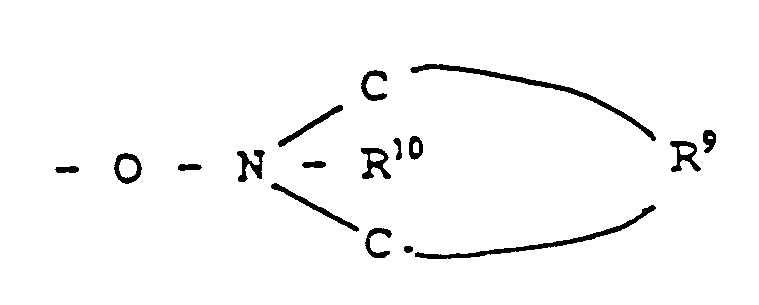 R⁶ et R⁷ indépendamment représentent un alkyle en C₁-C₂₀, un aryle ou un alkaryle ;R⁸ représente un alkyle en C₁-C₃₀, un aryle ou un alkaryle ;R⁹ représente un alkyle en C₁-C₂₀, un aryle ou un alkaryle et complète un hétérocycle ;et R¹⁰ représente un alkyle en C₁-C₂₀, un aryle ou un alkaryle et est absent lorsque R⁹ complète un hétérocycle aromatique ;(2) une quantité efficace pour le blanchiment d'une source de peroxyde d'hydrogène.
 - Une composition de blanchiment selon la revendication 1, qui comprend également :(3) un additif choisi parmi les agents tensio-actifs, les adjuvants pour détergents, les charges, les enzymes, les azurants optiques, les pigments, les colorants, les parfums, les stabilisants et les tampons.
- Une composition de blanchiment selon la revendication 1 ou la revendication 2, dans laquelle l'activateur de blanchiment est un ester d'oxyimide.
- Une composition de blanchiment selon l'une quelconque des revendications 1 à 3, dans laquelle -O-N-R¹ représente :

- Une composition de blanchiment selon l'une quelconque des revendications 1 à 4, dans laquelle l'activateur de blanchiment est
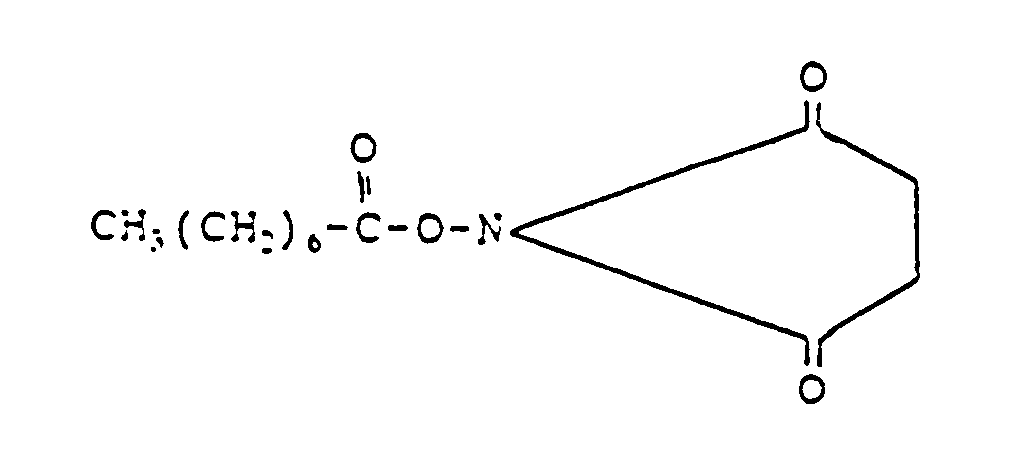

- Une composition de blanchiment selon la revendication 1 ou la revendication 2, dans laquelle l'activateur de blanchiment est un ester d'oxyde d'amine.
- Une composition de blanchiment selon la revendication 6, dans laquelle -O-N-R¹ représente :

- Une composition de blanchiment selon la revendication 7, dans laquelle l'activateur de blanchiment est :


- Une composition de blanchiment selon la revendication 1 ou la revendication 2, dans laquelle l'activateur de blanchiment est un ester d'oxime :


- Une composition de blanchiment selon l'une quelconque des revendications 1 à 9, dans laquelle la source de peroxyde d'hydrogène (2) est choisie parmi le peroxyde d'hydrogène, les produits d'addition du peroxyde d'hydrogène, et les perborates de métal alcalin et de métal alcalino-terreux.
- Une composition de blanchiment selon la revendication 10, dans laquelle la source de peroxyde d'hydrogène est un perborate de métal alcalin choisi parmi les formes monohydratées et tétrahydratées du perborate de sodium.
- Une composition de blanchiment selon l'une quelconque des revendications 1 à 11, dans laquelle le rapport molaire de la source de peroxyde d'hydrogène à l'activateur de blanchiment est de 0,5/1 à 10/1, exprimé en moles d'H₂O₂/moles d'ester.
- Une composition de blanchiment selon l'une quelconque des revendications 1 à 12, dans laquelle l'activateur de blanchiment est revêtu d'un agent tensio-actif ayant une température de fusion complète supérieure à 40°C.
- Un procédé pour la production d'une composition de blanchiment comprenant le mélange des constituants, caractérisé en ce que les constituants sont comme définis dans l'une quelconque des revendications 1 à 13.
- Un procédé de blanchiment comprenant le contact d'une matière à blanchir avec une composition de blanchiment dans un milieu aqueux, caractérisé en ce que la composition de blanchiment est comme revendiquée dans l'une quelconque des revendications 1 à 13.
Applications Claiming Priority (2)
| Application Number | Priority Date | Filing Date | Title |
|---|---|---|---|
| US92806586A | 1986-11-06 | 1986-11-06 | |
| US928065 | 1997-09-12 |
Publications (3)
| Publication Number | Publication Date |
|---|---|
| EP0267046A2 EP0267046A2 (fr) | 1988-05-11 |
| EP0267046A3 EP0267046A3 (en) | 1989-05-31 |
| EP0267046B1 true EP0267046B1 (fr) | 1992-12-30 |
Family
ID=25455670
Family Applications (1)
| Application Number | Title | Priority Date | Filing Date |
|---|---|---|---|
| EP19870309842 Expired EP0267046B1 (fr) | 1986-11-06 | 1987-11-06 | Compositions de blanchiment contenant des précurseurs de peracide |
Country Status (9)
| Country | Link |
|---|---|
| EP (1) | EP0267046B1 (fr) |
| JP (1) | JP2780774B2 (fr) |
| AR (1) | AR244799A1 (fr) |
| AU (1) | AU604263B2 (fr) |
| CA (1) | CA1340039C (fr) |
| DE (1) | DE3783330T2 (fr) |
| GR (1) | GR3006724T3 (fr) |
| MX (1) | MX169023B (fr) |
| TR (1) | TR24653A (fr) |
Families Citing this family (12)
| Publication number | Priority date | Publication date | Assignee | Title |
|---|---|---|---|---|
| US4957647A (en) * | 1986-11-06 | 1990-09-18 | The Clorox Company | Acyloxynitrogen peracid precursors |
| US5087385A (en) * | 1986-11-06 | 1992-02-11 | The Clorox Company | Acyloxynitrogen peracid precursors |
| US4859800A (en) * | 1986-11-06 | 1989-08-22 | The Clorox Company | Phenoxyacetate peracid precursors |
| IT1229564B (it) * | 1989-03-09 | 1991-09-04 | Ausimont Srl | Composizioni detergenti e/o sbiancanti prevalentemente liquide contenenti ammine terziarie a basso peso molecolare in forma di n ossido. |
| SG43007A1 (en) * | 1989-09-11 | 1997-10-17 | Kao Corp | Bleaching composition |
| DE19541012A1 (de) | 1995-11-03 | 1997-05-07 | Basf Ag | Verwendung von Oximestern als Aktivatoren für anorganische Perverbindungen |
| DE19609953A1 (de) * | 1996-03-14 | 1997-09-18 | Basf Ag | Feste Zusammensetzung aus heterocyclischen Verbindungen und/oder Oximestern und inerten porösen Trägermaterialien und ihre Verwendung als stabile Bleichaktivator-Komponente in Wasch-, Bleich- und Reinigungsmitteln |
| US5858949A (en) * | 1996-08-23 | 1999-01-12 | Lever Brothers Company, Division Of Conopco, Inc. | N-acylimines as bleach catalysts |
| EP1038946A3 (fr) * | 1996-08-23 | 2000-10-25 | Unilever Plc | N-Acylimine comme catalysateurs de blanchiment |
| DE19704143A1 (de) | 1997-02-04 | 1998-08-06 | Basf Ag | Aktivatoren für anorganische Perverbindungen |
| ES2235412T3 (es) * | 1998-08-17 | 2005-07-01 | Givaudan Sa | Derivados de oxima de acido carboxilico. |
| WO2000017310A1 (fr) * | 1998-09-23 | 2000-03-30 | The Procter & Gamble Company | Particule encapsulee comportant une couche de revetement amelioree |
Family Cites Families (6)
| Publication number | Priority date | Publication date | Assignee | Title |
|---|---|---|---|---|
| DE1768962C3 (de) * | 1968-07-17 | 1978-03-02 | Henkel Kgaa, 4000 Duesseldorf | Triacylierte Hydroxylamine und deren Verwendung als Aktivatoren für anorganische Perverbindungen |
| DE1794425A1 (de) * | 1968-07-17 | 1977-02-24 | Henkel & Cie Gmbh | Oxydations-, bleich-, wasch- und waschhilfsmittel |
| DE1953919A1 (de) * | 1969-10-27 | 1971-05-06 | Henkel & Cie Gmbh | Scheuermittel mit bleichender und desinfizierender Wirkung |
| FR2087687A5 (fr) * | 1970-05-27 | 1971-12-31 | Solvay | Activation des bains de lavage et de blanchiment aux peroxydes |
| US4021361A (en) * | 1975-08-25 | 1977-05-03 | Fmc Corporation | Storage-stable detergent composition containing sodium perborate and activator |
| US4778618A (en) * | 1986-11-06 | 1988-10-18 | The Clorox Company | Glycolate ester peracid precursors |
-
1987
- 1987-10-28 AU AU80449/87A patent/AU604263B2/en not_active Ceased
- 1987-10-29 AR AR30916187A patent/AR244799A1/es active
- 1987-11-05 JP JP62278444A patent/JP2780774B2/ja not_active Expired - Fee Related
- 1987-11-06 CA CA 551254 patent/CA1340039C/fr not_active Expired - Fee Related
- 1987-11-06 MX MX917787A patent/MX169023B/es unknown
- 1987-11-06 DE DE19873783330 patent/DE3783330T2/de not_active Expired - Fee Related
- 1987-11-06 EP EP19870309842 patent/EP0267046B1/fr not_active Expired
- 1987-11-06 TR TR75887A patent/TR24653A/xx unknown
-
1992
- 1992-12-31 GR GR920402971T patent/GR3006724T3/el unknown
Also Published As
| Publication number | Publication date |
|---|---|
| AU8044987A (en) | 1988-05-12 |
| GR3006724T3 (fr) | 1993-06-30 |
| EP0267046A2 (fr) | 1988-05-11 |
| EP0267046A3 (en) | 1989-05-31 |
| JPS63139999A (ja) | 1988-06-11 |
| MX169023B (es) | 1993-06-17 |
| AR244799A1 (es) | 1993-11-30 |
| JP2780774B2 (ja) | 1998-07-30 |
| CA1340039C (fr) | 1998-09-15 |
| AU604263B2 (en) | 1990-12-13 |
| DE3783330T2 (de) | 1993-04-22 |
| DE3783330D1 (de) | 1993-02-11 |
| TR24653A (tr) | 1992-01-08 |
Similar Documents
| Publication | Publication Date | Title |
|---|---|---|
| EP0267047B1 (fr) | Compositions de blanchiment, glycolate ester peracides et précurseurs | |
| US4957647A (en) | Acyloxynitrogen peracid precursors | |
| JP2575350B2 (ja) | 漂白剤活性剤化合物 | |
| US4634551A (en) | Bleaching compounds and compositions comprising fatty peroxyacids salts thereof and precursors therefor having amide moieties in the fatty chain | |
| US4606838A (en) | Bleaching compositions comprising alkoxy substituted aromatic peroxyacids | |
| CA1324558C (fr) | Detergent oxydant renfermant un activateur de blanchiment stable, sous forme de granules | |
| EP0267175B1 (fr) | Acides peroxycarboxyliques sulfoniques | |
| EP0267046B1 (fr) | Compositions de blanchiment contenant des précurseurs de peracide | |
| EP0507475A2 (fr) | Composition détergente contenant des granulés stables d'activateur de blanchiment | |
| WO1994011483A1 (fr) | Composition de nettoyage et de blanchiment contenant de l'acide amidoperoxy | |
| DE69019221T2 (de) | Polyglykolat-Persäurevorläufer und diese enthaltende Waschmittelzusammensetzungen. | |
| US4959187A (en) | Glycolate ester peracid precursors | |
| US5078907A (en) | Unsymmetrical dicarboxylic esters as bleach precursors | |
| EP0427224A1 (fr) | Composés polycationiques et compositions de blanchiment les contenant | |
| US5328634A (en) | Acyloxynitrogen peracid precursors | |
| JPS6181499A (ja) | 漂白化合物 | |
| EP0195597A1 (fr) | Activateurs de blanchiment et compositions containing them | |
| JPH04234498A (ja) | 漂白洗剤組成物 | |
| JPH093020A (ja) | N−ハロヒンダードアミン化合物 |
Legal Events
| Date | Code | Title | Description |
|---|---|---|---|
| PUAI | Public reference made under article 153(3) epc to a published international application that has entered the european phase |
Free format text: ORIGINAL CODE: 0009012 |
|
| AK | Designated contracting states |
Kind code of ref document: A2 Designated state(s): BE CH DE ES FR GB GR IT LI LU NL SE |
|
| PUAL | Search report despatched |
Free format text: ORIGINAL CODE: 0009013 |
|
| AK | Designated contracting states |
Kind code of ref document: A3 Designated state(s): BE CH DE ES FR GB GR IT LI LU NL SE |
|
| 17P | Request for examination filed |
Effective date: 19890629 |
|
| 17Q | First examination report despatched |
Effective date: 19901204 |
|
| GRAA | (expected) grant |
Free format text: ORIGINAL CODE: 0009210 |
|
| AK | Designated contracting states |
Kind code of ref document: B1 Designated state(s): BE CH DE ES FR GB GR IT LI LU NL SE |
|
| PG25 | Lapsed in a contracting state [announced via postgrant information from national office to epo] |
Ref country code: GR Free format text: LAPSE BECAUSE OF FAILURE TO SUBMIT A TRANSLATION OF THE DESCRIPTION OR TO PAY THE FEE WITHIN THE PRESCRIBED TIME-LIMIT Effective date: 19921230 |
|
| ITF | It: translation for a ep patent filed | ||
| REF | Corresponds to: |
Ref document number: 3783330 Country of ref document: DE Date of ref document: 19930211 |
|
| ET | Fr: translation filed | ||
| PG25 | Lapsed in a contracting state [announced via postgrant information from national office to epo] |
Ref country code: ES Free format text: LAPSE BECAUSE OF THE APPLICANT RENOUNCES Effective date: 19930525 |
|
| REG | Reference to a national code |
Ref country code: GR Ref legal event code: FG4A Free format text: 3006724 |
|
| PLBE | No opposition filed within time limit |
Free format text: ORIGINAL CODE: 0009261 |
|
| STAA | Information on the status of an ep patent application or granted ep patent |
Free format text: STATUS: NO OPPOSITION FILED WITHIN TIME LIMIT |
|
| PG25 | Lapsed in a contracting state [announced via postgrant information from national office to epo] |
Ref country code: SE Effective date: 19931107 |
|
| PG25 | Lapsed in a contracting state [announced via postgrant information from national office to epo] |
Ref country code: LU Free format text: LAPSE BECAUSE OF NON-PAYMENT OF DUE FEES Effective date: 19931130 Ref country code: LI Effective date: 19931130 Ref country code: CH Effective date: 19931130 Ref country code: BE Effective date: 19931130 |
|
| 26N | No opposition filed | ||
| BERE | Be: lapsed |
Owner name: THE CLOROX CY Effective date: 19931130 |
|
| PG25 | Lapsed in a contracting state [announced via postgrant information from national office to epo] |
Ref country code: NL Effective date: 19940601 |
|
| NLV4 | Nl: lapsed or anulled due to non-payment of the annual fee | ||
| REG | Reference to a national code |
Ref country code: CH Ref legal event code: PL |
|
| PGFP | Annual fee paid to national office [announced via postgrant information from national office to epo] |
Ref country code: GB Payment date: 19941026 Year of fee payment: 8 |
|
| REG | Reference to a national code |
Ref country code: GR Ref legal event code: MM2A Free format text: 3006724 |
|
| EUG | Se: european patent has lapsed |
Ref document number: 87309842.0 Effective date: 19940610 |
|
| PG25 | Lapsed in a contracting state [announced via postgrant information from national office to epo] |
Ref country code: GB Effective date: 19951106 |
|
| GBPC | Gb: european patent ceased through non-payment of renewal fee |
Effective date: 19951106 |
|
| PGFP | Annual fee paid to national office [announced via postgrant information from national office to epo] |
Ref country code: ES Payment date: 19971113 Year of fee payment: 11 |
|
| PGFP | Annual fee paid to national office [announced via postgrant information from national office to epo] |
Ref country code: FR Payment date: 19981020 Year of fee payment: 12 |
|
| PGFP | Annual fee paid to national office [announced via postgrant information from national office to epo] |
Ref country code: DE Payment date: 19981022 Year of fee payment: 12 |
|
| PG25 | Lapsed in a contracting state [announced via postgrant information from national office to epo] |
Ref country code: FR Free format text: LAPSE BECAUSE OF NON-PAYMENT OF DUE FEES Effective date: 20000731 |
|
| PG25 | Lapsed in a contracting state [announced via postgrant information from national office to epo] |
Ref country code: DE Free format text: LAPSE BECAUSE OF NON-PAYMENT OF DUE FEES Effective date: 20000901 |
|
| REG | Reference to a national code |
Ref country code: FR Ref legal event code: ST |
|
| PG25 | Lapsed in a contracting state [announced via postgrant information from national office to epo] |
Ref country code: IT Free format text: LAPSE BECAUSE OF NON-PAYMENT OF DUE FEES;WARNING: LAPSES OF ITALIAN PATENTS WITH EFFECTIVE DATE BEFORE 2007 MAY HAVE OCCURRED AT ANY TIME BEFORE 2007. THE CORRECT EFFECTIVE DATE MAY BE DIFFERENT FROM THE ONE RECORDED. Effective date: 20051106 |