EP0267989A2 - Installation pour le transbordement de marchandises, en particulier de conteneurs - Google Patents
Installation pour le transbordement de marchandises, en particulier de conteneurs Download PDFInfo
- Publication number
- EP0267989A2 EP0267989A2 EP86117563A EP86117563A EP0267989A2 EP 0267989 A2 EP0267989 A2 EP 0267989A2 EP 86117563 A EP86117563 A EP 86117563A EP 86117563 A EP86117563 A EP 86117563A EP 0267989 A2 EP0267989 A2 EP 0267989A2
- Authority
- EP
- European Patent Office
- Prior art keywords
- towing
- positioning
- guide rail
- drive
- chain
- Prior art date
- Legal status (The legal status is an assumption and is not a legal conclusion. Google has not performed a legal analysis and makes no representation as to the accuracy of the status listed.)
- Granted
Links
Images


Classifications
-
- B—PERFORMING OPERATIONS; TRANSPORTING
- B65—CONVEYING; PACKING; STORING; HANDLING THIN OR FILAMENTARY MATERIAL
- B65G—TRANSPORT OR STORAGE DEVICES, e.g. CONVEYORS FOR LOADING OR TIPPING, SHOP CONVEYOR SYSTEMS OR PNEUMATIC TUBE CONVEYORS
- B65G1/00—Storing articles, individually or in orderly arrangement, in warehouses or magazines
- B65G1/02—Storage devices
- B65G1/04—Storage devices mechanical
- B65G1/0407—Storage devices mechanical using stacker cranes
- B65G1/0421—Storage devices mechanical using stacker cranes with control for stacker crane operations
Definitions
- the invention relates to a system for transferring goods to be transported, in particular containers, such as containers, of objects moving in one direction, in particular railway vehicles, on portable parking spaces, in particular trucks, rail-bound vehicles, also for in-house transport and the like Use of a positioning device for the positioning of the railway vehicles in the transfer area.
- the system according to the invention is to be used, for example, in conveyor and / or transport technology, where it is important to position lifting and transfer vehicles for containers in relation to the latter, or on container carrier vehicles, as precisely as possible in order to or transferring required mechanical lifting devices or other conveying devices into engagement with one another.
- there should be the possibility of moving the vehicle to be loaded or unloaded into the transfer area without special devices such as displacement locomotives or the like. must be used.
- the invention solves the problem of creating a system of the type mentioned at the outset, with which, particularly in the internal area, cost-effective and personnel-saving implementation of transport goods, such as Containers, with simultaneous, economical moving or moving of the transport vehicles in the transfer area is possible, whereby the wagon positioning device used here can also be used on its own wherever, in particular, track-bound vehicles are to be moved without the aid of separate and known complex devices, by means of the system the goods or the filling material are not brought into the transport containers, such as containers, but the container is transported to the loading or filling location, so that a considerable reduction in costs, in particular in the internal transport, occurs.
- the container lifting device Due to the interaction of the container lifting device and the wagon positioning device, it is possible to transfer transport containers arriving on wagons, such as containers, to other portable loading areas, the movement and displacement of the wagons being carried out by means of the specially designed positioning device, which is designed as a towing and positioning slide to which the wagon to be moved is manually or automatically coupled, ie connected, by means of its rope hook, the towing and positioning carriage being movable on a guide rail parallel to the track by means of electrical or other suitable drive devices, thereby giving the possibility of the and positioning carriage connected carriage to position exactly, ie to position such that the lifting device of the container lifting device effortlessly detects the goods to be transported, such as containers, in those loading can capture range, which are provided for the detection of lifting arms.
- the specially designed positioning device which is designed as a towing and positioning slide to which the wagon to be moved is manually or automatically coupled, ie connected, by means of its rope hook, the towing and positioning carriage being movable on a guide rail parallel to the track by means of electrical or
- the lifting device for lifting and lowering the container is arranged in a fixed position, so that by means of the towing and positioning slide the wagon with the goods to be moved or placed can be moved into the lifting device, in such a way that positioning is carried out at the same time of the wagon and thus also the goods to be transported, i.e. the container, is carried out in order to grasp the container by means of the lifting device, to raise it, to then then move the track-bound transport vehicle and then to put the lifted container back on the loading surface of another, in the Put down the area of the lifting device brought transport vehicle, for example on an industrial truck, so that the container can be fed to a filling or emptying station.
- the wagon positioning device can be used wherever track-bound vehicles have to be moved or have to be positioned, not only in connection with container transfer devices, but also everywhere where wagons, e.g. on a loading station.
- the entire system is also suitable for use in areas that are not heavily frequented, e.g. at remote stations or freight stations, which are provided with siding and siding.
- there is the further possibility of increasing the transport of containers on track-bound vehicles since with the system according to the invention it is possible to transfer the containers to other means of transport in order to use these means of transport, e.g. Trucks, then the loaded containers to the destination, which relieves traffic on the road.
- the drive device for the towing and positioning slide consists of a chain drive, a drive spindle, rack and pinion drive, electromagnetic linear drive, cable drive, and a hydraulic one or a drive designed as an internal combustion engine.
- the drive device for the towing and positioning slide is designed as a chain drive, which consists of a chain which runs on the guide rail for the towing and positioning slide in the longitudinal direction of the guide rail, is tensioned, is fastened at the ends and extends loosely against the guide rail between the end fastening points and extends over the entire chain length and a sprocket which is driven on the towing and positioning slide and engages in the links of the chain, so that the towing and positioning slide moves along the chain by means of the driven sprocket.
- the invention further provides that the guide rail for the towing and positioning slide is designed as a double-T support and that the chain is arranged on the upper horizontal flange of the guide rail, whereas the towing and positioning slide consists of a cross-section of the guide rail on both sides Housing consists in which the sprocket with the drive device for the sprocket is arranged, the housing being provided in its upper region with a pair or with two pairs of impellers and with two guide rollers on each side of the web of the guide rail, by means of which the Towing and positioning slide supported on the underside of the upper flange of the guide rail.
- the housing of the towing and positioning slide has in its area facing the chain two deflection rollers for guiding the chain around the sprocket lying in the interior of the housing.
- the chain is on the guide rail in both of them End areas with the interposition of spring elements, such as disc springs or the like, held in the pretensioned state, the free ends of the chain merging with the spring elements into slide rods which are held freely displaceably in sleeves, one at the outer end of each guide sleeve Monitoring organ is arranged, or the like as a proximity initiator, light-optical sensor.
- the towing and positioning slide is formed and which is connected via a control device to a braking device arranged in the housing of the towing and positioning slide, by means of which the driving movement of the towing and positioning slide is braked when the drive is inoperative, for example when the chain breaks or the like. can be effected for the towing and positioning slide.
- the braking device of the towing and positioning slide consists of mechanical or magnetic brake shoes, brake wedges or the like which become effective with the guide rail.
- a control sensor for the towing and positioning carriage is arranged in the area of the two lifting columns so that when the control sensor is acted upon by the towing and positioning carriage, the latter is brought to a standstill with the transport vehicle, the support arms are mobile in the lower grip area of the goods to be transported.
- the coupling arm of the towing and positioning slide is equipped with control sensors such as sensors, proximity switches or the like. provided for stopping and aligning the towing and positioning slide in the rope hook area of the transport vehicle, wherein the coupling of the coupling arm to the vehicle cable hook by means of bolts or claws or the like which can be actuated by drive devices. he follows.
- the invention also relates to a wagon towing and positioning device having the features of claims 13 to 16.
- FIGS. 1 and 2 for moving containers and for positioning railway vehicles consists of a lifting device 20 and a towing and positioning device 60, in the area of the two devices 20, 60 a vehicle track designated 30 for one indicated at 35 Vehicle (FIG. 2) is provided, the frame of which is indicated at 36, to which a rope hook 37 shown in FIG. 4 is fastened in a manner known per se.
- the lifting device 20 consists of four lifting columns 21, 22, 23, 24, which are combined in pairs, two lifting columns being arranged on one side of the vehicle track 30 and the two other lifting columns on the other side of the vehicle track 30.
- the lifting columns 21, 23 are arranged on one side of the track 30 and the lifting columns 22, 24 are arranged on the other side of the track, in such a way that the lifting columns 21, 22 and the lifting columns 23.24 are facing each other.
- the four lifting columns 21, 22, 23, 24 are arranged in a fixed position; however, they can also be fastened together on a support plate.
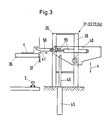
- each lifting column 21 to 24 is of identical design, the lifting column 21 is described in more detail below with reference to FIG. 3.
- the lifting column 21 consists of four vertical guide rails 25, 26, 27, 28 which complement each other to form a square or rectangular base. These guide rails 25 to 28 serve to accommodate a lifting platform, lifting platform or lifting carriage 40 which can be moved vertically in the direction of arrow X, the movability of the lifting carriage 40 by means of a drive device indicated at 45 (FIG. 3).
- the lifting carriage 40 which can be designed, for example, in the form of a platform, has guide rollers on the side walls facing the guide rails 25 to 27, which are guided in corresponding guides of the guide rails 25, 28 such that the guide rollers are lifted out of the guides of the guide rails 25 to 28 not possible.
- the guide rollers for the guide rails are arranged offset from one another in such a way that tilting of the lifting carriage 40 is avoided.
- the arrangement of the guide rollers on the lifting carriage 40 takes place approximately as shown in FIG. 3.
- a hydraulic working cylinder can be used which, if there is not enough space available, can be designed telescopically.
- differently designed drive devices can also be used, e.g. in addition to hydraulic drive devices, also compressed air operated drive devices, electromotive drives or also those drives which are operated by means of internal combustion engines.
- the lifting carriage 40 of each lifting column 21 to 24 also has a horizontal support arm 50 which can be extended and retracted in the direction of the arrow X1.
- a drive device 55 is provided, which can also be designed as a hydraulic or compressed air-operated working cylinder. However, other suitable drive devices can also be used.
- Both the drive device 45 for the lifting carriage 40 and the drive devices 55 for the support arms 50 are connected to one another via a control element in such a way that all movement sequences run simultaneously.
- the length of the retractable and extendable support arms 50 of all four lifting columns 21 to 24 is dimensioned such that in the extended state of the support arms 50, they underlie the container 30 arranged on a loading area of a vehicle, lift it and place it on another loading area of a transport vehicle, which has been retracted into the lifting device 20 after the track-bound vehicle, such as a wagon or the like, from which the container has been removed, has been moved out of the lifting device 20, has been moved out of the lifting device.
- This retraction and extension of the track-bound vehicle takes place by means of the towing and positioning device 60 described in more detail below.
- a control device is indicated at 90 in FIG. 2.
- the individual work processes of the lifting carriage 40 and the support arms 50 of the lifting columns 21 to 24 and the towing and positioning carriage 62 are brought together in such a way that the track vehicle 35 coupled to the towing and positioning carriage 62 is separated from the towing and positioning carriage 62 in the area of the lifting columns 21, 22, 23, 24 is moved, ie between the respective pairs of lifting columns, whereupon the support arms 50 in the retracted state from a position, for example, higher up to the lower arm of the support arm area on the container lowered by means of the lifting carriage 40 and extended to reach under the goods to be transported, that is to say the container C, whereupon the carrying arms are raised together with the goods to be transported.
- the wagon, from which the container C has been removed, is then moved out of the area of the lifting device 20 by means of the towing and positioning carriage 62, and a portable loading or storage area, for example of an in-house vehicle such as a truck or the like, is then placed under the lifted transport goods ., brought.
- the goods to be transported are then lowered onto the loading area of this vehicle by lowering the support arms 50 and placed on the loading area, so that the vehicle loaded with the container can then be moved out of the area of the lifting device 20.
- the towing and positioning device 60 consists of a towing and positioning slide 62 which can be moved on a guide rail 61 in the longitudinal direction of the guide rail (FIGS. 2 and 4).
- the guide rail 61 is designed as a double-T support, the upper flange of which is designated 61a and the web of which is designated 61b.
- This guide rail 61 which, however, can also have a different cross-sectional profile, is arranged at a distance and parallel to the track 30.
- the trailing and positioning slide 62 is moved on the guide rail 61 by means of a drive device 65.
- This drive device 65 for the sliding and positioning slide 62 consists of a chain drive, a drive spindle, a rack and pinion drive, an electromagnetic linear drive, a cable drive, and a hydraulic drive or an internal combustion engine drive.
- a chain drive is provided for the towing and positioning slide 62.
- This chain drive consists of a tensioned, i.e., running on the guide rail 61 for the towing and positioning slide 62 in the longitudinal direction of the guide rail.
- biased chain 165 which is attached at its ends to the guide rail 61.
- the chain 165 lies on the flange 61a of the guide rail 61, namely in the middle, i.e. thus over the web 61b of the guide rail 61.
- the length of the guide rail 61 can be chosen as desired; it will depend on the length of the required and desired displacement path.
- the chain lies loosely on the flange 61a of the guide rail 61.
- the towing and positioning slide 62 consists of a housing 162 which engages around the guide rail 61 on both sides.
- the housing is provided in its upper region with four running wheels, of which the running wheels 163, 164 are shown in FIG. 4.
- the housing 162 of the towing and positioning slide 62 is supported on the upper flange 61a of the guide rail 61.
- the four wheels 163, 164 are arranged such that two wheels are located on either side of the chain 165 of the chain drive running through the housing 162.
- the housing 162 has further guide rollers 170, 171 which are either dimensioned so that they are supported on the underside of the upper flange 61a of the guide rail 61 or are dimensioned such that these guide rollers 170, 171 are supported on both the upper flange 61a and the lower flange 61c of the guide rail 61.
- the housing 162 has four guide rollers, of which only the guide rollers 170, 171 are shown in FIG. 4, however. Two guide rollers each are arranged on both sides of the web 61b of the guide rail 61. These guide rollers 170, 171 are freely suspended, which also applies to the wheels 163, 164, which can be designed as flanged wheels.
- the chain 165 is guided into the interior of the housing 162 via deflection rollers 172, 173, as shown in FIG.
- This drive 167 is an electric motor drive.
- the current is supplied via a current collector 196 provided on the housing 162, which is operatively connected to a current supply rail 195 which is arranged parallel to the guide rail 61. Due to the use of a power supply rail 195, cable-type power supply lines are eliminated.
- the power supply rail can also be an integral part of the guide rail 61.
- the towing and positioning slide 62 moves automatically along the guide rail 61, ie the slide 62 runs on the chain 165 in the direction of the arrow X2.
- the chain 165 is on the guide rail 61 in its two end regions 165a, 165b with the interposition of spring elements, such as disc springs or the like. 174, 175 held in the pretensioned state, whereby, according to a preferred embodiment according to FIG. 6, the free ends of the chain 165 merge into sliding rods 176, 177 following the spring elements, which are held freely displaceably in stationary sleeves 178, 179, these sleeves on the guide rail 61 can be attached.
- a monitoring element 180 or 181 is arranged, for example as a proximity initiator, light-optical sensor or the like. can be formed and with which the movement path of the slide rods 176 and 177 is monitored.
- the chain 165 In the operating state of the system, the chain 165 assumes the position shown in FIG. 6 in the pretensioned state. If the chain 165 breaks due to a circumstance, then the slide rods 176, 177 slide in the direction of arrow X2 from position A to position B and at the same time interrupt the monitoring beam of the monitoring element 180 or 181, the monitoring element then actuating a control device via which a braking device, not shown in the drawing, takes effect in the housing 162 of the towing and positioning slide 62, by means of which the driving movement of the towing and positioning slide 62 is braked.
- a braking device not shown in the drawing
- the braking device of the towing and positioning slide 62 consists, for example, of mechanical or magnetic brake shoes, brake wedges or the like which becomes effective with the guide rail 61 and which, for example, take effect via actuatable electromagnets and which prevent further movement of the towing and positioning slide 62, thereby avoiding them is that the wagon coupled to the towing and positioning carriage 62 starts rolling and can no longer be stopped.
- a safety device is therefore particularly advantageous.
- the spring elements arranged in the end region of the chain 165 serve to brake the overrun movement of the wagons to be coupled to the towing and positioning slide 62, at the moment of the coupling process, which will be discussed in more detail below.
- the overrun movement of the wagon to be coupled is reduced during the coupling state with the towing and positioning slide, i.e. braked so that there can be no chain loading in any way.
- the towing and positioning carriage 62 has a coupling arm 63 (FIG. 4).
- the coupling arm 63 is arranged on the housing 162 of the towing and positioning slide 62 and is designed such that either when the slide 62 is moved towards the wagon to be coupled or when the wagon is moved towards the coupling arm 63 for coupling purposes, the coupling arm 63 with it free end is brought into the area of the rope hook 37 of the wagon and when this position is reached, the coupling takes place by means of rope hook closure elements 64 provided on the upper free end of the coupling arm 63, these elements 64 being purely mechanical elements, for example plug-in bolts which can be actuated by hand or by means of electromagnetic drives, but a fully automatic configuration of these rope hook closure elements 64 can also be provided.
- the rope hook closure element 64 is then claw-shaped and, via mechanical or electrically controlled sensors, these claw-like rope hook closure elements are brought to bear on both sides of the rope hook 37 and then actuated in such a way that they snap into the rope hook 37 or embrace the rope hook 37, so that there is a firm but detachable connection between the towing and positioning slide 62 with the wagon.
- the movement of the towing and positioning carriage 62 moves the wagon into the required position, i.e. into the lifting device 20, so that the container standing on the wagon can then be removed and transferred or placed on another loading area brought into the area of the lifting device 20.
- the exact positioning of the coupling arm 63 on the cable hook 37 of a wagon can be carried out by means of mechanical or electrically operated means and devices, wherein appropriately trained sensors can also be used. Light-optically designed sensors can also be used.
- the decoupling is also automatic, i.e. automatically, when appropriate control signals are given to the drive elements, via which the cable hook closure elements 62 are actuated.
- a corresponding control sensor arranged in the area of the coupling arm 62 is indicated at 191 in FIG. 4.
- Such a control sensor can also e.g. be designed as a proximity initiator in a manner known per se.
- the overall control of the system is carried out from a control station, not shown in the drawing.
- limit switches are provided on the guide rail 61, via which the further travel movement of the carriage is interrupted when the carriage 62 acts upon it.
- These limit switches are slidably arranged on the guide rail 61, so that the path of the carriage 62 and the exact position in which the towing and positioning carriage 62 has to be brought to a stop can be defined in order for the container to be loaded and unloaded Waggon between the lifting columns 21 to 24 of the lifting device 20 is arranged so that the support arms 50 of the lifting carriage 40 reach under the container and can lift it.
Landscapes
- Engineering & Computer Science (AREA)
- Mechanical Engineering (AREA)
- Automobile Manufacture Line, Endless Track Vehicle, Trailer (AREA)
- Loading Or Unloading Of Vehicles (AREA)
- Intermediate Stations On Conveyors (AREA)
- Control And Safety Of Cranes (AREA)
- Refuse Collection And Transfer (AREA)
- Catching Or Destruction (AREA)
Priority Applications (1)
| Application Number | Priority Date | Filing Date | Title |
|---|---|---|---|
| AT86117563T ATE55354T1 (de) | 1986-11-18 | 1986-12-17 | Anlage zum umsetzen von transportgut, insbesondere von containern. |
Applications Claiming Priority (2)
| Application Number | Priority Date | Filing Date | Title |
|---|---|---|---|
| DE19863639423 DE3639423A1 (de) | 1986-11-18 | 1986-11-18 | Anlage zum umsetzen von transportgut, insbesondere von containern, und zum positionieren von transportfahrzeugen |
| DE3639423 | 1986-11-18 |
Publications (3)
| Publication Number | Publication Date |
|---|---|
| EP0267989A2 true EP0267989A2 (fr) | 1988-05-25 |
| EP0267989A3 EP0267989A3 (en) | 1988-11-09 |
| EP0267989B1 EP0267989B1 (fr) | 1990-08-08 |
Family
ID=6314224
Family Applications (1)
| Application Number | Title | Priority Date | Filing Date |
|---|---|---|---|
| EP86117563A Expired - Lifetime EP0267989B1 (fr) | 1986-11-18 | 1986-12-17 | Installation pour le transbordement de marchandises, en particulier de conteneurs |
Country Status (3)
| Country | Link |
|---|---|
| EP (1) | EP0267989B1 (fr) |
| AT (1) | ATE55354T1 (fr) |
| DE (2) | DE3639423A1 (fr) |
Cited By (3)
| Publication number | Priority date | Publication date | Assignee | Title |
|---|---|---|---|---|
| AT507334B1 (de) * | 2008-09-08 | 2012-04-15 | Swisslog Evomatic Gmbh | Regalbediengerät |
| CN117550277A (zh) * | 2023-11-07 | 2024-02-13 | 江苏金珹智能储存设备有限公司 | 一种跨梁可调式料箱货架 |
| WO2025169192A1 (fr) * | 2024-02-08 | 2025-08-14 | Giat Yochanan | Transport et/ou convoyage de charges par cartouche commutable coordonnée de manière unique, transporteur et chariot |
Families Citing this family (3)
| Publication number | Priority date | Publication date | Assignee | Title |
|---|---|---|---|---|
| DE9306826U1 (de) * | 1993-05-06 | 1994-09-22 | Certus Maschinenbau GmbH, 86316 Friedberg | Beladeeinrichtung |
| DE9408884U1 (de) * | 1994-05-31 | 1995-10-05 | Fa. Paul Koschinski, 22926 Ahrensburg | Positionierungseinrichtung |
| WO2023084960A1 (fr) * | 2021-11-15 | 2023-05-19 | 村田機械株式会社 | Dispositif de transfert |
Family Cites Families (3)
| Publication number | Priority date | Publication date | Assignee | Title |
|---|---|---|---|---|
| CH395858A (de) * | 1962-05-07 | 1965-07-15 | Inventio Ag | Einrichtung zum Fördern und Abstellen von Behältern |
| DE3038454A1 (de) * | 1980-10-11 | 1982-05-27 | Ruhrkohle Ag, 4300 Essen | Zwangsgefuehrte schienenbahn des untertagebetriebes mit wenigstens auf teilstrecken der bahn vorgesehenen tribgliedern fuer den formschluessigen eingriff eines lokomotivantriebes |
| DE3419363A1 (de) * | 1984-05-24 | 1985-11-28 | Kaup GmbH & Co KG Gesellschaft für Maschinenbau, 8750 Aschaffenburg | Trageinrichtung fuer container |
-
1986
- 1986-11-18 DE DE19863639423 patent/DE3639423A1/de not_active Withdrawn
- 1986-12-17 EP EP86117563A patent/EP0267989B1/fr not_active Expired - Lifetime
- 1986-12-17 AT AT86117563T patent/ATE55354T1/de not_active IP Right Cessation
- 1986-12-17 DE DE8686117563T patent/DE3673429D1/de not_active Expired - Fee Related
Cited By (3)
| Publication number | Priority date | Publication date | Assignee | Title |
|---|---|---|---|---|
| AT507334B1 (de) * | 2008-09-08 | 2012-04-15 | Swisslog Evomatic Gmbh | Regalbediengerät |
| CN117550277A (zh) * | 2023-11-07 | 2024-02-13 | 江苏金珹智能储存设备有限公司 | 一种跨梁可调式料箱货架 |
| WO2025169192A1 (fr) * | 2024-02-08 | 2025-08-14 | Giat Yochanan | Transport et/ou convoyage de charges par cartouche commutable coordonnée de manière unique, transporteur et chariot |
Also Published As
| Publication number | Publication date |
|---|---|
| DE3673429D1 (de) | 1990-09-13 |
| EP0267989A3 (en) | 1988-11-09 |
| EP0267989B1 (fr) | 1990-08-08 |
| DE3639423A1 (de) | 1988-05-19 |
| ATE55354T1 (de) | 1990-08-15 |
Similar Documents
| Publication | Publication Date | Title |
|---|---|---|
| EP0389516B1 (fr) | Systeme de stockage a convoyeur, notamment systeme de stationnement de vehicules | |
| EP2384947B1 (fr) | Procédé et dispositif de chargement du transport de marchandises sur le rail | |
| DE102004040245A1 (de) | Güterumschlagverfahren und Transportsystem | |
| EP0790951A1 (fr) | Procede et dispositif de transfert de charges entre des vehicules sur rails et des vehicules routiers | |
| EP0276646A1 (fr) | Appareillage pour la dépose ou la pose ainsi que le transport des tronçons assemblés de la voie | |
| CH615969A5 (en) | Movable machine arrangement for transporting bulk material | |
| DE3833942A1 (de) | Verfahren und vorrichtung zum automatischen umsetzen von grossen behaeltern, wie containern | |
| DE3706563A1 (de) | Fahrbare anlage zum aufnehmen oder verlegen sowie transportieren von gleisjochen | |
| EP0267989B1 (fr) | Installation pour le transbordement de marchandises, en particulier de conteneurs | |
| DE2834163A1 (de) | Eisenbahnfahrzeug zum umsetzen von behaeltern wie containern auf seitlich des fahrzeuges befindlichen abstellflaechen | |
| EP0623498A1 (fr) | Dispositif de chargement pour porte-charges | |
| DE102017104751B4 (de) | Transportvorrichtung | |
| EP2781422A1 (fr) | Pont de chargement pour le chargement de conteneurs dans un train de marchandises présent sur une voie ferrée électrifiée | |
| DE9218878U1 (de) | Vorrichtung zum Umsetzen von Wechselbehältern, Containern und Flats | |
| DE3820891C2 (fr) | ||
| DE69011621T2 (de) | Einrichtung und Verfahren zum Handhaben von Behältern, die auf Eisenbahnwagen transportiert werden. | |
| EP0486942B1 (fr) | Dispositif pour charger et décharger un véhicule ferroviaire | |
| AT401911B (de) | Transportwaggon, insbesondere niederflurwagen | |
| DE19801880A1 (de) | Anlage zum Umsetzen der Frachtcontainer vom LKW auf die Bahn und umgekehrt | |
| WO2000078594A1 (fr) | Procede et dispositif pour transporter des charges | |
| DE2336710A1 (de) | Vorrichtung zum lagern von plattenstapeln | |
| EP0084823A1 (fr) | Dispositif de transfert de conteneurs | |
| EP0589255B1 (fr) | Méthode pour positionner et dispositif pour pousser des wagons de longeur et empâttement différents | |
| DE8914264U1 (de) | Fahrzeugpositionierungs- und Schleppvorrichtung | |
| DE4411870A1 (de) | Einrichtung zum Umladen von Transportträgern für den Gütertransport |
Legal Events
| Date | Code | Title | Description |
|---|---|---|---|
| PUAI | Public reference made under article 153(3) epc to a published international application that has entered the european phase |
Free format text: ORIGINAL CODE: 0009012 |
|
| AK | Designated contracting states |
Kind code of ref document: A2 Designated state(s): AT BE CH DE ES FR GB IT LI NL SE |
|
| PUAL | Search report despatched |
Free format text: ORIGINAL CODE: 0009013 |
|
| AK | Designated contracting states |
Kind code of ref document: A3 Designated state(s): AT BE CH DE ES FR GB IT LI NL SE |
|
| 17P | Request for examination filed |
Effective date: 19881220 |
|
| 17Q | First examination report despatched |
Effective date: 19890522 |
|
| RAP1 | Party data changed (applicant data changed or rights of an application transferred) |
Owner name: HELMUT HILLMER INH. REINHARD DOBRINDT Owner name: STOLZMANN, KLAUS-DIETER |
|
| GRAA | (expected) grant |
Free format text: ORIGINAL CODE: 0009210 |
|
| AK | Designated contracting states |
Kind code of ref document: B1 Designated state(s): AT BE CH DE ES FR GB IT LI NL SE |
|
| PG25 | Lapsed in a contracting state [announced via postgrant information from national office to epo] |
Ref country code: IT Free format text: LAPSE BECAUSE OF FAILURE TO SUBMIT A TRANSLATION OF THE DESCRIPTION OR TO PAY THE FEE WITHIN THE PRE;WARNING: LAPSES OF ITALIAN PATENTS WITH EFFECTIVE DATE BEFORE 2007 MAY HAVE OCCURRED AT ANY TIME BEFORE 2007. THE CORRECT EFFECTIVE DATE MAY BE DIFFERENT FROM THE ONE RECORDED.SCRIBED TIME-LIMIT Effective date: 19900808 Ref country code: BE Effective date: 19900808 Ref country code: SE Free format text: THE PATENT HAS BEEN ANNULLED BY A DECISION OF A NATIONAL AUTHORITY Effective date: 19900808 Ref country code: FR Effective date: 19900808 Ref country code: NL Effective date: 19900808 Ref country code: GB Effective date: 19900808 |
|
| REF | Corresponds to: |
Ref document number: 55354 Country of ref document: AT Date of ref document: 19900815 Kind code of ref document: T |
|
| REF | Corresponds to: |
Ref document number: 3673429 Country of ref document: DE Date of ref document: 19900913 |
|
| PG25 | Lapsed in a contracting state [announced via postgrant information from national office to epo] |
Ref country code: ES Free format text: LAPSE BECAUSE OF FAILURE TO SUBMIT A TRANSLATION OF THE DESCRIPTION OR TO PAY THE FEE WITHIN THE PRESCRIBED TIME-LIMIT Effective date: 19901119 |
|
| PG25 | Lapsed in a contracting state [announced via postgrant information from national office to epo] |
Ref country code: AT Effective date: 19901217 |
|
| EN | Fr: translation not filed | ||
| PG25 | Lapsed in a contracting state [announced via postgrant information from national office to epo] |
Ref country code: LI Effective date: 19901231 Ref country code: CH Effective date: 19901231 |
|
| NLV1 | Nl: lapsed or annulled due to failure to fulfill the requirements of art. 29p and 29m of the patents act | ||
| GBV | Gb: ep patent (uk) treated as always having been void in accordance with gb section 77(7)/1977 [no translation filed] | ||
| PLBE | No opposition filed within time limit |
Free format text: ORIGINAL CODE: 0009261 |
|
| STAA | Information on the status of an ep patent application or granted ep patent |
Free format text: STATUS: NO OPPOSITION FILED WITHIN TIME LIMIT |
|
| 26N | No opposition filed | ||
| REG | Reference to a national code |
Ref country code: CH Ref legal event code: PL |
|
| PGFP | Annual fee paid to national office [announced via postgrant information from national office to epo] |
Ref country code: DE Payment date: 19950217 Year of fee payment: 9 |
|
| PG25 | Lapsed in a contracting state [announced via postgrant information from national office to epo] |
Ref country code: DE Effective date: 19960903 |