EP0268708B1 - Vorrichtung zum Erkennen der Abstossungsreaktion nach Herztransplantation - Google Patents
Vorrichtung zum Erkennen der Abstossungsreaktion nach Herztransplantation Download PDFInfo
- Publication number
- EP0268708B1 EP0268708B1 EP86309102A EP86309102A EP0268708B1 EP 0268708 B1 EP0268708 B1 EP 0268708B1 EP 86309102 A EP86309102 A EP 86309102A EP 86309102 A EP86309102 A EP 86309102A EP 0268708 B1 EP0268708 B1 EP 0268708B1
- Authority
- EP
- European Patent Office
- Prior art keywords
- heart
- comparison
- rejection
- produced
- signal
- Prior art date
- Legal status (The legal status is an assumption and is not a legal conclusion. Google has not performed a legal analysis and makes no representation as to the accuracy of the status listed.)
- Expired
Links
Images
Classifications
-
- A—HUMAN NECESSITIES
- A61—MEDICAL OR VETERINARY SCIENCE; HYGIENE
- A61B—DIAGNOSIS; SURGERY; IDENTIFICATION
- A61B5/00—Measuring for diagnostic purposes; Identification of persons
- A61B5/41—Detecting, measuring or recording for evaluating the immune or lymphatic systems
- A61B5/413—Monitoring transplanted tissue or organ, e.g. for possible rejection reactions after a transplant
-
- A—HUMAN NECESSITIES
- A61—MEDICAL OR VETERINARY SCIENCE; HYGIENE
- A61B—DIAGNOSIS; SURGERY; IDENTIFICATION
- A61B5/00—Measuring for diagnostic purposes; Identification of persons
- A61B5/0002—Remote monitoring of patients using telemetry, e.g. transmission of vital signals via a communication network
- A61B5/0004—Remote monitoring of patients using telemetry, e.g. transmission of vital signals via a communication network characterised by the type of physiological signal transmitted
- A61B5/0006—ECG or EEG signals
-
- A—HUMAN NECESSITIES
- A61—MEDICAL OR VETERINARY SCIENCE; HYGIENE
- A61B—DIAGNOSIS; SURGERY; IDENTIFICATION
- A61B5/00—Measuring for diagnostic purposes; Identification of persons
- A61B5/24—Detecting, measuring or recording bioelectric or biomagnetic signals of the body or parts thereof
- A61B5/316—Modalities, i.e. specific diagnostic methods
- A61B5/318—Heart-related electrical modalities, e.g. electrocardiography [ECG]
- A61B5/346—Analysis of electrocardiograms
- A61B5/349—Detecting specific parameters of the electrocardiograph cycle
-
- A—HUMAN NECESSITIES
- A61—MEDICAL OR VETERINARY SCIENCE; HYGIENE
- A61B—DIAGNOSIS; SURGERY; IDENTIFICATION
- A61B5/00—Measuring for diagnostic purposes; Identification of persons
- A61B5/72—Signal processing specially adapted for physiological signals or for diagnostic purposes
- A61B5/7235—Details of waveform analysis
- A61B5/7239—Details of waveform analysis using differentiation including higher order derivatives
Definitions
- This invention relates to apparatus for recognising rejection of transplanted hearts.
- the invention relates in particular, but not exclusively, to cardiac implants for detecting and alerting a patient to rejection of a transplanted heart.
- the preferred method of monitoring the cardiac electrogram would be by use of an implanted pacemaker which would be able to transmit the electrogram via telemetry to an external device such as a tape recorder or a paper recorder.
- an external device such as a tape recorder or a paper recorder.
- the main limitation of this method lies in the poor transmission properties of the pacemaker electrocardiogram amplifier and the weakness of the telemetry link to the outside world.
- apparatus for monitoring the body reaction against a heart transplanted thereinto which is an apparatus which comprises sensing electrodes for attachment to the heart at either an endocardial or an epicardial location, the apparatus storing a reference waveform for comparison with a waveform of like type and identifying from discrepancies therebetween malfunctioning of the heart, the apparatus being characterised by a signal path for receiving electric current from the electrodes and having, in series, an analogue to digital converter, means for carrying out a first differentiation of the digital signals produced, a gradient pattern detector which is adapted to compare differentiated signals thereby produced with differentiated signals of like origin produced when the heart was newly transplanted, with respect to amplitude and, optionally, interval, as well as possibly polarity and sequence of amplitudes, and means for recording and storing the results of a comparison within the apparatus for supply on demand by telemetry to means lying externally of the body for reproducing the results of the comparison in a readable form and/or means for alerting the patient to un
- the present invention thus encompasses both cardiac implants modified to embody this invention either (A) to be worn by a patient discharged from hospital and/or (B) to be worn by a patient who is in a post-operative phase within a hospital.
- Apparatus embodying this invention is superior to that previously proposed in that, since the data reduction has been done inside the pacemaker, the requirements on a telemetry link are greatly relieved so that this operation no longer is limited by the quality of the telemetry link.
- he may be warned by an audible signal when the implanted pacemaker is transmitting signals suggesting rejection of the heart.
- the patient will then be able to consult his physician who, by obtaining transmission of stored data will be able to obtain the comparison of differentiated signals in readable form and can establish the extent of rejection which is taking place. Infusion of a rejection suppressing drug can then be prescribed for the patient. At a future time it is envisaged that an in board pump for supply to the body of such drug might be activated. Alternatively, if the indications are spurious then this would mean at least that the implant is malfunctioning and should be replaced, repaired or reprogrammed.
- apparatus of the present invention utilises the principle of gradient pattern detection. This is a simpler algorithm requiring less in the way of computing power and not reducing implant battery life to the same extent as other methods such as fast Fourier transformation and template matching.
- gradient pattern detection consumes battery power additional to that consumed when detection of heart implant rejection is carried out using conventional methods, it is not necessary to operate continuously the apparatus embodying this invention. GPD will only need to be effected at predetermined intervals since rejection does not occur instantaneously but over a period of time.
- electrograms are sensed in the usual manner shortly after implantation of the replacement heart, sensing generally taking place at a signal frequency in the range of 0.016 Hz-1 kHz, with a preferred range being from 0.5 Hz to 500 Hz, the electrograms being obtained during sinus rhythm.
- the analogue electrograms produced are then converted to digital form preferably using an analogue to digital converted frequency of 1024 Hz.
- the digital electrograms are then converted to a first differential form where the amplitudes of this processed signal are proportional to the gradients (slopes or slew-rates) of the original analogue signal.
- the resultant sequence of amplitudes and their temporal spacing is then stored.
- electrograms are produced and processed in like manner and compared with the processed "normal" electrogram to determine whether changes have taken place which are symptomatic of development of heart rejection. This comparison will be sufficiently sensitive to show the small changes which take place indicating the onset of rejection.
- the electrograms will become, as a result of rejection, of lower amplitude and slew rates.
- the apparatus will be specific both to the patient and the location at which the sensors are placed.
- this invention involves comparison of the first differentials of the slopes of the digital electrograms of each beat with what is established for the first differential of the slopes of the digital electrograms before rejection.
- each beat has gradients whose gradient differentials will differ from each other in magnitude, polarity and interval. It may be sufficient for many purposes to rely merely on gradients of and intervals between the processed signals being compared.
- a particularly sophisticated form of control can be achieved if scanning is carried out only at intervals, with it being necessary for a particular sequence of deflections of particular magnitude to be achieved within a particular time interval and generally in a particular order within that time interval, which parameters are of course established when the heart has been operating stably, that is the programmable window is utilised for comparison purposes.
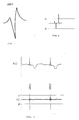
- each beat is shown to possess two peaks which differ in gradient and amplitude between the respective peaks although there may be a different number of peaks.
- This derivative plot through its simplicity can yield useful indications and requires less power to transmit by telemetry, an advantage in view of the poor transmission properties of a pacemaker electrocardiogram amplifier and the weakness of telemetry links to the outside world. It will enable even small changes in heart performance to be detected.
- An analogue electrogram obtained in practice is shown in the upper panel of Figure 3 of the drawings, the lower panel showing processed signals.
- the threshold lines A and B illustrate the mechanism.
- line A followed by line B both have to be crossed by the process signal (PS).
- PS process signal
- a failure of either line A or line B to be crossed by PS may denote rejection of the implanted heart.
- Such sensing coupled with change in separation between successive such intersections will indicate deterioration.
- electrograms have been recorded from 1 cm bipoles in the atrium and either 1 cm bipoles or 0.5 cm bipoles at the right ventricular apex (RVA), a single surface ECG channel being recorded simultaneously.
- the intracardiac recordings were made either DC to 1 kHz or 0.016 Hz to 1 kHz using a Biodata P400 amplifier onto a Racal store 7 tape recorder.
- the analogue electrograms recorded were then digitised at a sampling frequency of 1024 Hz. This relatively low sampling frequency was chosen firstly because the electrogram frequency spectrum contains little useful information among higher frequencies and secondly with a view to implantability of a pacemaker embodying the invention and the need to consider battery conservation.
- the digital electrogram was then converted into a form closely resembling its first time derivative where the amplitudes of the derived signal were proportional to the rates of change of the original electrogram.
- the derived signal was then analysed by a gradient pattern detection programme of the invention which examined for the sequence of turning point and more particularly for the magnitude of amplitudes and the temporal separation within the derived signal.
- the values obtained were then compared with those within a reference signal obtained during sinus rhythm shortly after implanting of the heart, recognition of rejection being based upon the difference between the sequences. Such recognition occurs when certain individually adjustable criteria were met by the derived signal and terminated after an adjustable number of gradients within the signal had occurred.
- the triggering criteria consisted for example of deflections of the processed signal (of either polarity) being less than thresholds for amplitudes and these being sustained for a preset minimum number of sampling points. Satisfaction of these requirements ensured that extraneous "noise" was not misinterpreted.
- the sequence of gradients within the original electrogram was detected by analysis of the amplitudes of the subsequent deflections of the processed signals. Rejection of the heart was detected when the amplitudes of the deflections differed in magnitude from those seen before rejection particularly if coupled with changing of the intervals between equivalent deflections.
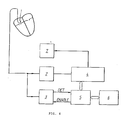
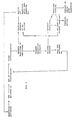
- Figures 4 and 5 show practical embodiments of the invention and should be viewed in conjunction with each other.
- an implant located at for example an atrial location may monitor heart rate at pre-programmed intervals using a normal heart beat detector 2 having time base and control 4 whose operation is directed by a microprocessor 5 having a memory 6.
- gradient pattern detection is switched on at rejection detector 3 which is normally operating in back-up mode.
- Electrograms produced in detector 3 are subjected to analogue digital conversion and the digitalised signals are subjected to a first differentiation.
- the amplitude and generally also sequence, interval and polarity of the deflections of the processed signals obtained are examined. With the assistance of memory 6, these first differentials are compared with first derivative values characteristic of the rhythm before rejection. If there is a match, then no device for warning a patient will be actuated.
- the variance will generally be manifested through change in magnitude of the derived function as well as possibly change in sequence, polarity and interval and a signal will be delivered from control 4 to transmitter 7.
- the purpose of the signal from transmitter 7 is to warn the patient to consult his physician.
- the transmitter 7 is provided with a storage memory and the physician can interrogate this memory to obtain retransmission of the original signals to means for reproducing the stored signals in a readable form. If the indications are of heart rejection, then the GPD may be switched on externally and further readings obtained. If the physician is satisfied that rejection is taking place, remedial action may be effected.
- the GPD will be switched off or reprogrammed, or the GPD may be kept operating on a continuous basis for the purposes of examination. If it should be shown that there is malfunctioning, then surgery will be required to achieve replacement of components of the pacemaker.
Landscapes
- Health & Medical Sciences (AREA)
- Life Sciences & Earth Sciences (AREA)
- Engineering & Computer Science (AREA)
- Public Health (AREA)
- Molecular Biology (AREA)
- Pathology (AREA)
- Physics & Mathematics (AREA)
- Biomedical Technology (AREA)
- Heart & Thoracic Surgery (AREA)
- Medical Informatics (AREA)
- Biophysics (AREA)
- Surgery (AREA)
- Animal Behavior & Ethology (AREA)
- General Health & Medical Sciences (AREA)
- Veterinary Medicine (AREA)
- Cardiology (AREA)
- Physiology (AREA)
- Transplantation (AREA)
- Vascular Medicine (AREA)
- Artificial Intelligence (AREA)
- Computer Vision & Pattern Recognition (AREA)
- Immunology (AREA)
- Psychiatry (AREA)
- Signal Processing (AREA)
- Computer Networks & Wireless Communication (AREA)
- Electrotherapy Devices (AREA)
- Measurement And Recording Of Electrical Phenomena And Electrical Characteristics Of The Living Body (AREA)
- Measuring Pulse, Heart Rate, Blood Pressure Or Blood Flow (AREA)
- Measuring And Recording Apparatus For Diagnosis (AREA)
Claims (6)
- Vorrichtung zum Erkennen der Abstoßreaktionen nach einer Herztransplantation, die Abfühlelektroden (1) aufweist, die entweder an einer endokardialen oder epikardialen Stelle des Herzens appliziert sind, und die eine Referenzwellenform zum Vergleich mit einer Wellenform gleichen Typs speichert und von einer Abweichung zwischen diesen beiden Wellenformen eine Fehlfunktion des Herzens herleitet, gekennzeichnet durch einen Anschluß zum Empfangen des elektrischen Stromes von den Elektroden (1) und
in Reihe einen Analog-Digitalwandler, Mittel (5) zur Durchführung einer ersten Ableitung des erzeugten digitalen Signals, einen Gradientenmusterdetektor (3) zum Vergleichen des abgeleiteten empfangenen Signals mit einem abgeleiteten Signal gleichen Ursprungs, das erzeugt wurde, als das Herz frisch transplantiert war, hinsichtlich Amplitude und, wahlweise, Intervall als auch möglicherweise Polarität und Sequenz der Amplituden, Mitteln (7) zum Aufzeichnen und Speichern der Ergebnisse des Vergleichs in der Vorrichtung zur telemetrischen Übertragung bei Bedarf an Mittel außerhalb des Körpers, die die Ergebnisse des Vergleichs in einer lesbaren Form reproduzieren, und/oder zur Warnung des Patienten hinsichtlich unvorteilhafter Wertungen der Ergebnisse des durchgeführten Vergleichs. - Vorrichtung nach Anspruch 1, die bei einer Signalfrequenz im Bereich von 0.016 Hz bis zu 1 kHz arbeitet.
- Vorrichtung einem der Ansprüche 1 oder 2, bei der der Analog-Digitalwandler bei einer Frequenz von 1024 Hz arbeitet.
- Vorrichtung nach einem der vorhergehenden Ansprüche, bei der die Mittel zur Warnung des Patienten ein hörbares Signal erzeugen.
- Vorrichtung nach einem der vorhergehenden Ansprüche, die so angepaßt ist, daß das Abfülen in periodischen Intervallen erfolgt.
- Vorrichtung nach einem der vorhergehenden Ansprüche, die Programmierungsmöglichkeiten aufweist, durch die gefordert werden kann, daß die Abweichung des erzeugten Signals kleiner ist als die Schwellwerte für die Amplituden und daß diese für eine vorherbestimmte Mindestanzahl von Abfühlpunkten aufrecht erhalten bleiben.
Priority Applications (3)
| Application Number | Priority Date | Filing Date | Title |
|---|---|---|---|
| DE8686309102T DE3686951T2 (de) | 1986-11-20 | 1986-11-20 | Vorrichtung zum erkennen der abstossungsreaktion nach herztransplantation. |
| EP86309102A EP0268708B1 (de) | 1986-11-20 | 1986-11-20 | Vorrichtung zum Erkennen der Abstossungsreaktion nach Herztransplantation |
| US06/939,343 US4905707A (en) | 1986-11-20 | 1986-12-08 | Method for recognizing rejection of transplanted hearts |
Applications Claiming Priority (1)
| Application Number | Priority Date | Filing Date | Title |
|---|---|---|---|
| EP86309102A EP0268708B1 (de) | 1986-11-20 | 1986-11-20 | Vorrichtung zum Erkennen der Abstossungsreaktion nach Herztransplantation |
Publications (2)
| Publication Number | Publication Date |
|---|---|
| EP0268708A1 EP0268708A1 (de) | 1988-06-01 |
| EP0268708B1 true EP0268708B1 (de) | 1992-10-07 |
Family
ID=8196224
Family Applications (1)
| Application Number | Title | Priority Date | Filing Date |
|---|---|---|---|
| EP86309102A Expired EP0268708B1 (de) | 1986-11-20 | 1986-11-20 | Vorrichtung zum Erkennen der Abstossungsreaktion nach Herztransplantation |
Country Status (3)
| Country | Link |
|---|---|
| US (1) | US4905707A (de) |
| EP (1) | EP0268708B1 (de) |
| DE (1) | DE3686951T2 (de) |
Families Citing this family (28)
| Publication number | Priority date | Publication date | Assignee | Title |
|---|---|---|---|---|
| US5197480A (en) * | 1990-06-08 | 1993-03-30 | Vitatron Medical, B.V. | System and method for monitoring heart transplant rejection |
| DE4029961C1 (de) * | 1990-09-21 | 1991-10-24 | Fehling, Guido, 8757 Karlstein, De | |
| US5313953A (en) * | 1992-01-14 | 1994-05-24 | Incontrol, Inc. | Implantable cardiac patient monitor |
| US5285793A (en) * | 1992-05-21 | 1994-02-15 | Regents Of The Univeristy Of Minnesota | Noninvasive detection of rejection in heart transplant patients |
| US5782890A (en) * | 1992-07-01 | 1998-07-21 | Medtronic, Inc. | Method for heart transplant monitoring and analog telemetry calibration |
| US5402794A (en) * | 1992-07-01 | 1995-04-04 | Medtronic, Inc. | Method and apparatus for heart transplant monitoring and analog telemetry calibration |
| US5871508A (en) * | 1997-08-06 | 1999-02-16 | Medtronic, Inc. | Apparatus for cardiac pacing in transplant |
| US7801596B2 (en) * | 2002-09-20 | 2010-09-21 | Angel Medical Systems, Inc. | Physician's programmer for implantable devices having cardiac diagnostic and patient alerting capabilities |
| US20050113886A1 (en) * | 2003-11-24 | 2005-05-26 | Fischell David R. | Implantable medical system with long range telemetry |
| US8244338B2 (en) | 2003-11-26 | 2012-08-14 | Angel Medical Systems, Inc. | Cardiac event detection over varying time scale |
| US7512438B2 (en) * | 2003-11-26 | 2009-03-31 | Angel Medical Systems, Inc. | Implantable system for monitoring the condition of the heart |
| US20070016089A1 (en) * | 2005-07-15 | 2007-01-18 | Fischell David R | Implantable device for vital signs monitoring |
| US8838215B2 (en) * | 2006-03-01 | 2014-09-16 | Angel Medical Systems, Inc. | Systems and methods of medical monitoring according to patient state |
| US8112149B2 (en) * | 2006-02-27 | 2012-02-07 | Monitoring Information Technologies, Inc. | System and method for heart and activity monitoring |
| US8781566B2 (en) * | 2006-03-01 | 2014-07-15 | Angel Medical Systems, Inc. | System and methods for sliding-scale cardiac event detection |
| US8002701B2 (en) | 2006-03-10 | 2011-08-23 | Angel Medical Systems, Inc. | Medical alarm and communication system and methods |
| US8676303B2 (en) | 2008-05-13 | 2014-03-18 | The Regents Of The University Of California | Methods and systems for treating heart instability |
| EP2339961B1 (de) | 2008-10-09 | 2018-03-07 | The Regents of the University of California | Gerät zur automatischen lokalisation von quellen von biologischen rhythmusstörungen |
| US10434319B2 (en) | 2009-10-09 | 2019-10-08 | The Regents Of The University Of California | System and method of identifying sources associated with biological rhythm disorders |
| US9392948B2 (en) | 2011-12-09 | 2016-07-19 | The Regents Of The University Of California | System and method of identifying sources for biological rhythms |
| US9332915B2 (en) | 2013-03-15 | 2016-05-10 | The Regents Of The University Of California | System and method to identify sources associated with biological rhythm disorders |
| US10398326B2 (en) | 2013-03-15 | 2019-09-03 | The Regents Of The University Of California | System and method of identifying sources associated with biological rhythm disorders |
| CN102917638B (zh) | 2010-04-08 | 2015-11-25 | 加利福尼亚大学董事会 | 用于检测、诊断和治疗生物节律紊乱的方法、系统和设备 |
| SE535666C2 (sv) | 2011-03-11 | 2012-10-30 | Totalfoersvarets Forskningsins | Metod och anordning för genomsökning av rasmassor |
| US9107600B2 (en) | 2011-05-02 | 2015-08-18 | The Regents Of The University Of California | System and method for reconstructing cardiac activation information |
| US9050006B2 (en) | 2011-05-02 | 2015-06-09 | The Regents Of The University Of California | System and method for reconstructing cardiac activation information |
| US8165666B1 (en) | 2011-05-02 | 2012-04-24 | Topera, Inc. | System and method for reconstructing cardiac activation information |
| CN103718191B (zh) | 2011-05-02 | 2018-02-02 | 加利福尼亚大学董事会 | 使用成形消融术来靶向心律紊乱的系统和方法 |
Family Cites Families (12)
| Publication number | Priority date | Publication date | Assignee | Title |
|---|---|---|---|---|
| US3593705A (en) * | 1968-10-03 | 1971-07-20 | Merck & Co Inc | Arrhythmia monitoring instrument and method using {37 normal{38 {0 and {37 total{38 {0 counting channels |
| US3707959A (en) * | 1970-07-13 | 1973-01-02 | Nat Res Dev | Method and apparatus for monitoring electrocardiac signals |
| FR2193320A5 (de) | 1972-02-04 | 1974-02-15 | Inst Nat Sante Rech Med | |
| US3861387A (en) * | 1972-09-11 | 1975-01-21 | Cardiodynamics | Cardiac arrhythmia detector |
| US4004577A (en) * | 1972-12-04 | 1977-01-25 | Survival Technology, Inc. | Method of treating heart attack patients prior to the establishment of qualified direct contact personal care |
| US4002979A (en) * | 1973-04-20 | 1977-01-11 | Electro Sciences For Medicine, Inc. | Pulse comparator |
| US4360030A (en) * | 1980-01-23 | 1982-11-23 | Medtronic, Inc. | Apparatus for monitoring and storing a variety of heart activity signals |
| US4336810A (en) * | 1980-09-30 | 1982-06-29 | Del Mar Avionics | Method and apparatus for arrhythmia analysis of ECG recordings |
| US4523595A (en) * | 1981-11-25 | 1985-06-18 | Zibell J Scott | Method and apparatus for automatic detection and treatment of ventricular fibrillation |
| US4523593A (en) | 1983-06-15 | 1985-06-18 | Medtronic, Inc. | Constant A-A interval control for DVI and DDD cardiac pacemakers |
| US4679144A (en) * | 1984-08-21 | 1987-07-07 | Q-Med, Inc. | Cardiac signal real time monitor and method of analysis |
| US4905708A (en) | 1985-10-31 | 1990-03-06 | Davies David W | Apparatus for recognizing cardiac rhythms |
-
1986
- 1986-11-20 EP EP86309102A patent/EP0268708B1/de not_active Expired
- 1986-11-20 DE DE8686309102T patent/DE3686951T2/de not_active Expired - Fee Related
- 1986-12-08 US US06/939,343 patent/US4905707A/en not_active Expired - Lifetime
Also Published As
| Publication number | Publication date |
|---|---|
| DE3686951T2 (de) | 1993-04-29 |
| EP0268708A1 (de) | 1988-06-01 |
| US4905707A (en) | 1990-03-06 |
| DE3686951D1 (de) | 1992-11-12 |
Similar Documents
| Publication | Publication Date | Title |
|---|---|---|
| US4905707A (en) | Method for recognizing rejection of transplanted hearts | |
| US5634468A (en) | Sensor patch and system for physiological monitoring | |
| US4905708A (en) | Apparatus for recognizing cardiac rhythms | |
| EP0565909B1 (de) | Implantierbare Vorrichtung zur Bestimmung und Steuerung der Wirkung des Sympathiko-Vagus-Nervs | |
| EP1192971B1 (de) | Implantierbarer Herzschrittmacher | |
| US6266554B1 (en) | System and method for classifying cardiac complexes | |
| EP1151718B1 (de) | Gerät zur Überwachung des Herzversagens mittels Analyse des Atemmusters | |
| EP1587422B1 (de) | Gerät und verfahren zum nachweis von lungengeräuschen mit einer implantierten vorrichtung | |
| US6381493B1 (en) | Ischemia detection during non-standard cardiac excitation patterns | |
| US9730604B2 (en) | Methods for detecting atrial tachyarrhythmia in implantable devices without dedicated atrial sensing | |
| US7328063B2 (en) | Method and apparatus for arrhythmia classification using atrial signal mapping | |
| US10702167B2 (en) | Method to trigger storage of onset of physiologic condition in an implantable device | |
| US20050004609A1 (en) | Implantable devices and methods using frequency-domain analysis of thoracic signal | |
| JPH06167A (ja) | 植え込み可能な心臓病患者モニター | |
| US20110152705A1 (en) | Systems, methods and computer program products for heart monitoring | |
| JPH0698864A (ja) | 心筋虚血患者スクリーニング法 | |
| WO2013074787A1 (en) | Electrograms to identify bundle branch block morphology | |
| EP2237722B1 (de) | Gerät zur überwachung von t-wellen-alternans | |
| US20200170526A1 (en) | Detection and monitoring using high frequency electrogram analysis | |
| WO2011126643A2 (en) | Detection of t-wave alternans phase reversal for arrhythmia prediction and sudden cardiac death risk stratification | |
| US9254094B2 (en) | Detection and monitoring using high frequency electrogram analysis | |
| EP3155964B1 (de) | Ein verfahren und ein überwachungsgeät zur analyse von ekg-daten durch vergleichen von aufeinanderfolgenden zeitintervallen | |
| EP2954841A1 (de) | Detektion und überwachung mithilfe hochfrequenter elektrogrammanalyse | |
| US20100114231A1 (en) | Methods and systems to monitor ischemia | |
| AU3818693A (en) | Sensor and system for physiological monitoring |
Legal Events
| Date | Code | Title | Description |
|---|---|---|---|
| PUAI | Public reference made under article 153(3) epc to a published international application that has entered the european phase |
Free format text: ORIGINAL CODE: 0009012 |
|
| AK | Designated contracting states |
Kind code of ref document: A1 Designated state(s): DE FR GB IT NL SE |
|
| 17P | Request for examination filed |
Effective date: 19881130 |
|
| 17Q | First examination report despatched |
Effective date: 19910321 |
|
| GRAA | (expected) grant |
Free format text: ORIGINAL CODE: 0009210 |
|
| AK | Designated contracting states |
Kind code of ref document: B1 Designated state(s): DE FR GB IT NL SE |
|
| REF | Corresponds to: |
Ref document number: 3686951 Country of ref document: DE Date of ref document: 19921112 |
|
| ET | Fr: translation filed | ||
| ITF | It: translation for a ep patent filed | ||
| PLBE | No opposition filed within time limit |
Free format text: ORIGINAL CODE: 0009261 |
|
| STAA | Information on the status of an ep patent application or granted ep patent |
Free format text: STATUS: NO OPPOSITION FILED WITHIN TIME LIMIT |
|
| 26N | No opposition filed | ||
| EAL | Se: european patent in force in sweden |
Ref document number: 86309102.1 |
|
| NLS | Nl: assignments of ep-patents |
Owner name: PACESETTER AB;D.W. DAVIES |
|
| REG | Reference to a national code |
Ref country code: FR Ref legal event code: TP |
|
| REG | Reference to a national code |
Ref country code: GB Ref legal event code: IF02 |
|
| PGFP | Annual fee paid to national office [announced via postgrant information from national office to epo] |
Ref country code: FR Payment date: 20041029 Year of fee payment: 19 |
|
| PGFP | Annual fee paid to national office [announced via postgrant information from national office to epo] |
Ref country code: GB Payment date: 20041103 Year of fee payment: 19 |
|
| PGFP | Annual fee paid to national office [announced via postgrant information from national office to epo] |
Ref country code: NL Payment date: 20041112 Year of fee payment: 19 |
|
| PGFP | Annual fee paid to national office [announced via postgrant information from national office to epo] |
Ref country code: SE Payment date: 20041125 Year of fee payment: 19 Ref country code: DE Payment date: 20041125 Year of fee payment: 19 |
|
| PG25 | Lapsed in a contracting state [announced via postgrant information from national office to epo] |
Ref country code: IT Free format text: LAPSE BECAUSE OF NON-PAYMENT OF DUE FEES;WARNING: LAPSES OF ITALIAN PATENTS WITH EFFECTIVE DATE BEFORE 2007 MAY HAVE OCCURRED AT ANY TIME BEFORE 2007. THE CORRECT EFFECTIVE DATE MAY BE DIFFERENT FROM THE ONE RECORDED. Effective date: 20051120 Ref country code: GB Free format text: LAPSE BECAUSE OF NON-PAYMENT OF DUE FEES Effective date: 20051120 |
|
| PG25 | Lapsed in a contracting state [announced via postgrant information from national office to epo] |
Ref country code: SE Free format text: LAPSE BECAUSE OF NON-PAYMENT OF DUE FEES Effective date: 20051121 |
|
| PG25 | Lapsed in a contracting state [announced via postgrant information from national office to epo] |
Ref country code: NL Free format text: LAPSE BECAUSE OF NON-PAYMENT OF DUE FEES Effective date: 20060601 Ref country code: DE Free format text: LAPSE BECAUSE OF NON-PAYMENT OF DUE FEES Effective date: 20060601 |
|
| EUG | Se: european patent has lapsed | ||
| GBPC | Gb: european patent ceased through non-payment of renewal fee |
Effective date: 20051120 |
|
| PG25 | Lapsed in a contracting state [announced via postgrant information from national office to epo] |
Ref country code: FR Free format text: LAPSE BECAUSE OF NON-PAYMENT OF DUE FEES Effective date: 20060731 |
|
| NLV4 | Nl: lapsed or anulled due to non-payment of the annual fee |
Effective date: 20060601 |
|
| REG | Reference to a national code |
Ref country code: FR Ref legal event code: ST Effective date: 20060731 |