EP0270862A2 - Verfahren zur Bestimmung eines Parameters in einem Medium mit Verwendung eines Laserbündels - Google Patents
Verfahren zur Bestimmung eines Parameters in einem Medium mit Verwendung eines Laserbündels Download PDFInfo
- Publication number
- EP0270862A2 EP0270862A2 EP87116615A EP87116615A EP0270862A2 EP 0270862 A2 EP0270862 A2 EP 0270862A2 EP 87116615 A EP87116615 A EP 87116615A EP 87116615 A EP87116615 A EP 87116615A EP 0270862 A2 EP0270862 A2 EP 0270862A2
- Authority
- EP
- European Patent Office
- Prior art keywords
- parameter
- value
- laser
- range
- absorbence
- Prior art date
- Legal status (The legal status is an assumption and is not a legal conclusion. Google has not performed a legal analysis and makes no representation as to the accuracy of the status listed.)
- Ceased
Links
- 238000000034 method Methods 0.000 title claims abstract description 18
- 239000000470 constituent Substances 0.000 claims abstract description 11
- 238000002835 absorbance Methods 0.000 claims abstract description 4
- 230000008033 biological extinction Effects 0.000 claims description 15
- 238000010521 absorption reaction Methods 0.000 abstract description 36
- 230000000694 effects Effects 0.000 abstract description 3
- 238000005259 measurement Methods 0.000 description 18
- 229910002092 carbon dioxide Inorganic materials 0.000 description 16
- 241000894007 species Species 0.000 description 14
- CURLTUGMZLYLDI-UHFFFAOYSA-N Carbon dioxide Chemical compound O=C=O CURLTUGMZLYLDI-UHFFFAOYSA-N 0.000 description 10
- 238000001228 spectrum Methods 0.000 description 10
- 238000001514 detection method Methods 0.000 description 8
- 239000003344 environmental pollutant Substances 0.000 description 7
- 231100000719 pollutant Toxicity 0.000 description 7
- 238000000862 absorption spectrum Methods 0.000 description 6
- CBENFWSGALASAD-UHFFFAOYSA-N Ozone Chemical compound [O-][O+]=O CBENFWSGALASAD-UHFFFAOYSA-N 0.000 description 5
- 239000001569 carbon dioxide Substances 0.000 description 5
- 230000035945 sensitivity Effects 0.000 description 5
- 230000007704 transition Effects 0.000 description 4
- XLYOFNOQVPJJNP-UHFFFAOYSA-N water Substances O XLYOFNOQVPJJNP-UHFFFAOYSA-N 0.000 description 4
- 239000000443 aerosol Substances 0.000 description 3
- 238000004364 calculation method Methods 0.000 description 3
- 239000007789 gas Substances 0.000 description 3
- 238000005192 partition Methods 0.000 description 3
- 238000002834 transmittance Methods 0.000 description 3
- 238000012935 Averaging Methods 0.000 description 2
- 239000006096 absorbing agent Substances 0.000 description 2
- 230000001419 dependent effect Effects 0.000 description 2
- 230000003287 optical effect Effects 0.000 description 2
- 230000005855 radiation Effects 0.000 description 2
- 239000000523 sample Substances 0.000 description 2
- 101100445834 Drosophila melanogaster E(z) gene Proteins 0.000 description 1
- 230000002238 attenuated effect Effects 0.000 description 1
- 230000005540 biological transmission Effects 0.000 description 1
- 230000000295 complement effect Effects 0.000 description 1
- 230000004069 differentiation Effects 0.000 description 1
- 230000005670 electromagnetic radiation Effects 0.000 description 1
- 238000011156 evaluation Methods 0.000 description 1
- 230000005284 excitation Effects 0.000 description 1
- 230000010354 integration Effects 0.000 description 1
- 230000003993 interaction Effects 0.000 description 1
- 230000002452 interceptive effect Effects 0.000 description 1
- 230000000155 isotopic effect Effects 0.000 description 1
- 239000000203 mixture Substances 0.000 description 1
- 230000003071 parasitic effect Effects 0.000 description 1
- 230000008569 process Effects 0.000 description 1
- 238000012545 processing Methods 0.000 description 1
- 238000012552 review Methods 0.000 description 1
- 230000003595 spectral effect Effects 0.000 description 1
- 230000009897 systematic effect Effects 0.000 description 1
- 230000002123 temporal effect Effects 0.000 description 1
- 239000005436 troposphere Substances 0.000 description 1
Images





Classifications
-
- H—ELECTRICITY
- H01—ELECTRIC ELEMENTS
- H01S—DEVICES USING THE PROCESS OF LIGHT AMPLIFICATION BY STIMULATED EMISSION OF RADIATION [LASER] TO AMPLIFY OR GENERATE LIGHT; DEVICES USING STIMULATED EMISSION OF ELECTROMAGNETIC RADIATION IN WAVE RANGES OTHER THAN OPTICAL
- H01S3/00—Lasers, i.e. devices using stimulated emission of electromagnetic radiation in the infrared, visible or ultraviolet wave range
- H01S3/10—Controlling the intensity, frequency, phase, polarisation or direction of the emitted radiation, e.g. switching, gating, modulating or demodulating
- H01S3/105—Controlling the intensity, frequency, phase, polarisation or direction of the emitted radiation, e.g. switching, gating, modulating or demodulating by controlling the mutual position or the reflecting properties of the reflectors of the cavity, e.g. by controlling the cavity length
- H01S3/1055—Controlling the intensity, frequency, phase, polarisation or direction of the emitted radiation, e.g. switching, gating, modulating or demodulating by controlling the mutual position or the reflecting properties of the reflectors of the cavity, e.g. by controlling the cavity length one of the reflectors being constituted by a diffraction grating
-
- G—PHYSICS
- G01—MEASURING; TESTING
- G01N—INVESTIGATING OR ANALYSING MATERIALS BY DETERMINING THEIR CHEMICAL OR PHYSICAL PROPERTIES
- G01N21/00—Investigating or analysing materials by the use of optical means, i.e. using sub-millimetre waves, infrared, visible or ultraviolet light
- G01N21/17—Systems in which incident light is modified in accordance with the properties of the material investigated
- G01N21/25—Colour; Spectral properties, i.e. comparison of effect of material on the light at two or more different wavelengths or wavelength bands
- G01N21/31—Investigating relative effect of material at wavelengths characteristic of specific elements or molecules, e.g. atomic absorption spectrometry
- G01N21/39—Investigating relative effect of material at wavelengths characteristic of specific elements or molecules, e.g. atomic absorption spectrometry using tunable lasers
-
- H—ELECTRICITY
- H01—ELECTRIC ELEMENTS
- H01S—DEVICES USING THE PROCESS OF LIGHT AMPLIFICATION BY STIMULATED EMISSION OF RADIATION [LASER] TO AMPLIFY OR GENERATE LIGHT; DEVICES USING STIMULATED EMISSION OF ELECTROMAGNETIC RADIATION IN WAVE RANGES OTHER THAN OPTICAL
- H01S3/00—Lasers, i.e. devices using stimulated emission of electromagnetic radiation in the infrared, visible or ultraviolet wave range
- H01S3/02—Constructional details
- H01S3/03—Constructional details of gas laser discharge tubes
- H01S3/036—Means for obtaining or maintaining the desired gas pressure within the tube, e.g. by gettering, replenishing; Means for circulating the gas, e.g. for equalising the pressure within the tube
-
- H—ELECTRICITY
- H01—ELECTRIC ELEMENTS
- H01S—DEVICES USING THE PROCESS OF LIGHT AMPLIFICATION BY STIMULATED EMISSION OF RADIATION [LASER] TO AMPLIFY OR GENERATE LIGHT; DEVICES USING STIMULATED EMISSION OF ELECTROMAGNETIC RADIATION IN WAVE RANGES OTHER THAN OPTICAL
- H01S3/00—Lasers, i.e. devices using stimulated emission of electromagnetic radiation in the infrared, visible or ultraviolet wave range
- H01S3/02—Constructional details
- H01S3/03—Constructional details of gas laser discharge tubes
- H01S3/038—Electrodes, e.g. special shape, configuration or composition
-
- H—ELECTRICITY
- H01—ELECTRIC ELEMENTS
- H01S—DEVICES USING THE PROCESS OF LIGHT AMPLIFICATION BY STIMULATED EMISSION OF RADIATION [LASER] TO AMPLIFY OR GENERATE LIGHT; DEVICES USING STIMULATED EMISSION OF ELECTROMAGNETIC RADIATION IN WAVE RANGES OTHER THAN OPTICAL
- H01S3/00—Lasers, i.e. devices using stimulated emission of electromagnetic radiation in the infrared, visible or ultraviolet wave range
- H01S3/05—Construction or shape of optical resonators; Accommodation of active medium therein; Shape of active medium
- H01S3/08—Construction or shape of optical resonators or components thereof
- H01S3/086—One or more reflectors having variable properties or positions for initial adjustment of the resonator
-
- H—ELECTRICITY
- H01—ELECTRIC ELEMENTS
- H01S—DEVICES USING THE PROCESS OF LIGHT AMPLIFICATION BY STIMULATED EMISSION OF RADIATION [LASER] TO AMPLIFY OR GENERATE LIGHT; DEVICES USING STIMULATED EMISSION OF ELECTROMAGNETIC RADIATION IN WAVE RANGES OTHER THAN OPTICAL
- H01S3/00—Lasers, i.e. devices using stimulated emission of electromagnetic radiation in the infrared, visible or ultraviolet wave range
- H01S3/09—Processes or apparatus for excitation, e.g. pumping
- H01S3/097—Processes or apparatus for excitation, e.g. pumping by gas discharge of a gas laser
- H01S3/0971—Processes or apparatus for excitation, e.g. pumping by gas discharge of a gas laser transversely excited
- H01S3/09713—Processes or apparatus for excitation, e.g. pumping by gas discharge of a gas laser transversely excited with auxiliary ionisation, e.g. double discharge excitation
-
- H—ELECTRICITY
- H01—ELECTRIC ELEMENTS
- H01S—DEVICES USING THE PROCESS OF LIGHT AMPLIFICATION BY STIMULATED EMISSION OF RADIATION [LASER] TO AMPLIFY OR GENERATE LIGHT; DEVICES USING STIMULATED EMISSION OF ELECTROMAGNETIC RADIATION IN WAVE RANGES OTHER THAN OPTICAL
- H01S3/00—Lasers, i.e. devices using stimulated emission of electromagnetic radiation in the infrared, visible or ultraviolet wave range
- H01S3/10—Controlling the intensity, frequency, phase, polarisation or direction of the emitted radiation, e.g. switching, gating, modulating or demodulating
- H01S3/13—Stabilisation of laser output parameters, e.g. frequency or amplitude
- H01S3/139—Stabilisation of laser output parameters, e.g. frequency or amplitude by controlling the mutual position or the reflecting properties of the reflectors of the cavity, e.g. by controlling the cavity length
Definitions
- the present invention relates to method of effecting with a laser determinations dependent upon absorbence or reflection of the laser beam
- the present invention a method of effecting a determination of a parameter (hereinafter called the first parameter) of a medium the absorbence or reflection of which in respect of the laser beam is indicative of the value of the first parameter and is most indicative of that value at a particular laser output characteristic, that is, output power and/or frequency; the first parameter along with a further parameter the true value of which indicates the optimum characteristic of the laser output, being indicative of the power of the reflected laser beam, characterised in that, a value is assumed for said further parameter and a laser operation effected to permit a value for the first parameter to be calculated; thereafter, using the calculated value of the first parameter as an assumed correct value, effecting a plurality of laser operations at different laser output characteristics and re-calculating the further parameter after each operation until a constant or near constant value is achieved, and then using that value of the further parameter to recalculate the first parameter to give a final value thereof on the assumption that said value of said further parameter is achieved by the optimum laser output.
- the first parameter a parameter the absorbence or
- the parameter to be determined may for instance "N” and the further parameter " ⁇ ".
- the laser employed is preferably a continuously tunable, high pressure, multi-atmosphere laser, but other lasers may be employed; and indeed separate lasers may be employed in the DIAL application to provide the "ON” and "OFF" frequencies.
- the differential absorption techniques uses two complementary transmitting laser frequencies, the so called “ON” resonance frequency and “OFF” resonance frequency.
- the light pulses are sequentially or simultaneously transmitted along a path in the atmosphere.
- the difference between the attenuation for the "ON” and “OFF” frequencies can be used-to estimate the concentration of say, a pollutant.
- This specification reviews the relevant interactions of light with the atmosphere, introduces the key frequency transmitter requirements and shows the range capabilities of a 100 mJ pulsed C02 laser.
- these absorption spectra may be used as a basis to illustrate the comparison between a continuous tunable and line tunable C02 laser for these two types of spectra.
- Absorption of electromagnetic radiation is caused by the excitation of molecules into higher states of rotation and vibration. & predominant atmospheric window occurs in the infrared between the 7.5 and 14 ⁇ m region of the spectra. Here the spectrum is made up of literally thousands of narrow rotational absorption bands. Each molecular species has its own characteristic band and lines. Atomic or molecular absorption lines are characterised by their transition frequency Vo , line strength S and lineshape ⁇ . The absorption cross section Jabs(v)for a single transition at some frequency is: where ⁇ abs(v-v 0 )is the normalized lineshape function. For monochromatic light, the attenuation coefficient due to absorption of a single specimen is: where N mol is the number density of the absorbing molecule.
- the absorption cross section is the sum of the contributions from each line.
- S( ⁇ 0 ) is the line strength at reference temperature To. E" is the lower state of the transition (expressed as frequency ) in cm -1 and T is the ambient temperature, T and T 0 are in Kelvin.
- the partition function Q( ⁇ ) can be approximated as where m is a molecular constant and could take values At 10 ⁇ m where the Doppler broadening is negligible at pressures P>140 m bar, the broadening is caused by the interruption of the absorption process by the collision of neighbouring molecules.
- the lineshape is given by: ⁇ P is the half width at half maximum. It is a function of pressure and temperature.
- the DIAL system depends on comparing atmospheric transmission at the "ON” and “OFF” frequencies for the target pollutant.
- the difference in absorption due to both target pollutant and background species (interference) at the "ON” and “OFF” frequencies, as indicated, may be taken as criteria to compare the line (TEA) and continuous tunable multi-atmospheric C02 lasers.
- the parameters for numerous species have been determined and collected in the so called AFCRL line parameter compilation, which provide the four parameters V 0 , So, e the lower energy state E" and the partition functions listed.
- this section gives an example of the interference generated by C02 and H20 which are able to influence the absorption on the recommended ozone lines in the P branch of a discrete tuneable C02 laser.
- the spectra are generated with a computer code (see reference mentioned below) which takes into account the above pressure and temperature dependence.
- the three species contribute to the attenuation coefficient in the wavelength region of interest.
- the characteristic values for P.T. and the molecular abundances are taken from the prior art.
- the reference mentioned above is LIDAR ALGORITHM - generation of absorbence spectra using the AFCRL-TR-730096 tapes and codes (1973).
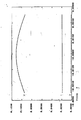
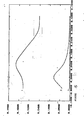
- Fig. 1 and 2 contain the ozone spectra; it can be seen directly that at high altitude (Fig. 2) the structure becomes much more detailed compared to sea level (Fig. 1).
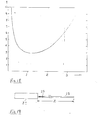
- Fig. 17 shows a schematic of a typical single ended DIAL sensor.
- the apparatus shown consists of a receiver assembly and a laser transmitter 1 in one location. If a hard target 3 to which the laser beam 5 is directed, intercepts the transmitted light pulse 7 with power Po at a range z8 , then the received power P is given by: where "a" is the receiver area and T (z) the atmospheric attenuation defined previously. In the infrared atmospheric attenuation can be expected to be primarily due to absorption rather than scattering.. is the target backscatter coefficient.
- a DIAL sensor compares the returns at two neighbouring frequencies to determine the concentration of some atmospheric species.
- N(z) is the concentration (number density) of the absorber
- T(V 2 ) the absorption cross section which depends on pressure andtemperature ando ⁇ r( V 2)is a residual attenuation coefficient to take into account the effects of interfering other molecular species and scatter losses.
- the Lidar equation [2.11] and the transmittance expression [2.12] can be used to represent the In ratio of the receiver signals as:
- a (2) in eqn [2.13] is a combination of absorption interference and scattering attenuation coefficient.
- the absorption interference of parasitic atmospheric species has been discussed above.
- the scatter attenuation can vary between two wavelengths but is normally negligible at 10 ⁇ m.
- the differential nature of the DIAL technique can cause large errors 10% if the target backscatter coefficients for the "ON” and "OFF" resonance frequency differs.
- the variations in aerosol backscatter coefficients depend on the aerosol size distribution and relative humidity. For range resolved measurements with a constant humidity over the range cell this does not matter as wavelength-dependent variations are automatically ratioed out. On the other hand it is significant for column measurements.
- a sensitivity estimate can be calculated unlike the system noise sources previously mentioned and the results are presented in table 2.3 below.
- Table 2.3 uses the values expressed in tables 2.2 and 2.1 given hereinbelow.
- the speckles from the incoherent backscattering of the transmitted laser beam are the cause of large statistical fluctuations of the intensity in the backscattered light.
- the intensity fluctuations are averaged by the detector but there is an additional optical background and electronic noise, which is dominant in direct detection systems.
- the normalized variance of the return power about the short term mean value for N output pulses in the direct detection case is: For direct detection at I.R. wavelengths: where P is the return power, B is the receiver bandwidth, (NEP) is the noise equivalent power for direct detection.
- the measurement noise is (optimally) dominated by the background source which is the shot noise of the local oscillator.
- S H is the carrier to noise ratio (CNR) for a single H speckle measurement of the return power P 3 as the photodetector quantum efficiency and hv the photon energy.
- B is the range radiation bandwidth and at I.R. wavelengths is the noise equivalent power given by:
- the speckle averaging is done electronically.
- lidar measurements is largely determined by the laser pulse energy, we conservatively assume this to be 100 milliJoules with a pulse repetition frequency (PRF) of 50Hz., (see Table 2.1).
- PRF pulse repetition frequency
- the system performance can be quantified in terms of a limiting range for which we assume the following:
- the absorbence can be calculated from the extinction. These absorption values are used together with the AFCRL line parameter compilation to represent the tabulated DAC values in table 2.2 Finally the relative sensitivity error E/E and equation [2.24] can be used to express the sensitivity error of the corresponding DAC values as ppb per range cell of 300 metre length (see table 2.2)
- Figure 19 is a diagrammatic illustration of the determination.
- 21 indicates, in this instance, a high-pressure, multi-atmosphere, continuously tunable pulsed gas emitting the "ON" and "OFF" frequencies simultaneously and along the same path
- 23 represents the atmospheric column in which the concentration of pollutant is to be determined.
- the reflected laser beam indicated purely by arrow 25 is detected by a suitable detector (not shown).
- each determination of the parameter may be the average of a plurality of, say, 10, shots of the laser or lasers concerned.
- equation "B" becomes :-
Landscapes
- Physics & Mathematics (AREA)
- Electromagnetism (AREA)
- Optics & Photonics (AREA)
- Engineering & Computer Science (AREA)
- Plasma & Fusion (AREA)
- Spectroscopy & Molecular Physics (AREA)
- Chemical & Material Sciences (AREA)
- Life Sciences & Earth Sciences (AREA)
- Health & Medical Sciences (AREA)
- Analytical Chemistry (AREA)
- Biochemistry (AREA)
- General Health & Medical Sciences (AREA)
- General Physics & Mathematics (AREA)
- Immunology (AREA)
- Pathology (AREA)
- Lasers (AREA)
- Investigating Or Analysing Materials By Optical Means (AREA)
- Semiconductor Lasers (AREA)
Applications Claiming Priority (2)
| Application Number | Priority Date | Filing Date | Title |
|---|---|---|---|
| GB8626751 | 1986-11-10 | ||
| GB868626751A GB8626751D0 (en) | 1986-11-10 | 1986-11-10 | Lasers |
Publications (2)
| Publication Number | Publication Date |
|---|---|
| EP0270862A2 true EP0270862A2 (de) | 1988-06-15 |
| EP0270862A3 EP0270862A3 (de) | 1990-01-17 |
Family
ID=10607045
Family Applications (4)
| Application Number | Title | Priority Date | Filing Date |
|---|---|---|---|
| EP87116618A Withdrawn EP0288602A3 (de) | 1986-11-10 | 1987-11-10 | Laser |
| EP87116616A Ceased EP0267592A3 (de) | 1986-11-10 | 1987-11-10 | Laser |
| EP87116617A Withdrawn EP0267593A3 (de) | 1986-11-10 | 1987-11-10 | Laser |
| EP87116615A Ceased EP0270862A3 (de) | 1986-11-10 | 1987-11-10 | Verfahren zur Bestimmung eines Parameters in einem Medium mit Verwendung eines Laserbündels |
Family Applications Before (3)
| Application Number | Title | Priority Date | Filing Date |
|---|---|---|---|
| EP87116618A Withdrawn EP0288602A3 (de) | 1986-11-10 | 1987-11-10 | Laser |
| EP87116616A Ceased EP0267592A3 (de) | 1986-11-10 | 1987-11-10 | Laser |
| EP87116617A Withdrawn EP0267593A3 (de) | 1986-11-10 | 1987-11-10 | Laser |
Country Status (6)
| Country | Link |
|---|---|
| US (1) | US4866727A (de) |
| EP (4) | EP0288602A3 (de) |
| DK (4) | DK589387A (de) |
| GB (1) | GB8626751D0 (de) |
| IE (1) | IE873020L (de) |
| PT (4) | PT86109A (de) |
Cited By (2)
| Publication number | Priority date | Publication date | Assignee | Title |
|---|---|---|---|---|
| WO1991009298A1 (fr) * | 1989-12-19 | 1991-06-27 | Komi Nauchny Tsentr Uralskogo Otdelenia Akademii Nauk Sssr | Procede et dispositif d'obtention de caracteristiques metriques de parametres spectrochimiques de matieres analysees |
| GB2311852A (en) * | 1996-04-06 | 1997-10-08 | Deutsche Forsch Luft Raumfahrt | Remote survey of trace gases |
Families Citing this family (5)
| Publication number | Priority date | Publication date | Assignee | Title |
|---|---|---|---|---|
| GB8626751D0 (en) * | 1986-11-10 | 1986-12-10 | Dijk J W | Lasers |
| US4905250A (en) * | 1987-11-13 | 1990-02-27 | The European Atomic Energy Community | Pre-ionizing electrode arrangement for a gas discharge laser |
| DE3930699C2 (de) * | 1989-09-14 | 1994-02-03 | Perzl Peter | Vorrichtung zur Energieeinkopplung in eine durchströmte elektrische Gasentladung |
| JP2839339B2 (ja) * | 1990-08-06 | 1998-12-16 | 松下電器産業株式会社 | 直交変換符号化装置および直交変換符号化方法 |
| US11435234B1 (en) * | 2021-02-10 | 2022-09-06 | Quantum Valley Ideas Laboratories | Increasing the measurement precision of optical instrumentation using Kalman-type filters |
Family Cites Families (6)
| Publication number | Priority date | Publication date | Assignee | Title |
|---|---|---|---|---|
| GB1577349A (en) * | 1977-03-11 | 1980-10-22 | Andersson H | Method and apparatus for producing laser pulses with high reproducibility |
| DE2824761A1 (de) * | 1977-06-08 | 1978-12-14 | Gen Electric | Entladungserhitzter kupferdampf-laser |
| DE3035730A1 (de) * | 1980-09-22 | 1982-05-13 | Kraftwerk Union AG, 4330 Mülheim | Hochenergielaser des tea-typs mit laser-achsparrallel angeordneten vorionisierungsstaeben |
| FR2553941B1 (fr) * | 1983-10-21 | 1985-12-13 | Commissariat Energie Atomique | Dispositif laser a vapeur metallique |
| US4719641A (en) * | 1985-11-08 | 1988-01-12 | Summit Technology, Inc. | Multiple chamber laser containment system |
| GB8626751D0 (en) * | 1986-11-10 | 1986-12-10 | Dijk J W | Lasers |
-
1986
- 1986-11-10 GB GB868626751A patent/GB8626751D0/en active Pending
-
1987
- 1987-11-10 EP EP87116618A patent/EP0288602A3/de not_active Withdrawn
- 1987-11-10 PT PT86109A patent/PT86109A/pt not_active Application Discontinuation
- 1987-11-10 DK DK589387A patent/DK589387A/da not_active Application Discontinuation
- 1987-11-10 EP EP87116616A patent/EP0267592A3/de not_active Ceased
- 1987-11-10 DK DK589287A patent/DK589287A/da not_active Application Discontinuation
- 1987-11-10 PT PT86108A patent/PT86108A/pt not_active Application Discontinuation
- 1987-11-10 IE IE873020A patent/IE873020L/xx unknown
- 1987-11-10 EP EP87116617A patent/EP0267593A3/de not_active Withdrawn
- 1987-11-10 DK DK589087A patent/DK589087A/da not_active Application Discontinuation
- 1987-11-10 PT PT86107A patent/PT86107A/pt not_active Application Discontinuation
- 1987-11-10 DK DK589187A patent/DK589187A/da not_active Application Discontinuation
- 1987-11-10 PT PT86106A patent/PT86106A/pt not_active Application Discontinuation
- 1987-11-10 EP EP87116615A patent/EP0270862A3/de not_active Ceased
- 1987-11-13 US US07/120,158 patent/US4866727A/en not_active Expired - Fee Related
Non-Patent Citations (6)
| Title |
|---|
| APPLIED OPTICS, vol. 18, no. 20, 15th October 1979, pages 3474-3483, Optical Society of America; E.V. BROWELL et al.: "Water vapor differential absorption lidar development and evaluation" * |
| APPLIED OPTICS, vol. 21, no. 24, 15th December 1982, pages 4411-4416, Optical Society of America, New York, US; D.J. BRASSINGTON: "Differential absorption lidar measurements of atmospheric water vapor using an optical parametric oscillator source" * |
| APPLIED OPTICS, vol. 23, no. 7, 1st April 1984, pages 998-1002, Optical Society of America, New York, US; U. PERSSON et al.: "Computer-automated CO2-laser long-path absorption system for air quality monitoring in the working environment" * |
| APPLIED OPTICS, vol. 24, no. 17, 1st September 1985, pages 2837-2841, Optical Society of America, New York, US; A.P. FORCE et al.: "Laser remote sensing of atmospheric ammonia using a CO2 lidar system" * |
| APPLIED OPTICS, vol. 24, no. 19, October 1985, pages 3297-3304, Optical Society of America; K.A. FREDRIKSSON: "DIAL technique for pollution monitoring: improvements and complementary systems" * |
| APPLIED OPTICS, vol. 24, no. 21, 1st November 1985, pages 3541-3545, Optical Society of America, New York, US; R.E. WARREN: "Detection and discrimination using multiple-wavelength differential absorption lidar" * |
Cited By (3)
| Publication number | Priority date | Publication date | Assignee | Title |
|---|---|---|---|---|
| WO1991009298A1 (fr) * | 1989-12-19 | 1991-06-27 | Komi Nauchny Tsentr Uralskogo Otdelenia Akademii Nauk Sssr | Procede et dispositif d'obtention de caracteristiques metriques de parametres spectrochimiques de matieres analysees |
| GB2311852A (en) * | 1996-04-06 | 1997-10-08 | Deutsche Forsch Luft Raumfahrt | Remote survey of trace gases |
| GB2311852B (en) * | 1996-04-06 | 1999-12-15 | Deutsche Forsch Luft Raumfahrt | Method and equipment for remote survey of trace gases |
Also Published As
| Publication number | Publication date |
|---|---|
| PT86106A (pt) | 1988-12-15 |
| DK589287D0 (da) | 1987-11-10 |
| PT86109A (pt) | 1988-12-15 |
| EP0267592A2 (de) | 1988-05-18 |
| EP0267592A3 (de) | 1989-09-06 |
| IE873020L (en) | 1988-05-10 |
| DK589187A (da) | 1988-05-11 |
| EP0270862A3 (de) | 1990-01-17 |
| PT86108A (pt) | 1988-12-15 |
| EP0288602A2 (de) | 1988-11-02 |
| DK589387D0 (da) | 1987-11-10 |
| PT86107A (pt) | 1988-12-15 |
| GB8626751D0 (en) | 1986-12-10 |
| DK589087A (da) | 1988-05-11 |
| EP0267593A2 (de) | 1988-05-18 |
| DK589287A (da) | 1988-05-11 |
| DK589187D0 (da) | 1987-11-10 |
| DK589387A (da) | 1988-05-11 |
| EP0267593A3 (de) | 1989-09-27 |
| EP0288602A3 (de) | 1989-09-27 |
| DK589087D0 (da) | 1987-11-10 |
| US4866727A (en) | 1989-09-12 |
Similar Documents
| Publication | Publication Date | Title |
|---|---|---|
| US5267010A (en) | Laser radar device | |
| Korb et al. | A theoretical study of a two-wavelength lidar technique for the measurement of atmospheric temperature profiles | |
| US5767519A (en) | Ambient-normalized differential absorption lidar system and method | |
| US4988190A (en) | Absorption line filter window and method for velocity measurements by light scattering | |
| US6750453B1 (en) | Methods of and apparatus for detecting low concentrations of target gases in the free atmosphere | |
| Hardesty | Coherent DIAL measurement of range-resolved water vapor concentration | |
| US4123160A (en) | Method and apparatus for remotely measuring sub-surface water temperatures | |
| US4493553A (en) | Method of and apparatus for measuring temperature and pressure | |
| US5111055A (en) | Method and system for the optical measurement of the air pressure by laser excitation, particularly in front of an aircraft | |
| US7333184B2 (en) | Ground surface cover type reflectivity variation correction in a differential absorption LIDAR system | |
| US4870275A (en) | Circulating raman-media laser radar method and apparatus for remote measurement of gases in the atmosphere | |
| Kavaya et al. | Monte Carlo computer simulations of ground-based and space-based coherent DIAL water vapor profiling | |
| Sun et al. | Accuracy analysis of the Fabry–Perot etalon based doppler wind lidar | |
| Leonard et al. | Experimental remote sensing of subsurface temperature in natural ocean water | |
| Krueger et al. | Self-consistent method for determining vertical profiles of aerosol and atmospheric properties using a high spectral resolution Rayleigh-Mie lidar | |
| GB2311852A (en) | Remote survey of trace gases | |
| Kobayasi et al. | Infra-red heterodyne laser radar for remote sensing of air pollutants by range-resolved differential absorption | |
| Fukuda et al. | Sensitivity of coherent rage-resolved differential absorption lidar | |
| Firsov et al. | The computer code SAGDAM for simulating the laser sounding of atmospheric gases | |
| Hua et al. | UV Rayleigh–Mie Raman lidar for simultaneous measurement of atmospheric temperature and relative humidity profiles in the troposphere | |
| CA1305767C (en) | Circulating raman-media laser radar method and apparatus for remote measurement of gases in the atmosphere | |
| Philbrick et al. | Lidar measurements of refractive propagation effects | |
| Hinkley | Air monitoring with tunable lasers | |
| Menyuk et al. | Effects of Differential Reflectivity, Background Interference, and Signal Fluctuations on IR Dial Measurement Accuracy | |
| Michaelis et al. | Sensitive remote and in situ detection of air pollutants by laser light absorption measurements |
Legal Events
| Date | Code | Title | Description |
|---|---|---|---|
| PUAI | Public reference made under article 153(3) epc to a published international application that has entered the european phase |
Free format text: ORIGINAL CODE: 0009012 |
|
| AK | Designated contracting states |
Kind code of ref document: A2 Designated state(s): AT BE CH DE ES FR GB GR IT LI LU NL SE |
|
| PUAL | Search report despatched |
Free format text: ORIGINAL CODE: 0009013 |
|
| AK | Designated contracting states |
Kind code of ref document: A3 Designated state(s): AT BE CH DE ES FR GB GR IT LI LU NL SE |
|
| 17P | Request for examination filed |
Effective date: 19900213 |
|
| 17Q | First examination report despatched |
Effective date: 19910624 |
|
| STAA | Information on the status of an ep patent application or granted ep patent |
Free format text: STATUS: THE APPLICATION HAS BEEN REFUSED |
|
| 18R | Application refused |
Effective date: 19920926 |
|
| RIN1 | Information on inventor provided before grant (corrected) |
Inventor name: VAN DIJK, JOHANNES WILHELMUS |