EP0271684A2 - Agglomerationsverfahren für einen Polymerlatex - Google Patents
Agglomerationsverfahren für einen Polymerlatex Download PDFInfo
- Publication number
- EP0271684A2 EP0271684A2 EP87115951A EP87115951A EP0271684A2 EP 0271684 A2 EP0271684 A2 EP 0271684A2 EP 87115951 A EP87115951 A EP 87115951A EP 87115951 A EP87115951 A EP 87115951A EP 0271684 A2 EP0271684 A2 EP 0271684A2
- Authority
- EP
- European Patent Office
- Prior art keywords
- latex
- particle size
- polymer latex
- acid
- emulsifying agent
- Prior art date
- Legal status (The legal status is an assumption and is not a legal conclusion. Google has not performed a legal analysis and makes no representation as to the accuracy of the status listed.)
- Withdrawn
Links
- 229920000126 latex Polymers 0.000 title claims abstract description 214
- 239000004816 latex Substances 0.000 title claims abstract description 213
- 229920000642 polymer Polymers 0.000 title claims abstract description 85
- 238000000034 method Methods 0.000 title claims abstract description 55
- 239000002245 particle Substances 0.000 claims abstract description 111
- 239000002253 acid Substances 0.000 claims abstract description 57
- 239000003995 emulsifying agent Substances 0.000 claims abstract description 46
- 230000000694 effects Effects 0.000 claims abstract description 42
- 239000007787 solid Substances 0.000 claims abstract description 40
- 230000002378 acidificating effect Effects 0.000 claims abstract description 21
- 239000003795 chemical substances by application Substances 0.000 claims abstract description 21
- 238000007720 emulsion polymerization reaction Methods 0.000 claims abstract description 11
- 238000002156 mixing Methods 0.000 claims abstract description 8
- 238000009826 distribution Methods 0.000 abstract description 5
- QTBSBXVTEAMEQO-UHFFFAOYSA-N Acetic acid Chemical compound CC(O)=O QTBSBXVTEAMEQO-UHFFFAOYSA-N 0.000 description 56
- KWYUFKZDYYNOTN-UHFFFAOYSA-M Potassium hydroxide Chemical compound [OH-].[K+] KWYUFKZDYYNOTN-UHFFFAOYSA-M 0.000 description 24
- QAOWNCQODCNURD-UHFFFAOYSA-N Sulfuric acid Chemical compound OS(O)(=O)=O QAOWNCQODCNURD-UHFFFAOYSA-N 0.000 description 24
- 238000005054 agglomeration Methods 0.000 description 24
- 230000002776 aggregation Effects 0.000 description 24
- 239000007864 aqueous solution Substances 0.000 description 24
- 235000002639 sodium chloride Nutrition 0.000 description 22
- 238000006116 polymerization reaction Methods 0.000 description 19
- 150000003839 salts Chemical class 0.000 description 18
- XLYOFNOQVPJJNP-UHFFFAOYSA-N water Substances O XLYOFNOQVPJJNP-UHFFFAOYSA-N 0.000 description 16
- 230000000052 comparative effect Effects 0.000 description 15
- HEMHJVSKTPXQMS-UHFFFAOYSA-M Sodium hydroxide Chemical compound [OH-].[Na+] HEMHJVSKTPXQMS-UHFFFAOYSA-M 0.000 description 12
- 239000008367 deionised water Substances 0.000 description 12
- 229910021641 deionized water Inorganic materials 0.000 description 12
- 150000007513 acids Chemical class 0.000 description 10
- 159000000000 sodium salts Chemical class 0.000 description 8
- 229920003171 Poly (ethylene oxide) Polymers 0.000 description 7
- 239000003513 alkali Substances 0.000 description 7
- LSNNMFCWUKXFEE-UHFFFAOYSA-L sulfite Chemical compound [O-]S([O-])=O LSNNMFCWUKXFEE-UHFFFAOYSA-L 0.000 description 7
- FAPWRFPIFSIZLT-UHFFFAOYSA-M Sodium chloride Chemical compound [Na+].[Cl-] FAPWRFPIFSIZLT-UHFFFAOYSA-M 0.000 description 6
- -1 alkali metal salt Chemical class 0.000 description 6
- FQENQNTWSFEDLI-UHFFFAOYSA-J sodium diphosphate Chemical compound [Na+].[Na+].[Na+].[Na+].[O-]P([O-])(=O)OP([O-])([O-])=O FQENQNTWSFEDLI-UHFFFAOYSA-J 0.000 description 6
- 235000019818 tetrasodium diphosphate Nutrition 0.000 description 6
- LWIHDJKSTIGBAC-UHFFFAOYSA-K tripotassium phosphate Chemical compound [K+].[K+].[K+].[O-]P([O-])([O-])=O LWIHDJKSTIGBAC-UHFFFAOYSA-K 0.000 description 6
- 239000005062 Polybutadiene Substances 0.000 description 5
- GVGUFUZHNYFZLC-UHFFFAOYSA-N dodecyl benzenesulfonate;sodium Chemical compound [Na].CCCCCCCCCCCCOS(=O)(=O)C1=CC=CC=C1 GVGUFUZHNYFZLC-UHFFFAOYSA-N 0.000 description 5
- 239000003792 electrolyte Substances 0.000 description 5
- 229920002857 polybutadiene Polymers 0.000 description 5
- 229940080264 sodium dodecylbenzenesulfonate Drugs 0.000 description 5
- 238000003756 stirring Methods 0.000 description 5
- 239000000126 substance Substances 0.000 description 5
- PPBRXRYQALVLMV-UHFFFAOYSA-N Styrene Chemical compound C=CC1=CC=CC=C1 PPBRXRYQALVLMV-UHFFFAOYSA-N 0.000 description 4
- WFDIJRYMOXRFFG-UHFFFAOYSA-N acetic acid anhydride Natural products CC(=O)OC(C)=O WFDIJRYMOXRFFG-UHFFFAOYSA-N 0.000 description 4
- 238000006243 chemical reaction Methods 0.000 description 4
- 230000002708 enhancing effect Effects 0.000 description 4
- 230000000977 initiatory effect Effects 0.000 description 4
- 239000000203 mixture Substances 0.000 description 4
- 229940096992 potassium oleate Drugs 0.000 description 4
- USHAGKDGDHPEEY-UHFFFAOYSA-L potassium persulfate Chemical compound [K+].[K+].[O-]S(=O)(=O)OOS([O-])(=O)=O USHAGKDGDHPEEY-UHFFFAOYSA-L 0.000 description 4
- MLICVSDCCDDWMD-KVVVOXFISA-M potassium;(z)-octadec-9-enoate Chemical compound [K+].CCCCCCCC\C=C/CCCCCCCC([O-])=O MLICVSDCCDDWMD-KVVVOXFISA-M 0.000 description 4
- KAKZBPTYRLMSJV-UHFFFAOYSA-N Butadiene Chemical group C=CC=C KAKZBPTYRLMSJV-UHFFFAOYSA-N 0.000 description 3
- VMHLLURERBWHNL-UHFFFAOYSA-M Sodium acetate Chemical compound [Na+].CC([O-])=O VMHLLURERBWHNL-UHFFFAOYSA-M 0.000 description 3
- 238000013019 agitation Methods 0.000 description 3
- 229920001577 copolymer Polymers 0.000 description 3
- 229920001971 elastomer Polymers 0.000 description 3
- 238000010559 graft polymerization reaction Methods 0.000 description 3
- 239000003999 initiator Substances 0.000 description 3
- 230000000704 physical effect Effects 0.000 description 3
- 229910000160 potassium phosphate Inorganic materials 0.000 description 3
- 235000011009 potassium phosphates Nutrition 0.000 description 3
- 229920005989 resin Polymers 0.000 description 3
- 239000011347 resin Substances 0.000 description 3
- 239000005060 rubber Substances 0.000 description 3
- 239000001632 sodium acetate Substances 0.000 description 3
- 235000017281 sodium acetate Nutrition 0.000 description 3
- 239000011780 sodium chloride Substances 0.000 description 3
- 238000003860 storage Methods 0.000 description 3
- 239000000758 substrate Substances 0.000 description 3
- ZORQXIQZAOLNGE-UHFFFAOYSA-N 1,1-difluorocyclohexane Chemical compound FC1(F)CCCCC1 ZORQXIQZAOLNGE-UHFFFAOYSA-N 0.000 description 2
- YAJYJWXEWKRTPO-UHFFFAOYSA-N 2,3,3,4,4,5-hexamethylhexane-2-thiol Chemical compound CC(C)C(C)(C)C(C)(C)C(C)(C)S YAJYJWXEWKRTPO-UHFFFAOYSA-N 0.000 description 2
- NLHHRLWOUZZQLW-UHFFFAOYSA-N Acrylonitrile Chemical compound C=CC#N NLHHRLWOUZZQLW-UHFFFAOYSA-N 0.000 description 2
- NLXLAEXVIDQMFP-UHFFFAOYSA-N Ammonia chloride Chemical compound [NH4+].[Cl-] NLXLAEXVIDQMFP-UHFFFAOYSA-N 0.000 description 2
- VHUUQVKOLVNVRT-UHFFFAOYSA-N Ammonium hydroxide Chemical compound [NH4+].[OH-] VHUUQVKOLVNVRT-UHFFFAOYSA-N 0.000 description 2
- LSNNMFCWUKXFEE-UHFFFAOYSA-M Bisulfite Chemical compound OS([O-])=O LSNNMFCWUKXFEE-UHFFFAOYSA-M 0.000 description 2
- VEXZGXHMUGYJMC-UHFFFAOYSA-N Hydrochloric acid Chemical compound Cl VEXZGXHMUGYJMC-UHFFFAOYSA-N 0.000 description 2
- DGAQECJNVWCQMB-PUAWFVPOSA-M Ilexoside XXIX Chemical compound C[C@@H]1CC[C@@]2(CC[C@@]3(C(=CC[C@H]4[C@]3(CC[C@@H]5[C@@]4(CC[C@@H](C5(C)C)OS(=O)(=O)[O-])C)C)[C@@H]2[C@]1(C)O)C)C(=O)O[C@H]6[C@@H]([C@H]([C@@H]([C@H](O6)CO)O)O)O.[Na+] DGAQECJNVWCQMB-PUAWFVPOSA-M 0.000 description 2
- ZLMJMSJWJFRBEC-UHFFFAOYSA-N Potassium Chemical compound [K] ZLMJMSJWJFRBEC-UHFFFAOYSA-N 0.000 description 2
- PMZURENOXWZQFD-UHFFFAOYSA-L Sodium Sulfate Chemical compound [Na+].[Na+].[O-]S([O-])(=O)=O PMZURENOXWZQFD-UHFFFAOYSA-L 0.000 description 2
- 229920000122 acrylonitrile butadiene styrene Polymers 0.000 description 2
- 229910052783 alkali metal Inorganic materials 0.000 description 2
- 239000000908 ammonium hydroxide Substances 0.000 description 2
- 230000001965 increasing effect Effects 0.000 description 2
- 239000007788 liquid Substances 0.000 description 2
- 239000002736 nonionic surfactant Substances 0.000 description 2
- 229920002114 octoxynol-9 Polymers 0.000 description 2
- 229920000233 poly(alkylene oxides) Polymers 0.000 description 2
- 229920001485 poly(butyl acrylate) polymer Polymers 0.000 description 2
- 229920001515 polyalkylene glycol Polymers 0.000 description 2
- 229920000259 polyoxyethylene lauryl ether Polymers 0.000 description 2
- 229920001451 polypropylene glycol Polymers 0.000 description 2
- 229910052700 potassium Inorganic materials 0.000 description 2
- 239000011591 potassium Substances 0.000 description 2
- OTYBMLCTZGSZBG-UHFFFAOYSA-L potassium sulfate Chemical compound [K+].[K+].[O-]S([O-])(=O)=O OTYBMLCTZGSZBG-UHFFFAOYSA-L 0.000 description 2
- 229910052939 potassium sulfate Inorganic materials 0.000 description 2
- 235000011151 potassium sulphates Nutrition 0.000 description 2
- 239000002994 raw material Substances 0.000 description 2
- 229910052708 sodium Inorganic materials 0.000 description 2
- 239000011734 sodium Substances 0.000 description 2
- 229910052938 sodium sulfate Inorganic materials 0.000 description 2
- 235000011152 sodium sulphate Nutrition 0.000 description 2
- 239000000243 solution Substances 0.000 description 2
- 239000001593 sorbitan monooleate Substances 0.000 description 2
- 235000011069 sorbitan monooleate Nutrition 0.000 description 2
- 229940035049 sorbitan monooleate Drugs 0.000 description 2
- 239000003381 stabilizer Substances 0.000 description 2
- KAKVFSYQVNHFBS-UHFFFAOYSA-N (5-hydroxycyclopenten-1-yl)-phenylmethanone Chemical compound OC1CCC=C1C(=O)C1=CC=CC=C1 KAKVFSYQVNHFBS-UHFFFAOYSA-N 0.000 description 1
- JAHNSTQSQJOJLO-UHFFFAOYSA-N 2-(3-fluorophenyl)-1h-imidazole Chemical compound FC1=CC=CC(C=2NC=CN=2)=C1 JAHNSTQSQJOJLO-UHFFFAOYSA-N 0.000 description 1
- 239000002202 Polyethylene glycol Substances 0.000 description 1
- 239000004793 Polystyrene Substances 0.000 description 1
- 239000004372 Polyvinyl alcohol Substances 0.000 description 1
- OFOBLEOULBTSOW-UHFFFAOYSA-N Propanedioic acid Natural products OC(=O)CC(O)=O OFOBLEOULBTSOW-UHFFFAOYSA-N 0.000 description 1
- DBMJMQXJHONAFJ-UHFFFAOYSA-M Sodium laurylsulphate Chemical compound [Na+].CCCCCCCCCCCCOS([O-])(=O)=O DBMJMQXJHONAFJ-UHFFFAOYSA-M 0.000 description 1
- BCKXLBQYZLBQEK-KVVVOXFISA-M Sodium oleate Chemical compound [Na+].CCCCCCCC\C=C/CCCCCCCC([O-])=O BCKXLBQYZLBQEK-KVVVOXFISA-M 0.000 description 1
- 150000001340 alkali metals Chemical class 0.000 description 1
- 235000019270 ammonium chloride Nutrition 0.000 description 1
- 125000000129 anionic group Chemical group 0.000 description 1
- 238000000149 argon plasma sintering Methods 0.000 description 1
- 238000010923 batch production Methods 0.000 description 1
- 230000015572 biosynthetic process Effects 0.000 description 1
- 125000002843 carboxylic acid group Chemical group 0.000 description 1
- 239000012986 chain transfer agent Substances 0.000 description 1
- 238000010276 construction Methods 0.000 description 1
- 235000014113 dietary fatty acids Nutrition 0.000 description 1
- 239000000839 emulsion Substances 0.000 description 1
- 229920006351 engineering plastic Polymers 0.000 description 1
- 238000002474 experimental method Methods 0.000 description 1
- 239000000194 fatty acid Substances 0.000 description 1
- 229930195729 fatty acid Natural products 0.000 description 1
- 150000004665 fatty acids Chemical class 0.000 description 1
- 238000001914 filtration Methods 0.000 description 1
- 125000001165 hydrophobic group Chemical group 0.000 description 1
- VZCYOOQTPOCHFL-UPHRSURJSA-N maleic acid Chemical compound OC(=O)\C=C/C(O)=O VZCYOOQTPOCHFL-UPHRSURJSA-N 0.000 description 1
- 239000011976 maleic acid Substances 0.000 description 1
- 238000004519 manufacturing process Methods 0.000 description 1
- 239000000463 material Substances 0.000 description 1
- LVHBHZANLOWSRM-UHFFFAOYSA-N methylenebutanedioic acid Natural products OC(=O)CC(=C)C(O)=O LVHBHZANLOWSRM-UHFFFAOYSA-N 0.000 description 1
- 239000011259 mixed solution Substances 0.000 description 1
- 239000000178 monomer Substances 0.000 description 1
- 230000003472 neutralizing effect Effects 0.000 description 1
- 229920002432 poly(vinyl methyl ether) polymer Polymers 0.000 description 1
- 229920001223 polyethylene glycol Polymers 0.000 description 1
- 230000000379 polymerizing effect Effects 0.000 description 1
- 229920002223 polystyrene Polymers 0.000 description 1
- 229920002689 polyvinyl acetate Polymers 0.000 description 1
- 239000011118 polyvinyl acetate Substances 0.000 description 1
- 229920002451 polyvinyl alcohol Polymers 0.000 description 1
- 159000000001 potassium salts Chemical class 0.000 description 1
- 230000015227 regulation of liquid surface tension Effects 0.000 description 1
- 235000019333 sodium laurylsulphate Nutrition 0.000 description 1
- 239000004094 surface-active agent Substances 0.000 description 1
- VZCYOOQTPOCHFL-UHFFFAOYSA-N trans-butenedioic acid Natural products OC(=O)C=CC(O)=O VZCYOOQTPOCHFL-UHFFFAOYSA-N 0.000 description 1
Images
Classifications
-
- C—CHEMISTRY; METALLURGY
- C08—ORGANIC MACROMOLECULAR COMPOUNDS; THEIR PREPARATION OR CHEMICAL WORKING-UP; COMPOSITIONS BASED THEREON
- C08F—MACROMOLECULAR COMPOUNDS OBTAINED BY REACTIONS ONLY INVOLVING CARBON-TO-CARBON UNSATURATED BONDS
- C08F2/00—Processes of polymerisation
- C08F2/12—Polymerisation in non-solvents
- C08F2/16—Aqueous medium
- C08F2/22—Emulsion polymerisation
-
- C—CHEMISTRY; METALLURGY
- C08—ORGANIC MACROMOLECULAR COMPOUNDS; THEIR PREPARATION OR CHEMICAL WORKING-UP; COMPOSITIONS BASED THEREON
- C08C—TREATMENT OR CHEMICAL MODIFICATION OF RUBBERS
- C08C1/00—Treatment of rubber latex
- C08C1/02—Chemical or physical treatment of rubber latex before or during concentration
- C08C1/065—Increasing the size of dispersed rubber particles
-
- B—PERFORMING OPERATIONS; TRANSPORTING
- B01—PHYSICAL OR CHEMICAL PROCESSES OR APPARATUS IN GENERAL
- B01J—CHEMICAL OR PHYSICAL PROCESSES, e.g. CATALYSIS OR COLLOID CHEMISTRY; THEIR RELEVANT APPARATUS
- B01J19/00—Chemical, physical or physico-chemical processes in general; Their relevant apparatus
- B01J19/24—Stationary reactors without moving elements inside
- B01J19/2415—Tubular reactors
-
- B—PERFORMING OPERATIONS; TRANSPORTING
- B01—PHYSICAL OR CHEMICAL PROCESSES OR APPARATUS IN GENERAL
- B01J—CHEMICAL OR PHYSICAL PROCESSES, e.g. CATALYSIS OR COLLOID CHEMISTRY; THEIR RELEVANT APPARATUS
- B01J19/00—Chemical, physical or physico-chemical processes in general; Their relevant apparatus
- B01J19/26—Nozzle-type reactors, i.e. the distribution of the initial reactants within the reactor is effected by their introduction or injection through nozzles
-
- C—CHEMISTRY; METALLURGY
- C08—ORGANIC MACROMOLECULAR COMPOUNDS; THEIR PREPARATION OR CHEMICAL WORKING-UP; COMPOSITIONS BASED THEREON
- C08F—MACROMOLECULAR COMPOUNDS OBTAINED BY REACTIONS ONLY INVOLVING CARBON-TO-CARBON UNSATURATED BONDS
- C08F2/00—Processes of polymerisation
- C08F2/02—Polymerisation in bulk
-
- C—CHEMISTRY; METALLURGY
- C08—ORGANIC MACROMOLECULAR COMPOUNDS; THEIR PREPARATION OR CHEMICAL WORKING-UP; COMPOSITIONS BASED THEREON
- C08F—MACROMOLECULAR COMPOUNDS OBTAINED BY REACTIONS ONLY INVOLVING CARBON-TO-CARBON UNSATURATED BONDS
- C08F6/00—Post-polymerisation treatments
- C08F6/14—Treatment of polymer emulsions
- C08F6/18—Increasing the size of the dispersed particles
-
- B—PERFORMING OPERATIONS; TRANSPORTING
- B01—PHYSICAL OR CHEMICAL PROCESSES OR APPARATUS IN GENERAL
- B01J—CHEMICAL OR PHYSICAL PROCESSES, e.g. CATALYSIS OR COLLOID CHEMISTRY; THEIR RELEVANT APPARATUS
- B01J2219/00—Chemical, physical or physico-chemical processes in general; Their relevant apparatus
- B01J2219/00049—Controlling or regulating processes
- B01J2219/00177—Controlling or regulating processes controlling the pH
-
- B—PERFORMING OPERATIONS; TRANSPORTING
- B01—PHYSICAL OR CHEMICAL PROCESSES OR APPARATUS IN GENERAL
- B01J—CHEMICAL OR PHYSICAL PROCESSES, e.g. CATALYSIS OR COLLOID CHEMISTRY; THEIR RELEVANT APPARATUS
- B01J2219/00—Chemical, physical or physico-chemical processes in general; Their relevant apparatus
- B01J2219/00049—Controlling or regulating processes
- B01J2219/00184—Controlling or regulating processes controlling the weight of reactants in the reactor vessel
Definitions
- This invention relates to a process for agglomerating a polymer latex for obtaining a polymer latex having a large particle size, in a commercially advantageous manner and without byproducing any coagulated particles at the agglomeration step.
- resins obtained by emulsion polymerization using rubber latexes as a substrate are important for engineering plastics, and as such resins, ABS resin obtained by subjecting styrene and acrylonitrile to graft polymerization onto polybutadiene, ASA resin obtained by subjecting styrene and acrylonitrile to graft polymerization onto polybutyl acrylate, etc. are exemplified.
- polymers containing grafted rubber particles as a component vary in their physical properties due to graft polymerization, but even when the particle size of the rubber substrate particles and its distribution are varied, the physical properties of the polymers vary notably; hence as well known, it is necessary to use a rubber substrate having an adequate particle size and distribution state thereof.
- ABS resin generally unless it has a particle size of 2,500 ⁇ or more, it is difficult to obtain superior physical properties, and further it is preferred to contain a certain quantity of particles of 5,000 ⁇ or more.
- latexes As to the process for agglomerating polymer latexes (hereinafter abbreviated to latexes), various processes have so far been known.
- U.S. patents 2,446,101 and 2,494,002 disclose addition of ammonium chloride to latexes, but when agglomeration is carried out using such a water-soluble salt, its effect is so small that it is necessary to add it in a large quantity in order to enhance the effect of increasing the particle size and further it is also necessary to add a large quantity of an emulsifying agent in order to again stabilize (re-stabilize) latexes after agglomeration.
- U.S. patents 3,281,386 and 3,551,370 propose a process of deactivating the surfactant activity of emulsifying agents by the use of acetic acid or acetic anhydride to thereby agglomerate particles, but according to such a process, the step of adding the acid to latexes is most unstable, and on the boundary surface where the added acid diffuses to the inside of the latexes, coagulated particles (i.e. particles which are agglomerated and enlarged up to 10 ⁇ or more so that they can no longer return to emulsion state; such particles will hereinafter be referred to as coagulum) are often formed, and in order not to form such coagulum, it is necessary to sufficiently lower the acid concentration.
- use of the acid of such a low concentration is disadvantageous since it not only lowers the concentration of the final latexes but reduces the effect of enlarging the particle size.
- the polymer-agglomerating agent is used as it is, or in a partly modified form and singly or together with a specified salt.
- the above-mentioned processes are roughly classified into two types of processes, that is, a process of unstabilizing latexes by the use of an acid or a salt and a process of using an agglomerating agent in a state where the stability of latexes is kept. According to the latter process, the effect of enlarging the particle size is so small as described above that the effect of employing the agglomeration step is not observed as compared with the process of obtaining the desired particle size by way of polymerization.
- the concentration of the solution on the boundary surface between the solution and the latexes is highest so that the latexes are most unstable and hence coagula are liable to be formed. Since the droplets of the agglomerating agent and the latexes are diffused into one another, the latex particles diffused into the inside of the droplets of the agglomerating agent contact with the agglomerating agent of a very high concentration so that coagula are often formed.
- the object of the present invention is to provide a process for agglomerating a polymer latex according to which process a polymer latex having a large particle size and a uniform particle size distribution can be produced without forming any coagulum, with a large effect of enlarging the particle size and in a short agglomeration time, in the agglomeration process.
- the present invention resides in a process for agglomerating polymer latex particles by adding an acid to a polymer latex of a small particle size obtained by emulsion polymerization using as a main emulsifying agent, an emulsifying agent which is reduced in the surface activity in an acidic state, in a conventional manner, which process is characterized by carrying out any one of the following four operations (i) to (iv):
- the particle size cannot be determined definitively, it is, for example, not higher than 2500 ⁇
- the polymer latex of a small particle size used in the present invention refers to those which are formed according to conventional emulsion polymerization using monomer, water, initiator, etc. and also using an emulsifying agent which is reduced in the surface activity in an acidic state, as a main emulsifying agent.
- the emulsifying agent which is reduced in the surface activity has no particular limitation, and is represented by an emulsifying agent having a carboxylic acid group and an alkali metal salt.
- anionic emulsifying agents such as potassium laurate, sodium oleate, potassium salts of mixed fatty acids, potassium rosinate, etc. may be used.
- the quantity thereof added may be a quantity necessary for keeping the stability of polymer latex when a polymer latex of a small particle size used in the agglomeration is polymerized, and has no particular limitation, but in general, it may be used in a range of 0.5 to 5 parts by weight based on 100 parts by weight of polymer.
- the kind of the polymer latex of a small particle size used in the present invention has no particular limitation, but as the latex, soft polymer latexes are preferred such as polybutadiene latex, polystyrene-butadiene copolymer latex, polyacrylonitrile-butadiene copolymer latex, polybutyl acrylate latex, etc. Further, hard polymer latexes may also be used such as polystyrene latex, polyacrylonitrile-styrene copolymer latex, etc. As to these latexes, two kinds or more thereof may be used in admixture.
- any of those having a higher ionization constant than that of the acid group of the above-mentioned emulsifying agent which lowers the surface activity in an acidic state may be used.
- acids are strong acids such as sulfuric acid, hydrochloric acid, sulfonic acid, etc. and weak acids such as maleic acid, itaconic acid, acetic acid, etc. These acids may be used alone or in the form of mixed solution of two or more kinds thereof.
- the concentration of the acids is preferred to be as high as possible provided that no coagulum is formed at the agglomeration step.
- the quantity thereof added since it varies depending on the kind and quantity of emulsifying agents used, it cannot be limited, but the pH of the latexes is preferred to be 6 or less.
- an inorganic electrolyte may be previously added to latexes obtained by emulsion polymerization in a conventional manner, or an alkali substance and/or an emulsifying agent having a surface activity which is stable in an acidic state may be continuously fed into a flow type tubular apparatus.
- the emulsifying agent used therein is the one having a good surface activity in an acidic state and as such, an emulsifying agent having an acid group of a higher ionization constant than those of the above-mentioned acids may be used.
- emulsifying agents constituted from sulfonic acid and alkali metals, sodium alkylbenzenesulfonates, sodium alkylnaphthalenesulfonates, potassium alkyldiphenylsulfonates, sodium laurylsulfate, etc. may be mentioned.
- the quantity of the agent added varies depending on the kind and concentration of the above-mentioned acids and the kind and concentration of the latexes and hence cannot be limited, but it is generally in the range of 0.01 to 1.0 part by weight based on 100 parts by weight of the latexes. If the quantity thereof added is less than 0.01 part by weight, coagula often are formed at the acid addition step, while if it exceeds 1.0 part by weight, the effect of enlarging the particle size is reduced. Further, the time when it is added may be either the time when the latex of a small particle size to be used for the agglomeration is polymerized or after the latex has been polymerized.
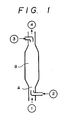
- the flow type tubular apparatus used in the present invention may be a conventional one and has no particular limitation, but an apparatus as illustrated in Fig. 1 is preferred.
- the flow type tubular apparatus comprises a tube with its central section expanded, having two inlets for the latex and acid at its one end and having an inlet for the restabilizer and an outlet for the stabilized latex at the other end.
- a latex is fed through an introducing port 1 or 2
- an acid is fed through an introducing port 2 or 1.
- An unstable latex having an enlarged particle size is again converted into a stable latex by re-stabilizers such as an alkali substance and/or an emulsifying agent having a surface activity in an acidic state, fed into an introducing port 3, and discharged through a discharge port 4 to the outside of the apparatus.
- re-stabilizers such as an alkali substance and/or an emulsifying agent having a surface activity in an acidic state
- a statically or dynamically stirring means is preferred to be provided at either one or both of section A where the latex is mixed with the acid and section B where the unstable latex is mixed with he re-stabilizers, but it is unsuitable to impart an excess shear or flow.
- the apparatus shown in the figure may be provided at various angles of a horizontal one to a vertical one.
- the introducing part at the upper part of the apparatus and thereby allow the liquid to descend, while if the density of the particles is lower than that of water, it is preferred to provide the introducing part so as to allow the flow to ascend as shown in the figure.
- Addition of a water-soluble salt to the latex used in the present invention in advance is effective for enhancing the stability of latexes of a small particle size at the time of polymerizing them or controlling the particle size and also effective for enhancing the effect of enlarging, the particle size at the agglomeration step.
- the kind of the salt used has no particular limitation as far as such conditions are satisfied that the salt is water-soluble and no water-insoluble salt is formed or no gas is evolved by its reaction with the acid added.
- Examples of such a salt are sodium chloride, potassium sulfate, sodium acetate, potassium phosphate, tetrasodium pyrophosphate, etc. These acids may be used alone or in admixture of two kinds or more thereof.
- the latex to be discharged from the discharge port 4 shown in the figure is so unstable that it is difficult to transfer and store the latex as it is.
- an alkali substance used for re-stabilizing this latex for example, sodium hydroxide, potassium hydroxide, ammonium hydroxide, etc. may be used.
- Its quantity added is suitable to be a quantity in which the acid added at the agglomeration step is neutralized. If its concentration is too high, coagula are formed so that a concentration of 20% or lower is preferred.
- an emulsifying agent which is stable at a pH of 6 or less.
- nonionic surfactants such as polyoxyethylene lauryl ether, polyoxyethylene octylphenyl ether, sorbitan monooleate, etc. may be used.
- the polymer-agglomerating agent used in this operation of the present invention refers to a water-soluble agent having a polar group having an affinity with water and also having a non-polar group having an affinity with the polymer latex in one molecule.
- the agent are polyalkylene oxides represented by polyethylene oxide and polypropylene oxide, polyalkylene glycols such as polyethylene glycol, polypropylene glycol, etc., partial oxides of polyalkylene oxides or polyalkylene glycols, polyvinyl methyl ether, polyvinyl alcohol, partially silicated polyvinyl acetate, etc., and these may be used alone or in admixture thereof.
- the molecular weight of these polymers may be employed in a broad range, but it is limited to a range where they are kept water-soluble.
- the quantity thereof added may be very slight and is in the range of 0.0001 to 0.5 part by weight, preferably 0.0005 to 0.2 part by weight based on 100 parts by weight of solids contained in the polymer latex of a small size. If the quantity is less than 0.0001 part by weight, the effect of enlarging the particle size of the polymer latex is slight, while it exceeds 0.5 part by weight, coagula are formed.
- the acid for lowering the pH of the latex may be the same as those previously described in the operation (i), but the pH of the polymer latex is required to be 6 or less.
- an inorganic electrolyte or an emulsifying agent having a good surface activity in an acidic state may be added to the polymer latex to be agglomerated, in advance, and in this case, these two may be added alone or in admixture thereof.
- the kind of the above-mentioned inorganic electrolyte has no particular limitation as far as it is water-soluble and forms no water-insoluble salt and also evolves no gas by reaction thereof with an acid added.
- As the substance sodium chloride, sodium acetate, potassium phosphate, tetrasodium pyrophosphate, etc. may be used, and these may be used alone or in admixture thereof.
- the quantity of the substance added may be in the range of 0 to 5 parts by weight based on 100 parts by weight of the polymer. If it is too large, the mechanical stability of the latex is often reduced at the post-step of using agglomerated latex.
- the emulsifying agent having a good surface activity may be the same as that described in the step (i), and the addition conditions (unfavorable conditions of the addition quantity, excess addition and insufficient addition) also apply to the foregoing.
- the time when the above-mentioned inorganic electrolyte and emulsifying agent are added may be either the time when the polymer latex of a small particle size is polymerized or the time when it has been polymerized.
- addition of water-soluble salts to the starting raw material in advance is effective for enhancing the stability of the polymer latex of a small particle size when polymerized and controlling the particle size, and further effective for enhancing the effect of enlarging the particle size at the agglomeration step.
- the kind of the salts has no particular limitation as far as such conditions are satisfied that the salts used are water-soluble; no water-insoluble salts are formed by the reaction thereof with acids used; and no gas is evolved at the time of the reaction.
- Examples of such salts are sodium chloride, potassium sulfate, sodium acetate, potassium phosphate, tetrasodium pyrophosphate, etc. These salts may be used alone or in admixture of two kinds or more thereof.
- the agglomerated polymer latex in the present invention is so unstable that it is necessary to re-stabilize the latex taking its transfer and long time storage into account.
- the process therefor includes a process of using an alkali and a process of using an emulsifying agent.
- sodium hydroxide, potassium hydroxide or ammonium hydroxide is added, and its quantity added is suitable to be a quantity in which the acid added at the agglomeration step is neutralized. If its concentration is too high, coagula are formed at the time of its addition; hence 15% or less is preferred.
- an emulsifying agent which is stable at a pH of 6 or less is added, and not only the above-mentioned emulsifying agents having a good surface activity in an acidic state, but also nonionic surfactants such as polyoxyethylene lauryl ether, polyoxyethylene octylphenyl ether, sorbitan monooleate, etc. may be used.
- an emulsifying agent having a good surface activity is added in advance of adding an acid to the polymer latex of a small particle size, and the kind and quantity added of the agent has been described above in the operation (ii). Further, unfavorable matters caused in the cases of excess addition and insufficient addition are also the same as those described therein.
- any of those having a higher ionization constant than that of the acid group of the above-mentioned emulsifying agent which lowers the surface activity in an acidic state may be used, and examples of such an acid have been already described.
- the quantity of the acid added to the polymer latex of a small particle size cannot be limited since the quantity varies depending on the kind and quantity of the emulsifying agent used, but the pH of the latex at the time of completion of the second step is required to be 6 or less.
- the concentration of the polymer latex used at the first step is important because if it is too high, coagula are formed at the step of adding the acid, while if it is too low, the effect of enlarging the particle size is small.
- the range of the concentration cannot be limited since it varies depending on the kind and concentration of the acid used and the kind and concentration of the emulsifying agent having a good surface activity in an acidic state, used.
- the concentration of the acid in contact and admixture with the latex has been sufficiently diluted at the first stage and also since the difference between the viscosity of the polymer latex and that of the polymer latex having completed the first step is small, a polymer latex of concentration higher than that of the polymer latex obtained at the first step can be used, and hence it is possible to enhance the effect of enlarging the particle size. For example, if the particle size is 1,000 ⁇ or larger, it is possible to use the latex in a concentration of 40% or higher.
- the ratio of the respective quantities of the polymer latex used at the first step and that used at the second step a broad range thereof is possible, and as compared in terms of solids, it is possible that the polymer latex used at the first step occupies 1/10 to 9/10 of the whole.
- the polymer latex after completion of the second step is so unstable that its transfer and long time storage are difficult. Thus a means of re-stabilizing the latex is required. This means has already been described, that is, a process using an alkali and a process using a surfactant may be applied.
- a polybutadiene latex having an average particle size of 850 ⁇ and a solids content of 38% and containing potassium oleate (3.2 parts) was fed into the apparatus through an introducing port 1 at a rate of 52 g/min.
- a 2.5% aqueous solution of acetic acid was fed into the apparatus through an introducing port 2 at a rate of 15.9 g/min. and also a 10% aqueous solution of sodium dodecylbenzenesulfonate was fed thereinto through an introducing port 3 at a rate of 15.9 g/min.
- the inside of section B was stirred dynamically.
- An agglomerated latex discharged from a discharge port 4 one hundred minutes after start of feed of the aqueous solution of acetic acid had a solids content of 29% and an average particle size of 2,500 ⁇ and no coagulum was formed during the period.
- a flow type tubular apparatus having an inner diameter of 10 mm at section B, as shown in Fig. 1, the same latex as that used in Example 1 was fed into the apparatus through an introducing port 1 at a rate of 9.8 g/min.
- a 2.5% aqueous solution of acetic acid was fed into the apparatus through an introducing port 2 at a rate of 3.0 g/min. and also a 10% aqueous solution of sodium dodecylbenzenesulfonate was fed thereinto through an introducing port 3 at a rate of 0.4 g/min.
- the inside of section B was stirred dynamically.
- a stable latex discharged from a discharge port 4 ninety minutes after start of feed of the aqueous solution of acetic acid had an average particle size of 3,200 ⁇ . Further, the agglomerated latex obtained during the period was filtered through two sheets of gauze. As a result, no coagulum was contained.
- Example 2 To the same latex as that used in Example 1 was added sodium dodecylbenzenesulfonate in a quantity of 0.1 part by weight based on 100 parts by weight of the solids contained in the latex, followed by feeding the resulting latex into a flow type tubular apparatus having an inner diameter of 12 mm at section B, as shown in Fig. 1, through an introducing port 1 at a rate of 88 g/min. After the inside of the apparatus was filled with the latex, a 12% aqueous solution of acetic acid was fed into the apparatus through an introducing port 2 at a rate of 5.2 g/min.
- the resulting agglomerated latex had an average particle size of 2,600 ⁇ and a solids content of 34.8%, that is, it was a latex having a high concentration and a large particle size.
- This latex was filtered through two sheets of gauze. As a result, only 0.6 part by weight on dry basis of coagula based on 100 parts of solids contained in the latex used in the agglomeration was formed.
- Example 2 To the same latex as that used in Example 1 were added sodium dodecylbenzenesulfonate (0.1 part by weight based on 100 parts by weight of the solids contained in the latex) and deionized water to adjust the concentration of the mixture to 34%.
- the resulting latex was fed into a flow type tubular apparatus having an inner diameter of 8 mm at section B as shown in Fig. 1 through an introducing port 2, followed by filling the inside of the tube with the latex, thereafter feeding a 12% aqueous solution of acetic acid through an introducing port 1 so that the quantity of acetic acid might be 2.0 parts by weight based on 100 parts by weight of the solids contained in the latex.
- the feeding rate of the latex and the aqueous solution of acetic acid was adjusted so that the liquid flow rate at section B might be 1 m/min., and a 10% aqueous solution of KOH in a quantity to neutralize the fed acetic acid, through an introducing port 3.
- the inside of section B was stirred dynamically.
- the latex discharged from a discharge port 4 two hours after start of feed of the aqueous solution of acetic acid had an average particle size of 2,600 ⁇ and a solids content of 30.4%, and even when continuous operation was carried out for 3 hours, no coagulum was formed.
- Example 2 The same latex as that used in Example 1 (600 g) was added into a 1 l beaker, followed by quietly adding thereto a 2.5% aqueous solution (182 g) of acetic acid over 3 minutes while agitating the mixture by means of a stirrer provided with 4 turbine blades of 6 cm in diameter at a rate of 100 rpm. About 2 minutes after completion of the addition, large particles of coagula were visibly observed at the upper part of the agitating element and thereafter they rapidly increased; hence the experiment was stopped.
- Example 2 To the same latex as that used in Example 1 was added sodium dodecylbenzenesulfonate (0.1 part by weight based on 100 parts by weight of the solids contained in the latex), followed by adding the resulting latex (600 g) into a 1 l beaker and quietly adding a 12% aqueous solution (38 g) of acetic acid without stirring the latex. Ten minutes after addition of the aqueous solution of acetic acid, a 10% aqueous solution (42.6 g) of KOH was quietly added, followed by allowing the mixture to stand for 5 minutes, further agitating it for 5 minutes and filtering the resulting latex. As a result, a large quantity of coagula was adhered onto the bottom part of the beaker.
- sodium dodecylbenzenesulfonate 0.1 part by weight based on 100 parts by weight of the solids contained in the latex
- Butadiene monomer 100 parts
- deionized water 85 parts
- potassium oleate 1.7 part
- sodium salt of an organosulfonic acid TAMOL-SN TR, trademark of a product manufactured by Rohm and Haas Company
- tetrasodium pyrophosphate 1.5 part
- the rate of polymerization reached 65% after the initiation of polymerization, the temperature was raised up to 65°C, followed by adding deionized water and an initiator.
- latex A After a polymerization time of 20 hours, the rate of polymerization reached 92%.
- the resulting polymer latex of a small particle size had a solids content of 52.6% and an average particle size of 1,700 ⁇ as measured according to light scattering method. This latex will be referred to as latex A.
- this latex A was added sodium salt of an organosulfonate (0.3 part by weight), a polyethylene oxide (an average molecular weight of 20,000) and deionized water to adjust the solids content to 40%.
- sodium salt of an organosulfonate 0.3 part by weight
- a polyethylene oxide an average molecular weight of 20,000
- deionized water 2%
- sulfuric acid 32 parts by weight
- KOH was added to adjust the pH of the latex to 11.5 and its average particle size was measured to give 3,100 ⁇ .
- this latex was filtered through two sheets of gauze. As a result, no coagulum was present.
- Example 5 was repeated except that in the polymerization of the latex A, sodium salt of an organosulfonate (0.3 parts), tetrasodium pyrophosphate (0.1 part) and sodium sulfate (0.8 part), each part by weight, to obtain a polymer latex of a small particle size having a solids content of 52% and an average particle size of 1,850 ⁇ .
- This latex will be referred to as latex B.
- this latex B was added a polyethylene oxide and sodium salt of an organosulfonate in 0.01 part by weight and 0.1 part by weight, respectively, based on 100 parts by weight of the solids contained in the latex B and further, deionized water was added to adjust the solids content to 40%.
- the resulting latex was added 2% sulfuric acid in 18 parts by weight based on 50 parts by weight of the solids contained in the latex.
- the latex B in a quantity of 50 parts in terms of solids was added.
- the resulting latex after the admixture had a pH of 3.4.
- an alkali was added to adjust the pH to 11.5, and the average particle size was measured to give 3,900 ⁇ .
- the solids content of the latex was 40% and no coagulum was formed.
- the latex was allowed to stand for 3 weeks and the average particle size was measured to give 3,950 ⁇ .
- Example 6 was repeated except that the quantity of the polyethylene oxide added to latex B was changed to 0.001 part by weight based on 100 parts by weight of the solids, to obtain an agglomerated latex having an average particle size of 3,200 ⁇ .
- Example 5 was repeated except that the polyethylene oxide was not added, to obtain a latex having an average particle size of 2,500 ⁇ .
- Example 6 was repeated except that the polyethylene oxide was not added, to obtain a latex having an average particle size of 2,850 ⁇ .
- Comparative example 6 was repeated except that the pH of the latex after addition of sulfuric acid was changed to 5.0. After addition of sulfuric acid, the resulting latex was allowed to stand for 200 minutes, to give an average particle size of 2,000 ⁇ .
- Butadiene monomer 100 parts
- deionized water 85 parts
- potassium oleate 1.6 part
- sodium salt of an organosulfonate TAMOL-SN TR, trademark of a product manufactured by Rohm and Haas Company
- sodium sulfate 0.8 part
- potassium persulfate 0.2 part
- t-dodecylmercaptan 0.15 part
- KOH t-dodecylmercaptan
- latex A When the rate of polymerization reached 65% after the initiation of polymerization, deionized water (5 parts by weight) having potassium persulfate (0.1 part by weight) dissolved therein was added into the pressure vessel and the polymerization temperature was raised up to 65°C. After a polymerization time of 26 hours, a polybutadiene latex having an average particle size of 1,850 ⁇ , a solids content of 50.4% and a viscosity of 200 cp was obtained with a rate of polymerization of 88%. This latex will be referred to as latex A.
- the latex A sodium salt of an organosulfonate (0.1 part by weight based on the solids contained in the latex A) and deionized water to make the concentration 40% and the resulting latex (50 parts by weight in terms of solids) was added into a vessel provided with a stirrer, followed by adding 2% sulfuric acid (18 parts by weight) with stirring.
- the latex A (50 parts by weight in terms of solids) was quietly added, followed by adding a 5% aqueous solution of NaOH in an equivalent quantity to the above sulfuric acid to obtain a stable latex.
- This latex was an agglomerated latex having an average particle size of 3,000 ⁇ and a high concentration of a solids content of 41.2%, without byproducing any coagulum.
- Example 8 was repeated except that after the latex A was formed, it was diluted into 40% concentration (29 parts by weight in terms of solids) and the quantity of the latex A to be added later was made 71 parts by weight in terms of solids, to obtain a stable latex.
- This latex was a stable agglomerated latex having an average particle size of 3,600 ⁇ and no coagulum was byproduced.
- Example 8 was repeated except that after formation of the latex A, the latex diluted to a concentration of 40% had 24 parts by weight of solids and the latex A to be later added had 76 parts by weight of solids, to obtain a stable latex.
- This latex had an average particle size of 3,700 ⁇ and a solids content of 43.5% without byproducing any coagulum, that is, it was a latex having a large particle size and a high solids content.
- Butadiene monomer 100 parts
- deionized water 85 parts
- potassium oleate 1.7 part
- sodium salt of an organosulfonate 0.1 part
- tetrasodium pyrophosphate 2.0 parts
- t-dodecylmercaptan 0.3 part
- potassium persulfate 0.2 part
- latex B a polybutadiene latex having an average particle size of 1,900 ⁇ . This latex will be referred to as latex B.
- this latex B was added deionized water to prepare a latex having a concentration of 40%, and 2% sulfuric acid in 44 parts by weight based on 100 parts by weight of solids contained in the latex was added.
- the resulting pH was 3.2, and after 100 minutes, a 5% aqueous solution of NaOH was added to raise the pH up to 11.5 to obtain a stable latex.
- no coagulum was byproduced, but the latex had an average particle size of 2,400 ⁇ and a solids content as low as 31.7%.
- Comparative example 8 was repeated except that, in order to increase the solids content of the latex to be obtained by enlarging the particle size and re-stabilizing the latex, the concentration of sulfuric acid in Comparative example 8 was raised up to 4% (22 parts by weight based on the weight of the solids) and such sulfuric acid was added. However, during the process of adding the above sulfuric acid, a large quantity of coagula was byproduced. The coagula were filtered through two sheets of gauze and the dry weight was measured to give 2.0 parts by weight.
Landscapes
- Chemical & Material Sciences (AREA)
- Chemical Kinetics & Catalysis (AREA)
- Organic Chemistry (AREA)
- Health & Medical Sciences (AREA)
- Medicinal Chemistry (AREA)
- Polymers & Plastics (AREA)
- Dispersion Chemistry (AREA)
- General Chemical & Material Sciences (AREA)
- Addition Polymer Or Copolymer, Post-Treatments, Or Chemical Modifications (AREA)
- Processes Of Treating Macromolecular Substances (AREA)
Applications Claiming Priority (6)
| Application Number | Priority Date | Filing Date | Title |
|---|---|---|---|
| JP260791/86 | 1986-11-04 | ||
| JP26079086A JPH0721012B2 (ja) | 1986-11-04 | 1986-11-04 | ポリマーラテックスの凝集方法 |
| JP260790/86 | 1986-11-04 | ||
| JP26079186A JPH0721013B2 (ja) | 1986-11-04 | 1986-11-04 | ポリマーラテックスの凝集方法 |
| JP279628/86 | 1986-11-26 | ||
| JP27962886A JPH0721014B2 (ja) | 1986-11-26 | 1986-11-26 | ポリマ−ラテツクスの連続凝集方法 |
Publications (2)
| Publication Number | Publication Date |
|---|---|
| EP0271684A2 true EP0271684A2 (de) | 1988-06-22 |
| EP0271684A3 EP0271684A3 (de) | 1988-08-10 |
Family
ID=27334963
Family Applications (1)
| Application Number | Title | Priority Date | Filing Date |
|---|---|---|---|
| EP87115951A Withdrawn EP0271684A3 (de) | 1986-11-04 | 1987-10-30 | Agglomerationsverfahren für einen Polymerlatex |
Country Status (3)
| Country | Link |
|---|---|
| EP (1) | EP0271684A3 (de) |
| KR (1) | KR910009109B1 (de) |
| CA (1) | CA1314651C (de) |
Cited By (5)
| Publication number | Priority date | Publication date | Assignee | Title |
|---|---|---|---|---|
| WO2001091898A1 (de) * | 2000-05-26 | 2001-12-06 | Basf Aktiengesellschaft | Verfahren und vorrichtung zur kontinuierlichen herstellung von organischen mono-oder polyisocyanaten |
| EP1245584A4 (de) * | 1999-12-20 | 2003-07-09 | Kureha Chemical Ind Co Ltd | Verfahren zur herstellung von vergrösserten latexteilchen |
| EP1647558A1 (de) * | 2004-10-13 | 2006-04-19 | Rohm and Haas Company | Verfahren zur Herstellung von vergrösserten Latexteilchen |
| CN104710547A (zh) * | 2013-12-17 | 2015-06-17 | 北方华锦化学工业集团有限公司 | 一种abs树脂用聚丁二烯胶乳附聚方法 |
| CN113493530A (zh) * | 2020-04-07 | 2021-10-12 | 万华化学集团股份有限公司 | 一种聚丁二烯胶乳附聚方法及其用途 |
Families Citing this family (1)
| Publication number | Priority date | Publication date | Assignee | Title |
|---|---|---|---|---|
| KR101726266B1 (ko) * | 2014-06-13 | 2017-04-12 | 주식회사 엘지화학 | 폴리부타디엔 라텍스 입자 제조장치 및 이를 이용한 연속 공정식 폴리부타디엔 라텍스 입자의 제조방법 |
Family Cites Families (3)
| Publication number | Priority date | Publication date | Assignee | Title |
|---|---|---|---|---|
| US2366460A (en) * | 1940-11-29 | 1945-01-02 | Goodrich Co B F | Method of coagulating dispersions |
| US3049501A (en) * | 1960-01-28 | 1962-08-14 | Us Rubber Co | Increasing the particle size of synthetic rubber altex by lowering and raising the ph in the presence of polyvinylmethyl ether |
| FR2301552A1 (fr) * | 1975-02-20 | 1976-09-17 | Monsanto Co | Procede en continu pour agglomerer des latex aqueux et dispositif utilise dans ce but |
-
1987
- 1987-10-30 EP EP87115951A patent/EP0271684A3/de not_active Withdrawn
- 1987-11-03 CA CA000550926A patent/CA1314651C/en not_active Expired - Lifetime
- 1987-11-04 KR KR1019870012396A patent/KR910009109B1/ko not_active Expired
Cited By (9)
| Publication number | Priority date | Publication date | Assignee | Title |
|---|---|---|---|---|
| EP1245584A4 (de) * | 1999-12-20 | 2003-07-09 | Kureha Chemical Ind Co Ltd | Verfahren zur herstellung von vergrösserten latexteilchen |
| US6723764B2 (en) | 1999-12-20 | 2004-04-20 | Rohm And Haas Company | Preparation process of enlarged latex |
| WO2001091898A1 (de) * | 2000-05-26 | 2001-12-06 | Basf Aktiengesellschaft | Verfahren und vorrichtung zur kontinuierlichen herstellung von organischen mono-oder polyisocyanaten |
| US6867324B2 (en) | 2000-05-26 | 2005-03-15 | Basf Aktiengesellschaft | Method and device for the continuous production of organic mono or polyisocyanates |
| KR100809167B1 (ko) | 2000-05-26 | 2008-02-29 | 바스프 악티엔게젤샤프트 | 유기 모노 또는 폴리이소시아네이트의 연속 제조 방법 및장치 |
| EP1647558A1 (de) * | 2004-10-13 | 2006-04-19 | Rohm and Haas Company | Verfahren zur Herstellung von vergrösserten Latexteilchen |
| CN104710547A (zh) * | 2013-12-17 | 2015-06-17 | 北方华锦化学工业集团有限公司 | 一种abs树脂用聚丁二烯胶乳附聚方法 |
| CN113493530A (zh) * | 2020-04-07 | 2021-10-12 | 万华化学集团股份有限公司 | 一种聚丁二烯胶乳附聚方法及其用途 |
| CN113493530B (zh) * | 2020-04-07 | 2022-09-20 | 万华化学集团股份有限公司 | 一种聚丁二烯胶乳附聚方法及其用途 |
Also Published As
| Publication number | Publication date |
|---|---|
| KR910009109B1 (ko) | 1991-10-31 |
| EP0271684A3 (de) | 1988-08-10 |
| CA1314651C (en) | 1993-03-16 |
| KR880006268A (ko) | 1988-07-22 |
Similar Documents
| Publication | Publication Date | Title |
|---|---|---|
| US4458057A (en) | Process for producing spherical and porous vinyl resin particles | |
| JP4163948B2 (ja) | 総固形分含量の高いアクリロニトリル−ブタジエン−スチレンラテックスの製造方法 | |
| US4966939A (en) | Polyacrylate dispersions prepared with a water-soluble conjugated unsaturated monomer in the absence of a protective colloid | |
| US3980603A (en) | Microsuspension polymerization process to yield vinyl halide polymer latex involving delayed addition of bulk monomer mix | |
| EP0107300B1 (de) | Verfahren zur Polymerisation mit einem Redox-Initiatorsystem zur Herstellung von sterisch stabilisierten, nicht geladenen, wässrigen Polymerdispersionen | |
| US5294659A (en) | Method for preparing emulsion polymerized polybutadiene of increased particle size | |
| CA1314651C (en) | Process for coagulating polymer latex | |
| EP3280749B1 (de) | Verfahren zur herstellung von latex auf fluorpolymerbasis mit mechanischer stabilität | |
| JP3177488B2 (ja) | 2つの平均粒径を有する塩化ビニルをベースとするポリマーのラテックスと、その製造方法と、流動特性が改善されたプラスチゾルへのその応用 | |
| US6242541B1 (en) | PVC polymerization with metered addition of emulsifiers | |
| EP0071116A1 (de) | Suspensionspolymerisation mit einem Co-Lösungsmittel | |
| EP0731128B1 (de) | Verbesserte Polymerpulverstabilität | |
| NO169719B (no) | Fremgangsmaate for polymerisasjon av sfaerisk formede, poroese polymerpartikler | |
| EP0052632B1 (de) | Verfahren zur herstellung kugelförmiger, poröser vinylharzteilchen | |
| KR100988962B1 (ko) | 중합율이 높으면서 응고물 함량이 저감된 대구경 고무질 중합체 라텍스 제조용 소구경 고무질 중합체 라텍스의 제조 방법 | |
| US6777483B2 (en) | Method of preparing diene latex having a large particle size by addition of a pretreated seed latex to an agglomerating agent | |
| EP0051678B1 (de) | Verfahren zur herstellung kugelförmiger, poröser vinylharzteilchen | |
| CA1152695A (en) | Method of polymerizing vinyl chloride | |
| JP2002506482A (ja) | ポリ塩化ビニル、その製造方法、およびそれを含有する組成物 | |
| CN118063646A (zh) | 采用微通道连续流反应工艺制备聚丁二烯附聚胶乳的方法 | |
| EP1647558A1 (de) | Verfahren zur Herstellung von vergrösserten Latexteilchen | |
| EP0006697A2 (de) | Verbessertes Verfahren zur Bildung von Emulsions/Suspensions-Polymeren sowie die so gebildeten Polymere | |
| JPH0721014B2 (ja) | ポリマ−ラテツクスの連続凝集方法 | |
| KR910009375B1 (ko) | 폴리머라텍스의 응집방법 | |
| KR910009374B1 (ko) | 폴리머라텍스의 응집방법 |
Legal Events
| Date | Code | Title | Description |
|---|---|---|---|
| PUAI | Public reference made under article 153(3) epc to a published international application that has entered the european phase |
Free format text: ORIGINAL CODE: 0009012 |
|
| AK | Designated contracting states |
Kind code of ref document: A2 Designated state(s): DE FR GB IT NL |
|
| PUAL | Search report despatched |
Free format text: ORIGINAL CODE: 0009013 |
|
| AK | Designated contracting states |
Kind code of ref document: A3 Designated state(s): DE FR GB IT NL |
|
| 17P | Request for examination filed |
Effective date: 19890131 |
|
| 17Q | First examination report despatched |
Effective date: 19900314 |
|
| STAA | Information on the status of an ep patent application or granted ep patent |
Free format text: STATUS: THE APPLICATION IS DEEMED TO BE WITHDRAWN |
|
| 18D | Application deemed to be withdrawn |
Effective date: 19930510 |