EP0271944A1 - Verfahren zur Herstellung von Hohlkugeln oder deren Verbunden mit Wandungen erhöhter Festigkeit - Google Patents
Verfahren zur Herstellung von Hohlkugeln oder deren Verbunden mit Wandungen erhöhter Festigkeit Download PDFInfo
- Publication number
- EP0271944A1 EP0271944A1 EP87202343A EP87202343A EP0271944A1 EP 0271944 A1 EP0271944 A1 EP 0271944A1 EP 87202343 A EP87202343 A EP 87202343A EP 87202343 A EP87202343 A EP 87202343A EP 0271944 A1 EP0271944 A1 EP 0271944A1
- Authority
- EP
- European Patent Office
- Prior art keywords
- particles
- spherical
- metal
- sintered
- cells
- Prior art date
- Legal status (The legal status is an assumption and is not a legal conclusion. Google has not performed a legal analysis and makes no representation as to the accuracy of the status listed.)
- Withdrawn
Links
- 238000000034 method Methods 0.000 title claims abstract description 31
- 238000004519 manufacturing process Methods 0.000 title claims abstract description 15
- 229910052751 metal Inorganic materials 0.000 claims abstract description 52
- 239000002184 metal Substances 0.000 claims abstract description 52
- 239000002245 particle Substances 0.000 claims abstract description 48
- 239000006185 dispersion Substances 0.000 claims abstract description 17
- 229920000642 polymer Polymers 0.000 claims abstract description 12
- 239000000919 ceramic Substances 0.000 claims abstract description 9
- 239000011819 refractory material Substances 0.000 claims abstract description 8
- 238000000197 pyrolysis Methods 0.000 claims abstract description 7
- 239000002131 composite material Substances 0.000 claims abstract description 6
- 210000004027 cell Anatomy 0.000 claims description 24
- 229910052759 nickel Inorganic materials 0.000 claims description 20
- 229910052802 copper Inorganic materials 0.000 claims description 19
- 210000002421 cell wall Anatomy 0.000 claims description 11
- 239000011230 binding agent Substances 0.000 claims description 8
- 239000000126 substance Substances 0.000 claims description 6
- 150000002739 metals Chemical class 0.000 claims description 5
- 229910052742 iron Inorganic materials 0.000 claims description 4
- 239000002253 acid Substances 0.000 claims description 3
- 229910052804 chromium Inorganic materials 0.000 claims description 2
- 239000002923 metal particle Substances 0.000 claims description 2
- 229910052715 tantalum Inorganic materials 0.000 claims description 2
- 229910052721 tungsten Inorganic materials 0.000 claims description 2
- 239000012798 spherical particle Substances 0.000 abstract 2
- PXHVJJICTQNCMI-UHFFFAOYSA-N Nickel Chemical compound [Ni] PXHVJJICTQNCMI-UHFFFAOYSA-N 0.000 description 35
- 239000010949 copper Substances 0.000 description 24
- RYGMFSIKBFXOCR-UHFFFAOYSA-N Copper Chemical compound [Cu] RYGMFSIKBFXOCR-UHFFFAOYSA-N 0.000 description 22
- 238000005245 sintering Methods 0.000 description 21
- 238000000576 coating method Methods 0.000 description 16
- 239000011248 coating agent Substances 0.000 description 12
- 239000010410 layer Substances 0.000 description 12
- XEEYBQQBJWHFJM-UHFFFAOYSA-N iron Substances [Fe] XEEYBQQBJWHFJM-UHFFFAOYSA-N 0.000 description 8
- PNEYBMLMFCGWSK-UHFFFAOYSA-N aluminium oxide Inorganic materials [O-2].[O-2].[O-2].[Al+3].[Al+3] PNEYBMLMFCGWSK-UHFFFAOYSA-N 0.000 description 6
- 229910052593 corundum Inorganic materials 0.000 description 5
- 239000006260 foam Substances 0.000 description 5
- 239000000843 powder Substances 0.000 description 5
- 229910001845 yogo sapphire Inorganic materials 0.000 description 5
- 229910000881 Cu alloy Inorganic materials 0.000 description 4
- 229910000990 Ni alloy Inorganic materials 0.000 description 4
- 229910010293 ceramic material Inorganic materials 0.000 description 4
- 239000000463 material Substances 0.000 description 4
- 229920006248 expandable polystyrene Polymers 0.000 description 3
- 239000011159 matrix material Substances 0.000 description 3
- 238000002844 melting Methods 0.000 description 3
- 239000007769 metal material Substances 0.000 description 3
- 238000000465 moulding Methods 0.000 description 3
- TWNQGVIAIRXVLR-UHFFFAOYSA-N oxo(oxoalumanyloxy)alumane Chemical compound O=[Al]O[Al]=O TWNQGVIAIRXVLR-UHFFFAOYSA-N 0.000 description 3
- 239000004033 plastic Substances 0.000 description 3
- 229920003023 plastic Polymers 0.000 description 3
- 239000000047 product Substances 0.000 description 3
- 239000005995 Aluminium silicate Substances 0.000 description 2
- VYPSYNLAJGMNEJ-UHFFFAOYSA-N Silicium dioxide Chemical compound O=[Si]=O VYPSYNLAJGMNEJ-UHFFFAOYSA-N 0.000 description 2
- 229910000831 Steel Inorganic materials 0.000 description 2
- GWEVSGVZZGPLCZ-UHFFFAOYSA-N Titan oxide Chemical compound O=[Ti]=O GWEVSGVZZGPLCZ-UHFFFAOYSA-N 0.000 description 2
- 235000012211 aluminium silicate Nutrition 0.000 description 2
- 239000007789 gas Substances 0.000 description 2
- 229910052500 inorganic mineral Inorganic materials 0.000 description 2
- NLYAJNPCOHFWQQ-UHFFFAOYSA-N kaolin Chemical compound O.O.O=[Al]O[Si](=O)O[Si](=O)O[Al]=O NLYAJNPCOHFWQQ-UHFFFAOYSA-N 0.000 description 2
- 239000000395 magnesium oxide Substances 0.000 description 2
- CPLXHLVBOLITMK-UHFFFAOYSA-N magnesium oxide Inorganic materials [Mg]=O CPLXHLVBOLITMK-UHFFFAOYSA-N 0.000 description 2
- 239000011707 mineral Substances 0.000 description 2
- 238000007789 sealing Methods 0.000 description 2
- 239000010959 steel Substances 0.000 description 2
- 239000004925 Acrylic resin Substances 0.000 description 1
- 229920000178 Acrylic resin Polymers 0.000 description 1
- VGGSQFUCUMXWEO-UHFFFAOYSA-N Ethene Chemical compound C=C VGGSQFUCUMXWEO-UHFFFAOYSA-N 0.000 description 1
- 229910001111 Fine metal Inorganic materials 0.000 description 1
- 239000004698 Polyethylene Substances 0.000 description 1
- 239000004793 Polystyrene Substances 0.000 description 1
- 229910045601 alloy Inorganic materials 0.000 description 1
- 239000000956 alloy Substances 0.000 description 1
- 229910002065 alloy metal Inorganic materials 0.000 description 1
- ILRRQNADMUWWFW-UHFFFAOYSA-K aluminium phosphate Chemical compound O1[Al]2OP1(=O)O2 ILRRQNADMUWWFW-UHFFFAOYSA-K 0.000 description 1
- 239000011324 bead Substances 0.000 description 1
- YXTPWUNVHCYOSP-UHFFFAOYSA-N bis($l^{2}-silanylidene)molybdenum Chemical compound [Si]=[Mo]=[Si] YXTPWUNVHCYOSP-UHFFFAOYSA-N 0.000 description 1
- ODINCKMPIJJUCX-UHFFFAOYSA-N calcium oxide Inorganic materials [Ca]=O ODINCKMPIJJUCX-UHFFFAOYSA-N 0.000 description 1
- 239000000292 calcium oxide Substances 0.000 description 1
- 210000003855 cell nucleus Anatomy 0.000 description 1
- 239000007795 chemical reaction product Substances 0.000 description 1
- 239000011651 chromium Substances 0.000 description 1
- 239000002734 clay mineral Substances 0.000 description 1
- 229910052681 coesite Inorganic materials 0.000 description 1
- PMHQVHHXPFUNSP-UHFFFAOYSA-M copper(1+);methylsulfanylmethane;bromide Chemical compound Br[Cu].CSC PMHQVHHXPFUNSP-UHFFFAOYSA-M 0.000 description 1
- 230000007797 corrosion Effects 0.000 description 1
- 238000005260 corrosion Methods 0.000 description 1
- 229910052906 cristobalite Inorganic materials 0.000 description 1
- 239000013078 crystal Substances 0.000 description 1
- 239000002270 dispersing agent Substances 0.000 description 1
- 238000010410 dusting Methods 0.000 description 1
- 238000001914 filtration Methods 0.000 description 1
- 239000008187 granular material Substances 0.000 description 1
- 238000002347 injection Methods 0.000 description 1
- 239000007924 injection Substances 0.000 description 1
- 239000007788 liquid Substances 0.000 description 1
- 239000007791 liquid phase Substances 0.000 description 1
- 229920001684 low density polyethylene Polymers 0.000 description 1
- 239000004702 low-density polyethylene Substances 0.000 description 1
- AXZKOIWUVFPNLO-UHFFFAOYSA-N magnesium;oxygen(2-) Chemical compound [O-2].[Mg+2] AXZKOIWUVFPNLO-UHFFFAOYSA-N 0.000 description 1
- 150000001247 metal acetylides Chemical class 0.000 description 1
- 238000001465 metallisation Methods 0.000 description 1
- 239000000203 mixture Substances 0.000 description 1
- 229910021344 molybdenum silicide Inorganic materials 0.000 description 1
- 229910000480 nickel oxide Inorganic materials 0.000 description 1
- 150000004767 nitrides Chemical class 0.000 description 1
- 239000003960 organic solvent Substances 0.000 description 1
- GNRSAWUEBMWBQH-UHFFFAOYSA-N oxonickel Chemical compound [Ni]=O GNRSAWUEBMWBQH-UHFFFAOYSA-N 0.000 description 1
- RVTZCBVAJQQJTK-UHFFFAOYSA-N oxygen(2-);zirconium(4+) Chemical compound [O-2].[O-2].[Zr+4] RVTZCBVAJQQJTK-UHFFFAOYSA-N 0.000 description 1
- 229920002037 poly(vinyl butyral) polymer Polymers 0.000 description 1
- -1 polyethylene Polymers 0.000 description 1
- 229920000573 polyethylene Polymers 0.000 description 1
- 229920002223 polystyrene Polymers 0.000 description 1
- 230000001681 protective effect Effects 0.000 description 1
- 230000000717 retained effect Effects 0.000 description 1
- 230000035939 shock Effects 0.000 description 1
- 150000004760 silicates Chemical class 0.000 description 1
- 229910021332 silicide Inorganic materials 0.000 description 1
- HBMJWWWQQXIZIP-UHFFFAOYSA-N silicon carbide Chemical compound [Si+]#[C-] HBMJWWWQQXIZIP-UHFFFAOYSA-N 0.000 description 1
- 229910010271 silicon carbide Inorganic materials 0.000 description 1
- 239000000377 silicon dioxide Substances 0.000 description 1
- 235000012239 silicon dioxide Nutrition 0.000 description 1
- 239000002356 single layer Substances 0.000 description 1
- 239000007787 solid Substances 0.000 description 1
- 238000001228 spectrum Methods 0.000 description 1
- 239000007921 spray Substances 0.000 description 1
- 229910052682 stishovite Inorganic materials 0.000 description 1
- 239000004408 titanium dioxide Substances 0.000 description 1
- 229910052905 tridymite Inorganic materials 0.000 description 1
- MTPVUVINMAGMJL-UHFFFAOYSA-N trimethyl(1,1,2,2,2-pentafluoroethyl)silane Chemical compound C[Si](C)(C)C(F)(F)C(F)(F)F MTPVUVINMAGMJL-UHFFFAOYSA-N 0.000 description 1
- XLYOFNOQVPJJNP-UHFFFAOYSA-N water Substances O XLYOFNOQVPJJNP-UHFFFAOYSA-N 0.000 description 1
- RUDFQVOCFDJEEF-UHFFFAOYSA-N yttrium(III) oxide Inorganic materials [O-2].[O-2].[O-2].[Y+3].[Y+3] RUDFQVOCFDJEEF-UHFFFAOYSA-N 0.000 description 1
- 229910001928 zirconium oxide Inorganic materials 0.000 description 1
- GFQYVLUOOAAOGM-UHFFFAOYSA-N zirconium(iv) silicate Chemical compound [Zr+4].[O-][Si]([O-])([O-])[O-] GFQYVLUOOAAOGM-UHFFFAOYSA-N 0.000 description 1
Images


Classifications
-
- C—CHEMISTRY; METALLURGY
- C04—CEMENTS; CONCRETE; ARTIFICIAL STONE; CERAMICS; REFRACTORIES
- C04B—LIME, MAGNESIA; SLAG; CEMENTS; COMPOSITIONS THEREOF, e.g. MORTARS, CONCRETE OR LIKE BUILDING MATERIALS; ARTIFICIAL STONE; CERAMICS; REFRACTORIES; TREATMENT OF NATURAL STONE
- C04B38/00—Porous mortars, concrete, artificial stone or ceramic ware; Preparation thereof
- C04B38/0038—Porous mortars, concrete, artificial stone or ceramic ware; Preparation thereof by superficial sintering or bonding of particulate matter
-
- B—PERFORMING OPERATIONS; TRANSPORTING
- B22—CASTING; POWDER METALLURGY
- B22F—WORKING METALLIC POWDER; MANUFACTURE OF ARTICLES FROM METALLIC POWDER; MAKING METALLIC POWDER; APPARATUS OR DEVICES SPECIALLY ADAPTED FOR METALLIC POWDER
- B22F1/00—Metallic powder; Treatment of metallic powder, e.g. to facilitate working or to improve properties
- B22F1/06—Metallic powder characterised by the shape of the particles
- B22F1/065—Spherical particles
- B22F1/0655—Hollow particles
-
- B—PERFORMING OPERATIONS; TRANSPORTING
- B22—CASTING; POWDER METALLURGY
- B22F—WORKING METALLIC POWDER; MANUFACTURE OF ARTICLES FROM METALLIC POWDER; MAKING METALLIC POWDER; APPARATUS OR DEVICES SPECIALLY ADAPTED FOR METALLIC POWDER
- B22F1/00—Metallic powder; Treatment of metallic powder, e.g. to facilitate working or to improve properties
- B22F1/16—Metallic particles coated with a non-metal
-
- B—PERFORMING OPERATIONS; TRANSPORTING
- B22—CASTING; POWDER METALLURGY
- B22F—WORKING METALLIC POWDER; MANUFACTURE OF ARTICLES FROM METALLIC POWDER; MAKING METALLIC POWDER; APPARATUS OR DEVICES SPECIALLY ADAPTED FOR METALLIC POWDER
- B22F1/00—Metallic powder; Treatment of metallic powder, e.g. to facilitate working or to improve properties
- B22F1/17—Metallic particles coated with metal
-
- B—PERFORMING OPERATIONS; TRANSPORTING
- B22—CASTING; POWDER METALLURGY
- B22F—WORKING METALLIC POWDER; MANUFACTURE OF ARTICLES FROM METALLIC POWDER; MAKING METALLIC POWDER; APPARATUS OR DEVICES SPECIALLY ADAPTED FOR METALLIC POWDER
- B22F3/00—Manufacture of workpieces or articles from metallic powder characterised by the manner of compacting or sintering; Apparatus specially adapted therefor ; Presses and furnaces
- B22F3/10—Sintering only
- B22F3/11—Making porous workpieces or articles
- B22F3/1103—Making porous workpieces or articles with particular physical characteristics
- B22F3/1112—Making porous workpieces or articles with particular physical characteristics comprising hollow spheres or hollow fibres
-
- C—CHEMISTRY; METALLURGY
- C04—CEMENTS; CONCRETE; ARTIFICIAL STONE; CERAMICS; REFRACTORIES
- C04B—LIME, MAGNESIA; SLAG; CEMENTS; COMPOSITIONS THEREOF, e.g. MORTARS, CONCRETE OR LIKE BUILDING MATERIALS; ARTIFICIAL STONE; CERAMICS; REFRACTORIES; TREATMENT OF NATURAL STONE
- C04B38/00—Porous mortars, concrete, artificial stone or ceramic ware; Preparation thereof
- C04B38/009—Porous or hollow ceramic granular materials, e.g. microballoons
-
- B—PERFORMING OPERATIONS; TRANSPORTING
- B29—WORKING OF PLASTICS; WORKING OF SUBSTANCES IN A PLASTIC STATE IN GENERAL
- B29C—SHAPING OR JOINING OF PLASTICS; SHAPING OF MATERIAL IN A PLASTIC STATE, NOT OTHERWISE PROVIDED FOR; AFTER-TREATMENT OF THE SHAPED PRODUCTS, e.g. REPAIRING
- B29C43/00—Compression moulding, i.e. applying external pressure to flow the moulding material; Apparatus therefor
- B29C43/006—Pressing and sintering powders, granules or fibres
-
- Y—GENERAL TAGGING OF NEW TECHNOLOGICAL DEVELOPMENTS; GENERAL TAGGING OF CROSS-SECTIONAL TECHNOLOGIES SPANNING OVER SEVERAL SECTIONS OF THE IPC; TECHNICAL SUBJECTS COVERED BY FORMER USPC CROSS-REFERENCE ART COLLECTIONS [XRACs] AND DIGESTS
- Y10—TECHNICAL SUBJECTS COVERED BY FORMER USPC
- Y10T—TECHNICAL SUBJECTS COVERED BY FORMER US CLASSIFICATION
- Y10T428/00—Stock material or miscellaneous articles
- Y10T428/12—All metal or with adjacent metals
- Y10T428/12014—All metal or with adjacent metals having metal particles
- Y10T428/12028—Composite; i.e., plural, adjacent, spatially distinct metal components [e.g., layers, etc.]
- Y10T428/12042—Porous component
-
- Y—GENERAL TAGGING OF NEW TECHNOLOGICAL DEVELOPMENTS; GENERAL TAGGING OF CROSS-SECTIONAL TECHNOLOGIES SPANNING OVER SEVERAL SECTIONS OF THE IPC; TECHNICAL SUBJECTS COVERED BY FORMER USPC CROSS-REFERENCE ART COLLECTIONS [XRACs] AND DIGESTS
- Y10—TECHNICAL SUBJECTS COVERED BY FORMER USPC
- Y10T—TECHNICAL SUBJECTS COVERED BY FORMER US CLASSIFICATION
- Y10T428/00—Stock material or miscellaneous articles
- Y10T428/12—All metal or with adjacent metals
- Y10T428/12014—All metal or with adjacent metals having metal particles
- Y10T428/12028—Composite; i.e., plural, adjacent, spatially distinct metal components [e.g., layers, etc.]
- Y10T428/12049—Nonmetal component
- Y10T428/12056—Entirely inorganic
-
- Y—GENERAL TAGGING OF NEW TECHNOLOGICAL DEVELOPMENTS; GENERAL TAGGING OF CROSS-SECTIONAL TECHNOLOGIES SPANNING OVER SEVERAL SECTIONS OF THE IPC; TECHNICAL SUBJECTS COVERED BY FORMER USPC CROSS-REFERENCE ART COLLECTIONS [XRACs] AND DIGESTS
- Y10—TECHNICAL SUBJECTS COVERED BY FORMER USPC
- Y10T—TECHNICAL SUBJECTS COVERED BY FORMER US CLASSIFICATION
- Y10T428/00—Stock material or miscellaneous articles
- Y10T428/12—All metal or with adjacent metals
- Y10T428/12181—Composite powder [e.g., coated, etc.]
-
- Y—GENERAL TAGGING OF NEW TECHNOLOGICAL DEVELOPMENTS; GENERAL TAGGING OF CROSS-SECTIONAL TECHNOLOGIES SPANNING OVER SEVERAL SECTIONS OF THE IPC; TECHNICAL SUBJECTS COVERED BY FORMER USPC CROSS-REFERENCE ART COLLECTIONS [XRACs] AND DIGESTS
- Y10—TECHNICAL SUBJECTS COVERED BY FORMER USPC
- Y10T—TECHNICAL SUBJECTS COVERED BY FORMER US CLASSIFICATION
- Y10T428/00—Stock material or miscellaneous articles
- Y10T428/29—Coated or structually defined flake, particle, cell, strand, strand portion, rod, filament, macroscopic fiber or mass thereof
- Y10T428/2982—Particulate matter [e.g., sphere, flake, etc.]
- Y10T428/2991—Coated
Definitions
- the invention relates to a method for producing hollow spheres or their composites or shaped bodies, starting from metallic, essentially spherical light body particles.
- hollow metal balls are proposed for the production of moldings in which hollow metal balls are installed in a matrix of pourable or pourable substances or a matrix of plastic or hardening substances.
- the hollow metal balls can communicate with one another by opening the contact points of the individual balls, or the hollow metal balls are present separately or more or less densely packed in the matrix.
- the invention is based on the object of a method for producing hollow metal spheres or structures To provide hollow metal spherical bonds (shaped bodies) with walls of increased strength and stability. Another object of the invention is to provide hollow metal spherical composites or structures with walls of increased strength, this strength being ensured both in the case of densely sintered walls and, in particular, in the case of porous walls, and creating a surface-rich, light cell structure of great strength with essentially spherical core cells.
- the invention is based on a process for the production of hollow spheres or hollow spherical composites with walls of increased strength, further layers being applied to metallized, essentially spherical light body particles with a core made of foamed polymer.
- the method according to the present invention is that metallized spherical light body particles with a metal wall thickness of 5 to 20 microns treated (coated) with a dispersion of fine metal or its oxide or fine ceramic or refractory material, which in a thickness of 15 to 500 micron coated spherical light-weight particles are dried, the dried particles are heated to a temperature of about 400 ° C. for pyrolysis of the polymer core and then sintered at a temperature of 900 to 1400 ° C.
- Light body particles of increased inherent strength or compressive strength are achieved, and light body walls of porous or densely sintered nature are also obtained by selecting the dispersed particles of the dispersion by type and grain size.
- the essentially spherical shape of the light body particle is retained individually or in combination.
- the original, essentially spherical core cells can be communicated at their contact points, ie there is a structure of spherical cells with macropores and with micropores.
- lightweight walls with micropores are generally achieved if the grain size of the dispersed particles is approximately between 0.04 and 0.3 mm.
- Dense sintered walls are achieved when the grain size of the dispersed particles is less than 0.04 mm and approximately between 0.0001 and 0.01 mm.
- Suitable sintering aids are, for example, CaO, SiO2, MgO, Y2O3. These high-melting oxides form low-melting mixed crystals with many ceramic materials such as aluminum oxide, zirconium oxide and thus enable a sintering process with liquid phases.
- the dispersant is preferably water, but can also be an organic solvent or a mixture of these substances. It is advantageous if the dispersion contains an organic binder which is combustible without residue. This facilitates the coating of the primary hollow metal spheres with, in particular, coarser particles with regard to adhesion, but also improves a multiple coating process.
- the concentration of the dispersion is generally 40 to 50% by weight, based on coating particles. In the case of sprayable dispersions (particle size 0.1 to 50 microns), the coating of the hollow metal spheres is expediently carried out in a fluidized bed. The duration of the dispersion injection determines the wall thickness.
- the organic binder can also be applied separately to the primary hollow metal spheres, the layer thickness being a maximum of 0.01 mm.
- Coating the hollow metal spheres with coarser particles is expediently carried out by dusting the hollow metal spheres previously provided with binder.
- the hollow spheres pretreated in this way are mixed with hot powder of coarser particles, the hollow spheres envelop themselves with a monolayer of coarse powder within a few seconds. This coating process can be repeated several times and a multi-layer application can be generated.
- Suitable binders are, for example, polyethylene (LDPE), acrylic resins, polyvinyl butyrals.
- Metallic or non-metallic materials are suitable as coating materials. Dispersions of one or more metals or oxides of the metals from the group Fe, Cu, Ni, Cr, W or Ta, in particular iron, copper or nickel, are usually used for metallic materials. used. If the oxides of these metals are used, sintering must be carried out in a reducing atmosphere in the sintering stage of the process. In any case, during the sintering process, the primary wall metal of the hollow metal sphere alloys with the metal of the coating. After sintering, the end product is, for example, a steel alloyed with copper or, for example, corrosion-resistant copper / nickel alloys, each with a sponge structure of low density and high strength. Such sponge structures made of copper-alloyed steel or copper-alloyed nickel are used, for example, to produce plate-shaped bodies for filters, porous electrodes, sound-absorbing and shock-absorbing elements, and for producing lightweight building boards.
- Dispersions of ceramic or refractory materials are expediently used for the production of hollow metal spheres coated with nonmetallic substances, if appropriate again using an organic binder.
- Suitable materials are, for example, clay minerals, high-melting oxides, refractory silicates; for example aluminum oxide, magnesium oxide, titanium dioxide, kaolin, zirconium silicate; also carbides, such as silicon carbide, titanium carbide; Nitrides such as aluminum nitride; Silicides such as molybdenum silicide; aluminum phosphate and other materials.
- the coated, metallized light body particles are then dried, if appropriate after coating has been carried out several times, and the dried light body particles for pyrolysis of the cell nucleus per se known manner heated to about 400 ° C and then sintered at a temperature of about 900 to 1400 ° C. Depending on the particle size, type and sintering temperature of the non-metallic material, this creates dense or porous coatings. If the sintering of the coated, metallized light body particles is carried out in a mold, moldings are formed from sintered and essentially spherical cells with either porous or more or less densely sintered cell walls. The metal of the primary metallized light-weight particles collects inside the cells and, if it is not mechanically spun out, can be removed by treatment with mineral acid.
- molded articles with an open-cell sponge structure are present in the products produced by the process according to the invention, the walls (shells) of the cells of a composite being more or less densely sintered shells made of metal or ceramic material, such as Al2O3, and the core cells at the points of contact communicate with each other; or after sintering there is a spherical structure with porous shells made of sintered metal or ceramic material, quasi a three-dimensional sieve structure, consisting of spherical sieve cages connected to one another.
- a molded body produced by the method according to the invention is thus characterized by 15 to 500 micron thick cell walls of increased strength made of sintered particles made of ceramic or refractory material or of metal particles which are alloyed by the primary wall metal, the sponge structure being made of a combination of optionally communicating, essentially spherical core cells (convex shell cells) and concave-spherical communicating cells (concave shell cells) lying between the core cells, and wherein the cell walls (shells) are porous or densely sintered.
- the moldings produced by the process according to the invention using hollow metal spheres and a grain spectrum defined by a coating material are particularly suitable for the production of stable, pressure-resistant filters for gases and liquids, in particular for high-temperature filtration, for the production of porous electrodes, sound absorbing and shock absorbing elements and for the production of lightweight panels.
- metallized foam polymer balls with a diameter of 1 to 10 mm such as balls made of foamed polystyrene coated with copper or nickel, are treated in a fluidized bed unit with an aqueous binder containing an organic binder and a sinterable metal or its oxide, and the coated and peeled dried product.
- a pyrolyzed product i.e. a hollow metal ball can be used.
- the coating can initially be carried out in the presence of air. For example, a layer of oxidic copper and oxidic nickel is formed. This is then converted into a copper / nickel alloy layer under reducing conditions.
- metallized foam polymer balls e.g. Balls made of foamed polystyrene coated with copper, placed in a sieve-like shape if necessary and compressed by shaking.
- the mold is then filled with a dispersion of ceramic material, such as kaolin slip, or the mold is immersed in such a dispersion, and the excess dispersion is then allowed to run off.
- This forms a film-like coating (19), as shown schematically in FIG. 9.
- the mold and its contents are then dried at 105 ° C.
- the molded body has a sufficient green strength so that it can be removed from the mold and subjected to pyrolysis and sealing sintering at 900 to 1400 ° C.
- the metal of the original ball wall, melted into balls or small ceremonies, is removed by treating the body with mineral acid.
Landscapes
- Chemical & Material Sciences (AREA)
- Engineering & Computer Science (AREA)
- Ceramic Engineering (AREA)
- Materials Engineering (AREA)
- Structural Engineering (AREA)
- Organic Chemistry (AREA)
- Nanotechnology (AREA)
- Manufacturing & Machinery (AREA)
- Mechanical Engineering (AREA)
- Powder Metallurgy (AREA)
- Porous Artificial Stone Or Porous Ceramic Products (AREA)
Abstract
Es wird ein Verfahren zur Herstellung von Hohlkugeln oder Hohlkugelverbunden (Formkörpern) mit Wandungen erhöhter Festigkeit beschrieben, wobei auf metallisierte kugelförmige Leichtkörperteilchen mit einem Kern aus geschäumtem Polymer weitere Schichten aufgetragen werden. Zwecks Erhöhung der Wandfestigkeit der kugelförmigen Teilchen und der Festigkeit des Formkörpers werden metallisierte kugelförmige Leichtkörperteilchen mit einer Metallwanddicke von 5 bis 20 micron mit einer Dispersion von feinteiligem Metall oder dessen Oxid oder feinteiligem keramischem oder feuerfestem Material behandelt (beschichtet), die in einer Stärke von 15 bis 500 micron beschichteten kugelförmigen Leichtkörperteilchen getrocknet, die getrockneten Teilchen auf eine Temperatur von etwa 400°C zur Pyrolyse des Polymerkerns erhitzt und anschließend bei einer Temperatur von 900 bis 1400°C gesintert.
Description
- Die Erfindung betrifft ein Verfahren zur Herstellung von Hohlkugeln oder deren Verbunden bzw. geformten Körpern, ausgehend von metallischen, im wesentlichen kugelförmigen Leichtkörperteilchen.
- Aus DE-PS 32 10 770 ist ein Verfahren zur Herstellung von metallischen, im wesentlichen kugelförmigen Leichtkörperteilchen durch naßchemische Metallisierung von Kunststoffteilchen bekannt. Nach dem vorbekannten Verfahren werden Schaumstoffteilchen, wie marktgängige Schaumstoffgranulatteilchen, stromlos mit z.B. Kupfer oder Nickel metallisiert und die Kunststoffkerne pyrolytisch bei Temperaturen von etwa 400°C zersetzt. Des weiteren können die Teilchenwandungen elektrolytisch auf Dicken bis zu 0,05 mm verstärkt werden. Die metallischen, kugelförmigen Leichtkörperteilchen sind zur Herstellung von Formkörpern durch Sinterung vorgeschlagen. Des weiteren sind die vorbekannten Metallhohlkugeln vorgeschlagen zur Herstellung von Formkörpern, bei denen in einer Matrix aus gieß- oder schüttfähigen Stoffen oder einer Matrix aus plastischen oder erhärtenden Stoffen Metallhohlkugeln eingebaut sind. Dabei können die Metallhohlkugeln miteinander kommunizieren, indem die Kontaktstellen der einzelnen Kugeln geöffnet sind, oder die Metallhohlkugeln liegen separat oder mehr oder weniger dicht gepackt in der Matrix vor.
- Der Erfindung liegt die Aufgabe zugrunde, ein Verfahren zur Herstellung von Metallhohlkugeln oder Strukturen aus Metallhohlkugelverbunden (Formkörper) mit Wandungen erhöhter Festigkeit und Stabilität bereitzustellen. Ein weiteres Ziel der Erfindung ist es, Metallhohlkugelverbunde bzw. Strukturen mit Wandungen erhöhter Festigkeit bereitzustellen, wobei diese Festigkeit sowohl bei dicht gesinterten als auch insbesondere bei porösen Wandungen gewährleistet ist und eine oberflächenreiche leichte Zellenstruktur großer Festigkeit mit im wesentlichen kugelförmigen Kernzellen geschaffen wird.
- Zur Lösung der Aufgabe geht die Erfindung aus von einem Verfahren zur Herstellung von Hohlkugeln oder Hohlkugelverbunden mit Wandungen erhöhter Festigkeit, wobei auf metallisierte, im wesentlichen kugelförmige Leichtkörperteilchen mit einem Kern aus geschäumtem Polymer weitere Schichten aufgetragen werden.
- Ausgehend von einem Verfahren der genannten Art besteht das Verfahren gemäß der vorliegenden Erfindung darin, daß metallisierte kugelförmige Leichtkörperteilchen mit einer Metallwanddicke von 5 bis 20 micron mit einer Dispersion von feinteiligem Metall oder dessen Oxid oder feinteiligem keramischem oder feuerfestem Material behandelt (beschichtet), die in einer Stärke von 15 bis 500 micron beschichteten kugelförmigen Leichtkörperteilchen getrocknet, die getrockneten Teilchen auf eine Temperatur von etwa 400°C zur Pyrolyse des Polymerkerns erhitzt und anschließend bei einer Temperatur von 900 bis 1400°C gesintert werden.
- Mit dem Verfahren der Erfindung werden Leichtkörperteilchen erhöhter Eigenfestigkeit bzw. Druckfestigkeit erzielt, und es werden auch durch Auswahl der dispergierten Teilchen der Dispersion nach Art und Korngröße Leichtkörperwandungen poröser oder dicht gesinterter Beschaffenheit erzielt. Dabei bleibt die im wesentlichen kugelförmige Gestalt des Leichtkörperteilchens einzeln oder im Verbund erhalten. Je nach Auswahl können nicht nur poröse oder dicht gesinterte Wandungen erzeugt werden, sondern es kann gleichzeitig auch ein Kommunizieren der ursprünglichen, im wesentlichen kugelförmigen Kernzellen an ihren Kontaktstellen bewirkt werden, d.h. es liegt eine Struktur von kugelförmigen Zellen mit Makroporen und mit Mikroporen vor.
- Nach dem Verfahren der Erfindung werden im allgemeinen Leichtkörperwandungen mit Mikroporen erzielt, wenn die Korngröße der dispergierten Teilchen etwa zwischen 0,04 und 0,3 mm liegt. Dichte gesinterte Wandungen werden erreicht, wenn die Korngröße der dispergierten Teilchen unter 0,04 mm und etwa zwischen 0,0001 und 0,01 mm liegt. Als Sinterhilfen eignen sich hierbei beispielsweise CaO, SiO₂, MgO, Y₂O₃. Diese hochschmelzenden Oxide bilden mit vielen Keramikwerkstoffen wie Aluminiumoxid, Zirkonoxid niedrigschmelzende Mischkristalle und ermöglichen damit einen Sintervorgang mit flüssigen Phasen.
- Zur Durchführung des erfindungsgemäßen Verfahrens wird zweckmäßig von einer Dispersion der Teilchen ausgegangen. Das Dispergiermittel ist vorzugsweise Wasser, kann aber auch ein organisches Lösungsmittel oder eine Mischung dieser Stoffe sein. Es ist von Vorteil, wenn die Dispersion ein organisches Bindemittel enthält, das rückstandsfrei verbrennbar ist. Hierdurch wird die Beschichtung der primären Metallhohlkugeln mit insbesondere gröberen Teilchen hinsichtlich Haftung erleichtert, wie aber auch ein mehrfacher Beschichtungsvorgang verbessert wird. Die Konzentration der Dispersion beträgt im allgemeinen 40 bis 50 Gew.-%, bezogen auf Beschichtungsteilchen. Bei spritzfähigen Dispersionen (Teilchengröße 0,1 bis 50 micron) wird die Beschichtung der Metallhohlkugeln zweckmäßig im Wirbelbett vorgenommen. Die Dauer des Eindüsens der Dispersion bestimmt dabei die Wanddicke. Selbstverständlich kann man auch mehrfach und unterschiedliche Schichten aufsprühen. Das organische Bindemittel kann auch separat auf die primären Metallhohlkugeln aufgetragen werden, wobei die Schichtstärke maximal 0,01 mm beträgt. Das Beschichten der Metallhohlkugeln mit gröberen Teilchen, beispielsweise zur Herstellung von Strukturen mit Filtereigenschaften, wird zweckmäßigerweise durch Einstäuben der zuvor mit Bindemittel versehenen Metallhohlkugeln vorgenommen. Beim Mischen derart vorbehandelter Hohlkugeln mit heißem Pulver gröberer Teilchen umhüllen sich die Hohlkugeln innerhalb weniger Sekunden mit einer Monoschicht aus Grobpulver. Dieser Beschichtungsvorgang kann mehrfach wiederholt und ein Mehrschichtenauftrag erzeugt werden. Geeignete Bindemittel sind beispielsweise Polyäthylen (LDPE), Acrylharze, Polyvinylbutyrale.
- Als Beschichtungsmaterialien eignen sich metallische oder nichtmetallische Werkstoffe. Für metallische Werkstoffe werden üblicherweise Dispersionen eines oder mehrerer Metalle oder Oxide der Metalle aus der Gruppe Fe, Cu, Ni, Cr, W oder Ta, insbesondere Eisen, Kupfer oder Nickel, verwendet. Im Falle der Verwendung der Oxide dieser Metalle muß in der Sinterstufe des Verfahrens in reduzierender Atmosphäre gesintert werden. Während des Sintervorgangs legiert sich in jedem Falle das primäre Wandungsmetall der Metallhohlkugel mit dem Metall der Beschichtung. Als Endprodukt entsteht nach der Sinterung beispielsweise ein mit Kupfer legierter Stahl oder z.B. korrosionsbeständige Kupfer/Nickel-Legierungen, jeweils in Schwammstruktur niedrigen Raumgewichts bei hoher Festigkeit. Derartige Schwammstrukturen aus mit Kupfer legiertem Stahl oder mit Kupfer legiertem Nickel dienen beispielsweise der Herstellung plattenförmiger Körper für Filter, poröse Elektroden, Schallschluck- und Stoßverzehrelemente sowie zur Herstellung von Leichtbauplatten.
- Zur Herstellung von mit nichtmetallischen Stoffen beschichteten Metallhohlkugeln werden zweckmäßig Dispersionen von keramischen bzw. feuerfesten Werkstoffen eingesetzt, gegebenenfalls wiederum unter Verwendung eines organischen Bindemittels. Geeignete Materialien sind beispielsweise Tonminerale, hochschmelzende Oxide, feuerfeste Silikate; beispielsweise Aluminiumoxid, Magnesiumoxid, Titandioxid, Kaolin, Zirkonsilikat; ferner Carbide, wie Siliciumcarbid, Titancarbid; Nitride, wie Aluminiumnitrid; Silicide, wie Molybdänsilicid; ferner Aluminiumphosphat und andere Materialien.
- Die beschichteten metallisierten Leichtkörperteilchen werden sodann, gegebenenfalls nach mehrfach vorgenommener Beschichtung, getrocknet und die getrockneten Leichtkörperteilchen zur Pyrolyse des Zellkerns in an sich bekannter Weise auf etwa 400°C erhitzt und anschließend bei einer Temperatur von etwa 900 bis 1400°C gesintert. Hierbei entstehen je nach Teilchengröße, Art und Sintertemperatur des nichtmetallischen Werkstoffes dichte oder poröse Beschichtungen. Sofern die Sinterung der beschichteten metallisierten Leichtkörperteilchen in einer Form vorgenommen wird, entstehen Formkörper aus gesinterten und im wesentlichen kugelförmigen Zellen mit entweder porösen oder mehr oder weniger dicht gesinterten Zellwandungen. Das Metall der primären metallisierten Leichtkörperteilchen sammelt sich im Inneren der Zellen und kann, sofern es nicht mechanisch ausgeschleudert ist, durch Behandlung mit Mineralsäure entfernt werden.
- Im Ergebnis liegen in den nach dem erfindungsgemäßen Verfahren hergestellten Produkten Formkörper mit offenzelliger Schwammstruktur vor, wobei die Wandungen (Schalen) der Zellen eines Verbundes mehr oder weniger dicht gesinterte Schalen aus Metall oder keramischem Material, wie Al₂O₃, sind und wobei die Kernzellen an den Berührungsstellen miteinander kommunizieren; oder es liegt nach dem Sintern ein Kugelverband mit porösen Schalen aus gesintertem Metall oder keramischem Material vor, quasi eine dreidimensionale Siebstruktur, bestehend aus miteinander verbundenen sphärischen Siebkäfigen.
- Ein nach dem erfindungsgemäßen Verfahren hergestellter Formkörper ist somit gekennzeichnet durch 15 bis 500 micron starke Zellwände erhöhter Festigkeit aus gesinterten Partikeln aus keramischem oder feuerfestem Material oder aus Metallpartikeln, die durch das primäre Wandmetall legiert sind, wobei die Schwammstruktur aus einem Verbund von gegebenenfalls kommunizierenden, im wesentlichen kugelförmigen Kernzellen (konvexen Schalenzellen) und zwischen den Kernzellen liegenden konkav-sphärischen kommunizierenden Zellen (konkaven Schalenzellen) besteht, und wobei die Zellwände (Schalen) porös oder dicht gesintert sind.
- Die nach dem erfindungsgemäßen Verfahren unter Verwendung von Metallhohlkugeln und einem Beschichtungsmaterial definierten Kornspektrums hergestellten Formkörper eignen sich in besonderer Weise zur Herstellung von stabilen, druckfesten Filtern für Gase und Flüssigkeiten, insbesondere für Hochtemperaturfiltration, zur Herstellung von porösen Elektroden, Schallschluck- und Stoßverzehrelementen sowie zur Herstellung von Leichtbauplatten.
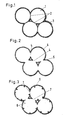
- Die Erfindung wird anhand schematischer Abbildungen in den Figuren 1 bis 10 und anhand von Ausführungsbeispielen näher und beispielhaft erläutert.
- Fig. 1 zeigt in vorgrößerter Darstellung im Schnitt einen Verband von metallisierten Hohlkugeln vor dem Sinterprozeß, deren Metallschalen (1) aus z.B. Kupfer sich an den Kontaktpunkten (2) berühren und die mit Partikeln (3), z.B. Nickel, beschichtet sind.
- Fig. 2 stellt den Verband metallisierter und mit Partikeln beschichteter Metallhohlkugeln nach dem Sintervorgang dar. Beispielsweise ist aus einer mit Nickelpartikeln beschichteten Kupferhohlkugel eine poröse Zellwand (5) aus einer Kupfer/Nickel-Legierung entstanden, und die Zellen stehen untereinander über Kontaktöffnungen (4) in Verbindung.
- Fig. 3 zeigt, nach dem Sintervorgang, einen Verband von mit z.B. Al₂O₃ beschichteten, z.B. Kupfer- oder Nickelhohlkugeln. Die Zellwände (6) aus Al₂O₃-Partikeln sind porös gesintert und die beim Sinterprozeß geschmolzenen Metallschalen aus z.B. Cu oder Ni sind zu Kügelchen (8) in den Zellen geschmolzen. Die Zellen stehen untereinander durch die Öffnungen (7) in Kontakt.
- Fig. 4 zeigt einen Verband von Metallhohlkugeln (9) aus z.B. Kupfer, die mit einer Schicht aus Metallpulver (10), z.B. Nickel, überzogen sind, vor dem Sintervorgang.
- Fig. 5 zeigt den Verband der Metallhohlkugeln der Fig. 4 nach dem Sinterprozeß, wobei sich poröse, feste Kugelschalen bzw. Zellwände (11) aus Partikeln einer Kupfer/Nickel-Legierung gebildet haben.
- Fig. 6 zeigt ein einzelnes Leichtkörperteilchen, dessen kugelförmiger Kern (12) aus einem geschäumten Polymer, wie geschäumtes Polystyrol, mit einer Metallschicht (14) aus z.B. Kupfer oder Nickel in einer Schichtdicke von 5 bis 20 µ überzogen ist. Mit (13) ist eine etwa 50 bis 100 µ starke Beschichtung aus sinterfähigem Metall oder aus dessen Oxid bezeichnet.
- Fig. 7 zeigt eine Schüttung der Leichtkörperteilchen der Figur 6 vor der Pyrolyse und vor dem Dichtsintern. Die Beschichtungen (13) aus z.B. Nickel- oder Eisenpulver haben Berührungskontakt in den Bereichen (13a).
- Fig. 8 zeigt die Schüttung gemäß Figur 7 nach der Pyrolyse und nach dem Sinterprozeß. Aus den Schichten (13, 14) sind dicht gesinterte Schalen (15) aus einem Legierungsmetall (Cu/Ni, Cu/Fe oder Ni/Fe) entstanden, die über Sinterbrücken (16) miteinander verbunden sind.
- Fig. 9 zeigt vor dem Sinterprozeß eine Schüttung von Metallhohlkugeln (19), deren Wandungen (18) aus z.B. Nickel oder Kupfer mit einer Schicht (19) aus z.B. Al₂O₃-Pulver überzogen sind. Die Berührungskontakte der Metallhohlkugeln sind mit (20) bezeichnet.
- Fig. 10 zeigt die Schüttung gemäß Figur 9, jedoch nach dem Sinterprozeß. Mit (21) ist eine dicht gesinterte, kompakte Schicht bzw. Zellwand aus z.B. Aluminiumoxid bezeichnet, wobei die Berührungskontakte der Zellwände (21) zu Kontaktlöchern bzw. Zellendurchgängen (22) erweitert sind. Die während des Sinterns geschmolzenen Metallkügelchen (23) aus z.B. Nickel oder Kupfer der ursprünglichen Metallhohlkugel befinden sich im Innern der Zelle an der Zellwand (21).
- Zur Herstellung von Leichtkörperteilchen gemäß Figur 6 werden metallisierte Schaumpolymerkugeln eines Durchmessers von 1 bis 10 mm, wie mit Kupfer oder Nickel beschichtete Kugeln aus geschäumtem Polystyrol, in einem Wirbelbettaggregat mit einer organisches Bindesmittel enthaltenden, wäßrigen Dispersion eines sinterfähigen Metalls oder dessen Oxid behandelt und das beschichtete und getrocknete Produkt abgezogen. In gleicher Weise kann auch ein pyrolysiertes Produkt, d.h. eine Metallhohlkugel eingesetzt werden.
- Zur Herstellung von Formkörpern hoher Festigkeit gemäß Figuren 7 und 8 werden Leichtkörperteilchen der vorstehend beschriebenen Art in eine entsprechende Form eingebracht und durch Rütteln verdichtet, ggf. wird ein leichter Druck ausgeübt, damit die Kugeln in guten Berührungskontakt treten. Anschließend wird die gefüllte Form, sofern noch Schaumpolymer in der Metallhohlkugel enthalten ist, auf etwa 400 bis 600°C erhitzt und das Polymer pyrolysiert. Anschließend wird die Form auf eine Temperatur von 900 bis 1400°C erhitzt und der Formkörper gesintert. Hierbei werden an den Berührungspunkten der Kugeln Sinterbrücken geschaffen. Wird die Metallhohlkugel bzw. das Leichtkörperteilchen mit Metallpulver, wie Kupfer, beschichtet, erfolgt Beschichtung und Sinterung des Formkörpers unter Schutzgas. Bei einer Beschichtung mit dem Oxid des entsprechenden Metalls, wie Nickeloxid, kann die Beschichtung zunächst in Gegenwart von Luft erfolgen. Dabei bildet sich z.B. eine Schicht aus oxidischem Kupfer und oxidischem Nickel aus. Diese wird anschließend unter reduzierenden Bedingungen in eine Kupfer/Nickel-Legierungsschicht umgewandelt.
- Zur Herstellung von Formkörpern hoher Festigkeit gemäß Figuren 9 und 10 in Gestalt einer offenzelligen keramischen Schwammstruktur werden metallisierte Schaumpolymerkugeln, z.B. mit Kupfer beschichtete Kugeln aus geschäumtem Polystyrol, in eine ggf. siebartige Form eingebracht und durch Rütteln verdichtet. Hierauf wird die Form mit einer Dispersion aus keramischem Material, wie Kaolin-Schlicker, gefüllt bzw. die Form in eine derartige Dispersion eingetaucht und anschließend die überschüssige Dispersion ablaufen gelassen. Hierbei bildet sich eine filmartige Beschichtung (19) aus, wie in Figur 9 schematisch dargestellt. Anschließend wird die Form mit Inhalt bei 105°C getrocknet. Hierbei erreicht der Formkörper eine ausreichende Grünfestigkeit, so daß er der Form entnommen und der Pyrolyse sowie einer Dichtsinterung bei 900 bis 1400°C unterzogen werden kann. Das zu Kugeln oder zu kleinen Reguli geschmolzene Metall der ursprünglichen Kugelwand wird durch Behandlung des Körpers mit Mineralsäure entfernt.
Claims (8)
1. Verfahren zur Herstellung von Hohlkugeln oder Hohlkugelverbunden (Formkörpern) mit Wandungen erhöhter Festigkeit, wobei auf metallisierte kugelförmige Leichtkörperteilchen mit einem Kern aus geschäumtem Polymer weitere Schichten aufgetragen werden, dadurch gekennzeichnet,
daß metallisierte kugelförmige Leichtkörperteilchen mit einer Metallwanddicke von 5 bis 20 micron mit einer Dispersion von feinteiligem Metall oder dessen Oxid oder feinteiligem keramischem oder feuerfestem Material behandelt (beschichtet), die in einer Stärke von 15 bis 500 micron beschichteten kugelförmigen Leichtkörperteilchen getrocknet, die getrockneten Teilchen auf eine Temperatur von etwa 400°C zur Pyrolyse des Polymerkerns erhitzt und anschließend bei einer Temperatur von 900 bis 1400°C gesintert werden.
daß metallisierte kugelförmige Leichtkörperteilchen mit einer Metallwanddicke von 5 bis 20 micron mit einer Dispersion von feinteiligem Metall oder dessen Oxid oder feinteiligem keramischem oder feuerfestem Material behandelt (beschichtet), die in einer Stärke von 15 bis 500 micron beschichteten kugelförmigen Leichtkörperteilchen getrocknet, die getrockneten Teilchen auf eine Temperatur von etwa 400°C zur Pyrolyse des Polymerkerns erhitzt und anschließend bei einer Temperatur von 900 bis 1400°C gesintert werden.
2. Verfahren nach Anspruch 1, dadurch gekennzeichnet,
daß die Dispersion ein rückstandsfrei verbrennbares organisches Bindemittel enthält.
daß die Dispersion ein rückstandsfrei verbrennbares organisches Bindemittel enthält.
3. Verfahren nach den Ansprüchen 1 bis 2, dadurch gekennzeichnet,
daß die Dispersion eines oder mehrere Metalle oder Oxide der Metalle aus der Gruppe Fe, Cu, Ni, Cr, W oder Ta enthält.
daß die Dispersion eines oder mehrere Metalle oder Oxide der Metalle aus der Gruppe Fe, Cu, Ni, Cr, W oder Ta enthält.
4. Verfahren nach den Ansprüchen 1 bis 2, dadurch gekennzeichnet,
daß die Dispersion eine Substanz aus der Gruppe der keramischen oder feuerfesten Werkstoffe enthält.
daß die Dispersion eine Substanz aus der Gruppe der keramischen oder feuerfesten Werkstoffe enthält.
5. Verfahren nach den Ansprüchen 1 bis 4, dadurch gekennzeichnet,
daß die dispergierten Teilchen eine Korngröße von etwa 0,1 bis 500 micron aufweisen.
daß die dispergierten Teilchen eine Korngröße von etwa 0,1 bis 500 micron aufweisen.
6. Verfahren nach den Ansprüchen 1 bis 5, dadurch gekennzeichnet,
daß die beschichteten und getrockneten Leichtkörperteilchen in eine Form eingerüttelt, in der Form bei einer Temperatur von etwa 400°C pyrolysiert und anschließend durch Erhöhung der Temperatur auf 900 bis 1400°C gesintert werden.
daß die beschichteten und getrockneten Leichtkörperteilchen in eine Form eingerüttelt, in der Form bei einer Temperatur von etwa 400°C pyrolysiert und anschließend durch Erhöhung der Temperatur auf 900 bis 1400°C gesintert werden.
7. Verfahren nach den Ansprüchen 1, 2 und 4 bis 7, dadurch gekennzeichnet,
daß aus den Zellen der Sinterstruktur aus keramischem oder feuerfestem Material das geschmolzene primäre Metall der Metalhohlkugel durch Behandlung mit Säure entfernt wird.
daß aus den Zellen der Sinterstruktur aus keramischem oder feuerfestem Material das geschmolzene primäre Metall der Metalhohlkugel durch Behandlung mit Säure entfernt wird.
8. Formkörper mit offenzelliger Schwammstruktur, hergestellt nach dem Verfahren der Ansprüche 1 bis 7, gekennzeichnet durch
15 bis 500 micron starke Zellwände erhöhter Festigkeit aus gesinterten Partikeln aus keramischem oder feuerfestem Material oder aus Metallpartikeln, die durch das primäre Wandmetall legiert sind, wobei die Schwammstruktur aus einem Verbund von gegebenenfalls kommunizierenden, im wesentlichen kugelförmigen Kernzellen (konvexen Schalenzellen) und zwischen den Kernzellen liegenden konkav-sphärischen kommunizierenden Zellen (konkaven Schalenzellen) besteht, und wobei die Zellwände (Schalen) porös oder dicht gesintert sind.
15 bis 500 micron starke Zellwände erhöhter Festigkeit aus gesinterten Partikeln aus keramischem oder feuerfestem Material oder aus Metallpartikeln, die durch das primäre Wandmetall legiert sind, wobei die Schwammstruktur aus einem Verbund von gegebenenfalls kommunizierenden, im wesentlichen kugelförmigen Kernzellen (konvexen Schalenzellen) und zwischen den Kernzellen liegenden konkav-sphärischen kommunizierenden Zellen (konkaven Schalenzellen) besteht, und wobei die Zellwände (Schalen) porös oder dicht gesintert sind.
Applications Claiming Priority (2)
| Application Number | Priority Date | Filing Date | Title |
|---|---|---|---|
| DE3640586 | 1986-11-27 | ||
| DE19863640586 DE3640586A1 (de) | 1986-11-27 | 1986-11-27 | Verfahren zur herstellung von hohlkugeln oder deren verbunden mit wandungen erhoehter festigkeit |
Publications (1)
| Publication Number | Publication Date |
|---|---|
| EP0271944A1 true EP0271944A1 (de) | 1988-06-22 |
Family
ID=6314935
Family Applications (1)
| Application Number | Title | Priority Date | Filing Date |
|---|---|---|---|
| EP87202343A Withdrawn EP0271944A1 (de) | 1986-11-27 | 1987-11-26 | Verfahren zur Herstellung von Hohlkugeln oder deren Verbunden mit Wandungen erhöhter Festigkeit |
Country Status (4)
| Country | Link |
|---|---|
| US (1) | US4775598A (de) |
| EP (1) | EP0271944A1 (de) |
| JP (1) | JPS63149306A (de) |
| DE (1) | DE3640586A1 (de) |
Cited By (5)
| Publication number | Priority date | Publication date | Assignee | Title |
|---|---|---|---|---|
| EP0440093A1 (de) * | 1990-01-26 | 1991-08-07 | Isuzu Motors Limited | Gusswerkstück mit keramischer Verstärkungseinlage und Verfahren zu dessen Herstellung |
| EP0666129A3 (de) * | 1994-02-08 | 1996-05-15 | Alfa Laval Flow Gmbh | Verfahren zum Herstellen gesinterter poröser Bauteile sowie deren Verwendung. |
| WO2001054846A3 (de) * | 2000-01-25 | 2002-02-14 | Glatt Systemtechnik Dresden | Hohlkugel und verfahren zur herstellung von hohlkugeln und leichtbauteilen mit hohlkugeln |
| EP2431344A4 (de) * | 2009-04-21 | 2015-03-25 | Hebei Yl Bangda New Materials Ltd Company | Verfahren und vorrichtung zur herstellung hohler mikrokugeln |
| CN112441843A (zh) * | 2020-12-05 | 2021-03-05 | 任杰 | 一种基于有机泡沫浸渍法的附丝型多孔陶瓷制备工艺 |
Families Citing this family (127)
| Publication number | Priority date | Publication date | Assignee | Title |
|---|---|---|---|---|
| JPH01131083A (ja) * | 1987-11-17 | 1989-05-23 | Mino Ceramic Kk | 中空セラミック焼結体の製造方法 |
| DE3902032A1 (de) * | 1989-01-25 | 1990-07-26 | Mtu Muenchen Gmbh | Gesintertes leichtbaumaterial mit herstellungsverfahren |
| JPH02212377A (ja) * | 1989-02-10 | 1990-08-23 | Aoki Corp | 球状中空セラミック骨材コンクリート工法 |
| US5318797A (en) * | 1990-06-20 | 1994-06-07 | Clarkson University | Coated particles, hollow particles, and process for manufacturing the same |
| US5366687A (en) * | 1991-01-07 | 1994-11-22 | United Technologies Corporation | Electrophoresis process for preparation of ceramic fibers |
| JPH04136844U (ja) * | 1991-06-14 | 1992-12-21 | 日新電機株式会社 | 圧縮空気操作形開閉装置 |
| US5167885A (en) * | 1992-01-07 | 1992-12-01 | W. R. Grace & Co.-Conn. | Method for making sintered bodies |
| US5282861A (en) * | 1992-03-11 | 1994-02-01 | Ultramet | Open cell tantalum structures for cancellous bone implants and cell and tissue receptors |
| DE4232969A1 (de) * | 1992-10-01 | 1994-04-07 | Abb Research Ltd | Elektrisches Widerstandselement |
| US5503795A (en) * | 1995-04-25 | 1996-04-02 | Pennsylvania Pressed Metals, Inc. | Preform compaction powdered metal process |
| AU1673797A (en) * | 1996-02-20 | 1997-09-10 | Mikuni Corporation | Method for producing granulated material |
| AU1673697A (en) * | 1996-02-21 | 1997-09-10 | Mikuni Corporation | Ceramic granules |
| US6210612B1 (en) | 1997-03-31 | 2001-04-03 | Pouvair Corporation | Method for the manufacture of porous ceramic articles |
| DE19804814A1 (de) * | 1998-02-06 | 1999-08-19 | Federal Mogul Burscheid Gmbh | Dichtungssystem für exzentrisch rotierende Wellen |
| US7563504B2 (en) * | 1998-03-27 | 2009-07-21 | Siemens Energy, Inc. | Utilization of discontinuous fibers for improving properties of high temperature insulation of ceramic matrix composites |
| US7067181B2 (en) * | 2003-08-05 | 2006-06-27 | Siemens Power Generation, Inc. | Insulating ceramic based on partially filled shapes |
| US6641907B1 (en) * | 1999-12-20 | 2003-11-04 | Siemens Westinghouse Power Corporation | High temperature erosion resistant coating and material containing compacted hollow geometric shapes |
| US6977060B1 (en) * | 2000-03-28 | 2005-12-20 | Siemens Westinghouse Power Corporation | Method for making a high temperature erosion resistant coating and material containing compacted hollow geometric shapes |
| TW511105B (en) * | 1999-03-11 | 2002-11-21 | Murata Manufacturing Co | Method of firing magnetic core |
| DE19929760C2 (de) * | 1999-06-29 | 2003-05-22 | Fraunhofer Ges Forschung | Verfahren zur Herstellung metallischer, oxydischer oder keramischer Hohlkugeln |
| US7969092B1 (en) | 2000-01-12 | 2011-06-28 | Imaging Systems Technology, Inc. | Gas discharge display |
| DE10018501C1 (de) * | 2000-04-14 | 2001-04-05 | Glatt Systemtechnik Dresden | Metallische miniaturisierte hohle Formkörper und Verfahren zur Herstellung derartiger Formkörper |
| JP2002274974A (ja) * | 2001-03-16 | 2002-09-25 | Sumitomo Chem Co Ltd | セラミックス球状多孔体およびその製造方法 |
| US6660224B2 (en) | 2001-08-16 | 2003-12-09 | National Research Council Of Canada | Method of making open cell material |
| US7108828B2 (en) * | 2001-08-27 | 2006-09-19 | National Research Council Of Canada | Method of making open cell material |
| US7458991B2 (en) * | 2002-02-08 | 2008-12-02 | Howmedica Osteonics Corp. | Porous metallic scaffold for tissue ingrowth |
| US7638943B1 (en) | 2002-05-21 | 2009-12-29 | Imaging Systems Technology | Plasma-disc article of manufacture |
| US7628666B1 (en) | 2002-05-21 | 2009-12-08 | Imaging Systems Technology | Process for manufacturing plasma-dome PDP |
| US8198812B1 (en) | 2002-05-21 | 2012-06-12 | Imaging Systems Technology | Gas filled detector shell with dipole antenna |
| US7932674B1 (en) | 2002-05-21 | 2011-04-26 | Imaging Systems Technology | Plasma-dome article of manufacture |
| US7727040B1 (en) | 2002-05-21 | 2010-06-01 | Imaging Systems Technology | Process for manufacturing plasma-disc PDP |
| US7405516B1 (en) | 2004-04-26 | 2008-07-29 | Imaging Systems Technology | Plasma-shell PDP with organic luminescent substance |
| US9682425B2 (en) | 2009-12-08 | 2017-06-20 | Baker Hughes Incorporated | Coated metallic powder and method of making the same |
| US9101978B2 (en) | 2002-12-08 | 2015-08-11 | Baker Hughes Incorporated | Nanomatrix powder metal compact |
| US9079246B2 (en) | 2009-12-08 | 2015-07-14 | Baker Hughes Incorporated | Method of making a nanomatrix powder metal compact |
| US8403037B2 (en) | 2009-12-08 | 2013-03-26 | Baker Hughes Incorporated | Dissolvable tool and method |
| US9109429B2 (en) | 2002-12-08 | 2015-08-18 | Baker Hughes Incorporated | Engineered powder compact composite material |
| WO2005021147A2 (en) * | 2003-02-06 | 2005-03-10 | William Marsh Rice University | High strength polycrystalline ceramic spheres |
| US7579069B2 (en) * | 2003-11-06 | 2009-08-25 | International Business Machines Corporation | Negative coefficient of thermal expansion particles and method of forming the same |
| JP3987022B2 (ja) * | 2003-11-20 | 2007-10-03 | 本田技研工業株式会社 | 三次元網目構造を備えたセラミック成形体の製造方法 |
| EP1577957B1 (de) * | 2004-03-18 | 2009-05-13 | C.R.F. Società Consortile per Azioni | Leuchtelement, das eine dreidimensionale Perkolationsschicht verwendet, und Herstellungsverfahren dafür |
| US7368523B2 (en) | 2004-11-12 | 2008-05-06 | Eastman Chemical Company | Polyester polymer and copolymer compositions containing titanium nitride particles |
| US8129906B1 (en) | 2004-04-26 | 2012-03-06 | Imaging Systems Technology, Inc. | Lumino-shells |
| WO2007145735A2 (en) * | 2006-06-07 | 2007-12-21 | Exxonmobil Upstream Research Company | Method for fabricating compressible objects for a variable density drilling mud |
| US8368303B1 (en) | 2004-06-21 | 2013-02-05 | Imaging Systems Technology, Inc. | Gas discharge device with electrical conductive bonding material |
| US8113898B1 (en) | 2004-06-21 | 2012-02-14 | Imaging Systems Technology, Inc. | Gas discharge device with electrical conductive bonding material |
| US7662880B2 (en) | 2004-09-03 | 2010-02-16 | Eastman Chemical Company | Polyester polymer and copolymer compositions containing metallic nickel particles |
| US20060110557A1 (en) * | 2004-09-03 | 2006-05-25 | Zhiyong Xia | Polyester polymer and copolymer compositions containing metallic tungsten particles |
| US7300967B2 (en) | 2004-11-12 | 2007-11-27 | Eastman Chemical Company | Polyester polymer and copolymer compositions containing metallic titanium particles |
| US7641984B2 (en) * | 2004-11-29 | 2010-01-05 | North Carolina State University | Composite metal foam and methods of preparation thereof |
| US9208912B2 (en) | 2004-11-29 | 2015-12-08 | Afsaneh Rabiei | Composite metal foam and methods of preparation thereof |
| US7622866B1 (en) | 2005-02-22 | 2009-11-24 | Imaging Systems Technology | Plasma-dome PDP |
| US8299696B1 (en) | 2005-02-22 | 2012-10-30 | Imaging Systems Technology | Plasma-shell gas discharge device |
| WO2006126527A1 (ja) * | 2005-05-27 | 2006-11-30 | Neomax Materials Co., Ltd. | 銀被覆ボールおよびその製造方法 |
| US8557950B2 (en) | 2005-06-16 | 2013-10-15 | Grupo Petrotemex, S.A. De C.V. | High intrinsic viscosity melt phase polyester polymers with acceptable acetaldehyde generation rates |
| US7544322B2 (en) * | 2005-07-07 | 2009-06-09 | Onera (Office National D'etudes Et De Recherches Aerospatiales) | Process for the pressureless sintering of metal alloys; and application to the manufacture of hollow spheres |
| FR2888145B1 (fr) * | 2005-07-07 | 2008-08-29 | Onera (Off Nat Aerospatiale) | Procede de fabrication et d'assemblage par brasure de billes en superalliage et objets fabriques avec de tels assemblages |
| US7730746B1 (en) | 2005-07-14 | 2010-06-08 | Imaging Systems Technology | Apparatus to prepare discrete hollow microsphere droplets |
| DE102005040599B4 (de) * | 2005-08-19 | 2007-07-05 | Glatt Systemtechnik Gmbh | Verfahren zur Herstellung von Hohlkörpern mit sphärischer gekrümmter Oberfläche, mit dem Verfahren hergestellte Hohlkörper und deren Verwendung |
| US7838596B2 (en) | 2005-09-16 | 2010-11-23 | Eastman Chemical Company | Late addition to effect compositional modifications in condensation polymers |
| US8431202B2 (en) | 2005-09-16 | 2013-04-30 | Grupo Petrotemex, S.A. De C.V. | Aluminum/alkaline or alkali/titanium containing polyesters having improved reheat, color and clarity |
| US7932345B2 (en) | 2005-09-16 | 2011-04-26 | Grupo Petrotemex, S.A. De C.V. | Aluminum containing polyester polymers having low acetaldehyde generation rates |
| US7745512B2 (en) | 2005-09-16 | 2010-06-29 | Eastman Chemical Company | Polyester polymer and copolymer compositions containing carbon-coated iron particles |
| US7655746B2 (en) | 2005-09-16 | 2010-02-02 | Eastman Chemical Company | Phosphorus containing compounds for reducing acetaldehyde in polyesters polymers |
| US7776942B2 (en) | 2005-09-16 | 2010-08-17 | Eastman Chemical Company | Polyester polymer and copolymer compositions containing particles of titanium nitride and carbon-coated iron |
| US9267007B2 (en) | 2005-09-16 | 2016-02-23 | Grupo Petrotemex, S.A. De C.V. | Method for addition of additives into a polymer melt |
| US7863815B1 (en) | 2006-01-26 | 2011-01-04 | Imaging Systems Technology | Electrode configurations for plasma-disc PDP |
| US8035303B1 (en) | 2006-02-16 | 2011-10-11 | Imaging Systems Technology | Electrode configurations for gas discharge device |
| CN100368463C (zh) * | 2006-04-07 | 2008-02-13 | 吉林大学 | 一步法合成双亲超顺磁亚微米无机物/聚合物复合空心球 |
| JP4641010B2 (ja) * | 2006-07-25 | 2011-03-02 | Jfeテクノリサーチ株式会社 | 中空金属体 |
| WO2008130438A1 (en) * | 2006-10-27 | 2008-10-30 | Stc.Unm | Hollow sphere metal oxides |
| US8901272B2 (en) * | 2007-02-02 | 2014-12-02 | Grupo Petrotemex, S.A. De C.V. | Polyester polymers with low acetaldehyde generation rates and high vinyl ends concentration |
| US7776255B1 (en) * | 2007-04-16 | 2010-08-17 | Imaging Systems Technology | Hollow shell and method of manufacture |
| WO2008148642A1 (de) * | 2007-06-04 | 2008-12-11 | Basf Se | Verfahren zur metallbeschichtung von thermoplastischen partikeln |
| US8105649B1 (en) | 2007-08-09 | 2012-01-31 | Imaging Systems Technology | Fabrication of silicon carbide shell |
| KR101028969B1 (ko) | 2008-12-08 | 2011-04-12 | 가야에이엠에이 주식회사 | 금속 중공구의 제조 방법, 금속 중공구, 경량 구조체의 제조 방법, 및 경량 구조체 |
| WO2010067967A2 (ko) * | 2008-12-08 | 2010-06-17 | 가야에이엠에이 주식회사 | 금속 중공구, 금속 중공구의 제조 방법, 경량 구조체, 및 경량 구조체의 제조 방법 |
| US8329091B2 (en) * | 2009-01-30 | 2012-12-11 | Widener University | Porous metallic structures |
| DE102009016803A1 (de) * | 2009-04-09 | 2010-10-14 | Rolls-Royce Deutschland Ltd & Co Kg | Labyrinth-Anstreifdichtung für eine Strömungsmaschine |
| US8815408B1 (en) | 2009-12-08 | 2014-08-26 | Imaging Systems Technology, Inc. | Metal syntactic foam |
| US9127515B2 (en) | 2010-10-27 | 2015-09-08 | Baker Hughes Incorporated | Nanomatrix carbon composite |
| US9243475B2 (en) | 2009-12-08 | 2016-01-26 | Baker Hughes Incorporated | Extruded powder metal compact |
| US10240419B2 (en) | 2009-12-08 | 2019-03-26 | Baker Hughes, A Ge Company, Llc | Downhole flow inhibition tool and method of unplugging a seat |
| JP2011156962A (ja) * | 2010-02-01 | 2011-08-18 | Miyata:Kk | エアバッグインフレータ用フィルタおよびその製造法 |
| US9314996B1 (en) * | 2010-06-04 | 2016-04-19 | Carol Ann Wedding | Metal foam containing hollow shells and methods of preparation |
| US9090955B2 (en) | 2010-10-27 | 2015-07-28 | Baker Hughes Incorporated | Nanomatrix powder metal composite |
| US9096034B2 (en) * | 2011-04-12 | 2015-08-04 | Powdermet, Inc. | Syntactic metal matrix materials and methods |
| US8631876B2 (en) | 2011-04-28 | 2014-01-21 | Baker Hughes Incorporated | Method of making and using a functionally gradient composite tool |
| US9080098B2 (en) | 2011-04-28 | 2015-07-14 | Baker Hughes Incorporated | Functionally gradient composite article |
| US9139928B2 (en) | 2011-06-17 | 2015-09-22 | Baker Hughes Incorporated | Corrodible downhole article and method of removing the article from downhole environment |
| US9707739B2 (en) | 2011-07-22 | 2017-07-18 | Baker Hughes Incorporated | Intermetallic metallic composite, method of manufacture thereof and articles comprising the same |
| US9833838B2 (en) | 2011-07-29 | 2017-12-05 | Baker Hughes, A Ge Company, Llc | Method of controlling the corrosion rate of alloy particles, alloy particle with controlled corrosion rate, and articles comprising the particle |
| US9643250B2 (en) | 2011-07-29 | 2017-05-09 | Baker Hughes Incorporated | Method of controlling the corrosion rate of alloy particles, alloy particle with controlled corrosion rate, and articles comprising the particle |
| US9057242B2 (en) | 2011-08-05 | 2015-06-16 | Baker Hughes Incorporated | Method of controlling corrosion rate in downhole article, and downhole article having controlled corrosion rate |
| US9033055B2 (en) | 2011-08-17 | 2015-05-19 | Baker Hughes Incorporated | Selectively degradable passage restriction and method |
| US9109269B2 (en) | 2011-08-30 | 2015-08-18 | Baker Hughes Incorporated | Magnesium alloy powder metal compact |
| US9090956B2 (en) | 2011-08-30 | 2015-07-28 | Baker Hughes Incorporated | Aluminum alloy powder metal compact |
| US9856547B2 (en) | 2011-08-30 | 2018-01-02 | Bakers Hughes, A Ge Company, Llc | Nanostructured powder metal compact |
| US9643144B2 (en) | 2011-09-02 | 2017-05-09 | Baker Hughes Incorporated | Method to generate and disperse nanostructures in a composite material |
| US9347119B2 (en) | 2011-09-03 | 2016-05-24 | Baker Hughes Incorporated | Degradable high shock impedance material |
| US9133695B2 (en) | 2011-09-03 | 2015-09-15 | Baker Hughes Incorporated | Degradable shaped charge and perforating gun system |
| EP2799166A4 (de) * | 2011-12-28 | 2016-06-15 | Taisei Kogyo Co Ltd | Poröser sinterkörper und verfahren zur herstellung eines porösen sinterkörpers |
| US9010416B2 (en) | 2012-01-25 | 2015-04-21 | Baker Hughes Incorporated | Tubular anchoring system and a seat for use in the same |
| US9068428B2 (en) | 2012-02-13 | 2015-06-30 | Baker Hughes Incorporated | Selectively corrodible downhole article and method of use |
| US9605508B2 (en) | 2012-05-08 | 2017-03-28 | Baker Hughes Incorporated | Disintegrable and conformable metallic seal, and method of making the same |
| US9024526B1 (en) | 2012-06-11 | 2015-05-05 | Imaging Systems Technology, Inc. | Detector element with antenna |
| US20130330388A1 (en) * | 2012-06-12 | 2013-12-12 | Mattech, Inc. | Porous Sphere-like Objects, Method to Form Same and Uses Thereof Involvoing the Treatment of Fluids Including Anti-bacterial Applications |
| DE102013019309B4 (de) | 2012-11-14 | 2014-07-24 | Technische Universität Bergakademie Freiberg | Verfahren zum Gießen von offenporigen zellularen Metallteilen |
| US9816339B2 (en) | 2013-09-03 | 2017-11-14 | Baker Hughes, A Ge Company, Llc | Plug reception assembly and method of reducing restriction in a borehole |
| MX2016003270A (es) | 2013-09-13 | 2016-10-26 | Biofilm Ip Llc | Valvulas magneto-criogenicas, sistemas y metodos para modular flujo en un conducto. |
| DE102013114429A1 (de) * | 2013-12-19 | 2015-06-25 | Endress + Hauser Flowtec Ag | Messrohr für ein magnetisch-induktives Durchflussmessgerät und Magnetisch-induktives Durchflussmessgerät |
| US10689740B2 (en) | 2014-04-18 | 2020-06-23 | Terves, LLCq | Galvanically-active in situ formed particles for controlled rate dissolving tools |
| US11167343B2 (en) | 2014-02-21 | 2021-11-09 | Terves, Llc | Galvanically-active in situ formed particles for controlled rate dissolving tools |
| US10150713B2 (en) | 2014-02-21 | 2018-12-11 | Terves, Inc. | Fluid activated disintegrating metal system |
| US9738788B1 (en) * | 2014-05-26 | 2017-08-22 | Hrl Laboratories, Llc | Nanoparticle-coated multilayer shell microstructures |
| US9910026B2 (en) | 2015-01-21 | 2018-03-06 | Baker Hughes, A Ge Company, Llc | High temperature tracers for downhole detection of produced water |
| US10378303B2 (en) | 2015-03-05 | 2019-08-13 | Baker Hughes, A Ge Company, Llc | Downhole tool and method of forming the same |
| US10221637B2 (en) | 2015-08-11 | 2019-03-05 | Baker Hughes, A Ge Company, Llc | Methods of manufacturing dissolvable tools via liquid-solid state molding |
| US10016810B2 (en) | 2015-12-14 | 2018-07-10 | Baker Hughes, A Ge Company, Llc | Methods of manufacturing degradable tools using a galvanic carrier and tools manufactured thereof |
| EP3199984A1 (de) * | 2016-02-01 | 2017-08-02 | Canon Kabushiki Kaisha | Antireflexbeschichtung, optisches element und verfahren zur herstellung eines optischen elements |
| DE102016110672A1 (de) * | 2016-06-09 | 2017-12-14 | Fraunhofer-Gesellschaft zur Förderung der angewandten Forschung e.V. | Verfahren zum Beaufschlagen einer Flüssigkeit mit beschleunigten Elektronen |
| US10214825B2 (en) * | 2016-12-29 | 2019-02-26 | GM Global Technology Operations LLC | Method of depositing one or more layers of microspheres to form a thermal barrier coating |
| CA3012511A1 (en) | 2017-07-27 | 2019-01-27 | Terves Inc. | Degradable metal matrix composite |
| US10851711B2 (en) | 2017-12-22 | 2020-12-01 | GM Global Technology Operations LLC | Thermal barrier coating with temperature-following layer |
| CN113088739A (zh) * | 2021-03-30 | 2021-07-09 | 孙增俊 | 泡沫金属的制备工艺、制备装置及泡沫金属 |
| JP7647652B2 (ja) | 2022-03-29 | 2025-03-18 | 株式会社村田製作所 | コイル部品 |
| JP7647651B2 (ja) | 2022-03-29 | 2025-03-18 | 株式会社村田製作所 | コイル部品 |
Citations (4)
| Publication number | Priority date | Publication date | Assignee | Title |
|---|---|---|---|---|
| FR1266824A (fr) * | 1960-09-03 | 1961-07-17 | Gen Electric | Produits métalliques poreux et procédé pour les fabriquer |
| DE3227726A1 (de) * | 1981-07-31 | 1983-03-10 | Kombinat VEB Elektronische Bauelemente, DDR 1530 Teltow | Verfahren zur herstellung von ventilmetallsinterkoerpern fuer elektrolytkondensatoren |
| DE3210770A1 (de) * | 1982-03-24 | 1983-09-29 | Manfred 2854 Loxstedt Jaeckel | Verfahren zur herstellung metallischer, insbesondere kugelfoermiger leichtkoerper und zur herstellung von formkoerpern mit einschluss solcher leichtkoerper sowie nach solchen verfahren hergestellte leichtkoerper und formkoerper |
| EP0119913A1 (de) * | 1983-03-14 | 1984-09-26 | Commissariat à l'Energie Atomique | Verfahren zur Herstellung hochporöser Körper aus anorganischem Material,die für Formkörper aus hygroskopischem, brennbarem oder radioaktivem Material verwendbar sind |
Family Cites Families (4)
| Publication number | Priority date | Publication date | Assignee | Title |
|---|---|---|---|---|
| US4013461A (en) * | 1971-07-21 | 1977-03-22 | Union Carbide Corporation | High void porous sheet and process therefor |
| US3975194A (en) * | 1974-03-04 | 1976-08-17 | Canadian Patents And Development Limited | Formation of hollow spherical articles |
| DE2737248C2 (de) * | 1977-08-18 | 1985-09-19 | MTU Motoren- und Turbinen-Union München GmbH, 8000 München | Bauteil hoher Festigkeit mit komplizierter geometrischer Form und Verfahren zu dessen Herstellung |
| US4293777A (en) * | 1979-07-30 | 1981-10-06 | Joseph Gamell Industries, Inc. | Turbo-electric power plant and process |
-
1986
- 1986-11-27 DE DE19863640586 patent/DE3640586A1/de not_active Withdrawn
-
1987
- 1987-11-25 US US07/126,214 patent/US4775598A/en not_active Expired - Fee Related
- 1987-11-26 EP EP87202343A patent/EP0271944A1/de not_active Withdrawn
- 1987-11-27 JP JP62299622A patent/JPS63149306A/ja active Pending
Patent Citations (4)
| Publication number | Priority date | Publication date | Assignee | Title |
|---|---|---|---|---|
| FR1266824A (fr) * | 1960-09-03 | 1961-07-17 | Gen Electric | Produits métalliques poreux et procédé pour les fabriquer |
| DE3227726A1 (de) * | 1981-07-31 | 1983-03-10 | Kombinat VEB Elektronische Bauelemente, DDR 1530 Teltow | Verfahren zur herstellung von ventilmetallsinterkoerpern fuer elektrolytkondensatoren |
| DE3210770A1 (de) * | 1982-03-24 | 1983-09-29 | Manfred 2854 Loxstedt Jaeckel | Verfahren zur herstellung metallischer, insbesondere kugelfoermiger leichtkoerper und zur herstellung von formkoerpern mit einschluss solcher leichtkoerper sowie nach solchen verfahren hergestellte leichtkoerper und formkoerper |
| EP0119913A1 (de) * | 1983-03-14 | 1984-09-26 | Commissariat à l'Energie Atomique | Verfahren zur Herstellung hochporöser Körper aus anorganischem Material,die für Formkörper aus hygroskopischem, brennbarem oder radioaktivem Material verwendbar sind |
Cited By (7)
| Publication number | Priority date | Publication date | Assignee | Title |
|---|---|---|---|---|
| EP0440093A1 (de) * | 1990-01-26 | 1991-08-07 | Isuzu Motors Limited | Gusswerkstück mit keramischer Verstärkungseinlage und Verfahren zu dessen Herstellung |
| EP0666129A3 (de) * | 1994-02-08 | 1996-05-15 | Alfa Laval Flow Gmbh | Verfahren zum Herstellen gesinterter poröser Bauteile sowie deren Verwendung. |
| WO2001054846A3 (de) * | 2000-01-25 | 2002-02-14 | Glatt Systemtechnik Dresden | Hohlkugel und verfahren zur herstellung von hohlkugeln und leichtbauteilen mit hohlkugeln |
| US6828026B2 (en) | 2000-01-25 | 2004-12-07 | Glatt Systemtechnik Dresden Gmbh | Hollow balls and a method for producing hollow balls and for producing light-weight structural components by means of hollow balls |
| CZ302242B6 (cs) * | 2000-01-25 | 2011-01-05 | Glatt Systemtechnik Dresden Gmbh | Zpusob výroby odlehcených konstrukcních prvku |
| EP2431344A4 (de) * | 2009-04-21 | 2015-03-25 | Hebei Yl Bangda New Materials Ltd Company | Verfahren und vorrichtung zur herstellung hohler mikrokugeln |
| CN112441843A (zh) * | 2020-12-05 | 2021-03-05 | 任杰 | 一种基于有机泡沫浸渍法的附丝型多孔陶瓷制备工艺 |
Also Published As
| Publication number | Publication date |
|---|---|
| US4775598A (en) | 1988-10-04 |
| DE3640586A1 (de) | 1988-06-09 |
| JPS63149306A (ja) | 1988-06-22 |
Similar Documents
| Publication | Publication Date | Title |
|---|---|---|
| DE3640586A1 (de) | Verfahren zur herstellung von hohlkugeln oder deren verbunden mit wandungen erhoehter festigkeit | |
| EP0300543B1 (de) | Verfahren zum Herstellen von metallischen oder keramischen Hohlkugeln | |
| EP1272300B1 (de) | Verfahren zur herstellung von metallischen hohlkörpern und hiernach hergestellte miniaturisierte hohlkörper | |
| EP0034328B1 (de) | Verfahren zur Herstellung von Formkörpern auf der Basis von Siliziumkarbid | |
| EP1251985B9 (de) | Verfahren zur herstellung von leichtbauteilen | |
| DE3009182A1 (de) | Material zur waermedaemmung bei hohen temperaturen und verfahren zu dessen herstellung | |
| DE2322593A1 (de) | Feuerfestes leichtmaterial | |
| WO2007128374A1 (de) | Verfahren zur herstellung von verbundkörpern sowie danach hergestellte verbundkörper | |
| DE3037199A1 (de) | Verfahren zum herstellen von formkoerpern aus siliziumkarbid oder formkoerpern aus graphit oder graphitaehnlichem werkstoff mit einer aus siliziumkarbid bestehenden oberflaeche | |
| WO2011089130A2 (de) | Verfahren zur herstellung von hohlkörpern mit eingeschlossenen frei beweglichen partikeln | |
| DE69631093T2 (de) | Anorganischer, poröser träger für eine filtrationsmembran und herstellungsverfahren | |
| DE69028550T2 (de) | Herstellung von sinterverbundwerkstoffen | |
| EP1915226B1 (de) | Verfahren zur pulvermetallurgischen herstellung von metallschaumstoff und von teilen aus metallschaumstoff | |
| WO2010115919A1 (de) | Verfahren zur herstellung von hohlkörpern mit eingeschlossenen frei beweglichen partikeln | |
| EP1557819A1 (de) | Schallabsorbierende Struktur | |
| DE2234737C3 (de) | Masse zum Extrudieren eines spitzbaren Mantels um eine Mine und Verfahren zur Herstellung eines Schreibstiftes | |
| DE2135444C3 (de) | Verfahren zur Herstellung poröser leichtgewichtiger Formkörper auf Leichtmetallbasis | |
| DE1458285B2 (de) | Verfahren zur pulvermetallurgischen herstellung von mehreren mehrschichtigen poroesen formkoerpern | |
| DE10256221B3 (de) | Verfahren zur Herstellung gesinterter Formkörper und so hergestellte Formkörper | |
| EP0810982B1 (de) | Verfahren zur herstellung von keramischen, metallischen oder keramometallischen formkörpern | |
| DE3610274A1 (de) | Keramischer formkoerper und verfahren zu seiner herstellung | |
| DE1771415C3 (de) | Verfahren zum Herstellen von Leichtbaustoffen und -Zuschlagstoffen aus vulkanischen Tuffen | |
| DE3200200C2 (de) | ||
| DE2445075C3 (de) | Verfahren zum Aufbringen einer Schicht aus kunststoffbeschichteten Teilchen aus anorganischem Material | |
| EP2636658A2 (de) | Verfahren zur Herstellung eines offenporigen keramischen Formkörpers |
Legal Events
| Date | Code | Title | Description |
|---|---|---|---|
| PUAI | Public reference made under article 153(3) epc to a published international application that has entered the european phase |
Free format text: ORIGINAL CODE: 0009012 |
|
| AK | Designated contracting states |
Kind code of ref document: A1 Designated state(s): BE CH DE FR GB LI NL SE |
|
| 17P | Request for examination filed |
Effective date: 19880901 |
|
| 17Q | First examination report despatched |
Effective date: 19891117 |
|
| STAA | Information on the status of an ep patent application or granted ep patent |
Free format text: STATUS: THE APPLICATION HAS BEEN WITHDRAWN |
|
| 18W | Application withdrawn |
Withdrawal date: 19900210 |
|
| R18W | Application withdrawn (corrected) |
Effective date: 19900210 |
|
| RIN1 | Information on inventor provided before grant (corrected) |
Inventor name: DER ERFINDER HAT AUF SEINE NENNUNG VERZICHTET. |