EP0273423A2 - Polyesters aromatiques et leur utilisation - Google Patents
Polyesters aromatiques et leur utilisation Download PDFInfo
- Publication number
- EP0273423A2 EP0273423A2 EP87119253A EP87119253A EP0273423A2 EP 0273423 A2 EP0273423 A2 EP 0273423A2 EP 87119253 A EP87119253 A EP 87119253A EP 87119253 A EP87119253 A EP 87119253A EP 0273423 A2 EP0273423 A2 EP 0273423A2
- Authority
- EP
- European Patent Office
- Prior art keywords
- polyester
- injection
- mol
- unit
- molded product
- Prior art date
- Legal status (The legal status is an assumption and is not a legal conclusion. Google has not performed a legal analysis and makes no representation as to the accuracy of the status listed.)
- Withdrawn
Links
Images

Classifications
-
- C—CHEMISTRY; METALLURGY
- C08—ORGANIC MACROMOLECULAR COMPOUNDS; THEIR PREPARATION OR CHEMICAL WORKING-UP; COMPOSITIONS BASED THEREON
- C08G—MACROMOLECULAR COMPOUNDS OBTAINED OTHERWISE THAN BY REACTIONS ONLY INVOLVING UNSATURATED CARBON-TO-CARBON BONDS
- C08G63/00—Macromolecular compounds obtained by reactions forming a carboxylic ester link in the main chain of the macromolecule
- C08G63/02—Polyesters derived from hydroxycarboxylic acids or from polycarboxylic acids and polyhydroxy compounds
- C08G63/60—Polyesters derived from hydroxycarboxylic acids or from polycarboxylic acids and polyhydroxy compounds derived from the reaction of a mixture of hydroxy carboxylic acids, polycarboxylic acids and polyhydroxy compounds
- C08G63/605—Polyesters derived from hydroxycarboxylic acids or from polycarboxylic acids and polyhydroxy compounds derived from the reaction of a mixture of hydroxy carboxylic acids, polycarboxylic acids and polyhydroxy compounds the hydroxy and carboxylic groups being bound to aromatic rings
Definitions
- This invention relates to aromatic thermotropic liquid crystal polyesters consisting of 4-oxybenzoyl units, terephthaloyl units and 4,4 ⁇ -dioxydiphenyl ether units in specified amounts to molded products obtained by injection molding said polyesters having high impact strength, and further to a blend of said polyesters with the so far proposed thermotropic liquid crystal polyesters.
- thermotropic liquid crystal polyesters i.e. thermotropic liquid crystal polyesters
- thermotropic liquid crystal polyester Since a thermotropic liquid crystal polyester has a tendency to readily orient to a great extent upon melt processing, injection molding of the polyester gives a molded product being highly oriented in one direction (machine direction) having mechanical properties such as strength and elastic moduli much better than those of molded products obtained from conventional polymeric compounds not forming liquid crystals.
- thermoly tropic liquid crystal polyesters do not always have markedly high impact strength. Further since such molded products are highly oriented in one direction, the mechanical properties such as strength and elastic modulus in the direction of flow (machine direction) greatly differ from those in the direction perpendicular to that direction, showing anisotropy, and therefore they suffer a great restriction in use as products. In usual cases fillers such as glass fibers are incorporated when subjecting the products to molding to reduce such anisotropy. It is known that in this case the impact strength of the molded product obtained decreases remarkably. Accordingly, a molded product obtained from a thermotropic liquid crystal polyester is not entirely suitable for uses where high impact strength is required.
- polycarbonates have been known as polymeric materials giving moldings with remarkably high impact strength.
- polycarbonates are inferior in resistance to hydrolysis and resistance to organic solvents, and so when contacted with for example an organic solvent readily produce cracks, whereby their use is limited.
- Further polycarbonates, as high performance polymers, are not sufficient in heat resistance, and are not entirely good in moldability.
- thermotropic liquid crystal polyesters compared to those obtained from polymeric compounds not forming liquid crystals, have much higher strength and elastic moduli and lower elongation.
- high strength combined with a relatively low elastic modulus or high elongation.
- sealing agent for integrated circuits of electronics parts there is desired high flexural strength simultaneously with a low elastic modulus for rendering internal stress low.
- An object of this invention crystal polyesters which give injection molded products having markedly high impact strength and heat resistance, as well as high resistance to solvents.
- Another object of this invention is to provide a blend of a melt-processable thermotropic liquid crystal polyester which gives various formed products which are, while superior in strength, relatively low in their elastic modulus, relatively high in breaking elongation, and excellent in toughness, as well as excellent in thermal characteristics.
- a wholly aromatic polyester according to the present invention is one consisting essentially of recurring units of the following formulae I, II and III: wherein the unit I is contained in the range from 45 to 68 mol%, the unit II is contained in the range from 16 to 27.5 mol%, the unit III is contained in the range from 16 to 27.5 mol%, and the unit II and the unit III exist in substantially the same molar amounts; having an inherent viscosity, when determined in pentafluorophenol solution with a concentration of 0.1 wt./vol% and at 60°C, of 0.5 dl/g or higher; and forming an optically anisotropic melt phase at a temperature below 350°C.
- Another object of this invention is to provide molded products being of a small anisotropy in mechanical properties and being excellent in impact strength.
- Still another object of this invention is to provide polymer compositions obtained by melt-blending the aromatic polyester consisting of recurring units I, II and III in the above specified contents (denoted as (X)) with an aromatic polyester excluding (X) melt-formable at a temperature below 450°C (denoted as (Y)) in a weight ratio from 90:10 to 10:90, wherein (Y) should satisfy the following condition:
- the flexural strength and the flexural modulus of the test specimen obtained from (Y) are at least 10 % higher than those of the test specimen obtained from (X) respectively.
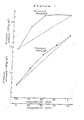
- Figure 1 and Figure 2 show curves each of which indicating a relationship between the flexural strength or the flexural modulus of the injection-molded product obtained from a blend of polymers, and the blending composition, found out in Example 4 and Comparative Example 3 respectively.
- the ordinate represents the flexural strength and modulus.
- the abscissa represents the percentage of the wholly aromatic polyester (X) and an aromatic polyester (Y).
- the unit I of the polyesters of this invention is a 4-oxybenzoyl moiety and is derived from 4-hydroxybenzoic acid or a functional derivative thereof.
- the unit I is contained in the polyester in an amount of 45 to 68 mol%, preferably 50 to 65 mol%.
- the unit II is a terephthaloyl moiety and is derived from terephthalic acid or a functional derivative thereof.
- the unit II is contained in the polyester in an amount of 16 to 27.5 mol%, preferably 17.5 to 25 mol%.
- the unit III is a 4,4 ⁇ -dioxydiphenyl ether moiety and is derived from 4,4 ⁇ -dihydroxydiphenyl ether or a functional derivative thereof.
- the unit III is contained in the polyester in an amount of 16 to 27.5 mol%, preferably 17.5 to 25 mol%.
- the molar amount of the unit II is substantially the same as the molar amount of the unit III.
- Part of the hydrogen atoms bonded to each aromatic ring of the above units, I, II and III may has been substituted with substituted groups including an alkyl group having 1 to 4 carbons atoms, an alkoxy group having 1 to 4 carbon atoms, halogen, a phenyl group and the like.
- substituted groups including an alkyl group having 1 to 4 carbons atoms, an alkoxy group having 1 to 4 carbon atoms, halogen, a phenyl group and the like.
- the substituting groups it is usually preferred that the substituting groups be not present because then the obtained polyester has higher crystallinity and also because the formed products obtained from the polyester have better mechanical properties.
- thermotropic liquid crystal polyesters of this invention can be prepared by various condensation reactions, and are usually prepared by melt polymerization. Normally while charging starting raw materials of 4-hydroxybenzoic acid and 4,4 ⁇ -dihydroxydiphenyl ether giving the unit I and the unit III, the hydroxyl groups of which have been converted to lower acyl esters, polymerization is conducted by the so-called acidolysis method. C 1-4 -Acyl esters of 4-hydroxybenzoic acid and 4,4 ⁇ -dihydroxydiphenyl ether are most preferred.
- the polymerization may be effected without employing a catalyst, it is often the case that employment of known catalysts in an amount of about 0.001 to 1 wt.%, preferably about 0.005 to 0.5 wt.% to the total monomer weight gives a preferred result in view of the polymerization rate.
- the catalysts are alkaline metal or alkali earth metal salts of carboxylic acids, alkyl tin oxides, diaryl tin oxides, alkyl stannic acids, titanium dioxide, alkoxy titanium silicates, titanium alkoxides, Lewis acid and hydrogen halides.
- Melt polymerization is usually effected at a temperature of 200 to 375°C under the atmosphere of an inert gas such as nitrogen or argon, preferably in a stream thereof or un der reduced pressure.
- an inert gas such as nitrogen or argon
- the polymerization time is normally in the range from 1 to 10 hours.
- the thus obtained polymer is a polyester consisting of recurring units in substantially the same ratio as that of the starting materials.
- the polyesters of this invention consist of the above recurring units of the units I to III in the above specified composition ratios; and the polyesters have an inherent viscosity of more than 0.5 dl/g determined in pentafluorophenol solution at a concentration of 0.1 wt./vol.% at 60°C, and form an optically anisotropic melt phase at a temperature of preferably below 350°C.
- an optically anisotropic melt phase can, as well known by those skilled in the art, be confirmed by observing a thin strip of specimen, preferably one to 5 to 20 ⁇ m with a polarizing microscope equipped with a heating stage, under crossed polarizers, to watch the transmission of light at a certain temperature and above.
- a polarizing microscope equipped with a heating stage, under crossed polarizers
- the temperature at which polarized light starts transmitting is the temperature of transition to an optically anisotropic melt phase.
- this transition temperature can be determined by the positions of endotherms when the thermal behavior of a specimen is observed with a differential scanning calorimeter (DSC) at a constant temperature increasing rate, usually at a rate of 10 to 20°C/minute. Since the endotherms of the thermotropic liquid crystal polyesters according to the present invention observed using a differential scanning calorimeter are much weaker then the peaks of crystal melting to the isotropic phase of conventional crystalline polymers, great attention should be paid to the observation. Sometimes more than one endotherms are observed, whereby the temperature giving the major peak can be deemed the transition temperature. Also, annealing of the specimen under a suitable condition sometimes makes clearer the endotherms.
- DSC differential scanning calorimeter
- polyesters of this invention it is necessary for the polyesters of this invention to have a temperature of transition to the anisotropic melt phase of 350°C or below with regard to the processability and mechanical properties of the formed products to be obtained.
- the polyesters according to this invention should have an inherent viscosity as specified hereinbefore of more than 0.5 dl/g, preferably more than 1.0 dl/g. In the case where the inherent viscosity is lower than 0.5 dl/g, the formed products obtained from the polymer do not have sufficient mechanical properties. Though there is no critical upper limit in the inherent viscosity, it is preferred that the inherent viscosity be 10 dl/g or below, preferably 7.5 dl/g or below with regard to the polymerization operation for the polyester, the formability of the obtained polyester and the mechanical properties of the formed products further obtainable from the polyester.
- thermotropic liquid crystal polyesters can be injection molded in a conventional manner at a temperature higher than, preferably 5 to 100°C higher than the temperature of transition to the optically anisotropic melt phase, into formed products having excellent properties. Prior to injection molding, it is preferred that the polymer be dried at 80 to 150°C.
- injection molded products obtained from the polyesters of this invention have only small anisotropy in mechanical properties, design of molds and gates is relatively easy. All conventional molds can be used. Also, as the type of gates of molds, conventional gates such as pingate, fangate, submarine gate, film gate, etc. are used.
- the temperature of a mold is preferably in the range from about 50 to about 150°C. Injection pressure is in the range from 150 to 1500 kg/cm2.
- the unit III that is, the 4,4 ⁇ -dioxydiphenyl ether moiety be contained in the polyester in an amount of 16 to 27.5 mol%, preferably 17.5 to 25 mol%.
- the unit III exists in an amount less than 16 mol%, as is clear from Comparative Example 1 later described, the impact strength of the molded products obtained will be markedly low.
- the unit III is employed in an amount above 27.5 mol%, as is clear from Comparative Example 2 later described, it will be difficult to obtain by melt polylmerization a polyester having uniform composition and the obtained polymer will not from at 350°C or below an optically anistropic melt phase.
- thermotropic liquid crystal polyester containing the unit III in an amount of 16 to 27.5 mol%, an injection-molded product having high impact strength can be obtained.
- the injection-molded products according to this invention show, when measured for notched Izod impact strength in accordance with ASTM D256, at least 30 kg ⁇ cm/cm, usually 50 kg ⁇ cm/cm or higher value in the direction parallel to the flow of the resin.
- the Patent Publication only discloses a method of heat treatment applied to a fiber obtained from the thermotropic liquid crystal polyester, and shows only that a fiber is obtained from a polyester consisting of 4-hydroxybenzoic acid/terephthalic acid/4,4 ⁇ -dihydroxydiphenyl ether and that the fiber increases its strength upon heat treatment; and does not describe nor suggest the fact that by injection-molding a thermotropic liquid crystal polyester comprising 4-hydroxybenzoic acid/terephthalic acid/4,4 ⁇ -dihydroxydiphenyl ether in a certain molar ratio, an injection molded product having only small anisotropy in its mechanical properties and having high impact strength is obtained.
- the notched Izod impact strength of a molded product obtained by injection-molding a polyester having the composition ratio specified in the above Patent Publication is as low as 2.0 kg ⁇ cm/cm, which is far lower than that of the injection molded products according to the present invention.
- This invention also provides polymer composition obtained by melt-blending the wholly aromatic polyester consisting of recurring units I, II and III in the above specified contents (denoted as (X)) with an aromatic polyester melt-formable at a temperature below 450°C (denoted as (Y)) in a weight ratio from 90:10 to 10:90, wherein (Y) should satisfy the following condition:
- the flexural strength and the flexural modulus of the test specimen obtained from (Y) is at least 10 % higher than those of the test specimen obtained from (X) respectively.
- a molded product obtained from a polymer composition obtained by melt-blending the wholly aromatic polyester (X) with an aromatic polyester (Y) is superior in strength and relatively low in its elastic modulus, and has high heat resistance. Besides, when the composition is made into films or fibers, their elongation at break is relatively high.
- aromatic polyester (Y) an aromatic polyester which forms an optically anisotropic melt phase at a temperature of preferably 450°C or below, more preferably 400°C or below be employed in view of the processability and properties of the polymeric composition to be obtained.
- the aromatic polyester (Y) should have in usual cases, when determined in pentafluorophenol solution with a concentration of 0.1 wt./vol.%, at 60°C, an inherent viscosity of 0.2 dl/g or higher, preferably 0.5 dl/g or higher, more preferably 1.0 dl/g or higher. In some cases however, depending on the structure of (Y), (Y) does not fully dissolve in pentafluorophenol.
- aromatic polyester (Y) there are many compounds of different structures. Preferred are among them aromatic polyesters derived from an aromatic hydroxy acid or functional derivatives thereof, from an aromatic or aliphatic dicarboxylic acid or functional derivatives thereof, from an aromatic or aliphatic dihydroxy compound or functional derivatives thereof; and particularly preferred is an aromatic polyester which forms an optically anisotropic melt phase.
- polymers are aromatic polyesters consisting of 6-hydroxy-2-naphthoic acid and 4-hydroxybenzoic acid (USP 4,161,470); aromatic polyesters excluding the wholly aromatic polyester (X), consisting of 6-hydroxy-2-naphthoic acid, 4-hydroxybenzoic acid, an aromatic dihydroxy compound and an aromatic dicarboxylic acid (USP's 4,256,624, 4,473,682 and 4,522,974); aromatic polyesters excluding the wholly aromatic polyester (X) consisting of 6-hydroxy-2-naphthoic acid, an aromatic dihydroxy compound and an aromatic dicarboxylic acid (USP 4,256,624); aromatic poly esters consisting of 6-hydroxy-2-naphthoic acid, an aromatic dihydroxy compound, cyclohexyldicarboxylic acid and an aromatic dicarboxylic acid (USP 4,318,842), aromatic polyesters obtained by reacting a polyester prepared from an aromatic
- An injection-molded product obtained from the wholly aromatic polyester (X) is, as described before, compared with an injection-molded product obtained from a wholly aromatic thermotropic liquid crystal polyester which has so far been proposed, low in strength and its elastic modulus, and its properties are close to the strength and the elastic modulus of an injection-molded product obtained from a polymeric compound such as polyethylene terephthalate or polycarbonate which does not form a liquid crystal phase.
- a polymeric compound such as polyethylene terephthalate or polycarbonate which does not form a liquid crystal phase.
- both the strength and the elastic modulus decreases on account of the incorporation of the polymeric compound which does not form liquid crystals far lower than the weighted average of each one.
- melt blending of the wholly aromatic thermotropic liquid crystal polyester (X) with the aromatic polyester (Y) is effected at a temperature higher than that where (X) and (Y) melt, that is, in a range from about 260 to 450°C, preferably about 280 to 400°C, by a conventional method using a mixing kneader, monoaxial extruder or biaxial extruder.
- the melt blending is carried out usually for 1 minute to 1 hour, preferably for 3 minutes to 30 minutes.
- the polymer compositions according to the present invention can readily be formed by conventional methods into various formed products such as fibers, films, injection-molded products, etc. Further in the case of the above various formed products, particularly fibers and films, by applying heat treatment at a temperature below the temperature causing sticking of the fibers or the films with each other while removing obtained byproducts, the mechanical properties can be further improved.
- the period of the heat treatment is selected from the range from 1 minute to about 50 hours.
- Various fillers and/or reinforcing agents may be added to the polyesters of the present invention or to the blend of said polyesters with the aromatic polyesters (Y) of this invention to modify the properties of the obtained formed products.
- Y aromatic polyesters
- the amount of fillers and/or reinforcing agents incorporated is about 10 to 600 weight parts per 100 weight parts of the polymeric composition.
- the inherent viscosity ⁇ inh is calculated by the following equation: wherein, t0: dropping time of solvent, pentafluorophenol measured at 60°C in Uberohde viscometer t : dropping time of solution having dissolved the specimen c : concentration (g/dl) of the specimen solution.
- the polymer was subjected to a measurement by 500 MHz 1H-NMR (JOEL GX-500) in a mixed solution of pentafluorophenol-trifluoroacetic acid, and it was confirmed that the polymer had essentially the same construction as that of charged raw materials.
- thermo-balance Differential Thermal Balance, RIGAKU ELECTRIC
- the obtained polymer was formed, with an injection molding machine (TK14-1AP, TABATA MACHINERY) at a cylinder temperature of 320°C, under an injection pressure of 800 kg/cm2 and using a mold equipped with a film gate, at a mold temperature of 100°C into pieces of injection-molded product.
- Pieces each of 75 ⁇ 15 ⁇ 2 mm in which the longitudinal axis is parallel to the direction of polymer flow (MD) and in which the longitudinal axis is perpendicular to the direction of polymer flow (TD) respectively were obtained by specially designed gate.
- the thus obtained molded products were subjected to measurements for the flexural strength and flexural modulus according to ASTM D790 and for notched Izod impact strength according ASTM D256. The results are shown in Table 1.
- the molded product had a surface luster and a very smooth surface.
- Polymerizations were conducted in a manner similar to that described in Example 1, by charging 4-acetoxybenzoic acid, terephthalic acid and 4,4 ⁇ -diacetoxydiphenyl ether in molar ratios of 55/22.5/22.5 and 64/18/18 respectively.
- the obtained polymers showed inherent viscosities of 2.74 dl/g and 2.68 dl/g, respectively.
- Observation with a polarized microscope and measurement with DSC proved that the polymers formed optically anisotropic melt phases at and above a temperature of 290°C and 292°C respectively.
- Polymerization was conducted in a manner similar to that described in Example 1, by charging 4-acetoxybenzoic acid, terephthalic acid and 4,4 ⁇ -diacetoxydiphenyl ether in a molar ratio of 70/15/15.
- the obtained polymer showed an inherent viscosity of 2.68 dl/g and formed, when observed with a polarized microscope, an optically anisotropic melt phase at about 325°C.
- the polymer was injection-molded in the same manner as in Example 1, except for that the cylinder temperature was 340°C.
- Mechanical properties of the obtained molded product are shown in Table 1. As apparent from Table 1, the impact strength of the molded product obtained from the polyester having above composition is remarkably low.
- Polymerization was conducted in a manner similar to that described in Example 1, by charging 4-acetoxybenzoic acid, terephthalic acid and 4,4 ⁇ -diacetoxydiphenyl ether in molar ratios of 40/30/30.
- evacuation was started at 320°C, the viscosity inside the system started increasing remarkably; and after about 20 minutes when the bath temperature was raised to 350°C, the content solidified to render further stirring impossible.
- the bath temperature was then raised up to 370°C, where the content did not melt.
- the obtained polymer was very brittle and showed a sharp endotherm at 505°C. This polymer is not formable at 400°C or below.
- aromatic polyester (Y) a wholly aromatic polyester represented by the formula below was synthesized according to a published literature from 60 mol% of 6-acetoxy-2-naphthoic acid, 20 mol% of terephthalic acid and 20 mol% of hydroquinone diacetate.
- the wholly aromatic thermotropic liquid crystal polyester (X) obtained in Example 1 was melt-blended with (Y) in weight ratios of 75:25, 50:50 and 25:75 respectively.
- the melt blending was conducted with Plastgraph made by Brabender Company, at a temperature of 310°C and at a rotation rate of 60 rpm for 5 minutes.
- the obtained polymeric compositions, the wholly aromatic polyester (X) and the aromatic polyester (Y) were subjected to injection molding separately.
- the thus obtained specimens were measured for flexural strength and flexural modulus both in the direction parallel to the flow of resin. The results are shown in Table 2.
Landscapes
- Chemical & Material Sciences (AREA)
- Health & Medical Sciences (AREA)
- Chemical Kinetics & Catalysis (AREA)
- Medicinal Chemistry (AREA)
- Polymers & Plastics (AREA)
- Organic Chemistry (AREA)
- Polyesters Or Polycarbonates (AREA)
- Injection Moulding Of Plastics Or The Like (AREA)
- Liquid Crystal Substances (AREA)
Applications Claiming Priority (2)
| Application Number | Priority Date | Filing Date | Title |
|---|---|---|---|
| JP61310917A JP2506352B2 (ja) | 1986-12-29 | 1986-12-29 | 全芳香族ポリエステル及びそれを用いた射出成形品の製造法 |
| JP310917/86 | 1986-12-29 |
Publications (2)
| Publication Number | Publication Date |
|---|---|
| EP0273423A2 true EP0273423A2 (fr) | 1988-07-06 |
| EP0273423A3 EP0273423A3 (fr) | 1990-04-18 |
Family
ID=18010935
Family Applications (1)
| Application Number | Title | Priority Date | Filing Date |
|---|---|---|---|
| EP87119253A Withdrawn EP0273423A3 (fr) | 1986-12-29 | 1987-12-28 | Polyesters aromatiques et leur utilisation |
Country Status (3)
| Country | Link |
|---|---|
| US (1) | US4837268A (fr) |
| EP (1) | EP0273423A3 (fr) |
| JP (1) | JP2506352B2 (fr) |
Cited By (1)
| Publication number | Priority date | Publication date | Assignee | Title |
|---|---|---|---|---|
| EP0323160A3 (fr) * | 1987-12-28 | 1991-06-12 | Mitsui Petrochemical Industries, Ltd. | Films à partir de polyesters entièrement aromatiques et procédé pour leur préparation |
Families Citing this family (12)
| Publication number | Priority date | Publication date | Assignee | Title |
|---|---|---|---|---|
| JPS6461087A (en) * | 1987-09-01 | 1989-03-08 | Sumitomo Chemical Co | Resin composition for printed wiring board |
| JPH0663448B2 (ja) * | 1988-07-15 | 1994-08-22 | 日本石油化学株式会社 | 消音器 |
| JP2838118B2 (ja) * | 1988-09-02 | 1998-12-16 | 住友化学工業株式会社 | 芳香族ポリエステルの製造方法 |
| US5268225A (en) * | 1990-08-16 | 1993-12-07 | The University Of Akron | Self reinforced thermoplastic composite laminate |
| US5238638A (en) * | 1990-08-16 | 1993-08-24 | The University Of Akron | Process for preparing a self-reinforced thermoplastic composite laminate |
| US5070157A (en) * | 1990-08-16 | 1991-12-03 | University Of Akron | Self reinforced composite of thermotropic liquid crystal polymers |
| US5260380A (en) * | 1992-01-23 | 1993-11-09 | The University Of Akron | Self-reinforced composite and process for preparing same |
| JPH09327990A (ja) * | 1996-06-11 | 1997-12-22 | Toshiba Corp | カード型記憶装置 |
| TW450985B (en) * | 1996-06-18 | 2001-08-21 | Sumitomo Chemical Co | Thermoplastic resin composition and its molded article |
| JP2000044797A (ja) | 1998-04-06 | 2000-02-15 | Kuraray Co Ltd | 液晶ポリマ―フィルムと積層体及びそれらの製造方法並びに多層実装回路基板 |
| CN1116164C (zh) | 1998-04-09 | 2003-07-30 | 可乐丽股份有限公司 | 使用聚合物薄膜的涂层方法和由此得到的涂层体 |
| JP3968068B2 (ja) * | 2003-09-30 | 2007-08-29 | 株式会社クラレ | 液晶ポリマーフィルムの製造方法 |
Family Cites Families (12)
| Publication number | Priority date | Publication date | Assignee | Title |
|---|---|---|---|---|
| US3773858A (en) * | 1969-05-28 | 1973-11-20 | Carborundum Co | Substantially void-free impact molded article of infusible oxybenzoyl polyesters |
| SE416814B (sv) * | 1974-05-10 | 1981-02-09 | Du Pont | Nya syntetiska polyestrar och sett for deras framstellning |
| US4247514A (en) * | 1975-05-05 | 1981-01-27 | E. I. Du Pont De Nemours And Company | Process for strengthening a shaped article of a polyester |
| JPS55149321A (en) * | 1979-05-11 | 1980-11-20 | Sumitomo Chem Co Ltd | Preparation of oxybenzoylcopolyester |
| US4269965A (en) * | 1979-09-17 | 1981-05-26 | E. I. Du Pont De Nemours And Company | Aromatic polyester which forms optically anisotropic melts and filaments thereof |
| JPS56104932A (en) * | 1980-01-24 | 1981-08-21 | Sumitomo Chem Co Ltd | Bulk polycondensation of aromatic polyester |
| US4299756A (en) * | 1980-03-10 | 1981-11-10 | Celanese Corporation | Polyester of phenyl-4-hydroxybenzoic acid, aromatic diol, and aromatic diacid capable of forming an anisotropic melt |
| US4355134A (en) * | 1981-06-04 | 1982-10-19 | Celanese Corporation | Wholly aromatic polyester capable of forming an anisotropic melt phase at an advantageously reduced temperature |
| US4451611A (en) * | 1981-12-15 | 1984-05-29 | Celanese Corporation | Process for forming blend of polyalkylene terephthalate and wholly aromatic polyester which exhibits an anisotropic melt phase |
| JPS58191219A (ja) * | 1982-04-28 | 1983-11-08 | Sumitomo Chem Co Ltd | 芳香族ポリエステル繊維の製造方法 |
| US4563508A (en) * | 1984-05-18 | 1986-01-07 | Dart Industries, Inc. | Injection moldable aromatic polyesters compositions and method of preparation |
| JPS61199821A (ja) * | 1985-03-01 | 1986-09-04 | 住友化学工業株式会社 | 非粘着性を有するプラスチックオ−ブンウエア |
-
1986
- 1986-12-29 JP JP61310917A patent/JP2506352B2/ja not_active Expired - Lifetime
-
1987
- 1987-12-18 US US07/134,754 patent/US4837268A/en not_active Expired - Fee Related
- 1987-12-28 EP EP87119253A patent/EP0273423A3/fr not_active Withdrawn
Cited By (1)
| Publication number | Priority date | Publication date | Assignee | Title |
|---|---|---|---|---|
| EP0323160A3 (fr) * | 1987-12-28 | 1991-06-12 | Mitsui Petrochemical Industries, Ltd. | Films à partir de polyesters entièrement aromatiques et procédé pour leur préparation |
Also Published As
| Publication number | Publication date |
|---|---|
| JP2506352B2 (ja) | 1996-06-12 |
| EP0273423A3 (fr) | 1990-04-18 |
| US4837268A (en) | 1989-06-06 |
| JPS63168429A (ja) | 1988-07-12 |
Similar Documents
| Publication | Publication Date | Title |
|---|---|---|
| EP0490346B1 (fr) | Compositions de polyesters thermotropes, liquides cristallins | |
| EP0513545B1 (fr) | Polyester-amide façonnable à l'état fondu pouvant former une masse fondue anisotrope | |
| JP2830279B2 (ja) | 流動性の改良された液晶ポリエステル樹脂組成物 | |
| EP0044175B2 (fr) | Composition à base de polycarbonate et de polyester entièrement aromatique | |
| US4355133A (en) | Polyester of 6-hydroxy-2-naphthoic acid, 4-hydroxy benzoic acid, 1,4-cyclohexanedicarboxylic acid, and aromatic diol capable of readily undergoing melt processing to form articles possessing high impact properties | |
| EP0888414B1 (fr) | Procede ameliore pour fabriquer des polymeres a cristaux liquides thermotropiques contenant de l'hydroquinone | |
| EP0273423A2 (fr) | Polyesters aromatiques et leur utilisation | |
| EP0298692A2 (fr) | Polyester transformable par fusion, capable de former une fusion anisotrope, contenant une concentration relativement faible de motif de 6-oxy-2-naphtoyle, un motif 4-oxy-benzoyle, un motif 2,6-dioxynaphthalène, et un motif téréphtoyle | |
| EP0154065A1 (fr) | Mélange de polyalkylène téréphtalate et de polyester totalement aromatique, à haut poids moléculaire et procédé pour sa fabrication | |
| US4851503A (en) | Wholly aromatic thermotropic liquid crystal polyester | |
| JPS5962630A (ja) | 比較的低濃度の6−オキシ−2−ナフトイル部分を含む異方性溶融加工可能なポリエステル | |
| US5071942A (en) | Melt processable thermotropic aromatic copolyesters | |
| JP2544731B2 (ja) | 全芳香族ポリエステル | |
| US5306800A (en) | Pseudo network condensation polymers | |
| JP3457000B2 (ja) | 4,4’−ビフェニルジカルボン酸から誘導されるモノマー単位を含む熱互変性ポリ(エステルアミド) | |
| EP0482639B1 (fr) | Polyesters liquides cristallins thermotropes à partir de 2-méthylhydroquinone, d'hydroquinone, d'acide téréphthalique et d'acide 2,6-naphthalènedicarboxylique. | |
| JP2599713B2 (ja) | 全芳香族サーモトロピツク液晶ポリエステル | |
| JP3284617B2 (ja) | 液晶性ポリエステルの製造方法 | |
| JP3132881B2 (ja) | 液晶性ポリエステルの製造方法 | |
| CA1269472A (fr) | Melange de poly(terephtalate d'alcoylene) et de polyester totalement aromatique et de masse moleculaire elevee; methode de preparation | |
| JPH05295093A (ja) | 共重合ポリエステル及びその製造法 | |
| JP3284631B2 (ja) | 共重合ポリエステル及び共重合ポリエステルアミドの製造方法 | |
| JPS63270730A (ja) | 全芳香族サーモトロピツク液晶ポリエステル | |
| JPH01149826A (ja) | 全芳香族ポリエステル | |
| EP0556021A1 (fr) | Compositions de polyesters cristallins liquides et procédé de préparation |
Legal Events
| Date | Code | Title | Description |
|---|---|---|---|
| PUAI | Public reference made under article 153(3) epc to a published international application that has entered the european phase |
Free format text: ORIGINAL CODE: 0009012 |
|
| AK | Designated contracting states |
Kind code of ref document: A2 Designated state(s): DE FR GB IT |
|
| PUAL | Search report despatched |
Free format text: ORIGINAL CODE: 0009013 |
|
| AK | Designated contracting states |
Kind code of ref document: A3 Designated state(s): DE FR GB IT |
|
| 17P | Request for examination filed |
Effective date: 19900903 |
|
| 17Q | First examination report despatched |
Effective date: 19910423 |
|
| STAA | Information on the status of an ep patent application or granted ep patent |
Free format text: STATUS: THE APPLICATION IS DEEMED TO BE WITHDRAWN |
|
| 18D | Application deemed to be withdrawn |
Effective date: 19930420 |