EP0274329A1 - Verfahren zur Dekontamination einer mit Tritium kontaminierten metallischen Oberfläche und Vorrichtung zur Verwendung desselben - Google Patents
Verfahren zur Dekontamination einer mit Tritium kontaminierten metallischen Oberfläche und Vorrichtung zur Verwendung desselben Download PDFInfo
- Publication number
- EP0274329A1 EP0274329A1 EP87403007A EP87403007A EP0274329A1 EP 0274329 A1 EP0274329 A1 EP 0274329A1 EP 87403007 A EP87403007 A EP 87403007A EP 87403007 A EP87403007 A EP 87403007A EP 0274329 A1 EP0274329 A1 EP 0274329A1
- Authority
- EP
- European Patent Office
- Prior art keywords
- decontaminated
- solid electrolyte
- electrolyte
- water
- hydrogen
- Prior art date
- Legal status (The legal status is an assumption and is not a legal conclusion. Google has not performed a legal analysis and makes no representation as to the accuracy of the status listed.)
- Granted
Links
- 238000000034 method Methods 0.000 title claims abstract description 49
- YZCKVEUIGOORGS-NJFSPNSNSA-N Tritium Chemical compound [3H] YZCKVEUIGOORGS-NJFSPNSNSA-N 0.000 title claims abstract description 42
- 229910052722 tritium Inorganic materials 0.000 title claims abstract description 42
- 229910052739 hydrogen Inorganic materials 0.000 claims abstract description 31
- 239000001257 hydrogen Substances 0.000 claims abstract description 31
- XLYOFNOQVPJJNP-UHFFFAOYSA-N water Substances O XLYOFNOQVPJJNP-UHFFFAOYSA-N 0.000 claims abstract description 31
- UFHFLCQGNIYNRP-UHFFFAOYSA-N Hydrogen Chemical compound [H][H] UFHFLCQGNIYNRP-UHFFFAOYSA-N 0.000 claims abstract description 30
- 239000003792 electrolyte Substances 0.000 claims abstract description 25
- 239000007784 solid electrolyte Substances 0.000 claims abstract description 24
- 239000007864 aqueous solution Substances 0.000 claims abstract description 23
- 229910052751 metal Inorganic materials 0.000 claims abstract description 17
- 239000002184 metal Substances 0.000 claims abstract description 17
- QAOWNCQODCNURD-UHFFFAOYSA-N Sulfuric acid Chemical compound OS(O)(=O)=O QAOWNCQODCNURD-UHFFFAOYSA-N 0.000 claims abstract description 14
- 239000000203 mixture Substances 0.000 claims abstract description 14
- 238000011282 treatment Methods 0.000 claims description 25
- 238000005868 electrolysis reaction Methods 0.000 claims description 22
- OKTJSMMVPCPJKN-UHFFFAOYSA-N Carbon Chemical compound [C] OKTJSMMVPCPJKN-UHFFFAOYSA-N 0.000 claims description 21
- HEMHJVSKTPXQMS-UHFFFAOYSA-M Sodium hydroxide Chemical compound [OH-].[Na+] HEMHJVSKTPXQMS-UHFFFAOYSA-M 0.000 claims description 21
- 229910002804 graphite Inorganic materials 0.000 claims description 21
- 239000010439 graphite Substances 0.000 claims description 21
- PXHVJJICTQNCMI-UHFFFAOYSA-N Nickel Chemical compound [Ni] PXHVJJICTQNCMI-UHFFFAOYSA-N 0.000 claims description 20
- KDLHZDBZIXYQEI-UHFFFAOYSA-N Palladium Chemical compound [Pd] KDLHZDBZIXYQEI-UHFFFAOYSA-N 0.000 claims description 13
- 229920001940 conductive polymer Polymers 0.000 claims description 11
- 239000010935 stainless steel Substances 0.000 claims description 10
- 229910052759 nickel Inorganic materials 0.000 claims description 9
- 239000000243 solution Substances 0.000 claims description 9
- 229910001220 stainless steel Inorganic materials 0.000 claims description 9
- -1 polytetrafluoroethylene Polymers 0.000 claims description 8
- 229920001343 polytetrafluoroethylene Polymers 0.000 claims description 7
- 239000004810 polytetrafluoroethylene Substances 0.000 claims description 7
- 238000001179 sorption measurement Methods 0.000 claims description 7
- 239000004020 conductor Substances 0.000 claims description 6
- 239000007788 liquid Substances 0.000 claims description 5
- 229910000881 Cu alloy Inorganic materials 0.000 claims description 3
- 150000008044 alkali metal hydroxides Chemical class 0.000 claims description 3
- UQSQSQZYBQSBJZ-UHFFFAOYSA-N fluorosulfonic acid Chemical group OS(F)(=O)=O UQSQSQZYBQSBJZ-UHFFFAOYSA-N 0.000 claims description 3
- 238000006116 polymerization reaction Methods 0.000 claims description 2
- 238000005202 decontamination Methods 0.000 abstract description 27
- 230000003588 decontaminative effect Effects 0.000 abstract description 26
- CDBYLPFSWZWCQE-UHFFFAOYSA-L Sodium Carbonate Chemical compound [Na+].[Na+].[O-]C([O-])=O CDBYLPFSWZWCQE-UHFFFAOYSA-L 0.000 abstract description 2
- 230000000694 effects Effects 0.000 description 9
- 239000007787 solid Substances 0.000 description 9
- 238000005260 corrosion Methods 0.000 description 5
- 230000007797 corrosion Effects 0.000 description 5
- 239000010410 layer Substances 0.000 description 5
- YZCKVEUIGOORGS-UHFFFAOYSA-N Hydrogen atom Chemical compound [H] YZCKVEUIGOORGS-UHFFFAOYSA-N 0.000 description 4
- 238000006243 chemical reaction Methods 0.000 description 4
- 150000002431 hydrogen Chemical class 0.000 description 4
- 238000003780 insertion Methods 0.000 description 4
- 230000037431 insertion Effects 0.000 description 4
- 239000002245 particle Substances 0.000 description 4
- 229910001369 Brass Inorganic materials 0.000 description 3
- 239000010951 brass Substances 0.000 description 3
- 238000009792 diffusion process Methods 0.000 description 3
- 239000000463 material Substances 0.000 description 3
- 229910052763 palladium Inorganic materials 0.000 description 3
- 229920000642 polymer Polymers 0.000 description 3
- 230000002285 radioactive effect Effects 0.000 description 3
- 230000007423 decrease Effects 0.000 description 2
- 238000002513 implantation Methods 0.000 description 2
- 230000007246 mechanism Effects 0.000 description 2
- 150000002739 metals Chemical class 0.000 description 2
- 229910000838 Al alloy Inorganic materials 0.000 description 1
- 229910021586 Nickel(II) chloride Inorganic materials 0.000 description 1
- 241000287107 Passer Species 0.000 description 1
- 229910045601 alloy Inorganic materials 0.000 description 1
- 239000000956 alloy Substances 0.000 description 1
- XAGFODPZIPBFFR-UHFFFAOYSA-N aluminium Chemical compound [Al] XAGFODPZIPBFFR-UHFFFAOYSA-N 0.000 description 1
- 125000000129 anionic group Chemical group 0.000 description 1
- 230000004888 barrier function Effects 0.000 description 1
- 239000002585 base Substances 0.000 description 1
- 230000000903 blocking effect Effects 0.000 description 1
- 239000013043 chemical agent Substances 0.000 description 1
- 239000002322 conducting polymer Substances 0.000 description 1
- 230000001934 delay Effects 0.000 description 1
- 230000001066 destructive effect Effects 0.000 description 1
- 238000010586 diagram Methods 0.000 description 1
- YPTUAQWMBNZZRN-UHFFFAOYSA-N dimethylaminoboron Chemical compound [B]N(C)C YPTUAQWMBNZZRN-UHFFFAOYSA-N 0.000 description 1
- 238000007598 dipping method Methods 0.000 description 1
- 238000007599 discharging Methods 0.000 description 1
- 238000006073 displacement reaction Methods 0.000 description 1
- 239000008151 electrolyte solution Substances 0.000 description 1
- XLYOFNOQVPJJNP-ZSJDYOACSA-N heavy water Substances [2H]O[2H] XLYOFNOQVPJJNP-ZSJDYOACSA-N 0.000 description 1
- 238000007654 immersion Methods 0.000 description 1
- 238000005470 impregnation Methods 0.000 description 1
- 238000011065 in-situ storage Methods 0.000 description 1
- 150000008040 ionic compounds Chemical class 0.000 description 1
- 230000002045 lasting effect Effects 0.000 description 1
- 239000002923 metal particle Substances 0.000 description 1
- 238000001465 metallisation Methods 0.000 description 1
- 150000002815 nickel Chemical class 0.000 description 1
- QMMRZOWCJAIUJA-UHFFFAOYSA-L nickel dichloride Chemical compound Cl[Ni]Cl QMMRZOWCJAIUJA-UHFFFAOYSA-L 0.000 description 1
- 150000002894 organic compounds Chemical class 0.000 description 1
- 150000002940 palladium Chemical class 0.000 description 1
- 230000010287 polarization Effects 0.000 description 1
- 239000012857 radioactive material Substances 0.000 description 1
- 238000012958 reprocessing Methods 0.000 description 1
- 238000004544 sputter deposition Methods 0.000 description 1
- 229910001256 stainless steel alloy Inorganic materials 0.000 description 1
- 239000000126 substance Substances 0.000 description 1
- BDHFUVZGWQCTTF-UHFFFAOYSA-N sulfonic acid Chemical compound OS(=O)=O BDHFUVZGWQCTTF-UHFFFAOYSA-N 0.000 description 1
- 239000002344 surface layer Substances 0.000 description 1
- 239000002699 waste material Substances 0.000 description 1
Images

Classifications
-
- G—PHYSICS
- G21—NUCLEAR PHYSICS; NUCLEAR ENGINEERING
- G21F—PROTECTION AGAINST X-RADIATION, GAMMA RADIATION, CORPUSCULAR RADIATION OR PARTICLE BOMBARDMENT; TREATING RADIOACTIVELY CONTAMINATED MATERIAL; DECONTAMINATION ARRANGEMENTS THEREFOR
- G21F9/00—Treating radioactively contaminated material; Decontamination arrangements therefor
- G21F9/001—Decontamination of contaminated objects, apparatus, clothes, food; Preventing contamination thereof
- G21F9/002—Decontamination of the surface of objects with chemical or electrochemical processes
- G21F9/004—Decontamination of the surface of objects with chemical or electrochemical processes of metallic surfaces
-
- C—CHEMISTRY; METALLURGY
- C25—ELECTROLYTIC OR ELECTROPHORETIC PROCESSES; APPARATUS THEREFOR
- C25F—PROCESSES FOR THE ELECTROLYTIC REMOVAL OF MATERIALS FROM OBJECTS; APPARATUS THEREFOR
- C25F1/00—Electrolytic cleaning, degreasing, pickling or descaling
Definitions
- the present invention relates to a process for decontaminating the surface of metal parts contaminated with tritium.
- it relates to an electrolytic decontamination process, which makes it possible to remove the tritium present on the surface of a metal part without modifying the profile of the surface of this part, in order to be able to possibly reuse it.
- This process applies in particular to small metal parts of complex geometry, to large-area parts but of simple geometry, as well as to parts having inaccessible areas such as parts having a tormented geometry.
- electrolytic methods can be used such as those described in French patents FR-A-2 490 685 and FR-A-2 533 356, and in U.S. Patent US-A-3,515,655.
- low current densities are used which make it possible to carry out a cathodic loading of hydrogen on the surface of the part.
- the hydrogen can be adsorbed on the surface of the part whereas, in the processes of the prior art such than that of patent US-A-3515655, where higher current densities are used, the release of hydrogen is very important and promotes the decohesion of the metal; this causes the growth of cavities and cracks to lead to the removal of surface particles and to demetallization of the treated part.
- reaction mechanisms are governed by different parameters such as electrochemical parameters such as current density, cathodic overvoltage and the nature of the electrolyte, temperature and electrolysis time.
- the cathode overvoltage when the cathode overvoltage is located at a correct value, the adsorption of hydrogen is favored, the energy difference between HM and TM causes the insertion of tritium in the room and a rejection of tritium in the water.
- the mixture comprising water and an electrolyte consists of an aqueous solution of an electrolyte chosen in such a way that the aqueous solution can liberate hydrogen by electrolysis.
- this electrolyte can be sulfuric acid or an alkali metal hydroxide such as sodium hydroxide.
- sodium hydroxide is used because it delays the evolution of hydrogen.
- sulfuric acid a metal attack is observed from 50 mA / cm2 and the attack speed, i.e. corrosion, increases from this value with the current density .
- the electrolyte concentration of the solution is low to avoid corrosion of the part to be treated.
- aqueous solutions containing 0.1 to 1 mol.l ⁇ 1 of sulfuric acid or alkali metal hydroxide such as NaOH.
- the part to be decontaminated is immersed in water or in an aqueous solution, preferably consisting of a aqueous electrolyte solution such as those described above.
- the anode can also be immersed in water or the aqueous solution.
- the tank containing the water or the aqueous solution as an anode.
- This tank can be made, for example, of graphite impregnated with polytetrafluoroethylene wax which is resistant to chemical attack and which is devoid of porosity compared to pure graphite; this has the consequence that the water or the aqueous solution cannot pass through the tank by capillarity.
- electrolysis is carried out using the so-called "buffer" electrolysis method.
- an assembly comprising the anode and a solid electrolyte is moved over the surface of the part and water is circulated between the anode, the solid electrolyte and the surface of the part to be decontaminated.
- the solid electrolyte can consist of an ionic conductive polymer ionizable by water or by an aqueous solution.
- This mode of implementation of the method is advantageous because it eliminates the use of chemical agents in solution which are responsible for corrosion as well as the problems of reprocessing of effluents. In addition, it makes it possible to decontaminate strongly tritiated zones compared to the others and reach areas that are difficult to access with another treatment. Finally, it is suitable for carrying out "in situ" decontamination and it provides little tritiated waste.
- the anode can be produced as before by graphite impregnated or not with polytetrafluoroethylene wax.
- an assembly which comprises both the anode and the solid electrolyte, and which is provided with means for circulating water or a aqueous solution between the anode, the solid electrolyte and the part to be decontaminated.
- the subject of the invention is also a device for electrolytic treatment of the surface of a metal part, which comprises a hollow body of electrically conductive material connected to one of the poles of an electric current generator, the hollow body being provided with at least one liquid outlet orifice to which a porous and permeable element of electrically conductive material is applied, a solid electrolyte applied to the external surface of the porous and permeable element, means to move the hollow body on the surface of the part to be treated so that the solid electrolyte is in contact with the part, and means for introducing a liquid into the hollow body and circulating it through the outlet orifice between the porous and permeable element of electrically conductive material and the surface of the part to be treated.
- the hollow body which in the process of the invention constitutes the anode of the device, can be made of graphite impregnated with polytetrafluoroethylene wax, and the porous and permeable element can be constituted by a graphite felt.
- the solid electrolyte applied to the external surface of the porous element can be produced, as above, from an ionic conductive polymer, ionizable with water or an aqueous solution, for example in perfluorinated carboxylic sulphonic acid.
- the solid anode-electrolyte assembly can be constituted by a graphite piece provided on one of its faces with a graphite felt coated externally with solid electrolyte, for example of solid ionic conductive polymer.
- the device further comprises a cathode element in palladium black and / or nickel in which the hydrogen can diffuse, said element being applied to the solid electrolyte so that the hydrogen which has diffused in said element is either installed directly in the room to be decontaminated.
- the cathode face of the solid electrolyte can be successively coated with palladium black by impregnation and with nickel over a thickness of 250 microns.
- Palladium black can be deposited from palladium salts in aqueous solution, nickel can then be deposited by metallization chemically or by sputtering and then by electrolysis of a nickel salt.
- the hydrogen diffuses into the nickel cathode.
- the atomic hydrogen is recovered on the opposite side and is installed directly on the part to be decontaminated which is attached to this assembly.
- anode-solid electrolyte-cathode sandwich in which the black of Pd and / or of Ni which constitute the cathodic adsorption element are nested in the underlying layers of the electrolyte. solid. This nesting has the advantage of increasing the adsorption surface of the cathodic hydrogen on the part to be decontaminated.
- this structure "sandwich" by impregnating the conductive polymer with an ionic compound of Ni or palladium which is not an anionic complex, for example NiCl2 or Pd (NO3) 2, and then dipping the polymer in a solution of dimethyl aminoborane at 25 % and at 85 ° C. Under these conditions, this organic compound decomposes, giving rise to atomic hydrogen inside the polymer, and this hydrogen chemically reduces the Pd2+ or Ni2+ cations to the state of finely divided metal in the first layers under - adjacent to the polymer.
- an ionic compound of Ni or palladium which is not an anionic complex
- this organic compound decomposes, giving rise to atomic hydrogen inside the polymer, and this hydrogen chemically reduces the Pd2+ or Ni2+ cations to the state of finely divided metal in the first layers under - adjacent to the polymer.
- the parts which can be decontaminated by the process of the invention can be made of different metals and alloys provided that the electrolyte and the electrolysis conditions are chosen so as to avoid corrosion of the material.
- the method can be applied to the treatment of parts made of stainless steel or copper alloys, for example brass.
- the process of the invention can be carried out at ambient temperature, but it can also operate at higher temperatures, since temperature plays an important role in the insertion of tritium into the deep layers of the part. Indeed, the amount of H or T adsorbed decreases with temperature during the electrolysis. Likewise, the diffusion of Hou T in the cathode increases with temperature; a slight backscatter exists, but the majority of H or T remains blocked in the metal and this blocking becomes even more important on returning to ambient temperature.
- temperatures above ambient temperature are preferable to operate at temperatures above ambient temperature while avoiding the risks of corrosion, for example at temperatures of 25 to 100 ° C., in particular at 80 ° C.
- the duration of electrolysis also constitutes an important parameter, since it acts on the quantity of tritium eliminated.
- a balance is obtained after a certain time between the concentration of tritium in the water or the aqueous solution and the concentration of tritium in the part to be treated. Indeed, this corresponds to the following reaction: T + H2O ⁇ HTO + H
- the surface decontamination of stainless steel parts is carried out using the first mode of implementation of the method, that is to say immersion of the parts in an aqueous solution containing 1 mol.l ⁇ 1 of NaOH, placed in a heated graphite tank impregnated with polytetrafluoroethylene wax which constitutes the anode of the device.
- a current density applied to the surface of the parts 10 mA.cm ⁇ 2, at a temperature of 80 ° C, and electrolysis is carried out for a period of 2 hours.
- the tritium decontamination rate (TD) is determined, which corresponds to the ratio of the surface activity of tritium in the part before treatment to the surface activity of the part after treatment.
- the loss of thickness of the part is also determined.
- brass parts are treated as in Example 1, but using an aqueous solution containing 1 mol.l ⁇ 1 of sulfuric acid instead of the aqueous NaOH solution.
- the decontamination rate and the loss of thickness of the part are determined after a treatment cycle. The results obtained are also given in Table 1.
- Electrolysis is carried out under the conditions of Example 1 on stainless steel parts, and the surface activity of the part is measured as a function of the duration of electrolysis always carried out in the same solution.
- FIG. 1 represents the increase in the rate of surface decontamination (TD) as a function of the duration of electrolysis (in hours).
- TD surface decontamination
- FIG. 2 represents the evolution of the surface activity of the parts as a function of the number of treatment cycles.
- Curves 1, 2, 3, 4 and 5 relate to parts respectively n o 1, 2, 3, 4 and 5.
- the device shown diagrammatically in FIG. 3 which comprises an anode constituted by a hollow cylinder 1 made of graphite impregnated with polytetrafluoroethylene wax provided at its base with an outlet orifice 1a to which a porous element is applied and permeable 2 in graphite felt and a film 3 of solid ionic conductive polymer, consisting of perfluorosulfonic acid, the felt and the film 3 being fixed on the cylinder 1 by suitable means, not shown in the drawing.
- anode constituted by a hollow cylinder 1 made of graphite impregnated with polytetrafluoroethylene wax provided at its base with an outlet orifice 1a to which a porous element is applied and permeable 2 in graphite felt and a film 3 of solid ionic conductive polymer, consisting of perfluorosulfonic acid, the felt and the film 3 being fixed on the cylinder 1 by suitable means, not shown in the drawing.
- the hollow graphite cylinder 1 is also provided with another orifice 1b for introducing liquid through which water can be circulated in the anodic hollow cylinder, the water then flowing through the orifice 1a through the graphite felt 2 and the film 3 of ion-conducting polymer.
- the hollow graphite cylinder can be connected to the positive pole of the electric current generator 5 and it can be moved in the three directions of space by any suitable means, for example by a laboratory automaton 7.
- This device can be used to decontaminate the flat part 9 which is connected to the negative pole of the electric current generator 5. Under these conditions, the hollow graphite cylinder 1 is moved to bring it into contact with the part so as to circulate the water in the graphite cylinder 1 through the graphite felt 2 and the film of ionic conductive polymer 3 on the surface of the room. The speed and the mode of movement of the assembly are moved and adjusted on the part 9 so as to obtain satisfactory decontamination.
- a device of this type was used to decontaminate a stainless steel plate using a current density on the plate from 10 mA.cm ⁇ 2 to 50 mA.cm ⁇ 2 and a speed of movement of the 40 cm.min ⁇ 1 hollow cylinder.
- the total time to carry out the decontamination of a 10 cm2 plate having a length of 10 cm is obtained in one hour.
- the temperature at which one operates is higher than room temperature due to the Joule effect obtained by electrolysis.
- Example 5 This is a variant of Example 5, in which the diffusibility property of atomic hydrogen is used in a nickel cathode.
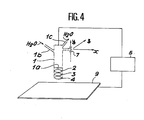
- the device shown diagrammatically in FIG. 4 is used, which is identical to that of FIG. 3 but to which a cathode 4 in palladium black and nickel of 250 ⁇ m has been added, located between the film of ionic conductive polymer and the plate to decontaminate.
- This device is provided with an orifice 1c for discharging the water contained in the hollow cylinder 1.
- a device of this type was used to decontaminate a stainless steel plate using a current density on the plate of 20 mA.cm ⁇ 2, an electrolyte temperature between 60 and 80 ° C. and a displacement speed of the hollow cylinder from 40 to 200 cm.min ⁇ 1.
- the total number of cycles to carry out the decontamination of a 10 cm2 plate, having a length of 10 cm is 700.
- the rate of tritium decontamination of the surface of the part is determined in the same way. In this case, the latter does not undergo any loss of thickness, and materials degradable to cathodic polarization and to electrolytes can be used: aluminum and copper alloy.
- the results obtained and the treatment conditions are given in Table 3 below.
- the first embodiment of the method of the invention is used to treat a medium-sized piece of stainless steel having a tormented geometry constituted by a valve whose orifice is very contaminated with tritium.
- the part is placed in a tank containing water and a solid anode-electrolyte assembly is introduced into the orifice to be decontaminated, consisting of a graphite pencil covered with a graphite felt and a solid ionic conductive polymer film.
- Electrolysis is carried out with a current density of 10 mA.cm ⁇ 2, for two hours the temperature obtained by the Joule effect due to the electrolysis. At the end of the operation, the tritium decontamination rate of the surface of the part is determined and its loss of thickness in micrometers. The results obtained and the treatment conditions are given in Table 4.
- the invention is in no way limited to the embodiments envisaged or described above.
- conventional apparatuses such as those described in French patents FR-A-2 490 685 and FR-A-2 533 356 can be used for the so-called buffer electrolysis method.
- electrolytes in aqueous solution can be used, for example a solution of soda or sulfuric acid.
Landscapes
- Chemical & Material Sciences (AREA)
- Engineering & Computer Science (AREA)
- Chemical Kinetics & Catalysis (AREA)
- Electrochemistry (AREA)
- Materials Engineering (AREA)
- Metallurgy (AREA)
- Organic Chemistry (AREA)
- General Chemical & Material Sciences (AREA)
- Life Sciences & Earth Sciences (AREA)
- Food Science & Technology (AREA)
- Physics & Mathematics (AREA)
- General Engineering & Computer Science (AREA)
- High Energy & Nuclear Physics (AREA)
- Electrolytic Production Of Non-Metals, Compounds, Apparatuses Therefor (AREA)
- Physical Vapour Deposition (AREA)
- Other Surface Treatments For Metallic Materials (AREA)
Applications Claiming Priority (2)
| Application Number | Priority Date | Filing Date | Title |
|---|---|---|---|
| FR8700017A FR2609352B1 (fr) | 1987-01-05 | 1987-01-05 | Procede de decontamination de la surface d'une piece metallique contaminee par du tritium et dispositif utilisable pour ce procede |
| FR8700017 | 1987-01-05 |
Publications (2)
| Publication Number | Publication Date |
|---|---|
| EP0274329A1 true EP0274329A1 (de) | 1988-07-13 |
| EP0274329B1 EP0274329B1 (de) | 1992-03-18 |
Family
ID=9346685
Family Applications (1)
| Application Number | Title | Priority Date | Filing Date |
|---|---|---|---|
| EP87403007A Expired - Lifetime EP0274329B1 (de) | 1987-01-05 | 1987-12-30 | Verfahren zur Dekontamination einer mit Tritium kontaminierten metallischen Oberfläche und Vorrichtung zur Verwendung desselben |
Country Status (6)
| Country | Link |
|---|---|
| US (1) | US4836900A (de) |
| EP (1) | EP0274329B1 (de) |
| JP (1) | JP2562164B2 (de) |
| CA (1) | CA1326643C (de) |
| DE (1) | DE3777598D1 (de) |
| FR (1) | FR2609352B1 (de) |
Cited By (1)
| Publication number | Priority date | Publication date | Assignee | Title |
|---|---|---|---|---|
| RU2143146C1 (ru) * | 1999-03-22 | 1999-12-20 | Тюняев Владимир Николаевич | Устройство для дезактивации радиоактивных отходов |
Families Citing this family (10)
| Publication number | Priority date | Publication date | Assignee | Title |
|---|---|---|---|---|
| DE58904254D1 (de) * | 1988-07-28 | 1993-06-09 | Siemens Ag | Elektropolierverfahren zum zwecke der dekontamination. |
| DE4420139C1 (de) * | 1994-06-09 | 1995-12-07 | Kraftanlagen En Und Industriea | Verfahren zur elektrochemischen Dekontamination von radioaktiv belasteten Oberflächen von Metallkomponenten aus kerntechnischen Anlagen |
| US5591270A (en) * | 1995-07-31 | 1997-01-07 | Corpex Technologies, Inc. | Lead oxide removal method |
| US5678232A (en) * | 1995-07-31 | 1997-10-14 | Corpex Technologies, Inc. | Lead decontamination method |
| US5814204A (en) * | 1996-10-11 | 1998-09-29 | Corpex Technologies, Inc. | Electrolytic decontamination processes |
| DE19944776C2 (de) * | 1999-09-17 | 2003-06-18 | Karlsruhe Forschzent | Verfahren zur Tritiumdekontamination der ersten Wand einer Einrichtung zur Durchführung von Kernfusionen |
| CN100577893C (zh) * | 2005-12-23 | 2010-01-06 | 中国辐射防护研究院 | 一种去除金属表面放射性污染的电解去污方法 |
| FR2936720B1 (fr) * | 2008-10-03 | 2010-10-29 | Commissariat Energie Atomique | Procede de decontamination electrocinetique d'un milieu solide poreux. |
| RU2419902C1 (ru) * | 2010-10-26 | 2011-05-27 | Государственное унитарное предприятие города Москвы - объединенный эколого-технологический и научно-исследовательский центр по обезвреживанию РАО и охране окружающей среды (ГУП МосНПО "Радон") | Способ реагентной дезактивации грунтов от радионуклидов цезия |
| RU2771172C1 (ru) * | 2021-05-11 | 2022-04-28 | Общество с ограниченной ответственностью "ИННОПЛАЗМАТЕХ" | Устройство для плазменной дезактивации элементов конструкции ядерного реактора |
Citations (5)
| Publication number | Priority date | Publication date | Assignee | Title |
|---|---|---|---|---|
| FR1481593A (fr) * | 1965-05-29 | 1967-05-19 | Hoechst Ag | Procédé et dispositif pour le traitement de surfaces métalliques par décapage électrolytique |
| US3515655A (en) * | 1967-09-15 | 1970-06-02 | Israel Defence | Electrolytic decontamination of radioactively contaminated equipment |
| US3957597A (en) * | 1974-05-28 | 1976-05-18 | The United States Of America As Represented By The United States Energy Research And Development Administration | Process for recovering tritium from molten lithium metal |
| FR2533356A1 (fr) * | 1982-09-22 | 1984-03-23 | Dalic | Dispositif de decontamination radioactive de surfaces metalliques par electrolyse au tampon et electrolytes utilisables pour realiser cette decontamination |
| EP0144036A2 (de) * | 1983-11-30 | 1985-06-12 | Siemens Aktiengesellschaft | Verfahren zum Dekontaminieren metallischer Komponenten einer kerntechnischen Anlage |
Family Cites Families (2)
| Publication number | Priority date | Publication date | Assignee | Title |
|---|---|---|---|---|
| DE1192522B (de) * | 1960-05-17 | 1965-05-06 | Chemische Maschb Werke Veb | Verfahren und Vorrichtung zur Entseuchung radioaktiv verseuchter Gegenstaende und Flaechen |
| FR2561672B1 (fr) * | 1984-03-21 | 1989-09-01 | Travaux Milieu Ionisant | Dispositif d'electrolyse, utilisable notamment pour la decontamination radioactive de surfaces metalliques |
-
1987
- 1987-01-05 FR FR8700017A patent/FR2609352B1/fr not_active Expired - Lifetime
- 1987-12-30 EP EP87403007A patent/EP0274329B1/de not_active Expired - Lifetime
- 1987-12-30 DE DE8787403007T patent/DE3777598D1/de not_active Expired - Lifetime
-
1988
- 1988-01-04 US US07/141,407 patent/US4836900A/en not_active Expired - Fee Related
- 1988-01-04 JP JP63000254A patent/JP2562164B2/ja not_active Expired - Lifetime
- 1988-01-04 CA CA000555775A patent/CA1326643C/en not_active Expired - Fee Related
Patent Citations (5)
| Publication number | Priority date | Publication date | Assignee | Title |
|---|---|---|---|---|
| FR1481593A (fr) * | 1965-05-29 | 1967-05-19 | Hoechst Ag | Procédé et dispositif pour le traitement de surfaces métalliques par décapage électrolytique |
| US3515655A (en) * | 1967-09-15 | 1970-06-02 | Israel Defence | Electrolytic decontamination of radioactively contaminated equipment |
| US3957597A (en) * | 1974-05-28 | 1976-05-18 | The United States Of America As Represented By The United States Energy Research And Development Administration | Process for recovering tritium from molten lithium metal |
| FR2533356A1 (fr) * | 1982-09-22 | 1984-03-23 | Dalic | Dispositif de decontamination radioactive de surfaces metalliques par electrolyse au tampon et electrolytes utilisables pour realiser cette decontamination |
| EP0144036A2 (de) * | 1983-11-30 | 1985-06-12 | Siemens Aktiengesellschaft | Verfahren zum Dekontaminieren metallischer Komponenten einer kerntechnischen Anlage |
Cited By (1)
| Publication number | Priority date | Publication date | Assignee | Title |
|---|---|---|---|---|
| RU2143146C1 (ru) * | 1999-03-22 | 1999-12-20 | Тюняев Владимир Николаевич | Устройство для дезактивации радиоактивных отходов |
Also Published As
| Publication number | Publication date |
|---|---|
| CA1326643C (en) | 1994-02-01 |
| DE3777598D1 (de) | 1992-04-23 |
| JPS63214698A (ja) | 1988-09-07 |
| EP0274329B1 (de) | 1992-03-18 |
| JP2562164B2 (ja) | 1996-12-11 |
| FR2609352B1 (fr) | 1992-10-30 |
| US4836900A (en) | 1989-06-06 |
| FR2609352A1 (fr) | 1988-07-08 |
Similar Documents
| Publication | Publication Date | Title |
|---|---|---|
| EP0274329B1 (de) | Verfahren zur Dekontamination einer mit Tritium kontaminierten metallischen Oberfläche und Vorrichtung zur Verwendung desselben | |
| Zhu et al. | A low-cost and non-corrosive electropolishing strategy for long-life zinc metal anode in rechargeable aqueous battery | |
| EP0552097B1 (de) | Verfahren und Vorrichtung zur Nickel-Elektroplattierung | |
| US20160251765A1 (en) | Electrochemical cell containing a graphene coated electrode | |
| FR2463200A1 (fr) | Electrode comprenant un polymere a surface hydrophile, cellule electrolytique obtenue et procede d'obtention d'halogene | |
| FR2643005A1 (fr) | Procede d'usinage electrochimique evitant l'erosion et dispositif pour la mise en oeuvre du procede | |
| KR20180108807A (ko) | 알루미늄판의 제조 방법, 및 알루미늄판의 제조 장치 | |
| CN115369297A (zh) | 镁锂合金构件及其制造方法、光学装置、成像装置 | |
| FR2511546A1 (fr) | Procede de chargement de plaques metalliques de batterie et plaques obtenues | |
| FR2624885A1 (fr) | Ensemble electrodes-electrolyte polymere solide utilisable par exemple pour l'electrolyse de l'eau, et son procede de fabrication | |
| FR2509446A1 (fr) | Procede de fabrication d'un absorbeur selectif de capteur solaire et absorbeur selectif obtenu | |
| FR3053364A1 (fr) | Procede de recuperation de platine, par voie electrochimique, a partir d'un materiau dans lequel il est contenu | |
| WO1991009992A1 (fr) | Procede d'application en continu de manganese ou d'un alliage de manganese de revetement depose par electrolyse sur une tole en acier | |
| US3986893A (en) | Method for making nickel and cadmium electrodes for batteries | |
| JP7466182B2 (ja) | 電極とこの電極を用いた過酸化水素の製造方法 | |
| Chen et al. | Choline Chloride-Carboxylic Acid Based Deep Eutectic Solvents as Advantageous Electrolytes for Direct Electrochemical Conversion of Tin Oxide to Tin | |
| Jalal et al. | EFFECT OF ORGANIC ADDITIVES ON AA6066 ANODIZATION. | |
| JPH07302581A (ja) | アルカリ電池 | |
| JP2008174771A (ja) | 太陽光発電を用いた水素吸蔵装置と水素吸蔵合金電極の形成方法及びその水素吸蔵合金電極 | |
| JP5373745B2 (ja) | エッチング特性に優れた電解コンデンサ電極用アルミニウム材の製造方法、アルミニウム電解コンデンサ用電極材ならびにアルミニウム電解コンデンサ | |
| FR2479856A1 (fr) | Installation de traitement de surface par depot metallique et procede de regeneration des bains de depot metallique par voie electrolytique | |
| FR3065229B1 (fr) | Procede de recuperation selective de l'argent en presence d'aluminium, par voie electrochimique et en solution aqueuse | |
| KR100272297B1 (ko) | 니켈-함유 지르코늄 또는 지르코늄 합금 재료의 부동태화 방법 | |
| FR2533356A1 (fr) | Dispositif de decontamination radioactive de surfaces metalliques par electrolyse au tampon et electrolytes utilisables pour realiser cette decontamination | |
| JP4763363B2 (ja) | エッチング特性に優れた電解コンデンサ電極用アルミニウム材及びその製造方法、アルミニウム電解コンデンサ用電極材ならびにアルミニウム電解コンデンサ |
Legal Events
| Date | Code | Title | Description |
|---|---|---|---|
| PUAI | Public reference made under article 153(3) epc to a published international application that has entered the european phase |
Free format text: ORIGINAL CODE: 0009012 |
|
| AK | Designated contracting states |
Kind code of ref document: A1 Designated state(s): BE DE FR GB IT |
|
| 17P | Request for examination filed |
Effective date: 19881215 |
|
| 17Q | First examination report despatched |
Effective date: 19900928 |
|
| GRAA | (expected) grant |
Free format text: ORIGINAL CODE: 0009210 |
|
| AK | Designated contracting states |
Kind code of ref document: B1 Designated state(s): BE DE FR GB IT |
|
| REF | Corresponds to: |
Ref document number: 3777598 Country of ref document: DE Date of ref document: 19920423 |
|
| ITF | It: translation for a ep patent filed | ||
| GBT | Gb: translation of ep patent filed (gb section 77(6)(a)/1977) | ||
| PLBE | No opposition filed within time limit |
Free format text: ORIGINAL CODE: 0009261 |
|
| STAA | Information on the status of an ep patent application or granted ep patent |
Free format text: STATUS: NO OPPOSITION FILED WITHIN TIME LIMIT |
|
| 26N | No opposition filed | ||
| PGFP | Annual fee paid to national office [announced via postgrant information from national office to epo] |
Ref country code: BE Payment date: 19951207 Year of fee payment: 9 |
|
| PG25 | Lapsed in a contracting state [announced via postgrant information from national office to epo] |
Ref country code: BE Effective date: 19961231 |
|
| BERE | Be: lapsed |
Owner name: COMMISSARIAT A L'ENERGIE ATOMIQUE ETABLISSEMENT D Effective date: 19961231 |
|
| PGFP | Annual fee paid to national office [announced via postgrant information from national office to epo] |
Ref country code: FR Payment date: 20011218 Year of fee payment: 15 |
|
| REG | Reference to a national code |
Ref country code: GB Ref legal event code: IF02 |
|
| PGFP | Annual fee paid to national office [announced via postgrant information from national office to epo] |
Ref country code: GB Payment date: 20020102 Year of fee payment: 15 |
|
| PGFP | Annual fee paid to national office [announced via postgrant information from national office to epo] |
Ref country code: DE Payment date: 20020306 Year of fee payment: 15 |
|
| PG25 | Lapsed in a contracting state [announced via postgrant information from national office to epo] |
Ref country code: GB Free format text: LAPSE BECAUSE OF NON-PAYMENT OF DUE FEES Effective date: 20021230 |
|
| PG25 | Lapsed in a contracting state [announced via postgrant information from national office to epo] |
Ref country code: DE Free format text: LAPSE BECAUSE OF NON-PAYMENT OF DUE FEES Effective date: 20030701 |
|
| GBPC | Gb: european patent ceased through non-payment of renewal fee |
Effective date: 20021230 |
|
| PG25 | Lapsed in a contracting state [announced via postgrant information from national office to epo] |
Ref country code: FR Free format text: LAPSE BECAUSE OF NON-PAYMENT OF DUE FEES Effective date: 20030901 |
|
| REG | Reference to a national code |
Ref country code: FR Ref legal event code: ST |
|
| PG25 | Lapsed in a contracting state [announced via postgrant information from national office to epo] |
Ref country code: IT Free format text: LAPSE BECAUSE OF NON-PAYMENT OF DUE FEES;WARNING: LAPSES OF ITALIAN PATENTS WITH EFFECTIVE DATE BEFORE 2007 MAY HAVE OCCURRED AT ANY TIME BEFORE 2007. THE CORRECT EFFECTIVE DATE MAY BE DIFFERENT FROM THE ONE RECORDED. Effective date: 20051230 |