EP0275978A2 - Verfahren zum Aufbringen von Verbundschichten - Google Patents
Verfahren zum Aufbringen von Verbundschichten Download PDFInfo
- Publication number
- EP0275978A2 EP0275978A2 EP88100691A EP88100691A EP0275978A2 EP 0275978 A2 EP0275978 A2 EP 0275978A2 EP 88100691 A EP88100691 A EP 88100691A EP 88100691 A EP88100691 A EP 88100691A EP 0275978 A2 EP0275978 A2 EP 0275978A2
- Authority
- EP
- European Patent Office
- Prior art keywords
- substrate
- metal
- phase
- halide
- aluminum
- Prior art date
- Legal status (The legal status is an assumption and is not a legal conclusion. Google has not performed a legal analysis and makes no representation as to the accuracy of the status listed.)
- Granted
Links
Images

Classifications
-
- C—CHEMISTRY; METALLURGY
- C23—COATING METALLIC MATERIAL; COATING MATERIAL WITH METALLIC MATERIAL; CHEMICAL SURFACE TREATMENT; DIFFUSION TREATMENT OF METALLIC MATERIAL; COATING BY VACUUM EVAPORATION, BY SPUTTERING, BY ION IMPLANTATION OR BY CHEMICAL VAPOUR DEPOSITION, IN GENERAL; INHIBITING CORROSION OF METALLIC MATERIAL OR INCRUSTATION IN GENERAL
- C23C—COATING METALLIC MATERIAL; COATING MATERIAL WITH METALLIC MATERIAL; SURFACE TREATMENT OF METALLIC MATERIAL BY DIFFUSION INTO THE SURFACE, BY CHEMICAL CONVERSION OR SUBSTITUTION; COATING BY VACUUM EVAPORATION, BY SPUTTERING, BY ION IMPLANTATION OR BY CHEMICAL VAPOUR DEPOSITION, IN GENERAL
- C23C16/00—Chemical coating by decomposition of gaseous compounds, without leaving reaction products of surface material in the coating, i.e. chemical vapour deposition [CVD] processes
- C23C16/22—Chemical coating by decomposition of gaseous compounds, without leaving reaction products of surface material in the coating, i.e. chemical vapour deposition [CVD] processes characterised by the deposition of inorganic material, other than metallic material
- C23C16/30—Deposition of compounds, mixtures or solid solutions, e.g. borides, carbides, nitrides
- C23C16/40—Oxides
-
- C—CHEMISTRY; METALLURGY
- C23—COATING METALLIC MATERIAL; COATING MATERIAL WITH METALLIC MATERIAL; CHEMICAL SURFACE TREATMENT; DIFFUSION TREATMENT OF METALLIC MATERIAL; COATING BY VACUUM EVAPORATION, BY SPUTTERING, BY ION IMPLANTATION OR BY CHEMICAL VAPOUR DEPOSITION, IN GENERAL; INHIBITING CORROSION OF METALLIC MATERIAL OR INCRUSTATION IN GENERAL
- C23C—COATING METALLIC MATERIAL; COATING MATERIAL WITH METALLIC MATERIAL; SURFACE TREATMENT OF METALLIC MATERIAL BY DIFFUSION INTO THE SURFACE, BY CHEMICAL CONVERSION OR SUBSTITUTION; COATING BY VACUUM EVAPORATION, BY SPUTTERING, BY ION IMPLANTATION OR BY CHEMICAL VAPOUR DEPOSITION, IN GENERAL
- C23C16/00—Chemical coating by decomposition of gaseous compounds, without leaving reaction products of surface material in the coating, i.e. chemical vapour deposition [CVD] processes
- C23C16/22—Chemical coating by decomposition of gaseous compounds, without leaving reaction products of surface material in the coating, i.e. chemical vapour deposition [CVD] processes characterised by the deposition of inorganic material, other than metallic material
- C23C16/30—Deposition of compounds, mixtures or solid solutions, e.g. borides, carbides, nitrides
- C23C16/40—Oxides
- C23C16/403—Oxides of aluminium, magnesium or beryllium
-
- C—CHEMISTRY; METALLURGY
- C23—COATING METALLIC MATERIAL; COATING MATERIAL WITH METALLIC MATERIAL; CHEMICAL SURFACE TREATMENT; DIFFUSION TREATMENT OF METALLIC MATERIAL; COATING BY VACUUM EVAPORATION, BY SPUTTERING, BY ION IMPLANTATION OR BY CHEMICAL VAPOUR DEPOSITION, IN GENERAL; INHIBITING CORROSION OF METALLIC MATERIAL OR INCRUSTATION IN GENERAL
- C23C—COATING METALLIC MATERIAL; COATING MATERIAL WITH METALLIC MATERIAL; SURFACE TREATMENT OF METALLIC MATERIAL BY DIFFUSION INTO THE SURFACE, BY CHEMICAL CONVERSION OR SUBSTITUTION; COATING BY VACUUM EVAPORATION, BY SPUTTERING, BY ION IMPLANTATION OR BY CHEMICAL VAPOUR DEPOSITION, IN GENERAL
- C23C16/00—Chemical coating by decomposition of gaseous compounds, without leaving reaction products of surface material in the coating, i.e. chemical vapour deposition [CVD] processes
- C23C16/22—Chemical coating by decomposition of gaseous compounds, without leaving reaction products of surface material in the coating, i.e. chemical vapour deposition [CVD] processes characterised by the deposition of inorganic material, other than metallic material
- C23C16/30—Deposition of compounds, mixtures or solid solutions, e.g. borides, carbides, nitrides
- C23C16/40—Oxides
- C23C16/405—Oxides of refractory metals or yttrium
Definitions
- This invention relates to a method for depositing a wear-resistant coating on a cemented carbide or hard ceramic substrate, and more particularly to the deposition of a two or more phase composite oxide coating on such a substrate.
- Cemented carbide and hard ceramic materials are known and are used extensively in such applications as mining tool bits, metal cutting and boring tools, metal drawing dies, wear-resistant machine parts and the like.
- Hard ceramic materials refers to such compositions as Al2O3, Si3N4, silicon aluminum oxynitride and related compounds, as hard and dense monolithic or composite materials.
- the composites include those containing whiskers and/or particulates of SiC, Si3N4, other ceramic materials, and metal carbides, nitrides, and carbonitrides such as TiC and TiN. It is also known that the service properties such as wear, high temperature and chemical resistance of such materials may be enhanced by the application of one or more thin coatings of, for example, metal carbides, metal nitrides, or ceramics.
- the invention described herein and recited in the appended claims provides a process for depositing a wear resistant composite coating of controlled composition and distribution on a cemented carbide or hard ceramic substrate, to produce an article showing improved abrasion resistance under extreme conditions of use.
- An improved process for depositing a wear resistant ceramic coating on a cemented carbide or hard ceramic substrate involves passing over the substrate a first gaseous mixture of a first halide vapor selected from the halides of aluminum, yttrium and zirconium, with other reactant gases, and optionally a carrier gas.
- the temperature is about 900°-1250°C for cemented carbide substrates, or about 900°-1500°C for hard ceramic substrates, and the pressure between about 1 torr and about ambient pressure.
- the partial pressure ratios, the flow rate, and the length of time is sufficient to deposit a continuous, fully dense, adherent, wear resistant layer of a material selected from the oxides of aluminum, zirconium, and yttrium about 0.1-20 microns thick on the substrate. At least one additional vapor selected from the halides of aluminum, zirconium, and yttrium is mixed with the first gaseous mixture.
- the additional metal halide vapor is different from the first halide vapor, and is mixed at a partial pressure selected to form at least one discontinuous additional phase, dispersed as discrete particles within the continuous oxide layer, of at least one material selected from the oxides of aluminum, zirconium and yttrium, to form a wear resistant composite ceramic layer on the substrate.
- the additional metal halide vapor is mixed with the first mixture by intermittently, during the deposition of the continuous oxide layer, pulsing the additional vapor into the first gaseous mixture to mix therewith.
- a single-phase oxide portion is deposited before the two or more phase portion and/or the process is controlled to form a stratified composite in which two or more phase portions alternate with single-phase continuous oxide portions.
- the process according to another preferred embodiment of the invention involves passing a halide vapor such as Cl2 or HCl, optionally mixed with a carrier gas, over a mixture or alloy of two or more metals selected from aluminum, zirconium, yttrium, and their metal salts at about 250°-1250°C to form a first gaseous mixture comprising halides of two or more of aluminum, zirconium, and yttrium, and optionally the carrier gas.
- the first gaseous mixture is mixed with other reactant gases to form a second gaseous mixture.
- the second gaseous mixture is passed over the substrate at a temperature of about 900-1250°C for the cemented carbide substrate, or about 900°-1500°C for the hard ceramic substrate, and a pressure between about 1 torr and about ambient pressure, to deposit a composite layer on the substrate.
- the other reactant gases, the flow rates of the gases, the surface areas and the ratio of the surface areas of the two or more metals, and the deposition time are selected so that the composite layer comprises an adherent layer about 0.1-20 microns thick of a continuous first phase of an oxide of one of the two or more of aluminum, zirconium, and yttrium, and one or more discontinuous additional phases, dispersed as discrete particle within the first-phase layer, of oxides of the remaining of the two or more of aluminum, zirconium, and yttrium.
- Another preferred embodiment of the invention involves passing a first gaseous halide, optionally mixed with a first carrier gas, over a first metal selected from the group consisting of aluminum, zirconium, yttrium, and metal salts thereof, at about 250°-1250°C to form a gaseous first metal halide of aluminum, zirconium, or yttrium.
- a second gaseous halide which may be the same or different from the first gaseous halide, optionally mixed with a second carrier gas, which may be the same or different from the first carrier gas, is passed over one or more additional metals selected from aluminum, zirconium, and yttrium, and alloys and metal salts thereof, and different from the first metal, at about 250°-1250°C to form additional metal halides of one or more of aluminum, zirconium, and yttrium.
- a gaseous mixture of the first metal halides and the one or more additional metal halides, optionally the carrier gases, and other reactant gases is passed over the substrate, at a temperature of about 900°-1250°C for the cemented carbide substrate, or about 900°-1500°C for the hard ceramic substrate, and at a pressure between about 1 torr and about ambient pressure, to deposit a composite layer on the substrate.
- the other reactant gases, the flow rates of the vapors, the surface areas of the first metal and the one or more additional metals, and the deposition time are selected so that the composite layer comprises an adherent layer about 0.1-20 microns thick of a continuous first phase of an oxide of one of aluminum, zirconium, and yttrium, having one or more discontinuous additional phases of discrete particles of oxide(s) of one or more of aluminum, zirconium, and yttrium dispersed therein, the additional phase oxide(s) being different from the first-phase oxide.
- At least one intermediate layer about 0.5-10 microns thick selected from the group consisting of the carbides, nitrides, and carbonitrides of Ti, Zr, Hf, Va, Nb, Ta, Cr, Mo, W, Si, and B is deposited between the substrate and the oxide layer.
- the step of passing the first halide over the first metal is a continuous step, producing a steady flow of the first metal halide to pass over the substrate
- the step of passing the second halide over the one or more additional metals is an intermittent, pulsing step, producing pulses of the one or more additional metal halide to pass over the substrate with the first metal halide, the second halide being pulsed at intervals and for times selected to control the size and distribution of the additional phase particles within the continuous first phase.
- the step of passing the gaseous mixture over the substrate takes place within a reactor, and at least one of the first metal and the one or more additional metals is disposed within a separate vessel within the reactor.
- the separate vessel operationally communicates with a source of the associated gaseous halide, and optionally the associated carrier gas, and with the reactor, so that the associated gaseous halide enters the separate vessel, passes over the surfaces of the metal or metals therein to form the metal halide, which flows into the reactor to pass over the substrate as a component of the gaseous mixture.
- the process according to the present invention involves deposition of an adherent two or more phase composite oxide-based coating on a cemented metal carbide substrate, for example, a tungsten carbide-cobalt or related material, or on a hard ceramic material as described above.
- the deposition of a two or more phase oxide-based composite coating which possesses the properties of adherence to the substrate, wear resistance, high temperature resistance and resistance to chemical attack or breakdown at high temperatures depends on careful control of the process parameters.
- the outstanding properties of the coating are a result of the achievement of a second phase of discrete particles of an Al2O3, ZrO2 or Y2O3, or a combination of these, within an Al2O3, ZrO2, or Y2O3 matrix.
- the preferred coatings include ZrO2 and/or Y2O3 particles within a continuous Al2O3 matrix, Y2O3 particles within a continuous ZrO2 matrix, ZrO2 particles within a continuous Y2O3 matrix, or Y2O3 stabilized ZrO2 particles, i.e., an Y2O3-ZrO2 solid solution, in a continuous Al2O3 matrix.
- the particles may be evenly distributed throughout the matrix, or their distribution may be controlled to achieve, for example, a stratified structure of single-phase oxide matrix portions alternating with two or more phase matrix/particle portions, preferably distributed at controlled intervals throughout the depth of the matrix.
- the deposition may be controlled to deposit a single-phase continuous portion of controlled depth of the matrix material below the two or more phase portion or the alternating single-phase/two or more phase portion of the coating.
- the process involves the use of a mixture of gases including a mixture of two or more metal halides and other reactant gases under carefully controlled conditions to deposit by chemical vapor deposition (CVD) compounds of the metals on a substrate.
- the metal halides preferably are produced by passing halide gas or gases over the metals, for example metal particulates.
- the metals may be combined as a mixture of metals, as a metal alloy, or as metal salts.
- a single halide gas is passed over the combined metals to form a mixture of metal halides.
- at least the metal forming the matrix is separate, and separate halide gas streams are passed over the metals to form separate metal halides, which are later combined.
- Carrier gases for example Ar
- Preferred halide gases are Cl2 and HCl, forming with the metals described above AlCl3, ZrCl4, and/or YCl3. These are combined with suitable other gases such as H2 and CO2 or other volatile oxidizing gases such as H2O.
- One or more of the metals may be advantageously contained in a separate vessel within the CVD reactor.
- the gas enters the reactor via the separate vessel, the halide gas being converted by contact with the metal therein to the desired metal halide, which then enters the reactor to pass over the substrate.
- This method presents the advantage of utilizing the temperature gradient within the reactor, which can be accurately controlled in a multiple zone furnace or by way of location within the reactor, to control the temperature of the halide-metal reaction.
- different metals in separate vessels may be disposed at different zones or positions within the reactor to control the reaction temperature for each.
- first-phase matrix containing discrete particles of a second phase or phases it is important to control the relative deposition by controlling such parameters as gas flow rates to produce the desired deposition of first and second phase materials.
- Further control over the deposition process may be achieved by pulsing the metal halide gas forming the second phase or phases while maintaining continuous flow of the metal halide gas forming the matrix.
- This pulsing method may also be used to control the distribution of the second phase within the matrix, for example to achieve either an even distribution or a stratified distribution as described above.
- a single metal halide gas may be allowed to flow, with the other reactant gases, for a period of time sufficient to deposit a continuous single-phase portion of the material comprising the matrix, before the two-phase portion or alternating single-phase/two or more phase portion of the coating is deposited.
- composite coatings according to the invention are: Al2O3 matrix/ZrO2 particles, ZrO2 matrix/Y2O3 particles, Y2O3 matrix/ZrO2 particles, Al2O3 matrix/Y2O3 stabilized ZrO2 particles, Al2O3 matrix/Y2O3 particles, and Al2O3 matrix/ZrO2 particles and Y2O3 particles.
- second phase and two-phase refer to composites comprising a first phase, continuous oxide matrix compound and one or more additional or second phases which may be a single compound or more than one compound, in the form of discrete particles.
- the particles may be oxides of a single metal or a solid solution of oxides of more than one metal, and the individual particles maybe of the same or different compounds.
- the particles disclosed herein may be regularly shaped, as spheres, rods, whiskers, etc., or irregularly shaped.
- the composite coatings according to the invention are fully dense, adherent, and make it possible to combine the wear resistant properties of two or more components without the problems associated with differences in expansion coefficients and adhesion presented by layering of continuous coatings of the materials.
- Further improvement in the adhesion of the coating to the substrate may be achieved by depositing between the composite coating and the substrate a thin intermediate layer of TiC, TiN, or other carbide, nitride or carbonitride of Ti, Zr, Hf, Va, Nb, Ta, Cr, Mo, W, Si or B.
- a thin outer layer such as TiN may be applied in known manner over the composite coating.
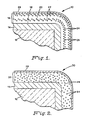
- FIGS 1 and 2 schematically illustrate typical articles 10 and 30 coated according to the invention.
- substrate 12 is a shaped cemented WC material, and may be a cutting tool or other article requiring wear resistance under the extreme conditions described above.
- a thin layer 14 of TiC covers the substrate, at least in the area subjected to wear.
- Composite layer 16 is deposited over TiC layer 14, and is made up of single-phase matrix portions 18 and 20 of Al2O3, and two-phase portions 22 of an Al2O3 matrix 24 and discrete particles 26 of ZrO2. As shown in Figure 1, there is no separation between the Al2O3 of matrix 24 of two-phase portions 22 and that of single-phase matrix portions 18 and 20.
- the Al2O3 of the composite coating is a single continuous matrix having a second phase of controlled composition and distribution dispersed therein.
- An outer layer 28 of TiN is deposited over the composite layer, giving article 10 a distinctive identifying color.
- FIG. 2 illustrates an alternate embodiment of the article coated according to the invention. Like features in the two figures are identified by the same reference numerals.
- substrate 12 is overlaid with thin TiC layer 14 in the same manner as shown in Figure 1.
- Composite layer 32 is deposited over TiC layer 14, and is made up of Al2O3 matrix 24 with particles 34 of Y2O3 stabilized ZrO2 evenly distributed throughout matrix 24.
- Outer layer 28 of TiN is deposited over the composite layer.
- samples of cutting tool inserts of a cemented carbide material, steel cutting grade C-5 were coated with a layer of TiC about 3 microns thick by known techniques in a CVD reactor.
- An excess of preweighed zirconium metal chips was placed in a separate vessel disposed in the reactor.
- An excess of aluminum chips was placed in a vessel outside the reactor.
- the reactor was evacuated to about 10 torr, then heated under low pressure, while being flushed with flowing hydrogen, to increase the outgassing before deposition.
- the reactor was cooled, at the deposition pressure and while being flushed with hydrogen, to about 300°C, then under ambient pressure and flowing nitrogen to room temperature.
- the deposition reaction conditions for Examples 1-6 are given in Table I, below.
- the halide gas was Cl2
- the carrier gas for the Al and Zr reactions was Ar
- the other reactant gas was CO2 with H2 as a carrier.
- the Cl2 flow rates were adjusted to give the metal chloride flow rates shown in Table I.
- the deposition pressure for Examples 1-6 was 50 torr; the temperature, 1040°C.
- a period of Al2O3 deposition (single-phase) ranging from 0.5 to 2.5 hrs was carried out before the two-phase Al2O3/ZrO2 deposition was begun.
- the single-phase deposition Ar gas was allowed to flow over the Zr, but the Cl2 gas flow was shut off.
- Example 1-6 The results of Examples 1-6 are shown in Table II.
- the thickness of the coatings was measured by the abrasive ball method (Calotest).
- the chemical composition of the coating was determined by x-ray diffraction analysis.
- the coating was deposited on the TiC underlayer as a stratified composite of alternating alumina and alumina/zirconia portions over a single-phase alumina portion, similar to that illustrated in Figure 1, but without the TiN layer over the oxide coating.
- the oxide coating and the TiC underlayer show satisfactory thickness and good adherence.
- Inserts A, B, C and D were tested by turning a 4340 steel workpiece under dry conditions at 700 sfm, 0.01 ipr, 0.5 in DOC. For each insert, 28 cu. in. of metal were removed in 6.7 min cutting time. The results are illustrated in Fig. 3, showing the average nose and flank wear for each type of insert.
- the inserts coated by the method according to the invention compared favorably with the materials in current commercial use.
- Examples 1-6 The process of Examples 1-6 was repeated for Examples 7 and 8, to coat the same type of TiC coated cemented carbide cutting tool inserts, except that both AlCl3 and ZrCl4 were flowing during the entire deposition period.
- the deposition pressure and temperature were 50 torr and 1040°C respectively.
- the remaining reaction conditions are given in Table III below.
- the resulting composite coatings were similar to that illustrated in Figure 2, except that no TiN layer was deposited over the oxide coating.
- the coating was a continuous ZrO2 matrix with Y2O3 particles distributed therein. No single phase portion was deposited below the two phase portion of the oxide layer.
- Examples 1-8 are also useful for applying similar coatings to hard ceramic substrates to produce similar cutting inserts.
Landscapes
- Chemical & Material Sciences (AREA)
- Inorganic Chemistry (AREA)
- General Chemical & Material Sciences (AREA)
- Chemical Kinetics & Catalysis (AREA)
- Engineering & Computer Science (AREA)
- Materials Engineering (AREA)
- Mechanical Engineering (AREA)
- Metallurgy (AREA)
- Organic Chemistry (AREA)
- Chemical Vapour Deposition (AREA)
- Application Of Or Painting With Fluid Materials (AREA)
- Macromolecular Compounds Obtained By Forming Nitrogen-Containing Linkages In General (AREA)
- Reinforced Plastic Materials (AREA)
Applications Claiming Priority (4)
| Application Number | Priority Date | Filing Date | Title |
|---|---|---|---|
| US5001 | 1987-01-20 | ||
| US07/005,003 US4751109A (en) | 1987-01-20 | 1987-01-20 | A process for depositing a composite ceramic coating on a hard ceramic substrate |
| US07/005,001 US4745010A (en) | 1987-01-20 | 1987-01-20 | Process for depositing a composite ceramic coating on a cemented carbide substrate |
| US5003 | 1987-01-20 |
Publications (4)
| Publication Number | Publication Date |
|---|---|
| EP0275978A2 true EP0275978A2 (de) | 1988-07-27 |
| EP0275978A3 EP0275978A3 (en) | 1990-04-04 |
| EP0275978B1 EP0275978B1 (de) | 1995-04-12 |
| EP0275978B2 EP0275978B2 (de) | 1999-03-10 |
Family
ID=26673767
Family Applications (1)
| Application Number | Title | Priority Date | Filing Date |
|---|---|---|---|
| EP88100691A Expired - Lifetime EP0275978B2 (de) | 1987-01-20 | 1988-01-19 | Verfahren zum Aufbringen von Verbundschichten |
Country Status (7)
| Country | Link |
|---|---|
| EP (1) | EP0275978B2 (de) |
| JP (1) | JP2626779B2 (de) |
| AT (1) | ATE121143T1 (de) |
| AU (1) | AU1026688A (de) |
| BR (1) | BR8800221A (de) |
| CA (1) | CA1329067C (de) |
| DE (1) | DE3853545T3 (de) |
Cited By (1)
| Publication number | Priority date | Publication date | Assignee | Title |
|---|---|---|---|---|
| US6033493A (en) * | 1994-12-01 | 2000-03-07 | Framatome | Process for coating a passivatable metal or alloy substrate with an oxide layer, and fuel assembly cladding and guide tubes and spacer grid coated with an oxide layer |
Families Citing this family (4)
| Publication number | Priority date | Publication date | Assignee | Title |
|---|---|---|---|---|
| JP5234354B2 (ja) * | 2009-01-07 | 2013-07-10 | 三菱マテリアル株式会社 | 耐熱塑性変形性、層間密着強度にすぐれた表面被覆切削工具 |
| DE102009037183B4 (de) | 2009-08-12 | 2012-03-22 | Bayerische Motoren Werke Aktiengesellschaft | Verfahren zur Herstellung eines Formteils, insbesondere eines Bedienteils für den Fahrgastraum eines Kraftfahrzeugs |
| JP5590329B2 (ja) * | 2011-02-03 | 2014-09-17 | 三菱マテリアル株式会社 | 硬質被覆層がすぐれた耐チッピング性、耐欠損性を備える表面被覆切削工具 |
| US9719175B2 (en) | 2014-09-30 | 2017-08-01 | Kennametal Inc. | Multilayer structured coatings for cutting tools |
Family Cites Families (3)
| Publication number | Priority date | Publication date | Assignee | Title |
|---|---|---|---|---|
| GB1275044A (en) * | 1968-05-08 | 1972-05-24 | Atomic Energy Authority Uk | Improvements in or relating to the deposition of oxide films |
| US4052530A (en) * | 1976-08-09 | 1977-10-04 | Materials Technology Corporation | Co-deposited coating of aluminum oxide and titanium oxide and method of making same |
| SE406090B (sv) * | 1977-06-09 | 1979-01-22 | Sandvik Ab | Belagd hardmetallkropp samt sett att framstalla en dylik kropp |
-
1988
- 1988-01-14 AU AU10266/88A patent/AU1026688A/en not_active Abandoned
- 1988-01-14 CA CA000556545A patent/CA1329067C/en not_active Expired - Fee Related
- 1988-01-19 BR BR8800221A patent/BR8800221A/pt unknown
- 1988-01-19 DE DE3853545T patent/DE3853545T3/de not_active Expired - Fee Related
- 1988-01-19 JP JP63007656A patent/JP2626779B2/ja not_active Expired - Lifetime
- 1988-01-19 AT AT88100691T patent/ATE121143T1/de not_active IP Right Cessation
- 1988-01-19 EP EP88100691A patent/EP0275978B2/de not_active Expired - Lifetime
Cited By (1)
| Publication number | Priority date | Publication date | Assignee | Title |
|---|---|---|---|---|
| US6033493A (en) * | 1994-12-01 | 2000-03-07 | Framatome | Process for coating a passivatable metal or alloy substrate with an oxide layer, and fuel assembly cladding and guide tubes and spacer grid coated with an oxide layer |
Also Published As
| Publication number | Publication date |
|---|---|
| DE3853545T2 (de) | 1995-08-24 |
| BR8800221A (pt) | 1988-08-30 |
| EP0275978B2 (de) | 1999-03-10 |
| EP0275978A3 (en) | 1990-04-04 |
| ATE121143T1 (de) | 1995-04-15 |
| EP0275978B1 (de) | 1995-04-12 |
| JP2626779B2 (ja) | 1997-07-02 |
| JPS63190785A (ja) | 1988-08-08 |
| CA1329067C (en) | 1994-05-03 |
| DE3853545D1 (de) | 1995-05-18 |
| AU1026688A (en) | 1988-07-21 |
| DE3853545T3 (de) | 1999-07-01 |
Similar Documents
| Publication | Publication Date | Title |
|---|---|---|
| US4745010A (en) | Process for depositing a composite ceramic coating on a cemented carbide substrate | |
| US4751109A (en) | A process for depositing a composite ceramic coating on a hard ceramic substrate | |
| US4701384A (en) | Composite coatings on cemented carbide substrates | |
| US4702970A (en) | Composite coatings on ceramic substrates | |
| EP0275975B1 (de) | Ultradünne mehrlagige Oxidbeschichtung | |
| US4714660A (en) | Hard coatings with multiphase microstructures | |
| US5827570A (en) | Composite ceramic articles and method for making such articles | |
| US5674564A (en) | Alumina-coated sintered body | |
| US3977061A (en) | Cutting insert and method of making the same | |
| US5654035A (en) | Method of coating a body with an α-alumina coating | |
| KR100348542B1 (ko) | 산화물이피복된절삭공구 | |
| Funk et al. | Coating of cemented carbide cutting tools with alumina by chemical vapor deposition | |
| EP0106817B1 (de) | Schneideinsatz und Verfahren zu seiner Herstellung | |
| US4844951A (en) | Method for depositing ultrathin laminated oxide coatings | |
| EP0275977B1 (de) | Verbundschichten | |
| JPH0576546B2 (de) | ||
| US4943450A (en) | Method for depositing nitride-based composite coatings by CVD | |
| CA1333763C (en) | Oxidation resistant, high temperature thermal cycling resistant coatings on silicon-based substrates and process for the production thereof | |
| US6284366B1 (en) | Cutting tool and method of making same | |
| EP0275978A2 (de) | Verfahren zum Aufbringen von Verbundschichten | |
| JP3117978B2 (ja) | 耐摩耗性物品及び製造方法 | |
| JP2646247B2 (ja) | AlN被覆窒化珪素基切削工具 | |
| PL174004B1 (pl) | Sposób powlekania narzędzia warstwątlenku oraz narzędzie powleczone warstwątlenku |
Legal Events
| Date | Code | Title | Description |
|---|---|---|---|
| PUAI | Public reference made under article 153(3) epc to a published international application that has entered the european phase |
Free format text: ORIGINAL CODE: 0009012 |
|
| AK | Designated contracting states |
Kind code of ref document: A2 Designated state(s): AT CH DE FR GB IT LI SE |
|
| PUAL | Search report despatched |
Free format text: ORIGINAL CODE: 0009013 |
|
| AK | Designated contracting states |
Kind code of ref document: A3 Designated state(s): AT CH DE FR GB IT LI SE |
|
| 17P | Request for examination filed |
Effective date: 19900927 |
|
| 17Q | First examination report despatched |
Effective date: 19920123 |
|
| RAP1 | Party data changed (applicant data changed or rights of an application transferred) |
Owner name: GTE VALENITE CORPORATION |
|
| RAP1 | Party data changed (applicant data changed or rights of an application transferred) |
Owner name: VALENITE INC. |
|
| GRAA | (expected) grant |
Free format text: ORIGINAL CODE: 0009210 |
|
| AK | Designated contracting states |
Kind code of ref document: B1 Designated state(s): AT CH DE FR GB IT LI SE |
|
| REF | Corresponds to: |
Ref document number: 121143 Country of ref document: AT Date of ref document: 19950415 Kind code of ref document: T |
|
| ET | Fr: translation filed | ||
| REF | Corresponds to: |
Ref document number: 3853545 Country of ref document: DE Date of ref document: 19950518 |
|
| ITF | It: translation for a ep patent filed | ||
| PLBI | Opposition filed |
Free format text: ORIGINAL CODE: 0009260 |
|
| PLBF | Reply of patent proprietor to notice(s) of opposition |
Free format text: ORIGINAL CODE: EPIDOS OBSO |
|
| 26 | Opposition filed |
Opponent name: SANDVIK AB Effective date: 19960110 |
|
| PLBF | Reply of patent proprietor to notice(s) of opposition |
Free format text: ORIGINAL CODE: EPIDOS OBSO |
|
| PLBQ | Unpublished change to opponent data |
Free format text: ORIGINAL CODE: EPIDOS OPPO |
|
| PLAW | Interlocutory decision in opposition |
Free format text: ORIGINAL CODE: EPIDOS IDOP |
|
| APAC | Appeal dossier modified |
Free format text: ORIGINAL CODE: EPIDOS NOAPO |
|
| APAE | Appeal reference modified |
Free format text: ORIGINAL CODE: EPIDOS REFNO |
|
| APAC | Appeal dossier modified |
Free format text: ORIGINAL CODE: EPIDOS NOAPO |
|
| PLAW | Interlocutory decision in opposition |
Free format text: ORIGINAL CODE: EPIDOS IDOP |
|
| PUAH | Patent maintained in amended form |
Free format text: ORIGINAL CODE: 0009272 |
|
| STAA | Information on the status of an ep patent application or granted ep patent |
Free format text: STATUS: PATENT MAINTAINED AS AMENDED |
|
| 27A | Patent maintained in amended form |
Effective date: 19990310 |
|
| AK | Designated contracting states |
Kind code of ref document: B2 Designated state(s): AT CH DE FR GB IT LI SE |
|
| ET3 | Fr: translation filed ** decision concerning opposition | ||
| REG | Reference to a national code |
Ref country code: CH Ref legal event code: AEN Free format text: AUFRECHTERHALTUNG DES PATENTES IN GEAENDERTER FORM |
|
| ITF | It: translation for a ep patent filed | ||
| PGFP | Annual fee paid to national office [announced via postgrant information from national office to epo] |
Ref country code: FR Payment date: 20010102 Year of fee payment: 14 |
|
| PGFP | Annual fee paid to national office [announced via postgrant information from national office to epo] |
Ref country code: SE Payment date: 20010103 Year of fee payment: 14 Ref country code: DE Payment date: 20010103 Year of fee payment: 14 |
|
| PGFP | Annual fee paid to national office [announced via postgrant information from national office to epo] |
Ref country code: CH Payment date: 20010104 Year of fee payment: 14 Ref country code: AT Payment date: 20010104 Year of fee payment: 14 |
|
| PGFP | Annual fee paid to national office [announced via postgrant information from national office to epo] |
Ref country code: GB Payment date: 20010105 Year of fee payment: 14 |
|
| REG | Reference to a national code |
Ref country code: GB Ref legal event code: IF02 |
|
| PG25 | Lapsed in a contracting state [announced via postgrant information from national office to epo] |
Ref country code: GB Free format text: LAPSE BECAUSE OF NON-PAYMENT OF DUE FEES Effective date: 20020119 Ref country code: AT Free format text: LAPSE BECAUSE OF NON-PAYMENT OF DUE FEES Effective date: 20020119 |
|
| PG25 | Lapsed in a contracting state [announced via postgrant information from national office to epo] |
Ref country code: SE Free format text: LAPSE BECAUSE OF NON-PAYMENT OF DUE FEES Effective date: 20020120 |
|
| PG25 | Lapsed in a contracting state [announced via postgrant information from national office to epo] |
Ref country code: LI Free format text: LAPSE BECAUSE OF NON-PAYMENT OF DUE FEES Effective date: 20020131 Ref country code: CH Free format text: LAPSE BECAUSE OF NON-PAYMENT OF DUE FEES Effective date: 20020131 |
|
| PG25 | Lapsed in a contracting state [announced via postgrant information from national office to epo] |
Ref country code: DE Free format text: LAPSE BECAUSE OF NON-PAYMENT OF DUE FEES Effective date: 20020801 |
|
| EUG | Se: european patent has lapsed |
Ref document number: 88100691.0 |
|
| GBPC | Gb: european patent ceased through non-payment of renewal fee |
Effective date: 20020119 |
|
| REG | Reference to a national code |
Ref country code: CH Ref legal event code: PL |
|
| PG25 | Lapsed in a contracting state [announced via postgrant information from national office to epo] |
Ref country code: FR Free format text: LAPSE BECAUSE OF NON-PAYMENT OF DUE FEES Effective date: 20020930 |
|
| REG | Reference to a national code |
Ref country code: FR Ref legal event code: ST |
|
| PG25 | Lapsed in a contracting state [announced via postgrant information from national office to epo] |
Ref country code: IT Free format text: LAPSE BECAUSE OF NON-PAYMENT OF DUE FEES Effective date: 20050119 |
|
| APAH | Appeal reference modified |
Free format text: ORIGINAL CODE: EPIDOSCREFNO |