EP0276079A2 - Verfahren zum Formen von keramischen Fasern und doppelten Keramik-/Nichtkeramikfasern und doppelten Fasern von nichtkreisförmigem Querschnitt - Google Patents
Verfahren zum Formen von keramischen Fasern und doppelten Keramik-/Nichtkeramikfasern und doppelten Fasern von nichtkreisförmigem Querschnitt Download PDFInfo
- Publication number
- EP0276079A2 EP0276079A2 EP88300252A EP88300252A EP0276079A2 EP 0276079 A2 EP0276079 A2 EP 0276079A2 EP 88300252 A EP88300252 A EP 88300252A EP 88300252 A EP88300252 A EP 88300252A EP 0276079 A2 EP0276079 A2 EP 0276079A2
- Authority
- EP
- European Patent Office
- Prior art keywords
- ceramic
- fiber
- ceramic fiber
- chemical precursor
- fibers
- Prior art date
- Legal status (The legal status is an assumption and is not a legal conclusion. Google has not performed a legal analysis and makes no representation as to the accuracy of the status listed.)
- Granted
Links
Images





Classifications
-
- C—CHEMISTRY; METALLURGY
- C04—CEMENTS; CONCRETE; ARTIFICIAL STONE; CERAMICS; REFRACTORIES
- C04B—LIME, MAGNESIA; SLAG; CEMENTS; COMPOSITIONS THEREOF, e.g. MORTARS, CONCRETE OR LIKE BUILDING MATERIALS; ARTIFICIAL STONE; CERAMICS; REFRACTORIES; TREATMENT OF NATURAL STONE
- C04B35/00—Shaped ceramic products characterised by their composition; Ceramics compositions; Processing powders of inorganic compounds preparatory to the manufacturing of ceramic products
- C04B35/622—Forming processes; Processing powders of inorganic compounds preparatory to the manufacturing of ceramic products
- C04B35/62227—Forming processes; Processing powders of inorganic compounds preparatory to the manufacturing of ceramic products obtaining fibres
- C04B35/62231—Forming processes; Processing powders of inorganic compounds preparatory to the manufacturing of ceramic products obtaining fibres based on oxide ceramics
-
- C—CHEMISTRY; METALLURGY
- C04—CEMENTS; CONCRETE; ARTIFICIAL STONE; CERAMICS; REFRACTORIES
- C04B—LIME, MAGNESIA; SLAG; CEMENTS; COMPOSITIONS THEREOF, e.g. MORTARS, CONCRETE OR LIKE BUILDING MATERIALS; ARTIFICIAL STONE; CERAMICS; REFRACTORIES; TREATMENT OF NATURAL STONE
- C04B41/00—After-treatment of mortars, concrete, artificial stone or ceramics; Treatment of natural stone
- C04B41/45—Coating or impregnating, e.g. injection in masonry, partial coating of green or fired ceramics, organic coating compositions for adhering together two concrete elements
- C04B41/4584—Coating or impregnating of particulate or fibrous ceramic material
-
- D—TEXTILES; PAPER
- D01—NATURAL OR MAN-MADE THREADS OR FIBRES; SPINNING
- D01F—CHEMICAL FEATURES IN THE MANUFACTURE OF ARTIFICIAL FILAMENTS, THREADS, FIBRES, BRISTLES OR RIBBONS; APPARATUS SPECIALLY ADAPTED FOR THE MANUFACTURE OF CARBON FILAMENTS
- D01F9/00—Artificial filaments or the like of other substances; Manufacture thereof; Apparatus specially adapted for the manufacture of carbon filaments
- D01F9/08—Artificial filaments or the like of other substances; Manufacture thereof; Apparatus specially adapted for the manufacture of carbon filaments of inorganic material
-
- Y—GENERAL TAGGING OF NEW TECHNOLOGICAL DEVELOPMENTS; GENERAL TAGGING OF CROSS-SECTIONAL TECHNOLOGIES SPANNING OVER SEVERAL SECTIONS OF THE IPC; TECHNICAL SUBJECTS COVERED BY FORMER USPC CROSS-REFERENCE ART COLLECTIONS [XRACs] AND DIGESTS
- Y10—TECHNICAL SUBJECTS COVERED BY FORMER USPC
- Y10S—TECHNICAL SUBJECTS COVERED BY FORMER USPC CROSS-REFERENCE ART COLLECTIONS [XRACs] AND DIGESTS
- Y10S264/00—Plastic and nonmetallic article shaping or treating: processes
- Y10S264/19—Inorganic fiber
-
- Y—GENERAL TAGGING OF NEW TECHNOLOGICAL DEVELOPMENTS; GENERAL TAGGING OF CROSS-SECTIONAL TECHNOLOGIES SPANNING OVER SEVERAL SECTIONS OF THE IPC; TECHNICAL SUBJECTS COVERED BY FORMER USPC CROSS-REFERENCE ART COLLECTIONS [XRACs] AND DIGESTS
- Y10—TECHNICAL SUBJECTS COVERED BY FORMER USPC
- Y10T—TECHNICAL SUBJECTS COVERED BY FORMER US CLASSIFICATION
- Y10T428/00—Stock material or miscellaneous articles
- Y10T428/29—Coated or structually defined flake, particle, cell, strand, strand portion, rod, filament, macroscopic fiber or mass thereof
- Y10T428/2913—Rod, strand, filament or fiber
- Y10T428/2929—Bicomponent, conjugate, composite or collateral fibers or filaments [i.e., coextruded sheath-core or side-by-side type]
-
- Y—GENERAL TAGGING OF NEW TECHNOLOGICAL DEVELOPMENTS; GENERAL TAGGING OF CROSS-SECTIONAL TECHNOLOGIES SPANNING OVER SEVERAL SECTIONS OF THE IPC; TECHNICAL SUBJECTS COVERED BY FORMER USPC CROSS-REFERENCE ART COLLECTIONS [XRACs] AND DIGESTS
- Y10—TECHNICAL SUBJECTS COVERED BY FORMER USPC
- Y10T—TECHNICAL SUBJECTS COVERED BY FORMER US CLASSIFICATION
- Y10T428/00—Stock material or miscellaneous articles
- Y10T428/29—Coated or structually defined flake, particle, cell, strand, strand portion, rod, filament, macroscopic fiber or mass thereof
- Y10T428/2913—Rod, strand, filament or fiber
- Y10T428/2933—Coated or with bond, impregnation or core
-
- Y—GENERAL TAGGING OF NEW TECHNOLOGICAL DEVELOPMENTS; GENERAL TAGGING OF CROSS-SECTIONAL TECHNOLOGIES SPANNING OVER SEVERAL SECTIONS OF THE IPC; TECHNICAL SUBJECTS COVERED BY FORMER USPC CROSS-REFERENCE ART COLLECTIONS [XRACs] AND DIGESTS
- Y10—TECHNICAL SUBJECTS COVERED BY FORMER USPC
- Y10T—TECHNICAL SUBJECTS COVERED BY FORMER US CLASSIFICATION
- Y10T428/00—Stock material or miscellaneous articles
- Y10T428/29—Coated or structually defined flake, particle, cell, strand, strand portion, rod, filament, macroscopic fiber or mass thereof
- Y10T428/2913—Rod, strand, filament or fiber
- Y10T428/2933—Coated or with bond, impregnation or core
- Y10T428/2935—Discontinuous or tubular or cellular core
-
- Y—GENERAL TAGGING OF NEW TECHNOLOGICAL DEVELOPMENTS; GENERAL TAGGING OF CROSS-SECTIONAL TECHNOLOGIES SPANNING OVER SEVERAL SECTIONS OF THE IPC; TECHNICAL SUBJECTS COVERED BY FORMER USPC CROSS-REFERENCE ART COLLECTIONS [XRACs] AND DIGESTS
- Y10—TECHNICAL SUBJECTS COVERED BY FORMER USPC
- Y10T—TECHNICAL SUBJECTS COVERED BY FORMER US CLASSIFICATION
- Y10T428/00—Stock material or miscellaneous articles
- Y10T428/29—Coated or structually defined flake, particle, cell, strand, strand portion, rod, filament, macroscopic fiber or mass thereof
- Y10T428/2913—Rod, strand, filament or fiber
- Y10T428/2933—Coated or with bond, impregnation or core
- Y10T428/2971—Impregnation
Definitions
- the present invention relates to nested ceramic fibers, non-circular ceramic fibers, and a piggyback micro-mold method for producing both kinds of ceramic fibers as well as circular ceramic fibers.
- Ceramic refractory fibers of alumina-silica, alumina and zirconia can be produced by a blowing method which calls for shattering a stream of molten ceramic with a jet of air or steam. Production of ceramic fibers by this method has the disadvantage of requiring large amounts of capital investment in process and control machinery.
- Other methods which have been used to produce ceramic fibers include spinning methods, continuous filament methods, colloidal evaporation processes, vapor deposition single-crystal method, whisker method, oxidation method, crystallization method and pseudomorphic alteration method.
- Ceramic fibers produced by melt drawing are further limited to compositions containing appreciable amounts of so-called "glass forming oxides" such as SiO2, B2O5, or P2O5. Melt drawing requires high temperatures and special equipment for the drawing of the fibers.
- sol-gel processing does pose a number of difficulties.
- one drawback to sol-gel processing is the difficulty in forming large monolithic pieces.
- Many compositions formed via the sol-gel process are limited to powders or thin films.
- Composite materials including graphite fibers in a matrix can be formed, and composite materials can be formed with ceramic fibers in a matrix as taught in U.S.-4,454,190.
- ceramic materials are difficult to work with because of their amorphous properties prior to sintering and their brittle properties after sintering.
- the production of a fiber having a ceramic portion and a non-ceramic portion is not known.
- An object of the present invention is to provide a dual fiber composed of ceramic material nested in another material, and also to provide a method of producing such a fiber.
- the present invention seeks to provide a method of producing a ceramic fiber that requires less capital investment in processing and control apparatus than conventional methods.
- Another aim of the present invention is to provide ceramic fibers having non-circular transverse cross-sectional perimeters and also to provide a method of producing such ceramic fibers.
- a piggyback method of forming an elongated dual fiber having an elongated ceramic portion and an elongated non-ceramic portion starting with a wet chemical precursor and a non-ceramic fiber having an elongated cavity therein.
- the method comprises wetting the non-ceramic fiber in the wet chemical precursor; setting the wet chemical precursor portion of the wetted non-ceramic fiber; placing the wetted non-ceramic fiber into an oxygen-free environment; heating the set wetted non-ceramic fiber in the oxygen-free environment to a temperature sufficient to sinter or pyrolyze the chemical precursor portion into a ceramic portion.
- the non-ceramic fiber is formed of one of the following materials: any carbon such as pitch, mesophase carbon, polyacrylinitrile (hereafter PAN), or any polymer such as polyethylene, polyvinyl alcohol, nylon, and the like.
- the elongated non-ceramic carrier fiber portion has an elongated cavity with either a C-shape or an annulus shape to its transverse cross-sectional perimeter. In other words, the carrier fiber portion defines an elongated cavity which has an open or closed cross-sectional shape.
- a dual fiber comprising an elongated non-ceramic carrier fiber portion having a non-circular transverse cross-sectional perimeter over a substantial length thereof and defining a cavity therein; and an elongated ceramic filler portion nesting in the cavity.
- the piggyback method of forming a dual fiber can be transformed into a piggyback micro-mold method of forming a ceramic fiber by adding the step of removing the non-ceramic fiber portion of the dual fiber to yield a ceramic fiber.
- the step of removing the non-ceramic fiber portion of the dual fiber is carried out either by heating the dual ceramic/non-ceramic fiber in an oxygen-containing environment until the non-ceramic fiber portion is burned away, or by mechanically stripping away the non-ceramic fiber portion leaving only the ceramic portion.
- an elongated ceramic fiber having a non-circular transverse cross-sectional perimeter over a substantial length thereof.
- a piggyback micro-mold method for forming a dual fiber having a substantial ceramic portion.
- the method of the present invention requires as starting materials, a wet chemical precursor, such as a sol-gel, and an elongated non-ceramic fiber having a non-circular transverse cross-sectional perimeter over a substantial portion of the length thereof.
- the transverse cross-sectional perimeter of the non-ceramic fiber defines an elongated cavity therein.
- These non-circular non-ceramic fibers act as micro-molds for a wet chemical precursor that is prepared from materials that would be desirable in the form of ceramic fibers.
- the materials constituting a part of the wet chemical precursor are not necessarily spinnable or easily formed into fibers by conventional methods.
- an elongated non-ceramic fiber having a non-circular transverse cross-sectional perimeter over a substantial portion of the length thereof.
- a carrier micro-mold fiber 20 has a C-shaped transverse cross-sectional perimeter 22.
- a carrier micro-mold fiber 24 has an annulus-shaped transverse cross-sectional perimeter 26.
- Fibers 20, 24 constitute suitable non-ceramic carrier fibers comprising components of the starting materials of the method of the present invention. Because of the non-circular transverse cross-sectional perimeters of the fibers used as micro-molds in the method of the present invention, an elongated cavity 28 is provided in the micro-mold carrier fibers.
- the non-ceramic carrier micro-mold fiber is formed from carbon or an organic polymer.
- the carbon can be in the form of pitch, meosphase or polyacrylinitrile.
- the organic polymer can be polyethylene, polyvinyl alcohol, nylon, or the like.
- Carbon or graphite carrier micro-mold fibers having a C-shaped or annulus-shaped profile can be obtained using the method set forth in our co-pending European Patent Application, Publication No. 0 232 051 which is hereby incorporated herein by reference.
- Polyethylene, nylon, and polyacrylinitrile carrier micro-mold fibers can be obtained using conventional spinning procedures for commercial polymers.
- Cavity 28 is available for receiving a wet chemical precursor which can be heat treated to form ceramic material.
- wet chemical precursors include: sol-gels, slurries, melts, suspensions and dispersions.
- ceramic materials used to form the wet chemical precursors which constituted one component of the starting material for the method of the present invention are: silica, alumina, silicon carbide, zirconia and hydroxyapatite.
- a sol is a suspension of fine solid particles in a liquid.
- a sol is usually the first stage in the formation of a gel, which is a two-phase colloidal mixture of a liquid and a solid.
- a slurry defines coarse particulate matter combined with a liquid.
- a melt is the liquid phase of a substance.
- Suspensions and dispersions are used interchangeably to define particulate matter on the order of between 1 micron (10 ⁇ 3 mm.) to one millimicron (10 ⁇ 6 mm.) in size suspended in a liquid.
- an organosilicate such as tetraethyl orthosilicate (TEOS) is mixed with a solvent, ethyl alcohol, for example.
- a continuous Si-O-Si network can then form through polymerization.
- Hydrolysis can occur in the following ways: Si(OR)4+H2O (RO)3 - Si - OH + ROH (1) Si(OR)4+2H2O (RO)2 - Si - (OH)2 + 2ROH (2) Si(OR)4+3H2O (RO) - Si - (OH)3 + 3ROH (3) Si(OR)4+4H2O Si - (OH)4 + 4ROH (4)
- Equation 4 shows a fully hydrolyzed system, in which all four (OR) groups are replaced by (OH) groups. This process consumes H2O, requiring four moles of H2O for every mole of TEOS.
- the Si-OH can react to form bridging oxygens between silicate molecules, releasing H2O as shown in equation (5): 2Si-OH Si - O - Si + H2O (5)
- the H2O that is condensed during polymerization can then cause further hydrolysis, allowing complete hydrolysis with less than four moles of H2O for every mole of TEOS.
- Si-O-Si linkage between particles or large molecules may be sufficient to bind particles together to form a rigid, porous, tangled network of branching chains.
- Hydroylsis and condensation reactions are critical steps, since they determine whether the subsequent processing steps to form the sol-gel will be successful. Both hydrolysis and condensation are affected by the following factors: the H2O to TEOS molar ratio, the solvent to TEOS ratio, temperature, pH, atmosphere, mixing speed, and time.
- Hydrolysis and condensation rates of a sol-gel can be increased by addition of acid or base as a catalytic agent.
- acid catalyzed systems pH less than two
- hydrolysis is rapid, but gelation is slow. This is due to a small amount of linkage between particles, which is a result of the small ionic charge of the particles.
- the ionic charge of the particles which increases as pH increases, is needed to facilitate particle-particle collisions. The result is a tendency towards chains rather than a three dimensional network.
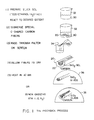
- the step of wetting the non-ceramic fiber in a wet chemical precursor preferably comprises submerging non-ceramic fibers 20 beneath the surface of a wet chemical precursor 30 held in a bath 32. This step also can be accomplished by dipping, bathing, spraying, or the like.
- the wet chemical precursor is allowed to set until it nests in the cavity of the non-ceramic fiber.
- the non-ceramic fiber is removed from the wet chemical precursor bath. As shown in Fig. 1, this can be accomplished by draining the liquid through a screen 34 to filter the non-ceramic fibers. As the non-ceramic fibers are removed from the wet chemical precursor bath, surface tension causes the wet chemical precursor to adhere to the non-ceramic fiber.
- the non-ceramic fiber micro-mold carries with it a substantial amount of the wet chemical precursor in the elongated cavity of the non-ceramic fiber.
- the wet chemical precursor in the cavity has set sufficiently to nest in the cavity of the non-ceramic fiber. This is shown for example in Fig. 4, for a non-ceramic fiber composed of carbon and a silica wet chemical precursor.
- a metal oxide sol-gel is a suitable wet chemical precursor for the method of the present invention.
- One of the factors that affects setting, i.e., gelling, time of a sol-gel is the H2O content.
- the gelling time will decrease because of the increase in the number of reactants.
- the humidity of the atmosphere above a solution can affect the water content. Because the gelling time is sensitive to water content, the gelling time could be affected by the atmosphere.
- the non-ceramic fiber with the wet chemical precursor set and nested in the cavity of the fiber is placed in an oxygen-free environment and heated to a temperature sufficient to pyrolyze or sinter the chemical precursor portion into a ceramic portion.
- the actual temperature depends on the composition of the chemical precursor portion, the preparation technique for the chemical precursor and the sintering desired.
- the sintering temperature cannot be so high as to burn away the non-ceramic fiber portion, unless removal of this portion is desired.
- the oxygen-free environment is provided by filling a heating chamber 36 with a non-oxidizing gas such as inert gases like argon, helium or nitrogen.
- the temperature inside the heating chamber is then raised in step-wise fashion over time at a rate of about 20° C per minute to a temperature of at least 600° C for a period of 20 to 30 minutes, or a longer or shorter time as necessary to pyrolyze or sinter the chemical precursor portion into a continuous ceramic portion nested in the cavity of the non-ceramic fiber portion.
- a dual fiber is produced.
- the dual fiber has a ceramic fiber portion nested in the C-shaped carbon fiber micro-mold portion.
- the line in the lower right hand corner of Fig. 18 represents a length of 100 microns.
- an additional processing step can be provided to remove the non-ceramic fiber portion of the non-ceramic/ceramic dual fiber in order to yield a ceramic fiber.
- This ceramic fiber may have a circular or non-circular transverse cross-sectional perimeter, depending on the shape of the cavity of the micro-mold carrier fiber.
- the step of removing the non-ceramic fiber portion preferably comprises heating the dual fiber in an oxygen-containing environment until the non-ceramic fiber portion is burned away and only the ceramic portion remains. Preferably, this is accomplished by evacuating the non-oxydizing gas from the heating chamber and substituting into the heating chamber an atmosphere of air.
- the temperature within the heating chamber is raised to a temperature sufficient to burn away the non-ceramic portion of the dual fiber.
- a temperature of approximately 1100° C has been used for a period of time which is sufficient to burn away the non-ceramic micro-mold fiber portion of the dual fiber.
- a temperature of approximately as low as 600°C can be used to burn away the non-ceramic micro-mold fiber portion of the dual fiber.
- a non-ceramic micro-mold fiber portion is mechanically removed until only the ceramic portion remains. This can be accomplished by using a separating agent or employing a shaking technique in the presence of an abrasion agent or instrumentality.
- the step of heating the non-ceramic fiber portion having the set wet precursor nested in the cavity can be eliminated, and the method can proceed directly to the step of removing the non-ceramic fiber portion by firing same in an air atmosphere.
- the firing in an air atmosphere is sufficient to pyrolyze or sinter the set chemical precursor into a continuous ceramic portion.
- the omission of the step of heating in a non-oxidizing environment can be used when the object of the method is to produce a ceramic fiber rather than a dual fiber having a ceramic portion nested in a non-ceramic portion. This is because the firing in an air atmosphere oxydizes the non-ceramic fiber portion and thus removes same.
- the materials chosen to demonstrate the effectiveness of the piggyback process as a means of forming ceramic fibers were: SiO2, Al2O3, ZrO2, SiC, and Hydroxyapatite.
- a silica sol was prepared using tetraethyl orthosilicate (hereafter TEOS) , which can be obtained from Fisher Scientific Co., P.O. Box 829, Norcross, Georgia 30091.
- the silica sol was prepared by adding anhydrous ethyl alcohol to TEOS in the ratio of three moles of alcohol to each mole of TEOS. The solution was mixed for 15 minutes before adding hydrochloric acid at a concentration that allowed the molecular ratio of water to TEOS to be 6.0 : 1.0 and the concentration of HCl to TEOS to be 0.01 : 1.0. The HCl solution was added dropwise over a period of 25 minutes. The sol was then covered and mixing continued for two hours.
- the water to TEOS molar ratio of the above sol was 6.0 : 1.0, corresponding to a solution that does not exhibit spinnability.
- Carbon fibers having a C-shaped transverse cross-sectional perimeter were prepared as described in our aforesaid European Patent Application, Publication No. 0 232 051.
- the C-shaped carbon fibers were submerged into the sol and removed from the sol before the sol reached the gelling point. No strict guidelines applied to the time at which the carbon fibers were dipped in the sol, except that it had to be after the final acid addition, and before gelling.
- the viscosity of the solution increases slowly with time as polymerization takes place. When the viscosity approaches 1 Pa Sec, it becomes difficult to separate the fibers from the sol and the fibers also tend to clump together.
- the dipped fibers were set by allowing them to dry in atmospheric pressure at room temperature.
- the set fibers were examined under a light microscope to reveal that the cavity of the "C" was filled with silica gel.
- a scanning electron microscope (hereafter SEM) photograph showing the gel nested within the C-shaped cavity is shown in Fig. 4 at a magnification of 2000 times actual size.
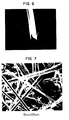
- the set fiber was heated from room temperature to 800° C at a rate of 20° C per minute to simultaneously burn off the carbon carrier fiber portion and complete the gel-to-glass transformation. Pure, transparent, amorphous silica fibers were the result and are shown in a SEM photograph in Fig. 5 at a magnification of 200 times.
- the tensile strength of these fibers was in excess of 150,000 psi (10.3 x 10² N/mm2).
- An individual silica fiber is shown in an SEM photograph in Fig. 6 at a magnification of 800 times. Note that the ceramic fiber shown in Fig. 6 has a non-circular transverse cross-sectional perimeter which is shaped like a crescent moon.
- silica sols were prepared with varying amounts of water, alcohol, and acid. Acid-base catalyzed systems were also used.
- zirconia fibers via the piggyback process Several different methods were used to form zirconia fibers via the piggyback process. These can be separated according to the three different starting materials: Zirconyl Hydroxycloride Trihydrate, supplied by Harshaw Chemical Company, Zirconium Acetate Solution, supplied by Harshaw, and Zirconium n-Butoxide Butanol Complex, supplied by Alfa Products, Inc.
- the MgCO3 was a precipitate. Both passed easily through 400 mesh.
- the powders were milled in a plastic jar using alumina grinding media. A slurry was made by adding water to the powder in a one to one volume ratio. Algin was added as a stabilizing agent.
- C-shaped carbon fibers were submerged, removed, dried and fired.
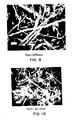
- the firing was done in two ways. In the first way, the dipped fibers were first fired to 1450° C in a non-oxidizing atmosphere, then oxidized to burn off the carbon fiber. In the second way, the fibers were fired in air to 1600° C. X-ray diffraction was used to determine that the final material was a zirconia fiber in crystal form. There were fibers in the tetragonal phase and some in the monoclinic phase. Zirconia fibers fired in the first way are shown in Fig. 8 in a SEM photograph. The rectangular bar in the lower left corner of Fig. 8 represents a length of 100 microns for purposes of indicating the fiber dimensions.
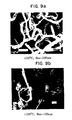
- Fig. 9 Zirconia fibers fired in the second way are shown in Fig. 9 in a SEM photograph.
- the firing temperature was 600°C
- Fig. 9b the firing temperature was 1600°C.
- the rectangular bars in the lower corners of Figs. 9a and 9b represent a length of 100 microns for purposes of indicating the fiber dimensions.
- zirconium acetate was used as the starting material for zirconia, a 25% zirconium acetate solution supplied by Harshaw Chemical Company was used. Either calcium oxide or yttria was employed as the stabilizing agent. Where calcium oxide was the stabilizing agent, 12 mol % equivalent CaO was added by dissolving the correct amount of calcium acetate (Ca(C2H3O2) ⁇ H2O) in the zirconium acetate solution. 0.1 mol % MgO was also included with the CaO as a sintering agent. The MgO was also added to the zirconium acetate solution in the acetate form (Mg (C2H3O2)2 ⁇ 4H2O).
- yttria was the stabilizer
- Y (C2H3O2)3 ⁇ xH2O, X 2
- C-shaped carbon fibers were submerged in them, removed, dried, and fired to a temperature as low as 750° C to form zirconia.
- X-ray diffraction was used to characterize the fired material as zirconia in the tetrogonal and monoclinic phases.
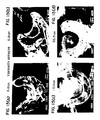
- Zirconia fibers produced from the acetate are shown in Fig. 10 in a SEM photograph in which the rectangular bar in the lower left corner represents a length of 25 microns for purposes of indicating the fiber dimensions.
- Fig. 11a shows fibers fired to 600°C in air
- Fig. 11b shows these fibers fired to 1600°C in air
- the rectangular bar represents a length of 100 microns
- Fig. 11b the bar represents a length of 200 microns.
- Zirconia fibers made from this trihydrate precursor appear to be made up of smaller fiber-like particles at 600°C whereas at 1600°C they appear to be more dense and are accompanied by larger non-fibrous particles. This starting material for the precursor is incapable of being drawn into a fiber or spun into a fiber through a spinerette.
- TEOS was added to the solution of alcohol and HCl.
- the TEOS : furfuryl alcohol volume ratio was 1:1.
- the H2O : TEOS molar ratio was 2:1, and the HCL : TEOS molar ratio was 0.01 : 1.0.
- This solution was mixed for one day before C-shaped carbon fibers were submerged, removed, dried and fired to 1450° C in an argon atmosphere. After firing in argon, the fibers were oxidized to 600° C to remove the carbon fibers and any excess carbon.
- the resulting fiber material was characterized by x-ray diffraction as ceramic material such as beta-SiC. These fibers are shown in Fig. 12 in a SEM photograph in which the rectangular bar in the lower left corner represents a length of 200 microns for purposes of indicting the fiber dimensions.
- SiC was made from polysilastyrene (PSS).
- PSS polysilastyrene
- the PSS was produced by a method similar to that described in R. West et al, "Polysilastyrene: Phenylmethylsilane-Dimethylsilane Copolymers as Precursors to Silicon Carbide," American Chemical Society Bulletin , Vol. 62, No. 8, pp. 899-902 (1983), which is hereby incorporated herein by reference, and via the TEOSIC process® using TEOS and Furfuryl Alcohol supplied by Fisher Scientific Co.
- C-shaped carbon fibers were submerged in a PSS-tolvene solution, removed, dried and pyrolyzed in an argon atmosphere at 1100°C.
- FT-IR Fourier transform infra-red spectroscopy
- HA-slurry A hydroxyapatite slurry (HA-slurry) was supplied by Coors Biomedical Company. C-shaped carbon fibers were submerged in HA-slurry, removed and dried. Redipping and drying was repeated two more times. The triple dipped fibers were then placed in a pure nitrogen (N2) atmosphere which was then heated from room temperature to 980° C at a rate of 4° C per minute. Then the fibers were removed from the nitrogen atmosphere and placed in an air atmosphere at room temperature. The fibers then were heated in the air atmosphere from room temperature to 600°C, at 5° C per minute. The samples were cooled slowly by leaving them in the furnace as it cooled after both heat treatments.
- Fig. 14 shows a SEM photograph at 50 times magnification for hydroxyapatite ceramic fibers produced according to the method of Example 5.
- a silica sol was prepared with a 2:1 TEOS to ethanol volume ratio, a 2:1 H2O to TEOS molar ratio, and a 0.01 : 1.0 HCl to TEOS molar ratio.
- the sol was covered with plastic wrap and mixed at a constant rate. After three days, pin-holes were made in the cover to allow some evaporation. After four days the pin-holes were enlarged to about 1/8 inch (3 mm) diameter. After five days the mixing rate was increased by 25%. The viscosity was measured and C-shaped carbon fibers dipped as shown on Table V.
- the ceramic fiber portion of the dual fiber produced according to the method of the present invention acquires a transverse cross-sectional perimeter that becomes more circular.
- the viscosity of the chemical precursor provides some degree of control over the non-circularity of the transverse cross-sectional perimeter of the ceramic fiber portion.
- Fig. 16 shows silica ceramic fibers formed by using nylon fibers having a trilobal transverse cross-sectional perimeter for the non-ceramic micro-mold portions.
- the rectangle at the lower left corner of Fig. 16 represents a length of 200 microns and indicates the dimensions of the silica fibers shown therein.
- Fig. 17 shows the trilobal nylon fiber acting as the micro-mold carrier fiber for the silica fibers shown in Fig. 16.
- the bar in the corner of Fig. 17 represents a length of 20 microns.
- the silica fibers shown in Fig. 16 were produced according to the method described in Example 1 above, except that the trilobal nylon fiber was used as the non-ceramic carrier micro-mold fiber instead of the C-shaped carbon fiber used in Example 1.
- the piggyback method makes possible many kinds of ceramic fibers not possible by other processes.
- Many ceramic fibers presently made are limited by the process of drawing the fibers from a melt and rapidly cooling to prevent devitrification or crystallization. Phase separation can also be a problem. This is particularly true in the case of glass fibers.
- Ceramic fibers produced by melt drawing are further limited to compositions containing appreciable amounts of glass forming oxides such as SiO2, B2O5, or P2O5.
- melt drawing requires high temperatures and special equipment for the drawing of the fibers.
- ceramic fibers are formed in a unique way which requires neither the use of high temperature melting equipment nor glass forming oxides as a major constituent of the composition of the fiber.
- Another potential advantage of incorporating ceramic-carbon dual fibers in a composite may be oxidation resistance.
- the surface of carbon-carbon composites are coated with an oxidation resistant material so that the composite can be used at higher temperatures.
- a break in this coating can cause failure of the composite due to oxidation.
- an oxidation resistant ceramic material in the reinforcing fibers, hence the body of the carbon-carbon composite, a sealing mechanism may occur when the ceramic material becomes less viscous at an elevated temperature.
- the ceramic component could be designed to melt at a given temperature through control of composition. Once fluid, the oxidation resistant ceramic material would be free to flow into pinholes and cracks, protecting against further oxidation.
- the micro-mold method of the present invention makes it possible to produce ceramic fibers having non-circular transverse cross-sectional perimeters.
- the use of C-shaped micro-mold carrier fibers yields ceramic fibers having a generally crescent moon shaped transverse cross-sectional perimeter.
- the use of micro-molds having a differently shaped non-circular cavity would yield a commensurately shaped transverse cross-sectional perimeter for the ceramic fiber produced therewith.
Landscapes
- Chemical & Material Sciences (AREA)
- Engineering & Computer Science (AREA)
- Ceramic Engineering (AREA)
- Manufacturing & Machinery (AREA)
- Materials Engineering (AREA)
- Structural Engineering (AREA)
- Organic Chemistry (AREA)
- Inorganic Chemistry (AREA)
- Chemical Kinetics & Catalysis (AREA)
- General Chemical & Material Sciences (AREA)
- Textile Engineering (AREA)
- Inorganic Fibers (AREA)
- Compositions Of Oxide Ceramics (AREA)
- Multicomponent Fibers (AREA)
Applications Claiming Priority (2)
| Application Number | Priority Date | Filing Date | Title |
|---|---|---|---|
| US4617 | 1987-01-20 | ||
| US07/004,617 US4820664A (en) | 1987-01-20 | 1987-01-20 | Piggy back method for producing ceramic fibers and non-circular ceramic fibers in particular |
Publications (3)
| Publication Number | Publication Date |
|---|---|
| EP0276079A2 true EP0276079A2 (de) | 1988-07-27 |
| EP0276079A3 EP0276079A3 (en) | 1988-08-10 |
| EP0276079B1 EP0276079B1 (de) | 1991-10-30 |
Family
ID=21711643
Family Applications (1)
| Application Number | Title | Priority Date | Filing Date |
|---|---|---|---|
| EP88300252A Expired - Lifetime EP0276079B1 (de) | 1987-01-20 | 1988-01-13 | Verfahren zum Formen von keramischen Fasern und doppelten Keramik-/Nichtkeramikfasern und doppelten Fasern von nichtkreisförmigem Querschnitt |
Country Status (4)
| Country | Link |
|---|---|
| US (1) | US4820664A (de) |
| EP (1) | EP0276079B1 (de) |
| JP (1) | JPS63190020A (de) |
| DE (1) | DE3865851D1 (de) |
Families Citing this family (7)
| Publication number | Priority date | Publication date | Assignee | Title |
|---|---|---|---|---|
| JPH085712B2 (ja) * | 1988-09-15 | 1996-01-24 | 旭光学工業株式会社 | 配向性リン酸カルシウム系化合物成形体及び焼結体並びにそれらの製造方法 |
| US5340515A (en) * | 1992-08-10 | 1994-08-23 | Fmc Corporation | Polycrystalline γ-lithium aluminate fibers and process of manufacture |
| US20040009112A1 (en) * | 2002-07-10 | 2004-01-15 | Advanced Composite Materials Corporation | Silicon carbide fibers essentially devoid of whiskers and method for preparation thereof |
| US7628041B2 (en) | 2004-02-27 | 2009-12-08 | Alcatel-Lucent Usa Inc. | Carbon particle fiber assembly technique |
| JP2007168832A (ja) * | 2005-12-21 | 2007-07-05 | Fuji Seal International Inc | 電子レンジ加熱用包装体 |
| US20070235450A1 (en) * | 2006-03-30 | 2007-10-11 | Advanced Composite Materials Corporation | Composite materials and devices comprising single crystal silicon carbide heated by electromagnetic radiation |
| US20070255422A1 (en) * | 2006-04-25 | 2007-11-01 | Mei Wei | Calcium phosphate polymer composite and method |
Family Cites Families (8)
| Publication number | Priority date | Publication date | Assignee | Title |
|---|---|---|---|---|
| US3082099A (en) * | 1960-02-26 | 1963-03-19 | Horizons Inc | Inorganic fibers and method of preparation |
| US3565749A (en) * | 1967-02-27 | 1971-02-23 | Fmc Corp | High temperature resistant structures |
| US4214037A (en) * | 1979-03-30 | 1980-07-22 | United Technologies Corporation | Silicon nitride coated carbon fibers and composites |
| US4284664A (en) * | 1979-12-05 | 1981-08-18 | General Electric Company | Fiber reinforced ceramics produced without pressing or sintering using a slurry comprising a silicate and a powdered ceramic |
| US4488920A (en) * | 1982-05-18 | 1984-12-18 | Williams International Corporation | Process of making a ceramic heat exchanger element |
| US4559191A (en) * | 1983-08-15 | 1985-12-17 | Celanese Corporation | Production of ceramic fibers |
| EP0195353A3 (de) * | 1985-03-20 | 1988-12-14 | American Cyanamid Company | Keramische Hohlfasern |
| JPS62223323A (ja) * | 1986-03-20 | 1987-10-01 | Central Glass Co Ltd | 酸化チタン繊維の製造法 |
-
1987
- 1987-01-20 US US07/004,617 patent/US4820664A/en not_active Expired - Fee Related
-
1988
- 1988-01-13 EP EP88300252A patent/EP0276079B1/de not_active Expired - Lifetime
- 1988-01-13 DE DE8888300252T patent/DE3865851D1/de not_active Expired - Lifetime
- 1988-01-20 JP JP63008595A patent/JPS63190020A/ja active Pending
Also Published As
| Publication number | Publication date |
|---|---|
| EP0276079B1 (de) | 1991-10-30 |
| DE3865851D1 (de) | 1991-12-05 |
| EP0276079A3 (en) | 1988-08-10 |
| US4820664A (en) | 1989-04-11 |
| JPS63190020A (ja) | 1988-08-05 |
Similar Documents
| Publication | Publication Date | Title |
|---|---|---|
| Sakka | Treatise on Materials Science and Technology, Vol. 22 | |
| Sakka et al. | Glasses from metal alcoholates | |
| US4101615A (en) | Process for producing alumina fiber or alumina-silica fiber | |
| US4094690A (en) | Liquid composition | |
| US4010233A (en) | Production of inorganic fibers | |
| CN104005115B (zh) | 一种氧化铝陶瓷纤维的制备方法 | |
| US5378665A (en) | Crystalline yttrium aluminate and process for making | |
| JPS62292683A (ja) | 浸透法による複合体 | |
| US4937212A (en) | Zirconium oxide fibers and process for their preparation | |
| US3994740A (en) | Shaped bodies of alumina and silica | |
| EP0276079B1 (de) | Verfahren zum Formen von keramischen Fasern und doppelten Keramik-/Nichtkeramikfasern und doppelten Fasern von nichtkreisförmigem Querschnitt | |
| Kamiya et al. | PREPARATION OF FIBROUS ZRO 2 AND CAO-ZRO 2 FROM ZIRCONIUM ALKOXIDE BY SOL-GEL METHOD. | |
| US4798815A (en) | Nested ceramic fibers and piggyback micro-mold method for producing same | |
| JPH0718056B2 (ja) | 酸窒化物セラミックスファイバーの製造方法 | |
| Roy et al. | Manufacturing of ceramic fibers: an overview | |
| WO1998051981A1 (en) | Glass fiber reinforced ceramic molding compositions | |
| Emig et al. | Sol/gel-based precursors for manufacturing refractory oxide fibres | |
| US5344512A (en) | Multilayer fiber-matrix ceramic composite material and process for its production | |
| US5507986A (en) | Method of making a ceramic tube | |
| Fitzer et al. | Fibre reinforced composites via the sol/gel route | |
| US5777057A (en) | Viscous liquid suitable for producing gel threads or fibres, process for the production thereof and its use for producing oxidic, inorganic fibres | |
| CN107986797A (zh) | 固态复合陶瓷前驱体、复合纤维棉及其制备方法 | |
| US4897232A (en) | Preparation of fibres from a liquid precursor | |
| KR920005731B1 (ko) | 다결정 물라이트섬유 및 그의 제조방법 | |
| Sumio et al. | Organometallic-derived ceramics |
Legal Events
| Date | Code | Title | Description |
|---|---|---|---|
| PUAI | Public reference made under article 153(3) epc to a published international application that has entered the european phase |
Free format text: ORIGINAL CODE: 0009012 |
|
| PUAL | Search report despatched |
Free format text: ORIGINAL CODE: 0009013 |
|
| AK | Designated contracting states |
Kind code of ref document: A2 Designated state(s): BE DE FR GB IT NL |
|
| AK | Designated contracting states |
Kind code of ref document: A3 Designated state(s): BE DE FR GB IT NL |
|
| 17P | Request for examination filed |
Effective date: 19890114 |
|
| 17Q | First examination report despatched |
Effective date: 19900305 |
|
| GRAA | (expected) grant |
Free format text: ORIGINAL CODE: 0009210 |
|
| AK | Designated contracting states |
Kind code of ref document: B1 Designated state(s): BE DE FR GB IT NL |
|
| PG25 | Lapsed in a contracting state [announced via postgrant information from national office to epo] |
Ref country code: NL Effective date: 19911030 Ref country code: BE Effective date: 19911030 |
|
| ET | Fr: translation filed | ||
| ITF | It: translation for a ep patent filed | ||
| REF | Corresponds to: |
Ref document number: 3865851 Country of ref document: DE Date of ref document: 19911205 |
|
| NLV1 | Nl: lapsed or annulled due to failure to fulfill the requirements of art. 29p and 29m of the patents act | ||
| PLBE | No opposition filed within time limit |
Free format text: ORIGINAL CODE: 0009261 |
|
| STAA | Information on the status of an ep patent application or granted ep patent |
Free format text: STATUS: NO OPPOSITION FILED WITHIN TIME LIMIT |
|
| 26N | No opposition filed | ||
| PGFP | Annual fee paid to national office [announced via postgrant information from national office to epo] |
Ref country code: GB Payment date: 19930106 Year of fee payment: 6 |
|
| PGFP | Annual fee paid to national office [announced via postgrant information from national office to epo] |
Ref country code: FR Payment date: 19930120 Year of fee payment: 6 |
|
| PGFP | Annual fee paid to national office [announced via postgrant information from national office to epo] |
Ref country code: DE Payment date: 19930201 Year of fee payment: 6 |
|
| PG25 | Lapsed in a contracting state [announced via postgrant information from national office to epo] |
Ref country code: GB Effective date: 19940113 |
|
| GBPC | Gb: european patent ceased through non-payment of renewal fee |
Effective date: 19940113 |
|
| PG25 | Lapsed in a contracting state [announced via postgrant information from national office to epo] |
Ref country code: FR Effective date: 19940930 |
|
| PG25 | Lapsed in a contracting state [announced via postgrant information from national office to epo] |
Ref country code: DE Effective date: 19941001 |
|
| REG | Reference to a national code |
Ref country code: FR Ref legal event code: ST |
|
| PG25 | Lapsed in a contracting state [announced via postgrant information from national office to epo] |
Ref country code: IT Free format text: LAPSE BECAUSE OF NON-PAYMENT OF DUE FEES;WARNING: LAPSES OF ITALIAN PATENTS WITH EFFECTIVE DATE BEFORE 2007 MAY HAVE OCCURRED AT ANY TIME BEFORE 2007. THE CORRECT EFFECTIVE DATE MAY BE DIFFERENT FROM THE ONE RECORDED. Effective date: 20050113 |