EP0276111B1 - Formierbare Copolymere aus Äthylen und Acrylamid und Herstellung davon - Google Patents
Formierbare Copolymere aus Äthylen und Acrylamid und Herstellung davon Download PDFInfo
- Publication number
- EP0276111B1 EP0276111B1 EP88300377A EP88300377A EP0276111B1 EP 0276111 B1 EP0276111 B1 EP 0276111B1 EP 88300377 A EP88300377 A EP 88300377A EP 88300377 A EP88300377 A EP 88300377A EP 0276111 B1 EP0276111 B1 EP 0276111B1
- Authority
- EP
- European Patent Office
- Prior art keywords
- ethylene
- copolymer
- acrylamide
- weight
- comonomer
- Prior art date
- Legal status (The legal status is an assumption and is not a legal conclusion. Google has not performed a legal analysis and makes no representation as to the accuracy of the status listed.)
- Expired - Lifetime
Links
Images
Classifications
-
- C—CHEMISTRY; METALLURGY
- C08—ORGANIC MACROMOLECULAR COMPOUNDS; THEIR PREPARATION OR CHEMICAL WORKING-UP; COMPOSITIONS BASED THEREON
- C08F—MACROMOLECULAR COMPOUNDS OBTAINED BY REACTIONS ONLY INVOLVING CARBON-TO-CARBON UNSATURATED BONDS
- C08F8/00—Chemical modification by after-treatment
- C08F8/44—Preparation of metal salts or ammonium salts
-
- C—CHEMISTRY; METALLURGY
- C08—ORGANIC MACROMOLECULAR COMPOUNDS; THEIR PREPARATION OR CHEMICAL WORKING-UP; COMPOSITIONS BASED THEREON
- C08F—MACROMOLECULAR COMPOUNDS OBTAINED BY REACTIONS ONLY INVOLVING CARBON-TO-CARBON UNSATURATED BONDS
- C08F210/00—Copolymers of unsaturated aliphatic hydrocarbons having only one carbon-to-carbon double bond
- C08F210/02—Ethene
Definitions
- the present invention relates to an ethylene copolymer obtained by radical copolymerization of ethylene and an ethylenically unsaturated comonomer and a process for producing said copolymer. More particularly, it is concerned with a copolymer of ethylene and a dialkylaminoalkyl acrylamide copolymer and a process for producing said copolymer by a high-pressure radical copolymerization method.
- the ethylene copolymer obtained by the present invention possesses characteristics which polyethylene inherently has, such as excellent moldability, low-temperature brittleness and flexibility, and further is superior in dyeability to polyethylene, has good compatibility with poly( ⁇ -olefins), and when formed into a quaternary salt, is capable of providing cationic electroconductive polymers excellent in film-forming properties and electroconductivity.
- Molded articles such as fibers, sheets and films, as obtained from the novel ethylene copolymer of the present invention are excellent in their performance to absorb aqueous solutions of organic acids or inorganic acids and/or aqueous solutions of various metal salts.
- the ethylene copolymer of the present invention has various functions and thus is expected to find various applications. In particular, it is expected to be used in the following two fields. That is, one is to use the ethylene copolymer as an additive to impart dyeability to poly( ⁇ -olefins), and the other is to use it as a starting material for electroconductive coating agents having excellent film forming properties and electroconductivity.
- Poly( ⁇ -olefins) such as polyethylene or polypropylene have excellent physical and mechanical properties and excellent processability, but since they are hydrophobic and chemically inactive, it is very difficult to dye fabricated articles of these polymers.
- crystalline polypropylene fibers have various features such that they are lightweight and strong and that they are good in heat retaining properties. Accordingly, at the initial development thereof, these fibers were expected to have wide applications for clothes as “dreamlike fibers", but since they have a serious fault that they cannot be dyed by an ordinary dyeing method, the fibers have now been used in limited use fields for, e.g., uncolored waddings and colored carpet pile yarns.
- a method of melt spinning a mixture of polypropylene and a material which can be a dyeing site for anionic dyes is realistic and is being watched with keen interest as to how far the characteristics which polypropylene inherently possesses, such as easy spinnability and yarn strength, are not reduced and how various kinds of dyes common to nylon yarns and wool can be applied thereto.
- a copolymer of ethylene and a dialkylaminoalkyl acrylate comonomer represented by dimethylaminoethyl methacrylate is good heat stability and can be very finely and uniformly dispersed in polypropylene by melt kneading and, hence, provides a dyeable poly( ⁇ -olefin) composition having excellent spinnability.
- the dipping time must be prolonged to an extent of from about 1.5 times to about 2 times that in the case of dyeing a tufted carpet made by using 6-nylon yarns or wool spun yarns of the same type. If the dipping time is shorter than the above-specified range, the dyeing properties are deficient to dye only the surface of yarns, whereby the dyed carpet becomes insufficient in various fastnesses such as washing resistance, light resistance, and rubbing resistance.
- Japanese Patent Application (OPI) No. 16542/72 discloses a cationic aqueous dispersion polymer obtained by reacting a copolymer of ethylene and a dialkylaminoalkyl acrylate and an acid in water.
- This aqueous dispersion is used as an electroconductive coating agent or antistatic agent for electrically insulating substrates such as paper or plastic films.
- the aqueous dispersion has the features that its acceptability for inorganic fillers (such as semi-conductors of metal oxides such as zinc oxide, tin oxide and titanium oxide) is excellent, a coating obtained by coating on a substrate such as paper or plastic film and drying the coated substrate is semi-conductive, and its flexibility, water resistance and solvent resistance are good.
- An object of the present invention is to provide a novel ethylene copolymer and a process for producing said copolymer.
- the novel ethylene copolymer overcomes the aforementioned problems of the ethylene-dialkylaminoalkyl acrylate copolymer, makes it possible to produce poly( ⁇ -olefin) fibers exhibiting an exhaustion speed of dye nearly equal to those of nylon yarns and wool even at an earlier stage of the dyeing process, that is, in a relatively low temperature region, when used as a dyeability-improving agent, and markedly increases the electroconductivity of a coating as obtained by coating on a substrate such as paper and plastic film when used as an electroconductive coating agent. Even when the thickness of the coating is small, the coating has a sufficiently low surface resistance and thus can be used as an electroconductive layer of electrostatic recording material.
- the present invention relates to an ethylene copolymer containing from 40 to 95% by weight of ethylene, from 60 to 5% by weight of at least one dialkylaminoalkyl acrylamide comonomer represented by formula (A): wherein R1 is a hydrogen atom or a methyl group; R2 and R3 are each an alkyl group having from 1 to 4 carbon atoms; and n is an integer of from 2 to 5. and from 0 to 20% by weight of at least one ethylenically unsaturated comonomer, and having a number average molecular weight of from 5,000 to 50,000.
- A dialkylaminoalkyl acrylamide comonomer represented by formula (A): wherein R1 is a hydrogen atom or a methyl group; R2 and R3 are each an alkyl group having from 1 to 4 carbon atoms; and n is an integer of from 2 to 5. and from 0 to 20% by weight of at least one ethylenically unsaturated
- the present invention also relates to a process for producing an ethylene copolymer which comprises copolymerizing a mixture of from 40 to 99% by weight of ethylene, from 60 to 1% by weight of at least one dialkylaminoalkyl acrylamide comonomer represented by formula (A): wherein R1 is a hydrogen atom or a methyl group; R2 and R3 are each an alkyl group having from 1 to 4 carbon atoms; and n is an integer of from 2 to 5, and from 0 to 20% by weight of at least one ethylenically unsaturated comonomer in the presence of a radical polymerization initiator under a polymerization pressure of from 50 - 300 MPa (500 to 3,000 kg/cm2) and at a polymerization temperature of from 100 to 300°C.
- A dialkylaminoalkyl acrylamide comonomer represented by formula (A): wherein R1 is a hydrogen atom or a methyl group; R2 and R3 are
- composition ratio of the starting monomers fed into a reactor may differ from that of the respective components in the product copolymer because of difference of polymerization reactivity between the monomers.
- the alkyl groups can be straight chain or branched.
- Preferred examples of (A) the dialkylaminoalkyl acrylamide comonomer for the ethylene copolymer of the present invention are dimethylaminoethyl acrylamide, dimethylaminopropyl acrylamide, dimethylaminobutyl acrylamide, diethylaminoethyl acrylamide, diethylaminopropyl acrylamide, diethylaminobutyl acrylamide, di-n-propylaminoethyl acrylamide, di-n-propylaminopropyl acrylamide, di-n-propylaminobutyl acrylamide, N-(1,1-dimethyl-3-dimethylaminopropyl)-acrylamide, N-(2-methyl-3-dimethylaminopropyl)-acrylamide, and their corresponding methacrylamide derivatives.
- Particularly preferred comonomers are dimethylaminopropyl acrylamide, dimethylaminopropyl methacrylamide, dimethylaminoethyl acrylamide and dimethylaminoethyl methacrylamide.
- Comonomers of formula (A) wherein n is 1 or 6 or more and/or R2 and R3 have 6 or more carbon atoms are not only relatively difficult to produce on a commercial scale and expensive, but also unstable or highly viscous under heated conditions. Thus they cannot be used in usual high-pressure ethylene polymerization process.
- the polymerization unit of the dialkylaminoalkyl acrylamide comonomer in the ethylene copolymer of the present invention amounts to from 60 to 5% by weight, preferably from 55 to 15% by weight, and more preferably from 50 to 20% by weight. If it is less than 5% by weight, the effect of improving the dyeability of the poly( ⁇ -olefin) composition is small, and when the copolymer is converted into a quaternary salt by reacting with an acid, it is poor in hydrophilicity and thus there cannot be obtained a stable aqueous dispersion containing uniform fine particles.
- the polymerization unit of the dialkylaminoalkyl acrylamide comonomer is more than 60% by weight, the poly( ⁇ -olefin) composition using the resulting copolymer is not satisfactory in physical properties of yarn and also from an economic standpoint.
- hydrophilicity is too increased and thus not only the water resistance of a coating is poor but also there cannot be obtained a tough coating.
- At least one other ethylenically unsaturated comonomer copolymerizable with ethylene can be used in combination, if necessary, for the purposes of, e.g., making it easy to continuously and stably feed the dialkylaminoalkyl acrylamide comonomer into the high pressure polymerization system by means of a pump.
- the polymerization unit of any ehtylenically unsaturated comonomer is used in amount of from 0 to 20% by weight per weight of ethylenic components, and preferably from 0 to 15% by weight.
- Preferred examples of the ethylenically unsaturated comonomer are methyl acrylate, ethyl acrylate, methyl methacrylate, vinyl acetate, dimethylaminoethyl methacrylate and dimethylaminoethyl acrylate.
- the number average molecular weight of the ethylene copolymer of the present invention as determined by comparing the peak count of a GPC chart measured using a tetrahydrofuran solution, with the peaks of the standard polystyrene having a known molecular weight is in the range of from 5,000 to 50,000 and preferably from 8,000 to 40,000. It is nearly equal to a melt index (determined according to JIS K-6760 at 190°C) in the range of from 1,000 to 1 g/10 min. and preferably from 500 to 50 g/10 min.
- the molecular weight is in excess of 50,000, when the copolymer is mixed with a poly( ⁇ -olefin), compatibility is poor and spinnability is not good, and when the copolymer is converted into a quaternary salt by reacting with an acid, the resulting aqueous dispersion is poor in dispersibility and has an increased viscosity and thus when coated on a substrate such as paper or plastic film, a problem will arise.
- it is less than 5,000 washing resistance of fibers of the poly( ⁇ -olefin) composition which have been dyed is poor, and when used as an electroconductive coating agent, the resulting coating is poor in water resistance, solvent resistance, and strength.
- the ethylene copolymer of the present invention can be produced by copolymerizing from 40 to 99% by weight of ethylene, from 60 to 1% by weight of a dialkylaminoalkyl acrylamide copolymer represented by formula (A) and from 0 to 20% by weight of at least one ethylenically unsaturated comonomer in the presence of a radical polymerization initiator under specified temperature and pressure conditions.
- the copolymerization reaction for the production of the ethylene copolymer can be carried out under a polymerization pressure of from 50 - 300 MPa (500 to 3,000 kg/cm2), with the range of from 70 - 250 MPa (700 to 2,500 kg/cm2) being preferred.
- the copolymerization reaction can be carried out at a polymerization temperature of from 100 to 300°C, with the range of from 150 to 250°C being preferred. If the polymerization pressure is less than 50 MPa (500 kg/cm2) or the polymerization temperature is less than 100°C, the rate of polymerization and the conversion are markedly decreased in any case, and a large amount of a polymerization initiator is needed, which is disadvantageous from an industrial standpoint. Under higher pressures than 300 MPa (3,000 kg/cm2) or at higher temperatures than 300°C, the polymerization operation becomes difficult and a stable operation cannot be expected.
- a batch system, a semi-continuous system or a continuous system may be employed.
- a high-pressure continuous process is advantageous from an industrial standpoint.
- oxygen, various organic peroxides and azo compounds are suitable. Particularly effective are peroxides and azo compounds represented by the following formulae: wherein X is an aralkyl group or its derivative group, or an allyl group; Y is an allyl group or its derivative group, an aralkyl group, an alkyl group, or a hydrogen atom; and X and Y may be the same or different.
- organic peroxides such as diethyl peroxide, tert-butyl hydroperoxide, di-tert-butyl peroxide, dicumyl peroxide, tert-butyl peroxylbenzoate, tert-butyl peroxyacetate, tert-butyl peroxy-2-ethylhexanoate, tert-butyl peroxypivarate, 2-ethylhexanoyl peroxide, pivaryl peroxide and isopropyl peroxydicarbonate; azo compounds such as azobisisobutyronitrile, azobis-2,2-diphenylacetonitrile, 1-tert-butylazo-1-cyanocyclohexane, 2-tert-butylazo-2-cyanopropane and 2-tert-butylazo-2-cyanobutane and mixtures comprising two or more thereof.
- organic peroxides such as diethyl peroxide, tert-but
- the amount of the radical polymerization initiator used is preferably from 5 to 3,000 parts by weight per 1,000,000 parts by weight of ethylene.
- a chain transfer agent is used if necessary.
- ethane, propane, propylene, butene-1, isobutene, hexane, heptane, methylcyclohexane or methanol are particularly effectively used.
- the ethylene copolymer of the present invention is mixed with a poly( ⁇ -olefin), there can be obtained a poly( ⁇ -olefin) composition in which the above polymer components are uniformly mixed and which is free from phase separation and is greatly improved in dyeability and color fastness without deteriorating excellent physical or mechanical properties and moldability which the poly( ⁇ -olefin) inherently possesses.
- the ethylene copolymer of the present invention When the ethylene copolymer of the present invention is mixed with a poly( ⁇ -olefin) exemplified by crystalline polypropylene, the ethylene copolymer is added generally in an amount of from 1 to 20 parts by weight per 100 parts by weight of the poly( ⁇ -olefin), with the range of from 2 to 10 parts by weight being preferred. If the amount of the ethylene copolymer added is less than 1 part by weight, dyeability is not sufficiently high. On the other hand, if it is more than 20 parts by weight, spinnability and characteristics of yarn are deteriorated.
- the poly( ⁇ -olefin) composition containing the novel ethylene copolymer of the present invention can be added, if necessary, various additives such as a heat stabilizer, an antioxidant, an ultraviolet degradation-preventing agent, an antistatic agent and a flame retardant, and further a small amount of an inorganic filler or pigment.
- various additives such as a heat stabilizer, an antioxidant, an ultraviolet degradation-preventing agent, an antistatic agent and a flame retardant, and further a small amount of an inorganic filler or pigment.
- the ethylene copolymer of the present invention When the ethylene copolymer of the present invention is converted into a quaternary salt by reacting with hydrochloric acid in water, the resulting salt is addition reacted with epichlorohydrin to form an aqueous dispersion, and further an alkylolamine compound such as diethanolamine is added thereto and heated, there can be obtained a stable cationic aqueous dispersion which can provide a coating having a low surface resistance over a wide humidity range.
- an alkylolamine compound such as diethanolamine
- aqueous dispersion polymer When the above-described aqueous dispersion polymer is coated on a substrate such as paper or a plastic film and then dried, there is obtained a coating which is good in transparency, has flexibility and is tough. The coating exhibits great stability against moisture or water. Furthermore, when the above-described aqueous dispersion polymer is used as an electroconductive layer of electrostatic recording material, there is obtained an electrostatic recording material which is small in humidity dependence of its recording density and is decreased in change of recording properties with lapse of time. Furthermore, when the aqueous dispersion polymer is used as an antistatic agent, there is obtained a member which is excellent in maintenance of antistatic performance.
- Articles such as fibers, sheets and films obtained by heat molding the ethylene copolymer of the present invention are excellent in their performance to absorb aqueous solutions of various organic acids and inorganic acids and/or those of metal salts, and thus the copolymer of the invention is expected to be used as an ion exchange resin, or as a chelate resin.
- the melt index (as determined by JIS K-6760 at 190°C) of the ethylene copolymer as obtained above was 108 g/10 min.
- the dimethylaminopropyl acrylamide content as determined by an elemental analysis method was 18% by weight.
- the number average molecular weight as determined by the GPC method under the conditions shown below with polystyrene (manufactured by Toyo Soda Manufacturing Co., Ltd.) having a known molecular weight as a standard sample was 19,100.
- Example 1 Various ethylene copolymers were produced in the same manner as in Example 1 by the use of the same apparatus as in Example 1. Polymerization reaction conditions and characteristics (comonomer copolymerization content, melt index and number average molecular weight) of the ethylene copolymer obtained are shown in Table 1.
- Poly( ⁇ -olefin) compositions were prepared using the ethylene copolymer of the present invention and their dyeability was evaluated. Dyeing of a fiber sample and the evaluation of dyeability and color fastness were carried out by the methods described below.
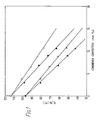
- Various fiber samples each in an amount of 3 g were dipped in the above dyeing bath. The temperature was raised at a rate of 1°C per minute while applying upward and downward agitation. After the temperature reached 100°C in 50 minutes, dyeing was continued for 30 minutes.
- Monogen® trade name for sodium salt of alkyl sulfate manufactured by Daiichi Kogyo Seiyaku Co., Ltd.
- DR100 100 ⁇ (a-c)/a
- FR DR100 - 100d/a
- the light source was a carbon arc.
- the light fastness was determined by comparing the hue after irradiation at 63°C for 80 hours with a blue scale. The rating was as follows: First class (worst) to Eighth class (best).
- the fiber sample was prepared by the following method.
- Predetermined amounts of three components polypropylene shown in the footnote of Table 2, an ethylene copolymer EC-4 as obtained in Example 4, and an organic carboxylic acid sodium salt, were added and further mixed with 0.1 part by weight of Irganox® 1010 (trade name manufactured by Ciba Geigy Ag.) as a stabilizer and 0.5 part by weight of Sumisorb® 300 (trade name manufactured by Sumitomo Chemical Co., Ltd.) as an ultraviolet light absorbent by the use of a Henschel mixer. The resulting mixture was melt kneaded in an extruder having a diameter of 30 mm and com position pellets, DC-1 and DC-2, shown in Table 2 were obtained.
- Irganox® 1010 trade name manufactured by Ciba Geigy Ag.
- Sumisorb® 300 trade name manufactured by Sumitomo Chemical Co., Ltd.
- the yarn was drawn 3 times by running on a hot plate maintained at 110°C to obtain a sample of multifilaments of 1.1 tex/filament (10 denier/filament).
- the multifilament sample thus obtained was dyed in a formic acid-acidified bath using an acidic dye, Aminyl® Blue E-PRL (trade name of Sumitomo Chemical Co., Ltd.) and then subjected to soaping. As shown in Table 3, dyeability and color fastness were good and further DR70 was at a high level.
- Dyeable compositions DC-3, DC-4 and DC-5 were prepared using polypropylene and an ethylene copolymer EC-5 or EC-8 in the same manner as in Reference Examples 1 and 2. Samples of multifilaments obtained by spinning and stretch ing in the same manner as in Reference Examples 1 and 2 were dyed and then subjected to soaping. The results were very satisfactory as shown in Table 3.
- a cationic aqueous dispersion was prepared using the ethylene copolymer of the present invention. This dispersion was coated to form an electrostatic recording material, which was then evaluated for surface resistance and recording properties.
- the reaction product obtained above was a pale brown and uniform aqueous dispersion in which the particle diameter was 0.1 ⁇ m (0.1 micron) or less.
- the pH was 6.9 and the viscosity was 1.7 x 10 ⁇ 2 Pa.s (17 cp) (25°C).
- the solids content as determined by evaporating moisture by heating at 100°C was 30% by weight.
- the aqueous dispersion was coated on a high quality paper (84 g/m2) by the use of a No. 10 bar coater and dried at 100°C for 5 minutes in a hot air circulation type drier to form a uniform coated film having a coated dry weight of 1.2 g/m2 and free from curling.
- the surface electric resistance of the coated paper was measured by the use of a resistance-measuring meter (super insulation meter Model SM-10E manufactured by Toa Denpa Kogyo Co., Ltd.) under the conditions that the applied voltage was 100 V, the humidity was 30, 50 or 70% RH, and the temperature was 23°C.
- the surface electric resistance was 5 ⁇ 107, 8 ⁇ 106 and 9 ⁇ 105 ⁇ , respectively.
- the surface resistance of the paper before coating was 4 ⁇ 1013 ⁇ at a humidity of 50% RH.
- a solution of 70 parts by weight of a coating agent for a dielectric layer (dielectric coating agent C manufactured by Sakata Shokai Co., Ltd.) and 30 parts by weight of calcium carbonate by the use of a No. 10 bar coater, which was then dried with air in a draft and then dried at 100°C for 5 minutes in a hot air circulation type drier to obtain an electrostatic recording paper having a coated solids of 6.0 g/m2.
- This electrostatic recording paper was placed on an electrostatic recording tester (electrostatic printer EP101, A O type manufactured by Matsushita Denso Co., Ltd.) and an electrostatic recording test was performed at a humidity of 30% RH. A very sharp printed pattern was obtained.
- Aqueous dispersions were prepared using ethylene copolymers, EC-4 and EC-6, in the same manner as in Reference Example 6. Also in the same manner as in Reference Example 6, the surface resistance was measured and the electrostatic recording test was conducted.
- a cationic aqueous dispersion was prepared, as shown in Table 4, using a copolymer of ethylene and dimethylaminoethyl methacrylate or dimethylaminoethyl acrylate as the starting material, the surface resistance was measured, and the electrostatic recording test was conducted. The results are shown in Table 4.
- the copolymer EC-4 was pelletized, heat pressed under conditions of 130°C and 5 MPa (50 kg/cm2) to form a sheet having a thickness of 0.5 mm, and a number of sample pieces each 2.5 cm in length and 4 cm in width were cut out from the sheet.
- the sample piece was soaked in 50 ml of each of various aqueous acid and inorganic metal salt solutions, having the concentration shown in Table 5, and stored for 4 hours at the temperature of 60°C. Then, the sample was taken out and after removing the attached solution on its surface with a filter paper, the change in weight was measured. An increase in weight was determined. In all the cases, even after absorption at a high rate, the shape of the sheet was maintained.
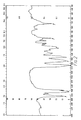
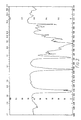
- the ethylene-dimethylaminopropyl acrylamide copolymer (EC-4) and the ethylene-dimethylaminoethyl methacrylate copolymer (E-1) were analyzed by the use of an infrared spectrophotometer.
- the infrared absorption spectra thus obtained are shown in Figs. 2 and 3, respectively.
- the wave number and assignment of each characteristic absorption peak are shown in Table 6.
- the ethylene-dimethylaminopropyl acrylamide copolymer had characteristic absorptions, i.e., an amide I absorption band (1640 cm ⁇ 1) due to amide bond and an amide II absorption band (1550 cm ⁇ 1).
- the ethylene-dimethylaminoethyl methacrylate copolymer had characteristic absorptions, i.e., absorptions due to an ester bond (1730 cm ⁇ 1 and 1150 cm ⁇ 1).
- the novel ethylene-dialkylaminoalkyl acrylamide copolymer of the present invention when mixed with a poly( ⁇ -olefin) provides a poly( ⁇ -olefin) composition having excellent dyeability.
- the copolymer of the present invention can be used as a starting material of an aqueous dispersion to produce a greatly increased electroconductive coated layer if the aqueous dispersion is coated on a substrate such as a paper or a plastic film and dried. This coated layer can be used as an electroconductive layer of electrostatic recording material.
Landscapes
- Chemical & Material Sciences (AREA)
- Health & Medical Sciences (AREA)
- Chemical Kinetics & Catalysis (AREA)
- Medicinal Chemistry (AREA)
- Polymers & Plastics (AREA)
- Organic Chemistry (AREA)
- General Chemical & Material Sciences (AREA)
- Addition Polymer Or Copolymer, Post-Treatments, Or Chemical Modifications (AREA)
Claims (10)
- Ethylencopolymer enthaltend 40 bis 95 Gew% Ethylen, 60 bis 5 Gew% mindestens eines Dialkylaminoalkylacrylamidcomonomers, dargestellt durch die allgemeine Formel (A):

und ein numerisch mittleres Molekulargewicht von 5'000 bis 50'000 besitzt. - Ethylencopolymer gemäss Anspruch 1, worin das Dialkylaminoalkylacrylamidcomonomer mindestens eines ist aus Dimethylaminopropylacrylamid, Dimethylaminopropylmethacrylamid, Dimethylaminoethylacrylamid und Dimethylaminoethylmethacrylamid.
- Ethylencopolymer gemäss Anspruch 2, worin das Dialkylaminoalkylacrylamidcomonomer ein Dimethylaminopropylacrylamid ist.
- Ethylencopolymer gemäss Anspruch 3, worin der Dimethylaminopropylacrylamidecomonomer-Gehalt ausgedrückt durch M (mol%), der Schmelzpunkt (Tm) und die Kristallisationstemperatur (Tc) des Copolymers in folgender Beziehung stehen:


- Ethylencopolymer gemäss einem der Ansprüche 1 bis 4, worin das ethylenisch ungesättigte Comonomer mindestens eines ist aus Methylacrylat, Ethylacrylat, Methylmethacrylat, Vinylacetat, Dimethylaminoethylmethacrylat und Dimethylaminoethylacrylat.
- Verfahren für die Herstellung eines Ethylencopolymers gemäss einem der Ansprüche 1 bis 5, umfassend die Copolymerisation von 40 bis 99 Gew% Ethylen, 60 bis 1 Gew% mindestens eines Dialkylaminoalkylacrylamidcomonomers, dargestellt durch die allgemeine Formel (A) im Anspruch 1 und gegebenenfalls mindestens eines ethylenisch ungesättigten Comonomers in Gegenwart eines Radikalpolymerisationsinitiators unter Bedingungen eines Polymerisationsdruckes von 50 bis 300 MPa (500 bis 3'000 kg/cm²) und einer Polymerisationstemperatur von 100 bis 300 °C.
- Verfahren gemäss Anspruch 6, worin das Dialkylaminoalkylacrylamidcomonomer wie im Anspruch 2, 3 oder 4 definiert ist.
- Verfahren gemäss Anspruch 6 oder 7, worin das ethylenisch ungesättigte Comonomer wie im Anspruch 5 definiert ist.
- Zusammensetzung enthaltend ein Comonomer gemäss einem der Ansprüche 1 bis 5, gemischt mit einem Poly(α-olefin).
- Quarternäres Salz einer Zusammensetzung gemäss einem der Ansprüche 1 bis 5, welches mit Epichlorhydrin umgesetzt worden ist.
Priority Applications (1)
| Application Number | Priority Date | Filing Date | Title |
|---|---|---|---|
| AT88300377T ATE90949T1 (de) | 1987-01-16 | 1988-01-18 | Formierbare copolymere aus aethylen und acrylamid und herstellung davon. |
Applications Claiming Priority (4)
| Application Number | Priority Date | Filing Date | Title |
|---|---|---|---|
| JP8386/87 | 1987-01-16 | ||
| JP838687 | 1987-01-16 | ||
| JP62327724A JPS63304010A (ja) | 1987-01-16 | 1987-12-23 | 新規エチレンランダム共重合体およびその製造方法 |
| JP327724/87 | 1987-12-23 |
Publications (3)
| Publication Number | Publication Date |
|---|---|
| EP0276111A2 EP0276111A2 (de) | 1988-07-27 |
| EP0276111A3 EP0276111A3 (en) | 1989-11-08 |
| EP0276111B1 true EP0276111B1 (de) | 1993-06-23 |
Family
ID=26342899
Family Applications (1)
| Application Number | Title | Priority Date | Filing Date |
|---|---|---|---|
| EP88300377A Expired - Lifetime EP0276111B1 (de) | 1987-01-16 | 1988-01-18 | Formierbare Copolymere aus Äthylen und Acrylamid und Herstellung davon |
Country Status (6)
| Country | Link |
|---|---|
| US (1) | US4831095A (de) |
| EP (1) | EP0276111B1 (de) |
| CN (1) | CN1019498B (de) |
| AU (1) | AU605230B2 (de) |
| CA (1) | CA1326730C (de) |
| DE (1) | DE3881902T2 (de) |
Families Citing this family (18)
| Publication number | Priority date | Publication date | Assignee | Title |
|---|---|---|---|---|
| DE3702153A1 (de) * | 1987-01-26 | 1988-08-04 | Stockhausen Chem Fab Gmbh | Verfahren zum nachgerben |
| JP2661241B2 (ja) * | 1988-03-03 | 1997-10-08 | 住友化学工業株式会社 | エチレン共重合体を有効成分とする殺菌剤および殺菌性樹脂組成物 |
| JP2609539B2 (ja) * | 1988-07-15 | 1997-05-14 | 日本ピー・エム・シー株式会社 | 紙の表面処理剤 |
| EP0492163B1 (de) * | 1990-11-28 | 1996-06-05 | Dai-Ichi Kogyo Seiyaku Co., Ltd. | N-Substituierte Acrylamid-Copolymere |
| JPH069832A (ja) * | 1992-06-26 | 1994-01-18 | Showa Denko Kk | 接着性樹脂組成物 |
| AU648468B2 (en) * | 1992-07-01 | 1994-04-21 | Lintec Corporation | Film for label |
| DE69418665T2 (de) * | 1993-09-24 | 2000-01-27 | Dai-Ichi Kogyo Seiyaku Co., Ltd. | Thermoplastische Kunstharzzusammensetzung |
| ATE152138T1 (de) * | 1993-10-02 | 1997-05-15 | Basf Ag | Copolymerisate auf ethylenbasis und ihre verwendung als fliessverbesserer in erdölmitteldestillaten |
| DE4342672A1 (de) * | 1993-12-15 | 1995-06-22 | Akzo Nobel Nv | Haftverbesserer |
| US5717048A (en) * | 1994-12-07 | 1998-02-10 | Dai-Ichi Kogyo Seiyaku Co., Ltd. | Cation-modified acrylamide or methacrylamide copolymer as well as antistatic agent, thermoplastic resin composition, aqueous composition and thermoplastic resin laminate comprising same |
| SE9800567L (sv) * | 1998-02-25 | 1999-08-26 | Abb Ab | En elektrisk likströmskabel med ett isoleringssystem innefattande en komposition baserad på extruderad, tväbunden polyeten och en metod för tillverkning av en sådan kabel |
| DE19833066A1 (de) * | 1998-07-22 | 2000-02-03 | Elotex Ag Sempach Station | Verfahren zur Herstellung wäßriger Dispersionen von (Co-)Polymerisaten, die danach erhältlichen Dispersionen, aus den Dispersionen erhältliche redispergierbare Pulver sowie deren Verwendung |
| DE10345798A1 (de) * | 2003-09-30 | 2005-04-14 | Basf Ag | Aminogruppenhaltige Ethylencopolymerwachse und ihre Verwendung |
| US20070110984A1 (en) * | 2005-11-15 | 2007-05-17 | Reedy Michael E | Process for producing wood/plastic composites and foams using foaming agents containing zeolite, and wood/plastic composites and foams produced thereby |
| CN101235551B (zh) * | 2006-11-08 | 2011-04-20 | 胡盼盼 | 一种高剪切超高分子量聚乙烯连续溶解纺丝新方法 |
| US8790426B2 (en) | 2010-04-27 | 2014-07-29 | Basf Se | Quaternized terpolymer |
| EP2563822A1 (de) * | 2010-04-27 | 2013-03-06 | Basf Se | Quaternisiertes terpolymerisat |
| AR110566A1 (es) | 2016-12-21 | 2019-04-10 | Braskem Sa | Composiciones de etilvinilacetato modificado, películas y mezclas de polímeros producidas a partir de ellas |
Family Cites Families (5)
| Publication number | Priority date | Publication date | Assignee | Title |
|---|---|---|---|---|
| NL129538C (de) * | 1964-02-21 | |||
| DE3237107A1 (de) * | 1982-10-07 | 1984-04-12 | Basf Ag, 6700 Ludwigshafen | Terpolymerisate des ethylens |
| US4489192A (en) * | 1983-10-05 | 1984-12-18 | National Starch And Chemical Corporation | Cationic vinyl ester based polymer latices, their preparation and use as formaldehyde-free binders |
| JPS60229904A (ja) * | 1984-04-27 | 1985-11-15 | Du Pont Mitsui Polychem Co Ltd | 導電性エチレン系共重合体の製造法 |
| CA1322806C (en) * | 1986-11-11 | 1993-10-05 | Noboru Yamaguchi | Aqueous dispersion of cationic polymer |
-
1988
- 1988-01-15 AU AU10296/88A patent/AU605230B2/en not_active Ceased
- 1988-01-15 CA CA000556621A patent/CA1326730C/en not_active Expired - Fee Related
- 1988-01-16 CN CN88100382A patent/CN1019498B/zh not_active Expired
- 1988-01-18 EP EP88300377A patent/EP0276111B1/de not_active Expired - Lifetime
- 1988-01-18 DE DE88300377T patent/DE3881902T2/de not_active Expired - Fee Related
- 1988-01-19 US US07/145,353 patent/US4831095A/en not_active Expired - Lifetime
Also Published As
| Publication number | Publication date |
|---|---|
| CN1019498B (zh) | 1992-12-16 |
| DE3881902T2 (de) | 1993-11-25 |
| AU1029688A (en) | 1988-07-21 |
| EP0276111A3 (en) | 1989-11-08 |
| CN1030242A (zh) | 1989-01-11 |
| US4831095A (en) | 1989-05-16 |
| AU605230B2 (en) | 1991-01-10 |
| CA1326730C (en) | 1994-02-01 |
| EP0276111A2 (de) | 1988-07-27 |
| DE3881902D1 (de) | 1993-07-29 |
Similar Documents
| Publication | Publication Date | Title |
|---|---|---|
| EP0276111B1 (de) | Formierbare Copolymere aus Äthylen und Acrylamid und Herstellung davon | |
| KR910008315B1 (ko) | 개량된 수분 농축제 | |
| US3497482A (en) | Polymers of quaternary ammonium compounds | |
| US4600761A (en) | Acrylic emulsion copolymers for thickening aqueous systems and copolymerizable surfactant monomers for use therein | |
| US5859141A (en) | Thermoplastic resin composition comprising cation-modified acrylamide or methacrylamide copolymer | |
| US2983712A (en) | Polymers of acrylonitrile | |
| US4308362A (en) | Copolymers of substituted piperidines, their manufacture and use | |
| EP0124347A1 (de) | Verfahren zur Modifizierung der Oberfläche von polymeren Materialien | |
| EP0129143A2 (de) | Polymer mit Fluor enthaltender Endgruppe und seine Herstellung | |
| KR950010549B1 (ko) | 에틸렌 공중합체 및 이의 제조방법 | |
| CN115141326A (zh) | 改性蜡粉及其制备方法和应用 | |
| US3823204A (en) | Acid dye dyeable acrylonitrile copolymer,fibers thereof and process for the preparation thereof | |
| US3907870A (en) | Polymerizable emulsifying agent | |
| CN115627655B (zh) | 一种气干性油改性两性聚丙烯酸酯乳液表面施胶剂的制备方法 | |
| US4326051A (en) | Acrylonitrile polymerization with organic solvent | |
| JP2021021020A (ja) | ジアリルアミン系/ジアリルエーテル系共重合体、その製造方法及び用途 | |
| EP0269293B1 (de) | Zusammensetzung aus einem anfärbbaren Poly-alpha-Olefin und einem Copolymer | |
| US20030177690A1 (en) | Vinylamine compounds | |
| JPS6221361B2 (de) | ||
| US3340221A (en) | Polymers containing ethylenically unsaturated derivatives of orthohydroxy aromatics as reactive dye sites | |
| US3240767A (en) | Acetonitrile soluble copolymers of acrylonitrile and alicyclic alcohol esters of acrylic and methacrylic acids | |
| CA1046871A (en) | Low viscosity piperidinium polymers, methods of preparation and use | |
| CN119264323A (zh) | 聚合物相变材料及其制备方法 | |
| JP2000045196A (ja) | 製紙用表面塗工剤および表面塗工紙 | |
| JP2003138088A (ja) | リン酸基含有重合体を含有する導電性樹脂組成物及びコーティング剤、並びにその導電性樹脂組成物の用途 |
Legal Events
| Date | Code | Title | Description |
|---|---|---|---|
| PUAI | Public reference made under article 153(3) epc to a published international application that has entered the european phase |
Free format text: ORIGINAL CODE: 0009012 |
|
| AK | Designated contracting states |
Kind code of ref document: A2 Designated state(s): AT BE CH DE FR GB IT LI NL |
|
| RAP3 | Party data changed (applicant data changed or rights of an application transferred) |
Owner name: SUMITOMO CHEMICAL COMPANY, LIMITED |
|
| PUAL | Search report despatched |
Free format text: ORIGINAL CODE: 0009013 |
|
| AK | Designated contracting states |
Kind code of ref document: A3 Designated state(s): AT BE CH DE FR GB IT LI NL |
|
| 17P | Request for examination filed |
Effective date: 19900427 |
|
| 17Q | First examination report despatched |
Effective date: 19911024 |
|
| GRAA | (expected) grant |
Free format text: ORIGINAL CODE: 0009210 |
|
| AK | Designated contracting states |
Kind code of ref document: B1 Designated state(s): AT BE CH DE FR GB IT LI NL |
|
| REF | Corresponds to: |
Ref document number: 90949 Country of ref document: AT Date of ref document: 19930715 Kind code of ref document: T |
|
| REF | Corresponds to: |
Ref document number: 3881902 Country of ref document: DE Date of ref document: 19930729 |
|
| ITF | It: translation for a ep patent filed | ||
| ET | Fr: translation filed | ||
| PLBE | No opposition filed within time limit |
Free format text: ORIGINAL CODE: 0009261 |
|
| STAA | Information on the status of an ep patent application or granted ep patent |
Free format text: STATUS: NO OPPOSITION FILED WITHIN TIME LIMIT |
|
| 26N | No opposition filed | ||
| PGFP | Annual fee paid to national office [announced via postgrant information from national office to epo] |
Ref country code: DE Payment date: 19991231 Year of fee payment: 13 |
|
| PGFP | Annual fee paid to national office [announced via postgrant information from national office to epo] |
Ref country code: AT Payment date: 20000110 Year of fee payment: 13 |
|
| PGFP | Annual fee paid to national office [announced via postgrant information from national office to epo] |
Ref country code: GB Payment date: 20000112 Year of fee payment: 13 Ref country code: FR Payment date: 20000112 Year of fee payment: 13 |
|
| PGFP | Annual fee paid to national office [announced via postgrant information from national office to epo] |
Ref country code: CH Payment date: 20000127 Year of fee payment: 13 |
|
| PGFP | Annual fee paid to national office [announced via postgrant information from national office to epo] |
Ref country code: NL Payment date: 20000131 Year of fee payment: 13 |
|
| PGFP | Annual fee paid to national office [announced via postgrant information from national office to epo] |
Ref country code: BE Payment date: 20000315 Year of fee payment: 13 |
|
| PG25 | Lapsed in a contracting state [announced via postgrant information from national office to epo] |
Ref country code: GB Free format text: LAPSE BECAUSE OF NON-PAYMENT OF DUE FEES Effective date: 20010118 Ref country code: AT Free format text: LAPSE BECAUSE OF NON-PAYMENT OF DUE FEES Effective date: 20010118 |
|
| PG25 | Lapsed in a contracting state [announced via postgrant information from national office to epo] |
Ref country code: LI Free format text: LAPSE BECAUSE OF NON-PAYMENT OF DUE FEES Effective date: 20010131 Ref country code: CH Free format text: LAPSE BECAUSE OF NON-PAYMENT OF DUE FEES Effective date: 20010131 Ref country code: BE Free format text: LAPSE BECAUSE OF NON-PAYMENT OF DUE FEES Effective date: 20010131 |
|
| BERE | Be: lapsed |
Owner name: SUMITOMO CHEMICAL CY LTD Effective date: 20010131 |
|
| PG25 | Lapsed in a contracting state [announced via postgrant information from national office to epo] |
Ref country code: NL Free format text: LAPSE BECAUSE OF NON-PAYMENT OF DUE FEES Effective date: 20010801 |
|
| GBPC | Gb: european patent ceased through non-payment of renewal fee |
Effective date: 20010118 |
|
| REG | Reference to a national code |
Ref country code: CH Ref legal event code: PL |
|
| PG25 | Lapsed in a contracting state [announced via postgrant information from national office to epo] |
Ref country code: FR Free format text: LAPSE BECAUSE OF NON-PAYMENT OF DUE FEES Effective date: 20010928 |
|
| NLV4 | Nl: lapsed or anulled due to non-payment of the annual fee |
Effective date: 20010801 |
|
| PG25 | Lapsed in a contracting state [announced via postgrant information from national office to epo] |
Ref country code: DE Free format text: LAPSE BECAUSE OF NON-PAYMENT OF DUE FEES Effective date: 20011101 |
|
| REG | Reference to a national code |
Ref country code: FR Ref legal event code: ST |
|
| PG25 | Lapsed in a contracting state [announced via postgrant information from national office to epo] |
Ref country code: IT Free format text: LAPSE BECAUSE OF NON-PAYMENT OF DUE FEES;WARNING: LAPSES OF ITALIAN PATENTS WITH EFFECTIVE DATE BEFORE 2007 MAY HAVE OCCURRED AT ANY TIME BEFORE 2007. THE CORRECT EFFECTIVE DATE MAY BE DIFFERENT FROM THE ONE RECORDED. Effective date: 20050118 |