EP0277362A2 - Verfahren zur Herstellung von elektrischen Widerständen mit weiten Werten der spezifischen Widerstände - Google Patents
Verfahren zur Herstellung von elektrischen Widerständen mit weiten Werten der spezifischen Widerstände Download PDFInfo
- Publication number
- EP0277362A2 EP0277362A2 EP87119312A EP87119312A EP0277362A2 EP 0277362 A2 EP0277362 A2 EP 0277362A2 EP 87119312 A EP87119312 A EP 87119312A EP 87119312 A EP87119312 A EP 87119312A EP 0277362 A2 EP0277362 A2 EP 0277362A2
- Authority
- EP
- European Patent Office
- Prior art keywords
- mass
- particles
- fact
- liquid material
- stage
- Prior art date
- Legal status (The legal status is an assumption and is not a legal conclusion. Google has not performed a legal analysis and makes no representation as to the accuracy of the status listed.)
- Granted
Links
- 238000000034 method Methods 0.000 title claims abstract description 38
- 239000000463 material Substances 0.000 claims abstract description 43
- 239000011344 liquid material Substances 0.000 claims abstract description 42
- 239000002245 particle Substances 0.000 claims abstract description 37
- 239000011159 matrix material Substances 0.000 claims abstract description 33
- 239000004020 conductor Substances 0.000 claims abstract description 16
- 230000009975 flexible effect Effects 0.000 claims abstract description 12
- 238000007711 solidification Methods 0.000 claims abstract description 10
- 230000008023 solidification Effects 0.000 claims abstract description 10
- 230000008093 supporting effect Effects 0.000 claims abstract description 6
- 239000008187 granular material Substances 0.000 claims description 70
- 239000007788 liquid Substances 0.000 claims description 9
- 238000010438 heat treatment Methods 0.000 claims description 4
- 238000002347 injection Methods 0.000 claims description 3
- 239000007924 injection Substances 0.000 claims description 3
- 238000001816 cooling Methods 0.000 claims description 2
- 229920000136 polysorbate Polymers 0.000 claims 1
- XEEYBQQBJWHFJM-UHFFFAOYSA-N Iron Chemical compound [Fe] XEEYBQQBJWHFJM-UHFFFAOYSA-N 0.000 description 6
- 239000012254 powdered material Substances 0.000 description 5
- OKTJSMMVPCPJKN-UHFFFAOYSA-N Carbon Chemical compound [C] OKTJSMMVPCPJKN-UHFFFAOYSA-N 0.000 description 3
- 239000003570 air Substances 0.000 description 3
- 230000000694 effects Effects 0.000 description 3
- 239000003822 epoxy resin Substances 0.000 description 3
- 239000011810 insulating material Substances 0.000 description 3
- 229910052742 iron Inorganic materials 0.000 description 3
- 229920000647 polyepoxide Polymers 0.000 description 3
- 239000000306 component Substances 0.000 description 2
- 238000001723 curing Methods 0.000 description 2
- 238000010586 diagram Methods 0.000 description 2
- 239000012777 electrically insulating material Substances 0.000 description 2
- 238000002156 mixing Methods 0.000 description 2
- 239000000843 powder Substances 0.000 description 2
- 238000012545 processing Methods 0.000 description 2
- 239000002994 raw material Substances 0.000 description 2
- 229920003002 synthetic resin Polymers 0.000 description 2
- 239000000057 synthetic resin Substances 0.000 description 2
- ROVRRJSRRSGUOL-UHFFFAOYSA-N victoria blue bo Chemical compound [Cl-].C12=CC=CC=C2C(NCC)=CC=C1C(C=1C=CC(=CC=1)N(CC)CC)=C1C=CC(=[N+](CC)CC)C=C1 ROVRRJSRRSGUOL-UHFFFAOYSA-N 0.000 description 2
- RYGMFSIKBFXOCR-UHFFFAOYSA-N Copper Chemical compound [Cu] RYGMFSIKBFXOCR-UHFFFAOYSA-N 0.000 description 1
- 208000036366 Sensation of pressure Diseases 0.000 description 1
- ATJFFYVFTNAWJD-UHFFFAOYSA-N Tin Chemical compound [Sn] ATJFFYVFTNAWJD-UHFFFAOYSA-N 0.000 description 1
- 239000012080 ambient air Substances 0.000 description 1
- 230000008901 benefit Effects 0.000 description 1
- 230000015572 biosynthetic process Effects 0.000 description 1
- 229910052799 carbon Inorganic materials 0.000 description 1
- 229910052729 chemical element Inorganic materials 0.000 description 1
- 229910052802 copper Inorganic materials 0.000 description 1
- 239000010949 copper Substances 0.000 description 1
- 230000007423 decrease Effects 0.000 description 1
- 230000001419 dependent effect Effects 0.000 description 1
- 230000002349 favourable effect Effects 0.000 description 1
- 229910002804 graphite Inorganic materials 0.000 description 1
- 239000010439 graphite Substances 0.000 description 1
- 230000001788 irregular Effects 0.000 description 1
- 238000010297 mechanical methods and process Methods 0.000 description 1
- 239000002184 metal Substances 0.000 description 1
- 229910052751 metal Inorganic materials 0.000 description 1
- 229910001092 metal group alloy Inorganic materials 0.000 description 1
- 239000007769 metal material Substances 0.000 description 1
- VNWKTOKETHGBQD-UHFFFAOYSA-N methane Chemical compound C VNWKTOKETHGBQD-UHFFFAOYSA-N 0.000 description 1
- 239000000203 mixture Substances 0.000 description 1
- 229910052755 nonmetal Inorganic materials 0.000 description 1
- 230000035515 penetration Effects 0.000 description 1
- 239000004033 plastic Substances 0.000 description 1
- 239000012255 powdered metal Substances 0.000 description 1
- 229920005989 resin Polymers 0.000 description 1
- 239000011347 resin Substances 0.000 description 1
- 229910052710 silicon Inorganic materials 0.000 description 1
- 239000010703 silicon Substances 0.000 description 1
- 239000007787 solid Substances 0.000 description 1
- 239000000126 substance Substances 0.000 description 1
- 229920005992 thermoplastic resin Polymers 0.000 description 1
Images


Classifications
-
- H—ELECTRICITY
- H01—ELECTRIC ELEMENTS
- H01C—RESISTORS
- H01C10/00—Adjustable resistors
- H01C10/10—Adjustable resistors adjustable by mechanical pressure or force
- H01C10/106—Adjustable resistors adjustable by mechanical pressure or force on resistive material dispersed in an elastic material
Definitions
- the present invention relates to a process for producing an electric resistor designed for use as a conducting element on an electric circuit; said resistor presenting a high conducting capacity selectable from within a wide range and, more especially, being capable of varying its electrical resistance as a function of the pressure exerted on the resistor itself.
- Electrical resistors are known, substantially comprising a matrix formed from flexible insulating material, e.g. synthetic plastic, and some sort of powdered metal dispersed inside the said matrix.
- flexible insulating material e.g. synthetic plastic
- the matrix consists of a sponge of insulating material defining a number of cells, inside which the powdered material is dispersed by passing a suitable liquid containing the suspended powder through the sponge.
- the matrix material is liquified and blended mechanically with the powdered material, so as to produce a mixture of powdered material inside the liquid matrix material, which is then solidified.
- Resistors so formed present a number of drawbacks. Firstly, they cannot be used as conducting elements on electric circuits, due to the exceptionally high resistance they present when idle. Specific conducting capacity is sufficiently high for this purpose only when the resistors are subjected to fairly high pressure. On resistors of this sort, electrical resistance decreases alongside increasing pressure, but, when idle, with no external pressure applied, resistance is substantially infinite. Secondly, the electrical characteristics of such resistors do not remain constant throughout their working life, and are difficult to repeat productionwise. For overcoming this drawback, processes have been proposed whereby the powdered material dispersed inside the matrix is produced by blending powders of specific types and grades, and specific physical and chemical characteristics. Such processes, however, are both complex and high-cost, due to the equipment involved, and the cost of raw materials and processing for producing the required powdered material.
- the aim of the present invention is to provide a process for producing electric resistors of the aforementioned type, but involving none of the aforementioned drawbacks; which process comprises a small number of easily repeatable stages, and employs only low-cost, readily available raw materials.
- the said process is characterised by the fact that it consists in preparing a homogeneous system comprising particles of a first electrically conductive material arranged in substantially uniform manner inside a mass of a second liquid material which, when solidified, is both flexible and electrically insulating; and in solidifying the said mass of the said second liquid material, so as to form a matrix for supporting the said particles; throughout solidification of the said second liquid material, a given pressure being applied on the system for the purpose of producing triaxial precompression of the said second material when solidified.
- a structure of the said particles is first formed; which structure statistically presents each of the said particles arranged at least partially contacting the adjacent particles with which it defines a number of gaps which are subsequently injected with the said mass of the said second liquid material.
- the said process conveniently comprises at least a first stage, in which is formed a mass of particles of the said first material; a second stage, in which the said mass is compacted by subjecting it to a given pressure; a third stage, in which the said mass is injected with the said second material in its liquid form, so as to fill the said gaps between the said particles and so form the said homogeneous system; and a fourth stage, in which the said second material is solidified.
- Fig.s 1 and 2 show sections of a portion of the resistor enlarged a few hundred times.
- the said resistor substantially comprises a supporting matrix 1, formed from flexible, electrically insulating material, and particles 2 of electrically conductive material arranged in substantially uniform manner inside corresonding cells 3 on the said matrix 1.
- the said particles preferably consist of granules of electrically conductive material.
- at least some (e.g. 50 to 90%) of the said cells communicate with one another, and, in a number of cases, are exactly the same shape and size as the granules contained inside.
- Other cells are slightly larger than the said granules, so as to form a minute gap 4 between at least part of the outer surface of the granule and the corresponding inner surface portion of the respective cell.
- the arrangement of cells 3, and therefore also of granules 2, inside matrix 1 is entirely random.
- the advantages of the resistor according to the present invention are obtainable even if only a few of cells 3 communicate with one another, it is nevertheless preferable for most of them to do so.
- the estimated percentage of communicating cells is around 50-90%.
- conducting granules 2 may be of any size, this conveniently ranges between 10 and 250 micron.
- granules 2 may be of any shape and, in this case, are preferably irregular, as shown in Fig.s 1 and 2.
- Matrix 1 may be formed from any type of electrically insulating material, providing it is flexible enough to flex, when a given pressure is applied on the resistor, and return to its original shape when such pressure is released. Furthermore, the material used for the matrix must be capable of assuming a first state, in which it is sufficiently liquid for it to be injected into a granule structure statistically presenting each of the said granules arranged at least partially contacting the adjacent granules with which it defines a number of gaps; and a second state in which it is both solid and flexible.
- the viscosity of the liquid material conveniently ranges from 500 to 10,000 centipoise.
- Matrix 1 may conveniently be formed from synthetic resin, preferably a synthetic thermoplastic resin, which presents all the aforementioned characteristics and is thus especially suitable for injection into a granule structure of the aforementioned type.
- the said granules are preferably very small, ranging in size from 10 to 250 micron.
- the conducting material used for the granules may be any type of metal, e.g. iron, copper, or any type of metal alloy, or non-metal material, such as graphite or carbon.
- the materials for matrix 1 and granules 2 may thus be selected from a wide range of categories, providing they present the characteristics already mentioned.
- the material employed for matrix 1 which, as already stated, must be flexible and insulating, is preferably, though not necessarily, so precompressed inside matrix 1 itself as to exert sufficient pressure on particles 2 to maintain contact between the same. It follows, therefore, that each minute element of the said matrix 1 material is in a suffiently marked state of triaxial precompression as to exert on adjacent elements, in particular particles 2, far greater stress, for producing contact pressure between the surfaces of the said particles, than if the said triaxial precompression were not provided for. As will be made clearer later on, such a state of triaxial precompression is a direct consequence of the process according to the present invention.
- the resistor according to the present invention presents an extremely large number of granules 2 of conducting material, which granules either contact one another, or are separated from adjacent granules by extremely small gaps 4 which may be readily bridged when given pressure is applied on the resistor.
- Each of the said chains may electrically connect end surfaces 5 and 6 on the resistor directly, as shown by dotted line C1 in Fig.1.
- chains may be formed inside the resistor, as shown by dotted line C2 in fig.1, in which the individual granules in the chain are partly arranged contacting one another directly, and partly separated solely by gaps 4.
- the granules in such chains may be brought into contact, as in the case of chain C1, by subjecting surfaces 5 and 6 on the resistor to a given pressure sufficient to flex the material of matrix 1 and so bridge the said gaps for bringing the adjacent granules separated by the same into direct contact.
- the process according to the present invention is as follows.
- the first step is to prepare a homogeneous system comprising particles, preferably granules, of a first electricallyly conductive material arranged in substantially uniform manner inside a mass of a second liquid material which, when solidified, is both electrically insulating and flex ible.
- the mass of the said second liquid material is then solidified to form a supporting matrix for the granules.
- a given pressure is applied on the system for the purpose of producing triaxial precompression of the said second material when solidified.
- Such pressure which is maintained substantially constant throughout solidification, ranges from a few tenths of a N/mm2 to a few N/mm2.
- a granule structure is first formed, which structure statistically presents each granule arranged at least partially contacting the adjacent granules, with which it defines a number of gaps which are then injected with the said second liquid material.
- the said second material may be liquified by simply heating it to a given temperature. For solidifying it, cooling is usually sufficient. In the case of synthetic resins, however, these must be solidified by means of curing.
- the process according to the present invention may comprise the following stages.
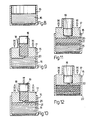
- a first stage in which a mass of electrically conductive granules 16 is formed, for example, inside an appropriate vessel 15 (Fig.8).
- the granules after being poured into the said vessel, are vibrated so as to enable settling.
- the bottom of vessel 15 is conveniently either porous or provided with holes for letting out the air or gas trapped between the granules.
- a second stage in which the mass of granules 16 is compacted by subjecting it to a given pressure, e.g. by means of piston 17, applied in any appropriate manner on the upper surface of mass 16.
- a given pressure e.g. by means of piston 17, applied in any appropriate manner on the upper surface of mass 16.
- piston 17 is conveniently provided with a tank 18 containing the said second material in liquid form; which liquid material may be forced, e.g, by a second piston 19, through hole 20 into a chamber 21 defined between the upper surface of granules 16 and the lower surface of piston 17, as shown clearly in Fig.10.
- the said second liquid material in tank 18 is a material which may be solidified and, when it is, is both insulating and flexible. In the event the said material is liquified by heating, appropriate heating means (not shown) are also provided for.
- a third stage in which piston 19 moves down and piston 17 up, so as to force a given amount of the said second liquid material inside chamber 21 (Fig. 10). Piston 17 is then brought down for producing a given pressure inside the liquid material in chamber 21 and so forcing it to flow into the gaps between the granules in mass 16 and form, with the said granules, the said homogeneous system. At the same time, any air between the granules is expelled through the porous bottom of vessel 15.
- the pressure produced by piston 17, at this stage, inside the liquid material mainly depends on the size of the granules, the viscosity of the liquid, the height of the granule mass being impregnated, and required impregnating time.
- a fourth stage in which the homogeneous system of granules and liquid material produced in the foregoing stage is substantially solidified. This may be achieved by simply allowing the system to cool and the said second liquid material to set. At this stage, changes may be observed in the structure of the said second material due, for example, to curing of the same.
- the mass of material so formed inside vessel 15 may be cut, using standard mechanical methods, into any shape or size for producing the electric resistor according to the present invention.
- granules 2 arranged inside matrix 1 may be replaced by particles of electrically conductive material of any shape of size, e.g. short fibres.
- processing stages may be adopted other than those described with reference to Figures 8 to 12.
- the said homogeneous system in fact, may be obtained by mixing the said particles mechanically with the said second liquid material, using any appropriate means for the purpose.
- the said system is forced against a porous (or punched) septum for letting out, through the said septum, at least part of the said second liquid material.
- the pressure so produced may be maintained until the said second material solidifies, so as to produce the said triaxial precompression in the solidified said second material.
- the said system may be spun throughout solidification of the said second liquid material.
- Total resistance of the resistor so formed has been found to be constant, and dependent solely on the structure of the resistor, in particular, the number and size of communicating cells 3 in matrix 1, and the number of gaps 4 separating adjacent granules 2.
- a resistor may be produced having a given prearranged resistance.
- the electrical resistance measured perpendicularly to the said surfaces is reduced in direct proportion to the amount of pressure applied.
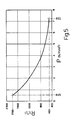
- Fig.s 3 to 6 show four resistance-pressure graphs by way of examples and relative to four different types of resistors, the characteristics of which will be discussed later on. As shown in the said graphs, the fall in resistance as a function of pressure is a gradual process represented by a curve usually presenting a steep initial portion. Even very light pressure, such as might be applied manually, has been found to produce a considerable fall in resistance.
- starting resistance was reduced to less than one percent by simply applying a pressure of around 1 N/mm2 (about 10 kg/cm2). With a different structure and pressures of around 2 N/mm2 (about 20 kg/cm2), starting resistance may be reduced by 1/3 (as shown in the Fig.3 graph).
- the density of the current feedable through the resistor ranges from 0.2 A/cm2 (Example 4) to 11 A/cm2 (Example 5) providing no external pressure is applied.
- the electrical performance of the material the resistor is made of has been found to be isotropic, in the sense that the specific resistance of the material is in no way affected by the direction in which it is measured. If, on the other hand, the material the resistor according to the present invention is made of is flexed by applying external pressure in a given direction, the specific resistance of the material has been found to vary continuously in the said direction, depending on the amount and direction of the flexing pressure applied.
- a fifth example will also be examined in which the speci fic resistance of the resistor according to the present invention is sufficiently low for it to be considered a conductor.
- a cylindrical resistor, 12.6 mm in diameter and 7.4 mm high was prepared, as shown in Fig.s 8 to 12, using epoxy resin (VB-BO 15) for matrix 1.
- Conducting granules 2 consisted of carbon powder ranging in size from 200 to 250 micron.
- the matrix insulating material injected between the granules occupies approximately 56.8% of the total volume of the resistor.
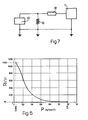
- the resistor so formed was connected to the electric circuit in Fig.7, in which it is indicated by number 10.
- the said circuit comprises a stabilized power unit 11 (with an output voltage, in this case, of 4.5V), a load resistor 12 (in this case, 10 ohm), and a digital voltmeter 13, connected as shown in Fig.7.
- Resistor 10 was subjected to pressures ranging from 7.8 . 10 ⁇ 2 N/mm2 to 196 . 10 ⁇ 2 N/mm2.
- Resistance was measured by measuring the difference in potential at the terminals of resistor 12 using voltmeter 13, and plotted against pressure as shown in the Fig.3 graph. From a starting figure of 5.4 Ohm, resistance gradually drops down to 1.78 Ohm as the said maximum pressure is reached.
- a cylindrical resistor, 12.6 mm in diameter and 7.2 mm high was prepared as before using an alpha-cyanoacrylate-base resin for matrix 1 and carbon granules ranging in size from 200 to 250 micron.
- a tubular resistor with an outside diameter of 12.6 mm, an inside diameter of 3.5 mm, and 5.4 mm high was prepared as before, using epoxy resin (VB-BO 15) for the matrix and iron granules ranging in size from 50 to 150 micron.
- epoxy resin VB-BO 15
- the matrix insulating material injected between the granules occupies approximately 55% of the total volume of the resistor.
- Resistance was again measured as shown in Fig.7, using a 1000 Ohm load resistor 12 and 4.5V power unit 11. Pressure was adjusted gradually from 59 . 10 ⁇ 2 N/mm2 to 7.22 N/mm2 to give the graph shown in Fig.5, which shows a resistance drop from 1790 to 493 Ohm between minimum and maximum pressure.
- a 2.4 mm high tubular resistor having the same section as in Example 3 was prepared as before, using silicon resin for matrix 1 and iron granules ranging in size from 50 to 150 micron.
- a 3.4 mm high tubular resistor having the same section as in Example 4 was prepared as before, using epoxy resin (VB-ST 29) for matrix 1 and tin granules ranging in size from 50 to 200 micron.
Landscapes
- Chemical & Material Sciences (AREA)
- Dispersion Chemistry (AREA)
- Engineering & Computer Science (AREA)
- Microelectronics & Electronic Packaging (AREA)
- Apparatuses And Processes For Manufacturing Resistors (AREA)
- Conductive Materials (AREA)
- Non-Adjustable Resistors (AREA)
- Thermistors And Varistors (AREA)
- Adjustable Resistors (AREA)
- Parts Printed On Printed Circuit Boards (AREA)
Priority Applications (1)
| Application Number | Priority Date | Filing Date | Title |
|---|---|---|---|
| AT87119312T ATE81921T1 (de) | 1987-02-05 | 1987-12-29 | Verfahren zur herstellung von elektrischen widerstaenden mit weiten werten der spezifischen widerstaende. |
Applications Claiming Priority (2)
| Application Number | Priority Date | Filing Date | Title |
|---|---|---|---|
| IT6707287 | 1987-02-05 | ||
| IT8767072A IT1206890B (it) | 1987-02-05 | 1987-02-05 | Resistore elettrico atto ad essere utilizzato come elemento conduttore di elettricita in un circuito elettrico e procedimento per realizzaretale resistore |
Publications (3)
| Publication Number | Publication Date |
|---|---|
| EP0277362A2 true EP0277362A2 (de) | 1988-08-10 |
| EP0277362A3 EP0277362A3 (en) | 1989-09-20 |
| EP0277362B1 EP0277362B1 (de) | 1992-10-28 |
Family
ID=11299357
Family Applications (1)
| Application Number | Title | Priority Date | Filing Date |
|---|---|---|---|
| EP87119312A Expired - Lifetime EP0277362B1 (de) | 1987-02-05 | 1987-12-29 | Verfahren zur Herstellung von elektrischen Widerständen mit weiten Werten der spezifischen Widerstände |
Country Status (9)
| Country | Link |
|---|---|
| US (1) | US4900497A (de) |
| EP (1) | EP0277362B1 (de) |
| JP (1) | JPS63260101A (de) |
| AT (1) | ATE81921T1 (de) |
| BR (1) | BR8800299A (de) |
| DE (1) | DE3782419T2 (de) |
| ES (1) | ES2035846T3 (de) |
| GR (1) | GR3006379T3 (de) |
| IT (1) | IT1206890B (de) |
Cited By (1)
| Publication number | Priority date | Publication date | Assignee | Title |
|---|---|---|---|---|
| EP0293735B1 (de) * | 1987-06-02 | 1993-09-29 | LEDA Logarithmic Electrical Devices for Automation S.r.l. | Ununterbrochener biegsamer elektrischer Leiter, funktionsfähig wie ein elektrischer Schalter |
Families Citing this family (12)
| Publication number | Priority date | Publication date | Assignee | Title |
|---|---|---|---|---|
| US6114645A (en) * | 1995-04-27 | 2000-09-05 | Burgess; Lester E. | Pressure activated switching device |
| US5856644A (en) * | 1995-04-27 | 1999-01-05 | Burgess; Lester E. | Drape sensor |
| US5695859A (en) * | 1995-04-27 | 1997-12-09 | Burgess; Lester E. | Pressure activated switching device |
| EP0745663A1 (de) * | 1995-05-31 | 1996-12-04 | The Procter & Gamble Company | Gefärbte, saure, wässrige flüssige Zusammensetzungen, die Peroxid-Bleichmittel enthalten |
| US6290868B1 (en) * | 1999-05-27 | 2001-09-18 | Sandia Corporation | Field-structured material media and methods for synthesis thereof |
| US6121869A (en) * | 1999-09-20 | 2000-09-19 | Burgess; Lester E. | Pressure activated switching device |
| US6329617B1 (en) | 2000-09-19 | 2001-12-11 | Lester E. Burgess | Pressure activated switching device |
| US6396010B1 (en) | 2000-10-17 | 2002-05-28 | Matamatic, Inc. | Safety edge switch for a movable door |
| EP2539948B1 (de) * | 2010-02-24 | 2017-11-01 | Auckland Uniservices Limited | Elektrische komponenten und schaltkreise mit diesen komponenten |
| KR101753247B1 (ko) * | 2016-06-30 | 2017-07-04 | 엘지이노텍 주식회사 | 압력 감지 센서 및 이를 포함하는 압력 감지 장치 |
| US10379654B2 (en) * | 2016-07-12 | 2019-08-13 | Advense Technology Inc. | Nanocomposite sensing material |
| CN117121132A (zh) * | 2021-03-25 | 2023-11-24 | 东京Cosmos电机株式会社 | 电阻体、可变电阻器、以及电阻体的制造方法 |
Family Cites Families (16)
| Publication number | Priority date | Publication date | Assignee | Title |
|---|---|---|---|---|
| US2305717A (en) * | 1939-10-23 | 1942-12-22 | Bell Oidric Joseph La | Circuit controlling means |
| US2774108A (en) * | 1951-10-08 | 1956-12-18 | Gulf Research Development Co | Method of making low-resistance ion-exchange membranes |
| GB778683A (en) * | 1952-11-10 | 1957-07-10 | Bristol Aircraft Ltd | Improvements in or relating to the moulding of articles from thermosetting resins and fibrous material |
| GB1059186A (en) * | 1963-11-25 | 1967-02-15 | John Henry Arthur Lewis | Variable resistor |
| JPS4818581B1 (de) * | 1969-08-11 | 1973-06-07 | ||
| CH506865A (de) * | 1970-06-18 | 1971-04-30 | Sprecher & Schuh Ag | Verfahren und Einrichtung zur Herstellung eines ein Mittelloch aufweisenden elektrischen Widerstandselementes |
| JPS5367856A (en) * | 1976-11-29 | 1978-06-16 | Shinetsu Polymer Co | Pressure sensitive resistance element |
| DE2901758A1 (de) * | 1979-01-18 | 1980-07-31 | Basf Ag | Verfahren zur herstellung elektrisch leitender polyolefinformkoerper und deren verwendung |
| JPS565840A (en) * | 1979-06-28 | 1981-01-21 | Shin Etsu Polymer Co Ltd | Anisotropic pressure electrically-conductive elastomer molded article |
| GB2088272B (en) * | 1980-12-02 | 1984-03-28 | Chloride Silent Power Ltd | Moulding fibre matrices |
| JPS58134721A (ja) * | 1982-02-04 | 1983-08-11 | Aron Kasei Co Ltd | 導電性フイラ−を混入してなる熱可塑性樹脂成形品 |
| JPS59124825A (ja) * | 1982-12-30 | 1984-07-19 | Nissei Plastics Ind Co | 射出成形機の型締装置 |
| DE3406148A1 (de) * | 1984-02-21 | 1985-09-05 | Philips Patentverwaltung Gmbh, 2000 Hamburg | Verfahren zur herstellung von rohrfoermigen koerpern und vorrichtung zur durchfuehrung des verfahrens |
| WO1985005069A1 (en) * | 1984-05-09 | 1985-11-21 | Hughes Aircraft Company | Method of fabricating composite or encapsulated articles |
| JPS61249713A (ja) * | 1985-04-30 | 1986-11-06 | Nippon Zeon Co Ltd | 電磁波遮蔽用成形体の製造方法 |
| US4732717A (en) * | 1985-10-11 | 1988-03-22 | Sumitomo Bakelite Company Limited | Process for producing piezo-electric or pyro-electric composite sheet |
-
1987
- 1987-02-05 IT IT8767072A patent/IT1206890B/it active
- 1987-12-29 AT AT87119312T patent/ATE81921T1/de not_active IP Right Cessation
- 1987-12-29 EP EP87119312A patent/EP0277362B1/de not_active Expired - Lifetime
- 1987-12-29 ES ES198787119312T patent/ES2035846T3/es not_active Expired - Lifetime
- 1987-12-29 DE DE8787119312T patent/DE3782419T2/de not_active Expired - Fee Related
-
1988
- 1988-01-19 US US07/145,612 patent/US4900497A/en not_active Expired - Fee Related
- 1988-01-26 BR BR8800299A patent/BR8800299A/pt unknown
- 1988-02-01 JP JP63019701A patent/JPS63260101A/ja active Pending
-
1992
- 1992-11-30 GR GR920401762T patent/GR3006379T3/el unknown
Cited By (1)
| Publication number | Priority date | Publication date | Assignee | Title |
|---|---|---|---|---|
| EP0293735B1 (de) * | 1987-06-02 | 1993-09-29 | LEDA Logarithmic Electrical Devices for Automation S.r.l. | Ununterbrochener biegsamer elektrischer Leiter, funktionsfähig wie ein elektrischer Schalter |
Also Published As
| Publication number | Publication date |
|---|---|
| EP0277362A3 (en) | 1989-09-20 |
| DE3782419T2 (de) | 1993-04-15 |
| GR3006379T3 (de) | 1993-06-21 |
| EP0277362B1 (de) | 1992-10-28 |
| IT1206890B (it) | 1989-05-11 |
| DE3782419D1 (de) | 1992-12-03 |
| IT8767072A0 (it) | 1987-02-05 |
| US4900497A (en) | 1990-02-13 |
| BR8800299A (pt) | 1988-09-06 |
| JPS63260101A (ja) | 1988-10-27 |
| ES2035846T3 (es) | 1993-05-01 |
| ATE81921T1 (de) | 1992-11-15 |
Similar Documents
| Publication | Publication Date | Title |
|---|---|---|
| US4876419A (en) | Two-dimensional electric conductor designed to function as an electric switch | |
| EP0277362A2 (de) | Verfahren zur Herstellung von elektrischen Widerständen mit weiten Werten der spezifischen Widerstände | |
| US4876420A (en) | Continuous flexible electric conductor capable of functioning as an electric switch | |
| EP0908902B1 (de) | PTC-Element, Schutzvorrichtung und elektrische Leiterplatte | |
| US4737112A (en) | Anisotropically conductive composite medium | |
| KR920003997B1 (ko) | 전기적 오버스트레스 펄스 보호물질 | |
| EP1050054B1 (de) | Polymerzusammensetzung | |
| US6495069B1 (en) | Polymer composition | |
| US4966729A (en) | Material having a resistivity with a positive temperature coefficient | |
| JP4921623B2 (ja) | バリスター特性を有する非線形抵抗及びこの抵抗の製造方法 | |
| Chekanov et al. | Electrical properties of epoxy resin filled with carbon fibers | |
| US5476714A (en) | Electrical overstress pulse protection | |
| IE45538B1 (en) | Reconstituted metal oxide varistor | |
| CA2233314A1 (en) | Improved polymeric ptc compositions | |
| EP0280787B1 (de) | Elektrischer Widerstand und Herstellungsverfahren | |
| JP2001509311A (ja) | ポリマー組成物 | |
| Maaroufi et al. | Electrical resistivity of polymeric matrix loaded with nickel and cobalt powders | |
| JPH0623350B2 (ja) | 異方導電性接着剤 | |
| GB2054277A (en) | Pressure-sensitive electroconductive bodies | |
| EP0311813B1 (de) | Druckempfindlicher elektrischer Widerstand und Herstellungsverfahren | |
| CA2068657A1 (en) | Moisture resistant electrically conductive cements and methods for making and using same | |
| US6652968B1 (en) | Pressure activated electrically conductive material | |
| JP2004339325A (ja) | 導電性接着剤およびそれを用いた電子部品実装体 | |
| CN1191927C (zh) | 弹性导电连接件及电连接装置 | |
| Singh et al. | Electrical resistivity behavior of solution‐cast metal‐filled composites |
Legal Events
| Date | Code | Title | Description |
|---|---|---|---|
| PUAI | Public reference made under article 153(3) epc to a published international application that has entered the european phase |
Free format text: ORIGINAL CODE: 0009012 |
|
| AK | Designated contracting states |
Kind code of ref document: A2 Designated state(s): AT BE CH DE ES FR GB GR LI LU NL SE |
|
| PUAL | Search report despatched |
Free format text: ORIGINAL CODE: 0009013 |
|
| AK | Designated contracting states |
Kind code of ref document: A3 Designated state(s): AT BE CH DE ES FR GB GR LI LU NL SE |
|
| 17P | Request for examination filed |
Effective date: 19900315 |
|
| 17Q | First examination report despatched |
Effective date: 19901130 |
|
| GRAA | (expected) grant |
Free format text: ORIGINAL CODE: 0009210 |
|
| AK | Designated contracting states |
Kind code of ref document: B1 Designated state(s): AT BE CH DE ES FR GB GR LI LU NL SE |
|
| REF | Corresponds to: |
Ref document number: 81921 Country of ref document: AT Date of ref document: 19921115 Kind code of ref document: T |
|
| PGFP | Annual fee paid to national office [announced via postgrant information from national office to epo] |
Ref country code: CH Payment date: 19921123 Year of fee payment: 6 |
|
| REF | Corresponds to: |
Ref document number: 3782419 Country of ref document: DE Date of ref document: 19921203 |
|
| PGFP | Annual fee paid to national office [announced via postgrant information from national office to epo] |
Ref country code: GR Payment date: 19921228 Year of fee payment: 6 |
|
| PGFP | Annual fee paid to national office [announced via postgrant information from national office to epo] |
Ref country code: LU Payment date: 19921231 Year of fee payment: 6 |
|
| ET | Fr: translation filed | ||
| EPTA | Lu: last paid annual fee | ||
| REG | Reference to a national code |
Ref country code: GR Ref legal event code: FG4A Free format text: 3006379 |
|
| REG | Reference to a national code |
Ref country code: ES Ref legal event code: FG2A Ref document number: 2035846 Country of ref document: ES Kind code of ref document: T3 |
|
| PLBE | No opposition filed within time limit |
Free format text: ORIGINAL CODE: 0009261 |
|
| STAA | Information on the status of an ep patent application or granted ep patent |
Free format text: STATUS: NO OPPOSITION FILED WITHIN TIME LIMIT |
|
| 26N | No opposition filed | ||
| PGFP | Annual fee paid to national office [announced via postgrant information from national office to epo] |
Ref country code: BE Payment date: 19931130 Year of fee payment: 7 |
|
| PGFP | Annual fee paid to national office [announced via postgrant information from national office to epo] |
Ref country code: AT Payment date: 19931215 Year of fee payment: 7 |
|
| PG25 | Lapsed in a contracting state [announced via postgrant information from national office to epo] |
Ref country code: LU Free format text: LAPSE BECAUSE OF NON-PAYMENT OF DUE FEES Effective date: 19931229 |
|
| PG25 | Lapsed in a contracting state [announced via postgrant information from national office to epo] |
Ref country code: LI Effective date: 19931231 Ref country code: CH Effective date: 19931231 |
|
| PGFP | Annual fee paid to national office [announced via postgrant information from national office to epo] |
Ref country code: NL Payment date: 19931231 Year of fee payment: 7 |
|
| PG25 | Lapsed in a contracting state [announced via postgrant information from national office to epo] |
Ref country code: GR Free format text: THE PATENT HAS BEEN ANNULLED BY A DECISION OF A NATIONAL AUTHORITY Effective date: 19940630 |
|
| REG | Reference to a national code |
Ref country code: CH Ref legal event code: PL |
|
| PGFP | Annual fee paid to national office [announced via postgrant information from national office to epo] |
Ref country code: SE Payment date: 19941206 Year of fee payment: 8 |
|
| PGFP | Annual fee paid to national office [announced via postgrant information from national office to epo] |
Ref country code: ES Payment date: 19941216 Year of fee payment: 8 |
|
| PGFP | Annual fee paid to national office [announced via postgrant information from national office to epo] |
Ref country code: DE Payment date: 19941220 Year of fee payment: 8 |
|
| PGFP | Annual fee paid to national office [announced via postgrant information from national office to epo] |
Ref country code: GB Payment date: 19941221 Year of fee payment: 8 |
|
| PGFP | Annual fee paid to national office [announced via postgrant information from national office to epo] |
Ref country code: FR Payment date: 19941228 Year of fee payment: 8 |
|
| PG25 | Lapsed in a contracting state [announced via postgrant information from national office to epo] |
Ref country code: AT Effective date: 19941229 |
|
| REG | Reference to a national code |
Ref country code: GR Ref legal event code: MM2A Free format text: 3006379 |
|
| PG25 | Lapsed in a contracting state [announced via postgrant information from national office to epo] |
Ref country code: BE Effective date: 19941231 |
|
| EAL | Se: european patent in force in sweden |
Ref document number: 87119312.4 |
|
| BERE | Be: lapsed |
Owner name: LOGARITHMIC ELECTRICAL DEVICES FOR AUTOMATION S.R. Effective date: 19941231 |
|
| PG25 | Lapsed in a contracting state [announced via postgrant information from national office to epo] |
Ref country code: NL Effective date: 19950701 |
|
| NLV4 | Nl: lapsed or anulled due to non-payment of the annual fee |
Effective date: 19950701 |
|
| PG25 | Lapsed in a contracting state [announced via postgrant information from national office to epo] |
Ref country code: GB Effective date: 19951229 |
|
| PG25 | Lapsed in a contracting state [announced via postgrant information from national office to epo] |
Ref country code: SE Effective date: 19951230 Ref country code: ES Free format text: LAPSE BECAUSE OF THE APPLICANT RENOUNCES Effective date: 19951230 |
|
| GBPC | Gb: european patent ceased through non-payment of renewal fee |
Effective date: 19951229 |
|
| PG25 | Lapsed in a contracting state [announced via postgrant information from national office to epo] |
Ref country code: FR Effective date: 19960830 |
|
| PG25 | Lapsed in a contracting state [announced via postgrant information from national office to epo] |
Ref country code: DE Effective date: 19960903 |
|
| REG | Reference to a national code |
Ref country code: FR Ref legal event code: ST |
|
| REG | Reference to a national code |
Ref country code: ES Ref legal event code: FD2A Effective date: 20010402 |