EP0277472A2 - Feste Messelektrode und Verfahren zu deren Herstellung - Google Patents
Feste Messelektrode und Verfahren zu deren Herstellung Download PDFInfo
- Publication number
- EP0277472A2 EP0277472A2 EP87870142A EP87870142A EP0277472A2 EP 0277472 A2 EP0277472 A2 EP 0277472A2 EP 87870142 A EP87870142 A EP 87870142A EP 87870142 A EP87870142 A EP 87870142A EP 0277472 A2 EP0277472 A2 EP 0277472A2
- Authority
- EP
- European Patent Office
- Prior art keywords
- electrode
- copolymer
- metal
- group
- oxide
- Prior art date
- Legal status (The legal status is an assumption and is not a legal conclusion. Google has not performed a legal analysis and makes no representation as to the accuracy of the status listed.)
- Granted
Links
Images



Classifications
-
- G—PHYSICS
- G01—MEASURING; TESTING
- G01N—INVESTIGATING OR ANALYSING MATERIALS BY DETERMINING THEIR CHEMICAL OR PHYSICAL PROPERTIES
- G01N27/00—Investigating or analysing materials by the use of electric, electrochemical, or magnetic means
- G01N27/26—Investigating or analysing materials by the use of electric, electrochemical, or magnetic means by investigating electrochemical variables; by using electrolysis or electrophoresis
- G01N27/28—Electrolytic cell components
- G01N27/30—Electrodes, e.g. test electrodes; Half-cells
- G01N27/333—Ion-selective electrodes or membranes
-
- G—PHYSICS
- G01—MEASURING; TESTING
- G01N—INVESTIGATING OR ANALYSING MATERIALS BY DETERMINING THEIR CHEMICAL OR PHYSICAL PROPERTIES
- G01N27/00—Investigating or analysing materials by the use of electric, electrochemical, or magnetic means
- G01N27/26—Investigating or analysing materials by the use of electric, electrochemical, or magnetic means by investigating electrochemical variables; by using electrolysis or electrophoresis
- G01N27/28—Electrolytic cell components
- G01N27/40—Semi-permeable membranes or partitions
Definitions
- This invention relates to a junction-type, metal/metal oxide solid state indicator electrode with a cation exchange polymer coating on the sensing portion of the electrode and to a process for making the electrode.
- the indicator electrode is used in combination with a reference electrode as a pH sensor.
- Electrolytic sensors for detecting and measuring the pH of a liquid system are well known.
- pH sensors include a glass membrane electrode and a reference electrode.
- the glass electrodes tend to be quite fragile, and are therefore not generally suitable for applications where the electrodes are subjected to a considerable amount of movement, jostling or shock, or high temperatures or pressures.
- junction-type metal/metal oxide solid state pH electrodes have been proposed for sensing the pH of solutions and other fluids. These electrodes have the advantage of stability in aqueous solutions over a wide range of temperatures and pressures, low impedance and fast response to pH changes.
- Fog et al "Electronic Semiconducting Oxides as pH Sensors", Sensors and Actuators , 5 (1984) 137-146, discuss the limitations of such pH sensors. Oxidizing and reducing agents, such as ferrocyanide, ferrocyanide and hydrogen peroxide were found to interfere with pH measurement.
- pH sensors. which utilize the junction-type electrodes discussed therein, retain the limitations of the glass electrodes discussed above, when coupled with a conventional reference electrode.
- junction-type electrode Various improvements have been made on the junction-type electrode to make it more rugged and compact.
- U.S.Patent No. 3,905,889 discloses a pH sensor in which the reference and indicator electrodes are surrounded by an electrolyte and encased in a hydrogen ion and carbon dioxide permeable diffusion barrier, such as poly(siloxane)-poly(bisphenol-A) polycarbonate block copolymer.
- a hydrogen ion and carbon dioxide permeable diffusion barrier such as poly(siloxane)-poly(bisphenol-A) polycarbonate block copolymer.
- the effective pH range for this probe is very limited, from 5.6 to 7.1.
- U.S.Patent No. 4,536,274 discloses a transcutaneous blood carbon dioxide sensor which utilizes a junction-type electrode of palladium/palladium oxide and a silver/silver halide electrode applied to an electrically nonconductive substrate, partially coated with an insulated dielectric and partially coated with any of a number of polymeric membrane materials, including perfluorocarbon copolymers.
- This pH sensor is limited to measuring a narrow pH range of from 6.49 to 8.50, and is characterized by slow responsiveness and poor reproducibility.
- the present invention involves a junction-type, metal/metal oxide solid state indicator electrode, having a sensing portion and a method for making such electrode.
- the sensing portion has a perfluorocarbon copolymer coating.
- the electrode can be made by the method comprising:
- Figure 1 depicts a cut away of an indicator electrode (1) made in accordance with the present invention.
- the electrode (1) consists of a junction-type metal/metal oxide electrode (10) having a sensing portion wherein the sensing portion is coated with a perfluorocarbon copolymer (12).
- the electrode has a zone (11) for electrial contact.
- a pH sensor is prepared wherein the indicator electrode is used in conjunction with the reference electrode described in copending application Serial No. 429,879 wherein the reference electrode is a metal/metal salt electrode, with an immobilized electrolyte in contact with the metal/metal salt electrode, and the immobilized electrolyte is coated with a perfluorocarbon copolymer which is hereby incorporated by reference.
- the reference electrode is a metal/metal salt electrode
- an immobilized electrolyte in contact with the metal/metal salt electrode
- the immobilized electrolyte is coated with a perfluorocarbon copolymer which is hereby incorporated by reference.
- the indicator electrode (20) is a junction-type, metal/metal oxide electrode.
- the reference electrode (21) is a metal/metal salt electrode in contact with an immobilized electrolyte.
- a support of electrically nonconductive material (23) produces a non-conducting barrier between the indicator electrode (20) and the reference electrode (21).
- the nonconductive support (23) can be any material that is substantially electrically nonconductive, such as a ceramic, refractory or thermoplastic material, or a thermosetting resin.
- the combination of the indicator electrode and the reference electrode, with the nonconductive support form a pH sensor.
- the sensing portion of the pH sensor is coated with a perfluorocarbon copolymer (22), described in detail hereinafter.
- the sensor has a zone (24) for electrical contact.
- the electrodes (20) and (21) together define an electrical potential between them when contacted with a solution or electrolyte.
- the junction-type metal/metal oxide indicator electrode (10) can be any suitable or conventional junction-type electrode made of a conducting metal having a single stable oxidation state at the particular temperature at which the active electrode is to be operated for pH sensing.
- this metal/metal oxide electrode is relatively immune to corrosive effects of electrolytes or other substances likely to be encountered by the active electrode while in use.
- Suitable metal/metal oxide combinations are palladium/palladium oxide, rhodium/rhodium oxide, ruthenium/ruthenium oxide, osmium/osmium oxide, iridium/iridium oxide, platinum/platinum oxide, tin/tin oxide, antimony/antimony oxide, lead/lead oxide and bismuth/bismuth oxide or any combination or mixture of such metals and their oxides.
- the indicator electrode metal/metal oxide is titanium/iridium oxide.
- the perfluorocarbon copolymers (12) and (22) are cation exchange polymers which act as a barrier to the migration of anions to the electrode which can cause interferences when measuring pH. Such interferences are characterized by scatter in pH data or no response of the electrode with change in pH.
- Suitable copolymers comprise at least two monomers with one monomer being selected from a group including vinyl fluoride, hexafluoropropylene, vinylidene fluoride, trifluoroethylene, chlorotrifluoroethylene, perfluoro(alkylvinyl ether), tetrafluoroethylene and mixtures thereof.
- the second monomer contains an SO2F or COF group.
- R1 in the generic formula is a bifunctional perfluorinated radical having from 1 to 25 carbon atoms.
- a preferred monomer has from 1 to 8 carbon atoms.
- One restraint upon the generic formula is a requirement for the presence of at least one fluorine atom on the carbon atom adjacent the -SO2 or COF group.
- the R1 generic formula portion can be of any suitable or conventional configuration, but it has been found preferably that the vinyl radical comonomer join the R1 group through an ether linkage.
- Typical sulfonyl or carbonyl fluoride containing monomers are set forth in U.S. Patent Nos. 3,282,875; 3,041,317; 3,560,568; 3,718,627 and methods of preparation of intermediate perfluorocarbon copolymers are set forth in U.S. Patent Nos. 3,041,317; 2,393,967; 2,559,752 and 2,593,583.
- Suitable perfluorocarbon copolymers are commercially available from E. I. duPont under the trademark Nafion® or Dow Chemical under the trademark PFSA®.
- Coating the sensing portion of the indicator electrode with crosslinked polymers such as crosslinked acrylate copolymers made by photopolymerization of lithium acrylate, or hydrogels of polymethacrylate acid or polyacrylic acid produces an indicator electrode which yields inaccurate pH readings because of interferences due to anion migration to the electrode.
- the electrode includes an area or zone (11) whereby electrical contact may be made between the electrode and sensing instrumentation. Typically, these contact areas are electrically insulated and water-proofed. Any suitable or conventional electrical device for measuring electrical output, or for comparing electrical output of the indicator electrode to a reference electrode may be used. Typically, a pH probe using the indicator electrode of the present invention would produce electrochemical potentials ranging from -1.00 volts to +1.00 volts depending on the pH of the particular electrolyte. An electrical sensing device used with the present invention must be capable of distinguishing small voltage changes used in that range.
- the indicator electrode of the present invention can be used in combination with any of a number of conventional reference electrodes as a pH sensor.
- reference electrodes include a standard calomel electrode and a silver/silver chloride electrode.
- Other reference electrodes that can be used with the indicator electrode of the present invention are disclosed in "Reference Electrodes, Theory and Practice", Ives, D. J. G. and Janz, D. J., Academic Press, 1961, which is hereby incorporated by reference.
- the process for preparing the indicator electrode involves contacting a junction-type, metal/metal oxide electrode with a perfluorocarbon copolymer in an amount sufficient to coat the sensing portion of the electrode. The coating is then dried. The coating and drying steps can be repeated as required to produce a coating which acts as a barrier for migration of anions to the electrode. The coating on the electrode is then cured, cooled, and finally the copolymer coating is hydrated.
- the electrode can be contacted with the perfluorocarbon copolymer by methods such as spraying, vacuum depositing or dipping.
- an electrode is coated by dipping into a solution of about 5% to about 15% by weight of Nafion® perfluorocarbon copolymer of 1100 equivalent weight in a low aliphatic alcohol and water.
- the electrode is then dried by any appropriate means to remove the solvent, such as heating, air drying at room temperature, or drying in a desicator. If heating to dry, the temperature should not be raised above about 120°C so as not to disturb the molecular configuration of the polymer.
- the preferred means of drying is to heat the electrode in the range of 80°C to about 120°C for about 30 to 90 minutes.
- the coating procedure is repeated until the electrode is completely coated with a thin film which is not thick enough to inhibit the responsiveness of the electrode, but sufficient to completely cover the electrode.
- the preferred number of coats is in the range of 2 to 5, the most preferred number of coats is 3 to 4.
- the coated electrode is cured by heating or irradiating the electrode.
- a temperature sufficient to allow a change in molecular configuration of the polymer which provides improved rejection of interferences must be reached.
- annealing of the polymer produces a better defined domain structure.
- the preferred method of curing involves heating the coated electrode in an oven at room temperature and slowly raising the oven temperature to a maximum temperature of about 280°C for a period of time sufficient to cure. If the polymer is subjected to a temperature in excess of about 300°, degradation of the polymer occurs.
- the polymer is subjected to a temperature of less than about 120°, or heated an insufficient time, the polymer will not cure.
- the most preferred maximum temperature range is about 180°C. to 230°C.
- the preferred time for maintaining the maximum temperature is about 15 to 60 minutes.
- the electrode is cooled by any conventional means that allows slow cooling. The preferred method is by turning off the oven and allowing the electrode to cool slowly to room temperature in the oven over a period of about 30 to 90 minutes. If cooled too quickly, the electrode may not properly cure because rapid cooling may cause contraction and cracking or crystallization of the polymer coating.
- Proper coating and curing of the electrode can be tested by cyclic voltammetry (CV) in the presence of ferricyanide.
- An untreated or improperly treated electrode will show a reversible CV for the reduction of ferricyanide to ferrocyanide caused by migration of the anion to the electrode.
- An electrode prepared according to the present invention will show no reversible CV for ferricyanide, since that interference is effectively eliminated, e.g. the anion is unable to migrate to the electrode.
- the coated electrode is hydrated by means such as soaking, heating, steaming or boiling in a liquid or vapor such as water, water solutions or buffer solutions.
- a liquid or vapor such as water, water solutions or buffer solutions.
- the electrode is heated in a boiling buffer solution.
- the most preferred method is to boil the electrode in a 0.1M solution of phosphate buffer, around pH 7, for about 15 to about 45 minutes.
- the electrode is allowed to cool in the solution and is stored in the buffer solution.
- a water source such as storing it immersed in water, buffer solution or other aqueous solutions.
- Other water sources include water-saturated air and steam.
- junction-type, metal/metal oxide electrodes composed of Ti/IrO2 were purchased from Englehard Corp., Specialty Metals Div., 700 Blair Rd., Carteret, N.J. 07008, and were prepared by iridium chloride decomposition on a titanium electrode.
- the dry electrodes were dipped three times into 10 wt % Nafion® perfluorocarbon copolymer 117, of 1100 equivalent weight polymer in a mixture of lower aliphatic alcohols and water, available from duPont, and dried at 100°C subsequent to each dipping.
- the solution was purchased as a 5 wt. percent solution and concentrated to 10 wt. percent by evaporation.
- the dried electrodes were placed in a room temperature oven and the oven temperature was slowly brought up to 210°C over a period of about 45 minutes.
- the electrodes were cured by heated at 210°C for thirty minutes in the oven.
- the electrodes were slowly cooled to room temperature over a period of about 1 hour by turning off the oven and leaving the electrodes in it while cooling.
- the electrodes were placed in a pH 7 phosphate buffer solution (0.1M) and heated to boiling and boiled for thirty minutes.
- the buffer solution containing the electrodes was removed from heat and allowed to cool.
- the electrodes
- the electrodes were tested using cyclic voltammetry (CV) in the presence of ferricyanide, and the reversible CV for the reduction of ferricyanide to ferrocyanide was effectively eliminated as an interference, e.g. migration of the Fe(CN)6 ⁇ 4 anion to the electrode was prevented.
- CV cyclic voltammetry
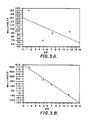
- the indicator electrode according to the present invention was prepared by the method described above. It was used with a standard calomel electrode as a pH sensor. Data were generated by the titration of 0.1M H3PO4 containing 0.01M K4Fe(CN)6, an oxidant that normally interferes with pH detection when metal/metal oxide electrodes are used, with 1M NaOH, in a pH range of 1.5 to 12.0. The pH was plotted versus voltage (millivolts). The plot of Figure 3(A) is generated by the above titration using a bare electrode and the plot of Figure 3(B) is generated using the coated electrode of the present invention.
- FIGS. 4A and 4B show plots generated by titration with 1M NaOH.
- the plot generated by titration using the bare electrode, shown in Figure 4(A) has scatter, while the plot generated by the coated electrode of the present invention, shown in Figure 4(B), has little scatter since the interferance due to anion migration is eliminated.
- Indicator electrodes were prepared by dip coating titanium/iridium oxide electrodes in a 10% by weight solution of polymethacrylic acid and drying by air at 50°C. The electrode was then dipped into a 0.12 M solution of hexamethylene diamine in water to achieve crosslinking at the surface. The electrode was dried at 50°C. The above two-dip process was repeated, and the electrode was stored in water. Upon testing by cyclic voltammetry (CV) in the presence of ferricyanide, a reversible CV for the reduction of ferricyanide to ferrocyanide was observed, indicating that migration of the anion to the electrode had occurred and that the interference was not eliminated.
- CV cyclic voltammetry
Landscapes
- Chemical & Material Sciences (AREA)
- Life Sciences & Earth Sciences (AREA)
- Health & Medical Sciences (AREA)
- General Physics & Mathematics (AREA)
- Pathology (AREA)
- Electrochemistry (AREA)
- Physics & Mathematics (AREA)
- Analytical Chemistry (AREA)
- Biochemistry (AREA)
- General Health & Medical Sciences (AREA)
- Molecular Biology (AREA)
- Immunology (AREA)
- Chemical Kinetics & Catalysis (AREA)
- Investigating Or Analyzing Materials By The Use Of Electric Means (AREA)
- Measurement Of Radiation (AREA)
- Thermistors And Varistors (AREA)
- Light Receiving Elements (AREA)
- Investigating Or Analyzing Materials By The Use Of Fluid Adsorption Or Reactions (AREA)
- Led Devices (AREA)
- Measurement Of The Respiration, Hearing Ability, Form, And Blood Characteristics Of Living Organisms (AREA)
- Investigating Or Analyzing Non-Biological Materials By The Use Of Chemical Means (AREA)
- Investigating Or Analysing Materials By The Use Of Chemical Reactions (AREA)
Priority Applications (1)
| Application Number | Priority Date | Filing Date | Title |
|---|---|---|---|
| AT87870142T ATE97490T1 (de) | 1986-10-14 | 1987-10-13 | Feste messelektrode und verfahren zu deren herstellung. |
Applications Claiming Priority (2)
| Application Number | Priority Date | Filing Date | Title |
|---|---|---|---|
| US918201 | 1986-10-14 | ||
| US06/918,201 US4818365A (en) | 1986-10-14 | 1986-10-14 | Solid state indicator electrode and method of making same |
Publications (3)
| Publication Number | Publication Date |
|---|---|
| EP0277472A2 true EP0277472A2 (de) | 1988-08-10 |
| EP0277472A3 EP0277472A3 (en) | 1989-10-11 |
| EP0277472B1 EP0277472B1 (de) | 1993-11-18 |
Family
ID=25439964
Family Applications (1)
| Application Number | Title | Priority Date | Filing Date |
|---|---|---|---|
| EP87870142A Expired - Lifetime EP0277472B1 (de) | 1986-10-14 | 1987-10-13 | Feste Messelektrode und Verfahren zu deren Herstellung |
Country Status (10)
| Country | Link |
|---|---|
| US (1) | US4818365A (de) |
| EP (1) | EP0277472B1 (de) |
| JP (1) | JPS63108259A (de) |
| AT (1) | ATE97490T1 (de) |
| AU (1) | AU590981B2 (de) |
| BR (1) | BR8705453A (de) |
| CA (1) | CA1286722C (de) |
| DE (1) | DE3788215T2 (de) |
| ES (1) | ES2003861T3 (de) |
| MX (1) | MX169154B (de) |
Cited By (5)
| Publication number | Priority date | Publication date | Assignee | Title |
|---|---|---|---|---|
| EP0447288A1 (de) * | 1990-03-02 | 1991-09-18 | ESA, Inc. | Amperometrische Messzelle |
| EP0382703A3 (de) * | 1989-02-06 | 1991-10-02 | Monsanto Company | Beschichtete Metalle mit Schutzüberzügen aus getemperten, perfluorierten Kationenaustauschpolymeren und ihr Herstellungsverfahren |
| EP0472398A1 (de) * | 1990-08-22 | 1992-02-26 | Toa Electronics Limited | pH-Messelektrode und Verfahren zur Herstellung derselben |
| US5480534A (en) * | 1990-08-22 | 1996-01-02 | Toa Electronics Ltd. | Electrode for measuring PH |
| WO2007049102A1 (en) | 2005-10-24 | 2007-05-03 | Fortune Apex Development Limited | Method of preparing an aqueous pharmaceutical composition comprising hydroxypropyl methylcellulose and pharmaceutical c0mp0siti0ns obtainable |
Families Citing this family (16)
| Publication number | Priority date | Publication date | Assignee | Title |
|---|---|---|---|---|
| CA1285614C (en) * | 1986-11-13 | 1991-07-02 | John E. Heider | Solid state reference electrode |
| US4908117A (en) * | 1986-11-13 | 1990-03-13 | Monsanto Company | Solid state reference electrode |
| US5110441A (en) * | 1989-12-14 | 1992-05-05 | Monsanto Company | Solid state ph sensor |
| DE4025785A1 (de) * | 1990-08-15 | 1992-02-20 | Degussa | Messeinrichtung fuer ph-werte |
| US5221456A (en) * | 1991-10-22 | 1993-06-22 | Rosemount Inc. | Insulated core electrode for ph sensor |
| US5271820A (en) * | 1992-06-19 | 1993-12-21 | Monsanto Company | Solid state pH sensor |
| US5458955A (en) * | 1993-10-21 | 1995-10-17 | Monsanto Company | Metal/polymer laminates having an anionomeric polymer film layer |
| EP1366354A2 (de) * | 2001-03-07 | 2003-12-03 | Instrumentation Laboratory Company | Bezugselektrode |
| AU2003296492A1 (en) * | 2002-12-11 | 2004-06-30 | Instrumentation Laboratory Company | Multi-analyte reference solutions |
| US20040154933A1 (en) * | 2003-02-11 | 2004-08-12 | Instrumentation Laboratory Company | Polymeric membranes for use in electrochemical sensors |
| US20040256227A1 (en) * | 2003-02-11 | 2004-12-23 | Jungwon Shin | Electrochemical urea sensors and methods of making the same |
| JP4075645B2 (ja) * | 2003-03-10 | 2008-04-16 | 株式会社デンソー | オイル用pHセンサ |
| US8574413B2 (en) | 2011-03-18 | 2013-11-05 | Digital Concepts Of Missouri, Inc. | Electrodes, sensors and methods for measuring components in water |
| US10538635B2 (en) * | 2014-06-11 | 2020-01-21 | Parker-Hannifin Corporation | Solid state electrodes and sensors |
| EP3851844B1 (de) | 2018-09-13 | 2024-09-25 | Kabushiki Kaisha Toshiba | Verfahren zur bewertung der anionenpermeabilität eines graphenhaltigen films |
| CN113588740A (zh) * | 2020-04-30 | 2021-11-02 | 深圳安吉尔饮水产业集团有限公司 | 水质pH检测传感器及钌铱电极作为pH传感材料的应用 |
Family Cites Families (6)
| Publication number | Priority date | Publication date | Assignee | Title |
|---|---|---|---|---|
| US3905889A (en) * | 1974-11-01 | 1975-09-16 | Gen Electric | Miniature multifunctional electrochemical sensor for simultaneous carbon dioxide-pH measurements |
| DE2644443B2 (de) * | 1975-10-06 | 1978-08-31 | Basf Wyandotte Corp., Wyandotte, Mich. (V.St.A.) | Verfahren zur Verbesserung der Selektivität von Membranen für Chloralkalielektrolysezellen |
| GB2096643A (en) * | 1981-04-09 | 1982-10-20 | Diamond Shamrock Corp | Electrocatalytic protective coating on lead or lead alloy electrodes |
| US4465533A (en) * | 1983-01-13 | 1984-08-14 | Eltech Systems Limited | Method for making polymer bonded electrodes |
| US4536274A (en) * | 1983-04-18 | 1985-08-20 | Diamond Shamrock Chemicals Company | pH and CO2 sensing device and method of making the same |
| CA1285614C (en) * | 1986-11-13 | 1991-07-02 | John E. Heider | Solid state reference electrode |
-
1986
- 1986-10-14 US US06/918,201 patent/US4818365A/en not_active Expired - Lifetime
-
1987
- 1987-10-13 AU AU79593/87A patent/AU590981B2/en not_active Ceased
- 1987-10-13 JP JP62258182A patent/JPS63108259A/ja active Pending
- 1987-10-13 EP EP87870142A patent/EP0277472B1/de not_active Expired - Lifetime
- 1987-10-13 DE DE87870142T patent/DE3788215T2/de not_active Expired - Fee Related
- 1987-10-13 MX MX008802A patent/MX169154B/es unknown
- 1987-10-13 BR BR8705453A patent/BR8705453A/pt not_active Application Discontinuation
- 1987-10-13 AT AT87870142T patent/ATE97490T1/de not_active IP Right Cessation
- 1987-10-13 CA CA000549173A patent/CA1286722C/en not_active Expired - Lifetime
- 1987-10-13 ES ES198787870142T patent/ES2003861T3/es not_active Expired - Lifetime
Cited By (7)
| Publication number | Priority date | Publication date | Assignee | Title |
|---|---|---|---|---|
| EP0382703A3 (de) * | 1989-02-06 | 1991-10-02 | Monsanto Company | Beschichtete Metalle mit Schutzüberzügen aus getemperten, perfluorierten Kationenaustauschpolymeren und ihr Herstellungsverfahren |
| EP0447288A1 (de) * | 1990-03-02 | 1991-09-18 | ESA, Inc. | Amperometrische Messzelle |
| EP0472398A1 (de) * | 1990-08-22 | 1992-02-26 | Toa Electronics Limited | pH-Messelektrode und Verfahren zur Herstellung derselben |
| US5320735A (en) * | 1990-08-22 | 1994-06-14 | Toa Electronics Ltd. | Electrode for measuring pH |
| US5480534A (en) * | 1990-08-22 | 1996-01-02 | Toa Electronics Ltd. | Electrode for measuring PH |
| US5573798A (en) * | 1990-08-22 | 1996-11-12 | Toa Electronics Ltd. | Method of manufacturing an electrode for measuring pH |
| WO2007049102A1 (en) | 2005-10-24 | 2007-05-03 | Fortune Apex Development Limited | Method of preparing an aqueous pharmaceutical composition comprising hydroxypropyl methylcellulose and pharmaceutical c0mp0siti0ns obtainable |
Also Published As
| Publication number | Publication date |
|---|---|
| BR8705453A (pt) | 1988-05-24 |
| ES2003861A4 (es) | 1988-12-01 |
| ATE97490T1 (de) | 1993-12-15 |
| ES2003861T3 (es) | 1994-02-01 |
| DE3788215T2 (de) | 1994-04-14 |
| DE3788215D1 (de) | 1993-12-23 |
| JPS63108259A (ja) | 1988-05-13 |
| EP0277472B1 (de) | 1993-11-18 |
| US4818365A (en) | 1989-04-04 |
| AU7959387A (en) | 1988-04-21 |
| MX169154B (es) | 1993-06-23 |
| EP0277472A3 (en) | 1989-10-11 |
| CA1286722C (en) | 1991-07-23 |
| AU590981B2 (en) | 1989-11-23 |
Similar Documents
| Publication | Publication Date | Title |
|---|---|---|
| EP0277472B1 (de) | Feste Messelektrode und Verfahren zu deren Herstellung | |
| US4908117A (en) | Solid state reference electrode | |
| US5271820A (en) | Solid state pH sensor | |
| US5110441A (en) | Solid state ph sensor | |
| Kinlen et al. | A solid-state pH sensor based on a Nafion-coated iridium oxide indicator electrode and a polymer-based silver chloride reference electrode | |
| CA1285614C (en) | Solid state reference electrode | |
| Dong et al. | Chloride chemical sensor based on an organic conducting polypyrrole polymer | |
| EP0125807B1 (de) | PH und C02 empfindliche Sonde | |
| US3905889A (en) | Miniature multifunctional electrochemical sensor for simultaneous carbon dioxide-pH measurements | |
| JPS6135510B2 (de) | ||
| JPH0273146A (ja) | 超小型電極及びその製法 | |
| US4773970A (en) | Ion-sensitive electrochemical sensor and method of determining ion concentrations | |
| US4579641A (en) | pH Measurement device | |
| US3730868A (en) | Carbon dioxide sensor | |
| Wang et al. | Ion-exchange voltammetry at poly (ester-sulfonic acid) film coated electrodes for trace analysis | |
| US3923627A (en) | Miniature probe containing multifunctional electrochemical sensing electrodes | |
| US3794575A (en) | Oxygen sensor | |
| CN109991293B (zh) | 一种高柔韧全固态pH选择性电极及其制备方法 | |
| Karagözler et al. | Potentiometric iodide ion sensor based on a conducting poly (3-methylthiophene) polymer film electrode | |
| CA1155800A (en) | Silver/silver halide electrodes comprising chromium or nickel | |
| US3705088A (en) | Carbon dioxide sensor | |
| Hailin et al. | Characterization of a chemoresistor pH sensor based on conducting polypyrrole | |
| JPS61251764A (ja) | ↓pHセンサ− | |
| US3856636A (en) | Oxygen sensor | |
| US3709812A (en) | Carbon dioxide sensor |
Legal Events
| Date | Code | Title | Description |
|---|---|---|---|
| PUAI | Public reference made under article 153(3) epc to a published international application that has entered the european phase |
Free format text: ORIGINAL CODE: 0009012 |
|
| AK | Designated contracting states |
Kind code of ref document: A2 Designated state(s): AT BE CH DE ES FR GB GR IT LI LU NL SE |
|
| PUAL | Search report despatched |
Free format text: ORIGINAL CODE: 0009013 |
|
| AK | Designated contracting states |
Kind code of ref document: A3 Designated state(s): AT BE CH DE ES FR GB GR IT LI LU NL SE |
|
| 17P | Request for examination filed |
Effective date: 19900307 |
|
| 17Q | First examination report despatched |
Effective date: 19910416 |
|
| GRAA | (expected) grant |
Free format text: ORIGINAL CODE: 0009210 |
|
| AK | Designated contracting states |
Kind code of ref document: B1 Designated state(s): AT BE CH DE ES FR GB GR IT LI LU NL SE |
|
| REF | Corresponds to: |
Ref document number: 97490 Country of ref document: AT Date of ref document: 19931215 Kind code of ref document: T |
|
| ITF | It: translation for a ep patent filed | ||
| ET | Fr: translation filed | ||
| REF | Corresponds to: |
Ref document number: 3788215 Country of ref document: DE Date of ref document: 19931223 |
|
| REG | Reference to a national code |
Ref country code: ES Ref legal event code: FG2A Ref document number: 2003861 Country of ref document: ES Kind code of ref document: T3 |
|
| REG | Reference to a national code |
Ref country code: GR Ref legal event code: FG4A Free format text: 3010057 |
|
| PGFP | Annual fee paid to national office [announced via postgrant information from national office to epo] |
Ref country code: LU Payment date: 19940901 Year of fee payment: 8 |
|
| PGFP | Annual fee paid to national office [announced via postgrant information from national office to epo] |
Ref country code: FR Payment date: 19940916 Year of fee payment: 8 Ref country code: DE Payment date: 19940916 Year of fee payment: 8 Ref country code: CH Payment date: 19940916 Year of fee payment: 8 |
|
| PGFP | Annual fee paid to national office [announced via postgrant information from national office to epo] |
Ref country code: SE Payment date: 19940920 Year of fee payment: 8 Ref country code: AT Payment date: 19940920 Year of fee payment: 8 |
|
| PLBE | No opposition filed within time limit |
Free format text: ORIGINAL CODE: 0009261 |
|
| STAA | Information on the status of an ep patent application or granted ep patent |
Free format text: STATUS: NO OPPOSITION FILED WITHIN TIME LIMIT |
|
| PGFP | Annual fee paid to national office [announced via postgrant information from national office to epo] |
Ref country code: GB Payment date: 19940927 Year of fee payment: 8 |
|
| PGFP | Annual fee paid to national office [announced via postgrant information from national office to epo] |
Ref country code: GR Payment date: 19940928 Year of fee payment: 8 |
|
| PGFP | Annual fee paid to national office [announced via postgrant information from national office to epo] |
Ref country code: BE Payment date: 19940929 Year of fee payment: 8 |
|
| PGFP | Annual fee paid to national office [announced via postgrant information from national office to epo] |
Ref country code: ES Payment date: 19941013 Year of fee payment: 8 |
|
| PGFP | Annual fee paid to national office [announced via postgrant information from national office to epo] |
Ref country code: NL Payment date: 19941031 Year of fee payment: 8 |
|
| 26N | No opposition filed | ||
| EAL | Se: european patent in force in sweden |
Ref document number: 87870142.4 |
|
| PG25 | Lapsed in a contracting state [announced via postgrant information from national office to epo] |
Ref country code: LU Free format text: LAPSE BECAUSE OF NON-PAYMENT OF DUE FEES Effective date: 19951013 Ref country code: GB Effective date: 19951013 Ref country code: AT Effective date: 19951013 |
|
| PG25 | Lapsed in a contracting state [announced via postgrant information from national office to epo] |
Ref country code: SE Effective date: 19951014 Ref country code: ES Free format text: LAPSE BECAUSE OF THE APPLICANT RENOUNCES Effective date: 19951014 |
|
| PG25 | Lapsed in a contracting state [announced via postgrant information from national office to epo] |
Ref country code: LI Effective date: 19951031 Ref country code: CH Effective date: 19951031 Ref country code: BE Effective date: 19951031 |
|
| BERE | Be: lapsed |
Owner name: MONSANTO CY Effective date: 19951031 |
|
| PG25 | Lapsed in a contracting state [announced via postgrant information from national office to epo] |
Ref country code: GR Free format text: THE PATENT HAS BEEN ANNULLED BY A DECISION OF A NATIONAL AUTHORITY Effective date: 19960430 |
|
| PG25 | Lapsed in a contracting state [announced via postgrant information from national office to epo] |
Ref country code: NL Effective date: 19960501 |
|
| GBPC | Gb: european patent ceased through non-payment of renewal fee |
Effective date: 19951013 |
|
| REG | Reference to a national code |
Ref country code: CH Ref legal event code: PL |
|
| PG25 | Lapsed in a contracting state [announced via postgrant information from national office to epo] |
Ref country code: FR Effective date: 19960628 |
|
| REG | Reference to a national code |
Ref country code: GR Ref legal event code: MM2A Free format text: 3010057 |
|
| EUG | Se: european patent has lapsed |
Ref document number: 87870142.4 |
|
| PG25 | Lapsed in a contracting state [announced via postgrant information from national office to epo] |
Ref country code: DE Effective date: 19960702 |
|
| NLV4 | Nl: lapsed or anulled due to non-payment of the annual fee |
Effective date: 19960501 |
|
| REG | Reference to a national code |
Ref country code: FR Ref legal event code: ST |
|
| REG | Reference to a national code |
Ref country code: ES Ref legal event code: FD2A Effective date: 19991007 |
|
| PG25 | Lapsed in a contracting state [announced via postgrant information from national office to epo] |
Ref country code: IT Free format text: LAPSE BECAUSE OF NON-PAYMENT OF DUE FEES;WARNING: LAPSES OF ITALIAN PATENTS WITH EFFECTIVE DATE BEFORE 2007 MAY HAVE OCCURRED AT ANY TIME BEFORE 2007. THE CORRECT EFFECTIVE DATE MAY BE DIFFERENT FROM THE ONE RECORDED. Effective date: 20051013 |