EP0277626A2 - Analogues synthetiques du GHRH - Google Patents
Analogues synthetiques du GHRH Download PDFInfo
- Publication number
- EP0277626A2 EP0277626A2 EP88101432A EP88101432A EP0277626A2 EP 0277626 A2 EP0277626 A2 EP 0277626A2 EP 88101432 A EP88101432 A EP 88101432A EP 88101432 A EP88101432 A EP 88101432A EP 0277626 A2 EP0277626 A2 EP 0277626A2
- Authority
- EP
- European Patent Office
- Prior art keywords
- leu
- ala
- group
- asp
- glu
- Prior art date
- Legal status (The legal status is an assumption and is not a legal conclusion. Google has not performed a legal analysis and makes no representation as to the accuracy of the status listed.)
- Withdrawn
Links
Images
Classifications
-
- C—CHEMISTRY; METALLURGY
- C07—ORGANIC CHEMISTRY
- C07K—PEPTIDES
- C07K14/00—Peptides having more than 20 amino acids; Gastrins; Somatostatins; Melanotropins; Derivatives thereof
- C07K14/435—Peptides having more than 20 amino acids; Gastrins; Somatostatins; Melanotropins; Derivatives thereof from animals; from humans
- C07K14/575—Hormones
- C07K14/60—Growth hormone-releasing factor [GH-RF], i.e. somatoliberin
-
- A—HUMAN NECESSITIES
- A61—MEDICAL OR VETERINARY SCIENCE; HYGIENE
- A61K—PREPARATIONS FOR MEDICAL, DENTAL OR TOILETRY PURPOSES
- A61K38/00—Medicinal preparations containing peptides
Definitions
- the present invention relates to peptides having influence on the function of the pituitary gland in humans and other animals.
- the present invention is directed to a peptide which promotes the release of growth hormone by the pituitary gland.
- hypothalamic releasing factors have been characterized for the pituitary hormone thyrotropin (the tripeptide TRF), for the pituitary gonadotropins luteinising hormone and follicle stimulating hormone (the decapeptide LRF, LH-RH or GnRH) and for the pituitary hormone and adreno-corticotropin (the 41-amino acid polypeptide CRF).
- TRF the tripeptide
- LRF the pituitary gonadotropins luteinising hormone and follicle stimulating hormone
- CRF the pituitary hormone and adreno-corticotropin
- GRFs growth hormone releasing factors
- R2 is Ala,D-Ala,or D-N-Methyl-Ala R3 ios Asp,D-Asp,Glu,or D-Glu R8 is Asn,D-Asn,Ser,or D-Ser R10 is Tyr or D-Tyr R12 is Lys, D-Lys Arg or Orn R13 is Val or Ile R14 is Leu or D-Leu R15 is Gly,N-Methyl-Gly, or D-Ala
- peptides of the present invention [PeP] are synthesized in accordance with the following procedures.
- the Q2 segment of NH2-Q2 moiety to a support phase [SP] selected from the group consisting of amino resins and hydroxyl type resins which comprises the sequential steps of reacting a t-butoxycarbonylating agent with NH2.Q2 in the presence of a base to form Boc-NH.Q 2 ⁇ (V) reacting said Boc-NH.Q2 with an arylsulphonyl halide suitably of the formula: Hal-SO2 - ⁇ o >-O-CH2-COOH (VI) wherein Hal is chloro or bromo, and ⁇ o > signifies (throughout the application) an unsubstituted benzene ring, at between -5 and 10°C in a water soluble ether in the presence of aqueous alkali to form the corresponding Boc- NH-Q 2 ⁇ -SO2 - ⁇ o >-OCH2- COOH (VII) which is coupled to the support phase [SP] by the action of a diloweralky
- the support phase [SP] is an amino resin of the formula H2N-CH2- ⁇ o >-[Pm]. (IX) where [Pm] is a polymeric substrate.
- Boc-NH-Q2 is reacted with Hal-SO2- ⁇ o >-O-CH2-CO-[SP] (X) wherein Hal is bromo or chloro, to yield Boc-NH-Q 2 ⁇ -SO2- ⁇ o >-O-CH2-CO-[SP] (XI)
- Yet another embodiment is available for attaching the guanidino alkyl group to the support phase.
- This method comprises the sequential steps of reacting N-benzyloxy carbonyl chloride with NH2.Q2 in the presence of a base to form Cbz-NH.Q2, reacting said Cbz-NH.Q2 with a substituted arylsulphonyl chloride of the formula: wherin Hal is chloro or bromo, M is lower alkyl or lower alkoxy of 1 to 5 carbon atoms, and S is 1-3, in the presence of a strong aqueous base and removing the Cbz group by catalytic hydrogenation to yield. reacting this product with 9-fluorenylmethoxy carbonyl chloride in the presence of a base to yield coupling this product to said support phase [SP] to yield:
- the desired peptide itself is built up in the conventional manner for solid phase synthesis utilizing the protective groups and the specific procedures set forth in detail hereinbelow.
- the guanidino alkyl end of the peptide is cleaved from the sulfonyl group to which it is attached by one or two procedures. If the Boc protocol is utilized then the cleaving agent is anhydrous hydrofluoric acid, on the other hand, in the Fmoc protocol the cleaving agent is trifluoroacetic acid.
- compositions in accordance with the invention include the peptides of Formula I, or a nontoxic salt of any of these, dispersed in a pharmaceutically or veterinarily acceptable liquid or solid carrier.
- pharmacetical compositions can be used in clinical medicine, both human and veterinary, for administration for therapeutic purposes, and also diagnostically. Moreover, they can be used to promote the growth of warm-blooded animals, including fowl, and in aquivulture for cold-blooded animals, e.g., fish, eels, etc.
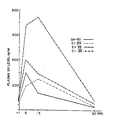
- Figure 1 is a plot of Plasma GH levels against time in rats.
- Nle norleucine
- Nva norvaline
- MeAla N-methyl-alanine
- the procedures of the present invention may be carried out using a variety of support phases.
- These support phases may be amino or hydroxy resins such as amino methyl resins (suitably 1% cross linked), benzhydrylamine resins (suitably 2% cross linked), p-methylbenzhydrylamine resins (suitably 2% cross linked) and the like.
- the key to the success of the present invention is the provision of a stable but readily cleavable bridging group between the guanidino moiety and the support phase. It has been found that such a bridge may be readily provided by the sulfonyl phenoxy acetyl moiety.
- the primary amino group of agmatine is protected with a t-butoxy carbonylating agent, suitably ditert-butyl dicarbonate, by reaction preferably at ambient temperatures in the presence of a base, providing the protected material (V) which is then reacted in a similar solvent system with the aryl sulfonyl halide (VI) which may be a sulfonyl chloride or sulfonyl bromide.
- a t-butoxy carbonylating agent suitably ditert-butyl dicarbonate
- the aromatic ring of the aryl sulfonyl halide is not substituted since such a situation will permit the use of trifluoroacetic acid as the intermediate deprotecting agent and hydrogen fluoride as the agent for final cleavage from the resin support phase.
- the thus obtained protected sulfonamido phenoxy acetic acid (VII) is then coupled to the support phase.
- the coupling is carried out using any of the known dialkyl carbodiimide coupling procedures. For example, there may be utilized diisopropyl carbodiimide in the presence of 1-hydroxybenzenetriazole hydrate in dimethylformamide at ambient temperatures.
- N,N ⁇ dicyclohexyl carbodiimide there may be employed N,N ⁇ dicyclohexyl carbodiimide.
- the aforesaid Boc-sulfonamido phenoxy acetic acid (VII) is mixed with the carbo-diimide in 2 to 1 molar ratio N,N ⁇ dicyclohexyl urea is formed, removed by filtration and the resulting solution added to the support phase, suitably an amino methyl resin. It is preferred to carry out this reaction utilizing a ratio of resin amino component to Boc-amino acid to dicyclohexyl carbodiimide of 1:6:3.
- carboxy methoxy phenyl sulfonic acid is coupled with the amino methyl resin in accordance with the foregoing carbodiimide procedures
- the sulfonic acid group of the product is converted to the corresponding sulfonyl chloride by reaction with thionyl chloride in dimethyl formamide and the resulting product coupled with the protected amino alkyl guanidine (V) in the presence of an organic base in a suitable organic solvent, for example, tetramethyl guanidine in chloroform, to yield the desired coupled product.
- the protecting group is Boc
- the aryl moiety of the sulfonamide bridge is unsubstituted.
- N-benzyloxy carbonyl chloride in the presence of an aqueous alkali, suitably sodium hydroxide, preferably at about 4N under agitation and cooling to between about 5 and about 15°C.
- an aqueous alkali suitably sodium hydroxide
- the protected product is precipitated and thereafter is reacted with the aryl sulfonyl chloride (XII) as previously.
- the aryl sulfonyl chloride (XII) should preferably carry between 1 and 3 substituents which may be alkyl or lower alkoxy, suitably methyl or methoxy.
- This reaction is carried out in the presence of a strong but dilute aqueous base, suitably about 1N sodium hydroxide.
- the reaction mixture is acidified and the product extracted, suitably with a water immiscible organic solvent such as ethyl acetate.
- the extract is then concentrated and hydrogenated, suitably at atmospheric pressure and temperature in the presence of a catalyst such as palladium on charcoal in a reduction inert solvent. If ethyl acetate is used as the extractant, this may be used as the hydrogenation solvent.
- the peptides are synthesized by a suitable method, such as by exclusively solid-phase techniques, by partial solid-phase techniques, by fragment condensation or by classical solution phase synthesis.
- a suitable method such as by exclusively solid-phase techniques, by partial solid-phase techniques, by fragment condensation or by classical solution phase synthesis.
- the employment of recently developed recombinant DNA techniques may be used to prepare a portion of an analog containing only natural amino acid residues.
- the techniques of exclusively solid-phase synthesis are set forth in the textbook "Solid Phase Peptide Synthesis", J. M. Stewart and J. D. Young, Pierce Chem. Company, Rockford, Ill., 1984 (2nd. ed.), G. Barany and R. B. Merrifield, "The Peptides", Ch. 1, 1-285, pp. 1979, Academic Press, Inc., and M.
- [PR] [PeP] attached to a support phase [SP] selected from the group consisting of amino resins and hydroxyl type resins said combination having the structure: where M is hydrogen, lower alkyl or lower alkoxy of 1 to 5 carbon atoms, suitably methyl or methoxy, s is 0, 1, 2 or 3, [SP] is an amino or hydroxyl type resin, suitably [PR] [PeP] has the structure wherein: X1 is either hydrogen or an alpha-amino protecting group.
- the alpha-amino protecting groups contemplated by X1 are those well known to be useful in the art of step-wise synthesis of polypeptides.
- alpha-amino protecting groups which may be employed as X1 are (1) aromatic urethan-type protecting groups, such as fluoroenylmethyloxycarbonyl (Fmoc), benzyloxycarbonyl (Cbz) and substituted Cbz, such as p-chlorobenzyloxycarbonyl, p-nitrobenzyloxycarbonyl, p-bromobenzyloxycarbonyl, and p-methoxybenzyloxycarbonyl; (2) aliphatic urethan protecting groups, such as t-butyloxycarbonyl (Boc), diisopropylmethyloxycarbonyl, allyloxycarbonyl; and (3) cycloalkyl urethan-type protecting groups, such as cyclopentyloxycarbonyl, adamantyloxycarbonyl, and cyclohexyloxycarbonyl.
- aromatic urethan-type protecting groups such as fluoroenylmethyloxycarbonyl (Fmo
- X3 is a suitable ester-forming protecting group for the carboxyl group of Asp or Glu, such as benzyl (OBzl), 2,6-dichlorobenzyl, and t-butyl.
- Boc benzyl
- 2,6-dichlorobenzyl 2,6-dichlorobenzyl
- t-butyl a suitable ester-forming protecting group for the carboxyl group of Asp or Glu
- Boc protocol o-cyclohexyl and o-benzyl are preferred; in the Fmoc protocol t-butyl is preferred.
- X7 may be a suitable protecting group for the hydroxyl group of Thr or Ser, such as tert-butyl, Bzl, and 2,6-dichloro-benzyl.
- the preferred protecting in the Boc protocol is Bzl, and in the Fmoc protocol is tert-butyl.
- X10 may be a suitable protecting group for the phenolic hydroxyl group of Tyr, such as tert-butyl, Bzl, 4Br-Cbz and 2,6-dichloro benzyl (DCB).
- the preferred protecting group in the Boc protocol is 2,6-dichlorobenzyl, and in the Fmoc protocol is tert-butyl.
- X11 is a suitable protecting group for the guanidino group of Arg, such as nitro, Tos, methyl-(t-butyl benzene)-sulfonyl, 4-methoxy-2,3,6-trimethylbenzenesulfonyl; in the Boc protocol Tos is the preferred group and 4-methoxy-2,3,6-trimethylbenzenesulfonyl in the Fmoc protocol.
- X12 is a suitable protecting group for the side chain amino group of Lys.
- suitable side chain amino protecting groups are 2-chlorobenzyloxycarbonyl (2-Cl-Z), Tos, t-amyloxycarbonyl and in the Boc protocol 2-chlorobenzyloxycarbonyl is the preferred protecting group and in the Fmoc protocol Boc is thus utilized.
- X24 is hydrogen or a protecting group for the imidazole nitrogen of His, such as Tos.
- side chain amino protecting group is not critical except that generally one is chosen which is not removed during deprotection of the alpha-amino groups during the synthesis.
- the protecting group preferably retains is protecting properties and is not split off under coupling conditions
- the protecting group should be stable to the reagent, is preferably stable under the reaction conditions selected for removing the alpha-amino protecting group at each step of the synthesis
- the side chain protecting group must be removable, upon the completion of the synthesis containing the desired amino acid sequence, under reaction conditions that will not undesirably alter the peptide chain.
- the peptides are not prepared using recombinant DNA technology, they are preferably prepared using solid phase synthesis, such as that generally described by Merrifield, J. Am. Chem. Soc. , 85 , p. 2149 (1963), although other equivalent chemical syntheses known in the art can also be used as previously mentioned. prepared as set forth above and constitutes the starting material for the synthetic sequence.
- the remaining alpha-amino- and side chain-protected amino acids are coupled step-wise in the desired order to obtain the intermediate compound defined hereinbefore, or as an alternative to adding each amino acid separately in the synthesis, some of them may be coupled to one another prior to addition to the solid phase reactor.
- the selection of an appropriate coupling reagent is within the skill of the art. Particularly suitable as a coupling reagent is N,N ⁇ -diisopropyl carbodiimide (DIC).
- activating reagents used in the solid phase synthesis of the peptides are well known in the peptide art.
- suitable activating reactions are carbodiimides, such as N,N ⁇ -diisopropylcarbodiimide and N,N-dicyclohexyl carbodiimide (DCCI).
- DCCI N,N-dicyclohexyl carbodiimide
- Other activating reagents and their use in peptide coupling are described by M. Bodanszky, "Principles of Peptide Synthesis", Springer-Verlag, 1984.
- Each protected amino acid or amino acid sequence is introduced into the solid phase reactor in about a three fold excess, and the coupling may be carried out in a medium or dimethylformamide (DMF): CH2Cl2 (1:1) or in DMF or CH2Cl2 alone.
- DMF dimethylformamide
- the coupling procedure is repeated before removal of the alpha-amino protecting group prior to the coupling of the next amino acid.
- the success of the coupling reaction at each stage of the synthesis is preferably monitored by the ninhydrin reaction, as described by E. Kaiser, et al., Anal. Biochem. , 34 595 (1970).
- the intermediate peptide can be removed from the resin support by treatment with a reagent such as liquid hydrogen fluoride or trifluoracetic acid, which not only cleaves the peptide from the resin but also cleaves all remaining side chain protecting groups X3, X7, X10, X11, X12, and X24 and the anchoring sulfonamido bond and also the alpha-amino protecting group X1.
- a reagent such as liquid hydrogen fluoride or trifluoracetic acid
- the Boc protecting group is preferably first removed using trifluoroacetic acid (TFA)/ethanedithiol prior to cleaving the peptide from the resin with HF to eliminate potential S-alkylation.
- TFA trifluoroacetic acid
- anisole and methylethyl sulfide are indluded as scavengers in the reaction vessel.
- Boc-Agmatine (4.29 g, 10 mmole) is taken up in a mixture of acetone (50 ml) and 1N sodium hydroxide (50 ml) with stirring and cooling in an ice bath and 4-chlorosulfonyl phenoxyacetic acid (3.8 g, 15 mmole) added to the solution. Stirring is continued for 3 hours and the pH of the reaction mixture is kept at 11-12 by adding 4N sodium hydroxide. The reaction mixture is acidified with 10% citric acid solution and concentrated under reduced pressure to the half of its volume, and extracted with ethyl acetate (3 x 50 ml).
- Boc-agmatine-sulfonyl-phenoxyacetic acid (abbreviated as Boc-agmatine-[SPA]) is obtained as thick oil (3.6 g, 81%).
- R f 0.5 in a 9:1 mixture (v/v) of ethyl acetate-acetic acid on Sigma F254 TLC plate.
- Cbz-agmatine (2.85 g, 10 mM) and 4-chlorosulfonyl-2,3,5-trimethylphenoxy acetic acid (or 4-chlorosulfonyl-2,3,6-trimethylphenoxy acetic acid (4.39 g, 15 mM) were reacted as described in Example III.
- Cbz-agmatine-sulfonyl-2,3,5 (or 2,3,6)-trimethylphenoxy acetic acid obtained was dissolved in ethanol (50 ml) and hydrogenated over palladium-charcoal catalyst (0.5 g). The catalyst was filtered off and the solvent was removed under reduced pressure.
- the aqueous phase was acidified with 1:1 hydrochloric acid solution and extracted 3 x 100 ml ethyl acetate. After drying over anhydrous sodium sulfate the solvent was removed under reduced pressure.
- the Fmoc-Agmatine-sulfonyl-2,3,5 (or 2,3,6)-trimethylphenoxy acetic acid obtained was dissolved in DMF (50 ml) and coupled to 5 g. aminomethyl resin as described in Example IV.
- Deblocking is carried out in accordance with Schedule A as follows:
- Boc-Arg (Tos)
- a mixture of 50% DMF and methylene chloride is used.
- Bzl ether is used as the hydroxyl side-chain protecting group for Ser and Thr.
- 2-Chloro benzyloxycarbonyl (2Cl-Cbz) is used as the protecting group for the Lys side chain.
- Tos is used to protect the guanidino group of Arg and the Glu and Asp side-chain carboxyl group is protected with OBzl or OChx.
- the phenolic hydroxyl group of Tyr is protected with 2,6-dichlorobenzyl (DCB).
- the protected peptide produced as above is utilized as starting material.
- the protected peptide is treated with TFA-Toluene (1:2 v/v), prior to the HF treatment, using two treatments with (2 + 28 min. then washed 3X with CH2Cl2.
- the incomplete mixing of the HF reagent and the peptidyl resin or peptide can be alleviated simply by the following order of addition of the reagents: (a) peptide or peptidyl-resin, (b) p-cresol, p-thiocresol, or both, in a melted form, carefully on top of the resin by a warm peptide, (c) after cooling and the p-cresol mixture has solidified, magnetic stirring bar, and (d) dimethyl sulfide.
- the reagents (dimethyl sulfide, 6,5 ml; p-cresol, 0.75 ml.; p-thiocresol, 0.25 ml.), total volume 7,5 ml, and peptide-resin (1.0 g.) were placed in the reaction vessel and connected to the HF line.
- the vessel was cooled to - 78°C for 0.5 hours (longer cooling time for large volume of reagent).
- the line was evacuated briefly for 0.5 min. and HF was quickly distilled into the evacuated reaction vessel to a 10 ml mark (or any desired volume).
- the reaction was then quickly equilibrated to 0°C by ice bath and allowed to stir vigorously for 2 hours (check stirring constantly).
- the HF-dimethyl sulfide-p-cresol mixture at this point was colorless to light yellow. After 2 hours, the mixture was then evacuated first with water aspirator (caution: bumping) with the valve of the reaction to the aspirator only partially opened. After most of the reagent was removed, the mixture was further evacuated by mechanical pump to a light colored liquid (usually at about 0.5 ml mark).
- HF should be charged to 7.5 or 10 ml total volume, so that the final HF concentration will be certain to reach at least 90% by volume. A final mixture of 95% HF and 5% cresol plus thiocresol has been found to be entirely satisfactory.] The reaction was then equilibrated to 0°C and allowed to react for 45-60 minutes. The HF was then removed as described previously.
- the crude peptides were purified by HPLC method using semipreparative or preparative reverse-phase chromatographic columns, (Vydac C18, 10 X 250 mm, particle size 5 micron or Dynamax C18 Macro HPLC column 21, 4 X 250 mm, particle size 12 micron).
- Pumps Beckman 114M Solvent Delivery Module Detector: Beckman 160A Absorbance Detector Gradient Controller: Beckman 420 Grad. Cont. Injector: Altex 210A Detection Wavelength: 214 mm
- Eluents A, 0.1% TFA in water (high purity) B, 0.1% TFA in water-acetonitile 3:7 (by vol.) mixture.
- Deblocking is carried out in accordance with Schedule A as follows:
- Fmoc-protected amino acid in DMF 1 to 2 mmol. of Fmoc-protected amino acid in DMF is used per gram of resin.
- Fmoc-Arg 4-MeO-2,3,6-tribenzene sulfonyl
- a mixture of 50% DMF and methylene chloride is used.
- T-Butyl ether is used as the hydroxyl side-chain protecting group for Ser and Thr.
- Tert-butyloxycarbonyl (Boc) is used as the protecting group for the Lys side chain.
- 4-MeO-2,3,6-tribenzene sulfonyl is used to protect the guanidino group of Arg and the Glu and Asp side-chain carboxyl group protected with t-butyl ester.
- the phenolic hydroxyl group of Tyr is similarly protected with t-butyl ether.
- the protected peptide produced as above is utilized as starting material.
- the cleavage of the peptide from the solid support and the removal of side chain protecting groups was carried out simultaneously by the reaction of the protected peptide resin with TFA-thioanisole (5%) at a temperature 25-30°C for 2-3 hours (10 ml. of liquid per each gram of resin was used). After the completion of the reaction the reagent was removed in vacuo at room temperature. The remaining material was extracted, first with ether (removing the nonpolar side-products), then the crude peptide was extracted from the filtered-cake with 10% acetic acid and the filtrate was lyophilized.
- the compounds of the present invention were tested both in vitro in rat cell culture and in vivo in rats to determine GHRH activity.
- the protocols are as follows:
- the cell suspension was centrifuged at room temperature for 10 minutes at 100 xg. The cell pellet was then resuspended in 1.0 ml. of medium. A small aliquot was diluted for counting the cells, and the rest of the suspension was divided into 2 equal volumes. Each volume (containing about 5 x 10⁶ cells, usually between 3.5 and 7.0 x 10⁶) was mixed with 0.5 ml.
- Sephadex G-15 which had been equilibrated with previously oxygenated medium. The mixture of pituitary cells and Sephadex was transferred into 2 chambers of the superfusion apparatus and perfused with the medium.
- the medium was always freshly prepared in a way similar to that used for the enzymatic dispersion, but with the omission of the collagenase, passed through a millipore filter, and gassed continuously with a mixture of O2 (95%) and CO2 (5%) during the experiment.
- the superfusion apparatus consisted of a number of 1 ml. plastic syringe barrels (modified by cutting off their distal end) and mounted vertically in a Plexiglas holder which was kept at 37°C by circulating water. The unit was constructed in our laboratory workshop. Properly greased O-rings prevented the leakage of the circulating water around the syringe barrels.
- Each barrel was fitted with plungers at both ends. Holes were drilled in the plungers to accommodate plastic tubing.
- the lower plunger was covered with a small piece of 30 um-pore nylon net to keep the Sephadex beads from escaping.
- the "pores" between the beads were small enough to prevent the pituitary cells from escaping and large enough to allow a practically unrestricted flow of medium through the cell column.
- the upper plunger tubing was used for directing the flow through the chamber from the medium reservoir.
- the flow through the system (0.5 ml. min) was controlled with a multichannel peristaltic pump (Gilson) Minipulse type HP-8 which was placed after the superfusion chamber; the tubing of the lower plunger was connected to the pump and from there to a four-channel fraction collector (a modified Gilson type Anacol SC30).
- Gilson multichannel peristaltic pump
- HP-8 peristaltic pump
- the tubing of the lower plunger was connected to the pump and from there to a four-channel fraction collector (a modified Gilson type Anacol SC30).
- the medium from the chamber was collected into disposable borosilicate glass tubes containing 30 ⁇ l of 1N HCl for immediate acidifying of the perfusate to prevent the loss of ACTH
- ACTH radioimmunoassays were performed on 100 ul aliquots of undiluted superfusion medium essentially as described elsewhere (14); however, the separation of bound and free ACTH was accomplished by a polyethylene glycol facilitated second antibody method.
- Rat GH was measured in aliquots of undiluted or diluted superfusates to determine either basal or stimulated secretion.
- the antisera a-hACTH batch No. 2, a-rGH S-4
- the hormones rGH RP-1 and I-4, hACTH
- NHPP NIADDK, NIH
Landscapes
- Health & Medical Sciences (AREA)
- Chemical & Material Sciences (AREA)
- Endocrinology (AREA)
- Life Sciences & Earth Sciences (AREA)
- Organic Chemistry (AREA)
- Biophysics (AREA)
- Gastroenterology & Hepatology (AREA)
- Biochemistry (AREA)
- Zoology (AREA)
- General Health & Medical Sciences (AREA)
- Genetics & Genomics (AREA)
- Medicinal Chemistry (AREA)
- Molecular Biology (AREA)
- Proteomics, Peptides & Aminoacids (AREA)
- Toxicology (AREA)
- Peptides Or Proteins (AREA)
- Medicines That Contain Protein Lipid Enzymes And Other Medicines (AREA)
Applications Claiming Priority (2)
| Application Number | Priority Date | Filing Date | Title |
|---|---|---|---|
| US07/011,152 US4914189A (en) | 1987-02-05 | 1987-02-05 | Synthetic GHRH analogs |
| US11152 | 2001-12-07 |
Publications (2)
| Publication Number | Publication Date |
|---|---|
| EP0277626A2 true EP0277626A2 (fr) | 1988-08-10 |
| EP0277626A3 EP0277626A3 (fr) | 1990-07-04 |
Family
ID=21749101
Family Applications (1)
| Application Number | Title | Priority Date | Filing Date |
|---|---|---|---|
| EP88101432A Withdrawn EP0277626A3 (fr) | 1987-02-05 | 1988-02-02 | Analogues synthetiques du GHRH |
Country Status (7)
| Country | Link |
|---|---|
| US (1) | US4914189A (fr) |
| EP (1) | EP0277626A3 (fr) |
| JP (1) | JPS63201198A (fr) |
| AU (1) | AU614734B2 (fr) |
| IE (1) | IE880302L (fr) |
| IL (1) | IL85299A0 (fr) |
| NZ (1) | NZ223374A (fr) |
Cited By (3)
| Publication number | Priority date | Publication date | Assignee | Title |
|---|---|---|---|---|
| EP0413839A1 (fr) * | 1989-08-22 | 1991-02-27 | The Administrators of The Tulane Educational Fund | Analogues du GHRH |
| WO1994029269A1 (fr) * | 1993-06-03 | 1994-12-22 | Astra Aktiebolag | Procede de production d'aminoalkylguanidines |
| US5498724A (en) * | 1994-06-28 | 1996-03-12 | Aktiebolaget Astra | Pyrazoleamidine compounds |
Families Citing this family (15)
| Publication number | Priority date | Publication date | Assignee | Title |
|---|---|---|---|---|
| NZ238748A (en) * | 1990-06-29 | 1993-09-27 | Hoffmann La Roche | Growth hormone releasing factor (grf) analogues |
| DK0490249T3 (da) * | 1990-12-10 | 1995-05-29 | Hoffmann La Roche | Fremgangsmåde til enzymatisk fremstilling af GRF(1-44)-NH2 |
| CA2084061A1 (fr) * | 1991-04-09 | 1992-10-10 | Arthur M. Felix | Analogues du facteur liberant l'hormone de croissance |
| US5550212A (en) * | 1993-12-17 | 1996-08-27 | The Administrators Of The Tulane Educational Fund | Analogues of hGH-RH(1-29)NH2 having antagonistic activity |
| US5792747A (en) * | 1995-01-24 | 1998-08-11 | The Administrators Of The Tulane Educational Fund | Highly potent agonists of growth hormone releasing hormone |
| US6458764B1 (en) * | 1995-05-26 | 2002-10-01 | Theratechnologies Inc. | GRF analogs with increased biological potency |
| US8691942B2 (en) | 2008-03-28 | 2014-04-08 | University Of Miami | N- and C- terminal substituted antagonistic analogs of GH-RH |
| WO2011153491A2 (fr) | 2010-06-03 | 2011-12-08 | University Of Miami | Agonistes de l'hormone de libération de l'hormone de croissance en tant qu'effecteurs de la survie et de la prolifération d'îlots pancréatiques |
| US9079974B2 (en) | 2011-12-21 | 2015-07-14 | The University Of Miami | GH-RH analogs with potent agonistic effects |
| EP2934565B1 (fr) | 2012-12-21 | 2019-03-13 | University of Miami | Agonistes de ghrh pour le traitement de troubles ischémiques |
| EP2935317B1 (fr) | 2012-12-21 | 2019-03-27 | University of Miami | Agonistes de ghrh pour la greffe et fonction de cellules d'îlot et le traitement du diabète |
| MX2018012716A (es) | 2016-04-19 | 2019-02-11 | Griffon Pharmaceuticals Inc | Peptidos bioactivos pegilados y usos de los mismos. |
| ES3069209T3 (en) | 2018-11-07 | 2026-06-04 | Univ Minnesota | Analgesic and anti-addictive compositions for treatment of chronic pain and opioid addiction |
| CA3129405A1 (fr) | 2019-02-08 | 2020-08-13 | United States Government As Represented By The Department Of Veterans Affairs | Antagonistes d'hormone de liberation d'hormone de croissance et leurs utilisations |
| WO2021011874A1 (fr) | 2019-07-18 | 2021-01-21 | University Of Miami | Antagonistes de ghrh destinés à être utilisés dans un procédé de traitement de la sarcoïdose |
Family Cites Families (6)
| Publication number | Priority date | Publication date | Assignee | Title |
|---|---|---|---|---|
| IL70530A (en) * | 1983-01-13 | 1986-09-30 | Salk Inst For Biological Studi | Synthetic peptides having growth hormone releasing factor activity and compositions containing them |
| US4528190A (en) * | 1983-10-25 | 1985-07-09 | The Salk Institute For Biological Studies | GRF Analogs IV |
| US4659693A (en) * | 1984-04-30 | 1987-04-21 | Syntex (U.S.A.) Inc. | N,N'-dialkyl substituted guanidino amino acyl residue substituted GRF-analog peptides |
| US4622312A (en) * | 1984-09-24 | 1986-11-11 | Hoffmann-La Roche Inc. | Growth hormone releasing factor analogs |
| US4677193A (en) * | 1985-02-22 | 1987-06-30 | The Salk Institute For Biological Studies | Peptides containing an aliphatic-aromatic ketone side chain |
| JPS62190198A (ja) * | 1986-02-14 | 1987-08-20 | Ajinomoto Co Inc | ペプチド誘導体 |
-
1987
- 1987-02-05 US US07/011,152 patent/US4914189A/en not_active Expired - Fee Related
-
1988
- 1988-02-01 NZ NZ223374A patent/NZ223374A/xx unknown
- 1988-02-02 AU AU11203/88A patent/AU614734B2/en not_active Ceased
- 1988-02-02 EP EP88101432A patent/EP0277626A3/fr not_active Withdrawn
- 1988-02-03 IL IL85299A patent/IL85299A0/xx unknown
- 1988-02-04 IE IE880302A patent/IE880302L/xx unknown
- 1988-02-04 JP JP63024918A patent/JPS63201198A/ja active Pending
Cited By (5)
| Publication number | Priority date | Publication date | Assignee | Title |
|---|---|---|---|---|
| EP0413839A1 (fr) * | 1989-08-22 | 1991-02-27 | The Administrators of The Tulane Educational Fund | Analogues du GHRH |
| WO1994029269A1 (fr) * | 1993-06-03 | 1994-12-22 | Astra Aktiebolag | Procede de production d'aminoalkylguanidines |
| AU674970B2 (en) * | 1993-06-03 | 1997-01-16 | Astra Aktiebolag | Process for the production of aminoalkylguanidines |
| US5659071A (en) * | 1993-06-03 | 1997-08-19 | Astra Aktiebolag | Process for the production of aminoalkylguanidines |
| US5498724A (en) * | 1994-06-28 | 1996-03-12 | Aktiebolaget Astra | Pyrazoleamidine compounds |
Also Published As
| Publication number | Publication date |
|---|---|
| AU1120388A (en) | 1988-08-11 |
| US4914189A (en) | 1990-04-03 |
| NZ223374A (en) | 1991-02-26 |
| JPS63201198A (ja) | 1988-08-19 |
| EP0277626A3 (fr) | 1990-07-04 |
| IE880302L (en) | 1988-08-05 |
| AU614734B2 (en) | 1991-09-12 |
| IL85299A0 (en) | 1988-07-31 |
Similar Documents
| Publication | Publication Date | Title |
|---|---|---|
| US4914189A (en) | Synthetic GHRH analogs | |
| FI91075B (fi) | Menetelmä uusien terapeuttisesti käyttökelpoisten peptidien valmistamiseksi | |
| US4116951A (en) | [Asn2 ]-thymosin α1 and analogs thereof | |
| EP0105759B1 (fr) | GRF pancréatique humain | |
| Izdebski et al. | Synthesis and biological evaluation of superactive agonists of growth hormone-releasing hormone. | |
| AU617291B2 (en) | Method of chain combination | |
| US5942489A (en) | HGH-RH(1-29)NH2 analogues having antagonistic activity | |
| DK148905B (da) | Analogifremgangsmaade til fremstilling af lh-rh-analoge nonapeptidderivater | |
| IE57813B1 (en) | Grf analogs iv | |
| HU206126B (en) | Process for producing growth hormone releasing factor derivatives | |
| EP0187622A2 (fr) | Dérivés de somatostatine | |
| US5043322A (en) | Cyclic GRF analogs | |
| NZ206578A (en) | G.r.f. peptide analogs | |
| EP0117034B1 (fr) | Analogues du facteur GRF | |
| JPH085916B2 (ja) | 新規カルシトニン誘導体 | |
| NZ209357A (en) | Polypeptides,(44 amino acid residue) having growth hormone releasing properties; growth promoting compositions | |
| HU199508B (en) | Process for producing grf analogues and pharmaceutical compositions comprising same as active ingredient | |
| EP0137689B1 (fr) | Analogues de GRF | |
| WO1994011396A1 (fr) | Agonistes de l'hormone de liberation de l'hormone de croissance | |
| EP0413839A1 (fr) | Analogues du GHRH | |
| EP0269299A2 (fr) | Peptides atriaux | |
| US6673769B2 (en) | Lanthionine bridged peptides | |
| WO1994011397A1 (fr) | Agonistes de somatostatine | |
| CA1247599A (fr) | Pgrf de mammiferes | |
| US4843064A (en) | GRF analogs V |
Legal Events
| Date | Code | Title | Description |
|---|---|---|---|
| PUAI | Public reference made under article 153(3) epc to a published international application that has entered the european phase |
Free format text: ORIGINAL CODE: 0009012 |
|
| AK | Designated contracting states |
Kind code of ref document: A2 Designated state(s): DE FR GB IT NL |
|
| PUAL | Search report despatched |
Free format text: ORIGINAL CODE: 0009013 |
|
| AK | Designated contracting states |
Kind code of ref document: A3 Designated state(s): DE FR GB IT NL |
|
| 17P | Request for examination filed |
Effective date: 19901211 |
|
| STAA | Information on the status of an ep patent application or granted ep patent |
Free format text: STATUS: THE APPLICATION IS DEEMED TO BE WITHDRAWN |
|
| 18D | Application deemed to be withdrawn |
Effective date: 19930901 |