EP0278434A2 - Rotorblatt - Google Patents
Rotorblatt Download PDFInfo
- Publication number
- EP0278434A2 EP0278434A2 EP88101712A EP88101712A EP0278434A2 EP 0278434 A2 EP0278434 A2 EP 0278434A2 EP 88101712 A EP88101712 A EP 88101712A EP 88101712 A EP88101712 A EP 88101712A EP 0278434 A2 EP0278434 A2 EP 0278434A2
- Authority
- EP
- European Patent Office
- Prior art keywords
- blade
- tip
- axis
- degrees
- injection holes
- Prior art date
- Legal status (The legal status is an assumption and is not a legal conclusion. Google has not performed a legal analysis and makes no representation as to the accuracy of the status listed.)
- Granted
Links
- 238000002347 injection Methods 0.000 claims abstract description 56
- 239000007924 injection Substances 0.000 claims abstract description 56
- 239000012530 fluid Substances 0.000 claims abstract description 27
- 230000000063 preceeding effect Effects 0.000 claims 3
- 230000000694 effects Effects 0.000 abstract description 4
- 238000001816 cooling Methods 0.000 description 8
- 239000007789 gas Substances 0.000 description 5
- 239000012809 cooling fluid Substances 0.000 description 3
- 230000009291 secondary effect Effects 0.000 description 3
- 238000000926 separation method Methods 0.000 description 3
- 238000010586 diagram Methods 0.000 description 2
- 238000000034 method Methods 0.000 description 2
- 239000003082 abrasive agent Substances 0.000 description 1
- 238000002485 combustion reaction Methods 0.000 description 1
- 230000003247 decreasing effect Effects 0.000 description 1
- 230000001419 dependent effect Effects 0.000 description 1
- 230000000881 depressing effect Effects 0.000 description 1
- 238000010438 heat treatment Methods 0.000 description 1
- 230000003993 interaction Effects 0.000 description 1
- 239000000463 material Substances 0.000 description 1
- 230000002093 peripheral effect Effects 0.000 description 1
Images



Classifications
-
- F—MECHANICAL ENGINEERING; LIGHTING; HEATING; WEAPONS; BLASTING
- F01—MACHINES OR ENGINES IN GENERAL; ENGINE PLANTS IN GENERAL; STEAM ENGINES
- F01D—NON-POSITIVE DISPLACEMENT MACHINES OR ENGINES, e.g. STEAM TURBINES
- F01D5/00—Blades; Blade-carrying members; Heating, heat-insulating, cooling or antivibration means on the blades or the members
- F01D5/12—Blades
- F01D5/14—Form or construction
- F01D5/141—Shape, i.e. outer, aerodynamic form
- F01D5/145—Means for influencing boundary layers or secondary circulations
-
- F—MECHANICAL ENGINEERING; LIGHTING; HEATING; WEAPONS; BLASTING
- F01—MACHINES OR ENGINES IN GENERAL; ENGINE PLANTS IN GENERAL; STEAM ENGINES
- F01D—NON-POSITIVE DISPLACEMENT MACHINES OR ENGINES, e.g. STEAM TURBINES
- F01D11/00—Preventing or minimising internal leakage of working-fluid, e.g. between stages
- F01D11/08—Preventing or minimising internal leakage of working-fluid, e.g. between stages for sealing space between rotor blade tips and stator
- F01D11/10—Preventing or minimising internal leakage of working-fluid, e.g. between stages for sealing space between rotor blade tips and stator using sealing fluid, e.g. steam
-
- F—MECHANICAL ENGINEERING; LIGHTING; HEATING; WEAPONS; BLASTING
- F01—MACHINES OR ENGINES IN GENERAL; ENGINE PLANTS IN GENERAL; STEAM ENGINES
- F01D—NON-POSITIVE DISPLACEMENT MACHINES OR ENGINES, e.g. STEAM TURBINES
- F01D5/00—Blades; Blade-carrying members; Heating, heat-insulating, cooling or antivibration means on the blades or the members
- F01D5/12—Blades
- F01D5/14—Form or construction
- F01D5/18—Hollow blades, i.e. blades with cooling or heating channels or cavities; Heating, heat-insulating or cooling means on blades
-
- F—MECHANICAL ENGINEERING; LIGHTING; HEATING; WEAPONS; BLASTING
- F01—MACHINES OR ENGINES IN GENERAL; ENGINE PLANTS IN GENERAL; STEAM ENGINES
- F01D—NON-POSITIVE DISPLACEMENT MACHINES OR ENGINES, e.g. STEAM TURBINES
- F01D5/00—Blades; Blade-carrying members; Heating, heat-insulating, cooling or antivibration means on the blades or the members
- F01D5/12—Blades
- F01D5/14—Form or construction
- F01D5/20—Specially-shaped blade tips to seal space between tips and stator
-
- F—MECHANICAL ENGINEERING; LIGHTING; HEATING; WEAPONS; BLASTING
- F04—POSITIVE - DISPLACEMENT MACHINES FOR LIQUIDS; PUMPS FOR LIQUIDS OR ELASTIC FLUIDS
- F04D—NON-POSITIVE-DISPLACEMENT PUMPS
- F04D29/00—Details, component parts, or accessories
- F04D29/66—Combating cavitation, whirls, noise, vibration or the like; Balancing
- F04D29/68—Combating cavitation, whirls, noise, vibration or the like; Balancing by influencing boundary layers
- F04D29/681—Combating cavitation, whirls, noise, vibration or the like; Balancing by influencing boundary layers especially adapted for elastic fluid pumps
- F04D29/684—Combating cavitation, whirls, noise, vibration or the like; Balancing by influencing boundary layers especially adapted for elastic fluid pumps by fluid injection
Definitions
- the present invention relates generally to blades used for example in turbomachinery and particularly to an improved turbine rotor blade.
- a gap between the rotor and the casing exists in all turbomachinery such as gas turbine engines, compressors, radial compressors or pumps. Furthermore the minimum size of this gap is dictated by different rates of thermal expansion and radial growth of the blades and the casing during different operational conditions. It is well established that greater operating efficiency and power output of a turbomachinery may be achieved by any means reducing the tip leakage flow, controlling the boundary layer, and increasing inlet operation temperatures.
- the tip leakage flow is the largest single source of energy loss in a turbomachine.
- the interaction of leakage flow, blade, and annulus wall boundary layers and radial transport of mass, momentum and energy results in a highly complex flow field near the tip region of a turbomachine.
- a further idea to reduce the tip leakage flow is the so called active clearance control. Thereby, the clearance or gap between the tip of the rotor blade and the casing of a turbine engine is maintained at a minimum by cooling or heating the casing of the turbo engine.
- a cooling fluid flows through openings arranged in the tip surface of the blade and is directed against the tip side wall surfaces in a plane perpendicular to the side walls.
- An object of the invention is an improved configuration for a blade, especially a rotor blade in a turbine engine, by which the energy loss in the turbo engine is significantly reduced.
- a further object of the invention is to reduce the tip leakage flow and to influence the complex flow field, thereby to reduce the corner separation zones and the energy losses produced by the complex flow field along the rotor blade.
- Yet another object of the present invention is to cool the surfaces of the rotor blade, and its root.
- the blade comprises elongated injection holes on the blade tip surface, the axes of said holes forming angles less than 90 degrees with the radial axis of the blade and having a component in the direction of the local chordline of the tip surface.
- chordline is approximately parallel to the main flow direction of the working gas along the rotor blade.
- the injection holes are generally arranged in the tip surface over the whole length thereof between the leading and the trailing edge of the blade. The main flow is thereby diverted in such a manner that no tip leakage flow occurs.
- Similar injection holes may be provided in the sidewalls of the blade near the tip and the root regions and in the root portion of the blade. The fluid passing through these holes supports the reduction of the tip leakage flow and/or smooth the flow of the working fluid and make it more uniform.
- tip leakage flow and the boundery layer on a blade as well as the corner separation zones may be controlled by this specific injection or suction arrangement located at the tip plane and at airfoil sections close to the tip and root plane, respectively, and at the root plane close to the airfoil section.
- the nature of this tip leakage and boundary control structure is based on an air-curtain effect interwoven with an entrainment effect which reduces the tip leakage flow as well or controls the boundary layer in such a fashion that the efficiency of the stage increases and the flow field behind the blade is more uniform.
- Such arrangements may also provide cooling in addition to decreasing tip leakage flow and boundary layer control.
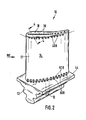
- Fig. 1 and 2 depict a blade 10 comprising a root portion 12 and a hollow airfoil portion 14.
- the airfoil portion 14 of the blade 10 is contoured to define a concave side 16, a convex side 17, and has a blade tip 18.
- the root portion 12 of the blade 10 secures the blade in a rotor disc (not shown) attached rigidly thereto and includes an inlet port 13 leading to various elongate injection holes 30, 40A, 40B, 50A, 50B, 60A and 60B.
- the main flow direction of a working fluid is designated as MF.
- the blade 10 has a generally flat surface 19 at the blade tip 18 structured to prevent tip leakage flow driven from the pressure 16 to the suction side 17 of blade 10, crossing the blade tip 18.
- a radially extending collar may be provided along the border lines of the tip surface 19 to increase the flow resistance between pressure and suction side.
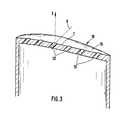
- the blade tip 18 of the rotor blade 10 comprises a plurality of elongate injection holes 30, arranged in a pattern, for example as shown in a row along a chordline C of the tip surface 19, running from the leading to the trailing edge of the blade.
- the injection holes 30 should be arranged over the whole peripheral length of the rotor blade 10.
- the fluid support for the injection running through hollow airfoil portion 14 enters at inlet port 13.
- the axes A of the elongated injection holes 30 are inclined with respect to the radial axis X of the blade under angles alpha less than 90 degrees. In this embodiment the angle is 45 degrees. Preferred values of this angle are between 15 and 75 degrees.
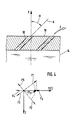
- the detail of the injection holes 30 is shown in Fig. 3 and 4.
- the local direction of the chordline is designated as Y in the diagram of figure 4, the direction perpendicular thereto and perpendicular to the radial axis X as Z.
- the axis A of an injection hole preferably lies in the plane X-Y, so that the fluid F flows upwards with a component F Y in the local direction of the chordline leading to the trailing edge of the rotor blade.
- the injection holes 30 thus provide means for controlling the boundary layer of blade 10 at the blade tip 18 and thus means for depressing the tip leakage flow crossing the blade tip 18, and the vortices close to blade tip 18.
- the blade 10 further comprises a plurality of injection holes 40A on the concave side 16 close to blade tip 18 and a plurality of injection holes 40B close to blade tip 18 on the convex side 17.
- the axes of the injection holes 40A on the pressure side and the holes 40B on the suction side form an angle less than 90 degrees between the radial extended tip plane and the perpendicular on the outer wall respectively. They have a component in the direction of the local main flow MF.
- the fluid passing through the injection holes 40A and 40B is directed upwards towards the trailing edge of the blade.
- the holes 40A, 40B may be directed towards the leading edge of the blade so that the working fluid may enter into the hollow plenum of the airfoil portion 14.
- the fluid for the injection coming from hollow airfoil portion 14 enters at inlet port 13.
- the detail of the injection holes 40A and 40B and 50A and 50B and 60A and 60B is shown in Fig. 5.
- holes 40A, 40B, 50A and 50B do not appear to extend to the hollow portion of the blade 18 because of the angle which they make with the plane of the drawings. These holes do, however, communicate with the hollow plenum.
- the injection holes 40A and 40B thus provide means for controlling the boundary layer and vortices close to the tip on the concave side 16 and the convex side 17, respectively. Moreover, the effect of reducing the tip leakage flow is supported. As shown, the axes of these holes form angles of less than 90 degrees with both the normal to the local plane of the rotor and with the radial axis of the rotor. The axes of those holes are not normal to the local plane of rotor.
- blade 10 includes a plurality of injection holes 50A and 50B close to the root plane 44 on the concave side 16 and the convex side 17 respectively.
- the axes of the injection holes 50A and 50B are directed towards the blade root 44 and form angles less than 90 degrees with the local plane of the concave side 16 and the convex side 17, respectively. These axes are, however, not normal to the local surface plane.
- the axes of the elongate holes also form an angle of less than 90 degrees with the radial axis of the rotor.
- the fluid for the injection comes from the hollow airfoil portion 14 and enters the hollow plenum at said inlet port 13.
- the horizontal detail of the injection holes 50A and 50B is shown in Fig. 7.
- the injection holes 50A and 50B thus provide means for controlling the boundary layer and vortices close to the root plane on the concave side 16 and the convex side 17, respectively.
- Blade 10 also comprises a plurality of elongate injection holes 60A and 60B close to the concave side 16 an the convex side 17 on the root plane 44.
- the elongate injection holes 60A and 60B are directed towards the side walls 16, 17 of the blade under angles less than 90 degree with the local perpendicular of the root plane 44.
- the fluid for the injection enters at inlet port 13.
- the detail of the injection holes 60A and 60B is shown in Fig. 5.
- the injection holes 60A and 60B thus provide means for controlling the boundary layer and vortices close to the root plane 44 on the concave side 16 and the convex side 17, respectively.
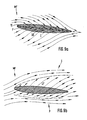
- Figure 9a shows the qualitative behavior of the main flow MF along a test standard blade 10 in the tip region.
- a fluid -short arrows F- is injected in the main flow between the pressure and suction side and directed upwards towards the trailing edge of the blade, with a component in the chordline C.
- the mainflow MF is diverted in the direction of the fluid flow F. No tip leakage flow occurs. Furthermore, the main flow is smoothed so that the secondary effects in the flow field, such as vortices and distortions in the boundary layer region, are significantly reduced.
- the volume of fluid injection through the holes into the gap region has a value between 0,05 % and 0,4 % of the working fluid volume, dependent on the configuration of the blade and the casing. Best results for a blade as shown in figures 1 and 2 may be achieved for values between 0,15 % and 0,25 %.
- a conventional standard rotor blade having no injection holes arranged and directed as in fig. 9a produces a significant leakage flow LF between the pressure side P and the suction side S of the main flow MF interwoven with secondary effects. It is to be pointed out that the occurrence of leakage flow LF cannot be suppressed even if a fluid is blown into the gap region radially or in a plane perpendicular to the local chordline as known in the state of the art for cooling purpose.
- the invention may be used for example to reduce the leakage flow between a stator with adjustable guide vanes and a rotating shaft and to improve the secondary effects of the main flow as explained above.
Landscapes
- Engineering & Computer Science (AREA)
- Mechanical Engineering (AREA)
- General Engineering & Computer Science (AREA)
- Physics & Mathematics (AREA)
- Fluid Mechanics (AREA)
- Turbine Rotor Nozzle Sealing (AREA)
- Structures Of Non-Positive Displacement Pumps (AREA)
Applications Claiming Priority (2)
| Application Number | Priority Date | Filing Date | Title |
|---|---|---|---|
| US1178887A | 1987-02-06 | 1987-02-06 | |
| US11788 | 1987-02-06 |
Publications (3)
| Publication Number | Publication Date |
|---|---|
| EP0278434A2 true EP0278434A2 (de) | 1988-08-17 |
| EP0278434A3 EP0278434A3 (en) | 1990-01-31 |
| EP0278434B1 EP0278434B1 (de) | 1994-07-20 |
Family
ID=21751969
Family Applications (1)
| Application Number | Title | Priority Date | Filing Date |
|---|---|---|---|
| EP88101712A Expired - Lifetime EP0278434B1 (de) | 1987-02-06 | 1988-02-05 | Rotorblatt |
Country Status (2)
| Country | Link |
|---|---|
| EP (1) | EP0278434B1 (de) |
| DE (1) | DE3850681T2 (de) |
Cited By (7)
| Publication number | Priority date | Publication date | Assignee | Title |
|---|---|---|---|---|
| TR23589A (tr) * | 1988-08-24 | 1990-04-19 | United Technologies Corp | Gizli |
| WO1994012765A1 (en) * | 1992-11-24 | 1994-06-09 | United Technologies Corporation | Rotor blade with cooled integral platform |
| DE4003802A1 (de) * | 1988-08-24 | 1998-01-15 | United Technologies Corp | Spaltregulierung für die Turbine eines Gasturbinentriebwerks |
| GB2319567A (en) * | 1988-07-29 | 1998-05-27 | United Technologies Corp | Clearance control for the turbine of a gas turbine engine |
| EP1491722A3 (de) * | 2003-06-24 | 2006-05-24 | Siemens Power Generation, Inc. | Kühlung einer Übergangszone zwischen Turbinenschaufel und Platform |
| EP1793089A2 (de) | 2005-11-30 | 2007-06-06 | General Electric Company | Verfahren und Vorrichtung zum Reduzieren der Randströmung einer Axialverdichterschaufel |
| CN110863864A (zh) * | 2019-12-11 | 2020-03-06 | 沈阳航空航天大学 | 一种内部带有横向蜿蜒交替缩扩短通道的涡轮叶片 |
Families Citing this family (2)
| Publication number | Priority date | Publication date | Assignee | Title |
|---|---|---|---|---|
| DE10305351A1 (de) * | 2003-02-10 | 2004-08-19 | Rolls-Royce Deutschland Ltd & Co Kg | Verdichterschaufel mit Vertiefung auf radialer Außenfläche |
| DE10355241A1 (de) * | 2003-11-26 | 2005-06-30 | Rolls-Royce Deutschland Ltd & Co Kg | Strömungsarbeitsmaschine mit Fluidzufuhr |
Family Cites Families (5)
| Publication number | Priority date | Publication date | Assignee | Title |
|---|---|---|---|---|
| DE1024754B (de) * | 1956-02-11 | 1958-02-20 | Maschf Augsburg Nuernberg Ag | Gekuehlte Laufschaufel fuer heiss betriebene Turbinen oder Verdichter |
| US4020538A (en) * | 1973-04-27 | 1977-05-03 | General Electric Company | Turbomachinery blade tip cap configuration |
| US4214355A (en) * | 1977-12-21 | 1980-07-29 | General Electric Company | Method for repairing a turbomachinery blade tip |
| US4390320A (en) * | 1980-05-01 | 1983-06-28 | General Electric Company | Tip cap for a rotor blade and method of replacement |
| NO811830L (no) * | 1980-06-05 | 1981-12-07 | United Technologies Corp | Slipende, kjoelbar tupphette for rotorblader. |
-
1988
- 1988-02-05 DE DE3850681T patent/DE3850681T2/de not_active Expired - Fee Related
- 1988-02-05 EP EP88101712A patent/EP0278434B1/de not_active Expired - Lifetime
Cited By (12)
| Publication number | Priority date | Publication date | Assignee | Title |
|---|---|---|---|---|
| GB2319567A (en) * | 1988-07-29 | 1998-05-27 | United Technologies Corp | Clearance control for the turbine of a gas turbine engine |
| GB2319567B (en) * | 1988-07-29 | 1998-09-23 | United Technologies Corp | Clearance control for the turbine of a gas turbine engine |
| TR23589A (tr) * | 1988-08-24 | 1990-04-19 | United Technologies Corp | Gizli |
| DE4003802A1 (de) * | 1988-08-24 | 1998-01-15 | United Technologies Corp | Spaltregulierung für die Turbine eines Gasturbinentriebwerks |
| DE4003802C2 (de) * | 1988-08-24 | 2001-12-13 | United Technologies Corp | Minimale Leckströmung zwischen Schaufelspitze und gegenüberliegender Gehäusewand |
| WO1994012765A1 (en) * | 1992-11-24 | 1994-06-09 | United Technologies Corporation | Rotor blade with cooled integral platform |
| EP1491722A3 (de) * | 2003-06-24 | 2006-05-24 | Siemens Power Generation, Inc. | Kühlung einer Übergangszone zwischen Turbinenschaufel und Platform |
| EP1793089A2 (de) | 2005-11-30 | 2007-06-06 | General Electric Company | Verfahren und Vorrichtung zum Reduzieren der Randströmung einer Axialverdichterschaufel |
| JP2007154887A (ja) * | 2005-11-30 | 2007-06-21 | General Electric Co <Ge> | 軸流圧縮機ブレード先端流を減少させるための方法及びタービン機械 |
| EP1793089A3 (de) * | 2005-11-30 | 2007-10-24 | General Electric Company | Verfahren und Vorrichtung zum Reduzieren der Randströmung einer Axialverdichterschaufel |
| CN110863864A (zh) * | 2019-12-11 | 2020-03-06 | 沈阳航空航天大学 | 一种内部带有横向蜿蜒交替缩扩短通道的涡轮叶片 |
| CN110863864B (zh) * | 2019-12-11 | 2022-05-10 | 沈阳航空航天大学 | 一种内部带有横向蜿蜒交替缩扩短通道的涡轮叶片 |
Also Published As
| Publication number | Publication date |
|---|---|
| DE3850681D1 (de) | 1994-08-25 |
| EP0278434B1 (de) | 1994-07-20 |
| EP0278434A3 (en) | 1990-01-31 |
| DE3850681T2 (de) | 1995-03-09 |
Similar Documents
| Publication | Publication Date | Title |
|---|---|---|
| US4863348A (en) | Blade, especially a rotor blade | |
| US6142739A (en) | Turbine rotor blades | |
| US3527543A (en) | Cooling of structural members particularly for gas turbine engines | |
| US7118329B2 (en) | Tip sealing for a turbine rotor blade | |
| US4604031A (en) | Hollow fluid cooled turbine blades | |
| US6174135B1 (en) | Turbine blade trailing edge cooling openings and slots | |
| US3726604A (en) | Cooled jet flap vane | |
| JP4152184B2 (ja) | 下降段を有するタービンのプラットフォーム | |
| US7364404B2 (en) | Turbomachine with fluid removal | |
| US5238364A (en) | Shroud ring for an axial flow turbine | |
| EP0330601B1 (de) | Kühlung einer Gasturbinenschaufel | |
| US20060153673A1 (en) | Turbomachine exerting dynamic influence on the flow | |
| US11933193B2 (en) | Turbine engine with an airfoil having a set of dimples | |
| JPH10274001A (ja) | ガスタービンエンジン内の翼の冷却通路の乱流促進構造 | |
| JP2003065299A (ja) | ガスタービンエンジンの圧縮機用アセンブリ | |
| US12421853B2 (en) | Turbine engine with reduced cross flow airfoils | |
| US10815790B2 (en) | Tip leakage flow directionality control | |
| JPS60206903A (ja) | タービン動翼 | |
| US20170145828A1 (en) | Turbine blade with airfoil tip vortex control | |
| EP0473536A1 (de) | Hitzefester Einsatz für die Anströmkante einer Turbinenschaufel | |
| JP2000161004A (ja) | エ―ロフォイルの前縁隔離冷却 | |
| CN108868898A (zh) | 用于冷却涡轮发动机的翼型件顶端的设备和方法 | |
| GB2127105A (en) | Improvements in cooled gas turbine engine aerofoils | |
| EP1573171A1 (de) | Passiv gekühlte schaufelplattform | |
| JPH09195705A (ja) | 軸流タービン翼 |
Legal Events
| Date | Code | Title | Description |
|---|---|---|---|
| PUAI | Public reference made under article 153(3) epc to a published international application that has entered the european phase |
Free format text: ORIGINAL CODE: 0009012 |
|
| AK | Designated contracting states |
Kind code of ref document: A2 Designated state(s): CH DE FR GB IT LI SE |
|
| PUAL | Search report despatched |
Free format text: ORIGINAL CODE: 0009013 |
|
| AK | Designated contracting states |
Kind code of ref document: A3 Designated state(s): CH DE FR GB IT LI SE |
|
| 17P | Request for examination filed |
Effective date: 19900726 |
|
| 17Q | First examination report despatched |
Effective date: 19910529 |
|
| GRAA | (expected) grant |
Free format text: ORIGINAL CODE: 0009210 |
|
| AK | Designated contracting states |
Kind code of ref document: B1 Designated state(s): CH DE FR GB IT LI SE |
|
| PG25 | Lapsed in a contracting state [announced via postgrant information from national office to epo] |
Ref country code: LI Effective date: 19940720 Ref country code: CH Effective date: 19940720 |
|
| REF | Corresponds to: |
Ref document number: 3850681 Country of ref document: DE Date of ref document: 19940825 |
|
| ITF | It: translation for a ep patent filed | ||
| REG | Reference to a national code |
Ref country code: CH Ref legal event code: PL |
|
| ET | Fr: translation filed | ||
| EAL | Se: european patent in force in sweden |
Ref document number: 88101712.3 |
|
| PLBE | No opposition filed within time limit |
Free format text: ORIGINAL CODE: 0009261 |
|
| STAA | Information on the status of an ep patent application or granted ep patent |
Free format text: STATUS: NO OPPOSITION FILED WITHIN TIME LIMIT |
|
| PGFP | Annual fee paid to national office [announced via postgrant information from national office to epo] |
Ref country code: FR Payment date: 19950619 Year of fee payment: 9 |
|
| 26N | No opposition filed | ||
| PGFP | Annual fee paid to national office [announced via postgrant information from national office to epo] |
Ref country code: GB Payment date: 19960205 Year of fee payment: 9 |
|
| PGFP | Annual fee paid to national office [announced via postgrant information from national office to epo] |
Ref country code: SE Payment date: 19960228 Year of fee payment: 9 |
|
| PGFP | Annual fee paid to national office [announced via postgrant information from national office to epo] |
Ref country code: DE Payment date: 19960403 Year of fee payment: 9 |
|
| PG25 | Lapsed in a contracting state [announced via postgrant information from national office to epo] |
Ref country code: GB Effective date: 19970205 |
|
| PG25 | Lapsed in a contracting state [announced via postgrant information from national office to epo] |
Ref country code: SE Effective date: 19970206 |
|
| GBPC | Gb: european patent ceased through non-payment of renewal fee |
Effective date: 19970205 |
|
| PG25 | Lapsed in a contracting state [announced via postgrant information from national office to epo] |
Ref country code: FR Effective date: 19971030 |
|
| PG25 | Lapsed in a contracting state [announced via postgrant information from national office to epo] |
Ref country code: DE Effective date: 19971101 |
|
| EUG | Se: european patent has lapsed |
Ref document number: 88101712.3 |
|
| REG | Reference to a national code |
Ref country code: FR Ref legal event code: ST |
|
| PG25 | Lapsed in a contracting state [announced via postgrant information from national office to epo] |
Ref country code: IT Free format text: LAPSE BECAUSE OF NON-PAYMENT OF DUE FEES;WARNING: LAPSES OF ITALIAN PATENTS WITH EFFECTIVE DATE BEFORE 2007 MAY HAVE OCCURRED AT ANY TIME BEFORE 2007. THE CORRECT EFFECTIVE DATE MAY BE DIFFERENT FROM THE ONE RECORDED. Effective date: 20050205 |
|
| REG | Reference to a national code |
Ref country code: SK Ref legal event code: SPCT Owner name: MERUS LABS LUXCO SARL, LU Free format text: PRODUCT NAME: HYDROBROMID (S)-2-{1-[2-(2,3-DIHYDROBENZOFURAN-5-YL)ETYL]-3--PYROLIDINYL}-2,2-DIFENYLACETAMIDU; REGISTRATION NO/DATE: EU/1/04/294/001-012 20041022; FORMER OWNER: NOVARTIS INTERNATIONAL PHARMACEUTICAL LTD. Spc suppl protection certif: 26 5002-2005 Filing date: 20050401 Expiry date: 20150317 |