EP0279541A2 - Elektrode mit einer Abdichtungsvorrichtung und einem Füllochabschluss - Google Patents
Elektrode mit einer Abdichtungsvorrichtung und einem Füllochabschluss Download PDFInfo
- Publication number
- EP0279541A2 EP0279541A2 EP88300732A EP88300732A EP0279541A2 EP 0279541 A2 EP0279541 A2 EP 0279541A2 EP 88300732 A EP88300732 A EP 88300732A EP 88300732 A EP88300732 A EP 88300732A EP 0279541 A2 EP0279541 A2 EP 0279541A2
- Authority
- EP
- European Patent Office
- Prior art keywords
- hole
- outer body
- fill hole
- annular element
- reference electrode
- Prior art date
- Legal status (The legal status is an assumption and is not a legal conclusion. Google has not performed a legal analysis and makes no representation as to the accuracy of the status listed.)
- Ceased
Links
Images

Classifications
-
- G—PHYSICS
- G01—MEASURING; TESTING
- G01N—INVESTIGATING OR ANALYSING MATERIALS BY DETERMINING THEIR CHEMICAL OR PHYSICAL PROPERTIES
- G01N27/00—Investigating or analysing materials by the use of electric, electrochemical, or magnetic means
- G01N27/26—Investigating or analysing materials by the use of electric, electrochemical, or magnetic means by investigating electrochemical variables; by using electrolysis or electrophoresis
- G01N27/28—Electrolytic cell components
- G01N27/30—Electrodes, e.g. test electrodes; Half-cells
- G01N27/301—Reference electrodes
Definitions
- the present invention relates to electrodes of the open-junction type, and especially to sealing assemblies for the fill hole through the cylindrical outer body of reference and pH combination electrodes.
- Liquid-junction reference electrodes constructed with a cylindrical outer body generally have the junction near the bottom end and the reference cell (e.g., calomel or Ag/AgCl) connected at and entering the outer body from the top end. Electrical connection between the open junction and the reference cell is established by an electrolyte in an electrolyte compartment within the outer body, which electrolyte is slowly depleted by flow through the liquid junction. Electrolyte is periodically replenished through a fill hole extending radially through the outer body near its upper end. For various reasons, it is desirable to cover the fill hole except when the unit is in use or the electrolyte is being replenished.
- the reference cell e.g., calomel or Ag/AgCl
- a cylindrical rubber sleeve is provided around the upper body, covering the fill hole in a normal position, but displaced axially below the fill hole when required.
- Disadvantages of such cylindrical sleeves include difficulties in use, poor seal and appearance and restrictions placed upon insertion of the electrodes into certain electrode holders.
- various components are slipped onto the top of the outer body in order to fix the reference cell and the cable lead in the electrode and to seal the top of the electrode around the cable.
- Such components typically include banding clips, metal shields and connectors.
- the rubber sleeve is below and separated from this fixing and sealing assembly.
- the present invention provides an annular element rotatably mounted outside of and substantially concentric with the outer body through which a first through hole extends horizontally.
- the annular element is axially aligned with the outer body so that the first through hole is axially aligned with the fill hole in all positions of the fully assembled electrode.
- the annular element In the position for replenishing electrolyte, the annular element is positioned with the first through hole also circumferentially aligned with the fill hole. In at least one other position, the first through hole is circumferentially displaced from the fill hole.
- a sealing means is provided for sealing the exterior of the outer body around the fill hole against the interior of the annular element.
- a second through hole is provided extending radially through the sealing means in axial and circumferential alignment with the fill hole so that, in the position for replenishing electrolyte, the first through hole, second through hole and fill hole form a continuous passage into the electrolyte compartment within the outer body of the electrode.
- the invention provides, in a reference electrode having a cylindrical outer body, an open junction adjacent to the base of and through the outer body, a reference cell within the outer body adjacent to its top and a fill hole extending radially through the outer body communicating with an electrolyte compartment within the outer body, the electrolyte compartment also communicating with the reference cell and the open junction, a reversible sealing mechanism which comprises:
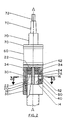
- a reference electrode 10 is shown in Figure 1, with a glass or polymer outer body 14 of cylindrical shape around axis A. As best seen in Figures 2 and 3, a fill hole 16 extends radially through the outer body 14 with a circular profile when viewed from the front.
- An inner body 18, shown in Figures 2 and 3, is within the upper portion of the outer body 14 and is cylindrical in shape around axis A.
- the annular space between outer body 14 and inner body 18 is the electrolyte compartment 20.
- inner body 18 contains the electrochemical reference cell and extends only partially downward from fill hole 16.
- the electrolyte compartment 20 then occupies the entire interior of the outer body 14 below the lower end of inner body 18 and communicates through an open junction (not shown) with the exterior of the outer body 14 near the base of the electrode 10.
- Such open junction is sufficiently small for electrolyte to flow out only gradually. So long as electrolyte remains in contact with the cell within inner body 18 to establish electrical connection, replenishment is not required.
- a conventional two part seal 22 around the inner body 18 seals the top of electrolyte compartment 20.
- a sealing O-ring 24 is provided around fill hole 16 radially outward of outer body 14.
- the through hole 26 within O-ring 24 extends radially in alignment with the fill hole 16. The functions of the sealing O-ring 24 are described further below.
- a main housing 30 of the sealing assembly is provided around outer body 14 and extends both above and below the fill hole 16. As best seen in Figure 2, main housing 30 is thickest at an upper collar portion 34 above the axial position of the fill hole 16. Above upper collar portion 34, the main housing 30 has a cylindrical portion with external screw threads (not shown). In certain embodiments, this cylindrical portion is metal or other electrical shielding material joined to or inside of the thermoplastic material (e.g., nylon) of upper collar portion 34. Below upper collar portion 34 is a thin tapered portion 36 of main housing 30, provided with external screw threads.
- the taper on the exterior of thin tapered portion 36 facilitates compression of thin tapered portion 36 against the outer body 14, as described below, to fix the main housing 30 and other portions of the assembly relative to the outer body 14 in both an axial and circumferential direction.
- Circumferential alignment can also be established by forming an axially-extending notch on the exterior of the outer body 14 and providing a protuberance on some portion of the main housing 30 that fits in the axially extending notch if and only if proper circumferential alignment exists.
- a through hole extends radially through the main housing 30 large enough to snugly enclose the O-ring 24, as can be seen in Figures 2 and 3. Both the taper and external threads of tapered portion 36 terminate below this through hole in most embodiments.
- a lower collar 40 is fitted around the outer body 14 below the fill hole 16 as shown in Figure 2.
- the interior of the lower collar 40 is tapered at the same angle as the exterior of tapered portion 36 of main housing 30 and has internal screw threads. Screwing lower collar 40 upward onto tapered portion 36 has the effect, once close contact between the corresponding tapers are made, of compressing the tapered portion 36 against the exterior of outer body 14.
- Such a means for fixing the assembly relative to the outer body 14 has the advantage of permitting small variances in the external diameter of the outer body 14 to be accommodated: for slightly larger than normal samples of outer body 14, the lower collar 40 is rotated upwardly in a spiral direction a fraction of a turn less than normal. Similarly, for slightly smaller than normal samples of outer body 14, the lower collar 40 is rotated upwardly in a spiral direction a fraction of a turn more than normal.
- annular element or turning ring 50 is provided around outer body 14, concentric with outer body 14 at the height (axial level) of the fill hole 16.
- annular element 50 also surrounds both part of the main housing 30 and the O-ring 24, each of which is sandwiched inwardly of the interior of the annular element 50 and outwardly of the outer body 14.
- the exterior of annular element 50 is knurled for manual rotation.
- the annular element 50 is rotatable around the outer body 14 and main housing 30, but is aligned axially in the fully assembled electrode 10 by the top of the lower collar 40 which engages the bottom of the annular element 50. While the top of the annular element 50 can sometimes engage the bottom of the upper collar portion 34 of main housing 30, it is preferred to leave a small gap therebetween (that is, small relative to the size of the fill hole 16). This enables the annular element 50 to fit on the main housing 30 even if the lower collar 40 is screwed on slightly higher than normal because the diameter of the outer body 14 is slightly smaller than normal. Even then, however, upper collar portion 34 provides a stop that prevents annular element 50 from moving far axially even when the electrode 10 is inverted, as may occur during shipping or use.
- a through hole 52 is provided radially through annular element 50 in axial alignment with fill hole 16. Even with the small axial movement of annular element 50 permitted by the gap below upper annular portion 34, through hole 52 remains sufficiently aligned with fill hole 16 to form a continuous passage, as shown in Figure 2, when the circumferential alignment exists.
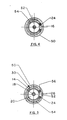
- annular element 50 is in a circumferential position in which through holes 52 and 26 are aligned with fill hole 16. In this position, electrolyte can be introduced through this passage into the electrolyte compartment 20 within outer body 14. A small inward taper can be formed on the outside of through hole 52 through annular element 50 to help position a tapered dispensing tip of an electrolyte filling vessel and seal around it.
- any rotation of the annular element 50 counterclockwise from the position shown in Figure 3 will tend to cover or close the passage and thus protect the fill hole 16 from evaporation.
- the preferred arrangement shown in Figure 3, however, will also provide a complete seal around fill hole 16 once the annular element is turned counterclockwise at least 40 degrees so that the rate of electrolyte loss through the junction when the electrode 10 is not in use is minimized.
- a step 56 is formed on the interior wall of annular element 50.
- the minimum inner radius of annular element 50 is present counterclockwise from step 56 for at least 185 degrees, and typically for about 190 degrees counterclockwise from step 56 as in the embodiment shown in Figure 3.
- the inner radius of the annular element 50 is at a maximum value for at least the number of degrees of arc corresponding to the width of the O-ring 24. This results in the inner wall of annular element 50 engaging the outer wall of main housing 30 along the major portion where the inner radius is minimal, but being spaced from such outer wall along the minor portion where the inner radius is maximal by a distance sufficient to accommodate the O-ring 25 snugly, but with little or no compression of the O-ring in a direction radial relative to axis A.
- the inner radius of annular element 50 tapers gradually from the minimal to the maximal inner radius along a tapered section 54 which extends counterclockwise from the major portion to the minor portion, i.e., from the seven o'clock position to the four o'clock position in the position and view shown in Figure 3.
- FIG. 4 illustrates a typical closed position in which the annular element 50 has been rotated 100 degrees counterclockwise from the position shown in Figure 3.
- annular element 50 and upper collar portion 32 or lower collar 40 can be provided on the exterior of annular element 50 and upper collar portion 32 or lower collar 40 to indicate the position wherein fill hole 16 is exposed for filling or use and one or more recommended positions in which fill hole 16 is sealed for storage.
- any change in the size, resiliency or encrusting of O-ring 24 can be compensated for by twisting annular element 50 somewhat less or somewhat more than normal.
- Figure 4 shows the full compression achieved by any rotation of annular element 50 over about 90 degrees. Because step 56 engages O-ring 16 in the open position shown in Figure 3, rotation of the annular element 50 in a clockwise direction is inhibited by the resistance of O-ring 16 to rapid compression from the maximum to the minimum radius at that point of contact.
- an upper collar 60 is provided around the upper cylindrical portion of main housing 30, with interior screw threads to engage the exterior screw threads on such upper portion.
- An optional O-ring 62 can be provided, as shown in Figures 1 and 2, between the lower end of upper collar 60 and the upper end of upper collar portion 34 of main housing 30 to establish a moisture-proof seal therebetween as the upper collar 60 is screwed downwardly.
- a cable relief sealing boot 70 preferably of an elastomeric material, is fitted into the top of upper collar 60 and has stepped sections of reduced radius going upwardly which surround the cable 72. As is conventional, the cable 72 connects the electrochemical half-cell in inner body 18 with external circuitry.
- the various components 30, 40, 50 and 60 can be produced in various ways from various materials such as molded plastic. If, for example, molded polyamides (nylon) are used, components 30, 40 and 60 can be rigidified by using filled (e.g., glass-filled) nylon, while element 50 can be made more flexible by using polyamide copolymers with some elastomeric character.
- Metal shielding can be provided on the top of component 30 by attaching (e.g., by sonic welding) a metal piece, inserting a metal piece or applying conductive paint to a plastic piece.
- Various elastomers can be used for rings 16 and 62, although it is preferred to use a high quality rubber for O-ring 16 because of its repeated compression and release.
- main housing 30 In assembling the electrode 10, normally all of the components shown, except for O-ring 24, are strung onto cable 72 in the order shown, with elements 40 and 50 below the main housing 30, and elements 60 and 70 above the main housing 30. If the upper portion of main housing 30 is a different material (e.g., metal) than the remainder of the main housing 30, then it may be affixed before stringing onto the cable 72 or may be affixed later in the process. Similarly, boot 70 can be fitted into upper collar 60 before or after stringing onto cable 72.
- a different material e.g., metal
- the inner body 18 has previously been positioned within outer body 14 at the desired position and the two-part seal 22 has been formed, typically by first inserting a porous lower section for support and then adding and curing the upper section. Usually this seal is formed before attaching the cable 72.
- components 40, 50 and 30 are slid down around the outer body 14 at or below their final positions.
- the top of the interior of outer body 14 is then filled with a potting material and elements 60 and 70 are slid down on top of the outer body 14 to complete the upper seal.
- upper collar 60 and the upper section of main housing 30 are screwed together, so as to position the metal shielding at the desired height (axial position) and establish the lower end of portion 34 of main housing 30 at the desired height (axial position), with the through hole through the main housing 30 surrounding fill hole 16.
- the O-ring 24 can then be positioned within the through hole through main housing 30 so that through hole 26 through O-ring 24 is aligned with fill hole 16.
- the annular element 50 is then rotated to the circumferential position shown in Figures 2 and 3 and brought axially upward around the main housing 30 and O-ring 24 generally into the axial position shown in Figures 1 and 2.
- the lower collar 40 is then brought upward axially until it engages the external screw threads on tapered lower portion 36 of main housing 30.
- the lower collar 40 is then screwed upwardly until the tapered lower portion 36 is compressed tightly around and against the exterior of outer body 14.
- the annular element 50 can then be checked for alignment with fill hole 16 and rotatability.
- Electrode 10 While the above description has applied to electrode 10 as a single-junction reference electrode, the application of the invention both to double-junction reference electrodes and to combination electrodes should be apparent.
- the primary changes for a double-junction reference electrode would involve a tube containing the half-cell, electrolyte (liquid or gelled) and an open junction replacing the inner body 18 and leading into electrolyte compartment 20 and modifying the two-part seal 22 accordingly.
- the inner body inserted would be a tube sealed to the interior of the outer body.
- the interior of the tube would form a central chamber and terminate in a pH sensing membrane which contacts the sample being measured. This central chamber would receive an element forming a half-cell.
- Electrolyte chamber 20 would also receive a half-cell element and form the reference side of the combination electrode.
- the electrode could be modified for use as a reference electrode for an ion-selective electrode.
- an appropriate cable 72 e.g., co-axial cable when electrode 10 is a combination electrode
- Some modification in boot 70 can be used to accommodate different cable sizes, while using a standard size of upper collar 60 and various other components.
- the present invention enables a varied line of electrodes to be manufactured with many common components so long as a standard outside diameter of outer body 14 is maintained.
- the interior of the upper section of the main housing 30 and the upper collar 60 can also be designed to receive a detachable cable system connector instead of upper boot 70 provided that electrical connection has been provided between the half-cell within body 18 and a termination on the upper end of main housing 30.
- upper collar 60, main housing 30 and lower collar 40 shown in the embodiment depicted in the Figures is one of many that can be used to position and align annular element 50 for free rotation, but a relatively fixed axial position, relative to fill hole 16 through outer body 14.
- upper collar 60 could extend downwardly over the top of the main housing 30 and directly form the alignment flange that restricts upward movement of the annular element 50.
- the O-ring 24 is a preferred geometry of sealing means, especially when a fill hole 16 of circular profile is used and especially in combination with the offset and tapered inner wall of annular element 50 shown in Figure 3. Even, however, in this environment, the O-ring 24 could be modified by, e.g., flattening its exterior so as to have a backwards "D" shape in the view shown in Figure 3. Other shapes of sealing means (e.g., square) could be provided and accommodated by a different shape of hole through main housing 50. Even a different shape of through hole 26 (e.g., oval) could be used, whether or not the circular shape of the fill hole 16 is maintained.
- a different shape of through hole 26 e.g., oval
- a modified use of the present invention would be to redesign the cap assembly so that, instead of annular element 50, which is axially aligned, but rotatable, an element would be provided that is circumferentially aligned, but movable vertically (axially).
- the O-ring 24 would form a passage between the fill hole 16 and a through hole in the element in one vertical position of the element but would seal the fill hole against the interior of the element in other vertical positions of the element.
- the interior of the element could be tapered to compress the O-ring as the element is moved away from the open position.
Landscapes
- Chemical & Material Sciences (AREA)
- Life Sciences & Earth Sciences (AREA)
- Health & Medical Sciences (AREA)
- Biochemistry (AREA)
- General Physics & Mathematics (AREA)
- Electrochemistry (AREA)
- Physics & Mathematics (AREA)
- Analytical Chemistry (AREA)
- Molecular Biology (AREA)
- General Health & Medical Sciences (AREA)
- Chemical Kinetics & Catalysis (AREA)
- Immunology (AREA)
- Pathology (AREA)
- Sealing Battery Cases Or Jackets (AREA)
- Connection Of Batteries Or Terminals (AREA)
- Drying Of Semiconductors (AREA)
- Cold Cathode And The Manufacture (AREA)
- Filling, Topping-Up Batteries (AREA)
- Connector Housings Or Holding Contact Members (AREA)
Applications Claiming Priority (2)
| Application Number | Priority Date | Filing Date | Title |
|---|---|---|---|
| US07/015,442 US4770762A (en) | 1987-02-17 | 1987-02-17 | Electrode with sealing assembly and fill hole cover |
| US15442 | 1987-02-17 |
Publications (2)
| Publication Number | Publication Date |
|---|---|
| EP0279541A2 true EP0279541A2 (de) | 1988-08-24 |
| EP0279541A3 EP0279541A3 (de) | 1989-11-15 |
Family
ID=21771430
Family Applications (1)
| Application Number | Title | Priority Date | Filing Date |
|---|---|---|---|
| EP88300732A Ceased EP0279541A3 (de) | 1987-02-17 | 1988-01-28 | Elektrode mit einer Abdichtungsvorrichtung und einem Füllochabschluss |
Country Status (5)
| Country | Link |
|---|---|
| US (1) | US4770762A (de) |
| EP (1) | EP0279541A3 (de) |
| JP (1) | JP2539879B2 (de) |
| CA (1) | CA1262475A (de) |
| MX (1) | MX166151B (de) |
Cited By (1)
| Publication number | Priority date | Publication date | Assignee | Title |
|---|---|---|---|---|
| WO2006061327A1 (de) * | 2004-12-06 | 2006-06-15 | Endress+Hauser Conducta Gesellschaft Für Mess- Und Regeltechnik Mbh | Adapter zur elektrolytzufuhr für einen potentiometrischen sensor |
Families Citing this family (4)
| Publication number | Priority date | Publication date | Assignee | Title |
|---|---|---|---|---|
| DE29705433U1 (de) * | 1997-03-26 | 1997-05-28 | Schott-Geräte GmbH, 65719 Hofheim | Einstabmeßkette für elektrochemische Messungen |
| US6899801B2 (en) | 2002-03-20 | 2005-05-31 | Applied Materials, Inc. | Electrode refilling mechanism |
| US7134189B2 (en) * | 2002-09-12 | 2006-11-14 | Andrew Corporation | Coaxial cable connector and tool and method for connecting a coaxial cable |
| CN112098483B (zh) * | 2020-09-11 | 2022-02-18 | 中山大学 | 一种水密参比电极 |
Family Cites Families (10)
| Publication number | Priority date | Publication date | Assignee | Title |
|---|---|---|---|---|
| GB890923A (en) * | 1959-10-20 | 1962-03-07 | British Oxygen Co Ltd | Method of and apparatus for oxygen determination |
| US3070539A (en) * | 1960-01-25 | 1962-12-25 | Beckman Instruments Inc | Ionic transducer |
| NL127773C (de) * | 1964-08-31 | |||
| US3676319A (en) * | 1969-03-28 | 1972-07-11 | Radiometer As | Electrode, half cell and electrode component for the measurement of electromotive force |
| US3756936A (en) * | 1970-09-28 | 1973-09-04 | Instrumentation Labor Inc | Electrochemical electrode structure |
| JPS53137096A (en) * | 1977-05-06 | 1978-11-30 | Fuji Photo Film Co Ltd | Production of slightly soluble silver salt particles |
| DK436381A (da) * | 1981-10-01 | 1983-04-02 | Radiometer As | Elektrokemisk elektrodeindretning |
| US4390406A (en) * | 1982-07-23 | 1983-06-28 | Allied Corporation | Replaceable outer junction double junction reference electrode |
| US4543175A (en) * | 1983-08-08 | 1985-09-24 | Gam Rad, Inc. | Ion responsive probe |
| US4473458A (en) * | 1983-08-30 | 1984-09-25 | Instrument Technology Incorporated | Ion measuring device with self-contained storage of standardizing solution |
-
1987
- 1987-02-17 US US07/015,442 patent/US4770762A/en not_active Expired - Lifetime
-
1988
- 1988-01-19 CA CA000556794A patent/CA1262475A/en not_active Expired
- 1988-01-28 EP EP88300732A patent/EP0279541A3/de not_active Ceased
- 1988-02-11 MX MX010371A patent/MX166151B/es unknown
- 1988-02-16 JP JP63033834A patent/JP2539879B2/ja not_active Expired - Lifetime
Cited By (3)
| Publication number | Priority date | Publication date | Assignee | Title |
|---|---|---|---|---|
| WO2006061327A1 (de) * | 2004-12-06 | 2006-06-15 | Endress+Hauser Conducta Gesellschaft Für Mess- Und Regeltechnik Mbh | Adapter zur elektrolytzufuhr für einen potentiometrischen sensor |
| CN101111760B (zh) * | 2004-12-06 | 2010-12-15 | 恩德莱斯和豪瑟尔测量及调节技术分析仪表两合公司 | 用于为电位传感器输送电解液的适配器 |
| US7880471B2 (en) | 2004-12-06 | 2011-02-01 | Endress + Hauser Conducta Gesellschaft Fur Mess-Und Regeltechnik Mbh + Co. Kg | Adapter for supplying electrolyte to a potentiometric sensor |
Also Published As
| Publication number | Publication date |
|---|---|
| EP0279541A3 (de) | 1989-11-15 |
| JP2539879B2 (ja) | 1996-10-02 |
| US4770762A (en) | 1988-09-13 |
| MX166151B (es) | 1992-12-22 |
| CA1262475A (en) | 1989-10-24 |
| JPS63206649A (ja) | 1988-08-25 |
Similar Documents
| Publication | Publication Date | Title |
|---|---|---|
| US5962158A (en) | End cap assembly for electrochemical cell | |
| US4495260A (en) | Sliding seal lead bushing | |
| US4162211A (en) | Combination electrode assembly | |
| US4770762A (en) | Electrode with sealing assembly and fill hole cover | |
| US3211638A (en) | Electrode assembly | |
| US4390406A (en) | Replaceable outer junction double junction reference electrode | |
| JPH09503616A (ja) | 蓄電池の電極接続装置 | |
| US4233143A (en) | Measured value receiver for the polarographic measurement of gases in liquids | |
| DE19616409A1 (de) | Elektrische Lampe | |
| US3835014A (en) | Electrode housing and holder | |
| US3891465A (en) | Battery equipped with an indicator for the lowering of the electrolyte level | |
| US3476672A (en) | Electrode assembly | |
| CA2406986A1 (en) | Inverted bottle cap | |
| US4616758A (en) | Insulating container, in particular insulating bottle | |
| US4317871A (en) | Battery side terminal assembly | |
| CN212410501U (zh) | 一种三电极测试装置 | |
| US4285791A (en) | Electrode system | |
| CN218212749U (zh) | 参比电极防渗液装置 | |
| CN212098419U (zh) | 一种卡车用油箱盖防护罩 | |
| JPH0734349Y2 (ja) | 液面計の取付け装置 | |
| KR0167330B1 (ko) | 밧데리전해액의 진공식 정량주입장치 | |
| JPH0134115Y2 (de) | ||
| CN221279682U (zh) | 一种水箱排污口处的钛阳极安装套件 | |
| EP0303737B1 (de) | Voltazelle und Verfahren zu ihrer Herstellung | |
| DE10358354B4 (de) | Verfahren zur Herstellung einer pH-Messsonde und Messsonde zur pH-Messung |
Legal Events
| Date | Code | Title | Description |
|---|---|---|---|
| PUAI | Public reference made under article 153(3) epc to a published international application that has entered the european phase |
Free format text: ORIGINAL CODE: 0009012 |
|
| AK | Designated contracting states |
Kind code of ref document: A2 Designated state(s): CH DE FR GB IT LI NL |
|
| PUAL | Search report despatched |
Free format text: ORIGINAL CODE: 0009013 |
|
| AK | Designated contracting states |
Kind code of ref document: A3 Designated state(s): CH DE FR GB IT LI NL |
|
| 17P | Request for examination filed |
Effective date: 19891107 |
|
| 17Q | First examination report despatched |
Effective date: 19910117 |
|
| STAA | Information on the status of an ep patent application or granted ep patent |
Free format text: STATUS: THE APPLICATION HAS BEEN REFUSED |
|
| 18R | Application refused |
Effective date: 19910711 |