EP0280028B1 - Optische Informationsplatte - Google Patents
Optische Informationsplatte Download PDFInfo
- Publication number
- EP0280028B1 EP0280028B1 EP88100697A EP88100697A EP0280028B1 EP 0280028 B1 EP0280028 B1 EP 0280028B1 EP 88100697 A EP88100697 A EP 88100697A EP 88100697 A EP88100697 A EP 88100697A EP 0280028 B1 EP0280028 B1 EP 0280028B1
- Authority
- EP
- European Patent Office
- Prior art keywords
- track
- optical information
- information disc
- pits
- area
- Prior art date
- Legal status (The legal status is an assumption and is not a legal conclusion. Google has not performed a legal analysis and makes no representation as to the accuracy of the status listed.)
- Expired - Lifetime
Links
- 230000003287 optical effect Effects 0.000 claims 8
- 238000004873 anchoring Methods 0.000 claims 1
- 238000000034 method Methods 0.000 claims 1
- 238000000465 moulding Methods 0.000 claims 1
- 239000011347 resin Substances 0.000 claims 1
- 229920005989 resin Polymers 0.000 claims 1
Images

Classifications
-
- G—PHYSICS
- G11—INFORMATION STORAGE
- G11B—INFORMATION STORAGE BASED ON RELATIVE MOVEMENT BETWEEN RECORD CARRIER AND TRANSDUCER
- G11B7/00—Recording or reproducing by optical means, e.g. recording using a thermal beam of optical radiation by modifying optical properties or the physical structure, reproducing using an optical beam at lower power by sensing optical properties; Record carriers therefor
- G11B7/24—Record carriers characterised by shape, structure or physical properties, or by the selection of the material
- G11B7/26—Apparatus or processes specially adapted for the manufacture of record carriers
-
- G—PHYSICS
- G11—INFORMATION STORAGE
- G11B—INFORMATION STORAGE BASED ON RELATIVE MOVEMENT BETWEEN RECORD CARRIER AND TRANSDUCER
- G11B7/00—Recording or reproducing by optical means, e.g. recording using a thermal beam of optical radiation by modifying optical properties or the physical structure, reproducing using an optical beam at lower power by sensing optical properties; Record carriers therefor
- G11B7/08—Disposition or mounting of heads or light sources relatively to record carriers
- G11B7/09—Disposition or mounting of heads or light sources relatively to record carriers with provision for moving the light beam or focus plane for the purpose of maintaining alignment of the light beam relative to the record carrier during transducing operation, e.g. to compensate for surface irregularities of the latter or for track following
- G11B7/0938—Disposition or mounting of heads or light sources relatively to record carriers with provision for moving the light beam or focus plane for the purpose of maintaining alignment of the light beam relative to the record carrier during transducing operation, e.g. to compensate for surface irregularities of the latter or for track following servo format, e.g. guide tracks, pilot signals
-
- G—PHYSICS
- G11—INFORMATION STORAGE
- G11B—INFORMATION STORAGE BASED ON RELATIVE MOVEMENT BETWEEN RECORD CARRIER AND TRANSDUCER
- G11B7/00—Recording or reproducing by optical means, e.g. recording using a thermal beam of optical radiation by modifying optical properties or the physical structure, reproducing using an optical beam at lower power by sensing optical properties; Record carriers therefor
- G11B7/24—Record carriers characterised by shape, structure or physical properties, or by the selection of the material
Definitions
- the present invention relates to an optical information disc which is capable to record/reproduce an information optically, especially for being capable to obtain a sufficient signal.
- Two kinds of tracking servo methods are known, one of which is the continuous groove servo method, and another of which is the sample servo method as shown in USP 4,40 ⁇ 2,0 ⁇ 61.
- the continuous groove servo method has already been used in products.
- the sample servo method has been recently developed because of a good tracking stability.
- the sample servo method does not use guiding grooves for tracking, but uses a pair of sample marks 10 ⁇ , 11 for tracking.
- the pair of sample marks are just located on both sides of the imaginary track with slight off-set.
- a center line of the imaginary track is indicated as a chain line.
- the accurate tracking of the imaginary track has been done by detecting each sample mark.
- a reference numeral 12 indicates pits for clocks.
- a reference numeral 1 indicates a replica base plate made of, for example, plastic.
- Figure 1A is a typical plane view
- Figure 1B is a typical cross view along line 1B-1B in Figure 1A.
- Length of each pits 10 ⁇ , 11, 12 is 90 ⁇ ns on a time axis, which corresponds to 0 ⁇ .5 ⁇ m in case of 180 ⁇ 0 ⁇ rpm of revolution number of the optical disc, and pits located at a position of the radius of 30 ⁇ mm of the optical disc.
- Optical depth of each pits 10 ⁇ , 11, 12 is ⁇ /4, here ⁇ is a wavelength of a laser beam for recording/reproducing, and 830 ⁇ nm is normally used.
- the sample mark portions shown in Figure 1A comprise necessarily 10 ⁇ 0 ⁇ 0 ⁇ to 30 ⁇ 0 ⁇ 0 ⁇ portions on each imaginary track. In one embodiment, the number of the sample mark portions is selected as 1376 portions on each track.
- sector address portions which are located 30 ⁇ portions on each track.
- the remaining areas excepting the sample mark portions and sector address portions are mirror areas which are used for recording some information or data. Therefore, the area occupied by some pits of sample marks and sector address is about 10 ⁇ % of the total area of the optical disc.
- the problem which the present invention has to solve is a different one. Due to different hardening of the resin, undesired resin flow occurs in the inner and outer regions of the disc which produces, in the recordable area, the phenomenon of double transcription by ghost pits. It cannot be avoided by merely extending the recordable area.
- An object of the present invention is to provide an optical disc with which can be obtained a good tracking signal without producing double transcription described above.
- the invention concerns a moulded optical information disc having a recordable area including at least one track with mirror areas between tracking mark portions along the track for recording information, each tracking mark portion including at least two pits, one slightly offset on one side of the track, the other slightly offset on the other side of the track.
- preformatted groove areas for preventing undesired resin flow during the moulding process are located at both the inner and the outer side of the recordable area, comprising a plurality of anchoring tracks.
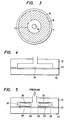
- Figure 3 shows an imaginary plane view of an optical disc which was at first manufactured by the inventors.
- a reference numeral 18 indicates an inner circle of a diameter of 15 mm.
- a hatched portion having a reference numeral 16 indicates a sample mark area.
- a reference numeral 17 indicates an inner mirror area.
- Reference numeral 15 indicates an outer mirror area.
- the outer diameter of the optical disc is 130 ⁇ mm.
- the double transcription occurred mainly at inner and outer areas of the sample mark area 16 of the disc 1, especially at boundary areas with the inner mirror area 17 and the outer mirror area 15.
- This phenomenon hardly occurred at the ordinary disc having grooves or pits on the whole surface of the disc.
- the phenomenon occurred at the disc for the sample servo method.
- the parts occupied by sample marks on the whole surface are small as about 10 ⁇ %, the remaining parts are mirror face. Therefore, the inventors considered that, at the time of injection molding, the plastic resin moves easily, causing the double transcription to occur.
- the inventors paid attention to the phenomenon that the double transcription occurred at the inner and outer areas of the sample mark area, and they considered a mechanism of of occurrence of the double transcription as follows.
- Figure 4 shows an imaginary cross sectional view of a metal mold for the injection molding.
- Reference numerals 21 and 22 indicate the metal molds.
- a reference numeral 23 indicates a stamper.
- a reference numeral 24 indicates a cavity of the metal mold.
- Figure 5 shows imaginary the state at the time of injecting resin into the cavity 24 of the metal mold. After injecting, the resin begins to harden from the hatched portions having a reference numeral 25, the resin locating portions indicated by a reference numeral 26 remain comparatively in a soft state. At this state, for preventing a reverse flow of the resin through an injection aperture, a predetermined pressure is applied through the aperture as shown in Figure 5, and then movement of the resin at the portions 26 where the resin is kept soft occurs, and causes the double transcription.
- the double transcription has occurred at the inner and outer area of the disc.
- the double transcription never occurred under the state shown in Figure 5. Because, slight unevennesses of the grooves or pits have a function for preventing movement of resin, even if the pressure is applied when resin is still soft, and for preventing the generation of double transcription.
- the optical disc for the sample servo method since sample mark pits are small, the effect for preventing the resin movement described above is very small, and the double transcription occurred.
- the present inventors found out that the double transcription can be prevented by forming grooves or pits at the portions 6 where the resin is kept soft, which have an effect of stopping a movement of the resin.
- FIG. 1A illustrates a typical plane view of an optical disc using the sample servo method.
- FIG. 1B illustrates a cross sectional view of FIG. 1A.
- FIG. 2 illustrates a plane view of the optical disc showing double transcription of pits.
- FIG. 3 illustrates an imaginary plane view of the optical disc.
- FIG.4 illustrates an imaginary cross sectional view of a metal mold.
- FIG. 5 illustrates a state at the time of injecting plastic resin into the metal mold shown in FIG. 4.
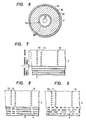
- FIG. 6 illustrates an imaginary plane view of an optical disc of the present invention.
- FIG. 7 illustrates a typical plane view of an embodiment of the present invention.
- FIG. 8 illustrates a typical plane view of another embodiment of the present invention.
- FIG. 9 illustrates a typical plane view of still another embodiment of the present invention.
- Figure 6 shows a plane view of an optical disc of an embodiment of the present invention.
- a replica base plate 2 is made of polycarbonate.
- the inner diameter 31 of the replica base plate 2 is 15 mm, the outer diameter of it is 130 ⁇ mm, and the thickness of it is 1.2 mm.
- a sample mark area 32 is provided from the radius of 29 mm to the radius of 61 mm. Data is recorded on the sample mark area 32.
- groove areas 35, 36 are provided adjacent to and inside and outside of the sample mark area 32 with a width of 1 mm.
- the reference numerals 33, 34 indicate mirror areas.
- Figure 7 shows an expanded plane view of a boundary portion of the sample mark area 32 and the groove area 35.
- the reference numerals 10 ⁇ , 11 indicate the sample mark pits.
- the reference numeral 12 indicates the clock pits.
- the reference numeral 2 indicates the grooves having an optical depth of about ⁇ /4, a width of 0 ⁇ .5 ⁇ m, a pitch of 1.5 ⁇ m. In case that a light having a wavelength of 830 ⁇ nm and the polycarbonate having an index of refraction of 1.5 are used, ⁇ /4 corresponds to 138 nm. In the groove area, 666 lines of the grooves are existing.
- the boundary portion of the sample mark area 32 and the groove area 36 is constructed as same as shown in Figure 7.
- the grooves provided at the inner and outer area of the sample mark area 32 cause an anchor effect at the time of injection molding.
- the conditions of the injection molding are a resin temperature of 340 ⁇ °C, a temperature of the metal mold of 90 ⁇ °C, an injection speed of 10 ⁇ 0 ⁇ mm/sec, an adding pressure of 10 ⁇ 0 ⁇ Kg/cm2. These condition may be changed by kinds of injection molding machines.
- Figure 8 shows another embodiment of the present invention. Instead of continuous grooves 3 shown in Figure 7, grooves 5 separated by mirror portion 4 can also be used for preventing the double transcription.
- Figure 9 shows still another embodiment of the present invention.
- a large number of pits 6 is used for preventing the double transcription.
- the optical depth of the grooves is not limited only to ⁇ /4 as described in the embodiment, but grooves having an optical depth of more that 10 ⁇ nm can also act as the anchor at the time of the injection molding.
- the width of the grooves or pits is desirably selected from 0 ⁇ .1 ⁇ m to 5 ⁇ m.
- the track pitch is also desirably selected from 1 ⁇ m to 10 ⁇ ⁇ m.
- the space between the sample mark area and the grooves or pits area is not limited to a track pitch which is 1.5 ⁇ m, but tile space of less than 0 ⁇ .5 mm can also be act as the anchor.
- the width of the grooves or pits area is not limited only to 1 mm, but a width of more than 0 ⁇ .1 mm can also act as the anchor.
- the optical recording disc is manufactured by following process.
- a photoresist layer coated on a glass plate is; irradiated by a pulse modulated laser beam.
- Laser cutting machines are known as shown in, for example, U.S.P. 4,456,914.
- the laser beam is modulated in such a way that, at the portion of the sample marks 10 ⁇ , 11, the clock pits 12, and the grooves 3, the laser beam irradiates the photoresist layer, and at the remaining portion, the laser beam does not irradiate the photoresist layer.
- the exposed photoresist layer is developed and removed.
- the glass plate onwhich the photoresist layer remains partially is coated with silver or nickel.
- a nickel layer is formed by electroforming with a thickness of about 0 ⁇ .2 mm.
- the electroformed nickel layer separated from the glass plate is called a master plate.
- a nickel layer is formed by electroforming with a thickness of about 0 ⁇ .2 mm.
- This nickel layer separated from the master plate is called a mother plate.
- mother plate Several mother plates are obtained from one master plate.
- a nickel layer is formed by electroforming.
- This nickel layer separated from the mother plate is called a stamper.
- stampers are obtained from one mother plate.
- the stamper is set in the metal mold for injection molding as shown in Figure 4.
- Molten plastic resin for example, polycarbonate, is injected into the metal molding cavity for making a replica.
- a recording layer is formed by sputtering.
- materials used for the recording layer Bi-Se-AS described in Japanese patent application No. 61-1560 ⁇ 31 filed on July 4, 1986 can be used.
- Corresponding German patent application No. P 37 22 0 ⁇ 78.0 ⁇ was filed on July 3, 1987.
- corresponding US Patent application was filed on June 29, 1987.
- a protective layer is coated.
- the replica base plate for the sample servo method having a good stability of tracking, because the double transcription of the sample marks can be prevented.
Landscapes
- Engineering & Computer Science (AREA)
- Manufacturing & Machinery (AREA)
- Optical Record Carriers And Manufacture Thereof (AREA)
- Moulds For Moulding Plastics Or The Like (AREA)
- Optical Recording Or Reproduction (AREA)
Claims (8)
- Geformte optische Informationsplatte, die einen aufzeichenbaren Bereich (16, 32) hat, der zumindest eine Spur mit Spiegelbereichen zwischen Nachführmarken-Abschnitten längs der Spur zum Aufzeichnen von Information aufweist, wobei jeder Nachführmarken-Abschnitt zumindest 2 Pit (10, 11), von denen einer (10) leicht auf eine Seite der Spur versetzt ist, und von denen der andere (11) leicht auf die andere Seite der Spur versetzt ist, aufweist, gekennzeichnet durch vorformatierte Rillenbereiche (35, 36) zum Verhindern unerwünschten Harzflußes während dem Formprozeß, die sowohl an der inneren als auch der äußeren Seite des aufzeichenbaren Bereiches angeordnet sind, und die eine Vielzahl von Verankerungsspuren (3; 5; 6) aufweisen.
- Optische Informationsplatte gemäß` Anspruch 1, worin die Spur eine kontinuierliche Rille (3) ist.
- Optische Informationsplatte gemäß Anspruch 1, worin die Spur eine Rille (5) ist, die einen Spiegelabschnitt (4) aufweist.
- Optische Informationsplatte gemäß Anspruch 1, worin die Spur eine Reihe von Pit (6) ist.
- Optische Informationsplatte gemäß Anspruch 1, worin die Tiefe der Spur mehr als 10 nm ist.
- Optische Informationsplatte gemäß Anspruch 1, worin die Breite der Spur von 0,1 µm bis 5 µm ist.
- Optische Informationsplatte gemaß Anspruch 1, worin der Abstand der Spuren von 1 µm bis 10 µm ist.
- Optische Informationsplatte gemaß Anspruch 1, worin die Breite des Rillenbereiches (35, 36) mehr als 0,1 mm ist.
Applications Claiming Priority (2)
| Application Number | Priority Date | Filing Date | Title |
|---|---|---|---|
| JP42522/87 | 1987-02-27 | ||
| JP62042522A JPH0731813B2 (ja) | 1987-02-27 | 1987-02-27 | 光デイスク |
Publications (3)
| Publication Number | Publication Date |
|---|---|
| EP0280028A2 EP0280028A2 (de) | 1988-08-31 |
| EP0280028A3 EP0280028A3 (en) | 1990-09-05 |
| EP0280028B1 true EP0280028B1 (de) | 1993-08-04 |
Family
ID=12638415
Family Applications (1)
| Application Number | Title | Priority Date | Filing Date |
|---|---|---|---|
| EP88100697A Expired - Lifetime EP0280028B1 (de) | 1987-02-27 | 1988-01-19 | Optische Informationsplatte |
Country Status (4)
| Country | Link |
|---|---|
| US (1) | US4991163A (de) |
| EP (1) | EP0280028B1 (de) |
| JP (1) | JPH0731813B2 (de) |
| DE (1) | DE3882735T2 (de) |
Families Citing this family (13)
| Publication number | Priority date | Publication date | Assignee | Title |
|---|---|---|---|---|
| JPS63273232A (ja) * | 1987-05-01 | 1988-11-10 | Seiko Epson Corp | 光記録ディスク |
| JPH0340250A (ja) * | 1989-07-06 | 1991-02-21 | Matsushita Electric Ind Co Ltd | 光磁気ディスクおよび光磁気ディスク装置 |
| DE69122896T2 (de) * | 1990-02-22 | 1997-05-15 | Sony Corp | Optischer Informationsaufzeichnungsträger |
| JP2638248B2 (ja) * | 1990-03-15 | 1997-08-06 | 松下電器産業株式会社 | 光学的情報媒体および再生装置および記録装置および再生方法および記録方法 |
| JPH04149834A (ja) * | 1990-10-12 | 1992-05-22 | Pioneer Electron Corp | 相変化型光学式情報記録媒体 |
| JP3301621B2 (ja) * | 1991-05-30 | 2002-07-15 | ティーディーケイ株式会社 | 光記録ディスクの製造方法 |
| JP3240762B2 (ja) * | 1993-07-26 | 2001-12-25 | ソニー株式会社 | 光記録媒体の再生方法及び再生装置 |
| US5654948A (en) * | 1993-09-07 | 1997-08-05 | Sony Corporation | Disc apparatus for recording/reproducing with zone constant angular velocity |
| EP0726572B1 (de) | 1994-08-25 | 2002-10-16 | Sony Corporation | Optische platte und optisches plattenantriebsgerät |
| DE60135377D1 (de) | 2000-12-14 | 2008-09-25 | Edc Systems Inc | Verfahren zur Authentifizierung eines optischen Aufzeichnungsmediums und ein optisches Aufzeichnungsmedium |
| US7562396B2 (en) * | 2001-08-21 | 2009-07-14 | Ecd Systems, Inc. | Systems and methods for media authentication |
| US7643393B2 (en) * | 2001-12-12 | 2010-01-05 | Ecd Systems, Inc. | Systems and methods for optical media modification |
| US7716485B2 (en) * | 2002-02-01 | 2010-05-11 | Sca Ipla Holdings Inc. | Systems and methods for media authentication |
Family Cites Families (8)
| Publication number | Priority date | Publication date | Assignee | Title |
|---|---|---|---|---|
| NL7904113A (nl) * | 1979-05-25 | 1980-11-27 | Philips Nv | Optisch uitleesbare informatieschijf, werkwijze voor de vervaardiging ervan alsmede een inrichting voor het uitvoeren van deze werkwijze. |
| JPS5841446A (ja) * | 1981-09-04 | 1983-03-10 | Hitachi Ltd | 光学的情報追跡方式 |
| EP0100995A3 (en) * | 1982-08-10 | 1985-10-16 | Kabushiki Kaisha Toshiba | Optical disk |
| JPS61156031A (ja) * | 1984-12-27 | 1986-07-15 | Nippon Denso Co Ltd | 車両用防眩型反射鏡 |
| US4748609A (en) * | 1985-03-29 | 1988-05-31 | Hitachi, Ltd. | Method and apparatus for composite tracking servo system with track offset correction and rotary optical disc having at least one correction mark for correcting track offset |
| US4779253A (en) * | 1985-07-30 | 1988-10-18 | Laser Magnetic Storage International Company | Sampled servo for an optical disk drive |
| JPS6313784A (ja) * | 1986-07-04 | 1988-01-21 | Hitachi Ltd | 追記形光学的情報記録部材 |
| JP2559372B2 (ja) * | 1986-07-09 | 1996-12-04 | 株式会社日立製作所 | 光ディスク装置及び光情報記録方法 |
-
1987
- 1987-02-27 JP JP62042522A patent/JPH0731813B2/ja not_active Expired - Lifetime
-
1988
- 1988-01-19 DE DE88100697T patent/DE3882735T2/de not_active Expired - Fee Related
- 1988-01-19 EP EP88100697A patent/EP0280028B1/de not_active Expired - Lifetime
- 1988-02-08 US US07/153,004 patent/US4991163A/en not_active Expired - Lifetime
Also Published As
| Publication number | Publication date |
|---|---|
| DE3882735D1 (de) | 1993-09-09 |
| JPH0731813B2 (ja) | 1995-04-10 |
| EP0280028A3 (en) | 1990-09-05 |
| US4991163A (en) | 1991-02-05 |
| EP0280028A2 (de) | 1988-08-31 |
| JPS63211137A (ja) | 1988-09-02 |
| DE3882735T2 (de) | 1993-12-02 |
Similar Documents
| Publication | Publication Date | Title |
|---|---|---|
| EP0280028B1 (de) | Optische Informationsplatte | |
| JP3104406B2 (ja) | 光ディスク用原板とその製造方法 | |
| JP2003016697A (ja) | 光情報記録媒体、スタンパー及びスタンパーの製造方法 | |
| JPH1186353A (ja) | 光ディスク、光ディスクの射出成形用金型、及び、光ディスク製造用の射出成形機 | |
| US20050167865A1 (en) | Multilayer optical recording medium manufacturing method and multilayer optical recording system | |
| US6704274B2 (en) | Optical recording disc | |
| KR100228845B1 (ko) | 디스크 금속 주형 및 기록 디스크 | |
| JPH08306080A (ja) | 情報記録媒体及びその成形型 | |
| US20040262793A1 (en) | Multi-layered optical recording medium and multi-layered optical recording medium manufacturing method | |
| US6815029B2 (en) | Stamper, mold system, recording medium substrate, recording medium, optical disc substrate, optical disc, and method for producing stamper | |
| JPS62135334A (ja) | 光情報記録用デイスク基板の製造方法及びその製造装置 | |
| JP2737335B2 (ja) | 光ディスク用のディスク基板 | |
| EP1494228B1 (de) | Optisches aufzeichnungsmedium und herstellungsverfahren dafür | |
| JP3304377B2 (ja) | 光ディスク | |
| JPH07272324A (ja) | 光ディスク | |
| JP2848992B2 (ja) | 光記録媒体及びそれに用いる光記録媒体用基板 | |
| JP2908005B2 (ja) | 光ディスク基板 | |
| KR100188922B1 (ko) | 광디스크 제조용 유리기판 및 포토마스크의 제조방법 | |
| JPH04274038A (ja) | 情報記録媒体の基板製造用スタンパ | |
| KR100224810B1 (ko) | 광디스크 복제 생산용 원판의 정보신호 기록방법 | |
| JPS63109013A (ja) | 光記録媒体用基板の成形に用いる型の製造方法 | |
| JP2822242B2 (ja) | 光ディスク用ディスク基板の製造方法 | |
| JPH07316B2 (ja) | フォーマット入り光ディスク基板の成形方法 | |
| JP4098592B2 (ja) | 光記録媒体、光記録媒体の成形用金型、および光記録媒体用の基板 | |
| JP2001118284A (ja) | 情報記録媒体用基板及び情報記録媒体 |
Legal Events
| Date | Code | Title | Description |
|---|---|---|---|
| PUAI | Public reference made under article 153(3) epc to a published international application that has entered the european phase |
Free format text: ORIGINAL CODE: 0009012 |
|
| 17P | Request for examination filed |
Effective date: 19880119 |
|
| AK | Designated contracting states |
Kind code of ref document: A2 Designated state(s): DE NL |
|
| PUAL | Search report despatched |
Free format text: ORIGINAL CODE: 0009013 |
|
| AK | Designated contracting states |
Kind code of ref document: A3 Designated state(s): DE NL |
|
| 17Q | First examination report despatched |
Effective date: 19911227 |
|
| GRAA | (expected) grant |
Free format text: ORIGINAL CODE: 0009210 |
|
| AK | Designated contracting states |
Kind code of ref document: B1 Designated state(s): DE NL |
|
| REF | Corresponds to: |
Ref document number: 3882735 Country of ref document: DE Date of ref document: 19930909 |
|
| PLBE | No opposition filed within time limit |
Free format text: ORIGINAL CODE: 0009261 |
|
| STAA | Information on the status of an ep patent application or granted ep patent |
Free format text: STATUS: NO OPPOSITION FILED WITHIN TIME LIMIT |
|
| 26N | No opposition filed | ||
| PGFP | Annual fee paid to national office [announced via postgrant information from national office to epo] |
Ref country code: NL Payment date: 20020131 Year of fee payment: 15 |
|
| PGFP | Annual fee paid to national office [announced via postgrant information from national office to epo] |
Ref country code: DE Payment date: 20020226 Year of fee payment: 15 |
|
| PG25 | Lapsed in a contracting state [announced via postgrant information from national office to epo] |
Ref country code: NL Free format text: LAPSE BECAUSE OF NON-PAYMENT OF DUE FEES Effective date: 20030801 Ref country code: DE Free format text: LAPSE BECAUSE OF NON-PAYMENT OF DUE FEES Effective date: 20030801 |
|
| NLV4 | Nl: lapsed or anulled due to non-payment of the annual fee |
Effective date: 20030801 |