EP0280214A2 - Druckfarbe für Bildaufzeichnung - Google Patents
Druckfarbe für Bildaufzeichnung Download PDFInfo
- Publication number
- EP0280214A2 EP0280214A2 EP88102476A EP88102476A EP0280214A2 EP 0280214 A2 EP0280214 A2 EP 0280214A2 EP 88102476 A EP88102476 A EP 88102476A EP 88102476 A EP88102476 A EP 88102476A EP 0280214 A2 EP0280214 A2 EP 0280214A2
- Authority
- EP
- European Patent Office
- Prior art keywords
- ink
- recording
- dispersion medium
- liquid dispersion
- medium
- Prior art date
- Legal status (The legal status is an assumption and is not a legal conclusion. Google has not performed a legal analysis and makes no representation as to the accuracy of the status listed.)
- Ceased
Links
- 239000007788 liquid Substances 0.000 claims abstract description 45
- 239000002612 dispersion medium Substances 0.000 claims abstract description 39
- 239000000126 substance Substances 0.000 claims abstract description 37
- 239000002563 ionic surfactant Substances 0.000 claims description 20
- 239000011973 solid acid Substances 0.000 claims description 20
- 229910052751 metal Inorganic materials 0.000 claims description 18
- 239000002184 metal Substances 0.000 claims description 18
- 239000002253 acid Substances 0.000 claims description 16
- 239000003945 anionic surfactant Substances 0.000 claims description 15
- 150000003839 salts Chemical class 0.000 claims description 15
- 239000003792 electrolyte Substances 0.000 claims description 13
- 230000009471 action Effects 0.000 claims description 11
- 239000003093 cationic surfactant Substances 0.000 claims description 6
- 229910044991 metal oxide Inorganic materials 0.000 claims description 5
- 150000004706 metal oxides Chemical class 0.000 claims description 5
- 229910021645 metal ion Inorganic materials 0.000 claims description 3
- 239000006174 pH buffer Substances 0.000 claims description 3
- 235000019593 adhesiveness Nutrition 0.000 claims 3
- 238000012546 transfer Methods 0.000 abstract description 86
- 239000002609 medium Substances 0.000 abstract description 51
- 150000001875 compounds Chemical class 0.000 abstract description 26
- 239000000872 buffer Substances 0.000 abstract description 17
- XLYOFNOQVPJJNP-UHFFFAOYSA-N water Substances O XLYOFNOQVPJJNP-UHFFFAOYSA-N 0.000 abstract description 12
- 239000000853 adhesive Substances 0.000 abstract description 11
- 230000001070 adhesive effect Effects 0.000 abstract description 11
- 238000003860 storage Methods 0.000 abstract description 11
- 239000004372 Polyvinyl alcohol Substances 0.000 abstract description 7
- 229920002451 polyvinyl alcohol Polymers 0.000 abstract description 7
- 229920002907 Guar gum Polymers 0.000 abstract description 3
- 235000010417 guar gum Nutrition 0.000 abstract description 3
- 239000000665 guar gum Substances 0.000 abstract description 3
- 229960002154 guar gum Drugs 0.000 abstract description 3
- 239000000976 ink Substances 0.000 description 318
- 239000000543 intermediate Substances 0.000 description 37
- 239000000499 gel Substances 0.000 description 27
- 238000000034 method Methods 0.000 description 26
- HEMHJVSKTPXQMS-UHFFFAOYSA-M Sodium hydroxide Chemical compound [OH-].[Na+] HEMHJVSKTPXQMS-UHFFFAOYSA-M 0.000 description 25
- 230000008859 change Effects 0.000 description 24
- VYPSYNLAJGMNEJ-UHFFFAOYSA-N Silicium dioxide Chemical compound O=[Si]=O VYPSYNLAJGMNEJ-UHFFFAOYSA-N 0.000 description 18
- 239000002245 particle Substances 0.000 description 18
- PNEYBMLMFCGWSK-UHFFFAOYSA-N aluminium oxide Inorganic materials [O-2].[O-2].[O-2].[Al+3].[Al+3] PNEYBMLMFCGWSK-UHFFFAOYSA-N 0.000 description 17
- 229910052782 aluminium Inorganic materials 0.000 description 16
- XAGFODPZIPBFFR-UHFFFAOYSA-N aluminium Chemical compound [Al] XAGFODPZIPBFFR-UHFFFAOYSA-N 0.000 description 15
- -1 borate ion Chemical class 0.000 description 15
- 238000006243 chemical reaction Methods 0.000 description 13
- 239000011888 foil Substances 0.000 description 13
- XEEYBQQBJWHFJM-UHFFFAOYSA-N Iron Chemical compound [Fe] XEEYBQQBJWHFJM-UHFFFAOYSA-N 0.000 description 12
- 230000000875 corresponding effect Effects 0.000 description 12
- 239000000203 mixture Substances 0.000 description 12
- 239000000049 pigment Substances 0.000 description 11
- 239000002585 base Substances 0.000 description 10
- 239000003086 colorant Substances 0.000 description 10
- 239000011734 sodium Substances 0.000 description 10
- 239000011248 coating agent Substances 0.000 description 9
- 238000000576 coating method Methods 0.000 description 9
- 230000007423 decrease Effects 0.000 description 9
- 229920000642 polymer Polymers 0.000 description 9
- 239000000377 silicon dioxide Substances 0.000 description 9
- 229910052708 sodium Inorganic materials 0.000 description 9
- 239000007853 buffer solution Substances 0.000 description 8
- 229910052681 coesite Inorganic materials 0.000 description 8
- 229910052593 corundum Inorganic materials 0.000 description 8
- 229910052906 cristobalite Inorganic materials 0.000 description 8
- 239000000243 solution Substances 0.000 description 8
- 229910052682 stishovite Inorganic materials 0.000 description 8
- 229910052905 tridymite Inorganic materials 0.000 description 8
- 229910001845 yogo sapphire Inorganic materials 0.000 description 8
- DGAQECJNVWCQMB-PUAWFVPOSA-M Ilexoside XXIX Chemical compound C[C@@H]1CC[C@@]2(CC[C@@]3(C(=CC[C@H]4[C@]3(CC[C@@H]5[C@@]4(CC[C@@H](C5(C)C)OS(=O)(=O)[O-])C)C)[C@@H]2[C@]1(C)O)C)C(=O)O[C@H]6[C@@H]([C@H]([C@@H]([C@H](O6)CO)O)O)O.[Na+] DGAQECJNVWCQMB-PUAWFVPOSA-M 0.000 description 7
- 239000000975 dye Substances 0.000 description 7
- BASFCYQUMIYNBI-UHFFFAOYSA-N platinum Chemical compound [Pt] BASFCYQUMIYNBI-UHFFFAOYSA-N 0.000 description 7
- DNIAPMSPPWPWGF-UHFFFAOYSA-N Propylene glycol Chemical compound CC(O)CO DNIAPMSPPWPWGF-UHFFFAOYSA-N 0.000 description 6
- 230000000052 comparative effect Effects 0.000 description 6
- 239000010949 copper Substances 0.000 description 6
- 239000006185 dispersion Substances 0.000 description 6
- 230000000694 effects Effects 0.000 description 6
- 238000002474 experimental method Methods 0.000 description 6
- 239000012530 fluid Substances 0.000 description 6
- 238000010438 heat treatment Methods 0.000 description 6
- VEXZGXHMUGYJMC-UHFFFAOYSA-N hydrochloric acid Substances Cl VEXZGXHMUGYJMC-UHFFFAOYSA-N 0.000 description 6
- 150000002500 ions Chemical class 0.000 description 6
- 229910052742 iron Inorganic materials 0.000 description 6
- 238000007747 plating Methods 0.000 description 6
- 238000007639 printing Methods 0.000 description 6
- 230000000717 retained effect Effects 0.000 description 6
- 235000010339 sodium tetraborate Nutrition 0.000 description 6
- 239000007787 solid Substances 0.000 description 6
- VHUUQVKOLVNVRT-UHFFFAOYSA-N Ammonium hydroxide Chemical compound [NH4+].[OH-] VHUUQVKOLVNVRT-UHFFFAOYSA-N 0.000 description 5
- 229920002472 Starch Polymers 0.000 description 5
- QGZKDVFQNNGYKY-UHFFFAOYSA-N ammonia Natural products N QGZKDVFQNNGYKY-UHFFFAOYSA-N 0.000 description 5
- 235000011114 ammonium hydroxide Nutrition 0.000 description 5
- 230000015572 biosynthetic process Effects 0.000 description 5
- 235000014113 dietary fatty acids Nutrition 0.000 description 5
- 238000003487 electrochemical reaction Methods 0.000 description 5
- 239000000194 fatty acid Substances 0.000 description 5
- 229930195729 fatty acid Natural products 0.000 description 5
- 230000006872 improvement Effects 0.000 description 5
- 239000004615 ingredient Substances 0.000 description 5
- 230000002093 peripheral effect Effects 0.000 description 5
- 229910052700 potassium Inorganic materials 0.000 description 5
- 241000894007 species Species 0.000 description 5
- 229910001220 stainless steel Inorganic materials 0.000 description 5
- 239000010935 stainless steel Substances 0.000 description 5
- 239000008107 starch Substances 0.000 description 5
- 235000019698 starch Nutrition 0.000 description 5
- RYGMFSIKBFXOCR-UHFFFAOYSA-N Copper Chemical compound [Cu] RYGMFSIKBFXOCR-UHFFFAOYSA-N 0.000 description 4
- 239000004642 Polyimide Substances 0.000 description 4
- ZLMJMSJWJFRBEC-UHFFFAOYSA-N Potassium Chemical compound [K] ZLMJMSJWJFRBEC-UHFFFAOYSA-N 0.000 description 4
- UIIMBOGNXHQVGW-UHFFFAOYSA-M Sodium bicarbonate Chemical compound [Na+].OC([O-])=O UIIMBOGNXHQVGW-UHFFFAOYSA-M 0.000 description 4
- FAPWRFPIFSIZLT-UHFFFAOYSA-M Sodium chloride Chemical compound [Na+].[Cl-] FAPWRFPIFSIZLT-UHFFFAOYSA-M 0.000 description 4
- QAOWNCQODCNURD-UHFFFAOYSA-N Sulfuric acid Chemical compound OS(O)(=O)=O QAOWNCQODCNURD-UHFFFAOYSA-N 0.000 description 4
- 230000002378 acidificating effect Effects 0.000 description 4
- 239000000654 additive Substances 0.000 description 4
- 230000000996 additive effect Effects 0.000 description 4
- 239000006229 carbon black Substances 0.000 description 4
- 238000004040 coloring Methods 0.000 description 4
- 229910052802 copper Inorganic materials 0.000 description 4
- JJLJMEJHUUYSSY-UHFFFAOYSA-L copper(II) hydroxide Inorganic materials [OH-].[OH-].[Cu+2] JJLJMEJHUUYSSY-UHFFFAOYSA-L 0.000 description 4
- ARUVKPQLZAKDPS-UHFFFAOYSA-L copper(II) sulfate Chemical compound [Cu+2].[O-][S+2]([O-])([O-])[O-] ARUVKPQLZAKDPS-UHFFFAOYSA-L 0.000 description 4
- 230000003247 decreasing effect Effects 0.000 description 4
- 239000010419 fine particle Substances 0.000 description 4
- 229960000443 hydrochloric acid Drugs 0.000 description 4
- 229920001477 hydrophilic polymer Polymers 0.000 description 4
- 238000004519 manufacturing process Methods 0.000 description 4
- 125000002496 methyl group Chemical group [H]C([H])([H])* 0.000 description 4
- 229920001721 polyimide Polymers 0.000 description 4
- 239000011591 potassium Substances 0.000 description 4
- JLQFVGYYVXALAG-CFEVTAHFSA-N yasmin 28 Chemical compound OC1=CC=C2[C@H]3CC[C@](C)([C@](CC4)(O)C#C)[C@@H]4[C@@H]3CCC2=C1.C([C@]12[C@H]3C[C@H]3[C@H]3[C@H]4[C@@H]([C@]5(CCC(=O)C=C5[C@@H]5C[C@@H]54)C)CC[C@@]31C)CC(=O)O2 JLQFVGYYVXALAG-CFEVTAHFSA-N 0.000 description 4
- BTBUEUYNUDRHOZ-UHFFFAOYSA-N Borate Chemical compound [O-]B([O-])[O-] BTBUEUYNUDRHOZ-UHFFFAOYSA-N 0.000 description 3
- VYZAMTAEIAYCRO-UHFFFAOYSA-N Chromium Chemical compound [Cr] VYZAMTAEIAYCRO-UHFFFAOYSA-N 0.000 description 3
- NBIIXXVUZAFLBC-UHFFFAOYSA-N Phosphoric acid Chemical compound OP(O)(O)=O NBIIXXVUZAFLBC-UHFFFAOYSA-N 0.000 description 3
- WCUXLLCKKVVCTQ-UHFFFAOYSA-M Potassium chloride Chemical compound [Cl-].[K+] WCUXLLCKKVVCTQ-UHFFFAOYSA-M 0.000 description 3
- YXFVVABEGXRONW-UHFFFAOYSA-N Toluene Chemical compound CC1=CC=CC=C1 YXFVVABEGXRONW-UHFFFAOYSA-N 0.000 description 3
- XLOMVQKBTHCTTD-UHFFFAOYSA-N Zinc monoxide Chemical compound [Zn]=O XLOMVQKBTHCTTD-UHFFFAOYSA-N 0.000 description 3
- 150000001450 anions Chemical class 0.000 description 3
- 229940063013 borate ion Drugs 0.000 description 3
- 238000010349 cathodic reaction Methods 0.000 description 3
- 229910052804 chromium Inorganic materials 0.000 description 3
- 239000011651 chromium Substances 0.000 description 3
- 229910000365 copper sulfate Inorganic materials 0.000 description 3
- 238000004132 cross linking Methods 0.000 description 3
- 239000003431 cross linking reagent Substances 0.000 description 3
- 238000001879 gelation Methods 0.000 description 3
- 239000010931 gold Substances 0.000 description 3
- 229910052739 hydrogen Inorganic materials 0.000 description 3
- 239000001257 hydrogen Substances 0.000 description 3
- 238000002156 mixing Methods 0.000 description 3
- 239000000843 powder Substances 0.000 description 3
- 230000008569 process Effects 0.000 description 3
- 235000021251 pulses Nutrition 0.000 description 3
- 229920002379 silicone rubber Polymers 0.000 description 3
- 239000010802 sludge Substances 0.000 description 3
- 239000002904 solvent Substances 0.000 description 3
- GVNVAWHJIKLAGL-UHFFFAOYSA-N 2-(cyclohexen-1-yl)cyclohexan-1-one Chemical compound O=C1CCCCC1C1=CCCCC1 GVNVAWHJIKLAGL-UHFFFAOYSA-N 0.000 description 2
- QTBSBXVTEAMEQO-UHFFFAOYSA-N Acetic acid Chemical compound CC(O)=O QTBSBXVTEAMEQO-UHFFFAOYSA-N 0.000 description 2
- 229910002012 Aerosil® Inorganic materials 0.000 description 2
- GOLCXWYRSKYTSP-UHFFFAOYSA-N Arsenious Acid Chemical compound O1[As]2O[As]1O2 GOLCXWYRSKYTSP-UHFFFAOYSA-N 0.000 description 2
- 101150065749 Churc1 gene Proteins 0.000 description 2
- 239000005750 Copper hydroxide Substances 0.000 description 2
- JPVYNHNXODAKFH-UHFFFAOYSA-N Cu2+ Chemical compound [Cu+2] JPVYNHNXODAKFH-UHFFFAOYSA-N 0.000 description 2
- 239000004375 Dextrin Substances 0.000 description 2
- 229920001353 Dextrin Polymers 0.000 description 2
- PXHVJJICTQNCMI-UHFFFAOYSA-N Nickel Chemical compound [Ni] PXHVJJICTQNCMI-UHFFFAOYSA-N 0.000 description 2
- 102100038239 Protein Churchill Human genes 0.000 description 2
- GWEVSGVZZGPLCZ-UHFFFAOYSA-N Titan oxide Chemical compound O=[Ti]=O GWEVSGVZZGPLCZ-UHFFFAOYSA-N 0.000 description 2
- 235000010443 alginic acid Nutrition 0.000 description 2
- 229920000615 alginic acid Polymers 0.000 description 2
- 239000000783 alginic acid Substances 0.000 description 2
- 229960001126 alginic acid Drugs 0.000 description 2
- 229910021538 borax Inorganic materials 0.000 description 2
- 238000004140 cleaning Methods 0.000 description 2
- 239000008119 colloidal silica Substances 0.000 description 2
- 229910001956 copper hydroxide Inorganic materials 0.000 description 2
- AEJIMXVJZFYIHN-UHFFFAOYSA-N copper;dihydrate Chemical compound O.O.[Cu] AEJIMXVJZFYIHN-UHFFFAOYSA-N 0.000 description 2
- 238000011161 development Methods 0.000 description 2
- 230000018109 developmental process Effects 0.000 description 2
- 235000019425 dextrin Nutrition 0.000 description 2
- QDOXWKRWXJOMAK-UHFFFAOYSA-N dichromium trioxide Chemical compound O=[Cr]O[Cr]=O QDOXWKRWXJOMAK-UHFFFAOYSA-N 0.000 description 2
- BNIILDVGGAEEIG-UHFFFAOYSA-L disodium hydrogen phosphate Chemical compound [Na+].[Na+].OP([O-])([O-])=O BNIILDVGGAEEIG-UHFFFAOYSA-L 0.000 description 2
- 239000002270 dispersing agent Substances 0.000 description 2
- GNTDGMZSJNCJKK-UHFFFAOYSA-N divanadium pentaoxide Chemical compound O=[V](=O)O[V](=O)=O GNTDGMZSJNCJKK-UHFFFAOYSA-N 0.000 description 2
- POULHZVOKOAJMA-UHFFFAOYSA-N dodecanoic acid Chemical compound CCCCCCCCCCCC(O)=O POULHZVOKOAJMA-UHFFFAOYSA-N 0.000 description 2
- 238000005868 electrolysis reaction Methods 0.000 description 2
- 238000005265 energy consumption Methods 0.000 description 2
- 238000009472 formulation Methods 0.000 description 2
- PCHJSUWPFVWCPO-UHFFFAOYSA-N gold Chemical compound [Au] PCHJSUWPFVWCPO-UHFFFAOYSA-N 0.000 description 2
- 229910052737 gold Inorganic materials 0.000 description 2
- 230000005484 gravity Effects 0.000 description 2
- IPCSVZSSVZVIGE-UHFFFAOYSA-N hexadecanoic acid Chemical compound CCCCCCCCCCCCCCCC(O)=O IPCSVZSSVZVIGE-UHFFFAOYSA-N 0.000 description 2
- GPRLSGONYQIRFK-UHFFFAOYSA-N hydron Chemical compound [H+] GPRLSGONYQIRFK-UHFFFAOYSA-N 0.000 description 2
- 238000007641 inkjet printing Methods 0.000 description 2
- 230000007774 longterm Effects 0.000 description 2
- 239000000395 magnesium oxide Substances 0.000 description 2
- CPLXHLVBOLITMK-UHFFFAOYSA-N magnesium oxide Inorganic materials [Mg]=O CPLXHLVBOLITMK-UHFFFAOYSA-N 0.000 description 2
- HQKMJHAJHXVSDF-UHFFFAOYSA-L magnesium stearate Chemical compound [Mg+2].CCCCCCCCCCCCCCCCCC([O-])=O.CCCCCCCCCCCCCCCCCC([O-])=O HQKMJHAJHXVSDF-UHFFFAOYSA-L 0.000 description 2
- 239000000463 material Substances 0.000 description 2
- 238000005259 measurement Methods 0.000 description 2
- JKQOBWVOAYFWKG-UHFFFAOYSA-N molybdenum trioxide Chemical compound O=[Mo](=O)=O JKQOBWVOAYFWKG-UHFFFAOYSA-N 0.000 description 2
- 229910000402 monopotassium phosphate Inorganic materials 0.000 description 2
- 235000019796 monopotassium phosphate Nutrition 0.000 description 2
- 229910052697 platinum Inorganic materials 0.000 description 2
- 108090000765 processed proteins & peptides Proteins 0.000 description 2
- 238000012545 processing Methods 0.000 description 2
- 239000011369 resultant mixture Substances 0.000 description 2
- 238000000926 separation method Methods 0.000 description 2
- 239000004945 silicone rubber Substances 0.000 description 2
- 239000000344 soap Substances 0.000 description 2
- 235000017557 sodium bicarbonate Nutrition 0.000 description 2
- 229910000030 sodium bicarbonate Inorganic materials 0.000 description 2
- 239000011780 sodium chloride Substances 0.000 description 2
- RYYKJJJTJZKILX-UHFFFAOYSA-M sodium octadecanoate Chemical class [Na+].CCCCCCCCCCCCCCCCCC([O-])=O RYYKJJJTJZKILX-UHFFFAOYSA-M 0.000 description 2
- 230000006641 stabilisation Effects 0.000 description 2
- 238000011105 stabilization Methods 0.000 description 2
- 239000000758 substrate Substances 0.000 description 2
- 230000003746 surface roughness Effects 0.000 description 2
- 229920001059 synthetic polymer Polymers 0.000 description 2
- FMZUHGYZWYNSOA-VVBFYGJXSA-N (1r)-1-[(4r,4ar,8as)-2,6-diphenyl-4,4a,8,8a-tetrahydro-[1,3]dioxino[5,4-d][1,3]dioxin-4-yl]ethane-1,2-diol Chemical compound C([C@@H]1OC(O[C@@H]([C@@H]1O1)[C@H](O)CO)C=2C=CC=CC=2)OC1C1=CC=CC=C1 FMZUHGYZWYNSOA-VVBFYGJXSA-N 0.000 description 1
- LNAZSHAWQACDHT-XIYTZBAFSA-N (2r,3r,4s,5r,6s)-4,5-dimethoxy-2-(methoxymethyl)-3-[(2s,3r,4s,5r,6r)-3,4,5-trimethoxy-6-(methoxymethyl)oxan-2-yl]oxy-6-[(2r,3r,4s,5r,6r)-4,5,6-trimethoxy-2-(methoxymethyl)oxan-3-yl]oxyoxane Chemical compound CO[C@@H]1[C@@H](OC)[C@H](OC)[C@@H](COC)O[C@H]1O[C@H]1[C@H](OC)[C@@H](OC)[C@H](O[C@H]2[C@@H]([C@@H](OC)[C@H](OC)O[C@@H]2COC)OC)O[C@@H]1COC LNAZSHAWQACDHT-XIYTZBAFSA-N 0.000 description 1
- 244000215068 Acacia senegal Species 0.000 description 1
- 229910002016 Aerosil® 200 Inorganic materials 0.000 description 1
- 102000009027 Albumins Human genes 0.000 description 1
- 108010088751 Albumins Proteins 0.000 description 1
- 229910018516 Al—O Inorganic materials 0.000 description 1
- 241000416162 Astragalus gummifer Species 0.000 description 1
- XCYPHVQONOTYJL-UHFFFAOYSA-N C(CCCCCCCCCCC)OS(=O)(=O)C1=CC=CC=C1.[Na].C(CCCCCCCCCCC)OS(=O)(=O)C1=CC=CC=C1.[Ca] Chemical compound C(CCCCCCCCCCC)OS(=O)(=O)C1=CC=CC=C1.[Na].C(CCCCCCCCCCC)OS(=O)(=O)C1=CC=CC=C1.[Ca] XCYPHVQONOTYJL-UHFFFAOYSA-N 0.000 description 1
- 229910002974 CaO–SiO2 Inorganic materials 0.000 description 1
- 102000011632 Caseins Human genes 0.000 description 1
- 108010076119 Caseins Proteins 0.000 description 1
- 102000008186 Collagen Human genes 0.000 description 1
- 108010035532 Collagen Proteins 0.000 description 1
- RWSOTUBLDIXVET-UHFFFAOYSA-N Dihydrogen sulfide Chemical compound S RWSOTUBLDIXVET-UHFFFAOYSA-N 0.000 description 1
- QXNVGIXVLWOKEQ-UHFFFAOYSA-N Disodium Chemical compound [Na][Na] QXNVGIXVLWOKEQ-UHFFFAOYSA-N 0.000 description 1
- 229920005682 EO-PO block copolymer Polymers 0.000 description 1
- 241000196324 Embryophyta Species 0.000 description 1
- LFQSCWFLJHTTHZ-UHFFFAOYSA-N Ethanol Chemical compound CCO LFQSCWFLJHTTHZ-UHFFFAOYSA-N 0.000 description 1
- 239000001856 Ethyl cellulose Substances 0.000 description 1
- ZZSNKZQZMQGXPY-UHFFFAOYSA-N Ethyl cellulose Chemical compound CCOCC1OC(OC)C(OCC)C(OCC)C1OC1C(O)C(O)C(OC)C(CO)O1 ZZSNKZQZMQGXPY-UHFFFAOYSA-N 0.000 description 1
- YCKRFDGAMUMZLT-UHFFFAOYSA-N Fluorine atom Chemical compound [F] YCKRFDGAMUMZLT-UHFFFAOYSA-N 0.000 description 1
- 108010010803 Gelatin Proteins 0.000 description 1
- 229920000084 Gum arabic Polymers 0.000 description 1
- UFHFLCQGNIYNRP-UHFFFAOYSA-N Hydrogen Chemical compound [H][H] UFHFLCQGNIYNRP-UHFFFAOYSA-N 0.000 description 1
- 229920001479 Hydroxyethyl methyl cellulose Polymers 0.000 description 1
- 229920002153 Hydroxypropyl cellulose Polymers 0.000 description 1
- 239000007836 KH2PO4 Substances 0.000 description 1
- 239000005639 Lauric acid Substances 0.000 description 1
- 229920000161 Locust bean gum Polymers 0.000 description 1
- 229920000057 Mannan Polymers 0.000 description 1
- 229930195725 Mannitol Natural products 0.000 description 1
- 229910017970 MgO-SiO2 Inorganic materials 0.000 description 1
- 235000021314 Palmitic acid Nutrition 0.000 description 1
- 229910020615 PbO—SiO2 Inorganic materials 0.000 description 1
- ISWSIDIOOBJBQZ-UHFFFAOYSA-N Phenol Chemical compound OC1=CC=CC=C1 ISWSIDIOOBJBQZ-UHFFFAOYSA-N 0.000 description 1
- 239000002202 Polyethylene glycol Substances 0.000 description 1
- HDSBZMRLPLPFLQ-UHFFFAOYSA-N Propylene glycol alginate Chemical compound OC1C(O)C(OC)OC(C(O)=O)C1OC1C(O)C(O)C(C)C(C(=O)OCC(C)O)O1 HDSBZMRLPLPFLQ-UHFFFAOYSA-N 0.000 description 1
- BQCADISMDOOEFD-UHFFFAOYSA-N Silver Chemical compound [Ag] BQCADISMDOOEFD-UHFFFAOYSA-N 0.000 description 1
- PMZURENOXWZQFD-UHFFFAOYSA-L Sodium Sulfate Chemical compound [Na+].[Na+].[O-]S([O-])(=O)=O PMZURENOXWZQFD-UHFFFAOYSA-L 0.000 description 1
- DBMJMQXJHONAFJ-UHFFFAOYSA-M Sodium laurylsulphate Chemical compound [Na+].CCCCCCCCCCCCOS([O-])(=O)=O DBMJMQXJHONAFJ-UHFFFAOYSA-M 0.000 description 1
- BCKXLBQYZLBQEK-KVVVOXFISA-M Sodium oleate Chemical compound [Na+].CCCCCCCC\C=C/CCCCCCCC([O-])=O BCKXLBQYZLBQEK-KVVVOXFISA-M 0.000 description 1
- 229920002125 Sokalan® Polymers 0.000 description 1
- 229930006000 Sucrose Natural products 0.000 description 1
- QAOWNCQODCNURD-UHFFFAOYSA-L Sulfate Chemical compound [O-]S([O-])(=O)=O QAOWNCQODCNURD-UHFFFAOYSA-L 0.000 description 1
- ATJFFYVFTNAWJD-UHFFFAOYSA-N Tin Chemical compound [Sn] ATJFFYVFTNAWJD-UHFFFAOYSA-N 0.000 description 1
- 229920001615 Tragacanth Polymers 0.000 description 1
- 229920006311 Urethane elastomer Polymers 0.000 description 1
- 235000010489 acacia gum Nutrition 0.000 description 1
- 239000000205 acacia gum Substances 0.000 description 1
- 238000005054 agglomeration Methods 0.000 description 1
- 230000002776 aggregation Effects 0.000 description 1
- 150000004781 alginic acids Chemical class 0.000 description 1
- 229910052783 alkali metal Inorganic materials 0.000 description 1
- 239000012670 alkaline solution Substances 0.000 description 1
- 229910000147 aluminium phosphate Inorganic materials 0.000 description 1
- CEGOLXSVJUTHNZ-UHFFFAOYSA-K aluminium tristearate Chemical compound [Al+3].CCCCCCCCCCCCCCCCCC([O-])=O.CCCCCCCCCCCCCCCCCC([O-])=O.CCCCCCCCCCCCCCCCCC([O-])=O CEGOLXSVJUTHNZ-UHFFFAOYSA-K 0.000 description 1
- 229940063655 aluminum stearate Drugs 0.000 description 1
- 150000001412 amines Chemical class 0.000 description 1
- 229910021529 ammonia Inorganic materials 0.000 description 1
- BTBJBAZGXNKLQC-UHFFFAOYSA-N ammonium lauryl sulfate Chemical compound [NH4+].CCCCCCCCCCCCOS([O-])(=O)=O BTBJBAZGXNKLQC-UHFFFAOYSA-N 0.000 description 1
- 229940063953 ammonium lauryl sulfate Drugs 0.000 description 1
- 239000010405 anode material Substances 0.000 description 1
- 230000002421 anti-septic effect Effects 0.000 description 1
- 239000003429 antifungal agent Substances 0.000 description 1
- 229940121375 antifungal agent Drugs 0.000 description 1
- BVKZGUZCCUSVTD-UHFFFAOYSA-N carbonic acid Chemical compound OC(O)=O BVKZGUZCCUSVTD-UHFFFAOYSA-N 0.000 description 1
- 125000002057 carboxymethyl group Chemical group [H]OC(=O)C([H])([H])[*] 0.000 description 1
- 235000010418 carrageenan Nutrition 0.000 description 1
- 239000000679 carrageenan Substances 0.000 description 1
- 229920001525 carrageenan Polymers 0.000 description 1
- 229940113118 carrageenan Drugs 0.000 description 1
- 239000005018 casein Substances 0.000 description 1
- BECPQYXYKAMYBN-UHFFFAOYSA-N casein, tech. Chemical compound NCCCCC(C(O)=O)N=C(O)C(CC(O)=O)N=C(O)C(CCC(O)=N)N=C(O)C(CC(C)C)N=C(O)C(CCC(O)=O)N=C(O)C(CC(O)=O)N=C(O)C(CCC(O)=O)N=C(O)C(C(C)O)N=C(O)C(CCC(O)=N)N=C(O)C(CCC(O)=N)N=C(O)C(CCC(O)=N)N=C(O)C(CCC(O)=O)N=C(O)C(CCC(O)=O)N=C(O)C(COP(O)(O)=O)N=C(O)C(CCC(O)=N)N=C(O)C(N)CC1=CC=CC=C1 BECPQYXYKAMYBN-UHFFFAOYSA-N 0.000 description 1
- 235000021240 caseins Nutrition 0.000 description 1
- 150000001768 cations Chemical class 0.000 description 1
- 229920002678 cellulose Polymers 0.000 description 1
- 239000001913 cellulose Substances 0.000 description 1
- CETPSERCERDGAM-UHFFFAOYSA-N ceric oxide Chemical compound O=[Ce]=O CETPSERCERDGAM-UHFFFAOYSA-N 0.000 description 1
- 229910000422 cerium(IV) oxide Inorganic materials 0.000 description 1
- 239000003795 chemical substances by application Substances 0.000 description 1
- 229920001436 collagen Polymers 0.000 description 1
- 239000000470 constituent Substances 0.000 description 1
- 229910001431 copper ion Inorganic materials 0.000 description 1
- 229910000366 copper(II) sulfate Inorganic materials 0.000 description 1
- 239000013078 crystal Substances 0.000 description 1
- 230000006378 damage Effects 0.000 description 1
- 230000007547 defect Effects 0.000 description 1
- 229910000397 disodium phosphate Inorganic materials 0.000 description 1
- 235000019800 disodium phosphate Nutrition 0.000 description 1
- SMVRDGHCVNAOIN-UHFFFAOYSA-L disodium;1-dodecoxydodecane;sulfate Chemical compound [Na+].[Na+].[O-]S([O-])(=O)=O.CCCCCCCCCCCCOCCCCCCCCCCCC SMVRDGHCVNAOIN-UHFFFAOYSA-L 0.000 description 1
- CDMADVZSLOHIFP-UHFFFAOYSA-N disodium;3,7-dioxido-2,4,6,8,9-pentaoxa-1,3,5,7-tetraborabicyclo[3.3.1]nonane;decahydrate Chemical compound O.O.O.O.O.O.O.O.O.O.[Na+].[Na+].O1B([O-])OB2OB([O-])OB1O2 CDMADVZSLOHIFP-UHFFFAOYSA-N 0.000 description 1
- DDXLVDQZPFLQMZ-UHFFFAOYSA-M dodecyl(trimethyl)azanium;chloride Chemical compound [Cl-].CCCCCCCCCCCC[N+](C)(C)C DDXLVDQZPFLQMZ-UHFFFAOYSA-M 0.000 description 1
- 239000013013 elastic material Substances 0.000 description 1
- 238000007772 electroless plating Methods 0.000 description 1
- 238000001017 electron-beam sputter deposition Methods 0.000 description 1
- 238000000313 electron-beam-induced deposition Methods 0.000 description 1
- 150000002148 esters Chemical class 0.000 description 1
- 238000005530 etching Methods 0.000 description 1
- 235000010944 ethyl methyl cellulose Nutrition 0.000 description 1
- 238000001704 evaporation Methods 0.000 description 1
- 230000008020 evaporation Effects 0.000 description 1
- 150000004665 fatty acids Chemical class 0.000 description 1
- 229910052731 fluorine Inorganic materials 0.000 description 1
- 239000011737 fluorine Substances 0.000 description 1
- 239000008273 gelatin Substances 0.000 description 1
- 229920000159 gelatin Polymers 0.000 description 1
- 235000019322 gelatine Nutrition 0.000 description 1
- 235000011852 gelatine desserts Nutrition 0.000 description 1
- 239000003349 gelling agent Substances 0.000 description 1
- 125000005843 halogen group Chemical group 0.000 description 1
- IXCSERBJSXMMFS-UHFFFAOYSA-N hcl hcl Chemical compound Cl.Cl IXCSERBJSXMMFS-UHFFFAOYSA-N 0.000 description 1
- CKDDRHZIAZRDBW-UHFFFAOYSA-N henicosanoic acid Chemical compound CCCCCCCCCCCCCCCCCCCCC(O)=O CKDDRHZIAZRDBW-UHFFFAOYSA-N 0.000 description 1
- 230000002209 hydrophobic effect Effects 0.000 description 1
- 125000002887 hydroxy group Chemical group [H]O* 0.000 description 1
- 235000010977 hydroxypropyl cellulose Nutrition 0.000 description 1
- 239000001863 hydroxypropyl cellulose Substances 0.000 description 1
- 230000001771 impaired effect Effects 0.000 description 1
- FLTRNWIFKITPIO-UHFFFAOYSA-N iron;trihydrate Chemical compound O.O.O.[Fe] FLTRNWIFKITPIO-UHFFFAOYSA-N 0.000 description 1
- 230000001788 irregular Effects 0.000 description 1
- 239000011133 lead Substances 0.000 description 1
- 235000010420 locust bean gum Nutrition 0.000 description 1
- 239000000711 locust bean gum Substances 0.000 description 1
- 229920002521 macromolecule Polymers 0.000 description 1
- 235000019359 magnesium stearate Nutrition 0.000 description 1
- 239000000594 mannitol Substances 0.000 description 1
- 235000010355 mannitol Nutrition 0.000 description 1
- KEMQGTRYUADPNZ-UHFFFAOYSA-M margarate Chemical compound CCCCCCCCCCCCCCCCC([O-])=O KEMQGTRYUADPNZ-UHFFFAOYSA-M 0.000 description 1
- QSHDDOUJBYECFT-UHFFFAOYSA-N mercury Chemical compound [Hg] QSHDDOUJBYECFT-UHFFFAOYSA-N 0.000 description 1
- 229910052753 mercury Inorganic materials 0.000 description 1
- 229920000609 methyl cellulose Polymers 0.000 description 1
- 235000010981 methylcellulose Nutrition 0.000 description 1
- 239000001923 methylcellulose Substances 0.000 description 1
- 229920003087 methylethyl cellulose Polymers 0.000 description 1
- 244000005700 microbiome Species 0.000 description 1
- 239000002480 mineral oil Substances 0.000 description 1
- 235000010446 mineral oil Nutrition 0.000 description 1
- WQEPLUUGTLDZJY-UHFFFAOYSA-N n-Pentadecanoic acid Natural products CCCCCCCCCCCCCCC(O)=O WQEPLUUGTLDZJY-UHFFFAOYSA-N 0.000 description 1
- 239000000025 natural resin Substances 0.000 description 1
- 230000003472 neutralizing effect Effects 0.000 description 1
- 229910052759 nickel Inorganic materials 0.000 description 1
- 229910000069 nitrogen hydride Inorganic materials 0.000 description 1
- 239000003921 oil Substances 0.000 description 1
- 239000003960 organic solvent Substances 0.000 description 1
- 125000004430 oxygen atom Chemical group O* 0.000 description 1
- 229920001277 pectin Polymers 0.000 description 1
- 235000010987 pectin Nutrition 0.000 description 1
- 239000001814 pectin Substances 0.000 description 1
- 229960000292 pectin Drugs 0.000 description 1
- PJNZPQUBCPKICU-UHFFFAOYSA-N phosphoric acid;potassium Chemical compound [K].OP(O)(O)=O PJNZPQUBCPKICU-UHFFFAOYSA-N 0.000 description 1
- IEQIEDJGQAUEQZ-UHFFFAOYSA-N phthalocyanine Chemical compound N1C(N=C2C3=CC=CC=C3C(N=C3C4=CC=CC=C4C(=N4)N3)=N2)=C(C=CC=C2)C2=C1N=C1C2=CC=CC=C2C4=N1 IEQIEDJGQAUEQZ-UHFFFAOYSA-N 0.000 description 1
- 229920003023 plastic Polymers 0.000 description 1
- 239000004033 plastic Substances 0.000 description 1
- 229920001495 poly(sodium acrylate) polymer Polymers 0.000 description 1
- 229920002432 poly(vinyl methyl ether) polymer Polymers 0.000 description 1
- 229920001225 polyester resin Polymers 0.000 description 1
- 239000004645 polyester resin Substances 0.000 description 1
- 229920001223 polyethylene glycol Polymers 0.000 description 1
- 238000006116 polymerization reaction Methods 0.000 description 1
- 229920001282 polysaccharide Polymers 0.000 description 1
- 239000005017 polysaccharide Substances 0.000 description 1
- 150000004804 polysaccharides Chemical class 0.000 description 1
- 239000001267 polyvinylpyrrolidone Substances 0.000 description 1
- 229920000036 polyvinylpyrrolidone Polymers 0.000 description 1
- 235000013855 polyvinylpyrrolidone Nutrition 0.000 description 1
- 239000001103 potassium chloride Substances 0.000 description 1
- 235000011164 potassium chloride Nutrition 0.000 description 1
- GNSKLFRGEWLPPA-UHFFFAOYSA-M potassium dihydrogen phosphate Chemical compound [K+].OP(O)([O-])=O GNSKLFRGEWLPPA-UHFFFAOYSA-M 0.000 description 1
- IWZKICVEHNUQTL-UHFFFAOYSA-M potassium hydrogen phthalate Chemical compound [K+].OC(=O)C1=CC=CC=C1C([O-])=O IWZKICVEHNUQTL-UHFFFAOYSA-M 0.000 description 1
- 239000002244 precipitate Substances 0.000 description 1
- 238000003825 pressing Methods 0.000 description 1
- 235000010409 propane-1,2-diol alginate Nutrition 0.000 description 1
- 239000000770 propane-1,2-diol alginate Substances 0.000 description 1
- OSFBJERFMQCEQY-UHFFFAOYSA-N propylidene Chemical compound [CH]CC OSFBJERFMQCEQY-UHFFFAOYSA-N 0.000 description 1
- 235000018102 proteins Nutrition 0.000 description 1
- 108090000623 proteins and genes Proteins 0.000 description 1
- 102000004169 proteins and genes Human genes 0.000 description 1
- 238000010298 pulverizing process Methods 0.000 description 1
- 125000001453 quaternary ammonium group Chemical class 0.000 description 1
- 238000001454 recorded image Methods 0.000 description 1
- 238000011084 recovery Methods 0.000 description 1
- 230000007261 regionalization Effects 0.000 description 1
- 230000001105 regulatory effect Effects 0.000 description 1
- 238000011160 research Methods 0.000 description 1
- 238000007127 saponification reaction Methods 0.000 description 1
- 238000004062 sedimentation Methods 0.000 description 1
- 229910052710 silicon Inorganic materials 0.000 description 1
- 235000012239 silicon dioxide Nutrition 0.000 description 1
- 229910052709 silver Inorganic materials 0.000 description 1
- 239000004332 silver Substances 0.000 description 1
- 229940080236 sodium cetyl sulfate Drugs 0.000 description 1
- BTURAGWYSMTVOW-UHFFFAOYSA-M sodium dodecanoate Chemical compound [Na+].CCCCCCCCCCCC([O-])=O BTURAGWYSMTVOW-UHFFFAOYSA-M 0.000 description 1
- 229910001415 sodium ion Inorganic materials 0.000 description 1
- 229940082004 sodium laurate Drugs 0.000 description 1
- 235000019333 sodium laurylsulphate Nutrition 0.000 description 1
- 229940045845 sodium myristate Drugs 0.000 description 1
- 229940045870 sodium palmitate Drugs 0.000 description 1
- NNMHYFLPFNGQFZ-UHFFFAOYSA-M sodium polyacrylate Chemical compound [Na+].[O-]C(=O)C=C NNMHYFLPFNGQFZ-UHFFFAOYSA-M 0.000 description 1
- IJRHDFLHUATAOS-DPMBMXLASA-M sodium ricinoleate Chemical compound [Na+].CCCCCC[C@@H](O)C\C=C/CCCCCCCC([O-])=O IJRHDFLHUATAOS-DPMBMXLASA-M 0.000 description 1
- 229910052938 sodium sulfate Inorganic materials 0.000 description 1
- 235000011152 sodium sulphate Nutrition 0.000 description 1
- 239000004328 sodium tetraborate Substances 0.000 description 1
- WYPBVHPKMJYUEO-NBTZWHCOSA-M sodium;(9z,12z)-octadeca-9,12-dienoate Chemical compound [Na+].CCCCC\C=C/C\C=C/CCCCCCCC([O-])=O WYPBVHPKMJYUEO-NBTZWHCOSA-M 0.000 description 1
- UNZSHUCNBUBSGW-IFNWOZJISA-M sodium;(9z,12z,15z)-octadeca-9,12,15-trienoate Chemical compound [Na+].CC\C=C/C\C=C/C\C=C/CCCCCCCC([O-])=O UNZSHUCNBUBSGW-IFNWOZJISA-M 0.000 description 1
- CIZUVRCXCXRQNI-UHFFFAOYSA-M sodium;2-(octadecylamino)propanoate Chemical compound [Na+].CCCCCCCCCCCCCCCCCCNC(C)C([O-])=O CIZUVRCXCXRQNI-UHFFFAOYSA-M 0.000 description 1
- HWCHICTXVOMIIF-UHFFFAOYSA-M sodium;3-(dodecylamino)propanoate Chemical compound [Na+].CCCCCCCCCCCCNCCC([O-])=O HWCHICTXVOMIIF-UHFFFAOYSA-M 0.000 description 1
- MWZFQMUXPSUDJQ-KVVVOXFISA-M sodium;[(z)-octadec-9-enyl] sulfate Chemical compound [Na+].CCCCCCCC\C=C/CCCCCCCCOS([O-])(=O)=O MWZFQMUXPSUDJQ-KVVVOXFISA-M 0.000 description 1
- FIWQZURFGYXCEO-UHFFFAOYSA-M sodium;decanoate Chemical compound [Na+].CCCCCCCCCC([O-])=O FIWQZURFGYXCEO-UHFFFAOYSA-M 0.000 description 1
- GGXKEBACDBNFAF-UHFFFAOYSA-M sodium;hexadecanoate Chemical compound [Na+].CCCCCCCCCCCCCCCC([O-])=O GGXKEBACDBNFAF-UHFFFAOYSA-M 0.000 description 1
- GGHPAKFFUZUEKL-UHFFFAOYSA-M sodium;hexadecyl sulfate Chemical compound [Na+].CCCCCCCCCCCCCCCCOS([O-])(=O)=O GGHPAKFFUZUEKL-UHFFFAOYSA-M 0.000 description 1
- MRQYKJNZWPCFNB-UHFFFAOYSA-M sodium;icosanoate Chemical compound [Na+].CCCCCCCCCCCCCCCCCCCC([O-])=O MRQYKJNZWPCFNB-UHFFFAOYSA-M 0.000 description 1
- XDWRCEPHPJFBND-UHFFFAOYSA-M sodium;nonadecanoate Chemical compound [Na+].CCCCCCCCCCCCCCCCCCC([O-])=O XDWRCEPHPJFBND-UHFFFAOYSA-M 0.000 description 1
- LTOCMXUTASYUOC-UHFFFAOYSA-M sodium;nonanoate Chemical compound [Na+].CCCCCCCCC([O-])=O LTOCMXUTASYUOC-UHFFFAOYSA-M 0.000 description 1
- NWZBFJYXRGSRGD-UHFFFAOYSA-M sodium;octadecyl sulfate Chemical compound [Na+].CCCCCCCCCCCCCCCCCCOS([O-])(=O)=O NWZBFJYXRGSRGD-UHFFFAOYSA-M 0.000 description 1
- DLJKLUIGOGBWRW-UHFFFAOYSA-M sodium;pentadecanoate Chemical compound [Na+].CCCCCCCCCCCCCCC([O-])=O DLJKLUIGOGBWRW-UHFFFAOYSA-M 0.000 description 1
- JUQGWKYSEXPRGL-UHFFFAOYSA-M sodium;tetradecanoate Chemical compound [Na+].CCCCCCCCCCCCCC([O-])=O JUQGWKYSEXPRGL-UHFFFAOYSA-M 0.000 description 1
- JZVZOOVZQIIUGY-UHFFFAOYSA-M sodium;tridecanoate Chemical compound [Na+].CCCCCCCCCCCCC([O-])=O JZVZOOVZQIIUGY-UHFFFAOYSA-M 0.000 description 1
- ZOOPHYLANWVUDY-UHFFFAOYSA-M sodium;undecanoate Chemical compound [Na+].CCCCCCCCCCC([O-])=O ZOOPHYLANWVUDY-UHFFFAOYSA-M 0.000 description 1
- 239000005720 sucrose Substances 0.000 description 1
- 150000003460 sulfonic acids Chemical class 0.000 description 1
- 235000011149 sulphuric acid Nutrition 0.000 description 1
- 239000004094 surface-active agent Substances 0.000 description 1
- 229920003002 synthetic resin Polymers 0.000 description 1
- 239000000057 synthetic resin Substances 0.000 description 1
- 238000012360 testing method Methods 0.000 description 1
- TUNFSRHWOTWDNC-HKGQFRNVSA-N tetradecanoic acid Chemical compound CCCCCCCCCCCCC[14C](O)=O TUNFSRHWOTWDNC-HKGQFRNVSA-N 0.000 description 1
- 229910052718 tin Inorganic materials 0.000 description 1
- 239000011135 tin Substances 0.000 description 1
- 235000010487 tragacanth Nutrition 0.000 description 1
- 239000000196 tragacanth Substances 0.000 description 1
- 229940116362 tragacanth Drugs 0.000 description 1
- 230000007704 transition Effects 0.000 description 1
- BSVBQGMMJUBVOD-UHFFFAOYSA-N trisodium borate Chemical compound [Na+].[Na+].[Na+].[O-]B([O-])[O-] BSVBQGMMJUBVOD-UHFFFAOYSA-N 0.000 description 1
- 238000011144 upstream manufacturing Methods 0.000 description 1
- 229920002554 vinyl polymer Polymers 0.000 description 1
- XOOUIPVCVHRTMJ-UHFFFAOYSA-L zinc stearate Chemical compound [Zn+2].CCCCCCCCCCCCCCCCCC([O-])=O.CCCCCCCCCCCCCCCCCC([O-])=O XOOUIPVCVHRTMJ-UHFFFAOYSA-L 0.000 description 1
- UHVMMEOXYDMDKI-JKYCWFKZSA-L zinc;1-(5-cyanopyridin-2-yl)-3-[(1s,2s)-2-(6-fluoro-2-hydroxy-3-propanoylphenyl)cyclopropyl]urea;diacetate Chemical compound [Zn+2].CC([O-])=O.CC([O-])=O.CCC(=O)C1=CC=C(F)C([C@H]2[C@H](C2)NC(=O)NC=2N=CC(=CC=2)C#N)=C1O UHVMMEOXYDMDKI-JKYCWFKZSA-L 0.000 description 1
Images
Classifications
-
- B—PERFORMING OPERATIONS; TRANSPORTING
- B41—PRINTING; LINING MACHINES; TYPEWRITERS; STAMPS
- B41C—PROCESSES FOR THE MANUFACTURE OR REPRODUCTION OF PRINTING SURFACES
- B41C1/00—Forme preparation
- B41C1/10—Forme preparation for lithographic printing; Master sheets for transferring a lithographic image to the forme
- B41C1/105—Forme preparation for lithographic printing; Master sheets for transferring a lithographic image to the forme by electrocoagulation, by electro-adhesion or by electro-releasing of material, e.g. a liquid from a gel
Definitions
- the present invention relates to an ink adapted to an image recording method which retains various advantages of the conventional recording systems and yet realizes a low recording cost.
- representative recording systems capable of recording on plain paper include electrophotography and laser beam printing system developed therefrom, ink jetting, thermal transfer, and impact printing system using a wire dot printer or daisy-wheel printer.
- the impact printing system produces annoying noise and the application thereof to full- or multicolor recording is difficult.
- the electrophotography and the laser beam printing produce images at a high resolution, but the apparatus therefor are complicated and large in size thus requiring a large apparatus cost.
- the ink jet printing system requires only a small expendable cost but involves a process defect that, because a thin nozzle is used for jetting a low-viscosity liquid ink therefrom, the nozzle is liable to be clogged with the ink solidified during a period of non-use. Further, as the ink for the ink jet system is low-viscosity ink, the ink is liable to spread after it is deposited on paper, thus resulting in blurring of images.
- thermal transfer method wherein a heat pattern was supplied to a solid ink layer formed on a sheet form support to form a fused ink pattern, which is then transferred to plain paper, etc., to form an image thereon.
- the thermal transfer method has advantages that a relatively snall apparatus is used and therefore only a small apparatus cost is required.
- an ink ribbon used in the thermal transfer method is composed by forming a solid ink layer on an expensive support and the ink ribbon is disposed after use, so that the thermal transfer method involves a disadvantage that it requires a high expendable cost.
- This recording method comprising: providing a fluid ink which is capable of forming a fluid layer, substantially non-adhesive and capable of being imparted with an adhesiveness on application of an energy, forming a layer of the fluid ink on an ink-carrying member, applying a pattern of the energy corresponding to a given image signal to the ink layer to form an adhesive pattern of the ink, and transferring the adhesive pattern of the ink to a transfer-receiving medium to form thereon an ink pattern corresponding to the energy pattern applied.
- This novel recording method has realized a low recording cost but there has been room for improvement in view of long-term storage stability and stability of performances during a continuous use.
- An object of the present invention is to provide an ink suitably used in an image recording method which has solved the above-mentioned problems of the conventional recording systems.
- Another object of the present invention is to provide a type of ink which can be used up without disposal as far as it has not been actually used for recording or without using an ink ribbon or ink sheet to be disposed after use as in the conventional thermal transfer system.
- a further object of the present invention is to provide an ink which is not attached or transferred to an intermediate transfer medium or a recording medium (final transfer medium) when it only contacts such a medium and which can be used without being applied as a thin solid ink layer on a support unlike a solid ink held on a conventional ink ribbon or ink donor film.
- a still further object of the present invention is to provide an ink excellent in storage stability and stability of performances during a continuous use.
- the image recording ink of the present invention is based on the above findings and comprises: a liquid dispersion medium, and a crosslinked substance impregnated with the liquid dispersion medium; the ink being capable of being imparted with an adhesiveness on application of an electric current; the ink containing a substance capable of imparting a pH buffer action thereto.
- the buffer action-imparting substance comprises an electrolyte, an ionic surfactant, or a solid acid comprising a metal oxide.
- the ink may be directly formed into a layer, and a part of the ink may be directly and selectively (or patternwise) provided with an adhesiveness to be transferred onto a transfer-receiving medium, thus forming an ink pattern thereon.
- an expensive ink ribbon or ink sheet which comprises a solid ink layer formed through complicated steps on an expensive support sheet and yet is to be disposed in the conventional thermal transfer process becomes unnecessary, whereby the expendable cost can be reduced remarkably.
- a part of the ink not actually used in the recording operation can be easily recycled for repeated use, so that the recording cost can be decreased also from this point.
- the image recording ink according to the present invention may preferably be one which is substantially non-adhesive and capable of being imparted with an adhesiveness on application of an electric current.
- the ink of the present invention may preferably have the following non-adhesiveness (or liquid dispersion medium-retaining ability).
- an aluminum foil of 5 cm ⁇ 5 cm in size is, after being accurately weighed, placed gently and is left standing as it is for 1 min. in an environment of a temperature of 25°C and a moisture of 60 %. Then, the aluminum foil is gently peeled off from the surface of the ink and then quickly weighed accurately to measure the increase in weight of the aluminum foil.
- the ink of the present invention should preferably show substantially no transfer of its solid content and a weight increase of the aluminum foil of less than 1000 mg, particularly on the order of 0 - 100 mg. In the above measurement, it is possible to separate the aluminum foil from the ink body, if necessary, with the aid of a spatula.
- the ink per se can transfer to a transfer-receiving medium to a practically non-negligible extent even under no current application, thus resulting in a lower image quality.
- the ink according to a preferred embodiment of the present invention has a layer-forming property but is substantially non-adhesive and can be imparted with an adhesiveness on application of an electric energy.
- adheresiveness used herein is a selective one and refers to a property of the ink by which a portion of the ink contacting an object such as an intermediate transfer medium (e.g., Reference Numeral 6 in Figure 1, described hereinafter) is selectively separated or cut from the ink body to adhere to the object.
- an intermediate transfer medium e.g., Reference Numeral 6 in Figure 1, described hereinafter
- the "adhesiveness” is not concerned with whether the ink body is glutinous or not.
- the ink of the present invention has a plasticity when it is applied onto an ink-carrying roller but the ink has an elasticity during a stage after an energy application step up to a transfer step of contacting the intermediate transfer roller. Therefore, the ink used in an embodiment as shown in Figure 1 may preferably have a certain viscoelasticity (i.e., complex elasticity comprising an elasticity term and a viscosity term).
- a ratio (G ⁇ /G ⁇ ) of a loss elasticity modulus G ⁇ to a storage elasticity modulus G ⁇ as described below is about 0.1 - 10.
- the above-mentioned storage elasticity modulus (G ⁇ ) and loss elasticity modulus (G ⁇ ) may be determined in the following manner.
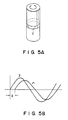
- the ink 2 of the present invention is formed into a sample having a diameter of 25 mm and a thickness of 2 mm.
- a sine strain ⁇ with an angular velocity of 1 rad/sec is applied to the sample in the direction (shear direction) as shown by an arrow in Figure 5A, and a stress ⁇ and a phase delay ⁇ are detected as shown in Figure 5B.
- the ratio (G ⁇ /G ⁇ ) is more than 10
- the size of the above-mentioned ink sample and the method of applying the strain thereto have been appropriately selected in consideration of a recording apparatus using the ink of the present invention.
- a preferred embodiment of the ink having such layer-forming property and non-adhesiveness include an ink in the form of a gel, in a broad sense, comprising a cross-linked substance impregnated with and holding therewith a liquid dispersion medium. Particles having a particle size of preferably 0.01 - 100 ⁇ m, further preferably 0.01 - 20 ⁇ m may by further dispersed in the above gel ink.
- the gel ink is substantially non-adhesive or not substantially transferred to a transfer-receiving medium because the liquid dispersion medium except for a minor portion thereof is well retained in the crosslinked substance.
- crosslinked substance refers to a single substance which per se can assume a crosslinked structure, such as those generally known as a thickness or a gelling agent, or a mixture of a substance capable of assuming a crosslinked structure with the aid of an additive such as a crosslinking agent for providing a crosslinking ion such as borate ion, and the additive.
- crosslinked structure refers to a three-dimensional structure having a crosslinkage or crosslinking bond.
- the crosslinkage may be composed of any one or more of covalent bond, ionic bond, hydrogen bond and van der Waal's bond.
- crosslinked structure is only required to be such that a desired degree of liquid dispersion medium-retaining property is given thereby.
- the crosslinked structure may be any one of a network, a honeycomb, a helix, etc., or may be an irregular one.
- the liquid dispersion medium (or vehicle) in the ink of the present invention may be any inorganic or organic liquid medium which is preferably liquid at room temperature.
- the liquid medium should preferably have a relatively low volatility, e.g., one equal to or even lower than that of water.
- liquid dispersion medium is an aqueous or a hydrophilic dispersion medium inclusive of water, a water-miscible solvent, and a mixture of water and a water-miscible solvent.
- the crosslinked substance may preferably be composed of or from a natural or synthetic hydrophilic high polymer or macromolecular substance.
- hydrophilic high polymer examples include: plant polymers, such as guar gum, locust bean gum, gum arabic, tragacanth, carrageenan, pectin, mannan, and starch; microorganism polymers, such as xanthane gum, dextrin, succinoglucan, and curdran; animal polymers, such as gelatin, casein, albumin, and collagen, cellulose polymers such as methyl cellulose, ethyl cellulose, and hydroxyethyl cellulose; starch polymers, such as soluble starch, carboxymethyl starch, methyl starch; alginic acid polymers, such as propylene glycol alginate, and alginic acid salts; other semi-synthetic polymers, such as derivatives of polysaccharides; vinyl polymers, such as polyvinyl alcohol, polyvinylpyrrolidone, polyvinyl methyl ether, carboxyvinyl polymer, and sodium polyacrylate; and other polyacrylate
- the hydrophilic polymer may preferably be used in a proportion of 0.2 - 50 parts, particularly 0.5 - 30 parts, with respect to 100 parts of the liquid dispersion medium.
- the crosslinked substance may be composed of or from one or a mixture of two or more compounds selected from metallic soaps inclusive of metal stearates, such as aluminum stearate, magnesium stearate, and zinc stearate, and similar metal salts of other fatty acids, such as palmitic acid, myristic acid, and lauric acid; or organic substances such as hydroxypropyl cellulose derivative, dibenzylidene-D-sorbitol, sucrose fatty acid esters, and dextrin fatty acid esters. These substances may be used in an amount similar to that of the above-mentioned hydrophilic polymer.
- the fluidity and liquid dispersant -retaining ability of the result ink vary to some extent depending on the formulation of these components or combination thereof with a liquid dispersant medium. It is somewhat difficult to determine the formulation or composition of these components in a single way. Accordingly, it is preferred to formulate a composition of a liquid dispersion medium and a crosslinked substance so that the resultant ink will satisfy the layer-forming property and non-adhesiveness (liquid dispersion medium-retaining property) as defined above.
- the image recording ink of the present invention further comprises a substance capable of imparting a pH buffer action to the ink.
- a substance capable of imparting a pH buffer action to the ink.
- the ink according to the present invention may preferably exhibit the following pH stability and/or viscosity stability.
- the ink of the present invention 100 g of the ink of the present invention, of which initial pH is p , is charged into a beaker.
- 1 ml of a 0.1N-aqueous sodium hydroxide solution or 1 ml of a 0.1N-hydrochloric acid
- the pH becomes a there may preferably be satisfied a relationship, -0.3 ⁇ (a-p) ⁇ +0.3, more preferably, -0.1 ⁇ (a-p) ⁇ +0.1.
- the ink of the present invention 100 g of the ink of the present invention, in which the initial pH is p and the initial viscosity is A (cps), is charged into a beaker.
- 1 ml of a 0.1N-aqueous sodium hydroxide solution or 1 ml of a 0.1N-hydrochloric acid
- B 0.1N-hydrochloric acid
- the viscosity A and viscosity B used herein are those measured by means of a rotational viscometer, (vismetron Model VS-A1, mfd. by Shibaura System K.K.) with a stainless steel (SUS 27) rotor of about 3 mm in diameter at rotor speed of 0.6 rpm, at normal temperature (25°C).
- the ink of the present invention When the ink of the present invention is supplied with electric conduction, because of a pH change caused thereby, the ink is at least partially subjected to a change in or destruction of the crosslinked structure to be reversibly converted into a sol state, whereby it is selectively imparted with an adhesiveness corresponding to the energy application pattern.
- the borate ion bonded to the -OH groups of the polyvinyl alcohol is subjected to an anodic reaction in the neighborhood of an anode based on electric conduction (or to the addition of an electron acceptor such as hydrochloric acid), the pH of the ink is changed to the acidic side and electrons may be removed from the above-mentioned borate ion to destroy at least a part of the crosslinked structure, whereby the ink may be imparted with an adhesiveness selectively or imagewise.
- the reaction at this time may presumably be expressed by the following formula:
- the gelation is generally promoted by an increase in pH and the solation is generally promoted by a decrease in pH, while depending on the polymerization degree or saponification degree of the polyvinyl alcohol, or the amount of borate ions used.
- the ink is alkalified and gelates on the cathode side thereby to be hardened. Further, because this hardened ink is not transferred, the pH value of the entire ink increases and the hardening thereof is promoted. As a result, the layer-forming property of the ink can be impaired and therefore the recording can be difficult to be conducted.
- the image recording ink according to the present invention contains the above-mentioned buffer action-imparting substance, in view of the entire ink, the pH-change based on the above electrochemical reaction is suppressed and pH conditions suitable for recording may be retained even when the recording based on the electric conduction is continuously effected.
- the buffer action-imparting substance i.e., a substance capable of imparting a buffer action to the ink, will be described in detail.
- an electrolyte may be used as the buffer action-imparting substance. More specifically, there may preferably used at least one of a weak acid, a weak acid salt, a weak base, and a weak acid salt. More preferably, there may be used a combination of a weak acid and a weak acid salt, or a combination of a weak base and a weak base salt.
- the buffer action-imparting electrolyte may preferably be used in an amount of about 0.5 - 20 parts, per 100 parts of the liquid dispersion medium, while depending on the kind or buffer capacity of the electrolyte.
- electrolyte may include: salts such as potassium hydrogenphthalate (C8H5KO4), potassium dihydrogen phosphate (KH2PO4), sodium hydrogencarbonate (NaHCO3) and disodium hydrogenphosphate (Na2HPO4); phosphoric acid (H3PO4), aqueous ammonia (NH4OH), etc.
- salts such as potassium hydrogenphthalate (C8H5KO4), potassium dihydrogen phosphate (KH2PO4), sodium hydrogencarbonate (NaHCO3) and disodium hydrogenphosphate (Na2HPO4)
- phosphoric acid H3PO4
- NH4OH aqueous ammonia
- a strong acid or base such as hydrochloric acid (HCl) and sodium hydroxide (NaOH); or a salt such as sodium chloride (NaCl) and potassium chloride (KCl)
- a commercially available buffer solution such as a potassium hydrogenphthalate-type buffer solution, a potassium dihydrogenphosphate-type buffer solution, a sodium hydrogencarbonate-type buffer solution, and a sodium dihydrogenphosphate-type buffer solution, may be used as a base or main constituent of the liquid dispersion medium or vehicle.
- a salt comprising a metal of a small ionization tendency such as copper sulfate may also preferably be used as the buffer action-imparting electrolyte.
- such salt comprising a metal of a small ionization tendency may preferably be used in an amount of about 0.01 - 1 part per 100 parts of the liquid dispersion medium.
- reaction in this case may presumably be expressed by the following formulas.
- anodic reaction SO42 ⁇ + H2O ⁇ H2SO4 + 1/2O2 + 2e ⁇
- the metal of a small ionization tendency is deposited on the cathode whereby the alkalification of the ink caused by an ion of a metal of a large ionization tendency such as Na or K ion may be prevented.
- metal of a small ionization tendency refers to a metal which can be deposited by an cathodic reaction. More specifically, as the electrolyte, a salt comprising a metal having a smaller ionization tendency than aluminum, such as iron, nickel, tin, lead, copper, mercury, silver, and gold may preferably be used. These salts may be used singly or in a combination of two or more species, as desired.
- metal of a large ionization tendency used herein refers to a metal which can be contained in the ink and which cannot be deposited on an electrode, more specifically, a metal having a larger ionization tendency than aluminum, such as sodium and potassium.
- these two kinds of metal ions i.e., the ion of a metal of a small ionization tendency and the ion of a metal of a large ionization tendency, are present in almost equal equivalents.
- there may more preferably be used a combination comprising: the above-mentioned at least one of a weak acid, a weak acid salt, a weak base, and a weak acid salt; and the ion of a metal of a small ionization tendency.
- such electrolyte also has a function of imparting desired electro-conductivity to the ink.
- an ionic surfactant may also be used as the buffer action-imparting substance.
- the buffer action of such ionic surfactant appears after a prescribed period of time counted from the time of electric conduction. Therefore, the ionic surfactant is particularly preferably used in a transfer recording because the adhesiveness of the ink may be retained for a certain period.
- the pH of the ink does not change even when a continuous recording based on electric conduction is effected.
- Preferred examples of such weak base may include NH4OH, Cu(OH)2, Fe(OH)3, etc.
- the dispersion medium contains a weak acid, particularly a weak acid capable of being dissociated into an anion which is contained in the cationic surfactant.
- a weak acid particularly a weak acid capable of being dissociated into an anion which is contained in the cationic surfactant.
- Preferred examples of such weak acid may include CH3COOH, H2CO3, H2S, etc.
- the pH value On the anode side, as described above, the pH value once decreases, and a little time thereafter the pH value recovers the initial state.
- This phenomenon may be attributable to the size of the CF3(CF2)6CF2COO ⁇ of the anionic surfactant. Namely, as the size of the anion becomes larger, the period of time required for the recovery to the initial state becomes longer.
- the ink when an ionic surfactant is added to the image recording ink, the ink does not gelate on the cathode (or anode) side, but it initially solate on the anode (or cathode) side and a several minutes thereafter it recovers the initial pH value.
- the surface energy of the sol ink decreases whereby the transfer efficiency thereof increases. Furthermore, there may be obtained another effect such as improvement in image quality due to improvement in pigment dispersibility, and a decrease in evaporation loss of the liquid dispersion medium due to improvement in mixability of mutual ingredients thereof, or mixability thereof with the crosslinked substance.
- cationic surfactant may include: amine salt-type or quaternary ammonium salt-type surfactants such as: lauryltrimethylammonium chloride
- ampholytic surfactant may include: sodium laurylaminopropionate (C12H25NHCH2CH2COONa), sodium stearylaminopropionate (C18H37NHCH2CH2COONa), and
- an anionic surfactant, a cationic surfactant or an ampholytic surfactant may be used as the ionic surfactant contained in the image recording ink.
- the anionic surfactant may preferably be used.
- the cationic surfactant may preferably be used.
- the ampholytic surfactant may preferably be used in a case where the ink solates either at the anode or at the cathode.
- the ionic surfactant may preferably be contained in the ink in an amount of 0.01 - 50 %, more preferably 0.1 - 20 %, particularly preferably 1 - 10 %, based on the total weight of the ink. If the amount of the ionic surfactant is less than 0.01 wt. %, the effect thereof is insufficient. On the other hand, if the amount is more than 50 wt. %, the ink is difficult to be applied onto an ink-carrying member.
- a solid acid comprising a metal oxide may be used as the buffer action-imparting substance.
- metal oxide compound oxide (or double oxide) may particularly preferably be used.
- the solid acid of SiO2-Al2O3 is neither a simple mixture of SiO2 and Al2O3 crystals nor a sinter thereof, but may be considered to be an oxide wherein Al is randomly distributed in an SiO2 skeleton.
- This SiO2-Al2O3 exhibit a stronger acidity than a simple oxide of silica or alumina. For this reason, there has been most affirmatively accepted one which Tomas has proposed in view of a structural theory, e.g., as described in a monthly "Hyomen" (Surface), Vol. 21, No. 12, 43 - 53 pp (1983).
- the pH value of the entire ink is stably controlled, whereby the viscoelasticity and adhesiveness of the ink may be retained constantly.
- solid acid powder produced by pulverization may preferably be used. This powder may preferably be uniformly dispersed in the ink. Because the ink of the present invention is a gel-type ink having viscoelasticity, the solid acid powder is suitably held in the crosslinked structure of the ink whereby ununiform dispersion state due to sedimentation does not occur.
- solid acid of a metal oxide used in the present invention may include: simple oxides such as Al2O3, ZnO, TiO2, CeO2, As2O3, V2O5, Cr2O3 and MoO3; or compound oxides such as SiO2-Al2O3, B2O3-Al2O3, Cr2O3-Al2O3, MoO3-Al2O3, ZrO2-SiO2, Ga2O3-SiO2, BeO-SiO2, MgO-SiO2, CaO-SiO2, SrO-SiO2, Y2O3-SiO2, La2O3-SiO2, SnO2-SiO2, PbO-SiO2, MgO-B2O3 and TiO2-ZnO.
- These solid acids may be used singly or in a mixture of two or more species.
- the solid acid may preferably be contained in an amount of 0.1 - 20 wt. %, more preferably 0.6 - 10 wt. %, based on the weight of the entire ink. If the solid acid content is less than 0.1 wt. %, the effect thereof on the stabilization of the ink pH value is not sufficient, and the ink pH can be increased in repeated use whereby the ink is hardened and the layer-forming property thereof becomes poor. On the other hand, if the solid acid content exceeds 20 wt. %, the fluidity of the ink decreases and the layer-forming property thereof also becomes poor.
- a known dispersing device such as roll mill, kneader and attritor can be used.
- the fluid ink of the present inven.tion comprises a liquid dispersion medium, a crosslinked substance and a buffer action-imparting substance, as described above, and may further comprise, as desired, a coloring agent or colorant inclusive of dye, pigment and colored fine particles, a color forming compound capable of generating a color on energy application, or another additive such as an antifungal agent or an antiseptic.
- the coloring agent may be any of dyes and pigments generally used in the filled of printing and recording, such as carbon black.
- a dye or pigment, particularly a pigment, having a relatively low affinity to the liquid dispersion medium is preferably used in order to suppress the coloring of a transfer-receiving medium, i.e., an intermediate transfer medium or a recording medium, due to the transfer thereto of the liquid dispersion medium under no electric conduction.
- the pigment or dye may preferably be used in a proportion of 0.1 part or more, more preferably 1 - 30 parts, particularly preferably 1 - 10 parts, per 100 parts of the liquid dispersion medium.
- the colorant may be in the form of fine colored particles, like a toner of various colors for electrophotography, obtained by dispersing a pigment or dye as described above in a natural or synthetic resin and forming the dispersion into fine particles.
- a fluid ink containing such colored particles behaves like a dilatant liquid and is particularly preferred in respect of suppressing the transfer of the liquid dispersion medium to or coloring of the transfer-receiving medium under no electric conduction.
- the colored fine particles may preferably be used in a proportion of 1 part or more, further preferably 5 - 100 parts, particularly preferably 20 - 80 parts, per 100 parts of the liquid dispersion medium. Generally speaking, it is preferred that colored particles having a large size are incorporated in a higher proportion in order to provide a better coloring characteristic. Further, in the present invention, the above-mentioned toner particles may be used without considering their electrophotographic characteristics such as a charging characteristic.
- the colorant inclusive of the pigment or the colored fine particles may preferably have a particle size of 0.01 - 100 ⁇ m, particularly 0.01 - 20 ⁇ m.
- the particle size is below 0.01 ⁇ m, the colorant particles are not retained in the crosslinked structure but are transferred together with the liquid dispersion medium even when the ink contacts the intermediate transfer medium, etc., under no energy application, whereby an image fog is liable to result.
- the particle size exceeds 100 ⁇ m, a resolution required for an ordinary image is not satisfied.
- the color forming compound may be those generally known as heat-sensitive color former or pressure-sensitive color former, i.e., those capable of forming color under the action of an acid or heat, and an ink containing such a coloring forming agent can be selectively subjected to color development on application of an energy pattern.
- color forming compound may include: triphenylmethane-phthalide-type compounds, fluoran-type compounds, phenothiazine-type compounds, indolylphthalide-type compounds, leucoauramine-type compounds, spiropyran-type compounds, Rhodamine-lactam-type compounds, triphenylmethan-type compounds, azaphthalide-type compounds, chromanoindole-type compounds and the like, triazene-type compounds and the like, and naphthalic acid-type compounds. These compounds may be used singly or as a combination of two or more species.
- the color forming compound may be encapsulated and dissolved or dispersed in the liquid dispersion medium whereby it may be directly developed according to an electrochemical reaction based on the transfer of electrons in the vicinity of a recording electrode. Further, the color forming compound may be caused to contact a solid acid such as phenol whereby the ink which is to be transferred to a transfer-receiving medium, an intermediate transfer medium or a recording medium (i.e., a final transfer medium), may be selectively subjected to color development.
- a solid acid such as phenol
- the colorant used in the present invention may preferably be pigment or dye or colored particles as described above, in combination with the above-mentioned color forming compound, as desired.
- the image recording ink according to the present invention may be obtained from the above components, for example, by uniformly mixing a liquid dispersion medium such as water, a crosslinked substance, such as a hydrophilic polymer, a buffer action-imparting substance, and also an optional additive such as a crosslinking agent, a colorant, etc., under heating as desired, to form a viscous solution or dispersion, which is then cooled to gel the same.
- a liquid dispersion medium such as water
- a crosslinked substance such as a hydrophilic polymer, a buffer action-imparting substance, and also an optional additive such as a crosslinking agent, a colorant, etc.
- a crosslinked substance and a liquid dispersion medium are first mixed under heating to form a uniform liquid, and then the colored particles are added thereto.
- the addition of the particles is effected in the neighborhood of room temperature so as to avoid the agglomeration of the particles.
- the pH change does not diffuse three-dimensionally like heat, but selectively diffuses in the direction of the ink depth (i.e., in the direction of the current), whereby the clearness of the resultant ink pattern (e.g., sharpness and image quality) may be enhanced.
- the anode material when a recording is effected by using a pH change based on electric conduction, the anode material can be dissolved due to electrolysis. Accordingly, when the recording electrode is an anode, it is preferred to use an inert metal such as platinum, as the material for the recording electrode. In such case, however, fine or micro fabrication such as photolitho-etching is required. As a result, e.g., by using electron-beam deposition or sputtering, the production cost relatively tends to increase.
- the recording electrode is a cathode
- the above-mentioned fine fabrication is not required whereby the production cost may preferably be reduced.
- the ink which can be used in such cathodic recording there may preferably be used an ink comprising a peptide compound such as a protein, and an aqueous dispersion medium, wherein the initial or unused pH value is higher than the isoelectric point of the peptide compound, e.g., by adding an aqueous alkaline solution thereto.
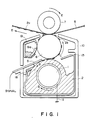
- FIG. 1 is a partial schematic sectional view taken across the thickness of a transfer-receiving medium showing an embodiment of the recording apparatus used in such recording method
- an ink 2 contained in an ink container 13 is carried on the surface of a cylindrical ink-carrying roller 1 of which the surface comprises, e.g., stainless steel, and conveyed in an arrow B direction along with the rotation in the arrow A direction of the roller 1.
- the ink 2 moved in this way is supplied with a pattern of voltage corresponding to an image signal from a recording electrode 5 at an energy application position where the ink 2 contacts the electrode 5.
- a current corresponding to the voltage flows from the recording electrode 5 to, e.g., the ink-carrying roller 1 connected to the earth 11, through the ink 2, whereby the ink 2 is selectively imparted with an adhesiveness, e.g., because of a change in crosslinking structure through an electro-chemical reaction in the ink 2.
- a portion of the ink 2 selectively imparted with an adhesiveness is further moved in the arrow B direction to reach an ink transfer position where the layer of the ink 2 contacts an intermediate transfer roller 6 which is composed of a cylinder of iron coated with a hard chromium plating and is disposed with a certain spacing from the ink-carrying roller 1 at the ink transfer position.
- the adhesive portion of the ink 2 to which the above-mentioned selective adhesiveness is imparted is transferred onto the intermediate transfer medium 6 rotating in the arrow C direction to form an ink pattern 2b thereon.
- the ink pattern 2b is then conveyed along with the rotation in the arrow C direction of the intermediate transfer roller 6 to reach an ink pattern-transfer position where the roller 6 confronts a platen roller 7 by the medium of a recording medium 8.
- the platen roller 7 as a transfer means having a surface of, e.g., silicon rubber is disposed opposite to the roller 6 rotating in the direction of an arrow E so as to movably sandwich the recording medium 8 with the intermediate transfer roller 6.
- the ink pattern 2b formed on the intermediate transfer medium 6 is transferred to the recording medium 8 thereby to form a transferred image 2c.
- the remainder of the ink 2 not transferred to the intermediate transfer roller 6 at the ink transfer position is further conveyed in the arrow B direction to be separated from the intermediate transfer roller 6 because of its non-adhesiveness and the action of a gravity, etc., and recycled to the ink container 13 for reuse.
- a blade 18 as an ink layer thickness-regulation means for regulating the thickness of a layer of the ink 2 on the roller 1 may be disposed as shown in Figure 1, as desired.
- a transferred pattern 2c formed on the recording medium 8 is not sufficiently fixed on the recording medium 8, it is possible to dispose a known fixing means by way of heating, pressing, etc., (not shown) at a point downstream from the ink image-transfer position along the recording medium 8.
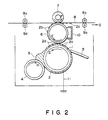
- a gel ink 2 of the present invention is carried on an ink-carrying roller 1 and conveyed along with the rotation in the arrow D direction of the roller 1.
- the ink 2 moved in this way forms an ink reservoir 3 by means of a coating roller 4 rotating in the arrow H direction, and the ink 2 stored in the ink reservoir 3 is formed into a layer having a certain thickness on the surface of the ink-carrying roller 1.
- the ink 2 is supplied with a pattern of voltage corresponding to an image signal from a recording electrode 5 at an energy application position where the ink 2 contacts the electrode 5.
- a current corresponding to the voltage flows from the recording electrode 5 to, e.g., the ink-carrying roller 1 connected to the earth 11, through the ink 2, whereby the ink 2 is selectively imparted with an adhesiveness to form an adhesive portion 2a.
- the portion 2a of the ink 2 selectively imparted with an adhesiveness is further moved in the arrow D direction to reach an ink transfer position where the layer of the ink 2 contacts an intermediate transfer roller 6.
- the adhesive portion of the ink 2 (i.e., at least a part of the ink 2 constituting the ink layer) to which the above-mentioned selective adhesiveness is imparted is transferred onto the intermediate transfer medium 6 to form an ink pattern 2b thereon.
- the ink pattern 2b is then conveyed along with the rotation in the arrow E direction of the intermediate transfer roller 6, and is transferred to a recording paper 8 under the action of a platen roller 7 rotating in the arrow F direction, thereby to form a transferred image 2c.
- the recording paper 8 on which the transferred image 2c is formed is conveyed in the arrow G direction by means of pairs of conveying rollers 9a, 9b and 9c, 9d.
- the remainder ink remaining on the surface of the intermediate transfer roller 6 is removed by means of a cleaning means 10, e.g., comprising a sponge and the intermediate transfer roller 6 is again provided for forming a new ink pattern 2b.
- the remainder of the ink 2 (inclusive of a portion 2d) not transferred to the intermediate transfer roller 6 at the ink transfer position is further conveyed in the arrow D direction to be separated from the intermediate transfer roller 6 because of its non-adhesiveness and the action of a gravity, etc., and recycled to the ink reservoir 3 for reuse.
- the ink 2 inclusive of the ink portion 2d recycled to the ink reservoir 3 is uniformly stirred by the rotation in the arrow D direction of the ink-carrying roller 1 and that in the arrow H direction of the coating roller 4. Thereafter, the ink 2 is again formed into a layer having a certain thickness and may be subjected to the process for recording.
- the ink 2 is one in the form of a gel, in a broad sense, comprising a crosslinked substance impregnated with and holding therewith a liquid dispersion medium, it is presumed that the gel ink is not substantially transferred to the intermediate transfer medium 6 on no energy application.
- the amount of current required for breaking at least a part of the crosslinked structure is only such an amount as required for causing transfer of electrons from crosslinking agent (e.g., the above-mentioned borate ions) which is generally used in a considerably small amount, e.g., on the order of several hundred ppm of the ink.
- crosslinking agent e.g., the above-mentioned borate ions
- the above amount of current is almost 1/10 of the amount of current required by a thermal head, so that a low energy consumption recording may be effected by using such an electrochemical change.
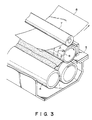
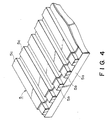
- the recording head 5 may preferably take a form of recording electrode as shown in Figure 4, an enlarged partial perspective view thereof.
- the recording electrode 5 may be obtained by forming a plurality of electrode elements 5b of a metal such as platinum or gold on a substrate 5a, and coating the electrode elements 5b except for the tip portions thereof contacting the ink with an insulating film 5c of polyimide, etc.
- the electrode elements 5b may preferably comprise an electroless plating of Pt in view of the adhesion to the substrate 5a and the durability thereof.
- a current is passed between the recording electrode 5 and the ink-carrying roller 1, but it is also possible that a current is passed between an adjacent pair of the plurality of electrode elements 5b on the recording electrode 5.
- an ink in the form of a gel in a broad sense
- an ink which is in the form of a sol having adhesiveness or adhesion on no electric conduction e.g., by making its pH acidic.
- Such ink may be selectively or patternwise formed into a gel having no adhesiveness, e.g., by imparting an electrochemical energy thereto, thereby to form an ink pattern.
- image recording ink As described hereinabove, by using the image recording ink according to the present invention, image recording is easily effected at an extremely low recording cost than the thermal transfer recording method and free from plugging of a nozzle or blurring of recorded images as encountered in the ink jet recording method.
- image recording can be effected at an amount of current which is about 1/10 of that required in the conventional thermal transfer method using a thermal head, whereby the recording cost can be remarkably reduced also in respect to energy consumption.
- the pH value thereof can be retained and the viscoelasticity is not changed even in continuous use.
- clear images may be constantly obtained even when the ink is continuously used.
- the above ingredients were uniformly mixed under heating at 90°C and then left standing at room temperature to form a gel ink retaining a high percentage of water and having an indefinite shape, i.e., a fluidity.
- the pH of the gel ink was lowered to below 7 by the addition of hydrochloric acid to be once converted into a viscous sol, into which 50 parts of toner particles of 10 ⁇ m size (cyan toner, before addition of externally added fluidity improver, for NP color copier, mfd. by Canon K.K.) prepared by uniformly dispersing a phthalocyanine pigment in a polyester resin, were added and uniformly mixed. Then, the mixture was again brought to a pH 8.3 by the addition of an aqueous NaOH solution to obtain a gel ink in the form of sludge.
- the viscosity change in the gel ink prepared above was examined while changing the pH value of the ink.
- the viscosity was measured by means of a rotational viscometer (Vismetron Model VS-A1, mfd. by Shibaura System K.K.) with a stainless steel (SUS 27) rotor of about 3 mm in diaemter at rotor speed of 0.6 rpm, at normal temperature (25°C), whereby a pH-viscosity curve as shown in Figure 6 was obtained.
- the sludge ink 2 was charged in an apparatus as shown in Figure 1 wherein an ink-carrying roller 1 comprising a cylindrical roller of 20 mm in diameter having a surface of stainless steel with a surface roughness of 1S and an intermediate transfer roller 6 comprising an iron cylindrical roller of 20 mm in diameter having a surface coated with a hard chromium plating were disposed opposite to each other with a gap of 2 mm at the ink transfer position.
- the sludge ink 2 obtained above was charged in the ink container 13.
- the ink-carrying roller 1 was rotated in the arrow A direction at about 60 rpm to form thereon a layer of the ink 2, and in contact with the ink layer 2, the intermediate transfer roller 6 was rotated in the arrow C direction at about 50 rpm.
- the recording head 5 had a structure as shown in Figure 4, wherein each electrode element 5b of copper was coated with a polyimide insulating film 5c except for a tip thereof which was coated with Au plating in an area of 100 ⁇ m ⁇ 100 ⁇ m.
- a platen roller 7 of a 12 mm-dia. iron cylindrical roller surfaced with 4 mm-thick silicone rubber layer was disposed opposite to the intermediate transfer roller 6 with a recording medium 8 of plain paper disposed therebetween moving in the arrow D direction. Further, the platen roller 7 was rotated in the arrow E direction at the same speed as the transfer roller 6 while exerting a slight pressure onto the recording medium 8. As a result, cyan-colored dot images each of about 100 ⁇ 150 ⁇ m in size were formed on the recording medium 8.
- the ink of this Example was excellent in long-term storage stability and stability in pH during a continuous application of signals (i.e., excellent in viscosity stability of the entire ink), as described hereinafter.
- a fluid ink was prepared in the same manner as in Example 1 except that 100 parts of water was used instead of 100 parts of the buffer solution of the prescription A in the Example 1.
- Example 1 and Comparative Example 1 were stored at 40°C for 2 weeks, and thereafter the viscosities of these inks were measured. As a result, the viscosity of the ink of Example 1 was not substantially changed. On the other hand, the viscosity of ink of the Comparative Example 1 was decreased due to the storage, and the ink partially solated and the pH thereof was decreased.
- Example 2 By using the thus prepared ink, image formation was effected in the same manner as in Example 1 whereby almost the same results as in Example 1 were obtained. In this image formation, the viscosity of the entire ink was stable during the signal application, while a very small amount of copper was attached to the surface of the ink-carrying roller 1 after use.
- sodium sulfate CuSO4 generally tended to be precipitate as copper hydroxide Cu(OH)2 in an alkaline region. In this instance, however, there was applied a relatively high voltage as compared with a general electrochemical reaction, whereby the copper was deposited on the cathode. Further, it was preferred to use ammonia for adjusting the ink pH because the copper hydroxide was dissolved as Cu(NH3)4(OH)2.
- colloidal silica (trade name: Aerosil R200, mfd. by Nihon Aerosil K.K.) was added thereto and mixed.
- 1.2 g of borax was added and mixed thereby to prepare an ink of the present invention in the form of a gel at room temperature.
- an aluminum foil of 5 cm ⁇ 5 cm in size was placed gently and was left standing as it is for 1 min. in an environment of a temperature of 25°C and a moisture of 60 %. Then, the aluminum foil is gently peeled off from the surface of the ink and then quickly weighed accurately to measure the increase in weight of the aluminum foil. As a result, there was substantially no weight increase of the aluminum foil (i.e., a weight increase of less than 0.1 g).
- the gel ink 2 in the total amount of 40 g was charged in an apparatus as shown in Figure 2 wherein an ink-carrying roller 1 and a coating roller 4 were disposed opposite to each other with a gap of 1 mm.
- the ink-carrying roller 1 was rotated in the arrow D direction at a peripheral speed of 20 mm/sec, and the coating roller 4 was rotated in the arrow H direction at a peripheral speed of 24 mm/sec, whereby a layer of the ink 2 having a thickness of about 1.2 mm and a coating width of 60 mm was formed on the ink-carrying roller 1.
- the recording head 5 had a structure wherein each electrode element 5b of a plating of Pt was coated with a polyimide insulating film 5c except for a tip thereof which had an area of 1 mm ⁇ 1 mm.
- the ink 2 When a pulse of +25 V and 25 msec was applied through the ink layer 2 between the recording head 5 as the anode and the ink-carrying roller 1 as the cathode, the ink 2 was selectively transferred to the transfer roller 6 to form an ink pattern 2b thereon. Then, the ink pattern 2b was transferred to a recording medium 8 of roll paper to form a transferred image 2c.
- the image recording was effected in this manner on the roll paper 8 whereby there was obtained a printed portion had a width of 50 mm wherein the area rate of the actually printed images was 50 %.
- the roll paper 8 having a length of 150 m (corresponding to about 500 sheets of A-4 paper, with respect to its vertical length) was printed, whereby there were obtained good images having substantially no variation in image density and resolution.
- the change in pH values was examined by means of a pH test paper.
- an ink according to the present invention was prepared in the same manner as described above except that the carbon black was not used.
- the pH value of the ink was 8.0 before electric conduction, and the pH value was 8.0 even after image recording was effected in a length of 150 m on the roll paper. Accordingly, the pH value was not substantially changed.
- An image recording ink according to the present invention was prepared in the same manner as in Example 3 except that 160 g of an anionic surfactant (Pelex SSH, mfd. by Kawo Sekken K.K.) was used instead of the anionic surfactant (Surflon S-111).
- an anionic surfactant Pelex SSH, mfd. by Kawo Sekken K.K.
- An image recording ink according to the present invention was prepared in the same manner as in Example 3 except that a mixture comprising 95 g of Surflon S11 and 33 g of Surflon S111-S was used instead of the anionic surfactant (Surflon S-111).
- an ink was prepared in the same manner as described above except that the carbon black was not used.
- the pH value of the ink was 8.5 before electric conduction, and the pH value was not changed even after image recording was effected in a length of 150 m on the roll paper.
- An image recording ink was prepared in the same manner as in Example 3 except that a 1N-NaOH solution was used so as to adjust the pH of the entire ink to the same as that in Example 3 (pH 8.5), instead of the anionic surfactant used in Example 3.
- Example 3 By using the thus prepared ink, experiments inclusive of image recording was conducted in the same manner as in Example 3. As a result, an image having a somewhat low image density as compared with Example 3 was formed in the initial stage. However, a disorder in image occurred as the printing continued, and the ink was hardened and could not provide a clear image when the roll paper was printed in a length of about 15 m.
- an ink was prepared in the same manner as described above except that the carbon black was not used. As a result, the pH value of the ink was 8.5 before electric conduction, but the pH value was changed to 11.0 after the roll paper was printed in a length of about 15 m.
- the above ingredients were uniformly mixed under heating at 80 - 90°C, and 3 g of colloidal silica (trade name: Aerosil 200, mfd. by Nihon Aerosil K.K.) and 3 g of a solid acid of silica-alumina (trade name: N633 HN, Al2O3 content of 28 wt. %, mfd. by Nikki Kagaku K.K.) were added thereto and sufficiently dispersed.
- colloidal silica trade name: Aerosil 200, mfd. by Nihon Aerosil K.K.
- 3 a solid acid of silica-alumina trade name: N633 HN, Al2O3 content of 28 wt. %, mfd. by Nikki Kagaku K.K.
- an aluminum foil of 5 cm ⁇ 5 cm in size was placed gently and was left standing as it is for 1 min. in an environment of a temperature of 25°C and a moisture of 60 %. Then, the aluminum foil is gently peeled off from the surface of the ink and then quickly weighed accurately to measure the increase in weight of the aluminum foil. As a result, there was substantially no weight increase of the aluminum foil (i.e., a weight increase of less than 0.1 g).
- the gel ink 2 was charged in an apparatus as shown in Figure 2 wherein an ink-carrying roller 1 comprising a cylindrical roller of 40 mm in diameter having a surface of stainless steel with a surface roughness of 100S and an intermediate transfer roller 6 comprising an iron cylindrical roller of 40 mm in diameter having a surface coated with a hard chromium plating were disposed opposite to each other with a gap of 1 mm at the ink transfer position.
- an ink-carrying roller 1 comprising a cylindrical roller of 40 mm in diameter having a surface of stainless steel with a surface roughness of 100S
- an intermediate transfer roller 6 comprising an iron cylindrical roller of 40 mm in diameter having a surface coated with a hard chromium plating were disposed opposite to each other with a gap of 1 mm at the ink transfer position.
- the ink-carrying roller 1 and a coating roller 4 of 40 mm in diameter were disposed opposite to each other with a gap of 1 mm.
- the gel ink 2 obtained above was charged in the ink reservoir 3.
- the ink-carrying roller 1 was rotated in the arrow D direction at about 10 rpm and the coating roller 4 was rotated at about 12 rpm to form a layer of the ink 2, whereby the ink 2 of the present invention could be suitably applied onto the ink-carrying roller 1 to form an ink layer having a very smooth surface. Thus, a uniform coating could be effected.
- the intermediate transfer roller 6 was rotated in the arrow E direction at about 10 rpm.
- the recording head 5 had a structure as shown in Figure 4, wherein each electrode element 5b of a plating of Pt was coated with a polyimide insulating film 5c except for a tip thereof which had an area of 1 mm ⁇ 1 mm.
- a platen roller 7 of a 20 mm-dia. iron cylindrical roller surfaced with 10 mm-thick silicone rubber layer was disposed opposite to the intermediate transfer roller 6 with a recording medium 8 of plain paper disposed therebetween moving in the arrow G direction. Further, the platen roller 7 was rotated in the arrow F direction at the same speed as the transfer roller 60 while exerting a slight pressure onto the recording medium 8. As a result, cyan-colored dot images 2c each of about 1 mm ⁇ 1 mm in size corresponding to the ink pattern 2b were formed on the recording medium 8.
- the transferred image 2c formed on the recording paper 8 was a high-quality image without trailing and fog, and with a high image density.
- the printed portion of the recording paper 8 formed in the above-mentioned recording due to electric conduction had a width of 50 mm wherein the area rate of the actually printed images was 50 %.
- Such recording was effected repeatedly and the change in image density and resolution was evaluated.
- As a result there were obtained good images having substantially no variation in image density and resolution compared with the initial image, even when 300 sheets of cut plain paper having a size of 297 mm ⁇ 52.5 mm (corresponding to 1/4 of A-4 size) were printed in the longitudinal direction thereof.
- Example 6 An ink was prepared in the same manner as in Example 6 except that silica-magnesia (Nikkagel M-30, mfd. by Nihon Kassei Hakudo K.K.) was used intead of the silica-alumina used in Example 6.
- silica-magnesia Nikkagel M-30, mfd. by Nihon Kassei Hakudo K.K.
- Example 6 An ink was prepared in the same manner as in Example 6 except that silica-alumina (trade name: N633L, Al2O3 content of 13 wt. % mfd. by Nikki Kagaku K.K.) was used instead of the silica-alumina (trade name: N633 HN, Al2O3 content of 28 wt.%, mfd. by Nikki Kagaku K.K.) used in Example 6.
- silica-alumina trade name: N633L, Al2O3 content of 13 wt. % mfd. by Nikki Kagaku K.K.
- Example 6 An ink was prepared in the same manner as in Example 6 except that silica-magnesia (trade name: E53J1, mfd. by Nikki Kagaku K.K.) was used instead of the solid acid of silica-alumina used in Example 6.
- silica-magnesia trade name: E53J1, mfd. by Nikki Kagaku K.K.
- An ink was prepared in the same manner as in Example 6 except that the silica-alumina was not used.
- Example 6 By using the thus prepared ink, an image recording was conducted in the same manner as in Example 6. As a result, only images having a low image density and a poor image quality as compared with the initial image were obtained after 300 sheets of the cut paper were printed. Further, the image quality of the thus obtained image was lower than that in Example 6.
Landscapes
- Chemical & Material Sciences (AREA)
- Dispersion Chemistry (AREA)
- Engineering & Computer Science (AREA)
- Manufacturing & Machinery (AREA)
- Inks, Pencil-Leads, Or Crayons (AREA)
- Ink Jet (AREA)
Applications Claiming Priority (6)
| Application Number | Priority Date | Filing Date | Title |
|---|---|---|---|
| JP62036904A JPS63205377A (ja) | 1987-02-21 | 1987-02-21 | 画像記録用インク |
| JP36904/87 | 1987-02-21 | ||
| JP15242/88 | 1988-01-25 | ||
| JP63015242A JPH01190774A (ja) | 1988-01-25 | 1988-01-25 | 画像記録用インク |
| JP63015241A JPH01190773A (ja) | 1988-01-25 | 1988-01-25 | 画像記録用インク |
| JP15241/88 | 1988-01-25 |
Publications (2)
| Publication Number | Publication Date |
|---|---|
| EP0280214A2 true EP0280214A2 (de) | 1988-08-31 |
| EP0280214A3 EP0280214A3 (de) | 1990-12-12 |
Family
ID=27280931
Family Applications (1)
| Application Number | Title | Priority Date | Filing Date |
|---|---|---|---|
| EP19880102476 Ceased EP0280214A3 (de) | 1987-02-21 | 1988-02-19 | Druckfarbe für Bildaufzeichnung |
Country Status (2)
| Country | Link |
|---|---|
| US (1) | US4838940A (de) |
| EP (1) | EP0280214A3 (de) |
Cited By (5)
| Publication number | Priority date | Publication date | Assignee | Title |
|---|---|---|---|---|
| EP0292991A3 (de) * | 1987-05-29 | 1990-12-05 | Canon Kabushiki Kaisha | Aufzeichnungstinte |
| EP0306947A3 (de) * | 1987-09-09 | 1990-12-05 | Canon Kabushiki Kaisha | Bildaufzeichnungstinte |
| EP0296640A3 (de) * | 1987-06-26 | 1990-12-12 | Canon Kabushiki Kaisha | Bildaufzeichnungsverfahren und Vorrichtung |
| EP0352796A3 (de) * | 1988-07-29 | 1991-06-19 | Canon Kabushiki Kaisha | Aufzeichnungsmaterial |
| EP0776768A3 (de) * | 1995-11-29 | 1997-10-22 | Tokushu Paper Mfg Co Ltd | Aufzeichnungsschicht, die bei einem Elektrokoagulationsdruckverfahren verwendet wird |
Families Citing this family (31)
| Publication number | Priority date | Publication date | Assignee | Title |
|---|---|---|---|---|
| US4881084A (en) * | 1986-07-25 | 1989-11-14 | Canon Kabushiki Kaisha | Image recording method using fluid ink electrochemically imparted with adhesiveness |
| JP2753580B2 (ja) * | 1987-10-14 | 1998-05-20 | 株式会社リコー | 通電転写記録方法 |
| JPH01168383A (ja) * | 1987-12-24 | 1989-07-03 | Canon Inc | インク供給方法 |
| JPH0641221B2 (ja) * | 1988-01-25 | 1994-06-01 | キヤノン株式会社 | 画像形成方法、並びに記録材及び画像形成装置 |
| US5021802A (en) * | 1988-02-19 | 1991-06-04 | Dataproducts Corporation | Thermally reversible sol-gel phase change ink or bubble jet ink |
| JPH01242254A (ja) * | 1988-03-24 | 1989-09-27 | Canon Inc | 画像形成装置及び方法 |
| EP0363148A3 (de) * | 1988-10-04 | 1991-03-20 | Canon Kabushiki Kaisha | Bildaufzeichnungsverfahren und -vorrichtung |
| US5041843A (en) * | 1988-10-04 | 1991-08-20 | Canon Kabushiki Kaisha | Method and apparatus for transferring an adhesive viscous substance corresponding to the ratio of the area of an electroconduction portion of a pattern on one electrode to the area of an insulating portion of the pattern of the electrode |
| US5032849A (en) * | 1988-10-04 | 1991-07-16 | Canon Kabushiki Kaisha | Method for transferring a viscous substance whose adhesiveness is reduced when a voltage is applied thereto by disposing the viscous substance between and applying a voltage to first and second electrodes |
| US5278126A (en) * | 1989-03-31 | 1994-01-11 | Ricoh Company, Ltd. | Recording process and apparatus and recording medium in the same |
| EP0392826A3 (de) * | 1989-04-12 | 1991-03-27 | Canon Kabushiki Kaisha | Verfahren und Gerät zur Herstellung von Abbildungen |
| CA2017167A1 (en) * | 1989-05-24 | 1990-11-24 | Kohzoh Arahara | Method of transferring viscous substance and image forming method using the same |
| US5112399A (en) * | 1989-07-11 | 1992-05-12 | Hewlett-Packard Company | Plain paper inks |
| JPH0358846A (ja) * | 1989-07-27 | 1991-03-14 | Canon Inc | 通電記録材を用いた画像形成装置 |
| US5143546A (en) * | 1990-01-08 | 1992-09-01 | Canon Kabushiki Kaisha | Recording material |
| US5335001A (en) * | 1990-04-09 | 1994-08-02 | Ricoh Company, Ltd. | Process and apparatus for forming dot image capable of controlling dot size |
| US5200762A (en) * | 1990-04-25 | 1993-04-06 | Ricoh Company, Ltd. | Image forming apparatus |
| US5389133A (en) * | 1992-12-17 | 1995-02-14 | Xerox Corporation | Ink compositions for ink jet printing |
| US5554213A (en) * | 1992-12-17 | 1996-09-10 | Xerox Corporation | Ink compositions for ink jet printing |
| US5258064A (en) * | 1992-12-17 | 1993-11-02 | Xerox Corporation | Ink compositions and preparation processes thereof |
| US5389131A (en) * | 1992-12-17 | 1995-02-14 | Xerox Corporation | Ink compositions and preparation processes thereof |
| US5433893A (en) * | 1993-02-03 | 1995-07-18 | Chemet Corporation | Conductive compositions |
| US5966570A (en) * | 1998-01-08 | 1999-10-12 | Xerox Corporation | Image-wise toner layer charging for image development |
| JP3520275B2 (ja) * | 2001-01-26 | 2004-04-19 | ゼブラ株式会社 | 消色又は変色可能な水性インキ及びその製造方法 |
| JP3689643B2 (ja) * | 2001-03-28 | 2005-08-31 | キヤノン株式会社 | 液滴による画像形成方法および画像形成装置並びに液滴吐出飛翔方法 |
| US7037973B2 (en) * | 2001-06-27 | 2006-05-02 | Eastman Kodak Company | Highly viscous coating material for porous substrates |
| JP2009263632A (ja) * | 2008-03-31 | 2009-11-12 | Brother Ind Ltd | インクジェット記録用水性インク、インクカートリッジ、インクジェット記録装置、インクジェット記録用水性インクの評価方法およびインクジェット記録用水性インクの製造方法 |
| JP2009263633A (ja) * | 2008-03-31 | 2009-11-12 | Brother Ind Ltd | インクジェット記録用水性インク、インクカートリッジ、インクジェット記録装置、インクジェット記録用水性インクの評価方法およびインクジェット記録用水性インクの製造方法 |
| US8487970B2 (en) * | 2008-10-03 | 2013-07-16 | Palo Alto Research Center Incorporated | Digital imaging of marking materials by thermally induced pattern-wise transfer |
| US8040364B2 (en) * | 2009-07-14 | 2011-10-18 | Palo Alto Research Center Incorporated | Latent resistive image layer for high speed thermal printing applications |
| US10131806B2 (en) * | 2016-05-20 | 2018-11-20 | Canon Kabushiki Kaisha | Aqueous ink, ink cartridge, and ink jet recording method |
Family Cites Families (9)
| Publication number | Priority date | Publication date | Assignee | Title |
|---|---|---|---|---|
| US4183765A (en) * | 1978-07-14 | 1980-01-15 | Hercules Incorporated | Method of increasing viscosity of hydroxyalkyl cellulose solutions |
| JPS5657862A (en) * | 1979-10-17 | 1981-05-20 | Seiko Epson Corp | Ink for ink-jet recording |
| US4508570A (en) * | 1981-10-21 | 1985-04-02 | Ricoh Company, Ltd. | Aqueous ink for ink-jet printing |
| FR2516526B1 (fr) * | 1981-11-16 | 1987-05-22 | Rhone Poulenc Spec Chim | Compositions a base de gommes hydrosolubles, leur preparation et leur utilisation |
| JPS60243175A (ja) * | 1984-05-17 | 1985-12-03 | Canon Inc | 記録液 |
| JPS61101572A (ja) * | 1984-10-23 | 1986-05-20 | Ricoh Co Ltd | 水性インク |
| JPS61101574A (ja) * | 1984-10-23 | 1986-05-20 | Ricoh Co Ltd | 水性インク |
| US4549907A (en) * | 1984-12-20 | 1985-10-29 | Celanese Corporation | Thixotropic aqueous solutions containing a crosslinked polygalactomannan gum |
| US4881084A (en) * | 1986-07-25 | 1989-11-14 | Canon Kabushiki Kaisha | Image recording method using fluid ink electrochemically imparted with adhesiveness |
-
1988
- 1988-02-18 US US07/156,978 patent/US4838940A/en not_active Expired - Lifetime
- 1988-02-19 EP EP19880102476 patent/EP0280214A3/de not_active Ceased
Cited By (7)
| Publication number | Priority date | Publication date | Assignee | Title |
|---|---|---|---|---|
| EP0292991A3 (de) * | 1987-05-29 | 1990-12-05 | Canon Kabushiki Kaisha | Aufzeichnungstinte |
| EP0296640A3 (de) * | 1987-06-26 | 1990-12-12 | Canon Kabushiki Kaisha | Bildaufzeichnungsverfahren und Vorrichtung |
| EP0306947A3 (de) * | 1987-09-09 | 1990-12-05 | Canon Kabushiki Kaisha | Bildaufzeichnungstinte |
| US5100468A (en) * | 1987-09-09 | 1992-03-31 | Canon Kabushiki Kaisha | Image recording ink |
| EP0352796A3 (de) * | 1988-07-29 | 1991-06-19 | Canon Kabushiki Kaisha | Aufzeichnungsmaterial |
| EP0776768A3 (de) * | 1995-11-29 | 1997-10-22 | Tokushu Paper Mfg Co Ltd | Aufzeichnungsschicht, die bei einem Elektrokoagulationsdruckverfahren verwendet wird |
| US5888367A (en) * | 1995-11-29 | 1999-03-30 | Tokushu Paper Mfg. Co., Ltd. | Record sheet used in electro-coagulation printing method |
Also Published As
| Publication number | Publication date |
|---|---|
| EP0280214A3 (de) | 1990-12-12 |
| US4838940A (en) | 1989-06-13 |
Similar Documents
| Publication | Publication Date | Title |
|---|---|---|
| US4838940A (en) | Image recording ink | |
| US4881084A (en) | Image recording method using fluid ink electrochemically imparted with adhesiveness | |
| US4920361A (en) | Image recording method and apparatus therefor | |
| US5017223A (en) | Recording material | |
| US5100468A (en) | Image recording ink | |
| CA1325550C (en) | Image forming method and image forming apparatus | |
| EP0437318A1 (de) | Aufzeichnungsmaterial | |
| EP0392826A2 (de) | Verfahren und Gerät zur Herstellung von Abbildungen | |
| US5142306A (en) | Image forming apparatus and method for applying an adhesive recording material to an electrode | |
| US5019835A (en) | Image forming apparatus and image forming method using a negative image insulating pattern formed on an electroconductive substrate | |
| JPS6330279A (ja) | 画像記録方法、画像記録用インクおよび画像記録装置 | |
| US5138345A (en) | Method and apparatus for supplying a substance between electrodes, the viscous adhesiveness of which is reduced at one electrode to attach a variable amount of substance to the other electrode according to the duration of an applied pulse voltage | |
| US5032849A (en) | Method for transferring a viscous substance whose adhesiveness is reduced when a voltage is applied thereto by disposing the viscous substance between and applying a voltage to first and second electrodes | |
| EP0322816A2 (de) | Druckverfahren | |
| US5151712A (en) | Method of transferring viscous substance by applying plural voltages to reduce its adhesiveness | |
| EP0292991A2 (de) | Aufzeichnungstinte | |
| JPH01188574A (ja) | 画像記録用インク | |
| JPH01190773A (ja) | 画像記録用インク | |
| JPH02299878A (ja) | 画像記録用インク | |
| JPS63205377A (ja) | 画像記録用インク | |
| JPH01190774A (ja) | 画像記録用インク | |
| JPH02282761A (ja) | 印刷方法および装置 | |
| JPH02192980A (ja) | 画像形成装置及び画像形成方法 | |
| JPH01190772A (ja) | 画像記録用インク | |
| JPH044183A (ja) | 画像形成方法及びその装置 |
Legal Events
| Date | Code | Title | Description |
|---|---|---|---|
| PUAI | Public reference made under article 153(3) epc to a published international application that has entered the european phase |
Free format text: ORIGINAL CODE: 0009012 |
|
| 17P | Request for examination filed |
Effective date: 19880219 |
|
| AK | Designated contracting states |
Kind code of ref document: A2 Designated state(s): DE FR GB |
|
| PUAL | Search report despatched |
Free format text: ORIGINAL CODE: 0009013 |
|
| AK | Designated contracting states |
Kind code of ref document: A3 Designated state(s): DE FR GB |
|
| 17Q | First examination report despatched |
Effective date: 19930521 |
|
| STAA | Information on the status of an ep patent application or granted ep patent |
Free format text: STATUS: THE APPLICATION HAS BEEN REFUSED |
|
| 18R | Application refused |
Effective date: 19931108 |