EP0280298A2 - Elektrostatische Abscheiderspannungssteuereinrichtung mit erhöhten elektrischen Eigenschaften - Google Patents
Elektrostatische Abscheiderspannungssteuereinrichtung mit erhöhten elektrischen Eigenschaften Download PDFInfo
- Publication number
- EP0280298A2 EP0280298A2 EP88102821A EP88102821A EP0280298A2 EP 0280298 A2 EP0280298 A2 EP 0280298A2 EP 88102821 A EP88102821 A EP 88102821A EP 88102821 A EP88102821 A EP 88102821A EP 0280298 A2 EP0280298 A2 EP 0280298A2
- Authority
- EP
- European Patent Office
- Prior art keywords
- state
- changing
- peak
- electrodes
- time
- Prior art date
- Legal status (The legal status is an assumption and is not a legal conclusion. Google has not performed a legal analysis and makes no representation as to the accuracy of the status listed.)
- Withdrawn
Links
- 239000012717 electrostatic precipitator Substances 0.000 title claims abstract description 15
- 238000000034 method Methods 0.000 claims description 12
- 239000012716 precipitator Substances 0.000 abstract description 6
- 235000021251 pulses Nutrition 0.000 description 82
- 238000010304 firing Methods 0.000 description 11
- PWPJGUXAGUPAHP-UHFFFAOYSA-N lufenuron Chemical compound C1=C(Cl)C(OC(F)(F)C(C(F)(F)F)F)=CC(Cl)=C1NC(=O)NC(=O)C1=C(F)C=CC=C1F PWPJGUXAGUPAHP-UHFFFAOYSA-N 0.000 description 8
- 239000003990 capacitor Substances 0.000 description 4
- XUIMIQQOPSSXEZ-UHFFFAOYSA-N Silicon Chemical compound [Si] XUIMIQQOPSSXEZ-UHFFFAOYSA-N 0.000 description 3
- 229910052710 silicon Inorganic materials 0.000 description 3
- 239000010703 silicon Substances 0.000 description 3
- 230000000903 blocking effect Effects 0.000 description 2
- 238000010586 diagram Methods 0.000 description 2
- 239000002245 particle Substances 0.000 description 2
- 229940036310 program Drugs 0.000 description 2
- 208000031501 Emergencies Diseases 0.000 description 1
- 230000005355 Hall effect Effects 0.000 description 1
- 239000002817 coal dust Substances 0.000 description 1
- 238000013016 damping Methods 0.000 description 1
- 230000003247 decreasing effect Effects 0.000 description 1
- 238000005516 engineering process Methods 0.000 description 1
- 239000000463 material Substances 0.000 description 1
- 238000005065 mining Methods 0.000 description 1
- 238000001556 precipitation Methods 0.000 description 1
- 238000007493 shaping process Methods 0.000 description 1
- 230000001360 synchronised effect Effects 0.000 description 1
Images


Classifications
-
- B—PERFORMING OPERATIONS; TRANSPORTING
- B03—SEPARATION OF SOLID MATERIALS USING LIQUIDS OR USING PNEUMATIC TABLES OR JIGS; MAGNETIC OR ELECTROSTATIC SEPARATION OF SOLID MATERIALS FROM SOLID MATERIALS OR FLUIDS; SEPARATION BY HIGH-VOLTAGE ELECTRIC FIELDS
- B03C—MAGNETIC OR ELECTROSTATIC SEPARATION OF SOLID MATERIALS FROM SOLID MATERIALS OR FLUIDS; SEPARATION BY HIGH-VOLTAGE ELECTRIC FIELDS
- B03C3/00—Separating dispersed particles from gases or vapour, e.g. air, by electrostatic effect
- B03C3/34—Constructional details or accessories or operation thereof
- B03C3/66—Applications of electricity supply techniques
- B03C3/68—Control systems therefor
-
- Y—GENERAL TAGGING OF NEW TECHNOLOGICAL DEVELOPMENTS; GENERAL TAGGING OF CROSS-SECTIONAL TECHNOLOGIES SPANNING OVER SEVERAL SECTIONS OF THE IPC; TECHNICAL SUBJECTS COVERED BY FORMER USPC CROSS-REFERENCE ART COLLECTIONS [XRACs] AND DIGESTS
- Y10—TECHNICAL SUBJECTS COVERED BY FORMER USPC
- Y10S—TECHNICAL SUBJECTS COVERED BY FORMER USPC CROSS-REFERENCE ART COLLECTIONS [XRACs] AND DIGESTS
- Y10S323/00—Electricity: power supply or regulation systems
- Y10S323/903—Precipitators
Definitions
- the present invention relates to controlling a high power alternating source for an electrostatic precipitator.
- the SCR was usually turned on after the peak of a half-cycle because arcing of the electrodes is most likely at the peak of the AC signal. This delay in turning the SCR on avoided applying energy to the electrodes during the portion of the half-cycle most likely to cause arcing.
- GTO gate turn-off thyristors
- a control system for controlling high power from an AC source for electrostatic precipitators The AC power is gated both on and off during the same half-cycle of the AC source.
- the gating off of the AC power occurs at a time substantially different from the time of the zero crossings of the source.
- the AC source may be gated on and off respectively before and after each peak to provide high voltage to the precipitator electrodes while the period of such pulsing is kept short enough to prevent arcing.
- the AC source may be gated on after one peak and gated off before the next peak, thereby providing high voltage to the electrodes without applying the peak voltage of the AC.
- such gating may be performed using gate turn-off thyristors.
- gate turn-off thyristors are used to shape AC waveforms.
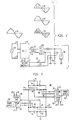
- System 10 includes a high power alternating source 12 which applies AC signal 16 to switch 18 by way of lines 14.
- the power provided by high power source 12 may be in the range of five kilowatts to two hundred fifty kilowatts.
- Switch 18 receives AC signal 16 and shapes AC signal 16 into pulses such as pulses 22 (mode A), pulses 23 (mode C), or pulses 24 (mode B).
- Pulses 22,23,24 are applied to transformer 25 by way of lines 20 and thereby to full wave rectifier 26. Rectified voltage is then applied to electrodes 28.
- GTO gate turn-off thyristors
- GTO'S 88 operate during opposite polarities of signal 16 and have the ability to block reverse voltage as described in International Rectifier Aplication Notes AN-315 "Applying International Rectifiers 160 PFT Type Gate Turn-Off Thyristors".
- Each GTO 88 is controlled at its respective gate control terminals 96 by a respective firing circuit 84 and current trip 86 which cause GTO'S 88 to be turned on and off as required to produce pulses 22, 23, 24. Details of voltage controller 31, which produces timed signals as required for pulses 22, 23, 24, are set forth below.
- GTO's 88 may be turned off quickly they may be used to chop up signal 16 and produce the high voltage waveforms applied to electrodes 28 by way of lines 20 as compared with conventional control using silicon control rectifiers which could only be reliably turned off by a reversal of supply current, usually at a zero-crossing, or forced to turn off by commutating circuits.
- Damping resistors 92, charging diodes 90 and capacitors 94 provide conventional directionally con trolled snubber circuits for GTO's 88.
- a GTO 88 When a negative voltage is provided from the gate to the cathode of a GTO 88, current to the load is diverted to the snubber circuit. During these conditions it is desired to charge capacitors 94 as quickly as possible to more quickly stop current to the load.
- forward biased diodes 90 are provided in order to by-pass resistors 92.
- diodes 90 are back biased and current from capacitors 94 pass through resistors 92.
- Conventional power supplies 82 provide power for firing circuits 84 as well as current trip circuits 86 which permit GTO's 88 to be turned off very quickly during the shaping of pulses 22, 23, 24 as well as during arcing of electrodes 28. Supplies 82 may provide 0, +5, and +15 volts. Current trips 86 are also conventional.
- Switch 18 may gate signal 16 through to lines 20 to produce pulses 22 by turning on shortly before the peaks of signal 16 and turning off shortly after the peaks of signal 16.
- Pulses 22 are preferivelyably symmetric about the peaks of signal 16. Because the likelihood of arcing at electrodes 28 is highest at the peaks of signal 16, the duration of pulses 22 is kept shorter than the amount of time required for electrodes 28 to arc. This permits high peak voltages to be applied to electrodes 28 while preventing elec trodes 28 from arcing. This is useful in systems in which high voltage at electrodes 28 is required because of the resistivity of the particles being precipitated.
- switch 18 may provide pulses 23 by combining pulses such as pulses 22, 24.
- pulses 23 may contain portions in which energy is gated on around each peak of signal 16 as previously described for pulses 22 as well as portions in which energy is gated on after one peak and gated off before the next peak as previously described for pulses 24.
- further energy may be provided by pulses 23 by further gating of switch 18 between the pulses described for pulses 22, 23 as will be described in detail below.
- Signal 16 provided by supply 12, typically is in the range of 440 to 575 volts AC and has peaks 30, 32 and zero-crossings 31a,b,c.
- Pulses 22, 23, 24 may have a peak DC voltage in the range of ninety to one-hundred fifty kilovolts while the RMS voltage on the primary side of transformer 25 may be in the range of four hundred forty to six hundred volts.
- the switching is performed on the alternating source voltage and the voltage is then stepped up and rectified.
- Pulses 22 are provided by causing switch 18 to turn on at time 34 and to turn off at time 36 preferably by means of GTO 88.
- the time difference between turn-on time 34 and the time of peak 30 may be selected to be equal to the time difference between the time of peak 30 and turn-off time 36.
- the pulse produced when switch 18 is in mode A, which turns on at time 34 and off at time 36 may be symmetrical about the positive-going peak 30 of signal 16.
- switch 18 turns on at time 38 and turns off at time 40 in which times 38, 40 may be selected to cause a pulse 22 which is symmetrical about the time of negative-going peak 32 of signal 16.
- the total time difference between turn-on time 34 and turn-off time 36 in mode A, as well as the total time difference between turn-on time 38 and turn-off time 40, may be as short as permitted by circuit parameters (typically fifty to seventy-five microseconds) or as wide as the entire half cycle of signal 16. In general, these durations are selected to be short enough to prevent electrodes 28 from arcing. In high resistivity particle environments, it is often desired that a high DC value be provided to electrodes 28 while still preventing electrodes 28 from arcing. An example of such a high resistivity environment is precipitation of some types of coal dust.
- Times 34, 36, as well as times 38, 40 may be adjusted outwardly from the times of peaks 30, 32, as shown by the directions of the arrows of Fig. 2B, to provide greater average DC to electrodes 28 while stopping short of a pulse width which would cause electrodes 28 to arc.
- pulses 24 mode B
- switch 18 is turned on at time 44 and turned off at time 48.
- signal 16 passes through zero-crossing 31b.
- switch 18 is designed to include GTO's 88 rather than silicon controlled rectifiers, shutoff of power to electrodes 28 at a the zero-crossing is prevented.
- An example of such a shutoff during the zero-crossing, which is avoided in the present invention, is shown in the prior art waveform of Fig. 2E. (For simplicity, the waveform of Fig.
- Pulses 24 may continue after the zero-crossing by firing the GTO 88 of the opposite polarity because the portion of pulse 24 thus produced may then be terminated before the next peak of signal 16 by GTO 88 control circuits 84, 86.
- control of the turn-off point of individual GTO's 88 permits complete control of termination of pulses 24 to maintain equal volt-seconds for each segment of each pulse of pulses 24 as well as equal volt-seconds for each pulse of pulses 24.
- Switch 18 thus causes signal 16 to be gated off from time 48 until time 50. At time 50, switch 18 gates signal 16 on again as previously described for time 44. The pulse produced when switch 18 turns on at time 50 continues past zero-crossing 31c into the next half-cycle (not shown) of signal 16 until switch 18 is again turned off. Similarly, in a half-cycle (not shown) prior to zero-crossing 31a, switch 18 is turned on. Switch 18 is then turned off at time 42 in the manner previously described for time 48.
- the average DC of pulses 24 when switch 18 is operating in mode B may be increased by adjusting times 42, 44, 48, 50 in the direction indicated by the arrows of Fig. 2C.
- a GTO 88 may be turned on before time 44 and turned off after time 48.
- the utilization of signal 16 may be increased without applying energy to electrodes 28 at peaks 30, 32 of signal 16.
- Times 42, 44 may be symmetric about the time of peak 30 and times 48, 50 may be symmetric around the time of peak 32.
- pulses 23 are produced by applying the techniques used to produce pulses 22, 24. For example, by turning switch 18 on at time 64 and off at time 68, a pulse similar to pulses 24 is produced in which switch 18 turned on at time 44 and off at time 48 as previously described. Likewise, turning switch 18 off at time 54 ends a pulse similar to pulses 24 in a manner similar to that described for time 42 of Fig. 2C, and turning switch 18 on at time 78 begins a pulse in a manner similar to that described for turning switch 18 on at time 50.
- switch 18 may be turned on at time 34 and off at time 36 within pulses 23 in a manner similar to that previously described for pulses 22. Likewise, during the negative half-cycle of signal 16, switch 18 may turn on at time 38 and off at time 40 when operating in mode C to produce a portion of pulse 23 in a manner similar to that described for pulses 22.
- pulses 22, 24 may be combined by having switch 18 gate signal 16 on and off a plurality of times during each half cycle. Additionally, switch 18 may be turned on at time 56 and off at time 58 in the same manner as previously described for times 34, 36. Likewise, switch 18 may be turned on at time 60 and off at time 62, on at time 70 and off at time 72, and on at time 74 and off at time 76 to provide additional portions of pulses 23. A plurality of such pulses may be provided between pulses 22, 24 when combining pulses 22, 24 as required for the optimum operation of system 10. Thus each GTO 88 may be fired several times within the half-cycle that it is forward biased. This is useful when impedance matching system 10. The turn off current of switch 18 when providing pulses 22, 23, 24 may be aproximately 600 amps.
- pulses 22,24 may be combined to form pulses such as pulses 23.
- Pulse 23 are a direct combination of pulses 22,24.
- Fig. 4 there is shown a flow chart for selecting one of a plurality of programs for providing pulses 22 (mode A), pulses 24 (mode B), and pulses 23 (mode C).
- mode A pulses 22
- mode B pulses 24
- mode C pulses 23
- Mode D is a mixed mode which permits variable selection of one of the preceding modes A, B, C by the main program from cycle to cycle.
- routine 150 for synchronizing pulses 22, 23, 24 with the zero crossings of signal 16 is shown.
- a conventional zero crossing detector (not shown) is used in system 10 for detecting the zero crossings of signal 16, such as 31a, 31b, 31c. This conventional zero crossing detector outputs a pulse (not shown) at each zero crossing of signal 16.
- the zero crossing pulses are received in input block 152 and clock timing computations are performed in block 154. These timing computations may include for example a computation of the time between time 34 and time 36 or between time 38 and time 40 when system 10 is in mode A.
- the computations which are used in the program of Table 1 determine the value of X which represents the period of time between zero-crossing 31a and time 34.
- X represents the period of time between zero-crossing 31a and time 42.
- Z represents the period of time between zero-crossing 31a and time 54 while Y represents the period of time between time 54 and time 56.
- turn-off time 42 and turn-on time 44 are determined when system 10 is in mode B and these times are used in the program of Table 2.
- the main program of block 156 analyzes feedback variables from the transformer/rectifier set and ESP electrodes 28 in determining optimum values of X, Y, and Z.
- timing computation 154 may be performed by hardware (not shown).
- the determinations made in accordance with the feedback signals of lines 27, 29 may be determinations such as those set forth in U.S. Patents 4,326,860 and 4,390,830 which are herein incorporated by reference. These determinations, in addition to being used to shape pulses 22, 23, 24, may be used by voltage controller 31 to provide emergency shutdown of energy to electrodes 28, for example during arcing. Furthermore, voltage controller 31 may adjust timing periods, such as periods X, Y, and Z, to tailor and fine tune pulses 22, 23, 24 to the specific parameters of a particular electrostatic precipitator and the materials being precipitated.
- enable routine 160 is shown.
- the programs of Tables 1-3 enable the firing of GTO's 88 to shape pulses 22, 23, 24.
- GTO's 88 therefore must be enabled when, for example, instructions 10, 20 of Table 1 are executed or instructions 100, 200, 300 of Table 2 are executed.
- enable routine 160 is executed.
- Execution of enable routine 160 begins when a PULSE (EN) instruction is executed by way of on-page connector 162 and in decision 164 determination is made whether signal 16 is in the on period of the first GTO.
- Each GTO 88 of switch 18 has an on period during one of the half cycles of signal 16.
- Switch 18a is used for GTO's 88 which cannot block reverse voltage.
- GTO's 88 are connected cathode to anode.
- a conventional snubber circuit, including diode 90, resistor 92 and capacitor 94 is provided across each GTO 88 as previously described.
- Each GTO 88 is also provided with an anti-parallel diode 102 connected across it to prevent build-up of reverse voltage.
- each GTO 88 is provided with an additional series diode 104 to provide the reverse voltage blocking capability lacking within GTO 88.
- Power supplies 82, firing circuits 84 and current trips 86 may be similar to those described for switch 18.
- switch 18b which is an additional alternate embodiment of switch 18.
- Switch 18b may be used when GTO's 88 lack reverse voltage blocking capability.
- GTO's 88 are connected cathode to cathode and the series diode of switch 18b may then be omitted.
- Anti-parallel diodes 102 are provided as in switch 18a to prevent build-up of reverse voltage.
- Snubber circuits, power supplies 82, firing circuits 84, and current trips 86 are provided as previously described.
Landscapes
- Engineering & Computer Science (AREA)
- Automation & Control Theory (AREA)
- Electrostatic Separation (AREA)
Applications Claiming Priority (2)
| Application Number | Priority Date | Filing Date | Title |
|---|---|---|---|
| US19031 | 1987-02-26 | ||
| US07/019,031 US4772998A (en) | 1987-02-26 | 1987-02-26 | Electrostatic precipitator voltage controller having improved electrical characteristics |
Publications (2)
| Publication Number | Publication Date |
|---|---|
| EP0280298A2 true EP0280298A2 (de) | 1988-08-31 |
| EP0280298A3 EP0280298A3 (de) | 1989-08-23 |
Family
ID=21791065
Family Applications (1)
| Application Number | Title | Priority Date | Filing Date |
|---|---|---|---|
| EP88102821A Withdrawn EP0280298A3 (de) | 1987-02-26 | 1988-02-25 | Elektrostatische Abscheiderspannungssteuereinrichtung mit erhöhten elektrischen Eigenschaften |
Country Status (2)
| Country | Link |
|---|---|
| US (1) | US4772998A (de) |
| EP (1) | EP0280298A3 (de) |
Families Citing this family (20)
| Publication number | Priority date | Publication date | Assignee | Title |
|---|---|---|---|---|
| JPH07232102A (ja) * | 1993-12-28 | 1995-09-05 | Mitsubishi Heavy Ind Ltd | 電気集塵装置 |
| US5578112A (en) * | 1995-06-01 | 1996-11-26 | 999520 Ontario Limited | Modular and low power ionizer |
| US5689177A (en) * | 1996-01-11 | 1997-11-18 | The Babcock & Wilcox Company | Method and apparatus to regulate a voltage controller |
| PL346832A1 (en) * | 1998-09-18 | 2002-02-25 | Fls Miljo As | A method of operating an electrostatic precipitator |
| US6504308B1 (en) * | 1998-10-16 | 2003-01-07 | Kronos Air Technologies, Inc. | Electrostatic fluid accelerator |
| US6937455B2 (en) | 2002-07-03 | 2005-08-30 | Kronos Advanced Technologies, Inc. | Spark management method and device |
| US6919698B2 (en) * | 2003-01-28 | 2005-07-19 | Kronos Advanced Technologies, Inc. | Electrostatic fluid accelerator for and method of controlling a fluid flow |
| US6727657B2 (en) * | 2002-07-03 | 2004-04-27 | Kronos Advanced Technologies, Inc. | Electrostatic fluid accelerator for and a method of controlling fluid flow |
| US7122070B1 (en) * | 2002-06-21 | 2006-10-17 | Kronos Advanced Technologies, Inc. | Method of and apparatus for electrostatic fluid acceleration control of a fluid flow |
| US7053565B2 (en) | 2002-07-03 | 2006-05-30 | Kronos Advanced Technologies, Inc. | Electrostatic fluid accelerator for and a method of controlling fluid flow |
| US7157704B2 (en) | 2003-12-02 | 2007-01-02 | Kronos Advanced Technologies, Inc. | Corona discharge electrode and method of operating the same |
| KR100462275B1 (ko) * | 2002-07-18 | 2004-12-17 | 두산중공업 주식회사 | 전기집진기용 인버터의 스위칭 타임 설정 회로와 그 방법 |
| JP3775417B2 (ja) * | 2004-02-09 | 2006-05-17 | ダイキン工業株式会社 | 放電装置及び空気浄化装置 |
| US7081152B2 (en) * | 2004-02-18 | 2006-07-25 | Electric Power Research Institute Incorporated | ESP performance optimization control |
| AT500959B1 (de) * | 2004-11-09 | 2007-05-15 | Carl M Dr Fleck | Verfahren und filteranordnung zum abscheiden von russpartikeln |
| US7410532B2 (en) | 2005-04-04 | 2008-08-12 | Krichtafovitch Igor A | Method of controlling a fluid flow |
| FR2927550B1 (fr) * | 2008-02-19 | 2011-04-22 | Commissariat Energie Atomique | Dispositif de filtration electrostatique au moyen de sites emissifs optimises. |
| KR100954878B1 (ko) * | 2009-03-10 | 2010-04-28 | 넥슨 주식회사 | 실내 공기의 이온 및 오존 최적화 포화방법 |
| EP3112029B1 (de) * | 2015-06-29 | 2021-09-29 | General Electric Technology GmbH | Impulszündmuster für einen transformator eines elektrostatischen abscheiders und elektrostatischer abscheider |
| RU2658186C1 (ru) * | 2017-06-07 | 2018-06-19 | Виталий Григорьевич Ерошенко | Способ предотвращения воспламенения продуктов несгоревшего топлива в электрофильтре |
Family Cites Families (11)
| Publication number | Priority date | Publication date | Assignee | Title |
|---|---|---|---|---|
| US3039252A (en) * | 1956-01-12 | 1962-06-19 | Research Corp | Electrical precipitator power system |
| US2961577A (en) * | 1959-08-04 | 1960-11-22 | Koppers Co Inc | Electrostatic precipitators |
| GB1372843A (en) * | 1970-09-24 | 1974-11-06 | Westinghouse Brake & Signal | Electrical power supply control circuit |
| DE2162988C3 (de) * | 1970-12-23 | 1975-09-25 | International Standard Electric Corp., New York, N.Y. (V.St.A.) | Stellglied für einen Wechselspannungsregler |
| US3745749A (en) * | 1971-07-12 | 1973-07-17 | Envirotech Corp | Circuits for controlling the power supplied to an electrical precipitator |
| DE2540084C2 (de) * | 1975-09-09 | 1983-08-25 | Metallgesellschaft Ag, 6000 Frankfurt | Einrichtung zum hochspannungsseitigen Erfassen von Überschlägen bei einem Elektroabscheider |
| CA1089002A (en) * | 1976-08-13 | 1980-11-04 | Richard K. Davis | Automatic control system for electric precipitators |
| US4326860A (en) * | 1980-11-28 | 1982-04-27 | Nwl Transformers | Ripple insensitive electric precipitator |
| US4390830A (en) * | 1981-10-15 | 1983-06-28 | Nwl Transformers | Back corona detection and current setback for electrostatic precipitators |
| US4522635A (en) * | 1982-10-19 | 1985-06-11 | Flakt Aktiebolag | Method and device for varying a d.c. voltage connected to an electrostatic dust separator |
| JPS6125650A (ja) * | 1984-07-17 | 1986-02-04 | Sumitomo Heavy Ind Ltd | 電気集塵装置の荷電制御方法 |
-
1987
- 1987-02-26 US US07/019,031 patent/US4772998A/en not_active Expired - Fee Related
-
1988
- 1988-02-25 EP EP88102821A patent/EP0280298A3/de not_active Withdrawn
Also Published As
| Publication number | Publication date |
|---|---|
| US4772998A (en) | 1988-09-20 |
| EP0280298A3 (de) | 1989-08-23 |
Similar Documents
| Publication | Publication Date | Title |
|---|---|---|
| EP0280298A2 (de) | Elektrostatische Abscheiderspannungssteuereinrichtung mit erhöhten elektrischen Eigenschaften | |
| US3987356A (en) | Controlled capacitive filter for active loads | |
| US3849670A (en) | Scr commutation circuit for current pulse generators | |
| US4039926A (en) | Current fed inverter with commutation independent of load inductance | |
| EP0259240B1 (de) | Einrichtung und Verfahren für die Steuerung eines Zwangskommutierungswechselrichters | |
| US4720776A (en) | DC bus shorting apparatus and method for polyphase AC inverter | |
| EP0227993B1 (de) | Hochspannungs-Breitstrom-Generatorgerät und Hochspannungs-/Breitstrom-Erzeugungsverfahren | |
| Borst et al. | Voltage control by means of power thyristors | |
| KR900003483B1 (ko) | 전력 변환장치 | |
| Agrawal et al. | A study of single-phase to three-phase cycloconverters using PSPICE | |
| US3453524A (en) | Inverter commutation circuit | |
| GB2051507A (en) | Selective commutation circuit for an inverter | |
| US4455600A (en) | Single phase, double-ended thyristor inverter with choke-coupled impulse commutation | |
| US4644240A (en) | Method and apparatus for controlling reverse-conducting GTO thyristor | |
| US5260863A (en) | Control of a discontinuous current by a thyristor rectifier with inductive load | |
| JP2663535B2 (ja) | アーク加工用電源装置 | |
| US4245287A (en) | Method of controlling switching of a multiphase inductor-converter bridge | |
| Matsuse et al. | Performance of PWM-controlled thyristor rectifier operating at unity fundamental power factor in PWM current source GTO inverter system for induction motor drives | |
| KR820000337B1 (ko) | 전류원형 인버터의 전압제한 및 에너지 궤환(饋還)회로 | |
| EP0477643B1 (de) | Steuerung eines diskontinuierlichen Stromes in einer induktiven Last mittels eines Thyristorgleichrichters | |
| JP2549101B2 (ja) | 電力変換装置 | |
| SU1117821A1 (ru) | Способ управлени преобразователем посто нного напр жени в переменное | |
| Parikh et al. | Equal-pulse-width modulation control strategy for an AC to DC converter | |
| RU1816591C (ru) | Источник питани дл импульсно-дуговой сварки | |
| SU1169118A1 (ru) | Однополупериодный выпр митель |
Legal Events
| Date | Code | Title | Description |
|---|---|---|---|
| PUAI | Public reference made under article 153(3) epc to a published international application that has entered the european phase |
Free format text: ORIGINAL CODE: 0009012 |
|
| AK | Designated contracting states |
Kind code of ref document: A2 Designated state(s): AT BE CH DE ES FR GB GR IT LI LU NL SE |
|
| PUAL | Search report despatched |
Free format text: ORIGINAL CODE: 0009013 |
|
| AK | Designated contracting states |
Kind code of ref document: A3 Designated state(s): AT BE CH DE ES FR GB GR IT LI LU NL SE |
|
| STAA | Information on the status of an ep patent application or granted ep patent |
Free format text: STATUS: THE APPLICATION IS DEEMED TO BE WITHDRAWN |
|
| 18D | Application deemed to be withdrawn |
Effective date: 19900224 |