EP0281247A2 - Capteurs de gaz - Google Patents
Capteurs de gaz Download PDFInfo
- Publication number
- EP0281247A2 EP0281247A2 EP88300867A EP88300867A EP0281247A2 EP 0281247 A2 EP0281247 A2 EP 0281247A2 EP 88300867 A EP88300867 A EP 88300867A EP 88300867 A EP88300867 A EP 88300867A EP 0281247 A2 EP0281247 A2 EP 0281247A2
- Authority
- EP
- European Patent Office
- Prior art keywords
- sensor
- gas
- air
- liquid electrolyte
- electrodes
- Prior art date
- Legal status (The legal status is an assumption and is not a legal conclusion. Google has not performed a legal analysis and makes no representation as to the accuracy of the status listed.)
- Withdrawn
Links
- 239000007789 gas Substances 0.000 claims abstract description 51
- 239000011244 liquid electrolyte Substances 0.000 claims abstract description 28
- 239000010409 thin film Substances 0.000 claims abstract description 15
- 239000008246 gaseous mixture Substances 0.000 claims abstract description 14
- XLYOFNOQVPJJNP-UHFFFAOYSA-N water Substances O XLYOFNOQVPJJNP-UHFFFAOYSA-N 0.000 claims abstract description 12
- 239000007864 aqueous solution Substances 0.000 claims abstract description 6
- RWSOTUBLDIXVET-UHFFFAOYSA-N Dihydrogen sulfide Chemical compound S RWSOTUBLDIXVET-UHFFFAOYSA-N 0.000 claims description 19
- 239000000463 material Substances 0.000 claims description 19
- 229910052739 hydrogen Inorganic materials 0.000 claims description 18
- 239000001257 hydrogen Substances 0.000 claims description 18
- XLOMVQKBTHCTTD-UHFFFAOYSA-N Zinc monoxide Chemical compound [Zn]=O XLOMVQKBTHCTTD-UHFFFAOYSA-N 0.000 claims description 16
- 229910002091 carbon monoxide Inorganic materials 0.000 claims description 12
- 238000000034 method Methods 0.000 claims description 9
- 239000011787 zinc oxide Substances 0.000 claims description 8
- PNEYBMLMFCGWSK-UHFFFAOYSA-N Alumina Chemical compound [O-2].[O-2].[O-2].[Al+3].[Al+3] PNEYBMLMFCGWSK-UHFFFAOYSA-N 0.000 claims description 6
- 239000012528 membrane Substances 0.000 claims description 6
- XOLBLPGZBRYERU-UHFFFAOYSA-N tin dioxide Chemical compound O=[Sn]=O XOLBLPGZBRYERU-UHFFFAOYSA-N 0.000 claims description 6
- RAHZWNYVWXNFOC-UHFFFAOYSA-N Sulphur dioxide Chemical compound O=S=O RAHZWNYVWXNFOC-UHFFFAOYSA-N 0.000 claims description 4
- 239000010408 film Substances 0.000 claims description 4
- QGZKDVFQNNGYKY-UHFFFAOYSA-N Ammonia Chemical compound N QGZKDVFQNNGYKY-UHFFFAOYSA-N 0.000 claims description 3
- 239000003792 electrolyte Substances 0.000 claims description 3
- 230000008021 deposition Effects 0.000 claims description 2
- -1 hydrogen carbon monoxide Chemical class 0.000 claims description 2
- 229910001887 tin oxide Inorganic materials 0.000 claims description 2
- 229910021529 ammonia Inorganic materials 0.000 claims 1
- 239000011368 organic material Substances 0.000 claims 1
- 235000010269 sulphur dioxide Nutrition 0.000 claims 1
- 239000004291 sulphur dioxide Substances 0.000 claims 1
- UFHFLCQGNIYNRP-UHFFFAOYSA-N Hydrogen Chemical compound [H][H] UFHFLCQGNIYNRP-UHFFFAOYSA-N 0.000 description 16
- 230000003247 decreasing effect Effects 0.000 description 10
- LFQSCWFLJHTTHZ-UHFFFAOYSA-N Ethanol Chemical compound CCO LFQSCWFLJHTTHZ-UHFFFAOYSA-N 0.000 description 8
- 235000019441 ethanol Nutrition 0.000 description 8
- 229910052737 gold Inorganic materials 0.000 description 5
- 229910052697 platinum Inorganic materials 0.000 description 5
- 238000004544 sputter deposition Methods 0.000 description 4
- UGFAIRIUMAVXCW-UHFFFAOYSA-N Carbon monoxide Chemical compound [O+]#[C-] UGFAIRIUMAVXCW-UHFFFAOYSA-N 0.000 description 3
- 229920006395 saturated elastomer Polymers 0.000 description 3
- 229920000557 Nafion® Polymers 0.000 description 2
- 238000006243 chemical reaction Methods 0.000 description 2
- 238000009792 diffusion process Methods 0.000 description 2
- 239000008188 pellet Substances 0.000 description 2
- 230000004888 barrier function Effects 0.000 description 1
- 125000002091 cationic group Chemical group 0.000 description 1
- 239000004020 conductor Substances 0.000 description 1
- 239000000470 constituent Substances 0.000 description 1
- 238000000151 deposition Methods 0.000 description 1
- 238000003411 electrode reaction Methods 0.000 description 1
- UQSQSQZYBQSBJZ-UHFFFAOYSA-N fluorosulfonic acid Chemical compound OS(F)(=O)=O UQSQSQZYBQSBJZ-UHFFFAOYSA-N 0.000 description 1
- 238000010438 heat treatment Methods 0.000 description 1
- 150000002431 hydrogen Chemical class 0.000 description 1
- 229910000037 hydrogen sulfide Inorganic materials 0.000 description 1
- 230000014759 maintenance of location Effects 0.000 description 1
- 229910052759 nickel Inorganic materials 0.000 description 1
- 229910000069 nitrogen hydride Inorganic materials 0.000 description 1
- 231100000572 poisoning Toxicity 0.000 description 1
- 230000000607 poisoning effect Effects 0.000 description 1
- 239000000843 powder Substances 0.000 description 1
- 239000011347 resin Substances 0.000 description 1
- 229920005989 resin Polymers 0.000 description 1
- 235000011149 sulphuric acid Nutrition 0.000 description 1
- 239000001117 sulphuric acid Substances 0.000 description 1
Images



Classifications
-
- G—PHYSICS
- G01—MEASURING; TESTING
- G01N—INVESTIGATING OR ANALYSING MATERIALS BY DETERMINING THEIR CHEMICAL OR PHYSICAL PROPERTIES
- G01N27/00—Investigating or analysing materials by the use of electric, electrochemical, or magnetic means
- G01N27/26—Investigating or analysing materials by the use of electric, electrochemical, or magnetic means by investigating electrochemical variables; by using electrolysis or electrophoresis
- G01N27/416—Systems
- G01N27/42—Measuring deposition or liberation of materials from an electrolyte; Coulometry, i.e. measuring coulomb-equivalent of material in an electrolyte
-
- G—PHYSICS
- G01—MEASURING; TESTING
- G01N—INVESTIGATING OR ANALYSING MATERIALS BY DETERMINING THEIR CHEMICAL OR PHYSICAL PROPERTIES
- G01N27/00—Investigating or analysing materials by the use of electric, electrochemical, or magnetic means
- G01N27/26—Investigating or analysing materials by the use of electric, electrochemical, or magnetic means by investigating electrochemical variables; by using electrolysis or electrophoresis
- G01N27/403—Cells and electrode assemblies
- G01N27/404—Cells with anode, cathode and cell electrolyte on the same side of a permeable membrane which separates them from the sample fluid, e.g. Clark-type oxygen sensors
-
- G—PHYSICS
- G01—MEASURING; TESTING
- G01N—INVESTIGATING OR ANALYSING MATERIALS BY DETERMINING THEIR CHEMICAL OR PHYSICAL PROPERTIES
- G01N27/00—Investigating or analysing materials by the use of electric, electrochemical, or magnetic means
- G01N27/26—Investigating or analysing materials by the use of electric, electrochemical, or magnetic means by investigating electrochemical variables; by using electrolysis or electrophoresis
- G01N27/416—Systems
- G01N27/4162—Systems investigating the composition of gases, by the influence exerted on ionic conductivity in a liquid
Definitions
- the present invention relates to sensors and more particularly to gas sensors suitable for use in gases and gaseous mixtures.
- a gas sensor comprising a liquid electrolyte and two or more electrodes in communication with the said liquid electrolyte and capable of being contacted with a gas or gaseous mixture, the arrangement being such that two or more of the electrodes produce different potentials when in contact with the said gas or gaseous mixture.
- the liquid electrolyte may be, for example, in the form of a thin layer or thin film.
- the thin layer or film may be up to about a micron in thickness.
- liquid electrolyte is in the form of a thin layer or thin film it is preferably supported by a support material.
- the liquid electrolyte may comprise a thin film of water, or a thin film of an aqueous solution.
- a liquid electrolyte may be formed by forming a thin layer of water, or a thin layer of an aqueous solution, on a support material; thus, for example, a thin layer of water may be formed by deposition as moisture, for example, from the environment.
- the support material may be, for example, any material which is capable of supporting a layer or film of liquid electrolyte and which does not interfere, or does not interfere unacceptably, with the operation of the gas sensor.
- the support material may be tin oxide, zinc oxide or aluminium oxide.
- the support material may be porous to facilitate retention of a liquid electrolyte.
- the support material may be an organic membrane.
- the organic membrane may be a perfluoro sulphonic acid membrane (such as that available under the Trade Name "Nafion”), a cationic exchange resin (such as that available under the Trade Name “Raipore”) or a hydrophilic microporous film (such as that available under the Trade Name "Celguard”).
- the electrodes may be arranged to produce different potentials when in contact with the common gas or gaseous mixture such that the sensor is a mixed potential gas sensor, for example, by arranging for the electrodes to be of different size, or by arranging for the electrodes to be of different materials (e.g. Pt or Au or Ni), or by arranging for the rate of diffusion to and/or from one electrode to be different (e.g. by use of a porous diffusion "barrier" at one electrode).
- a mixed potential gas sensor for example, by arranging for the electrodes to be of different size, or by arranging for the electrodes to be of different materials (e.g. Pt or Au or Ni), or by arranging for the rate of diffusion to and/or from one electrode to be different (e.g. by use of a porous diffusion "barrier" at one electrode).
- a gas sensor in accordance with the present invention may be used in quantitative and/or qualitative determinations with gases and gaseous mixtures.
- the electrodes may be in direct communication with the liquid electrolyte by being in contact therewith.
- a sensor in accordance with the present invention may be used to detect, in air, gases such as hydrogen, carbon monoxide, NH3, SO2 and H2S.
- the sensor may, for example, include a means for measuring the potentials, or difference in potentials developed, by the electrodes.
- the means for measuring the potential produced may be, for example, a high impedance voltmeter (e.g. digital voltmeter (DVM)) the impedance of which allows a rest voltage to be shown (e.g. a rest voltage of say about 100 millivolt may be arranged to be shown by a voltmeter).
- DVM digital voltmeter
- current may be measured.
- changes in current from the sensor may be used to detect the presence or absence of a gas.
- the senor may include, for example, a mean for measuring current.
- a support material for use in accordance with the present invention may be, for example, prepared by pressing a suitable material in powder form (e.g. to form a disc, plate or pellet which disc, plate or pellet may optionally be porous).
- a method of sensing a gas which comprises contacting a sensor with the gas and measuring the electrical potential response of the sensor, said sensor comprising a liquid electrolyte, and two or more electrodes in communication with the said liquid electrolyte, the arrangement being such that two or more of the electrodes produce different potentials when in contact with the gas, and said electrolyte and said electrodes being in contact with the gas.
- the electrolyte is a thin layer of water (e.g. moisture from the atmosphere) or a thin layer of an aqueous solution
- a rest potential may be observed due to the output of an electrochemical cell comprising the electrodes and the thin layer of water. It is believed that the observed gas responses are generated by various reactions at the electrodes to give different potentials and thereby provide a gas sensitive "mixed potential".
- a sensor device in accordance with the present invention can operate at substantially room temperature and thus the requirement of providing a heating means may be avoided.
- a gas to be detected or gaseous mixture containing a gas to be detected may be passed over a sensor in accordance with the present invention and the potentials generated used to detect the presence of the gas.
- the voltage is preferably measured using a voltmeter of impedance such that a rest voltage is measureable.
- a rest voltage e.g. 100 mV
- the potential developed is believed to be related to the concentration in the gaseous mixture of gas which gives reaction at the electrodes.
- gases e.g. H2, CO, NH3, SO2 and H2S
- current from the sensor may be measured as an alternative to measuring voltage.
- Sensors in accordance with the present invention are believed to be less prone to moisture "poisoning" than are resistance modulating devices.
- FIG. 1 of the accompanying drawings there is shown a gas sensor having a support material 1 in contact with an electrode 2 and an electrode 3.
- the electrodes 2 and 3 are in communication with a thin film of liquid electrolyte 4.
- Conductors 5 and 6 are provided to connect the electrodes 2 and 3 to a voltage measuring means 7 for measuring voltage from the sensor.
- a gas to be detected or a gaseous mixture containing a gas to be detected is passed over the sensor, a different potential is developed at each electrode 2 and 3 and the resulting mixed potential is detected by means 7.
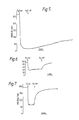
- a sensor of the form shown in Figure 1 of the accompanying drawings was used to detect hydrogen in air.
- the sensor had a support material of tin dioxide having a Au electrode provided by sputtering and a Pt electrode provided by sputtering.
- the Au and Pt were connected to a voltage measuring device (DVM) via Cu wires.
- DVM voltage measuring device
- a thin film of water was allowed to form from the atmosphere onto the tin dioxide and between the electrodes to serve as a liquid electrolyte.
- the sensor was placed in an enclosure and alternately air and air containing 1% hydrogen was passed over the sensor.
- H2 ON and H2 OFF in Figure 2 indicate respectively the point in time at which air containing 1% H2 was introduced to the sensor and the point in time at which air containing 1% H2 was replaced by air.
- a sensor of the form shown in Figure 1 of the accompanying drawings was used to detect hydrogen in air.
- the sensor had a support material of WO3 having sputtered Au and Pt electrodes.
- a thin film of water was allowed to form from the atmosphere onto the WO3 and between the electrodes to serve as a liquid electrolyte.
- the sensor was placed in an enclosure and alternately air and air containing 1% hydrogen was passed over the sensor.
- H2 ON and H2 OFF in Figure 3 indicate respectively the point in time at which air containing 1% H2 was introduced to the sensor and the point in time at which air containing 1% H2 was replaced by air.
- Example 2 The procedure of Example 2 was followed using a sensor of the type used therein (i.e. Au/WO3/Pt) with the exception that air containing hydrogen was not used and alternately air and air containing 1% carbon monoxide was passed over the sensor.
- a sensor of the type used therein i.e. Au/WO3/Pt
- CO ON and CO OFF in Figure 4 indicate respectively the point in time at which air containing 1% CO was introduced to the sensor and the point in time at which air containing 1% CO was replaced by air.
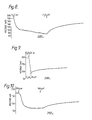
- Example 2 The procedure of Example 2 was followed using a sensor of the type used therein (i.e. Au/WO3/Pt) with the exception that air containing CO was not used and alternately air and air containing 0.1% hydrogen sulphide was passed over the sensor.
- a sensor of the type used therein i.e. Au/WO3/Pt
- H2S ON and H2S OFF in the Figure 6 indicate respectively the point in time at which air containing 0.1% H2S was introduced to the sensor and the point in time at which air containing 0.1% H2S was replaced by air.
- a sensor of the form shown in Figure 1 of the accompanying drawings was used to detect hydrogen in air.
- the sensor had a support material of ZnO having sputtered Au and Pt electrodes.
- a thin film of water was allowed to form from the atmosphere onto the ZnO and between the electrodes to serve as a liquid electrolyte.
- the sensor was placed in an enclosure and alternately air and air containing 1% hydrogen was passed over the sensor.
- H2 ON and H2 OFF in Figure 6 indicate respectively the point in time at which air containing 1% H2 was introduced to the sensor and the point in time at which air containing 1% H2 was replaced by air.
- Example 5 The procedure of Example 5 was followed using a sensor of the type used therein (i.e. Au/ZnO/Pt) with the exception that air containing hydrogen was not used and alternately air and air containing 1% carbon monoxide was passed over the sensor.
- a sensor of the type used therein i.e. Au/ZnO/Pt
- Example 5 The procedure of Example 5 was followed using a sensor of the type used therein (i.e. Au/ZnO/Pt) with the exception that air containing hydrogen was not used and alternately air and air containing 0.1% hydrogen sulphide was passed over the sensor.
- a sensor of the type used therein i.e. Au/ZnO/Pt
- H2S ON and H2S OFF in Figure 8 indicate respectively the point in time at which air containing 0.1% H2S was introduced to the sensor and the point in time at which air containing 0.1% H2S was replaced by air.
- Example 5 The procedure of Example 5 was followed using a sensor of the type used therein (i.e. Au/ZnO/Pt) with the exception that air containing hydrogen was not used and alternately air and air saturated with C2H5OH at 20°C was passed over the sensor.
- a sensor of the type used therein i.e. Au/ZnO/Pt
- C2H5OH ON and “C2H5OH OFF” in the Figure 9 indicate respectively the point in time at which the air containing C2H5OH was introduced to the sensor and the point in time at which the air containing C2H5OH was replaced by air.
- Example 5 The procedure of Example 5 was followed using a sensor of the type used therein (i.e. Au/ZnO/Pt) with the exception that air containing hydrogen was not used and alternately air and air containing 1% NH3 was passed over the sensor.
- a sensor of the type used therein i.e. Au/ZnO/Pt
- NH3 ON and “NH3 OFF” in Figure 10 indicate respectively the point in time at which air containing 1% NH3 was introduced to the sensor and the point in time at which air containing 1% NH3 was replaced by air.
- a sensor of the form shown in Figure 1 of the accompanying drawings was used to detect hydrogen in air.
- the sensor had a support material of perfluoro sulphuric acid membrane (available under the Trade Name "Nafion”) having a Au electrode provided by sputtering and a Pt electrode provided by sputtering.
- a support material of perfluoro sulphuric acid membrane available under the Trade Name "Nafion” having a Au electrode provided by sputtering and a Pt electrode provided by sputtering.
- the Au and Pt electrodes were connected to a voltage measuring device (DVM) via Cu wires.
- DVM voltage measuring device
- a thin film of water was allowed to form from the atmosphere onto the membrane and between the electrodes to serve as a liquid electrolyte.
- the sensor was placed in an enclosure and a stream of air was passed over the sensor. After 60 minutes the stream of air was replaced by a stream of 1% H2 in air.
Landscapes
- Chemical & Material Sciences (AREA)
- Life Sciences & Earth Sciences (AREA)
- Health & Medical Sciences (AREA)
- Biochemistry (AREA)
- General Physics & Mathematics (AREA)
- Electrochemistry (AREA)
- Physics & Mathematics (AREA)
- Analytical Chemistry (AREA)
- Molecular Biology (AREA)
- General Health & Medical Sciences (AREA)
- Chemical Kinetics & Catalysis (AREA)
- Immunology (AREA)
- Pathology (AREA)
- Investigating Or Analyzing Materials By The Use Of Fluid Adsorption Or Reactions (AREA)
- Investigating Or Analyzing Materials By The Use Of Electric Means (AREA)
- Measuring Fluid Pressure (AREA)
- Measuring Oxygen Concentration In Cells (AREA)
Applications Claiming Priority (2)
| Application Number | Priority Date | Filing Date | Title |
|---|---|---|---|
| GB878704874A GB8704874D0 (en) | 1987-03-02 | 1987-03-02 | Sensors |
| GB8704874 | 1987-03-02 |
Publications (2)
| Publication Number | Publication Date |
|---|---|
| EP0281247A2 true EP0281247A2 (fr) | 1988-09-07 |
| EP0281247A3 EP0281247A3 (fr) | 1990-05-09 |
Family
ID=10613198
Family Applications (1)
| Application Number | Title | Priority Date | Filing Date |
|---|---|---|---|
| EP88300867A Withdrawn EP0281247A3 (fr) | 1987-03-02 | 1988-02-02 | Capteurs de gaz |
Country Status (4)
| Country | Link |
|---|---|
| EP (1) | EP0281247A3 (fr) |
| JP (1) | JPS63231258A (fr) |
| KR (1) | KR880011591A (fr) |
| GB (2) | GB8704874D0 (fr) |
Cited By (2)
| Publication number | Priority date | Publication date | Assignee | Title |
|---|---|---|---|---|
| DE3718549A1 (de) * | 1987-06-03 | 1988-12-22 | Gyulai Maria Dobosne | Anordnung und verfahren zum nachweis von kohlenmonoxid |
| WO2005080957A1 (fr) | 2004-02-19 | 2005-09-01 | Niigata Tlo Corporation | Capteur de gaz hydrogène |
Families Citing this family (4)
| Publication number | Priority date | Publication date | Assignee | Title |
|---|---|---|---|---|
| JPH07104323B2 (ja) * | 1992-01-14 | 1995-11-13 | 日本コーリン株式会社 | ガスセンサ |
| US20100006431A1 (en) * | 2006-02-06 | 2010-01-14 | Gordon George Wallace | Self-Powered Sensing Devices |
| US9772303B2 (en) * | 2015-01-12 | 2017-09-26 | Ecolab Usa Inc. | Apparatus for, system for and methods of maintaining sensor accuracy |
| KR102131388B1 (ko) * | 2018-06-21 | 2020-07-08 | 현대자동차주식회사 | 기체센서, 이를 제조하는 방법 및 이를 이용하여 기체를 센싱하는 방법 |
Family Cites Families (7)
| Publication number | Priority date | Publication date | Assignee | Title |
|---|---|---|---|---|
| US3450619A (en) * | 1966-05-24 | 1969-06-17 | Cambridge Instr Co Inc | Oxygen detector |
| FR2147344A5 (fr) * | 1970-12-31 | 1973-03-09 | Hoffmann La Roche | |
| DE2454659C3 (de) * | 1974-11-18 | 1981-06-11 | Drägerwerk AG, 2400 Lübeck | Meßzelle zur Ermittlung des Schwefeldioxidgehaltes in Gasgemischen |
| GB2001763B (en) * | 1977-07-27 | 1982-01-06 | Coal Ind | Co-detection |
| US4302315A (en) * | 1980-06-18 | 1981-11-24 | Becton, Dickinson And Company | Gas sensing unit |
| EP0097554A3 (fr) * | 1982-06-04 | 1984-08-01 | The Bendix Corporation | Capteurs chimiques avec une membrane hydrophile comme support d'électrolyte |
| GB8313846D0 (en) * | 1983-05-19 | 1983-06-22 | City Tech | Gas sensor |
-
1987
- 1987-03-02 GB GB878704874A patent/GB8704874D0/en active Pending
-
1988
- 1988-01-22 GB GB8801394A patent/GB2201787B/en not_active Expired - Lifetime
- 1988-02-02 EP EP88300867A patent/EP0281247A3/fr not_active Withdrawn
- 1988-02-25 JP JP63043245A patent/JPS63231258A/ja active Pending
- 1988-03-02 KR KR1019880002160A patent/KR880011591A/ko not_active Ceased
Cited By (4)
| Publication number | Priority date | Publication date | Assignee | Title |
|---|---|---|---|---|
| DE3718549A1 (de) * | 1987-06-03 | 1988-12-22 | Gyulai Maria Dobosne | Anordnung und verfahren zum nachweis von kohlenmonoxid |
| WO2005080957A1 (fr) | 2004-02-19 | 2005-09-01 | Niigata Tlo Corporation | Capteur de gaz hydrogène |
| EP1717579A4 (fr) * | 2004-02-19 | 2010-01-13 | Niigata Tlo Corp | Capteur de gaz hydrogene |
| US8097136B2 (en) | 2004-02-19 | 2012-01-17 | Niigata Tlo Corporation | Hydrogen gas sensor |
Also Published As
| Publication number | Publication date |
|---|---|
| KR880011591A (ko) | 1988-10-29 |
| EP0281247A3 (fr) | 1990-05-09 |
| GB2201787B (en) | 1991-11-13 |
| JPS63231258A (ja) | 1988-09-27 |
| GB8801394D0 (en) | 1988-02-24 |
| GB8704874D0 (en) | 1987-04-08 |
| GB2201787A (en) | 1988-09-07 |
Similar Documents
| Publication | Publication Date | Title |
|---|---|---|
| US3325378A (en) | Electrochemical method and apparatus for measuring hydrogen content | |
| US4025412A (en) | Electrically biased two electrode, electrochemical gas sensor with a H.sub.2 | |
| US4227984A (en) | Potentiostated, three-electrode, solid polymer electrolyte (SPE) gas sensor having highly invariant background current characteristics with temperature during zero-air operation | |
| JP3851561B2 (ja) | フィルム形固体ポリマーイオノマーセンサー及びセンサーセル | |
| US7404882B2 (en) | Film-type solid polymer ionomer sensor and sensor cell | |
| CA2360595C (fr) | Capteur de type film hybride | |
| EP0710835A3 (fr) | Appareil et procédé pour la détection de monoxyde de carbon, des composés organiques, des alcools inférieurs | |
| US3296113A (en) | Gas-stream monitor | |
| JPH06288975A (ja) | ガスセンサ | |
| GB2094005A (en) | Electrochemical gas sensor | |
| US4661211A (en) | Gas detection with three-component membrane and sensor using said membrane | |
| US4073698A (en) | Method and device for the detection and measurement of carbon monoxide in the presence of hydrogen | |
| US4125374A (en) | Method and apparatus for determining combustion mixture air/fuel ratio | |
| US4302315A (en) | Gas sensing unit | |
| US4622105A (en) | Method for measuring gaseous sulfur dioxide | |
| US5128018A (en) | Electrochemical measuring cell for detecting gas components in a fluid medium | |
| JPH06341972A (ja) | センサ装置 | |
| GB2201787A (en) | Gas sensor | |
| US4333810A (en) | Analyzer for chemical oxidizing or reducing agents | |
| JPH10123093A (ja) | 固体電解質水素センサ | |
| US4960497A (en) | Apparatus and method for minimizing the effect of an electrolyte's dissolved oxygen content in low range oxygen analyzers | |
| Pijolat et al. | Detection of CO in H2-rich gases with a samarium doped ceria (SDC) sensor for fuel cell applications | |
| CA2490945A1 (fr) | Capteurs resistants au soufre | |
| Sotiropoulos et al. | Solid-state microelectrode oxygen sensors | |
| EP0096117B1 (fr) | Analyseur d'espèces chimiques oxydantes ou réductrices |
Legal Events
| Date | Code | Title | Description |
|---|---|---|---|
| PUAI | Public reference made under article 153(3) epc to a published international application that has entered the european phase |
Free format text: ORIGINAL CODE: 0009012 |
|
| AK | Designated contracting states |
Kind code of ref document: A2 Designated state(s): BE DE FR IT NL |
|
| PUAL | Search report despatched |
Free format text: ORIGINAL CODE: 0009013 |
|
| AK | Designated contracting states |
Kind code of ref document: A3 Designated state(s): BE DE FR IT NL |
|
| 17P | Request for examination filed |
Effective date: 19901106 |
|
| 17Q | First examination report despatched |
Effective date: 19920526 |
|
| RAP1 | Party data changed (applicant data changed or rights of an application transferred) |
Owner name: UNITED KINGDOM ATOMIC ENERGY AUTHORITY |
|
| STAA | Information on the status of an ep patent application or granted ep patent |
Free format text: STATUS: THE APPLICATION IS DEEMED TO BE WITHDRAWN |
|
| 18D | Application deemed to be withdrawn |
Effective date: 19930720 |