EP0281265B1 - Verfahren zur Darstellung von leicht monodispergierbarem Aluminiumoxid - Google Patents
Verfahren zur Darstellung von leicht monodispergierbarem Aluminiumoxid Download PDFInfo
- Publication number
- EP0281265B1 EP0281265B1 EP88301205A EP88301205A EP0281265B1 EP 0281265 B1 EP0281265 B1 EP 0281265B1 EP 88301205 A EP88301205 A EP 88301205A EP 88301205 A EP88301205 A EP 88301205A EP 0281265 B1 EP0281265 B1 EP 0281265B1
- Authority
- EP
- European Patent Office
- Prior art keywords
- alumina
- process according
- powder
- chlorine
- slurry
- Prior art date
- Legal status (The legal status is an assumption and is not a legal conclusion. Google has not performed a legal analysis and makes no representation as to the accuracy of the status listed.)
- Expired - Lifetime
Links
Images




Classifications
-
- C—CHEMISTRY; METALLURGY
- C04—CEMENTS; CONCRETE; ARTIFICIAL STONE; CERAMICS; REFRACTORIES
- C04B—LIME, MAGNESIA; SLAG; CEMENTS; COMPOSITIONS THEREOF, e.g. MORTARS, CONCRETE OR LIKE BUILDING MATERIALS; ARTIFICIAL STONE; CERAMICS; REFRACTORIES; TREATMENT OF NATURAL STONE
- C04B35/00—Shaped ceramic products characterised by their composition; Ceramics compositions; Processing powders of inorganic compounds preparatory to the manufacturing of ceramic products
- C04B35/01—Shaped ceramic products characterised by their composition; Ceramics compositions; Processing powders of inorganic compounds preparatory to the manufacturing of ceramic products based on oxide ceramics
- C04B35/10—Shaped ceramic products characterised by their composition; Ceramics compositions; Processing powders of inorganic compounds preparatory to the manufacturing of ceramic products based on oxide ceramics based on aluminium oxide
- C04B35/111—Fine ceramics
-
- C—CHEMISTRY; METALLURGY
- C01—INORGANIC CHEMISTRY
- C01F—COMPOUNDS OF THE METALS BERYLLIUM, MAGNESIUM, ALUMINIUM, CALCIUM, STRONTIUM, BARIUM, RADIUM, THORIUM, OR OF THE RARE-EARTH METALS
- C01F7/00—Compounds of aluminium
- C01F7/02—Aluminium oxide; Aluminium hydroxide; Aluminates
- C01F7/021—After-treatment of oxides or hydroxides
- C01F7/023—Grinding, deagglomeration or disintegration
-
- C—CHEMISTRY; METALLURGY
- C01—INORGANIC CHEMISTRY
- C01F—COMPOUNDS OF THE METALS BERYLLIUM, MAGNESIUM, ALUMINIUM, CALCIUM, STRONTIUM, BARIUM, RADIUM, THORIUM, OR OF THE RARE-EARTH METALS
- C01F7/00—Compounds of aluminium
- C01F7/02—Aluminium oxide; Aluminium hydroxide; Aluminates
- C01F7/44—Dehydration of aluminium oxide or hydroxide, i.e. all conversions of one form into another involving a loss of water
- C01F7/441—Dehydration of aluminium oxide or hydroxide, i.e. all conversions of one form into another involving a loss of water by calcination
- C01F7/442—Dehydration of aluminium oxide or hydroxide, i.e. all conversions of one form into another involving a loss of water by calcination in presence of a calcination additive
-
- C—CHEMISTRY; METALLURGY
- C04—CEMENTS; CONCRETE; ARTIFICIAL STONE; CERAMICS; REFRACTORIES
- C04B—LIME, MAGNESIA; SLAG; CEMENTS; COMPOSITIONS THEREOF, e.g. MORTARS, CONCRETE OR LIKE BUILDING MATERIALS; ARTIFICIAL STONE; CERAMICS; REFRACTORIES; TREATMENT OF NATURAL STONE
- C04B35/00—Shaped ceramic products characterised by their composition; Ceramics compositions; Processing powders of inorganic compounds preparatory to the manufacturing of ceramic products
- C04B35/01—Shaped ceramic products characterised by their composition; Ceramics compositions; Processing powders of inorganic compounds preparatory to the manufacturing of ceramic products based on oxide ceramics
- C04B35/10—Shaped ceramic products characterised by their composition; Ceramics compositions; Processing powders of inorganic compounds preparatory to the manufacturing of ceramic products based on oxide ceramics based on aluminium oxide
- C04B35/111—Fine ceramics
- C04B35/1115—Minute sintered entities, e.g. sintered abrasive grains or shaped particles such as platelets
-
- C—CHEMISTRY; METALLURGY
- C01—INORGANIC CHEMISTRY
- C01P—INDEXING SCHEME RELATING TO STRUCTURAL AND PHYSICAL ASPECTS OF SOLID INORGANIC COMPOUNDS
- C01P2002/00—Crystal-structural characteristics
- C01P2002/70—Crystal-structural characteristics defined by measured X-ray, neutron or electron diffraction data
- C01P2002/74—Crystal-structural characteristics defined by measured X-ray, neutron or electron diffraction data by peak-intensities or a ratio thereof only
-
- C—CHEMISTRY; METALLURGY
- C01—INORGANIC CHEMISTRY
- C01P—INDEXING SCHEME RELATING TO STRUCTURAL AND PHYSICAL ASPECTS OF SOLID INORGANIC COMPOUNDS
- C01P2004/00—Particle morphology
- C01P2004/01—Particle morphology depicted by an image
- C01P2004/03—Particle morphology depicted by an image obtained by SEM
-
- C—CHEMISTRY; METALLURGY
- C01—INORGANIC CHEMISTRY
- C01P—INDEXING SCHEME RELATING TO STRUCTURAL AND PHYSICAL ASPECTS OF SOLID INORGANIC COMPOUNDS
- C01P2004/00—Particle morphology
- C01P2004/51—Particles with a specific particle size distribution
-
- C—CHEMISTRY; METALLURGY
- C01—INORGANIC CHEMISTRY
- C01P—INDEXING SCHEME RELATING TO STRUCTURAL AND PHYSICAL ASPECTS OF SOLID INORGANIC COMPOUNDS
- C01P2004/00—Particle morphology
- C01P2004/51—Particles with a specific particle size distribution
- C01P2004/52—Particles with a specific particle size distribution highly monodisperse size distribution
-
- C—CHEMISTRY; METALLURGY
- C01—INORGANIC CHEMISTRY
- C01P—INDEXING SCHEME RELATING TO STRUCTURAL AND PHYSICAL ASPECTS OF SOLID INORGANIC COMPOUNDS
- C01P2004/00—Particle morphology
- C01P2004/60—Particles characterised by their size
- C01P2004/61—Micrometer sized, i.e. from 1-100 micrometer
-
- C—CHEMISTRY; METALLURGY
- C01—INORGANIC CHEMISTRY
- C01P—INDEXING SCHEME RELATING TO STRUCTURAL AND PHYSICAL ASPECTS OF SOLID INORGANIC COMPOUNDS
- C01P2004/00—Particle morphology
- C01P2004/60—Particles characterised by their size
- C01P2004/62—Submicrometer sized, i.e. from 0.1-1 micrometer
-
- C—CHEMISTRY; METALLURGY
- C01—INORGANIC CHEMISTRY
- C01P—INDEXING SCHEME RELATING TO STRUCTURAL AND PHYSICAL ASPECTS OF SOLID INORGANIC COMPOUNDS
- C01P2006/00—Physical properties of inorganic compounds
- C01P2006/10—Solid density
-
- C—CHEMISTRY; METALLURGY
- C01—INORGANIC CHEMISTRY
- C01P—INDEXING SCHEME RELATING TO STRUCTURAL AND PHYSICAL ASPECTS OF SOLID INORGANIC COMPOUNDS
- C01P2006/00—Physical properties of inorganic compounds
- C01P2006/22—Rheological behaviour as dispersion, e.g. viscosity, sedimentation stability
Definitions
- the present invention relates to a process for preparing easily mono-dispersible alumina having a sharp particle size distribution.
- Alumina powders are used as raw materials for various ceramic articles, abrasives, special refractories and the like.
- the physical properties of the alumina powders as the raw materials noticeably affect the structural uniformity, productivity and yield of the final products, so that their improvement is particularly required.
- the alumina powders should have a narrow particle size distribution and be of the uniform shape.
- the alumina powders are usually used after mono-dispersing the agglomerates (secondary particles) of the calcined alumina powders to the constituents thereof (primary particles) or so. Therefore, a time needed for mono-dispersing the alumina powders is desired to be short, that is, the powders are easily mono-dispersible.
- the alumina powders are used as abrasives, they are also required to have a sharp particle size distribution, because with such abrasive, a high polishing speed and excellent surface finish without scratch can be achieved.
- alumina powders conventionally used for ceramics consists of agglomerates (secondary particles) of several to over a hundred ⁇ m, which result from the strong agglomeration of the primary particles of sub-microns to scores ⁇ m.
- DE-A-3032382 describes a process in which aluminium-trihydroxide (bayerite and/or nordstrandite) is pulverised to a degree of comminution of from 8 to 10 based on the average grain diameter and the comminuted material is heated to 620 to 700° C for 36 to 40 hours and slowly cooled.
- aluminium-trihydroxide bayerite and/or nordstrandite
- European Application No. 8830502.7 (which was not published until after the filing date of the present application but which claims an earlier priority date) describes a process of mixing aluminium hydroxide and/or transition alumina with a dispersion medium, adjusting the viscosity of the resultant slurry, spray drying the slurry and calcining the resulting dry powders.
- European Application No. 87890219.6 (which was published after the filing date of the present application but claims an earlier priority date) discloses a process in which a highly dispersed ⁇ -aluminium oxide hydrate is stirred in a dilute acidic solvent, air is separated from the suspension by vacuum deaeration, agglomerates are disintegrated in a dispersing apparatus, large size particles are removed from the suspension if necessary and the suspension is then dried, pulverised and sintered at a temperature of 1000° C to 1500° C.
- the conventionally used alumina powders need a long time to mono-disperse the same. In addition, they do not cleave along with the peripheries of the original particles but split into miscellaneously shaped ⁇ -alumina fragments.
- these aluminas have a flaky shape having a high aspect ratio and a trace of crystal form of their mother salt aluminium hydroxide.
- the present inventors made intensive studies in order to obtain an easily mono-dispersible alumina having, after the mono-dispersion thereof, a sharp particle size distribution and being of uniform shape to finally accomplish the present invention based on the following findings.
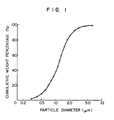
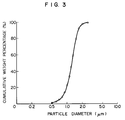
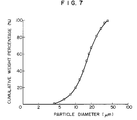
- Figures 1, 3, 5, 7 and 9 show the particle size distributions of aluminium hydroxide powder or alumina powder.
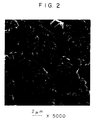
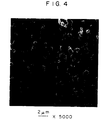
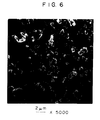
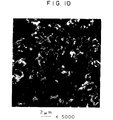
- Figures 2, 4, 6, 8 and 10 are the scanning electron micrographs of aluminium hydroxide powders or alumina powders.
- Figure 11 shows the relationship between the ball-milling periods and the BET specific surface areas of the particles resulted from the ball-milling of the alumina powders with respect to the differences in their aspect ratios.
- the material powder having an average secondary particle diameter of about 10 ⁇ m or less, preferably about 8 ⁇ m or less, more preferably about 5 ⁇ m or less produced by the Bayer's process.
- the transition alumina used in the present invention includes intermediate aluminas having ⁇ -, ⁇ -, ⁇ -, ⁇ -, ⁇ - or ⁇ -crystal form before the phase transition to the ⁇ -crystal form obtained by drying and/or calcining aluminum hydroxide.
- Specific examples thereof are a transition alumina having an ignition loss of about 0.5 to about 15% by weight industrially obtained by contacting aluminum hydroxide produced by the Bayer's process with hot gas at about 400° to about 1,200°C for about 0.1 to 10 seconds, that obtained by heating aluminum hydroxide under a reduced pressure at about 250° to about 900°C for, generally, 1 minute to 4 hours and the like.
- the average secondary particle diameter is larger than 10 ⁇ m, the particle size of the ⁇ -alumina obtained by the calcination naturally becomes large.
- the material powder having a large average secondary particle diameter usually contains far more number of primary particles having a large particle diameter in the secondary particles than that having a small average secondary particle diameter. And since these large primary particles unite together at the joining point of the crystal face to form larger ⁇ -crystals, there occur unevenness of the shape and broadening of the particle size distribution.
- soda was unavoidably contained in the material powder obtained by the Bayer's process and it accelerates the fusion-growth of the primary particles to further broaden the particle size distribution. Therefore, the above-mentioned phenomena are not desired.
- Means for applying a mechanical impact to the material powder is not critical provided it can apply the impact on said material powder as uniformly as possible.
- any conventional pulverizers utilizing a pulverizing medium such as attritor, ball mill and the like are usable.
- alumina balls having a diameter of 1-50 mm, preferably 2-30 mm, more preferably 2-5 mm.
- both dry process and wet process are adoptable.
- the wet process is preferred because it can give the mechanical impact more uniformly on the material powder than the dry process.
- the extent of the mechanical impact applied by the pulverizer to the material powder is variable depending on the physical properties of the material powder, the type and volume of the pulverizer, the type and amount of the pulverizing medium in the pulverizer, the process conditions of the pulverizer such as the number of the rotation and the like, so that it cannot be described simply.
- the extent of the applied impact is such that the peak intensity of X-ray diffraction at (110) crystal face of the powder suffered from the pulverization is reduced by 5% or more (retention of 95% or less), preferably by 10% or more (retention of 90% or less) relative to the peak intensity of the powder before the pulverization as 100%. Selecting the type of pulverizer, those who are skilled in the art can easily determine the process conditions by a preparatory experiment.
- the mechanical impact is applied to material aluminum hydroxide (gibbsite) having an average secondary particle diameter of 1.4 - 1.0 ⁇ m by an attritor having a volume of about 5 liters which is impregnated with about 8 kg of alumina balls having a diameter of 2 - 5 mm, it may usually take one hour or more, preferably 3 - 24 hours.
- the pulverization time may be determined from the viewpoint of the cost-effectiveness.
- pulverised powder is subjected to a calcination as such or after drying.
- An easily mono-dispersible alumina having a sharp particle size distribution and having particles of an extremely uniform shape is obtained by the calcination of the dried powder after the drying step, comprising disperse-mixing the pulverised powder into an aqueous solution to form a slurry, adjusting the viscosity thereof to 100 to 1,000 centipoises and spray drying the resulting slurry.
- the amount of the material powder to be disperse-mixed into an aqueous solution cannot be simply determined since it depends on the succeeding spray drying conditions. However, it may be usually about 200 g/l to about 2,000 g/l, preferably about 600 g/l to 1,200 g/l.
- Means for disperse-mixing the pulverized powder into an aqueous solution is not critical provided it can uniformly disperse the powder into an aqueous solution.
- the dispersion can be accomplished by mechanical agitation using a stirrer or by wet process using a ball mill, attritor or the like. Among these, the wet process is preferred.
- the viscosity of the slurry which depends on whether a dispersing agent is added thereto or not, is usually about several 10 centipoises or less, so that the slurry in which the pulverized powder is dispersed may be adjusted to a viscosity of 100 centipoises to about 1,000 centipoises, preferably 200 centipoises to 800 centipoises before the spray drying.
- Means for adjusting the viscosity is not critical provided it has no possibility of causing serious contamination on the alumina after the calcination.
- Specific examples of the additives used for adjusting the viscosity are an aqueous ammonia; binders such as polyvinyl alcohol, carboxymethyl cellulose, methyl cellulose, acrylic resins, and the like used in the shaping of alumina; chlorides or carbonates of calcium, magnesium or the like.
- a binder such as polyvinyl alcohol and the like has an effect of increasing the recovery of the dried powder in a cyclone collector or the like after the spray drying.
- any means may be adopted including rotary disk method, pressurized nozzle method, two-phase flow nozzle method and the like. Of these, the rotary disk method is preferred since the spray-dried, granular powder having the most sharp particle size distribution is obtained.
- Particle size range of the spray-dried, granular powder is not critical; however, average particle diameter of the spray-dried, granular powder usually falls in the range of from 20 to 200 ⁇ m.
- the process conditions for obtaining the powder having an intended particle size depend on the type of spray dryer used; however, any skilled artisan can easily determine the conditions.
- the intended particle size can be obtained by controlling the slurry concentration for spray drying, amount of the slurry supplied to the disk, disk revolution, gas flow rate and drying speed.
- chlorine compounds such as hydrochloric acid, chlorine gas, aluminum chloride, magnesium chloride, calcium chloride and the like, chlorine-containing macromolecular compounds and the like are usable.
- hydrochloric acid is preferable.
- chlorine-containing macromolecular compounds are homopolymers of vinyl chloride, copolymers of vinyl chloride with an unsaturated ethylenic monomer which is copolymerizable with vinyl chloride (including the graft copolymers and block copolymers), homopolymers of vinylidene chloride, copolymers of vinylidene chloride with an unsaturated ethylenic monomer which is copolymerizable with vinylidene chloride, and the like.
- the amount of the chlorine-containing substance added cannot be determined unanimously because the optimum addition depends on the amount of chlorine or hydrogen chloride which the chlorine-containing substance possesses or evolves on pyrolysis.
- the chlorine-containing substance is usually added in an amount of 0.1 - 10%, preferably 1 - 5% in terms of the weight of chlorine based on the weight of alumina (dry basis) present in the material powder.
- the amount added When the amount added is smaller than about 0.1% by weight, the effect of improving aspect ratio of the resulting powder is sometimes unsatisfactory. While, when the amount added exceeds about 10% by weight, the effect of improving aspect ratio hits the ceiling and a problem of corroding the equipment tends to occur. Moreover, when a chlorine-containing macromolecular compound is used in such a large amount, decomposition thereof during the calcination tends to leave an increased amount of carbon in the alumina that lowers the purity thereof.
- a method for carrying out the calcination in the presence of the chlorine-containing substance there can be adopted a method comprising admixing the chlorine-containing substance with the aqueous dispersion of aluminum hydroxide before the spray drying, a method comprising admixing the chlorine-containing substance with the spray-dried powder, a method comprising introducing the chlorine-containing substance into a calcining furnace at the calcination to make it contact with the aluminum hydroxide and/or a transition alumina. These methods can be applied alone or in the combination thereof.
- the presence of the chlorine-containing substance during the calcination naturally shows, other than the above-mentioned effects, the effect of eliminating the soda components therefrom.
- a siliceous substance may be added thereto at the calcination in order to reduce the soda content.
- siliceous substance examples include silica stone, quartz, silica sand, chamotte, mulite, sillimanite, magnesium silicate, aluminum silicate and the like.
- saggers made of such a sliceous substance may be used in the furnace.
- balls made of such a siliceous substance having a diameter of about 5 - 10 mm may be added in saggers.
- the siliceous substance absorbs the soda generated during the calcination of the pulverized powder or spray-dried powder to promote the reduction of the soda content.
- the amount of the siliceous substance to be added thereto are about 1% or more, preferably 5 - 10% in terms of the weight of silica based on that of alumina (dry basis).
- optimum conditions of the calcination vary with the type of calcining furnace employed and hence cannot be determined unanimously.
- the calcination is usually carried out at 1,100° to 1,500°C.
- Retention time for the calcination varies with the type of the calcination furnace.
- the retention time at a temperature in the above-mentioned range is usually from several minutes to scores of minutes.
- a tunnel furnace it is usually several hours.
- the calcination temperature and retention time are properly chosen according to the intended particle size of the product ⁇ -alumina. Naturally, the longer the retention time and the higher the temperature, the greater the particle size of the resulting ⁇ -alumina.
- the type and structure of the calcination furnace employed are not critical provided the above-mentioned calcination temperature and retention time are secured.
- Specific examples of the adoptable furnace are rotary kilns, roller hearth kilns, tunnel furnaces, pneumatic conveying furnaces, fluidized bed furnaces, flash roaster type furnaces, electric furnaces and the other known furnaces.
- the thus calcined alumina powder is cooled and, if necessary, sieved in order to remove the siliceous substance to obtain an easily mono-dispersible alumina having a sharp particle size distribution and a small primary particle diameter after the mono-dispersing.
- the calcined alumina powder has a small aspect ratio in addition to the above advantages.
- aluminum hydroxide particles are deposited from a solution, separated from the liquid by decantation, filtration or the like and dried. During the course of these steps, the particles agglomerate and match each other in the crystal surface of the primary particle. This grows as the ⁇ -crystals with calcination and causes a coarsening of the particles and a broadening of the particle size distribution.
- the process of the present invention is considered to provide an easily mono-dispersible, finely-divided ⁇ -alumina having a sharp particle size distribution and being of the uniform shape from the following mechanisms:
- the spray drying method comprising dispersing the material powder into an aqueous solution to form a slurry followed by the instant spray drying of the slurry is adopted, the agglomeration of the primary particle of the dried powder obtained is prevented and after the calcination, the ⁇ -crystal growth by the joining of the particles is rarely seen.
- the calcination in the case where the calcination is carried out in the presence of the chlorine-containing substance, it accelerates the C-axial growth of the alumina during the calcination, and as the results, there can be obtained an ⁇ -alumina having a small aspect ratio and a sharp particle size distribution and being of the uniform shape.
- the process of the present invention can provide an easily mono-dispersible ⁇ -alumina which gives by a simple powdering (mono-dispersing) a finely-divided alumina powder usually having an average secondary particle diameter of 2 or 3 ⁇ m or less and a sharp particle size distribution.
- a simple powdering mono-dispersing
- a finely-divided alumina powder usually having an average secondary particle diameter of 2 or 3 ⁇ m or less and a sharp particle size distribution.
- a sintered product having a uniform structure, a high density and a high strength.
- This sintered product is fitted for various ceramic applications including unprecedented ceramics for electronic purpose, abrasive applications, high-grade refractory applications and the like so that it has a noticeable value in industry.
- the viscosity of slurry was measured by a B-type viscometer (mfd. by Tokyo Keiki Co., Ltd.) using No. 2 rotor of 30 r.p.m. at a room temperature.
- the thus obtained slurry was flash-dried by means of a rotating disk type dryer (Type MM mfd. by A/S NIRO ATOMIZER, Denmark) under the conditions of the slurry feed rate of 2 l/hr, the slurry concentration of 677 g/l, the number of the disk revolution of 10,000 r.p.m. and the drying temperature of 110°C to obtain a flash-dried powder having an average particle diameter of 30 ⁇ m.
- a rotating disk type dryer Type MM mfd. by A/S NIRO ATOMIZER, Denmark
- the powder was charged in mullite saggers and was calcined in a box type electric furnace at 1,300°C for 2 hours and ball-milled for 2 hours to obtain a mono-dispersed alumina powder.
- Example 1 The same procedure as in Example 1 was repeated except that the viscosity of the slurry was altered by adding polyvinyl alcohol and 25% aqueous ammonia in amounts shown in Table 1.
- the same aluminum hydroxide as in Example 1 was preparatorily calcined at 500°C for 4 hours.
- the preparatorily calcined alumina thus obtained had an ignition loss of 10% by weight and the crystal structure thereof was regarded as being constituted of gibbsite as the main structure, boehmite, ⁇ -alumina and ⁇ -alumina from the information of X-ray diffraction.
- This preparatorily calcined alumina was subjected to the same attritor treatment as in Example 1 to obtain a pulverized alumina.
- the peak intensity of X-ray diffraction at (110) crystal face of this pulverized alumina was reduced down to 92% relative to that before the pulverization as 100%.
- This pulverized alumina was dispersed into water to form a slurry and the viscosity of the slurry was adjusted.
- Example 2 The slurry was treated in the same manner as in Example 1 to obtain a mono-dispersed alumina having a low-soda content.
- the physical properties thereof are shown in Table 1.
- Example 1 In the procedure in Example 1, the time for attritor-treatment was changed to 6 hours. After the pulverization, this aluminum hydroxide was dehydrated and was subjected to an X-ray diffraction measurement to find that the peak intensity at (110) crystal face was reduced down to 90% based on that before the pulverization as 100%.
- Example 2 Then the same procedure as in Example 1 was applied to this pulverized alumina to obtain a mono-dispersed alumina powder.
- Example 2 The same procedure as in Example 1 was repeated except that the calcination temperature was changed to 1,250°C.
- Example 2 The same procedure as in Example 1 was repeated except that an aluminum hydroxide having a soda-content of 0.2% by weight (as Na2O), a particle size distribution shown in Figure 7, a scanning electron micrograph shown as Figure 8 and an average secondary particle diameter of 15 ⁇ m produced by the Bayer's process was used as the material powder to obtain a non-dispersed alumina powder.
- an aluminum hydroxide having a soda-content of 0.2% by weight (as Na2O)
- Figure 7 a scanning electron micrograph shown as Figure 8
- an average secondary particle diameter of 15 ⁇ m produced by the Bayer's process was used as the material powder to obtain a non-dispersed alumina powder.
- Example 1 The same procedure as in Example 1 was repeated without carrying out the attritor-treatment, addition of hydrochloric acid, adjustment of viscosity and spray drying.
- a slurry was obtained by the same procedure as in Example 1 without carrying out the adjustment of viscosity and spray-drying.
- the slurry was filtered, dried in an air-bath at 110°C for 2 hours, charged in mullite saggers and calcined as in Example 1.
- a slurry was obtained by the same procedure as in Example 4 without carrying out the adjustment of viscosity and spray drying. Then the slurry was subjected to a filtration, a drying in an air-bath at 110°C for 2 hours and a calcination in the mullite saggers as in Example 1.
- the same aluminum hydroxide as in Example 1 was preparatorily calcined at 500°C for 4 hours.
- the preparatorily calcined alumina thus obtained had an ignition loss of 10% by weight and the crystal structure thereof was regarded as being constituted of gibbsite as the main structure, boehmite, ⁇ -alumina, ⁇ -alumina from the information of X-ray diffraction. It was subjected to the same attritor treatment as in Example 1 to obtain a pulverized alumina.
- the peak intensity of X-ray diffraction at (110) crystal face of this pulverized alumina was reduced down to 92% relative to that before the pulverization as 100%.
- the pulverized alumina was filtrated and dried in an air-bath at 110°C for 2 hours to obtain a dried alumina.
- a powdery polyvinyl chloride resin (trade-named as Sumilit® mfd. by Sumitomo Chemical Co., Ltd.) and 5.0 parts by weight of quartz having an average particle diameter of 2 mm and they were stirred so that they were uniformly get mixed. Then the mixture was calcined in a box type electric furnace at 1,300°C for 2 hours and thereafter further ball-milled for 2 hours to obtain an alumina powder.
Landscapes
- Chemical & Material Sciences (AREA)
- Organic Chemistry (AREA)
- Engineering & Computer Science (AREA)
- Ceramic Engineering (AREA)
- Life Sciences & Earth Sciences (AREA)
- Geology (AREA)
- Inorganic Chemistry (AREA)
- Manufacturing & Machinery (AREA)
- Materials Engineering (AREA)
- Structural Engineering (AREA)
- Compounds Of Alkaline-Earth Elements, Aluminum Or Rare-Earth Metals (AREA)
- Compositions Of Oxide Ceramics (AREA)
Claims (18)
- Verfahren zur Herstellung von leicht monodispergierbarem Aluminiumoxid, dadurch gekennzeichnet, daß es umfaßt:(a) Anwendung eines mechanischen Stoßes auf (i) Aluminiumhydroxid, das einen durchschnittlichen Sekundär-Teilchendurchmesser von ungefähr 10 µm oder weniger hat und nach dem Bayer-Verfahren hergestellt wurde, und/oder auf (ii) Übergangs-Aluminiumoxid, das einen durchschnittlichen Sekundär-Teilchendurchmesser von etwa 10 µm oder weniger hat und nach dem Bayer-Verfahren hergestellt wurde, zur Herstellung eines auf Staubfreiheit gemahlenen Pulvers; wobei der angewendete mechanische Stoß derart ist, daß nach dem Mahlen die Peakintensität bei der Röntgenstrahlbeugung an der Kristallebene (110) des gemahlenen Pulvers um etwa 5 % oder mehr abnimmt;(b) Erzeugen einer Aufschlämmung durch Dispergieren des auf Staubfeinheit gemahlenen Pulvers in einer wäßrigen Lösung;(c) Einstellen der Viskosität der Aufschlämmung auf 100 bis 1000 Centipoise;(d) Sprühtrocknung der auf eine bestimmte Viskosität eingestellten Aufschlämmung zu einem getrockneten Pulver;(e) Brennen des getrockneten Pulvers bei 1100 bis 1500°C.
- Verfahren gemäß Anspruch 1, wobei der durchschnittliche Sekundär-Teilchendurchmesser des Aluminiumhydroxids und/oder des Übergangs-Aluminiumoxids etwa 8 µm oder weniger beträgt.
- Verfahren gemäß Anspruch 2, wobei der durchschnittliche Sekundär-Teilchendurchmesser des Aluminiumhydroxids und/oder des Übergangs-Aluminiumoxids etwa 5 µm oder weniger beträgt.
- Verfahren gemäß einem der Ansprüche 1 bis 3, wobei der angewandte mechanische Stoß derart ist, daß nach dem Mahlen die Peakintensität bei der Röntgenstrahlbeugung an der Kristallebene (110) des auf Staubfeinheit gemahlenen Pulvers um etwa 10 % oder mehr abnimmt.
- Verfahren gemäß einem vorhergehenden Anspruch, wobei das Brennen in Gegenwart eines chlorhaltigen Stoffs durchgeführt wird.
- Verfahren gemäß Anspruch 5, wobei der chlorhaltige Stoff Salzsäure, Chlorgas, Aluminiumchlorid, Magnesiumchlorid oder Calciumchlorid ist.
- Verfahren gemäß Anspruch 6, wobei der chlorhaltige Stoff Salzsäure ist.
- Verfahren gemäß einem der Ansprüche 5 bis 7, wobei der chlorhaltige Stoff in einer Menge von 0,1 bis 10 %, ausgedrückt als Masse des Chlors, und bezogen auf die Masse des (trockenen) Aluminiumoxids, das in dem Aluminiumhydroxid und/oder dem Übergangs-Aluminiumoxid vorhanden ist, hinzugefügt wird.
- Verfahren gemäß Anspruch 8, wobei der chlorhaltige Stoff in einer Menge von 1 bis 5 %, ausgedrückt als Masse des Chlors, bezogen auf die Masse des (trockenen) Aluminiumoxids, das in dem Aluminiumhydroxid und/oder in dem Übergangs-Aluminiumoxid vorhanden ist, hinzugefügt wird.
- Verfahren gemäß einem vorhergehenden Anspruch, wobei ein kieselsäurehaltiger Stoff beim Brennen hinzugefügt wird.
- Verfahren gemäß Anspruch 10, wobei der kieselsäurehaltige Stoff Silikastein, Quarz, Quarzsand, Schamotte, Mullit, Sillimanit, Magnesiumsilikat oder Aluminiumsilikat ist.
- Verfahren gemäß Anspruch 10 oder 11, wobei die kieselsäurehaltige Substanz in einer Menge von etwa 1 % oder mehr, ausgedrückt als Masse des Siliciumdioxids, bezogen auf die Masse des (trockenen) Aluminiumoxids, hinzugefügt wird.
- Verfahren gemäß Anspruch 12, wobei der kieselsäurehaltige Stoff in einer Menge von 5 bis 10 %, ausgedrückt als Masse des Siliciumdioxids, bezogen auf die Masse des (trockenen) Aluminiumoxids, hinzugefügt wird.
- Verfahren gemäß einem vorhergehenden Anspruch, wobei die Viskosität der Aufschlämmung auf 200 bis 800 Centipoise eingestellt wird.
- Verfahren gemäß einem vorhergehenden Anspruch, wobei die Viskosität der Aufschlämmung durch Hinzufügen wenigstens eines der folgenden Stoffe eingestellt wird: Wäßrige Ammoniaklösung, Polyvinylalkohol, Carboxymethylcellulose, Methylcellulose, Methylmethacrylat, Calciumchlorid, Calciumcarbonat, Magnesiumchlorid oder Magnesiumcarbonat.
- Verfahren gemäß Anspruch 15, wobei die Viskosität der Aufschlämmung durch Hinzufügen von wäßriger Ammoniaklösung und/oder Polyvinylalkohol eingestellt wird.
- Verfahren gemäß einem der vorhergehenden Ansprüche, wobei die Sprühtrocknung mit einer rotierenden Scheibe durchgeführt wird.
- Verfahren gemäß Anspruch 17, wobei der durchschnittliche Teilchendurchmesser des sprühgetrocknete, gekörnten Pulvers 20 bis 200 µm beträgt.
Applications Claiming Priority (4)
| Application Number | Priority Date | Filing Date | Title |
|---|---|---|---|
| JP44613/87 | 1987-02-26 | ||
| JP4461387 | 1987-02-26 | ||
| JP5916587 | 1987-03-13 | ||
| JP59165/87 | 1987-03-13 |
Publications (2)
| Publication Number | Publication Date |
|---|---|
| EP0281265A1 EP0281265A1 (de) | 1988-09-07 |
| EP0281265B1 true EP0281265B1 (de) | 1992-08-05 |
Family
ID=26384558
Family Applications (1)
| Application Number | Title | Priority Date | Filing Date |
|---|---|---|---|
| EP88301205A Expired - Lifetime EP0281265B1 (de) | 1987-02-26 | 1988-02-12 | Verfahren zur Darstellung von leicht monodispergierbarem Aluminiumoxid |
Country Status (3)
| Country | Link |
|---|---|
| EP (1) | EP0281265B1 (de) |
| JP (1) | JP2638890B2 (de) |
| DE (1) | DE3873377T2 (de) |
Cited By (1)
| Publication number | Priority date | Publication date | Assignee | Title |
|---|---|---|---|---|
| KR100726113B1 (ko) * | 2003-04-02 | 2007-06-12 | 생-고뱅 세라믹스 앤드 플라스틱스, 인코포레이티드 | 나노다공성 극미세 알파-알루미나 분말 및 이의 동결 건조제조방법 |
Families Citing this family (26)
| Publication number | Priority date | Publication date | Assignee | Title |
|---|---|---|---|---|
| JPH0610083B2 (ja) * | 1989-09-04 | 1994-02-09 | 昭和電工株式会社 | 易焼結アルミナの製造方法 |
| DE4109264A1 (de) * | 1991-03-21 | 1992-09-24 | Schepers Bernhard H Dr | Verfahren zum herstellen von aluminiumoxid zum schleifen und/oder polieren aus aluminiumhydroxid |
| RU2107662C1 (ru) * | 1992-06-02 | 1998-03-27 | Сумитомо Кемикал Компани, Лимитед | α ОКСИД АЛЮМИНИЯ |
| US6521203B1 (en) | 1992-06-02 | 2003-02-18 | Sumitomo Chemical Co., Ltd. | Process for producing α-alumina |
| GB2268901B (en) * | 1992-07-23 | 1995-07-05 | Nsk Ltd | A rolling/sliding part |
| DE4302795C1 (de) * | 1993-02-02 | 1994-08-25 | Hoechst Ceram Tec Ag | Verfahren zur Herstellung eines dichtgesinterten, plattenförmigen keramischen Formteils aus Aluminiumoxid mit verbesserter Temperaturwechselbeständigkeit, Formteil sowie seine Verwendung |
| JP3744010B2 (ja) * | 1993-06-30 | 2006-02-08 | 住友化学株式会社 | α−アルミナ粉末の製造方法 |
| US5593467A (en) * | 1993-11-12 | 1997-01-14 | Minnesota Mining And Manufacturing Company | Abrasive grain |
| ATE178298T1 (de) * | 1993-11-12 | 1999-04-15 | Minnesota Mining & Mfg | Schleifkorn und verfahren zur herstellung desselben |
| CN1071710C (zh) * | 1993-11-25 | 2001-09-26 | 住友化学工业株式会社 | α型氧化铝粉末的制造方法 |
| EP0656319B1 (de) * | 1993-11-25 | 2003-04-09 | Sumitomo Chemical Company, Limited | Verfahren zur Herstellung von Alpha-Aluminiumoxidpulver |
| US6136288A (en) * | 1993-12-16 | 2000-10-24 | Norton Company | Firing fines |
| JP3470395B2 (ja) * | 1994-06-24 | 2003-11-25 | 住友化学工業株式会社 | 微粒酸化アルミニウムの製造方法 |
| AU699077B2 (en) * | 1995-02-21 | 1998-11-19 | Sumitomo Chemical Company, Limited | Alpha-alumina and method for producing the same |
| JPH08267363A (ja) * | 1995-03-30 | 1996-10-15 | Fuji Photo Film Co Ltd | 研磨体 |
| FR2739864B1 (fr) * | 1995-10-16 | 1998-01-09 | Pechiney Electrometallurgie | Grains abrasifs a base d'alumine et procede de preparation de ces grains |
| FR2755435A1 (fr) * | 1996-11-04 | 1998-05-07 | Pechiney Aluminium | Fabrication d'alumine calcinee a taille de cristallite reglee a la demande avec une faible dispersion |
| US6887454B1 (en) * | 1999-06-29 | 2005-05-03 | Albemarle Corporation | Process for the production of aluminium hydroxide |
| CN1241833C (zh) * | 2000-10-20 | 2006-02-15 | 昭和电工株式会社 | 生产低碱氧化铝的方法及其设备 |
| KR100408079B1 (ko) * | 2000-12-06 | 2003-12-01 | 주식회사 한국특수절연 | 폐 염화 알루미늄 용액으로부터 알루미나 졸의 제조방법 |
| KR100400178B1 (ko) * | 2000-12-07 | 2003-10-01 | 주식회사 한국특수절연 | 요변성이 우수한 고점도 알루미나 졸의 제조방법 |
| JP2006183550A (ja) * | 2004-12-27 | 2006-07-13 | Nissan Motor Co Ltd | 内燃機関の吸排気構造 |
| RU2423333C2 (ru) * | 2009-05-18 | 2011-07-10 | Государственное образовательное учреждение высшего профессионального образования "Уральский государственный технический университет-УПИ имени первого Президента России Б.Н. Ельцина" | Способ обработки наноразмерных материалов на основе оксида алюминия |
| CN102910659B (zh) * | 2012-10-29 | 2014-07-30 | 上海飞凯光电材料股份有限公司 | 一种高纯氧化铝的制备方法及其应用 |
| CN114516649B (zh) * | 2020-10-30 | 2024-02-09 | 中国石油化工股份有限公司 | 具有超大孔结构的球形氧化铝及其制备方法 |
| CN115385367A (zh) * | 2021-05-06 | 2022-11-25 | 湖南大学 | 纳米氧化铝颗粒及制备方法和应用 |
Citations (2)
| Publication number | Priority date | Publication date | Assignee | Title |
|---|---|---|---|---|
| EP0263810A2 (de) * | 1986-10-03 | 1988-04-13 | Treibacher Chemische Werke Aktiengesellschaft | Gesintertes Schleifmaterial auf Basis von alpha-Aluminiumoxid |
| EP0277730A1 (de) * | 1987-01-29 | 1988-08-10 | Sumitomo Chemical Company, Limited | Verfahren zur Herstellung von Aluminiumoxid |
Family Cites Families (2)
| Publication number | Priority date | Publication date | Assignee | Title |
|---|---|---|---|---|
| DD151565A3 (de) * | 1979-11-08 | 1981-10-28 | Heiner Axmann | Verfahren zur herstellung von poliertonerde |
| GB8302952D0 (en) * | 1983-02-03 | 1983-03-09 | British Aluminium Co Plc | Alumina sols |
-
1988
- 1988-02-12 EP EP88301205A patent/EP0281265B1/de not_active Expired - Lifetime
- 1988-02-12 DE DE8888301205T patent/DE3873377T2/de not_active Expired - Lifetime
- 1988-02-24 JP JP63042921A patent/JP2638890B2/ja not_active Expired - Fee Related
Patent Citations (2)
| Publication number | Priority date | Publication date | Assignee | Title |
|---|---|---|---|---|
| EP0263810A2 (de) * | 1986-10-03 | 1988-04-13 | Treibacher Chemische Werke Aktiengesellschaft | Gesintertes Schleifmaterial auf Basis von alpha-Aluminiumoxid |
| EP0277730A1 (de) * | 1987-01-29 | 1988-08-10 | Sumitomo Chemical Company, Limited | Verfahren zur Herstellung von Aluminiumoxid |
Cited By (1)
| Publication number | Priority date | Publication date | Assignee | Title |
|---|---|---|---|---|
| KR100726113B1 (ko) * | 2003-04-02 | 2007-06-12 | 생-고뱅 세라믹스 앤드 플라스틱스, 인코포레이티드 | 나노다공성 극미세 알파-알루미나 분말 및 이의 동결 건조제조방법 |
Also Published As
| Publication number | Publication date |
|---|---|
| JP2638890B2 (ja) | 1997-08-06 |
| EP0281265A1 (de) | 1988-09-07 |
| DE3873377T2 (de) | 1992-12-10 |
| DE3873377D1 (de) | 1992-09-10 |
| JPS643008A (en) | 1989-01-06 |
Similar Documents
| Publication | Publication Date | Title |
|---|---|---|
| EP0281265A1 (de) | Verfahren zur Darstellung von leicht monodispergierbarem Aluminiumoxid | |
| US5302368A (en) | Process for preparation of alumina | |
| EP0277730B1 (de) | Verfahren zur Herstellung von Aluminiumoxid | |
| CA1144454A (en) | Coarse crystalline alumina and method for its production | |
| JPH013008A (ja) | 易解砕性アルミナの製造方法 | |
| CA2168834C (en) | Process for producing sintered .alpha.-ai2o3 bodies and their use | |
| EP0429548B1 (de) | Kleine partikel und plättchen von alpha-aluminiumoxyd | |
| US5236471A (en) | Process for the production of sintered material based on α-aluminum oxide, especially for abrasives | |
| JP3262301B2 (ja) | 炭化ケイ索焼結研摩粒子およびその製造方法 | |
| KR100869679B1 (ko) | α-알루미나 미세 분말 및 이의 제조 방법 | |
| NZ210805A (en) | Aluminous abrasive grits or shaped bodies | |
| CN100469698C (zh) | 氧化铝颗粒及其生产方法 | |
| US5149520A (en) | Small sized alpha alumina particles and platelets | |
| JPH06171931A (ja) | α−アルミナ粉末の製造方法 | |
| JPH05117636A (ja) | α−三酸化アルミニウムを基礎とする多結晶性の焼結研磨粒子、この研磨粒子からなる研磨剤、研磨粒子の製造法および耐火性セラミツク製品の製造法 | |
| US4695294A (en) | Vibratory grinding of silicon carbide | |
| EP0536381B1 (de) | Verfahren zur herstellung von submikronischen aluminateilchen | |
| EP0996696B1 (de) | Schleifmittel im wesentlichen aus gesintertem titanoxid | |
| CA2003526A1 (en) | Ceramic microspheres | |
| US5338709A (en) | Process for producing granulated strontium carbonate with a strontium-containing binder | |
| JPH06144831A (ja) | 微粒・易焼結性アルミナの製造方法 | |
| CN120681776A (zh) | 一种直接制备板状刚玉粉体的方法 | |
| JPS62230614A (ja) | アルミナ粉末の製造方法 | |
| KR20010014358A (ko) | 소결된 TiO₂입자를 주성분으로 하는 분쇄 매체 | |
| HK1061008B (en) | Spherical alumina particles and production process thereof |
Legal Events
| Date | Code | Title | Description |
|---|---|---|---|
| PUAI | Public reference made under article 153(3) epc to a published international application that has entered the european phase |
Free format text: ORIGINAL CODE: 0009012 |
|
| AK | Designated contracting states |
Kind code of ref document: A1 Designated state(s): DE FR GB IT |
|
| 17P | Request for examination filed |
Effective date: 19890118 |
|
| RAP3 | Party data changed (applicant data changed or rights of an application transferred) |
Owner name: SUMITOMO CHEMICAL COMPANY, LIMITED |
|
| 17Q | First examination report despatched |
Effective date: 19910214 |
|
| GRAA | (expected) grant |
Free format text: ORIGINAL CODE: 0009210 |
|
| AK | Designated contracting states |
Kind code of ref document: B1 Designated state(s): DE FR GB IT |
|
| ITF | It: translation for a ep patent filed | ||
| REF | Corresponds to: |
Ref document number: 3873377 Country of ref document: DE Date of ref document: 19920910 |
|
| ET | Fr: translation filed | ||
| ITTA | It: last paid annual fee | ||
| PLBE | No opposition filed within time limit |
Free format text: ORIGINAL CODE: 0009261 |
|
| STAA | Information on the status of an ep patent application or granted ep patent |
Free format text: STATUS: NO OPPOSITION FILED WITHIN TIME LIMIT |
|
| 26N | No opposition filed | ||
| PGFP | Annual fee paid to national office [announced via postgrant information from national office to epo] |
Ref country code: GB Payment date: 19940118 Year of fee payment: 7 |
|
| PG25 | Lapsed in a contracting state [announced via postgrant information from national office to epo] |
Ref country code: GB Effective date: 19950212 |
|
| GBPC | Gb: european patent ceased through non-payment of renewal fee |
Effective date: 19950212 |
|
| PGFP | Annual fee paid to national office [announced via postgrant information from national office to epo] |
Ref country code: FR Payment date: 19970113 Year of fee payment: 10 |
|
| PGFP | Annual fee paid to national office [announced via postgrant information from national office to epo] |
Ref country code: DE Payment date: 19970122 Year of fee payment: 10 |
|
| PG25 | Lapsed in a contracting state [announced via postgrant information from national office to epo] |
Ref country code: FR Free format text: THE PATENT HAS BEEN ANNULLED BY A DECISION OF A NATIONAL AUTHORITY Effective date: 19980228 |
|
| PG25 | Lapsed in a contracting state [announced via postgrant information from national office to epo] |
Ref country code: DE Free format text: LAPSE BECAUSE OF NON-PAYMENT OF DUE FEES Effective date: 19981103 |
|
| REG | Reference to a national code |
Ref country code: FR Ref legal event code: ST |
|
| PG25 | Lapsed in a contracting state [announced via postgrant information from national office to epo] |
Ref country code: IT Free format text: LAPSE BECAUSE OF NON-PAYMENT OF DUE FEES;WARNING: LAPSES OF ITALIAN PATENTS WITH EFFECTIVE DATE BEFORE 2007 MAY HAVE OCCURRED AT ANY TIME BEFORE 2007. THE CORRECT EFFECTIVE DATE MAY BE DIFFERENT FROM THE ONE RECORDED. Effective date: 20050212 |