EP0281347B1 - Liaison de couches en matière plastique - Google Patents
Liaison de couches en matière plastique Download PDFInfo
- Publication number
- EP0281347B1 EP0281347B1 EP88301739A EP88301739A EP0281347B1 EP 0281347 B1 EP0281347 B1 EP 0281347B1 EP 88301739 A EP88301739 A EP 88301739A EP 88301739 A EP88301739 A EP 88301739A EP 0281347 B1 EP0281347 B1 EP 0281347B1
- Authority
- EP
- European Patent Office
- Prior art keywords
- substrate
- thermoplastic layer
- layer
- thermoplastic
- conductors
- Prior art date
- Legal status (The legal status is an assumption and is not a legal conclusion. Google has not performed a legal analysis and makes no representation as to the accuracy of the status listed.)
- Expired - Lifetime
Links
- 229920001169 thermoplastic Polymers 0.000 title claims description 34
- 239000004416 thermosoftening plastic Substances 0.000 title claims description 34
- 238000000034 method Methods 0.000 claims description 27
- 230000006698 induction Effects 0.000 claims description 19
- 239000000758 substrate Substances 0.000 claims description 18
- 239000004020 conductor Substances 0.000 claims description 14
- OKTJSMMVPCPJKN-UHFFFAOYSA-N Carbon Chemical compound [C] OKTJSMMVPCPJKN-UHFFFAOYSA-N 0.000 claims description 11
- 229910052799 carbon Inorganic materials 0.000 claims description 11
- 239000002131 composite material Substances 0.000 claims description 11
- 101100379068 Caenorhabditis elegans apc-2 gene Proteins 0.000 claims description 10
- 230000005672 electromagnetic field Effects 0.000 claims description 7
- 239000012815 thermoplastic material Substances 0.000 claims description 6
- 125000003118 aryl group Chemical group 0.000 claims description 2
- 239000000203 mixture Substances 0.000 claims description 2
- 229920000642 polymer Polymers 0.000 claims description 2
- 238000010438 heat treatment Methods 0.000 description 27
- 239000000463 material Substances 0.000 description 18
- 230000000694 effects Effects 0.000 description 7
- 239000004696 Poly ether ether ketone Substances 0.000 description 5
- 239000002184 metal Substances 0.000 description 5
- 229910052751 metal Inorganic materials 0.000 description 5
- 229920002530 polyetherether ketone Polymers 0.000 description 5
- 238000007596 consolidation process Methods 0.000 description 4
- 239000000835 fiber Substances 0.000 description 3
- 239000007788 liquid Substances 0.000 description 3
- 238000004519 manufacturing process Methods 0.000 description 3
- 238000003466 welding Methods 0.000 description 3
- 101000927062 Haematobia irritans exigua Aquaporin Proteins 0.000 description 2
- 229910001209 Low-carbon steel Inorganic materials 0.000 description 2
- 230000015556 catabolic process Effects 0.000 description 2
- 239000011521 glass Substances 0.000 description 2
- 239000007769 metal material Substances 0.000 description 2
- 239000003973 paint Substances 0.000 description 2
- 239000003351 stiffener Substances 0.000 description 2
- XLYOFNOQVPJJNP-UHFFFAOYSA-N water Substances O XLYOFNOQVPJJNP-UHFFFAOYSA-N 0.000 description 2
- 229910000838 Al alloy Inorganic materials 0.000 description 1
- 229910001369 Brass Inorganic materials 0.000 description 1
- 239000010951 brass Substances 0.000 description 1
- 150000001875 compounds Chemical class 0.000 description 1
- 239000002826 coolant Substances 0.000 description 1
- 230000007797 corrosion Effects 0.000 description 1
- 238000005260 corrosion Methods 0.000 description 1
- 230000006866 deterioration Effects 0.000 description 1
- 230000004927 fusion Effects 0.000 description 1
- 239000007943 implant Substances 0.000 description 1
- 238000005304 joining Methods 0.000 description 1
- 238000003754 machining Methods 0.000 description 1
- 238000002844 melting Methods 0.000 description 1
- 230000008018 melting Effects 0.000 description 1
- 150000002739 metals Chemical class 0.000 description 1
- 239000004033 plastic Substances 0.000 description 1
- 230000002787 reinforcement Effects 0.000 description 1
- 239000007787 solid Substances 0.000 description 1
Images


Classifications
-
- B—PERFORMING OPERATIONS; TRANSPORTING
- B29—WORKING OF PLASTICS; WORKING OF SUBSTANCES IN A PLASTIC STATE IN GENERAL
- B29C—SHAPING OR JOINING OF PLASTICS; SHAPING OF MATERIAL IN A PLASTIC STATE, NOT OTHERWISE PROVIDED FOR; AFTER-TREATMENT OF THE SHAPED PRODUCTS, e.g. REPAIRING
- B29C65/00—Joining or sealing of preformed parts, e.g. welding of plastics materials; Apparatus therefor
- B29C65/02—Joining or sealing of preformed parts, e.g. welding of plastics materials; Apparatus therefor by heating, with or without pressure
- B29C65/34—Joining or sealing of preformed parts, e.g. welding of plastics materials; Apparatus therefor by heating, with or without pressure using heated elements which remain in the joint, e.g. "verlorenes Schweisselement"
- B29C65/36—Joining or sealing of preformed parts, e.g. welding of plastics materials; Apparatus therefor by heating, with or without pressure using heated elements which remain in the joint, e.g. "verlorenes Schweisselement" heated by induction
- B29C65/3604—Joining or sealing of preformed parts, e.g. welding of plastics materials; Apparatus therefor by heating, with or without pressure using heated elements which remain in the joint, e.g. "verlorenes Schweisselement" heated by induction characterised by the type of elements heated by induction which remain in the joint
- B29C65/3608—Joining or sealing of preformed parts, e.g. welding of plastics materials; Apparatus therefor by heating, with or without pressure using heated elements which remain in the joint, e.g. "verlorenes Schweisselement" heated by induction characterised by the type of elements heated by induction which remain in the joint comprising single particles, e.g. fillers or discontinuous fibre-reinforcements
- B29C65/3616—Joining or sealing of preformed parts, e.g. welding of plastics materials; Apparatus therefor by heating, with or without pressure using heated elements which remain in the joint, e.g. "verlorenes Schweisselement" heated by induction characterised by the type of elements heated by induction which remain in the joint comprising single particles, e.g. fillers or discontinuous fibre-reinforcements comprising discontinuous fibre-reinforcements
-
- B—PERFORMING OPERATIONS; TRANSPORTING
- B29—WORKING OF PLASTICS; WORKING OF SUBSTANCES IN A PLASTIC STATE IN GENERAL
- B29C—SHAPING OR JOINING OF PLASTICS; SHAPING OF MATERIAL IN A PLASTIC STATE, NOT OTHERWISE PROVIDED FOR; AFTER-TREATMENT OF THE SHAPED PRODUCTS, e.g. REPAIRING
- B29C65/00—Joining or sealing of preformed parts, e.g. welding of plastics materials; Apparatus therefor
- B29C65/02—Joining or sealing of preformed parts, e.g. welding of plastics materials; Apparatus therefor by heating, with or without pressure
- B29C65/34—Joining or sealing of preformed parts, e.g. welding of plastics materials; Apparatus therefor by heating, with or without pressure using heated elements which remain in the joint, e.g. "verlorenes Schweisselement"
- B29C65/36—Joining or sealing of preformed parts, e.g. welding of plastics materials; Apparatus therefor by heating, with or without pressure using heated elements which remain in the joint, e.g. "verlorenes Schweisselement" heated by induction
- B29C65/3604—Joining or sealing of preformed parts, e.g. welding of plastics materials; Apparatus therefor by heating, with or without pressure using heated elements which remain in the joint, e.g. "verlorenes Schweisselement" heated by induction characterised by the type of elements heated by induction which remain in the joint
- B29C65/3636—Joining or sealing of preformed parts, e.g. welding of plastics materials; Apparatus therefor by heating, with or without pressure using heated elements which remain in the joint, e.g. "verlorenes Schweisselement" heated by induction characterised by the type of elements heated by induction which remain in the joint comprising independent continuous fibre-reinforcements
-
- B—PERFORMING OPERATIONS; TRANSPORTING
- B29—WORKING OF PLASTICS; WORKING OF SUBSTANCES IN A PLASTIC STATE IN GENERAL
- B29C—SHAPING OR JOINING OF PLASTICS; SHAPING OF MATERIAL IN A PLASTIC STATE, NOT OTHERWISE PROVIDED FOR; AFTER-TREATMENT OF THE SHAPED PRODUCTS, e.g. REPAIRING
- B29C65/00—Joining or sealing of preformed parts, e.g. welding of plastics materials; Apparatus therefor
- B29C65/02—Joining or sealing of preformed parts, e.g. welding of plastics materials; Apparatus therefor by heating, with or without pressure
- B29C65/34—Joining or sealing of preformed parts, e.g. welding of plastics materials; Apparatus therefor by heating, with or without pressure using heated elements which remain in the joint, e.g. "verlorenes Schweisselement"
- B29C65/36—Joining or sealing of preformed parts, e.g. welding of plastics materials; Apparatus therefor by heating, with or without pressure using heated elements which remain in the joint, e.g. "verlorenes Schweisselement" heated by induction
- B29C65/3604—Joining or sealing of preformed parts, e.g. welding of plastics materials; Apparatus therefor by heating, with or without pressure using heated elements which remain in the joint, e.g. "verlorenes Schweisselement" heated by induction characterised by the type of elements heated by induction which remain in the joint
- B29C65/364—Joining or sealing of preformed parts, e.g. welding of plastics materials; Apparatus therefor by heating, with or without pressure using heated elements which remain in the joint, e.g. "verlorenes Schweisselement" heated by induction characterised by the type of elements heated by induction which remain in the joint being a woven or non-woven fabric or being a mesh
-
- B—PERFORMING OPERATIONS; TRANSPORTING
- B29—WORKING OF PLASTICS; WORKING OF SUBSTANCES IN A PLASTIC STATE IN GENERAL
- B29C—SHAPING OR JOINING OF PLASTICS; SHAPING OF MATERIAL IN A PLASTIC STATE, NOT OTHERWISE PROVIDED FOR; AFTER-TREATMENT OF THE SHAPED PRODUCTS, e.g. REPAIRING
- B29C65/00—Joining or sealing of preformed parts, e.g. welding of plastics materials; Apparatus therefor
- B29C65/82—Testing the joint
- B29C65/8253—Testing the joint by the use of waves or particle radiation, e.g. visual examination, scanning electron microscopy, or X-rays
-
- B—PERFORMING OPERATIONS; TRANSPORTING
- B29—WORKING OF PLASTICS; WORKING OF SUBSTANCES IN A PLASTIC STATE IN GENERAL
- B29C—SHAPING OR JOINING OF PLASTICS; SHAPING OF MATERIAL IN A PLASTIC STATE, NOT OTHERWISE PROVIDED FOR; AFTER-TREATMENT OF THE SHAPED PRODUCTS, e.g. REPAIRING
- B29C66/00—General aspects of processes or apparatus for joining preformed parts
- B29C66/01—General aspects dealing with the joint area or with the area to be joined
- B29C66/05—Particular design of joint configurations
- B29C66/10—Particular design of joint configurations particular design of the joint cross-sections
- B29C66/11—Joint cross-sections comprising a single joint-segment, i.e. one of the parts to be joined comprising a single joint-segment in the joint cross-section
- B29C66/112—Single lapped joints
- B29C66/1122—Single lap to lap joints, i.e. overlap joints
-
- B—PERFORMING OPERATIONS; TRANSPORTING
- B29—WORKING OF PLASTICS; WORKING OF SUBSTANCES IN A PLASTIC STATE IN GENERAL
- B29C—SHAPING OR JOINING OF PLASTICS; SHAPING OF MATERIAL IN A PLASTIC STATE, NOT OTHERWISE PROVIDED FOR; AFTER-TREATMENT OF THE SHAPED PRODUCTS, e.g. REPAIRING
- B29C66/00—General aspects of processes or apparatus for joining preformed parts
- B29C66/40—General aspects of joining substantially flat articles, e.g. plates, sheets or web-like materials; Making flat seams in tubular or hollow articles; Joining single elements to substantially flat surfaces
- B29C66/41—Joining substantially flat articles ; Making flat seams in tubular or hollow articles
- B29C66/43—Joining a relatively small portion of the surface of said articles
-
- B—PERFORMING OPERATIONS; TRANSPORTING
- B29—WORKING OF PLASTICS; WORKING OF SUBSTANCES IN A PLASTIC STATE IN GENERAL
- B29C—SHAPING OR JOINING OF PLASTICS; SHAPING OF MATERIAL IN A PLASTIC STATE, NOT OTHERWISE PROVIDED FOR; AFTER-TREATMENT OF THE SHAPED PRODUCTS, e.g. REPAIRING
- B29C66/00—General aspects of processes or apparatus for joining preformed parts
- B29C66/70—General aspects of processes or apparatus for joining preformed parts characterised by the composition, physical properties or the structure of the material of the parts to be joined; Joining with non-plastics material
- B29C66/71—General aspects of processes or apparatus for joining preformed parts characterised by the composition, physical properties or the structure of the material of the parts to be joined; Joining with non-plastics material characterised by the composition of the plastics material of the parts to be joined
-
- B—PERFORMING OPERATIONS; TRANSPORTING
- B29—WORKING OF PLASTICS; WORKING OF SUBSTANCES IN A PLASTIC STATE IN GENERAL
- B29C—SHAPING OR JOINING OF PLASTICS; SHAPING OF MATERIAL IN A PLASTIC STATE, NOT OTHERWISE PROVIDED FOR; AFTER-TREATMENT OF THE SHAPED PRODUCTS, e.g. REPAIRING
- B29C66/00—General aspects of processes or apparatus for joining preformed parts
- B29C66/70—General aspects of processes or apparatus for joining preformed parts characterised by the composition, physical properties or the structure of the material of the parts to be joined; Joining with non-plastics material
- B29C66/72—General aspects of processes or apparatus for joining preformed parts characterised by the composition, physical properties or the structure of the material of the parts to be joined; Joining with non-plastics material characterised by the structure of the material of the parts to be joined
- B29C66/721—Fibre-reinforced materials
-
- B—PERFORMING OPERATIONS; TRANSPORTING
- B29—WORKING OF PLASTICS; WORKING OF SUBSTANCES IN A PLASTIC STATE IN GENERAL
- B29C—SHAPING OR JOINING OF PLASTICS; SHAPING OF MATERIAL IN A PLASTIC STATE, NOT OTHERWISE PROVIDED FOR; AFTER-TREATMENT OF THE SHAPED PRODUCTS, e.g. REPAIRING
- B29C66/00—General aspects of processes or apparatus for joining preformed parts
- B29C66/70—General aspects of processes or apparatus for joining preformed parts characterised by the composition, physical properties or the structure of the material of the parts to be joined; Joining with non-plastics material
- B29C66/72—General aspects of processes or apparatus for joining preformed parts characterised by the composition, physical properties or the structure of the material of the parts to be joined; Joining with non-plastics material characterised by the structure of the material of the parts to be joined
- B29C66/721—Fibre-reinforced materials
- B29C66/7212—Fibre-reinforced materials characterised by the composition of the fibres
-
- B—PERFORMING OPERATIONS; TRANSPORTING
- B29—WORKING OF PLASTICS; WORKING OF SUBSTANCES IN A PLASTIC STATE IN GENERAL
- B29C—SHAPING OR JOINING OF PLASTICS; SHAPING OF MATERIAL IN A PLASTIC STATE, NOT OTHERWISE PROVIDED FOR; AFTER-TREATMENT OF THE SHAPED PRODUCTS, e.g. REPAIRING
- B29C66/00—General aspects of processes or apparatus for joining preformed parts
- B29C66/70—General aspects of processes or apparatus for joining preformed parts characterised by the composition, physical properties or the structure of the material of the parts to be joined; Joining with non-plastics material
- B29C66/72—General aspects of processes or apparatus for joining preformed parts characterised by the composition, physical properties or the structure of the material of the parts to be joined; Joining with non-plastics material characterised by the structure of the material of the parts to be joined
- B29C66/721—Fibre-reinforced materials
- B29C66/7214—Fibre-reinforced materials characterised by the length of the fibres
- B29C66/72141—Fibres of continuous length
-
- B—PERFORMING OPERATIONS; TRANSPORTING
- B29—WORKING OF PLASTICS; WORKING OF SUBSTANCES IN A PLASTIC STATE IN GENERAL
- B29C—SHAPING OR JOINING OF PLASTICS; SHAPING OF MATERIAL IN A PLASTIC STATE, NOT OTHERWISE PROVIDED FOR; AFTER-TREATMENT OF THE SHAPED PRODUCTS, e.g. REPAIRING
- B29C66/00—General aspects of processes or apparatus for joining preformed parts
- B29C66/70—General aspects of processes or apparatus for joining preformed parts characterised by the composition, physical properties or the structure of the material of the parts to be joined; Joining with non-plastics material
- B29C66/73—General aspects of processes or apparatus for joining preformed parts characterised by the composition, physical properties or the structure of the material of the parts to be joined; Joining with non-plastics material characterised by the intensive physical properties of the material of the parts to be joined, by the optical properties of the material of the parts to be joined, by the extensive physical properties of the parts to be joined, by the state of the material of the parts to be joined or by the material of the parts to be joined being a thermoplastic or a thermoset
-
- B—PERFORMING OPERATIONS; TRANSPORTING
- B29—WORKING OF PLASTICS; WORKING OF SUBSTANCES IN A PLASTIC STATE IN GENERAL
- B29C—SHAPING OR JOINING OF PLASTICS; SHAPING OF MATERIAL IN A PLASTIC STATE, NOT OTHERWISE PROVIDED FOR; AFTER-TREATMENT OF THE SHAPED PRODUCTS, e.g. REPAIRING
- B29C66/00—General aspects of processes or apparatus for joining preformed parts
- B29C66/70—General aspects of processes or apparatus for joining preformed parts characterised by the composition, physical properties or the structure of the material of the parts to be joined; Joining with non-plastics material
- B29C66/73—General aspects of processes or apparatus for joining preformed parts characterised by the composition, physical properties or the structure of the material of the parts to be joined; Joining with non-plastics material characterised by the intensive physical properties of the material of the parts to be joined, by the optical properties of the material of the parts to be joined, by the extensive physical properties of the parts to be joined, by the state of the material of the parts to be joined or by the material of the parts to be joined being a thermoplastic or a thermoset
- B29C66/739—General aspects of processes or apparatus for joining preformed parts characterised by the composition, physical properties or the structure of the material of the parts to be joined; Joining with non-plastics material characterised by the intensive physical properties of the material of the parts to be joined, by the optical properties of the material of the parts to be joined, by the extensive physical properties of the parts to be joined, by the state of the material of the parts to be joined or by the material of the parts to be joined being a thermoplastic or a thermoset characterised by the material of the parts to be joined being a thermoplastic or a thermoset
- B29C66/7392—General aspects of processes or apparatus for joining preformed parts characterised by the composition, physical properties or the structure of the material of the parts to be joined; Joining with non-plastics material characterised by the intensive physical properties of the material of the parts to be joined, by the optical properties of the material of the parts to be joined, by the extensive physical properties of the parts to be joined, by the state of the material of the parts to be joined or by the material of the parts to be joined being a thermoplastic or a thermoset characterised by the material of the parts to be joined being a thermoplastic or a thermoset characterised by the material of at least one of the parts being a thermoplastic
- B29C66/73921—General aspects of processes or apparatus for joining preformed parts characterised by the composition, physical properties or the structure of the material of the parts to be joined; Joining with non-plastics material characterised by the intensive physical properties of the material of the parts to be joined, by the optical properties of the material of the parts to be joined, by the extensive physical properties of the parts to be joined, by the state of the material of the parts to be joined or by the material of the parts to be joined being a thermoplastic or a thermoset characterised by the material of the parts to be joined being a thermoplastic or a thermoset characterised by the material of at least one of the parts being a thermoplastic characterised by the materials of both parts being thermoplastics
-
- B—PERFORMING OPERATIONS; TRANSPORTING
- B29—WORKING OF PLASTICS; WORKING OF SUBSTANCES IN A PLASTIC STATE IN GENERAL
- B29C—SHAPING OR JOINING OF PLASTICS; SHAPING OF MATERIAL IN A PLASTIC STATE, NOT OTHERWISE PROVIDED FOR; AFTER-TREATMENT OF THE SHAPED PRODUCTS, e.g. REPAIRING
- B29C66/00—General aspects of processes or apparatus for joining preformed parts
- B29C66/80—General aspects of machine operations or constructions and parts thereof
- B29C66/81—General aspects of the pressing elements, i.e. the elements applying pressure on the parts to be joined in the area to be joined, e.g. the welding jaws or clamps
- B29C66/814—General aspects of the pressing elements, i.e. the elements applying pressure on the parts to be joined in the area to be joined, e.g. the welding jaws or clamps characterised by the design of the pressing elements, e.g. of the welding jaws or clamps
- B29C66/8145—General aspects of the pressing elements, i.e. the elements applying pressure on the parts to be joined in the area to be joined, e.g. the welding jaws or clamps characterised by the design of the pressing elements, e.g. of the welding jaws or clamps characterised by the constructional aspects of the pressing elements, e.g. of the welding jaws or clamps
- B29C66/81463—General aspects of the pressing elements, i.e. the elements applying pressure on the parts to be joined in the area to be joined, e.g. the welding jaws or clamps characterised by the design of the pressing elements, e.g. of the welding jaws or clamps characterised by the constructional aspects of the pressing elements, e.g. of the welding jaws or clamps comprising a plurality of single pressing elements, e.g. a plurality of sonotrodes, or comprising a plurality of single counter-pressing elements, e.g. a plurality of anvils, said plurality of said single elements being suitable for making a single joint
- B29C66/81465—General aspects of the pressing elements, i.e. the elements applying pressure on the parts to be joined in the area to be joined, e.g. the welding jaws or clamps characterised by the design of the pressing elements, e.g. of the welding jaws or clamps characterised by the constructional aspects of the pressing elements, e.g. of the welding jaws or clamps comprising a plurality of single pressing elements, e.g. a plurality of sonotrodes, or comprising a plurality of single counter-pressing elements, e.g. a plurality of anvils, said plurality of said single elements being suitable for making a single joint one placed behind the other in a single row in the feed direction
-
- B—PERFORMING OPERATIONS; TRANSPORTING
- B29—WORKING OF PLASTICS; WORKING OF SUBSTANCES IN A PLASTIC STATE IN GENERAL
- B29C—SHAPING OR JOINING OF PLASTICS; SHAPING OF MATERIAL IN A PLASTIC STATE, NOT OTHERWISE PROVIDED FOR; AFTER-TREATMENT OF THE SHAPED PRODUCTS, e.g. REPAIRING
- B29C66/00—General aspects of processes or apparatus for joining preformed parts
- B29C66/80—General aspects of machine operations or constructions and parts thereof
- B29C66/81—General aspects of the pressing elements, i.e. the elements applying pressure on the parts to be joined in the area to be joined, e.g. the welding jaws or clamps
- B29C66/818—General aspects of the pressing elements, i.e. the elements applying pressure on the parts to be joined in the area to be joined, e.g. the welding jaws or clamps characterised by the cooling constructional aspects, or by the thermal or electrical insulating or conducting constructional aspects of the welding jaws or of the clamps ; comprising means for compensating for the thermal expansion of the welding jaws or of the clamps
- B29C66/8181—General aspects of the pressing elements, i.e. the elements applying pressure on the parts to be joined in the area to be joined, e.g. the welding jaws or clamps characterised by the cooling constructional aspects, or by the thermal or electrical insulating or conducting constructional aspects of the welding jaws or of the clamps ; comprising means for compensating for the thermal expansion of the welding jaws or of the clamps characterised by the cooling constructional aspects
-
- B—PERFORMING OPERATIONS; TRANSPORTING
- B29—WORKING OF PLASTICS; WORKING OF SUBSTANCES IN A PLASTIC STATE IN GENERAL
- B29C—SHAPING OR JOINING OF PLASTICS; SHAPING OF MATERIAL IN A PLASTIC STATE, NOT OTHERWISE PROVIDED FOR; AFTER-TREATMENT OF THE SHAPED PRODUCTS, e.g. REPAIRING
- B29C66/00—General aspects of processes or apparatus for joining preformed parts
- B29C66/80—General aspects of machine operations or constructions and parts thereof
- B29C66/82—Pressure application arrangements, e.g. transmission or actuating mechanisms for joining tools or clamps
- B29C66/822—Transmission mechanisms
- B29C66/8221—Scissor or lever mechanisms, i.e. involving a pivot point
-
- B—PERFORMING OPERATIONS; TRANSPORTING
- B29—WORKING OF PLASTICS; WORKING OF SUBSTANCES IN A PLASTIC STATE IN GENERAL
- B29C—SHAPING OR JOINING OF PLASTICS; SHAPING OF MATERIAL IN A PLASTIC STATE, NOT OTHERWISE PROVIDED FOR; AFTER-TREATMENT OF THE SHAPED PRODUCTS, e.g. REPAIRING
- B29C66/00—General aspects of processes or apparatus for joining preformed parts
- B29C66/80—General aspects of machine operations or constructions and parts thereof
- B29C66/83—General aspects of machine operations or constructions and parts thereof characterised by the movement of the joining or pressing tools
- B29C66/834—General aspects of machine operations or constructions and parts thereof characterised by the movement of the joining or pressing tools moving with the parts to be joined
- B29C66/8341—Roller, cylinder or drum types; Band or belt types; Ball types
- B29C66/83411—Roller, cylinder or drum types
-
- B—PERFORMING OPERATIONS; TRANSPORTING
- B29—WORKING OF PLASTICS; WORKING OF SUBSTANCES IN A PLASTIC STATE IN GENERAL
- B29C—SHAPING OR JOINING OF PLASTICS; SHAPING OF MATERIAL IN A PLASTIC STATE, NOT OTHERWISE PROVIDED FOR; AFTER-TREATMENT OF THE SHAPED PRODUCTS, e.g. REPAIRING
- B29C66/00—General aspects of processes or apparatus for joining preformed parts
- B29C66/80—General aspects of machine operations or constructions and parts thereof
- B29C66/83—General aspects of machine operations or constructions and parts thereof characterised by the movement of the joining or pressing tools
- B29C66/836—Moving relative to and tangentially to the parts to be joined, e.g. transversely to the displacement of the parts to be joined, e.g. using a X-Y table
- B29C66/8362—Rollers, cylinders or drums moving relative to and tangentially to the parts to be joined
-
- B—PERFORMING OPERATIONS; TRANSPORTING
- B29—WORKING OF PLASTICS; WORKING OF SUBSTANCES IN A PLASTIC STATE IN GENERAL
- B29C—SHAPING OR JOINING OF PLASTICS; SHAPING OF MATERIAL IN A PLASTIC STATE, NOT OTHERWISE PROVIDED FOR; AFTER-TREATMENT OF THE SHAPED PRODUCTS, e.g. REPAIRING
- B29C66/00—General aspects of processes or apparatus for joining preformed parts
- B29C66/90—Measuring or controlling the joining process
- B29C66/91—Measuring or controlling the joining process by measuring or controlling the temperature, the heat or the thermal flux
- B29C66/912—Measuring or controlling the joining process by measuring or controlling the temperature, the heat or the thermal flux by measuring the temperature, the heat or the thermal flux
- B29C66/9121—Measuring or controlling the joining process by measuring or controlling the temperature, the heat or the thermal flux by measuring the temperature, the heat or the thermal flux by measuring the temperature
- B29C66/91211—Measuring or controlling the joining process by measuring or controlling the temperature, the heat or the thermal flux by measuring the temperature, the heat or the thermal flux by measuring the temperature with special temperature measurement means or methods
- B29C66/91218—Measuring or controlling the joining process by measuring or controlling the temperature, the heat or the thermal flux by measuring the temperature, the heat or the thermal flux by measuring the temperature with special temperature measurement means or methods using colour change, e.g. using separate colour indicators
-
- B—PERFORMING OPERATIONS; TRANSPORTING
- B29—WORKING OF PLASTICS; WORKING OF SUBSTANCES IN A PLASTIC STATE IN GENERAL
- B29C—SHAPING OR JOINING OF PLASTICS; SHAPING OF MATERIAL IN A PLASTIC STATE, NOT OTHERWISE PROVIDED FOR; AFTER-TREATMENT OF THE SHAPED PRODUCTS, e.g. REPAIRING
- B29C66/00—General aspects of processes or apparatus for joining preformed parts
- B29C66/90—Measuring or controlling the joining process
- B29C66/91—Measuring or controlling the joining process by measuring or controlling the temperature, the heat or the thermal flux
- B29C66/912—Measuring or controlling the joining process by measuring or controlling the temperature, the heat or the thermal flux by measuring the temperature, the heat or the thermal flux
- B29C66/9121—Measuring or controlling the joining process by measuring or controlling the temperature, the heat or the thermal flux by measuring the temperature, the heat or the thermal flux by measuring the temperature
- B29C66/91231—Measuring or controlling the joining process by measuring or controlling the temperature, the heat or the thermal flux by measuring the temperature, the heat or the thermal flux by measuring the temperature of the joining tool
-
- B—PERFORMING OPERATIONS; TRANSPORTING
- B29—WORKING OF PLASTICS; WORKING OF SUBSTANCES IN A PLASTIC STATE IN GENERAL
- B29C—SHAPING OR JOINING OF PLASTICS; SHAPING OF MATERIAL IN A PLASTIC STATE, NOT OTHERWISE PROVIDED FOR; AFTER-TREATMENT OF THE SHAPED PRODUCTS, e.g. REPAIRING
- B29C66/00—General aspects of processes or apparatus for joining preformed parts
- B29C66/90—Measuring or controlling the joining process
- B29C66/91—Measuring or controlling the joining process by measuring or controlling the temperature, the heat or the thermal flux
- B29C66/914—Measuring or controlling the joining process by measuring or controlling the temperature, the heat or the thermal flux by controlling or regulating the temperature, the heat or the thermal flux
- B29C66/9161—Measuring or controlling the joining process by measuring or controlling the temperature, the heat or the thermal flux by controlling or regulating the temperature, the heat or the thermal flux by controlling or regulating the heat or the thermal flux, i.e. the heat flux
- B29C66/91651—Measuring or controlling the joining process by measuring or controlling the temperature, the heat or the thermal flux by controlling or regulating the temperature, the heat or the thermal flux by controlling or regulating the heat or the thermal flux, i.e. the heat flux by controlling or regulating the heat generated by Joule heating or induction heating
-
- B—PERFORMING OPERATIONS; TRANSPORTING
- B29—WORKING OF PLASTICS; WORKING OF SUBSTANCES IN A PLASTIC STATE IN GENERAL
- B29C—SHAPING OR JOINING OF PLASTICS; SHAPING OF MATERIAL IN A PLASTIC STATE, NOT OTHERWISE PROVIDED FOR; AFTER-TREATMENT OF THE SHAPED PRODUCTS, e.g. REPAIRING
- B29C65/00—Joining or sealing of preformed parts, e.g. welding of plastics materials; Apparatus therefor
- B29C65/02—Joining or sealing of preformed parts, e.g. welding of plastics materials; Apparatus therefor by heating, with or without pressure
- B29C65/34—Joining or sealing of preformed parts, e.g. welding of plastics materials; Apparatus therefor by heating, with or without pressure using heated elements which remain in the joint, e.g. "verlorenes Schweisselement"
- B29C65/36—Joining or sealing of preformed parts, e.g. welding of plastics materials; Apparatus therefor by heating, with or without pressure using heated elements which remain in the joint, e.g. "verlorenes Schweisselement" heated by induction
- B29C65/3668—Joining or sealing of preformed parts, e.g. welding of plastics materials; Apparatus therefor by heating, with or without pressure using heated elements which remain in the joint, e.g. "verlorenes Schweisselement" heated by induction characterised by the means for supplying heat to said heated elements which remain in the join, e.g. special induction coils
-
- B—PERFORMING OPERATIONS; TRANSPORTING
- B29—WORKING OF PLASTICS; WORKING OF SUBSTANCES IN A PLASTIC STATE IN GENERAL
- B29C—SHAPING OR JOINING OF PLASTICS; SHAPING OF MATERIAL IN A PLASTIC STATE, NOT OTHERWISE PROVIDED FOR; AFTER-TREATMENT OF THE SHAPED PRODUCTS, e.g. REPAIRING
- B29C65/00—Joining or sealing of preformed parts, e.g. welding of plastics materials; Apparatus therefor
- B29C65/02—Joining or sealing of preformed parts, e.g. welding of plastics materials; Apparatus therefor by heating, with or without pressure
- B29C65/34—Joining or sealing of preformed parts, e.g. welding of plastics materials; Apparatus therefor by heating, with or without pressure using heated elements which remain in the joint, e.g. "verlorenes Schweisselement"
- B29C65/36—Joining or sealing of preformed parts, e.g. welding of plastics materials; Apparatus therefor by heating, with or without pressure using heated elements which remain in the joint, e.g. "verlorenes Schweisselement" heated by induction
- B29C65/3672—Joining or sealing of preformed parts, e.g. welding of plastics materials; Apparatus therefor by heating, with or without pressure using heated elements which remain in the joint, e.g. "verlorenes Schweisselement" heated by induction characterised by the composition of the elements heated by induction which remain in the joint
- B29C65/3684—Joining or sealing of preformed parts, e.g. welding of plastics materials; Apparatus therefor by heating, with or without pressure using heated elements which remain in the joint, e.g. "verlorenes Schweisselement" heated by induction characterised by the composition of the elements heated by induction which remain in the joint being non-metallic
- B29C65/3696—Joining or sealing of preformed parts, e.g. welding of plastics materials; Apparatus therefor by heating, with or without pressure using heated elements which remain in the joint, e.g. "verlorenes Schweisselement" heated by induction characterised by the composition of the elements heated by induction which remain in the joint being non-metallic with a coating
-
- B—PERFORMING OPERATIONS; TRANSPORTING
- B29—WORKING OF PLASTICS; WORKING OF SUBSTANCES IN A PLASTIC STATE IN GENERAL
- B29C—SHAPING OR JOINING OF PLASTICS; SHAPING OF MATERIAL IN A PLASTIC STATE, NOT OTHERWISE PROVIDED FOR; AFTER-TREATMENT OF THE SHAPED PRODUCTS, e.g. REPAIRING
- B29C66/00—General aspects of processes or apparatus for joining preformed parts
- B29C66/80—General aspects of machine operations or constructions and parts thereof
- B29C66/81—General aspects of the pressing elements, i.e. the elements applying pressure on the parts to be joined in the area to be joined, e.g. the welding jaws or clamps
- B29C66/812—General aspects of the pressing elements, i.e. the elements applying pressure on the parts to be joined in the area to be joined, e.g. the welding jaws or clamps characterised by the composition, by the structure, by the intensive physical properties or by the optical properties of the material constituting the pressing elements, e.g. constituting the welding jaws or clamps
- B29C66/8122—General aspects of the pressing elements, i.e. the elements applying pressure on the parts to be joined in the area to be joined, e.g. the welding jaws or clamps characterised by the composition, by the structure, by the intensive physical properties or by the optical properties of the material constituting the pressing elements, e.g. constituting the welding jaws or clamps characterised by the composition of the material constituting the pressing elements, e.g. constituting the welding jaws or clamps
-
- B—PERFORMING OPERATIONS; TRANSPORTING
- B29—WORKING OF PLASTICS; WORKING OF SUBSTANCES IN A PLASTIC STATE IN GENERAL
- B29C—SHAPING OR JOINING OF PLASTICS; SHAPING OF MATERIAL IN A PLASTIC STATE, NOT OTHERWISE PROVIDED FOR; AFTER-TREATMENT OF THE SHAPED PRODUCTS, e.g. REPAIRING
- B29C66/00—General aspects of processes or apparatus for joining preformed parts
- B29C66/80—General aspects of machine operations or constructions and parts thereof
- B29C66/81—General aspects of the pressing elements, i.e. the elements applying pressure on the parts to be joined in the area to be joined, e.g. the welding jaws or clamps
- B29C66/812—General aspects of the pressing elements, i.e. the elements applying pressure on the parts to be joined in the area to be joined, e.g. the welding jaws or clamps characterised by the composition, by the structure, by the intensive physical properties or by the optical properties of the material constituting the pressing elements, e.g. constituting the welding jaws or clamps
- B29C66/8126—General aspects of the pressing elements, i.e. the elements applying pressure on the parts to be joined in the area to be joined, e.g. the welding jaws or clamps characterised by the composition, by the structure, by the intensive physical properties or by the optical properties of the material constituting the pressing elements, e.g. constituting the welding jaws or clamps characterised by the intensive physical properties or by the optical properties of the material constituting the pressing elements, e.g. constituting the welding jaws or clamps
- B29C66/81265—Surface properties, e.g. surface roughness or rugosity
-
- B—PERFORMING OPERATIONS; TRANSPORTING
- B29—WORKING OF PLASTICS; WORKING OF SUBSTANCES IN A PLASTIC STATE IN GENERAL
- B29C—SHAPING OR JOINING OF PLASTICS; SHAPING OF MATERIAL IN A PLASTIC STATE, NOT OTHERWISE PROVIDED FOR; AFTER-TREATMENT OF THE SHAPED PRODUCTS, e.g. REPAIRING
- B29C66/00—General aspects of processes or apparatus for joining preformed parts
- B29C66/90—Measuring or controlling the joining process
- B29C66/91—Measuring or controlling the joining process by measuring or controlling the temperature, the heat or the thermal flux
- B29C66/919—Measuring or controlling the joining process by measuring or controlling the temperature, the heat or the thermal flux characterised by specific temperature, heat or thermal flux values or ranges
-
- B—PERFORMING OPERATIONS; TRANSPORTING
- B29—WORKING OF PLASTICS; WORKING OF SUBSTANCES IN A PLASTIC STATE IN GENERAL
- B29C—SHAPING OR JOINING OF PLASTICS; SHAPING OF MATERIAL IN A PLASTIC STATE, NOT OTHERWISE PROVIDED FOR; AFTER-TREATMENT OF THE SHAPED PRODUCTS, e.g. REPAIRING
- B29C66/00—General aspects of processes or apparatus for joining preformed parts
- B29C66/90—Measuring or controlling the joining process
- B29C66/94—Measuring or controlling the joining process by measuring or controlling the time
- B29C66/949—Measuring or controlling the joining process by measuring or controlling the time characterised by specific time values or ranges
-
- B—PERFORMING OPERATIONS; TRANSPORTING
- B29—WORKING OF PLASTICS; WORKING OF SUBSTANCES IN A PLASTIC STATE IN GENERAL
- B29K—INDEXING SCHEME ASSOCIATED WITH SUBCLASSES B29B, B29C OR B29D, RELATING TO MOULDING MATERIALS OR TO MATERIALS FOR MOULDS, REINFORCEMENTS, FILLERS OR PREFORMED PARTS, e.g. INSERTS
- B29K2995/00—Properties of moulding materials, reinforcements, fillers, preformed parts or moulds
- B29K2995/0003—Properties of moulding materials, reinforcements, fillers, preformed parts or moulds having particular electrical or magnetic properties, e.g. piezoelectric
- B29K2995/0005—Conductive
Definitions
- This invention relates to the bonding or welding of a thermoplastic layer to a substrate and in particular to the bonding of the so-called advanced thermoplastics which are reinforced with conducting fibres.
- thermoplastic An example of a suitable thermoplastic is known as APC-2, which is an aromatic polymer composite comprising layers of unidirectional carbon fibres coated in poly-ether-ether-ketone (PEEK) which is a thermoplastic.
- PEEK poly-ether-ether-ketone
- Such materials may be joined by heating the interface between them by means of a heating element or hot plate such that the local material is raised to a temperature in excess of 350°C so that the two components may be forged together immediately the heating plate is removed.
- interfaces can be heated radiantly and typical heating densities quoted are 75kW per metre square.
- This technique has the disadvantage of requiring appreciable time (such as one minute) to allow sufficient heat soak into the material and results in appreciable set-down when the components are forged together.
- Alternative heating techniques include the application of ultrasonics at high frequency (in excess of 15kHz), or vibrating one component with respect to the other at low frequency (usually at less than 200Hz).
- the former method is suited to small components but is impractical for large areas of bonding and, while vibration methods have been applied to some thermoplastics, they are not suited to the advanced thermoplastic composites and joint strengths are poor.
- a third method described in GB-A-2200590 (not a prior publication) relies on heating an interface conductor such as a thin metallic tape or mesh, by direct resistance heating.
- This method although reasonably satisfactory, has the disadvantage of introducing a foreign material into the thermoplastic joint. Particularly in hostile environments, corrosion and seepage in association with the metallic material can lead to deterioration of the plastic joint.
- US-A-4029837 which discloses the features of the preamble of the independent claim, describes a method of bonding layers via a metallic mesh interposed between the layers, currents being induced into the metal mesh by an alternating magnetic field so as to generate heat and enabling bonding to take place.
- this leads to the introduction of an incompatible material (the wire mesh) which is undesirable.
- a method is proposed, which avoids introducing non-compatible materials and which is both fast in operation and suitable for both spot welds and for long seams, as in the lap joining of large sheets or adding stiffeners or ribs to sheet material.
- thermoplastic layer in accordance with the present invention, a method of bonding a thermoplastic layer to a substrate the method comprising placing the thermoplastic layer in contact with the substrate; and applying an alternating electromagnetic field so as to induce electric currents in electrical conductors associated with the layer and substrate whereby heat generated by the currents passing through the conductors causes thermoplastic material to bond the layer to the substrate, and is characterised in that the thermoplastic layer and the substrate each comprise at least one layer of substantially unidirectional electrical conductors embedded in and individually coated with thermoplastic material.
- the substrate will comprise another thermoplastic layer or composite, the thermoplastic material of each layer generally being the same.
- the electrical conductors of both the substrate and thermoplastic layer preferably have the same composition and will typically comprise carbon fibres.
- thermoplastic composite sheet such as APC-2
- Pre-preg tape is a suitable implant material for thermoplastic composites including carbon fibres such as APC-2 and comprises unidirectional continuous carbon fibres set in PEEK.
- thermoplastic since the conducting fibres are coated with a thermoplastic and set in a similar material, such as PEEK, there is no reason to expect induction heating to be effective in the same manner as it would be for conducting metals. Indeed experience with such thermoplastic composites has shown that heating at 100kHz and even at frequencies as high as 400kHz is ineffective in producing a satisfactory result. On the other hand heating at very high frequencies (dielectric heating), such as at 100MHz, or even down to 27MHz is also found to be unsuitable, as it is difficult to control.
- dielectric heating such as at 100MHz, or even down to 27MHz is also found to be unsuitable, as it is difficult to control.
- induction heating coils are not generally suitable for use with this method due to their bulky nature.
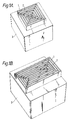
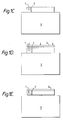
- a water channel 1 is cut therein, preferably in the form of a rectangular (Figure 1B) or square ( Figure 1A) helix, together with an adjacent but deeper channel 2 which forms the air gap between turns ( Figure 1C).
- the cut paths are then covered on their upper surface with a metal (eg. brass) plate 4 ( Figure 1D) which is soldered or brazed to the block to form two nominally rectangular channels within the overall helix.
- the assembly is then parted from the main block ( Figure 1E) such that the deeper air gap path 2 is exposed, but the water channel 1 remains enclosed (intact) so that water coolant can be passed through the coil during use.
- a continuous gap is then cut in the cover plate in alignment with the channel 2 to provide an air gap or space between the conducting sides of the channel forming the compact rectangular helix.
- This fabrication technique enables a coil of several turns (such as two or more) to be constructed in a space as small as 30 x 30mm.
- This coil is coupled to a conventional r.f. power supply and may be applied to the materials to be joined to make a single, relatively large, interface spot weld or may alternatively be passed along a lap seam to produce a continuous joint. In either case the coil will be positioned a small distance away from the materials (such as 2mm), for example by interposing a glass plate.
- reinforcement patches and stiffener ribs may be welded to a given sheet by passing such a coil along the surface of the sheet or patch as required.
- FIG. 1B An example of apparatus utilising an induction heating coil of the form shown in Figure 1B is shown in Figure 2.
- the finished induction coil ( Figure 1E) is located in a recess (not shown) in a pyrophillite block 10, the upper surface of the coil being covered with a glass plate having an upper surface flush with the upper surface 11 of the block 10.
- the block 10 is mounted on a base 12 and is positioned between a pair of guide blocks 13, 14 (e.g. of aluminum alloy) each of which has an upper surface substantially flush with the upper surface 11 of the block 10.
- a generally U-shaped frame 15 is mounted on the base 12 and this frame has a central opening 16 through which passes a rod 17.
- the lower end of the rod 17 is fixed to a U-shaped bracket 18 to which is mounted a pair of consolidation rollers 19, 20 positioned above the upper surface 11 of the block 10.
- RF power is supplied to the coil via water cooled leads 23, 24, shown schematically in Figure 2, from a power source (not shown).
- a power source not shown.
- the two sheets are overlapped, and are fed, for example by hand, through the frame 15 with the overlapping region 25 passing beneath the consolidation rollers 19, 20.
- RF power is supplied to the induction coil mounted in the block 10 which generates an alternating electro magnetic field with a frequency in the range 2-4MHz and this causes electrical potentials to be induced in the carbon fibres in the layers 21, 22 of the overlapped region 25 resulting in resistance heating of those carbon fibres and consequent softening or melting of the thermoplastic material or PEEK in which the carbon fibres are embedded.
- the softened or melted materials is consolidated by the rollers 19, 20 so as to bond or weld the thermoplastic sheets 21, 22 together.
- a consolidation force is applied to the upper end of the rod 17 by a conventional ram or the like (not shown).
- a layer of pre-preg tape could be inserted between the sheets 21, 22 in the overlap region 25.
- the heating effect of the coil on a mild steel sheet suspended above the coil can be monitored using liquid cystals.
- Liquid cystal paint (such as BDH Thermodynamics liquid cystal paint indicating 34.2°C) is coated onto a mild steel plate (e.g 150mm x 250mm x 1m), and a circle 45mm diameter is marked on the surface.
- the plate is suspended 16.0 mm above the coil, for best results.
- the temperature within the marked circle attained at least 34.2°C within 15 seconds.
- This technique does not give an absolute measure of the power transmitted by the coil, but has been found to be a reproducible technique for setting the equipment.
- the invention enables local or spot welds to be made as well as continuous seam welds.
- a patch weld or joint can equally be readily carried out with the induction coil either of similar dimensions to the patch so that the edge effect is directly enhanced or, for a larger patch, to pass the four edges in the vicinity of the coil in turn. It should be noted that with the coil on the same side as the patch the latter is preferentially heated. Conversely, with the coil on the remote side from the patch (that is adjacent to the main sheet) the latter is more heated but the patch will bond when a sufficient temperature has been obtained at the interface with consolidation under applied load.
Landscapes
- Engineering & Computer Science (AREA)
- Mechanical Engineering (AREA)
- Physics & Mathematics (AREA)
- Thermal Sciences (AREA)
- Textile Engineering (AREA)
- Health & Medical Sciences (AREA)
- Toxicology (AREA)
- Lining Or Joining Of Plastics Or The Like (AREA)
- Laminated Bodies (AREA)
- General Induction Heating (AREA)
Claims (11)
- Procédé de liaison d'une couche thermoplastique (22) sur un substrat (21), le procédé comportant la mise en place de la couche thermoplastique en contact avec le substrat; et l'application d'un champ électromagnétique alternatif de façon à induire des courants électriques dans des conducteurs électriques associés à la couche et au substrat, la chaleur générée par les courants passant à travers les conducteurs amenant la matière thermoplastique à lier la couche au substrat, caractérisé en ce que la couche thermoplastique et le substrat comportent chacun au moins une couche de conducteurs électriques sensiblement unidirectionnels noyés dans et revêtus par la matière thermoplastique.
- Procédé selon la revendication 1, selon lequel les conducteurs électriques dans le substrat (21) et dans la couche thermoplastique (22) devant être liée au substrat ont la même composition.
- Procédé selon la revendication 2, selon lequel les conducteurs électriques comportent des fibres de carbone.
- Procédé selon l'une quelconque des revendications précédentes, selon lequel l'étape d'induction comprend la génération d'un champ électromagnétique alternatif avec une fréquence dans la plage de 1 à 10 MHz.
- Procédé selon la revendication 4, selon lequel la fréquence du champ électromagnétique est dans la plage de 2 à 4 MHz.
- Procédé selon l'une quelconque des revendications précédentes, selon lequel la couche thermoplastique comprend du APC-2.
- Procédé selon l'une quelconque des revendications précédentes, selon lequel la couche thermoplastique comprend un composite polymère aromatique comportant des couches de fibres de carbone unidirectionnelles revêtues de poly-éther-cétone.
- Procédé selon l'une quelconque des revendications précédentes, comportant en outre le positionnement d'une autre couche thermoplastique sur la première couche thermoplastique, la première couche thermoplastique étant positionnée entre le substrat et l'autre couche thermoplastique, et l'étape d'application d'un champ électromagnétique alternatif qui amène l'autre couche thermoplastique à être liée au substrat par l'intermédiaire de la première couche.
- Procédé selon l'une quelconque des revendications précédentes, selon lequel les conducteurs dans la couche thermoplastique s'étendent transversalement aux conducteurs dans le substrat.
- Procédé selon l'une quelconque des revendications précédentes, selon lequel le champ électromagnétique est appliqué par une bobine d'induction ayant au moins deux tours espacés latéralement.
- Procédé selon la revendication 10, selon lequel les tours sont positionnés dans une zone 30 mm x 30 mm.
Applications Claiming Priority (2)
| Application Number | Priority Date | Filing Date | Title |
|---|---|---|---|
| GB8704852 | 1987-03-02 | ||
| GB878704852A GB8704852D0 (en) | 1987-03-02 | 1987-03-02 | Bonding thermoplastic layers |
Publications (3)
| Publication Number | Publication Date |
|---|---|
| EP0281347A2 EP0281347A2 (fr) | 1988-09-07 |
| EP0281347A3 EP0281347A3 (en) | 1989-10-18 |
| EP0281347B1 true EP0281347B1 (fr) | 1993-05-05 |
Family
ID=10613188
Family Applications (1)
| Application Number | Title | Priority Date | Filing Date |
|---|---|---|---|
| EP88301739A Expired - Lifetime EP0281347B1 (fr) | 1987-03-02 | 1988-02-29 | Liaison de couches en matière plastique |
Country Status (4)
| Country | Link |
|---|---|
| US (1) | US4871412A (fr) |
| EP (1) | EP0281347B1 (fr) |
| DE (1) | DE3880716T2 (fr) |
| GB (1) | GB8704852D0 (fr) |
Cited By (2)
| Publication number | Priority date | Publication date | Assignee | Title |
|---|---|---|---|---|
| US7255770B2 (en) | 2002-08-12 | 2007-08-14 | Mentor Corporation | Method for laser welding flexible polymers |
| US8343410B2 (en) | 2007-02-24 | 2013-01-01 | Evonik Degussa Gmbh | Induction-assisted production method |
Families Citing this family (28)
| Publication number | Priority date | Publication date | Assignee | Title |
|---|---|---|---|---|
| JPH04504386A (ja) * | 1989-01-10 | 1992-08-06 | コートールズ パブリック リミティド カンパニー | 複合材料の接合方法 |
| US4978825A (en) * | 1989-11-08 | 1990-12-18 | Northrop Corporation | Thermoplastic composite induction welder |
| US5240542A (en) * | 1990-09-06 | 1993-08-31 | The Board Of Trustees Of The Leland Stanford Junior University | Joining of composite materials by induction heating |
| US5531614A (en) * | 1991-05-08 | 1996-07-02 | Amphenol Corporation | Composite canned data bus coupler connector |
| US5225025A (en) * | 1991-05-14 | 1993-07-06 | Aluminum Company Of America | Apparatus and method for resistance welding |
| US5248864A (en) * | 1991-07-30 | 1993-09-28 | E. I. Du Pont De Nemours And Company | Method for induction heating of composite materials |
| US5500511A (en) * | 1991-10-18 | 1996-03-19 | The Boeing Company | Tailored susceptors for induction welding of thermoplastic |
| JPH05217121A (ja) * | 1991-11-22 | 1993-08-27 | Internatl Business Mach Corp <Ibm> | 磁気変換器付きチップ等の感熱素子を結合する方法及び装置 |
| US5313034A (en) * | 1992-01-15 | 1994-05-17 | Edison Welding Institute, Inc. | Thermoplastic welding |
| US5338497A (en) * | 1992-04-03 | 1994-08-16 | Ford Motor Company | Induction heating method for forming composite articles |
| US5916469A (en) * | 1996-06-06 | 1999-06-29 | The Boeing Company | Susceptor integration into reinforced thermoplastic composites |
| AU746100B2 (en) | 1997-02-28 | 2002-04-18 | Robert Harlan Johnson Jr. | High efficiency heating agents |
| US7141768B2 (en) | 2000-04-28 | 2006-11-28 | Nexicor, Llc | Fastening device |
| US6951798B2 (en) * | 2001-06-08 | 2005-10-04 | Wisconsin Alumni Research Foundation | Method of bonding a stack of layers by electromagnetic induction heating |
| WO2003026821A1 (fr) * | 2001-09-25 | 2003-04-03 | Gerhard Jack K | Appareil et procede de stratification par induction de materiaux composites renforces par des fibres conductrices |
| US20090032184A1 (en) * | 2005-04-08 | 2009-02-05 | Ali Yousefpour | Resistance Welding of Thermoplastics |
| DE102006040049B4 (de) * | 2006-08-26 | 2009-12-17 | Airbus Deutschland Gmbh | Verfahren und Vorrichtung zum Vorformen von Kohlenstofffaser-Halbzeugen für die Herstellung von Faserverbundbauteilen |
| DE102007006702B4 (de) | 2007-02-10 | 2015-10-01 | Deutsches Zentrum für Luft- und Raumfahrt e.V. | Verfahren zur Beurteilung der Qualität von Vorformen von Bauteilen aus Faserverbundwerkstoffen |
| US10252376B2 (en) * | 2009-03-03 | 2019-04-09 | U-Haul International, Inc. | Welded lap joint with corrosive-protective structure |
| KR20110118963A (ko) * | 2010-04-26 | 2011-11-02 | 한국생산기술연구원 | 비접촉 충전 발열 장치 |
| WO2013094008A1 (fr) * | 2011-12-20 | 2013-06-27 | トヨタ自動車株式会社 | Procédé pour connecter des éléments et structure de connexion |
| US8741091B2 (en) * | 2012-04-26 | 2014-06-03 | Richard Hardy | Method for thermoplastic welding and welded composite structures |
| DE102013219822A1 (de) | 2013-09-30 | 2015-04-02 | Bayerische Motoren Werke Aktiengesellschaft | Formkörper aus einem Faserverbundwerkstoff, Verwendung des Formkörpers sowie Verfahren zur Herstellung eines Bauteils |
| DE102015209571A1 (de) | 2014-05-27 | 2015-12-03 | Leichtbau-Zentrum Sachsen Gmbh | Bauteile aus faser-kunststoff-verbunden und verfahren zu ihrer herstellung |
| BR112020021755B1 (pt) | 2018-04-24 | 2022-07-05 | Qarbon Aerospace (Foundation), Llc | Aeroestrutura aquecida |
| GB201807144D0 (en) | 2018-05-01 | 2018-06-13 | Rolls Royce Plc | Polymer matrix composite repair |
| US10449749B1 (en) | 2018-05-03 | 2019-10-22 | Triumph Aerostructures, Llc. | Thermoplastic aerostructure with localized ply isolation and method for forming aerostructure |
| NL2029435B1 (en) | 2021-10-15 | 2023-05-16 | Kok & Van Engelen Composite Structures B V | Method for electromagnetic welding of molded parts and a heat sink for use in such method |
Citations (2)
| Publication number | Priority date | Publication date | Assignee | Title |
|---|---|---|---|---|
| US4029837A (en) * | 1975-08-14 | 1977-06-14 | William C. Heller, Jr. | Composite plastic-metallic bonding means and method |
| GB2200590A (en) * | 1987-02-10 | 1988-08-10 | Welding Inst | Bonding thermoplastic materials |
Family Cites Families (12)
| Publication number | Priority date | Publication date | Assignee | Title |
|---|---|---|---|---|
| BE452317A (fr) * | ||||
| GB1025388A (en) * | 1961-11-30 | 1966-04-06 | Lord Corp | Joining articles and structure therefor |
| US3528867A (en) * | 1966-08-15 | 1970-09-15 | Heller William C Jun | Method for selective heat sealing or joining of materials |
| US3902940A (en) * | 1969-12-08 | 1975-09-02 | Heller William C Jun | Art of joining foamed members |
| US3996402A (en) * | 1974-03-04 | 1976-12-07 | The Boeing Company | Fastening device for use with induction heater apparatus and system for holding together two nonmetal surfaces |
| FR2348957A1 (fr) * | 1976-04-21 | 1977-11-18 | Weber & Broutin Sa | Procede,appareil et produit a base de colle thermofusible pour l'assemblage d'un element de revetement a un support |
| DE2843385C2 (de) * | 1978-10-05 | 1980-10-02 | Cyklop Gesellschaft Emil Hoffmann, 5000 Koeln | Verfahren zum Verbinden der Bandenden eines Kunststoffbandes |
| US4313777A (en) * | 1979-08-30 | 1982-02-02 | The United States Of America As Represented By The United States National Aeronautics And Space Administration | One-step dual purpose joining technique |
| GB2102036B (en) * | 1981-07-01 | 1984-12-05 | Rolls Royce | Method of manufacturing composite materials |
| GB2119710A (en) * | 1982-05-05 | 1983-11-23 | Smith H R | Producing thermoplastics material laminates, foams and articles |
| US4483896A (en) * | 1983-02-04 | 1984-11-20 | Seam Team | Carpet seaming tape with separate heating circuits |
| US4673450A (en) * | 1985-01-22 | 1987-06-16 | The Boeing Company | Method of welding together graphite fiber reinforced thermoplastic laminates |
-
1987
- 1987-03-02 GB GB878704852A patent/GB8704852D0/en active Pending
-
1988
- 1988-02-24 US US07/159,726 patent/US4871412A/en not_active Expired - Fee Related
- 1988-02-29 EP EP88301739A patent/EP0281347B1/fr not_active Expired - Lifetime
- 1988-02-29 DE DE88301739T patent/DE3880716T2/de not_active Expired - Fee Related
Patent Citations (2)
| Publication number | Priority date | Publication date | Assignee | Title |
|---|---|---|---|---|
| US4029837A (en) * | 1975-08-14 | 1977-06-14 | William C. Heller, Jr. | Composite plastic-metallic bonding means and method |
| GB2200590A (en) * | 1987-02-10 | 1988-08-10 | Welding Inst | Bonding thermoplastic materials |
Cited By (2)
| Publication number | Priority date | Publication date | Assignee | Title |
|---|---|---|---|---|
| US7255770B2 (en) | 2002-08-12 | 2007-08-14 | Mentor Corporation | Method for laser welding flexible polymers |
| US8343410B2 (en) | 2007-02-24 | 2013-01-01 | Evonik Degussa Gmbh | Induction-assisted production method |
Also Published As
| Publication number | Publication date |
|---|---|
| GB8704852D0 (en) | 1987-04-08 |
| EP0281347A2 (fr) | 1988-09-07 |
| DE3880716T2 (de) | 1993-10-14 |
| EP0281347A3 (en) | 1989-10-18 |
| DE3880716D1 (de) | 1993-06-09 |
| US4871412A (en) | 1989-10-03 |
Similar Documents
| Publication | Publication Date | Title |
|---|---|---|
| EP0281347B1 (fr) | Liaison de couches en matière plastique | |
| US7126096B1 (en) | Resistance welding of thermoplastics in aerospace structure | |
| US5508496A (en) | Selvaged susceptor for thermoplastic welding by induction heating | |
| CN103702792B (zh) | 接合带有由热塑性塑料制成的中间层的板状构件 | |
| US5444220A (en) | Asymmetric induction work coil for thermoplastic welding | |
| US6323468B1 (en) | Static coil apparatus and method for welding thermoplastic composite structures | |
| US5313034A (en) | Thermoplastic welding | |
| EP3802072B1 (fr) | Méthode et dispositif d'assemblage de pièces moulées par soudage électromagnétique | |
| CN105473268B (zh) | 使用第二电路电阻焊接夹芯板的方法和设备 | |
| CA2685143A1 (fr) | Procede et dispositif pour le brasage electromagnetique de pieces moulees | |
| JP2016535679A (ja) | サンドイッチパネルの多段抵抗溶接 | |
| US20210291286A1 (en) | Device and method for soldering contact elements with induction heat | |
| EP0625868A2 (fr) | Appareil et procédé pour connexion fixe par induction | |
| US20050184053A1 (en) | Method for bonding thermoplastics | |
| DE4444461A1 (de) | Kombiniertes Ultraschall- und Widerstandspreßschweißverfahren | |
| US20090032184A1 (en) | Resistance Welding of Thermoplastics | |
| US3555231A (en) | Process for welding butyl rubber | |
| EP0924054A2 (fr) | Elément de soudage pour des pièces en matière plastique | |
| US2438155A (en) | Process of welding metal bodies by high-frequency electric heating of dielectric material therebetween | |
| JP7794828B2 (ja) | 成形部品の電磁スポット溶接のための方法及び装置 | |
| JP7402741B2 (ja) | 融着方法及び接合体 | |
| EP0830283A1 (fr) | Soudage electrique par resistance de thermoplastiques dans une structure aerospatiale | |
| JPH04339999A (ja) | 防水シート | |
| KR100386133B1 (ko) | 박막 적층형 플렉시블 단자 제조장치 및 그 방법 | |
| JPH061804Y2 (ja) | 誘導加熱ウエルダの型構造 |
Legal Events
| Date | Code | Title | Description |
|---|---|---|---|
| PUAI | Public reference made under article 153(3) epc to a published international application that has entered the european phase |
Free format text: ORIGINAL CODE: 0009012 |
|
| AK | Designated contracting states |
Kind code of ref document: A2 Designated state(s): DE FR GB IT |
|
| PUAL | Search report despatched |
Free format text: ORIGINAL CODE: 0009013 |
|
| AK | Designated contracting states |
Kind code of ref document: A3 Designated state(s): DE FR GB IT |
|
| 17P | Request for examination filed |
Effective date: 19900314 |
|
| 17Q | First examination report despatched |
Effective date: 19910627 |
|
| GRAA | (expected) grant |
Free format text: ORIGINAL CODE: 0009210 |
|
| AK | Designated contracting states |
Kind code of ref document: B1 Designated state(s): DE FR GB IT |
|
| REF | Corresponds to: |
Ref document number: 3880716 Country of ref document: DE Date of ref document: 19930609 |
|
| ITF | It: translation for a ep patent filed | ||
| ET | Fr: translation filed | ||
| PLBE | No opposition filed within time limit |
Free format text: ORIGINAL CODE: 0009261 |
|
| STAA | Information on the status of an ep patent application or granted ep patent |
Free format text: STATUS: NO OPPOSITION FILED WITHIN TIME LIMIT |
|
| 26N | No opposition filed | ||
| PGFP | Annual fee paid to national office [announced via postgrant information from national office to epo] |
Ref country code: GB Payment date: 19950303 Year of fee payment: 8 |
|
| PGFP | Annual fee paid to national office [announced via postgrant information from national office to epo] |
Ref country code: FR Payment date: 19950309 Year of fee payment: 8 Ref country code: DE Payment date: 19950309 Year of fee payment: 8 |
|
| PG25 | Lapsed in a contracting state [announced via postgrant information from national office to epo] |
Ref country code: GB Effective date: 19960229 |
|
| GBPC | Gb: european patent ceased through non-payment of renewal fee |
Effective date: 19960229 |
|
| PG25 | Lapsed in a contracting state [announced via postgrant information from national office to epo] |
Ref country code: FR Effective date: 19961031 |
|
| PG25 | Lapsed in a contracting state [announced via postgrant information from national office to epo] |
Ref country code: DE Effective date: 19961101 |
|
| REG | Reference to a national code |
Ref country code: FR Ref legal event code: ST |
|
| PG25 | Lapsed in a contracting state [announced via postgrant information from national office to epo] |
Ref country code: IT Free format text: LAPSE BECAUSE OF NON-PAYMENT OF DUE FEES Effective date: 20050228 |