EP0281410A2 - Moulage d'un écrou indésserrable en matière plastique - Google Patents
Moulage d'un écrou indésserrable en matière plastique Download PDFInfo
- Publication number
- EP0281410A2 EP0281410A2 EP88301898A EP88301898A EP0281410A2 EP 0281410 A2 EP0281410 A2 EP 0281410A2 EP 88301898 A EP88301898 A EP 88301898A EP 88301898 A EP88301898 A EP 88301898A EP 0281410 A2 EP0281410 A2 EP 0281410A2
- Authority
- EP
- European Patent Office
- Prior art keywords
- nut
- cavity
- sectors
- core
- threaded
- Prior art date
- Legal status (The legal status is an assumption and is not a legal conclusion. Google has not performed a legal analysis and makes no representation as to the accuracy of the status listed.)
- Ceased
Links
Images


Classifications
-
- B—PERFORMING OPERATIONS; TRANSPORTING
- B29—WORKING OF PLASTICS; WORKING OF SUBSTANCES IN A PLASTIC STATE IN GENERAL
- B29C—SHAPING OR JOINING OF PLASTICS; SHAPING OF MATERIAL IN A PLASTIC STATE, NOT OTHERWISE PROVIDED FOR; AFTER-TREATMENT OF THE SHAPED PRODUCTS, e.g. REPAIRING
- B29C45/00—Injection moulding, i.e. forcing the required volume of moulding material through a nozzle into a closed mould; Apparatus therefor
- B29C45/17—Component parts, details or accessories; Auxiliary operations
- B29C45/26—Moulds
- B29C45/2618—Moulds having screw-threaded mould walls
-
- B—PERFORMING OPERATIONS; TRANSPORTING
- B29—WORKING OF PLASTICS; WORKING OF SUBSTANCES IN A PLASTIC STATE IN GENERAL
- B29C—SHAPING OR JOINING OF PLASTICS; SHAPING OF MATERIAL IN A PLASTIC STATE, NOT OTHERWISE PROVIDED FOR; AFTER-TREATMENT OF THE SHAPED PRODUCTS, e.g. REPAIRING
- B29C33/00—Moulds or cores; Details thereof or accessories therefor
- B29C33/44—Moulds or cores; Details thereof or accessories therefor with means for, or specially constructed to facilitate, the removal of articles, e.g. of undercut articles
- B29C33/48—Moulds or cores; Details thereof or accessories therefor with means for, or specially constructed to facilitate, the removal of articles, e.g. of undercut articles with means for collapsing or disassembling
- B29C33/485—Moulds or cores; Details thereof or accessories therefor with means for, or specially constructed to facilitate, the removal of articles, e.g. of undercut articles with means for collapsing or disassembling cores or mandrels
-
- B—PERFORMING OPERATIONS; TRANSPORTING
- B29—WORKING OF PLASTICS; WORKING OF SUBSTANCES IN A PLASTIC STATE IN GENERAL
- B29C—SHAPING OR JOINING OF PLASTICS; SHAPING OF MATERIAL IN A PLASTIC STATE, NOT OTHERWISE PROVIDED FOR; AFTER-TREATMENT OF THE SHAPED PRODUCTS, e.g. REPAIRING
- B29C45/00—Injection moulding, i.e. forcing the required volume of moulding material through a nozzle into a closed mould; Apparatus therefor
- B29C45/17—Component parts, details or accessories; Auxiliary operations
- B29C45/26—Moulds
- B29C45/2681—Moulds with rotatable mould parts
-
- B—PERFORMING OPERATIONS; TRANSPORTING
- B29—WORKING OF PLASTICS; WORKING OF SUBSTANCES IN A PLASTIC STATE IN GENERAL
- B29D—PRODUCING PARTICULAR ARTICLES FROM PLASTICS OR FROM SUBSTANCES IN A PLASTIC STATE
- B29D1/00—Producing articles with screw-threads
-
- B—PERFORMING OPERATIONS; TRANSPORTING
- B29—WORKING OF PLASTICS; WORKING OF SUBSTANCES IN A PLASTIC STATE IN GENERAL
- B29C—SHAPING OR JOINING OF PLASTICS; SHAPING OF MATERIAL IN A PLASTIC STATE, NOT OTHERWISE PROVIDED FOR; AFTER-TREATMENT OF THE SHAPED PRODUCTS, e.g. REPAIRING
- B29C45/00—Injection moulding, i.e. forcing the required volume of moulding material through a nozzle into a closed mould; Apparatus therefor
- B29C45/17—Component parts, details or accessories; Auxiliary operations
- B29C45/26—Moulds
- B29C45/2618—Moulds having screw-threaded mould walls
- B29C45/262—Moulds having screw-threaded mould walls provided with unscrewing drive means
-
- Y—GENERAL TAGGING OF NEW TECHNOLOGICAL DEVELOPMENTS; GENERAL TAGGING OF CROSS-SECTIONAL TECHNOLOGIES SPANNING OVER SEVERAL SECTIONS OF THE IPC; TECHNICAL SUBJECTS COVERED BY FORMER USPC CROSS-REFERENCE ART COLLECTIONS [XRACs] AND DIGESTS
- Y10—TECHNICAL SUBJECTS COVERED BY FORMER USPC
- Y10S—TECHNICAL SUBJECTS COVERED BY FORMER USPC CROSS-REFERENCE ART COLLECTIONS [XRACs] AND DIGESTS
- Y10S425/00—Plastic article or earthenware shaping or treating: apparatus
- Y10S425/058—Undercut
Definitions
- a Luer nut is a device that is usually used in the medical field to hold two liquid carrying fittings together.
- the fittings have a Luer taper as described in the American National Standard ANSI/HIMA MD70.1-1983.
- the Luer taper is used to make quick, leak proof connections, and is comprised of two tapered pieces, one male and one female. The male and female parts are drawn together to make a tightly fitting connection.
- the connection is held together by a male thread on the female Luer taper part and a nut-like device with internal threads, called a Luer nut, on the male Luer taper part.
- An improved Luer nut is disclosed by Thomas P. Stephens in U.S. Patent Application, Serial Number 740,353, entitled “Non-Loosening Luer Nut", filed June 3, 1985.
- the internal cross section of the threaded section of the improved Luer nut is not round like previous Luer nuts, but is generally in the shape of a polygon that is deformable rather than stiff.
- the polygonal cross-section of the improved Luer nut frequently is in the general shape of a triangle with rounded sides each with a relatively large average radius and rounded corners each with a relatively small radius, which is referred to as a trilobate shape.
- a second solution to the problem of molding such a polygonal nut is to use a collapsible core. That is, the threaded core is designed so that it can be folded in on itself after the plastic has solidified.
- Luer nuts are generally small, with an internal diameter on the order of five millimeters. In general, building a collapsible core with such small dimensions is impractical.
- the present invention involves a technique for automatically molding the new Luer nut, with its polygonal internal cross-section.
- this technique will be described with respect to a plastic Luer nut with a generally trilobate internal shape.
- the technique can readily be adapted to molding of materials other than plastic, and to any nut with a non-round, polygonal internal cross-section.
- an inner threaded core having a generally trilobate external cross-section is arranged in spaced relationship to a cavity within a mold housing.
- the cavity will have a generally trilobate internal cross-section so that the resulting Luer nuts will have a relatively constant wall thickness.
- the movable sections of the mold cavity provide areas for the molded part to expand into as the trilobate shaped threaded core is unscrewed. Since the nut and the mold core are both trilobate in sectional shape, and because sections of the cavity are movable, the portions of the part which are adjacent to the large radius portions of the core have room to expand as the three high lobes on the threaded core rotate within the nut.
- the cavity hold the nut around its perimeter to prevent the nut from turning with the core as the core is rotated.
- This can be accomplished by having longitudinal slots in the inner wall of the cavity to form ribs on the outside of the nut which prevent the nut from rotating as the core is rotated.
- the ribs can be made significantly shorter in height, while still providing sufficient resistance to rotation especially when the threaded core initially begins to unscrew, by spacing several slots and the resulting ribs around the nut and thereby extending into both the fixed and movable sections of the mold cavity.
- additional resistance to rotation of the nut can be provided through the use of radially inwardly acting springs connected to the movable sections of the mold cavity.
- the mold can be readily adapted to form a plurality of Luer nuts at one time by providing an equal number of cavities and threaded cores within the mold housing.
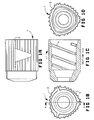
- Figures 1A-1D show the shape of a trilobate Luer nut, which is the result of the molding technique of the present invention.
- Figure 1A shows an outside side view of the Luer nut 1, including a plurality of ribs 2.
- the ribs 2 serve to provide means by which a user can easily grip and turn the nut 1 for screwing it onto a mating female part (not shown). Because the ribs 2 are intended to be manually gripped it is desirable that the ribs 2 not be so high as to irritate the user.
- Figure 1C which is a sectional view of the nut 1 taken along the axis A-A as shown in Figure 1B, shows the internal Luer threads 4.
- the illustrated nut has both an inner and outer trilobate shape, so that the mean thickness of the wall 5 is essentially constant around the circumference of the nut 5 at any plane along the length of the nut.
- the wall thickness can be varied to provide an outer shape which is any desired shape, including round.
- FIG. 2 shows a side sectional view of the plastic mold 6 according to a preferred embodiment.
- the nut 1 is formed within a cavity 7 by injecting a thermoplastic such as polyester (e.g., Valox 325 available from the General Electric Company) via a sprew 8 and a runner 9 and a gate 10 into the cavity 7.
- a thermoplastic such as polyester (e.g., Valox 325 available from the General Electric Company)
- the radial sides of the cavity 7 are formed, in the case of a trilobate nut, by three fixed sectors 11 and three movable sectors 12 in a cavity retainer plate 13.
- Added strength is provided by a cavity backup plate 14 to the outside of the cavity retainer plate 13.
- a knock-out pin 15 extends through the cavity retainer plate 13 and the cavity backup plate 14, and is mounted so that the pin 15 can slidably move along the central axis 16 of the cavity 7.
- the knock-out pin 15 serves two purposes: first, when in the position shown in Figure 2, its end 17 provides one end of the cavity 7; and, second, when the nut 1 is ready to ejected from the mold 6, it can be moved longitudinally in direction L to push the nut 1 out of the mold 6 via a parting line 18 between the cavity retainer plate 13 and a stripper plate 19.
- a movable pin 20 is also provided within the cavity retainer plate 13, which in the position shown locks the movable sectors 12 relative to the fixed sectors 11. When the pin 20 is moved longitudinally in direction R, the movable sectors 12 are free to move with respect to the fixed sectors 11 with respect to the central axis 16.
- a threaded core 21 is provided extending through a core retainer plate 22, the stripper plate 19, into the cavity 7.
- the threaded core 21 has an end 23 with external Luer threads 24, with a trilobate external cross-section, and serves to provide the internal shape of the nut 1.
- the threaded core 21 can be rotated within a bearing 25 by an external rotating mechanism (not shown), such as an oil cylinder and rack and pinion gear.
- an external rotating mechanism such as an oil cylinder and rack and pinion gear.
- the core retainer plate 22 is moved in direction L at the same rate as the pitch of the Luer threads 24.
- the coordinated movement of the rotation of the threaded core 21 and the core retainer plate 22 can be accomplished by conventional means, such as a cam (not shown) connected to the external rotating mechanism.
- Figures 3A and 3B show a sectional view of the mold 6 taken along the parting line 18, as indicated by axis B-B.
- Figure 3A shows the mold 6 when the nut 1 is in its as molded position.
- the corners of the nut 1 will be referred to as the small radii sr, and the portions between the corners will be referred to as the large radii LR.
- the outermost portions 30 of the core 21 form the small radii sr, and when the core 21 is unscrewing, the portions 32 of the nut 1 initially adjacent to the portions 30 of the core 21 do not have to expand because they are the outermost portions of the nut 1.
- the portions 32 of the nut 1 can be in an area of the mold 6 that does not expand, that is, the fixed sectors 11. Further, since the fixed sectors 11 do not have to expand, they can serve to hold the nut 1 from rotating while the core 21 is unscrewing.
- the large radii portions LR of the nut 1 must, however, expand while the core 21 is unscrewing as shown in Figure 3B.
- the movable sectors 13 must move radially outward so that the large radii portions LR of the nut 1 can expand as the high points 30 of the core 21 rotate within the nut and push the large radii portions LR radially outward.
- the force of the unscrewing core 21 is sufficient to expand the movable sectors 13, but active means, such as a cam (not shown) coupled between the core and the moveable sectors 13 could be used as well.
- the core 21 applies considerable torque to the nut 1 while being unscrewed because the molded nut 1 is continually being distorted as the core 1 is removed.
- the torque applied to the nut 1 after initial break away is considerably less.
- This high initial torque could cause the nut 1 to turn and strip off the outside texture of the nut 1 unless the nut 1 is held firmly within the cavity 7.
- Such stripping is prevented by the use of slots 34 and 36, which form the ribs 2 on the nut 1. At least one of the sets of slots 34 or 36 are therefore required to prevent rotation of the nut 1.
- slots 36 and 34 be provided in both the fixed sectors 11 and the movable sectors 13, respectively, to provide sufficient holding, so that the ribs 2 need not be too high and/or thick. If added holding force is required, inwardly acting springs (not shown) can be then coupled to the moveable sectors 13 to maintain the even higher resistance to rotation of the nut 1. Once the initial break away of the core 21 has occurred, the moveable sectors 13 can stay in their radially expanded position, and can be retained there either by friction or by a detent device (not shown).
- the use of the fixed sectors 11 also permits the sprew 8, the runner 9 and the gate 10 to be machined therein. This is generally very desireable, so that the mold can easily be run with automatic gate and runner removal.
Landscapes
- Engineering & Computer Science (AREA)
- Mechanical Engineering (AREA)
- Manufacturing & Machinery (AREA)
- Moulds For Moulding Plastics Or The Like (AREA)
- Casting Or Compression Moulding Of Plastics Or The Like (AREA)
Applications Claiming Priority (2)
| Application Number | Priority Date | Filing Date | Title |
|---|---|---|---|
| US22701 | 1987-03-06 | ||
| US07/022,701 US4737334A (en) | 1987-03-06 | 1987-03-06 | Plastic molding of an improved Luer nut |
Publications (2)
| Publication Number | Publication Date |
|---|---|
| EP0281410A2 true EP0281410A2 (fr) | 1988-09-07 |
| EP0281410A3 EP0281410A3 (fr) | 1989-10-18 |
Family
ID=21810983
Family Applications (1)
| Application Number | Title | Priority Date | Filing Date |
|---|---|---|---|
| EP88301898A Ceased EP0281410A3 (fr) | 1987-03-06 | 1988-03-04 | Moulage d'un écrou indésserrable en matière plastique |
Country Status (3)
| Country | Link |
|---|---|
| US (1) | US4737334A (fr) |
| EP (1) | EP0281410A3 (fr) |
| JP (1) | JP2579793B2 (fr) |
Families Citing this family (11)
| Publication number | Priority date | Publication date | Assignee | Title |
|---|---|---|---|---|
| US5106650A (en) * | 1988-07-14 | 1992-04-21 | Union Carbide Chemicals & Plastics Technology Corporation | Electrostatic liquid spray application of coating with supercritical fluids as diluents and spraying from an orifice |
| US5176415A (en) * | 1990-08-16 | 1993-01-05 | Choksi Pradip V | Taper fitting with protective skirt |
| DE4224141A1 (de) * | 1992-07-22 | 1994-01-27 | Hoechst Ag | Vorrichtung zum Vorformen von plastifiziertem Kunststoffmaterial |
| US5352215A (en) * | 1992-08-26 | 1994-10-04 | Scimed Life Systems, Inc. | Y-adapter with a sideport radius |
| CA2231066C (fr) * | 1998-01-09 | 2004-05-11 | Andrew J. Boast | Composant en plastique moule monolithique adapte pour recevoir un joint annulaire |
| JP3558003B2 (ja) | 2000-03-03 | 2004-08-25 | 株式会社村田製作所 | 非可逆回路素子および通信装置 |
| US7611503B2 (en) | 2004-04-16 | 2009-11-03 | Medrad, Inc. | Fluid delivery system, fluid path set, sterile connector and improved drip chamber and pressure isolation mechanism |
| US20070161970A1 (en) * | 2004-04-16 | 2007-07-12 | Medrad, Inc. | Fluid Delivery System, Fluid Path Set, and Pressure Isolation Mechanism with Hemodynamic Pressure Dampening Correction |
| US8540698B2 (en) * | 2004-04-16 | 2013-09-24 | Medrad, Inc. | Fluid delivery system including a fluid path set and a check valve connector |
| EP1639286B1 (fr) * | 2003-06-17 | 2014-12-03 | Filtertek Inc. | Dispositif de manipulation de fluide |
| ES2371731B1 (es) * | 2010-06-11 | 2012-05-28 | Irumold S.L. | Molde para piezas inyectadas con contrasalidas internas. |
Family Cites Families (12)
| Publication number | Priority date | Publication date | Assignee | Title |
|---|---|---|---|---|
| US952279A (en) * | 1909-08-02 | 1910-03-15 | Hayes Mcgibbeny | Mold in which to form plastic articles. |
| US2558027A (en) * | 1947-12-30 | 1951-06-26 | Armstrong Cork Co | Injection molding machine |
| GB861777A (en) * | 1956-04-23 | 1961-02-22 | Naimer Hubert | Improvements in or relating to nuts and methods of manufacturing them |
| US2891283A (en) * | 1956-05-29 | 1959-06-23 | Plastene Corp | Apparatus for molding parts having irregular outer surfaces |
| FR1495001A (fr) * | 1957-10-14 | 1967-09-15 | Rhone Poulenc Sa | Nouveau manchon fileté, notamment en matière moulée, et procédé pour sa réalisation |
| US3718419A (en) * | 1971-04-21 | 1973-02-27 | Monsanto Co | Apparatus for removing a hollow article having internal enlargements from an injection mold assembly |
| NL185061C (nl) * | 1978-07-03 | 1990-01-16 | Smiths Industries Plc | Verbindingsinrichting. |
| FR2458734B1 (fr) * | 1979-06-04 | 1985-06-07 | Baxter Travenol Lab | Dispositif de raccordement a blocage pour tuyaux |
| DE3237298C1 (de) * | 1982-10-08 | 1983-12-15 | Frömag Fröndenberger Maschinen-u.Apparatebau-Gesellschaft mbH, 5758 Fröndenberg | Vorrichtung zum Entfernen von gespritzten Kunststoffteilen mit Gewinden aus dem Werkzeug einer Spritzgiessmaschine |
| JPS59150715A (ja) * | 1983-02-16 | 1984-08-29 | Daiichi Gaiyaa Kk | 金型部材 |
| IT1171214B (it) * | 1983-07-26 | 1987-06-10 | Fip Formatura Inienzione Poli | Procedimento di sformatura di articoli tubolari in materiale plastico dotati di sporgenze anulari |
| JPH0348472Y2 (fr) * | 1985-06-03 | 1991-10-16 |
-
1987
- 1987-03-06 US US07/022,701 patent/US4737334A/en not_active Expired - Fee Related
-
1988
- 1988-03-04 EP EP88301898A patent/EP0281410A3/fr not_active Ceased
- 1988-03-04 JP JP63052025A patent/JP2579793B2/ja not_active Expired - Lifetime
Also Published As
| Publication number | Publication date |
|---|---|
| JPH0193308A (ja) | 1989-04-12 |
| EP0281410A3 (fr) | 1989-10-18 |
| US4737334A (en) | 1988-04-12 |
| JP2579793B2 (ja) | 1997-02-12 |
Similar Documents
| Publication | Publication Date | Title |
|---|---|---|
| EP0281410A2 (fr) | Moulage d'un écrou indésserrable en matière plastique | |
| US4787596A (en) | Mold for forming plastic Luer nuts | |
| EP0808240B1 (fr) | Jupe moulee sans ligne de jointure et procede de fabrication | |
| US4877144A (en) | Plastic threaded sleeve | |
| US5038455A (en) | Method of manufacturing tube coupling bodies | |
| US20020002772A1 (en) | Method for manufacturing a storage battery terminal | |
| US5540582A (en) | Expandable cavity core element for use in an injection molding system | |
| CN113543950A (zh) | 模制用于连接器的主体或帽的模具和方法 | |
| US4501301A (en) | Pipe thread protector | |
| JPH0230780B2 (fr) | ||
| KR102261980B1 (ko) | 나사 캡 사출 금형 장치 | |
| JPH0767591B2 (ja) | 中空物品の製造用工具およびその製造方法 | |
| AU683488B2 (en) | Plunger rod for cartridge-needle unit | |
| EP0833732B1 (fr) | Production de sections de manchon assemblees amovibles | |
| US20020113031A1 (en) | Molded closure and apparatus for making same | |
| GB2028949A (en) | Protectors for Screwthreads | |
| WO1991011369A1 (fr) | Bouchon filete avec bande de garantie | |
| PL201950B1 (pl) | Sposób wytwarzania gniazdowego końca części rurowej i urządzenie do wytwarzania gniazdowego końca części rurowej oraz część rurowa z gniazdowym końcem | |
| JP2960347B2 (ja) | 中空樹脂製品の成形方法 | |
| GB1575034A (en) | Method of manufacturing a helically grooved plastics bearing | |
| CN222844658U (zh) | 一种模具螺纹产品内缩结构 | |
| CN119974430B (zh) | 一种注塑模具用内螺纹抽芯脱模结构及注塑模具 | |
| KR910005128Y1 (ko) | 판재의 연결장치 | |
| WO1992001546A1 (fr) | Conteneur thermoplastique moule par injection et procedes de fabrication d'un tel conteneur | |
| JPH0239907A (ja) | 外面が逆テーパーで内面にアンダーカットリブを有する成形品の離型方法 |
Legal Events
| Date | Code | Title | Description |
|---|---|---|---|
| PUAI | Public reference made under article 153(3) epc to a published international application that has entered the european phase |
Free format text: ORIGINAL CODE: 0009012 |
|
| AK | Designated contracting states |
Kind code of ref document: A2 Designated state(s): DE FR GB |
|
| PUAL | Search report despatched |
Free format text: ORIGINAL CODE: 0009013 |
|
| AK | Designated contracting states |
Kind code of ref document: A3 Designated state(s): DE FR GB |
|
| 17P | Request for examination filed |
Effective date: 19900117 |
|
| 17Q | First examination report despatched |
Effective date: 19901026 |
|
| STAA | Information on the status of an ep patent application or granted ep patent |
Free format text: STATUS: THE APPLICATION HAS BEEN REFUSED |
|
| 18R | Application refused |
Effective date: 19911216 |