EP0281718A2 - Procédé de préparation d'un organopolysiloxane à fonction acrylate et/ou méthacrylate - Google Patents
Procédé de préparation d'un organopolysiloxane à fonction acrylate et/ou méthacrylate Download PDFInfo
- Publication number
- EP0281718A2 EP0281718A2 EP87420217A EP87420217A EP0281718A2 EP 0281718 A2 EP0281718 A2 EP 0281718A2 EP 87420217 A EP87420217 A EP 87420217A EP 87420217 A EP87420217 A EP 87420217A EP 0281718 A2 EP0281718 A2 EP 0281718A2
- Authority
- EP
- European Patent Office
- Prior art keywords
- formula
- inclusive
- reaction
- tin
- ester
- Prior art date
- Legal status (The legal status is an assumption and is not a legal conclusion. Google has not performed a legal analysis and makes no representation as to the accuracy of the status listed.)
- Granted
Links
Classifications
-
- C—CHEMISTRY; METALLURGY
- C08—ORGANIC MACROMOLECULAR COMPOUNDS; THEIR PREPARATION OR CHEMICAL WORKING-UP; COMPOSITIONS BASED THEREON
- C08G—MACROMOLECULAR COMPOUNDS OBTAINED OTHERWISE THAN BY REACTIONS ONLY INVOLVING UNSATURATED CARBON-TO-CARBON BONDS
- C08G77/00—Macromolecular compounds obtained by reactions forming a linkage containing silicon with or without sulfur, nitrogen, oxygen or carbon in the main chain of the macromolecule
- C08G77/04—Polysiloxanes
- C08G77/38—Polysiloxanes modified by chemical after-treatment
Definitions
- the present invention relates to a process for the preparation of an organopolysiloxane with an acrylate and / or methacrylate function linked to the polysiloxane chain by an SiC bond.
- organopolysiloxane of this type is increasing sharply because it has faster crosslinking rates than commercially available vinylated organopolysiloxanes.
- These acrylate and / or methacrylate organopolysiloxanes are generally in the form of diorganopolysiloxane oils and can be formulated alone or in combination with unsaturated monomers or polymers, to be subsequently crosslinked in general under UV radiation.
- US Pat. No. 3,577,264 describes paint binders forming a film and crosslinkable under radiation containing such oils.
- American patent US Pat. No. 4,035,355 describes the crosslinking in an anaerobic medium of these oils.
- European patent EP-A-016 663 describes their use as a non-stick coating.
- hydrolysable silanes are described, used as adhesion promoters of glass fiber reinforcing materials, some of these silanes being prepared by hydrosilylation of allylmethacrylate.
- esters of higher alcohols called heavy esters
- light ester transesterification of an ester of a lower alcohol
- this ester as entraining agent for the lower alcohol produced during the reaction, to accelerate this reaction by the use of a catalyst, and - possibly recycling the light ester-light alcohol fraction to the own production of the light ester.
- the aim of the present invention is to propose an industrial process for the preparation of an organopolysiloxane, in particular of a diorganopolysiloxane oil with acrylate and / or methacrylate function linked to the polysiloxane chain by an SiC bond, which does not have the disadvantages of known methods, namely the appearance of considerable quantities of by-products, the need to filter the catalyst and / or a by-product of the reaction, as well as the appearance of undesired polymerization reactions.
- the present invention which in fact relates to a process for the preparation of an organopolysiloxane, in particular of a diorganopolysiloxane oil with acrylate and / or methacrylate function, characterized in that at least partially a transesterification is carried out, by presence of a catalytically effective amount of a compound (A) with tin, an organopolysiloxane (B) having at least two siloxy units per molecule, at least one of these units corresponding to the formula: in which a is 1 or 2, the symbols R, which are identical or different, represent a radical chosen from C1-C12 alkyl radicals included, phenyl and trifluoro-3,3,3 propyl radicals, at least 80 mol% of the radicals R being methyl radicals, the symbols Y, which are identical or different, represent a link chosen from a linear or branched C1-C18 alkylene link inclusive, on an ester (C) of formula
- the alcohol formed of formula ZOH is preferably removed continuously by azeotropic distillation with the ester (C).
- alkyl radicals R mention may be made of the methyl, ethyl, propyl and butyl radical.
- Y link we can cite: -CH2-, - (CH2) 2-, - (CH2) 3-, -CH2-CH (CH3) -CH2-, - (CH2) 12-,
- the link - (CH2) 3- is the preferred link.
- group W mention may be made of the dialkylaminoalkyl and glycidyloxyalkyl groups.
- Catalyst (A) can be any mineral and / or organic tin compound. However, it is preferred to use the tin 4 valence compounds.
- dialkyltin oxides in which the alkyl radicals are C1-C18 inclusive, such as di n'butyltin oxide, di n-octyltin oxide, di (2-ethyl hexyl) oxide tin and the reaction products of these dialkyltin oxides on organic esters such as dimethyl maleate and diethyl phthalate or alkyl silicates such as methyl or ethyl silicate as described in detail in the US patents US-A-2,597,920 and US-A-3,839,246 and the British patent GB-A-1,551,868.
- tin catalysts used as curing catalysts for elastomeric silicone compositions which crosslink by polycondensation reaction.
- tin carboxylates such as dialkyltin dicarboxylates can be used, in particular di n-butyltin or di n-octyltin dilaurate, di n-octyltin or di n-butyltin diacetate (see work by NOLL “CHEMISTRY AND TECHNOLOGY OF SILICONES "page 337 Academic Press, 1968, 2nd edition) as well as the dialkyltin diversatates (US-A-3,678,002).
- the catalyst (A) can be introduced at the same time as the reactants (B) and (C) or in small portions or during the reaction.
- the amount of catalyst used can vary considerably, it is generally from 0.001 to 2%, preferably 0.01 to 0.5%, by weight of tin metal relative to the weight of the reaction mass (B) + (C) .
- the amount of ester (C) is preferably between about 1.1 and 5 moles of (C) per equivalent of alcohol YOH functions contained in (B).
- This reaction can be carried out in bulk or, preferably in an organic solvent medium such as xylene, toluene.
- the transesterification reaction is carried out between 50 and 160 ° C, preferably between 80 and 120 ° C, most often at the azeotropic distillation temperature of the ester (C) and the alcohol released. Reduced pressures can be used to avoid excessively high temperatures in the reaction mixture. It is therefore preferable to use a catalyst (A) which does not distill and which is stable under the reaction conditions so that it can continue its catalytic action.
- the reaction is preferably carried out in bulk but it can also be carried out in an organic solvent such as xylene and toluene.
- the transesterification reaction preferably takes place, firstly in the presence of 0.1 to 1% by weight relative to the weight of the reaction mass of a phenolic antioxidant such as, for example, hydroquinone and resorcinol, and, on the other hand, under an inert atmosphere, for example under nitrogen, preferably by bubbling through the reaction medium to improve the elimination of the alcohol / product azeotrope continuously (C).
- a phenolic antioxidant such as, for example, hydroquinone and resorcinol
- the functionalized oil obtained can be optionally discolored by passing over activated carbon, although this operation is generally not necessary.
- the process of the invention is carried out using a titanium catalyst such as tetraalkoxytitanium, a colored oil is obtained which it is not possible to discolour even by passage over activated carbon.
- 40 g are charged into a 500 ml three-necked flask heated by an oil bath at 100 ° C. and provided with central agitation, an ascending cooler and swept by a stream of nitrogen by bubbling through the reaction medium.
- reaction product is used as the tin catalyst for 1 h 30 minutes at 140 ° C. of 2 moles of dibutyltin oxide on 1 mole of methyl myristate following the teaching of American patent US-A-2 597,920.
- a pale yellow oil is obtained, titrating 32% by weight of tin.
- the reaction is carried out with stirring for 20 hours. At the end of the reaction, the excess MMA is removed by distillation for 1 hour at 70 ° C. at 0.4 KPa.
- Example 2 The exact same operations are carried out as in Example 1 except that 1.13 g of di-n-butyltin oxide is used, ie 0.16% by weight of tin metal relative to the reaction mass and 0.26 g of hydroquinone.
- a clear oil is obtained, of which 92 mol% of the gamma-hydroxyalkyl groups are transesterified.
- Example 2 Exactly the same operations are carried out as in Example 1, except that 5.4 g of di-n-butyltin dilaurate is used, ie 0.95% of tin metal relative to the reaction mass and 0, 52 g of hydroquinone.
- a clear oil is obtained, of which 58 mol% of the gamma-hydroxyalkyl groups are transesterified.
- Example 1 The procedure of Example 1 is repeated except that 40 g of a gamma-hydroxypropylated oil of formula: measuring 468 meq / 100 g, - 65.5 g of MAM, - 1.13 g of di-n-butyltin oxide, or 0.15% by weight of tin metal relative to the reaction mass, - 0.26 g of hydroquinone.
- a gamma-hydroxypropylated oil of formula measuring 468 meq / 100 g, - 65.5 g of MAM, - 1.13 g of di-n-butyltin oxide, or 0.15% by weight of tin metal relative to the reaction mass, - 0.26 g of hydroquinone.
- the reaction is carried out for one hour at 100 ° C., and, at the end of the reaction, the excess MMA is removed by distillation for one hour at 0.4 KPa.
- Example 4 100 g of the oil obtained in Example 4 are loaded into a 500 ml three-necked flask provided with central agitation, an ascending cooler and a thermometric sheath.
- Example 1 The procedure of Example 1 is exactly repeated, except that the tin catalyst is replaced by 0.5 g of tetrabutoxytitanium, which corresponds to the introduction of a number of moles of titanium substantially equivalent to the number of moles of tin.
- a very strongly colored blackish oil is obtained which cannot be discolored with carbon black and which is therefore unusable.
- Example 1 The procedure of Example 1 is repeated, except that the catalyst used is 1.48 g of tetrapropylzirconate, ie a number of moles of zirconium substantially equivalent to the number of moles of tin.
- the reaction medium gels during the removal of the MMA.
- a reaction time of 15 hours instead of 20 hours causes the same phenomenon.
Landscapes
- Chemical & Material Sciences (AREA)
- General Chemical & Material Sciences (AREA)
- Health & Medical Sciences (AREA)
- Chemical Kinetics & Catalysis (AREA)
- Medicinal Chemistry (AREA)
- Polymers & Plastics (AREA)
- Organic Chemistry (AREA)
- Low-Molecular Organic Synthesis Reactions Using Catalysts (AREA)
- Silicon Polymers (AREA)
- Paints Or Removers (AREA)
Abstract
Description
- La présente invention concerne un procédé de préparation d'un organopolysiloxane à fonction acrylate et/ou méthacrylate liée à la chaîne polysiloxane par une liaison SiC.
- La demande en organopolysiloxane de ce type s'accroît fortement car il présente des vitesses de réticulation plus rapides que les organopolysiloxanes vinylés disponibles dans le commerce. Ces organopolysiloxanes à fonction acrylate et/ou méthacrylate se présentent généralement sous forme d'huiles diorganopolysiloxanes et peuvent être formulées seuls ou en combinaison avec des monomères ou des polymères insaturés, pour être par la suite réticulés en général sous rayonnement UV. Ainsi le brevet américain US-A-3 577 264 décrit des liants de peinture formant une pellicule et réticulables sous radiation contenant de telles huiles. Le brevet américain US-A-4 035 355 décrit la réticulation en milieu anaérobie de ces huiles. Le brevet européen EP-A-016 663 décrit leur utilisation comme revêtement anti-adhérent. Dans le brevet britannique GB-A-949 126 on décrit des silanes hydrolysables, utilisés comme promoteurs d'adhérence de matériaux renforçateurs en fibre de verre, certains de ces silanes étant préparés par hydrosilylation d'allylméthacrylate.
- Cependant il est bien connu par la littérature que la réaction d'hydrosilylation de composés à substituant allyle, en présence d'un catalyseur au platine peut engendrer des réactions secondaires indésirables avec notamment apparition de propène à moins que l'hydrure de silicium contienne des groupements donneurs d'électrons tels que des groupements chlore ou carbonyle. On peut se rapporter à ce sujet à SPEIER, J.L. et al., J AM CHEM SOC. 79 51957 (1974) ET RYAM, I.W. ET al. J AM CHEM. SOC., 82 3601 (1980) ainsi qu'aux brevets américains US-A-4 503 208 et US-A-3 767 690.
- Les brevets américains US-A-4 011 247 et US-A-4 554 339 décrivent des diorganopolysiloxanes portant à la fois des motifs acryloxy et des motifs SiH.
- Selon le brevet US-A-4 554 339 on estérifie des huiles gamma-hydroxypropylées en bout de chaîne par de l'acide acrylique en utilisant une terre acide du type montmorillonite. Ce procédé présente l'inconvénient de devoir séparer le catalyseur solide en fin de réaction.
- Dans les brevets américains US-A-4 261 875 et US-A-4 294 974 on décrit un procédé de préparation d'huiles diorganopolysiloxanes à fonctionnalité acrylate et/ou méthacrylate pouvant présenter en outre des fonctions hydroxyalkyle par réaction de l'huile diorganopolysiloxane correspondante à fonction hydroxyalkyle sur le chlorure d'acryloyle ou de méthacryloyle en présence de triéthylamine et formation du chlorhydrate de l'amine correspondant. Le principal inconvénient de cette méthode est précisément l'élimination du chlorhydrate d'amine formé.
- Il est par ailleurs bien connu de façon générale, en dehors des silicones, en chimie organique :
- de préparer des esters des alcools supérieurs, dénommés esters lourds, par transestérification d'un ester d'un alcool inférieur, dénommé ester léger, avec ces alcools supérieurs,
de favoriser la transéstérification par l'emploi d'un excès de l'ester léger et d'utiliser cet ester comme agent d'entraînement de l'acool inférieur produit au cours de la réaction,
- d'accélérer cette réaction par l'emploi d'un catalyseur, et
- éventuellement recycler la fraction ester léger-alcool léger à la propre fabrication de l'ester léger. - Cette réaction, appliquée aux acrylates et méthacrylates légers et aux alcools lourds, est connue en utilisant comme catalyseur un phénoxyde de titane (brevet français FR-A-2 033 441), de l'oxyde de zinc (brevet américain US-A-3 714 234) et de l'oxyde de dialkylétain (brevet d'Allemagne Démocratique DE-A-205 891).
- Le but de la présente invention est de proposer un procédé industriel de préparation d'un organopolysiloxane, en particulier d'une huile diorganopolysiloxane à fonction acrylate et/ou méthacrylate liée à la chaîne polysiloxane par une liaison SiC, qui ne présente pas les inconvénients des procédés connus, à savoir l'apparition de quantités considérables de sous-produits, la nécessité de filtrer le catalyseur et/ou un sous-produit de la réaction, ainsi que l'apparition de réactions de polymérisation indésirées.
- Ce but est atteint par la présente invention qui concerne en effet un procédé de préparation d'un organopolysiloxane, en particulier d'une huile diorganopolysiloxane à fonction acrylate et/ou méthacrylate, caractérisé en ce qu'on effectue au moins partiellement une transéstérification, en présence d'une quantité catalytiquement efficace d'un composé (A) à l'étain,
d'un organopolysiloxane (B) présentant au moins deux motifs siloxy par molécule, au moins un de ces motifs répondant à la formule :

sur un ester (C) de formule :
CH₂ =- COOZ (2)
dans laquelle X est un atome d'hydrogène ou le radical méthyle et Z est un radical alkyle en C₁-C₆ inclusivement, de préférence un radical méthyle. - Au cours de la réaction de transéstérification on élimine, de préférence en continu, l'alcool formé de formule ZOH par distillation azéotropique avec l'ester (C).
- Plus précisément l'organopolysiloxane (B) de départ est une huile diorganopolysiloxane répondant à la formule :

- b est 3 ou 2,
- p est un nombre entier compris entre 1 et 50 inclusivement, de préférence entre 1 et 16 avec p pouvant être égal à 0 quand b = 2,
- q est un nombre entier compris entre 0 et 30 inclusivement, de préférence entre 0 to 8 inclusivement,
- r est un nombre entier compris entre 0 et 500 inclusivement, de préférence entre 2 et 50,
- R et Y ont la même signification qu'à la formule (1) ci-dessus,
- W est un groupe fonctionnel inerte vis-à-vis de la réaction de transestérification. - Bien entendu, quand les copolymères de formule (1) se présentent sous forme de mélange présentant les mêmes motifs mais en nombre différent comme dans certains des exemples ci-dessous, ce mélange peut être représenté par une formule (3) moyenne dans laquelle p, q et r peuvent être des nombres décimaux.
- Comme exemples de radicaux R alkyle on peut citer le radical méthyle, éthyle, propyle et butyle.
- Comme exemples de motifs diorganosiloxane R₂ SiO on peut citer :
(CH₃)₂ SiO
(CH₂ = CH)(CH₃) SiO
(C₆H₅)(CH₃) SiO
(C₆H₅)₂ SiO
(CF₃ - CH₂ - CH₂)(CH₃) SiO - Comme exemples de chaînon Y, on peut citer :
-CH₂-, -(CH₂)₂-, -(CH₂)₃-, -CH₂-CH(CH₃)-CH₂-, -(CH₂)₁₂-, - Le chaînon -(CH₂)₃- est le chaînon préféré.
- Comme exemples de groupe W on peut citer les groupes dialkylaminoalkyle et glycidyloxyalkyle.
- Les organopolysiloxanes (B) et ceux répondant à la formule (3) sont abondamment décrits dans la littérature.
- Le catalyseur (A) peut être n'importe quel composé minéral et/ou organique de l'étain. On préfère toutefois utiliser les composés de l'étain de valence 4.
- Sont plus particulièrement préférés les oxydes de dialkylétain dont les radicaux alkyle sont en C₁-C₁₈ inclusivement, tels que l'oxyde de di n'butylétain, l'oxyde de di n-octylétain, l'oxyde de di(éthyl-2 hexyl)étain et les produits de réaction de ces oxydes de dialkylétain sur des esters organiques tels que le maléate de diméthyle et le phtalate de diéthyle ou des silicates d'alkyle tels que le silicatàe de méthyle ou d'éthyle comme décrits en détail dans les brevets américains US-A-2 597 920 et US-A-3 839 246 et le brevet britannique GB-A-1 551 868.
- Sont également utilisables tous les catalyseurs à l'étain utilisés comme catalyseurs de durcissement des compositions élastomères de silicones réticulant par réaction de polycondensation. Sont ainsi utilisables les carboxylates d'étain tels que les dicarboxylates de dialkylétain en particulier le dilaurate de di n-butylétain ou de di n-octylétain, le diacétate de di n-octylétain ou de di n-butylétain (voir ouvrage de NOLL "CHEMISTRY AND TECHNOLOGY OF SILICONES" page 337 Academic Press, 1968, 2ème édition) ainsi que les diversatates de dialkylétain (US-A-3 678 002).
- Sont également utilisables les produits de réaction des dicarboxylates de dialkylétain sur les silicates ou leurs produits d'hydrolyse partielle comme décrit dans le brevet français FR-A-1 343 138 et les brevets américains US-A-3 186 963 et US-A-3 862 919, ainsi que les chelates d'étain décrits dans le brevet américain US-A-3 055 845 et le brevet européen EP-A-147 323.
- Le catalyseur (A) peut être introduit en même temps que les réactifs (B) et (C) ou par petites portions ou cours de la réaction.
- La quantité utilisée de catalyseur peut varier considérablement, elle est généralement de 0,001 à 2 %, de préférence 0,01 à 0,5 %, en poids d'étain métal par rapport au moids de la masse réactionnelle (B) + (C).
- La quantité d'ester (C) est comprise, de préférence entre environ 1,1 et 5 moles de (C) par équivalent de fonctions alcool YOH contenues dans (B). On peut toutefois utiliser un défaut de (C) ou effectuer une transéstérification incomplète si l'on veut laisser des fonctions alcools libres.
- Sur ces fonctions alcools libres on peut effectuer diverses réactions inertes vis-à-vis des groupements acrylate ou méthacrylate, on peut en particulier faire réagir du dicétène pour obtenir des groupements béta-cétoester :
- Y - O -- CH₂ - - CH₃
- CH₃
en présence d'un catalyseur acide tel que l'acide p-toluène sulfonique ou basique tel qu'une amine tertaire, en particulier la triméthylamine, la triéthylamine, etc ..... - Cette réaction peut s'effectuer en masse ou, de préférence en milieu solvant organique tel que le xylène, le toluène.
- La réaction d'un groupe hydroxyalkyle sur le dicétène est bien connue de l'homme de métier et est en particulier décrite par A.B. BOESE Industrial and Engineering Chemistry Int. Ed. 32 1940, pages 16 à 25 et par R.N. LACEY "Advances in organic Chemistry Methods and results", vol. 2, pages 240 à 248.
- La réaction de transéstérification est conduite entre 50 et 160 °C, de préférence entre 80 et 120 °C, le plus souvent à la température de distillation azéotropique de l'ester (C) et de l'alcool libéré. Des pressions réduites peuvent être utilisées pour éviter des températures trop élevées dans le mélange réactionnel. Il est donc préfèrable d'utiliser un catalyseur (A) qui ne distille pas et qui soit stable dans les conditions réactionnelles pour qu'il puisse poursuivre son action catalytique.
- La réaction est effectuée de préfèrence en masse mais elle peut être effectuée également au sein d'un solvant organique tel que le xylène et le toluène.
- La réaction de transestérification à lieu de préférence, d'une part en présence de 0,1 à 1 % en poids par rapport au poids de la masse réactionnelle d'un antioxydant phénolique tel que par exemple l'hydroquinone et le résorcinol, et, d'autre part, sous atmosphère inerte, par exemple sous azote, de préférence par bullage dans le milieu réactionnel pour améliorer l'élimination de l'azéotrope alcool/produit (C) en continu.
- L'huile fonctionnalisée obtenue peut être éventuellement décolorée par passage sur du charbon actif bien que cette opération ne soit généralement pas nécessaire.
- Si par contre on met en oeuvre le procédé de l'invention en utilisant un catalyseur au titane tel que les tétraalcoxytitane, on obtient une huile colorée qu'il n'est pas possible de décolorer même par passage sur du charbon actif.
- Les catalyseurs au zirconium ne sont pas également utilisables.
- Ainsi l'emploi de tétraalcoxyzirconium entraîne une gélification du milieu réactionnel due probablement à des réactions de pontage des groupes hydroxyalkyle via le zirconium, soit

- Les exemples suivants, non limitatifs, illustrent l'invention.
- Dans un ballon tricol de 500 ml chauffé par un bain d'huile à 100 °C et muni d'une agitation centrale, d'un réfrigérant ascendant et balayé par un courant d'azote par bullage dans le milieu réactionnel, on charge 40 g d'huile gamma-hydroxypropylée de formule moyenne :

- On utilise comme catalyseur à l'étain le produit de réaction, pendant 1 h 30 minutes à 140 °C de 2 moles d'oxyde de dibutylétain sur 1 mole de myristate de méthyle en suivant l'enseignement du brevet américain US-A-2 597 920.
- On obtient une huile jaune pâle titrant 32 % en poids d'étain.
- On charge 1,68 g de ce produit de réaction, ce qui représente environ 0,16 % en poids d'étain par rapport à la masse réactionelle, ainsi que 0,27 g soit 0,25 % en poids par rapport à la masse réactionnelle d'hydroquinone.
- On effectue la réaction sous agitation pendant 20 heures. En fin de réaction on élimine le MAM en excès par distillation pendant 1 heure à 70 °C sous 0,4 KPa.
- On obtient une huile limpide pratiquement incolore et stable au stockage de formule moyenne en accord avec le spectre RMN :

- On effectue exactement les mêmes opérations qu'à l'exemple 1 sauf que l'on utilise 1,13 g d'oxyde de di n-butylétain, soit 0,16 % en poids d'étain métal par rapport à la masse réactionelle et 0,26 g d'hydroquinone.
- On obtient une huile limpide dont 92 % en mole des groupements gamma-hydroxyalkyle sont transestérifiés.
- On effectue exactement les mêmes opérations qu'à l'exemple 1, sauf que l'on utilise 5,4 g de dilaurate de di n-butylétain, soit 0,95 % d'étain métal par rapport à la masse réactionnelle et 0,52 g d'hydroquinone.
- On obtient une huile limpide dont 58 % en mole des groupements gamma-hydroxyalkyle sont transéstérifiés.
- On répète le mode opératoire de l'exemple 1 sauf que l'on utilise 40 g d'une huile gamma-hydroxypropylée de formule :
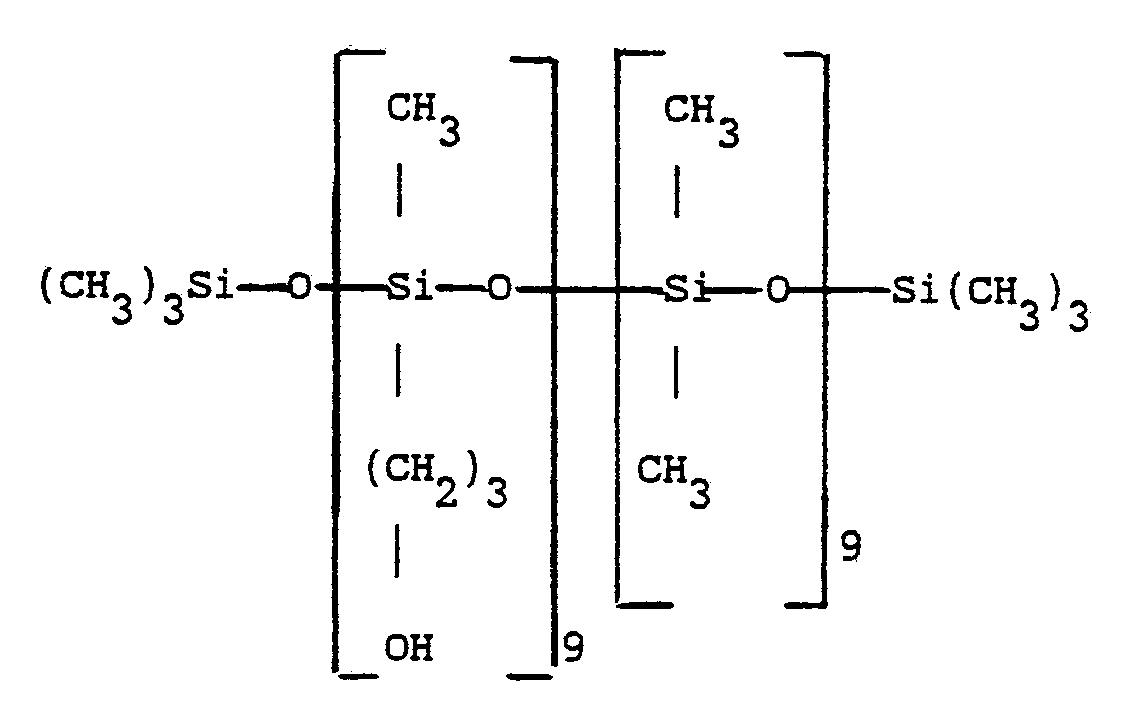
- 65,5 g de MAM,
- 1,13 g d'oxyde de di n-butylétain, soit 0,15 % en poids d'étain métal par rapport à la masse réactionnelle,
- 0,26 g d'hydroquinone. - On effectue la réaction pendant une heure à 100 °C, et, en fin de réaction on élimine l'excès de MAM par distillation pendant une heure sous 0,4 KPa.
- On obtient une huile de formule :
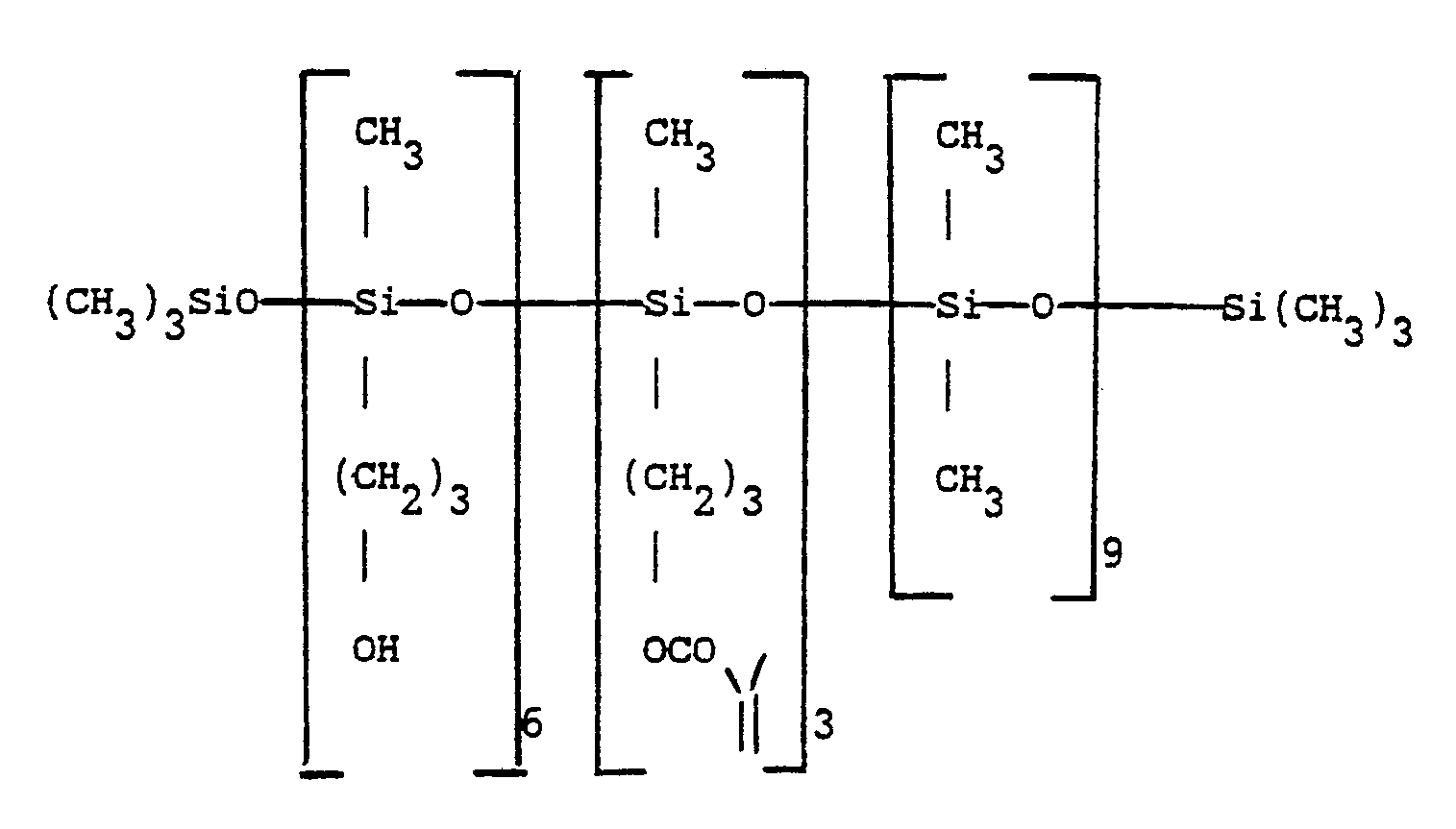
- Dans un ballon tricol de 500 ml muni d'une agitation centrale, d'un réfrigérant ascendant et d'une gaine thermométrique on charge 100 g de l'huile obtenue à l'exemple 4.
- On ajoute 1 ml de triéthylamine et 150 ml de toluène puis on chauffe le mélange homogène ainsi obtenu à 45-50 °C. On coule alors 27,7 g de dicétène en maintenant la température à 50 °C. On note une légère exothermicité notamment en début de coulée. En fin de coulée on laisse encore une heure à 50 °C, puis on laisse revenir le mélange réactionnel à température ambiante. On élimine l'excès de dicétène par évaporation sous pression réduite (0.7 KPa) à 50-60 °C. On obtient après élimination de dicétène une huile jaune limpide et inodore de formule approchée :

- On répète exactement le mode opératoire de l'exemple 1, sauf qu'on remplace le catalyseur à l'étain par 0.5 g de tétrabutoxytitane, ce qui correspond à l'introduction d'un nombre de moles en titane sensiblement équivalent au nombre de moles d'étain.
- On obtient une huile noirâtre très fortement colorée qui ne peut être décolorée au noir de carbone et qui est par conséquent inutilisable.
- On répète le mode opératoire de l'exemple 1, sauf que le catalyseur utilisé est 1,48 g de tétrapropylzirconate, soit un nombre de moles en zirconium sensiblement équivalent au nombre de moles d'étain. Le milieu réactionnel gélifie au cours de l'élimination du MAM. Un temps de réaction de 15 heures au lieu de 20 heures entraîne le même phénomène.
Claims (10)

sur un ester (C) de formule :
CH₂ =

dans laquelle X est un atome d'hydrogène ou le radical méthyle et Z est un radical alkyle en C₁-C₆ inclusivement.

- b est 3 ou 2,
- p est un nombre entier compris entre 1 et 50 inclusivement, de préférence entre 1 et 16 avec p pouvant être égal à 0 quand b = 2,
- q est un nombre entier compris entre 0 et 30 inclusivement, de préférence entre 0 et 8 inclusivement,
- r est un nombre entier compris entre 0 et 500 inclusivement, de préférence entre 2 et 50,
- R et Y ont la même signification qu'à la formule (1) ci-dessus,
- W est un groupe fonctionnel inerte vis-à-vis de la réaction de transestérification.
Y - O -


en présence d'un catalyseur acide ou basique.
Priority Applications (1)
| Application Number | Priority Date | Filing Date | Title |
|---|---|---|---|
| AT87420217T ATE80901T1 (de) | 1987-02-24 | 1987-08-10 | Verfahren zur herstellung eines acrylat- oder methacrylatgruppen enthaltenden polysiloxans. |
Applications Claiming Priority (2)
| Application Number | Priority Date | Filing Date | Title |
|---|---|---|---|
| FR8702617A FR2611729B1 (fr) | 1987-02-24 | 1987-02-24 | Procede de preparation d'un organopolysiloxane a fonction acrylate et/ou methacrylate |
| FR8702617 | 1987-02-24 |
Publications (3)
| Publication Number | Publication Date |
|---|---|
| EP0281718A2 true EP0281718A2 (fr) | 1988-09-14 |
| EP0281718A3 EP0281718A3 (en) | 1988-09-28 |
| EP0281718B1 EP0281718B1 (fr) | 1992-09-23 |
Family
ID=9348389
Family Applications (1)
| Application Number | Title | Priority Date | Filing Date |
|---|---|---|---|
| EP87420217A Expired - Lifetime EP0281718B1 (fr) | 1987-02-24 | 1987-08-10 | Procédé de préparation d'un organopolysiloxane à fonction acrylate et/ou méthacrylate |
Country Status (8)
| Country | Link |
|---|---|
| US (1) | US4940766A (fr) |
| EP (1) | EP0281718B1 (fr) |
| AR (1) | AR243210A1 (fr) |
| AT (1) | ATE80901T1 (fr) |
| BR (1) | BR8800850A (fr) |
| DE (1) | DE3781886T2 (fr) |
| ES (1) | ES2033912T3 (fr) |
| FR (1) | FR2611729B1 (fr) |
Cited By (19)
| Publication number | Priority date | Publication date | Assignee | Title |
|---|---|---|---|---|
| FR2644169A1 (fr) * | 1989-03-08 | 1990-09-14 | Thone Poulenc Chimie | |
| EP0335407A3 (fr) * | 1988-03-31 | 1991-03-27 | Union Carbide Corporation | Compositions de polyoléfine qui contiennent des polyorgano-siloxanes et leur emploi dans la fabrication de films |
| EP0484119A1 (fr) * | 1990-10-31 | 1992-05-06 | Shin-Etsu Chemical Co., Ltd. | Organopolysiloxanes et procédé pour leur préparation |
| EP0679675B1 (fr) * | 1994-04-26 | 1998-07-29 | Th. Goldschmidt AG | Copolymère en bloc des esterpolyméthacrylique-polysiloxane, leur préparation et leur utilisation comme modificateurs et additifs pour peintures |
| FR2824061A1 (fr) * | 2001-04-26 | 2002-10-31 | Atofina | Procede de fabrication du (meth) acrylate de 2-(dimethylamino)-1-(dimethylaminomethyl) ethyle |
| US6670508B2 (en) | 2001-04-26 | 2003-12-30 | Atofina | Process for manufacturing the chloride of 1,3-bis- (dimethylbenzylammonium) isopropyl, acrylate alone or mixed with other monomers, and corresponding (co) polymers |
| US6683203B2 (en) | 2001-04-26 | 2004-01-27 | Atofina | Process for the manufacture of aqueous solutions of unsaturated quaternary ammonium salts |
| WO2017005993A1 (fr) | 2015-07-06 | 2017-01-12 | Bluestar Silicones France Sas | Procede de preparation d'organopolysiloxanes avec des fonctions (meth)acrylates |
| WO2017187030A1 (fr) | 2016-04-29 | 2017-11-02 | Bluestar Silicones France Sas | Procede de preparation d'organopolysiloxanes avec des fonctions (meth)acrylates |
| WO2018234643A1 (fr) | 2017-06-22 | 2018-12-27 | Elkem Silicones France Sas | Photoamorceurs radicalaires et leurs utilisations dans les compositions silicones |
| WO2020142372A1 (fr) * | 2018-12-31 | 2020-07-09 | Dow Silicones Corporation | Procédé de préparation de composés d'organosilicium à fonctionnalité acryloxy |
| US11820846B2 (en) | 2018-12-31 | 2023-11-21 | Dow Silicones Corporation | Composition, method of preparing copolymer, and methods and end uses thereof |
| WO2024200927A1 (fr) | 2023-03-31 | 2024-10-03 | Elkem Silicones France Sas | Procédé de préparation d'organopolysiloxanes à fonctions (méth)acrylates |
| US12215198B2 (en) | 2018-12-31 | 2025-02-04 | Dow Silicones Corporation | Branched organosilicon compound, method of preparing same, and compositions comprising same |
| US12269833B2 (en) | 2018-12-31 | 2025-04-08 | Dow Silicones Corporation | Branched organosilicon compound, method of preparing same, and compositions comprising same |
| US12338259B2 (en) | 2018-12-31 | 2025-06-24 | Dow Silicones Corporation | Branched organosilicon compound, method of preparing same, and copolymer formed therewith |
| US12371535B2 (en) | 2018-12-31 | 2025-07-29 | Dow Silicones Corporation | Branched organosilicon compound, method of preparing same, and copolymer formed therewith |
| US12398270B2 (en) | 2018-12-31 | 2025-08-26 | Dow Silicones Corporation | Acrylate-functional branched organosilicon compound, method of preparing same, and copolymer formed therewith |
| US12583876B2 (en) | 2018-12-31 | 2026-03-24 | Dow Silicones Corporation | Branched organosilicon compound, method of preparing same, and related compositions |
Families Citing this family (11)
| Publication number | Priority date | Publication date | Assignee | Title |
|---|---|---|---|---|
| FR2634769B1 (fr) * | 1988-07-29 | 1990-10-05 | Rhone Poulenc Chimie | Diorganopolysiloxane a fonction thioalkylacrylate |
| US5070215A (en) * | 1989-05-02 | 1991-12-03 | Bausch & Lomb Incorporated | Novel vinyl carbonate and vinyl carbamate contact lens material monomers |
| US5136065A (en) * | 1991-12-30 | 1992-08-04 | Dow Corning Corporation | Propargyl esters of carboxylic acids containing conjugated ethylenic unsaturation and organosilicon compounds derived from same |
| US5380901A (en) * | 1992-01-30 | 1995-01-10 | The United States Of America As Represented By The Secretary Of Commerce | Multifunctional acrylates and the synthesis thereof |
| JP2851477B2 (ja) * | 1992-03-25 | 1999-01-27 | 東レ・ダウコーニング・シリコーン株式会社 | アクリロキシ基またはメタクリロキシ基含有有機ケイ素化合物の製造方法 |
| DE4443749A1 (de) * | 1994-12-08 | 1996-06-13 | Wacker Chemie Gmbh | (Meth)acryloxygruppen aufweisende Organosiliciumverbindungen, deren Herstellung und Verwendung |
| US6846852B2 (en) | 2001-08-16 | 2005-01-25 | Goldschmidt Ag | Siloxane-containing compositions curable by radiation to silicone elastomers |
| DE102006020712A1 (de) * | 2006-05-04 | 2007-11-08 | Mitsubishi Polyester Film Gmbh | Beschichtete Polyesterfolie mit hoher Oberflächenspannung und niedriger Reibung |
| CN106146754A (zh) * | 2015-04-07 | 2016-11-23 | 常州华科聚合物股份有限公司 | 3d打印用含硅纳米凝胶光固化树脂的制备方法及其应用 |
| WO2018111458A1 (fr) | 2016-12-14 | 2018-06-21 | Rohm And Haas Company | Catalyseur non toxique pour la préparation de (méth)acrylates de polysiloxanes |
| JP6991236B2 (ja) * | 2017-10-24 | 2022-02-10 | 信越化学工業株式会社 | ラジカル重合性オルガノポリシロキサンの製造方法、放射線硬化性オルガノポリシロキサン組成物、及び剥離シート |
Family Cites Families (13)
| Publication number | Priority date | Publication date | Assignee | Title |
|---|---|---|---|---|
| US2922806A (en) * | 1957-02-01 | 1960-01-26 | Dow Corning | Preparation of acryloxyalkyl substituted siloxanes |
| US4207155A (en) * | 1976-01-19 | 1980-06-10 | Celanese Corporation | Diluents for ultraviolet coating compositions |
| US4189546A (en) * | 1977-07-25 | 1980-02-19 | Bausch & Lomb Incorporated | Polysiloxane shaped article for use in biomedical applications |
| US4294974A (en) * | 1979-01-31 | 1981-10-13 | American Optical Corporation | Hydrophilic silicone compounds and contact lenses containing polymers thereof |
| US4261875A (en) * | 1979-01-31 | 1981-04-14 | American Optical Corporation | Contact lenses containing hydrophilic silicone polymers |
| DE3222839A1 (de) * | 1982-06-18 | 1983-12-22 | Wacker-Chemie GmbH, 8000 München | Neue organopolysiloxane, verfahren zu ihrer herstellung und verwendung dieser organopolysiloxane |
| US4575545A (en) * | 1983-06-30 | 1986-03-11 | Loctite Corporation | Terminal cluster acrylate silicones |
| US4503208A (en) * | 1983-06-30 | 1985-03-05 | Loctite Corporation | Acrylic functional silicone copolymers |
| JPS60148560A (ja) * | 1984-01-17 | 1985-08-05 | 富士システムズ株式会社 | 皮膚用封止材 |
| NL8400726A (nl) * | 1984-03-07 | 1985-10-01 | Philips Nv | Hardbare kunststofsamenstelling en werkwijze voor de vervaardiging van een copolymeer. |
| US4562238A (en) * | 1984-06-18 | 1985-12-31 | Shin-Etsu Chemical Co., Ltd. | Room temperature curable silicone rubber composition |
| US4558111A (en) * | 1984-12-05 | 1985-12-10 | General Electric Company | Method for preparing acrylic functional halosilanes and halosiloxanes |
| FR2602776B1 (fr) * | 1986-08-12 | 1988-11-10 | Rhone Poulenc Chimie | Diorganopolysiloxane a fonction beta-cetoester utile comme stabilisant des polymeres a base de polychlorure de vinyle |
-
1987
- 1987-02-24 FR FR8702617A patent/FR2611729B1/fr not_active Expired
- 1987-08-10 DE DE8787420217T patent/DE3781886T2/de not_active Expired - Fee Related
- 1987-08-10 EP EP87420217A patent/EP0281718B1/fr not_active Expired - Lifetime
- 1987-08-10 AT AT87420217T patent/ATE80901T1/de not_active IP Right Cessation
- 1987-08-10 ES ES198787420217T patent/ES2033912T3/es not_active Expired - Lifetime
- 1987-08-12 US US07/084,181 patent/US4940766A/en not_active Expired - Fee Related
-
1988
- 1988-01-28 AR AR88309951A patent/AR243210A1/es active
- 1988-02-24 BR BR8800850A patent/BR8800850A/pt not_active IP Right Cessation
Cited By (25)
| Publication number | Priority date | Publication date | Assignee | Title |
|---|---|---|---|---|
| EP0335407A3 (fr) * | 1988-03-31 | 1991-03-27 | Union Carbide Corporation | Compositions de polyoléfine qui contiennent des polyorgano-siloxanes et leur emploi dans la fabrication de films |
| FR2644169A1 (fr) * | 1989-03-08 | 1990-09-14 | Thone Poulenc Chimie | |
| WO1990010665A1 (fr) * | 1989-03-08 | 1990-09-20 | Rhone-Poulenc Chimie | Polymeres modifies a base de polyester greffe et son procede de preparation |
| EP0484119A1 (fr) * | 1990-10-31 | 1992-05-06 | Shin-Etsu Chemical Co., Ltd. | Organopolysiloxanes et procédé pour leur préparation |
| US5248750A (en) * | 1990-10-31 | 1993-09-28 | Shin-Etsu Chemical Co., Ltd. | Organopolysiloxanes and methods of making |
| EP0679675B1 (fr) * | 1994-04-26 | 1998-07-29 | Th. Goldschmidt AG | Copolymère en bloc des esterpolyméthacrylique-polysiloxane, leur préparation et leur utilisation comme modificateurs et additifs pour peintures |
| FR2824061A1 (fr) * | 2001-04-26 | 2002-10-31 | Atofina | Procede de fabrication du (meth) acrylate de 2-(dimethylamino)-1-(dimethylaminomethyl) ethyle |
| EP1254891A1 (fr) * | 2001-04-26 | 2002-11-06 | Atofina | Procédé de fabrication du (meth) acrylate de-2(dimethylamino)-1-(dimethylaminomethyl) ethyle |
| US6670508B2 (en) | 2001-04-26 | 2003-12-30 | Atofina | Process for manufacturing the chloride of 1,3-bis- (dimethylbenzylammonium) isopropyl, acrylate alone or mixed with other monomers, and corresponding (co) polymers |
| US6683203B2 (en) | 2001-04-26 | 2004-01-27 | Atofina | Process for the manufacture of aqueous solutions of unsaturated quaternary ammonium salts |
| US6841697B2 (en) | 2001-04-26 | 2005-01-11 | Atofina | Process for preparing 2-(dimethylamino)-1-(dimethyl-aminomethyl) ethyl meth (acrylate) |
| WO2017005993A1 (fr) | 2015-07-06 | 2017-01-12 | Bluestar Silicones France Sas | Procede de preparation d'organopolysiloxanes avec des fonctions (meth)acrylates |
| WO2017187030A1 (fr) | 2016-04-29 | 2017-11-02 | Bluestar Silicones France Sas | Procede de preparation d'organopolysiloxanes avec des fonctions (meth)acrylates |
| WO2018234643A1 (fr) | 2017-06-22 | 2018-12-27 | Elkem Silicones France Sas | Photoamorceurs radicalaires et leurs utilisations dans les compositions silicones |
| US11629233B2 (en) | 2017-06-22 | 2023-04-18 | Elkem Silicones France Sas | Free-radical photoinitiators and uses of same in silicone compositions |
| WO2020142372A1 (fr) * | 2018-12-31 | 2020-07-09 | Dow Silicones Corporation | Procédé de préparation de composés d'organosilicium à fonctionnalité acryloxy |
| US11820846B2 (en) | 2018-12-31 | 2023-11-21 | Dow Silicones Corporation | Composition, method of preparing copolymer, and methods and end uses thereof |
| US12215117B2 (en) | 2018-12-31 | 2025-02-04 | Dow Silicones Corporation | Method of preparing acryloxy-functional organosilicon compounds |
| US12215198B2 (en) | 2018-12-31 | 2025-02-04 | Dow Silicones Corporation | Branched organosilicon compound, method of preparing same, and compositions comprising same |
| US12269833B2 (en) | 2018-12-31 | 2025-04-08 | Dow Silicones Corporation | Branched organosilicon compound, method of preparing same, and compositions comprising same |
| US12338259B2 (en) | 2018-12-31 | 2025-06-24 | Dow Silicones Corporation | Branched organosilicon compound, method of preparing same, and copolymer formed therewith |
| US12371535B2 (en) | 2018-12-31 | 2025-07-29 | Dow Silicones Corporation | Branched organosilicon compound, method of preparing same, and copolymer formed therewith |
| US12398270B2 (en) | 2018-12-31 | 2025-08-26 | Dow Silicones Corporation | Acrylate-functional branched organosilicon compound, method of preparing same, and copolymer formed therewith |
| US12583876B2 (en) | 2018-12-31 | 2026-03-24 | Dow Silicones Corporation | Branched organosilicon compound, method of preparing same, and related compositions |
| WO2024200927A1 (fr) | 2023-03-31 | 2024-10-03 | Elkem Silicones France Sas | Procédé de préparation d'organopolysiloxanes à fonctions (méth)acrylates |
Also Published As
| Publication number | Publication date |
|---|---|
| DE3781886D1 (de) | 1992-10-29 |
| EP0281718B1 (fr) | 1992-09-23 |
| US4940766A (en) | 1990-07-10 |
| BR8800850A (pt) | 1988-10-04 |
| ES2033912T3 (es) | 1993-04-01 |
| EP0281718A3 (en) | 1988-09-28 |
| DE3781886T2 (de) | 1993-04-15 |
| ATE80901T1 (de) | 1992-10-15 |
| FR2611729A1 (fr) | 1988-09-09 |
| AR243210A1 (es) | 1993-07-30 |
| FR2611729B1 (fr) | 1989-06-16 |
Similar Documents
| Publication | Publication Date | Title |
|---|---|---|
| EP0281718B1 (fr) | Procédé de préparation d'un organopolysiloxane à fonction acrylate et/ou méthacrylate | |
| EP0147323B1 (fr) | Composition polyorganosiloxanique durcissant en élastomère etcomportant un catalyseur à l'étain chelate. | |
| FR2566394A1 (fr) | Procede pour la preparation d'esters des acides acrylique et methacrylique par trans-esterification | |
| FR2566393A1 (fr) | Procede pour la preparation d'esters des acides acrylique et methacrylique par trans-esterification | |
| EP0358584A1 (fr) | Diorganopolysiloxane à fonction benzalmalonate | |
| EP0263038B1 (fr) | Diorganopolysiloxane à fonction bétacétoester utile comme stabilisant des polymères à base de polychlorure de vinyle | |
| FR2961205A1 (fr) | Procede de preparation de composes esteramides | |
| EP0354145B1 (fr) | Diorganopolysiloxane à fonction benzotriazole | |
| EP2099739B1 (fr) | Procede de synthese d'esters (meth)acryliques catalyse par un titanate de polyol. | |
| FR2617168A1 (fr) | Catalyseur a l'etain obtenu a partir d'oxyde d'etain et de compose b-dicarbonyle pour composition elastomere silicone | |
| EP0904315A1 (fr) | Procede de preparation d'huiles silicones par hydrosilylation avec des polyorganohydrogenosiloxanes et des motifs contenant au moins un cycle hydrocarbone dans lequel est inclus un atome d'oxygene en presence d'une composition catalytique heterogene | |
| EP1273589A1 (fr) | Procédé de fabrication de (meth)acrylates silanes | |
| CA2990973A1 (fr) | Procede de preparation d'organopolysiloxanes avec des fonctions (meth)acrylates. | |
| EP0354143A1 (fr) | Diorganopolysiloxane à fonction thioalkylacrylate | |
| EP0284473B1 (fr) | Procédé de préparation de cétènes acétals silylés | |
| EP0214351B1 (fr) | Composés organophosphorés, un procédé pour leur préparation et compositions polymères ignifigées au moyen desdits composés | |
| EP0319384A2 (fr) | Hydrocarbylsilyloxydes cériques et leur procédé de fabrication | |
| EP0325881B1 (fr) | Diorganopolysiloxane à fonction benzylidène-3 camphre | |
| CA1139310A (fr) | Procede de preparation de trihalogenures organostanniques | |
| FR2747675A1 (fr) | Procede de preparation de (meth)acrylates | |
| FR2747596A1 (fr) | Procede de regeneration de catalyseurs au zirconium et procede de preparation de (meth)acrylates integrant une telle regeneration du catalyseur | |
| EP2580185A1 (fr) | Procede de preparation de composes estaramides | |
| EP3728277A1 (fr) | Silanes présentant des groupes ester d'oxamine | |
| EP0319383A2 (fr) | Procédé pour la fabrication d'hydrocarbylsilyloxydes cériques par transéthérification d'alcoxydes cériques | |
| EP2262779B1 (fr) | Preparation de (meth)acrylates d'alkylimidazolidone dans l'eau |
Legal Events
| Date | Code | Title | Description |
|---|---|---|---|
| PUAI | Public reference made under article 153(3) epc to a published international application that has entered the european phase |
Free format text: ORIGINAL CODE: 0009012 |
|
| PUAL | Search report despatched |
Free format text: ORIGINAL CODE: 0009013 |
|
| AK | Designated contracting states |
Kind code of ref document: A2 Designated state(s): AT BE CH DE ES FR GB GR IT LI LU NL SE |
|
| AK | Designated contracting states |
Kind code of ref document: A3 Designated state(s): AT BE CH DE ES FR GB GR IT LI LU NL SE |
|
| 17P | Request for examination filed |
Effective date: 19881014 |
|
| 17Q | First examination report despatched |
Effective date: 19910115 |
|
| GRAA | (expected) grant |
Free format text: ORIGINAL CODE: 0009210 |
|
| ITF | It: translation for a ep patent filed | ||
| AK | Designated contracting states |
Kind code of ref document: B1 Designated state(s): AT BE CH DE ES FR GB GR IT LI LU NL SE |
|
| PG25 | Lapsed in a contracting state [announced via postgrant information from national office to epo] |
Ref country code: SE Effective date: 19920923 Ref country code: GR Free format text: LAPSE BECAUSE OF FAILURE TO SUBMIT A TRANSLATION OF THE DESCRIPTION OR TO PAY THE FEE WITHIN THE PRESCRIBED TIME-LIMIT Effective date: 19920923 Ref country code: AT Effective date: 19920923 |
|
| REF | Corresponds to: |
Ref document number: 80901 Country of ref document: AT Date of ref document: 19921015 Kind code of ref document: T |
|
| GBT | Gb: translation of ep patent filed (gb section 77(6)(a)/1977) | ||
| REF | Corresponds to: |
Ref document number: 3781886 Country of ref document: DE Date of ref document: 19921029 |
|
| REG | Reference to a national code |
Ref country code: ES Ref legal event code: FG2A Ref document number: 2033912 Country of ref document: ES Kind code of ref document: T3 |
|
| PGFP | Annual fee paid to national office [announced via postgrant information from national office to epo] |
Ref country code: FR Payment date: 19930719 Year of fee payment: 7 |
|
| PLBE | No opposition filed within time limit |
Free format text: ORIGINAL CODE: 0009261 |
|
| STAA | Information on the status of an ep patent application or granted ep patent |
Free format text: STATUS: NO OPPOSITION FILED WITHIN TIME LIMIT |
|
| PGFP | Annual fee paid to national office [announced via postgrant information from national office to epo] |
Ref country code: GB Payment date: 19930730 Year of fee payment: 7 |
|
| PGFP | Annual fee paid to national office [announced via postgrant information from national office to epo] |
Ref country code: DE Payment date: 19930806 Year of fee payment: 7 |
|
| PGFP | Annual fee paid to national office [announced via postgrant information from national office to epo] |
Ref country code: ES Payment date: 19930812 Year of fee payment: 7 |
|
| PG25 | Lapsed in a contracting state [announced via postgrant information from national office to epo] |
Ref country code: LU Free format text: LAPSE BECAUSE OF NON-PAYMENT OF DUE FEES Effective date: 19930831 Ref country code: LI Effective date: 19930831 Ref country code: CH Effective date: 19930831 Ref country code: BE Effective date: 19930831 |
|
| PGFP | Annual fee paid to national office [announced via postgrant information from national office to epo] |
Ref country code: NL Payment date: 19930831 Year of fee payment: 7 |
|
| 26N | No opposition filed | ||
| BERE | Be: lapsed |
Owner name: RHONE-POULENC CHIMIE Effective date: 19930831 |
|
| REG | Reference to a national code |
Ref country code: CH Ref legal event code: PL |
|
| PG25 | Lapsed in a contracting state [announced via postgrant information from national office to epo] |
Ref country code: GB Effective date: 19940810 |
|
| PG25 | Lapsed in a contracting state [announced via postgrant information from national office to epo] |
Ref country code: ES Free format text: LAPSE BECAUSE OF EXPIRATION OF PROTECTION Effective date: 19940811 |
|
| PG25 | Lapsed in a contracting state [announced via postgrant information from national office to epo] |
Ref country code: NL Effective date: 19950301 |
|
| GBPC | Gb: european patent ceased through non-payment of renewal fee |
Effective date: 19940810 |
|
| NLV4 | Nl: lapsed or anulled due to non-payment of the annual fee | ||
| PG25 | Lapsed in a contracting state [announced via postgrant information from national office to epo] |
Ref country code: FR Effective date: 19950428 |
|
| PG25 | Lapsed in a contracting state [announced via postgrant information from national office to epo] |
Ref country code: DE Effective date: 19950503 |
|
| REG | Reference to a national code |
Ref country code: FR Ref legal event code: ST |
|
| REG | Reference to a national code |
Ref country code: ES Ref legal event code: FD2A Effective date: 19990601 |
|
| PG25 | Lapsed in a contracting state [announced via postgrant information from national office to epo] |
Ref country code: IT Free format text: LAPSE BECAUSE OF NON-PAYMENT OF DUE FEES;WARNING: LAPSES OF ITALIAN PATENTS WITH EFFECTIVE DATE BEFORE 2007 MAY HAVE OCCURRED AT ANY TIME BEFORE 2007. THE CORRECT EFFECTIVE DATE MAY BE DIFFERENT FROM THE ONE RECORDED. Effective date: 20050810 |