EP0282325A2 - Haftende Grundschicht für Gegenstände aus Tonerde - Google Patents
Haftende Grundschicht für Gegenstände aus Tonerde Download PDFInfo
- Publication number
- EP0282325A2 EP0282325A2 EP88302127A EP88302127A EP0282325A2 EP 0282325 A2 EP0282325 A2 EP 0282325A2 EP 88302127 A EP88302127 A EP 88302127A EP 88302127 A EP88302127 A EP 88302127A EP 0282325 A2 EP0282325 A2 EP 0282325A2
- Authority
- EP
- European Patent Office
- Prior art keywords
- alumina
- brackets
- rod
- coating
- mpa
- Prior art date
- Legal status (The legal status is an assumption and is not a legal conclusion. Google has not performed a legal analysis and makes no representation as to the accuracy of the status listed.)
- Granted
Links
Images


Classifications
-
- A—HUMAN NECESSITIES
- A61—MEDICAL OR VETERINARY SCIENCE; HYGIENE
- A61C—DENTISTRY; APPARATUS OR METHODS FOR ORAL OR DENTAL HYGIENE
- A61C7/00—Orthodontics, i.e. obtaining or maintaining the desired position of teeth, e.g. by straightening, evening, regulating, separating, or by correcting malocclusions
-
- C—CHEMISTRY; METALLURGY
- C04—CEMENTS; CONCRETE; ARTIFICIAL STONE; CERAMICS; REFRACTORIES
- C04B—LIME, MAGNESIA; SLAG; CEMENTS; COMPOSITIONS THEREOF, e.g. MORTARS, CONCRETE OR LIKE BUILDING MATERIALS; ARTIFICIAL STONE; CERAMICS; REFRACTORIES; TREATMENT OF NATURAL STONE
- C04B41/00—After-treatment of mortars, concrete, artificial stone or ceramics; Treatment of natural stone
- C04B41/009—After-treatment of mortars, concrete, artificial stone or ceramics; Treatment of natural stone characterised by the material treated
-
- A—HUMAN NECESSITIES
- A61—MEDICAL OR VETERINARY SCIENCE; HYGIENE
- A61C—DENTISTRY; APPARATUS OR METHODS FOR ORAL OR DENTAL HYGIENE
- A61C7/00—Orthodontics, i.e. obtaining or maintaining the desired position of teeth, e.g. by straightening, evening, regulating, separating, or by correcting malocclusions
- A61C7/12—Brackets; Arch wires; Combinations thereof; Accessories therefor
-
- B—PERFORMING OPERATIONS; TRANSPORTING
- B05—SPRAYING OR ATOMISING IN GENERAL; APPLYING FLUENT MATERIALS TO SURFACES, IN GENERAL
- B05D—PROCESSES FOR APPLYING FLUENT MATERIALS TO SURFACES, IN GENERAL
- B05D7/00—Processes, other than flocking, specially adapted for applying liquids or other fluent materials to particular surfaces or for applying particular liquids or other fluent materials
-
- C—CHEMISTRY; METALLURGY
- C04—CEMENTS; CONCRETE; ARTIFICIAL STONE; CERAMICS; REFRACTORIES
- C04B—LIME, MAGNESIA; SLAG; CEMENTS; COMPOSITIONS THEREOF, e.g. MORTARS, CONCRETE OR LIKE BUILDING MATERIALS; ARTIFICIAL STONE; CERAMICS; REFRACTORIES; TREATMENT OF NATURAL STONE
- C04B41/00—After-treatment of mortars, concrete, artificial stone or ceramics; Treatment of natural stone
- C04B41/45—Coating or impregnating, e.g. injection in masonry, partial coating of green or fired ceramics, organic coating compositions for adhering together two concrete elements
- C04B41/50—Coating or impregnating, e.g. injection in masonry, partial coating of green or fired ceramics, organic coating compositions for adhering together two concrete elements with inorganic materials
- C04B41/5025—Coating or impregnating, e.g. injection in masonry, partial coating of green or fired ceramics, organic coating compositions for adhering together two concrete elements with inorganic materials with ceramic materials
- C04B41/5035—Silica
-
- C—CHEMISTRY; METALLURGY
- C04—CEMENTS; CONCRETE; ARTIFICIAL STONE; CERAMICS; REFRACTORIES
- C04B—LIME, MAGNESIA; SLAG; CEMENTS; COMPOSITIONS THEREOF, e.g. MORTARS, CONCRETE OR LIKE BUILDING MATERIALS; ARTIFICIAL STONE; CERAMICS; REFRACTORIES; TREATMENT OF NATURAL STONE
- C04B41/00—After-treatment of mortars, concrete, artificial stone or ceramics; Treatment of natural stone
- C04B41/80—After-treatment of mortars, concrete, artificial stone or ceramics; Treatment of natural stone of only ceramics
- C04B41/81—Coating or impregnation
- C04B41/85—Coating or impregnation with inorganic materials
- C04B41/87—Ceramics
Definitions
- This invention relates to the adhesive priming of alumina articles such as orthodontic brackets.
- Orthodontic brackets made of crystalline alumina have been proposed. Such brackets are described in US-A-4 639 218.
- Orthodontic brackets are usually bonded directly to teeth with an acrylic cement. It has proven to be difficult to obtain sufficient bond strength between acrylic cements and crystalline alumina brackets to ensure that such brackets will not come off during normal use.
- silica coating increases the bond strength of the alumina to acrylic cements, especially when primed with a silane coupling agent.
- the specific methods for forming the siliceous coating on the alumina include cathode sputtering, plasma deposition, and electron beam evaporation.
- This invention provides an improved method for forming a thin, adherent coating of a siliceous material on the surface of alumina, preferably crystalline alumina, to thereby enhance the bond strength to acrylic adhesive cements.
- the invention provides a method for producing a silica coating on the surface of alumina articles such as orthodontic brackets to thereby enhance the adhesive strength of the thus coated surface to acrylic cements, which method comprises the steps of:
- Norling et al. in U.S. Patent No. 4,364,731, discloses the deposition of an oxide layer such as alumina or silica on a substrate to enhance the adhesive bonding of the substrate to polymers.
- Acrylic orthodontic bracket cements are known, as is illustrated by Johnston, U.S. Patent No. 4,363,624, and by Orlowski et al., U.S. Patent No. 4,479,782.
- the major novelty of the invention resides in the step of coating the bonding surface of an alumina article with an organosilicon compound, and then pyrolyzing the coating (in air or other oxidizing atmosphere) to volatilize the organic moieties in the coating to thereby leave a coating of a siliceous material that is predominantly silica.
- organosilicon compounds that can be used for this purpose include the organosilane compounds such as those that are employed as coupling agents, silicate esters, and other organosilicon compounds.
- Specific illustrative examples include gamma-methacryloxypropyltrimethoxysilane, gamma-aminopropyltrimethoxysilane, vinyltriethoxysilane, allyltrimethoxylsilane, dimethyldiethoxysilane, dihydroxydiphenylsilane, triethoxysilane, trimethoxysilane, triethoxysilanol, 3-(2-aminoethylamino)propyltrimethoxysilane, gamma-glycidoxypropyltrimethoxysilane, methyltrimethoxysilane, vinyltriacetoxysilane, vinyl-tris(2-methoxyethoxy)silane, methyltriethoxysilane, tetraethyl orthosilicate, tetramethyl orthosilicate, and similar compounds.
- the organosilicon compound is coated on the bonding surface by any convenient method.
- the alumina article can be (a) immersed in an organic solvent solution of the organosilicon compound, (b) removed from the solution, and (c) subjected to moderately elevated temperature to evaporate the solvent, thereby leaving a coating of the organosilicon compound on the entire surface of the article (including the bonding surface).
- the article Prior to the coating step, the article should be thoroughly cleaned and dried to enhance the adhesion of the organosilicon compound to the surface of the alumina.
- the coated articles are subjected to a pyrolysis step in an oxidizing atmosphere such as air to volatilize the organic portion of the organosilicon compound, and to leave a coating that is essentially silica on the bonding surface of the alumina article.
- a pyrolysis step in an oxidizing atmosphere such as air to volatilize the organic portion of the organosilicon compound, and to leave a coating that is essentially silica on the bonding surface of the alumina article.
- the specific conditions used in the pyrolysis step are not critical; the important factors are to use a temperature high enough to volatilize (“burn off") the organic moieties in the organosilicon compound, and to carry out the step for a period of time sufficient to volatilize essentially all of the organic moieties and to convert the silicon present to silica. Routine experimentation will suffice to determine the best conditions to use in particular cases.
- the alumina article is a crystalline alumina orthodontic bracket, and wherein the bonding surface (i.e., the surface to be bonded to a substrate) is the tooth contacting surface of the bracket.
- Sapphire brackets from the Cleaning Procedure step are heated in a furnace at 350°C for 16 hours. They are removed and stored immediately in a dessicator containing desiccants such as "drierite".
- Brackets Since the bond strengths of the two types are substantially equivalent, both will be referred to as "brackets".
- a flat wire mesh 60 mesh size
- This substrate is used for bonding sapphire brackets.
- the wire mesh provides mechanical locking with the orthodontic adhesive.
- the substrate-sapphire assembly is then tested for bond strength on an Instron instrument.
- This procedure is used to ensure that the bond strength measured is between the sapphire and the acrylic cement, and not between the cement and the steel cylinder substrate.
- isopropyl alcohol in a 250-mL wide-mouth polyethylene bottle is added 2 g of gamma-methacryloxypropyltrimethoxysilane ("A-174 silane", from Union Carbide), 6 g of deionized water, and 8 g of glacial acetic acid. After closing the bottle, the contents are mixed by swirling, and the bottle is placed in a water bath at 37°C.
- the silane solution can be used between 2 and 23 hours after preparation.
- Brackets which have gone through the Cleaning Procedure and Heating Procedure I are removed from the desiccator and added to a beaker containing the Silane Solution (about 1-2 ml solution per bracket). After 10 minutes the brackets are collected on a sieve and transferred to an aluminum drying dish. The dish is then stored in a desiccator (no desiccant) for 30 min. The primed brackets are subsequently heated in a forced draft oven at 110°C for 1 hour to volatilize the solvent and to cure the silane, as is conventional in the art. The brackets are then stored in a desiccator.
- Brackets that have been Single Primed are heated according to Heating Procedure I or Heating Procedure II.
- Heating Procedure I or II both done in air
- the brackets having the essentially silica coating may then be subjected to a second priming with A-174 silane ("Double Priming").
- the second primer layer is then used in the conventional manner as a coupling agent.
- the two pastes of a chemical-cured orthodontic adhesive (e.g. "Achieve” marketed by Johnson & Johnson Dental Products Company or “Concise” marketed by 3M) are mixed and a small amount is applied to the base of a primed sapphire bracket, which is then pressed against the Wire Mesh Substrate for 1 min.
- the bonded pairs are stored in water at 37°C for 16 hours.
- An Instron instrument is used to measure the shear strength of the bonds at a crosshead speed of 0.5 mm per min.
- the acrylic adhesive used in these experiments was "Achieve", an acrylic cement containing bis-GMA, bisphenol A dimethacrylate, triethylene glycol dimethacrylate, and silica fillers.
- the shear strength test was carried out on an Instron tester as follows:
- the Wire Mesh Substrate to which is bonded the sapphire bracket is clamped securely in the Instron tester.
- a rod from the Instron is brought to bear against the side of the bracket at a rate of 0.5 mm per minute until the bracket breaks away from the wire mesh.
- Example 2 Identical to Example 2, except the heating step (prior to priming) was changed to Heating Procedure II (600°C/1 hr).
- the average shear strengths were: Group A, 8.8 MPa (Std. dev. 5.1 MPa), and Group B, 17.8 MPa (Std. dev. 6.5 MPa).
- Quartz (silica) pieces having dimensions similar to those of sapphire brackets went through the Cleaning Procedure, Heating Procedure II, Single Priming, and Bond Strength Testing steps. The results are as follows: Group A (bases faced up) 19.6 MPa (Std. dev. 9.4 MPa), and Group B (bases faced down) 21.4 MPa (Std. dev. 4.5 MPa).
- the bases of sapphire brackets were sputtered coated with silicon dioxide. Twenty four such brackets were single primed and the bond strengths determined. The results show that Group A (bases faced up) had shear strengths of 26.1 MPa (Std. dev. 9.0 MPa), and Group B (bases faced down) had shear strengths of 22.2 MPa (Std. dev. 7.5 MPa).
- This invention is employed in connection with alumina articles, preferably crystalline alumina articles, and more preferably crystalline alpha-alumina.
- crystalline alumina is intended to include only essentially monocrystalline alumina, that is, alumina comprised of a single crystal or two or more single crystals grown together longitudinally but separated by a relatively small angle (usually within 4°, determined with respect to the C-axes of neighboring single crystals) grain boundary.
- the alumina article is a crystalline alumina orthodontic bracket made entirely from crystalline alpha-alumina.
- a bracket can be produced by first drawing a crystalline alpha-alumina rod from a melt, wherein the rod has a predetermined cross-sectional configuration, by slicing the rod into individual blanks, and then machining the blanks to produce the bracket.
- the cross-sectional configuration of the rod is approximately the configuration of the cross-section of an orthodontic bracket taken in a plane that is perpendicular to the top and bottom faces of the bracket and is approximately parallel to the two side faces of the bracket.
- top and bottom faces” and side faces refer to the top, bottom, and side surfaces, respectively, of the bracket when looking directly at the front of the bracket (the “front of the bracket” is the surface opposite the tooth contacting surface) in the position the bracket would assume when installed on a tooth with the patient in the upright position.
- the brackets have two pairs of tie wings, and the said plane is taken through a pair of tie wings.
- the said predetermined cross-sectional configuration will preferably include two pairs of tie wings and a base.
- the preferred procedure for producing a crystalline alpha-alumina rod having a predetermined cross-sectional configuration is the EFG (for Edge-defined, Film-fed, Growth) modification of the Czochralski process for growing crystalline alpha-alumina.
- the EFG process is described by LaBelle in "EFG - The Invention and Application to Sapphire Growth", in Journal of Crystal Growth, 50 , pages 8-17 (September 1980). See also LaBelle, U. S. Patent Nos. 3,591,348, and 3,870,477, LaBelle et al., U. S. Patent Nos. 3,701,636 and 3,915,662, and other patents and articles cited in the Journal of Crystal Growth article.
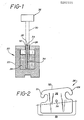
- Fig. 1 is a schematic representation of apparatus for producing a crystalline alpha-alumina rod having a predetermined cross-sectional configuration by the EFG process.
- the apparatus 20 includes a crucible 22 containing molten alumina 24.
- a die 26 made of a suitable material such as molybdenum or iridium is positioned such that the bottom of the die 26 is immersed in the molten alumina 24, and the top of the die 26 is above the surface of the melt 24.
- a vertical distance from the top of the melt 24 to the top surface 28 of the die 26 of up to 50 millimeters is permissible. (This distance is exaggerated in Fig. 1 for clarity.).
- Fig. 2 shows the top surface 28 of the die 26.
- the top surface 28 is smooth, flat, and has the overall approximate shape of the desired configuration of the cross-section of the crystalline alpha-alumina rod 30 (shown in Fig. 3) from which the brackets are made, including the configuration of a pair of tie wings, shown as 29 and 31, and the base of the bracket, shown as 33. It is important that the sides 32 and the top surface 28 of the die 26 meet in a sharp 90° angle, in order to minimize imperfections in the surface of the growing rod 30.
- the die 26 contains a capillary passage 34 through which molten alumina 24 is drawn.
- the melt 24 is drawn from the crucible 22 through the capillary 34 to the top surface 28 of the die 26, where it spreads out and completely covers the said top surface 28 with a film of molten alumina.
- molten alumina and molybdenum or iridium have the appropriate wettability relationship, the molten alumina film stops at the edge of the surface 28. Therefore, crystalline alpha-alumina crystal grown or pulled from this film of molten alumina assumes a cross-sectional configuration substantially exactly the same as the configuration of the top surface 28 of the die 26.
- the rod 30 (which had been started by a seed crystal, as in the Czochralski process) pulled by a pulling mechanism 36 from the film of molten alumina on the top surface 28 of the die 26 will have a cross-sectional configuration substantially identical to the configuration of the top surface 28 of the die 26. It has been found to be convenient to grow the rod 30 to a length of about two inches (about 5 centimeters) in order to minimize any machining problems that could be caused by the failure of the rod to grow exactly strength.
- the crystal orientation of the growing rod may prove to be important (at least economically, and perhaps also from a performance standpoint) in the practice of the invention.
- the crystal orientation can be defined with reference to the C axis of the crystal (The C axis is perpendicular to the plane which contains the simplest arrangement of atoms in the crystal unit cell. Stated another way, the C axis is perpendicular to the plane which contains the a1 and a2 axes.)
- the minimum amount of strain developed in the growing crystal will occur if the C axis is found in a plane perpendicular to the longitudinal axis L of the rod 30. (See Fig. 3.) This has proven to be the optimum crystal orientation in some cases.
- the growing crystal will assume the crystal orientation of the seed crystal.
- a typical annealing cycle would be to heat the rod 30 from room temperature up to 1950-2000°C at an even rate for about two hours, to maintain the rod 30 at 1950-2000°C for 4 to 6 hours, and to then cool the rod 30 down to room temperature at an even rate for two hours.
- the entire annealing cycle is preferably carried out under an inert atmosphere such as argon.
- the archwire groove may be ground in the rod to produce the grooved rod 86 shown in Fig. 4. ( In Figs. 4-8 and 10-11, the archwire groove is defined by walls 88a, 88b, 88c.)
- the bracket blanks 92 that are cut from the rod 86 are cut at a slight angle, as is seen in Figs. 5 and 6.
- the cuts are made in the following manner:
- each cut is made in a vertical plane that is angled slightly (e.g., up to about 12°) at an angle a from the vertical plane that is perpendicular to the longitudinal axis L of the rod 86. This is best seen in Fig. 6.
- the "saddles" (defined by walls 140, 142, 144 - see Fig. 12) and the two base concavities (shown as 73 and 74 in Fig. 7) can be machined in the bracket prior to cutting the individual brackets from the rod 86. This is preferred because it is easier to handle the rod 86 than the individual bracket blanks 92.
- the machining of the saddles can then be done with a diamond grinding wheel by feeding the rod stepwise to the wheel and cutting a series of grooves across the rod, wherein the said grooves will be oriented generally perpendicularly to the longitudinal axis L of the rod 86 (although, when rhomboidally shaped brackets are being produced, the cut will depart from the perpendicular by the angle, ⁇ , as discussed above), and the two base concavities can be ground in a similar stepwise manner with a double-contoured diamond grinding wheel whose grinding edge is rounded or radiused to the appropriate degree so that the two concavities can be ground at the same time.
- Figs. 10 and 11 show the saddles and both concavities already machined in the brackets 150 as the rod is cut into individual brackets.
- the brackets are preferably annealed under the conditions disclosed above for drawn rods. Then, the brackets may be polished to smooth off contours and to remove any surface imperfections which could encourage propagation of cracks. If a polishing step is employed, a flux polishing procedure would be recommended in which the flux is partially saturated with alumina so that the removal of alumina from the surface of the bracket will proceed at a controllable rate.
- One preferred flux is composed of 51.2 per cent LiBO2, 12.8 per cent Li2B4O7, 16 per cent Al2O3, and 20 per cent LiF (the percentages are by weight).
- the machined brackets are immersed in molten flux at 850° to 900°C.
- brackets can be immersed in aqueous hydrofluoric acid to remove any flux adhering to the surfaces of the brackets.
- polishing step may be omitted, and in fact it may be undesired in many cases because of the problems it causes in holding to the dimensional specifications, especially in the archwire grooves.
- FIG. 9-13 A means of enhancing the mechanical adhesion of the bracket to the surface of the tooth is shown in Figs. 9-13.
- Small grooves 120 may be cut in the bottom surface of the rod 122, as is shown in Fig. 23.
- the grooves 120 extend the entire length of the rod 122.
- the grooves 120 will be from about 6 to 15 mils wide, with a depth about one and one-half times the width.
- the grooves 120 are preferably angled slightly (about 12-15° from a direction that is generally perpendicular to the tooth contacting surface of the bracket 150, as is seen most clearly in Fig. 13).
- the grooves 120 will extend in a direction that is generally parallel to the orientation of the archwire groove. That is, the grooves 120 will be generally parallel to the walls 88a, 88b, 88c that define the archwire groove.
Landscapes
- Chemical & Material Sciences (AREA)
- Engineering & Computer Science (AREA)
- Ceramic Engineering (AREA)
- Health & Medical Sciences (AREA)
- Organic Chemistry (AREA)
- Structural Engineering (AREA)
- Materials Engineering (AREA)
- Life Sciences & Earth Sciences (AREA)
- Inorganic Chemistry (AREA)
- Public Health (AREA)
- General Health & Medical Sciences (AREA)
- Animal Behavior & Ethology (AREA)
- Epidemiology (AREA)
- Dentistry (AREA)
- Oral & Maxillofacial Surgery (AREA)
- Veterinary Medicine (AREA)
- Wood Science & Technology (AREA)
- Dental Tools And Instruments Or Auxiliary Dental Instruments (AREA)
- Application Of Or Painting With Fluid Materials (AREA)
- Adhesives Or Adhesive Processes (AREA)
- Laminated Bodies (AREA)
- Compounds Of Alkaline-Earth Elements, Aluminum Or Rare-Earth Metals (AREA)
- Dental Preparations (AREA)
- Details Of Garments (AREA)
- Manufacturing Of Multi-Layer Textile Fabrics (AREA)
- Paints Or Removers (AREA)
- Chemical Treatment Of Metals (AREA)
- Confectionery (AREA)
- Materials For Medical Uses (AREA)
Priority Applications (1)
| Application Number | Priority Date | Filing Date | Title |
|---|---|---|---|
| AT88302127T ATE79112T1 (de) | 1987-03-13 | 1988-03-11 | Haftende grundschicht fuer gegenstaende aus tonerde. |
Applications Claiming Priority (2)
| Application Number | Priority Date | Filing Date | Title |
|---|---|---|---|
| US2543887A | 1987-03-13 | 1987-03-13 | |
| US25438 | 1987-03-13 |
Publications (3)
| Publication Number | Publication Date |
|---|---|
| EP0282325A2 true EP0282325A2 (de) | 1988-09-14 |
| EP0282325A3 EP0282325A3 (en) | 1990-03-07 |
| EP0282325B1 EP0282325B1 (de) | 1992-08-05 |
Family
ID=21826072
Family Applications (1)
| Application Number | Title | Priority Date | Filing Date |
|---|---|---|---|
| EP88302127A Expired - Lifetime EP0282325B1 (de) | 1987-03-13 | 1988-03-11 | Haftende Grundschicht für Gegenstände aus Tonerde |
Country Status (18)
| Country | Link |
|---|---|
| EP (1) | EP0282325B1 (de) |
| JP (1) | JP2563122B2 (de) |
| KR (1) | KR970006636B1 (de) |
| AT (1) | ATE79112T1 (de) |
| BR (1) | BR8801116A (de) |
| CA (1) | CA1298743C (de) |
| DE (1) | DE3873381T2 (de) |
| DK (1) | DK170816B1 (de) |
| ES (1) | ES2034195T3 (de) |
| FI (1) | FI90972C (de) |
| GR (1) | GR1000078B (de) |
| IE (1) | IE62251B1 (de) |
| MY (1) | MY103232A (de) |
| NO (1) | NO881112L (de) |
| NZ (1) | NZ223704A (de) |
| PH (1) | PH25562A (de) |
| PT (1) | PT86945B (de) |
| ZA (1) | ZA881773B (de) |
Cited By (1)
| Publication number | Priority date | Publication date | Assignee | Title |
|---|---|---|---|---|
| EP0633005A3 (de) * | 1993-07-08 | 1995-08-30 | Duran Alberto Julio Cervera | Einstückiges Bracket. |
Families Citing this family (4)
| Publication number | Priority date | Publication date | Assignee | Title |
|---|---|---|---|---|
| DE102004050202A1 (de) * | 2004-10-15 | 2006-04-20 | Otto Huber | Verfahren zum adhäsiven Verbinden von Hartkeramikteilen, insbesondere im Bereich des Zahnersatzes |
| KR20120105030A (ko) * | 2009-12-17 | 2012-09-24 | 세람테크 게엠베하 | 골 시멘트 부착을 향상시키기 위한 세라믹 기재에 대한 표면 컨디셔닝 |
| KR101161172B1 (ko) * | 2010-10-22 | 2012-06-29 | 주식회사 엔피덱 | 치아교정용 세라믹 브라켓의 제조방법 |
| KR102102262B1 (ko) * | 2019-11-11 | 2020-05-29 | 주식회사 바이오세텍 | 치아 교정용 브라켓 |
Family Cites Families (4)
| Publication number | Priority date | Publication date | Assignee | Title |
|---|---|---|---|---|
| DE1671240A1 (de) * | 1968-02-26 | 1971-08-26 | Elektronische Bauelemente Veb | Verfahren zur Herstellung von insbesondere gleichstrombestaendigen,keramischen Traegerkoerpern fuer Schichtwiderstaende |
| US4364731A (en) * | 1981-01-29 | 1982-12-21 | Board Of Regents, The University Of Texas System | Methods for producing adhesive bonds between substrate and polymer employing an intermediate oxide layer |
| DE3403894C1 (de) * | 1984-02-04 | 1985-07-25 | Kulzer & Co GmbH, 6393 Wehrheim | Vorrichtung zum Beschichten eines metallischen Dentalprothesenteils und Verfahren zum Betrieb einer solchen Vorrichtung |
| US4595598A (en) * | 1984-04-23 | 1986-06-17 | Johnson & Johnson Dental Products Company | Crystalline alumina composites |
-
1988
- 1988-03-01 NZ NZ223704A patent/NZ223704A/xx unknown
- 1988-03-10 PT PT86945A patent/PT86945B/pt not_active IP Right Cessation
- 1988-03-11 DE DE8888302127T patent/DE3873381T2/de not_active Expired - Lifetime
- 1988-03-11 IE IE73188A patent/IE62251B1/en not_active IP Right Cessation
- 1988-03-11 ES ES198888302127T patent/ES2034195T3/es not_active Expired - Lifetime
- 1988-03-11 BR BR8801116A patent/BR8801116A/pt not_active IP Right Cessation
- 1988-03-11 MY MYPI88000255A patent/MY103232A/en unknown
- 1988-03-11 JP JP5651188A patent/JP2563122B2/ja not_active Expired - Lifetime
- 1988-03-11 FI FI881161A patent/FI90972C/fi not_active IP Right Cessation
- 1988-03-11 DK DK134488A patent/DK170816B1/da not_active IP Right Cessation
- 1988-03-11 GR GR880100150A patent/GR1000078B/el not_active IP Right Cessation
- 1988-03-11 ZA ZA881773A patent/ZA881773B/xx unknown
- 1988-03-11 AT AT88302127T patent/ATE79112T1/de not_active IP Right Cessation
- 1988-03-11 EP EP88302127A patent/EP0282325B1/de not_active Expired - Lifetime
- 1988-03-11 CA CA000561316A patent/CA1298743C/en not_active Expired - Lifetime
- 1988-03-11 NO NO881112A patent/NO881112L/no unknown
- 1988-03-11 PH PH36629A patent/PH25562A/en unknown
- 1988-03-12 KR KR1019880002632A patent/KR970006636B1/ko not_active Expired - Lifetime
Cited By (1)
| Publication number | Priority date | Publication date | Assignee | Title |
|---|---|---|---|---|
| EP0633005A3 (de) * | 1993-07-08 | 1995-08-30 | Duran Alberto Julio Cervera | Einstückiges Bracket. |
Also Published As
| Publication number | Publication date |
|---|---|
| IE62251B1 (en) | 1995-01-11 |
| NZ223704A (en) | 1990-02-26 |
| GR1000078B (el) | 1990-11-29 |
| MY103232A (en) | 1993-05-29 |
| CA1298743C (en) | 1992-04-14 |
| KR970006636B1 (ko) | 1997-04-29 |
| FI90972B (fi) | 1994-01-14 |
| AU600803B2 (en) | 1990-08-23 |
| DK134488A (da) | 1988-09-14 |
| KR880010740A (ko) | 1988-10-24 |
| JPS63278582A (ja) | 1988-11-16 |
| NO881112D0 (no) | 1988-03-11 |
| PH25562A (en) | 1991-08-08 |
| DE3873381D1 (de) | 1992-09-10 |
| NO881112L (no) | 1988-09-14 |
| AU1305888A (en) | 1988-09-15 |
| DK170816B1 (da) | 1996-01-29 |
| EP0282325B1 (de) | 1992-08-05 |
| GR880100150A (en) | 1989-01-31 |
| BR8801116A (pt) | 1988-10-18 |
| ES2034195T3 (es) | 1993-04-01 |
| ATE79112T1 (de) | 1992-08-15 |
| PT86945B (pt) | 1995-03-01 |
| DE3873381T2 (de) | 1992-12-10 |
| EP0282325A3 (en) | 1990-03-07 |
| IE880731L (en) | 1988-09-13 |
| JP2563122B2 (ja) | 1996-12-11 |
| ZA881773B (en) | 1989-11-29 |
| FI881161L (fi) | 1988-09-14 |
| DK134488D0 (da) | 1988-03-11 |
| FI90972C (fi) | 1994-04-25 |
| FI881161A0 (fi) | 1988-03-11 |
| PT86945A (pt) | 1989-03-30 |
Similar Documents
| Publication | Publication Date | Title |
|---|---|---|
| US4826430A (en) | Adhesive primer for alumina brackets | |
| EP0160481B1 (de) | Orthodontische Klammer aus monokristallinem alpha-Aluminiumoxid | |
| US4681538A (en) | Crystalline alumina composites | |
| EP0161831B1 (de) | Orthodontisches Bracket aus kristallinem Aluminiumoxid | |
| EP1985593B1 (de) | Verstärkter Kieselglastiegel | |
| US4988293A (en) | Toughness coating for crystalline orthodontic brackets | |
| EP0748885A1 (de) | Tiegel für die Züchtung fehlerfreier Einkristalle | |
| US20030091835A1 (en) | Quartz glass parts, ceramic parts and process of producing those | |
| EP0282325B1 (de) | Haftende Grundschicht für Gegenstände aus Tonerde | |
| JP4330363B2 (ja) | 石英ガラスルツボ | |
| EP0399787B1 (de) | Orthodontisches Bracket aus Glas | |
| JPH11292694A (ja) | シリコン単結晶引上げ用石英ルツボ | |
| US4932865A (en) | Crystalline orthodontic bracket | |
| JP3904093B2 (ja) | 単結晶の育成方法 | |
| JPH06116082A (ja) | 単結晶の製造方法 | |
| WO2017002457A1 (ja) | シリコン単結晶引上げ装置内の部材の再生方法 | |
| JP3555661B2 (ja) | 単結晶の育成方法 |
Legal Events
| Date | Code | Title | Description |
|---|---|---|---|
| PUAI | Public reference made under article 153(3) epc to a published international application that has entered the european phase |
Free format text: ORIGINAL CODE: 0009012 |
|
| AK | Designated contracting states |
Kind code of ref document: A2 Designated state(s): AT BE CH DE ES FR GB IT LI LU NL SE |
|
| PUAL | Search report despatched |
Free format text: ORIGINAL CODE: 0009013 |
|
| AK | Designated contracting states |
Kind code of ref document: A3 Designated state(s): AT BE CH DE ES FR GB IT LI LU NL SE |
|
| 17P | Request for examination filed |
Effective date: 19900831 |
|
| 17Q | First examination report despatched |
Effective date: 19910828 |
|
| RAP1 | Party data changed (applicant data changed or rights of an application transferred) |
Owner name: JOHNSON & JOHNSON CONSUMER PRODUCTS, INC. |
|
| GRAA | (expected) grant |
Free format text: ORIGINAL CODE: 0009210 |
|
| AK | Designated contracting states |
Kind code of ref document: B1 Designated state(s): AT BE CH DE ES FR GB IT LI LU NL SE |
|
| REF | Corresponds to: |
Ref document number: 79112 Country of ref document: AT Date of ref document: 19920815 Kind code of ref document: T |
|
| REF | Corresponds to: |
Ref document number: 3873381 Country of ref document: DE Date of ref document: 19920910 |
|
| ET | Fr: translation filed | ||
| ITF | It: translation for a ep patent filed | ||
| REG | Reference to a national code |
Ref country code: ES Ref legal event code: FG2A Ref document number: 2034195 Country of ref document: ES Kind code of ref document: T3 |
|
| PLBE | No opposition filed within time limit |
Free format text: ORIGINAL CODE: 0009261 |
|
| STAA | Information on the status of an ep patent application or granted ep patent |
Free format text: STATUS: NO OPPOSITION FILED WITHIN TIME LIMIT |
|
| 26N | No opposition filed | ||
| EPTA | Lu: last paid annual fee | ||
| EAL | Se: european patent in force in sweden |
Ref document number: 88302127.1 |
|
| REG | Reference to a national code |
Ref country code: GB Ref legal event code: IF02 |
|
| PGFP | Annual fee paid to national office [announced via postgrant information from national office to epo] |
Ref country code: NL Payment date: 20070304 Year of fee payment: 20 |
|
| PGFP | Annual fee paid to national office [announced via postgrant information from national office to epo] |
Ref country code: GB Payment date: 20070307 Year of fee payment: 20 Ref country code: SE Payment date: 20070307 Year of fee payment: 20 |
|
| PGFP | Annual fee paid to national office [announced via postgrant information from national office to epo] |
Ref country code: DE Payment date: 20070308 Year of fee payment: 20 |
|
| PGFP | Annual fee paid to national office [announced via postgrant information from national office to epo] |
Ref country code: LU Payment date: 20070313 Year of fee payment: 20 Ref country code: AT Payment date: 20070313 Year of fee payment: 20 |
|
| PGFP | Annual fee paid to national office [announced via postgrant information from national office to epo] |
Ref country code: CH Payment date: 20070314 Year of fee payment: 20 |
|
| PGFP | Annual fee paid to national office [announced via postgrant information from national office to epo] |
Ref country code: ES Payment date: 20070417 Year of fee payment: 20 |
|
| PGFP | Annual fee paid to national office [announced via postgrant information from national office to epo] |
Ref country code: BE Payment date: 20070514 Year of fee payment: 20 |
|
| REG | Reference to a national code |
Ref country code: CH Ref legal event code: PFA Owner name: JOHNSON & JOHNSON CONSUMER PRODUCTS INC. Free format text: JOHNSON & JOHNSON CONSUMER PRODUCTS INC.#ONE JOHNSON & JOHNSON PLAZA#NEW BRUNSWICK/NJ (US) -TRANSFER TO- JOHNSON & JOHNSON CONSUMER PRODUCTS INC.#ONE JOHNSON & JOHNSON PLAZA#NEW BRUNSWICK/NJ (US) |
|
| PGFP | Annual fee paid to national office [announced via postgrant information from national office to epo] |
Ref country code: IT Payment date: 20070625 Year of fee payment: 20 |
|
| BE20 | Be: patent expired |
Owner name: *JOHNSON & JOHNSON CONSUMER PRODUCTS INC. Effective date: 20080311 |
|
| REG | Reference to a national code |
Ref country code: GB Ref legal event code: PE20 Expiry date: 20080310 |
|
| REG | Reference to a national code |
Ref country code: CH Ref legal event code: PL |
|
| PG25 | Lapsed in a contracting state [announced via postgrant information from national office to epo] |
Ref country code: NL Free format text: LAPSE BECAUSE OF EXPIRATION OF PROTECTION Effective date: 20080311 |
|
| PGFP | Annual fee paid to national office [announced via postgrant information from national office to epo] |
Ref country code: FR Payment date: 20070308 Year of fee payment: 20 |
|
| NLV7 | Nl: ceased due to reaching the maximum lifetime of a patent |
Effective date: 20080311 |
|
| EUG | Se: european patent has lapsed | ||
| PG25 | Lapsed in a contracting state [announced via postgrant information from national office to epo] |
Ref country code: GB Free format text: LAPSE BECAUSE OF EXPIRATION OF PROTECTION Effective date: 20080310 |
|
| REG | Reference to a national code |
Ref country code: ES Ref legal event code: FD2A Effective date: 20080312 |
|
| PG25 | Lapsed in a contracting state [announced via postgrant information from national office to epo] |
Ref country code: ES Free format text: LAPSE BECAUSE OF EXPIRATION OF PROTECTION Effective date: 20080312 |