EP0282992B1 - Procédé de commande de la communication dans un système d'identification - Google Patents
Procédé de commande de la communication dans un système d'identification Download PDFInfo
- Publication number
- EP0282992B1 EP0282992B1 EP88104177A EP88104177A EP0282992B1 EP 0282992 B1 EP0282992 B1 EP 0282992B1 EP 88104177 A EP88104177 A EP 88104177A EP 88104177 A EP88104177 A EP 88104177A EP 0282992 B1 EP0282992 B1 EP 0282992B1
- Authority
- EP
- European Patent Office
- Prior art keywords
- data carrier
- controller
- signal
- communication protocol
- memory
- Prior art date
- Legal status (The legal status is an assumption and is not a legal conclusion. Google has not performed a legal analysis and makes no representation as to the accuracy of the status listed.)
- Revoked
Links
Images



Classifications
-
- G—PHYSICS
- G06—COMPUTING OR CALCULATING; COUNTING
- G06K—GRAPHICAL DATA READING; PRESENTATION OF DATA; RECORD CARRIERS; HANDLING RECORD CARRIERS
- G06K7/00—Methods or arrangements for sensing record carriers, e.g. for reading patterns
- G06K7/10—Methods or arrangements for sensing record carriers, e.g. for reading patterns by electromagnetic radiation, e.g. optical sensing; by corpuscular radiation
- G06K7/10009—Methods or arrangements for sensing record carriers, e.g. for reading patterns by electromagnetic radiation, e.g. optical sensing; by corpuscular radiation sensing by radiation using wavelengths larger than 0.1 mm, e.g. radio-waves or microwaves
- G06K7/10297—Methods or arrangements for sensing record carriers, e.g. for reading patterns by electromagnetic radiation, e.g. optical sensing; by corpuscular radiation sensing by radiation using wavelengths larger than 0.1 mm, e.g. radio-waves or microwaves arrangements for handling protocols designed for non-contact record carriers such as RFIDs NFCs, e.g. ISO/IEC 14443 and 18092
-
- G—PHYSICS
- G06—COMPUTING OR CALCULATING; COUNTING
- G06K—GRAPHICAL DATA READING; PRESENTATION OF DATA; RECORD CARRIERS; HANDLING RECORD CARRIERS
- G06K7/00—Methods or arrangements for sensing record carriers, e.g. for reading patterns
- G06K7/0008—General problems related to the reading of electronic memory record carriers, independent of its reading method, e.g. power transfer
-
- Y—GENERAL TAGGING OF NEW TECHNOLOGICAL DEVELOPMENTS; GENERAL TAGGING OF CROSS-SECTIONAL TECHNOLOGIES SPANNING OVER SEVERAL SECTIONS OF THE IPC; TECHNICAL SUBJECTS COVERED BY FORMER USPC CROSS-REFERENCE ART COLLECTIONS [XRACs] AND DIGESTS
- Y02—TECHNOLOGIES OR APPLICATIONS FOR MITIGATION OR ADAPTATION AGAINST CLIMATE CHANGE
- Y02P—CLIMATE CHANGE MITIGATION TECHNOLOGIES IN THE PRODUCTION OR PROCESSING OF GOODS
- Y02P90/00—Enabling technologies with a potential contribution to greenhouse gas [GHG] emissions mitigation
- Y02P90/02—Total factory control, e.g. smart factories, flexible manufacturing systems [FMS] or integrated manufacturing systems [IMS]
Definitions
- This invention relates to an ID system communication control method through which it is possible to control communication between a controller and a plurality of data carriers having different communication protocols.
- ID (identification) systems are available for identifying the types of assembly parts, manufactured parts and semi-fabricated products delivered on a conveyor or the type of tool on a machine tool, by way of example.
- One type of such an ID system which has recently been considered employs data carrier elements affixed to these articles.
- Each data carrier contains a memory in which specific data from a controller can be written or from which data can be read.
- a large number of the data carriers arrive at a single ID controller to have data read or written.
- This ID system is premised on the fact that the communication between the ID controller and the data carriers will use an identical communication protocol.
- An ID system having a controller capable of communicating with a plurality of data carriers having different communication protocols has not been proposed heretofore.
- an ID system in which a controller is capable of communicating with a plurality of data carriers having different communication protocols does not yet exist.
- ID systems spread and become more common, it is inevitable that data carriers of a variety of types, i.e. of different communication protocols, will appear on the market.
- developers of ID systems will be pressed to provide communication control systems in which one and the same controller is capable of communicating with any type of data carrier, regardless of its communication protocol, without imposing limitations upon the data carriers used.
- an object of the present invention is to provide an ID system in which the same controller can communicate with a variety of data carriers even if they have different communication protocols, as well as a method of controlling communication in such an ID system.
- Another object of the present invention is to provide a data carrier and a controller used in the aforementioned ID system.
- a further object of the present invention is to provide a system in which a controller is capable of communicating with a variety of data carriers having different transmission speeds.
- a method of controlling communication in an ID system in which an exchange of data is carried out between a controller and plural types of data carriers having respective internal memories and different communication protocols comprises the steps of: previously registering the different types of communication protocols of the plurality of data carriers in a memory of the controller in correspondence with classification information of the communication protocols; previously registering in the memory of each data carrier the classification information of its own communication protocol; causing the controller to store classification information received from a data carrier at the beginning of communication; causing the controller to select a corresponding communication protocol from its memory using the received classification information; and causing the controller to communicate with the corresponding data carrier in accordance with the selected communication protocol.
- the controller will be capable of communicating with any data carrier that arrives regardless of the communication protocol thereof. Accordingly, even if the type of data carrier changes, the original controller can be used without modification. This is advantageous economically.
- the classification information of the communication protocol is sent to the controller. If the data carrier is of the type in which operating power for communication with the controller is supplied by the controller at the time of communication, the controller turns the power supplied to the data carrier from the off state to the on state, thereby initially resetting the data carrier.
- a controller for communicating with a data carrier using one of a plurality of communication protocols stored in the controller is as defined in claim 11.
- the controller is capable of detecting the transmission speed and producing a synchronizing clock signal. This makes proper communication possible with data carriers having various transmission speeds.
- An ID system according to the invention is defined by claim 4.
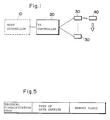
- Fig. 1 is a block diagram illustrating an ID (identification) system embodying the present embodiment.
- the ID system of Fig. 1 includes a data carrier 40 attached for example, to an assembly conveyed on a conveyor or to a tool on a machine tool.
- the data carrier 40 is composed of a single chip IC and has internal memory means such as an EE PROM.
- the memory means is adapted to store data conforming to the article to which the data carrier 40 is attached.
- an ID controller 20 has a plurality of read/write heads 30, with a variety of the data carriers 40 arriving at the read/write heads 30 in respectively independent systems.
- the read/write heads 30 are fixed at suitable locations.
- the ID controller 20 communicates with the data carrier 40 via the head 30. More specifically, in response to a command from a host controller 10, the ID controller 20 acts through the read/write head 30 to write data into, or read data out of, the memory means of the data carrier 40 which approaches the read/write head 30.
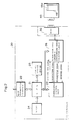
- the ID controller 20 includes a host communication interface 22 for communicating with the host controller 10, a ROM 25 for storing a control program for overall control, a CPU 21 for executing a control operation in accordance with the program, a communication control unit 23 for performing an exchange of data with the data carriers 40, a memory 24 for storing the contents of a plurality of communication protocols, which are individually possessed by the data carriers 40, in relation to classification codes (or memory addresses if desired) of the protocols, and a transmission speed sensing and synchronizing signal generating circuit 26 for detecting the speeds at which data are read out of the data carriers 40 and for outputting a synchronizing clock signal.
- a host communication interface 22 for communicating with the host controller 10
- a ROM 25 for storing a control program for overall control
- a CPU 21 for executing a control operation in accordance with the program
- a communication control unit 23 for performing an exchange of data with the data carriers 40
- a memory 24 for storing the contents of a plurality of communication protocols, which are individually
- Fig. 4 illustrates an example of communication protocols set in the communication protocol storage memory 24 of ID controller 20.
- Four types of communication protocols A, B, C and D are exemplified. The contents of each communication protocol are divided into a physical level and data link level.
- the type of communication protocol used by a data carrier which has approached the head 30 is identified by a classification code (the aforementioned A, B, C or D) contained in protocol identification information transmitted by the data carrier.
- the ID controller 20 uses the communication protocol of the type specified by the identified classification code, the ID controller 20 communicates with the data carrier 40 having this protocol.
- the type of data carrier and the memory range in the data link level are contained in the protocol identification information transmitted by the data carrier 40. This information is stored in this table after being received.
- the data carrier 40 includes a modulator/demodulator circuit 41 electromagnetically coupled to the read/write head 30 of the ID controller 20, a decoding circuit 42 for decoding a received signal outputted by the modulator/demodulator circuit 41, a serial input circuit 43, a command decoder 44 for decoding a received command, a data buffer 45 for temporarily storing received data, an EE PROM 46 in which data to be stored is written or from which data is read, a serial output circuit 47 for outputting data read out of the EE PROM 46, and an encoding circuit 48 for encoding the read data before applying the data to the modulator/demodulator circuit 41.
- the writing of data in the EE PROM 46 is so arranged that data can be rewritten in units of e.g. one page (eight bytes) using the data buffer 45.
- the data carrier 40 may have an internal battery for supplying operating power to the various circuits mentioned above, or the operating power may be obtained through the electromagnetic coupling with the head 30. Another option would be for some of the operating power to be supplied by an internal battery and for the rest to be received from the ID controller 20.
- the head 30 of the ID controller 20 includes an oscillator circuit having a coil and sends the transmission data by varying the oscillation frequency of the oscillator circuit or causing the oscillator circuit to oscillate in intermittent fashion.
- the modulator/demodulator circuit 41 of the data carrier 40 includes a resonance circuit having a coil and receives the data in the form of the signal induced in the resonance circuit.
- a signal from an oscillator circuit in the data carrier 40 induces a signal in a resonance circuit possessed by the head 30.
- the load of the oscillator circuit in the head 30 can be changed by varying the resonant frequency of the resonance circuit in data carrier 40.
- the EE PROM 46 of data carrier 40 has an identification information storage area (leading address area 46a, see Fig. 2) in which the communication protocol identification information, namely classification data indicating which communication protocol the data carrier 40 is using, is stored.
- the format of the communication protocol identification information is illustrated in Fig. 5.
- This information includes the protocol classification code, namely codes indicating the distinction among A, B, C and D in Fig. 4, type of data carrier, e.g. read only, read/write, presence or absence of battery, and memory range, namely the address range and memory capacity.
- the transmission speed sensing and synchronizing signal generating circuit 26 of ID controller 20 includes a modulator/demodulator circuit 51, a decoding circuit 52, an encoding circuit 53, a sensing gate circuit 54a for controlling the application of the output signal from decoding circuit 52 to an edge detecting circuit 54, the edge detecting circuit 54, which is for detecting the leading and trailing edges of a pulse signal outputted by the decoding circuit 52, an oscillator 55 for generating a pulse signal having a constant frequency f c , a counter 56 which counts the pulse signals outputted by the oscillator 55, and which is cleared by a detection pulse signal from the edge detecting circuit 54, a latch circuit 57 for latching the count output of the counter 56 each time a detection pulse is outputted by the edge detecting circuit 54, a latch circuit 58 for latching any input signal from the CPU 21 such as a signal representing a value which is one-half the count value indicated by the output data of the latch circuit 57, and a multiplexer
- the operation of the ID controller 20 and data carrier 40 for a case where an auto-read command is supplied by the host controller 10 in the ID system of the illustrated embodiment will now be described with reference to Fig. 8.
- the auto-read command is one which instructs the data in EE PROM 46 accessed by an address contained in the command to be read out of the data carrier 40.
- the ID controller 20 Upon receiving the auto-read command from the host controller 10, the ID controller 20 initially resets the data carrier 40, receives the synchronizing character and the communication protocol identification information from the data carrier 40, identifies the transmission speed, selects the corresponding communication protocol from the memory 24 and thereafter communicates with the data carrier 40 in accordance with the communication protocol. The details of this operation will now be set forth.
- the auto-read command is issued by the host controller 10 at a step ST1.
- the ID controller 20 receives the auto-read command, resulting in a YES decision at a step ST2.
- the ID controller 20 turns off a head drive signal for the read/write head 30 at a step ST3 and resets a data carrier detection flag at a step ST4.
- a step ST5 at which the ID controller 20 turns on the drive signal of the read/write head 30 again and simultaneously turns on a detection gate signal to open the gate 54a.
- the data carrier When the head 30 of the ID controller 20 is turned from off to on, the data carrier receives the oscillating signal from the head 30 if this data carrier 40 draws near the head 30 at this time. This means that the data carrier 40 will be supplied with the operating electric power. In other words, the data carrier 40 attains a state equivalent to that which would be attained by closing a power switch. In response, the data carrier 40 is initially reset and the communication protocol identification information in the leading address area 46a of the EE PROM 46 is read out. The data carrier 40 encodes and transmits the synchronizing character signal and then encodes and transmits the communication protocol identification information (data) that has been read.
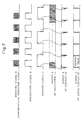
- the synchronizing character signal is composed of eight bits. A portion of this synchronizing character signal received by the ID controller 20 is shown at A in Fig. 7.
- the ID controller 20 detects the transmission speed of the data carrier 40 on the basis of the first few bits of the signal A.
- This detection of the transmission speed is performed by the transmission speed sensing and synchronizing signal generating circuit 26.
- the operation of this circuit will now be described with reference to Figs. 6 and 7.
- the received signal A is inputted to the modulator/demodulator circuit 51 in order to be demodulated into and outputted as a demodulated signal B.
- This demodulated signal is a special signal having on/off times related by the ratio 1:1.
- the demodulated signal is decoded into and outputted as a signal C by the decoding circuit 52.
- the decoded signal C has its leading and trailing edges detected by the edge detecting circuit 54, which outputs a pulse signal E at each leading and trailing edge of the signal C.
- the pulse signal E has a repetition rate corresponding to the transmission speed of the data carrier 40.
- the oscillator 55 oscillates continuously to produce a pulse signal D having a predetermined frequency f c .
- This signal is inputted to the counter 56 and is counted thereby.
- the count recorded in counter 56 is cleared by the output signal E of edge detecting circuit 54, after which the counter 56 is restarted to repeat the counting operation.
- the output signal E of edge detecting circuit 54 also causes the count of counter 56 to be latched in the latch circuit 57. Accordingly, the latch circuit 57 outputs the updated contents of counter 56.
- This counted value C n is a signal conforming to the transmission speed of the data carrier 40.
- the controller 20 thus senses the transmission speed of the data carrier 40.
- the transmission speed has a set value of 9600 BPS or the like. Even if the count C n does not exactly corrrespond to this set value, it will correspond to a value substantially close to the set value and therefore can be regarded as same.
- the CPU 21 of ID controller 20 provides the latch circuit 58 with a value conforming to the count C n , e.g. a value that is one-half of the count.
- the value latched in the latch circuit 58 is applied as a selection signal to the multiplexer 59, which is receiving the count from the counter 56.
- the multiplexer 59 selects a signal representing the prevailing count output and outputs this signal as the synchronizing clock signal.
- the synchronizing clock signal has a waveform the same as that of the demodulated signal B.
- the synchronizing clock signal is applied to the communication control unit 23, as is the decoded signal from the decoding circuit 52.
- the communication control unit 23 reads the inputted decoded signal in synchronization with the synchronizing clock signal, whereby the data transmitted by the data carrier 40 can be discriminated.
- the data transmitted from the ID controller 20 to the data carrier 40 is also expressed by a signal synchronized to the synchronizing clock signal in the communication control unit 23 and is applied to the encoding circuit 53.
- the data is eventually transmitted by the modulator/demodulator circuit 51.
- the ID controller 20 communicates with the data carrier 40 in sync with the clock signal. In other words, the ID controller 20 is capable of communication matched to the transmission speed of the data carrier 40.
- the data carrier 40 transmits the signal representing the communication protocol identification information following the abovementioned synchronizing character signal. Therefore, the communication protocol identification signal is inputted to the communication control unit 23 via the modulator/demodulator circuit 51 and decoding circuit 52. When this identification information is received, the detection flag of data carrier 40 is set. As a result, a YES decision is rendered at a step ST7 in Fig. 8 and the communication protocol identification information received is saved in a buffer or memory at a step ST8. The communication protocol indicated by the protocol classification code in this identification information is selected in memory 24 at a step ST9. Thereafter, the ID controller 20 and the data carrier 40 communicate with each other in accordance with the selected protocol. For example, if B is the protocol of the data carrier 40, data communication is subsequently performed using the communication protocol B in memory 24.
- a step ST10 calls for a determination as to whether the communication protocol indicated by the communication protocol identification information transmitted by the data carrier 40 is set in the memory 24, or in other words, whether this communication protocol is present in the memory 24. If the protocol is present, then the ID controller 20 sends a read command to the data carrier 40 at a step ST11. In response to the read command, the data carrier 40 reads the prescribed data out of the EE PROM 46 and transmits the data to the ID controller 20, thereby performing a read response (step ST12).
- the ID controller 20 If the protocol is not present, namely if the communication protocol identification information sent by the data carrier 40 indicates a communication protocol not present in the memory 24, a NO answer is received at the step ST10 and the ID controller 20 returns an auto-read response indicative of this fact to the host controller 10 at a step ST13. Further, even when the data carrier 40 responds to a normal read response, the ID controller 20 returns an auto-read response indicative of this fact to the host controller 10, as mentioned above.
- the communication protocols classified and defined are of four types, namely A, B, C and D, and the physical level and data link level are as illustrated in Fig. 4.
- definitions and classifications of selectable communication protocols can be selected at will and the invention is not limited to the foregoing embodiment.
Landscapes
- Engineering & Computer Science (AREA)
- Physics & Mathematics (AREA)
- Health & Medical Sciences (AREA)
- Artificial Intelligence (AREA)
- General Physics & Mathematics (AREA)
- Theoretical Computer Science (AREA)
- Computer Vision & Pattern Recognition (AREA)
- Toxicology (AREA)
- Computer Networks & Wireless Communication (AREA)
- Computer Security & Cryptography (AREA)
- Electromagnetism (AREA)
- General Health & Medical Sciences (AREA)
- Communication Control (AREA)
- Selective Calling Equipment (AREA)
- Mobile Radio Communication Systems (AREA)
- Channel Selection Circuits, Automatic Tuning Circuits (AREA)
- Multi-Process Working Machines And Systems (AREA)
- General Factory Administration (AREA)
Claims (11)
- Un procédé de commande de communication dans un système d'identification, ou système d'ID, dans lequel un échange de données est effectué entre un dispositif de commande (20) et une série de types de porteurs (40) de données pourvus de mémoires internes respectives (46) et de protocoles de communication différentes,
ledit procédé comprenant l'étape consistant à :
enregistrer au préalable dans une mémoire (24) dudit dispositif de commande les différents types de protocoles de communication de la série des porteurs de données en correspondance avec une information de classement des protocoles de communication ;
enregistrer au préalable dans la mémoire de chacun des porteurs de données l'information de classement de son propre protocole de communication ;
amener ledit dispositif de commande à mémoriser au début de la communication une information de classement reçue d'un porteur de donnée ;
amener ledit dispositif de commande à sélectionner dans sa mémoire un protocole correspondant de communication en utilisant l'information de classement reçue ; et
amener ledit dispositif de commande à communiquer avec le porteur correspondant de donnée conformément au protocole de communication sélectionné. - Le procédé selon la revendication 1, dans lequel le porteur de donnée est d'un type auquel est appliquée une énergie de mise en oeuvre qui vient dudit dispositif de commande lorsque le porteur de donnée communique avec ledit dispositif de commande ;
ledit dispositif de commande restaure initialement le porteur de donnée en faisant passer de l'état hors service à l'état en service l'énergie qui lui est appliquée ; et
ledit porteur de donnée transmet audit dispositif de commande, lorsqu'il est restauré initialement, une information de classement de protocole de communication. - Le procédé selon la revendication 2 dans lequel ledit porteur de donnée transmet, lorsque ledit porteur de donnée est restauré initialement, un signal de caractère de synchronisation avant de transmettre un signal représentant l'information de classement de protocole de communication.
- Un système d'identification qui comprend un porteur (40) de données susceptible d'être attaché à un article à identifier et
un dispositif de commande (20) qui communique avec ledit porteur de donnée ;
ledit porteur de donnée étant pourvu d'une mémoire (46) qui mémorise un code de classement qui indique son propre protocole de communication ;
ledit dispositif de commande incluant :
une mémoire (24) pour mémoriser au préalable une série de types de protocoles de communication en correspondance avec leurs codes de classement ;
un moyen (21) susceptible d'être mis en oeuvre pour sélectionner dans ladite mémoire (24), lorsqu'un code de classement transmis par ledit porteur de donnée est reçu, un protocole de communication indiqué par le code de classement ; et
un moyen (21, 23) de commande d'exécution de communication avec ledit porteur de donnée en utilisant le protocole sélectionné de communication. - Un système d'identification selon la revendication 4, dans lequel ledit porteur (40) de donnée comprend :
un moyen (41, 47, 48) destiné à transmettre un signal de message lorsqu'il est restauré initialement, ledit signal de message incluant un caractère de synchronisation et un code de classement lu dans ladite mémoire. - Un système d'identification selon la revendication 5, dans lequel ledit moyen de transmission du signal de message inclut un circuit modulateur (41) de signaux.
- Un système d'identification selon la revendication 5, dans lequel ledit moyen de transmission du signal de message inclut un circuit d'encodage (48) de données et un circuit modulateur (41).
- Un système d'identification selon l'une des revendications 4 à 7, dans lequel ledit dispositif de commande comprend :
un moyen (21, 23, 30) de restauration initiale du porteur de donnée ;
un moyen (30, 51) de réception et de démodulation d'un signal modulé de caractère de synchronisation envoyé par le porteur de donnée lorsque ledit porteur de donnée est restauré initialement ; et
un moyen (26, 21) de détection, à partir du signal démodulé, d'une vitesse de transmissison des signaux. - Un système d'identification selon la revendication 8, dans laquelle le dispositif de commande comprend en outre un moyen (59) de production d'un signal d'horloge de synchronisation sur la base du signal démodulé.
- Un système d'identification selon la revendication 8, dans lequel le moyen détecteur de vitesse de transmission comprend :
un circuit décodeur (52) pour décoder le signal démodulé ;
un circuit détecteur (54) de bords pour détecter un bord avant et un bord arrière d'un signal de sortie dudit circuit de décodage ;
un compteur (56) qui compte, à partir de l'instant où il est restauré, un signal d'impulsions à fréquence constante qui est restauré par une sortie de détection de bord venant dudit circuit détecteur de bords ; et
un moyen de calcul (21) de la vitesse de transmission sur la base d'une valeur comptée existant immédiatement avant une restauration dudit compteur. - Un dispositif de commande (20) qui communique avec un porteur (40) de donnée pourvu d'une mémoire (46) qui mémorise un code de classement indiquant son propre protocole de communication,
ledit dispositif de commande comprenant :
une mémoire (24) pour mémoriser au préalable une série de types de protocoles de communication en correspondance avec leurs codes de classement ;
un moyen (21) susceptible d'être mis en oeuvre, lorsqu'un code de classement transmis par ledit porteur de donnée est reçu, pour sélectionner dans ladite mémoire (24) un protocole de communication indiqué par le code de classement ; et
un moyen (21, 23) de commande d'exécution d'une communication avec ledit porteur de donnée en utilisant le protocole sélectionné de communication.
Applications Claiming Priority (2)
| Application Number | Priority Date | Filing Date | Title |
|---|---|---|---|
| JP62063469A JPS63228852A (ja) | 1987-03-17 | 1987-03-17 | Idシステムの通信制御方式 |
| JP63469/87 | 1987-03-17 |
Publications (3)
| Publication Number | Publication Date |
|---|---|
| EP0282992A2 EP0282992A2 (fr) | 1988-09-21 |
| EP0282992A3 EP0282992A3 (fr) | 1991-10-16 |
| EP0282992B1 true EP0282992B1 (fr) | 1995-09-13 |
Family
ID=13230122
Family Applications (1)
| Application Number | Title | Priority Date | Filing Date |
|---|---|---|---|
| EP88104177A Revoked EP0282992B1 (fr) | 1987-03-17 | 1988-03-16 | Procédé de commande de la communication dans un système d'identification |
Country Status (4)
| Country | Link |
|---|---|
| EP (1) | EP0282992B1 (fr) |
| JP (1) | JPS63228852A (fr) |
| AT (1) | ATE127947T1 (fr) |
| DE (1) | DE3854442T2 (fr) |
Families Citing this family (19)
| Publication number | Priority date | Publication date | Assignee | Title |
|---|---|---|---|---|
| JPH0290840A (ja) * | 1988-09-28 | 1990-03-30 | Hitachi Ltd | データ通信方式 |
| US5030807A (en) * | 1990-01-16 | 1991-07-09 | Amtech Corporation | System for reading and writing data from and into remote tags |
| JP3192139B2 (ja) * | 1990-06-14 | 2001-07-23 | 三菱電機株式会社 | 非接触型icカード及び非接触型icカードシステム並びに端末装置と非接触型icカードとの間の信号伝送方法 |
| EP1793325A3 (fr) * | 1993-03-10 | 2009-12-09 | Avid Identification Systems, Inc. | Système d'identification multi-mode |
| JP3568970B2 (ja) * | 1993-04-12 | 2004-09-22 | 株式会社東芝 | Icカード発行装置 |
| JP3540414B2 (ja) * | 1995-02-20 | 2004-07-07 | 株式会社東芝 | Icカードリーダライタ |
| JP3522882B2 (ja) * | 1995-03-22 | 2004-04-26 | 株式会社東芝 | プロトコル切換方法 |
| US5679945A (en) * | 1995-03-31 | 1997-10-21 | Cybermark, L.L.C. | Intelligent card reader having emulation features |
| US5739766A (en) * | 1995-07-12 | 1998-04-14 | Ilco Unican Inc. | Transponder detector |
| DE19601511C1 (de) * | 1996-01-17 | 1997-08-21 | Pronet Netzwerkloesungen Fuer | Verfahren und Vorrichtung zum Parametrieren einer Datenträgerleseeinrichtung |
| FR2776148B1 (fr) * | 1998-03-11 | 2000-10-13 | Dassault Automatismes | Procede, systeme et dispositif pour transferer, par liaison electromagnetique, des informations entre des lecteurs et des objets nomades |
| FR2776147B1 (fr) * | 1998-03-11 | 2000-08-04 | Dassault Automatismes | Procede, systeme et dispositif pour transferer, par liaison electromagnetique, des informations entre des lecteurs et des objets nomades |
| US6578768B1 (en) | 1998-03-20 | 2003-06-17 | Mastercard International Incorporated | Method and device for selecting a reconfigurable communications protocol between and IC card and a terminal |
| GB9806069D0 (en) * | 1998-03-20 | 1998-05-20 | Mondex Int Ltd | Integrated circuit card |
| FR2777673B1 (fr) * | 1998-04-15 | 2001-09-21 | Bull Cp8 | Dispositif de traitement de l'information comprenant des moyens pour gerer une memoire virtuelle, et procede de stockage d'informations associe |
| US6617962B1 (en) | 2000-01-06 | 2003-09-09 | Samsys Technologies Inc. | System for multi-standard RFID tags |
| JP2002170090A (ja) * | 2000-09-21 | 2002-06-14 | Toshiba Corp | 携帯可能電子装置及び携帯可能電子装置の通信方法 |
| NL2002273C2 (nl) * | 2008-12-02 | 2010-06-03 | Amb I T Holding B V | Detectiesysteem omvattende een detectie-inrichting voor meerdere toepassingen en één of meer transponders. |
| CH709804B1 (de) * | 2014-06-23 | 2018-12-28 | Legic Identsystems Ag | Elektronische Zugangskontrollvorrichtung und Zugangskontrollverfahren. |
Family Cites Families (7)
| Publication number | Priority date | Publication date | Assignee | Title |
|---|---|---|---|---|
| FR2501396B1 (fr) * | 1981-03-05 | 1985-10-11 | Dassault Electronique | Systeme de controle d'acces, notamment pour le passage de points de peage |
| US4471345A (en) * | 1982-03-05 | 1984-09-11 | Sensormatic Electronics Corporation | Randomized tag to portal communication system |
| DE3307579A1 (de) * | 1983-03-03 | 1984-11-29 | Jürgen Dipl.-Ing. 8017 Ebersberg Machate | Einrichtung zur kontaktlosen abfrage eines zugehoerigen datentraegers |
| DE3410410A1 (de) * | 1984-03-21 | 1985-09-26 | Maho Werkzeugmaschinenbau Babel & Co, 8962 Pfronten | Werkzeughalter mit datentraeger zur kennung seines werkzeuges |
| DE3523554A1 (de) * | 1984-08-24 | 1986-03-06 | Peter L. Ing.(grad.) 8084 Inning Ortloff | Vorrichtung zur kontaktfreien steuerung einer foerder-, sortier- und/oder verarbeitungsanlage |
| US4656345A (en) * | 1984-09-27 | 1987-04-07 | Tokyo Electric Co., Ltd. | Bar code reading apparatus |
| DD235745A1 (de) * | 1985-03-28 | 1986-05-14 | Deutfracht Seereederei Rostock | Vorrichtung zur erfassung von guetern beim frachtumschlag |
-
1987
- 1987-03-17 JP JP62063469A patent/JPS63228852A/ja active Pending
-
1988
- 1988-03-16 DE DE3854442T patent/DE3854442T2/de not_active Revoked
- 1988-03-16 EP EP88104177A patent/EP0282992B1/fr not_active Revoked
- 1988-03-16 AT AT88104177T patent/ATE127947T1/de not_active IP Right Cessation
Also Published As
| Publication number | Publication date |
|---|---|
| JPS63228852A (ja) | 1988-09-22 |
| DE3854442D1 (de) | 1995-10-19 |
| EP0282992A2 (fr) | 1988-09-21 |
| DE3854442T2 (de) | 1996-05-30 |
| EP0282992A3 (fr) | 1991-10-16 |
| ATE127947T1 (de) | 1995-09-15 |
Similar Documents
| Publication | Publication Date | Title |
|---|---|---|
| US4924210A (en) | Method of controlling communication in an ID system | |
| EP0282992A2 (fr) | Procédé de commande de la communication dans un système d'identification | |
| JP4713491B2 (ja) | デバイスを識別するための方法と装置 | |
| EP1256083B1 (fr) | Systeme de lecture d'etiquette electronique | |
| US7716208B2 (en) | RFID handshaking | |
| EP0733988B1 (fr) | Système d'identification électronique | |
| JP2001501391A (ja) | 無線周波数識別システムにおいてデータを伝送する方法 | |
| KR100560770B1 (ko) | 실시간 프로토콜 전환 기능을 갖는 비접촉 집적회로 카드및 그것을 포함한 카드 시스템 | |
| EP0217654B1 (fr) | Porteur d'information | |
| JPH0573694A (ja) | 持ち運びの可能なフイールドプログラマブル検出用プレート | |
| KR920004754B1 (ko) | 이동체 식별 시스템 | |
| US7609147B2 (en) | Method and apparatus for improving wireless data transmission | |
| CN100568259C (zh) | 防冲突中的同步 | |
| US7880588B2 (en) | Resistive and capacitive modulation in an electromagnetic transponder | |
| US20050231326A1 (en) | Maintenance of an anticollision channel in an electronic identification system | |
| JPS63221950A (ja) | 物品識別システム | |
| JP2560660B2 (ja) | 物品識別システム | |
| US6328218B1 (en) | Electronic card identification methods | |
| JPS63228854A (ja) | Idシステムの通信制御装置 | |
| JPH03501193A (ja) | データ担持デバイス | |
| JP2003333112A (ja) | 復調装置 | |
| KR100705162B1 (ko) | 다중 제어시스템의 피 제어기기 인식방법 | |
| JPH0454751A (ja) | 物品識別システム | |
| JPH04123532A (ja) | 物品識別システム | |
| JPH01314985A (ja) | 物体管理方式 |
Legal Events
| Date | Code | Title | Description |
|---|---|---|---|
| PUAI | Public reference made under article 153(3) epc to a published international application that has entered the european phase |
Free format text: ORIGINAL CODE: 0009012 |
|
| 17P | Request for examination filed |
Effective date: 19880316 |
|
| AK | Designated contracting states |
Kind code of ref document: A2 Designated state(s): AT BE CH DE ES FR GB GR IT LI LU NL SE |
|
| PUAL | Search report despatched |
Free format text: ORIGINAL CODE: 0009013 |
|
| AK | Designated contracting states |
Kind code of ref document: A3 Designated state(s): AT BE CH DE ES FR GB GR IT LI LU NL SE |
|
| 17Q | First examination report despatched |
Effective date: 19920316 |
|
| GRAA | (expected) grant |
Free format text: ORIGINAL CODE: 0009210 |
|
| AK | Designated contracting states |
Kind code of ref document: B1 Designated state(s): AT BE CH DE ES FR GB GR IT LI LU NL SE |
|
| PG25 | Lapsed in a contracting state [announced via postgrant information from national office to epo] |
Ref country code: IT Free format text: LAPSE BECAUSE OF FAILURE TO SUBMIT A TRANSLATION OF THE DESCRIPTION OR TO PAY THE FEE WITHIN THE PRESCRIBED TIME-LIMIT;WARNING: LAPSES OF ITALIAN PATENTS WITH EFFECTIVE DATE BEFORE 2007 MAY HAVE OCCURRED AT ANY TIME BEFORE 2007. THE CORRECT EFFECTIVE DATE MAY BE DIFFERENT FROM THE ONE RECORDED. Effective date: 19950913 Ref country code: AT Effective date: 19950913 Ref country code: BE Effective date: 19950913 Ref country code: CH Effective date: 19950913 Ref country code: LI Effective date: 19950913 Ref country code: GR Free format text: LAPSE BECAUSE OF FAILURE TO SUBMIT A TRANSLATION OF THE DESCRIPTION OR TO PAY THE FEE WITHIN THE PRESCRIBED TIME-LIMIT Effective date: 19950913 |
|
| REF | Corresponds to: |
Ref document number: 127947 Country of ref document: AT Date of ref document: 19950915 Kind code of ref document: T |
|
| REF | Corresponds to: |
Ref document number: 3854442 Country of ref document: DE Date of ref document: 19951019 |
|
| ET | Fr: translation filed | ||
| PG25 | Lapsed in a contracting state [announced via postgrant information from national office to epo] |
Ref country code: ES Free format text: LAPSE BECAUSE OF FAILURE TO SUBMIT A TRANSLATION OF THE DESCRIPTION OR TO PAY THE FEE WITHIN THE PRESCRIBED TIME-LIMIT Effective date: 19951214 |
|
| REG | Reference to a national code |
Ref country code: CH Ref legal event code: PL |
|
| PGFP | Annual fee paid to national office [announced via postgrant information from national office to epo] |
Ref country code: NL Payment date: 19960322 Year of fee payment: 9 |
|
| PG25 | Lapsed in a contracting state [announced via postgrant information from national office to epo] |
Ref country code: LU Free format text: LAPSE BECAUSE OF NON-PAYMENT OF DUE FEES Effective date: 19960331 |
|
| PLBI | Opposition filed |
Free format text: ORIGINAL CODE: 0009260 |
|
| PLBQ | Unpublished change to opponent data |
Free format text: ORIGINAL CODE: EPIDOS OPPO |
|
| PLAB | Opposition data, opponent's data or that of the opponent's representative modified |
Free format text: ORIGINAL CODE: 0009299OPPO |
|
| PLBF | Reply of patent proprietor to notice(s) of opposition |
Free format text: ORIGINAL CODE: EPIDOS OBSO |
|
| 26 | Opposition filed |
Opponent name: GIESECKE & DEVRIENT GMBH Effective date: 19960613 |
|
| R26 | Opposition filed (corrected) |
Opponent name: GIESECKE & DEVRIENT GMBH Effective date: 19960613 |
|
| NLR1 | Nl: opposition has been filed with the epo |
Opponent name: GIESECKE & DEVRIENT GMBH |
|
| PLBF | Reply of patent proprietor to notice(s) of opposition |
Free format text: ORIGINAL CODE: EPIDOS OBSO |
|
| PLBF | Reply of patent proprietor to notice(s) of opposition |
Free format text: ORIGINAL CODE: EPIDOS OBSO |
|
| PG25 | Lapsed in a contracting state [announced via postgrant information from national office to epo] |
Ref country code: NL Effective date: 19971001 |
|
| NLV4 | Nl: lapsed or anulled due to non-payment of the annual fee |
Effective date: 19971001 |
|
| PGFP | Annual fee paid to national office [announced via postgrant information from national office to epo] |
Ref country code: GB Payment date: 20000218 Year of fee payment: 13 |
|
| PGFP | Annual fee paid to national office [announced via postgrant information from national office to epo] |
Ref country code: FR Payment date: 20000316 Year of fee payment: 13 Ref country code: SE Payment date: 20000316 Year of fee payment: 13 |
|
| PGFP | Annual fee paid to national office [announced via postgrant information from national office to epo] |
Ref country code: DE Payment date: 20000330 Year of fee payment: 13 |
|
| RDAH | Patent revoked |
Free format text: ORIGINAL CODE: EPIDOS REVO |
|
| REG | Reference to a national code |
Ref country code: GB Ref legal event code: 746 Effective date: 20000503 |
|
| REG | Reference to a national code |
Ref country code: FR Ref legal event code: D6 |
|
| RDAG | Patent revoked |
Free format text: ORIGINAL CODE: 0009271 |
|
| STAA | Information on the status of an ep patent application or granted ep patent |
Free format text: STATUS: PATENT REVOKED |
|
| 27W | Patent revoked |
Effective date: 20000528 |
|
| GBPR | Gb: patent revoked under art. 102 of the ep convention designating the uk as contracting state |
Free format text: 20000528 |