EP0283199A2 - Agent fortifiant ou renforçant pour résines époxydes durcissables par un anhydride et résines époxydes durcissables le contenant - Google Patents
Agent fortifiant ou renforçant pour résines époxydes durcissables par un anhydride et résines époxydes durcissables le contenant Download PDFInfo
- Publication number
- EP0283199A2 EP0283199A2 EP88302047A EP88302047A EP0283199A2 EP 0283199 A2 EP0283199 A2 EP 0283199A2 EP 88302047 A EP88302047 A EP 88302047A EP 88302047 A EP88302047 A EP 88302047A EP 0283199 A2 EP0283199 A2 EP 0283199A2
- Authority
- EP
- European Patent Office
- Prior art keywords
- anhydride
- fortifier
- carboxylic acid
- reaction product
- composition
- Prior art date
- Legal status (The legal status is an assumption and is not a legal conclusion. Google has not performed a legal analysis and makes no representation as to the accuracy of the status listed.)
- Withdrawn
Links
Images
Classifications
-
- C—CHEMISTRY; METALLURGY
- C08—ORGANIC MACROMOLECULAR COMPOUNDS; THEIR PREPARATION OR CHEMICAL WORKING-UP; COMPOSITIONS BASED THEREON
- C08L—COMPOSITIONS OF MACROMOLECULAR COMPOUNDS
- C08L63/00—Compositions of epoxy resins; Compositions of derivatives of epoxy resins
-
- C—CHEMISTRY; METALLURGY
- C08—ORGANIC MACROMOLECULAR COMPOUNDS; THEIR PREPARATION OR CHEMICAL WORKING-UP; COMPOSITIONS BASED THEREON
- C08G—MACROMOLECULAR COMPOUNDS OBTAINED OTHERWISE THAN BY REACTIONS ONLY INVOLVING UNSATURATED CARBON-TO-CARBON BONDS
- C08G59/00—Polycondensates containing more than one epoxy group per molecule; Macromolecules obtained by polymerising compounds containing more than one epoxy group per molecule using curing agents or catalysts which react with the epoxy groups
- C08G59/18—Macromolecules obtained by polymerising compounds containing more than one epoxy group per molecule using curing agents or catalysts which react with the epoxy groups ; e.g. general methods of curing
- C08G59/40—Macromolecules obtained by polymerising compounds containing more than one epoxy group per molecule using curing agents or catalysts which react with the epoxy groups ; e.g. general methods of curing characterised by the curing agents used
- C08G59/42—Polycarboxylic acids; Anhydrides, halides or low molecular weight esters thereof
-
- C—CHEMISTRY; METALLURGY
- C08—ORGANIC MACROMOLECULAR COMPOUNDS; THEIR PREPARATION OR CHEMICAL WORKING-UP; COMPOSITIONS BASED THEREON
- C08G—MACROMOLECULAR COMPOUNDS OBTAINED OTHERWISE THAN BY REACTIONS ONLY INVOLVING UNSATURATED CARBON-TO-CARBON BONDS
- C08G59/00—Polycondensates containing more than one epoxy group per molecule; Macromolecules obtained by polymerising compounds containing more than one epoxy group per molecule using curing agents or catalysts which react with the epoxy groups
- C08G59/18—Macromolecules obtained by polymerising compounds containing more than one epoxy group per molecule using curing agents or catalysts which react with the epoxy groups ; e.g. general methods of curing
- C08G59/40—Macromolecules obtained by polymerising compounds containing more than one epoxy group per molecule using curing agents or catalysts which react with the epoxy groups ; e.g. general methods of curing characterised by the curing agents used
- C08G59/44—Amides
- C08G59/46—Amides together with other curing agents
- C08G59/48—Amides together with other curing agents with polycarboxylic acids, or with anhydrides, halides or low-molecular-weight esters thereof
Definitions
- This invention relates to a fortifier or strengthener for anhydride-cured epoxy resins, and anhydride curable resin compositions containing it.
- Anhydride-cured epoxy resins are made up of an epoxy resin component [e.g. a diglycidyl ether of bisphenol A (DGEBA)], and a catalyst [e.g. benzyldimethylamine (BDMA)]. Diluents or fillers are also often added for economic or procesing reasons.
- the resin, curing agent and catalyst are mixed and "cured" usually at elevated temperatures.
- Such a plastic typically has a tensile strength of about 70 MPa, a tensile modulus of about 2800 MPa, an elongation-to-break of 1 to 6%, and a glass transition temperature (T g ) of about 140°C.
- anhydride curing agents or hardeners have been used in epoxy resin systems, in particular multi-ring alicyclic anhydrides such as Nadic methyl anhydride (NMA) or aromatic anhydrides such as phthalic anhydride (PA).
- organic acids are used in conjunction with anhydrides to reduce cure times and improve impact properties.
- NMA Nadic methyl anhydride
- PA phthalic anhydride
- organic acids are used in conjunction with anhydrides to reduce cure times and improve impact properties.
- a carboxyl terminated polyester is used as a co-curing agent with an anhydride for epoxy resins.
- SPE Transctions 3 251-9, 1963 which describes the effect on the mechanical properties and heat deflection temperature of the plastic.
- an alternative method of improving the mechanical properties of anhydride-cured epoxy resins comprises adding to the resin a fortifier or strengthening agent comprising: (i) a carboxylic acid; and (ii) the reaction product of a carboxylic acid anhydride and an aromatic amine; the molar proportions of (i) to (ii) being selected to give a final free anhydride-to-acid mole ratio within the range of about 0.05/1 up to about 10/1, the free anhydride being that remaining after reaction in (ii).
- the invention also is directed to a curable epoxy resin composition
- a curable epoxy resin composition comprising: (a) a resin-forming polyepoxide; optionally (b) an anhydride curing agent and cross-linking catalyst for (a); and (c) a fortifier for (a) + (b) comprising: (i) a carboxylic acid, and (ii) the reaction product of a carboxylic acid anhydride and an aromatic amine (having the amine group attached to an aromatic ring).
- the mole ratio of carboxylic acid to fortifier reaction product will be within the range 0.1/1-1.5/1.
- anhydride content of fortifier (c) may be adjusted so that no additional anhydride curing agent in (b) is necessary.
- This invention also includes this composition cured to a strong, high modulus, relatively ductile solid form.
- the invention further includes a process of fortifying an epoxy resin comprising:
- One preferred procedure involves:
- step (a) Preferably in step (a) about 1 mole of carboxylic acid anhydride is reacted with about 0.1 to 0.9 moles of amine by heating to about 120-170°C for about 1-2 hours.
- the resin-forming polyepoxide to be fortified can be any known to form epoxy resin matrices and will have a plurality of reactive 1,2-epoxy groups. These resin-forming polyepoxides should be curable by anhydride curing agents.
- polyepoxide materials can be monomeric or polymeric, saturated or unsaturated, aliphatic, cycloaliphatic, aromatic or heterocyclic, and may be substituted, if desired, with other substituents besides the epoxy groups, e.g. hydroxyl groups, ether radicals, aromatic halogen atoms and the like.
- a widely used class of polyepoxides which can be fortified according to the practice of the present invention includes the resinous epoxy polyethers obtained by reacting an epihalohydrin, such as epichlorohydrin, and the like, with either a polyhydric phenol or a polyhydric alcohol.
- dihydric phenols include 4,4 ⁇ -isopropylidene bisphenol; 2,4 ⁇ -dihydroxydiphenylethylmethane; 3,3 ⁇ -dihydroxydiphenyldiethylmethane; 3,4 ⁇ -dihydroxydiphenylmethylpropylmethane; 2,3 ⁇ -dihydroxydiphenylethylphenylmethane; 4,4 ⁇ -dihydroxydiphenylpropylphenylmethane; 4,4 ⁇ -dihydroxydiphenylbutylphenylmethane; 2,2 ⁇ -dihydroxydiphenylditolylmethane; 4,4 ⁇ -dihydroxydiphenyltolyl-methyl methane and the like.
- polyhydric phenols which may also be co-reacted with an epihalohydrin to provide these epoxy polyethers are such compounds as resorcinol, hydroquinone, substituted hydroquinones, e.g. p-tert-butylhydroquinone, and the like.
- polyethylene glycols polypropylene glycols, triglycerol, dipentaerythritol and the like, polyallyl alcohol, polyhydric thioethers, such as 2,2 ⁇ -, 3,3 ⁇ -tetrahydroxydipropylsulfide and the like, mercapto alcohols such as ⁇ -monothioglycerol, ⁇ , ⁇ -dithio-glycerol, and the like, polyhydric alcohol partial esters, such as monostearin, pentaaerythriotol monoacetate, and the like, and halogenated polyhydric alcohols, such as the monochlorohydrins of glycerol, sorbitol, pentaerythritol and the like.
- Another class of polymeric polyepoxides which can be cured by means of the amine curing agents and fortified includes the epoxy novolac resins obtained by reacting, preferably, in the presence of a basic catalyst, e.g. sodium or potassium hydroxide, an epihalohydrin, such as epichlorohydrin, with the resinous condensate of an aldehyde, e.g. formaldehyde, and either a monohydric phenol, e.g. phenol itself, or a polyhydric phenol.
- a basic catalyst e.g. sodium or potassium hydroxide
- an epihalohydrin such as epichlorohydrin
- polyglycidyl compounds are the polyglycidyl esters of polycarboxylic acids, such as the polyglycidyl esters of adipic acid, phthalic acid and the like.
- Polyglycidyl esters of polycarboxylic acids are described in U.S. Patent 2,870,170 to Payne et al.
- polyglycidyl compounds produced by reacting epichlorohydrin with aromatic amines such as aniline, 2,6-dimethylaniline, p-toluidine, m-chloroaniline, p-amino-diphenyl, m-phenylenediamine, p-phenylenediamine, 4,4 ⁇ -diaminodiphenyl methane, or with amino phenols such as p-aminophenol, 5-amino-l-n-naphthol, 4-aminoresorcinol, 2-methyl-4-aminophenol, 2-chloro-4-aminophenol and the like.
- aromatic amines such as aniline, 2,6-dimethylaniline, p-toluidine, m-chloroaniline, p-amino-diphenyl, m-phenylenediamine, p-phenylenediamine, 4,4 ⁇ -diaminodiphenyl methane
- Specific compounds include, among others, N,N-diglycidylaniline, N,N-diglycidyl-2,6-dimethylaniline, N,N,N ⁇ ,N-tetraglycidyl-4,4 ⁇ -diaminodiphenyl methane, the triglycidyl derivative of p-aminophenol wherein the aminohydrogen and OH hydrogen atoms are replaced by glycidyl groups.
- polyepoxide compositions which can be cured and fortified according to the practice of the present invention are not limited to those containing the above described polyepoxides, but that these polyepoxides are to be considered merely as being representative of the class of polyepoxides as a whole.
- the anhydride curing agents are any aliphatic or aromatic anhydride curing agents (hardeners) known in the art. Typical examples include succinic anhydride, polysebacic polyanhydride, maleic anhydride, Nadic methyl anhydride (NMA), hexahydrophthalic anhydride, dodecenylsuccinic anhydride, phthalic anhydride, tetrahydrophthalic anhydride, and dianhydride curing agents such as pyromellitic dianhydride, and benzophenonetetracarboxylic dianhydride (BTDA).
- BTDA benzophenonetetracarboxylic dianhydride
- the cross-linking catalyst may be of the amine type or of the acid type.
- Suitable amine cross-linking catalysts include BDMA, the alpha-methyl and 2-hydroxy BDMA derivatives, and tris (dimethylaminomethyl)phenol.
- Suitable acid cross-linking catalysts include BF3, carboxyl-terminated polyesters, and adipic acid. These catalysts are used in concentrations of about 0.1-0.6%. Tertiary amine catalysts usually are preferred.
- the anhydride used for forming the fortifier may be either a monoanhydride (e.g. NMA and methyl tetrahydrophthalic anhydride) or a dianhydride (e.g. BTDA and pyromellitic dianhydride ).
- a monoanhydride e.g. NMA and methyl tetrahydrophthalic anhydride
- a dianhydride e.g. BTDA and pyromellitic dianhydride
- the aromatic amine reactant used to form the fortifier has the general formula in which A-E are selected from hydrogen, lower alkyl (1-4 C atoms), groups having amide functionality or sulphonamide functionality, nitro, mercapto or halogen.
- Suitable compounds include m-aminoacetanilide, sulphanilamide, 3,4-dichloroaniline, m-nitroaniline, 2,4-dimethyl aniline and 4-chloro-2-nitroaniline.
- the carboxylic acid component added to the fortifier reaction product preferably is selected from those which are soluble in the anhydride-amine reaction product.
- Two acids found particularly valuable for this application are maleic acid and the acid produced by partial hydrolysis of NMA.
- the latter compound was prepared by heating NMA and water at the desired molar ratio (typically about 1.5:1) to about 85°C for two hours in the presence of, e.g. 0.2% diethylamine hydrochloride catalyst.
- the acid content of the resultant hydrolysis product was determined by anhydrous titration: a preferred acid/anhydride content ranges from about 0.05:1 to about 1:1 acid-to-anhydride ratio (see S. Siggia, "Quantitative Organic Analysis via Functional Groups" J.
- Long chain (e.g. C12-C22) fatty acids are also effective as the acid component of the fortifier, but only in applications where a high T g is not required.
- Aliphatic dicarboxylic acids are preferred, but monocarboxylic acids and aromatic acids if soluble or dispersible in the reaction product, would be operative.
- Further examples include dodecanoic acid (or dodecyl anhydride), stearic acid and acetylsalicyclic acid. The carboxylic acid has been found necessary because with no acid present the tensile test specimen consistently failed in a brittle fashion.
- the fortifier is formed by reaction of the anhydride and the aromatic amine, initially at about 50°-70°C, preferably 60°C, followed by heating usually within about 120°C to 170°C for 1-2 hours. If the reactants are liquids or low melting point solids, no solvents are neccessary, although for high melting point ingredients (e.g. BTDA) the presence of acetone, dimethylformamide or other suitable solvent facilitated processing. An excess of anhydride (1 mole anhydride to 0.1-0.9 moles amine or a molar ratio of anhydride ot amine of about 1/1-10/1) is present in the reaction mixture.
- a precipitate is formed on initial reaction of anhydride and amine, which dissolves on heating at ⁇ 120°C.
- the major volatile product is water which may be removed, e.g. by a stream of nitrogen.
- the mixture is allowed to cool and preferively the carboxylic acid (within about 0.05-1.5 moles for the 1.1-1.9 moles of the fortifier above) is added at this point.
- a temperature of about 90-100°C is necessary to dissolve the acid.
- Other solvents which may be used as reaction medium are dimethylacetamide, methyl isobutyl ketone and l-methyl-2-pyrrolidinone. With lower boiling point solvents, the latter stage of the reaction will need to be under pressure. The solvent is removed after the reaction by volatilization (it is possible to delay this until the final heat curing of the resin).
- the final reaction products are complex chemical mixtures which were used as fortifiers without further purification or separation.
- the preferred products were viscous oils or low melting point solids, because of their ease of mixing with the epoxy resin system. Higher melting point products required the use of solvent casting techniques to prepare the cured plastic.
- liquid anhydrides such as NMA
- it was particularly advantageous to have a larger excess of anhydride e.g. 5:1 molar ratio of anhydride to amine
- the anhydride functionality of the fortifier was determined by anhydrous titration (S. Siggia, op.cit.) and the calculated value was used in determining the stoichiometric balance of the epoxy resin/anhydride curing agent/fortifier mixture.
- the preferred procedure for preparation of cured plastic specimens is illustrated in the Examples which follow.
- the amount of additional anhydride curing agent is calculated from a knowledge of the epoxy equivalent of the resin, the anhydrde functionality of the fortifier and the carboxylic acid content.
- the presence of carboxylic acid also reduces the requirement for anhydride curing agent (H. Lee and K. Neville, op. cit.) and in general 1 equivalent of acid reduced the requirement for anhydride by about 1.5 equivalents.
- the calculated amount of anhydride curing agent is dissolved in the fortifier and the mixture degassed.
- the epoxy resin is degassed separately, then added to the fortifier/curing agent mixture and stirred thoroughly.
- NMA sodiumdic methyl anhydride
- MAA m-aminoacetanilide
- the unfortified Epon 828/NMA/BDMA typically has a tensile strength of 80 MPa, a tensile modulus of 3000 MPa, an elongation of 2.4% and a T g of 138°C.
- NMA (1 mole) and MAA (0.35 moles) were mixed and heated to about 130°C for two hours.
- the product had cooled to 100°C, 0.24 moles of maleic acid were added, and the mixture stirred until the maleic acid dissolved, to give a fortifier designated "B".
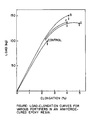
- NMA at 20 PHR was added to 95 PHR of B, degassed, then added to 100 parts Epon 828 and 1 PHR BDMA catalyst. The mixture was cured at 80°C for 5 hours and 160°C for 6 hours to give a plastic with a tensile strength of 118 MPa and an elongation of 4.1%.
- Benzophenone tetracarboxylic acid dianhydride (BTDA, 1 mole), as a slurry in methyl ethyl ketone was mixed with an acetone solution of m-aminoacetanilide (MAA). The resultant precipitate was washed with hot acetone then added to NMA (3.2 moles), and the mixture heated to 160°C for 40 minutes under flowing nitrogen. When the product had cooled to 100°C, maleic acid (1.1 mole) was added and stirred until dissolved, to give a fortifier designated "C".
- BTDA Benzophenone tetracarboxylic acid dianhydride
- MAA m-aminoacetanilide
- NMA (1 mole) and 2,4-dimethylaniline (DMA, 0.25 moles) were mixed and heated to 160°C for 2.5 hours.
- DMA 2,4-dimethylaniline
- 0.18 moles of maleic acid was added and the mixture stirred until the maleic acid dissolved, to give a fortifier designated "D".
- no additional anhydride curing agent was required and the fortifier was mixed at 105 PHR with Epon 828 and 1 PHR BDMA catalyst.
- a plastic was produced with a tensile strength of 114 MPa and an elongation of 3.5%.
- NMA (1 mole) and m-nitroaniline (MNA, 0.28 moles) were mixed and heated to 160°C for 2.5 hours.
- MNA m-nitroaniline
- 0.18 moles maleic acid was added and the mixture stirred until the maleic acid dissolved, to give a fortifier designated "E".
- E Because of the high anhydride functionality of fortifier E, no additional anhydride curing agent was required and the fortifier was mixed at 105 PHR with Epon 828 and 1 PHR BDMA catalyst. After a cure cycle of 6 hours at 80°C and 6 hours at 150°C, a plastic was produced with a tensile strength of 112 MPa and an elongation of 3.5%.
- NMA (1 mole) and 3,4-dichloroaniline (DCA, 0.23 moles) were mixed and heated to 160°C for 1.5 hours.
- DCA 3,4-dichloroaniline
- 0.18 moles of maleic acid was added and the mixture stirred until the maleic acid dissolved to give a fortifier designated "F". Because of the high anhydride functionality of fortifier F, no additional anhydride curing agent was required and the fortifier was mixed at 105 PHR with Epon 828 and 1 PHR BDMA catalyst. After a cure cycle of 6 hours at 80°C and 6 hours at 150°C, a plastic was produced with a tensile strength of 108 MPa and an elongation of 4.0%.
- NMA (1 mole) and p-aminoacetanilide (PAA, 0.23 moles) were mixed and heated to 160°C for 2 hours.
- PAA p-aminoacetanilide
- 0.18 moles of maleic acid was added and the mixture stirred until the maleic acid dissolved to give a fortifier designated "H".
- the fortifier was mixed at 105 PHR with Epon 828 and 1 PHR BDMA catalyst.
- a plastic was produced with a tensile strength of 111 MPa and an elongation of 3.8%.
Landscapes
- Chemical & Material Sciences (AREA)
- Health & Medical Sciences (AREA)
- Chemical Kinetics & Catalysis (AREA)
- Medicinal Chemistry (AREA)
- Polymers & Plastics (AREA)
- Organic Chemistry (AREA)
- Epoxy Resins (AREA)
- Compositions Of Macromolecular Compounds (AREA)
Applications Claiming Priority (2)
| Application Number | Priority Date | Filing Date | Title |
|---|---|---|---|
| CA531931 | 1987-03-12 | ||
| CA000531931A CA1315430C (fr) | 1987-03-12 | 1987-03-12 | Agents de renforcement pour resines epoxydes reticulees par un anhydride |
Publications (2)
| Publication Number | Publication Date |
|---|---|
| EP0283199A2 true EP0283199A2 (fr) | 1988-09-21 |
| EP0283199A3 EP0283199A3 (fr) | 1989-09-06 |
Family
ID=4135166
Family Applications (1)
| Application Number | Title | Priority Date | Filing Date |
|---|---|---|---|
| EP88302047A Withdrawn EP0283199A3 (fr) | 1987-03-12 | 1988-03-09 | Agent fortifiant ou renforçant pour résines époxydes durcissables par un anhydride et résines époxydes durcissables le contenant |
Country Status (9)
| Country | Link |
|---|---|
| US (1) | US4851484A (fr) |
| EP (1) | EP0283199A3 (fr) |
| JP (1) | JPS63273628A (fr) |
| KR (1) | KR880011268A (fr) |
| AU (1) | AU601819B2 (fr) |
| BR (1) | BR8801068A (fr) |
| CA (1) | CA1315430C (fr) |
| IL (1) | IL85630A (fr) |
| ZA (1) | ZA881675B (fr) |
Families Citing this family (3)
| Publication number | Priority date | Publication date | Assignee | Title |
|---|---|---|---|---|
| US5503936A (en) * | 1994-02-28 | 1996-04-02 | Ciba-Geigy Corporation | N-alkyl-N'-aryl-P-phenylenediamines as modifiers for epoxy resins |
| CA2662982A1 (fr) | 2009-04-17 | 2010-10-17 | Crosslink Technology Inc. | Amines aromatiques liquides et utilisations connexes dans des revetements impermeables au gaz |
| JP5605389B2 (ja) * | 2012-04-13 | 2014-10-15 | 住友電気工業株式会社 | 光ファイバ |
Family Cites Families (11)
| Publication number | Priority date | Publication date | Assignee | Title |
|---|---|---|---|---|
| US2955101A (en) * | 1955-10-11 | 1960-10-04 | Shell Oil Co | Curing polyepoxides with an acid anhydride and an acid amide |
| US2970972A (en) * | 1956-12-31 | 1961-02-07 | Minnesota Mining & Mfg | Resinous compositions |
| US3639657A (en) * | 1969-03-19 | 1972-02-01 | Ciba Geigy Corp | Products of acid anhydrides and polyamines used as latent hardeners for epoxy resins |
| US3960980A (en) * | 1971-11-22 | 1976-06-01 | Bridgestone Tire Company Limited | Method of producing elastomer resins |
| DE2602412A1 (de) * | 1976-01-23 | 1977-07-28 | Bayer Ag | Lagerstabile, haertbare einkomponentenharze aus epoxidharzen und haertern |
| US4212959A (en) * | 1978-05-09 | 1980-07-15 | Mitsubishi Denki Kabushiki Kaisha | Heat resistant resin composition |
| CA1221192A (fr) * | 1982-08-12 | 1987-04-28 | Andrew Garton | Renforcement d'une resine epoxyde |
| US4410664A (en) * | 1982-09-20 | 1983-10-18 | Plastics Engineering Company | Polyimide-epoxy thermoset resins |
| US4518749A (en) * | 1983-11-07 | 1985-05-21 | Texaco Inc. | Epoxy resin curatives |
| US4668757A (en) * | 1984-03-26 | 1987-05-26 | Gus Nichols | Use of aromatic amines for setting epoxide resins |
| FR2569413B1 (fr) * | 1984-08-27 | 1986-11-28 | Atochem | Compositions reactives a base d'oligomeres de polyamides et de resines epoxydes |
-
1987
- 1987-03-12 CA CA000531931A patent/CA1315430C/fr not_active Expired - Fee Related
-
1988
- 1988-03-03 US US07/163,807 patent/US4851484A/en not_active Expired - Fee Related
- 1988-03-03 IL IL85630A patent/IL85630A/xx unknown
- 1988-03-09 ZA ZA881675A patent/ZA881675B/xx unknown
- 1988-03-09 EP EP88302047A patent/EP0283199A3/fr not_active Withdrawn
- 1988-03-10 AU AU12873/88A patent/AU601819B2/en not_active Ceased
- 1988-03-10 BR BR8801068A patent/BR8801068A/pt unknown
- 1988-03-11 JP JP63058129A patent/JPS63273628A/ja active Pending
- 1988-03-12 KR KR1019880002593A patent/KR880011268A/ko not_active Withdrawn
Also Published As
| Publication number | Publication date |
|---|---|
| IL85630A0 (en) | 1988-08-31 |
| EP0283199A3 (fr) | 1989-09-06 |
| IL85630A (en) | 1991-09-16 |
| US4851484A (en) | 1989-07-25 |
| KR880011268A (ko) | 1988-10-27 |
| AU601819B2 (en) | 1990-09-20 |
| JPS63273628A (ja) | 1988-11-10 |
| AU1287388A (en) | 1988-09-15 |
| BR8801068A (pt) | 1988-10-18 |
| ZA881675B (en) | 1988-09-06 |
| CA1315430C (fr) | 1993-03-30 |
Similar Documents
| Publication | Publication Date | Title |
|---|---|---|
| EP0103968B1 (fr) | Agent fortifiant pour des résines époxydes, son procédé de préparation et compositions époxydes fortifiées le contenant | |
| EP0229770B1 (fr) | Systemes a base de resines epoxydes amine aromatique contenant des composes aromatiques trihydroxy en tant qu'accelerateurs de polymerisation | |
| US3756984A (en) | Epoxy imidazole adducts as curing agents for epoxy resins | |
| US3979477A (en) | Composition of epoxide resins, polycarboxylic acid anhydrides and polyester-dicarboxylic acids | |
| US4390664A (en) | Process for preparing a polyepoxide and composition therefrom | |
| US3639657A (en) | Products of acid anhydrides and polyamines used as latent hardeners for epoxy resins | |
| US4340715A (en) | Epoxy resin compositions cured with imide-amines | |
| JPH0262152B2 (fr) | ||
| US4942215A (en) | Thermosetting liquid composition containing a polyepoxide and a tricarboxylic isocyanurate | |
| JPH0422929B2 (fr) | ||
| US4518749A (en) | Epoxy resin curatives | |
| US3725345A (en) | Composition comprising an epoxy resin acid anhydride and a n,n{40 {0 bis-imide | |
| US3301795A (en) | Self-catalyzing epoxy resin compositions, improved polycarboxylic acid anhydride curing agent therefor and process for preparing them | |
| US3427282A (en) | Use of selected 4,4'-methylene-bis(2-alkylanilines) as curing agent for epoxy resins | |
| US2947712A (en) | Epoxide resin compositions | |
| US4816533A (en) | Epoxy fortifiers based on aromatic amines | |
| EP0194756B1 (fr) | Résines polyamides | |
| US5599628A (en) | Accelerated cycloaliphatic epoxide/aromatic amine resin systems | |
| US2934521A (en) | Epoxide resin compositions | |
| US4851484A (en) | Anhydride-based fortifiers for anhydride-cured epoxy resins | |
| US2934506A (en) | Modified epoxide resins | |
| EP0118270A2 (fr) | Catalyseurs modifiés contenant des imidazoles pour le durcissage des résines époxy | |
| US3326856A (en) | Substituted benzyl succinic anhydride cured epoxy resin compositions | |
| US3483146A (en) | Cured and curable compositions comprising a polyglycidyl ether of a polymeric fatty alcohol | |
| US4739028A (en) | Epoxy fortifiers based on aromatic polyhydroxyl compounds |
Legal Events
| Date | Code | Title | Description |
|---|---|---|---|
| PUAI | Public reference made under article 153(3) epc to a published international application that has entered the european phase |
Free format text: ORIGINAL CODE: 0009012 |
|
| AK | Designated contracting states |
Kind code of ref document: A2 Designated state(s): BE CH DE FR GB IT LI NL SE |
|
| PUAL | Search report despatched |
Free format text: ORIGINAL CODE: 0009013 |
|
| AK | Designated contracting states |
Kind code of ref document: A3 Designated state(s): BE CH DE FR GB IT LI NL SE |
|
| 17P | Request for examination filed |
Effective date: 19900215 |
|
| 17Q | First examination report despatched |
Effective date: 19911121 |
|
| RAP1 | Party data changed (applicant data changed or rights of an application transferred) |
Owner name: NATIONAL RESEARCH COUNCIL OF CANADA |
|
| STAA | Information on the status of an ep patent application or granted ep patent |
Free format text: STATUS: THE APPLICATION IS DEEMED TO BE WITHDRAWN |
|
| 18D | Application deemed to be withdrawn |
Effective date: 19921217 |