EP0283213A2 - Rückgewinnungsverfahren von Argon - Google Patents
Rückgewinnungsverfahren von Argon Download PDFInfo
- Publication number
- EP0283213A2 EP0283213A2 EP88302121A EP88302121A EP0283213A2 EP 0283213 A2 EP0283213 A2 EP 0283213A2 EP 88302121 A EP88302121 A EP 88302121A EP 88302121 A EP88302121 A EP 88302121A EP 0283213 A2 EP0283213 A2 EP 0283213A2
- Authority
- EP
- European Patent Office
- Prior art keywords
- stream
- argon
- nitrogen
- hydrogen
- line
- Prior art date
- Legal status (The legal status is an assumption and is not a legal conclusion. Google has not performed a legal analysis and makes no representation as to the accuracy of the status listed.)
- Granted
Links
Images
Classifications
-
- F—MECHANICAL ENGINEERING; LIGHTING; HEATING; WEAPONS; BLASTING
- F25—REFRIGERATION OR COOLING; COMBINED HEATING AND REFRIGERATION SYSTEMS; HEAT PUMP SYSTEMS; MANUFACTURE OR STORAGE OF ICE; LIQUEFACTION SOLIDIFICATION OF GASES
- F25J—LIQUEFACTION, SOLIDIFICATION OR SEPARATION OF GASES OR GASEOUS OR LIQUEFIED GASEOUS MIXTURES BY PRESSURE AND COLD TREATMENT OR BY BRINGING THEM INTO THE SUPERCRITICAL STATE
- F25J3/00—Processes or apparatus for separating the constituents of gaseous or liquefied gaseous mixtures involving the use of liquefaction or solidification
- F25J3/02—Processes or apparatus for separating the constituents of gaseous or liquefied gaseous mixtures involving the use of liquefaction or solidification by rectification, i.e. by continuous interchange of heat and material between a vapour stream and a liquid stream
- F25J3/0204—Processes or apparatus for separating the constituents of gaseous or liquefied gaseous mixtures involving the use of liquefaction or solidification by rectification, i.e. by continuous interchange of heat and material between a vapour stream and a liquid stream characterised by the feed stream
- F25J3/0219—Refinery gas, cracking gas, coke oven gas, gaseous mixtures containing aliphatic unsaturated CnHm or gaseous mixtures of undefined nature
-
- F—MECHANICAL ENGINEERING; LIGHTING; HEATING; WEAPONS; BLASTING
- F25—REFRIGERATION OR COOLING; COMBINED HEATING AND REFRIGERATION SYSTEMS; HEAT PUMP SYSTEMS; MANUFACTURE OR STORAGE OF ICE; LIQUEFACTION SOLIDIFICATION OF GASES
- F25J—LIQUEFACTION, SOLIDIFICATION OR SEPARATION OF GASES OR GASEOUS OR LIQUEFIED GASEOUS MIXTURES BY PRESSURE AND COLD TREATMENT OR BY BRINGING THEM INTO THE SUPERCRITICAL STATE
- F25J3/00—Processes or apparatus for separating the constituents of gaseous or liquefied gaseous mixtures involving the use of liquefaction or solidification
- F25J3/02—Processes or apparatus for separating the constituents of gaseous or liquefied gaseous mixtures involving the use of liquefaction or solidification by rectification, i.e. by continuous interchange of heat and material between a vapour stream and a liquid stream
- F25J3/0228—Processes or apparatus for separating the constituents of gaseous or liquefied gaseous mixtures involving the use of liquefaction or solidification by rectification, i.e. by continuous interchange of heat and material between a vapour stream and a liquid stream characterised by the separated product stream
- F25J3/0233—Processes or apparatus for separating the constituents of gaseous or liquefied gaseous mixtures involving the use of liquefaction or solidification by rectification, i.e. by continuous interchange of heat and material between a vapour stream and a liquid stream characterised by the separated product stream separation of CnHm with 1 carbon atom or more
-
- F—MECHANICAL ENGINEERING; LIGHTING; HEATING; WEAPONS; BLASTING
- F25—REFRIGERATION OR COOLING; COMBINED HEATING AND REFRIGERATION SYSTEMS; HEAT PUMP SYSTEMS; MANUFACTURE OR STORAGE OF ICE; LIQUEFACTION SOLIDIFICATION OF GASES
- F25J—LIQUEFACTION, SOLIDIFICATION OR SEPARATION OF GASES OR GASEOUS OR LIQUEFIED GASEOUS MIXTURES BY PRESSURE AND COLD TREATMENT OR BY BRINGING THEM INTO THE SUPERCRITICAL STATE
- F25J3/00—Processes or apparatus for separating the constituents of gaseous or liquefied gaseous mixtures involving the use of liquefaction or solidification
- F25J3/02—Processes or apparatus for separating the constituents of gaseous or liquefied gaseous mixtures involving the use of liquefaction or solidification by rectification, i.e. by continuous interchange of heat and material between a vapour stream and a liquid stream
- F25J3/0228—Processes or apparatus for separating the constituents of gaseous or liquefied gaseous mixtures involving the use of liquefaction or solidification by rectification, i.e. by continuous interchange of heat and material between a vapour stream and a liquid stream characterised by the separated product stream
- F25J3/0252—Processes or apparatus for separating the constituents of gaseous or liquefied gaseous mixtures involving the use of liquefaction or solidification by rectification, i.e. by continuous interchange of heat and material between a vapour stream and a liquid stream characterised by the separated product stream separation of hydrogen
-
- F—MECHANICAL ENGINEERING; LIGHTING; HEATING; WEAPONS; BLASTING
- F25—REFRIGERATION OR COOLING; COMBINED HEATING AND REFRIGERATION SYSTEMS; HEAT PUMP SYSTEMS; MANUFACTURE OR STORAGE OF ICE; LIQUEFACTION SOLIDIFICATION OF GASES
- F25J—LIQUEFACTION, SOLIDIFICATION OR SEPARATION OF GASES OR GASEOUS OR LIQUEFIED GASEOUS MIXTURES BY PRESSURE AND COLD TREATMENT OR BY BRINGING THEM INTO THE SUPERCRITICAL STATE
- F25J3/00—Processes or apparatus for separating the constituents of gaseous or liquefied gaseous mixtures involving the use of liquefaction or solidification
- F25J3/02—Processes or apparatus for separating the constituents of gaseous or liquefied gaseous mixtures involving the use of liquefaction or solidification by rectification, i.e. by continuous interchange of heat and material between a vapour stream and a liquid stream
- F25J3/0228—Processes or apparatus for separating the constituents of gaseous or liquefied gaseous mixtures involving the use of liquefaction or solidification by rectification, i.e. by continuous interchange of heat and material between a vapour stream and a liquid stream characterised by the separated product stream
- F25J3/0257—Processes or apparatus for separating the constituents of gaseous or liquefied gaseous mixtures involving the use of liquefaction or solidification by rectification, i.e. by continuous interchange of heat and material between a vapour stream and a liquid stream characterised by the separated product stream separation of nitrogen
-
- F—MECHANICAL ENGINEERING; LIGHTING; HEATING; WEAPONS; BLASTING
- F25—REFRIGERATION OR COOLING; COMBINED HEATING AND REFRIGERATION SYSTEMS; HEAT PUMP SYSTEMS; MANUFACTURE OR STORAGE OF ICE; LIQUEFACTION SOLIDIFICATION OF GASES
- F25J—LIQUEFACTION, SOLIDIFICATION OR SEPARATION OF GASES OR GASEOUS OR LIQUEFIED GASEOUS MIXTURES BY PRESSURE AND COLD TREATMENT OR BY BRINGING THEM INTO THE SUPERCRITICAL STATE
- F25J3/00—Processes or apparatus for separating the constituents of gaseous or liquefied gaseous mixtures involving the use of liquefaction or solidification
- F25J3/02—Processes or apparatus for separating the constituents of gaseous or liquefied gaseous mixtures involving the use of liquefaction or solidification by rectification, i.e. by continuous interchange of heat and material between a vapour stream and a liquid stream
- F25J3/0228—Processes or apparatus for separating the constituents of gaseous or liquefied gaseous mixtures involving the use of liquefaction or solidification by rectification, i.e. by continuous interchange of heat and material between a vapour stream and a liquid stream characterised by the separated product stream
- F25J3/028—Processes or apparatus for separating the constituents of gaseous or liquefied gaseous mixtures involving the use of liquefaction or solidification by rectification, i.e. by continuous interchange of heat and material between a vapour stream and a liquid stream characterised by the separated product stream separation of noble gases
- F25J3/0285—Processes or apparatus for separating the constituents of gaseous or liquefied gaseous mixtures involving the use of liquefaction or solidification by rectification, i.e. by continuous interchange of heat and material between a vapour stream and a liquid stream characterised by the separated product stream separation of noble gases of argon
-
- F—MECHANICAL ENGINEERING; LIGHTING; HEATING; WEAPONS; BLASTING
- F25—REFRIGERATION OR COOLING; COMBINED HEATING AND REFRIGERATION SYSTEMS; HEAT PUMP SYSTEMS; MANUFACTURE OR STORAGE OF ICE; LIQUEFACTION SOLIDIFICATION OF GASES
- F25J—LIQUEFACTION, SOLIDIFICATION OR SEPARATION OF GASES OR GASEOUS OR LIQUEFIED GASEOUS MIXTURES BY PRESSURE AND COLD TREATMENT OR BY BRINGING THEM INTO THE SUPERCRITICAL STATE
- F25J2200/00—Processes or apparatus using separation by rectification
- F25J2200/04—Processes or apparatus using separation by rectification in a dual pressure main column system
-
- F—MECHANICAL ENGINEERING; LIGHTING; HEATING; WEAPONS; BLASTING
- F25—REFRIGERATION OR COOLING; COMBINED HEATING AND REFRIGERATION SYSTEMS; HEAT PUMP SYSTEMS; MANUFACTURE OR STORAGE OF ICE; LIQUEFACTION SOLIDIFICATION OF GASES
- F25J—LIQUEFACTION, SOLIDIFICATION OR SEPARATION OF GASES OR GASEOUS OR LIQUEFIED GASEOUS MIXTURES BY PRESSURE AND COLD TREATMENT OR BY BRINGING THEM INTO THE SUPERCRITICAL STATE
- F25J2200/00—Processes or apparatus using separation by rectification
- F25J2200/72—Refluxing the column with at least a part of the totally condensed overhead gas
-
- F—MECHANICAL ENGINEERING; LIGHTING; HEATING; WEAPONS; BLASTING
- F25—REFRIGERATION OR COOLING; COMBINED HEATING AND REFRIGERATION SYSTEMS; HEAT PUMP SYSTEMS; MANUFACTURE OR STORAGE OF ICE; LIQUEFACTION SOLIDIFICATION OF GASES
- F25J—LIQUEFACTION, SOLIDIFICATION OR SEPARATION OF GASES OR GASEOUS OR LIQUEFIED GASEOUS MIXTURES BY PRESSURE AND COLD TREATMENT OR BY BRINGING THEM INTO THE SUPERCRITICAL STATE
- F25J2200/00—Processes or apparatus using separation by rectification
- F25J2200/74—Refluxing the column with at least a part of the partially condensed overhead gas
-
- F—MECHANICAL ENGINEERING; LIGHTING; HEATING; WEAPONS; BLASTING
- F25—REFRIGERATION OR COOLING; COMBINED HEATING AND REFRIGERATION SYSTEMS; HEAT PUMP SYSTEMS; MANUFACTURE OR STORAGE OF ICE; LIQUEFACTION SOLIDIFICATION OF GASES
- F25J—LIQUEFACTION, SOLIDIFICATION OR SEPARATION OF GASES OR GASEOUS OR LIQUEFIED GASEOUS MIXTURES BY PRESSURE AND COLD TREATMENT OR BY BRINGING THEM INTO THE SUPERCRITICAL STATE
- F25J2205/00—Processes or apparatus using other separation and/or other processing means
- F25J2205/02—Processes or apparatus using other separation and/or other processing means using simple phase separation in a vessel or drum
-
- F—MECHANICAL ENGINEERING; LIGHTING; HEATING; WEAPONS; BLASTING
- F25—REFRIGERATION OR COOLING; COMBINED HEATING AND REFRIGERATION SYSTEMS; HEAT PUMP SYSTEMS; MANUFACTURE OR STORAGE OF ICE; LIQUEFACTION SOLIDIFICATION OF GASES
- F25J—LIQUEFACTION, SOLIDIFICATION OR SEPARATION OF GASES OR GASEOUS OR LIQUEFIED GASEOUS MIXTURES BY PRESSURE AND COLD TREATMENT OR BY BRINGING THEM INTO THE SUPERCRITICAL STATE
- F25J2210/00—Processes characterised by the type or other details of the feed stream
- F25J2210/20—H2/N2 mixture, i.e. synthesis gas for or purge gas from ammonia synthesis
-
- F—MECHANICAL ENGINEERING; LIGHTING; HEATING; WEAPONS; BLASTING
- F25—REFRIGERATION OR COOLING; COMBINED HEATING AND REFRIGERATION SYSTEMS; HEAT PUMP SYSTEMS; MANUFACTURE OR STORAGE OF ICE; LIQUEFACTION SOLIDIFICATION OF GASES
- F25J—LIQUEFACTION, SOLIDIFICATION OR SEPARATION OF GASES OR GASEOUS OR LIQUEFIED GASEOUS MIXTURES BY PRESSURE AND COLD TREATMENT OR BY BRINGING THEM INTO THE SUPERCRITICAL STATE
- F25J2235/00—Processes or apparatus involving steps for increasing the pressure or for conveying of liquid process streams
- F25J2235/60—Processes or apparatus involving steps for increasing the pressure or for conveying of liquid process streams the fluid being (a mixture of) hydrocarbons
-
- F—MECHANICAL ENGINEERING; LIGHTING; HEATING; WEAPONS; BLASTING
- F25—REFRIGERATION OR COOLING; COMBINED HEATING AND REFRIGERATION SYSTEMS; HEAT PUMP SYSTEMS; MANUFACTURE OR STORAGE OF ICE; LIQUEFACTION SOLIDIFICATION OF GASES
- F25J—LIQUEFACTION, SOLIDIFICATION OR SEPARATION OF GASES OR GASEOUS OR LIQUEFIED GASEOUS MIXTURES BY PRESSURE AND COLD TREATMENT OR BY BRINGING THEM INTO THE SUPERCRITICAL STATE
- F25J2270/00—Refrigeration techniques used
- F25J2270/02—Internal refrigeration with liquid vaporising loop
-
- F—MECHANICAL ENGINEERING; LIGHTING; HEATING; WEAPONS; BLASTING
- F25—REFRIGERATION OR COOLING; COMBINED HEATING AND REFRIGERATION SYSTEMS; HEAT PUMP SYSTEMS; MANUFACTURE OR STORAGE OF ICE; LIQUEFACTION SOLIDIFICATION OF GASES
- F25J—LIQUEFACTION, SOLIDIFICATION OR SEPARATION OF GASES OR GASEOUS OR LIQUEFIED GASEOUS MIXTURES BY PRESSURE AND COLD TREATMENT OR BY BRINGING THEM INTO THE SUPERCRITICAL STATE
- F25J2270/00—Refrigeration techniques used
- F25J2270/04—Internal refrigeration with work-producing gas expansion loop
-
- F—MECHANICAL ENGINEERING; LIGHTING; HEATING; WEAPONS; BLASTING
- F25—REFRIGERATION OR COOLING; COMBINED HEATING AND REFRIGERATION SYSTEMS; HEAT PUMP SYSTEMS; MANUFACTURE OR STORAGE OF ICE; LIQUEFACTION SOLIDIFICATION OF GASES
- F25J—LIQUEFACTION, SOLIDIFICATION OR SEPARATION OF GASES OR GASEOUS OR LIQUEFIED GASEOUS MIXTURES BY PRESSURE AND COLD TREATMENT OR BY BRINGING THEM INTO THE SUPERCRITICAL STATE
- F25J2270/00—Refrigeration techniques used
- F25J2270/12—External refrigeration with liquid vaporising loop
-
- F—MECHANICAL ENGINEERING; LIGHTING; HEATING; WEAPONS; BLASTING
- F25—REFRIGERATION OR COOLING; COMBINED HEATING AND REFRIGERATION SYSTEMS; HEAT PUMP SYSTEMS; MANUFACTURE OR STORAGE OF ICE; LIQUEFACTION SOLIDIFICATION OF GASES
- F25J—LIQUEFACTION, SOLIDIFICATION OR SEPARATION OF GASES OR GASEOUS OR LIQUEFIED GASEOUS MIXTURES BY PRESSURE AND COLD TREATMENT OR BY BRINGING THEM INTO THE SUPERCRITICAL STATE
- F25J2270/00—Refrigeration techniques used
- F25J2270/14—External refrigeration with work-producing gas expansion loop
-
- F—MECHANICAL ENGINEERING; LIGHTING; HEATING; WEAPONS; BLASTING
- F25—REFRIGERATION OR COOLING; COMBINED HEATING AND REFRIGERATION SYSTEMS; HEAT PUMP SYSTEMS; MANUFACTURE OR STORAGE OF ICE; LIQUEFACTION SOLIDIFICATION OF GASES
- F25J—LIQUEFACTION, SOLIDIFICATION OR SEPARATION OF GASES OR GASEOUS OR LIQUEFIED GASEOUS MIXTURES BY PRESSURE AND COLD TREATMENT OR BY BRINGING THEM INTO THE SUPERCRITICAL STATE
- F25J2270/00—Refrigeration techniques used
- F25J2270/42—Quasi-closed internal or closed external nitrogen refrigeration cycle
-
- Y—GENERAL TAGGING OF NEW TECHNOLOGICAL DEVELOPMENTS; GENERAL TAGGING OF CROSS-SECTIONAL TECHNOLOGIES SPANNING OVER SEVERAL SECTIONS OF THE IPC; TECHNICAL SUBJECTS COVERED BY FORMER USPC CROSS-REFERENCE ART COLLECTIONS [XRACs] AND DIGESTS
- Y10—TECHNICAL SUBJECTS COVERED BY FORMER USPC
- Y10S—TECHNICAL SUBJECTS COVERED BY FORMER USPC CROSS-REFERENCE ART COLLECTIONS [XRACs] AND DIGESTS
- Y10S62/00—Refrigeration
- Y10S62/923—Inert gas
- Y10S62/924—Argon
Definitions
- This invention relates to an improved process for recovering argon from gaseous streams, and more particularly to an improved process for recovering argon from a gaseous stream remaining after the recovery of hydrogen values from an ammonia synthesis gas.
- the invention seeks to ameliorete these difficulties by recovering the argon (for example from a tail gas obtained from a hydrogen recovery unit processing purge gas from a plant for synthesizing ammonia) wherein hydrogen and nitrogen are effectively separated from the mixture in a single fractionating step.
- argon for example from a tail gas obtained from a hydrogen recovery unit processing purge gas from a plant for synthesizing ammonia
- just two fractionating zones may be employed.
- An argon-methane fraction essentially free of nitrogen and hydrogen is produced in the first zone and argon is separated therefrom in a second fractionating zone.
- the invention preferably provides a process for recovering argon from a gaseous stream, preferably a tail gas obtained from a hydrogen recovery unit processing a purge gas obtained in the synthesis of ammonia and comprising argon, methane, nitrogen, and residual quantities of hydrogen, wherein the tail gas is partially liquefied prior to introduction into a first fractionation column to form a bottoms liquid stream comprising argon and methane wherein such liquid stream is thereupon introduced into a second fractionation column to separate argon as an overhead gaseous stream which is condensed to form liquid argon or as product.
- the off-gas from ammonia synthesis typically has the following approximate compositions: hydrogen 61-64 mol %, nitrogen 20-23 mol %, methane 10-13 mol %, and argon 2-5 mol %.
- such off-gas contains 2-5 times the amount of argon than does air, and with the present demand for argon, presents a commercially viable source of argon.
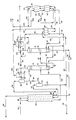
- the primary fractionation column 10 is provided with a plurality of contact trays, such as perforated plates, schematically illustrated as 14, which effect intimate contact between vapors rising in the column with liquid flowing down the column.
- the secondary fractionation column 12 is provided with perforated plates, schematically illustrated as 16 for effecting like contact between rising vapors and descending liquid streams.
- the tail gas stream In operation, the tail gas stream, at ambient temperature and a pressure of from 45 to 130 psia, is passed for cooling by line 20 in indirect heat transfer relationship through a heat exchanger 22 wherein a portion of the tail gas stream is condensed.
- a two-phase mixture of the tail gas stream is introduced via line 24 into an intermediate portion of the primary fractionation column 10 including a reboiler 26 and a reflux condenser assembly 28.
- the primary fractionation column 10 is operated to provide an overhead gaseous stream in line 30 comprising nitrogen and residual hydrogen and a bottoms liquid stream in line 32 comprising argon and methane.
- the gaseous stream in line 30 is introduced into the reflux condenser assembly 28 including heat exchanger 33 and cooled to a temperature to condense a portion of such stream.
- the cooled, partially condensed stream is withdrawn by line 34 from the reflux condenser assembly 28 and introduced into a separator 36 to form a gaseous stream containing substantially all of the hydrogen and most of the nitrogen in the tail gas feed stream in line 38 and a liquid stream in line 40.
- a portion of the liquid stream in line 40 is returned by line 42 to an upper portion of the primary fractionation column 10 to provide reflux requirements therefor.
- the gaseous stream in line 38 is passed to the heat exchanger 22 to recover the cold potential.
- the remaining portion of the liquid stream in line 40 (i.e. not required for reflux requirements) is passed by line 44 and expanded in valve 46 for introduction by line 48 into a separator 50 for separation into a gaseous stream in line 52 containing residual hydrogen dissolved in liquid nitrogen and a liquid stream in line 54.
- the gaseous stream in line 52 is passed to the heat exchanger 22 to recover its cold potential prior to venting to the atmosphere by line 56.
- the liquid stream in line 54 is passed by line 58 to a liquid nitrogen storage tank (not shown), or alternately, is passed by line 60 to the nitrogen heat pump cycle, as more fully hereinafter discussed.
- the argon-enriched liquid stream in line 32 withdrawn from the primary fractionation column 10 is expanded by a valve 62 and is introduced into an intermediate portion of the secondary fractionation column 12 including a reboiler 64 and a reflux condenser assembly 66.
- the secondary fractionation column 12 is operated to provide an overhead gaseous argon stream in line 68 and a bottoms liquid methane stream in line 70.
- the gaseous argon stream in line 68 is introduced into the reflux condenser assembly 66 including heat exchanger 72 and cooled to a temperature to condense all or a major portion thereof withdrawn by line 74 from the reflux condenser assembly 66.
- a portion of the condensed stream in line 74 is returned by line 76 to the upper portion of the secondary fractionation column 12 to provide reflux requirements therefor with the remaining portion being passed by line 78 to argon storage facilities (not shown).
- the liquid stream in line 70, substantially pure methane withdrawn as bottoms from the secondary fractionation column 12 is passed by pump 80 via line 82 and is combined in line 84 with the gaseous stream in line 38 passed through the heat exchanger 22 to recover its cold poten- tial.
- the pressure of the liquid methane stream in line 70 is increased by pump 80 to about the operating pressure of the primary fractionation column 10 prior to combining with the hydrogen stream in line 38 to depress the boiling point of the methane allowing same to boil in the heat exchanger 22 against the incoming feed in line 20.
- the gaseous methane is thereby warmed to ambient temperature in line 86 for use, such as a fuel gas or the like.
- the energy requirements for fractionation, etc., to maintain cryogenic temperatures may be provided by any means; however, such energy requirements may be readily provided by a nitrogen heat pump cycle.
- the partially condensed stream in line 34 from the reflux condenser assembly 28 is separated in separator 36 into a gaseous stream in line 38 containing most of the nitrogen and substantially all of the hydrogen in the tail gas feed, and a liquid nitrogen-containing stream in line 40, a portion of which in line 42 provides the reflux requirements for the primary fractionation column 10.
- liquid nitrogen stream in line 40 still contains dissolved hydrogen
- the liquid stream in line 44 is flashed across the valve 46 to cause substantially all of the remaining hydrogen to vaporize concomitantly with some nitrogen withdrawn as a gaseous stream in line 52 from separator 50 thereby permitting the withdrawal by line 54 of substantially pure nitrogen.
- Liquefied nitrogen in line 54 in excess of the nitrogen requirements in line 60 for the nitrogen heat pump cycle and for gaseous nitrogen product is passed by line 58 to the liquefied nitrogen storage facility, as hereinabove described.
- the nitrogen heat pump cycle is comprised of indirect heat transfer exchangers 88, 90, and 92, cycle compressor 94, and expander unit 96.
- the liquid nitrogen in line 60 is vaporized and heated in indirect heat transfer exchanger 88 and combined in line 98 with a recycle gaseous nitrogen stream in line 100 prior to passage through indirect heat transfer exchangers 90 and 92.
- the gaseous stream in line 98 is compressed in the cycle compressor 94 to a pressure of from 275 to 400 psia to form a gaseous stream in line 102.
- a portion of the gaseous stream in line 102 in excess of heat pump requirements is passed at an appropriate stage pressure by line 104 to gaseous nitrogen user (not shown).
- the remaining portion in line 102 is passed by line 106 through indirect heat transfer exchanger 92 and a portion thereof in line 108 is passed through the expander unit 96.
- Such expanded portion in line 108 is thence passed through the indirect heat transfer exchangers 90 and 92 to be introduced at an intermediate pressure level into the cycle compressor 94 and admixed with the gaseous nitrogen in line 98 introduced into the cycle compressor 94 at a lower pressure level.
- the remaining portion of the compressed nitrogen in line 106 is passed by line 110 through the indirect heat transfer exchanger 90 and is split into two gaseous nitrogen streams in lines 112 and 114.
- the gaseous nitrogen streams in lines 112 and 114 are introduced into the reboilers 26 and 64 of the primary fractionation column 10 and the secondary fractionation column 12, respectively, to provide the reboiler requirements therefor.
- the nitrogen gaseous streams in lines 112 and 114 are withdrawn from the reboilers 26 and 64, respectively, and combined in line 116 for passage through the indirect heat transfer exchanger 88.
- the nitrogen stream in line 116 is split into liquid nitrogen streams in lines 118 and 120 for introduction, after being expanded in valves 122 and 124, into the reflux condenser assemblies 28 and 66, respectively, to provide the reflux requirements for the primary and secondary fractionation columns 10 and 12, respectively.
- the resulting gaseous nitrogen streams from reflux condenser assemblies 28 and 66 in lines 126 and 128, respectively, are combined in line 130 to form, after passage through the indirect heat transfer exchanger 88, the recycled gaseous nitrogen stream in line 100.
- the flow of the gaseous nitrogen is cooled in the sequence of the heat exchangers to a temperature near its dew point for condensation in the reboilers 26 and 64 of the primary and secondary fractionation columns 10 and 12, respectively.
- the liquefied nitrogen in line 116 is subcooled during passage through the indirect heat transfer exchanger 88 prior to being expanded by valves 122 and 124 into the reflux condenser assemblies 28 and 66, respectively, to be vaporized at 20 to 40 psia against the overhead gaseous streams in lines 30 and 68 from the primary and secondary fractionation columns 10 and 12, respectively.
- the thus vaporized nitrogen stream in lines 126 and 128 are combined in line 130 and warmed in the indirect heat transfer exchangers 88, 90, and 92 prior to being returned to the cycle compressor 94 at a lower pressure level together with the nitrogen stream in line 60.
- Such gaseous stream having the composition shown in Table I below is cooled from ambient temperature to a temperature of -271.5°F. in heat exchanger 22.
- Such thus cooled stream which emerges from the heat exchanger 22 as a vapor-liquid mixture is passed serially to the primary and secondary fractionation columns 10 and 12 wherein the bottoms product of the primary fraction- ation column 10 is introduced into the secondary fraction- ation column 12.
- the primary and secondary fractionation columns 10 and 12 are operated under the conditions shown in the following Table II, such that all of the hydrogen and nitrogen contained in the feed gas stream in line 20 exits as overhead in line 30 from the primary fractionation column 10 and substantially all of the methane exits as bottoms in line 70 from the secondary fractionation column 12.
- Merchant grade argon product is withdrawn from the secondary fractionation column 12 as overhead vapor and is condensed in the reflux condenser assembly 66 and sent to storage (not shown) at a rate of 39.47 lb mol/hr.
- Liquid methane withdrawn from the secondary fractionation column 12 as bottoms in line 70, is passed by pump 80 to heat exchanger 22 at a pressure of 45 psia and mixed with the hydrogen-nitrogen gaseous stream in line 38 with the combined stream in line 84 being vaporized and warmed to ambient temperature.
- the thus warmed gaseous stream in line 86 is withdrawn from the heat exchanger 22 and returned as fuel to the ammonia synthesis process.
- the overhead vapor in line 30 from the primary fractionation column 10 is introduced into the reflux condenser assembly 28 for partial condensation thereof and is then introduced into the separator 36.
- the reflux condenser assembly 28 is operated to condense overhead vapor for reflux to the primary fractionation column 10 and to provide an impure liquid nitrogen stream to be further processed.
- the uncondensed overhead in line 38 separated in the separator 36 is passed to the heat exchanger 22 and is admixed with liquid methane in line 82 from the pump 80 which is then warmed to ambient temperature as hereinabove mentioned at a pressure of 42 psia for use as dry fuel gas.
- Pure nitrogen product is produced from the impure liquid nitrogen in line 40 withdrawn from the separator 36 by flashing such gaseous stream into separator 50.
- the separator 50 is operated at a pressure between 20 to 30 psia so that hydrogen dissolved in the higher pressure impure nitrogen is released from solution and is passed to the heat exchanger 22 to be warmed to ambient temperature.
- Liquid nitrogen containing less than 100 parts per million of hydrogen is withdrawn from the separator 50 at a rate of 185.0 lb mol/hr. 14.9 lb mol/hr. of pure liquid nitrogen is passed to storage (not shown); the remaining 170.1 lb mol/hr.
- the pure nitrogen in line 98 is passed through indirect heat transfer exchangers 90 and 92 wherein it is warmed to ambient temperature and is made available at convenient pressures from the nitrogen cycle compressor 94 (e.g. 362 psia) which corresponds to the discharge pressure of the nitrogen cycle compressor 94.
- the nitrogen cycle compressor 94 e.g. 362 psia
Landscapes
- Engineering & Computer Science (AREA)
- Physics & Mathematics (AREA)
- Mechanical Engineering (AREA)
- Thermal Sciences (AREA)
- General Engineering & Computer Science (AREA)
- Separation By Low-Temperature Treatments (AREA)
Applications Claiming Priority (2)
| Application Number | Priority Date | Filing Date | Title |
|---|---|---|---|
| US07/028,413 US4762542A (en) | 1987-03-20 | 1987-03-20 | Process for the recovery of argon |
| US28413 | 1987-03-20 |
Publications (3)
| Publication Number | Publication Date |
|---|---|
| EP0283213A2 true EP0283213A2 (de) | 1988-09-21 |
| EP0283213A3 EP0283213A3 (en) | 1989-03-01 |
| EP0283213B1 EP0283213B1 (de) | 1992-11-25 |
Family
ID=21843320
Family Applications (1)
| Application Number | Title | Priority Date | Filing Date |
|---|---|---|---|
| EP88302121A Expired - Lifetime EP0283213B1 (de) | 1987-03-20 | 1988-03-10 | Rückgewinnungsverfahren von Argon |
Country Status (7)
| Country | Link |
|---|---|
| US (1) | US4762542A (de) |
| EP (1) | EP0283213B1 (de) |
| JP (1) | JP2594604B2 (de) |
| AU (1) | AU605258B2 (de) |
| CA (1) | CA1285208C (de) |
| DE (1) | DE3876115T2 (de) |
| ZA (1) | ZA881812B (de) |
Cited By (2)
| Publication number | Priority date | Publication date | Assignee | Title |
|---|---|---|---|---|
| US6536076B2 (en) | 2001-01-15 | 2003-03-25 | Simac-Vetrella Spa | Suction nozzle for cleaning apparatuses such as vacuum cleaners, electric brushes or similar |
| US10000525B2 (en) | 2010-04-05 | 2018-06-19 | Reveragen Biopharma, Inc. | Non-hormonal steroid modulators of NF-κB for treatment of disease |
Families Citing this family (10)
| Publication number | Priority date | Publication date | Assignee | Title |
|---|---|---|---|---|
| US4805414A (en) * | 1987-12-15 | 1989-02-21 | Union Carbide Corporation | Process to recover hydrogen-free higher boiling synthesis gas component |
| US4869741A (en) * | 1988-05-13 | 1989-09-26 | Air Products And Chemicals, Inc. | Ultra pure liquid oxygen cycle |
| JPH0672740B2 (ja) * | 1989-01-20 | 1994-09-14 | ル・エール・リクイツド・ソシエテ・アノニム・プール・ル・エチユド・エ・ル・エクスプルワテション・デ・プロセデ・ジエオルジエ・クロード | 空気分離及び超高純度酸素製造方法並びに装置 |
| US5230217A (en) * | 1992-05-19 | 1993-07-27 | Air Products And Chemicals, Inc. | Inter-column heat integration for multi-column distillation system |
| JP3020842B2 (ja) * | 1995-09-05 | 2000-03-15 | 日本エア・リキード株式会社 | アルゴン精製方法及び装置 |
| AU2007334020A1 (en) * | 2006-12-18 | 2008-06-26 | Linde, Inc. | Methods for recovering argon |
| DE102009003350C5 (de) * | 2009-01-14 | 2017-02-09 | Reicat Gmbh | Verfahren und Vorrichtung zur Abtrennung von Argon aus einem Gasgemisch |
| FR2946418B1 (fr) | 2009-06-05 | 2011-06-24 | Air Liquide | Procede et appareil de recuperation d'argon dans une unite de separation d'un gaz de purge de synthese d'ammoniac |
| FR3119996A3 (fr) | 2021-02-25 | 2022-08-26 | L'air Liquide Societe Anonyme Pour L'etude Et L'exploitation Des Procedes Georges Claude | Procédé et appareil de séparation d’un gaz contenant de l’azote, de l’hydrogène et du méthane |
| CN114777420B (zh) * | 2022-03-31 | 2024-08-02 | 中科瑞奥能源科技股份有限公司 | 氢体系中回收氩气和高纯甲烷的系统和方法 |
Family Cites Families (13)
| Publication number | Priority date | Publication date | Assignee | Title |
|---|---|---|---|---|
| US354328A (en) * | 1886-12-14 | William mason | ||
| US2530602A (en) * | 1946-12-12 | 1950-11-21 | Air Reduction | Recovery of the constituents of gaseous mixtures |
| DE1048937B (de) * | 1957-10-29 | 1959-01-22 | Adolf Messer G M B H | Verfahren zur Gewinnung von Argon aus Syntheserestgas |
| GB901580A (en) * | 1960-07-04 | 1962-07-18 | Texaco Development Corp | Process for the recovery of argon in the production of ammonia synthesis gas |
| US3173778A (en) * | 1961-01-05 | 1965-03-16 | Air Prod & Chem | Separation of gaseous mixtures including argon |
| GB1124580A (en) * | 1966-02-22 | 1968-08-21 | Petrocarbon Dev Ltd | Low temperature separation of a mixture of gases |
| JPS526714B2 (de) * | 1971-08-11 | 1977-02-24 | ||
| JPS50137875A (de) * | 1974-04-24 | 1975-11-01 | ||
| IN153160B (de) * | 1979-07-12 | 1984-06-09 | Petrocarbon Dev Ltd | |
| GB2132328B (en) * | 1982-12-23 | 1986-03-26 | Air Prod & Chem | A process for removing methane and argon from crude ammonia synthesis gas] |
| US4496382A (en) * | 1983-03-21 | 1985-01-29 | Air Products And Chemicals, Inc. | Process using serpentine heat exchange relationship for condensing substantially single component gas streams |
| US4501600A (en) * | 1983-07-15 | 1985-02-26 | Union Carbide Corporation | Process to separate nitrogen from natural gas |
| US4629484A (en) * | 1983-08-31 | 1986-12-16 | C F Braun & Co. | Process for separating hydrogen and methane from an ethylene rich stream |
-
1987
- 1987-03-20 US US07/028,413 patent/US4762542A/en not_active Expired - Lifetime
-
1988
- 1988-03-08 CA CA000560819A patent/CA1285208C/en not_active Expired - Lifetime
- 1988-03-10 DE DE8888302121T patent/DE3876115T2/de not_active Expired - Fee Related
- 1988-03-10 EP EP88302121A patent/EP0283213B1/de not_active Expired - Lifetime
- 1988-03-11 AU AU13061/88A patent/AU605258B2/en not_active Ceased
- 1988-03-11 JP JP63058096A patent/JP2594604B2/ja not_active Expired - Lifetime
- 1988-03-14 ZA ZA881812A patent/ZA881812B/xx unknown
Cited By (2)
| Publication number | Priority date | Publication date | Assignee | Title |
|---|---|---|---|---|
| US6536076B2 (en) | 2001-01-15 | 2003-03-25 | Simac-Vetrella Spa | Suction nozzle for cleaning apparatuses such as vacuum cleaners, electric brushes or similar |
| US10000525B2 (en) | 2010-04-05 | 2018-06-19 | Reveragen Biopharma, Inc. | Non-hormonal steroid modulators of NF-κB for treatment of disease |
Also Published As
| Publication number | Publication date |
|---|---|
| US4762542A (en) | 1988-08-09 |
| CA1285208C (en) | 1991-06-25 |
| DE3876115D1 (de) | 1993-01-07 |
| EP0283213B1 (de) | 1992-11-25 |
| AU1306188A (en) | 1988-09-22 |
| DE3876115T2 (de) | 1993-04-01 |
| AU605258B2 (en) | 1991-01-10 |
| JP2594604B2 (ja) | 1997-03-26 |
| EP0283213A3 (en) | 1989-03-01 |
| ZA881812B (en) | 1989-03-29 |
| JPS63251782A (ja) | 1988-10-19 |
Similar Documents
| Publication | Publication Date | Title |
|---|---|---|
| EP0173168B1 (de) | Verfahren zur Herstellung von ultrareinem Sauerstoff | |
| US4824453A (en) | Process and apparatus for air separation by rectification | |
| US4311496A (en) | Preliminary condensation of methane in the fractionation of a gaseous mixture | |
| US5509271A (en) | Process and installation for the separation of a gaseous mixture | |
| US6070430A (en) | Separation of carbon monoxide from nitrogen-contaminated gaseous mixtures also containing hydrogen | |
| KR910004123B1 (ko) | 변형된 단일 증류탑 질소 발생기를 이용한 공기분리 방법 | |
| CA2805272A1 (en) | Methods and systems for recovering liquified petroleum gas from natural gas | |
| US6173585B1 (en) | Process for the production of carbon monoxide | |
| US4867772A (en) | Cryogenic gas purification process and apparatus | |
| KR930001593B1 (ko) | 수소가 없는 고비등 합성 기체성분을 회수하는 방법 | |
| EP0593703B1 (de) | Extrem reiner stickstoff- und sauerstoffgenerator und verfahren | |
| US5167125A (en) | Recovery of dissolved light gases from a liquid stream | |
| US4749393A (en) | Process for the recovery of hydrogen/heavy hydrocarbons from hydrogen-lean feed gases | |
| US4659351A (en) | Combined process to produce liquid helium, liquid nitrogen, and gaseous nitrogen from a crude helium feed | |
| US4762542A (en) | Process for the recovery of argon | |
| US3675434A (en) | Separation of low-boiling gas mixtures | |
| US4057407A (en) | Method and apparatus for recovering argon from an air fractionating process | |
| JP2000055542A (ja) | 低温空気分離によるアルゴン製造方法 | |
| JPH02230079A (ja) | 空気の分離による酸素製造法 | |
| US5205127A (en) | Cryogenic process for producing ultra high purity nitrogen | |
| JPH067601A (ja) | 多成分流の分離方法 | |
| EP1346950A1 (de) | Rückgewinnung von Wasserstoff und Kohlenmonoxid aus Methan und schwerere Kohlenwasserstoffe enthaltenden Gemischen | |
| EP0895961B1 (de) | Verfahren und Vorrichtung zur Trennung einer Gasmischung | |
| US4608069A (en) | Separation of higher boiling impurities from liquefied gases | |
| EP0539268A1 (de) | Verfahren zur Entfernung von Wasserstoff bei der kryogenen Destillation zwecks Erzeugung von hochreinem Stickstoff |
Legal Events
| Date | Code | Title | Description |
|---|---|---|---|
| PUAI | Public reference made under article 153(3) epc to a published international application that has entered the european phase |
Free format text: ORIGINAL CODE: 0009012 |
|
| AK | Designated contracting states |
Kind code of ref document: A2 Designated state(s): DE FR GB |
|
| PUAL | Search report despatched |
Free format text: ORIGINAL CODE: 0009013 |
|
| AK | Designated contracting states |
Kind code of ref document: A3 Designated state(s): DE FR GB |
|
| 17P | Request for examination filed |
Effective date: 19890823 |
|
| 17Q | First examination report despatched |
Effective date: 19900423 |
|
| GRAA | (expected) grant |
Free format text: ORIGINAL CODE: 0009210 |
|
| AK | Designated contracting states |
Kind code of ref document: B1 Designated state(s): DE FR GB |
|
| ET | Fr: translation filed | ||
| REF | Corresponds to: |
Ref document number: 3876115 Country of ref document: DE Date of ref document: 19930107 |
|
| PLBE | No opposition filed within time limit |
Free format text: ORIGINAL CODE: 0009261 |
|
| STAA | Information on the status of an ep patent application or granted ep patent |
Free format text: STATUS: NO OPPOSITION FILED WITHIN TIME LIMIT |
|
| 26N | No opposition filed | ||
| REG | Reference to a national code |
Ref country code: GB Ref legal event code: IF02 |
|
| PGFP | Annual fee paid to national office [announced via postgrant information from national office to epo] |
Ref country code: GB Payment date: 20040303 Year of fee payment: 17 |
|
| PGFP | Annual fee paid to national office [announced via postgrant information from national office to epo] |
Ref country code: FR Payment date: 20040318 Year of fee payment: 17 |
|
| PGFP | Annual fee paid to national office [announced via postgrant information from national office to epo] |
Ref country code: DE Payment date: 20040430 Year of fee payment: 17 |
|
| PG25 | Lapsed in a contracting state [announced via postgrant information from national office to epo] |
Ref country code: GB Free format text: LAPSE BECAUSE OF NON-PAYMENT OF DUE FEES Effective date: 20050310 |
|
| PG25 | Lapsed in a contracting state [announced via postgrant information from national office to epo] |
Ref country code: DE Free format text: LAPSE BECAUSE OF NON-PAYMENT OF DUE FEES Effective date: 20051001 |
|
| GBPC | Gb: european patent ceased through non-payment of renewal fee |
Effective date: 20050310 |
|
| PG25 | Lapsed in a contracting state [announced via postgrant information from national office to epo] |
Ref country code: FR Free format text: LAPSE BECAUSE OF NON-PAYMENT OF DUE FEES Effective date: 20051130 |
|
| REG | Reference to a national code |
Ref country code: FR Ref legal event code: ST Effective date: 20051130 |